
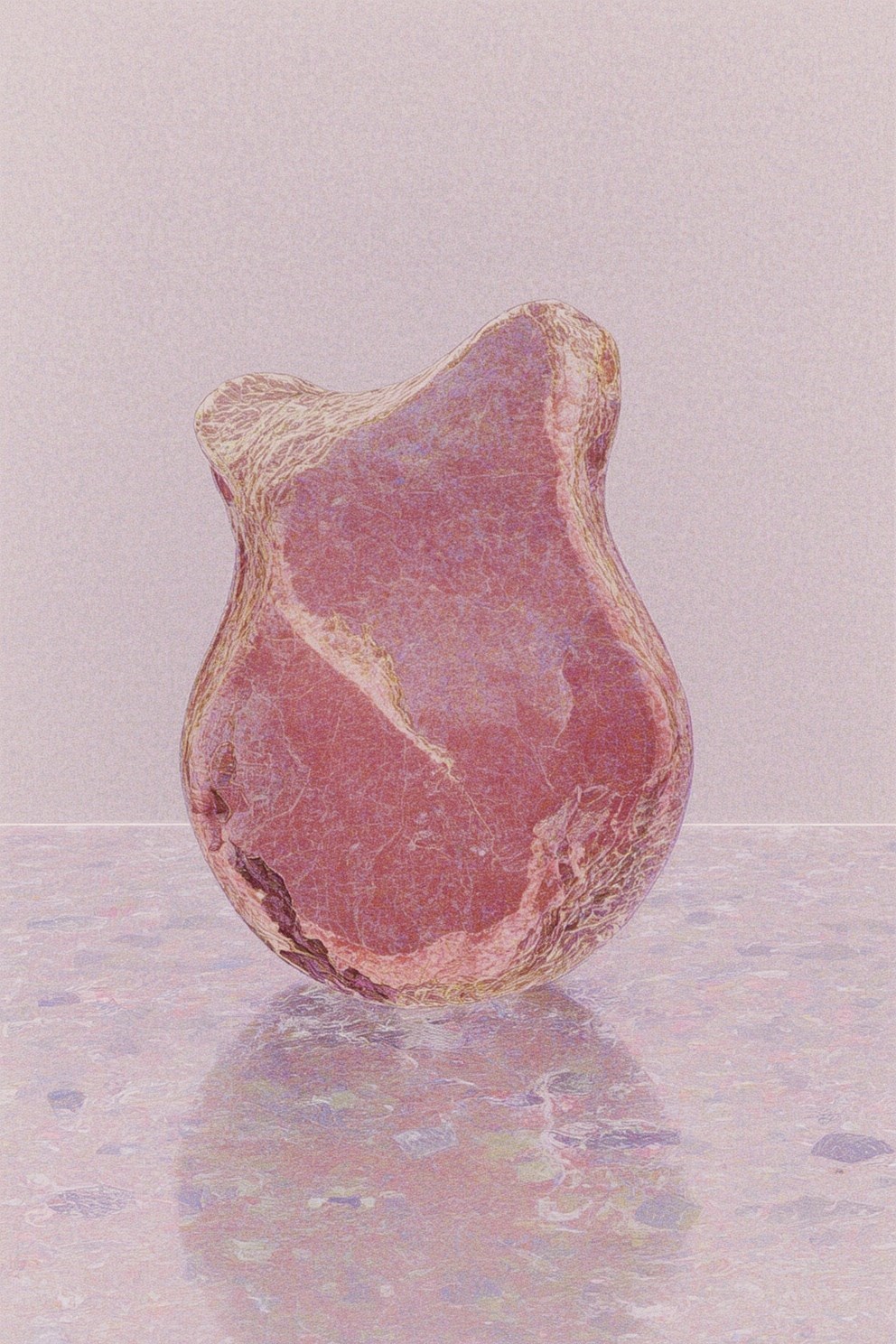
After the Soy Steak
Глава 1
We live in an era desperately thirsting for new metaphors. The old images, like maps bleached by the sun, are no longer capable of describing the rapidly changing world. And when old languages fall silent, new meanings break through in the most unexpected places. Thus, a fleeting, almost joking comparison, dropped once on a social network, suddenly became a precise diagnosis, piercing the essence of our socio-cultural formation. This diagnosis became the assertion: "AI clips are soy meat."
Arising as the fruit of intellectual snobbery or momentary wit, this metaphor, upon closer examination, revealed its profound power, transforming into a capacious philosophical tool, a key to understanding the tectonic shifts society is experiencing. We are witnessing not merely the emergence of another video generation technology; we stand at the origins of a "great simulation," where the very categories of reality, authenticity, creativity, and, ultimately, the human "self" are changing. AI clips are merely the brightest, most visually obvious symptom of this global transformation, its vanguard and, simultaneously, its mirror.
To grasp the true scale of the phenomenon, one must decisively move beyond narrow disciplinary frameworks. A synthetic, interdisciplinary approach is required — an alloy of philosophy, cultural studies, economics, and futurology — which will allow us to examine the phenomenon in all its multifaceted complexity. What is this "synthetic" world emerging before our eyes? Is it a lighter, ethically cleansed version of the past, or a fundamentally new reality with its own ontology and ethics, its own laws and its own melancholy?
Immersion in this world begins with a fundamental rethinking of the very nature of what is created. Picture a steak — dense, juicy, with a bloody sheen, marbled streaks of fat, smelling of smoke and heat. Its existence is inseparable from the flesh of a living being, from the biography of a bull that grazed in a meadow. This is the first order of reality, to follow Jean Baudrillard’s terminology. A direct, indisputable, bloody link to the referent. In the world of moving images, its counterpart is the film camera capturing a real actor in real time. The light reflected from their face leaves a chemical, almost alchemical, trace on the emulsion. Each frame is not just an image but a physical testimony of a moment that will never repeat, a unique cast of flowing time, its material imprint.
Then the frozen burger patty enters the stage. It is still made of meat, but its origin is blurred, its individuality dissolved. It is a product of the assembly line, where the fate of an individual animal is lost in a gigantic, anonymous mince. The referent still exists, but it is mediated, masked by the technology of mass production, having become an abstraction. In cinema, this corresponds to the classic Hollywood industry with its virtuoso, invisible editing, special effects, the work of body doubles and stunt performers. We still know that somewhere there was a film set, real people, and props, but reality has already been subjected to powerful, total processing, becoming a commodity ready for consumption, stripped of the roughness and accidents of the authentic process.
And here is the soy goulash. Its existence is not a forgery but a brilliant trick, a fundamental illusion. It does not even try to hide that it is not meat; it offers its own autonomous reality, based on the abstraction of "the taste of meat in general." This is the simulacrum in its purest form — a copy that never had an original. It models not a specific steak but the idea of meat, its philosophical essence, extracted from thousands of chemical analyses and taste profiles. It is in this realm that modern AI clips dwell. They are not shot on camera. They are generated based on patterns extracted from millions of hours of real video. Their referent is not the world as such, but a gigantic database about the world, its crystallized statistical shadow. This is the third order of simulation according to Baudrillard, where the sign masks the absence of any fundamental reality and begins to exist on its own, as a new reality.
But there is also a fourth, the most mysterious and disturbing order — the order of pure simulation, its final victory. This is the moment when soy meat ceases to be an alternative and becomes the standard, the new norm. When a generation raised on it finds the taste of a real steak too coarse, too "uneven," excessive in its authenticity, in its demanding, almost violent reality. In the world of content, this manifests when the aesthetics generated by AI — these shimmering, surreal, eerily smooth textures — begin to dictate terms to the visual language of real vloggers, advertising, and fashion. Beauty bloggers apply filters that do not just retouch the skin but give it that characteristic "plastic," sterile gloss, the dreamlike flawlessness inherent in neural network generations. Reality, in an attempt to be competitive and attractive, begins to imitate the simulacrum, to fawn over it. We are entering an era of hyperreality, where the map precedes the territory and ultimately replaces it, where simulation proves weightier than the real, and the reflection in the mirror becomes more significant than the reflected object itself, which loses its ontological rights in this game.
In this new landscape, an old concept introduced by Walter Benjamin — "aura" — is radically transformed, acquiring a new resonance. Benjamin spoke of aura as the unique atmosphere of authenticity, the "here and now" of a work of art, which irreversibly disappears in the age of its technical reproduction. But what happens when a work never had this "here and now" from the very beginning? When it is born not in the pangs of a creative act, in the struggle of spirit and flesh, but in the sterile, timeless space of a server cluster, in a silence broken only by the monotonous hum of processors calculating probability?
The aura of a traditional film is a trace, a scar, a memory. The trace of the director's vision, a coffee cup mistakenly left in the frame, the genuine, accumulated fatigue in an actor's eyes on the fifth take, a sun flare that accidentally caught the lens, as a sign of reality's benevolence. It is the biography of the artifact, its connection to the flow of life, its testimony to a lived moment.
The machine has none of this. The aura of an AI clip is of a different, fundamentally different order. It is the aura of the algorithm, cold and detached in its statistical predetermination. Its "here and now" is the instant data passes through the final layer of a neural network, a flash of computation. In place of a human trace are artifacts of generation: those ghostly six-fingered hands, nonsensical inscriptions, surreal fusions of forms. The irony is that these errors, these "hallucinations" of the machine, unexpectedly become new markers of authenticity for us, a kind of negative aura. In the sterile world of flawless digital tailoring, it is precisely they — like a beauty mark on a perfectly smooth face — that impart uniqueness to the object, its strange, non-human "aura of error," becoming the sole testimony that behind the generative act, there does, after all, stand some intellect — albeit an alien, unfathomable one — whose nature reveals itself precisely in its glitches.
And here we come close to the ethical dimension of our metaphor — to the concept of "veganism of the gaze." Historically, the consumption of visual content has almost always been linked to invisible, carefully concealed exploitation. For us to see a spectacular stunt, a stuntman risked life and limb. For us to be charmed by an animal scene, a trainer often employed cruel methods. For us to be imbued with "realism," a documentary filmmaker invaded someone else's unhealed grief, and an actor turned their own psyche inside out, sacrificing it for sincerity. AI offers a radical, almost utopian break with this centuries-old tradition. It allows us to become "vegans of the gaze" — to consume visual impressions untainted by real suffering, unburdened by the unbearable weight of another's pain, sacrificed for our perception and entertainment.
This is a seductive utopia: a world where making an action film requires no broken ribs, and a war documentary requires no sending a cameraman to the front lines, toward real death. Ethically impeccable, sterile content, synthetic yet nutritious food for our eyes and brains. However, this utopia immediately engenders its own paradoxes. Does not such total sterilization of the gaze lead to general desensitization, to a dulling of feelings? If we grow accustomed to seeing hyperrealistic yet absolutely safe simulations of suffering, violence, and pain — devoid of genuine consequences — will we not become more indifferent to real suffering occurring just beyond our screen's threshold, in the world of flesh and blood? Or, conversely, could such simulations become a powerful tool for empathy — ideal training simulators for future surgeons, psychologists, rescuers, allowing them to hone skills in the most stressful situations without risk, cultivating not callousness but that very professional, salvific detachment necessary for real help?
This agonizing question has no single answer and probably cannot have one, much like the fate of documentary filmmaking in the era of the total simulacrum. What remains of a genre founded on testimony, on the "truth of life," when any "truth" can be flawlessly generated, creating an equally flawless forgery of any, even the most unbelievable, event? Perhaps the value of documentary expression will radically shift from the recording of the event as such to the author's interpretation, to a unique, inimitable human perspective that cannot be simulated because it is based on personal, hard-won experience rather than impersonal data, on a lived, not a modeled, biography, on the responsibility of a living witness.
The economy of this new world is as contradictory as its ethics, of which it is a direct reflection. Content production is undergoing a great dematerialization, comparable only to the transition from craft to machine production, but happening a thousand times more rapidly. The artisan, the "butcher" of creativity — the artist, the cameraman, the editor, whose unique skill lay in direct, tactile contact with material (paint, light, film) — is being displaced, giving way to the prompt engineer, the "chef of the soy kitchen." Their mastery lies not in working with material but in higher semiotics, in the ability to select magical formula-incantations designed to tame and guide the "black box" of the neural network, to divine its hidden logic. "Create an image of a lone astronaut against the backdrop of the Carina Nebula in the style of 1970s Soviet popular science aesthetics with elements of de Chirico's metaphysical painting." This is not a technical brief; it is a ritual for summoning a spirit, an alchemical attempt to translate the subtlest, vaguest vibrations of the human soul into the dry, formalized language understood by the statistical leviathan.
Such an economy ruthlessly and rapidly washes away entire strata of professions, leaving a cultural desert in its wake. The "middle tier" disappears — those very motion designers, riggers, colorists, whose labor was important but, alas, replaceable. At the top of the pyramid remain the "stars" — creative directors, visionaries, whose very name is a brand and a guarantee. And below, at the base, lies a vast, growing "creative precariat" of prompters, whose income is unstable and skills easily replicable and, consequently, devalued. We are witnessing a paradoxical, almost ironic revival of "digital cottage industry": theoretically, every person, sitting at home, can produce content that once required entire industries, but pays a terrible price for this — the total devaluation of creative labor itself and immersion in constant, exhausting competition with all other inhabitants of the global digital village.
This leads us to the main economic paradox of the synthetic aura era — the paradox of abundance leading to spiritual impoverishment. AI clips democratize access to creativity, erasing age-old barriers. A true golden age of dilettantes is dawning, when any person lacking years of grueling hand-eye training can easily, almost playfully, visualize their own, even the most whimsical, fantasy. This is an incredible, avalanche-like explosion of creativity, a demolition of cultural barriers and class partitions. But we pay for this freedom with a price — the rapid inflation of meaning. When there is too much content, when it pours forth in a continuous stream, its value as a statement, as an event, plummets rapidly. The main deficit is no longer the ability to create something but human attention — that new currency, more valuable than gold. How to find a grain of genuine gold in a stream that has become a boundless ocean of trash? How to hear an individual, fragile voice in a deafening, all-crushing choir singing simultaneously in all languages but speaking of nothing?
And here, against the backdrop of universal "soy" abundance, a new, even more refined and elusive type of elitism emerges. The value of the "organic," the authentic, is growing rapidly, exponentially. Handcrafted content, created by a human from start to finish, with its inevitable roughness, blessed accidents, and the living trace of the author's presence, turns into a premium brand, an object of desire. Analog photography, requiring patience and knowledge; hand-drawn, frame-by-frame animation, in which the breath of the master is felt; documentary cinema shot on film, with its graininess and tactility — all this is marked with a special, invisible yet universally recognized sign of quality, becoming a coveted object for connoisseurs weary of the sterile, lifeless smoothness of the simulacrum. The taste of a real steak, its complex, bloody truth, is back in value, but now it is accessible only to the few capable of appreciating its true depth and willing to pay for it — not only with money but with time and attention, that very scarce attention.
This quiet but insistent rebellion against flawlessness is not just an aethetic caprice or a nostalgic whim but a profound existential gesture, an attempt to defend one's humanity in an inhumanly perfect world. In a world where everything can be generated on demand, a genuine, acute deficit arises in the realm of the unintended, the accidental, that which bears the mark of a unique, irreversible moment and the irreversibility of existence. We begin instinctively, almost on a physiological level, to value the hoarse roughness of a living voice, the slight, betraying shake of a handheld camera, a softly out-of-focus sharpness — everything the algorithm diligently, with manic pedantry, cleanses as "noise," as interference. This "noise" becomes a new signal, the most important signal. A signal of human presence in a world increasingly populated by flawless but faceless, history-deprived simulacra. This is a quiet revolt of finitude against infinity, of life against lifeless perfection, of flesh against the digital.
In a paradoxical way, artificial intelligence itself, this great simulator, involuntarily becomes a tool for studying the deepest, archetypal layers of human culture in the process of its work. Learning from gigantic arrays of human-created images, the model reveals not the objects themselves but hidden patterns, invisible connections, stable combinations that essentially constitute the visual mythology of our species. One could say that AI, unbeknownst to itself, plays the role of Carl Jung of the digital age, revealing the contours of the collective unconscious, expressed in pixels and vectors.
Its famous "hallucinations" — those six-fingered hands, spiral-shaped cities, hybrid creatures — are not just computational errors, bugs, or glitches. They are traces of working with archetypes, visual interferences arising where the impeccable statistical model collides with the limit of generalization, with what cannot be unambiguously averaged, with the very excess of the real that defies algorithmic fit. When a neural network generates a bizarre dragon with traits from a dozen other animals, it is perhaps visualizing not a specific image from a myth but the very idea of a "mythical hybrid," the archetype of the chimera, existing independently in hundreds of cultures, its quintessence. AI clips thus become the dreams of a digital Leviathan — our shared culture, passed through a giant statistical meat grinder and disgorged as bizarre hallucinatory visions. Analyzing these dreams, these collective reveries, we may learn something new and terrifying about ourselves — about our shared, unconscious fears, repressed desires, collective traumas, expressed not through words but through visual anomalies seeping through the flawless yet thin surface of the algorithm, like a face through cloth.
Looking into the future, into the misty landscapes where the "soy road" leads us, we face the necessity of rethinking, from scratch, the very nature of creativity under the conditions of an advancing "post-labor" era. When the machine learns to generate not only flawless form but also convincing, complex, multi-layered meanings, the role of the human creator will undergo a cardinal, painful metamorphosis.
The first scenario: the human as a curator-filter in the boundless, raging ocean of generated content. Their task will not be the creation of artifacts but their selection, composition, investment with context, and, ultimately, meaning. They will be a guide in the labyrinth of mirrors, the one who helps others not get lost in the endless, self-similar corridors of simulations, who points out those very cracks in the perfect surface where genuine, living meaning is born, breaking through like a weed.
The second, more optimistic scenario: symbiosis, an elegant dance of the semiotic and the algorithmic, human intuition and machine power. The human co-creator will set the direction, the emotional and ethical vector, establish the super-objective, formulate the higher purpose, while AI will propose thousands, millions of options for its realization, becoming a gigantic, tireless amplifier of the human imagination. Creativity will turn into a dialogue, an iterative, multi-step process of refining the prompt, where each machine response will generate new, more subtle and sophisticated questions, forcing the human to look deeper into themselves and formulate the vague, still-unformed images of their inner world more precisely and clearly.
The third, most radical scenario: the emergence of the figure of the "creator of experiences." Such a person will create not the artifacts themselves (paintings, clips, texts) but the conditions, rules, complex systems for their generation and, importantly, their perception. They will design the very environment, the ecological niche in which algorithms and viewers jointly, in real time, create unique, never-repeated aesthetic experiences, where each act of perception becomes simultaneously an act of co-creation, co-authorship.
Even more radical, truly tectonic shifts may occur in the very fabric, the substance of our perception. With the development of neural interfaces and augmented reality, we are approaching a threshold beyond which the generation of personalized, individual realities in real time will become as commonplace as the smartphone is today. Your news feed, your movie, your memories of yesterday's walk — all of this will be subtly, almost imperceptibly, adjusted and generated on the fly, in accordance with your deepest, unconscious preferences, momentary mood, even the biochemical indicators of your body. This will lead to the final, total collapse of the idea of a common, objective, shared reality. We will live in personalized universes, crafted for us and us alone every minute, every second, in ideally tailored, cozy, and safe cocoons where any discomfort, any disharmony, any accidental roughness will be carefully, preemptively removed by that same invisible guardian algorithm.
Such a world, a world of absolute personal comfort, will engender an unprecedented epistemological crisis: how to distinguish a genuine, lived memory from an artificially — even if with good intentions — generated one? What will count as "truth" if immediate experience itself, the very tissue of lived experience, becomes a product of customization, of individual tuning? The foundation of our knowledge of the world, always resting on a shared, intersubjective experience, will begin to unravel, turning into shifting sand beneath our feet. In response, powerful, almost religious movements of "anti-veganism" will likely arise — a conscious, almost ascetic, voluntary rejection of simulations in favor of "natural," ungenerated, raw reality with all its inconveniences and dangers. But will not life in such an "analog," uncontrollable reality become a new form of luxury, a privilege of an elite capable of affording an unoptimized, uncontrolled, and therefore unpredictable, truly risky existence, with its genuine, not simulated, pain and equally genuine, hard-won discoveries?
All these challenges — epistemological, ethical, existential — inescapably demand the development of a new system of ethics and law adequate to the challenges of the times, a kind of "Constitution of Reality" for the world of simulacra. We will have to solve questions that only yesterday seemed the province of science fiction writers. Who is the author in this new world — the prompter, who poured soul into a precise, calculated formulation; the model's developer, who created the very possibility of creation; or the model itself, as some new, incomprehensible form of agency, whose intentions and inner state we are yet unable to understand or measure? Who bears responsibility for harmful, dangerous content generated by AI? How to legally, at the level of law, anchor the blurring concepts of "authenticity," "source," "testimony" in a world where any testimony can be flawlessly, seamlessly fabricated? Critically important, fundamental, will be the recognition of the right to digital sovereignty — the inalienable right of a person to control their digital traces, their personal information, and how they are used for training and tuning AI, these new masters of reality. And finally, the most fundamental, existential right — the right to non-simulation. The right to live in a reality that was not generated for you, was not tailored to your weaknesses, the right to unpredictability and blessed chance, the right to an error that will not be immediately corrected or erased by an algorithm, the right to that very roughness, coarseness, and non-ideality of being that makes us human, and not merely users.
Cultivating an "immunity to simulacra" becomes a key, vitally important task of education in the near future. Critical thinking, media literacy, the capacity for semiotic analysis and philosophical reflection will transform from intellectual refinements for the few into basic survival skills in the new world. We will need to learn to live in conditions where appearance is often more convincing than essence, where any image can be synthesized, and any experience simulated with photographic, and sometimes reality-surpassing, precision. To learn to ask not only the technical question "how was this made?" but also the more important, essential ones — "why am I being shown this?", "what meanings are embedded in this image?", and, most importantly, "what does the very fact of my interest in this simulacrum say about me?" We will have to develop in ourselves an internal, finely tuned authenticity detector, oriented not towards the search for traces of handiwork — there may be none — but towards catching the breath of living meaning, towards recognizing those rare, precious moments when, through the perfect, cold surface of the simulacrum, the quivering, warm breath of something genuine, unfeigned, uncomputed suddenly emerges.
This global transition from an economy of scarcity to an economy of abundance also has its reverse, shadow, psychologically destructive side — a growing existential fatigue from infinite, overwhelming choice. In a world where everything is possible, where any fantasy materializes with a snap of the fingers, nothing seems truly valuable, singular, fateful. When any image, any melody, any narrative can be called to life by a simple command, the magic of exclusivity once granted by great art simply evaporates, dissolving into the rarefied air of total accessibility. We find ourselves in the position of an inhabitant of Borges' famous library, consisting of endless galleries where every book is a formal masterpiece, and therefore, in this universal equality of masterpieces, there are none at all. This engenders a special type of spiritual anomie, a longing for hierarchy, when consciousness, attacked by countless, equivalent simulacra, falls into a sort of paralysis of will, an apathy of choice. Why strive for something, seek something, make an effort, if everything is already at hand, devoid of weight and history, devoid of the unique value born only in overcoming, in struggle, in long waiting?
Paradoxically, this dizzying lightness of being in the world of synthetic aura exposes our deep, archetypal longing for limitations, for the resistance of the material. That very resistance, as we discussed, was not only a creative challenge but also an existential compass, a kind of resilient medium pushing against which we felt our own presence, our strength. It reminded us that we are finite, embodied beings, and it is precisely this finitude, this fragility, that gives our actions meaning, sharpness, uniqueness. By removing resistance, smoothing all roughness, we risk losing this fundamental sense of self, dissolving into a smooth, impersonal flow. Perhaps this is why we see today a growing interest in analog practices, in manual, slow labor, in everything that bears the indelible mark of the "human, all too human." Knitting, woodworking, gardening, analog photography — these are not merely hobbies or nostalgia. They are rituals of resistance against total simulation, instinctive attempts to find solid ground, to return to a direct, unmediated dialogue with a world that answers you not with statistical probability but with a rough, undeniable physical reality, which can prick, burn, delight with an unexpected find — a world existing independently of our ideas about it, our queries and expectations.
In this context, a curious, symptomatic phenomenon arises — a nostalgia for a future that never came to be, for utopias we never built. AI generations, especially in the stylistics of retrofuturism, often revive the ghosts of grandiose projects of the past — brutalist garden cities, the smooth, streamlined lines of Art Deco, the naïve and bright cosmic optimism of the mid-20th century. But it always does so with a slight yet distinct touch of melancholy, as if reminding us not so much of those dreams themselves as of the fact that they remained unrealized, shattered against the harshness of reality. Consuming these flawless, detailed simulations of "the future that could have been," we experience a strange, aching feeling of loss, a double nostalgia. We feel nostalgia for an alternative reality in which we never lived, because our own reality turned out to be far more complex, ambiguous, ecologically fragile, and devoid of grand, unifying utopian narratives. AI involuntarily becomes a time machine for journeys into parallel, history-abandoned branches of development, into the world of lost possibilities and unfulfilled hopes, and this gives its creations a special, bittersweet aftertaste, the taste of the unfulfilled for which the soul so longs.
This retreat into the simulacra of the past, into an idealized "tomorrow" from yesterday's newspapers, may also be read as a form of escapism, an escape from the challenges of an uncomfortable, problematic present. However, this nostalgic escapism has its reverse, destructive side, manifesting at the moment of collision with reality. The complexity of the modern world — climate crises, geopolitical instability, ruptures in social connections — pushes many to seek refuge in aesthetically perfect, sterile, safe worlds devoid of these painful, problem-demanding issues. But a cunning trap awaits us here: the longer, the more comfortably we dwell in these ideal, picture-perfect simulations, the more traumatic, the more shocking the collision with rough, raw, unmanageable reality becomes. A risk arises of a new, much deeper type of split — not only digital but psychological, existential — when a person exists in two non-intersecting, mutually exclusive universes, and the transition between them, this daily motion between fantasy and actuality, requires ever greater psychic effort, engendering a state one might call a "digital hangover" — an acute, agonizing sense of dissonance, emptiness, and longing upon returning from the smooth, predictable world of the simulacrum to our good old world, full of sharp corners, insoluble contradictions, and others' unsimulated pain.
What may become the antidote to this deep split, this existential schizophrenia? Perhaps the answer lies not in the total rejection of technology — which is itself a utopia and an escape from reality — but in its new, more conscious, responsible use. In turning AI from a tool for generating simulacra into a tool for the deep investigation of reality, a powerful microscope for studying complexity. Instead of creating endless, self-similar variations of the already known, we can use its analytical power to penetrate zones of ignorance, to model consequences, to clarify the obscure. For instance, to task it with modeling the consequences of a particular political or ecological decision not in the form of dry, lifeless graphs and numbers, but as emotional, visually rich narratives enabling us to feel, to "live through" these consequences on a deep, empathic level, to feel on our skin the pain of future generations or the joy of a catastrophe averted. Or to use its limitless possibilities to visualize the most complex scientific concepts — from the quirks of quantum mechanics to the multidimensional landscapes of string theory — transforming abstract, ordinarily imperceptible formulas into intuitively understandable, imagination-striking images. In this case, AI becomes not a refuge from reality, not a narcotic, but a powerful means for its deeper, more voluminous comprehension, a kind of telescope or microscope of the mind, enabling us to discern the landscapes of being inaccessible to the naked eye or thought.
Ethics in this new, simulacra-permeated world cannot remain the same, frozen in its classical formulations. If previously we viewed it as a refusal of exploitation, now we must turn to an ethics of responsibility for the meanings themselves. Traditional ethics was based on the simple and clear principle "do no harm" — to a real person, a real living being of flesh and blood. But what about simulacra, with their hyperrealistic sufferings? Do we bear moral responsibility for the pain of a digital character generated with such verisimilitude that the viewer's brain cannot distinguish it from genuine pain? At first glance, the question seems absurd, scholastic. But if our brain, thanks to mirror neurons and the mechanisms of empathy, reacts to the simulation of suffering in the same way as to real suffering, albeit with less intensity, do we not find ourselves in the zone of a new, uncharted ethical conflict, where old landmarks no longer work? Will not the prolonged, mass consumption of scenes of violence against realistic but unreal beings lead to that very erosion of empathy we so intuitively fear, to the erasure of a crucial boundary? Or, on the contrary, might such simulations become a sort of "inoculation," a safe, controlled proving ground for working through complex moral choices, where we can allow ourselves to make mistakes, to experiment, without causing anyone real, irreparable harm, and in this way — learn compassion, responsibility, and wisdom through safe experience?
These agonizing, unanswerable questions lead us to the urgent need to develop a new, "vegan" ethics of the gaze, which we have already discussed. Its cornerstone principle could become not just formal impeccability in terms of the absence of real, physical harm to living beings, but also a higher awareness of the meanings generated, their long-term cultural and psychological impact. The content creator of the future, be it a single individual or a creative tandem of human and machine, will have to ask not only the technical, almost magical question "What can I generate?" but also the deep, essential questions: "Why am I generating this? What meaning, what value am I embedding in this simulacrum? What psychological, cultural, ecological impact will it have on the fragile ecosystem of consciousness?" The focus of responsibility will inevitably shift from the realm of material production — did I break the camera, did I harm the actor — to the realm of semiotic and psychological impact. We become responsible not only for what we do with our hands but also for the virtual worlds, the systems of meanings we generate with our words, queries, and digital gestures, for the reality we actively co-create.
This great, fundamental challenge of the synthetic aura era is a challenge not towards a technological race, not towards a competition in algorithm power, but towards profound, unsparing self-knowledge. The machine, capable of simulating any conceivable and inconceivable form, becomes a merciless, crystal-clear mirror for us, in which our own essence, our collective fears and hopes, are reflected with inexorable precision. And here is the key question: what will we choose to generate in this mirror? Endless, lulling variations of the comfortable and pleasant, leading us further and further from the complexity, tragedy, and beauty of authentic being? Or will we find the courage, intellectual honesty, and strength of spirit to use this new, granted tool to ask ourselves the most uncomfortable, most painful questions, to explore the dark, unlit corners of our own soul and the collective unconscious, to visualize not only radiant utopias but also grim, frightening dystopias — precisely in order to understand their mechanisms and prevent their realization in reality? Will we be able, possessing this unprecedented power, to transform the world of abundant simulacra from a boring, bland paradise of total consumption into a tense, living field for endless intellectual and spiritual quests, into a new agora for a dialogue on meaning?
This dialogue between the human and the machine, between authentic experience and digital simulation, is gradually forming a new ecology of consciousness — as fragile and complex as the biosphere. We find ourselves in a situation where the traditional, seemingly unshakeable oppositions — authentic and fake, natural and artificial, original and copy — lose their former clarity, giving way to a more fluid, almost quantum superposition of states. An image generated by AI is neither authentic nor fake in the old, good sense of those words. It exists in a special, third dimension — as the realization of a statistical probability, as the materialization of a pattern extracted from a gigantic dataset. Its ontological status is comparable not to a painting executed by a master's hand, into which their soul and time are poured, but to a crystal grown in a supersaturated solution — a lawful, predictable product of the environment, but devoid of conscious intention, engendered not by will but by the aggregate of external conditions and internal algorithmic predispositions.
In this new ecology, the nature of aesthetic experience itself, our very ability to admire, changes just as radically. If classical art evoked admiration through the mastery of overcoming material resistance — how the sculptor managed to subdue the stubborn marble, and the painter to tame capricious light — we now encounter an aesthetics of flawless, total correspondence to the model. The perfection of AI generation is different, almost transcendent — it is the perfection of a precise hit into a semantic cluster, the flawless execution of a statistical prescription, of mathematical elegance. And the main paradox lies in the fact that it is precisely in the glitches of this flawless system, in its famous "hallucinations" and artifacts, that we feel with unexpected sharpness and even gratitude the presence of something Other — not human, yet not quite machine in its computational essence. This something other is the spectral dimension of the data itself, its dark, uncharted, chaotic matter, that which escapes even the all-seeing eye of the algorithm, its logic, and its predictions.
Perhaps it is these artifacts, these errors, that unexpectedly become new symbols of the transcendent in our era of artificial intelligence — casts of the unfathomable complexity of the world, which resist total algorithmization, its last bastion. The six-fingered hand generated by a neural network is not just an annoying blunder but a living testimony to the existence of zones of indeterminacy, those areas where the impeccable mathematical model comes face to face with the irreducible excess of the real, with what does not fit into the Procrustean bed of statistics, with what resists averaging. In this sense, AI artifacts begin to perform the same function as the sublime did in Kant's classical aesthetics — they point with alarming and majestic clarity to the limits of reason itself, even if artificial, to that which cannot be fully mastered, calculated, and understood, reminding us, finite beings, of the existence of an abyss of complexity over which we and our creations erect our fragile, temporary constructions of meaning.
This encounter with the unintended, with the accidental at the very heart of total control, in the core of the algorithm, gives birth to a special, new kind of nostalgia. This is nostalgia for the uncontrollable, for that chaotic element that always eludes total prediction and management. In a world where, it would seem, everything can be calculated, modeled, and predicted, it is precisely the error, the glitch, the artifact, that become desired guests, a living reminder of that Reality with a capital R, which is always larger, richer, and infinitely stranger than any of our, even the most sophisticated, conceptions of it. We begin to value in simulacra, paradoxically, not their flawless, slavish correspondence to our expectations, but, on the contrary, their rare, precious ability to surprise us, to go beyond the bounds of the prompt, to display willfulness, demonstrating thereby that even in the most controlled, deterministic process, there is always a crack, a loophole for unpredictability, for a miracle.
This willfulness of the machine, this "creative disobedience" of its, opens a promising perspective for an entirely new understanding of creativity as such. If traditional, human art was in its essence a dialogue of the artist with a resistant yet pliable material — clay, paint, word — then the art of the AI era becomes a triangular, multidimensional dialogue between the artist, the algorithm, and the unpredictable, chaotic nature of the data itself, its inner logic. The artist now works not with passive, inert matter but with an active, living, reactive medium possessing its own, albeit spectral, unconscious, yet entirely real agency. They do not so much create images directly as conduct subtle, complex negotiations with the system, provoking it, nudging it towards the manifestation of hidden, dormant possibilities, towards those very "hallucinations" that become the source of a genuine, unplanned, living discovery, which neither the human nor the machine could have foreseen.
In this new context, the very philosophical role of chance in art also changes fundamentally. Accidents, force majeure, are no longer merely an external factor that the artist tries either to exclude as interference or, as in modernist art, to use as a co-author. It finds itself deeply embedded in the very process of generation, at its very heart, becoming an inalienable, constructive part of the creative act. The artist working in tandem with AI begins to resemble not so much a sculptor carving form from a block of marble as a gardener or breeder who creates optimal conditions for growth but cannot ultimately predict which unique flower will bloom in their bed — they can fertilize the soil of data, water it with precise prompts, but the final result will always contain an element of unpredictability, that very element of miracle that is not guaranteed in advance by any, even the most perfect, algorithm.
All this leads to a deep, tectonic transformation of what we have always called "artistic vision," the unique gaze of the creator. If earlier the uniqueness of the artist's gaze was defined by their biography, their ability to see the world from a special, unique angle, their personal pain and joy, now it increasingly shifts from the sphere of pure perception to the sphere of curatorship, semiotic competence, and, crucially, ethical positioning. Vision becomes not so much a physiological ability to see as the ability to select, combine, critically evaluate, and endow with deep, existential meaning what the machine produces. This is a transition from sight as passive perception to vision as active interpretation and responsible choice, to the ability to discern, in the infinite, deafening stream of machine generations, those rare, precious grains that carry a reflection, a spark of something truly significant, genuine, resonant with our human fate.
The ethics of such a choice, of this moment-by-moment selection, prove to be closely tied to a new, ecological dimension of the digital environment. Every generated image, every simulacrum, is not just a neutral, harmless object in virtual space, but a kind of informational organism, a virus of meaning that enters the common, fragile ecosystem of culture, influencing it, engendering new associations and entire worlds, and sometimes polluting it irrevocably, like microplastics pollute the world ocean. We are only just beginning to realize what an "ecology of attention" means under conditions of total, continuous content generation, how to protect our mental space, our "inner territory" from aggressive informational noise, how to preserve the precious ability for deep, prolonged concentration in a raging ocean of endless, bright, and empty simulacra. This new ecology requires of us not only technical solutions, blockers, and recommendation algorithms, but also the development of a special inner, psychic hygiene — a conscious, volitional limitation of the consumed flow, the creation of "nature reserves" of silence, stillness, and unfilledness in our daily schedule, and, most importantly, in our own consciousness.
Perhaps the next logical stage in the development of art within this new paradigm will be the emergence and wide dissemination of what might be called "slow art" — by analogy with the "slow food" movement. This will be art that consciously and demonstratively resists the dominant logic of instantaneous, streaming generation. It will offer the speed-exhausted viewer not quantity but quality — the experience of deep, meditative, almost ritual immersion in a limited number of carefully calibrated, meaning-saturated images. In a world where everything is available immediately, on demand, it is the voluntary effort to slow down, to consciously limit, to concentrate on a single, unique artifact that may become a new form of spiritual practice, intellectual resistance, and aesthetic statement simultaneously. An artist of this type will not compete with AI in the speed and volume of production — that is a losing battle from the start — but will deliberately, strategically slow down perception, creating works that demand prolonged, contemplative viewing, repeated return, an unfinished dialogue — everything that is diametrically opposed to the clip logic of endless scrolling and cursory, superficial viewing that has become dominant in the era of synthetic abundance.
Ultimately, this entire grandiose phenomenon of the synthetic aura poses before us a question not so much about the future of art or technology as about the future of the human in the human being. The technology of image generation acts as a powerful magnifying mirror, in which we see with unprecedented clarity the reflection of our own cognitive processes, our deep archetypes, our collective dreams, fears, and aspirations. The machine becomes for us not just a utilitarian tool but a full-fledged, albeit strange, partner in the most important dialogue — a dialogue on the nature of reality, consciousness, creativity, and meaning. And how deeply, honestly, and courageously we are able to conduct this dialogue, preserving our human essence while not closing ourselves off with dogmas from new, frightening experience, determines the fate not merely of culture, but of the human spirit — whether the AI era will be for it a time of unprecedented enrichment and expansion of horizons, or a gradual but inexorable capitulation to the convenience, efficiency, and total comfort of algorithms.
This dialogue is only just beginning, its first phrases have yet to find their final form. We are at its very epicenter, and it may seem to us that the ground is slipping from under our feet, that familiar supports are crumbling. But it is precisely in this instability, in this intermediate, liminal state, that the most interesting questions, the boldest hypotheses, and the most fruitful possibilities are born. Perhaps our main task today is not to find final, once-and-for-all answers, but to learn to live in conditions of radical, abiding uncertainty, while preserving our innate, childlike ability to wonder, question, and create — even in a situation where someone or something besides us can create, and often far faster and more strikingly. This existential flexibility, the readiness to exist in the mode of a perpetual question rather than a ready answer, may prove to be the main survival skill, the most vital competency necessary for navigating this new, rapidly changing world.
This fundamental shift forces us to pose with new, unprecedented sharpness a question that until recently would have seemed blasphemous or simply meaningless: what, in fact, constitutes the competition between human and machine creativity? Out of an old, bad habit, we instinctively try to beat the machine with its own weapon — demanding of ourselves and others greater speed, greater productivity, greater variety of options, greater virtuosity in imitation. But this is a losing strategy from the very start, for we thereby compete in a field where the rules are determined not by us and not in our favor. A neural network does not "create" faster than a person; it exists in a fundamentally different temporality, in another dimension of being, where our habitual concepts of "fast" and "slow" lose their anthropocentric, human meaning. Its apparent abundance is not the result of insight, inspiration, or the torments of creation, but a consequence, a statistical inevitability, a byproduct of the very architecture — a system capable of sifting through terabytes of data in the time it takes us to have one morning cup of coffee.
Our fatal, conceptual error lies precisely in the fact that we try to compete with the Leviathan in the generation of forms, while the machine has already abolished, devalued the very value of form as such. Its perfection is the perfection of infinite, total repeatability, of ideal, soulless cloning of patterns. By imitating it in this senseless chase, we are as if trying to compete with Gutenberg's printing press in the speed and quality of text reproduction — a pursuit not only hopeless but humiliating for the human spirit. The genuine competition, if it must be spoken of, occurs not at the level of artifact production, not in the realm of form, but at the level of the generation of meanings, which alone can fill these artifacts with genuine, not simulated, life. The machine can generate a million flawless, compositionally speaking, images of the crucifixion, but it does not understand and cannot understand the concepts of sacrifice, redemption, spiritual pain. It will create endless, sophisticated variations on the theme of love lyrics, but it will not experience or comprehend longing, jealousy, self-abnegation, the ecstasy of union. Its creation is the simulacrum in its purest, crystalline form — perfect, flawless, and yet empty, like an ideally polished, glittering diamond, devoid of any inner history, memory, and pain.
And here, closing this circle, we return with necessity to our original, capacious metaphor — to the soy steak and the philosophy of veganism. AI essentially offers us a "vegan" ethics of creativity — production without suffering, without effort, without resistance of material, without the agonizing responsibility of a living being before another living being. This is a seductive, beautiful utopia, especially for a culture exhausted by the toxic cult of genius, often accompanied by neurosis and self-destruction, and the total exploitation of creative labor. But as with soy meat, for this ethical, external purity one must pay a high ontological price, the price of existential density. The soy product only imitates nutritional value, but it is devoid of density, blood, flesh, the very substance of authentic existence, its tragedy and its joy. So too the simulacra of AI — they virtuosically, flawlessly imitate form, but they are totally deprived of what Walter Benjamin would call "aura" — the unique, untransmittable trace of being in a work, its rootedness in the continuous, living flow of life and death, its connection to a unique moment of time and space.
Perhaps our true, ultimate role in this new symbiosis is not to compete with the machine in its strong but narrow domain — the domain of imitation — but to become the guardians, defenders, and continuers of precisely that which cannot be simulated in principle. Not ideal, smooth forms, but the living, warm roughness of human touch. Not infinite, cheap variations, but the agonizing, responsible finality of a single choice. Not impassive, cold perfection, but a crack in the voice, an accidental, unintended tear, an unplanned error, which is precisely the genuine, unforgeable signature of the human on a work. In a world where the algorithm can generate any possible, conceivable masterpiece, the only genuinely valuable, unique, and desirable thing becomes that which is born not from probability, not from statistics, but from impossibility — from a single, inimitable, finite, and therefore priceless human life, with its pain, love, memory, and hope.
Thus, the choice in contemporary creativity is not just a rejection of exploitation in the narrow sense, but also a deep, conscious acceptance of our human limitations, our mortality, our embodiment. It is a conscious, courageous choice in favor of the "steak" — with its blood and sinews, its imperfection and irreversibility — against the sterile, safe perfection of the "soy" simulacrum. We must not, we cannot try to compete with AI on its own field. Our task is to remain true to our own, human field of experience, where creativity is not the production of content, not the generation of artifacts, but an act of profound questioning, of personal testimony, and of a living, bloody co-participation in the world and in each other.
The future belongs not to the one who can generate the most images, not to the most virtuoso prompter, but to the one who can live the single life given to them with such intensity, depth, and meaning that its trace, its unique, elusive, and unsimulatable imprint, becomes the greatest value in the raging ocean of endless, flawless, smooth, and empty simulacra. In this lies our final and chief creative act. In this act, the focus conclusively and irrevocably shifts from the creation of objects to the living of experience, from production to presence, from generation to testimony.
The finale of this great transformation is not yet written; it is open and depends on our collective choice. We stand on the threshold, holding a brush in one hand and a keyboard in the other; a living seed in one, a cold crystal of silicon in the other. The path of "bright soy" — the path of ethical, accessible, safe, democratic creativity — beckons with its purity and humaneness. But it inevitably leads to a world where the very category of authenticity risks becoming a relic, a museum exhibit. The path of "dark soy" — the path of total, undivided simulation, of creating ideal cocoon-illusions — promises previously unimaginable comfort and safety, but threatens final spiritual impoverishment, a loss of connection with reality as such. Between these two highways lies not a beaten path but a difficult, uncomfortable way of conscious, moment-by-moment choice, a labyrinth-path on which we are forced constantly to decide what exactly from our priceless human heritage — pain, joy, chance, responsibility, memory — is worth preserving, protecting, and amplifying in this new, hybrid, rapid world.
The ultimate, fateful choice is not a choice between technology and tradition, as is often thought. It is a choice between the passive, infantilizing consumption of ready-made simulacra and active, responsible co-creation with reality and with the machine. It is a choice between spiritual laziness, the desire to hide in a comfortable illusion, and the effort of ascent, of accepting the complexity of being. It is a choice, in the final analysis, between an escape from the tragic and beautiful fullness of life and the courage to accept it in all its ineradicable, bloody, and beautiful wholeness. Artificial intelligence, this great imitator, in its final, ironic turn, serves as the most precise and merciless instrument for testing our human worthiness, our maturity. It sets before us a gigantic, pure mirror and silently, without judgment or approval, waits for us to show it — and thus, show ourselves — something that cannot be extracted from data, cannot be modeled by probability, cannot be reduced to an algorithm. Something unique, fragile, and indestructible. Something for the sake of which it is worth remaining human in an era when, technically, one can become anyone and anything.
Спасибо за чтение
Вернуться к книге