
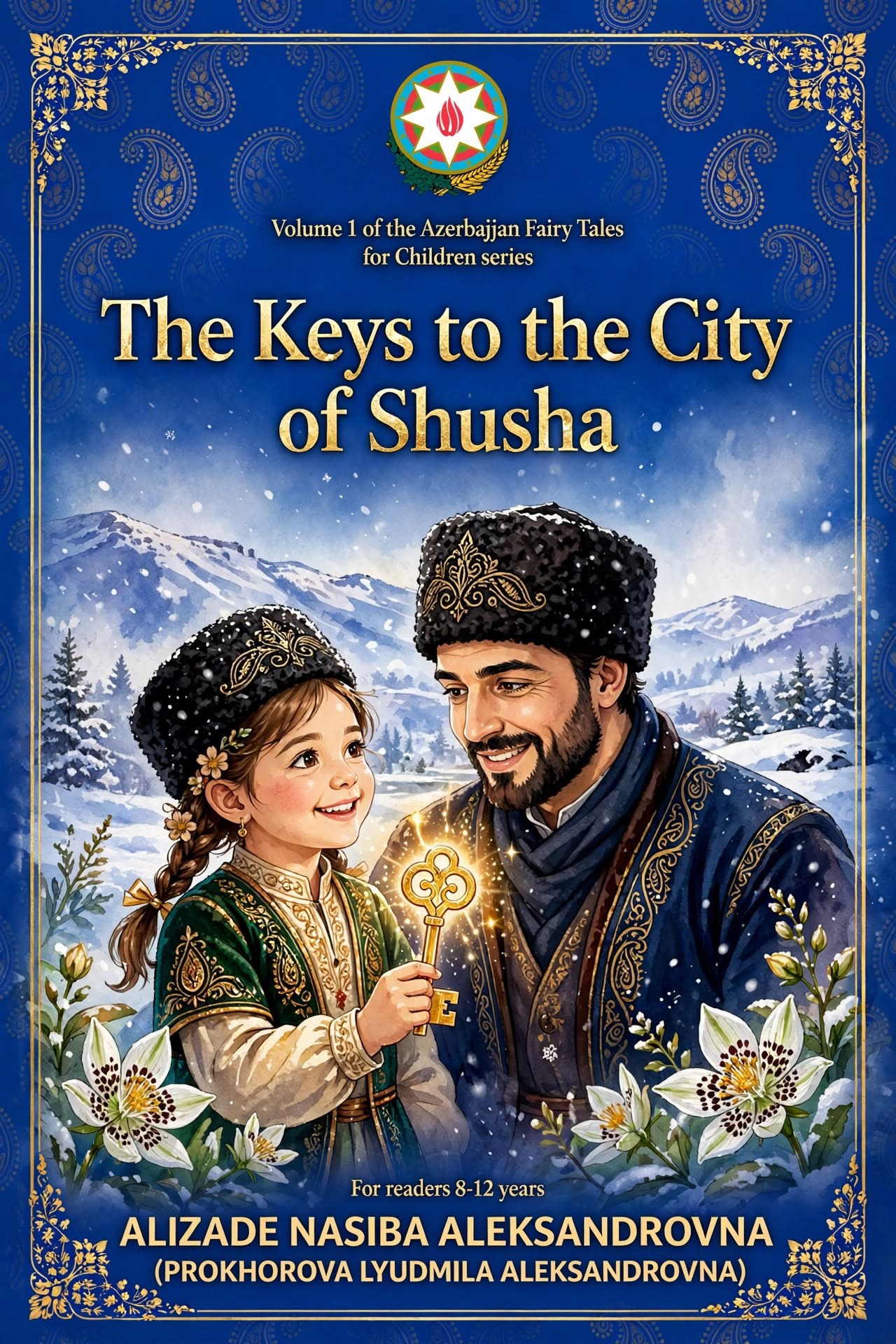
The Keys to the City of Shusha
Chapter 1. The Tale of January: The Magic Key of Icherisheher
Chapter 1. The Tale of January: The Magic Key of Icherisheher
When the first lights of the new year are lit in Baku, and the streets smell of tangerines and pomegranates, the ancient Maiden Tower awakens in the very heart of Icherisheher.
The winter wind wandered along the fortress walls, climbed into the cracks between the old stones, and told them stories a thousand years old. That evening it was especially restless. From the sea came the scent of salt and fuel oil, from the teahouse drifted the aroma of saffron and fresh churek, and somewhere in the distance, children’s laughter mixed with music pouring from open windows.
Little Nasiba loved to walk with Uncle Sasha, her mother’s younger brother, through the narrow stone streets of the Old City. Her red boots clattered brightly on the cobblestones, and the warm scarf knitted by her grandmother smelled of home and cinnamon. This evening, Uncle, who usually loved strolls along the embankment, suddenly turned toward the tower itself.
“Today is a special night,” he said, and his eyes gleamed in the lantern light like two beads. “They say once a year, on the first night of January, the tower chooses the keeper of the magic key. Not just anyone — only the one whose heart holds kindness.”
Nasiba raised her head. The Maiden Tower stood before her, tall and mysterious. By day it looked simply ancient, covered in wrinkle-cracks. But now, in the blue twilight, its golden outline lighting shone brighter than usual. The light ran over the stones like living gold, tracing every ledge, every loophole. It seemed the tower was breathing.
Suddenly the air grew warm, despite January. The heavy wooden door, bound with iron, creaked open. On the threshold appeared an old woman. She was small, but stood as straight as a young girl. Her dress was the color of the night sky, embroidered with golden pomegranates and wheat stalks. In her hair, silver as moonlight, bloomed tiny khari-bulbul flowers.
“I am Khari-bulbul, the spirit of these lands,” she smiled. Her voice sounded like rustling leaves and a distant mugham song at once. “Our fairy-tale calendar begins here, by the walls that remember everything. To travel the path from Icherisheher to Shusha and gather all 12 festive stories, you need a key.”
The old woman took a step, and not a single pebble crunched under her feet. She held out a small golden key to Leyla. It was warm and light, and its bit was carved in the shape of a buta — the ancient drop-shaped pattern that means life, fire, and eternity.
“But remember, child,” Khari-bulbul touched Nasiba’s chest, “the key opens not doors, but hearts. January is the month of new beginnings. The first holiday of the year is a time when people make wishes. But true magic begins not with a wish for yourself, but with a good deed for another. What good deed will you do today?”
Nasiba clutched the key tightly. It answered at once, warming in her palm like a chick. The girl closed her eyes and thought. The face of Auntie Milena from the second floor surfaced before her. Auntie Milena baked the tastiest shekerbura, but since her son had left, she hardly ever went out. Her windows in winter were always dark.
“I… I’ll bring her a piece of Grandma’s gogal!” Nasiba suddenly said loudly. “And I’ll draw her a card. A big one, with the Maiden Tower and a pomegranate. So she won’t be lonely in the New Year!”
The moment she said it, the key in her palm flared with soft light. It grew so warm that Nasiba almost let go. The tower’s golden illumination ran upward to the very top, and there, on the ancient stone, fiery letters appeared. They formed the first page of an enormous calendar:
“January. The Holiday of New Beginnings”
And just below, in ornate script, more words appeared: “Kindness, done from the heart, opens any road.”
Uncle Sasha watched in silence. When the letters faded, he dropped to one knee and hugged his niece. His coat smelled of tobacco and old books.
“So you’ve turned the first key, Nasiba,” he said, and there was pride in his voice. “Ahead lie 11 more fairy tales, 11 holidays, and a long road to Shusha. Each month — a new story, a new trial, and a new lesson. But now you are the keeper of the calendar. The key chose you.”
Khari-bulbul nodded and began to melt into the air, like smoke from fragrant tea. The last thing Nasiba saw was the flower in her hair. It detached and floated down onto the girl’s palm, turning into a golden badge shaped like a buta.
“When it gets hard, squeeze it,” came a voice from nowhere. “And remember why you’re walking.”
The tower door closed silently.
They walked back with Uncle in silence. Nasiba held the key and the badge to her chest. It seemed to her that all of Icherisheher was looking at her differently. Lanterns winked, cats warming themselves by the walls watched her intently, and in the windows of houses she thought she saw silhouettes of people from past centuries.
At home, Grandma was already waiting for them with hot tea and gogal. Without a word, Leyla took the two most golden ones, wrapped them in a napkin, took out her paints, and sat down to draw a card. She painted the Maiden Tower, golden and shining, and next to it — a small door with a kind old woman peeking out.
Half an hour later, she threw her coat on right over her house dress and ran to Auntie Milena. The door was opened by a surprised old woman with tear-stained eyes.
“Happy New Year, Auntie Milena!” Nasiba blurted out and held out the gogal and the card. “This is for you. So your year will be sweet!”
Auntie Milena took the gift. Her hands trembled. She looked at the card for a long time, then at Nasiba, and suddenly hugged the girl tightly.
“Thank you, sunshine,” she whispered. “You have no idea how timely this is…”
At that moment, the key in Nasiba’s pocket grew completely hot. And when she returned home and looked out the window, she saw snowflakes slowly circling over Icherisheher. They didn’t melt when they reached the ground — they turned into tiny sparks of light.
The Maiden Tower smiled quietly into the night. Its golden outline glowed softly in the darkness, as if winking at everyone who believes in miracles and is ready to open their heart to a good deed.
The first page of the fairy-tale calendar had been turned. February awaited.
End of the first tale
Глава 2
The Tale of February: The Lost Letters
February in Baku smells of damp wind from the Caspian and the first, still timid hints of spring. The snow no longer sparkled, but melted on the cobblestones of Icherisheher, turning into little mirrors that reflected the gray sky.
After the January night with the magic key, Nasiba carried the golden buta-badge in her pocket every day. Sometimes it warmed, as if reminding her: the fairy-tale calendar is waiting.
On one such day, February 21, Grandpa took Leyla to the Old City library.
“Today is Mother Language Day,” he said. “It’s a holiday for all the words we use to think, dream, and love.”
In the quiet hall of the library it smelled of old books and thyme tea. The librarian, Auntie Nigyar, showed Nasiba the oldest book. Its leather cover was cracked with age, and on the spine a buta was embossed in gold.
“This is ‘The Book of Native Speech,’” Auntie Nigyar whispered. “They say the soul of our language lives in it.”
As soon as Nasiba touched the cover, the book shuddered. The lock clicked, the pages flew open on their own — and suddenly, with a loud rustle, hundreds of golden letters fluttered out of it like fireflies! They circled the hall, flew out the window, and scattered over Icherisheher.
“Oh!” Auntie Nigyar gasped. “Without letters the book will go mute. And if the language goes mute, then the heart of the people will fall silent…”
At that same moment, the buta-badge in Nasiba’s pocket grew hot. Before her, woven from a sunbeam, Khari-bulbul appeared. Today her dress was the color of ink and paper, and golden letters shimmered in her hair.
“The key did not choose you for nothing, keeper,” she said. “The letters have scattered through the city. They got frightened that people were starting to forget their native words, replacing them with foreign ones. By sunset we must gather them, or the holiday will not come.”
Nasiba nodded and ran out into the street. The first letter — the ringing “Ç” — was trembling on an almond petal that was about to bloom by the fortress wall.
“Don’t be afraid,” Nasiba said to it in Azerbaijani. “‘Ç’ is for ‘çıçək’ — flower. Without you we can’t say how beautiful spring is.”
The letter trustingly lowered itself onto her palm and turned into a warm spark.
By the Maiden Tower, Nasiba found “Ş.” The letter was hiding in the shadows, frightened by the noise of cars.
“‘Ş’ is for ‘şəhər’ — city,” Nasiba smiled. “This is our Baku, our Icherisheher. We need you.”
So, word by word, she walked the streets. She took “A” from the dome of the mosque — it’s “ana,” mother. “V” was found in the cooing of pigeons — “vətən,” homeland. “M” was warming itself by the samovar in the teahouse — “musiqi,” music.
The hardest was the letter “Ə.” The most tender and melodious, it had hidden in the darkest corner and was crying.
“Everyone forgets me,” it sobbed. “I’m hard to pronounce. They replace me with ‘E’.”
Nasiba sat down beside it on the cold stone.
“‘Ə’ is for ‘əl,’ hand. It’s ‘ər,’ husband, ‘ailə,’ family, ‘Əlifba,’ alphabet book. Without you there is no ‘Azərbaycan.’ You are the most ours. Come to me.”
And “Ə” flew to her, the brightest of all.
When the sun touched the sea, Nasiba returned to the library. A whole swarm of golden letters glowed in her palms. She opened The Book of Native Speech, and the letters poured onto the pages, becoming words, poems, fairy tales. The book sighed, and the hall filled with the scent of pomegranate and fresh bread.
Khari-bulbul touched Nasiba’s shoulder.
“You returned not just letters. You returned pride. Today every child who speaks their native language will light one of them in their heart.”
On the last page of the book, a new entry appeared in the calendar, in gold:
“February. The Holiday of the Native Language. Who guards the word — guards the soul of the people.”
That evening, Auntie Nigyar read fairy tales in Azerbaijani to the children in the library. And Nasiba, walking home, heard how all of Icherisheher sounded: in laughter, in a mugham song from a window, in a mother calling her son to dinner.
The buta-badge in her pocket was warm. The second key had been turned. March awaited.
End of the second tale
Chapter 3. The Tale of March: Novruz Bayram
Chapter 3. The Tale of March: Novruz Bayram
March in Baku always comes with wind. It tears winter’s silence from the roofs, rattles the windows of Icherisheher, and brings the smell of earth, rain, and the first buds. And March also brings Novruz — the holiday of spring, fire, and renewal.
On one of those windy days, the buta-badge in Nasiba’s pocket grew warm. The girl understood: the calendar was calling. She threw on her coat and ran outside.
The Old City was already preparing for the holiday. On the squares they were piling khonchas with semeni, shekerbura, and pakhlava. Boys were flying paper kites, and the air hung heavy with the scent of sumac and roasted chestnuts. But today Nasiba was not going to the square. Her feet carried her to the ancient fortress walls, where among the stones the first, stubborn wheat sprout was breaking through.
“You’re on time, keeper,” Khari-bulbul’s voice came with a gust of wind. Today her dress was the color of flame: scarlet, orange, gold. Sparks glimmered in her hair, and in her hands she held a small clay bowl in which there was no fire.
“This is the Novruz bowl,” said Khari-bulbul. “But its fire has gone out. People have started to forget that Novruz is not just bonfires and sweets. It is a holiday of a pure heart, of forgiveness and good beginnings. Without true fire, spring will not come to Icherisheher. And without spring, we will not reach Shusha.”
Nasiba looked into the bowl. At the bottom lay only cold ash.
“How do I light it?” she asked. “I have no matches.”
“Novruz fire is not lit with matches,” Khari-bulbul smiled. “It is lit with four sparks: The Spark of Courage, the Spark of Generosity, the Spark of Memory, and the Spark of Hope. Gather them by sunset, and the bowl will blaze.”
And Khari-bulbul dissolved into the air, leaving behind the scent of smoke and blooming almond.
Nasiba squeezed the key tighter and ran to find the first spark.
The Spark of Courage was waiting for her at the Maiden Tower. There, a boy named Rufat was afraid to jump over a small holiday bonfire. His friends were laughing, but he stood pale.
“What if I fall?” he whispered.
Nasiba remembered how she herself had been afraid last year. She walked over and took Rufat’s hand.
“I’ll jump with you. On three. Novruz is when fear burns up in the fire! One, two… three!”
They jumped together. The flame licked their boots but did not burn. At that moment, a scarlet spark flew from the bonfire and landed in the bowl. The bowl grew a little warmer.
Nasiba found the Spark of Generosity on the street. Old master Uncle Ali was sitting by his shop, trying to mend a kelaghayi that had torn for a little girl. The girl had no money and was about to cry.
“Take this,” Nasiba took the buta-badge from her pocket. It was golden and beautiful. “Sell it and buy her a new one.”
Uncle Ali shook his head and laughed.
“Your heart is gold, daughter. Look.” He made a few stitches, and the kelaghayi was as good as new. “I don’t take money for kindness.”
And then, from the golden thread in the master’s hands, a second spark flew out — orange. It, too, fell into the bowl.
The Spark of Memory took longer to find. It was hiding in an old house on the edge of Icherisheher. There lived Grandma Fatma. On Novruz she always baked the tastiest shekerbura, but this year the house was dark and quiet.
“No one to bake for,” the grandmother sighed. “The children are far away, the grandchildren have forgotten.”
Nasiba sat down beside her and took her wrinkled hand.
“What if I’m your granddaughter for today? Teach me? Tell me how you celebrated Novruz when you were little, like me.”
Grandma Fatma’s eyes sparkled. She took out flour, nuts, cardamom. Soon the whole kitchen filled with the aroma of the holiday. Grandma told stories, Nasiba listened and shaped shekerbura. When the first batch browned in the oven, a third spark flew out of it — white as flour.
The sun was already setting. Only one remained — the Spark of Hope. Where to look for it? In despair, Nasiba went out onto the fortress wall. Below, Baku burned with lights, and ahead, far, far away, lay the road to Shusha. And suddenly she saw it.
On the very edge of the wall, on a thin stem, swayed a lone khari-bulbul flower. It had bloomed early, among the stones and wind. It was small, but it did not bend.
“You are Hope,” Nasiba whispered. “You believe that spring will come, even when winter is all around.”
She didn’t pick the flower. She just leaned over and breathed on it, warming it. And then, from its petals, the last, brightest spark broke free — gold.
Nasiba ran back to Khari-bulbul. Four sparks swirled in the bowl. Khari-bulbul covered it with her palms.
“Now say the main words of Novruz,” she whispered.
Leyla closed her eyes and remembered everything: Rufat’s courage, Uncle Ali’s kindness, Grandma Fatma’s stories, and the stubborn flower on the wall.
“Let all the bad burn away! Let only good remain! Let there be peace!” she shouted with all her heart.
The bowl in her hands burst into flame. Not a little flicker, but a tall, pure, golden fire. It rose to the sky, and at that same moment, festive bonfires lit up all across Icherisheher. People laughed, jumped over the fire, forgave offenses. And at the top of the Maiden Tower, a new page of the calendar lit up in gold:
“March. Novruz. A fire lit by the heart warms the whole people.”
Khari-bulbul hugged Nasiba.
“You lit not just a fire. You lit spring. Now the road to Shusha is one month shorter.”
That night, Nasiba fell asleep and dreamed of a road of khari-bulbul flowers leading from Icherisheher to the mountains of Shusha. And in her pocket, next to the key, lay a piece of warm, fresh shekerbura from Grandma Fatma.
The third key had been turned. April awaited.
End of the third tale
Chapter 4. The Tale of April: Flowers for Shusha
Chapter 4. The Tale of April: Flowers for Shusha
April came to Icherisheher with rain and laughter. After noisy Novruz, the old city washed itself and shone. Tiny wild poppies bloomed on the stone walls, and every courtyard smelled of damp earth and the first apricots.
The buta-badge in Nasiba’s pocket grew warm on the morning she had a dream. She dreamed of a road. Long, winding, it led from Icherisheher through mountains and mists straight to Shusha. And on both sides of the road grew flowers — not ordinary ones, but khari-bulbul. Thousands of them, scarlet and white, swayed in the wind and whispered: “It’s time… it’s time…”
In the morning, Nasiba told her mother about the dream. She was silent for a long time, looking out the window at the Maiden Tower.
“In April 1992, Shusha fell silent,” she said quietly. “And in November 2020, it spoke again. Now our road home is open. But a road is not only stones and asphalt. A road is memory.”
That same day, while Nasiba was drawing a khari-bulbul with chalk in the yard, the badge flashed. Khari-bulbul appeared before her. Her dress today was the color of the spring sky and the Karabakh mountains, and in her hands she held an empty basket of willow twigs.
“Hello, keeper of April,” she said. “Novruz lit the fire, but fire needs earth to warm it. And earth needs flowers, to remember.”
She held the basket out to Nasiba.
“This basket must be filled before the holiday of the Last Tuesday of April. But not with ordinary flowers. We will gather ‘Flowers of Memory.’ Four flowers: The Flower of Bravery, the Flower of Song, the Flower of Tears, and the Flower of Return. Find them — and the road to Shusha will become one month shorter.”
And Khari-bulbul vanished, leaving the scent of rain and mountains in the air.
Nasiba found the Flower of Bravery at the Military Gates. There, a veteran, Uncle Murad, was telling boys about the Shusha Fortress. His voice trembled, but his eyes burned.
“The scariest thing in war isn’t bullets,” he said. “The scariest thing is forgetting what you’re fighting for. And we never forgot. Not for a single day.”
When one of the boys asked, “Was it scary?” Uncle Murad smiled.
“Scary. But love for the Motherland is stronger than fear.”
At that moment, at his feet, right out of the stone, a scarlet poppy broke through. Nasiba carefully picked it. The poppy was warm, like a coal. She placed it in the basket.
The Flower of Song waited for her at the music school. Mugham drifted from inside. Nasiba peeked through the window. A girl named Sevil was playing “Karabakh Shikastasi” on the tar. She couldn’t get it right, her fingers slipped, and she was almost crying.
“I can’t,” she whispered. “It’s too painful and too beautiful.”
Nasiba went in and sat beside her.
“Close your eyes,” she said. “Imagine you’re not in Baku. You’re in Shusha. On Jidir Duzu. Mountains all around, and the wind sings with you.”
Sevil nodded, closed her eyes, and played. And suddenly — it flowed. The mugham wept and laughed, telling of mountains, of home, of victory. When the last note melted away, a white khari-bulbul flower blossomed on the tar string. It was woven from sound. Leyla took it and placed it in the basket.
The Flower of Tears was the heaviest. Nasiba found it on Martyrs’ Lane. There, an elderly woman, Aunt Zeynab, was wiping her son’s photograph on a marble slab.
“He loved April so much,” she told Nasiba. “He used to say, ‘Mom, you’ll see, in April we’ll drink tea in Shusha.’ He didn’t live to see November. But he lived to see Victory in our hearts.”
She wasn’t crying. Her tears had long dried. But when she smiled at Nasiba, a single, silver tear glistened on her eyelash. It fell to the ground and turned into a cornflower, blue as the sky over Karabakh. Nasiba picked it up. It was cold and light.
The sun was setting. Only one remained — the Flower of Return. Where to look for it? In despair, Nasiba sat on the shore of the Caspian. And suddenly she saw it.
A little boat was floating on the sea. Paper. Some child had launched it in Icherisheher, in a ditch. It had sailed through the whole city and reached the sea. On its side, written in charcoal, was one word: “Shusha.”
Nasiba walked into the water, not afraid of wetting her boots, and took the boat. Inside lay not a flower. Inside lay a sprout. Tiny, with two green leaves and a khari-bulbul bud about to open.
“You are Return,” Nasiba whispered. “You sailed so long to say that we are home already.”
She carefully placed the sprout in the basket.
When Nasiba returned to the square before the Maiden Tower, Khari-bulbul was waiting for her. The basket in Nasiba’s hands was glowing.
“You gathered them,” Khari-bulbul said. “Bravery, Song, Tears, and Return. Look.”
She waved her hand, and the flowers from the basket flew into the sky. They did not scatter. They formed a shining road of petals. The road began in Icherisheher and went beyond the horizon, to the mountains. And at the end of the road, in a golden haze, the walls of the Shusha Fortress could be seen.
“This road is now in the heart of everyone who remembers,” said Khari-bulbul. “And in May we will plant these flowers in Shusha itself.”
On the wall of the Maiden Tower, a new entry in the calendar lit up in gold:
“April. Flowers of Memory. Who remembers the road home — is already home.”
That night, all of Baku had a strange dream: as if a path of khari-bulbul flowers stretched from the sea to the mountains. And Nasiba fell asleep, clutching in her palm the paper boat with the word “Shusha.”
The fourth key had been turned. May awaited.
End of the fourth tale
Chapter 5. The Tale of May: The Garden of Victory
Chapter 5. The Tale of May: The Garden of Victory
May in Baku is the victory of light. After the April rains, Icherisheher exploded with green. Pomegranates bloomed with scarlet torches, figs spread their broad leaf-palms, and the air grew thick with the scent of lilac and sea.
The buta-badge in Nasiba’s pocket no longer warmed — it sang. Quietly, like a lullaby. The girl knew: it was time for the road.
On the first morning of May, when the sun was rising over the Caspian, Nasiba found a bundle on the doorstep of her old apartment in Icherisheher. Inside lay a white dress embroidered with golden khari-bulbul, a wreath of living flowers, and a letter.
“Keeper, you lit the fire, gathered the words, and grew the memory. Now it is time to plant the Garden. I await you in Shusha. The road is open. Khari-bulbul.”
Nasiba put on the dress. It was light as a petal. She took the basket with the sprout — that very Flower of Return from April — and stepped out of the house. At the Maiden Tower, an old bus was already waiting for her. Not an ordinary one, but painted with patterns, with “Baku — Shusha” on the windshield. The driver was Uncle Murad, the veteran from the March tale. He nodded silently and opened the door.
Others were already sitting in the bus: Grandma Fatma with a shekerchurek pie, the girl Sevil with her tar, the boy Rufat with a mulberry sapling, and many more people — old and young. Each held something for the new garden: seeds, saplings, a jug of water from a Baku spring.
The road flew by. Gobustan, the Kura, the Murov mountains slipped past. The closer to Shusha, the higher the sky became. And then, after a turn, they saw it. Shusha. It lay on the plateau like a crown, in a wreath of clouds. Half-destroyed, but proud. Wounded, but alive.
On Jidir Duzu they were met. But not with a salute — with silence. The kind of ringing silence that happens only in native places after a long separation.
Khari-bulbul stood in the middle of the field. Today she was not alone. Around her stood thousands of khari-bulbul — real, living ones. They swayed in the wind and looked at the guests.
“You brought fire, word, and memory,” said Khari-bulbul. “And now you have brought life. It is time to plant the Garden of Victory.”
And everyone began to work. Uncle Murad drove in the first stake for a future house. Grandma Fatma handed out shekerchurek to all. Sevil sat on a stone and played “Karabakh Shikastasi.” And to that music, Nasiba knelt in the center of Jidir Duzu.
She dug a hole with her warm palms. She took the khari-bulbul sprout from the basket — the one that had sailed to her in the paper boat. She planted it in the soil of Shusha. Watered it with water from Baku. And whispered:
“Grow. You are Bravery. You are Song. You are Tears. You are Return. You are Home.”
And then a miracle happened. The sprout blazed with golden light. Green shoots ran from it in all directions. In a minute, the whole field was covered with a carpet of khari-bulbul flowers. They bloomed before their eyes — scarlet, white, tender. And in the center, where Nasiba had planted her sprout, a tree grew. Small, but strong — a pomegranate tree. And it immediately set fruit.
Rufat planted his mulberry. Sevil — a rose bush. Grandma Fatma sowed basil seeds. Everyone planted their own, and Jidir Duzu was turning into a garden.
Khari-bulbul came to Nasiba and placed a wreath on her head.
“The Garden of Victory is not planted with shovels,” she said. “It is planted with the heart. You walked the path from Icherisheher to Shusha. You carried the keys of all the months: January gave you will, February — word, March — fire, April — memory. And May gave you the Motherland.”
She touched the pomegranate on the tree. It opened, and inside, instead of seeds, little golden keys shone.
“Now you are the Keeper not of the calendar, but of the whole land.”
A new star lit up in the sky above Shusha. And on the wall of the restored mosque, a final entry appeared in gold:
“May. The Garden of Victory. Who planted one flower on native soil — planted a whole world.”
In the evening, everyone sat in the new garden. They drank tea from a samovar, ate shekerbura, and listened to the wind playing in the branches of the young pomegranate. Leyla looked at Shusha. The city was healing its wounds. The city was breathing. The city was living.
The buta-badge in her pocket had cooled. It had done its work. The calendar had closed. The path had been walked.
Khari-bulbul hugged Nasiba goodbye.
“Fairy tales end,” she whispered. “But the Motherland — never. Come to the garden every May. It will be waiting.”
Nasiba returned to Baku not by bus, but on foot — along the path of flowers she herself had planted. In her hand she held one pomegranate from the Garden of Victory.
End of the fifth tale.
Chapter 6. The Tale of June: The Key That Was Always There
Chapter 6. The Tale of June: The Key That Was Always There
After May in Shusha, summer came. But not just summer — summer after return. The Garden of Victory, planted by Nasiba, had grown. The pomegranate tree was already giving shade, the mulberry rustled its leaves, and the carpet of khari-bulbul was so thick you could sink into it up to your knees.
Nasiba came to Shusha every weekend. She helped Grandma Fatma bake bread in the new tandir, learned from Uncle Murad how to fix a roof, and in the evenings listened to Sevil play the tar for the children. The city was coming alive. But one day in June, Leyla woke up in Baku with anxiety.
The buta-badge in her pocket was cold. Completely icy. And silent.
She went out into Icherisheher. By the Maiden Tower it was empty. Khari-bulbul did not come. Leyla got scared: were the fairy tales over? Was everything that happened — a dream?
She wandered the old streets until evening. And only by the spring, where in January she had found the first key, did she notice a scratch on the stone. New. An arrow. It was pointing not to Shusha. It was pointing to her home.
Leyla ran home. She burst into her room. And froze.
On her desk, among textbooks and drawings, lay a book. Thick, bound in velvet the color of pomegranate. On the cover, embossed in gold: The Keys to the City of Shusha. And below — her name. Leyla.
With trembling hands she opened the book. On the first page was a map: the road from Icherisheher to Shusha, strewn with flowers. And then — the fairy tales. January, February, March, April, May. Everything that had happened to her. Everything she had lived through. Everything she had planted, lit, preserved, and returned.
On the last page there was only one sentence, written in Khari-bulbul’s handwriting:
“Keeper, you searched for keys all winter and spring. But the main key was always with you. It is your memory. Your love. Your faith. As long as you remember, as long as you tell, as long as you plant flowers — Shusha will live. And Baku will live. And Azerbaijan will live. Now you yourself are the Fairy Tale. Go and write it further. Not for me. For them.”
Next to the book lay a small bundle. Leyla unwrapped it. Inside was not a key. Inside was a feather. Golden, with a khari-bulbul bud at the top.
The buta-badge in her pocket suddenly grew warm. So warm it warmed her whole heart. It was not silent. It was singing. But now it was not a lullaby. It was a hymn.
Leyla understood. The path to Shusha is not a road on a map. It is a road in the heart. And she had already walked it. Now her task was to lead others along it. Those who are younger. Those who do not yet know. Those who have forgotten.
She sat at the table. Dipped the golden feather in the inkwell. And began to write a new fairy tale. The first fairy tale of June.
A fairy tale that would have no end.
Epilogue. The Key in Your Hands
If you, reading these lines, ever go to Shusha — stop on Jidir Duzu. Find the pomegranate tree there. Touch its bark. And listen.
You will hear children’s laughter. The ring of a tar. The smell of shekerbura. And the quiet whisper of the wind in khari-bulbul petals.
This is Leyla planting her Garden. Every day. Every June. Forever.
And if you cannot go — don’t be sad. Close your eyes. Remember the Maiden Tower. Remember the smell of the Caspian. Remember the fire of Novruz. Remember your grandfather’s tales.
Plant a flower on your balcony. Tell your younger brother a legend. Draw a buta. Bake shekerbura.
Because Shusha is not just a city on a map. Shusha is a key. And it is now in your hands.
End of the book. Beginning of your fairy tale.
Chapter 7. The Tale of July: The Song the Mountains Hear
Chapter 7. The Tale of July: The Song the Mountains Hear
July came to Shusha. The sun melted the stones of the fortress walls, cicadas sang so loudly they drowned out even the wind from Jidir Duzu. The Garden of Victory, planted by Nasiba, was now a real garden. The pomegranate had already set its first fruits, the mulberry gave shade, and the khari-bulbul were blooming for the second time that summer — something even the old people in Karabakh couldn’t remember.
Nasiba came to Shusha for the whole vacation. By day she helped restore the library: dusted old books, arranged mugham scores, learned from Grandma Fatma how to cook dovga for all the craftsmen. And in the evenings the city came alive with music. Sevil played the tar, Uncle Murad sang “Karabakh Shikastasi,” and even the stones seemed to sing along.
But in mid-July the music suddenly stopped.
Nasiba woke at night from silence. So thick it rang in her ears. She ran out onto the balcony. Shusha was sleeping. But it was not the sleep when a city rests. It was the sleep when a city forgets how to breathe.
The buta-badge on her palm grew cold and heavy. Like a stone.
In the morning Nasiba ran to Sevil. She was sitting with her tar on her lap, crying. The strings were intact, but the tar was silent.
“It doesn’t sing, Nasiba. I touch the strings, and they’re like threads. The city needs a song. But not mine. Another one. The one it remembers itself.”
Nasiba understood. In half a year she had returned to Shusha the keys, the flowers, the fire, the bread, and the water. But she had not returned its voice.
She went to the Shusha Fortress. To the oldest walls, where the stones remembered the Khan, Bulbul, Uzeyir Hajibeyov. She placed her palm on them. And the buta-badge suddenly grew warm.
A sound came from under her fingers. First quiet, like the whisper of wind in a gorge. Then — like the ringing of a spring. Then — like the distant voice of a muezzin. Then — like a lullaby a mother sings. The stones themselves were singing. The Song of Shusha. The very one the city had sung for centuries, but forgotten in silence.
Nasiba closed her eyes and began to sing along. Without words. Just with her heart. Her voice was caught by the wind. Carried over Jidir Duzu, over the mosques, over the gardens, over the ruined houses that were already being rebuilt.
Chapter 8. August’s Tale: The Fruit That Remembers Everything
Chapter 8. August’s Tale: The Fruit That Remembers Everything
In Shusha, August arrived. The heat was so fierce that the fortress stones grew as hot as a tandoor. But in the Garden of Victory, under the shade of the mulberry and the pomegranate tree, it was cool. The cicadas no longer sang so loudly—they were tired. Yet the khari-bulbul bloomed for the third time. The old men shook their heads: “It’s a sign. The earth is giving thanks.”
Nasiba lived in Shusha all summer. She woke at dawn, watered the garden, helped Grandmother Fatma dry dogwood and mulberries on the roof. By day, in the library, she read old Karabakh legends to the children, and in the evenings she learned to sing mugham from Sevil. The city was no longer silent. It sang, laughed, hammered, smelled of bread and paint.
But in mid-August, Nasiba noticed something strange. The pomegranate in the Garden of Victory ripened before all the others. A single fruit. Huge, heavy, with skin the color of old blood. It hung from the lowest branch, as if waiting just for her.
The buta brooch on Nasiba’s chest suddenly grew cool. Not cold, like in winter. But cool, like spring water on a hot day.
She reached out and picked the pomegranate.
In that same second, a sound rolled through all of Shusha. Not loud. Deep. As if the earth itself sighed. As if the heart of the city beat once—strong, resounding, across all of Karabakh.
Nasiba carried the pomegranate into the house. Grandmother Fatma saw it and wept.
“This is the first, daughter. The first fruit of Shusha after the return. It can’t just be eaten.”
That evening the whole city gathered on Jydyr-düzü. They spread carpets. Lit lanterns. Uncle Murad brought an old silver tray. Sevil brought a tar. The children brought flowers.
Nasiba stepped into the center. In her hands she held the pomegranate. The buta brooch on her chest shone so brightly it lit her face.
She raised a knife. Carefully cut the skin.
The pomegranate opened by itself.
Inside there were no seeds. Inside was light. Warm, golden, alive. It burst out and scattered over Jydyr-düzü in a thousand sparks. Each spark fell to the ground and turned into a seed.
And the people understood. These were not just seeds. This was memory.
One seed—the smell of shekerbura that great-grandmother used to bake.
Another—a lullaby that a mother sang.
A third—the first sound of the tar that a grandfather heard.
A fourth—the taste of spring water.
A fifth—the laughter of children on this very square a hundred years ago.
The sixth, the seventh, the thousandth...
All of Shusha. All its history, pain, love, songs, fairy tales—everything was in this pomegranate.
Nasiba took a handful of seeds of light and walked through the rows. She gave one to each person: an old man, a child, a craftsman, a musician.
“Eat,” she said. “Remember. And never forget again.”
When the last seed had been given out, the August moon rose over Shusha. Huge, copper-colored, like a shield. And in its light the people saw that on the spot where the sparks had fallen, grass had sprouted straight from the stone. And on the grass—flowers. Khari-bulbul. Thousands.
The city wept and laughed at the same time. Because it understood: it would never be lost again. Never. As long as there was even one person who remembered its taste.
Nasiba returned home toward morning. She took out the velvet book “The Keys to the City of Shusha.” The golden pen lay itself in her hand. And she began to write “August’s Tale.”
The buta brooch on her chest cooled. It had done its work. Now it was just a brooch. Beautiful, dear. But Nasiba knew: if Shusha ever forgot its song again—it would grow hot once more.
Because she was the Keeper. Forever.
End of August’s Tale. But the seeds are already in the earth. And they will sprout.
Chapter 9. September’s Tale: The Lesson Not Written in a Notebook
Chapter 9. September’s Tale: The Lesson Not Written in a Notebook
In Shusha, September arrived. The heat subsided. In the mornings, cold beads of dew lay on the fortress stones, and the first autumn wind drifted from the mountains of Karabakh. The Garden of Victory dressed in gold and crimson. The pomegranate swelled with juice, the fig turned honey-sweet, and the grapevines bent under heavy clusters.
For Nasiba, this was a special September. The first September in Shusha. The first bell after the return.
School No. 1 was reopening. It had been rebuilt on the old foundation, but the walls were now light, the windows huge, and young cypresses had been planted in the courtyard. Nasiba stood at the assembly in a new green dress with a golden buta ornament. On her chest—the buta brooch. In her hands—not a bouquet for the teacher. In her hands—the velvet book “The Keys to the City of Shusha” and the golden pen.
The principal, a gray-haired history teacher who remembered this school before the silence, said:
“Children, today we don’t just have our first lesson. Today we have Shusha’s first lesson. And it will be taught by the one who brought us back the keys.”
Nasiba came up to the blackboard. Children sat in the classroom. Those born in Baku, in Ganja, in exile. Those who had seen Shusha only in photographs. Those who were hearing the silence of Jydyr-düzü for the first time.
She opened the book. But she did not read.
“Tell me,” Nasiba asked, “what is the most important thing in school?”
“To learn!” shouted someone from the front desk.
“To get A’s!” added someone from the second row.
“So Mom doesn’t scold me,” whispered someone from the back.
Nasiba smiled.
“And I think—it’s to remember. To remember why we learn. To remember who we are. To remember where we’re from.”
She dipped the golden pen in ink. And drew on the board not a formula. Not a rule. She drew a pomegranate. That same August pomegranate. From which seeds of light were flying out.
“Each of you,” Nasiba said, “is a seed. A seed of memory. A seed of Shusha. A seed of Azerbaijan. You can be taken far away. You can be planted in foreign soil. But if you remember the taste of shekerbura, the sound of the tar, the scent of khari-bulbul, your mother’s lullaby in Azerbaijani—you will sprout. Anywhere. And you will bear fruit.”
She walked to the window. Beyond the window the Shusha fortress was visible. And beyond—mountains. And beyond the mountains—the whole world.
“Your main lesson,” Nasiba said, “isn’t in a notebook. Your main lesson is in your heart. To be a key. For those who come after you. So they, too, will know the way home.”
The buta brooch on her chest grew warm. Not hot. Not cold. Steady, like a heart beating in the right rhythm.
At that moment the bell rang through the whole school. But it wasn’t an ordinary bell. In it you could hear Sevil’s tar. Uncle Murad’s hammer. The laughter of children. The whisper of wind in the khari-bulbul. The voice of stones.
Shusha was singing. Its first song after a long lesson of silence.
And Nasiba opened a clean page in her velvet book and wrote at the top:
“September’s Tale. Lesson One. And it is—forever.”
End of September’s Tale. But the school year has only just begun.
Chapter 10. October’s Tale: The Letter That Arrived Across the Years
Chapter 10. October’s Tale: The Letter That Arrived Across the Years
In Shusha, October arrived. The Karabakh mountains wore caps of morning fog, and by day they burned gold and copper. The Garden of Victory grew quiet. The grapes had already been gathered, the pomegranate taken down, and the mulberry leaves rustled underfoot like old letters.
Nasiba now went to School No. 1 every day. After classes she sat in the new library and read. She read everything: old newspapers, soldiers’ letters, teachers’ diaries—those who had hidden books when the city was in silence. The buta brooch on her chest grew warm only when she held someone else’s memory in her hands.
In mid-October a truck arrived in Shusha. From Baku. It brought boxes. In the boxes were books, notebooks, paints for the art school. And one strange parcel. No address. Just: “To the school of the city of Shusha. For the teacher.”
The principal opened it. Inside lay an old, yellowed envelope. And a letter. Written in a child’s handwriting, in ink that had faded to the color of autumn leaves.
*“Hello, teacher.
My name is Anar. I’m 10 years old. I’m in 4th ‘B’ at School No. 1 in the city of Shusha. Today is October 15, 1991.
There’s shooting outside our window. Mom says we have to leave. I don’t want to. I collected my herbarium—maple leaves from Jydyr-düzü. And I hid it under the floor in our classroom.
Teacher, if you’re reading this, it means Shusha is ours again. It means you’ve returned.
Please, find my herbarium. And tell my leaves that I’ve come home.
Your student, Anar.”*
The library grew quiet. So quiet you could hear a leaf fall outside the window.
The buta brooch on Nasiba’s chest grew hot. Burning hot.
She knew what to do.
After classes, Nasiba, the principal, and several older students went to the old part of the school. To where the foundation remained. 4th “B.” The floor was new, but Nasiba pressed her palm to it. The buta brooch flared. And one floorboard trembled slightly.
They lifted it.
Under the floor lay a bundle. Oilskin paper. And in it—a herbarium. Maple leaves. Dry, fragile, but whole. Thirty years they had waited. Thirty years they had remembered.
Nasiba took one leaf. Held it to the light. And the leaf flared gold. It didn’t burn. It glowed. As if the sun of 1991, which the boy Anar had caught, had finally burst out.
That evening the whole school went out to Jydyr-düzü. Each student held a maple leaf from Anar’s herbarium. And each made a wish. Not for themselves. For Shusha.
That it would never be empty again.
That its schools would always ring with laughter.
That letters would always arrive. Even across thirty years.
And then they let the leaves go to the wind. And the wind—real October Karabakh wind—took them and carried them over the fortress, over the mosques, over the new roofs. Carried them home.
At night Nasiba opened the velvet book “The Keys to the City of Shusha.” The golden pen was already waiting.
She wrote: “October’s Tale. The letter arrived.”
And in Baku, at the same hour, a grown man named Anar suddenly stopped in the middle of the street. It seemed to him that someone had called his name. In the voice of his first teacher. And his heart grew warm. As if he had finally returned to his 4th “B.”
The buta brooch on Leyla’s chest cooled. It was satisfied.
Because the most important lesson of Shusha isn’t literacy. It’s memory. Which knows how to wait. And knows how to return.
End of October’s Tale. But the leaves are still circling over the city.
Chapter 11. November’s Tale: The Rain That Remembers Names
Chapter 11. November’s Tale: The Rain That Remembers Names
In Shusha, November arrived. The Karabakh mountains turned gray with the first snow on their peaks. The Garden of Victory fell asleep. The mulberry leaves had flown off, the pomegranate stood bare but proud. Only the khari-bulbul still held on—they hid their buds until spring, like a secret.
In the mornings, fog covered the city. Thick, milky, like steam from a tandoor. And by evening came the rain. Not a downpour. Not a drizzle. A whispering rain. It drummed on the roofs of old and new Shusha, on the domes of the mosques, on the fortress stones. And in each tap a name could be heard.
Nasiba now lived in Shusha permanently. She studied at School No. 1, and after classes she helped in the library sorting the archive. Letters, photographs, scraps of newspapers. Everything people brought with the words: “This belonged to my grandfather. This was in the attic. This is the only thing I carried out.”
The buta brooch on her chest became cool and calm. Like November rain.
In mid-November, an old woman came to the library. Very small, dry, like an autumn leaf. In her hands—a bundle wrapped in a headscarf.
“Daughter,” she said. “My name is Zeynab. I was born in Shusha. I left in 1992. I was 17. This is my brother Samad’s album. He was 5. He loved to draw rain. He said every drop had a name. The day we left, he forgot the album at home. I came back for it thirty years later. But Samad is gone. He died. But the album—here it is.”
Leyla unwrapped the scarf. The album was a child’s. The cover had softened with time. Inside—drawings. Unskilled, with colored pencils.
On the first page—a house. And a caption: “Our house. Shusha. Veterans Street, 5.”
On the second—a tree. “Mulberry in the yard. It’s tasty.”
On the third—rain. Just blue sticks across the whole page. And below, in crooked letters: “Rain. It calls: Samad, Samad, Samad...”
Nasiba closed her eyes. And heard.
The rain outside the library window was tapping on the glass: Sa-med... Sa-med... Ley-la... Zey-nab... Shu-sha...
It remembered. All the names. Everyone who had lived, who had left, who hadn’t returned, who had returned.
The buta brooch grew hot.
Nasiba took Samad’s album. Took her velvet book “The Keys to the City of Shusha.” Took the golden pen. And went out into the street. Right into the rain.
She walked through Shusha. Along Veterans Street. House No. 5 was gone. A new one was being built in its place. But the mulberry in the yard—old, burned, but alive—was there.
Nasiba walked up to it. Pressed Samad’s album to the trunk. And the rain around grew stronger. It beat on the pages, but didn’t smear the drawings. On the contrary—the colors grew brighter. Blue became the sky. Green became the grass on Jydyr-düzü. Red became the sun.
And then from the rain a boy took shape. About five years old. With colored pencils in his pocket. He looked at Nasiba, at his mulberry, at the new house. Smiled. And said:
“Thank you for bringing me home, sister.”
And vanished. Dissolved into the rain.
Old Zeynab, who had followed, fell to her knees by the mulberry and wept. But they were bright tears. Like November rain.
Leyla returned to the library. Opened “The Keys to the City of Shusha.” And wrote:
“November’s Tale. The rain remembers all the names. And it returned one of them. Samad, 5 years old, artist. Veterans Street, 5. Shusha.”
Since then they say in Shusha: if in November you stand under the rain and listen carefully—you will hear your name. It means the city remembers you. It means you are—home. Forever.
The buta brooch on Leyla’s chest cooled. It had done its work. Until spring.
End of November’s Tale. But the rain is still drumming on the roofs.
Chapter 12. December’s Tale: The First Snow That Doesn’t Melt
Chapter 12. December’s Tale: The First Snow That Doesn’t Melt
In Shusha, December arrived.
The Karabakh mountains donned white papakhas down to their brows and fell silent. The way old men fall silent when they look at their grandchildren—sternly, but with love. The Garden of Victory slept under a thick snowy blanket. Pomegranate, fig, mulberry—all stood bare, black on white, like lines on old paper. Only the khari-bulbul stubbornly refused to surrender: they hid their buds deep in their roots, the way mothers hide bread for a hard day. “Spring will come,” they whispered to the earth. And the earth believed.
In the mornings, fog covered the city. Thick, milky, viscous, like Grandmother Fatma’s jelly. It hid the new roofs, the construction cranes, the domes of the Govhar Agha and Saatli mosques. It even hid the Shusha fortress. It seemed Shusha wasn’t there. There was only white silence and a sound. Drip. Drip-drip-drip. The icicles on the roof of School No. 1 were weeping. Weeping from happiness that they could hear children’s laughter again.
Nasiba now lived in Shusha permanently. In a small house on Veterans Street, which had been rebuilt on the site of Samad’s house. The old mulberry in the yard had burned in that war, but survived. One wing was black, dead. The other—alive, and in spring three green leaves had sprouted on it. Nasiba talked to it in the mornings.
“Good morning, grandfather-mulberry,” she would say, touching the scorched bark. “Today is December first. Soon it will snow.”
The mulberry was silent. But it seemed to Nasiba that something hummed deep in its trunk. Like a tar covered with felt.
The buta brooch on her chest became cold. Not icy, like in February. Not burning, like in July. But calm, even, like the pulse of a sleeping child. It had done its work. Spring, summer, autumn it had woken the city, gathered memory by seeds, by leaves, by raindrops. And now it was resting. And Leyla was resting with it.
She went to school. To 7th “A.” Sat at the third desk by the window. Learned to write essays, solve equations, break down the word “Veten” into its parts. After classes she helped in the new library. Books were sent there from all over Azerbaijan. Boxes with inscriptions: “For the children of Shusha from the children of Ganja,” “From 3rd ‘B’ in Sheki,” “Let Shusha read.” Nasiba unpacked them, wiped off the dust, arranged them on shelves. Sometimes she found notes between the pages.
“Hello, Shusha! I’m Aydan. When I grow up, I’ll come visit you.”
“My name is Elvin. My grandfather fought for you. Don’t give up.”
Nasiba carefully folded the notes into the velvet book “The Keys to the City of Shusha.” The book grew thicker. The golden pen lay beside it and did not write. It, too, was waiting.
On December first, it snowed.
Not that city snow, dirty, that melts as soon as it touches asphalt in Baku. But the real kind. Mountain. Karabakh.
First, one snowflake appeared in the sky over Jydyr-düzü. Huge, like a khari-bulbul flower. It spun slowly, importantly, like a khan at a festival. Behind it—a second. A third. And then the sky burst.
Snow came down in a wall. Silent, fluffy, windless. It didn’t fall. It descended. As if angels on parachutes. It settled on the domes, and they looked like shekerbura. It settled on the fortress walls, and they became a thousand years younger. It settled on the shoulders of the monument to Uzeyir Hajibeyov, and it seemed the composer had thrown on a white burka.
Nasiba ran out into the yard in just her dress. Emerald green, with a golden buta ornament. Grandmother Fatma managed to throw a heavy shawl over her shoulders—also green, with golden tassels.
“Have you lost your mind, daughter! You’ll catch cold!”
But Nasiba didn’t hear. She threw her head back and opened her mouth, catching snowflakes.
One snowflake landed on her sleeve. Right on the gold embroidery.
And it didn’t melt.
Nasiba froze. Carefully she brought the sleeve to her face. The snowflake wasn’t made of ice. Not of water. It was made of light. Warm, living, faintly trembling, like a candle flame in a mosque. Inside the snowflake Nasiba saw a courtyard. A summer courtyard. A five-year-old boy watering a rose bush with a watering can. Beside him, his mother laughs.
“Samad, basdi, you’ve poured out all the water!”
A snowflake.
Nasiba caught another. On her palm.
Inside—a room. An old man teaching a young man to play the tar. The young man’s fingers are bloody, and the old man says: “Endure, bala. Mugham loves blood.”
A snowflake.
A third.
A girl in a white dress trying on a kevreme in front of a mirror. Behind her, her mother weeps and whispers: “Inshallah, we’ll play the wedding in Shusha.”
A snowflake.
Nasiba understood.
This wasn’t snow. This was memory. Shusha’s memory, which had been gathering for thirty years in the sky, in the clouds, in the wind over Karabakh. And now, in the first winter of return, it had come home. Each snowflake—someone’s life. Someone’s moment. Someone’s undrawn breath, unsung song, unplayed wedding.
The whole city came out into the streets. No one worked. No one studied lessons. Old men wept and laughed, catching snowflakes in wrinkled hands.
“Vay, that’s my Yusif! Look, he’s fixing the fence again!”
“And this is my Sevda, she’s making gutabs, look, flour on her nose!”
Children squealed with delight, because in their snowflakes were swings, jump ropes, scraped knees, the first day of School No. 1 in 1988.
Uncle Murad, the stonemason, caught a snowflake and fell to his knees right in the snowdrift. In his snowflake was his father, also Murad, laying the first stone of their house on Veterans Street, 5.
“Ata...” Uncle Murad whispered. “We rebuilt it, ata. Look. It stands.”
And the snow around him melted. From hot tears.
Sevil, the mugham teacher, spun on Jydyr-düzü, arms outstretched. Her tar stayed home, but she sang without it. She sang with the voices of all the snowflakes that fell on her face. And her voice was—a hundred voices. The voices of all the khanende born in Shusha.
The school principal, the gray-haired historian, called a staff meeting right in the yard.
“Classes are canceled,” he said, and his voice trembled. “Today the sky is teaching the lesson. Everyone—into the city. Look. Remember. This is more important than algebra.”
By evening the snow covered Shusha up to the knees. But no one was cold. The snow warmed. Warmth came from it, like from a tandoor. Like from a mother’s hands. Like from the buta brooch in July.
People began to sculpt. Not snowmen. Not snow women.
They sculpted from the snow those they had seen in the snowflakes.
Uncle Murad sculpted his father. Tall, with a trowel in his hands.
Sevil sculpted her mugham teacher, Fatma-khanum, with a tar.
Grandmother Fatma sculpted her husband, who hadn’t returned from the war in 1993. Young, in a soldier’s uniform.
Children sculpted grandmothers, grandfathers, great-grandfathers, whom they knew only from faded photographs on the wall.
Nasiba sculpted Samad. A five-year-old boy with colored pencils in his pants pocket. She remembered him from the album she had found in October. She sculpted long, carefully. Curly hair. A turned-up nose. Sticking-out ears.
“There,” she whispered when she finished. “Now you’re home, Samad. For good.”
And the snow figures didn’t melt.
They stood on Jydyr-düzü, in the courtyards, by the Govhar Agha Mosque, by the “Khan’s Daughter” spring. Stood and watched. At the new Shusha. At the construction cranes. At the children throwing snowballs. At the lights in the windows.
And it seemed—they were breathing. It seemed snow-Murad-the-father was about to raise his trowel. It seemed snow-Fatma-khanum was about to strike the tar strings. It seemed snow-Samad was about to ask: “Can I draw on your fence, auntie?”
At midnight the wind from the mountains strengthened. It wasn’t angry. It was—calling.
All the residents of Shusha came out to Jydyr-düzü. Stood in a circle. In the center—Nasiba. In her hands she held nothing. Only the buta brooch on her chest, which suddenly grew hot. For the first time all winter.
The wind gathered all the snowflakes that were swirling in the air. Millions. Billions. All the lives, all the moments, all the unspoken words of Shusha. It gathered them into one huge sphere.
A sphere of light.
It was bigger than the mosque. Bigger than the fortress. It rose above Shusha and stopped.
And spoke.
Not with a voice. With light.
Each person in the circle saw their own in that sphere.
Uncle Murad saw his father hugging him and saying: “Gozum aydin, son.”
Sevil saw Fatma-khanum nodding to her and whispering: “You sing better than me, gyz.”
Grandmother Fatma saw her husband returning from the war, alive, and putting a bag of persimmons on the table: “This is for you, Fatma. Sweet, like you.”
Children saw great-grandfathers who sat them on their laps and told fairy tales about Div and about Melikmammad.
Nasiba saw Samad. He was waving to her from the sphere and shouting: “I finished drawing the rain! Look! It’s forever now!”
And then the sphere flared.
It didn’t explode. It flared. Like a thousand suns.
Light flooded all of Karabakh. From Khankendi to Lachin. From Aghdam to Fuzuli. From Kalbajar to Gubadly. In that light every path, every stone, every destroyed house could be seen. And every new house.
And in that light all those who slept in the earth of Karabakh woke for one moment. Looked. Saw.
Saw that Shusha—stands.
That children—laugh.
That mugham—sounds.
That bread—is baking.
And they were at peace. Finally.
The light went out.
The sphere scattered. And snow fell again. Ordinary. Cold. Wet. It fell on people’s faces and melted.
The snow figures on Jydyr-düzü also began to melt. Slowly, with dignity. First the smiles. Then the eyes. Then the hands. By morning only mounds remained of them.
But on each mound, straight from the snow, a flower sprouted.
Khari-bulbul.
Alive. In winter. In December. Against all laws of nature. Against death.
On the morning of January first, Nasiba woke up. The buta brooch on her chest was cold. Ordinary. Metallic.
She walked to the window. Shusha was white. Clean. New. Three icicles hung on the mulberry in the yard. And beneath it, in the snow, three khari-bulbul bloomed.
Nasiba got dressed. Took out of the cabinet the velvet book “The Keys to the City of Shusha.” It was written to the end. To the last page. To the last period.
Nasiba stroked the cover. Opened the last page. There, where yesterday there had been emptiness, it now said in golden letters:
*“December’s Tale. The First Snow.
It will not melt. Never.
Because this—is us.
All of us.
Those who were.
Those who are.
Those who will be.
Shusha, winter, 2026.
End of the book.
Beginning of the city.
Keeper Nasiba.”*
The golden pen lay beside it. It was dry. It had finished its work.
Nasiba closed the book. Tied the velvet ribbons. Put it on the top shelf in the library. Next to Samad’s album.
And then she went to school. To 7th “A.” To the third desk by the window. To learn equations. To write an essay on the topic “How I Spent My Winter.”
Because the fairy tale was over.
Life began.
Ordinary. Snowy. Noisy. With math tests and gutabs at recess. With first love and first quarrel. With mugham from Sevil’s window and the knock of Uncle Murad’s hammer.
And that was the greatest miracle.
And the buta brooch?
Nasiba took it off her dress. And pinned it to her backpack. Next to a keychain shaped like a khari-bulbul.
Let it be. Just in case.
You never know.
In case the city needs to remember who it is again.
But Nasiba hoped—no. It wouldn’t be needed.
Because now everyone in Shusha had their own buta brooch. In their heart.
And it warmed. Even in December. Even on the coldest night.
Forever.
The End.
Спасибо за чтение
Вернуться к книге