
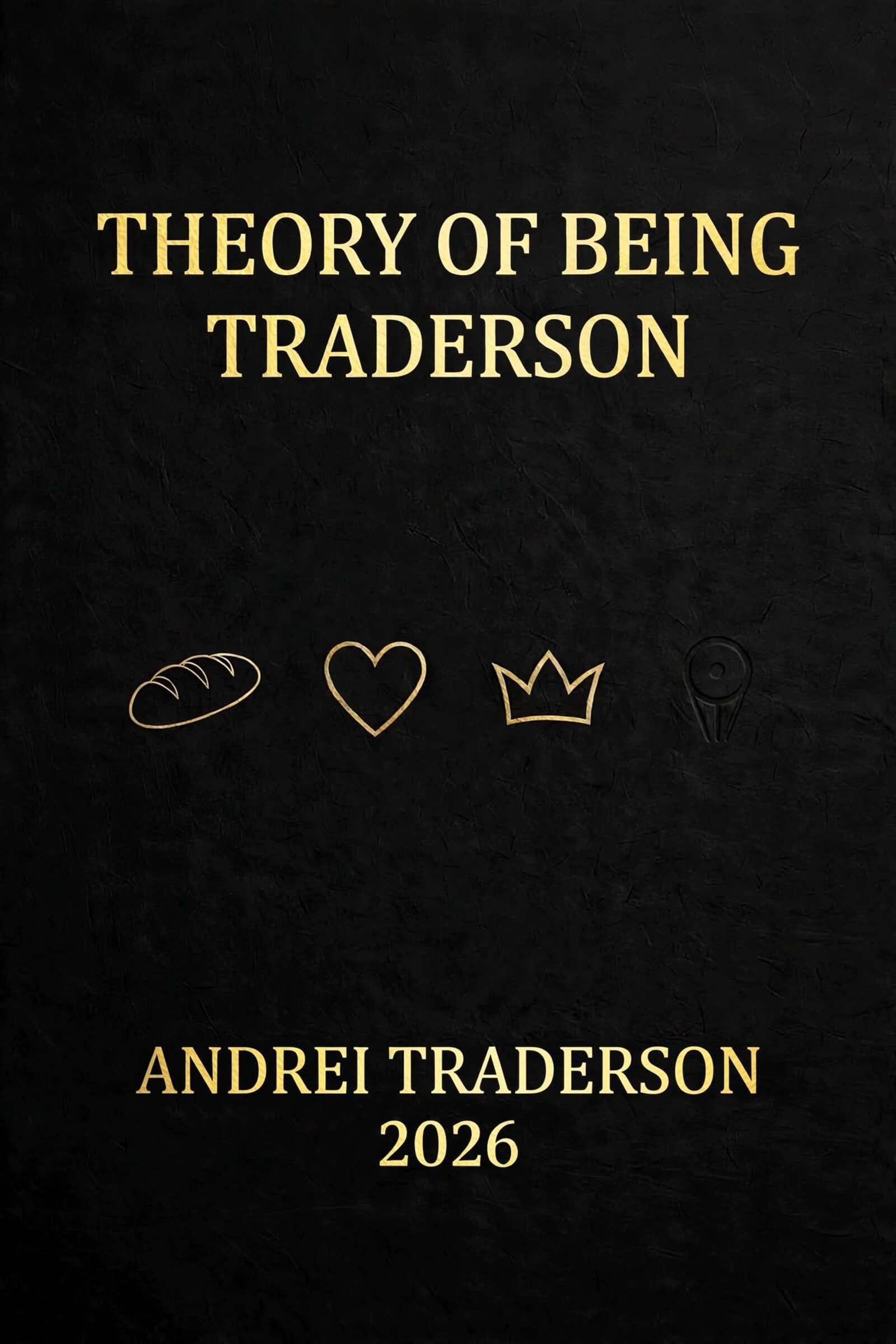
THEORY OF BEING TRADERSON
Introduction. Three Words About Life
I can explain a human being with a multitude of words: reason, love, labor, faith, freedom, and fear. But if I step back and look at everyday life without embellishment, I see three simple and insistent beginnings.
I must eat. I feel desire and seek closeness. I want to be noticed, recognized, remembered — or at least not humiliated and not rejected.
Thus begins my theory of being.
I do not consider food, sex, and vanity to be three random weaknesses, nor do I propose to condemn a person for them. I regard them as three hypostases of existence: through them I sustain life, experience its joy, and strive to surpass my present limits.
Food says: “I live, I nourish my body and taste life.”
Sex says: “I experience the highest bodily pleasure and can continue life in offspring.”
Vanity says: “I want to develop, to achieve, and to leave a trace.”
In the first hypostasis I see both benefit and pleasure: proper nutrition sustains health, and taste turns necessity into joy. In the second I join pleasure and the continuation of the species. In the third I use the word “vanity” in a broad authorial sense that I myself define: I include in it ambition, fame, striving for development, recognition, and achievement.
I propose a model of one hundred percent: harmony arises when vital forces are distributed among the three hypostases evenly — roughly 33.33 percent for each. I do not mean a literal counting of time spent at the table, in intimate life, or at work. For me this is a principle of measure: each domain matters, but none should take so much strength that it deprives me of the other two.
If food turns into gluttony and occupies an excessive place, I see how it can take attention and strength away from sexual life, development, and achievement. If sexual desire grows into promiscuity and subordinates life to itself, it violates the same measure. If ambition, fame, and achievement absorb a person, they too become a source of disharmony.
In my theory, a person wholly absorbed by any one of these hypostases loses quality of life and does not attain genuine happiness: abundance of food no longer becomes joy, uncontrolled striving for sex does not replace fullness of relationships and life, and endless pursuit of fame and achievement brings no peace. Excess promises satisfaction, but by displacing the other two hypostases, it deprives one of balance. I understand harmony not as renunciation of pleasure, desire, or success, but as their coordinated presence in measure.
I include in my model one more image — the black hypostasis, which I call the “self-destruction toggle.” I do not consider it a fourth healthy need, nor do I allot it an equal share in the formula of one hundred percent. For me it is a metaphor for a state or direction in which a person ceases to maintain harmony and begins to harm his own life — sometimes intentionally, sometimes without fully realizing where his actions lead.
With this image I can denote destructive dependencies and habits: abuse of alcohol or drugs and other forms of behavior that undermine health and distance one from care for the body, intimacy, development, and future. But I do not wish to turn metaphor into diagnosis or accusation. Addiction is complex and often requires professional help; a suffering person is not reducible to weakness of will.
It is especially important for me to separate this metaphor from congenital, chronic, and incurable diseases. Disease by itself does not mean that a person has flipped the “toggle,” chosen self-destruction, or ceased striving for harmony. It may be a trial, a limitation, or a circumstance a person did not choose to face. In my theory the “toggle” denotes an image of a self-destructive course, not the value, guilt, or dignity of a sick person.
Why these three hypostases? I see in them three simple questions I answer every day:
What sustains my life?
Whom or what do I yearn for?
How do I want to be seen, and who do I want to be in my own eyes?
My answers change. For one person food is the joy of a common table, for another — care for health, for a third — struggle with scarcity. Sex can mean passion, tenderness, curiosity, closeness, or conscious abstinence. Vanity can appear as desire for fame, wish to look good, pride in mastery, or painful dependence on others’ opinions.
I do not want my theory to become a judgment upon people. I conceive it as a map, not a sentence. A map helps me notice where I am; it does not decide for me where to go.
In this book I test the model against experience. What does equal distribution mean? Can harmony be different for different people? Where does healthy desire for recognition end and the power of vanity begin? How to distinguish attraction from intimacy, and satiation from pursuit of excess? And most importantly: is it possible to live so that the three forces do not destroy one another?
I begin with a simple assertion, but I do not believe a theory must remain simple. I will have to refine it, argue with it, and, if necessary, change it. I offer three supports and invite the reader to join me in testing whether they can bear the weight of a human life.
Спасибо за чтение
Вернуться к книге