
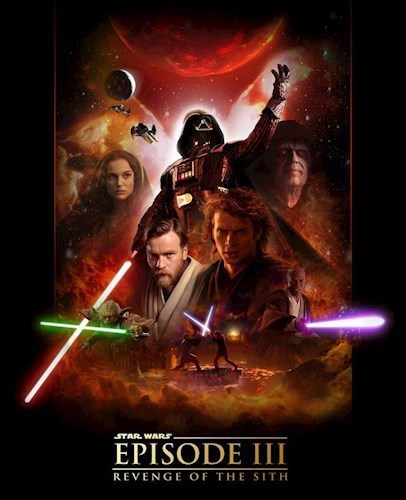
Star Wars. The fall of the Jedi
Chapter 1. The Death of Count Dooku
War! The Republic shuddered beneath the merciless blows of the Sith Lord Count Dooku. Heroes fought beneath the banners of both sides. The ring of evil closed.
General Grievous’s daring operation had succeeded: his forces breached the Republic capital and the droids seized Chancellor Palpatine, head of the Galactic Senate. As the Confederate droid army tried to withdraw from the besieged capital with their priceless hostage, two Jedi Knights made a desperate attempt to free the Chancellor from captivity.
They planned the operation from start to finish and had calculated the Chancellor’s location: Grievous’s flagship, the Invisible Hand. Master Kenobi and his former apprentice, Anakin Skywalker, fought their way to the starship.
— You saved my life, Anakin, — Obi-Wan breathed.
— I’ve lost count of how many times I’ve done that, — Anakin replied with a brisk joke.
Their appearances differed. Obi-Wan wore the traditional white Jedi robe, while Anakin had been wearing black for some time; as an officer of the Secret Police he was required to wear that color, and his role as a general required a black cape that fluttered behind him. In recent years the young Skywalker had made a career many could only dream of. He had joined the Secret Police almost at the start of the Clone Wars. The Chancellor had noticed his skill at sabotage and covert operations and had immediately appointed him, granting him the rank of captain. The Jedi had not objected — they often served on covert missions and rarely fought as conventional infantry or artillery, with few opportunities to use the Force openly.
An ambush awaited them aboard the starship, but the attackers were ordinary battle droids, easily handled by seasoned Jedi. Soon Kenobi and Skywalker reached the ship’s control center. There they found two figures waiting: the captive Chancellor himself, seated in a chair, and the traitorous former Jedi turned Sith — Count Dooku.
— Who would have thought it? — Dooku said, eyeing his guests. — General Skywalker himself comes to visit.
— You owe me one, Dooku, — Anakin snarled, clenching his artificial hand into a fist.
Over the years he had grown used to the metal arm; its synthetic skin felt almost real. Still, he could not forgive himself for the terrible mistake in a past duel that had cost him more than any lesser injury — a mistake that had left scars deeper than the loss of flesh.
Dooku ignited his lightsaber.
— Anakin — he’s provoking you, — Obi-Wan warned, drawing his own saber.
— Don’t worry, Obi-Wan, I’ll take him down this time, — Anakin said.
— Still as arrogant as ever, — Dooku smirked. — You remind me of Qui-Gon, my apprentice in younger days.
— Don’t mention his name, — Obi-Wan snapped. — You betrayed Qui-Gon when you joined the Sith.
— Qui-Gon died at the hands of a Sith, — Dooku’s face darkened a little, — but who sent him to his death? Who deceived him for years, and when he drew close to the truth, exposed him in disgrace? The Jedi.
— What are you talking about? I don’t understand, — Obi-Wan said.
— I know he didn’t share his discovery with you. He revealed his secret to me — apparently he trusted me more than anyone else, — Dooku replied.
— Stop talking! — Anakin could not bear it. — We are not here for a debate. Count Dooku, lay down your weapon and come with us. You’re under arrest.
Dooku’s expression shifted as if he had brushed off a haze of memory.
— I will keep my weapon, — he said coldly.
— So be it, — Anakin answered, and charged.
Obi-Wan followed, attempting to read his apprentice’s movements so as not to get in the way. The opposite happened. Because they both attacked at once, they interfered with each other and blocked each other’s openings. Dooku took advantage of their misstep and parried with ease.
— You’re in my way! — Anakin shouted to Obi-Wan. — I can handle him alone.
— Have you forgotten how the last fight ended? — Obi-Wan retorted.
Before Obi-Wan could finish, a heavy object hurled by the Force struck him on the head and knocked him to the floor. Obi-Wan lay unconscious. Anakin was alone.
The duel turned into a fight between masters: a master of the light and a master of darkness. Skywalker fought with restraint this time; he did not repeat the haste of the previous duel. His metal arm proved useful — he caught and deflected a thrown object Dooku hurled with the Force. Anakin struck back with surprising speed. A series of blows rained down on the dark lord like lightning; moments later Dooku was disarmed and sank to his knees.
— Finish him off, Anakin, — Chancellor Palpatine said quietly, watching the duel.
— Anakin, no! — Obi-Wan cried out, struggling to rise. — We must bring him alive.
— Kill him, — Palpatine insisted, more urgently this time.
Rage filled Skywalker’s chest; his hearing narrowed to a harsh drum. He raised his saber and, in a single instant, severed the head of the hated enemy from his body.
— What have you done? — Obi-Wan leapt to his feet, clutching his bruised skull. — He was unarmed! He should have been brought to trial.
— I had other instructions, — Anakin said, surprised at the coldness of his own voice.
— What? Are you saying the Secret Police execute people without trial? — Obi-Wan asked incredulously.
— Only in exceptional cases — and this was such a case, — Anakin replied.
— And why am I only hearing this now? — Obi-Wan demanded.
— Otherwise you would have interfered, — Anakin answered.
— You can’t do this! — Obi-Wan turned to the Chancellor. — You’re breaking the law.
— I am the law, — Palpatine said imperiously. — The Senate has entrusted me with emergency powers, and I have judged that this criminal should not live.
— So that’s how you earned your general’s cloak, Anakin, — Obi-Wan said bitterly. — Violating everything the Republic stands for. If this is the road you choose, go without me.
With that he walked away.
— The Jedi have always been afraid of dirtying their hands, — Palpatine murmured softly.
— Don’t forget, Chancellor, I’m a Jedi too, — Anakin replied, switching off his saber.
It took time to free the Chancellor from his restraints. Anakin expected Obi-Wan to be waiting outside the door with Secret Police agents — it would have been unwise to try to force their way out alone while General Grievous still commanded the ship with Trade Federation officers aboard. But Obi-Wan was not there.
— Agent Brandon, — Skywalker asked, adopting the businesslike tone of a police commander, — where is Master Kenobi?
A pale, plump, unremarkable man stepped from among the agents. — My General, — he said, — Master Kenobi asked not to be detained. R2-D2 received an attack signal and he went to assist the droid.
— Very well, then there’s nothing stopping us. The elevator isn’t working, but if R2 can get it up and running, we’ll be out of here fast.
Anakin’s plans did not come to fruition. When Obi-Wan was around he always handled the tactical details; Anakin was a strategist and required a tactician to work out the specifics. Without his master’s presence, a mistake occurred. As they walked down the corridor a force field sprang up around them, sealing Anakin, the Chancellor, and the four accompanying agents. There was no way to break it.
— R2, we’re trapped, — Anakin said into his commlink; static was the only answer. Apparently R2 had not yet repelled the attack or was damaged. Skywalker’s annoyance mounted, but the Chancellor did not scold him. Their complaints continued until droids surrounded them and disarmed them.
— This evening is mine, — General Grievous rasped, amusement in his voice. — For the second time in a month I have captured the Chancellor of the Republic. And now he brings me more valuable prisoners — General Skywalker himself, it seems. I had thought you were older.
— General Grievous, I expected you to be taller, — Anakin snapped back.
The cyborg emitted a hollow chuckle. Once a powerful warrior and humanoid of a distinct race, Grievous was now more machine than living being. His body had been so badly damaged that it could function only when grafted into a droid frame — like a mollusk inside a metal shell. Rumor held his people had become dependent on technology, choosing to ally with the Trade Federation or remain neutral.
— The Jadeite saber, — Grievous said, holding Skywalker’s lightsaber in his metal hand, — will be a fine addition to my collection.
He pushed back the cloak hanging from his back and slipped the saber into an inner pocket among other trophies. Anakin surveyed the control room: computers, green-skinned Trade Federation officers, and two heavy battle droids.
— Where’s the other Jedi? — Grievous demanded of an officer. — Master Kenobi. You said they entered together.
— They split up, — the officer stammered. — The second Jedi disappeared from our scanners.
— Where did you last see him?
At that instant several things happened at once. A Trade Federation officer began to click keys to show the general video evidence, but one of the heavy droids jammed and moved, firing without command at another officer. People ducked for cover; the Chancellor and the Secret Police agents were pressed back against the bulkheads to avoid stray shots. Anakin felt something — a pull in the Force — and leapt; a lightsaber blade sliced his handcuffs. Obi-Wan now stood in the room beside them, having apparently cut through the deck beneath a computer console. A second droid attacked, but Anakin reclaimed his saber from Grievous’s pocket and blocked the assault. Moments later the droid lay in pieces. Obi-Wan severed the head from the jammed droid and strode to meet Grievous.
— So the second one appears, — Grievous growled. — Fine — you will all perish together. Dooku foresaw this.
With that he swung his metal staff and smashed the viewport. The glass shattered; a sudden rush of vacuum swept Grievous and anyone too near the breach into space. Those inside clung desperately; one Secret Police agent failed to hold on and was pulled away into the void. Metal shutters slammed down, sealing the room from the vacuum. An emergency alarm sounded: the starship was failing and all rescue pods had been used.
— Can you handle a ship this size? — Obi-Wan shouted to Anakin, who had taken the pilot’s seat.
— I think I can manage, — Skywalker replied, — but what did Qui-Gon tell Dooku?
— We’ll never know now that you killed him, — Obi-Wan said.
— Dooku was a Jedi, — Anakin muttered, pretending not to hear the sting. When exactly had he turned to the dark side, and why had the Council missed it?
— That’s a question for another time, — Chancellor Palpatine observed.
— Not now, — Obi-Wan cut him off as the ship’s attitude shifted and everyone struggled to keep their balance. The starship blazed as it entered Coruscant’s atmosphere; pieces of the hull sheared away. The capital below had already endured a day of fighting between the Clone Army and the Trade Federation’s droids. There was no time to think — only to survive. Fire-tenders swept alongside to cool the burning skin, but only a pilot could land the crippled vessel.
— We saved each other once, Obi-Wan, — Anakin attempted a joke over the roar, — but if we make it down in one piece, you still owe me.
— What do you mean, if? — Obi-Wan shot back.
— I mean don’t expect a soft landing.
The descent was brutal. Anakin barely managed to bring the ship down on the runway. For a minute, everyone was thrown in their seats into unnatural postures. When the ship halted, the survivors checked themselves for injury. Most were unharmed, though Agent Brandon and two other Secret Police officers were violently ill from the impact. The Chancellor was safe and the immediate danger had passed. Republic forces controlled the landing strip — the Trade Federation had been forced back from the city and their bold sortie had failed.
Chapter 2. On Coruscant
Agent Brandon asked at once to be taken to the hospital, and two officers accompanied him. Escorting the Chancellor back to the Senate Palace were Anakin, Obi-Wan, and another agent from the Secret Police. When they arrived, Obi-Wan found an excuse to slip away. No one tried to stop him; after all the intrigue of the day, it would have been awkward for him to remain in such company.
A number of senators, ministers, and even Mace Windu, head of the Jedi Order, met the rescued Chancellor at the palace entrance. Windu’s robes still bore the marks of recent combat; they were torn and stained. It was clear the Master had been in the thick of battle. He nodded to Anakin and immediately began speaking with the Chancellor.
— Chancellor Palpatine, are you all right? — he asked politely.
— Yes, thanks to two Jedi Knights. They killed Dooku, but General Grievous escaped again, — the Chancellor answered.
— Grievous runs and hides like a coward, — Windu said.
— When Count Dooku is gone, he will command the droid army, and the Senate will vote to continue the war while Grievous remains at large, — Palpatine warned.
— Then the Jedi Council’s primary task will be to find Grievous, — Windu concluded.
Out of the corner of his eye, Anakin saw a delegation of Secret Police approaching in haste. At its head was a tall man with deep-set cheeks and wisps of grey hair — General Cyrus, director of the department. He wore a fresh suit, as always aiming to appear impeccable.
— Good to see you, Skywalker, — he said without expression.
— Yes, sir. Count Dooku is dead, — Anakin replied.
— Excellent. What did the Chancellor say?
— He confirmed your order.
— Then I have little to fear beyond resigning in disgrace, — Cyrus murmured.
— Resignations? — Anakin pretended not to understand.
— Of course — I will retire. The enemy attacked our capital and kidnapped the Chancellor. We missed it all. In my case, resignation is preferable; otherwise, I might be accused of treason and imprisoned. But what of the head of the Jedi Council? Windu will be expected to prove his loyalty to the Republic. They missed the attack too.
— There aren’t many Jedi left on Coruscant, and Dooku was once one of them, — Anakin said.
— I know, Skywalker, — Cyrus replied. — If the Council does not dismiss Windu, the Chancellor will be furious. Believe me — I know him well.
Soon Cyrus made his way to a meeting of the Security Council. Normally present were the Vice-Chancellor, two ministers, the Chief Prosecutor, the head of the Clone Army, the head of the Jedi Order, and the director of the Secret Police, together with the Chancellor. Anakin could not attend; he later learned the content of that meeting only from participants’ reports. It emerged that Cyrus was quickly dismissed — a resignation he accepted without protest. Then Palpatine demanded the resignation of the Jedi Council’s leader. What followed was unexpected: Windu refused to discuss or even table the matter for Council consideration. Instead, he delivered a measured speech about the long history and traditions of the Jedi Order. It was odd. Windu might have stalled, taking the issue to the Council and buying time; the Council would likely have rejected dismissing its head on the first vote, and the crisis could have died down. But Windu stood firm, and Palpatine erupted in rage, loudly complaining of his humiliations while in captivity. At a time like that, they needed Master Yoda — but Yoda, spiteful or otherwise influenced, had departed the day before for Kashyyyk to perform rites at a local Jedi temple. With the planet under a temporary orbital blockade, his return to Coruscant was uncertain.
While politics swirled, Anakin had other thoughts. A boyish excitement began to beat in his chest as his taxi climbed toward the high-rise where his wife lived. On the top floor was their apartment — Padmé, former queen and now senator, lived there. He had not seen her in a long time; had it not been for this desperate sortie to the capital, he might have been away for months on the front lines. He found himself oddly glad for the separation and at the same time longing for reunion. The feeling was like the early days of their love: sharp, sweet, and electric. Over time, their happiness had settled into habit; smiles and embraces became routine and less frequent. Sometimes Padmé’s tenderness felt overwhelming to Anakin, though he never said so. Now, apart, he expected her arms and kisses — the thought intoxicated him.
By the time the elevator reached the top floor, he was racing down the corridor, opening the door with his key. The apartment was quiet — until a deep, masculine voice echoed from the living room.
— I became a senator thanks to you, and many in the Senate still remember and appreciate you, — it said.
Anakin entered, alert and braced for anything. In the chair sat a familiar, odd-looking figure: Jar-Jar Binks, the Gungan whose floppy ears and long snout made him unmistakable.
— Jar-Jar? — Anakin blurted, surprised. — How are you here…?
Jar-Jar did not wait for the sentence to finish; he leapt up and rushed to embrace his old friend. Anakin halted him with a gesture and, with a gentle use of the Force, eased him back into his seat.
— Did you just use the Force? — Padmé’s voice, both sweet and stern, sounded nearby.
— Sorry — I’m a rough Jedi, — Anakin replied.
— And that justifies using the Force against a friend? — she chided.
— No excuse, — he said. — Jar-Jar, come on, let’s hug.
Jar-Jar sprang up and embraced Anakin again. Anakin returned the hug, then smiled as Padmé smiled and joined them. It was obvious she was restraining herself slightly in front of their guest.
— Jar-Jar, my friend, — Anakin said, sinking onto the couch. — Were you here on Coruscant during that terrible attack?
— Me wanted to be close to Padmé, to support her, — Jar-Jar replied.
— He was worried about you, — Padmé said. — And so was I.
Padmé’s flush told Anakin she felt the same flutter in her chest; for a moment he remembered how vivid their earliest feelings had been. To distract himself, he recounted the mission in lighter terms, omitting the sharpest moments. He portrayed Dooku’s death as more orderly than it had been, and described Grievous in a caricatured way — hunched, coughing, his voice a crude rasp. Everyone laughed.
— Me tell you what, — Jar-Jar chuckled, — a father like you will make a hero of the child.
— A child? What child? — Anakin asked, puzzled.
Padmé’s expression shifted; she looked reproachful at Jar-Jar. The Gungan slapped his knee and covered his face, clearly having spoken too freely.
— What’s wrong? — Anakin asked, his eyes fixed on his wife. She sat across from him, petite as ever with hair falling over her shoulders, but something was different. He felt as if a third heartbeat pulsed inside her — an odd sensation.
— I’m pregnant, Ani, — Padmé said.
Confusion crossed Anakin’s face. He looked from her to Jar-Jar, then back. The idea of a third heartbeat made sense only when he realized the baby's beating could sometimes be felt in time with the mother’s.
— Are you happy? — Padmé asked.
— I… I don’t know how to express my joy! — he stammered.
He seized Jar-Jar’s hands, lifted him out of the chair, and danced a clumsy step. Jar-Jar gamboled along, humming a Gungan tune of vowel-rich nonsense. Finally, Anakin collapsed onto the couch beside Padmé. He cupped her face and kissed her. The kiss deepened; he wrapped her in a fierce embrace.
— Me have to go now, me have to meet with the senators. Goodbye, — Jar-Jar said, coming to himself.
Padmé saw him to the door and then showered Anakin with kisses. They spent a tender night together — the kind of night Anakin had dreamed of on distant fronts while sleeping in hammocks or on bare planks, enduring long interrogations of corrupt officials. In his memory the desert was softened by images of rare purple flowers and moments of surprising beauty. The room felt like a palace; Padmé was once again a goddess in his eyes. As a child on Tatooine he had seen her as his first young, beautiful woman — the princess who had noticed the slave boy and changed his life. For years he had dreamed of her, confided in that image, and now he was learning to know her as a human being and a partner. They had fallen in love again, as people do, and now they awaited a child.
Padmé mentioned wanting to give birth on Naboo — her home world. With the planet under orbital blockade, anyone entering or leaving required the Secret Police director’s permission. Padmé’s plight made Anakin consider, in practical terms, who would replace Cyrus and whether he could use that office to help her secure passage. He fell asleep with those thoughts, and when he woke the decision had already formed. He received a message on his communicator: the Chancellor requested his presence.
Anakin knew Palpatine’s residence well. The Chancellor had furnished it to his taste — a taste Anakin found peculiar. Statues of rare lizards crowded tables; a terrarium of venomous snakes hissed behind glass. Palpatine loved reptiles; the office was draped in gloomy shades and the chairs upholstered in greenish, snakeskin leather. Anakin sat opposite the Chancellor at the head of the table.
— These are difficult times, Anakin, — Palpatine said. — I would not ask this of you at any other hour. Cyrus has been loyal for many years; I do not know whom to replace him with — except you.
— Me? — Skywalker straightened. — But you know I’m a Jedi.
— …and a Secret Police general, — Palpatine added.
— I am not eager to accept this position, Chancellor. You know the rivalry between our departments. Master Windu and Cyrus have clashed in the past. Now, with Windu’s position threatened, my appointment will strike him as a blow. How will the Jedi Order react?
— We will present it as a temporary measure, — Palpatine said quickly. — You will serve as acting commander during the orbital blockade. Who better to control arrivals and departures? Only a high-rank Jedi of your standing.
— Perhaps, Chancellor, — Anakin replied slowly, — but why do you need a Jedi in such a post?
— Jedis cannot be deceived, — Palpatine said, wagging a finger then growing serious. — Whoever aided my abduction must be punished. Some will be removed from office, some arrested, some sentenced to death. We must purge the capital of traitors. You understand.
— Not yet, — Anakin said.
— The Force opens possibilities, Anakin. You can probe a mind, extract information — a form of coercion. It is considered a dark practice, but in times of danger we may need extreme measures.
— Jedi are not trained for that, — Anakin snapped. — Nor are we allowed to use the Force to compel — it’s the dark side’s weapon.
— But if you tried? You could do it. You are stronger than most Jedi, — Palpatine said softly. — I need someone close to me. You rescued me. My offer stands.
Thoughts of Padmé returned to Anakin — how to get her to Naboo to give birth peacefully. If he were head of the Secret Police, securing her passage would be simple: an official pass, a signed order, and they could leave. He could resign later. The idea settled into him, rational and tempting. He agreed.
— Fine, — Palpatine clapped his hands. — Get to work.
— With your permission, Chancellor, I would like to find General Grievous and deal with him, — Anakin said.
— Obi-Wan has already been sent after Grievous with a battalion of clones. He can handle it. For now, listen to the Force. What does it tell you?
— The Force… my premonitions are vague. I think of Qui-Gon, who wanted to teach me as a boy. The Jedi Council forbade him, and he died in a duel with a Sith. His apprentice, Obi-Wan, took me on.
— And Count Dooku? I heard he once trained Qui-Gon. My captivity was not without meaning — I overheard things. I overheard something, and I saw something. I don't know much about it, since I'm not a Jedi, but Dooku had a place of the Force on Apatros, a temple founded by an ancient Sith. He intended to go there; Qui-Gon had been there before him.
— Let me go there at once, — Anakin said, standing.
— Leave right today, — Palpatine replied. — But first, appoint a deputy to oversee the orbital blockade.
Chapter 3. Apatros
Not much was known about the planet Apatros. It lay in the Outer Ring — poor in population, but rich in minerals. It also had some connection to a Sith named Darth Bane. The Jedi had discovered the existence of this Sith by accident, and it turned out that he had established the “Rule of Two,” according to which there could now be only two Sith: a master and an apprentice. However, many years had passed since then, and the Jedi had made sure to erase the memory of the last Sith they had known.
Anakin knew inexcusably little, but the thought of Qui-Gon drove him forward. He had long tried to learn more about the Jedi who had bought him out of slavery as a child and granted him freedom. It was said that Qui-Gon often played dangerously close to the dark side of the Force — hence the name “gray Jedi.” The dark side allowed him to achieve what the light could not, and for many years Qui-Gon had successfully balanced between the two. Because of this, the Jedi never invited him to the Council of Masters and rarely honored him as they did others.
Years after Qui-Gon’s death, it was revealed that, by order of the late Head of the Jedi Order, he had taken part in creating the clone army for the Republic. But that was not his only secret. It was now reported that he had once been in a Sith place of Force — and afterward, he told his teacher, Count Dooku, about that place and his visit. These two Jedi knew what no one else did.
Padmé had taken the news that her secret husband was now the Head of the Secret Police rather coldly. But Anakin assured her that it was necessary — only then could he ensure her safe passage to Naboo to give birth to their child. She told him about her favorite place on the lake, about the wonderful gardens. Ja-Ja Binks promised to watch over Padmé and support her while her husband was away. Of course, Anakin was uneasy that a talkative creature like Ja-Ja knew of his secret marriage to Padmé, but surprisingly, when it came to personal matters, the Gungan could keep his mouth shut. Only their closest friends knew about the Jedi’s marriage to the former princess.
To reach Apatros, Anakin had to take an entire cruiser — it was the only ship with enough fuel to reach the Outer Ring. Consequently, he had many companions on the way, who clearly saw the Head of the Secret Police descend to the planet’s surface and head toward a horseshoe-shaped mountain range. Anakin nearly despaired when he saw the mountains — it was easy to get lost among them. He had no precise coordinates, and it was a miracle that Palpatine had managed to see them earlier on the monitors of Grievous’s starship.
But suddenly, Skywalker felt a pulse in the Force, and he knew he was close. He guided his ship to the top of a mountain and told his companions to wait. Then he continued on alone, on foot. It was a long trek — about four hours — but Anakin felt no fatigue. He climbed ledges, descended into gorges, and followed winding paths that led to dead ends, forcing him to backtrack again and again. It was exhausting, and when yet another trail ended in a rocky wall, Anakin thought he was at a dead end once more. But then he noticed what seemed like a doorway in the rock. As he approached, he saw that it was in fact an entire building made of stone blocks, built into the mountain and overgrown with moss. There was no doubt: this was the place of the Force — a temple founded by an ancient Sith.
Anakin approached what from afar had looked like a doorway — three solid stone blocks forming a “P”-shaped frame. There was no door, only a dark cave beyond. He stepped inside, immediately sensing the presence of the Force — yet something else was there, something alive and moving. Anakin drew his lightsaber, and in its reflection he saw the face of a man with a gray beard.
— Who are you supposed to be? — the Jedi exclaimed.
— You don’t need to know my name. It’s enough that I’m human. My ancestors made a vow to visit this temple from time to time and keep watch over it. In return, we were promised good fortune. We have no need of riches, though we own many mines. I don’t know if this place is truly connected to the Sith, but I’m not willing to take the risk — and my family has always kept its promise.
— A promise to whom?
— To one Sith. But I’ve said enough already. I have no wish to talk further, stranger. If you are a Sith, you will pass easily. But if you are a Jedi, you’ll find it very difficult to enter.
Anakin now noticed the gates behind the old man. They were indeed sealed. As he approached, he saw a combination lock — it required a password.
— Wrath opens these gates, — said the old man. — Without wrath, no one has ever passed through them.
— And do you know what that means? — Anakin asked sharply. — Or are you just repeating what your father told you, and his father before him? How long have you been watching over this temple?
— Three years. Since my older brother, who watched it before me, died.
— How did he die?
— I found him here, dead on this very spot, — the stranger pointed to the floor — with a lightsaber wound in his chest.
— Dooku, — Anakin realized. — Three years ago he was already a Sith. Why kill the guardian? So he wouldn’t talk, of course. Naturally, you’ve never seen Dooku yourself, but if he had come here again, he’d have killed you too — or worse, left you alive until you told him who else knew of this place. You’re lucky it was me who came, not him. I won’t harm you. But there’s a password on that door, and I’m sure you know it. I was sent by the Chancellor of the Republic — Palpatine himself. I have authorization.
— That’s not the issue. If I tell you the password of my own free will, I will break my vow. My brother said so. A curse will fall upon our family, and we will lose everything we have.
— The Chancellor of the Republic, do you understand? I could grant you honors you’ve never dreamed of. You and your family would live on Coruscant instead of this wasteland.
But the old man stayed silent.
Meanwhile, Anakin felt a growing pull from the dark side. The concentration of darkness here was so great that he began recalling old grievances and the faces of those who had wronged him. How many times had he stayed silent when he should have spoken? How many times had he held back when he should have struck? Only once had he unleashed his instincts — on Tatooine, when he killed those savage barbarians who had captured and tortured his mother to death. He had slaughtered them all, even their wretched offspring, and would have killed more had there been anyone left. Among the corpses lay a frail, dying woman who had spent her entire life in slavery. His mother had suffered in vain.
Anakin’s metal hand clenched around the old man’s throat.
— In the name of the Republic, I order you to open this door! — he roared.
The old man said nothing. “If I tell you the password of my own free will, I will break my vow,” the words echoed in Anakin’s mind. “Of my own free will…” What did that mean? His mind darkened again — his dying mother’s face returned.
Palpatine’s recent words came back to him: “I know the Force offers great possibilities. You can make a person act against his will — a kind of hypnosis. You can enter a mind, extract what you need, force him to betray his secrets.”
The thought pulsed painfully in Anakin’s head. “I was never trained to do that,” he thought, “but the Force will guide me. This temple belongs to the dark side — it will tell me how to use it.”
The cave and his memories faded, and suddenly an image appeared — mines where men and humanoids toiled together. It took Anakin a moment to realize he had entered the guardian’s mind. He began searching for the brother — and found several old men instead: one was the guardian’s father, another his grandfather, another a miner applying for a pension. Then he saw one more with a gray beard — unmistakably the brother. His words were filled with fear and mystery. He feared the Jedi, feared his mission, but said he was sacrificing himself for his family.
“Password,” Anakin thought, following the trail of fear — until he heard it. “Ostracon.”
Whatever the word meant, Anakin was sure it was the password. He rushed to the gate and entered it. The gates opened — of course they did.
Soon the Jedi stood in a clean, high-ceilinged hall dimly lit by artificial light.
— Welcome to the domain of Darth Bane! — said a voice from nowhere.
Anakin turned sharply and saw a human figure with a bald head, no trace of hair, and a dark robe reaching the floor.
— Sith! — he said, tightening his grip on his saber.
— Alas, no. Only the shadow of a once-great master. I am a projection of Darth Bane, a hologram created shortly before his death. He poured all his memories into me. What he knew — I know.
— Dooku — did he come here? Speak to you? And Qui-Gon?
— I have no memories. I cannot learn. I am merely an archive — a model of Sith behavior. You can learn from me all he knew of the ancient history of the Sith and the Jedi.
— I already know that, — Anakin snapped. — I’m a Jedi, in case you haven’t noticed. Since childhood we were taught that dark Jedi betrayed the Order, created their own, and became so consumed by the dark side that they forgot how to use the light. They became the first Sith.
— No, it was not like that, — the figure replied confidently.
— I don’t want to hear Sith lies. That’s what deceived Dooku. But I won’t fall for it.
— Dooku? — the projection seemed to recognize the name. — I have data on several Jedi of that name. Dooku the First — a Jedi of noble birth. His power surpassed all others, none on the Council of Masters could match him. And so they decided to subject him to ostracism.
— Subject him to what? — Anakin asked, frowning.
— Ah, you don’t know what ostracism is? I shall tell you. It was an ancient Jedi ritual. When one became too powerful, they banished him — forbade him to use the Force ever again. Such a Jedi lived the rest of his life as an ordinary mortal.
— Nonsense, Sith. I’ve never heard of such a ritual.
— Perhaps because you are too weak. Dooku the First was strong — and he was exiled. His descendants were also Force-sensitive. Dooku the Second was less powerful, but when he learned why his ancestor had been banished, he was outraged. Dooku the First had suffered for nothing — simply for being stronger. His virtues were impeccable, his wisdom unquestionable, his mastery unmatched. But he was human. The Council of Masters was then composed mostly of humanoids — only two were of the human race, and both were the strongest. First they banished one, then the other. The humanoids, racially inferior, conspired against humanity and cast Dooku the First out, refusing to serve a human. Dooku the Second sought a seat on the Council himself, even the Head’s seat — and then he, too, was threatened with ostracism. His rebellion was bloody; he took many with him before he fell. The Jedi tried to erase all memory of him, to make the world forget his name, but they could not. His bloodline endured. Dooku the Third renounced his ancestry, his titles, his privileges — and was still ostracized, like the First.
— Venom pours from your mouth, Sith, — Anakin said coldly, — but now I see why your words worked on Qui-Gon, and then on Dooku. Dooku remembered his ancestors, was outraged, and sought revenge. So he turned to the dark side, betrayed both Qui-Gon and the Jedi Order. It’s still unclear to me why Dooku killed the temple guardian. Why didn’t he want anyone else to listen to the same bullshit you’re saying now?
— This is no bullshit. I have confirmed it. Ostracism is real — the Council hides it. In the days of Darth Bane, the ritual still existed. From those exiles, the first Sith Order was born. Usually, an exile was confined within one country, forbidden to leave — a prison the size of a state. Some learned to escape. Three such fugitives met — and founded the first Sith Order. Soon after, their apprentices built the first Sith Empire.
— That ritual doesn’t exist anymore, Sith. I would know. I’ve fought half the galaxy against the Trade Federation, and I’ve never met a Jedi forbidden to leave his own land.
— And how many of them were human Jedi? — asked the figure.
Anakin was already convinced it was indeed a hologram, from the faint flicker of its outline.
— I’ve met many human Jedi, — he said. — Most live on Coruscant, near the Council of Masters.
— Exactly. Close to the capital, under the Council’s watch.
— I don’t see what you’re implying.
— It’s simple. The greatest bearers of the Force are always born among humans. That was Darth Bane’s law, his discovery. He was a great scholar — he knew the Force better than any of his time. His wisdom was unwanted — especially by the Jedi. They feared tyranny, declared his racial theory heresy. They feared that one human of such power would arise that he would take control of the Council and expel the racially inferior. And that would have been just. That is the truth you call the dark side. It isn’t darkness — it’s the strict, inconvenient truth. The Sith are humans, the strongest bearers of the Force, who by right of strength must rule over the weak. It was not the Sith who left the Jedi — it was the Jedi Order that betrayed us, the strongest, and cast us into the shadows.
Anakin now felt clearly that the projection was using the Force, pressing on his mind. The weight of it was crushing; he could barely breathe.
— You are darkness — the Jedi are light, — he forced out.
— That’s what the Jedi say. We called ourselves the dark only because we were driven into the shadows — forced to hide. It was the Jedi who took the light and cast us down into caves and darkness. Our true name is not “dark ones.” Sith means “the strongest” in the forgotten tongue.
The figure’s voice grew louder and louder, until it was echoing inside Anakin’s mind. The pressure became unbearable, and he ran out of the temple.
Once again, Anakin found himself in the mountain hollow — dawn breaking above. Only now did he realize the force of the attack he had endured. Never had he imagined that the dark side could so overwhelm the mind. Reckless — utterly reckless — to have come here without consulting the Jedi, the sages, Yoda himself.
Anakin felt like a guilty schoolboy who had escaped the clutches of a monster — exhausted, barely able to move his legs. After walking a little farther along the path, he collapsed into unconsciousness.
Chapter 4. General Grievous
General Grievous did not remain in open space for long. Soon a rescue capsule picked him up and carried him to the nearest cruiser, far from Coruscant. But even a short stay in a vacuum had damaged his life-support systems, and now the cyborg had to remove the armor from his chest, exposing his lungs. Droids inserted tubes to let him breathe, and set up an IV to enrich his blood. Only after that did Grievous begin to recover and take control of the cruiser himself. With one hand he held the controls, and with the other he occasionally adjusted the tubes protruding from his chest.
At one point, the green-skinned face of a humanoid appeared on the communicator screen — the Viceroy Nute Gunray.
— General, your reckless venture has failed. What of Count Dooku?
— He’s dead, — Grievous rasped, — killed by a Jedi.
— Bad… very bad. He shouldn’t have risked it. Our whole army depended on him!
— He had no choice, Viceroy. The Jedi captured him — and then killed him while unarmed. They’ve lost their damn minds. Everything went off plan.
The Viceroy’s eyes darted nervously.
— Gods, what will become of us now? Will they kill us all? We can’t risk this! I won’t! Let them arrest me — I’ll surrender to the clone army!
— Don’t lose your head, Viceroy. The clones would hand you over to the Jedi anyway — and they’d make sure you never reached a trial.
— Then what should we do? What should we do?!
— First, listen to me. I am now in command of your army — that’s number one. I’ll think of something. Second — contact the Supreme Sith, Darth… whatever his... damn— Sidious.
— No! Impossible. Darth Sidious has spoken to me only through Count Dooku lately. He fears being traced. If we expose him, none of us will survive.
— Then pray, — said Grievous, cutting the transmission.
His course lay toward the planet Utapau, in the distant Outer Ring — where the leaders of the Trade Federation had taken refuge. The journey was long, and Grievous sank into memories. Echoing in his head was the voice of Count Dooku from their last conversation:
— Inevitably, the Jedi will board our starship, — Dooku said. — Naturally, only those away from Coruscant could do it. If I were to wager, I would bet on Master Kenobi.
— Then we must leave before they arrive, — Grievous replied. — If they break in, our plans are doomed.
— We will not run or hide. We’ll wait for them. I’ll meet them and face them in combat. You, General, will prepare a trap — make sure they can’t leave this ship alive.
— I worry about ensuring you leave alive, Count.
— That’s an empty worry, — Dooku smiled faintly. — The Jedi will try to capture me. And likely, they will succeed. When they attempt to extract us, all you must do is aim your weapons at the Chancellor — and the Jedi will surrender. My task is to distract them.
— I don’t like this plan.
— My friend, Grievous, trust me. A Jedi can kill me only in a duel — but I’ll make it so they can disarm me, not wound me. Many fighters fall because they fear losing their weapon. I won’t fear it — therefore, I won’t fall. Once I am unarmed, they’ll have to take me prisoner.
— But others will be there — clones, the Secret Police. They might shoot you when you’re unarmed.
— That’s what the Force is for. The Force can do unimaginable things. I’ve only begun to learn the dark side, and already I’m amazed by its power. Truly, the Jedi restrained me. I’d never have reached such strength had I remained among them. But they are not to blame — they are merely disciples of their harsh ancient teachers. I bear no hatred for the Jedi of this age. After our victory, I’d spare them all. Our only rivals will be human Jedi, and they can be easily won to our cause.
The memory broke off as Utapau’s atmosphere appeared before the ship. Grievous removed the tubes, sealed his armor again, and became once more a cyborg — a mechanical body housing a humanoid heart. He managed to land the cruiser with difficulty. The planet’s surface was porous; one had to descend into a sinkhole to find a landing platform. Grievous handled the maneuver on his first try and entered a spacious hangar, where Viceroy Gunray already awaited him.
— General Grievous, please tell me you have a plan! — the Viceroy pleaded.
— I do. We’ll hold out to the last droid. This place is well-fortified. We can occupy a fortress and withstand a siege for months. Our supplies are sufficient. By then, our allies will strike the Republic — maybe even capture someone for a prisoner exchange. That’s the only guarantee of survival.
— That’s not much of a plan. I can’t stay here! We must complete the ultimate weapon for Darth Sidious, and for that we need years, not months!
— Then perhaps it’s time you told me what that secret weapon is.
— That’s not within my competence, — the Viceroy objected.
— Then connect me to Darth Sidious. I’ll speak to him myself. Enough of this hiding — now is not the time.
— I’ve already told you…
— Ah, I know, — Grievous waved a metal hand, — then just hide somewhere and stay out of my way. I’ve got a siege to prepare for.
Grievous didn’t much trust that mysterious Sith, Darth Sidious, whom he had never seen in person — only as a hooded hologram. He didn’t trust Sith at all, and had his reasons. Dooku, though — that was different. He respected Dooku and had considered him a valiant knight, ready to serve and deserved trust beyond measure. Once Grievous had overheard a conversation between the two Sith; Dooku’s lively counsel with the hologram had left a deep impression upon the general.
— When this is over, what shall we do with our friends in the Trade Federation? — Dooku had asked. — They’re racially inferior as well. We have few allies among the human race, which is strange given our grand purpose.
— Humanoids are useful, — the hologram replied. — They have the resources to build our ultimate weapon.
— Still, my Lord Sidious, they know too much. Surely you wouldn’t wish to leave them alive?
— You are right, Darth Tyranus. The racially inferior always betray. Why wait for it?
— For one reason, — Dooku persisted, — to keep our creed unstained. We already have a poor reputation — no one trusts us. We’ve been exiled for generations. Better to wait until the Viceroy betrays us, even in some small thing. Then we’ll have cause to deal with him, and no one will call us unjust.
— My apprentice, you’ve only just become a Sith. You still remember Jedi virtues. You idealize the Sith order, as I once did. Imagine our green-skinned friends not as sentients but as cattle. A cow gives us milk — and later we slaughter it for meat. No one calls that unjust. We cared for them; they owe us their lives and wealth. We’ll use them as we see fit.
— I agree, my Lord, — Dooku said submissively, — and in other circumstances I would. But now, we must mind our reputation. We must appear just — to show that we are better than the Jedi. If we treat our allies so from the start, who will follow us later?
— If all goes to plan, if we gain the ultimate weapon, then I assure you — no rebellion will ever threaten us again. None will dare defy us. This weapon can destroy entire planets with their populations. Who would dare oppose such power?
Dooku sighed heavily.
— What troubles you, my apprentice? Has compassion stirred in you again — as though you were still a Jedi?
— It’s something else, my Lord. I don’t want us accused of cowardice. To annihilate worlds, to war against women and children — it is cowardly. It will dull our edge. The Sith of old were strong because they faced their enemies openly. Yes, many perished, but it was worth it. I fear this perfect weapon will destroy our strength.
For a moment, silence filled the chamber. It seemed Darth Sidious was truly thinking — perhaps, for once, struggling to find words.
— You have visited that temple on Apatros again, haven’t you? — the older Sith finally asked. — Studied the ancient Sith teachings?
— Yes, my Lord, — Dooku replied. — That place feeds me with anger. I see how unjust the world has been to the Sith through the ages — and that injustice enrages me. Anger helps me master the dark side. Every Sith must have his own source of anger.
— How I envy you, my friend, that I cannot go there myself. I would give much to visit that place — but it’s far too dangerous now.
— To be honest, my Lord, I’d prefer that no one else ever visit that temple. We should post our own guards there.
— Why? That place brought you to the dark side. Might it not bring another Jedi as well?
— But the Rule of Two, my Lord — I remember it, — Dooku said quietly. — If I take an apprentice, I must kill you.
— And I must kill you. Such is the law.
— And yet we have so much to do together.
— Very well. As for the ultimate weapon — to ease your mind, know this: a single demonstration on an uninhabited world will terrify the galaxy. We’ll use it against the unworthy races. Against the Jedi, we’ll fight as tradition demands.
Grievous remembered that conversation — and what came after. Dooku had left the room and summoned him.
— I do not know what you overheard, General, — the Count had said when Grievous entered, — but mark my words: had I turned over knowledge of your eavesdropping, you would already be dead. I knew that Darth Sidious would demand your death, and so I did not tell him. Remember this — if it happens again, I will not be so lenient.
That was one of the reasons Grievous respected Count Dooku — and distrusted Darth Sidious. After all, Grievous himself was a humanoid, racially “inferior” by Sith standards. Unlike the Viceroy, however, the General knew when to hold his tongue, and had proven his loyalty many times. Yet who knew — perhaps his fate too would be the same as the cattle Sidious spoke of.
Now, Grievous was sorely tempted to tell the Viceroy about that overheard conversation, to reveal the Sith racial doctrine — but he stopped himself, knowing what would follow: panic. The Viceroy would lose his head again, and chaos would ensue. What Grievous needed least now was disorder.
He scouted most of the planet, searching for a site suitable for a fortress. Once found, he began hauling in every weapon and supply he could get. He hurried, grew angry with the droids, sometimes even struck them — though it accomplished little beyond the absurd sight of a droid trying to stand up.
One day, Grievous saw that the Trade Federation leaders were preparing a shuttle — clearly intending to flee.
— Where do you think you’re going? — the General roared. — Who gave permission?
— General, — the Viceroy began, — it’s not safe here! We must finish the ultimate weapon for Darth Sidious!
— Then let him tell me that himself.
— I already told you…
— And I say you’ll stay on this planet until the Supreme Sith contacts me. I forbid you to leave.
— You can’t do that!
— I just did.
Truthfully, Grievous wanted them gone — but more than that, he wanted to know what was being done for their salvation. In the end, he got his answer. That same day, the Viceroy handed him the communicator with trembling hands.
Grievous brushed the screen with his metal fingers, and the full figure of the Supreme Sith appeared beside him — face hidden, as always. For a fleeting moment, the General thought that face looked oddly familiar — almost like the Republic’s Chancellor. The notion was so absurd it nearly amused him.
— Darth Sidious, — Grievous began, — your plan has failed. Count Dooku is dead, and we’re about to be destroyed by the Jedi. I’d like to hear your orders for our salvation.
— Everything proceeds according to plan, — Sidious said calmly. — Our victory is closer than ever.
— But Count Dooku!
— Soon I shall have a new apprentice — one far stronger and younger. He will lead the Separatist army.
— You mean you planned Dooku’s death?
— I hear insolence in your voice, or am I mistaken?
— Insolence? I’m furious! Dooku was a warrior — we fought side by side! And you? I’ve never even seen you fight! All you ever do is issue orders, damn it— khh— khh…
Sidious raised his hand, and Grievous felt his throat tighten — as though strangled from across the galaxy.
— Shall I demonstrate my power? I could crush you from where I stand. Do as I command, trust me — and you’ll live.
— Yes… my Lord, — Grievous wheezed, as the invisible grip released him.
— You will send the Viceroy and his entourage to Mustafar and ensure their safety. Remain here yourself — to keep the Jedi from pursuing them.
— Yes, my Lord. May I ask — how long am I to stay?
— Not long. A single battalion of clones and one Jedi — Obi-Wan Kenobi — are on their way. I trust you can handle them.
The hologram vanished. Grievous cursed violently. The situation couldn’t have been worse — but at least he now had Sidious’s promise that his life would be spared. And that was something.
Chapter 5. Diplomats
Ostracism, the dark side, the right of the strong — Darth Bane’s words from the temple echoed in Anakin’s head. When he came to, he was terribly thirsty. He lay on bare rocks in a mountain hollow; his lips dry, he made a movement — and suddenly a canteen of water appeared at his side. The temple guardian had handed it to him; he was still here, he had not fled.
— I was too rough, — Anakin said after he drank and forced himself to sit up. — I should not have treated you like that.
— Just pay me, and we’ll call it even, — the stranger answered.
Anakin smiled at the simplicity of the man, found a few gold coins and handed them over.
— Gold? — the guardian blinked in surprise. — I even take Republic credits. You know, I once visited Coruscant, but I won’t go back.
— And why not? It’s the capital.
— Apparently, my friend, you have only recently become a Jedi. I am a white human male — such as I am are not liked on Coruscant. I tried to open a business there; my business was closed immediately without explanation. Much later I learned that some humanoid had filed a denunciation, claiming I belonged to some syndicate and sought to create a monopoly. Nonsense, but no one checked it — the informant was taken at his word.
— Tell me your name and I’ll correct this misunderstanding, — Anakin offered.
— No need, — the stranger replied. — I won’t return to Coruscant anyway. There I could only be a waiter or a cab driver; they would not let me open my own business. Well, let it go.
The stranger helped Anakin to his feet. Skywalker felt strength return and continued on by himself. He kept thinking about the old man’s words: the young Jedi still understood almost nothing about how the Republic’s economy worked. He only knew that several powerful oligarchs had once formed a monopoly — a trading syndicate later called the Trade Federation. And now that federation was at war with the Republic. How that related to the racial theory — or whether it did at all — nobody had ever explained to Anakin. Finally he rejoined his companions from the Clone Army and together they reached the cruiser. The journey home would be long. Anakin called his wife; he saw Jar-Jar beside Padmé, and other senators who called on her out of longstanding friendship. He promised his wife he would arrange her passage to Naboo as soon as possible. Later Palpatine phoned; he sounded clearly agitated.
— Anakin, don’t say too much, someone could be listening. But tell me, did you see it?
— What?
— The place of the Force, of course. Were you there?
— Yes, Chancellor, and it’s not my best memory. To be honest, the place caused me great pain; it made me recall things I wanted to forget, it made me angry — which is very dangerous for a Jedi.
— I understand, — Palpatine smiled. — Jedi do not know how to master their anger; they try to suppress it completely. Sith, as I have heard, know how to use their wrath. Thus anger does not harm them; it makes them invulnerable.
— But Sith inflict a great deal of pain on others.
Palpatine fell quiet for a moment and spoke more softly:
— Since you were in that place, Anakin, you now possess something most other Jedi do not; you have learned the craft of penetrating another mind. No one will stand before you during interrogation.
— How do you know so much about that place of the Force, Chancellor?
— As I said, I overheard what Dooku said while I was his captive.
— Dooku was not loquacious; it’s strange he revealed so much to you in such a short time.
— You have the grip of a true secret agent, — Palpatine smiled. — But I must go; I’m in a hurry. Stay in touch.
With that, he cut the communicator.
When Anakin approached Coruscant, he felt for the first time that the times had truly changed. A huge queue of transports wanting to land loitered in orbit; on the other side of customs another long line waited to depart. Heavy cargo freighters with containers might stand in line for more than a day; sometimes those carrying perishable food had to discard their cargo after the wait. And it was not easy to get through customs. Those carrying perishable goods were told to queue in a third line leading to Coruscant’s satellite planet. That moon held a vast junkheap; dumping waste into open space was prohibited. Anakin stood in the queue a while, but after six hours he realized that at this pace it would be three days before he cleared customs. He decided to break out of the line and left the columnPatrol shuttles surrounded him at once and demanded papers. When they learned he was the head of the Secret Police, they let him pass without even searching his luggage. In the rearview mirror Anakin saw the line behind him erupt into chaos: some tried to skip ahead, others argued and offered bribes to the customs officers. It was ugly to watch, and Skywalker could hardly imagine his pregnant wife spending days aboard a transport ship just to get through customs. He had to find a way to get her through without that trouble.
When Anakin finally reached home he looked exhausted and troubled. Padmé tried not to bother him; she ordered food at a restaurant. Anakin suddenly wondered who owned that restaurant — human or humanoid? It turned out to be a humanoid. But when the doorbell rang, a white human male appeared on the threshold — the food delivery man. Anakin recalled the temple guardian’s words on Apatros, but he tried to push the thought away. Until evening he managed to.
High guests arrived that night. First came Jar-Jar Binks — the floppy-eared senator and family friend.
— Ani, something must be done, — he begged. — I cannot leave the planet; my Gungan friends own a restaurant in the south of the city and they are nearly ruined by the orbital blockade.
— Don’t worry, my friend, this will end soon, — Skywalker reassured him. — Once General Grievous is captured, I expect the orbital blockade will be lifted.
— Yes, provided Palpatine does not dream up something else, — Padmé said.
— Is there any reason not to trust him? — Anakin asked.
— Well, there are reasons, — Padmé answered.
— Share with me, I head the Secret Police, I can open an investigation, — Anakin offered.
Before Padmé could reply, the doorbell rang again. Senator Bail Organa arrived — a white man with a narrow black moustache and small beard. Two more senators followed: a white woman with a distinctive haircut — Mon Mothma — and the dark-skinned senator Nië̈́ Alavar. After greetings, they resumed the conversation that had been under way.
— I think all senators here agree the war has reached a dead end, — Mon Mothma said.
— I agree. The orbital blockade will destroy the capital’s economy, — Nië̈́ Alavar added.
— Perhaps someone intends that, — Senator Organa suggested.
— I don’t understand, — Anakin broke into the discussion of the high-ranking persons. — Are you suggesting Chancellor Palpatine is to blame?
— We have no grounds to accuse him, — Padmé said soothingly. — We only suspect he’s been in office too long. Recently he held a Senate vote that granted him additional emergency powers. Enormous power is concentrated in his hands.
— Fine. Then fewer words, more action. Explain — what does he gain from wrecking the capital’s economy?
— It’s simple, — Alavar said. — He is hostile to humanoid races. Palpatine is a white human male, and he may want to ruin humanoid businesses on Coruscant.
— Do you have proof?
— Only circumstantial. In recent years Palpatine purged the Secret Police and dismissed all humanoids from the force. Now among your subordinates, General Skywalker, there are only white human males. Moreover, the Clone Army consists entirely of white males — even created to the template of one of the most beautiful and physically enduring human nation.
— The clone army was created by Qui-Gon, and he was a Jedi Master, — Anakin replied, — and the Secret Police in recent years was headed by General Cyrus.
— By the way, accept my condolences, — Senator Organa said.
— Condolences? What happened? — Anakin asked.
— You didn’t know? While you were away, General Cyrus died. Official sources report he choked to death on an apricot pit.
— A strange death, — Mon Mothma remarked. The remark sent Anakin into thought for a while. The senators continued speaking among themselves.
— The Trade Federation is no longer dangerous, — Alavar said. — Count Dooku — the white male who stood behind that monopoly — is dead. Now the syndicate is led by humanoids; by nature they are less likely to build durable monopolies.
— Yes. Now, certainly, military action makes little sense, — Organa added. — We should stop the war and enter negotiations.
— Negotiations? — the word pricked Anakin painfully. — With whom? With that coughing machine — General Grievous? Or with those green toads? And why all this talk about white human males, as if that race is somehow inferior?
— Allow me, — Organa moved closer. — I’ll lend you a book by a scholar at our university. She’s a humanoid and very intelligent. She argues that white human males tend by nature to create monopolies. Historical examples abound: most Sith were white human males; major dictators and syndicate founders were of the human race. Humans are more capable of production than any humanoid race, which makes them more prone to forming monopolies. The Trade Federation was initially founded by human males, later replaced by humanoids. They did not create the monopoly; they only wove intrigues upon a foundation laid before them. We were negotiating with them until Count Dooku appeared. He headed the Trade Federation’s army, and then war soon followed. Dooku was to blame for the war starting. If not for him, the Trade Federation might at some point have sold a controlling share and ceased being a monopoly. A deal was even prepared. Dooku appeared and spoiled the deal. Now Dooku is dead — we can return to the old deal and solve the problem via negotiations.
— My head is spinning, — Anakin said. — Is monopoly always so bad?
— Certainly it harms free trade and stifles competition. Free competition is the key to a prosperous economy. I understand — it’s not simple; I too did not grasp it until I read that book. You should read it.
— One question, Senator Organa. You are a white man yourself, and you oppose your own race?
— Yes, I am white, but I am a senator — I represent a planet populated by humanoids, not humans. I defend their interests, not my own. The Jedi act the same way, it seems.
— Yes, that is the code, — Anakin agreed.
Still, a seed of doubt was sown in him. Padmé joined the small group of senators who formed a minority in the Senate; the press called them the Diplomats. They advocated talks with the enemy. Anakin did not fear them; he believed the war would soon end in the enemy’s capitulation. The next day he was summoned to the Council of Masters. It was already clear what the subject would be: appointing a Jedi Knight to head the Secret Police.
— Tell us what you feel, — the hologram of Master Yoda said from a chair near the window.
— My heart is full of compassion, — Anakin answered. — I will keep this feeling within me, no matter what.
— How do you intend to keep compassion, — Master Mace Windu, a dark-skinned man, asked, — when your post requires interrogations and investigations? In recent years Palpatine has shaped the Secret Police into men loyal to him. They sometimes behave cruelly; the press criticizes them, even hates them. You are very vulnerable, Anakin — how will you bear all that?
— I will endure, I hope not for long, — Anakin replied.
— Sometimes one day is enough to fall under the influence of the dark side, — Yoda said.
— You have suffered much, Anakin, — said the humanoid Jedi with the egg-shaped head, Ki-Adi-Mundi. — You were traumatized in childhood — separation from your mother, then Qui-Gon’s death. We fear this will affect your psyche and may trigger anger, as once on Tatooine. But you were then still an apprentice; now your training is complete and such mistakes will be unforgivable.
— Yes, I agree, — Master Windu answered. — We are very concerned by your appointment and by the fact you accepted it without consulting us.
— There was no time, — Anakin said. — The Chancellor dispatched me immediately to the Outer Ring. I agreed to the post thinking of Padmé — my wife. She expects a child and wants to give birth on her homeworld, Naboo. While I head the Secret Police I can get her there without hindrance.
— This news troubles me even more, — Yoda pleaded, — you got a marriage permit because we thought it would make up for your traumatic experience. But attachments are dangerous, especially when we get attached to children. Fear of losing someone close to you can lead to wrath. If to fear we succumb, falling under the influence of the dark side we risk.
— Yes, a child at such a time is a severe test, — Master Windu said. — But something must be done. As head of the Secret Police, Anakin, you will conduct interrogations of high Republic officials. You will meet thieves and traitors, but you must feel compassion for them as well — remember that.
— A hard trial indeed, — said Ki-Adi-Mundi. — I doubt any of the members of the High Council of the Jedi would easily handle it. Interrogating the Republic’s enemies while feeling compassion is difficult even for a master. And Anakin, you are not yet a master. Better you refrain entirely and leave interrogations to the agents — your appointment is temporary. Use your rank to help Padmé and then step down.
— I will try to refrain from interrogations and undertake them only by the Chancellor’s order, — Anakin said.
— That’s something, — Windu sighed. — And one more task we have for you, Anakin. The Chancellor arouses our suspicions. We know he is physically ill and perhaps mentally troubled. We must ensure he does not seek dictatorship. You are close to him — observe him. We are especially interested in his mental state. Take no action; your duty is to watch and gather evidence, then hand it to us. If we have enough evidence of a move toward dictatorship, we will demand his resignation.
— Yes, Master. Permission to go?
— Go on.
Chapter 6: Obi-Wan Pursues Grievous
The Jedi Council had not idly asked Anakin to observe the Chancellor’s health. On the day Palpatine was rescued and brought back to Coruscant, he demanded the presence of his personal physician. During the Security Council session, he clutched at his heart several times, summoned the doctor, and took some kind of mixtures. The first time was right after Master Windu refused to resign and even refused to raise the issue before the Jedi Council. After his fiery speech, the Chancellor called for the doctor again. Finally, he ended the meeting, citing stress and poor health.
By then, Master Windu had time to change out of the robe torn and stained with droid oil. In new attire, he arrived at the Jedi Council chamber, where holograms of Masters Yoda and Ki-Adi-Mundi already shimmered, alongside several Masters in person — including Master Obi-Wan Kenobi. As expected, Windu’s first topic was the Chancellor’s health.
— It is said he suffers from gout, — Obi-Wan began, clearly well-informed. — He also has high blood pressure, insomnia, and a weak heart — and all this even before his abduction. Considering what he went through in captivity, deprived of medicine, doctor, and rest, yes — his condition may well cause concern.
— Perhaps that is for the best, — said Master Ki-Adi-Mundi. — Palpatine clearly strives for dictatorship. A little more of such rule and he will destroy the Republic. I don’t recall any Chancellor holding office this long.
— Such cases in history there have been, — said the short, green-skinned Master Yoda. — There have been Chancellors who longer have served, and even those who was longer , who have died in office.
— That’s my point, — Ki-Adi-Mundi continued, — if the Chancellor is as gravely ill as we believe, then soon his health will make it impossible for him to remain in office. He’ll either die or be confined to a hospital bed. We need not fear his attempts at dictatorship.
— Unless he’s deceiving us, — Mace Windu said darkly. — He uses his sickness too conveniently, too deliberately. He knows the Jedi must preserve compassion within themselves. Today he demanded my resignation — demanded! As if he were my superior. He doesn’t even know our traditions. It isn’t he who decides when the head of the Order steps down; only the Jedi Council can. Instead of sending us a formal request, he began coughing, clutching his heart, complaining of life, and urging me to abdicate right there in the Security Council.
— Strange indeed, — Ki-Adi-Mundi agreed. — And what did you tell him?
— I refused. I would not even bring the question before the Council. If he wants to discuss my resignation, he must petition us properly.
— If he only pretends to be ill, then it must be a carefully staged play, — Obi-Wan said thoughtfully. — His physician and entourage would have to play along; they seem entirely convinced he’s sick. They are no actors — not before this, at least.
— Yes, Master Kenobi is right, — Yoda said. — To reach into someone else’s mind and make them believe they are sick when they are healthy — that only a Sith Master can.
— Sith are said to be destroyed, — Windu replied. — Dooku was the last, and his teacher was the late Darth Maul. There are always two, no more. Yet once before we were mistaken, thinking the Sith extinct. We must test the theory. Can Palpatine’s doctor be interrogated — and during interrogation, can we trace whether the dark side has touched his mind?
— That effect I could track, — Yoda said, — but none of you will be able to do that, I’m afraid.
— Then we must bring you to Coruscant as soon as possible, — said Obi-Wan. — I’ll speak with Anakin. He’s close to the Chancellor. We’ll find a way to get you past the orbital checkpoints.
— Anakin! — Ki-Adi-Mundi exclaimed, striking his forehead. — He speaks with Palpatine and his physician. We should charge him with watching the Chancellor’s condition and reporting anything suspicious.
— Such an assignment itself would arouse suspicion, — Windu objected. — Anakin might suspect us, tell the Chancellor, and then Palpatine would suspect us in turn.
— Then we’ll find another pretext, — Ki-Adi-Mundi countered quickly. — For instance, we’re concerned about the Chancellor’s mental health. He suffers from insomnia; what if he loses his mind, descends into senility, and begins issuing reckless orders? We can formally ask Anakin to observe him for that reason — to record their conversations and those with his physician. We’ll study those records to see whether the doctor has been clouded by the dark side.
— Yes, possible it is, — Yoda agreed.
— Then it’s settled, — said Mace Windu. — I’ll assign Anakin the task tomorrow.
— Better that I do it, — Obi-Wan said quietly. — He’s my apprentice. He trusts me more.
— Forgive me, Obi-Wan, but there’s no time, — Windu replied. — You must leave at once, pursue General Grievous while the trail is still warm. Destroy him, and we end this war.
— As you wish. Only one question remains — where is he?
— We believe he has fled to the Outer Ring, — said Ki-Adi-Mundi, gesturing. A holographic star map shimmered to life above the Council floor. Countless planets and systems glowed blue, but a few in the Outer Rim burned red.
— These are the worlds where Grievous might be hiding. You, Master Kenobi, will take the Utapau system. Bring a battalion of clones. If you find him, inform us at once.
— Then I’ll leave immediately, — Obi-Wan said, bowing.
The journey to Utapau took several days. Аlone in the cockpit, Obi-Wan had time to think. Reports reached him en route — troubling news. Anakin had been appointed head of the Secret Police, and he had accepted without consulting the Council. Even more concerning, he had since disappeared on one of the Chancellor’s errands. The timing, the secrecy — none of it felt right. The Force whispered of danger, yet offered no shape to the warning.
At last, the ship reveal Utapau — a pale sphere encircled by rings of storm-cloud and stone. It was a world carved into endless sinkholes, its cities burrowed into the depths. Kenobi began a slow survey, moving from moon to moon. Searching every cavern and crevice was impossible, so he relied on intuition and diplomacy.
He met with local governors, dined with chieftains, listening more than he spoke. Fear and debt bound most of them to the Trade Federation. Few supported it from conviction. To hide a warlord required silence — but silence trembles when touched by the Force. Obi-Wan felt for those tremors, waiting for fear to show its face.
After many fruitless days among barren moons, he turned at last to the planet itself. He left his clone battalion aboard the cruiser and descended alone in his starfighter. The landing platform stretched wide and empty. To his surprise, he was met personally by the planetary chairman, a tall humanoid with gray skin and a high-collared robe.
— Welcome, young Jedi. What brings you to our distant refuge?
— Regretfully, war, — Obi-Wan replied, studying the man’s eyes.
— There is no war here, unless you’ve brought it with you.
— With your permission, I wish to refuel and use your world as a base for further searches for General Grievous.
At a word from the chairman, several small aliens hurried to service the ship, dragging hoses and shouting orders. Amid the clamor, the chairman leaned close and whispered:
— He is here. We are hostages. They watch us.
— I understand.
— The tenth level — thousands of battle droids.
— Hide your people, — Obi-Wan murmured. — If you have warriors, you’ll need them now.
The revelation struck like lightning — no more pointless visits, no more diplomatic games. The prey was cornered. Grievous had fortified a citadel to the east, but now he was still here, in the administrative complex, unguarded by an army. One lone fighter — he didn’t believe one lone fighter no threat; not a clone battalion to fear.
Kenobi sent a coded message to his troops to prepare for descent. Then, with the chairman’s help, he acquired a local beast — a reptilian creature, shrill and agile, able to climb sheer cliffs with a rider upon its back. Mounting it, Obi-Wan rode toward the tenth level, keeping to the shadows.
The noise of machinery grew. Through a grate he saw them: rows of droids standing in rigid lines, and before them — Grievous himself, towering, metallic, cape swirling like tattered smoke.
— One Jedi — that is no army, not even a battalion, — the cyborg’s rasping voice echoed. — Surround him, close the circle, and don’t let him through. If you can’t arrest him, kill him. I will go to the fortress and prepare for the Republic’s assault.
Kenobi realized that had he arrived a minute later, Grievous would already have fled. Now or never. He leapt down from the rafters, cloak billowing, landing amidst the droids.
— Hello there, — he said brightly.
— General Kenobi! — Grievous turned, his metallic grin spreading. — You are indeed a bold one.
The droids hesitated, afraid to fire and hit each other. Instead, tall guards with electrostaves advanced.
— Kill him, — Grievous ordered.
Obi-Wan cut them down swiftly with his lightsaber. Sparks leapt, bodies fell. Then came the heavy droids, those shielded in shimmering energy fields — unafraid of striking each other.
— Stand aside! — barked Grievous. — I’ll deal with this Jedi filth myself!
He cast off his cloak. From two metal arms sprang two more; in each gleamed a lightsaber, four blades igniting with snarling hums.
— You never meant to take me alive, Master Kenobi. The Jedi Code has changed — now you kill the unarmed.
— I have no order to kill you.
— Then others will. If I’m captured, I’ll never live to see a trial — I know too much. Still, it would be foolish to surrender. But if you lay down your weapon, I promise your life will be spared.
— Tempting offer, — Obi-Wan said, raising his saber. — I thought you only wanted to test your strength against a Jedi Master.
— So be it.
Grievous lunged, his four sabers a whirlwind of blue and green. The upper blades spun in circles, forming a shield; the lower struck like claws. To face him without the Force was suicide. Kenobi gave ground, blocking, sidestepping, using the Force to fling debris — pipes, panels, bolts — anything to break the rhythm. Grievous twisted, deflecting flying metal, and in that instant Obi-Wan struck — a single arc severed one of the cyborg’s lower arms.
Grievous howled, stumbling back, his remaining sabers flailing. Obi-Wan steadied his breathing. Even in victory he could be trapped; droids were closing in again, blasters primed. He had to buy time until the clones arrived.
The general came at him again, slower now, more cautious. Obi-Wan yielded step by step, parrying blow after blow. Then — the faint roar of engines above, the whine of landing pods. Reinforcements. Relief surged through him. He pressed forward; Grievous faltered, lost another arm, and terror flickered even through the mask of metal. He turned and fled.
Obi-Wan started after him, but blaster fire rained down; he was forced to retreat behind cover. Outside, the battle erupted — clones versus droids, smoke and flame filling the air. Through the chaos he glimpsed Grievous climbing into a monstrous wheel-shaped vehicle, its turrets blazing as it tore across the hangar, crushing soldiers under its rim.
Kenobi fought free of the crossfire, summoned his little beast, and vaulted into the saddle. The creature shrieked, claws scraping metal as it bounded after the fleeing general. The chase surged through tunnels and across bridges, stone and fire whirling together.
— Your struggle is useless, Jedi! — Grievous shouted over the roar. — My death won’t end the war. I’m not the most powerful one in this system!
— Dooku is dead! — Obi-Wan called. — Without you there’s no one left to command the army. Surrender, and I’ll spare your life!
— Without me, someone far worse will take command!
The words made Kenobi hesitate — only for a heartbeat, but enough. The wheel swerved, crushing the beast’s paw. The creature screamed and veered aside. Obi-Wan used the Force to calm it, leapt clear, and landed hard upon the rocks. By the time he rose, the wheel’s echo had vanished into the canyons.
Grievous was gone.
For now.
Chapter 7. Internal enemies
While Obi-Wan led the brutal siege of the enemy fortress on Utapau, Anakin fought a different kind of war — an inward one. The Masters’ warnings that he might not be able to preserve himself while conducting interrogations he took as a challenge. Perhaps none of the Masters could endure what he intended, but Anakin believed himself stronger than any of them; what he lacked was only experience to surpass them all. Of course he kept his promise and did not personally conduct interrogations without explicit orders, yet Palpatine seemed to insist — again and again — that he take charge of some suspect accused of treason.
Anakin had come to understand that penetrating the minds of living beings was not a simple trick. On Apatros, in the place of the dark side, it had been possible; there the Force itself had opened a path. But now, to break a prisoner’s will, physical methods were required. Time was short, and basic torture had to be employed. Anakin did not personally carry out those acts; he delegated the direct brutal work to agents of the Secret Police. After they had weakened a prisoner’s resistance, he would approach and attempt to enter the man’s mind. It did not always work easily and rarely on the first try, but Anakin’s prodigious potential usually let him succeed. He was often stunned by what he learned.
Questioning certain businessmen and former high officials revealed a multitude of petty cruelties they had committed to harm white human males. Often they hated Palpatine not for his deeds but simply because he himself was a white human male. Beneath an apparently plausible theory — that white human males are natural monopolists — lay dirty and shameless methods of fighting them: denunciations, slanders, schemes designed to ruin an individual’s business. There were more radical actors as well — outright terrorists who murdered high officials, and in doing so often killed innocents too. On Coruscant their terror was less effective, but on other worlds they had blown up even senators. One story enraged Anakin in particular: a journalist wrote about a senator; the senator challenged him to a duel. On that world duels were legal and judges ensured that the opponents had equal chances. The journalist accepted the duel, and at the very same time organized a terror attack — killing the senator together with his daughter. Enemies of the human race proved tightly knit and showed a high degree of solidarity; even those who did not join radicals often sympathized with them.
In a short time Anakin uncovered crimes the Secret Police had failed to solve over a decade, yet he lacked hard evidence — only fragments of memories he alone could see. He realized extraordinary powers would be required to arrest all the culprits.
To distract himself, Anakin decided to look into the death of his predecessor as head of the Secret Police — General Cyrus. Oddities abounded there as well. Officially the general choked on an apricot kernel and died, yet bruises were found on his neck and traces of violence on his body. Anakin was certain Cyrus had been murdered — hardly surprising given the secrets he held. What baffled him was how terrorists could reach a former official of such rank, and why the official version called the death an accident. Disturbed, Anakin sought out other Jedi and by chance met Master Windu near the Jedi Temple.
— It’s strange the Jedi do not know about this conspiracy against the human race, — Anakin said. — How could we have missed it?
— People often overstep in their quest for justice, — Windu replied. — In fighting against human oppressors they sometimes go too far. That is why we exist — to restrain them. But we cannot remake human nature. I assure you, there is no conspiracy here.
— But we could unmask the terrorists, round up their cells. We haven’t done that.
— Whether you like it or not, they fight on our side against the Trade Federation, — Windu answered.
— Have you heard of the Diplomats faction in the Senate, Master? My wife Padmé is close to them. They advocate negotiations with the separatists; they believe one can reach an agreement with humanoids but not with humans. They considered Count Dooku their main enemy because he was a white human male, and with his death they believe negotiations are possible.
— Yes, I know of them. They might be right.
— How can you say that? We must retain compassion for all, humans included, without making such distinctions.
— Anakin, — Windu put a hand on his shoulder, — you still do not understand many of the Jedi traditions and our rituals. There is much for you to learn. For now, please trust me and the Council.
— What rituals? — Anakin pulled away. — Are you speaking of ostracism?
— What? — Windu’s surprise was genuine; he grabbed the young Jedi by the elbow and led him aside where no one could overhear.
— Anakin, such knowledge comes only from a Master-Jedi or from dark sources, — Windu said in a low voice.
— Or from the Secret Police archives, — Anakin lied. — My security clearance would allow me access to such records. What a man like Dooku knew, I can find out too.
— This was to be expected, — Windu seemed to believe him. — Dooku took pains to sow confusion in our hearts.
— Do we know why he turned to the dark side?
— On that matter I forbid you to pry. I speak frankly. Here the temptation of the dark side is especially strong. If you try to understand Dooku, you may be seduced to walk his path. Only Masters may pursue such investigations.
— Very well. Then tell me about Qui-Gon, — Anakin persisted. — Tell me what I do not know about his death. How does it relate to ostracism?
— I cannot tell you that either.
— So there is a connection. They tried to ostracize him for experiments with the dark side. He was powerful and also a white human male. He created the clone army, composed entirely of white males. And Dooku, apparently, knew this and rose up against the Order. Did Dooku really think the Jedi betrayed their strongest members by ostracism, and that those exiles became Sith? Is it true that on the ancient forgotten tongue the word “Sith” means “the strongest”?
— Sith exaggerate much, — Windu replied. — Yes, we have taught falsehoods to our apprentices about the origin of the Sith. That is necessary to protect them from the dark side’s temptation. History shows the ancient Jedi were right. Ostracism was necessary. Those called the strongest — the Sith — committed abominable acts: experiments on living subjects, control of others’ minds, even experiments on dead flesh and attempts at resurrection. The results were horrible; those revived resembled mutilated droids more than people. You have seen General Grievous. It seems Count Dooku resurrected him and made him a cyborg. If the Sith are so righteous, tell me — why would they practice mind control, turning a person into a wretched puppet? They did that, time and again. We hide parts of the truth because in early training the dark side’s temptation is greatest. With experience a Jedi learns more. But you, Anakin, are young and have already learned too much; that worries me.
Anakin realized he had spoken too freely and hurried to end the conversation. Lately he had been using the dark side and learning its craft; he had to keep this from everyone, for suspicion would sink in if others knew. Even with his wife he could not share the extent of his accomplishments or how much he had served the Republic. Once he had been ready to tell Padmé about the Sith and the dark side, lying on their couch, and with the Force he pulled the communicator to him.
— I asked you not to use the Force at home, — Padmé’s voice sounded immediately, — you know it frightens me.
— I don’t understand why it matters, — Anakin shrugged.
— For you it is nothing; for me — a person — it is not normal when things fly around the living room.
— All right, sorry, — he said, trying to change the subject. Padmé’s belly was beginning to show; she wore looser clothes. She was upset that he had not yet arranged passage for her to Naboo to give birth. As Anakin tried to broach the topic of the dark side, the doorbell rang. Jar-Jar Binks’s equine face appeared in the doorway.
— Another senators’ meeting? — Anakin asked as he let him in.
— Wha? — Padmé did not understand.
— Can you warn them that they may not come today? I do not want the enemies of the human race in my apartment.
— You sound like an advocate of violence, — Padmé reproached.
— Let it be. If you knew what I know, you might endorse it too. Have you ever wondered why I was a slave as a child? Why slavery flourished on Tatooine while your senators and your humanitarians, together with Jedi, did nothing? I think I understand now. My slave-owner was a humanoid, a bug enlarged in size. If humans are enslaved by humanoids — that is acceptable. But if it is the other way round, when a human enslaves a humanoid, that is wrong. Right? Perhaps slavery still flourishes there; people remain slaves to humanoids, like my mother, who died a slave.
— Jar-Jar, how is your relative? — Padmé affected to ignore her husband. — The one who owned the restaurant?
— He’s ruined, — the senator answered in his broken way. — Me hearing they will come out into streets, they organizing with other victims.
— As you wish, — Anakin said. — It’s legal. But it gets you beaten by the police.
Padmé opened her mouth to protest, but the doorbell rang again. The apartment soon filled with senators. Anakin could not stay and began to prepare to leave.
— Now that everyone is assembled, — he said, — understand this: your conspiracies and secret meetings in my home stop. I forbid you to appear here, except Jar-Jar Binks — family friend. I forbid you to drag my wife into your intrigues. Anyone who breaks my ban will have the Secret Police to answer to.
With that he left before the Diplomats could protest. Work calmed him; he had noticed that duty kept his anger in check. On returning he summoned two agents and ordered them to watch his apartment — to keep out the Diplomats, except Jar-Jar — and to monitor for the upcoming street protests. He instructed them to handle humanoids gently and not to act unless the law was broken. Then Anakin set off for the far end of the city; he needed an excuse not to sleep at home. The pretext was a raid on a small group of corrupt officials. The head of the Secret Police was not meant to take part personally, but his presence invigorated many. After a night of raids on warehouses and arrests, Anakin managed a few hours’ sleep at an inn. In the morning he returned to the capital and learned the Chancellor wished to see him. Palpatine was agitated; he paced his apartments while Anakin joined him on his walk.
— I suppose you have questions for me? — the Chancellor asked.
— How are you feeling? — Anakin asked.
— Poorly, very poorly. I sleep little, I am in pain. I fear I cannot survive another conspiracy.
— Conspiracy? I have not yet reported to you. There does seem to be one. Senators support humanoid protests. I suspect their involvement in General Cyrus’s death.
— You investigate his death? — the Chancellor was surprised. — How do you find time for all this?
— He did not simply die, Chancellor. He was murdered. I have no doubt, and I find it strange that the official verdict claims an accident.
— And what do you want from me? I am but a sick old man. Conspiracies tighten around me. What can I do? Humanoids hate me; they call me racist. I was told Cyrus died by accident. I accepted that version because I did not wish to besmirch him. I had facts that linked him to my kidnapping. If I proclaimed he was murdered by enemies, he would become a martyr. I did not want that. His death came at a convenient time. It is better the official version remain unchanged.
— Very well, Chancellor, as you wish.
— Good, — Palpatine smiled through his pain. — Now tell me about this conspiracy. There is information that not only senators are involved.
— Who else?
— Some of the Jedi. What do you think, Anakin, can that be?
— Given what I learned on Apatros and my recent talks, yes — I can imagine some Jedi might be involved. But that is for the Council to handle.
— There is no time. The Council cannot meet in full. Master Yoda is out of reach; the separatist army attacked his world, Kashyyyk. He may be dead. The Council cannot now make decisions. So the traitors must be handled by the Secret Police. You are a Jedi, therefore you have certain authority to arrest another Jedi.
— I suppose I could do that, — Anakin agreed.
— And then they must be interrogated — using the dark side of the Force, as you have done many times.
— That will not be easy. The Jedi themselves wield the Force; I will need to use myself wrath to affect them with the dark side.
Anakin tried to remain composed though inside he trusted the Chancellor less and less. He understood that torturing members of the Order could have dire consequences; perhaps they would punish him with an ancient sanction rarely used now — ostracism. At the same time he suspected Palpatine’s hand in General Cyrus’s death. That meant that, should Cyrus be exposed and removed, Anakin himself might be risking his life. In these times the head of the Secret Police might only resign by dying. In truth, young Skywalker was in turmoil and could not immediately answer the Chancellor.
— Well, what do you say, Anakin — are you ready?
— I will arrest those Jedi who are suspected of treason.
— And the interrogations — will you conduct them yourself?
— Why are you so insistent, Chancellor? I must weigh this decision carefully. You are asking me to use the dark side of the Force — that is a tremendous risk for a Jedi.
— Very well, Anakin, I’ll give you time to think. But remember — every second of hesitation may cost us dearly.
The young Skywalker left the Chancellor — agitated and in need of wise counsel — and hurried through the halls thinking whom he could still trust.
Chapter 8: Obi-Wan continues to fight
One battalion of clones was clearly not enough to besiege General Grievous’s fortress — that was obvious from the start. The Separatists were well fortified: droids and battle mechs guarded every meter of the rocky valley. Reinforcements could perhaps arrive later, but Obi-Wan decided not to wait. He would use every force the people of Utapau could provide.
The planet possessed advanced technologies and skilled humanoid warriors, eager to be free of the hated yoke of the Trade Federation. Within a short time, they trained many others in the art of war. The local army grew rapidly, and every day it destroyed enemy droids — often more than one. Obi-Wan was waging a war of attrition, hoping to cut down a significant part of Grievous’s forces before the final assault.
The droids, however, were not idle. They launched counter-raids that often caused heavy losses. Once, they dropped a bomb almost directly onto Obi-Wan’s tent; only through the Force did he manage to hurl the bomb away. Still, the enemy’s defense was weakening, and the number of active droids decreased daily. Victory, it seemed, was only a matter of time.
Elsewhere, however — even in the Republic’s capital — the situation was far less optimistic. At the latest Jedi Council, Obi-Wan learned that contact had been lost with Master Yoda.
— How did that happen? — he asked, bewildered.
— Kashyyyk was attacked by the Separatists, — Windu answered. — We wait until the signal is restored … and try not to think of the worst.
— But who led the attack? Who commands them now?
— I wish I knew, — Windu said grimly.
— Strange, — Obi-Wan sighed. — When I met Grievous, he assured me the Separatists had another leader — one even more dangerous than Count Dooku.
— Did he really say that? That is troubling. Before contact with Yoda was lost, he sent us a message. Anakin completed our task and recorded conversations with Palpatine’s physician. We forwarded them to Yoda. This was his reply.
Windu moved his hand in the air; a holographic projection of Master Yoda appeared in the center of the chamber — a recorded transmission.
— Dark Side working on the doctor I can feel, — Yoda’s voice said, — and around the Chancellor the darkness gathering is.
The message ended.
— What does that mean? — Obi-Wan asked.
— It means someone in the Chancellor’s circle is using the Dark Side upon those around him — perhaps even upon the Chancellor himself.
— But how can that be? We would have sensed a Dark Side presence on Coruscant. He was close — and we noticed nothing.
— Yes, very strange, — Windu agreed.
— Anyway, — Ki-Adi-Mundi interjected, — we know the Chancellor is under Dark Side influence. He must be removed from office.
— And then we’ll never discover who was influencing him, — Windu countered. — No, we must keep watch, be ready to remove him if needed, but first find the true source of the corruption.
— Do you have any idea who it could be? — Obi-Wan asked.
Windu hesitated, lowering his gaze. — Only vague suspicions. Anakin Skywalker has lately become deeply drawn toward the Dark Side. When we spoke, he told me things that only a Sith could know. He claimed to have found Count Dooku’s records. And throughout the conversation, I felt an unnatural calm — cold restraint. We all know his temper. Now he controls his wrath … like a Sith.
— Impossible, — Obi-Wan objected. — He killed Count Dooku.
— That was under the supposed order of General Cyrus — recently found dead. Besides, among the Sith, it is tradition: master and apprentice must one day duel, and one shall slay the other.
— Anakin is my apprentice, Master, and very young. During the war we were almost always together; I can’t imagine when he could have met Dooku, much less studied the Dark Arts under him. And you can trace every movement he’s made since the war began. Don’t forget the prophecy — Anakin’s immense Force potential, that he might be the Chosen One destined to restore balance.
— Perhaps the prophecy was misread, — Ki-Adi-Mundi said. Windu nodded slowly.
— You may be right about one thing, — Windu conceded. — The recording of Palpatine’s doctor was indeed delivered by Anakin. Someone might be trying to frame him — to divide us. Skywalker may have brushed the Dark Side, but he remains a Jedi. Many Jedi have touched darkness — but only seasoned Masters, not the young. His power could harm him more than help. If it isn’t Skywalker influencing the Chancellor’s circle … then who? Whom could Count Dooku have turned, trained as a Sith? He was powerful, well connected — even taught once by Yoda himself, and yet chose the shadow. Why? His example might tempt others.
— Do we know why Count Dooku turned to the Dark Side? — Obi-Wan asked quietly.
— It was likely tied to Qui-Gon’s death. Dooku blamed us — or someone convinced him so. He may have known of the ostracism ritual … which other Jedi must never learn. We can’t reveal the full truth of Qui-Gon’s death.
— Then tell me how my Master’s death connects to that ritual, — Obi-Wan demanded.
— Not now, my friend, — Windu said gravely. — When we meet, I will tell you everything. It is a tragedy for us all. And by the way — Anakin already knows about the ritual.
The Council stirred uneasily, like a group caught doing something improper.
— What exactly does he know? — Ki-Adi-Mundi asked.
— Not everything, — Windu said, — but enough. He knows the Sith’s true origin — that they see us Jedi as the traitors, not themselves, because the first Sith were Jedi cast out through ostracism.
— And what of it? — Obi-Wan said. — The ritual hasn’t been used in a thousand years — not since we destroyed the last Sith Order. Or did we?
— We’ll discuss it when we meet, Master Kenobi.
Still, Obi-Wan fought on, determined to end at least one branch of the Separatist command. Grievous knew something — of that he was sure — so taking him alive was vital. But the general fought ferociously, launching daring counter-raids day after day.
Then one day, a message arrived.
— I appreciate your persistence, General Kenobi, — Grievous’s metallic voice rasped. — Perhaps if you are so determined to destroy me, you may one day succeed.
— I don’t want to destroy you, — Obi-Wan replied. — Surrender, and you shall live.
— Perhaps we can discuss that … after you watch one little recording.
Before Obi-Wan could ask more, the transmission cut off. Moments later, the promised file arrived. When he opened it, Count Dooku’s image appeared.
— Greetings, my friend, — the Count began calmly. — If you are watching this, then I am likely dead. That is quite probable for two reasons: first, the path I chose carries many perils; second, for a Sith, to die in battle is an honor. We seek such deaths — and rejoice when slain by another Sith.
The ancient Sith believed that upon such a death, the Force would carry their consciousness to a realm where other warriors of equal strength would feast beside them. In time, this belief was forgotten. A thousand years ago Darth Bane placed power above honor and turned the old dueling tradition into the Rule of Two, where master and student must one day fight until one destroys the other.
When I first met the Sith, they already lived by those new laws. But I was always old-fashioned — even as a Jedi. I studied the teachings of the ancient Sith and came to value honor above ambition. It often anger my master.
Yet I tell you this: the Jedi did indeed lie about the Sith, suppressing them, forcing them into the shadows. Thus did the Sith sink so deep into darkness that they lost their own path. And still, once, the Sith possessed virtue — the true virtue of warriors, not the fanatic belief in absolute goodness that the Jedi worship.
The Jedi’s faith is an illusion. They believe every sentient being is perfect — that intelligence alone grants superiority over all life. They even claim that only the intelligent can wield the Force. But the Sith were honest: they knew that life in its simplest forms is often happier and more serene than any humanoid mind. Reason does not make one whole. Compared with nature, we are clumsy, fearful, and sickly creatures. Only a few among us can show the calm courage of wild beasts — and those few are truly worthy.
The Jedi never valued such courage; they called all humanoids perfect by default. What arrogance! What vain conceit! The ancient Sith saw life clearly, valued bravery, and feared not death. Alas, I lack the time to revive their teachings … but perhaps you will succeed, my accidental listener.
The speech left Obi-Wan shaken. He had seen Dooku as a power-hungry traitor, but here spoke a philosopher and romantic. He told no one of the recording, but watched it often, seeking to understand or refute it within himself.
Days later came urgent news from the clone commander: a weak spot had been found in the fortress wall — unguarded, perhaps because too few droids remained to cover it. The commander urged an immediate assault. Obi-Wan personally verified the report and gave the order to attack.
Several small drones latched onto the wall and anchored cables. Then the Republic’s air forces dived in, and clones with Utapauan allies scaled the ropes to the ramparts. Within minutes they were in the courtyard, battling the grotesque humanoid machines that fell in sparks and scrap. Heavy droids with force-shields proved deadly and stalled the storming for a time. Then a narrow opening appeared as if by chance — just wide enough for a Jedi’s agility to slip through. Obi-Wan did not hesitate to take the risk.
He leapt inside and found himself in a vast hangar or palace, its design cold and mechanical.
— It’s high time we met this way, — came Grievous’s voice, metal feet clanging nearer. — The death of one of us will grant the other victory over his army. Why make them fight for us?
— You could have asked for a meeting, General.
— After your stunt with Count Dooku? Ha! I no longer believe a Jedi’s word — nor should you trust a Separatist’s. But we are here, and we will fight by the old rules.
He cast off his cloak, revealing the gleam of four metal arms, each gripping a lightsaber. Obi-Wan considered using the same tactic as before but saw that Grievous had anticipated it — no loose objects lay around to be hurled by the Force. He was forced into defense from the start, dodging and parrying under a storm of blades.
Twice he used the Force to flip over the cyborg’s head, but Grievous turned with impossible speed, sensors tracking every motion.
— You command the army here, — Obi-Wan said between strikes. — Who commands on Kashyyyk?
— You’re in no position to interrogate me, Jedi!
— Strange … I thought he was a more talented general than you.
Grievous snarled and pressed his attack. Obi-Wan understood the fight could end only with death — yet he still hoped for answers.
— Then tell me, — Obi-Wan gritted out, parrying another flurry. — If you ordered that offensive on Kashyyyk, why there? You could use reinforcements here.
— That’s for sure, Jedi — but it wasn’t my decision where to send them.
— Then who commands you now? First you served Dooku; whose pawn are you today?
— I am no pawn! — Grievous roared in wrath and lunged carelessly.
Obi-Wan saw his chance. He remembered a move he had once used to defeat Darth Maul — a technique which he had honed and practiced many times, and which no one else could perform so skillfully. This was something Obi-Wan could do better than anyone, to the envy of the most skilled swordsmen, but he didn't succeed with every attempt. He leaped to the very ceiling of the hangar with unimaginable speed, nearly touching the ceiling, spun midair, and founding himself behind Grievous struck straight into the cyborg’s chestplate. Metal split apart; beneath it, a living heart throbbed.
Grievous screamed in pain and rage but did not fall. He swung again, slower now, his strength draining away.
— Give up, — Obi-Wan pleaded once more, — and you’ll live.
— And to miss the Sith feast that awaits me? Never!
He charged recklessly. Obi-Wan’s blade pierced the exposed heart. Grievous fell to his knees, gasped twice, and collapsed lifeless.
Obi-Wan hurried to the droid control center and shut down every machine on the battlefield. Relief filled him — the war, it seemed, was finally ending. Now only the surrender of the remaining Separatists and the unmasking of the traitors within the Republic remained ahead.
Chapter 9. Yoda
Anakin Skywalker, seated inside his starfighter, once again found himself in the very heart of battle. Blaster fire streaked across the void, and homing missiles chased his tail. Against him stood an entire fleet of the Trade Federation. Yet the daring Jedi maneuvered through every obstacle and soon pierced the upper layers of Kashyyyk’s green atmosphere.
Not long ago, he could not have imagined he would come here. His days were consumed by duties as both Jedi Knight and head of the Republic’s secret police. The decision to travel came suddenly. When Chancellor Palpatine suggested he begin interrogating Jedi suspected of treason, Anakin hesitated. But by the next morning, he believed he had found a way to solve everything with a single bold move.
He would report the Chancellor’s order to the Jedi Council and seek official permission for such interrogations. For that, however, the full Council had to convene—and that was impossible. Master Yoda, the oldest and, as they said, wisest of all Jedi, was cut off on the planet Kashyyyk. No one could reach him.
Then came Anakin’s idea: fly there himself, break through the blockade, and restore communication. If that failed, at least he might secure Yoda’s approval directly—then return and appeal to the Council with authority. It was a reckless plan, yet brilliant in its simplicity.
In orbit above Kashyyyk, a vast battle raged between Republic forces and the Trade Federation fleet. In several sectors the enemy had linked their cruisers to form a defensive grid—a wall of energy impenetrable to large transports. Having arrived aboard a Republic cruiser, Anakin quickly realized he could do little in the heavy assault and would never breach that shield in a capital ship. Time was running out; soon the Chancellor would notice his disappearance.
So he switched to a nimble fighter and made a solo run. Any other pilot would have been blasted apart, but Skywalker reached the planet’s surface safely, landing deep within the forest canopy and forcing himself not to think about how he would ever leave again.
The war here was fought jointly by clone troopers and the native Wookiees—tall, fur-covered humanoids with fierce jaws, resembling both ape and hound. Anakin did not know their tongue, nor did he wish to meet them unprepared. Fortune favored him: his fuel lasted long enough to reach a nearby Republic outpost, where clone officers quickly verified his identity. Yet reaching Yoda remained a challenge. The master’s last known location lay on the opposite side of the planet, inside a fortified city now surrounded by the Trade Federation’s ground forces.
It seemed hopeless—until chance intervened. In a small Wookiee village, Anakin discovered large stores of food hidden from the droids, who had no need for nourishment and thus never searched for such supplies. The villagers secretly ferried these goods into the besieged city under cover of darkness, aided by a daring pilot named Chewbacca.
Before the war, Chewbacca had been a smuggler, accustomed to risk and secrecy. Now he used those same talents for the Republic, running blockades and slipping past enemy patrols. Intrigued, Anakin stayed several days in the village, observing and learning.
One moonless night they woke him. He followed to the riverbank—only to watch a massive submersible rise silently from the water. Its pilot released a buoy to the surface that bobbed with the current; by its motion he could judge direction and depth without ever exposing the vessel. Chewbacca at first refused to take passengers, but after much persuasion he agreed to bring Anakin alone, leaving the clones behind.
Beneath the dark waters the craft glided unseen. When they surfaced within the city’s walls, Anakin was struck by his companion’s skill—ancestral instinct turned art. Several Wookiees hurried to unload the cargo, while the Jedi demanded to be taken to Master Yoda immediately.
The small green master waited in an underground shelter, safe from the bombardment above. He lifted his eyes, surprised to see his visitor.
— What brings you to such distance, young Skywalker?
— Matters of state, — Anakin answered. — You are needed on Coruscant. I’m here to bring you home.
— Have you orders from the Chancellor—or from the Council?
— Neither.
— Then your own will it is—to take me hence? What drives you so far, through such peril?
— Lies, — Anakin said honestly. — Too many lies around me. Everyone hides something, weaving plots and conspiracies. I can no longer tell friend from foe. I need your wisdom, Master.
— And what wisdom seek you?
— The truth about Qui-Gon’s death. They say you wished to cast him out.
Yoda’s ears twitched.
— Hidden knowledge this is, — he murmured. — Dangerous, perhaps, for you. Ready you may not be.
— The Chancellor ordered me to arrest and interrogate Jedi. I refused—for now. But before I act, I need to understand.
Yoda frowned, then sighed. It was better, he decided, that Anakin hear the truth from him rather than from darker mouths.
— Ostracism—ancient ritual it was, — Yoda began. — Often a Jedi took it willingly, fearing his own strength. Some knew their power too great, their wrath untamed, and chose exile rather than fall.
— Is it true that those cast out were always the strongest? Punished not for crimes, but for being greater than the rest?
— Indeed. Equal must all Jedi be. To rise above others invites hunger for power—and power leads to the dark side. The Order learned early how perilous wrath could become. The mightiest received honors, then desired more, sweeping away all who stood in path. Thus we learned: darkness dwells not only outside, but within the gifted.
Anakin leaned closer.
— Tell me truth, Master—is it also true that only human Jedi were ever cast out? That among species, humans are the strongest?
Yoda breathed deeply.
— Humans—more prone to wrath than others. True this is. My species calmer born, attuned to stillness. Yours… to flame. That is why we feared to train you, young Skywalker. So vast your potential, yet can you master it?
— Qui-Gon believed he could teach me. He thought he could handle it. And for that you threatened him with exile, didn’t you?
— No. Already exiled he was in truth—infected.
Anakin blinked.
— Infected?
Yoda nodded gravely.
— When last Sith Order destroyed was, Jedi found their laboratory—and captives. The Sith had created a virus that weakened midichlorians. They called it ostraken. For a mortal, it meant death; for a Jedi, loss of power. In a year it drained the Force, and only after many years could strength return. We, the Jedi, chose to use it, not destroy it. Henceforth exile became an injection—an act of mercy, not banishment.
Anakin listened without distraction, absorbing every word. He learned that when the Jedi believed the Sith to be completely defeated, they decided to do everything possible to prevent the rebirth of the dark side’s teachings. At that time, they did not yet know that one member of the last Sith Order — Darth Bane — had survived. He reflected on the mistakes of the Sith Order and concluded that although the Sith were potentially stronger than the Jedi, they could never overcome them because they constantly quarreled among themselves. No one had been able to put an end to this innate discord of the Sith and turn it toward a useful purpose.
Darth Bane decided that from then on there would be only two Sith at any given time — a master and an apprentice — and that they would act even more secretly than before. While the Jedi were still unaware of this, they actively used the virus known as Ostraken to weaken members of their own Order and keep them from becoming obsessed with power. Often, for great deeds, a Jedi would receive, along with honors and rewards, an injection of Ostraken. And it seemed fairer than before: previously such a Jedi might have received no honors at all, but instead been subjected to ostracism.
Shortly before the Jedi encountered Anakin on Tatooine, an attack took place on the laboratory that produced Ostraken. The facility was completely destroyed. At first, it was unclear who was responsible, but now it could be assumed that the Sith had a hand in it. Only a few vials of Ostraken remained in the possession of the Jedi Order, and one of them was administered to Qui-Gon shortly before the events on Tatooine.
Qui-Gon had often drawn upon the dark side of the Force, though only the aspects permitted by the Jedi. In essence, he was no longer a light Jedi, but a gray one. The only way to return him fully to the light side was an injection of Ostraken. Count Dooku protested vehemently against this decision and tried to defend his apprentice, but even his authority within the Jedi Order could not change the outcome. Dooku had clearly sensed something, yet no one listened to him.
Then the tragedy occurred. It turned out that the Sith had not vanished after all — a master of the dark side appeared, Darth Maul, who challenged Qui-Gon. Their duel ended with the Jedi’s death, and then young Obi-Wan faced the Sith and killed him. Count Dooku took his apprentice’s death very hard and even openly accused the Jedi High Council of being responsible. Thus, everyone was shocked when they later learned that Dooku himself had become a master of darkness and, apparently, a disciple of that same Darth Maul who had slain Qui-Gon. On the other hand, it is quite possible that Dooku had intended to kill Darth Maul as his own master and then lure another to the dark side — making him his apprentice.
— Now, young Skywalker, — Yoda concluded his story, — I think you understand that soon you too will have to undergo an ostraken injection?"Rapid your growth is—too rapid. The greater your strength, the greater the danger.
—No. Not yet, — Anakin objected. — There are enemies still within. Some even among the Jedi. I must expose them before it’s too late. Only I can do it. Give me leave to interrogate our own, Master—or come with me to Coruscant.
— Leave Kashyyyk I cannot. To go would mean surrender. And permission to interrogate the Jedi I do not give you.
— The Republic is in peril! Don’t you see? What if another Dooku rises among us?
— Only in your soul do I see darkness now, — Yoda said. — Your wrath burns, young Skywalker. I fear you feed it by choice—to draw upon the dark side.
— So what if I do? Even Qui-Gon used it. The dark side can serve the light.
— End badly that path will.
— I have power greater than any other Jedi. Who else could wield darkness without falling? Only one who can do what others cannot.
— Use it you must not. Begin your interrogations, and Jedi no longer you will be. Expelled from the Order you shall be.
Yoda was adamant; persuasion was futile. Anakin spent a few more days on Kashyyyk, helping repel an attack by enemy droids. He even demonstrated some success using the Force, and Chewbacca even began to admire him, seeing the young Jedi pilot a flying transport. At another time, the two might have become close friends, but now was not the time. Anakin needed to somehow get off the planet, and that seemed even more difficult than getting started. After all, he had the Republic's protection in orbit, and upon leaving the planet, he would be left alone to face the advance of the Trade Federation. Yoda, meanwhile, recorded a short message for the Jedi Council, letting them know that he was alive and continuing to hold the line.
Anakin gathered a small squad of daring pilots eager to strike the enemy, and Chewbacca eagerly joined his team. Thus, not one starfighter rose into the sky, but a full dozen. They were supported by rocket salvos from ground batteries, yet this cover was effective only while they remained in the lower layers of the atmosphere. Upon reaching the stratosphere, the starfighters found themselves face to face with the enemy’s cruisers and battleships.
However, from this side the enemy vessels proved far more vulnerable, since their entire shield network was concentrated outward, meant to repel external assaults. Anakin spotted a gap in the defensive grid of one of the starships, and a bold idea struck him. He ordered the squadron to target that very point. The fearless pilots instantly caught on to his plan, and their excitement matched his own.
Anakin drew on all his mastery and skill, circling again and again, attacking and retreating just far enough to make another pass. Each time, he had to evade a storm of enemy fire. After the fourth or fifth run, their attack finally bore fruit—the enemy ship’s hull cracked and caught fire. A few more strikes, and the massive vessel began to break apart.
Anakin then ordered the squad to retreat, while he, taking advantage of the confusion, the blazing wreckage, and the sheets of hull plating flying in every direction, landed directly on the ship’s underside. His plan worked perfectly—no one noticed him there. The enemy assumed the Republic fighters had simply carried out a raid and were now returning to the planet, mission accomplished. No one could have guessed that one lone starfighter still remained.
Anakin waited patiently until the enemy fleet began pursuing his comrades from Kashyyyk. Then, fastening his ship to a fragment of the starship’s outer plating, he used it as cover to slip beyond the range of the shield field and set course back to friendly territory. Soon he was aboard a Republic cruiser, heading once again toward Coruscant.
When he reached the capital, the blockade still filled the skies. A queue of starships stretched endlessly toward customs. As he approached a control node, his communicator lit up—Obi-Wan Kenobi calling.
— Anakin, I can’t get through to Coruscant, — Obi-Wan said. — I’ve been stuck in orbit for two days. Can you clear me a path?
— More than that—I can escort you myself. Dock with my cruiser, I’ll take you in.
The plan worked. Soon the two sat side by side in the cockpit, Obi-Wan holding a steaming tin cup of coffee.
— Good news, — the master said. — The war is over—Grievous is dead.
— There are still enemies within, — Anakin replied. — And Kashyyyk—why does the Trade Federation still attack?
— I have a bad feeling, — Obi-Wan said. — Maybe paranoia—but I think there’s another Sith.
— Another one? How could that be?
— Grievous sent me a recording of Count Dooku. I’ve watched it several times. He speaks of a master—in the present tense, not past. Darth Maul is long dead, yet… someone trained him.
— Strange indeed, — said Anakin. — Will you let me see that recording?
— Only with Council approval, — Obi-Wan replied, as dutiful as ever. Persuasion was pointless; he lived by the Code.
Anakin said nothing more. The rest of the flight passed in silence, broken only by idle talk of distant worlds and the faint hum of the stars beyond the glass.
Chapter 10. The Dark Side of the Force
When Anakin returned to Coruscant he was more than surprised. He had expected at the very least a reprimand — perhaps even threats of dismissal for his unauthorized departure — but instead everyone simply acted as if it had been the right thing to do and went on with their business. It felt odd, but Anakin played along: he continued his duties and postponed, whenever he could, the meeting with the Chancellor. At home, of course, the pretense was impossible. Padmé was plainly unhappy that agents of the Secret Police were now watching her home and that guests were hardly ever admitted. She demanded that her husband keep his promise and get her to Naboo so she could give birth. But now Anakin did not want to let her go — he feared she would resume those meetings with senators or other suspicious members of the Diplomats faction. It should be said that that faction had lately gained new supporters in the Senate. With General Grievous dead, the Trade Federation’s army had no single leader. There were still various warlords and commanders in the Outer Rim, but many of them were likely ready to surrender if the right terms were offered. Chancellor Palpatine, of course, insisted there could be no negotiations with the Trade Federation’s leaders: they were criminals and should be arrested and punished. The Jedi Order and many public figures, on the other hand, demanded the Chancellor announce an end to the war and open negotiations with the rebels.
Anakin found it harder and harder to stay at home, so he spent more and more time at work — interrogating suspects, sometimes after they had been weakened by torture or by pressure applied with the dark side of the Force. Anakin was learning to use wrath; he let his fury fly. Once, he allowed himself to sink into a true rage. That day Padmé was not at home; on the table lay only a communicator with a video message. Padmé often left such notes to warn where she had gone. This one, however, was different.
— Ani, you must understand me, — Padmé said from the screen. — From a very young age I have fought for liberty. I was the top student at my university class, chosen as a princess, and then went to the Senate for my work in the cause of freedom. You cannot lock me up and forbid me to speak to people. I hope you will understand, and we will see each other soon. For now I have gone to Naboo. There is little time; I want to give birth on my homeworld, and since you cannot get me there, I decided to go myself. Jar-Jar helped, and our friend Obi-Wan Kenobi as well. He thinks you are going too far, and the Chancellor is clearly moving toward dictatorship. For that reason it is dangerous for me to remain on Coruscant; the Chancellor could use me to pressure you. We will not give him that chance. Believe me, this is for our good, for our family. We used your Secret Police pass to pass through the orbital blockade. Don’t think I have abandoned you; you are still my husband, and I love you. But besides my marital duty, I have a civic duty. I warned you a wife-politician is not easy. Remember when you asked me to marry you and said it didn’t frighten you? Now our feelings must weather politics. I’m sorry. I hope we will manage. See you soon.
Anakin watched the recording over and over. He could not believe what he had heard. With every word his anger rose. His friends had stabbed him in the back. Innocent Jar-Jar — and along with him his mentor, Obi-Wan — had stolen his pass and thereby put him at risk with his superiors. His rage was fed also by jealousy: Obi-Wan was unmarried and, it seemed, had no secret lover like many Jedi. If he had one, he hid it better than any of them. In earlier days Anakin would have gone to the Jedi Temple to master his wrath, but now he had learned to indulge it, then become cold and utterly without compassion. After a fit of fury — a couple of overturned chairs and scattered pillows — Anakin steadied himself and felt a tremendous thirst for destruction. For the next days he worked harder than ever, hunting the Republic’s enemies, until the Chancellor summoned him to his office. Palpatine looked at him oddly: a mixture of exultation and caution.
— Keep your courage, Anakin, — the Chancellor said. — Troubling news has come to me. The threads of the conspiracy run not only in the Senate but into the Jedi Order. You remember my request: to interrogate Jedi?
— Yes, Chancellor, — Anakin replied. — And I have done it.
He showed the video. In it sat a battered humanoid Jedi who was being interrogated. Anakin made hand gestures near the man’s head — clearly using the Force to probe his mind.
— Excellent, — Palpatine murmured. — Have you learned anything useful?
— Only what I already suspected. Humanoid Jedi secretly hate human Jedi; they cooperated with other humanoids to persecute the human species. They lied, hiding the true nature of the Force and the real history of the Sith.
— Yes, that is so, — Palpatine visibly savored the words.
— I spoke with Yoda, Chancellor, — Anakin continued. — I flew to Kashyyyk. He told me that if I began interrogating Jedi I may no longer be considered a Jedi. They are likely to expel me.
— I hear no regret in your voice.
— Because there isn’t any. The Jedi betrayed me; they secretly took my wife. Let them do what they will. If they remove me from the Order it will be easier for me to remain head of the Secret Police.
— How wonderful that you have finally understood, Anakin. The Jedi lied to you; they hid the true nature of the Force. I could not tell you everything — I could only hint and point you. That is why I sent you to the temple on Apatros; I expected you to learn the truth when you spoke with the projection of Darth Bane. To enter that place you had to use the dark side. From that moment your path was sealed; your break with the Jedi Order was only a matter of time. I knew your thirst for truth would eventually bring you to me.
— What are you saying, Chancellor? I do not understand.
— I say, Anakin, that I am a Sith Lord. All this time I stood behind the Trade Federation; Count Dooku was my apprentice. I had to lie and hide so that truth might one day triumph.
— Impossible, — Anakin spat. — The Jedi would have sensed the presence of the dark side in you.
They paced slowly, circling as if preparing to fight. Anakin, beneath his robe, had his lightsaber in hand; he assumed the Chancellor had likewise prepared himself.
— That was our problem for many years, — Palpatine answered. — We had to learn to deceive the Jedi’s senses. I will not pretend the idea was mine. My master — a wise Sith — attacked the Jedi laboratory that created the ostraken virus. I had to inject myself with that virus to suppress my midi-chlorians. It was a hard decision. For ten years I had to be an ordinary man. The term has only recently ended, and the Jedi Masters began to suspect something; they began to feel a presence of the dark side around me. But that no longer matters. Our plan succeeded magnificently — now I rule the Republic.
— What happened to your master? — Anakin asked.
— Oh, I killed him, — Palpatine said. — Before I gave myself the ostraken injection. Those are the rules; I did not invent them. Darth Bane made the Rule of Two so the Sith might come to power. As you see, he was right, and the Sith now stand at the head of the Republic. But the road was long. Time and again the apprentice killed the master; sometimes the master killed the apprentice. I remember my duel with my teacher — it was breathtaking. A teacher’s defeat always ended in his death. The apprentice could survive if the teacher decided the loss was merely because the student hadn’t yet learned everything. Worthless pupils were killed. Darth Maul was my apprentice. But he was a humanoid and not my equal. He was used as a decoy. No one should know a human stands behind the Trade Federation. Had the truth been revealed, no one would have negotiated with the Federation. A humanoid Sith seemed a less irreconcilable enemy. Maul’s death almost ruined my plans. He misjudged Kwi-Gon, attacked and killed him, then thought he could defeat the second. He failed. I had to find a new apprentice — and it is an irony that my new pupil became Count Dooku, the former teacher of Kwi-Gon. He was human, and that caused problems. So I had to start a war.
— Why did Dooku betray his pupil and the Jedi Order? — Anakin asked, eyes fixed on the Chancellor.
— Sit, — Palpatine invited, and Anakin, to his own surprise, sat down across from him.
— Dooku mourned his pupil’s death, — Palpatine went on, — but he believed Kwi-Gon had received an honorable death. In the old ways the Sith considered it an honor to die in battle or to take one's own life rather than be captured. They thought such a death transported them to a feast where they would sit with great departed Sith. Kwi-Gon was, in truth, a gray Jedi, and Dooku prayed the Force would carry him to that feast.
— Why did you betray Dooku and let him die? — Anakin demanded.
— I did not betray him. He received the death that was his desire: he died in combat. I could not grant him that honor because I still felt the effects of ostraken — I was not at the peak of my strength. A duel between us would have been unlikely. Dooku clung to the old ways; they hindered the seizure of power. Darth Bane had good reason to abolish the old rules and institute the Rule of Two. He saw the Sith could not triumph so long as they fought each other. There was only one viable path to victory — one chance in a thousand. Sith tried many schemes; nothing worked. Bane’s plan worked, and we followed it. My master — Darth Plagueis — chose me as his pupil because he sought a student who could make a political career. He wanted someone from an aristocratic line; in my family many ancestors had held high office. A political career would be mine, and mastery of the dark side would open the path in the Senate. I helped found a trading syndicate that grew into the Trade Federation. At first the board had many humans; over time I replaced them and ended up the only human. No one believed I could become Chancellor. Even my master thought it unlikely. He imagined I would be senator and manager of the Federation while he pulled the strings. His plan was to bend the Republic by trade, sanctions, and war and become emperor. I, however, made some changes. When offered ostraken, I realized ten years of weakness would leave me a puppet for Darth Plagueis. I felt I could do more. Secretly I taught my own humanoid apprentice. Then I challenged Plagueis and defeated him.
— I stood at the height of my power and felled the mightiest Sith. Afterwards I weakened myself and became ordinary. You cannot know how difficult it was, but it was necessary. Perhaps the Jedi suspected me when I was a senator, but after the ostraken injection they trusted me more than ever. Then, through intrigue, I became Chancellor. You remember the day; that’s when we first met. You were a child. My plan has been close to collapse more than once. Darth Maul died; I was useless after the injection; someone had to run the Trade Federation. Fate united me with Count Dooku. I could not train him fully — I was too weak. He learned on his own and embraced the old ways more than the new. He was not truly my disciple. He came to the dark for himself.
— And your illness? — Anakin pressed. — Was that part of the plan?
— Of course. It lulled the Jedi’s vigilance, though they began to suspect something.
— I see. You are a great master. Few could pull this off. I could learn much from you.
— And I would like a pupil such as you.
In that moment Anakin felt utterly abandoned. He believed friends and his beloved had betrayed him; the High Council and even Yoda distrusted him. Palpatine was the only friend left with enough power to help him punish traitors and to return his wife. Anakin was also driven by the hunger for knowledge — he wanted to master the Force in full, not only the light side, to learn what none had mastered. Yet he still needed answers.
— Suppose I become your pupil, — he said, — do you not fear that with my potential I will quickly surpass you and then use the Rule of Two against you?
— That danger exists. But the Rule of Two no longer matters. It was a tool to bring the Sith to power; now that the galaxy is in my hands, the goal is achieved. Of course, you could use your right to challenge me, but that would be pointless. It is better to share power.
— But you will be ruler in the system. What would my role be?
— You remain head of the Secret Police and my heir. After my death the post will pass to you, then to your pupil.
— That suits me, — Anakin agreed. — And I do not want to take part in the Sith’s disgusting experiments.
— That is ancient history. The Sith performed experiments, not all of them, and the Jedi exaggerated the horror. I practice only revival techniques. Some deem it monstrous: I brought back to life beings so mutilated they scarcely resembled living creatures. You saw General Grievous — though Dooku reanimated him, he did so by my method. He is not a zombie, though vulnerable to the dark side. I kept his life and used it to control him.
— I would not wish to become a Sith, — Anakin said, still hesitant, — but I would learn from you and master the dark side.
— I understand, — Palpatine agreed. — But to study with me you must swear fealty to my teaching. My dark name is Darth Sidious.
— Very well, — Anakin said, kneeling. — My lord Darth Sidious, I swear my loyalty to your teaching.
— Splendid, — Palpatine smiled. — I look forward to what great deeds we will accomplish. From now on I will call you — Darth Vader.
— So be it. Where do we begin, Master?
— First we must neutralize the opposition in the Senate and the Jedi Council. Later we will outlaw the Jedi; the most rebellious will be arrested. We must hold the orbital blockade as long as possible. The Trade Federation must continue hostilities so we have a formal pretext to maintain the blockade. Afterwards we will fold its structures into our empire. Those humanoids in the Trade Federation are no longer useful. We will begin the triumph of the human race across the galaxy.
— So it shall be, — Anakin felt a rush of inspiration. — Humans have suffered too long under humanoids. When we are done, teacher, I ask you to outlaw slavery on Tatooine and free all human slaves held by humanoids.
— Of course, Anakin. I intended to do that. It’s a great injustice that you were a slave and that your mother suffered. We will free all humans from bondage. But for now, continue your work hunting enemies and traitors. Above all among the Jedi. I no longer doubt the conspiracy reaches the High Council. Pressure them and learn what you can — but do not reveal yourself.
— As you command, Master.
Anakin had not felt such exhilaration in a long time. He left the Chancellor’s office full of energy, anticipating the grand deeds that lay ahead.
Chapter 11. The Security Council
A few days later the Security Council was convened — and for the first time Anakin was among those permitted to attend. Never before had he set foot in these chambers: the Council was reserved for the highest officials of the Republic — the Chancellor, the Vice-Chancellor, the Prosecutor General, the Supreme Commander of the clone army, the head of the Jedi High Council, and, the Head of the Secret Police. Only after receiving that post had Anakin earned the right to be present at such meetings.
This session, however, had been called at the insistence of the Jedi. All the generals, ministers, and service chiefs required to attend sat listening to Master Windu’s indignant harangues.
— There is no need to maintain the orbital blockade any longer, — he repeatedly insisted. — This is the firm position of the Jedi Council, and, if you will, our demand. We demand that the travel restrictions on Coruscant be lifted at once; they are critically endangering the planet’s economy.
— Since when did the Jedi become experts in economics? — the Chancellor sneered.
— The Jedi are well acquainted with abuse of power, and we recall that the Senate voted to continue the war so long as General Grievous lived and commanded the Trade Federation’s forces. Now General Grievous is dead, and you have no authority to prolong the war.
— I can put the question to the Senate again — I assure you the result will be exactly the same.
— That sounds like an insult, — the Jedi flared. — The Senate is not your private property.
— The senators understand full well that I cannot end the war or lift the blockade at this time. With the Trade Federation reduced to a handful of disparate bands, it would be foolish to negotiate with them as though they were a sovereign nation. Intelligence from the Secret Police confirms that Trade Federation agents are still entrenched among us even now. What will happen when we remove the blockade? I will not again risk my life and the future of the Republic.
— From the Secret Police? Anakin, what intelligence is that? Support me.
Anakin stepped forward without really looking at the Jedi Master; his gaze carried a tart, sneering arrogance — the kind that cut like venom.
— I believe the Chancellor is entirely right, and I fully support his decisions, — he said.
— What? — Windu could not believe his ears. — This is impossible. Anakin, you do not truly mean that, do you?
This time Anakin turned toward the Jedi; his look was stripped of feeling.
— I have intelligence that confirms the Chancellor’s claims, — he replied. — Therefore I fully share his position regarding the continuation of the blockade and the war.
— Fine, — Windu’s face hardened with contempt. — Then I inform the Security Council that the health of our Chancellor is under threat. I demand that a medical examination be carried out. The High Council suspects that the Chancellor has been subjected to influence from the dark side of the Force. To verify this, we asked our agent — Anakin Skywalker — to examine the Chancellor, and our agent has confirmed such influence. You will not deny this, Skywalker?
Windu had hoped by this to unsettle both the Chancellor and the Head of the Secret Police; to his surprise he saw not a flicker of change in either man’s expression.
— Yes, I confirm the presence of the dark side’s influence on the Chancellor, — Anakin said. — And I therefore believe ordinary medicine will not help him. I, as a Jedi master in practice, consult the Chancellor on health matters and can vouch that he is fully competent.
Windu, outraged, left the chamber before the meeting concluded. Anakin forced his wrath back into himself; memories of his mother and of Padmé’s departure kept rising up in his mind, fueling him. Windu’s indignation provoked only a scornful elation in him. For the remainder of the session Chancellor Palpatine announced that he did indeed require treatment and would, for a time, leave the planet. While he convalesced, his powers would be transferred to the Head of the Secret Police. In effect, for a while Anakin would be the acting head of state. It was a superb opportunity to try a taste of imperial power; Skywalker ought to prove himself with dignity. Now he could act on any whim; any fantasy could be enacted with the blink of an eye. The one thing that preoccupied him was the fate of his race.
From the first day Anakin received petitioners by the dozen — and scandalously declared he would hear only representatives of the human race. A stream of aggrieved merchants and businessmen, hit by tariffs and trade restrictions, poured in. Anakin backed them all. At the same time raids and inspections were carried out against businesses of other species; frequently these raids turned into full-scale pogroms. Secret Police officers smashed shop windows, burned furniture, carted away equipment. On occasion the Head of the Secret Police himself — in black leather gloves and a black cloak billowing behind him — attended these actions. He took nothing for himself; he needed nothing material. What he fed on was his own wrath — and these violent displays fed it. He then channeled that wrath into interrogations. Beaten, tortured prisoners were brought before him, and the head of the Secret Police could easily penetrate their minds. Occasionally human activists who defended humanoids were brought to him; Anakin would have them moved to another room or promise, mockingly, to refer their pleas to the Chancellor.
At last Anakin obtained the information he had longed for: a conspiracy was taking shape within the High Council of the Jedi. The Council intended to depose the Chancellor upon his return from treatment. That was the signal to act. Anakin went in person to see Master Windu.
— Any word from Obi-Wan? — he began with a neutral note.
— He’s being hunted by Secret Police agents across the galaxy, — Windu replied. — How do you expect him to make contact?
— I’m told he’s not on Naboo, — Anakin said, avoiding Windu’s eye. — Where could he have taken Senator Amidala? When was it ever acceptable for a Jedi to spirit away a senator?
— You know he didn’t abduct anyone, — Windu smiled.
— I know, Master. And you know — but who else knows? To the public it looks as I say: the Jedi and the senator colluded, or he kidnapped her. So what am I to do? I am Head of the Secret Police; it is my duty to investigate such rumours.
— Do what you do when your agents smash up shops on Coruscant: close your eyes and pretend you see nothing.
— Since when do shopkeepers concern you, Master? — Anakin rose from his seat.
— Compassion is a Jedi virtue, if you’ve forgotten.
— Yet your compassion seems to stretch only to humanoids. What of the human race? Are we undeserving of compassion?
— The dark side clouds your mind, Anakin. You see only one side of things. If Count Dooku were still alive, I would suspect you of learning his dark craft. Your wrath overflows.
— You see Sith under every bush. But I am angry for reasons. Our state is in danger, and you will not grant me support nor give me hope in the Jedi.
— Hope? — Windu rose. — Do you mean me? Are you implying I’m suspect? Or is the whole High Council now under suspicion? It is intolerable to hear this from you.
— You force me to turn to the dark side to reveal the truth, — Anakin said. — Yet we could have spoken plainly; you would have told me the truth, and I would have ceased to draw strength from wrath.
— You will not intimidate me, boy. You have neither the power nor the authority to arrest the High Council.
— Perhaps it is unnecessary to arrest them all. Perhaps we only need arrest a few — those involved in the conspiracy, those aligned with Obi-Wan. The Council only needs to authorize it. Or perhaps you are one of the conspirators yourself — that would explain your persistence.
— Out! — Windu cried, pointing to the door. Anakin bowed slightly and left. He held back a sinister smile until his back was turned. Everything proceeded according to plan. The next step would be the High Council meeting. Anakin demanded to be present; of course he was invited. Now he was virtue itself — there was no hint of arrogance in his voice.
— I’m confused, — he said at the Council, — I’ve almost ceased to feel compassion. And it torments me.
— You hide much from us, — Ki-Adi-Mundi said kindly. — Open up and you will feel relieved.
— You were right from the outset, Master. As Head of the Secret Police I have interrogated high officials; among them I found thieves and traitors. I didn’t feel compassion toward them — at work I ceased to be a Jedi and became a warrior. I have used the dark side of the Force; it was necessary to protect the Republic.
— But you did so without the Council’s approval, — Windu protested.
— I understand my guilt and am ready to accept punishment. But I am also prepared to continue bearing the burden. If the Council permits me to use the dark side, I will no longer have to hide anything from you.
— Hm, interesting, — Ki-Adi-Mundi said. — What do we risk? There are no Sith left; the Jedi Order is strong and numerous enough to stop a lone dark Jedi.
— We cannot make such decisions without Yoda, — Windu replied. — He knows the subtleties of the Force we do not.
— Then permit me to bring Yoda to the Council, — Anakin offered. — I will crush the remnants of the Trade Federation and return Master Yoda to Coruscant.
— But to do that you require permission to use the dark side, — Windu scoffed. — It seems to me you simply seek a legal pretext to indulge your wrath. It is sweet to be able to be angry with impunity, is it not?
— What are you implying, Master? I serve the Republic. Shall I arrest the Chancellor when he returns to Coruscant? Let us vote for it now.
— For starters we wish you to end the orbital blockade.
— If so the Chancellor will not return, — Anakin said. — He will brand you rebels and wage war against you.
— We will deal with the Chancellor, — Ki-Adi-Mundi said. — We have the Senate here; he has no one there.
— You neglect one thing, — a sinister smile crossed Anakin’s face. — Palpatine is not merely the Chancellor. He is a Sith Lord.
— What? — Windu, Ki-Adi-Mundi, and the other masters exclaimed together. Anakin laughed openly.
— See yourselves, Masters. What of it? Yes, Chancellor Palpatine is a Sith Lord who taught Count Dooku the dark arts. He has secretly seized power in the Republic, deceived the Senate, the army and the Jedi Council. Declare him an outlaw and he will rally every Jedi against you. You will be branded conspirators; because of the blockade you will be trapped on this planet like mice.
— Outrageous, — Windu stood. — Yet I sense there is truth in your words. It explains your wrath, it explains the darkness we sense around the Chancellor. This has gone too far. I propose we put it to a vote. Who here supports subjecting Jedi Anakin Skywalker to ostracism?
— That’s nonsense, — Anakin rolled his eyes. — You have no ostraken virus, and in any case you cannot evict the Head of the Secret Police from the planet.
— Boy, you have yet to grasp even a fraction of the Order’s might. So — Masters, vote.
The masters raised their hands in unison. Traditionally a Jedi would then bow his head and hand over his lightsaber; from that moment he ceased to be counted among the Order. But Anakin smiled contemptuously. Windu drew his purple blade.
— Anakin, — he said, — give us your saber.
— Or will you kill me? — Anakin asked. — Convincing argument. But I did not tell you I am alone. So, gentlemen, one killing will not do. Clone troopers — into the chamber.
He sent the command through a transmitter strapped to his wrist. The chamber doors flew open and dozens of armored clones poured in.
— You cannot interfere, — Windu said. — This is an internal matter of the Order.
— Treason against the Chancellor and the Republic is not an internal matter, — Anakin shot back. — But if I am no longer a Jedi...
He took his saber, deactivated it, and tossed it at Windu’s feet.
— You want to kill me, Master? Very well. But you will not reach the Chancellor. He is distant and will punish you for the murder of his Head of the Secret Police.
— And you would sacrifice yourself for him? — Windu asked.
— No — for the prosperity of my race.
With that Anakin raised his hand and, by the Force, shoved Windu’s chair; it slid toward him and almost threw the master off balance. Windu leapt aside at the last moment.
— This is madness, Anakin. I will not kill you.
— Then lay down your weapons and surrender. You have no other choice. Either kill me and the brave patriots at my back, or put down your sabers and submit to arrest.
— You fight for your race? — Ki-Adi-Mundi asked, drawing his blade. — And what of mine? Will you send them to rot in the mines?
He lunged. Anakin barely parried and immediately barked an order to the troopers: — Fire!
Blaster bolts ricocheted off the council chamber walls and struck the clones themselves. Several fell wounded; one died on the spot. The Jedi used the Force to turn the bolts aside and remained unharmed. Anakin commanded the troopers to cease fire.
— First casualties of Jedi vanity, — he sneered.
Ki-Adi-Mundi moved again; Windu seized his arm, wrested the blade from him, and tossed the sabers to Anakin’s feet.
— One Sith stands against thousands of Jedi. Throw down your blades. There are no walls in the Republic that can hold us captive.
Windu was wrong on that point. Anakin had engineered a prison that suppressed any Force manifestations in its cells. It was costly to run. Each cell contained a screen that flashed light at a very high frequency. The effect so weakened a Force-sensitive that he became, for all practical purposes, an ordinary human. But if the power failed for even a second, the prisoner would regain his abilities.
— How long would it take to escape? — the Chancellor asked, having returned to the planet immediately after the operation.
— Less than a minute, — Anakin said. — If the lights go out, Master Windu breaks out of his cell in about forty-five seconds and reaches the outer corridor, where no flashes are present and guards stand. Another minute to deal with the guards. If they all flee at once, they could be free in twenty seconds.
— Yes, the Jedi are mighty, — the Chancellor said.
— Their might is ended now, — Anakin assured him. — The prison has two generators. If the lights go out, a generator takes thirty seconds to come online; by then the escapee has only left the cell and runs straight into another corridor with the same light flashes that block the Force.
— Well planned, Darth Vader, — the Chancellor said. — But this is only the beginning. We have much to do.
— Indeed, — Anakin answered, the smile on his face thin and satisfied.
Chapter 12. The Uprising
Anakin woke up in the morning and, out of habit, reached his hand across the bed to embrace his wife. But the sheets were empty—empty as they had been for many days. His mind had accepted this new solitude, but his body still refused to adapt. For a moment, Darth Vader felt a faint pang of sadness, a weakness quickly suppressed. He comforted himself with the thought that now he could freely use the Force at home without worrying about frightening anyone.
The head of the Secret Police lay in bed for a while longer, then made himself some coffee and headed to work. He was a full hour late. Agents of the Secret Police waited for him in the reception hall, all of them prepared for another round of raids and the smashing of humanoid shops. Skywalker did not delay further and led them out to the place where the other agents were already waiting. Out on the street he sensed unusual bustle, and a moment later, a frightened agent named Brandon ran up to him.
— Sir, we’ve been waiting for you for a whole hour, — he said. — And yet you still managed to disobey an order, — Anakin frowned. — We only began a few minutes ago. — No one can be relied upon. You will answer for this negligence, Brandon. But first—
He didn’t finish. A crash of shattering glass rang from above, followed by a desperate scream. From a tenth-floor window, someone threw out a Secret Police agent. The unfortunate man flailed his arms in the air as if grasping at some invisible salvation, then crashed to the pavement like a rag doll at Anakin’s feet. His neck snapped instantly and twisted into an unnatural angle, though his arms and legs still twitched for a few seconds, as if desperately trying to cling to life.
— That, — Skywalker shouted, — is what happens when you don’t follow orders! Everyone, with me—time to teach this scum a lesson.
But the agents had barely taken a few steps when an entire crowd of humanoids surged forward to meet them. Local merchants had called for help, and now sympathizers were flooding in from every street. As was learned later, the crowd had been agitated since early morning after hours in line for scarce supplies. Not everyone received food, and those left empty-handed roamed the street hurling curses at the regime. When they heard a cry for help from the building under inspection, they began gathering, calling others to join them. This was an uprising. Anakin expected to confront a handful of humanoids; instead, he faced an entire enraged mob. He stopped, but did not back down, drawing his lightsaber.
— Well then! Who’s first? Come on! — he shouted.
The protestors hesitated. Several of their leaders stepped forward.
— What have we done to you, — said one humanoid with long pink tentacles hanging like a beard, — that you point weapons at us? We simply want food. Because of the orbital blockade we didn’t receive enough supplies. We are peaceful citizens—we are unarmed. — Peaceful citizens? — Anakin stepped slightly aside so they could see the murdered agent at his feet. — And what do you call that? — We didn’t do that. — Oh? Then who? Perhaps I did it? That was an attack on an officer—worse, a murder. Either you hand over the ones responsible, or face the consequences.
He extended his hand. The Force tightened invisibly around the leader’s throat—he collapsed to his knees, clutching at his neck, choking and gasping. The crowd wavered, terrified to make a move. A humanoid with gray skin stepped out.
— He’s innocent, — the man said. — I’m the criminal. — You couldn’t have done it alone. — Skywalker tightened his invisible grip again; the choking leader collapsed fully, kicking uncontrollably. More humanoids stepped forward—five in total. Only then did Anakin release the suffocating leader and order the killers arrested. — Ladies and gentlemen, — he addressed the crowd, — tomorrow at noon, be at the central square. You are all invited to the execution.
He bowed theatrically, then—with the Secret Police agents, the corpse of their comrade, and the arrested murderers—walked toward the transport. But the crowd did not calm down—only grew more inflamed. Protestors gathered all over the city. They marched toward the central square; some tried to push into the government district but were stopped by clone troopers and police blocking the streets.
Anakin returned to his office and worked until evening. Then he went to the opera, where a separate seat in the Chancellor’s box had been reserved for him.
— Darth Sidious, — he said quietly, — the riots have begun. — Excellent, Lord Vader, — the Chancellor replied. — Everything proceeds as we planned. We must wait for the senators from the diplomat faction to join the unrest—then we can accuse them openly. — And then we begin negotiations with the Trade Federation? — Of course. We cannot delay. The diplomats are our last obstacle to reshaping this Republic into an Empire. If we begin negotiations now, it will strengthen them—they’ve long wanted talks with the Federation. — But when the arrests begin, some may escape and start negotiations independently. — You needn’t worry, Lord Vader. The leaders of the Trade Federation are loyal to me like dogs. — Racially inferior dogs? — Anakin asked skeptically. — I haven’t told them about my racial preferences. Though they may have learned something from Count Dooku. You’re right—I should consider how to secure their loyalty further. But for now, something else. Your wife—the senator Amidala. Do you miss her? — I’m not thinking about her at all. — Perhaps. But your body is accustomed to her. And that habit may weaken your wrath. — Master, I perform every exercise you taught me to sustain my wrath. I attend raids and beatings of shops and restaurants run by the racially inferior. Today I nearly strangled an insurgent in front of thousands. — But she carries your child. Your blood, your spirit. You felt its heartbeat in her womb.
For a moment, Anakin froze. Memories washed over him.
— Tomorrow I’ll be at the execution, — he said tonelessly. — We captured the rebels who murdered a Secret Police agent. — I was informed. Watching an execution will strengthen your wrath. But beware the wrath of the crowd—your strength in the dark is not yet complete. The Force may not protect you if they turn against you.
That night, Anakin thought long about his mother. He fed his wrath deliberately, reminding himself again and again that his mother had been killed by humanoids. He slept poorly and woke very early.
— If I don’t do this, others will—and they will do it worse, crueler, uglier, — he told himself. — If I hadn’t been at yesterday’s raid, the agents would’ve opened fire into the crowd. I handled it far more cleanly. I found the real killers.
But then, from deep within—almost from his heart—another voice rose:
— What if those wretches aren’t the killers? What if they confessed only to protect the crowd? Then the real killers remain free.
Anakin felt cold sweat, though the room was cool. He sat up. His thoughts spun painfully.
— They might be innocent. Or they might know the real killers. They must be interrogated. We cannot make a mistake.
He dressed hurriedly, skipped breakfast, and ran out as the sun rose. Public transport wasn’t running this early, so he took a taxi. At the detention center, a guard at the desk demanded his pass. Anakin patted himself frantically—nothing. He’d left it at home.
— Listen to me, agent, — he said sharply. — My name is Anakin Skywalker. I’ve been in this building dozens of times. I’m the head of the Secret Police—you should know me. — Sir, I’m new here, — the guard said apologetically. — Your latest order requires that even entry-level agents be human. Before, humanoids worked this desk. Maybe they recognized you—but I’ve never seen you. Maybe you are Skywalker… but what if you’re not? — Listen to me carefully, — Anakin hissed, feeling fury rise. — If you don’t open this door, I will be forced to use the Force.
He raised his hand—the man behind the glass began choking, clutching his throat. But Secret Police guards had protocols for such situations. He hit a button, and a metal shutter slammed down over the glass. The visual contact broke. The Force hold dissipated instantly. Skywalker could have torn the barrier apart, obliterated the building, freed every prisoner—and unleashed chaos across the city. But that would be idiotic. Many dangerous criminals were kept here; many on the outside wanted them freed. He needed another approach.
Anakin called another taxi and returned home. He searched the entire apartment and finally found his pass—his new pass, issued after his wife had stolen the old one.
— I must direct my wrath properly, — he told himself. — Otherwise I lose control. I can’t be angry at Padmé… so it must be Obi-Wan. Damn Jedi, curse you. It’s because of you I got used to walking without a pass and left the new one at home.
Using the Force, Anakin crushed a glass in his hand, shattering it into dust. He had to hurry. The sun was high already; its glare reflected from the roof of the Jedi Temple. But the thing he feared most had already happened. When he reached the detention center, he was too late. The prisoners had already been taken to the square for execution. He forced himself to stay composed.
On the square, he saw a massive crowd. Humanoids were begging, crying, shouting curses at the regime. Some senators from the diplomat party were present as well. Darth Vader focused on his direct duty—security. But the Secret Police were panicking and making mistakes. Gaps opened in the perimeter—visible even to the crowd. In one alley, officers had cornered a loud humanoid and were beating him mercilessly. Anakin arrived just in time—he hurled one officer away with the Force and placed himself between them and the victim. The bloodied man was dragged into the crowd by his companions. But instead of gratitude, there was hatred in their eyes. They blamed Skywalker for all of this. And the scene could unsettle anyone.
Five prisoners were brought forward, wearing prison robes. All but one remained calm. One, however, begged Anakin for mercy one moment and cursed the regime the next, shouting that under the Jedi none of this would have happened. He was clearly a rebel. But the other four… Anakin didn’t even know who they were. Only now did he realize the mistake—he had allowed himself to be incompetent. They could be respected citizens. Their execution could inflame the crowd far beyond what Palpatine expected. He needed a delay, a pardon—something. But there was no time. Everything was happening too fast. Skywalker ended up blocking out the noise of the crowd entirely, focusing solely on the execution.
They brought the first condemned to the executioner. His hands were tied behind his back; a rope was looped around his neck. One assistant held him from behind, another dragged him forward until he bent down. Then the executioner approached—and with a single stroke of his lightsaber, severed the man’s head. A wave of horror rippled through the square. The wound almost didn’t bleed; the blade had cauterized it instantly. The headless body collapsed into the assistants’ arms; they laid it on a stretcher and loaded it onto a cart. Another metal container held the severed head. Anakin marveled at the executioner’s skill—he was no Jedi, yet wielded a lightsaber with remarkable precision. A single misstep, if the condemned jerked, could have maimed the assistants. Darth Vader wanted to meet this master, but the man’s face was hidden beneath a black cloth.
The second execution went just as swiftly. No more perfect instrument of execution existed. Blasters could burn through several victims at once unless met with armor—lightsabers offered immaculate precision. This was why the Sith still favored Jedi weapons. The third prisoner was the most frantic. His screams stirred the crowd even further. When they dragged him to the executioner, he thrashed wildly. Then Anakin saw what the executioner did in such cases: two quick cuts behind the knees—the prisoner collapsed—and the head was severed immediately. Anakin noted the efficiency.
But chaos erupted behind him. The crowd pushed against the perimeter; fighting broke out. A bottle of incendiary mixture flew toward the platform—Anakin caught it using the Force and hurled it back into the crowd. As the fourth prisoner was executed, explosions roared in the side streets. Anakin noticed diplomats trying to leave the square.
— Detain them, — Skywalker ordered and rushed after them.
But they vanished into the crowd. He could only restore the broken perimeter. He didn’t see the fifth execution—only glimpsed the executioner boarding the cart with his assistants as it lifted off.
Then something exploded right beside him. He had just enough time to shield himself with the Force, blocking the shockwave. Even so, the blast knocked him and many officers off their feet. The armed crowd charged them. Anakin ignited his lightsaber—and the first humanoid impaled himself on the blade. As Vader rose to his feet, he cut down six more in a single motion. The crowd recoiled, stunned. Then more incendiary bottles flew. The Secret Police began retreating. Darth Vader withdrew with them until all officers at the execution were pressed together in one narrow alley. The crowd stormed the square, filling every space. A humanoid leader climbed onto a platform and began shouting openly revolutionary slogans—his voice amplified and echoing through the city. When the Secret Police crossed a bridge, Vader ordered them to fortify their position. He sensed doubt among them, so he spoke.
— My friends, — he began, — our race is in danger. Today you saw how vicious and ruthless our racial enemies can be. They’ve long plotted in secret, weakening the Republic from within. We forced them into the open—we exposed their intentions. Now everything is clear: either they survive, or we do. One side will win. The other will fall. But we cannot lose. Truth and the Force are on our side. Their greatest allies—the Jedi—are imprisoned. Their only hope lies with a handful of supporters in the Senate, and we know all of them by name. Stand on this bridge for as long as needed. Do not let the rebels through. Tonight we give them their lesson. We crush them. We show them what their worth truly is.
The officers erupted in cheers. Doubts no longer troubled Anakin—though he understood that tonight, perhaps, sleep would not come easily. But for now he had to act. He had to find the senators who had been at the execution—interrogate them, and perhaps… arrest them.
Chapter 13. The Terrors
Padmé was on some almost deserted planet with rather primitive technology. Only two droids were near her, and their work was far from the highest quality. She was suffering; this was evident in her face, contorted with pain. Seeing her, Anakin immediately felt pity and an almost physical ache. He saw that she was in physical pain, so great that she could not rise from the couch. Only later did Anakin see blood everywhere and notice her abdomen. A terrible realization suddenly gripped him. He tried to help, but a transparent pane of glass separated him from his wife, a barrier he could not cross. Yet he heard everything and saw everything. He heard her screams, watched her contortions, saw his child come into the world, only to immediately disappear from sight. Then the screams ceased, Padmé's gaze became fixed, her eyes glazed over, and life left her body.
Anakin woke up in a cold sweat. Almost immediately, he realized this was no ordinary nightmare. Jedi were trained to foresee the future, though usually precognition only allowed them a few seconds, such as guessing where a blaster bolt would fly or where an opponent would strike with a lightsaber. From the outside, a lightsaber duel looked like fencing, but the main skill was not waving the energy plasma, but predicting the opponent’s next move a few seconds ahead. Although the speed and technique of strikes also mattered, as they could confuse the opponent’s foresight. But sometimes the Force revealed the future over a much longer period than a few seconds, allowing one to see events far ahead, though not inevitable. This was practically impossible to control; visions came unexpectedly, but when a vision arrived, a Jedi could always recognize it as such. Now, too, his feelings told Anakin that this was more than just a dream, and it made him anxious. That same day, he told his Master about what he had seen.
— Fear for those close to you is a good source of wrath, —Palpatine said, — it helps one to comprehend the dark side of the Force.
— But Master, this was not just fear, it was a vision. I know it will happen, and that thought is unbearable to me.
— Well, the Jedi forbid attachments and turn into liars, ready to enslave the entire Universe if they are convinced it is necessary for the greater good. We, however, are proponents of freedom, and thus we can allow ourselves attachments. And yet, your case is a special one, because your attachment is one of the leaders of our enemies, a Senator-Diplomat weaving conspiracies with them. She betrayed you, but your big heart was able to forgive her. Nevertheless, you must remember your mother. On one scale is the memory of her, on the other scale is your wife. It is impossible to love both at the same time now.
— Yes, Master, perhaps you are right. I should not have allowed myself to...
— You should not have thought that the light side of the Force would let you go so easily. No, the light within you will resist, it will deceive you.
— And yet, — Anakin still doubted, — my child. I am not sure, but it seems something happened to him in that vision too. I cannot allow that. Pad—Senator Amidala has stolen my child, whom she carries in her womb; my enemies could raise him, turn him against me, perhaps even kill him.
— Then, Darth Vader, you must endeavor to quickly locate Senator Amidala's whereabouts. When we overthrow and capture them, you will easily be able to reunite with your child. This is the only way. And if they dare to harm your child, it will be a great sorrow, but you can use it to amplify your wrath and vengeance against the enemies of our race. Now, Darth Vader, tell me about the suppression of the rebellion. I am receiving not very joyful reports, that the city guard and the Secret Police have already blown up four bridges across the river.
— Yes, My Lord, that was my order.
The river in the city was a natural border separating the government quarter from the poorer districts. This river extended far beyond the city limits and flowed from a high mountain located a hundred kilometers from the capital. Naturally, there were some disturbances on the government side of the river as well, since there were several city districts there too. But these uprisings were suppressed, and the rebellion was completely localized on the other side of the river. Law enforcement raids brought little benefit, and the rebels soon took control of all districts on their side of the river. At the same time, their attempts to cross to the other bank were unsuccessful. When the Secret Police could no longer hold the bridge, the decision was made to mine it, and subsequently, all bridges across the river were mined. The first bridge was accidentally blown up by the rebels themselves, who used explosives that detonated with the mines beneath the bridge. But three other bridges were stormed so quickly and decisively by the guard that they did not have time to gather significant forces there and also detonated those bridges. The remaining bridges in the city were also mined, and outposts were established on them, holding the defense day and night.
— This city belongs to the mob, not to us, — Palpatine concluded, —sometime we will have to abandon it, but before that, it will be necessary to destroy the greater part of the city and deport the population. Our empire will not have a fixed capital; it will be expedient to conceal my location and constantly change it. But for this, we must first suppress this rebellion and deal with our enemies in the Senate. I know that several Senators have already left the planet; there is information that some of them are crossing to the other side of the river at night and inciting the rebels. They must be arrested.
— It will be done, My Lord. I know the names of many of them.
— Excellent. Commence immediately.
The arrest of the Senators also had an economic significance, as they were the wealthiest people in the Republic and commanded enormous resources. Under the conditions of the orbital blockade, when a serious deficit of goods was already being felt on the planet, the Senators could afford to supply the opposition. On the rebellious side of the river, people had not worked for weeks, and all this time they were eating something, somehow feeding their families, somewhere obtaining ammunition and warmth for their tents scattered along the bank. Therefore, it was important to arrest or at least temporarily isolate all suspicious Senators. If even a few managed to escape, they could leave the capital and continue supplying the rebels from the suburbs. In the army and police, many were loyal to these Senators. It turned out there was only one way to detain these Senators: to meet them before the Senate session, that is, in a place where they would surely gather together and suspect nothing. But this required convening a Senate session, which Chancellor Palpatine had not done for a very long time, as it was quite dangerous. The Senate could essentially dismiss him or authorize him to immediately end the war with the Trade Federation and lift the orbital blockade threatening the economy. Nevertheless, a Senate session was called, and Darth Vader appeared in the building accompanied by fifty guards and several Secret Police agents. Some suspects were caught off guard and detained so quickly that they didn't have time to understand anything. Others, however, noticed something was wrong and began to loudly resist, which caused indignation among many other members of the Senate. When the Senate convened, its demands, among other things, included the immediate release of the detainees and the immediate resignation of the head of the Secret Police, Anakin Skywalker. However, not everyone was indignant; there was no unanimity in the Senate. Then the Chancellor stepped out and addressed the Senate with a speech:
— Of course, dear Senators, I understand your indignation. You ask, who is this Sheev Palpatine, who allows himself to treat the Senate this way? What right does he have to arrest Senators and representatives of the Coruscant commune? Who granted him the authority to hold an entire planet under economic blockade, disregarding the will of the people, the authority to neglect the will of the voters? After all, did not the voters give him the power he possesses, did they not elect him as Senator, then Chancellor, then grant him emergency powers? I will answer you — no. All this time it only seemed to you that you were giving me authority, but in reality, my power came from higher up, directly from the Force, which stands above all living beings in the Universe. Yes, this Force flows not only in the veins of the Jedi; it does not obey the Jedi and chooses itself whom to bestow the great gift upon. I was endowed with this gift no less than the Jedi. But the Jedi used the Force to oppress the human race, while I, by the authority granted to me by the Force, declare that now racial oppression in the Galaxy has come to an end. Henceforth, the highest posts in the army and in the bureaucratic apparatus will be occupied only by representatives of the human race. The Senate, in which many representatives of humanoid races sit, will be preserved, but its powers will be curtailed. All my decisions are dictated by the Force itself, and I believe none of you will wish to argue with the might of the Force, which has also endowed the head of the Secret Police, Anakin Skywalker, with its gift, and so he will remain in his post. This is necessary to restore justice in the Galaxy and abolish the injustice to which the human race has been subjected for so long.
Anakin, who was in the Senate hall at the time, could not hide his overwhelming delight. At last, they had begun to realize their goals; the salvation of the human race had begun. The Senate reacted differently to Palpatine's speech; many Senators left the session in protest. But even when the Senate session was dismissed, no further protests occurred. Darth Vader was tasked with ensuring that the Senate did not reconvene elsewhere and pass any resolutions. This did not happen. And soon enough, the arrests of the rebellious Senators began to bear fruit: civil unrest began to subside, the protest was exhausted and suffered from a lack of resources. Anakin was finally able to afford to return home from work early. He was used to living alone, but his solitude still bothered him a little. In the empty apartment, he once again gave himself over to memories of Padmé and even began to feel a little longing. He remembered that terrible vision and his child again. Something had to be done to ensure his child was born and survived; Padmé's whereabouts needed to be tracked down. Anakin looked at the communicator lying on the couch. Something had to be done. Not entirely hoping that the idea would succeed, Anakin nonetheless picked up the communicator and dialed Obi-Wan Kenobi's number. For a while, he listened to the beeps, expecting someone to answer, one of those who had so betrayed him, and with each beep, he grew more disappointed in this foolish idea. Suddenly the beeps stopped, and the familiar face of his former Master appeared on the screen.
— Hello, Anakin.
— Obi-Wan, — Darth Vader uttered, feeling wrath rise from his chest to his throat, "hello, treacherous friend.
— You know, I was always loyal to the Republic, Anakin, and I never betrayed it.
— What about me? I was your friend. You called me a friend.
— I still consider you a friend. Yes, you made a mistake, you became confused, but I believe you can still come to your senses when you see that Chancellor Palpatine has long ceased to care about the Republic and only seeks to increase his own power.
— And because of these absurd suppositions, you undermined me with the Chancellor by stealing my key card?
— No, not just that, Anakin. As I told you, during the duel with Grievous, I learned that there is another Sith who trained Count Dooku. Dooku did not turn to the dark side on his own; he had a master. This means our troops are in danger; they think they are finishing off the remnants of the Trade Federation forces, but they may face a powerful Sith. That's why I couldn't stay on Coruscant any longer; I was tasked with going to our army. But due to the orbital blockade, I couldn't quickly get off Coruscant. When I met Padmé, I told her about my problem, and she decided to help me, in the name of saving the Republic. When Padmé took your key card, she wanted to go with me, and I could not object, as the Senator's support in such a matter wouldn’t hurt.
— Why didn't you tell me earlier?
— I'm not sure if I should even now. The Council of Masters instructed me not to disclose the mission they gave me. They are the ones who sent me to the army's location. But news reached me that the Jedi Council has been arrested, which means, Anakin, you are now the only one who can help me. Palpatine is leading the Republic to ruin; without the Council of Masters, he won't be able to oppose the Trade Federation. He is mistaken in thinking the Sith are finished and no longer needs the Jedi, when the enemy might be very close.
Anakin covered his mouth with his fist to stifle a malicious laugh.
— I will not go against the Chancellor, — he said, — I support his policy. You should have heard his recent speech in the Senate. He issued a new decree: now only representatives of the human race will occupy the highest posts in the Republic. The oppression of the human race has come to an end; our race is being reborn.
— Anakin, that's horrible. I don't believe my ears. That is called segregation; it is incompatible with the idea of the Republic.
— Call it whatever you want. But there is no turning back; I am ruthlessly dealing with the enemies of our race, I instill fear in our enemies, so now there is nowhere to retreat.
— There is no discrimination against the human race; those are fabrications.
— Is that so? Then why did I spend years of my childhood in slavery? Why did my mother die a slave? The poor woman was killed on that desert planet by vile creatures. Have you forgotten that? But I will show you all that even the pain of a hapless slave on a godforsaken planet can be heard and echoed throughout the Galaxy. You will all feel her pain!
— Wrath is speaking in you, Anakin. I have never sensed so much wrath in you.
— Tell me, righteous Obi-Wan, did you know the truth about how your Master died? You are a Master; they must have entrusted this secret to you and told you about the Ostracene virus.
— Of course, I found out about it in my time. My late Master himself agreed to the introduction of the virus after the Council of Masters presented him with the arguments. He understood that it was necessary.
— And necessary for what? Only for the oppression of the human race, obviously. Tell me, what were you preparing for me? After all, someday I too would become the strongest of the Jedi, and then the virus would be needed. And this was clear from the beginning, since you considered me the Chosen One. Yoda didn't think the Chosen One could be from the human race, did he? The Jedi believed the Chosen One would be a humanoid, and here you are, a human, and a slave besides.
Obi-Wan sighed heavily.
— I see, Anakin, you know a great deal. Well, I will tell you the truth. In time, you would have understood the necessity of your Ostracism yourself. You needed to mature enough as a person to come to this. And we would have administered the virus to you. Had it not been for the threat of new Sith and war, you wouldn't have been taken as an apprentice. The calculation was that you would help win the war. And after that, would you need the Force? It would have been a time of peace.
— Obi-Wan, you are blind if you don't see that the Jedi Council and all these rules are based on lies. The Jedi committed terrible, cruel things; you should have known that. They destroyed the strongest Jedi, deceived, and made dubious alliances. That is the only way the Sith came to be—they were those who suffered from the cruel rules of the Jedi. There would be no Sith if the Jedi had pursued a different policy.
— Anakin, those were the Jedi of past eras. Back then, there were constant wars in the Galaxy. But the Jedi believed that everything they did would bear fruit in the future when there would be no wars. And they succeeded in establishing a long peace in the Galaxy. What difference does the price make? The current Council of Masters is completely different; they are the kindest beings in the Galaxy; our methods are much gentler, and they certainly did not deserve what happened to them. And you know that yourself, you're not a stupid man, Anakin. Remember the kindness Yoda showed you, the kindness I always showed you when you were my apprentice. We even allowed you to have a wife, though we didn't give official permission, but in the old days, you would have been immediately expelled from the Order for that.
— In my opinion, you and Yoda are the only ones on the Council of Masters who don't have wives or lovers, — Anakin sneered, — Coruscant talks about Master Windu's escapades.
— You see, Anakin, the Jedi have changed. If the virus had been injected into you, they wouldn't even have expelled you. You would have continued to live on Coruscant with Padmé, raising your children. I understand you've done a lot, but I will make sure you are only punished by the introduction of Ostracene.
Anakin could no longer contain himself and burst into malicious laughter.
— You talk as if you can win.
— Of course, Anakin. Think about it: arrayed against you are thousands of Jedi in the Galaxy, among whom there are a couple dozen who are no less mighty than the Masters. What can Palpatine oppose against such a Force? He is merely a cunning politician; his capabilities are nothing against the might of the Force. You are the only strong Jedi in his service, but you alone cannot withstand such power. As soon as the Jedi learn what the Chancellor is doing, his days in power will be numbered.
— Arrogance has always been the main flaw of the Jedi. Because of it, you could not see a powerful Sith operating right under your nose, making a political career, becoming a Senator, and then the Chancellor. You failed to see that the Galaxy is already being ruled by the Sith.
— What? — to Anakin's satisfaction, Obi-Wan paled — What are you talking about?
— Yes, you understood me, Obi-Wan. Chancellor Palpatine is the Sith Lord, and I am now his apprentice.
— No, no, Anakin. You have fallen to the dark side? I don't believe it!
— Believe me, for I comprehend the dark mastery every day. I didn't want to become a Sith, but I no longer want to be a Jedi. I will use the dark side for the benefit of the human race, my race, cursed and humiliated. I will restore justice.
Obi-Wan's face completely darkened; it was evident he was shocked. Anakin was satisfied with this and, not wishing to continue the conversation, cut the connection.
Chapter 14 Obi-Wan becomes a General
Obi-Wan Kenobi was shaken to his core by the grim news of his friend’s fall to the dark side. Yet there was no time to hesitate. The Republic itself was on the brink of extinction; action was the only option. Heavy-hearted, he arrived at Padmé’s quarters. The senator had already finished dressing for the morning and was preparing to leave for breakfast. Even beneath the layered fabrics of her gown, the curve of her pregnancy was unmistakable — Anakin’s child, waiting to enter the world.
— Padmé, please… sit, — he said quietly. His face was pale, strained, tormented.
— What happened, Master Kenobi? — Padmé’s voice trembled.
— I’m about to address the army, — he said, — but before I do, I must speak with you. What I’m going to tell you will hurt you deeply. We have to forget about Anakin. The Anakin we knew no longer exists. His body is still alive, but to me he is no different than dead — and it would be better for you to think the same.
— You’re asking too much, — she whispered. — He’s my husband. The father of my child.
— I understand. But he has been deceived, as have we all. I told you once that I had evidence of another Sith Lord — someone powerful, hidden. The Council sent me here to find him. You came with me to negotiate with the Trade Federation. All this time I searched for signs of the Sith — and found nothing. Because, as it turns out, the true master of the dark arts was not here at all, but back where we came from.
— Who are you talking about?
— Chancellor Palpatine is not who he pretended to be. We thought he was merely a cunning politician convinced only he could save the Republic. But yesterday I spoke with Anakin. And he revealed the truth: Palpatine has been deceiving us from the beginning. I never imagined such treachery was possible. The elected Chancellor of the Republic… is the Dark Lord of the Sith.
— That’s impossible. Jedi would have sensed him. I was told you can feel the darkness near you.
— I don’t know how he hid from us — perhaps some technology unknown to us. There is much I still do not understand. But one thing is clear: the Sith have seized the capital, imprisoned the Jedi Council, and are moments away from becoming the rulers of the entire Galaxy.
— And Anakin… tell me he’s not serving him.
— That, — Obi-Wan said softly, — is the bitterest part. Anakin told me he does more than serve him. He is the Sith’s apprentice.
— No… no, that isn’t true… — Padmé rose abruptly and covered her face, as though her hands could keep the tears from escaping.
— Padmé, we must be strong. The Republic faces a danger unlike any in its history. I tore Anakin from my heart, and I advise you to do the same. He is arrogant enough to believe he can study under a Sith and not become one. But that is impossible. Once you step onto the path of darkness, there is no return. With every crime, every cruel deed, every killing, the darkness consumes the soul deeper and deeper — until eventually the apprentice is ready to be initiated as a Sith himself.
— I hope you recorded your conversation with Anakin, — she said, her voice on the verge of breaking. But she held herself together with astonishing discipline.
— Yes, Senator. — Obi-Wan bowed, set the communicator with the recording on a chair, and silently left.
The hardest part was done. Now he had to face General Forrest, commander of the military garrison on this section of the front. Forrest was human, but had never shown the slightest doubt in the ideals of the Republic. His loyalty was unquestioned — though Obi-Wan could not know how he would react to learning that the supreme commander of the army had betrayed them all.
Obi-Wan told him everything. Forrest listened, stiff and silent, his face frozen in bleak contemplation.
— If what you say is true, Master, — he finally said, — how does this change our war against the Trade Federation?
— It means we must fight it ourselves. Palpatine commands the Federation — his apprentice, Count Dooku, commanded it as well. We must launch an offensive immediately — decisive and unexpected. No more negotiations.
— And the millions of hostages on Federation-occupied worlds?
— Without Palpatine’s approval they won’t dare kill hostages — and he will never give such an order. He fears losing face. It has all been a bluff from the start. No one wants negotiations. No one will kill the hostages. The only thing preventing us from defeating the Trade Federation… is the Sith ruling the Republic.
— Assuming all this is true, Master — you understand what the military calls what you’re suggesting? Treason. A coup. Whatever Palpatine is, the Galaxy sees him as the Chancellor. The moment we disobey his orders, we will be declared rebels.
— The truth will spread quickly. The prisoners of the Federation will confirm everything. Once we capture the Viceroy or any of his inner circle, they will expose Palpatine — and the whole Galaxy will learn he is a Sith.
— And do you know where to find the Viceroy?
— No. But once we force the Federation into retreat, his location will reveal itself. First, we liberate Kashyyyk and rescue Master Yoda. When I join forces with him, the Republic will have two Jedi Masters again. Believe me — that is considerable power.
— I need time, — Forrest said after a pause. — I must think it over thoroughly.
Obi-Wan left him alone, handing him the recording of his conversation with Anakin. This time, however, he gave him only the extracted fragment— the portion containing the confession itself — copied the previous night into a separate file by the droid.
The following day, Obi-Wan met Padmé again. Her eyes were red from weeping, yet the hardened look on her face revealed that she had reached a difficult decision.
— I will never stop loving Anakin, — she said quietly, — he will always be in my heart. But you were right, Master Kenobi… he is now our enemy. I ask only one thing: that if we prevail, you promise me he will not be executed. I ask you to give me your word that you will do everything in your power to spare his life.
— I give you that word. He was my friend as well. And if he can be taken alive, I will fight to ensure he receives mercy.
— Good. Then I hope you understand what must happen next. I am now a threat to everyone in this camp. Anakin will try to reclaim his child; to do that, he must find me — and he will attack. He will not stop. He now commands the full resources of the Republic. It is too dangerous for me to remain here. I ask that you send me to a trusted world, under the protection of allies we can rely on.
— I understand. That can be arranged.
Obi-Wan left her with mixed emotions: sorrow for her suffering, but profound admiration for her resolve. His conversation with General Forrest, however, filled him with hope.
— You are right, Master, — the general said. — I swore to serve the Republic. I cannot accept an enemy of its very principles as its ruler. You wanted to address the army — I will make it possible. But you will speak not to the entire garrison. Only to the officers. They will understand you. As for the soldiers… they are all clones of the human race. I would not rely entirely on their judgment.
— You are likely correct, General.
Within hours, Obi-Wan was standing before the garrison’s officers — humans and humanoids alike — delivering the truth he had kept silent for so long. Outrage followed disbelief; astonishment followed anger. Heated debates erupted immediately. None of the officers believed in the supposed “alien conspiracy” against the human race — they saw it now as a fabrication of the Sith.
And as they spoke, a far more disturbing truth emerged.
Palpatine’s masterstroke had been laid many years earlier, long before the war — at the very moment the clone army was conceived. It was obvious now that it had not been an accident that every clone had been engineered to be human. Worse still, their minds were undeveloped: they matured too quickly, reaching the bodies of grown men while retaining the psychological and educational limitations of adolescence. They were soldiers without childhoods, with stunted capacity for strategy or critical thinking. Propaganda could seep into their minds perfectly, ensuring absolute loyalty to the Chancellor.
— This is a disaster, — the officers murmured. — The cursed Sith guaranteed himself the allegiance of the entire rank-and-file. To fight him, we will need a new army.
— It is impossible to say, — Forrest replied, — whether the usurper is truly a racist, or whether he adopted racism as a tool to buy the clones’ loyalty. Either way, we cannot rely on them for long. We will rise in rebellion while standing in the shadow of a potential enemy. At any moment the usurper could speak to them directly and command them to turn on us.
— Are you suggesting we revive the droid armies?
— Droids cannot compete with human soldiers or clones in neuro-armor. They win only through numbers — and the Federation does not have enough numbers even now.
— But we can take their droids, — Obi-Wan said. — We need only act quickly. If we liberate Kashyyyk as soon as possible, the droids stationed there will be ours. Thousands of them. It is not enough, but it is a beginning.
— Then that is our only path, — Forrest concluded. — We will delay any public declaration against the usurper… perhaps we can buy time before we are branded traitors.
Soon the garrison boarded its fleet, and Padmé was sent to the safest world their allies could offer. The plan of attack had existed for months; fear for the hostages on Kashyyyk had kept them from carrying it out. Now hesitation was no longer possible.
Hundreds of ships emerged over the forest world. Within hours, the first breach in the blockade appeared. More openings followed as the Federation scrambled in confusion. Their resistance was disorganized and half-hearted. In less than a day, the first Republic transports landed among the towering trees of Kashyyyk.
There was no time to rest. The assault continued at once. Multiple Federation outposts were stormed, each defended by several hundred droids. All now fell under the command of General Kenobi — the rank newly granted to him at the officers’ council.
Two days later, the Trade Federation requested a ceasefire. The Viceroy himself asked to negotiate with General Kenobi.
It seemed impossible. End a years-long war after two days? Obi-Wan refused to celebrate prematurely. Only at sunset did he agree to the meeting.
And so, after twenty years, he stood once again before Nute Gunray. The green-skinned humanoid had aged: more wrinkles now lined his face.
— Magh’istr Kenobi, — the Viceroy greeted him with a bow.
— Viceroy, — Obi-Wan returned the gesture; etiquette had its place. — You have come to discuss the terms of your surrender.
— My surrender? Hm. You do not have enough forces to attack us. Your troops are exhausted. They need rest. But we have ample reserves. We can hold out for years.
— Then why request this meeting?
— I think we may have common interests, Magh’istr Kenobi. Your assault… is a military mutiny against the Chancellor. I am quite certain he did not order you to seize us. That means you know the truth about your Chancellor. You disobeyed him because—
— Because Chancellor Palpatine is the Dark Lord of the Sith, the usurper, and the true master of the Trade Federation. I’m surprised, Viceroy, that you accepted such a humiliating role in his scheme. Your officers died in battles orchestrated by the very leader you served. Do you think the soldiers of the Republic will forget that with a signature on a peace treaty?
— Do you think I had a choice, Magh’istr? Our leader recently proclaimed the superiority of the human race, while all directors of the Trade Federation are not of the human race. He used that to create an image of an alien enemy—us—so he could rally humans behind him and crush us later. Had we known his plan, known the role he assigned us… we would never have followed him. But he hid his racism from us. Now he is not only your enemy… but ours. We should not fight one another. We should stand shoulder to shoulder against him.
— Are you proposing I join the Trade Federation? — Obi-Wan allowed himself a faint smirk.
— I propose an alliance, Magh’istr. We have tens of thousands of droids. As a gesture of goodwill, we will lift the siege of the city where Magh’istr Yoda is held. You may reunite with him tomorrow.
— If you are sincere, Viceroy, then you must publicly declare that Chancellor Palpatine is a treacherous Sith, and that he has been the true head of the Trade Federation all along. Do this, and I promise—you will have my friendship and my trust.
— Hm… I must think on this, Magh’istr Kenobi. For now, let us allow our soldiers to rest and suspend all hostilities.
— So be it.
Yet as Obi-Wan walked away, an unease gnawed at him. Something was wrong. Something did not fit. He could feel a trap forming, though he could not yet discern its shape.
Still, he gave the order: cease all attacks, halt all operations against the Federation. Their droids likewise turned and marched back behind their gates.
The ceasefire began.
And that same evening, the Viceroy’s holoprojector flickered to life, revealing the now-familiar silhouette in a dark hood — the figure watching him from across the Galaxy.
— You spoke with him? — the hooded voice asked.
— Yes, my lord.
— And he swallowed the bait?
— I believe so.
— Excellent. Evacuate your forces at once. Divert everything you have to completing the Death Star. As for Obi-Wan Kenobi… leave him to me.
Chapter 15 The Trap
The protests indeed quickly began to suffocate, deprived of the constant supply of resources from the wealthiest senators, which made them scattered and ineffective. The Guard raids became increasingly successful, and Anakin was personally present at many of them. This presence gave opposition newspapers cause to quickly nickname him Palpatine's loyal dog, though half of what they wrote was untrue. They claimed that Anakin personally executed captured protesters, fired cannons into the crowd, and tortured and tormented prisoners. The head of the Secret Police could indeed be seen near the guards using artillery against the lightly armed crowd, but his role there was quite different. Hearing the cannon salvos one day, Anakin rushed to the source of the sounds, driven by the instinct to preserve his race. When he arrived, one of the guards was already loading a plasma shell into the barrel of the weapon; Anakin used the Force to stop him, and the shell tore from the guard's hands and literally hung in the air.
— Stop this immediately! — Skywalker commanded sharply, feeling wrath rise at his subordinates' incompetence.
— But sir, — protested one of the officers, — you yourself ordered the cannons brought here.
— Yes, but I did not order you to fire. Look into the crowd; if you are not blind, you will see many representatives of the human race there. Yes, they are lost and find themselves in the camp of their racial enemy, but for this they deserve not death, but re-education. Wherever possible, we must strive to take representatives of the human race alive.
Nevertheless, the mere appearance of the cannons and the few salvos fired turned the tide of the struggle, and the protesters' resistance quickly began to weaken. Day by day, the Guard regained control over several city streets on the other side of the river until they finally established control over the entire city. The revolt was over, and mass arrests, interrogations, and court hearings immediately began. Anakin was satisfied with himself, although Palpatine made it clear to him that he considered this success temporary. "Too many humanoids live in the capital, Lord Vader; sooner or later they must inevitably revolt again," the Chancellor had said, and in his words lay not just a statement, but a cold anticipation. Therefore, in the future, Palpatine planned to deport a significant portion of the population and raze a large part of the city, aiming to cleanse the capital of dissent and the very possibility of a new rebellion. Now, however, it was time to move on to the second part of his masterful plan, which was designed to eliminate the last opponents and consolidate power. As soon as Palpatine learned that Obi-Wan Kenobi had attacked Kashyyyk without orders and achieved significant military success, he did not declare him a rebel but devised something much cleverer. He issued a statement that Obi-Wan Kenobi was nothing less than the apprentice of Count Dooku, that he was secretly a Sith and had always been a supporter of the Trade Federation. The fact of his battle against the Trade Federation was concealed; the matter was framed as if Obi-Wan had landed peacefully on Kashyyyk and met with the Viceroy.
As proof, Palpatine provided a video recording in which Obi-Wan was conversing with the Viceroy, stating that his spy had obtained the recording at great risk, which was why the sound had not been preserved. Everyone saw only the image of the Jedi Obi-Wan, the apprentice of Count Dooku's former student, Qui-Gon, calmly and unarmed talking to the Viceroy, after which they politely bowed to each other and parted ways. The effect was amplified by the fact that the betrayal of Obi-Wan was announced by Anakin himself—his former apprentice. It must be said that Skywalker was far from immediately agreeing to such a dirty game, consenting only when he was convinced that it was necessary for the salvation of the human race. Anakin sent a message to all the Jedi in the Galaxy, requesting them to arrive on Coruscant for the election of new Jedi Masters and the appointment of a new Council of Masters. It was announced that the old masters had not justified the trust placed in them and had failed to notice how one of their own had fallen to the dark side, while the only one whose authority no one doubted—Master Yoda—was now besieged by Trade Federation forces, that is, the forces of the traitor Obi-Wan. This call had its effect, and many Jedi indeed began to arrive on Coruscant: not all of them believed Anakin's words, but many wanted to investigate everything themselves on the spot, fearing the worst. All these statements were made before the rebellion was suppressed. When the protests were over, Anakin gathered a large Jedi council, before which he delivered a speech full of bitter truth and political manipulation.
— My friends, — he proclaimed, — it is with a heavy heart that I announce that the one we considered the most impeccable among us, my master—Obi-Wan Kenobi—has been corrupted by the dark side. I knew all the masters who were part of the old council, and I know that none of them honored our code as strictly as Obi-Wan Kenobi and Master Yoda. Unfortunately, Master Yoda cannot be present with us now, otherwise he would surely support me. The Council of Masters needed renewal. I think many of you know that the masters are very wealthy individuals, even though we are forbidden to have personal property. They conducted business through their relatives and accrued enormous profits. Many of them had mistresses, and others were officially allowed to have a wife, even many wives, like Master Ki-Adi-Mundi. When Chancellor Palpatine decided to fight corruption, he harmed the interests of the private businesses of some Jedi Masters, and they forgot their Jedi duty and began to plot a conspiracy. Until recently, I believed that Obi-Wan Kenobi was better than them, for he truly was not wealthy, nor did he have a wife or mistress. But as it turned out, he was simply hiding better than all the others and had long secretly joined the Sith.
The Jedi were astonished and even outraged by such a speech, which shattered their familiar worldview. One of them, on behalf of the rest, spoke, directly challenging the head of the Secret Police:
— You speak of the depravity of the Council of Masters, but can you boast of purity before them? Have you not deviated from our code? We have reliable information that you were secretly married to Senator Padmé Amidala and cohabited with her as your wife.
A wave of indignation swept through the meeting, and Anakin struggled to contain his wrath, understanding how subtly he had been attacked. But he did not flinch.
— Yes, that is true! — he declared, looking into the faces of those present, — seeing the behavior of the Council of Masters, I myself succumbed to vice and followed their example. But that is in the past. As you know, Senator Amidala left Coruscant, and I assure you, she did so against my will. Now our marriage is over, and I am ready to serve the Force honestly. I have arrested the old Council of Masters; therefore, I alone possess enough power to lead the new Council of Masters.
His words again outraged many. And once again, the same speaker addressed him, expressing general mistrust:
— To begin with, we would like to know what you intend to do with the old Council of Masters.
— A fair trial awaits them. They committed a crime against the Republic, and the Republic must pass judgment upon them.
The Jedi began to consult among themselves, and finally made a decision that did not align with Anakin's plans, but was the only one possible in the circumstances:
— We cannot elect a new composition for the Council of Masters until the fate of the old Council is decided. If you claim the role of our leader, we ask you to show a gesture of goodwill and release the masters into our custody. We will ensure they plot nothing against the Republic and will conduct a trial over them ourselves. We have the right to judge members of our Order, and we believe the accused should be given a voice, given the opportunity to explain their actions to the Jedi.
— Very well, I will convey your request to the Chancellor, — Anakin said through clenched teeth, feeling the bitter taste of defeat and involuntarily annoyed by how stubbornly his former allies clung to a dead code. At one point, he had truly convinced himself that he might succeed and be appointed a master. But it did not happen, and it was foolish to expect the head of the Secret Police to be placed in such a position. In the end, that was not the point of the plan; the point was to gather them all in one place. After long, fruitless negotiations, some Jedi attempted to leave the planet, but they were denied permission. They were in a trap, and all they could do was inform other Jedi in the Galaxy not to heed Anakin's call and not to fly to Coruscant. They could not then suspect the true, awful purpose of their entrapment. They believed they were being held captive to force them to elect Anakin as master and leader of the new Jedi Council of Masters. Anakin himself believed they were only being temporarily held captive so they wouldn't join Obi-Wan, although in the depths of his soul, a heavy premonition tormented him, as if the Force was screaming about a mistake. This premonition became particularly agonizing when he was alone in his apartment in the evenings. Meditation to avoid dreams became his nightly ritual, and only by sheer Will could he plunge himself into the saving emptiness. It took a lot of time and strength, and it did not always work. Sometimes the unconscious broke through, and images of the dying Padmé rose before his eyes again, a nightmare worse than any awakened Sith. Now, after the Jedi council meeting, Anakin felt he had spent too much energy concealing the darkness within himself and was unsure if he could restrain his dreams. He thought more and more about Padmé, about his unborn child, whose location he still did not know, and this uncertainty burned him more fiercely than any plasma fire. The previous conversation with Obi-Wan had yielded no clues. Now it was clear that Obi-Wan and all his forces were on Kashyyyk; if Padmé was with him, she was in a trap. Anakin had managed to survive the separation, but now her reputation could be tarnished if she were declared an accomplice of the Trade Federation. Something had to be done to prevent this, and Darth Vader found nothing better than to take his communicator again and try to contact Obi-Wan Kenobi. As head of the Secret Police, he easily accessed classified channels through which no one could call the besieged Kashyyyk without special permission. And soon, the bearded face with an expression of fatigue and slight disdain appeared on the screen once more.
— Well met, Sith Lord! — Obi-Wan greeted him with toxic irony.
— Greetings to you, apprentice of Count Dooku, — Anakin sneered, returning the jab.
— What is this foolish fabrication, Anakin? Or whatever name your evil master, the usurper Palpatine, has given you?
— Listen, Obi-Wan, let us set aside our politics for a few seconds. Hear me out. I want to talk about Padmé.
— Afraid she will cast a shadow on your dark name?
— That is not the issue, — Anakin suppressed his irritation. — Listen, I had a vision. It was one of those visions that see the future months, and for some, I have read, years ahead. Yoda told me about them. You must know this; you are a master. Please, listen, Padmé and my child are in danger; I saw them die. They are in danger; you cannot protect them.
— And you want me to believe that the Force revealed the future over such a long term to you, a Sith, a corrupt murderer obsessed with power?
— The ways of the Force are inscrutable, Obi-Wan. Heed me, Padmé must not be on Kashyyyk. Evacuate her to any other planet, or better yet, transfer her to me. This is no longer politics; everything is far more serious. I can circumvent the future and save her life and the life of my child.
— And I believe, Anakin, that this is precisely politics. You want to seize Senator Amidala by deception, make her your prisoner, and perform the dirty experiments of the Sith upon her. Have you forgotten what the code taught us? Attachments destroy; if loved ones must perish, you must let them go.
— And have you considered how many lives your principle has broken? — Anakin persisted. — My mother died because of it.
— Do you think your mother would want what you have done?
— I think she certainly would not have wanted to end her life that way. We will soon free all slaves of the human race on Tatooine, and every slave trader who resists will be executed without mercy in the square for all to see. Hundreds, perhaps tousands of thousands of tortured people will wash away their tears and curse the days when the Jedi and their cursed code could do nothing to help them.
— And what then? Tell me, Anakin, if the voice of reason has not been entirely silenced within you. Will you establish a rigid dictate and forbid free trade? The slaves you liberate will live in destitution due to economic collapse. You have no positive program; you only fight against, not for. If you defeat all your enemies, people will see that only one goal remains—the personal power of you and the usurper Palpatine. And when the people revolt, they will become your enemies, and you will have to deprive them of their last freedoms. To free hundreds of thousands from slavery, you will make slaves of everyone.
— Ah, the familiar nonsense about economics I used to hear when Padmé's friends gathered in my apartment. They told me that representatives of the human race are monopolists by definition and will inevitably destroy any economy if given the chance. They underestimate the modesty and self-sacrifice of some representatives of the human race. Yes, not only the Jedi code encourages modesty. Even ordinary representatives of the human race, in times past, voluntarily forbade themselves gold and luxury; their slaves lived richer lives than their masters. I'm talking about the country of Lacedaemon, haven't you read about it? There were no monopolies; all property in the Lacedaemon I speak of was divided roughly equally among the free citizens of the country. Yes, foreigners were forbidden to buy land in that country; that could be called a restriction on trade, but citizens could lease land to anyone, even a foreigner, and paid no duty to the state. Furthermore, if a citizen held office—and often everyone held some office at least once in their life—they used their own money, earned from leasing land, for public needs. Such an official received no salary from the state budget and no subsidies. And often the country simply had no budget; it appeared only in times of war. This is the kind of society we will build. Tell me, how can the state interfere in the economy if it has no budget? How can the state create monopolies under such conditions? This is the society we are building, Obi-Wan: only the chosen ones will own land, only representatives of the human race.
— I see, Anakin, you have not yet undergone the initiation into the Sith. When you are initiated, your master will reveal their true deceit to you, and then you will renounce the remnants of your nobility.
— Abandon your dogmatism, Obi-Wan; times are changing; there is nothing that cannot change. The Jedi Order has changed beyond recognition over the years, and it will change even more when I lead it—neither Jedi nor Sith, but something new, — Anakin was almost convinced of his own words.
— For that, you need to convince the Jedi of the incompetence of all current Jedi Masters, all of whom are held captive, except for two—myself and Yoda.
— Well, actually, everyone thinks Yoda is also captive, — Anakin felt the wrath swell in his chest again, unable to forget the danger threatening his child, — because all the Jedi now believe that you have captured him.
— What? What are you talking about? We are reclaiming territory from the Trade Federation day by day. The Viceroy is essentially our prisoner, merely negotiating terms for his advantageous surrender. The planet is blockaded by our forces.
Anakin could not help but laugh loudly and maliciously. He laughed for several seconds to the confusion of his interlocutor.
— You didn't understand anything. An hour after your negotiations with the Viceroy, he left the planet, before it was blockaded. The leadership of the Trade Federation is no longer on the planet. You can take all their droids if you can; it doesn't matter anymore. Because it has been announced throughout the Galaxy that you are now an ally of the Trade Federation and the apprentice of Count Dooku; everyone considers you, not me, to be the Sith.
Color rushed to Obi-Wan's face; Anakin had never sensed such anger and treacherous wrath in his old friend. He enjoyed it so much that he momentarily forgot the original purpose of his call. Wrath boiled inside both speakers this time, although only one knew how to use it to wield the Force. Ultimately, Obi-Wan terminated the connection.
Chapter 16 Obi-Wan seeks a way out
In one fell swoop, everything lost all meaning; the entire strategy collapsed. The failure was so stunning and so obvious that Obi-Wan Kenobi was far from immediately deciding to report it to General Forrest. Much time had passed since their meeting with the Viceroy, and since then, the formal head of the Trade Federation had not made contact. Obi-Wan had been confident that the treacherous Gunray was trying to negotiate better surrender terms and continued to destroy one droid regiment after another. But how could he have forgotten how truly cunning their shared enemy was? The Sith who had fooled the Jedi Order for so long, who had built a political career and seized supreme power over the Republic. How sorely he missed Yoda’s wisdom now; he surely would have figured something out. Finally, Obi-Wan gathered his strength and went to General Forrest’s office. The general’s lean figure, with deep-set eyes, hollow cheeks, and silver hair evenly distributed at his temples, rarely betrayed any agitation, but now the Jedi's story made him bite his lips and clench his hands into fists.
— It seems our rebellion was extinguished before it could even begin, — he muttered. — Well, it is time to leave this unfortunate planet; we have nothing more to do here.
— And what then?
— All that remains for me is to surrender and rely on the mercy of the Senate. Perhaps they will show me leniency out of respect for my past merits.
— You speak as if the old Republic still exists. But the times are different now; there is nowhere to return.
— And what do you propose, Master?
— I am devastated; Master Yoda’s wisdom is needed here to sort everything out. And he is here, on this planet; we just need to free him. I will appeal to the local population. There are 200 Wookiee barons, 200 of the wealthiest families who hold influence over all the others. Perhaps, upon learning that the Chancellor is a Sith and a racist who intends to use them, and also that the Viceroy is not on the planet, they will help us finish off the remaining Trade Federation forces here and free Master Yoda.
— So be it. Out of respect for you, Master, I am prepared to wait here for a while longer, say, one month, until the matter of Wookiee reinforcements is resolved. If there is no resolution, my army will leave the planet.
Meanwhile, events accelerated faster than anyone could have imagined. Soon, a committee of five clone troopers came to Obi-Wan and General Forrest. The rest of the clones—it was unclear if it was all of them or just a fraction—had chosen them as their delegates and announced that they refused to continue the war because they had learned that Chancellor Palpatine was defending the human race. They disagreed with the army's leadership calling the Chancellor a usurper and the leader of the Trade Federation; the clones believed that a slander had been cast upon the leader of their race, fabricated by conspirators from hostile races. From that moment on, a portion of the clone army actually left the military camp and, declaring a strike, set up camp in the forest. The remaining clones were clearly sympathetic, so the army could now rely only on the officers and captured, reprogrammed droids. But, strangely enough, this circumstance helped Obi-Wan. The clones, like the rest of the army, sourced supplies from Wookiee villages. However, while the officers behaved restrainedly and left credit chits for all resources taken, with a firm obligation to repay everything, the clones often simply looted the local population or slipped them fake credit chits without the signatures of Generals Forrest and Kenobi. Therefore, when Obi-Wan came for an audience with the nine Wookiee barons he managed to contact three weeks later, they first presented him with these fake chits, asking for clarification on whether the payments would be made. They also demanded an explanation for the clones' predatory behavior. General Kenobi considered this the most appropriate moment to tell the truth to the fur-covered nobility of Kashyyyk. He spoke at length about the deception of the treacherous Chancellor, about how Viceroy Nute Gunray had agreed to serve a racist—that is, he had made a deal with someone who was ready to strip his race, and therefore himself, of any rights. Evidence was presented in the form of a recording of his dialogue with the head of the Secret Police, Anakin Skywalker. But from everything he said, the barons drew only one conclusion: that no payments would be made for the fake chits, and that the clones were acting of their own volition.
— You must subdue them, — one of the barons growled, — because it is difficult for us to do so due to their complex armament. We do not know exactly what weapons they possess. Please provide us with a list of the weapons they took with them, so that we can defend ourselves against them with our own forces in case you cannot help us.
— We will give you our weapons and teach you how to use them, — Obi-Wan replied, — just help us defeat all the droids.
The translator, a protocol droid with rust in places, precisely roared Obi-Wan’s words. It was strange to hear a droid produce such sounds; the accent was noticeable even to those unfamiliar with the Wookiee language. But no matter how hard the droid tried to convey all the nuances of Obi-Wan’s speech, the barons remained indifferent and did not agree to his proposal. In the end, the Master had to leave empty-handed. The Wookiee dwellings were large tents, inside which even the stumps of cut trees remained whole. These stumps were used as tables or stands for furniture. After all, Wookiees lived in forests. Their immense physical strength allowed them to uproot small tree saplings that grew right in their tents, so they were not at all bothered that this type of dwelling was more characteristic of the steppe than the forest. As he was leaving the barons, Obi-Wan was examining the countless tents when he suddenly saw a Wookiee suspended by his hands from a tree between them, bloodied and exhausted.
— My God, why have they punished him like this? — Obi-Wan said aloud.
— If you wish, I can find out, — the translator responded.
He brought the poor fellow back to consciousness and spoke with him a little in his native language.
— What does he say? — Obi-Wan asked.
— He claims his name is Chewbacca, and he fought against the Trade Federation for the besieged Republic forces.
— And why was he punished?
The translator was embarrassed but still answered.
— You shouldn't pay him any mind. He is just a common thief. He was stealing food from the barons’ barns and was caught doing it. Now he has been apprehended, and he is lying, claiming he was obtaining food for Master Yoda himself. Apparently, this thief can read and knows a thing or two; with your help, he hopes to escape to freedom.
— But if he is not lying, it means the local barons are in collusion with the Trade Federation.
— That is impossible; they simply did not believe this Wookiee's story.
— Yet they still refused to help. Could you convey my last request to the barons? I would like to buy this Chewbacca from them and pay for him with gold.
— I assure you, Master, he is not worth that money.
— Do as I command.
The droid had no choice but to carry out the instruction of the guest to whom it was temporarily attached. Nevertheless, this request was also denied, which further raised Obi-Wan’s suspicions. At the same time, little time remained, and the Master had to figure out something to free Yoda. For now, this Wookiee thief was his only clue, the drowning man’s straw that might turn out to be merely an illusion of salvation. Yet, it was worth a try. And Obi-Wan took the risk. Using the Force, he influenced the droid’s software and ordered it to wait for the Jedi at the eastern borders of the settlement that night. At night, Obi-Wan returned to the place, and the droid was waiting as instructed. But before the Master could do anything to free the Wookiee, the droid informed him that the thief had escaped several hours earlier. He had to return empty-handed, yet there was a faint hope that the escaped Wookiee had been telling the truth. It was clear that he could have escaped only if he knew he could quickly reach his people, probably within a day's run. Obi-Wan began to examine the map to determine the location of the Trade Federation bases. Fortunately, this area was well-scouted; there were two major bases here, which they had no forces to assault. Meanwhile, beyond them were many local settlements, and if Yoda was here, he was certainly in one of them. He struggled alone for long hours to formulate a plan until officers came to him with alarming news. The clone camp had been attacked; local Wookiees had assaulted them, and the barons immediately declared they were not involved and that it was the initiative of the leaders of the popular uprising. For some reason, Obi-Wan again thought of the escaped thief; his escape coincided remarkably well with the local population’s uprising against the looters. Several clones were killed, and in response, their committee commanded the use of plasma mortars against the crowd armed with spears and pump-action shotguns. At that moment, the clones were preparing a full counter-raid on the rebellious Wookiee camp. And then Master Kenobi made a fateful decision that would influence the entire tragedy of his subsequent life. The following night, he made another foray into the Wookiee settlement where he had met with the barons the day before. Here, he stole a protocol droid, then encoded a message into it, and sent it to the Wookiees who had revolted against the clones. The content of the message was short, but it changed everything at once.
— Master Kenobi cordially greets you and expresses support for your cause. He is giving you weapons that can help you defeat the clones—the enemies of your race and all races differing from the human race. Ignite the fire of the uprising, for the racists are everywhere; your barons, living in luxury and indifferent to your suffering, have been bought by the racists and serve them. They have betrayed your race. Do not wait for support from them; take up arms and fight against your racial enemy. In return, I only ask you to help me attack the two Trade Federation bases.
These words had colossal consequences. The very next day, Wookiees appeared at the Republic forces’ camp and received weapons from the droids, including light artillery. That night, the clones launched their daring raid, but they met with an unexpected response. The element of surprise multiplied the potential casualties many times over. Clones died in huge numbers, abandoning their wounded and fleeing in panic. At the same time, the rebels captured the wounded and executed them all the next day, and publicly desecrated the bodies of the slain by tying them naked to trees upside down. Following this, they began an uprising against their own barons, executing those they could catch. The clones who still remained at the Republic camp also abandoned the camp and, armed, headed to aid their comrades defeated in battle. Now, only the officers and droids remained there. When General Forrest learned of what had happened, he immediately appeared before Obi-Wan.
— Well, General, — the Jedi Master said, — it seems I have solved the problem. The barons, of course, refused me, but I have found an army that will help me free Yoda.
— I would not call this a solution. You have declared war on the human race, that is, our own race.
— No, I did not participate in the Wookiees' actions. And they are fighting not for their race, but for all the oppressed races in the Galaxy.
— And what if other races follow their example?
— They will also overthrow their barons and the wealthy, destroy their kings and viceroys; their rulers will come from the lowest ranks, from the workers, who will be impossible to buy, who will hate luxury.
— And hate humans. No, I cannot support this. I will help you reunite with Master Yoda, but after that, I and my officers will leave the planet and surrender to the main forces of the Republic.
These words hurt Obi-Wan deeply, but he was certain that many senators would support him, and so he began preparations for the attack. The plan was quite simple overall. The Wookiees were to attack both droid-overrun bases, distracting their forces. Meanwhile, Republic officers with their subordinate droids were to pass between the bases, quickly ford the river, and cross over to the settlements on the other bank. As they began the operation, alarming news came from the rear that the clones had attacked the rebellious Wookiees again, and a fierce battle had reignited between them. The tragic consequences of this battle soon became clear. Almost all the clones were exterminated, and those who remained rushed in panic to the officers' camp, begging for help. But the officers were not there at that moment, and the local droids refused to let them through. As a result, the clones fell under crossfire from both the local rebels and the guard droids. Almost everyone perished then, and those who were wounded and survived envied the dead. Things went much better for the officers at that moment. They managed to wait for the right moment, when all the Trade Federation droids in their geographical sector were engaged in battle, and then swiftly moved in a raid through the forest to the river. Here they encountered only a few outposts that could not communicate with the center, as the Trade Federation satellites in orbit were now subservient to the Republic forces and did not service the droids' communication. The officers spent some time destroying all the outposts so as not to leave any enemies in their rear or allow them to reach their bases and report the attack. After this, only one small task remained: to build a bridge over the river. The officers used floating droids for this, which began to line up in a neat chain, forming a pontoon crossing. The crossing seemed very unreliable; the river current was quite turbulent. The officers walked as if on a tightrope, balancing with their hands so as not to fall into the water. Yet, some did fall, and they grasped the ropes dangling from the droids to hold on. Nevertheless, it was difficult, and pulling them onto the bridge proved quite challenging; those who attempted to do so also fell into the river. The droids’ surface was very slippery from the water. When everyone had crossed the bridge, they watched the sorrowful sight of their drowning comrades from the shore, while Obi-Wan tried to use the Force to help them somehow. But the river current would not yield, or perhaps he was emotionally exhausted. But suddenly, the droids began to move across the water towards the shore on their own, without command or order from Obi-Wan. The officers on the bank rushed back into the river and, knee-deep in water, began grabbing their exhausted comrades swimming towards them on the droids and pulling them ashore. Obi-Wan’s eyes searched for the author of this miracle, and soon he saw a short figure wrapped in a gray tunic among the tree thickets. The Jedi immediately sprinted towards this figure, his premonition growing with every second, and when he saw green fingers peeking out from under the short sleeves, he rejoiced completely.
— Master, it is you! — he uttered.
— What brought you so far, Master Kenobi? — the familiar voice of Yoda asked.
— Trouble, Master Yoda; our entire Order is under threat; we are in danger; the Council of Masters tasked me with finding and rescuing you.
— But not captive I was ; the battle with the Trade Federation forces on this planet detained me .
— I know, but the enemy proved stronger, and we were looking for him in entirely the wrong place.
— Great anxiety in you I sense , Obi-Wan. Come, and tell me everything you know, and about the task the Council of Masters gave me.
Chapter 17 The Ghost of Count Dooku
Once again, a crowd gathered to witness an execution. Some came with sympathy, barely holding back tears, others came with jubilation, and between them stood the city guards to prevent them from attacking one another. Today's spectacle promised to be unusual; the current execution differed from all the previous ones, for today they were executing neither a human nor a humanoid, but a Jedi Master. Anakin was present here; he stood among the guards and watched carefully what was happening. Only the Force knew what he was feeling at this moment. It was clear that it would come to this; after the Chancellor had neutralized the popular uprising and disposed of his most radical opponents in the Senate, all that remained was to deal with the Jedi. It was foolish to think this would not happen; one could only drive the thought away, prevent the terrible images from forming in one's head, which were now about to be seen in reality. Jedi Master Ki-Adi-Mundi, one of the most powerful beings in the Galaxy, was led onto the square, bound hand and foot in the most cunning way. Because of this, he could not move on his own, so he was simply wheeled on a cart to which a backrest had been attached so that the condemned man would not fall to the ground. His mouth was also covered with a bandage so that he could not address the assembled crowd. Of course, such measures were unlikely to restrain a powerful Jedi, but that was precisely why Anakin was present: he was to intervene the instant the Jedi tried to free himself from his bonds using the Force. It could not be said that Darth Vader enjoyed this role; he would have much rather spent the time during the execution in his office or in an isolation cell, interrogating the detained leaders of the suppressed revolt. When Ki-Adi-Mundi was brought before the executioner, his eyes met Anakin's, and the look in his eyes held such burning contempt that the head of the Secret Police felt uneasy and looked away. He did not look at the scene for just one moment, and in that moment, the executioner's sword tore from his hands and soared into the air. Anakin immediately drew his own lightsaber and rushed to the spot. He managed to intercept the blow; no one was harmed. This was the last time Jedi Ki-Adi-Mundi used the Force; in the next moment, the executioner cut off his head. Anakin was so close at that moment that blood from the executed man's neck splattered onto his cape. However, there was little blood; the lightsaber cauterized the wound. Nevertheless, this greatly disturbed Darth Vader, and immediately after the execution, he headed to his office.
He needed to change his attire, and his spare black suit was in his office. But to enter the office, he had to cross the reception room, where several Jedi were already present. Lately, they had often besieged Anakin and sent a delegation to him almost every third day. Now he encountered four Jedi, and only at this moment did he somehow think it would be a good idea to forbid them from carrying weapons in the capital. Four fighters with lightsabers could be successful in combat even against such a powerful opponent. But their intentions seemed peaceful, although the sight of their comrade's blood on Anakin's clothing greatly unsettled them and threw many into a stupor.
— By what right was this disgusting execution carried out? — asked one of them. — The emergency laws were adopted by the Senate three years ago, — Anakin replied, — and they grant the Security Council the right to pronounce death sentences on enemies of the Republic. — But the Security Council is incomplete; the head of the Jedi Order's Council of Masters must be a permanent member. — I speak for the Jedi in the Council; I have two votes in the Council, the second is the voice of the head of the Secret Police. But even if I made the decision unilaterally, I would not have pardoned Master Ki-Adi-Mundi, and you know the reason for this. He was one of the most outrageous violators of the Jedi Code. His wealth was comparable to the fortunes of ore magnates and bankers; he was so rich that he could afford to maintain a harem. Naturally, we are now confiscating a large part of his property.
— This is too much, — exclaimed a humanoid Jedi, unable to contain himself. — On behalf of the Jedi Grand Council, we forbid you from pronouncing any further death sentences and request that you surrender your lightsaber.
Anakin felt the wrath rise from his gut, allowed it to spread through his heart, and seize his mind.
— This lightsaber? — he asked with bitter arrogance, drawing his weapon.
In response, the Jedi also ignited their lightsabers.
— This is the weapon of the Jedi, and you are filled with anger; we feel it now.
— They have already tried to take this saber from me. They were Jedi Masters then. I was alone against them, and the result was that I arrested all of them. Do you think you will succeed where they failed?
These words had their effect; the Jedi put away their lightsabers and, indignant, walked away. Nevertheless, employees from the Secret Police saw them, and the incident became widely known; among others, it was soon reported to the Chancellor. During their next meeting, Palpatine first spoke of this.
— There is no need to worry, my Master, — said Darth Vader. — They were unsettled by Ki-Adi-Mundi’s blood on my clothes. They will come to their senses.
— More likely, they will devise something more cunning. You are brave, my apprentice, but you cannot risk yourself like this now. With Obi-Wan reunited with Master Yoda and preparing a rebellion, we must be especially vigilant.
— Where did you get this information, my Lord?
— Officers from the rebel army have surrendered. General Forrest showed prudence; for this, we will certainly spare him and merely retire him.
— Perhaps he knows something else? He must be interrogated using the Force.
— Of course, you are now worried about your pregnant wife, — Palpatine surmised. — But interrogating General Forrest is impossible. The generals to whom he surrendered refused to transport him to Coruscant. He remained on a distant planet at a Republic military base, and the Secret Police is interrogating him and his officers there. It is regrettable, but for now, we had better not insist, as the generals might disobey our order and start a mutiny.
— Then I must travel to that planet and interrogate the General and his officers. I beg you, my Lord, allow me to go and fight Obi-Wan’s rebels and find my wife. These dreams give me no peace.
— These dreams, Anakin, fill you with such wrath that your training in the dark side is progressing incredibly fast. Believe me, none of the Sith apprentices have achieved such success. You will stay here to be present at the executions of the other Jedi. I will not remain here alone, surrounded by a full Grand Council. If you wish to leave the planet, help me dispose of the threat sooner. We must execute the arrested Jedi under various pretexts and arrest those who have already arrived on the planet. You can choose the form of arrest yourself; send some to isolation, and for others, house arrest is enough. The main thing is that they can no longer use their lightsabers.
— As you command, my Lord, — Anakin submitted.
— And furthermore, a traitor has appeared within our command. Someone is transmitting information to Obi-Wan via a closed channel. General Forrest is certain that I am a Sith Lord; very few people know this. Someone told them. Someone also reported to them that the Viceroy had left the planet Kashyyyk. This information helped Obi-Wan act more vigorously and ultimately helped incite the popular Wookiee uprising. Find this traitor.
Anakin bowed in submission. But he had no intention of fulfilling the second task. On the contrary, now that he was forbidden to interrogate the captured rebel officers, who could certainly tell him Padmé's location, Anakin firmly decided he would act on his own discretion. He again used the closed channel to call Obi-Wan, wherever he was, and once again saw his former friend's face on the screen. He did not greet him, said nothing, only watched.
— We killed Ki-Adi-Mundi, — Anakin stated. — Today he was executed in the square. Does that bother you? He was a Jedi Master. Do you hear me? Does anything bother you? Padmé is due to give birth soon; if you won't tell me where she is, at least tell her that she and our child are in danger; tell her to protect herself, let her decide what to do. You even deprived her of that; do you want to use her blindly?
— I have not the slightest desire to speak with you, — Obi-Wan replied. — But since you called, I will send you one video recording. When I was chasing Grievous, he sent me a video message from Count Dooku, made shortly before his death. As I now understand, Dooku was Palpatine's apprentice, and he told the truth about his Master. Part of the message was encrypted; I couldn't decrypt it immediately, nor could the Masters. We all relied on Master Yoda's wisdom, but contact with him was lost. Now I have reunited with Yoda, and he has decrypted the missing part of Dooku's last message. I am sending you the entire message. That is all.
Before Anakin could say anything, the connection was broken, and a video file arrived in his inbox. Darth Vader opened it with curiosity and saw the long-forgotten face of the gray-bearded Sith with hollow cheeks. The message began with the words: "If you see this recording, then I am most likely no longer alive." Dooku spoke much about his respect for the ancient Sith and for dueling rules, about how he had ceased to honor the Rule of Two when he learned about the ancient Sith traditions, but did not dare to tell his Master about it.
“Everything went too far. My Master did not even want to hear about open conflict; he was only interested in intrigues and hidden methods. All his attention was consumed by the creation of the ultimate weapon. Even I was not sufficiently dedicated to this project, as I showed no enthusiasm. A powerful weapon, capable of destroying entire planets with a single precise salvo, would certainly become a powerful instrument of rule. But such immense power means destruction not only for the Jedi but also for the Sith, a complete degradation of their Code, their final decomposition and transformation into beings of a different kind. Several times the Master demanded that I change my mind about the ultimate weapon, and each time I refused. Then he devised this plan with his abduction from Coruscant. My premonition tells me that if this plan is safe for him, it is very risky for me. I assume I may not survive it. It is hard to imagine that my Master would want to get rid of me in such a way, as it goes too far beyond the Sith rules. But if I am, after all, being lured into a trap, I would like to reserve the right to the last word. I do not know who you are, my solitary listener, but I would very much like you to be my Master’s new apprentice, so that you learn the truth before you realize the irreversibility of what is happening.”
Anakin put down the communicator; he felt a strange fit of faintness, as if someone had stabbed him in the heart. He broke out in a sweat; the image of his duel with Count Dooku rose before his eyes again, the Sith's face after defeat, and his surprise when Palpatine ordered him killed. Now Anakin remembered that it was not so much surprise as indignation. The ancient Sith rules had been cynically trampled. Essentially, at that moment, Dooku ceased to be Palpatine's apprentice, and Anakin became a pawn of this great manipulator. "I understood he was far from a saint; I understood what I was getting into," he reassured himself. "But I immediately set my terms, immediately said I wouldn't let myself be manipulated or used blindly. So this changes nothing." But then another voice broke out from the depths of his unconscious: "It changes everything. The ultimate weapon." With great difficulty, Anakin managed to gather his thoughts and maintain a calm expression the next day. He had to look confident when he arrested the Jedi who had arrived on the planet, trusting him. First and foremost, he seized those who had drawn their lightsabers against him yesterday. One of them tried to resist but was easily disarmed. Still, Anakin made an awkward move, and when disarming the detainee, accidentally lightly wounded him in the shoulder. He had not planned this. At that moment, the image of Count Dooku seemed to reappear before his eyes; he shook his head disapprovingly, as if he did not like it. Anakin involuntarily began to wonder, "What would Dooku have done in his place?" Meanwhile, he received news that a large Jedi council was gathering in the evening; obviously, they were going to discuss what was happening. Anakin was invited to give explanations; he did not refuse and came to the assembly. He could say nothing but lies, and usually, he lied with a light heart, because he was sure he was doing it for the benefit of the human race, but now he stumbled and lost the thread of conversation; he looked doubtful.
— The Order is in danger, — he said. — Perhaps it has never known greater dangers than the one hanging over it now. A Jedi Master turned to the dark side, and you expect us to trust the Masters after that. Can their authority still mean anything to us?
— And Yoda’s authority? — the Jedi were indignant. — We have received news that he has made contact with other Jedi in the Galaxy. That means he is no longer besieged, and they say he has joined Obi-Wan.
— You have been misinformed. I don't need to tell you about the treachery of the dark side. Yoda's messages could have been faked, he could have been captured, perhaps he is not even alive anymore. We do not know everything the dark side of the Force is capable of. Its treachery surpasses all conceivable limits; its cunning exceeds anything we can imagine.
His voice grew quieter, becoming almost inaudible by the end, and therefore his words did not inspire confidence.
— We demand a meeting with the Chancellor, — the Jedi spoke again. — If you cannot explain why we cannot meet with Master Windu, let Palpatine himself say it. If he also refuses to meet with us, we will demand to speak before the Senate.
— But you... you cannot... you must not.
Suddenly, Anakin felt intense dizziness; his body refused to obey him, and he sat down near the tribune. Several Jedi immediately ran up to him to help, but when they touched him, they recoiled in horror. They felt the darkness; they felt the hidden wrath fueling the dark side and recoiled from their comrade.
— I have to go, — Anakin muttered, struggling to his feet. — I will convey your request to the Chancellor.
— This is not a request, but a demand.
— Of course, I will convey your demands. Just let me pass!
He shouted the last words with such wrath that the chandeliers in the hall swayed. The Jedi indeed stepped back and allowed Anakin to head for the exit. He could barely move his legs and could not understand what was happening to him. At one point, the thought even occurred to him that he had been poisoned, and he asked the droid on his airspeeder to scan his condition. The droid performed a quick analysis of his blood, pressure, and pulse and reported that it found no serious anomalies. Anakin then directed his craft toward the repository of remains, where the ashes of the cremated deceased were stored in drawers in a massive wall; a premonition told him he needed to be here. Here, he met the guide droid again and asked it to escort him to the remains of Count Dooku. Dooku had been interred on Coruscant, which was a great honor for a Sith, and perhaps the Jedi had done this to honor his past merits as a Jedi.
— You were supposed to be my teacher, not him, — Anakin said, looking at the marble slab with a plaque on the wall. The plaque was located more than seven meters high, and one could only reach it on a special platform. The droid retrieved the urn of ashes from the drawer and handed it to Anakin, after which they descended.
— Forgive me, brother! — Anakin said, again recalling the scene of their duel and the scene of the killing. At one point, he thought he heard a familiar voice; it came from somewhere above, or perhaps it sounded inside his head, but it undoubtedly belonged to Count Dooku.
— The ultimate weapon must not exist. The Sith Order will be purified and will revive the nobility of times past.
When Anakin left the repository, he knew firmly what he had to do.
Chapter 18. Obi-Wan builds his Army
In fact, of all his combat forces, Obi-Wan Kenobi retained only the captured and reprogrammed Trade Federation droids and the fleet, consisting of one large cruiser and a hundred smaller ships. Almost all the officers had left with General Forrest, with only a handful remaining. The clones who were still alive and fighting on Yoda’s side, as soon as they learned the fate of their comrades who died at the hands of the Wookiee rebels, also wished to leave the planet and departed with Forrest. Meanwhile, it was obvious that the usurper Palpatine would soon strike, and a combat-ready army was needed to repel him. The idea of recruiting Wookiee volunteers was immediately dismissed. That species was technologically underdeveloped, and the planet was ill-suited for repelling a major attack. Furthermore, Yoda’s assistant, Chewbacca, had vanished somewhere; Obi-Wan never got to know him then and only vaguely recalled him many years later. Perhaps he would have reappeared later, but Obi-Wan did not spend even a week on the planet after reuniting with Yoda. The leaders of the Wookiee uprising made it clear they had no intention of leaving the planet until they finished their revolution there. There were still many barons gathering armies around themselves and continuing to resist the revolution. Only one planet remained where all their forces could be transferred—the planet Utapau, the very one where Obi-Wan had fought General Grievous and finally caught him. The Master had learned from experience that the planet was ideally suited for the role of a military fortress. Its porous structure allowed for defense to be held for years, and if the local population had been loyal to the Trade Federation, Grievous would still be alive. But the population was loyal to the Republic and personally to Obi-Wan, so when the question arose of where to transfer Padmé to safety, the Master unhesitatingly decided to send her to this very planet. Should she speak the word, all the other senators who had fled Coruscant would join her, which would lend legitimacy to the rebellion. Nevertheless, Yoda did not go to Utapau but took a small ship with three droids and set off in a different direction. When he learned the truth about the Sith usurper, that Anakin had become his apprentice, and about Skywalker’s call for all Jedi to go to Coruscant, the old Master decided to travel to the other Jedi of the Galaxy to persuade them to join the Resistance.
Before they left Kashyyyk, he used his age-old knowledge to help decrypt Count Dooku’s message. Yoda knew so many languages that his erudition was sometimes compared to that of a protocol droid; moreover, he knew several languages that were now dead or had changed so much that they were largely unrecognizable from their former selves. Yoda used the Force to enhance his erudition and, therefore, with the necessary literature on hand, could learn a new language in three to four months. Of course, few could appreciate such abilities, as everyone increasingly relied on technology. Why learn languages if there are protocol droids? In peacetime, this indeed made no sense, but in wartime, Yoda had demonstrated the value of his knowledge several times. In particular, he also communicated with the Wookiees in a dialect they understood. In their language, this dialect was called "the squeaky language." This language was used by representatives of other species who could not growl like Wookiees and spoke with a strong accent; Wookiee hearing perceived it as a squeak or a very low tenor. But Yoda even taught some Wookiees to understand the common language; for example, he taught his friend Chewbacca to understand the common language, though he could not teach him to speak the common language intelligibly. And now Yoda's knowledge came in handy one more time to decrypt Count Dooku’s message. The message contained elements of the language spoken in one vanished Sith state. This language was similar to the common language, but used an entirely different, unique script, partly borrowed from one old extinct people.
And so, Obi-Wan arrived on Utapau without his main ally and first met with his recent acquaintances from the planet's leadership, who had only recently been Grievous’s hostages. Now they were less favorably disposed toward their guest than before. The planet was governed by a council of Ephors, and the Ephors asked Obi-Wan about his intentions regarding their planet right at the port.
— If you want to use our planet as a safe haven, — said the oldest ephor, who looked just like the others, with the same gray skin and sharp teeth, — then you're putting all of us at risk.
— You are under my protection, and I am ready to give you weapons if you are ready to defend yourself, — the Master answered them.
— And if we refuse, will you start a revolution here? —
I don't organize revolutions, they are made by the people.
— So, you deny any involvement in what happened on Kashyyyk?
— How do you know what happened there?
— We've heard some rumors...
— Rumors? I assure you, the rumors are exaggerated. I will definitely tell you the truth later. Right now, I need to see an old friend.
Padmé lived in comfort and safety in an apartment resembling a large cave, tastefully furnished. She wore a wide dress, but even so, her large belly was already visible. Padmé was glad to see a familiar face and could not suppress a smile when Obi-Wan appeared at her doorstep.
— Master Kenobi, it is pleasant to see that you have not forgotten about me yet.
— Not only have I not forgotten, but I want to ask for your help, — Obi-Wan bowed. — It is time to put an end to the usurper.
— I guess what you need, — Padmé said thoughtfully, gesturing for him to sit in a chair. — Across the Galaxy, you now have the reputation of a Sith. We must dispel this vile lie.
— And for this, we must summon the senators from the Diplomat Party. I think they will not refuse to join you. And after that, I will create an army that will crush the troops the usurper sends against us. Unfortunately, until everyone sees the light, we must be prepared to fight against the soldiers of the Republic.
— Yes, I understand, this is very sad. I will do everything that is required of me. Do you have any news from Anakin?
For a moment, Obi-Wan wondered if he should tell her.
— I fear we have lost him completely, — the Jedi said. — He called me on my communicator, tried to talk. He is committing terrible things; they are executing someone regularly; now they have even raised a hand against the Jedi Masters. He is also spreading dirty rumors about me; in short, he behaves like a true Sith.
— So, he spoke with you? — Padmé saddened. — Did he ask about me?
— He is very worried about the fate of his child and asked me to take care of you, Senator.
— So, good still remains in him; it has not died.
— I think it is utilitarian interest; he is thinking of the heir to his power. After all, he mistakenly believes that the Galaxy is already in their hands, and that they will supposedly be able to pass on power by inheritance. Of course, they are mistaken; we will crush them before they manage to abolish the Republic Constitution.
— I still cannot believe that Palpatine tricked us so cleverly.
— Yes, he is cunning and shrewd; this allowed him to win tactically. But strategically, he has nothing that would help him suppress the Resistance.
— If only I could talk to Anakin. If we could somehow contact him. You can call him, can't you?
— That would be too dangerous. Then he would be able to calculate our location. Right now, he does not know where we are; that is our advantage. He might call himself, via a closed channel; in that case, he won't be able to detect us, although there is still a risk that we will be discovered.
— This is very sad to hear.
At the Council of Ephors, Obi-Wan immediately stated his goals. He needed soldiers, because sooner or later they would be discovered, and the Sith usurper would strike. When the Ephors tried to accuse him of bringing war to their planet, he replied that war had already been declared because the Republic was ruled by racists. The usurper had already passed the first racial laws; he openly speaks of the privileges of the human race and is trying to oppress other species in the Galaxy. This means that war has also been declared on the species of Utapau, and if they do not fight for their freedom, they will soon become slaves. Then the opinions of the Ephors split. A long discussion lay ahead, and that would take a lot of time. Obi-Wan could not afford such a long delay, so he decided to address the people through local television channels and call for volunteers to enlist in his army. And indeed, his army began to grow; many believed in the looming threat to their species; popular leaders emerged who began to agitate for a racial war. Obi-Wan corrected them, adding that the war was being fought not only for their species but for the rights of all humanoid species in the Galaxy oppressed by the human race. The Ephors watched this from the sidelines for some time, merely expressing indignation in verbal statements, but then a small group decided to act. They gathered the city guard and besieged the recruiting station, where volunteers were arriving from all over the planet. Before Obi-Wan could arrive at the scene, armed clashes had already begun. His new soldiers, typically recruited from the poorest and most destitute segments of society, upon receiving weapons, did not miss the opportunity to use them against the guards. But the guards proved more experienced and managed to fully besiege the recruiting station. Obi-Wan was faced with a difficult choice. On the one hand, his soldiers were the first to open fire; they acted without orders and clearly in violation of the law; on the other hand, they could not be abandoned to the guards' mercy, which would mean the unambiguous failure of the entire mobilization. Thus, he spent several days in agonizing contemplation. Fortunately for him, Master Yoda soon arrived on the planet; all that remained was to rely on his wisdom.
— Your position hopeless seems, — Yoda spoke, when alone in the conference room they remained, — but I also good news not brought have. All Jedi, whom I asked for help, to join us refused. They Masters trust no more, and even if that lie not believe, that to the dark side you fell, still, also not ready to believe, that the Chancellor is a Sith Lord.
— Our Jedi brothers to remain aside decided, really?
— Or fight want by themselves, with their own strengths.
— In that case, Master, the idea of creating our army we must abandon. Without the support of the other Jedi, nothing we can do.
— Hm, exit one more there is, — Yoda thoughtfully spoke. He hesitated, to speak should he. Finally, he asked: — Master Kenobi, of a Jedi Archon, by the Council of Masters appointed, heard you ever?
— I read something about that in ancient times, when wars between Jedi and Sith tore the Galaxy apart, 2 or 3 times the Jedi appointed an Archon from among the Masters with emergency powers for a short term. But I did not quite understand what these powers were, and how his capabilities differed from the capabilities of other such Masters?
— Ancient Masters believed, a Master, great experience and wisdom possessing, can overcome even with the dark side of the Force. The Council of Masters gave him the right some elements of the dark art for fighting the Sith to use.
— I do not understand, then how did such an Archon differ from a Sith? — Obi-Wan was bewildered.
— By this, that forbidden to him was all sides of the dark art to study and all possibilities of the dark side to use, only a limited aspect of the dark side was to him allowed, and used it he strictly with the permission of the Jedi Masters.
— That is, you propose... But Jedi Masters all on Coruscant held are, if still alive they are. Of the entire Council of Masters, only we have: just two Masters. Such decisions can we make?
— Think, Master Kenobi, our authority enough will be, that all Council members our decision support. The situation is truly extraordinary, only an Archon the Jedi cause will save.
— Good, Master Yoda, you can count on my vote in support of your candidacy.
— My candidacy? — Yoda surprised was. — No, Master Kenobi, to you I wanted the Archon position to offer.
— To me? But I read that every time the Council chose an Archon, never a representative of the human race it was. Considered it is, that the human race an especially strong temptation to fall under the dark side’s influence has.
— Worry not, Master Kenobi, near I will be, to not let the darkness your heart possess.
— But why me?
— Because I never the dark art learned, and you already some elements of the dark art possess. Remember, what your Master Qui-Gon taught you. He was no ordinary Jedi, a Gray Jedi they called him. Living beings he could hypnotize and them by his will to act compel. Remember, he many times this art used near you, what forbidden for Jedi was, therefore Qui-Gon we ostracized. Perhaps a mistake that was. Allow him what he did to do, maybe we could have crushed the Sith at the very beginning still.
— Yes, Master Yoda, my Master taught me that art, — Obi-Wan mused. — I remember it very vaguely; I hardly practiced it. Yet, I think I can.
— Excellent, Master Kenobi, then as a Jedi Master I give my vote for appointing you Archon with permission this aspect of the dark side to use.
The siege of the recruiting station continued. The besieged were running out of provisions; they could hold out for a few more days, and the guard commander still periodically ordered the walls of the cave, which housed the fortified building, to be shelled. This achieved no results but had a psychological effect. The guards were currently engaged in just this when a huge elevator began to rise from the mountainous abyss. Such elevators helped to move quickly through the mountains and often traveled not only vertically but also horizontally. But this elevator moved strictly upward until it stopped exactly at the level where the clashes were taking place. Only one person in loose, sackcloth clothing emerged from the elevator. The middle-aged man with a light beard confidently walked straight toward the guards. He introduced himself as Jedi Obi-Wan Kenobi and announced his intention to speak with the guard commander. The guards quickly escorted him, and Obi-Wan asked the commander to step aside to talk face-to-face.
— Order your soldiers to surrender their weapons, — the commander was saying.
— They have no chance; they cannot hold out.
— You will immediately lift the siege, — Obi-Wan said and made a gesture with his hand near the commander's face.
— I will immediately lift the siege, — the commander repeated, instantly forgetting what he had just said.
— I command you to lift the siege and leave, — Obi-Wan pronounced.
— I command you to lift the siege and leave! — the commander shouted, addressing his subordinates.
That very day, the guard retreated, and the recruiting station continued to enlist volunteers. The Ephors tried to object, but in the end, the majority supported Obi-Wan. Those who continued to persist quickly left the city. A little more time would pass, and the remaining Ephors, under pressure from the masses, would renounce their titles, and a significant portion of their capital would be donated to the cause of the revolution. For this, their lives and good names would be spared, and many would even take positions in the revolutionary government. The revolution on Utapau proceeded relatively bloodlessly and without the horrors that occurred with the Wookiees. Archon Obi-Wan thus gained his own army. Soon he would have to say goodbye to Master Yoda again; he decided to continue his mission and travel even further into the expanses of the Galaxy to try to convince the Jedi to join their Resistance.
Chapter 19. Epiphany
The days of hesitation dragged on for Anakin like torture. He was so close to the peak, virtually standing at the head of the Galaxy—was he now ready to give it all up to punish the cunning Sith and fulfill his destiny? He was torn by terrible doubts, which were amplified by agonizing dreams. The head of the Secret Police was unlike himself; everyone noticed the change in him. He looked haggard, pale, even thinner. He was also emotionally exhausted by the non-stop executions, which he was obligated to attend. In a short period, Anakin managed to arrest all the Jedi who were on Coruscant and had arrived there at his summons. Under various pretexts, he arrested them in small groups until he had isolated everyone in different ways. Some of them were sentenced to death by the Security Council. At each such Council meeting, entire lists of those condemned to death, including hundreds of names, were signed. Jedi Masters were on this list. One by one, they were executed until only one remained alive—the head of the Council of Masters, Master Windu. It was decided to save him for last. Anakin did everything required of him; he voted for the executions in the Security Council and attended the executions. He tried with all his might not to arouse suspicion, not to show that he doubted, since in reality, he had long doubted his leader and was conducting his own investigation.
Deep in the basement of the Secret Police building lay the body of the cyborg, the slain General Grievous, brought here by Obi-Wan Kenobi. The organic part of the cyborg had long been cremated, but the mechanical part continued to be stored here. Anakin recalled all his engineering skills, and an idea matured in his mind. He went straight to Grievous's remains and spent some time tinkering with them. He was accompanied by a single assistant droid whose short-term memory was automatically erased every day. Finally, Anakin cracked open Grievous's head, but to his disappointment, he did not find what he was looking for.
— There should be a memory block here, — he said. — Grievous was no ordinary general; a navigator was implanted into his head. He navigated perfectly even on planets he knew poorly. This gave him a strategic advantage. While his enemies were requesting navigation from a droid, he received data directly into his brain.
— Why do you need Grievous's navigator? — the droid asked.
— He left markers there. It is clear that the names of all bases and secret facilities were encrypted, otherwise we would have found them long ago. His head was opened immediately after the body was brought to the planet. Yet, I was not present, and I am almost certain that the expert group missed something. I must see this memory block myself. Droid, perform a search query for "General Grievous memory block."
— Data on the memory block is classified, — the droid replied. — I do not have access; the block itself was confiscated and hidden in a storage facility, the number of which was also classified.
— Who ordered it classified?
— Personally, Chancellor Palpatine of the Republic.
— I see! Now I am certain there is something there. Find me the names of all the experts who opened Grievous's body.
Anakin spent long days interrogating all the experts, searching the storage facility in the basement of the Secret Police building, correlating the dates items were placed there, eyewitness testimonies, and finally calculating where the memory block had been hidden. It took a long time to sort through the data on the map that showed the entire Galaxy. But Anakin was looking for something specific, something very large and artificial. He examined planet after planet but saw no large objects with encrypted markers. He was already tired and intended to continue tomorrow when he accidentally looked at a moon near a planet controlled by the Trade Federation. This moon behaved strangely. Anakin checked the known map of the Galaxy and found that this moon simply did not exist on known maps. It moved as if it were artificial, although there were no such large artificial objects in the Galaxy yet. A label was attached to the object, perhaps just a cipher, but the name "Death Star" was somehow conspicuous. A gut feeling told Anakin that he had found exactly what he was looking for, the ultimate weapon, but there was only one way to confirm it: ask Palpatine.
Anakin found the Chancellor in a triumphant mood; he was gazing rapturously out of the large window in his office, surveying his domain.
— The hour of our triumph approaches, Darth Vader, — he said, turning to the newcomer. — Soon I will announce the lifting of the orbital blockade and proclaim myself Emperor. We must conclude peace with the Trade Federation and assimilate its structures into the Empire.
— But what about the rebellion of Obi-Wan and Yoda? — Anakin wondered.
— Let them rebel; soon we will possess such power that we can suppress any rebellion within a day.
— Are you speaking of the Death Star, Darth Sidious?
Now confusion appeared on Palpatine's face; he was surprised that his apprentice called him by his Sith name, not "Master" or "Lord," and had somehow discovered his secret.
— You know, — he said. — Well, all the better.
— Yet, you were not completely honest with me. I did not know that you were secretly creating the ultimate weapon that would be capable of destroying entire planets with a single salvo.
— The slightest leak of information could harm us, Darth Vader. I created an entire corruption scheme within the army that transferred stolen resources to me, and I passed them to the Trade Federation. In the strictest secrecy, they have been constructing the Death Star for me for many years, and now it is almost ready—less than a year remains. On the ground, the main element of the Death Star is being assembled—a super-powerful cannon. This was the most complex element; it took a very long time to build; after testing, it will be transported to the Death Star. More precisely, we will transport it when we conclude peace with the Trade Federation; it would be foolish to trust such a weapon even to a coward like Viceroy Nute Gunray. But what is it, Darth Vader? I sense turmoil in you. What disturbs you?
Anakin did indeed slump his head, sitting in the chair; he was not at all pleased by what Palpatine was relating with such enthusiasm.
— Count Dooku was against the creation of the Death Star, wasn't he? — he asked.
— You suppose so? Yes, he and I had disagreements.
— Count Dooku adhered to the old, noble rules of the Sith.
— Are you talking about the rules that were in effect when the Sith exterminated each other more than the Jedi killed them? Listen to me, my apprentice, because of those rules, the Jedi were able to win. The Sith were stronger, but they destroyed themselves in never-ending duels to reach this feast of the gods, as they claimed. The Jedi merely struck the final blow.
— But now the Jedi have lost, — Anakin persisted. — Victory is in our hands. Why then use a weapon like the Death Star? Doesn't that also destroy the Sith Order? Jedi love peace and can live without battle, but how can the Sith exist without war? If we don't expose ourselves to danger, we will lose the ability to wield the Force; it won't be necessary for us.
— You speak exactly like Count Dooku, a miserable idealist. That's what destroyed him.
— Your order, executed by my hand, destroyed him.
— Listen, Anakin, I understand that all these ideas sound appealing, look beautiful. Noble Sith knights ruling the Galaxy. Oh, do you think I wouldn't want to see that? But the truth is that right now we need the Death Star to suppress Kenobi's rebellion.
— By destroying them along with an entire planet, on which my wife and my unborn child may be?
— By then your child will be born, and you will be able to retrieve him from the clutches of the rebels. We could exchange him for prisoners. Anakin, Darth Vader, please, trust me. Now that we are so close to our triumph, I ask you to share this triumph with me. Is it foolish to refuse power that comes into your hands on its own?
— Yes, Master, I think you are right, — Darth Vader agreed.
— Excellent, Darth Vader, now let's finish this war, and then we will return to this conversation and discuss what to do with the Death Star. Don't forget that you are my heir; one day, supreme power in the Galaxy will pass to you, and then you will decide what we should do with our ultimate weapon.
— Yes, Master, — Anakin bowed his head. — I was disturbed not by the existence of the Death Star, but by the fact that I learned it not from you, but through my own sources.
— By the way, what were those sources?
— Allow me also to keep my secrets to myself. You still haven't told me on which planet the creators of the Death Star are working and where the Trade Federation headquarters is now located?
— Oh, the almighty Force, — Palpatine turned his gaze to the sky. — There is no special secret in this. The Trade Federation headquarters is on the planet Mustafar; the assembly of the Death Star also takes place there. It is a volcanic planet; because of its seismic activity, it attracts few accidental visitors, and the planet's landscape is constantly changing, so it is difficult to navigate there using any maps. An ideal location for a headquarters. A shield generator protects the headquarters from volcanic ash and other harmful effects. General Grievous was still alive when I ordered the Viceroy to evacuate to Mustafar. But the planet's landscapes did not appeal much to Gunray, and he moved to Kashyyyk without my order. That humanoid has always been self-willed, though very cowardly. He almost fell into the clutches of Jedi Kenobi. Frankly, I suspect the scoundrel might indeed be running some kind of double game. At least, when he spoke with Kenobi, one might have thought he was speaking sincerely, and he really was upset that I am pursuing a policy in defense of the human race. He might actually think of surrendering to the Jedi. It is time to end these games with the Trade Federation and conclude a truce with them, and exile the Viceroy somewhere far from Mustafar, preferably to his home planet.
— My Lord, allow me to do this, — Anakin said. — Allow me to go to Mustafar and evacuate the Trade Federation headquarters.
— Yes, I am confident you deserve this, Darth Vader, and I will give you such an opportunity. But first, you need to finish something here, on Coruscant. We must finish with the last stronghold of the Council of Masters; we must deal with Master Windu. As soon as he is executed, proceed to Mustafar and evacuate the entire Trade Federation headquarters; only our engineers creating the Death Star should remain in the town; you are appointed the commandant of that town.
— Then let us not delay, my Lord. Let us convene the Security Council today and pass sentence on Master Windu.
— Hmm, I like your zeal, Darth Vader. Not a trace of former doubts remains. So be it. No need to procrastinate; let us finish with the Jedi once and for all.
Early the next morning, the Security Council assembled in full. Palpatine delivered a speech about his preparation to lift the orbital blockade, after which the planet's economy would be restored. Only one obstacle remained to be removed—the living head of the Council of Masters. The Chancellor proposed executing him but did not even bother to list the charges. The Republic's Chief Prosecutor immediately seized upon this, reminding everyone that the Security Council was not an organ of terror but an organ of justice, and it could not execute a person merely for being a Jedi Master. Other Council members also hesitated. They recalled that Master Windu was once also a member of this Council; he sat with them in this very hall, gave his speeches from the same tribune currently used by the other Council members. In other words, they were now about to pass sentence not just on a Jedi Master, but on one of their own—a former member of the Security Council, which was a dangerous precedent for them. Every member of the Security Council considered himself inviolable, and executing one of them, even a former member, deprived each of them of that inviolability. At one point, Anakin truly believed that the decision for execution would not be passed, and he felt great joy in his soul because of this. But then Palpatine took the floor.
— If the Security Council no longer trusts me, then it doubts my qualification as Chancellor. Perhaps this is a clear signal that it is time for me to resign.
— But you cannot, — the Vice-Chancellor panicked.
— I? I assure you, my friends, you do not know half of what I can do. I will go to my home planet and observe from the sidelines as the senators and Jedi tear you to pieces. The Jedi have long since condemned you to death. Your inviolability is only valid as long as I am Chancellor. No one will forget what I have done for the human race, so when I leave you, all representatives of our race will still choose me as their Emperor, and I will lead their army against our enemies, only you will no longer be alive then. We will win, with your help or without. Only you decide if you will share my victory with me. Now, your decision.
And the Council members surrendered. Anakin even found it amusing to watch this gathering of cowards with general ranks. They all unanimously voted for the execution of Master Windu. In the end, Anakin cast his vote.
— Well, that's wonderful, — Palpatine said. — I set the date for the execution: tomorrow afternoon. Mister Skywalker, see to the execution.
Anakin bowed his head in agreement, though everything in his soul was boiling. With enormous effort, he managed to maintain a calm expression. And the reward for this followed very soon—he received the coordinates of the Trade Federation's location. But now this did not please him. Anakin dropped everything and headed home. When he entered, he furiously tore off his cape and threw it onto the chair. Had Palpatine outsmarted him again? There was no way to escape the planet, to fly to Mustafar. And once Master Windu was executed, the point of no return would be passed; there would be no turning back, and Anakin would forever remain a hostage of the cunning Sith, the executor of his vile plans. For some time, he suffered in torment; he threw objects around the house, shouted curses, laughed nervously, paced the room, sat down in the chair, and again plunged into agonizing reflection. And at some point, he suddenly raised his head, and there was no doubt in his gaze; there was resolve. Anakin figured out what he would do. He immediately grabbed his communicator and began dialing Obi-Wan's number. He couldn't get through, which was not surprising since Obi-Wan was now hiding the planet he was on. Then Anakin turned on the video recording that he intended to send as a message.
— Perhaps I was mistaken. But I was not mistaken in breaking with the Jedi at all. The Order has long been rotten, and the human race has long needed salvation. But I should have become Dooku's apprentice. He should have finished off Palpatine, become the ruler, and I should have become his heir. I greatly regret that I could not learn from that mighty and noble Sith; perhaps then I myself would have become a Sith. It is bitter to realize that Dooku died by my hand, but I was merely carrying out the order of that coward Palpatine. I served as the weapon of his treachery. But the past cannot be returned; one must look to the future. Let it be known to you, Obi-Wan, that Darth Sidious has almost finished creating the most powerful weapon in the Galaxy. This weapon will be able to destroy planets with a single salvo; your rebellion will be crushed like an insect by him. Whether you like it or not, I am your only chance for salvation. Dooku bequeathed to me the task of destroying the ultimate weapon; that is exactly what I will do. It is located on the planet Mustafar, where the Trade Federation headquarters is also located; I am sending you the coordinates. Arrive there with all your forces. You will meet an impregnable fortress there that can defend itself for many months. But inside, you will have an ally—me. I will deactivate the shield generator and help you penetrate the town. We will destroy the ultimate weapon, rip the poisonous sting from the snake. In return, I ask for full amnesty for everything I did as head of the Secret Police. I understand that you cannot just let me go; I agree to ostracism. Inject me with your virus, if you have one, or better yet, just exile me somewhere far away, but only with Padmé. I still expect to save her and my child. Therefore, my condition is that you bring Padmé to Mustafar, and she will leave with me. If you agree, reply today; the sooner, the better. Tomorrow will be too late.
Chapter 20. The Vader Conspiracy
Obi-Wan Kenobi’s army grew and expanded, especially after senators from the diplomat party, who had managed to escape Coruscant, began joining him. They arrived from various ends of the Galaxy at Padmé’s summons, lending legitimacy to the rebellion. Obi-Wan was delighted to learn that Senator Organa had escaped, as had his old friend—Senator Jar Jar Binks; the floppy-eared humanoid had slipped away right at the start of the uprising on Coruscant. They were all about to learn the bitter truth that their main idea—diplomacy and negotiations with the Trade Federation—had been a mistake. That is, the cunning Sith had also used them for his purposes, for it was he who did not want the Trade Federation to be utterly defeated, preferring negotiations. After all, he, the Chancellor, was the head of the Trade Federation; he had been preparing a truce from the very beginning, using the war merely to secure emergency powers for himself. The combination had been played out like a brilliant game of chess, but now things were moving toward the dénouement, and in anticipation of their triumph, leaders often get carried away, forget themselves, and make mistakes. The rebels did not have to wait long for the enemy to make such a mistake. Obi-Wan received a message from Anakin Skywalker via a closed channel, and that same day, he hastened to gather a council of senators and his closest military comrades. When they listened to the recording, they experienced mixed feelings. Padmé, seeing her husband in a role completely unfamiliar to her, barely held back tears; Jar Jar was also upset and lowered his long ears, and Senator Organa was the first to voice his doubts.
— There is no evidence that this is not a trap. We know the treachery of the Sith and cannot trust them.
— Yes, but you can trust my feelings, — Obi-Wan replied, — and they suggest to me that although Anakin’s intentions are not entirely pure, he is not lying and truly wants to destroy the Trade Federation.
— Yes, I feel it too, — Padmé said softly. — I’ve never experienced anything like this before, but now it’s as if someone is sending various images to my mind, suggesting something.
— That is how Jedi foresight works, Senator, — Archon Kenobi answered her. — But you...
— What?
— Your child. It seems he should be born soon, and since this is the child of a Jedi, he has midi-chlorians in his blood. Apparently, midi-chlorians have passed from him into your blood as well, and now you have acquired some Jedi abilities.
— I cannot argue with the feelings of two Jedi at once, — Senator Organa said. — Since that is the case, I agree. We will crush, destroy the Trade Federation once and for all, with one decisive blow. And once we seize their weapon, victory over the usurper will be guaranteed. Allow me to accompany the troops on this raid, Archon Kenobi.
— Yes, of course, Senator.
— I am going with you too, — Padmé immediately stated.
But here, Obi-Wan became troubled.
— This is too dangerous in your condition.
— I risk no more than you.
— Yes, perhaps there is a point to this, — Organa supported her. — When we destroy the Trade Federation, we will need to address the Galaxy. After all, if the Trade Federation is gone, Palpatine’s emergency powers no longer make sense. If he tries to retain those powers, it will become clear to everyone that he is a usurper. And it would be good if Senator Amidala makes this declaration. It was under her patronage that Palpatine was once chosen as Chancellor. Remember when she was a Princess and cast the deciding vote for Palpatine's candidacy in the Senate? Her address will now hold special significance for everyone.
— Yes, I am ready to make such an address.
— I am not at liberty to expose you to such danger, — Obi-Wan still disagreed. — But since you insist, you must know what you risk. Anakin shared his vision, which the Force itself sent him. He saw your death and the possible death of your child. If you go with us to Mustafar, you are at great risk, even far from the front line. You could go into labor, and that planet lacks any infrastructure to provide you with assistance. You can record the address here, and we will broadcast it from Mustafar, and as proof, we will show the captive Viceroy and the wreckage of the Trade Federation headquarters.
— You did not listen carefully to Anakin’s recording, Archon. My presence on the planet is his condition. Without me, the deal could fall apart; he might become stubborn and refuse to follow the plan.
— And are you truly prepared to go into exile with him, to spend the rest of your life as his wife, raising your children?
— If it saves the Galaxy, then of course, I am ready.
And Obi-Wan had to yield, though an uneasy premonition tormented him concerning this. He sent Anakin a message confirming his agreement with the plan, after which he began preparing the army for departure.
That night, Anakin did not go to sleep; he was waiting for Obi-Wan’s reply, and when the answer arrived, he immediately left the apartment. He had to act; there was no time for sleep. When the first rays of the Sun illuminated Coruscant, guards and Secret Police officers arrived at the special isolation facility on the city’s outskirts. Their steps echoed far down the corridor, alarming all the prisoners. They knew well what those steps meant, for every time they were heard, one prisoner was taken away, never to return. There was only one exit from this prison: to meet the executioner. Today, the security forces passed all the cells in the corridor to the very last one. They were noticeably nervous, as always when sending a Jedi to execution. The door opened, and everyone saw the emaciated dark-skinned figure of the Supreme Master of the Jedi Order—Windu. High above his head, a lamp flashed at a constant frequency, intended to suppress the midi-chlorians in the Jedi’s body. Similar lamps were installed throughout the corridor. Windu was led out of the cell, and restraints were immediately fastened on his hands behind his back. Then his legs were shackled.
— How will I walk? — Windu protested.
— There is no need for that, — the Secret Police officer replied cynically, after which a metal clasp was placed over the Supreme Master’s mouth.
He was gagged and immobilized. He was lifted and placed on a wheeled trolley with a backrest, which took him to the prison’s outer courtyard. Soon the trolley was rolled into a flying transport vehicle and taken toward the square. Windu understood he was being taken to his execution, yet he felt some relief. Being in that cell was pure torture; the light from the lamps oppressed his psyche and prevented him from sleeping. Now the Master felt the ability to use the Force returning to him, and he instinctively began looking around, searching for a way to use it. But all around were guards equipped and armed to the teeth; one sharp movement, and they would be ready to wound their prisoner. Their faces were hidden by helmets, their chests covered by silvery metallic armor; their shoulders and elbows were also protected by metal pauldrons and armguards. Finally, they arrived at the square; when the door opened, the light blinded Windu, and he could not immediately see the crowd gathered to witness his death. Was this truly the end? Such a inglorious one, without a battle, without any chance to resist. One of the guards approached Windu from behind:
— This is your moment of glory, Master, — he said.
Windu thought the voice sounded familiar, but in the next moment, he and the trolley were rolled onto the cobblestones. In the center of the square, an executioner with a masked face was already waiting for him, seated on a folding chair. As Windu was being transported, he searched for the slightest chance to break free, use the Force, and fight back. Thoughts raced frantically through his mind, but no good ideas emerged. When Windu was very close, he tugged his hands and suddenly realized that the handcuffs were not fastened on him. Similarly, the leg restraints were not fastened, although he clearly remembered the shackles being tightly closed when he was brought here. This was his chance, and Windu immediately seized it. With a single leap, he freed himself from all the restraints, pulled the executioner’s saber to himself, and struck down two armed guards instantly. The crowd, horrified and ecstatic, screamed; the guard officers also yelled, issuing commands to their subordinates. They tried to surround Windu, but he preempted them and rushed toward the cordon. Someone frantically started firing blasters at him, but the Jedi easily deflected the shots, which ricocheted and hit the guards themselves. When he reached the cordon, the security forces scattered in terror, and the crowd they had been holding back surged into the center of the square. Many fled in panic, spreading the news of the daring escape throughout the city. But many others, mostly humanoids, remained. They surrounded Master Windu, and several individuals stepped forward.
— Master, — one of them said, — we are glad for your release and are ready to help you.
Windu tore the gag from his mouth and asked skeptically:
— Who are you?
— We are what remains of the popular uprising, suppressed by the Chancellor and the guard. The rest were arrested; many have already been executed. But if you support us, we are ready to incite a revolt again, for now, even with our small numbers, we will have a real chance to win.
— You can consider me with you, — the Master replied. — It is time to put an end to Sith tyranny.
And the crowd greeted his words with a joyful cry. They helped Windu fight his way through the detachments of guards trying to block their path on the streets of Coruscant. Together they retreated to the other side of the river, to the part of the city where the uprising had broken out last time. Their march resembled a triumphal procession; many passersby joined them along the way, and their numbers swelled. The general jubilation was interrupted for a moment when they encountered only one guard near the bridge, in silvery armor and a helmet that shone just as brightly in the Sun. Windu sensed something amiss and prevented the rebels from attacking the enemy, instead stepping out in front of the crowd and walking toward him.
— Glad to see you free, Master, — the guard said.
— Your voice sounds familiar to me, — Windu said. — Who are you?
— I am a friend, but I ask you to come with me so I can show you my face.
The guard gestured toward a small hangar nearby, where the guards had housed combat vehicles during the last uprising. Windu sensed no threat and ordered the rebels to stay put. When they were alone with the guard in the empty hangar, he removed his helmet, and Master Windu immediately drew his lightsaber.
— You, — he said contemptuously, seeing Anakin’s face.
— I think you’ve already figured out, Master, that your restraints did not unfasten by chance, — Anakin replied calmly.
— Plotting against your Master, Skywalker? And you think that will make me spare you?
— There is no need for that, Master. I have already been pardoned by the Council of Masters in exchange for the invaluable services I rendered to Archon Kenobi’s rebellion.
— No one will forget all the atrocities you committed as the head of the Secret Police. Even though I was in isolation, news reached me. You executed Jedi Masters; you tortured and executed masses of people without the slightest legal justification.
During his speech, Windu brandished his lightsaber, and Anakin did not take his eyes off him.
— Throw away that foolish toy, Master. We both know your lightsaber was purple.
And with these words, Anakin indeed took a lightsaber from his belt and, without activating it, threw it to the other end of the hangar. Windu caught it in the air and immediately ignited a purple stream of light.
— Whether you like it or not, Master, right now I am your only hope to overthrow the Sith controlling the Galaxy. I am not asking to be readmitted to the Order; my path no longer lies with the Jedi. But I also do not wish to follow the teachings of Darth Sidious. I learned something about him that no longer allows me to be his apprentice. Not only do the Jedi have their code, but the Sith do too.
Saying this, Anakin took a plastic card from his pants pocket and threw it to his interlocutor. With his free hand, Windu caught the object.
— What is this?
— This is a key. With it, you can enter the Chancellor’s residence and any facility in the city. You can arrest the Sith, or perhaps kill him. It is unlikely he will surrender to you alive.
A look of genuine surprise froze on Master Windu’s face.
— You could do this yourself, — he uttered. — Alas, I need to be somewhere else. I have matters far more important than the murder of one Sith. I will leave the planet today. Do what you will. Start a rebellion, arrest the Chancellor; I will not interfere.
— And where will you go, Skywalker?
— I have a meeting with Master Obi-Wan. Together we will destroy the Trade Federation and end the war.
The surprised Windu deactivated his lightsaber.
— Don’t think I’ll trust you, — he said. — But for now, I will let you go, because my feelings tell me that you truly intend to do what you say.
Anakin put on the helmet again, concealing his face, and without turning his back, moved toward the back wall, thereby freeing the path to the door for his interlocutor. Master Windu quickly stepped outside, where a jubilant crowd awaited him.
— Where shall we go, Master? — they asked. — Gather all your forces, all our supporters; tonight we must visit a place that served as my home for many months. Many Jedi are still languishing there in captivity; we must free them.
Anakin waited until the rebels had crossed the bridge, after which he almost ran in the opposite direction. A pre-arranged vehicle was waiting for him. Anakin smiled, remembering the times when he used to take public transport to work, like an ordinary Jedi. Now he commanded all the resources the Secret Police could provide, including air-cars confiscated from detainees. This was exactly such a vehicle. Here, Anakin had left his ordinary clothes and quickly changed now. Afterward, he headed toward the spaceship that was already awaiting him. He set out on the journey completely alone, accompanied only by inanimate droids necessary for navigating such a large transport vessel. The next part of the plan, he believed, was the most difficult
Chapter 21. Sith Honor
As soon as Anakin arrived on Mustafar, he attempted to contact Obi-Wan, but no one picked up his signal. This meant the Resistance army had not yet arrived on the planet, which made Skywalker extremely nervous. The entire plan now depended on whether Obi-Wan would arrive or not. If he failed to show, Anakin would truly have to evacuate the Trade Federation headquarters and transport the gun to the Death Star, thereby handing the Chancellor an absolute weapon. After that, considering his recent actions, Anakin would most likely meet the same fate as Count Dooku, and quite quickly. But he managed to suppress his anxiety. He landed his spaceship not at the headquarters base, but three kilometers away on a flat elevation of a mountain. From there, it was about three kilometers to the headquarters, a distance Anakin covered on foot through the mountains. He entered through the main entrance, which might have seemed suspicious, but he had no intention of explaining himself to anyone; he had clearance and demanded to be taken straight to the Viceroy. A servant went ahead, opened the door, and announced:
— Darth Vader has arrived, the envoy of Darth Sidious and the commandant of our fortress.
The green-skinned Viceroy gestured for him to enter. When Anakin stepped in, the Viceroy was quite surprised.
— Darth Vader—that is you? — Yes, and who did you expect to see? — This is astonishing. Truly, the power of Darth Sidious knows no bounds if he could make a supporter out of one of the Republic’s fiercest and most heroic warriors.
Anakin bowed, thanking him for the compliment.
— And now, Viceroy, as the new commandant of the fortress, as you call it, I ask you to show me everything here.
— As you wish. I will assign a guide to you.
— That would certainly be wonderful. But I insist that you also be present during the inspection.
— I? There is no necessity for this.
— I insist.
— Well, Lord Vader, in that case, I shall follow you.
Nute Gunray was the height of politeness, but he was clearly bored during the tour and showed no interest. The guide was a young human lieutenant, an engineer who spoke with frightening admiration about the Death Star. It seemed as if he were talking about some scientific breakthrough in medicine or energy, and not a new, deadly weapon of mass destruction. Anakin first requested to be shown the gun. Its size was truly impressive. At its base was a metallic "dish" the size of a football field. It was here that the deadly laser was meant to concentrate. Inside were three massive emitters, each independently firing a beam; these three beams would then merge into one and deliver a devastating strike. The engineers, eager to boast about their creation, flipped some triggers and made it rotate in different directions. These were the best minds of the human race, the flower of the nation, who toiled tirelessly over the creation of a monstrous weapon of destruction. Anakin asked questions about the gun's controls with interest, trying to memorize every button, every trigger on the control panel.
— It’s a pity we cannot test it out, — he repeated.
— We have tested it many times, — the engineers replied, — we have video recordings. For that, we had to move it far away from here, as using it within the fortress walls is dangerous. The seismic activity on the planet is unstable; an explosion could cause a volcanic eruption.
— Surely the gun has enough power for that?
— Absolutely. We do not have the energy sources here that are available on the Death Star, and our sources do not provide even one percent of the power the Weapon will have there. But even this much power is enough to cause a devastating explosion.
— If, for example, we were to fire at this mountain? — and Anakin pointed his metallic hand at the nearest mountain.
— That would surely doom the fortress, — the engineer replied, — that mountain is seismically very active, and a shot would split it in half. Cracks would reach our location, and we could all simply drown in lava.
Anakin looked thoughtfully toward the mountain.
— Show me how to rotate the gun and how to aim it.
— Just one request, Lord Vader, — the engineer smiled, — do not call it a gun. We all here call it the Piece.
After Anakin had learned how to operate the gun, how to aim, and how to fire a volley, he was completely satisfied and stated that the inspection was concluded for now, and he wished to rest. Indeed, the flight and the walk had taken a toll. Anakin went to his room; it must be said that the commandant's quarters were tastefully furnished and very spacious. After dinner, Darth Vader lay down on the bed and quickly fell asleep. He slept surprisingly soundly and had no dreams; he was awakened by a call on his communicator. Anakin immediately sat up in bed, as if scalded; this was the call he had been waiting for.
— Anakin, we have arrived on Mustafar, — said Obi-Wan. — Excellent, I am here too. I can disable the force field at any moment.
— Then let us waste no more time.
— One moment, my old friend. Have you satisfied all my conditions? I want to see Padmé, is she with you?
— Yes, Anakin, she is here.
— Excellent, I want to see her.
Next to Obi-Wan, his wife appeared on the screen, and soon she stepped far enough away so they could talk alone.
— Hello, Anakin, — she spoke.
— Well, hello, Princess, — he replied. He always affectionately called her that, even when she was no longer serving as Princess. — To think, I was starting to forget how beautiful your eyes are. Indeed, her black eyes seemed bottomless, creating the deceptive impression of dilated pupils, as if she were constantly on edge. Anakin liked this very much.
— How is our little one doing?
— Listen, Ani, — tears involuntarily streamed down Padmé’s cheeks, — you don't need to pretend that nothing happened and everything is as it was before. It will never be like before. We all know what you have done. But if you truly atone for what you have done, I am ready to stay with you. — You speak as if you are making a sacrifice in the name of the Republic, forgetting that you once said you loved me. — I loved you, but what you have turned into…
She covered her face with her hands; she could not continue.
— Do not worry, my love. We will see each other soon, and I will be able to explain everything to you. Goodbye for now, take care of yourself and our child.
He never asked if it was a boy or a girl; he forgot, and he would punish himself for this for years to come. Now, Anakin set the communicator aside and gathered all his will. He was about to do something terrible, and for that, he needed to use all his anger, to give free rein to the dark side of the Force. Anakin summoned the young lieutenant and the Viceroy again. This time he asked to be shown the force field control panel.
— Our field has already survived more than one volcanic eruption, — the engineer boasted, — there were times when the sky was hidden by ash, and we were in complete darkness, but even then, we remained completely safe.
— And how do you disable the force field?
— Disable it? Why?
— Well, suppose someone wanted to temporarily disable the defense to allow a spaceship to enter.
— We don't seem to be expecting anyone else, Lord Vader.
— I am the commandant of the fortress, and I demand to be informed how the force field is disabled.
The Viceroy became visibly nervous, as did all the engineers present; moreover, the Viceroy had received a report that a large number of spaceships had landed on the planet. He suspected that he would simply be disposed of at the end of everything, and, of course, feared for his life.
— Lord Vader, — he addressed Anakin, — we will inform you of the force field deactivation code, but first, I would like to leave Mustafar. You see, the local air is not agreeing with me.
In response, Anakin drew his lightsaber, pointing the blade directly at the Viceroy’s neck.
— What are you doing? Lord Sidious guaranteed my safety.
— I guarantee you nothing if you do not tell me the force field deactivation code.
The engineers and officers reached for their blasters; they understood that their lives were also at risk in this situation.
— We ask you to deactivate your lightsaber, — one of them uttered.
In response, Anakin smiled viciously and struck. The blade passed through the officer's body like a knife through butter; he crashed to the floor, cut in half. The Viceroy screamed in horror and ran toward the exit. In a short time, Anakin disposed of everyone in the room who stood in his path. The marble floor became slick with blood, and Skywalker’s clothes were splattered. When he rushed to intercept the Viceroy, his boots were also stained with blood.
— I don't know the code! — the Viceroy shrieked. — Only the chief engineer, who manages the field, knows it.
— Then I have no need for you.
And in the next instant, the Viceroy’s head flew off his shoulders. The terrified lieutenant froze in horror near the control panel and did not even try to draw his blaster.
— Do you know where the engineer who manages the field is located?
In response, the lieutenant merely nodded convulsively.
— Then lead the way.
Together they went out into the corridor, leaving bloody footprints on the floor. Anakin mercilessly killed everyone they met along the way; those who tried to run were caught and cleaved. Blood sprayed everywhere, staining the walls and even reaching the ceiling. When they reached the necessary engineer's office, the trembling lieutenant's white uniform was entirely stained with blood. Anakin cut through the door and went inside. The engineer tried to grab his blaster, but immediately received a powerful blow to the face with the hilt of the lightsaber.
— Force field deactivation code! — Darth Vader commanded.
The engineer gave the code, but Anakin took him along anyway. The lieutenant managed to slip away at that moment, but so be it. Anakin returned to the force field control panel, this time with the engineer. Finally, the force field was disabled.
— I beg you, — the engineer fell to his knees, — I have two children.
Anakin merely smirked at this. How many children was this poor wretch, now begging for mercy, ready to kill? And yet, Anakin did not sever his head, but merely stabbed him through the chest with his lightsaber. Now it was time for the gun. Anakin had memorized the way to the deadly Weapon. He killed everyone he encountered on his path, even if they offered no resistance. He was full of resolve, and it seemed he even derived pleasure from what he was doing. Human bodies flew away from him like rag dolls, cleaved by his lightsaber or choked by the Force. They screamed, begged, and convulsed in agony, and he stepped over them and walked on, leaving bloody tracks on the floor. And so, again and again, he continued to kill and kill until he reached the gun. Here Anakin heard the first shots outside; the fortress assault had begun, his allies were punctual. All that remained was to help them and, at the same time, ensure that the deadly weapon did not fall into the hands of the rebels. No one should possess such a Weapon, even if their intentions were the most noble. Anakin pressed a few buttons and easily turned the gun in the right direction; it was now aimed precisely at the mountain he had discussed yesterday. All that remained was to pull down the trigger to fire, but first, the gun needed to be charged with energy, which required several minutes. Anakin set the gun to charge, then headed away from the area. In the corridor, he encountered a small squad of battle droids—those powerful droids that surrounded themselves with a force field, making them very difficult to destroy. To save time, he had to find another way. Anakin sliced through the nearest door and found himself in a small room. Here, he decided to cut a hole in the ceiling immediately, through which he climbed to the next floor. He sliced through a door there too and emerged into a corridor. At one moment, he saw a mirror and looked into it. At first, he did not even recognize himself. All his black clothing was damp with blood, which was invisible against the dark fabric; there was blood in his hair and on his gloves. His eyes had changed and turned yellow, like those of a Sith fallen into uncontrolled rage. Anakin removed his glove, beneath which lay his metallic hand. After the duel with Count Dooku, he was partly a droid himself. What he saw in the mirror both frightened and amused him. But he was distracted by the alarmed shouts of soldiers. They saw him and began to assume combat positions. But their blasters could inflict no harm on this Master of the Force. He playfully deflected all their shots, chased them down, and killed them; and the more he killed, the more the darkness possessed him. Finally, the soldiers stopped trying to fight back and simply began to run away, attempting to block the doors. But Anakin quickly dealt with the doors, cutting through them and moving forward.
Meanwhile, combat operations were in full swing outside the complex. The fortress command released several fighters and ordered troops to take positions at the roof cannons. They resisted desperately, not quite understanding who they were fighting against. They saw an army of droids—the same droids that fought for the Trade Federation, even with their brand marks on the back of their heads, yet they were fighting on the other side. All the droids inside the fortress were released against them, and soon the entire area surrounding the base was strewn with the metallic wreckage of battle machines, which from a distance resembled parts of human bodies. Nevertheless, the enemy had more droids, and they were gradually approaching the fortress gates. Anakin was rushing toward the roof with all his might; he needed to neutralize the cannons. He cut through crowds of droids and soldiers, sliced through doors, and stepped over the bodies of the slain, ignoring their pleas and moans. Finally, he reached the location. At that moment, the enemy battle droids had already broken down the gates and were beginning to penetrate the fortress grounds. As soon as Anakin, covered in blood, climbed onto the roof, the soldiers understood everything and began preparing to turn the cannons in his direction. But they did not have time to do anything before Darth Vader attacked them, cleaving some and choking others with the Force. The roof was now clear, and soon the first enemy craft landed there. The ramp opened, and a familiar bearded figure in gray robes appeared in the doorway—Obi-Wan.
Chapter 22. Purple saber
From the early hours of the morning, Chancellor Palpatine was receiving troubling reports — though, in truth, the first urgent briefing had not awakened him. He had slept poorly the whole night, attempting to make sense of what was happening. Predictably, he had been informed of Master Windu’s escape within an hour, and the Chancellor immediately tried to contact his Head of the Secret Police. But Anakin did not answer, and later it became clear he had left the planet entirely.
The city was sinking into chaos. On the far bank of the river, an uprising had flared up again as if on command, and law-enforcement forces failed to contain the rebels. Now they were led by a Jedi Master whose lightsaber could deflect even artillery fire, and who, with a mere gesture, disabled the newest military hardware. The guards retreated behind the river, detonating the bridge behind them. Someone gave the order to mine all bridges across the river again.
And now, this morning, the deputy head of the Secret Police came with a new report. During the night, rebels crossed a mined bridge — which perplexingly failed to explode, likely due to the Force — and then spread into the central districts. After that, someone attacked the detention facility where the arrested Jedi were kept. All of them escaped.
— Did the guards not attempt to intervene? — the Chancellor asked.
— No, sir. Everything happened too quickly and too quietly. There were no signs of an explosion or forced entry. They simply… opened the doors. As though they had a key.
— So now we have about a hundred Jedi roaming the city, armed and under a Master’s command.
— Sir, I ordered your evacuation vessel to be prepared. It is too dangerous for you to remain here.
— Oh? Is that your assessment, General?
— If they use the Force, sir… we will have nothing to counter them. And Anakin Skywalker has left the planet.
— Yes. That is another matter yet to be clarified. I instructed him to leave Coruscant — but that was to be after Windu’s execution, not before it. Very well. Keep the escape module ready. If the situation spirals out of control, I will depart the planet. But for now, that will not be necessary.
When the general left, Palpatine sank into deep thoughts. Anakin’s behavior raised too many questions. Suppose he had not wished to witness Master Windu’s execution — unwilling to see the death of the Jedi Order’s leader, who for many years had been his mentor as well. But how could he leave the planet without ensuring the deed was done? And even if he left earlier, he should have eventually received a message about what happened. Yes — far travel disrupted communications severely, but the link should have restored itself, and even if Skywalker could not return personally, he should have sent something. A reply. Anything. It would have reached Coruscant overnight. But nothing came.
Still, many explanations were possible — a diverted route, a region of intense magnetic storms, meteor activity. Anything might have happened. There was no solid basis to accuse Anakin of treason yet — only severe negligence. If he completed the task assigned to him, the Jedi rebellion would pose no real threat to their power. The Death Star would easily crush any revolt, even one on Coruscant itself. All that remained was to wait for word from Mustafar.
Meanwhile, events were moving on their own. By midday, the guard and the rebels were merely exchanging shouts and occasional blaster fire. Each side held its bank of the river, though on the main bank the insurgents had already placed a checkpoint and secured one of the bridges, which they had managed to clear of mines during the day.
But the true events unfolded again at night.
Master Windu gathered before him all the Jedi freed from the detention center the previous night. Sadly, none of them had even half the strength of a Master; all the most powerful Jedi on the planet had already been executed. Yet even so, the remaining group was formidable.
— Jedi, — Windu addressed them, — we were misled by Sith deception and by an ancient prophecy. The prophecy spoke of a Chosen One who would bring balance to the Force. We waited for his coming and mistakenly believed that Anakin was that chosen one. From the very beginning, the idea troubled me. Like all of you, I believed the Chosen One would not be of the human race, yet possess mastery of the Force equal to any human Jedi. But we were convinced otherwise. That was an error.
Now I inform you: Anakin Skywalker succumbed to the temptation of the dark side. Yes — he did not become a Sith, and in the end he repented. But now I know for certain he is not the great hope of the Order. He was tempted by a most powerful enemy — Darth Sidious, whom we all know as Chancellor Palpatine. All these years he deceived us. I do not yet know how — but I will learn how he hid himself from the senses of the Jedi Masters.
Regardless, today we correct this mistake. The Chancellor must be deposed and arrested. If he resists — he will be killed on sight.
Remember: he is the strongest Sith alive — perhaps the strongest ever known in the Galaxy. Do not attempt to face him alone. Do not attack him at all unless I am with you. Focus your strength on neutralizing the city guard and the military. I will deal with the Sith myself.
Windu’s presence gave everyone confidence, and so, in high spirits, both Jedi and rebels crossed the bridge and advanced toward the government complex.
Palpatine had already prepared. He reinforced the guard with military units. The clones were unwaveringly loyal to the leader of the human race; they believed that through him they might eventually gain privileges and rise beyond the rank of ordinary troops. Lacking strategic insight, they still possessed ambition. With zealous fervor they charged the rebels, no longer hesitating to fire upon everyone, even the unarmed.
But this time the insurgents themselves were armed — and protected by the lightsabers of the Jedi leading them. The only thing the military achieved with their salvos was igniting countless fires across the city. Blaster shots ricocheted into buildings, setting them ablaze as if they were made of paper.
The uprising advanced, and behind it rolled a devouring wall of fire.
By the time they reached the government building and broke inside, Windu took several Jedi with him into the lift and ascended to the upper floors — straight to the Chancellor’s office.
Palpatine was in his office during this time. Over the course of the day, he had managed to take certain precautions. He still hadn't received a message from Mustafar, which deeply troubled him, suggesting that something had gone wrong. Therefore, he couldn't yet rely on the ultimate weapon. Leaving the planet meant losing power, and Palpatine could not allow that. So, he began to do things he had never done before. First, he went to the isolation ward where the Jedi were being held. He had never been there, but now he wanted to personally examine the technology that blocked a Jedi's ability to use the Force. When Palpatine subjected himself to the radiation's effect, he began contemplating how to use this weapon. When Anakin first became the head of the Secret Police, Palpatine had given him these projectors, which could generate the same radiation as the ostraquen virus when it reacted with a living organism. The Jedi prison had been built based on this development. Palpatine thought he had a little more time, but he miscalculated; the clones did not hold out for long, they could not withstand the enemy's assault and retreated, allowing the enemy to penetrate the government building. Now Palpatine was furious. He missed Anakin, who had established iron discipline in the guard. The Chancellor himself did not command such authority. In the final moments of the assault, he sat at his desk in his office, reviewing a video on his computer screen. It was a recording of the duel between Obi-Wan Kenobi and Darth Maul. Obi-Wan’s situation seemed hopeless; he had lost his lightsaber and was now simply hanging over an abyss, moments away from death. And then, in the next instant, he simply vanished, evaporated, and a fraction of a second later, he appeared behind Darth Maul and delivered a fatal blow. Only by slowing the video significantly could one see Obi-Wan leap and use the command of the Force to draw his fallen master’s saber to him. It was incredibly fast; no eye could follow such a jump. Since the death of his apprentice, Darth Maul, Palpatine had rewatched this video countless times. He was trying to understand how to defend against such a super-jump if necessary, and he also dreamed of mastering the technique himself. But then the door to his office was smashed down, and four Jedi entered, led by Master Windu.
— Glad to see you well, Master Windu, — Palpatine smirked. — To what do I owe the pleasure of this late visit?
— It’s over, Sith. You are under arrest. Surrender, and we will spare your life.
— An old politician like me? — Palpatine raised his hands as though in resignation.
— Against four Jedi? It seems I have no choice.
He slowly stepped away from the desk, hands extended, pretending to comply. One of the Jedi approached with binders— —and the world turned into a blur. To an ordinary eye it would have looked like teleportation: Palpatine vanished from sight and reappeared at the opposite wall. But Windu’s perception caught the truth—a flash of metal from a hidden sleeve, a streak of crimson, and three Jedi falling before even realizing they had been struck. Their bodies hit the marble floor as Palpatine completed the impossible dash. Only Windu had been fast enough to intercept him. A single parry deflected the kill-stroke and sent the Sith Lord skidding backward.
— Excellent, — Windu said coldly. — I hoped you would resist. Now I can put an end to the Sith permanently.
Palpatine lunged again—faster, heavier, a barrage of vicious overhead strikes meant to break bone and blade alike. Windu caught them all, but the force of the blows threw him back toward the door. He stumbled, fell— Palpatine pounced. Even from the floor Windu managed to defend, rolling aside as scarlet light slashed through the tiles where his head had been. He rose, meeting blade with blade, the purple glow of Vaapad whirling in tight arcs.
— You’re weakening, Sith, — he said.
— Your victory means nothing, — Palpatine hissed, panting. — My apprentice—Darth Vader—will surpass me. The galaxy will call me a martyr, murdered by a traitor to the human race.
— Your apprentice will fail you.
This time Windu attacked. His amethyst blade blurred into a storm, casting white and violet reflections across the windows. From the streets far below, people saw the flickering glow and realized the battle was continuing—somewhere above them, the fate of the Republic hung by a thread. Outside, a squad of clones rolled a heavy device into position: an enormous projector mounted on an armored chassis. They powered it up, unleashing a beam of specialized radiation—an imitation of the ostraquen effect that disrupted the flow of midi-chlorians. Waves of invisible particles spilled into the battlefield. Jedi on the lower floors felt it instantly. Their foresight died. Their reflexes dulled. In the next second, blaster fire tore through them—fatal shots that none of them had been able to anticipate. The projector was quickly destroyed by the rebels, but the damage was done. The uprising faltered, Jedi fell back wounded or dead, and the guards surged forward. Through the haze of battle below, something shattered above—glass and metal raining from the Chancellor’s window. A lightsaber spun downward, tumbling end over end. Inside the office, Windu and Palpatine fought with dwindling reserves of strength. Palpatine attempted one last super-fast strike, burning through the remnants of his stamina. It failed—and Windu’s counterattack blasted the saber from his grip. The crimson blade spun through the broken window and disappeared into the night. Palpatine collapsed, crawling backward on his elbows, keeping his face toward the Jedi Master.
— I may have overestimated you, — Windu said. — You’re not as powerful as you believed.
He hesitated—just a heartbeat—studying the crumpled, desperate form of the Sith. Palpatine, now cornered against the wall, raised his hands and unleashed a torrent of Force lightning. The bolts ripped through the air with murderous intent, bright enough to illuminate the shattered office. Windu caught the storm on his blade. The pressure was monstrous, pushing him back step by step. But the attack worked against its own wielder: the lightning rebounded on Palpatine, burning into his flesh, twisting his features, aging him in seconds. His body convulsed beneath the feedback, skin turning pale and shriveled, eyes sinking into dark hollows. He was killing himself to kill Windu—and failing. When the last spark died, Palpatine sagged, barely recognizable.
— In this state, — Windu said, — you’re no threat. I’ll keep you alive. You will face justice, and the galaxy will hear your confession.
— No, — the deformed Sith rasped, voice reduced to a dry croak. — There will be no trial.
He hurled himself backward, out through the shattered window. Windu blinked, stunned—until he heard the rev of a repulsor engine. Palpatine had landed neatly on a waiting flybike.
— How—? — Windu muttered. — We seized all your transport.
— I suppose the uprising didn’t go exactly as planned, — Palpatine said, grinning grotesquely.
And with a burst of speed, he shot away from the tower. Windu’s gaze dropped to the streets—flames spreading, rebels in retreat, the government building surrounded. None of that mattered now. His duty was singular. He called another flybike to himself with the Force, leapt through the window, and landed on the saddle. The engine screamed as he accelerated after the fleeing Sith.
— You cannot hide from me, — Windu shouted, closing the distance.
— Then hurry, traitor of your own race! — Palpatine retorted.
The Chancellor dove sharply downward, streaking toward a block of industrial buildings. His bike slipped through the open doors of a tall structure—one Windu recognized instantly. The detention complex. He followed without hesitation. The battle outside worsened. The moment the crowd saw two flybikes streak away—one carrying a hunched figure, the other a warrior with a purple blade—they realized their long-awaited hope was gone. Palpatine had drawn Windu away, and now the uprising trembled on the edge of collapse. Clones stormed the barricades, heavy artillery blasting apart defenses. Rebels dragged dying Jedi from the fireline. The entire movement retreated toward the bridge.
— Finish him, Master Windu… — they whispered, watching the bikes vanish into the darkness. — Finish him, and we can still win…
Inside the detention block, Windu dismounted and stepped into a dark corridor.
— No matter how long you delay, — he said, walking forward, — you only postpone the inevitable.
— Astounding, — hissed a familiar voice. — You think I’m hiding?
The lights snapped on. A row of emitters mounted along the corridor began to glow—those same lamps that produced the midi-chlorian-suppressing radiation. The moment the field washed over him, Windu felt his senses collapse. His connection to the Force vanished as though a door had slammed shut. And then Darth Sidious emerged from the shadows, holding a new crimson blade.
— Fool, — Windu said through clenched teeth. — We will both die. One cannot wield a lightsaber without the Force.
— I’ve had time to practice. — Sidious stepped closer, savoring Windu’s shock. — I once injected myself with your virus—ostraken. Yes, I took that contemptuous step, a disgrace for any Sith. Unlike my predecessors, I understood that the path to power can lead through shame. That's why you couldn't sense the Sith in me for many years; my midi-chlorians were suppressed. But I practiced with a lightsaber. I saw how executioners on one planet used lightsabers for executions. They only made a few movements, but these movements must be precise and trained to perfection. I even brought several of these executioners to Coruscant. I learned their skills and even performed several executions. Rest assured, I can fight with a lightsaber without Force training. But can you? You were never a simple man, Jedi.
He raised his blade.
— Do not doubt me. I can fight without the Force. But can you, Jedi? You were never a mere man.
Sidious blurred forward—not with supernatural speed, but with lethal human precision. Windu lifted his blade to block— —but Sidious ducked, rolled, and struck. Windu’s weapon clattered onto the floor along with his severed hands. The Jedi Master screamed and fell to his knees, blood pouring across the tiles.
— In this state, you are no threat, — Sidious said mockingly. — I could spare your life for trial—but that would be only half as satisfying as this.
He raised the saber for the final stroke. Windu lifted his head. Hatred burned in his eyes—hotter than any lightning. Then the blade fell. And his gaze went dark, when the Jedi's head was separated from his body.
Chapter 23. Volcanic lava
The battle on Mustafar was at its peak. Archon Kenobi was issuing orders, wiping out the remaining forces of the Trade Federation, convinced that he was bringing the long war to an end. During the assault, he piloted a small craft when he caught sight of a familiar figure on the roof of the main command building below. There could be no doubt—it was Anakin, cutting down gunners manning the rooftop cannons. Cold and efficient, he showed no mercy, leaving no one alive.
Obi-Wan ordered a landing directly on the rooftop; he was eager to meet his old friend—perhaps now turned away from darkness. As the ramp lowered, the Archon stepped outside with a faint smile on his face. Yet Anakin showed no joy in return. Something was wrong—he radiated immense dark energy. When Obi-Wan approached, he saw his friend’s eyes glimmering yellow like those of a Sith consumed by unrestrained wrath. His robes, boots, even his long hair were stained with blood.
— Hello, Anakin, — said Obi-Wan quietly.
— My wife… is she here?
— Of course, Anakin. I gave you my word.
— I want to hear it from her. I want proof that the deal is honored, or there will be no deal at all.
— Very well, I’ll contact her now.
Obi-Wan raised his communicator.
— You’ve done well, Anakin. You’ve accomplished something great. We’ve brought peace to the Galaxy. You will be granted amnesty, and you can spend the rest of your life with Padmé, raising your children in peace.
But when the communicator came alive, it was not Padmé’s voice that answered.
— General Kenobi, — said a man’s urgent voice, — we’re under attack! The rear lines are being shelled, Senator Amidala is in danger! We need assistance!
Then the signal cut out.
— Damn the Jedi, — growled Anakin. — You can’t even organize proper resistance. I risked my career—my destiny—for you, for the fate of the entire human race! And this is my reward?
— Anakin, it’s a misunderstanding—
— It’s lack of discipline! That’s why your Republic is flawed, why it must be replaced by an Empire! I won’t let humanity be enslaved again by incompetence like yours!
— Anakin, look at yourself! Do you think Padmé will be glad to see you like this? Wash off the blood. Calm your wrath. Please—control yourself!
— In my hands lies the fate of the entire Galaxy!
With those words, Anakin thrust out his arms, unleashing a surge of the Force so powerful that two officers standing behind Obi-Wan were flung off the roof. Obi-Wan himself barely caught the edge with the Force and held on.
— No, Anakin! What have you done?
— I brought peace, freedom, and security to my new Empire!
With that, Anakin pulled out a datapad linked to a remote camera trained on the firing trigger of the Death Star’s cannon. He clenched his fist, and through the Force moved the trigger. A thunderous explosion followed, and a beam of energy shot out, striking a nearby mountain. The ground quaked violently. Obi-Wan lost his footing and fell to the roof as the mountain split open from peak to base. Rivers of molten lava began to spill forth, spreading outward until the cracks reached the very foundations of the command center.
— The ultimate weapon is destroyed, — said Anakin coldly. — It will belong to no one—not the rebels, not the fools of the Federation. I’ve released Master Windu; by now he’s likely dueling Palpatine to the death. Whoever wins, I win. If Palpatine triumphs, I’ll strike him down when he’s weak. If Windu prevails, I’ll brand him an enemy of the human race and take command myself. I will be Emperor. The Galaxy will be mine. There’s only one obstacle left—you, Obi-Wan. With a single blow, I’ll end not only the Federation but your so-called Rebellion. Yoda alone will never stop me. I regret that it must be this way, but it’s necessary—for the good of humanity. Today, you die, Obi-Wan.
And with that, Anakin charged. Obi-Wan barely had time to ignite his lightsaber to deflect the first strike. He still didn’t wish to kill his former friend, so he fought defensively, retreating more than attacking. It cost him dearly: within moments, Anakin’s assault disarmed him. Obi-Wan’s saber flew from his hands, and he was left weaponless.
Anakin raised his lightsaber to strike the final blow—but suddenly turned aside to block incoming blaster fire.
— No discipline! — he snarled. — Your rebels are firing on us! They might hit you, fool!
Taking advantage of the distraction, Obi-Wan dived for his fallen saber. Anakin rushed after him, but the entire building lurched and tilted sharply to one side. The structure was collapsing, sinking into the lava below. Both opponents fell as the roof gave way, but Obi-Wan rolled aside, caught his lightsaber, and leapt through a doorway into the interior. Anakin followed immediately.
Inside, the floor was steeply slanted, like the slope of a mountain, impossible to walk on. Lights flickered and went out one by one.
— You can’t hide forever, — Anakin’s voice echoed through the shaking corridors. — You’re only delaying the inevitable!
And then came a sudden, blinding strike. Obi-Wan burst from a side door, his lightsaber slashing downward with ferocity. Now resolute, he intended to end his fallen apprentice. Anakin barely parried the blow, staggering on the tilted floor. Fighting here was nearly impossible; the whole building was sliding further into the lava. Obi-Wan fought with agility, striking and retreating, one hand braced against the wall for balance. Anakin, with his mechanical arm—a gift from Count Dooku—anchored himself more firmly. He had better footing, and soon he disarmed Obi-Wan again. But Obi-Wan hurled a metal barrel at him with the Force, knocking Anakin’s saber from his grip. Both men were disarmed, forced into brutal hand-to-hand combat.
They exchanged crushing kicks and punches. Anakin lunged, grabbing Obi-Wan by the throat with his metal hand and pressing him to the floor. The grip, amplified by the Force, was unbreakable. Obi-Wan gasped for air, helpless. Another few seconds—and it would have been over. But the ground convulsed violently once more. The structure tilted sharply, then collapsed entirely into the lake of lava. Anakin barely managed to grab the doorway with his free hand; his mechanical grasp loosened, freeing his opponent. He hauled himself into the next chamber and found his lightsaber amid the wreckage. Armed again, he climbed out onto what had been the building’s side—now its roof. Moments later, Obi-Wan appeared as well, saber in hand. Both were trapped: the sinking structure was being consumed by molten fire all around them.
Anakin watched with grim satisfaction as the great cannon—the so-called ultimate weapon—sank into the lava.
— You can’t defeat me, Obi-Wan, — he said. — You trained me. I know every move you’ll make. But you don’t know what else I’ve learned.
— So this is your gratitude? Betraying us all and joining the darkness?
— You betrayed the human race, Jedi. Look at you—pathetic. You suppress your wrath, you waste half your strength. For what? For that undisciplined rabble you call the Rebellion? For your revolution of mediocrity?
A floating droid—one used for river crossings—drifted nearby. Anakin leapt onto it with the Force and sped away across the molten river. Obi-Wan’s situation grew dire; the heat from the sinking platform scorched his legs, his boots beginning to melt. Then, from above, a rebel fighter swooped in and dropped a cable. Obi-Wan seized it and soared upward. He scanned the lava below, hoping this would be their last encounter—but soon saw Anakin again, standing atop a tall communications tower still jutting from the lava like a sinking mast.
With the Force, Anakin lifted a molten object from the lava and hurled it at Obi-Wan. Seeing no escape, Obi-Wan let go of the cable, landing on the same tower a few levels below. The tower began to drift down the lava river, like the mast of a dying ship. Explosions burst around them; fountains of molten rock illuminated the air. The current carried them toward Anakin’s ship.
— Interesting, — Anakin said coldly. — I feel something in you… wrath. You’re not suppressing it. Are you using the dark side too, hypocrite?
— I have permission from the Council of Masters, — Obi-Wan replied grimly.
— Lying fools! When I asked for such permission, they denied me. But you—they allowed you to wield your anger. Why? Because you turned against the human race!
— I was given temporary permission—under Council supervision.
— And who’s on that Council? You and Yoda? How convenient. Don’t you see it’s all a conspiracy against humanity? Because of your revolutions, you gained the right they denied me. Jedi or Sith—it doesn’t matter—you’ve chosen the wrong side!
— That’s not true!
Unable to listen any longer, Obi-Wan gathered his strength and leapt onto another passing pontoon droid—one that rebels had shot down moments before. Anakin followed suit, jumping onto another. But as soon as he advanced to attack, Obi-Wan used a legendary move—the superjump that had once felled Darth Maul and General Grievous. He crouched slightly, pushed off—and vanished. To Anakin’s eyes, his master simply disappeared. The next instant, Obi-Wan stood on the far bank, right beside Anakin’s ship—the only way off this doomed planet.
The situation was desperate. But Anakin felt a thrill of challenge. He knew that technique. He managed to do this jump once, but back then he was in much worse shape than he is now. To defeat his teacher with his own signature move—that thought ignited his pride.
— It’s over, Anakin, — said Obi-Wan, as if reading his thoughts. — I have the high ground. Attack, and you’ll lose.
— You underestimate my power! — shouted Anakin, and leapt.
He soared upward faster than a blaster bolt, like a streak of lightning—faster than sight itself. He would land behind Obi-Wan, strike once, and fulfill his destiny. In that instant, he already saw himself enthroned, crowned with gold, his beloved at his side, his son heir to a new Galactic Empire. One leap. One blow.
But when his boots touched the ground, Obi-Wan was still standing. Anakin stared in horror as his severed hand, still clutching his lightsaber, fell into the ash. Pain consumed him. Roaring, he used the Force to tear rocks from above and hurl them at Obi-Wan, knocking him down. Then Anakin fled upward toward his ship, bleeding heavily, his strength fading fast.
How had this happened? Obi-Wan couldn’t have seen him—only predicted, foreseed him. Of course. He knew the move’s rhythm, every detail of this technique. But Anakin wouldn’t surrender. He reached his ship, barking orders for liftoff and opening fire from all cannons. Obi-Wan barely found cover behind a shattered boulder. Inside, Anakin applied medical gel to his wound to stem the bleeding. With only one remaining mechanical arm—sluggish and imprecise—he struggled to control the ship.
— No… this is not the end, — he rasped through the agony. — You will all witness my wrath… miserable creatures.
He activated the comms.
— Attention, all Republic forces. This is Head of the Secret Police, Anakin Skywalker. I’ve been attacked and am in distress on Mustafar. Requesting immediate reinforcements. Coordinates attached.
His ship climbed above the burning horizon. Below, rebel troops fled from the spreading lava, trading fire with the last of the Federation’s droids. The plan had succeeded: the headquarters was gone, the great cannon buried in molten rock. But Obi-Wan was still alive, and Padmé—Padmé was in danger. He had to save her.
Scanning the battlefield, Anakin opened fire on the rebels while reaching out with the Force, searching for the presence of his child. The child’s essence, strong in the Force, pulsed faintly—alive. Then, suddenly, a premonition of danger struck him. A heavy energy blast was heading straight for his ship.
He tried to dodge—but forgot he had only one damaged arm. In other circumstances, he could have easily evaded it. Now, despite every effort, his strength failed him. At the last instant, he hit the eject button—but it was too late.
The explosion tore the ship apart. The ejection seat launched upward, but the blast wave hurled it sideways. The parachute failed to open. Anakin crashed hard into the volcanic slope. The ashen soil softened the impact slightly, but the seat’s frame crushed his legs, severing both at the knees. His scream echoed across the burning valley as he rolled downward toward the lava.
With his last remaining hand, the metal one, he clutched at the crumbling ground, halting himself inches from the molten river. His robes caught fire; pain like molten knives consumed him. Toxic fumes scorched his lungs. He crawled, dragging himself by one arm, his body aflame. In his delirium he saw not lava, but the sands of Tatooine—sands he once crawled through as a slave, trying to escape fear and guilt. The agony was unbearable. His mind begged to slip into unconsciousness—but he knew that meant death.
So he held on, forcing himself awake through sheer will. Even when the fire reached his genitals, consuming his flesh, he refused to black out. Through the Force, he anchored his consciousness to the last flicker of life within him.
Hours later, clone troopers finally arrived, responding to his distress signal. What they found horrified them. The thing lying before them barely resembled a man—charred, broken, yet somehow still alive.
They lifted the burned, trembling remnant of the once-proud leader of their race and laid him onto a stretcher. One officer turned to the others.
— We need a bacta tank, immediately.
— It won’t be enough, — said a clone quietly.
— Then we’ll need more than medicine. We’ll need droids—ones that can build a life-support system.
— Out of what?
— Out of anything. Scrap metal if we must. Whatever it takes—to make him breathe again.
As they loaded Anakin onto the ship, he felt the faintest sense of safety—and finally allowed his tortured mind to surrender to darkness.
Chapter 24. The Twins
When Obi-Wan saw the explosion, he finally allowed himself to sit down and catch his breath. He was utterly exhausted from the duel; he had spent his last reserves using the Force to nudge the trajectory of the shot that streaked from the rebels’ gun. Obi-Wan wasn’t certain it would work, but he aimed the projectile straight at Anakin’s spacecraft — and it did work. The enemy ship was ripped apart by the blast; whatever remained was thrown outwards, clearly beyond survival. The archon tried to reach his comrades on the comms.
— I order everyone to fall back to the safe plateau, — he said. — There’s nothing more for us to do here. The Trade Federation is destroyed.
— And your opponent, the Sith? — an officer asked.
— He’s finished. Another one remains, but I think we’ll deal with him soon as well — if he hasn’t already been taken care of. On Coruscant an uprising has flared; we must link up with the rebels and deliver Senator Padmé’s message. It’s vital to ensure she’s all right.
— But, sir, — the officer faltered, — we can’t guarantee that.
— What? What happened?
— She’s with us, and alive… but — it’s better if you see for yourself.
Obi-Wan hurried to find a way to cross to the far bank of the lava river, and after a while he found a pontoon droid half-melted from below. That was enough. Soon he learned the bitter truth. The Trade Federation leadership, cut off from its command, realized there was no one left with authority to negotiate. That left only fighting, hoping for luck or that the enemy would propose terms first. Attacking the droids was pointless, and commanders who had not been killed by Anakin ordered strikes against those behind the droid lines — the enemy’s rear. They threw every craft they had into the effort; many were shot down before they could fire a single volley. Others fared better, breaking through to shell the ships that had brought the enemy army. All civilians present were forced to evacuate in haste. Padmé and Senator Organa, with a dozen companions and some droids, made for a nearby gorge to wait out the attack. There Padmé suddenly felt unwell and clutched her belly.
— What’s wrong? — Senator Organa asked. — Are you ill?
— I feel… my child, — she said.
— We need urgent medical help.
Organa called for assistance; the nearest medical droids were a kilometer away. They abandoned the safe spot and moved toward another temporary shelter. They rode in a small armored carriage that crawled slowly across the rocky terrain. They were harried, but soldiers returned fire. Still, one fighter would not leave them alone, running circle after circle. At last it came close enough to damage the carriage. An explosion flipped it on its side, and everyone inside had to climb out. Padmé felt continuous labor pains but tried to stay composed. Obi-Wan called, attempting to confirm Padmé’s safety, but the enemy fighter came round again and launched another attack. This new blast killed two soldiers who hadn’t managed to take cover behind the carriage’s hull. The comms to Obi-Wan were cut; only a distress signal got through. Startled by the blast, Padmé stumbled away from the carriage into open ground. She became an easy target for the attacker, who circled again — his shots passed over her head and detonated behind her; as the fighter descended, its aim sharpened. Another moment and Padmé would have been killed. Senator Organa screamed for her to run and hide behind the carriage, but she froze like a statue. Then, suddenly, Padmé lifted a small, almost childish hand and clenched it into a fist. The fighter began to spin out of control. Something happened; its pilot lost control and tried to flee. Padmé made another motion and the fighter smashed into the mountainside and exploded.
— That’s incredible, — Senator Organa ran to her. — Not even every Jedi can do that. Obi-Wan was right — the Force flows through you.
— Yes, — Padmé agreed as she fell to her knees, — and it’s very heavy.
Soldiers helped her up. From that moment they obeyed her without question, because only she could save them.
— We must go there, — Padmé lifted a hand and pointed toward the headquarters, where two lightsabers gleamed on the roof of one building.
She had no time to say more before a deafeningly loud laser roar cut the air. The absolute-weapon’s massive gun had discharged, hitting the nearest mountain with an overwhelming beam. The earth shook.
— The town might collapse into the ground now, — Organa said, getting to his feet.
— Yes, you’re right, — Padmé replied, — but we must move. My senses will show me the way.
— Senator, it’s dangerous for you to walk so far in your condition.
But no one listened to Organa’s objections; now Padmé was prophet and beacon, and everyone followed her. They walked a long way. They saw two Jedi dueling on a towering comm-mast, itself sinking into the lava, and tried to make for the river. Padmé’s labor intensified; her contractions became agonizing. After a while a spacecraft rose in the distance and its heavy guns began firing on the rebels. Everyone who could took cover behind the nearest rocks; forward movement became impossible.
— That’s Anakin — I feel it, — Padmé said. — I just know it. How awful, I feel his pain.
Despite the pounding of the guns she stepped from cover; shots veered wide and left her untouched. Then a loud, despairing scream rang out. It was Padmé. She dropped to her knees. The blaster fire stopped; the soldiers rushed to her aid and saw the reason for her collapse: Anakin’s ship had been shot down and thrown out in a jet of flame. He was doomed; everyone understood he was gone. When contact was made with Obi-Wan he confirmed what they already suspected. Then Obi-Wan himself appeared.
— We urgently need medical droids, — Senator Organa said. — Padmé needs help. Her waters have broken.
— Medical droids can patch wounds, not perform childbirth, — Obi-Wan said.
— They can handle this; delivering a baby is no more complex than extracting shrapnel.
— They can help bring the children into the world, yes, but they cannot fully care for the mother’s health. I’m worried about her condition.
— General Kenobi, — an officer interrupted, — we have a connection to Coruscant. An uprising has begun there; our allies are fighting the usurper and approaching the government building.
Meanwhile the uprising itself had stalled. There had been no word from Master Windu, and the rebels were struggling to hold the bridge as the only crossing to the other bank. Guard forces and support troops were exhausted from fighting around the government building; many had gone without rest. Generals had lost contact with the Chancellor and were sweeping the city in search of him. Finally Palpatine was found in a bacta tank in one of the city hospitals nearest the former isolation facility where the Jedi had been held. The naked chancellor, breathing through a tube, lay submerged in healing fluid that in hours could mend wounds. But many of Palpatine’s injuries were irreversible; his face was horribly disfigured — to the point that the generals did not immediately recognize him. When they pulled the healed body from the tank and he wiped his face with a towel, a voice filled the room that no one could mistake.
— We must convene the Senate at once. I will speak to the senators, explain what has occurred, and make clear that the rebels have no hope — the Supreme Master of the Jedi has been executed. For proof we will display the body. You will find Master Windu’s remains in the isolation facility; put them in a box and deliver them to the opening of the session.
The senators were astonished to be summoned in such a fraught political moment. They were rarely called for emergencies requiring force. Much of the city remained in rebel hands; other districts still echoed with gunfire. The Chancellor’s position had never seemed so shaky. Some senators who had been critical of Palpatine saw a chance to depose him; they thought he might try to bargain for his life. Instead he did the opposite. At the opening they displayed a gruesome sight — the mangled, dismembered body of the Supreme Master of the Jedi — broadcast on large screens across the city. Then Palpatine stepped to the podium and spoke with a confidence and triumph they had not heard from him before.
— You have all seen how hard I have worked these past months to preserve the Republic, whose institutions have been torn and left to fall here and there. The state of emergency I imposed on Coruscant after my abduction by enemies harmed the planet’s economy, and therefore I can no longer sustain the orbital blockade. Today the blockade will be lifted and the shortages ended. If anyone continues to protest it will not be over products or prices but against my rule, given me from above — and such rebels we will crush without mercy. I also declare an end to the war with the Trade Federation and a truce. We will forget past disputes and offer terms that favor us. If we ask whether this will restore the Republic, with sorrow I must say no. The proof is on my face. I suffered in the assault by the Jedi; other Jedi have staged a full rebellion, inciting peoples and races to overthrow their rulers and aristocracy. I ask you to look truth in the face and admit that the Republic is dead. In admitting this, you will see that the only feasible form of government for the Galaxy now is a Galactic Empire. I will accept the great honor and burden of becoming Emperor of such an empire, for none other could do it. Over many years I have proven my competence in governing the Galaxy; my resignation would hasten its decay. I do not ask for a vote — I call the Senate to inform them of my decision and will summon it henceforth for advice. The Senate retains legislative initiative and is elected by the peoples of the Galaxy, but committee chairs and the Chancellor are appointed by the Emperor. I now appoint my Vice-Chancellor to the chancellorship; the office of Vice-Chancellor is abolished.
In effect this abolished the Constitution, though few seemed concerned. The guard cheered, and when shortages ended the protests did subside. Yet some protests persisted. The rebels had contacted Obi-Wan and were awaiting Padmé’s address to them. She had once nominated Palpatine for office; with her testimony she could carry weight. But cruelly, Padmé could no longer speak. The labor had been severe; the military medical droids knew little about maternal care. Obi-Wan’s heart tore as he heard Padmé’s cries. He stood outside the makeshift delivery room that barely resembled a labor ward. Senator Organa stood beside the archon, dark as thunder. Finally they heard the cry of an infant and were roused; the droids asked them to enter. Padmé lay on the table white as marble, the bedding soaked with blood — even the blanket the droids hastily threw over her.
— She has lost a lot of blood, — the mech voice said.
— We’ll find a blood donor, — Obi-Wan said, — we have a bacta tank; we can heal her.
— I fear not, — the droid replied. — A bacta tank would do more harm now. First the surgical wounds must be repaired and the tissues sutured correctly.
— My children, bring them to me, — Padmé whispered weakly. The droids returned not one but two infants.
— This is the cause of your suffering, — Obi-Wan said gently. — Twins, — he whispered. — Oh, Padmé, you knew when you volunteered to fly with us.
— It was necessary; I had to deliver my speech from here, from the former Trade Federation headquarters. But now it is impossible. Take care of my children. Obi-Wan, promise me.
— I promise you, — Obi-Wan answered, and a tear rolled down his cheek into his thick beard.
She took the boy and named him Luke; she then took the girl and named her Leia. The infants needed medical attention too, but the droids could handle that. Padmé faded before their eyes; Obi-Wan stayed with her to the very end.
— What a pity, — she said with her last breath, — there was still good in Anakin. I felt it. If only he could have been spared.
Her gaze dimmed and life left her. Obi-Wan could not hold back tears; Senator Organa too was stricken, as were all present. They now venerated Padmé as a saint for having saved their lives. She had saved them but could not save herself. Obi-Wan forced himself to address the rebels and his officers, with Organa beside him, to relay that the Trade Federation had been destroyed and that the place of its headquarters had become a lake of lava. Forces of the Republic were arriving at Mustafar but had not yet engaged the archon’s troops. Of course, this statement lacked half the force of what Padmé herself would have said. On top of that came news of Palpatine’s dreadful address to the Senate and his display of Master Windu’s remains. The situation was far from promising.
— It looks like we face a long, hard struggle, — Obi-Wan told his officers.
— We must care for Padmé and Anakin’s children, — Senator Organa reminded them.
— We cannot raise children here.
— Then let me take one, — Organa offered.
— The children are great concentrations of the Force. They might be hunted. For security we should separate them. Take one child, Senator, and we’ll decide about the other later.
Organa chose the girl and quickly left the planet with her. Luke stayed with Obi-Wan, and he would spend some time in the rebel camp before the boy was placed with relatives on Tatooine, where his father had once lived.
Chapter 25. Ostracism
When a sandstorm began on Tatooine, everyone knew it was coming. The wind would suddenly change direction and swiftly intensify, then a murky band would rise on the horizon, and when the horizon line was completely obscured, it meant there were only a few minutes left to hide. Everyone would abandon their work; if they were in a transport, they would hastily cover it with tarps; if someone was unfortunate enough to be caught in the open, they would try to wrap their entire face, and ideally, leave no part of their body exposed. On that day, the storm began just as unexpectedly. Little Anakin was rummaging in the machinery junkyard and suddenly found the head of a protocol droid. He quickly realized he could fix it; the damage was minor. But the sandstorm interrupted his search and forced the child to run home. Opening the door, he immediately fell into the arms of his mother; she hugged him so tightly, as no one else would ever hug him.
— My God, Anakin, I was beside myself with worry.
— Don’t worry, Mom, I can feel when I need to hide and come home. No storm is scary for me.
— Oh, you little boast, — Shmi smiled.
— Truly, many times the other kids didn't notice the storm coming, but I always warned them in time and saved everyone.
— Oh, Anakin, I have no doubt that a great future awaits you. Someday you will fly far away to the stars, you will visit places few have ever been.
— What about you? I won't leave you alone here.
— I'll be fine, son, and I'll always be close to you, right here.
And she placed her palm over his heart. His heart began to beat faster, its rhythm accelerating, until eventually, it began to ache. The pleasant dream faded. Anakin woke up to a sound, as if someone was breathing heavily, a whistling and rattling as some unfortunate creature gasped for air. When Anakin opened his eyes, he realized that creature was him. Everything around him was bathed in red light. He realized he was lying on some surface, possibly a medical table, and some device was forcefully pumping air directly into his lungs. Consciousness gradually returned, and with it came the terrible memories. Anakin raised his hand and saw gleaming metal instead of burnt, old iron. When he raised his second hand, he saw the same thing there. Exerting himself, he raised his head and saw that his legs were also metal now. He tried to touch his face. The iron hands felt no cold or heat; they only felt something hard, a mask worn over his head.
— What have you done to me? — he painfully uttered, and heard a different voice, not his own—a muffled, coarse, mechanical voice.
— Glad to welcome you, Darth Vader, — a medical droid’s voice sounded nearby, — the life support suit is keeping you alive, but please, do not make any sudden movements.
— How much time has passed?
— More than two standard days. We fought for your life; you were on the verge of death several times.
— Padmé, my child, are they alive?
— I do not have information regarding that.
— Damn it, — Anakin tried to do exactly what the droid had warned him against: standing up, but it proved impossible. His body would not obey him, and an automated wheelchair rolled up to the table. The droid helped Anakin move into it, and he steered toward the mirror. Staring back at him was no longer a man, but more a mechanism, like a droid. A metallic mask transitioning into a helmet on his head, buttons on his chest to control the armor, metallic hands, and legs. Anakin now felt that the armor was attached to his body, literally screwed into his bones. On the outside, metallic shoulder guards rested on his shoulders, clinging to his collarbone through his flesh with metallic hooks. These acted as a hanger for the rest of the suit, especially for the metallic brace supporting his spine, which was broken in several places. Because of these shoulder guards, it was impossible to raise his arms high. Anakin was horrified, realizing how much this would reduce his combat skills.
— How incompetently this is made, — he muttered, — bring me an officer.
— Lord Vader, all officers and soldiers have left you. They received orders to proceed to Coruscant; Emperor Palpatine summoned them. You were dropped off on a sparsely populated planet with everything necessary for your life support.
— Cowards, — Anakin swore, — they were afraid I would choke them when I saw this. Explain to me, droid, why do I need this mask?
— Your lungs were almost completely burned by the explosion and the harmful fumes of the lava. You cannot breathe independently, so air is pressurized and pumped in from outside. Increased pressure is created under the mask; this allows air to penetrate the lungs, where the pressure is lower. You need this to breathe.
— And how will I eat in this?
— Food will be supplied in a crushed form through special tubes. For this, you will need to take special feeding equipment everywhere with you. This same equipment connects hoses to openings in your body to remove urine and digestive waste products.
— Almighty Force, how humiliating this is.
— You also need to constantly carry a bacta chamber with you, as the suit exhausts your body, and the open wounds where the suit attaches to your bones may become infected.
— What am I now? What kind of creature? Am I a man?
The droid perceived these words as a direct question and began to answer.
— Theoretically, you could engage in sexual intercourse with a female, but your testicles are irreversibly damaged, and you are now sterile.
— A eunuch, too, — a heavy sigh echoed from the armor.
Anakin agonizingly examined himself in the mirror. He tried to clench his metallic fists, to move his fingers; all movements came out coarse and clumsy; his body refused to obey him. Again and again, he recalled his duel and the moment of the explosion that had divided his life into before and after. These memories inflicted unbearable pain and intensified his rage. Rage was replaced by despair, as Anakin could not yet walk; he had to learn how to do it again, and it was unknown if he would ever be able to fight. A long time passed before he could think of anything other than the terrible predicament he was in. He remembered the droid telling him about some Emperor. This meant the Republic was no more; there was now an Empire, led by an Emperor. Therefore, Palpatine had survived; he had miraculously managed to win. Now he was the most powerful man in the Galaxy, and he suspected Anakin of disloyalty. He needed to contact him immediately. Several more hours passed before a response came from Coruscant, and then the life-size hologram of a figure resembling Palpatine, only heavily disfigured, appeared in the room.
— My Lord, — Anakin said, — I have failed you.
— What happened to you, Darth Vader? By whose hands were you so injured?
— Obi-Wan, my former Master, tracked me down. I am to blame; I did not sense, I did not notice the pursuit. They arrived on Mustafar right after me; they attacked the Trade Federation; I was unable to win.
— Yes, it seems I overestimated you. I should have sent someone else with you, someone more competent and disciplined, someone who would have strictly followed my instructions and not fled Coruscant before the execution of the Grand Master was completed. But even his absurd rebellion pales in comparison to the fact that we have lost the absolute weapon. I am told it sank in the lava. The foolish rebels either did not want to claim this weapon for themselves or were unable to. I cannot understand why they killed everyone in the headquarters? They disposed of the best engineers; all the blueprints are either destroyed or are in their hands. This means we are now set back by years. I do not know how long it will take us to catch up. Years, perhaps decades. This means we face a long war against the rebels, as we have no weapon to threaten them with. This means I must now pardon those Senators who have already been declared rebels and enemies; I must preserve the Senate, although I planned to dispose of it immediately after declaring myself Emperor. We have an Empire, but it is shaky and fragile, perhaps even more so than the Republic in former times.
— My Lord, the Force will help us cope. Any absolute weapon is nothing before the might of the Force.
— The Force? Look at yourself. Do you think the Force will help you?
— My armor is incompetently made; I can do better; I can restore my strength.
— That will take a long time. Dozens of surgeries, months of recovery. We do not have time for that. Out of respect for your injuries and your losses, Darth Vader, I keep you as the head of the Secret Police. But from this moment on, Anakin Skywalker is dead, remember that. That will be announced to everyone, and I do not wish to hear that name again. From now on, you will be referred to only as Darth Vader. Learn to function in the armor you are now in. Perhaps you will still be of some use.
With these words, the Emperor terminated the communication session. Anakin wanted to ask him about Padmé, about his child, but realized he would tell him nothing more. Pain and despair overwhelmed him. He attempted to use the Force and suddenly discovered he was capable of a great deal. He had lost the ability to skillfully fight with a lightsaber, but in exchange, he had acquired something else. His cry of rage echoed through the room; he smashed furniture, knocked over dishes; there was an incredible outburst of Force energy within him.
The brutal war between the Empire and the Rebel forces lasted for over a year. Obi-Wan raised rebellions on one planet after another; his army grew; his capabilities increased. However, the more his power grew, the less the other Jedi wanted to join his rebellion. Even Master Yoda’s arguments could not convince them. They chose a different tactic and decided to fight evil in small groups, refusing to gather into a large army. This was a mistake. One by one, the armed forces of the Empire annihilated these small groups. The new head of the Secret Police, Darth Vader, was incredibly inventive in his methods of destroying the Jedi, and everyone tried to guess who this dangerous Sith was. In the end, Obi-Wan also suffered defeat; his army was crushed, and none of the survivors wished to continue the war. Only then did the remnants of the Jedi in the Galaxy gather together. Yoda implored them to unite and jointly repel the enemy. But the Jedi at the general meeting took a completely different tone. The first thing they discussed was the personality of Obi-Wan Kenobi. They were outraged that he was not pure in his mastery of the Force and used the dark side; they were outraged by his questionable revolutions, as revolutionaries were often very cruel and committed terrible acts that their leader overlooked. Finally, they held him responsible for the destruction of all leaders and staff at the Trade Federation headquarters. Instead of capturing and judging at least some of them alive, they were all annihilated. After all, they were all valuable witnesses who could testify against Palpatine and prove that he had led the Trade Federation from the very beginning, and that it was he who unleashed the war that ruined the Republic. In vain did Obi-Wan argue that this killing was not committed by him but by the deceased Anakin Skywalker. He was immediately accused of trusting the treacherous head of the Secret Police, whom he also failed to capture alive. Yoda vigorously defended the Master; he tried to answer every accusation, but the council refused to listen.
— That is the will of the council, — Yoda agreed, — if you do not wish for Master Kenobi to lead the rebellion, appoint any other from among you.
— We were against giving such power to any one of us from the very beginning, — the Jedi argued, — it would be wise for the rebellion to be led by an ordinary human, or better yet, a representative of a non-human race. Yet, you placed one of us so high above us that even if we remove him, his power will still be greater than that of each of us.
— It seems you share the foolish rumors spread about Master Kenobi, that he is a Sith, — Yoda countered, — but we all know that the true Sith is the Emperor. He is a threat to all of us, and if we do not unite against him, we will all be destroyed.
— Who knows, — the Jedi countered, — perhaps the reason for our defeats until now lay in the fact that we delayed resolving the issue with Obi-Wan. But now, in the Grand Council, we have that opportunity. We propose to put the question of Obi-Wan’s ostracism to a vote.
Yoda was outraged by this, but even he could not oppose the Grand Council of the Jedi. When the voting concluded, the majority voted for Master Kenobi’s ostracism.
— Given the circumstances, — pronounced the Jedi herald, — we allow former Master Kenobi to independently choose his planet of exile and to inform only a few delegates of the council of its location. Only a few will know where he is serving his punishment.
— Perhaps you have issued a death sentence, — Yoda objected, — Master Kenobi will be sought by all the forces of the Empire, and if he is confined to one planet, he will be in grave danger. If the council adopts such a decision, then here is my decision: I also depart into exile. I will not reveal the planet of my stay to anyone but Master Kenobi; only he will know my location, and only when the council changes its decision and frees him will I break my solitude.
This was a strong move, but even it did not make the Jedi council change their minds. There was no alternative, and Obi-Wan, so recently a powerful General, now had to spend the rest of his life on a distant planet.
— Do not grieve, Master, — he comforted Yoda when they were alone, — perhaps I can still survive. I have chosen the planet of my exile; it will be the sandy Tatooine. There are many former slaves there who have now gained freedom. Many of them never had names before, only nicknames; many do not have identity papers. It will be easy for me to disappear among them, posing as such a slave. I will take another name.
— And what will happen to the boy? — Yoda pointed to the one-year-old infant Luke, sitting in his crib and intently playing with a small toy spaceship.
— I will take him with me. I will find him an adoptive family; he will not suspect the power hidden within him until the time comes.
— Well, let it be so, — Yoda agreed, — my path, however, lies to a more distant planet in the Dagobah system, where there is no sentient life, and no one will disturb my solitude.
They parted as good friends. No one then anticipated how long their isolation would last. Obi-Wan gave his coordinates to a few officers of the rebellion but warned them not to even think about trying to find him. From now on, he could only help them with advice.
Epilogue
Padmé Amidala’s tomb was located on the planet Naboo. It was quite bright and unlike a usual crypt. There were wall paintings, and there were always fresh flowers, which indicated that the former Senator always had admirers. On this day, an unusual guest appeared at her grave. The cruel mechanical monster known throughout the Galaxy as Darth Vader had, for some reason, visited the tomb. He asked to be left alone, slowly approached the stone coffin, and placed his mechanical hand in a black glove upon it. Immediately, a rush of memories flooded his mind—moments of tenderness, shared dreams, and their child. He never learned if it was a boy or a girl. These thoughts made his heart unbearably heavy. The two-meter mechanical eunuch, it seemed, was still capable of feeling regret. But the next moment, the voice of a Stormtrooper officer sounded in his helmet earpieces.
— Darth Vader, we have found the trail of another Jedi.
Vader automatically grabbed the lightsaber on his belt. No, he could no longer be a man; now he was a machine of destruction, whose task was to detect and destroy.
— I am moving out, — he pronounced, and his black cape lifted, following his quickly departing figure.
(If you desire a continuation, please support the author on "Patreon" with a paid subscription or financing: patreon.com/user?u=67078912. There, you can also read the continuation about the first year of the war between the Empire and the rebels, and about Darth Vader's recovery after the duel on Mustafar.)
Спасибо за чтение
Вернуться к книге