
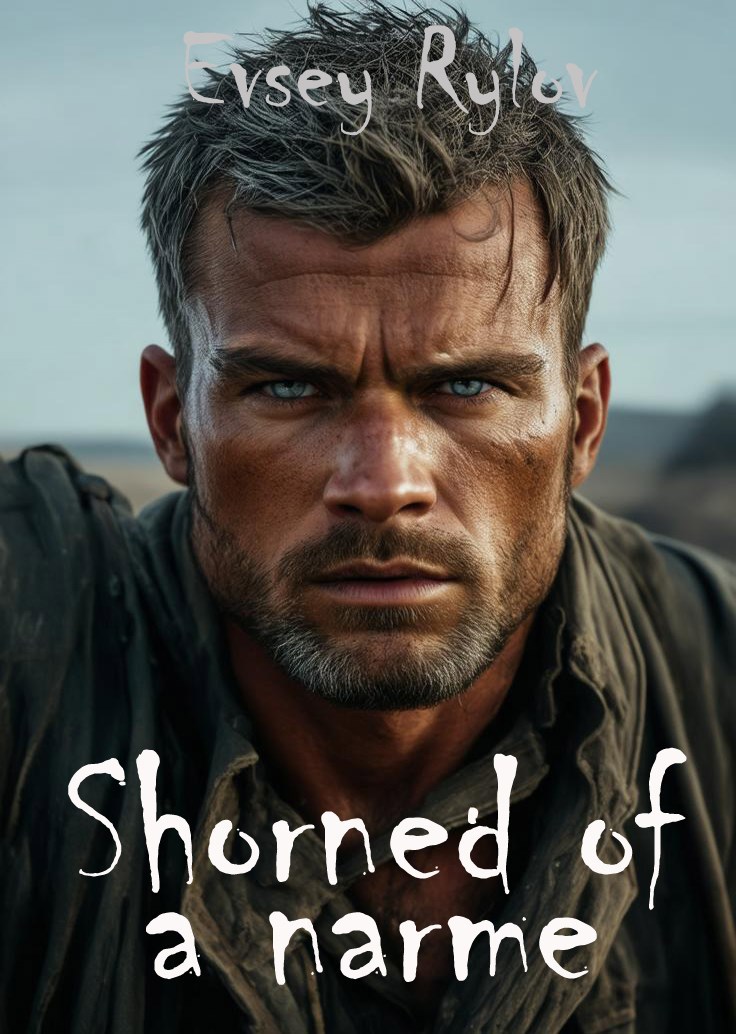
Shorned of a name
Chapter 1. Doom
“Yuri Andreevich, I’m out!” I heard Kolya’s voice over the thunder of gunfire.
Without turning around, I roared back: “Kolya, get out of here!”
I cut loose with a short burst at the creature that had poked its head around the corner. Its ugly head exploded, and the body collapsed onto the concrete floor. A puddle of bluish goo spread out from the dead monster.
“Run, we’ll hold them here,” I shouted again without looking back.
I still had three full magazines and three rounds left in the one I was using. Plus a pistol with two clips. I cursed myself angrily. How I regretted now skipping training sessions at the firing range.
Amid the rattle of gunfire, a menacing roar — or was it a howl? — echoed from the engine room.
“They’re coming…” Georgich said in the sudden silence. His white coat was smeared all over with the monsters’ blue blood.
I swapped out the empty magazine. As the commander used to say in the army: “When we’re not shooting, we’re reloading.” I glanced at the concrete walls splattered with blue goo. In the red flickering light, they looked especially sinister.
Just a second later, an ugly head poked out from around the corner — then another, and another. Without stopping, I fired into the mass of monsters surging from that side. It was nearly impossible to tell what they actually were — some kind of crab-octopuses, or maybe crustacean-squids. The creatures trampled over their dead and living kin without any mercy.
I kept shooting, and shooting, and shooting. Even if I’d picked up a Kalashnikov for the first time, I couldn’t have missed. The whole corridor was already piled with corpses, but the monsters just kept coming.
“Andreich!” Korneyev, our security officer, shouted at me. “Drop the Kalash and run to the device! We need to close the portal…” He jabbed at me with a key.
“You’d better do it…” I replied, trying to be heard over the gunfire.
“No! I’ll cover here — you’re missing!”
Yeah, as if I could miss in this mess!
I hesitated for a second. Then I laid the empty AKM down on the floor next to two full magazines and sprinted back down the corridor. On the run, I checked my pistol and fumbled a bit entering the code into the terminal on the bypass gallery door.
Suddenly, someone shoved me.
“Kolya, what the hell are you doing here?! Get out of here!” I kept cursing, trying to punch in the code with hands slippery from blood.
“I sent the girls up — there wasn’t enough room in the elevator. Let’s do this together!” he yelled over the shrieks of the monsters and the roar of gunfire.
“Idiot, I’m going to activate the device,” my voice betrayed a tremor.
“It’ll be fine, it’s gonna be a great blast!” he tried to sound cheerful.
Finally, I managed to enter the combination, and the door slid aside, letting us into the gallery — a long corridor lined with grayish plastic panels. The left wall had windows covered with bulletproof glass.
The gallery circled around the entire engine room. The staircase to the lower level was on the other side — at the very end of the corridor. I paused for a second to look down.
In the middle of the vast room, the murky surface of the portal shimmered with an ominous dark-violet glow, and more and more creatures were crawling out, trampling each other. I cursed and dashed down the gallery. Kolya followed behind me.
***
“Prisoner number two eight one three eight six, Article 318, Paragraph B,” the young man recited, standing at full attention on the narrow bunk in his solitary cell.
Two men in unfamiliar uniforms stood by the newly opened metal door. Both had short, coiled fire-whips at their belts. The taller one smiled mockingly and nodded toward the corridor.
The guy stepped toward them, holding out his hands. Instead of putting on shackles, they twisted his arms behind his back. Only then did they snap the handcuffs on. After that, the two guards checked the number on his blocker collar and led him toward the stairs.
They stopped at the runengraved grille, pressing the prisoner against the wall. One guard held him while the other unlocked the door. The warden stepped into the stairwell, then turned to the prisoner, whom his partner dragged out after him.
Then they descended for what felt like much longer than it should have taken to reach the ground floor. When they reached the basement, the guards shoved the young man into a tiny cell that looked more like a closet. They didn’t even bother to remove his handcuffs. As soon as the door closed, Prisoner 386 was plunged into complete darkness and silence.
He had no idea how much time passed, but then the door opened and he was roughly hauled outside, then led down a corridor — clearly carved into solid rock — just as before.
They hadn’t gone far when they reached a door reinforced with a tangle of unfamiliar runes. One of the wardens flung the door open, while the other forcefully shoved the young man into the chamber, illuminated by magical lanterns. He tumbled across the stone floor.
“Prisoner number two eight one three eight six, Ivan Koshkin,” a state official in the uniform of the Investigative Order intoned wearily. “You are charged with murder, bodily harm, and conspiracy to commit a crime.” The investigator read from a sheet he’d pulled from a thick stack on the table in front of him. “You have been sentenced to the s shorning of your name.” The young man struggled to his feet and straightened up, looking at the investigator. “The court has denied your petition to substitute the sentence with capital punishment,” the man continued in the same dull voice. “Therefore, today — in the year 2054 since the Birth of Our Lord, on the nineteenth day of the fifth month — you will be shorned of your name. Before the sentence is carried out, I ask once more: do you plead guilty to the murder of Ksenia Lopukhina?”
“I… Ksyusha…” he faltered. “Yes, it happened…” the prisoner continued.
“Can we get on with it?”
“Go to hell!” the young man spat out angrily.
One of the guards behind him immediately struck him hard across the back with his whip. Ivan winced in pain but stayed silent.
“Do you have anything else to say before the sentence is carried out?” the investigator asked in the same monotonous tone.
“No…”
They wrenched the young man’s arms behind his back again and dragged him to the far end of the chamber. Through another rune-engraved door, they entered a small room where a complex magical circle flickered with ominous dark-violet flashes on the floor. Its glow danced across the rough stone walls and the faces of the people standing along them.
The guy stared in horror at the flickering light, unable to tear his eyes away. One of the guards gruffly said:
“Move…”
A cold sweat broke out over the prisoner. He hesitated, staring at the circle. His knees were shaking.
Suddenly, the warden tripped him with a swift, practiced motion, simultaneously shoving him forward — and the guy flew into the shimmering radiance…
***
I sprinted down the gallery. The red glow of the emergency lights mingled with the eerie violet reflections from the portal. They danced on the walls, creating an unreal atmosphere. It seemed to me that the flickers were forming some kind of signs.
There was no time to think about it. I was barely breathing and spitting out dust every minute.
BANG!
Something struck the bulletproof glass with force. Another hit, then a third, a fourth!
“Move it!” I shouted to Kolya, who had fallen behind — he seemed to be looking out one of the windows.
I picked up speed; the impacts were getting closer. Kolya was running slightly behind me. I glanced back for a moment to hurry him up — and at that instant, the window shattered. A torrent of shards flooded into the gallery.
In the flickering light, it looked like sparks. As if in slow motion, they flew toward Kolya. The guy instinctively tried to shield himself with his arms from the flying glass — and then something burst into the gallery.
It was a translucent claw, barely visible among the shards. It struck the boy and then recoiled. Kolya flew toward the wall. I rushed to the wounded man, dropped to my knees, and began to examine him. Blood was gushing from a large hole in the right side of his chest; a red stain was rapidly spreading across his white coat.
Kolya looked at me with a glazing gaze and wheezed:
“What an interesting experiment we’ve… ”
He went silent. His eyes rolled back.
I was shaking all over; anger consumed my entire being. I wanted to leap to the broken window and shoot that abomination. I didn’t even have time to stand up before the claw struck again, this time hitting the wall and tearing apart the plastic panels. For some reason, it lingered — either stuck or something else.
A burnt smell wafted in. A roar full of pain and fury echoed from the engine room. Instinctively, I threw myself to the floor — right into a pool of blood.
The claw was still there. I rolled over, drew my pistol, and emptied the entire clip into the creature’s limb. The bullets pierced the translucent flesh, leaving blue holes from which blue blood flowed. “Copper instead of iron,” I noted mechanically.
I jumped up and dashed further down the gallery. The monster kept roaring. Smoke billowed from where its claw had embedded in the wall. The emergency lights flickered and went out.
“Don’t stick your fingers in the socket, you idiot!” I yelled angrily — and immediately regretted it because my breath was thrown off, making running harder.
I raced, zigzagging like a hare. The beast in the engine room had gone into a frenzy, slamming its claws against the walls and glass. It pounded so hard that the entire underground complex seemed to shake. Bulletproof windows shattered here and there, and streams of shards flew into the gallery.
It felt like I had been running for an eternity — though it couldn’t have been more than half a kilometer.
On the other side, I found a door just like the one I had entered through. I knew the code by heart, but my trembling, blood-slick fingers couldn’t hit the right buttons. Finally, I managed to enter the correct combination, and the door opened, letting me onto the staircase.
As soon as I stepped in, the door slammed shut, and complete darkness descended. The main lighting had been knocked out by the electromagnetic pulse when the portal opened. The backup power had done us a favor, though. The creature had struck a cable with its claw, and it clearly hadn’t enjoyed the experience.
I pulled a penlight from my chest pocket and, shining it ahead, dashed down the stairs. I ran like a madman — one flight, two, a landing, another, two more, another landing…
The impacts were barely audible here; instead, I felt the wall vibrate under my hand as I gripped it. When the stairs ended, I found myself on a slightly larger patch of floor in front of yet another door.
It took considerable effort to unlock it. My hands were trembling; the key kept slipping. Finally, with great difficulty, I inserted it into the lock and turned it three times clockwise, waited for the click, and then made five turns counterclockwise.
The lock clanged, and the door swung open. I stepped into a long, completely empty corridor. I couldn’t see anything now, but I remembered the concrete walls and ceiling perfectly.
The darkness here was impenetrable, but I wasn’t likely to get lost — the passage was straight. I dashed along it at full speed, turning off the flashlight to conserve battery. The tremors were much stronger here; the corridor quivered as if shaken by a fine tremor.
I tripped and tumbled across the concrete floor. I was pretty bruised; something warm was trickling down my face — but I felt for the wall, got up, and limped onward.
I had no strength left. My breath was ragged; a stitch stabbed at my side.
Cursing every bun and noodle I’d ever eaten, I raced down the corridor. It felt like I couldn’t run anymore, yet somehow I forced myself on, trying to vividly imagine what would happen if the creatures broke through to the surface. Images of mutilated corpses and ruined buildings, turned into death traps for their inhabitants, flashed before my eyes.
Focusing, I pictured Lena and the children on the beach on that terrible day when the cluster munition rained down on them. That image ignited a wild fury — and that fury gave me strength, and I dashed onward down the corridor.
I ran like a madman until I slammed full-force into a door. The impact was so strong asa it knocked the breath out of me. A cold shiver ran down my spine: “What if I broke the flashlight?” I fumbled to get it out, but it was intact.
The door was secured with a mechanical combination lock. I knew the key sequence by heart and entered it easily. A click sounded, and I stepped into a small room located directly beneath the portal. I remembered its gray walls, the overhanging dome-shaped ceiling, and the metal cylinder in the center.
Now the cramped space was illuminated by violet flashes. They seeped in through a wide crack in the ceiling. From there, it seemed as if the edge of the portal’s murky haze was protruding.
I began to recite a prayer and crawled toward the cylinder, careful not to touch the veils. The distance was nothing, but I could see the shimmering jelly-like mass creeping down from above. Just a few seconds — and there it was, the device.
The control system was on its upper surface. I had no choice; I turned onto my side and pushed the cylinder with all my might. Not on the first try, but I managed to tilt the device. With a crash, it toppled onto its side and rolled a bit.
Praying, I crawled a few more meters, watching in horror as the haze slowly descended, as if flowing from the crack. When I reached the device, I hesitated. I remembered the fate of suicide bombers.
Seconds crept by, and I delayed… Cold, nasty sweat spread across my face; everything inside me froze. Even the memories of that terrible day faded. I trembled with fear. I was afraid of death…
I reached for my pistol, checked it, ejected the empty magazine, and inserted a new one. I found the first aid kit on my belt.
I managed to distract myself, and a thought came to me: just a little more, one small step, and I’ll be with Lena again…
I focused and began to repeat the words of the prayer.
“May God arise…”
I inserted the key.
“…and let His enemies be scattered…”
I entered the first code.
“…let those who hate Him flee from His face…”
I turned the key.
“…as smoke vanishes, so let them vanish…”
I entered the second code.
“…as wax melts before the fire, so let the demons perish from the face of those who love God…”
Another turn of the key.
“And I make the sign…”
At that moment, the initiating charges exploded. Energy surged through the metal “lenses” and compressed the plutonium hemispheres, instantly creating a critical mass that triggered the fusion reaction.
“…of the Cross…”
Everything was swallowed by an incredibly bright white light, as if a new sun had ignited.
Suddenly, I found myself looking at myself from the outside. I saw myself instantly turn to ash. I stood there and watched as the relentless thermonuclear flame tore through the concrete and vaporized the abominations that had broken into our world. The light surged onward, scorching the underground complex, purifying it, freeing all who remained there.
I watched with satisfaction as the ceiling collapsed, burying under tons of rock any chance that the monsters might break through to the surface.
I turned my new, unfettered gaze to the violet haze. It writhed in the thermonuclear flames as if trying to crawl away, to defend itself — but there was no escape.
I thought: “Well, that’s it — finally, we’ll be together” — but at that moment, something came to me — not a voice, but a certainty: “You still have work to do. You’ll have to wait…”
Then the haze suddenly shrank into a tiny sphere, from which, a moment later, protuberances of the same eerie violet hue burst forth. I watched in horror as one of those loathsome tendrils darted toward me. I tried to evade it, to get away — but it was too late.
The protuberance caught me and dragged me at breakneck speed toward the rapidly shrinking violet lump. In the blink of an eye, I plunged into the void.
A moment of darkness, as if someone were toying with a light switch — and I found myself back in the little room, filled with violet glimmers. Only now I was someone else.
This other me heard singing — a choir softly and steadily drawing out a mournful melody. That sound tore me apart with unbearable, transcendent pain. From him… no, from me. From the very core of our souls, something was being ripped out. I thrashed wildly, resisting, but the violet shimmers held me fast.
My hands were bound behind my back. A tormenting haze rushed into my mind; I tried to scream, but couldn’t. The pain grew stronger, tearing my entire being apart.
Images began to appear, as if from afar.
He — or rather, the local me — used to be called Ivan.
There he was — or us, no, me — at home. In a large, beautiful mansion, with servants bustling about. And this local me had a whole crowd of brothers and sisters — full, half, and even second cousins. They grew up together, year after year. All equal, all happy.
Now this local me was older, and among the children, the first, second, and third heirs of the family had been chosen — but I wasn’t one of them. That guy who was me didn’t stand out much among the others. Average in his studies, barely capable of magic — only hand‑to‑hand combat came easier to him than to the rest, but what good was that here…
Wait, what the hell kind of magic… It didn’t exist! That was me — me, Viktor Andreevich, senior researcher at Research Institute No. 186 — screaming like a madman, but my cry was durowned out by the surging memories.
Time passed — I, or rather he, graduated from an ordinary school; soon he would be off to the academy, like the other aristocrats. This local me wasn’t particularly happy about it. His grades were so‑so, and his magical strength was only on paper — not like the others’.
Then came that terrible day. Father came to see me himself — an incredible rarity. The head of the family hadn’t paid attention to his son in a long time. He talked at length about something.
Then there was a blank.
After that, for some reason, there was a trial — just two brief sessions — and then Mednogorsk penal colony for the gifted. The one from which no one ever returned. The malachite of Mednaya Mountain drained the life force from people, and no one had ever survived in the underground for more than five years.
There were few guards at the penal colony; the wardens only cared that everyone showed up for work and met their malachite quota. If someone refused to work, they were placed in a magical shell — through which neither food nor water could be passed — and chained to the wall.
What happened in the living quarters after lights‑out didn’t concern the wardens — until the convicts grew too few. That meant the malachite output had fallen, and the guards wouldn’t get their bonuses.
That’s when the investigation was swift and simple. There was only one prisoner with confirmed hand‑to‑hand combat skills, and the magic block only helped him.
This local me was indeed guilty of injuries and even a couple of deaths. But he had never started a fight himself. If the investigation had been even slightly fair, they couldn’t have convicted him of anything.
But no one cared that this local me had been defending himself. A huge scandal was whipped up around the story. Now they called me the “Mednogorsk Butcher.”
The victims were portrayed as harmless lambs, and instead of a quick death, this local me was to be shorned of his name — a punishment worse than any other in this world.
During that terrible rite, a person was forever stripped of their ability to use magic. For the locals, it was like losing their eyes, ears, and hands. Worse still, the shorned one continued to accumulate magical power but could no longer expend it — a torment from which there was no relief.
No more images came. Everything suddenly became surprisingly clear. The pain vanished. I pried my eyes open with difficulty, but for some reason, the terrible violet light was gone. A soft white radiance filled the room.
The singing stopped. The hooded figures stood in silence, staring at me in disbelief. One of them even opened his mouth. I suddenly felt that my hands were free, and nothing held me anymore. And we — no, I — stood up, looking around in bewilderment.
At that moment, I… what was my name? I, I… I couldn’t remember. Only the present me remained — the nameless one. Then there was a flash of unbearable pain — and darkness.
Chapter 2. Wastelands
I came to my senses on dirty straw inside a freight train car. Light filtered through the narrow gaps between the boards. I lay there, tormented by a blinding headache and nausea. We travelled for a long time — probably a whole day.
Then they drove me and three other prisoners out of the car. We found ourselves in a small square squeezed between a brick wall as tall as a five‑storey building and several red‑brick warehouses. One by one, they led us up to a slab of polished granite. In its lower right corner was a schematic image of a hand.
Obeying some vague instinct, I pressed my hand to it. At that moment, a symbol lit up on the smooth surface of the slab: a skull set against two crossed scythes inscribed within a thin circle, glowing bright green.
***
I stepped aside to let the next person through — and suddenly found myself locked in the gaze of a pretty girl. She was wearing a severe dress and clutching a handbag with both hands. Something about her seemed familiar, but I couldn’t recall what.
Tanya fixed her eyes on her sister’s killer. Damn it, what was his name again… He was their third cousin!
They’d grown up together! The damn bastard had stabbed Ksyusha with an enchanted knife. How had he even managed that — he was nearly powerless!
No one said it outright, but everyone knew the boy was a throwback. The family’s magic had dwindled, and his children were barely different from commoners. And all because of that nonsense about aristocrats being free to choose how and with whom to live. They’d even studied together… What nonsense!
No wonder the heirs of the family were two nephews — and one was adopted, at that.
She hadn’t recognised the relative at first. In just a couple of years in Mednogorsk, the guy had changed drastically. There was almost nothing left of the once strong and healthy youth.
Now the killer was painfully thin and pale, with an unhealthy flush on his cheeks. His once‑black hair had turned a mousy shade, streaked with grey. Heavy shadows lay under his eyes, and he was slightly hunched over. His whole demeanour had subtly changed.
He was dressed in a black robe, with a grimy padded jacket over it. In his hands, he was fidgeting with an ear‑flap hat, out of place at this time of year. If Tanya hadn’t known him all her life, she’d have thought he was nearing fifty.
And his gaze — that calm, assessing look — was completely different from the darting eyes of the others. They led him to the small gate first. A detective was already waiting there. He scanned the killer and said:
“You hear me?”
“Yes,” the other shrugged.
“Good! You’re forbidden to appear in inhabited lands except for the city of Vyborg. You may only be there while the sun is in the sky. If not, the dome will kill you. Understand?”
“What’s not to understand?” the killer replied. His voice sounded like the creak of some mechanism.
“Good. Second: you’re obliged to arrive in Vyborg no later than July 30th this year. You’ll study at the academy there.”
Tanya started shaking. What the hell! Why was this scum being sent to the very place where she worked? Who cared that no one had ever made it there in her memory. What the hell was going on?!
“But I… I can’t cast spells anymore, and I never will. Why? I’d rather be in nature…” the killer rasped, seeming taken aback.
“That’s up to you, but I advise you to come,” the detective said firmly. “If you’re alive and don’t show up, your family will face punishment. Understand?”
“I understand…” he echoed.
The man handed him a flat bag.
“Your documents. The verdict, the conditional early release order, and the letter of admission to the academy — along with the address in Vyborg where you’ll have to check in.”
Then the detective pulled a folder with papers out of somewhere and placed one sheet on top of the bag.
“Sign here.” He pointed to the bottom of the document, next to an ornate monogram.
“But how? I’m nobody…” the boy said again, surprised.
“Write however you like, but remember: you’ve been stripped of your rights, but no one’s relieved you of your duties. Get it?”
Tanya didn’t see the killer sign, but the detective glanced at it and smirked wryly.
“Where are we?” the wretch rasped as they unlocked the gate.
“Dibuny, over there…” the detective pointed at the wall, already moving on to the next prisoner.
The killer lingered for a moment, then stepped through the gate — straight into the jaws of the beasts. At that moment, triumph filled Tanya’s soul. Finally, her sister was avenged, and the degenerate would get what he deserved!
***
I walked about eight kilometres without any trouble — and then something grey hurled itself at me from the bushes like a whirlwind. Only by a miracle did I manage to thrust my arm, protected by a leather bracer, forward — and the toothy maw clamped down on it instead of my throat.
I slammed my fist into the creature’s elongated head, again and again. The beast didn’t let go. It couldn’t bite through my bootlegs, but it squeezed my forearm so hard I thought I heard bones crack.
Bracing my bent arm in front of me, I threw myself forward, trying to crush the beast with my full weight. The blow was devastating — it shattered its head. I grabbed a rock from the ground, ready to finish it off — but suddenly, it relaxed and let go. I jumped up and stomped on it several times with the sole of my boot, literally driving the monster into the moss‑covered earth.
A hare!
Yes, it was a damn hare — finally dead. It was so dirty, skinny, and mangy that for a moment I even felt sorry for it.
June was approaching, and in the northwest — I hadn’t gone far from Petrograd — the white nights were coming into their own. I walked through a mixed forest. Mostly pines, but other trees appeared here and there.
For some reason, the wasteland was eerily quiet. I hadn’t heard a single bird song all along the way.
I didn’t feel hungry, either — maybe because of the damn ritual, or maybe the nervous strain of the past few days was to blame. But I had no doubt that soon I’d need food.
I spent about half an hour, but finally managed to slit the hare’s neck artery with a shard of glass and drain its blood. Then I struggled for a while to gut it — and only then stuffed the rabbit into my bag. I attached the bag to the rope that served as my belt.
The detective hadn’t lied. They really had dumped us in the ruins of a village. The remains of the houses had been demolished so the beasts couldn’t hide in them, and now a rubble‑strewn wasteland stretched for several kilometres from the wall.
Among the debris, I quickly found a shard of glass. With it, I cut a thick cloth strap from my document bag. Then I unravelled one end into threads and wove them into strong cords, which I used to tie a suitable stone.
This trick the local me had learned in prison. A flail is devastatingly effective — if you know how to use it. And I’d had plenty of practice.
I’d arrived in the wasteland around six in the evening, with several hours left until sunset. I’d put the time to good use — and now, besides the flail, I had bracers made from the leggings of old boots I’d found along the way.
I knew little about the fate of the other convicts. Two had stayed near the wall. One sat swaying back and forth, babbling incoherently; the other lay silently, staring into space. No matter how hard I tried to rouse them, I couldn’t.
The third kept his distance. Almost immediately, he picked up a piece of wood from the ground — clearly intending to use it as a club. We parted ways at the river: he headed downstream toward the ruins of Dyuny — what they called Sestroretsk here — while I swam across to the other bank and set off toward Kurnosovka. There, I planned to reach the gulf and continue along the shore.
I was shaking all over. My memories had turned to tatters. Scenes I didn’t understand kept flooding back. But the life in the other world was vividly clear.
How impressive, though! It seemed I’d taken quite a beating to the head and forgotten a lot. My brain, dissatisfied with the emptiness, had replaced real memories with invented images.
If I’m not mistaken, it’s called confabulation. Well, would you look at that! I think I even made up that word myself…
Everything that had happened felt like some wild nightmare, and the only straw I clung to, to keep from slipping into madness, was the certainty that I had work to do. It was that conviction that drove me onward. It was what kept me alive.
The terrain I was walking through was no different from the forests of the Karelian Isthmus I was used to. Mostly pine trees, but now and then I’d come across firs, aspens, birches, and, very rarely, little oaks. The ground was mostly covered with moss that muffled all sounds.
Crack!
My makeshift flail struck the creature’s ugly head. The beast whined, stopped abruptly, and then jumped back. I immediately started swinging my weapon again.
A wolf, or maybe a dog… No, more likely a wolf. It was skinny. Its dirty fur was matted and hanging in clumps, exposing pinkish patches of mange. Steam puffed from its jaws. It was missing quite a few teeth. In short, it was starving…
So it began to circle me slowly, trying to get to my flank. I pretended it had succeeded, turning my head the other way. I didn’t want to break the distance myself.
I didn’t have to wait long. The grey beast lunged, clearly intending to knock me to the ground. I was ready: I spun around and smashed the head of my flail right into its ribs. In the silence of the white night, I heard the crunch of breaking bones.
Knocked off course, the wolf flew to the side and let out a nasty whine as it hit a fallen pine. It tried to get up, but it was too late. I lashed out at its ugly head — once, twice, three times. The brute went still. I kept hitting it with the flail over and over until it dawned on me that it was dead.
Breathing heavily, I stood there, staring at the beast. I’d been lucky to spot it in time. Along the way, I’d made a point of choosing the most open stretches, avoiding underbrush so that enemies would have a harder time sneaking up on me — and that tactic had paid off.
A sense of victory rose within me, filling my entire being with elation. I lifted my face to the sky and shouted:
“RIKI-TIKI-TA!”
I’d learned that battle cry while serving under contract. Our grenade launcher operator, Kipling, liked to compare himself to a mongoose. Looking at a burning vehicle, he’d raise his RPG and yell, “RIKI-TIKI-TANK!”
There was so much triumphant joy in that cry that everyone around him caught it. He was killed by a VOG dropped from a drone, but until our discharge, we kept raising our rifles to the sky in the middle of captured strongholds, shouting in unison, “RIKI-TIKI-TA.”
But now it was time to get back to my story.
They called it the Wasteland because it lacked the natural magical background that everyone in this world needed to breathe. Without it, animals fell ill and began to seek only one thing: to replenish their magical energy. And there was only one way to get it here — by devouring a sentient being. That’s why they called these creatures the Starved.
The same thing happened to people in the Wastelands. When their store of magical power ran dry, they’d fly into a frenzy and be ready to kill anyone without a second thought or regret, just to refill it.
The Starved could sense people and tended to gather near the borders of normal territories, which were shielded by what they called domes. They were like films, impenetrable to those who had no magic left. They prevented both people and beasts from simply escaping the Wastelands to live in peace.
I was making my way, using the remains of the railway embankment as a guide. As I remembered from my own world, it ran — or rather, should have run — almost straight, which meant it was the shortest path to humanity’s last stronghold before the Great Wasteland.
The hardest part was crossing the streams. They weren’t deep, but the dark peaty water flowed swiftly and was icy cold.
It was completely dark when I reached the ruins of Beloostrov. I had no intention of lingering there. The Wasteland had swallowed the village relatively recently — from what the local me had heard before prison, not even ten years had passed. There was still some magical background in the town, which meant the ruins were teeming with the Starved. They were calmer, sure, but I still wasn’t about to go in.
Besides, even from a distance, I could easily see that everything had been stripped from the houses. Not a single door or window frame was left, let alone any glass. Little pines were already sprouting between the buildings, making the ruins even more dangerous.
This settlement turned out to be smaller than what I remembered from my world. Yes, yes, my personal world. I’d invented it, which meant I was its rightful owner… It wasn’t so bad being a madman!
I stopped a hundred metres from the first houses, then doubled back into the forest and began skirting the village, veering away from the railway toward the gulf.
When dawn broke, I was five or six versts farther from Beloostrov. At that moment, the forest was pierced through with red rays of sunlight. Some people thought it was beautiful. To me, it looked as if everything around — the pines, the moss, the rocks, and the sandy screes — was drenched in blood.
I gripped my flail tighter and pressed on. The Starved, like all those suffering from nervous afflictions, slept during the day and hunted at night. For a moment, I felt a flicker of relief.
Suddenly, walking felt easier. I turned to look at the rising sun — and in the red glow, I saw a dark silhouette hurtling toward me. The creature was running absolutely silently, treading lightly on the soft moss.
I leaped to the side and tried to reach it with my flail, but it dodged with astonishing ease. It backed off a little, then moved toward me again.
Now I could see it clearly. Its lean body was covered in tufts of рыжей fur. A large clump of dirty hair remained on one ear. In the sunlight, the patches of mange glistened unpleasantly. It was a lynx, larger than a German shepherd. It bared its yellow fangs now.
I spun my flail and began slowly closing the distance, preparing to attack. The cat suddenly darted to the side and leaped. Only by a miracle did I manage to evade it. I tried to strike, but it deftly jumped away — and lunged at me again. Over and over, I attacked, but it was too fast.
I backed away slowly, tracing a figure‑eight in the air with my flail. The lynx advanced with growing confidence. This went on for quite a while, and I began to feel noticeably tired. At one point, we came to a sandy scree that sloped steeply downward.
Here, my flank was blocked, so I tried to go on the offensive. I spun my flail and thrust it forcefully toward the lynx. It began to dodge, but didn’t make it in time.
I was just about to celebrate victory when the stone slipped out of the cords holding it and flew into the lynx’s side. It lost its footing and tumbled down the scree. I was left standing on top, holding a piece of canvas strap.
Just a second later, the damned cat was on its feet and racing up the slope. I had no choice but to flee. I sprinted as fast as my legs could carry me, trying to stay close to the scree — if need be, I’d jump down to shake off the pursuit.
The lynx dashed after me. It had clearly taken a beating and was now furious — even more so than my wife when I mentioned a work trip. I could barely stay on my feet, but the will to live infused me with strength. I’d probably never run so fast before. Alas, it still wasn’t enough — the lynx was gradually catching up.
I was drenched in sweat, a stitch stabbing at my side. Memories of my made‑up past life kept crowding into my head. I wished I had a rifle right now. Or even a knife — but that was too much of a luxury.
The scree was behind us now, and we were racing headlong through a sparse pine forest. The sun had risen more than halfway above the horizon, and it was much brighter now. I zigzagged, trying not to trip over hummocks.
Lynxes usually hunt from ambush and can’t run for long. But it seemed no one had told this one that — it was
Lynxes are ambush hunters — they can’t keep up a long chase. But this one hadn’t gotten the memo. It was coming after me like a damned warhorse, lungs roaring, claws tearing up the dirt.
I was running on fumes — old habits kicking in, the training buried deep in my bones. My legs were lead, my chest on fire, but I pushed through. That’s what they drill into you: move, survive, don’t stop. I’d done longer marches with a pack twice my weight, back when I was somebody. Back before Mednogorsk.
The chain‑link fence loomed up ahead — one panel listing drunkenly to the side, the rest standing like teeth in a rusted jaw. Fear lit a fuse in my gut, but I cut it short. No time for that. I hit the fence running, grabbed the top rail with both hands — calluses scraped raw, but I didn’t feel it — heaved myself up, and flung my body over in one ragged motion. Just like scaling the yard walls back in the colony.
No time to watch the lynx clear the obstacle. I was already sprinting again, lungs rasping, every step a stab of agony. A hulking shape loomed ahead — some kind of big building. I aimed for it like a dying man aims for water. Barricade. Weapon. Survival. That was all that mattered.
When I reached the building, I realized the lynx had fallen back — just for a second, but it was enough. I should’ve scouted, should’ve checked the angles. Muscle memory screamed at me to set up a proper perimeter, but panic was a bitch. Instead, I charged in like a cornered animal.
The place was a husk — a massive brick mansion in the classical style, squatting in the middle of a barren lot. Plaster hung from the walls like flayed skin, exposing the raw brick beneath. Ground‑floor windows were shackled with thick iron bars — like a prison, or a vault. Just what I needed.
The door was still there. That surprised me. It was wood, but solid as a bunker door. I slammed my shoulder into it — once, twice — and felt nothing but a jolt of pain up my arm. I actually grinned. Good. Keep the monsters out. Just like keeping the bastards out in the yard.
I staggered to the side. Near the porch, rain had gnawed through the plaster, leaving a jagged, toothy gap in the masonry. In my half‑dead state, it looked like a ladder. I scrambled up, fingers digging into the crumbling brick, boots slipping, then finding purchase. Every joint screamed from old injuries — the ones I’d earned in the service, the ones they’d given me in Mednogorsk. I didn’t care. I climbed.
The balcony door fought me — creaking, resisting — but finally gave way with a groan. I stumbled inside, gasping, and let the darkness swallow me. For now, I was safe. But I knew better than to trust safety. It’s always the quiet moments that get you.
Chapter 3. Damned old house
From the outside, I’ll admit, it looked like some kind of manor house — but once I stepped inside, I knew I’d been wrong. The place felt more like a lab. Brown tiles on the floor, white ones on the walls, corridors lit by small windows set above the doors.
I’d seen enough labs in my time — more than my fair share. So I wasn’t fooled by the balcony, the stucco, or even the ballroom in the central part of the building.
The place had two wings. Oddly enough, you could get to the balcony from the left one. All the rooms there were identical — and completely empty. Except for one that held the skeleton of a metal cabinet, bolted into the wall and floor.
The central hall had once had a glass dome for a roof. Now only the frame remained, letting rain and snow fall freely inside. The parquet floor was buckled, and the joists beneath it sagged and creaked ominously.
After everything I’d been through, I moved like a shadow. I skirted the hall, hugging the wall, and stepped into the right wing. Nothing interesting there either — just the same endless tiles and emptiness.
At the end of the corridor, I found a door leading to a narrow staircase. The railings had apparently been deemed valuable enough to haul away. I descended to the ground floor and wandered the corridors again. Same empty rooms.
There was a storage room, though — its door had miraculously survived. A pile of rags lay on the plank floor. Dry and dusty.
Perfect for sleeping.
The ground‑floor hall was much like the one upstairs — except it was strewn with chunks of plaster that had fallen from the ceiling and walls. I looked up and whistled under my breath. The ceiling beams were rotten, crumbling in places.
In the farthest room of the right wing, I found a thick metal rod, nearly a metre long, threaded on both ends. One end had been slant‑cut, forming a crude point.
“Things are looking up,” I thought. “Now if I could just find a weight, I’d be set.”
Buoyed by that thought, I made my way to the basement. It was divided into small rooms, each with a barred door. Like the rest of the place, the locks had been stripped, so the doors swung open easily.
It was empty and dim down there, light filtering through tiny windows near the ceiling. A thin layer of water lapped at the floor.
I walked the length of the corridor and ended up back in the hall. In the far end, light streamed in through a huge hole in the wall — bricks had crumbled away, probably washed out by water. A deep pit had formed outside, creating a kind of ramp.
The hall had a few raised platforms. On one of them lay a mound of something — rags or maybe old, mangy pelts. I didn’t give it much thought and pressed on.
With the iron rod in hand, I grew bolder. I wasn’t creeping anymore. A grim, angry excitement stirred in me. At the far end of the hall stood a nearly intact workbench, with tools hanging on the wall above it. I don’t think I’d ever been so glad to see anything in my life. Joking aside, it looked like there were files, chisels, a hammer, and even a vise up there.
I’d covered maybe half the hall when I noticed the mound on the distant platform had shifted shape. Two round things glinted on the near side.
It’s a bear, I realized too late — and bolted back toward the stairs.
The lumbering beast gave chase in total silence. That’s not how it works in the movies, where predators roar to give their prey a fighting chance. In real life, they don’t bother.
I ran faster than I had from the lynx. I slammed every door I passed. There was nothing left in me but fear. I sprinted for the second floor, for the balcony — I thought I might find safety there. Behind me, the echo of the bear’s paws splashing through the shallow water grew louder.
Suddenly, a wave nearly as tall as I was surged from behind. It had lost some height by the time it reached me, but it still gave me a good shove.
I flew up the stairs to the second floor, dashed through the corridor, and burst into the hall without slowing. The rotten wooden floor heaved under me, and I muttered a prayer:
“Lord, please let these joists hold.”
I was nearing the door to the left wing when the bear charged into the hall. The floor creaked in protest. With a desperate leap, I landed just a couple of centimetres from the safety of the tiled corridor. My rod flew ahead of me, clattering across the floor into the hallway.
Then, with a terrible crash and splintering groan, the rotten floor began to collapse. By some miracle, I managed to catch the edge of the door. The floor gave way beneath me, but I hauled myself up and dragged my body into the corridor.
Just a second later, an angry roar echoed below. I peered over the edge and saw the bear struggling, pinned under several heavy beams. The nearest section of the floor now tilted at a sharp angle.
I wasn’t about to waste that chance. I got a better grip on my rod, found a smooth spot, and slid down the warped parquet.
It wasn’t a graceful slide — not like coasting down a snowy hill — but I landed on my feet, and I didn’t break anything. Now I was just a few metres from the beast’s head.
Without waiting for it to break free, I started hammering at it with the rod. It roared, first furiously, then pitifully — but I had no intention of letting it live.
When I realized I wasn’t making much headway, I drove the rod into its eye with all my strength. The point was dull, but I threw my full weight behind it, then wrenched it free. Blood gushed from the wound. The beast went still — but I kept swinging, lashing out at the already lifeless body.
Finally, when I was sure it was dead, I slumped to the floor, panting. I lay among the splintered boards and broken plaster. Everything seemed hazy. A wave of nausea rose in my throat.
But I got up anyway, stared at the grey sky, and hoarsely shouted:
“RIKI-TIKI-TA!”
I couldn’t remember the last time I’d eaten, and I’d only drunk peaty river water. But I was too tired even to think about hunger. I got up and trudged toward the storage room. On the way, I grabbed a sturdy piece of wood and propped the door shut from the inside. Then I collapsed onto the dusty rags and fell asleep.
***
Here I am, sitting at the workbench, tinkering with a reduction-gear rifle. Should’ve just bought a proper one — but no, they had to drag in this NATO abomination. Non‑standard threading, gotta hunt down a custom flask, adjust the nozzle — climb inside to fix it. Nothing’s ever simple. And it roars like hell — my ears aren’t made of iron, yet I spend all day studying these shooters.
I load a blank into the 3D metalworking station and fiddle with the software.
“Sergeich, you got nothing better to do?”
I whip around and see Anton, our lab chief. He’s clearly fuming.
“You were supposed to hand in that analytical review last week,” he snaps. “You’re always holed up in the workshop. Then they’ll dump some sick case on us, and who’s gonna do the work? Kolya’s on assignment, Semyonych’s been reassigned to another department, I’m swamped with my own stuff… You write a memo and think that’s it, done and dusted…”
In an instant, I’m sitting on a hard chair by the side table in Trefolev’s office. He studies my report for a long time. When he’s done, he flips back to the beginning. Flips through the pages, looking for something. Then he takes off his glasses, drops his face into his hands, rubs his eyes for a while, and asks:
“Are you absolutely certain they’ll do it? Look, you’ve got to understand my position. Do you have any idea how many resources we’d need to mobilize to prepare for a pandemic? And they don’t even have a real healthcare system — no central command. It’ll hit them harder than anyone else. And what makes you so sure it’ll be this virus?”
“Let’s start from the end, like I wrote in the report. Their first SARS infection was a dud — too severe, the Chinese shut it down fast. Then MERS, milder but still too aggressive. Then COVID — way milder, with asymptomatic carriers. Notice the trend: they were honing that particular angle. Bottom line, they’ve learned their lesson — now the bug won’t kill right away. They’re still after that global conflagration. As for it hitting them hardest — they weren’t preparing for COVID either.”
“And if you’re wrong? If their tool is something else? They’re pushing hard on sepsis research.”
“Sepsis can be triggered by nearly any bacteria,” I reply. “It’s the outcome, not the cause. Sure, they’re probably studying all kinds of cocci and bacilli too — but we’ve got antibiotics for those. Viruses are a whole different ball game.”
A blink — and I’m standing in the parking lot in Efremov, in front of the Tingham store, next to our forty‑ton behemoth. No joke — eight‑by‑eight all‑wheel drive, tire inflation system, extra fuel tanks, extended‑base van body, two bunks in the cab (though we still preferred hotels).
Sergei, our driver, is smoking beside me.
Out of the snowy haze steps a sturdy local guy, who asks:
“Hey, guys, what’s this rig?” He nods toward the truck.
Sergei takes a deep drag and says, “Honestly? It’s a rolling fridge. Full of infected corpses inside. Best strain collection you’ll ever see.” He gives a conspiratorial grin. “Sergeich here put it together,” he adds, pointing at me.
The local chuckles and starts peppering the driver with questions about the engine, brakes, transmission, and whatnot. As soon as he walks off, Sergei gives a wry smile.
“There you go — the truth, nothing but the truth. Like anyone’d ever believe it…”
I just smirk back.
Another blink — and I’m in the office of our deputy director for science. As usual, he’s pacing around the side table, saying:
“You do realize that gluon resonance waves propagate not only through space but through time as well. In theory, you could focus them to detonate our nuclear warheads…”
“Okay, but what’s our institute got to do with it?” I cut in.
“That’s precisely the point — it’s a unique chance to study how these waves affect humans!” he bursts out, fired up. “Perfectly suited to your skill set. I mean, you haven’t really broken a sweat since the main phase of the pandemic ended a year ago…”
***
I was woken by a gnawing, vicious hunger — my stomach was twisting itself into knots. I hauled myself out of the storage room with difficulty. Bright sunlight was streaming through the windows again — looks like I’d slept a full day.
The only food I had left was the hare. When I pulled it out of my pack, though, it was already giving off a nasty stench. Spoiling too fast — that couldn’t be good…
Well, I’d have to eat the bear instead — but first I’d need to butcher it.
I stood there, staring at the lumbering brute pinned under the thick beam. What was left of this once‑mighty forest lord? Just a shameless, ugly carcass now.
Suddenly, I felt a surge of triumph like I hadn’t known since the war. This was real life right here. A single, powerful word rose up inside me — victory!
Oh, how sweet it tasted! They used to tell us in school that cola had that taste. I’d earned threes, fours, fives, a red diploma, my first paycheck, a government bonus, an apartment voucher, a medal for service, and my beloved’s consent. All of them tasted infinitely sweeter than some flavoured water.
This time, I’d fought for the right to live, and victory had the salty tang of blood — mine and my enemy’s. He was bigger than me! Stronger than me! Faster than me! He even smelled worse than I did! And still, I’d come out on top. Mind had bested matter.
“RIKI-TIKI-TA!” I roared at the grey sky.
The last time I’d felt anything like this was when we’d punched a hole between worlds. We puny humans had gnawed through space itself, made the universes bend to our will! Back then, I’d truly, sharply felt that we were the larvae of God. Every little human could be a bit like Him!
Of course, that had backfired on us good. The other side had its own hunters, eager to bring peace to the world at any cost. Like us, they craved that sweet taste of victory. For it, the monsters calmly gave up the lives of their own kin.
But I didn’t get to bask in my vanity for long. Hunger was collecting its due. So I headed down to the basement, hoping to find something useful for butchering my fallen foe. I descended with mixed feelings — after all, anyone could come down here.
Once in the basement hall, I noticed a magical circle glowing faintly on the raised platform the bear had used as a bed. Runes scattered shimmering reflections across the walls — not as bright as the ones I’d seen when they stripped me of my name.
I cautiously approached the platform and studied the tangle of runes. Unlike the ones I’d seen in prison, these were familiar to the me of this place. So, what do we have here? A rune of cold, a rune of fire, a symbol of firmness, one of longevity…
There was also a strange mark in the weave of the magical runes — a skull and two crossed scythes, but without the circle around them. I stared at the glyph for a long time, then suddenly remembered: it stood for the gift of death.
In this world, the gifts from God to humans came in all shapes and sizes — but we all shared this one, which is why we’re called mortals. So, uh, thanks, Captain! I’m completely devoid of magic in all its forms.
The weirdest thing was that a depiction of a right hand was inscribed right into the rune pattern. I’d never seen anything like that before.
Just to be safe, I gave the circle a wide berth and made my way to the workbench. There was all sorts of stuff here — and yet, nothing I needed: no knife, no axe, no metal saw, no crowbar, no hammer! Just a set of files and chisels, and a vise corroded by rust. But that was all I really needed anyway.
I happily picked up a flat file with coarse teeth from the holder. It was about ten centimetres wide, with an oiled wooden handle. Not a speck of rust, not a speck of dust, not a crack on its surface — the tool practically shone…
If you only knew the joy of holding an oiled handle, polished by the calloused palms of hardworking metalworkers?
Don’t know?
Neither did I!
The moment I touched that marvel, the file turned to dust, streaming through my fingers. Horrified, I grabbed the chisel’s handle — it rustled to the water‑soaked floor. The round, half‑round, and triangular files followed suit, as did the needle files and the chisels…
I dropped to my knees in the icy water and let out a howl. My cry was filled with such fury and despair that it probably reached the heavens. Oh, God, how cruel this world is!
I jumped up and started smashing everything within reach — the workbench, the walls, the doors. I tore the tabletop apart board by board. I cried and screamed, not caring that wild beasts might come running at the noise. I didn’t care!
Finally, my rage burned out, and I collapsed onto one of the platforms, shaking with sobs.
I don’t know how much time passed, but I eventually calmed down and went to inspect the other wing. More empty rooms, dirt, mould, and cracks in the walls and ceiling. In the farthest room stood an old chest, rotten and warped. I would’ve walked right past it if I hadn’t seen the rusty haze around the box in the light filtering through what must’ve once been a window.
The chest was full of junk. I found a parasol that crumbled at a touch, old shoes without soles, a pile of oiled rags, a ladle, an empty bottle, and… a set of tools — magnificent, wonderful, amazing…
Oh, merciful God! What bliss! In a cloth case lay rusty files with decayed handles, a piece of whetstone, small pliers, a brace without bits, a chain saw, a wrench, and, miracle of miracles! Thank you, Lord, for your boundless mercy! I found a mounting knife with a broken tip and a dull blade. The handle was wrapped in rotten rope. What joy!
I felt ashamed for raging over those fancy trinkets in the hall. I knelt down and asked God for forgiveness. After all, no one but Him had seen my humiliation.
But my precious finds weren’t over yet. I discovered four heavy, enormous nuts and washers. Without hesitation, I tried screwing them onto the steel rod — and soon, I was the happiest owner of a mace.
I headed upstairs. My stomach was demanding food with insistence. I inspected the bear. Surprisingly, it looked well‑fed. Its fur was patchy in places, but it seemed to be shedding. Otherwise, it was a perfectly healthy bear — well, except for being a bit dead…
I sat down on a beam fragment and started sharpening my knife. I don’t know how long I spent on it, but soon enough, I managed to cut through the thick hide and reach the meat. That’s when I realized the bear was still alive.
Its heart was barely beating. I fumbled around for a while but managed to find and sever a large artery. Blood flowed in sluggish pulses. The bear was dying, but eating the meat of a still‑living enemy… No, that was beyond me.
I’d love to tell you how I built a fire, skewered the meat on sticks, and roasted it over the coals, inhaling the tart aroma… Mmm.
Alas, I simply found the cleanest tiled windowsill and pounded the meat with a stone until it flattened into a thin sheet. Only then did I cut it into small pieces and ate it.
Why couldn’t I start a fire? In books, it’s so easy — just rub two sticks or stones together, right?
Well, making sparks isn’t hard — finding something to catch fire is. Chips or dry lichen work great. But there was nothing suitable here. Even if I’d set the rags from the storage room on fire, it wouldn’t have helped. The wood was so soaked and rotten that when I picked it up, water sometimes dripped from it.
So, the raw meat had a bit of an off‑flavour — like urine or bile — but you know, it tasted surprisingly good. As I chewed, I could taste victory on my tongue!
Back when I was a civilized inhabitant of a highly developed state — one that had mastered nuclear energy, conquered space, and given the world countless technologies — the mere thought of such a meal would’ve made me retch. But hunger is the best cook! I wolfed it down, not minding the sand and blood.
First, I gorged myself — then I ate. Once that was done, I began to sate myself leisurely, and finally, I even picked at a few more bites. Then I rested and crammed in some more food, not stopping until I felt absolutely stuffed.
The meal had made me so heavy that, after I’d drunk some rainwater — it had collected in a tiled depression in the floor of one of the rooms — I just collapsed and fell asleep again.
***
“Contact!”
The blast wave hits me in the chest. Someone’s screaming; I hit the ground and immediately roll to the side — just like they taught us during conscription. In my earpiece, Utes — our commander — is barking orders:
“Obed’s a three-hundred! Render assistance!”
I shed my backpack on instinct. Sych and Goretz are already dragging Obed toward me. He’s writhing, letting out hoarse howls. Together, we haul him into a shallow depression behind a boulder. I set my AKM aside. My comrades pull back as I disarm Obed. Chattering nonstop to keep him conscious, I start cutting away his trouser leg.
There are two holes in his left thigh, dark blood oozing steadily. I get to work on the wound packing, shoving the chitosan bandage into the gash. Then I wrap a pressure bandage around it. Next, I strip off his body armor and do a full check. Only then do I inject the painkiller.
No other wounds. I slice open his left boot and secure a folding splint to his leg.
A blink — and I’m crawling through the underbrush toward the strongpoint, moving agonizingly slow, freezing in place every few seconds to avoid detection. Sych is crawling a bit to the side; further behind are Galich and Vorobey. Time drags on excruciatingly.
In an instant, I’m sprinting up a staircase with half‑shattered railings. I burst onto the landing and race down the corridor. First door on the left is mine. I roll an unprimed grenade into the room and drop flat to the floor.
Explosion.
I hurl a second grenade — this one with the pin — and immediately lay down a long burst into the room, holding the rifle with both arms fully extended. I swap magazines, charge inside — and wake up.
I’d just graduated from university when they mobilized me. I served in the infantry and worked as an ad‑hoc medic. The pay was actually pretty good, and I got tons of hands‑on experience in emergency medicine. It’s how I saved up for an apartment. I remember being discharged due to injury and going to see Lena with flowers at the dorm — she was four years younger than me. I look up and see my photo on her wall — with a black ribbon.
I’ve gotten sidetracked again. What was I talking about… oh, right.
Night was approaching. After tending to myself and eating again, I wove a sturdy rope from threads I’d unraveled from some rags. Then I wrapped it around the handle of my mace. One end of the rod had a mangled thread — probably why someone had tossed it aside.
The rope held fast, didn’t slip. Better yet, I managed to fashion a loop to secure the weapon to my wrist. Now it wouldn’t fly out of my hands in a fight.
Then I ate again and headed off to sleep.
***
I was lying there, and in my dream I thought I’d dozed off in my own bed at home. In that half‑sleep, I saw the moment the portal opened. The electromagnetic pulse wiped out most of our equipment. Who could’ve known it’d hit that hard? No one…
But that wasn’t even the worst of it. The portal turned out to be enormous — and it was slowly spreading in all directions. Its sinister, shimmering purple surface rippled like water when you drop a stone into it — and then the first crab‑octopus thing hauled itself out of the haze.
The beast swivelled its head — apart from two eyes the size of decent saucers, it had a circular, funnel‑shaped mouth, bristling with teeth that looked more like spikes — and then it jerked backwards.
Barely a minute passed before more creatures began crawling out of the swaying purple mist. At first, they just huddled together near the portal. They seemed to be sizing things up, sniffing the air, waiting for something. We were watching and listening too — but we weren’t nearly as calm.
All of us — the military, the scientists, the techs — were jumping around, shouting, hugging each other. Somebody even cracked open a bottle of saved‑up champagne. After all, what a breakthrough! Fascinating stuff — the first extradimensional life form. Never mind that it was a bluish, ugly colour and scary as sin. Maybe to them, humans looked like hideous freaks too.
A couple more minutes crawled by. We were still playing this deadly game of chicken — and then, apparently, one of the beasts decided it was time to get the party started. It lunged at Petrovich, who was trying to revive a bank of measuring instruments a couple of dozen metres from the portal.
He probably didn’t even know what hit him. He died instantly. With its funnel‑like mouth, the creature suddenly moved with astonishing speed — snapped him in two and swallowed one half.
And then we followed protocol. We tried to shut down the portal, handed out the AKs — but it was already too late…
***
I woke up to the sound of someone moving around the house. The footsteps were barely audible, but that was enough to shatter any chance of falling back to sleep.
I tossed and turned until dawn, then gathered my things and decided to move on. Good thing my boots had dried out. Plus, I now had a few extra pairs of foot rags.
I crossed myself and slowly stepped into the hall. It was clear someone else had been feasting on the bear. Clumps of blood‑stained fur were scattered all over the room. Whoever had eaten my prize was moving very quietly. Oh, Lord… it was a lynx!
No sooner had the thought crossed my mind than the damned cat made its appearance, trying to pounce on me from the second floor. But this time, I was ready. I darted to the side, rolled, and swung my club at the beast. No luck! It twisted mid‑air, and my weapon whizzed past its flank, missing by a hair’s breadth.
The lynx crouched low and hissed.
“So that’s how it is?” I grinned. “You see me as a rival, not prey? In‑ter‑esting…”
I raised my makeshift mace and charged at the enemy. Suddenly, the beast spun around and bolted.
“Get back here!” I rasped. “Face me like a man, you mangy cat!”
What am I even saying? I added to myself.
In a few leaps, the lynx crossed the corridor, turned toward the stairs, and vanished into the basement. I wasn’t about to let it go — this creature could easily set up an ambush in one of the rooms.
The cat dashed into the main hall and flew straight toward the platform where the rune circle glowed eerily. In the heat of the chase, I barely paid it any mind.
The lynx reached the dais, leaped over it, and made for the exit. I followed close behind.
What happened next, I’m not entirely sure. Either I thought I’d become some parkour master and tried to jump over the platform, or I simply slipped — but suddenly, my palm landed right on the spot in the rune circle where the hand symbol was drawn.
On the platform, the skull and scythe mark flared a poisonous green. The glyph flickered… and then went dark. At the time, I didn’t understand what had happened, but I felt the same sensation I’d experienced when my tools crumbled to dust in my hands.
I jumped up and kept running. The lynx stopped short and let out a howl full of such triumph that my earlier battle cry sounded downright melancholic in comparison.
Dust began to rain down from the ceiling, followed by chunks of plaster and bits of wood. The lynx hesitated for a moment, then dashed for the exit. I sprinted after it. When I’d fled from the bear, I’d thought I couldn’t possibly run any faster — but turns out, I could!
I raced on, barely feeling my feet beneath me. The ceiling and walls crumbled around me, turning to dust and sand. Splat! My boot hit an unseen hole beneath the water, and I tumbled across the flooded floor, banging into everything in my path. Ignoring the pain, I jumped up and ran with all my might toward the saving gap in the wall. My mace was still with me.
Ouch! It smacked painfully against my calf.
The opening was getting closer. The whole world seemed to slow down.
All I could see was the gap in the wall ahead. I was running toward it — but it still felt so far away.
Ten metres! Several bricks fell in front of me. Right in mid‑air, the mortar between them crumbled to dust, and they hit the floor one by one.
Eight metres! The building was shaking violently. A trickle of dust began to stream down from the top of the gap.
Six metres! Another stream appeared, then a third, then a fourth.
Four metres! A brick crashed to the floor. I tripped over something, nearly toppled forward — but that only made me run even faster.
Two metres! A chunk of plaster splashed into the water. Dust fell like a curtain.
One metre! I threw my arms forward and pushed off the ground with all my strength. I landed face‑first amid the falling dust and immediately got hit on the back by a brick. It hurt!
I scrambled to my hands and knees and crawled up the soggy earth with all my might. My hands slipped, my wet boots weighed me down. I grabbed at the grass at the edge of the pit. The turf tore away, but somehow, miraculously, I managed to hold on. I pulled myself up and, a moment later, was standing on solid ground.
And just like that, the world snapped back to its normal pace. I lay on the grass, breathing as deeply as I could.
Behind me, utter pandemonium was unfolding. With a roar, a crash, and what almost sounded like a bellow, the old house came tumbling down. Clouds of dust flew in every direction, like smoke from a terrible fire.
Cement, plaster, wood, metal — everything crumbled, swiftly turning to ash. Some force that had been holding it together must have vanished, and now time was reclaiming its due.
I started to gag. My stomach was empty, but I heaved anyway. I struggled to my feet and staggered away, limping. I hadn’t taken three steps when a fountain of dust and debris shot up from the centre of the collapsing building.
It felt like I couldn’t even walk properly anymore, let alone run — but then a surge of life welled up from the depths of my being, and I took off again.
Step, another step. I glanced back as I ran — the fountain of rubble was rising higher. Once more, as if in slow motion, rags, bundles, stacks of paper, books, folders, and all sorts of junk rained down from the sky — where had it all come from?
I ran like a madman. A moment later, it was as if I were standing under an umbrella of debris and dust. Just a few steps more, and I’d be out of the falling junk’s reach.
At that very moment, I tripped over something soft and fell onto it without even putting my hands out in front of me. Before I even hit the ground, the rubble started raining down around me. Something soft thudded against my head, and then I blacked out.
****
What a day — it’s barely morning and already chaos reigns. My bed was unbearably hard and lumpy, for crying out loud. Outrageous! Sunlight was streaming through the window — of course, we’d forgotten to close the curtains last night. One bright spot: Lena was trying to wake me with kisses. Pure bliss!
But why was she licking my face? And why was her tongue so rough…?
I opened my eyes and jerked upright. Right in front of my face was the muzzle of a lynx. The beast was licking me with its enormous, sandpaper‑like tongue — and damn me if it wasn’t smiling!
Chapter 4. The city of rats. part 1 - "Ruins"
I tensed up, gripping my spear tight. I’d wedged the shaft into a notch in the brick wall. Once, this masonry had been plastered and even adorned with elaborate stucco mouldings — but those days were long gone.
I crouched low, keeping the spear pointed down. The boar was charging at me with a roar. You could tell right away it wasn’t a predator — it was trying to scare me.
Crack!
The razor‑backed brute slammed into the tip I’d forged from a rusty cold chisel — and in its blind fury, it impaled itself on the knotty shaft. The spear creaked but held. Just a moment later, the hog had worked its way up to the fork where two mighty branches sprouted from the pine trunk.
That “crossbar” stopped its advance, but it kept roaring and rolling its eyes, gnashing its jaws lined with terrifying tusks. I straightened up, grabbed my club, and started pounding the boar’s ugly head.
The boar bellowed, clearly focused on one thing: tearing apart this irritating human. Its head quickly turned into a bloody mess — but the beast showed no signs of dying. I started to run out of breath, fatigue creeping in — and just then, an almost invisible shockwave slammed into the boar’s side, shattering its ribs.
It was Murka, sneaking up from the flank and blasting it with magic. The boar went still, its legs buckled, and it slumped to the ground. I stood there, panting heavily. Meanwhile, the lynx padded over and started rubbing against my leg. She seemed pleased with today’s hunt.
Yeah, I’d started calling that lynx Murka. She’d earned her name because when I’d come to near the collapsed house, she’d been purring like some powerful machine was humming nearby.
No idea how it happened, but her madness had left her. Or rather, she’d become like a giant house cat — except she could cast at least two kinds of spells: narrow pulses and wide shockwaves. In battle, she could also cloak herself in a translucent armour for a few seconds. It was a good thing she was on my side.
Truth was, a lot of animals here could use magic. Wolves could induce panic, boars had magical shields, and bears could cast up to a dozen different spells. Without the natural magical background energy, animals couldn’t cast — and that was probably the only thing that evened the odds for me.
Where Murka got her power remained a mystery. Maybe it was the bear meat — after all, the bear had been sleeping on a magic circle, soaking up its energy. Or maybe the lynx had absorbed power during the house’s collapse. Either way, she had plenty of it now.
She could even heal. When she rubbed against my leg, the dizziness and fog in my head would lift. In fact, I hadn’t even realised how bad I’d felt until I met Murka.
I figured I’d taken a pretty good knock to the head during that accursed ritual of theirs. Probably had a concussion, maybe even a mild brain injury.
Still, like any cat, Murka put herself first. We’d been travelling together for only five days, and already the ringworm had cleared up — where there’d been scaly red patches, tough fur was now growing in.
To Murka, I was probably like a tank in a computer game. She’d lure enemies toward me, then hang back and blast them from a safe distance.
But it wasn’t just that. I couldn’t shake the feeling that Murka was leading me somewhere. If I stopped — not to butcher our latest kill and feed my companion, of course — the lynx would get restless and even meow insistently, though very quietly. When I moved in what she deemed the right direction, she’d reward me with a purr.
We were clearly headed the same way, anyway — and I was more focused on the new hunting opportunities. We’d taken down a couple of wolves, which I found pretty tasteless, but Murka loved them. Then we encountered a medium‑sized deer — a particularly nasty opponent, let me tell you.
I had to play the role of a torer fantasy‑looking crystal — long, faceted, and completely transparent. In the starving, it sometimes grew to enormous sizes, gaining incredible capacity.
The boar’s crystal barely fit in my palm. I examined it, turning it this way and that — and suddenly noticed it was rapidly filling with red light.
When I’d pulled it from the carcass, it had been as clear as glass — now it was cloudy and glowed ominously. That couldn’t be good. But it’d be a shame to throw it away — it could pay for a full academy education and leave enough for a comfortable life… the rest of my life.
So, what was I saying? Oh, right…
The crystal was now glowing an unsettlingly bright yellow. I wrapped it in cloth and stuffed it into my backpack. Not bad, really — it’d make a decent flashlight.
Алиса
Where once there had been lawns, tall pines now rose up — here and there, you’d also spot spruces and birches. And, of course, juniper bushes formed thickets I made a point of avoiding.
The city, like the forest, was unsettlingly quiet. Where had all the birds gone? Maybe they’d managed to fly away in time — or maybe they’d found places where scraps of magic still lingered. Then again, I hadn’t seen or heard any birds around that old house either, and it was prime singing season.
I sliced up the meat and marinated it, then set off deeper into the city. The boar had attacked on the outskirts. The centre, I figured, would be empty and relatively safe — at least, that’s what I told myself to keep my hopes up.
As I walked, a prickling sensation crept up the back of my neck — the kind you get when eyes are boring into you from the shadows. I stopped, scanning the broken windows of the buildings around me. Nothing moved. No flutter of wings, no rustle of leaves. Just the faint creak of warped metal somewhere in the distance.
I made my way through the buildings, trying not to skip a single one. Sadly, it didn’t amount to much. Most of what I found crumbled to dust in my hands, slipping through my fingers. Every time I bent down to pick something up, I felt it again — that cold, crawling awareness, as if the ruins themselves were watching.
Still, I did come across two genuinely valuable items: a long strip of metal, all that remained of some machine that had looked brand‑new until I showed up. In the same workshop, I dug a coarse file out of a crate — it was wider than my palm. Rust had eaten into the blade in places, and the handle had rotted away completely, but it was still a fantastic find. All I needed now was a vise.
Oh, and a bit later, I stumbled upon an excellent hunting dagger — one of the wooden grips on the hilt was even still intact. I gripped it tight, half expecting to feel the weight of a gaze on the blade’s edge.
I felt like celebrating. As I kept searching, I came across a two‑storey wooden mansion in the distinctive style of the Karelian Isthmus. Inside, I found a small windowless room, lined with steel sheets and fitted with a metal door.
By the way, the door locked from the inside with a handle‑style latch instead of a key. A perfect place to rest — or so I thought. Even as I stepped inside, the hairs on the back of my neck stood up. I turned sharply, half‑expecting to see a shape dart away from the doorway. Nothing. Just the echo of my own breath.
A faint scratching noise came from the walls — not like rats, but like fingernails dragged slowly across metal. I pressed my ear to the steel paneling. Silence. Then, from somewhere deep within the house, a floorboard groaned — too heavy for a mouse, too deliberate for the wind.
The kitchen still had a decent stove, and I even found something that looked like skewers. But as I gathered them, I couldn’t shake the feeling that I wasn’t alone. Every shadow seemed to shift when I wasn’t looking directly at it.
Late in the evening, I ran into an apothecary. Most of the potions there were magical and of no use to me — but not the alcohol. It was stored in dozens of glass bottles and at least one two‑hundred‑litre barrel. Next to it stood jars of starch, perfectly dry. It hadn’t even caked up too badly — just a hard crust on top.
It immediately occurred to me to make something like a Molotov cocktail by thickening the alcohol with starch. I managed that pretty quickly. All that was left was to find a lighter. Alas, what wasn’t there, wasn’t there — and my spark‑striking method was hit‑or‑miss. Lucky if it worked on the fifth try.
Anyway, I took three ready‑made Molotovs and another bottle of alcohol with me. After all, paper or kindling soaked in it burned quite nicely. So, having eaten my fill and setting aside plenty for tomorrow, I locked the door and went to bed.
But even behind the steel walls, the feeling didn’t go away. I lay in the dark, listening to the house breathe around me — creaks and groans settling into a rhythm that felt almost… intentional. Once, just once, I thought I heard a soft, rhythmic tapping, like a finger testing the strength of the door.
I gripped the dagger tighter and forced myself to stay awake. Because I knew, deep in my gut, that whatever was out there wasn’t just waiting. It was watching. And it was patient.
***
I suddenly found myself in the void. No — that’s not right. I was in a strange place, one I couldn’t even begin to describe. Right then, I was seeing with those free eyes I’d had when nuclear fire consumed my body.
Then an angel appeared. Not the kind you see in icons, though. He wore grey clothes that looked distinctly uniform-like. At his belt hung a flaming sword in worn scabbards — no ridiculous lightsaber from those Jedi and Sith tales. This blade was woven from thermonuclear flame, where worlds are born and die. I don’t even know how I understood he was an angel, but for some reason, I was sure of it. He spoke:
“Listen, there’s very little time…”
“Repeat after me,” I snapped. “I believe in one God, the Father Almighty…”
He repeated every word of the Creed after me, and then “Let God arise.” When we finished, the angel smiled and said:
“Well done. Don’t forget that angels come in many forms. Now, to business. You’re in a world much like your own, yet fundamentally different. This planet has what the locals call a magical background. Thanks to it, the mind can directly control matter — meaning many here can use magic without any occultism or other nonsense.
Now, their magical power is a form of energy, and it’s being actively drained from the world. Your task is to stop it. You’ve already destroyed one of the enemy’s installations. Don’t stop there. When we transported you, we endowed you with all the abilities you’ll need for this work.
One more thing. The local version of you has been freed and has moved on. I’m sorry, but you’ll have to fight alone. We managed to persuade him to leave you some of his memories — including certain skills, mostly hand‑to‑hand combat.
Good luck! And remember, we’ll help you in any way we can.”
***
It was the stifling heat that woke me up. The dream wouldn’t leave me in peace. Or was it not a dream at all? Angels only appear to those worthy of it. And I’m definitely not one of them. I’ve got sins piled up in both worlds…
All right, the local me had to get to Vyborg. He’d been through too much, and I couldn’t betray his efforts — so I’d head to the exclave too.
I lay there for a long time. To be honest, I didn’t feel like leaving the little cell if it was still night outside. I tossed and turned, unable to sleep, envying Murka, who was snoring contentedly beside me.
I was just starting to doze off when I heard a scratching and rustling. It seemed to come from all directions at once — as if millions of tiny paws were trying to claw their way through the metal sheets lining the inside of the room. Looks like the rats had paid us a visit.
Murka was already on her feet. I got up quickly and started striking my makeshift flint, trying to light the alcohol‑soaked paper. It caught fire soon enough, and I grabbed my backpack, pulling out all three Molotov cocktails.
“Murka, I’m opening the door now, and you attack!” The cat looked at me and, I swear, shook her head in a very human way. I turned the lock handle as quietly as I could, holding the door panel. Then I let go and kicked it open with all my might.
The door swung wide, and on the other side, thousands of small, malevolent eyes shone, reflecting the light of the flame. The rats had clearly been busy with something, and our appearance had taken them by surprise.
I lit the rag around the neck of the bottle and hurled it into the densest cluster of enemies. It hit soft rat backs and slid, still intact, to the floor. I cursed and threw the second one — same result.
In a panic, I turned and saw Murka mimicking that now‑legendary gesture of the foreign minister, slapping her paw to her forehead. I could almost hear his words.
“Just attack already!” I yelled.
The lynx just snorted. The rats had clearly recovered and were rushing towards us in an eerily orderly fashion. I tore the rag from the neck of the last bottle and began frantically splashing its contents over the rodents. It ran out quickly, so I threw a burning paper torch at the advancing horde.
And then it flared up. Apparently, the contents of the first two bottles had spread across the floor and were now burning under the little vermin’s feet. In an instant, the rat formation shattered, and the rodents, squealing loudly and making some kind of moans, fled in panic towards the exit.
I was about to follow them when I saw Murka, not taking her eyes off the fire, backing fearfully into the little room.
If I hadn’t been in such a panic myself, I’d have remembered that the lynx had a shield, but I was terrified by the horde of rats and the blazing fire outside. With a shout of “Lord, help me!” I grabbed Murka around the middle, threw her over my shoulder, and bolted for the exit, right across the burning floor. The lynx struggled wildly. My feet burned. The smoke stung my eyes.
After just a couple of steps, I slipped on something soft — probably a rat corpse. Somehow, I managed to keep my balance, and a second later, I burst out of the blazing room onto the staircase. To my horror, I saw that the fire was spreading here too.
I ran, not feeling my scorched feet, coughing from the smoke that was eating my eyes. I could barely see anything. When I reached a landing that the fire hadn’t reached yet, I dashed down, jumping over the steps. A flight lower, I slipped on something and, losing my balance, slid down the stairs on my back.
My lower back ached, my bruised backside ached, my scorched feet ached, and my irritated throat burned — but, muttering the sacred phrase “Pain is a friend, a tick is a brother,” I jumped up and sprinted outside. Bursting through the house’s doors, I collapsed right into a large puddle, trying to extinguish my burning clothes.
Murka finally wriggled free and dashed off into the darkness with a hysterical mew. The rats were nowhere to be seen; apparently, in the time since humans had left, they’d grown unused to fire and now feared the flames in panic.
Meanwhile, the fire was growing stronger, devouring the wooden mansion. Waves of unbearable heat spread from the flames. I sat up with difficulty and, crossing myself, said:
“Thank the Lord!”
Both Murka and I had just escaped death by a hair’s breadth. I examined myself. There were a couple of large holes in my trousers and jacket, and I’d lost my hat. I’d doused myself in the puddle in time, and it looked like I’d avoided serious burns.
I was filthy. Don’t get me wrong — I don’t even remember the last time the local me had washed. Unless you count that time I swam across the river. By the way, the bottom had been muddy, and I’d gotten pretty dirty.
Right now, I was filthy even by my own standards. If you, my esteemed readers, saw me on the street, you’d cross to the other side to avoid the stench of an unwashed body and having to fend off a beggar looking for a hangover cure. I didn’t even look like a self‑respecting bum. Oh well!
You know what? I was happy — I’d just wriggled out of a nearly hopeless situation, albeit not without losses.
Well, my club, flail, both knives, and tool kit were still with me, as was everything in my backpack. But that wonderful spear, with its beautiful tip forged from a rusty cold chisel! Where are you, my darling?!
My bucket… full of wonderful marinated meat… the garlic was almost wilted… my piece of metal, my little treasure… who have you left me for?!
But the main thing was, I was alive — and for the living, everything’s all right!
Interestingly, when I pulled the crystal out of my backpack, I noticed it had somehow turned transparent again and was now glowing with an even blue light. I’d wanted to use it as a lantern, but I realised it was already quite light outside, so I headed towards the pharmacy — which, by the way, was on the way to the river.
I had a feeling this wasn’t our last encounter with the rats. After all, a horde of small enemies is far more dangerous than a single large one, so I was planning to stock up on flammable liquid. A couple of torches wouldn’t hurt either. Wait — where’s Murka?
Chapter 5. The city of a rats. part 2 - "Prepare to the future"
After the run-in with the rats, I couldn’t shake the feeling I was being watched. Looked like I wasn’t gonna survive through the night…
“Well then, don’t,” I muttered to myself and set off toward the pharmacy.
That’s where I figured I could scrounge up everything I needed for my pyromaniac schemes. On the way, I cut onto the grounds of some old factory and started poking around.
I didn’t need much: a tank, a hose, a capped pipe, and a few other bits. Yeah, I was planning to rig up a flamethrower. I remembered all too well how those Molotovs had failed me, and I wasn’t about to screw up again.
To some folks, that’d sound like madness, but I’d pulled off worse in my past life. I’d always loved tinkering with metal. Lucky for me, my job at the institute had encouraged it — we were always short-staffed, so we had to do everything ourselves.
And anyway, don’t be scared to try something for the first time. Let’s not forget: an amateur built the ark, while the experts built the Titanic.
The real bottleneck was the squib that pressurized the tank. I needed sugar and saltpeter for that. Saltpeter I could probably find in town, but sugar? Not a chance. I doubted the rats had been napping all these years. If I were them, I’d trade anything for something sweet.
On the way, I came across a tall fence around another factory. The gates stood open, so I slipped in easily. The place had turned into a forest. Weird — there was barely any moss on the streets, but here it ruled supreme.
I stepped through the factory’s massive doors. The building was red brick, built in the best traditions of the Vyborg Side factory architecture. It even had a clock tower, though the hands had long since frozen.
There were no floors inside, just a space that soared eight meters high. The roof, miraculously almost intact, clung to a tangled web of metal beams. High windows let light into every corner. Most of the glass was shattered, but a few panes remained, glinting dully in the sun’s weak rays.
This was where my uncanny ability to turn decent things into dust came in handy. Not that the shop floor wasn’t already a mess — and it only got worse after I showed up.
I’d already scored a decent tank — looked like it was once used to carry water, complete with straps for shoulder straps. I found a pipe, then a turn cap, and had just spotted a fitting when, behind a machine, I came face-to-face with a rat the size of a medium dog.
It was plump and looked downright prosperous. Its gray-brown fur gleamed. At that moment, it was chewing on something — or someone. A thin, unpleasantly wriggling rat tail stuck out of its mouth.
We stared at each other for a few seconds. Then it sucked the tail in like a noodle and charged. I hurled the pipe I was holding, trying to distract it, and raised the mace that hung from my right wrist. The rat dodged the flying metal with ease.
But then it had to back away under the blows of my club. I couldn’t land a hit — it was too nimble. So with my other hand, I uncoiled the flail I wore like a sash and started swinging it around. I deliberately swung the club clumsily, missing by a wide margin.
The rat clearly didn’t get my trick and lunged again. It closed the distance fast, and I swung the club, aiming for its right flank. It darted left — and took a hit from the flail right in the ribs.
The vermin jumped back a couple of meters and let out a piercing squeal. Suddenly, the bricks, splinters, and other junk scattered across the floor rose into the air and flew at me at breakneck speed. In slow motion, I saw myself trapped in a sphere of hurtling debris. No time to run.
I started praying — and then the whole mess seemed to hit an invisible wall. It lost momentum and rained down, pounding the cannibal rat. I never doubted whose tail had been hanging out of its mouth a minute ago.
What a miracle — not a single piece hit me. Guess I’m a lucky son of a gun after all.
The rat squealed again, but it was too late. I jumped in and smashed its head with the club. It gave up the ghost, and the debris that had floated up crashed back to the floor.
No point shouting my mongoose battle cry. This was just a rat, not a boar, a bear, or some giant alien monster. So I just said:
“What, not enough juice to take a proper shot, huh?” and gave the dead vermin a kick.
I gutted the rat and found a crystal with interest. It was much smaller than the one from the boar, but still hefty — about the size of my big toe. The local me had never seen anything like it, let alone the one who’d grown up in the wild. Here’s the thing: the rat’s stone was full of red murk and glowed faintly.
As soon as I picked it up, it started turning yellow. I wrapped it in a rag and stuffed it in my pack.
The rat meat stank, so I didn’t eat it. I wasn’t that hungry yet. I looked away from the “royal” rat. From every corner, angry little eyes stared — but not at me. At their king.
Rats are a huge problem on submarines, ships, and underground sites — and they’re tough to deal with. One trick is to catch a bunch, throw them in a barrel, and starve them. They’ll fight it out, and the last one standing becomes their king. It won’t eat anything but its own kind.
We’d done it more than once. Sure, the “monarch” might be missing limbs or have just one eye, but the winner really only ate other rats. Didn’t just eat them — killed them for fun.
Rarely lasted long, but you could find its last stand by the trail of rat corpses.
I wondered where the local rat king got its magical energy. There had to be a rune circle around here somewhere. As soon as I thought that, I got a strong urge to find it and shut it down.
Right — that’s what I’m here for…
I was about to start searching when a rustling started from all sides — the rats were rushing to devour their king.
But not so fast. From somewhere near the high roof of the workshop, a black shadow swooped down. It snatched the rat carcass and soared upward. I followed it with my eyes and suddenly spotted a crow perched on the iron beams near the ceiling.
It was enormous — over a fathom tall. Its blue-black feathers shimmered. White feathers stood out on its chest and wings, making it look like it was wearing a formal suit.
In one motion, it tossed the rat king into the air, caught it in its beak, and swallowed it. I half-expected it to belch loudly, but no. The crow wasn’t wearing its “tailcoat” for nothing. It looked down at the gathering — me and the rats — gave a strange caw that sounded like a chuckle, and said, slightly mangling the words:
“Thank you, Ratbutcher!”
Having spoken its piece, the crow took off from its perch and flew out through the broken workshop window. I immediately shifted my gaze to the huddle of rodents. They were eyeing me hungrily. I adjusted my grip on the club and the flail — old habits die hard. The rats glanced at one another, apparently weighing their chances, and grudgingly began to disperse. Yeah, they know who they’re dealing with.
I never found the circle, nor the hose. But I did scrounge up an excellent shell for the squib and a pair of metal shears. I was about to leave when I spotted a careless rat near the workshop gates.
It took one look at me and bolted, but I’d noticed something. This rodent was perfectly healthy — just a common sewer rat, no signs of mange or any of the other ailments that plagued the others.
I started thinking back and realized all the rats I’d seen here had been normal. Weird! Then again, that boar had looked scruffy, missing teeth, and hadn’t even been able to use its shield. Strange all around.
I hunted for the hose until evening and was finally rewarded for my persistence. It turned out to be made of cracked but still sturdy leather — looks like they didn’t know rubber here.
While scavenging, I also found a three-sided file, a brace, and various other bits and pieces. I even stumbled upon something like sugar — a whole pile of homeopathic pellets, which were mostly made of it. A bit later, I found saltpeter and materials for a slow-match fuse.
Evening was falling, and I started to feel itchy all over. Probably from that dip in the puddle — who knows what was in it. I needed a proper wash.
I stood looking at the river, wondering what might try to eat me in there. The itching grew worse, so I stopped guessing. I stripped down, keeping only my knife, and waded in. I’d picked up a dried-out sliver of soap earlier that morning — who knew how it had survived all this time.
But as soon as I got into the water, tiny fish swarmed all over me. They must have been bleak. They started nipping at me, hoping to make a meal, but their little mouths weren’t up to the task. Except for a couple of painful bites in a particularly sensitive spot, they didn’t do much damage.
I’d just decided to get out of the cold water after this fishy exfoliation when something clamped onto my leg. I jerked violently toward the shallows. The creature wouldn’t let go. It had sunk its teeth into my calf, definitely breaking the skin, but there wasn’t much blood in the water.
I struggled to reach the shore while the thing pulled me back, and the bleak kept nipping at me. I reached the shallows and stood in water up to my waist. Some of the fish wouldn’t let go and were hanging on like leeches.
The creature gave a mighty tug, trying to drag me deeper, but I grabbed a birch tree hanging over the water and started pulling the fish toward the bank. I had a plan.
I relaxed my body, trying to fool the creature. Feeling victorious, it pulled harder. I gripped the birch tighter with my left hand and grabbed the knife strapped to my thigh with my right.
I focused, got ready, and then yanked my legs up toward my stomach. In a flash, I saw a dark, bumpy back glide beneath me. With all my strength, I plunged the knife into the fish’s side. It was so huge the blade sank in two-thirds of the way.
The beast let go of me and tried to twist away. Not a chance. Hunger was getting to me, and besides, I wasn’t about to let the thing that had bitten me get away — principle, you know. I found the bottom with my feet, stood up, and bent over to grab the bumpy body. My hand slipped and suddenly found a flat opening.
A sturgeon! You prehistoric pest. I grabbed the knife handle and the gill slit and started hauling the fish ashore. The bleak were still clinging to my wounds, but the thrill of victory was overwhelming — I barely noticed them.
The sturgeon thrashed feebly — I’d wounded it badly. It took all my strength to drag it onto the bank. It must have weighed fifteen kilos, if not more.
What a sight! Could go straight into a gallery: a naked man with a few stubborn bleak still clinging to him, hauling a massive sturgeon out of the water. Artist Krivorukov, oil on canvas…
So I tied my clothes to the birch to let the current wash them, built a fire, and started roasting my catch. By the way, I’d scored some salt earlier in the day. It was dirty and caked, but to me it was like magic.
The smell of fried fish drifted over the city. They say in some countries they throw away the glass they drank beer from after eating dried roach, the smell is so strong. That’s what I was counting on.
To be honest, I was hoping Murka would come back, drawn by the scent of fish. Time passed, and I grew more and more worried — had something happened to her? Even if the lynx had just decided I was a hopeless pyromaniac not worth dealing with, that would be fine — as long as she was safe.
I quickly ate the fried sturgeon. The local memories flooded me with recollections of the fabulous taste of kulebyakas with sturgeon cartilage, cabbage soup with fish heads, fried, baked, stuffed, stewed, steamed, poached, and all the other ways you could cook sturgeon. But as it turned out, you had to know how to cook it.
Of course, the local me had tasted such dishes many times — after all, I came from a respectable boyar family. There were two cooks in the household, their helpers — young apprentices — and even a couple of maids who only served the food. To their credit, the parents of the local me ate with everyone else. Though maybe they just wanted to avoid being poisoned…
Such a large staff was justified. After all, about thirty children the same age as the local me lived in the house. It wasn’t out of any special love for children — all remotely promising kids were raised in the clan leader’s home. This prevented poorer relatives from trying to profit off the main branch.
Time to stop reminiscing. After eating, I took what I could carry, put on my wet clothes, and, shivering in the cold — it was still early June — headed to my nighttime shelter.
In a nearby mansion, I found a great windowless room. Its door was sheathed in iron, so it would be hard for rats to get in. It also had ventilation covered by a sturdy grate. They wouldn’t take me by siege easily.
This house had a workshop, and using the tools I’d gathered, I tinkered with the flamethrower late into the night. Basically, I had the whole thing assembled now. I’d even managed to attach the fittings to the tank and pipe, and made an ignition star on the other side. All that was left was to make the squib.
That required a simple task: boiling saltpeter caramel. I’d learned how to do it as a teenager, making homemade fireworks. This same caramel was used to make solid-fuel rocket engines that carried brightly burning compounds to great heights.
The caramel didn’t want to cooperate. Sometimes it burned, probably because something had been added to the pellets besides sugar; other times it just wouldn’t set properly.
But late at night, I finally managed to make a decent squib. It burned even underwater, producing a huge amount of gas. How did it work? Simple — the saltpeter released an oxidizer, nitrogen oxide.
I had a huge urge to taste the sugar. After all, the local me hadn’t seen anything sweet in two years. What stopped me was the knowledge that something must have been added to those pellets. Otherwise, they wouldn’t have survived untouched for thirty years.
While the caramel was setting, I made a slow-match fuse. Soon enough, the backpack flamethrower was ready, and I even had a couple of spare squibs.
Growing unease drove me on. I couldn’t sleep, so I made a spear as well. It didn’t take long — I’d cut the shaft earlier in the day and had found the blade near Beloostrov.
In the room where I worked, I set up several torches and poured alcohol across the floor. I deliberately left the door open, and dozens of small, predatory eyes stared at me from the darkness — but they didn’t dare attack. They’d learned their lesson yesterday.
Finally, utterly exhausted, I lay down to rest. I didn’t sleep long; worry kept gnawing at me. Even in my dreams, unpleasant thoughts crept into my mind.
I dreamed some weird version of The Nutcracker. In it, I was rescuing a beautiful girl with cute ears and a short lynx tail from a many-headed rat king.
Where the hell did that come from? Sure, I’d heard plenty of jokes about “anime cat girls” and seen my share of memes and demotivators, but this was something else…
Still, there was a grain of sense to the dream. There had to be some cold steel to be found in the city. In the tale, the Nutcracker needed a saber to defeat the mice. I could sure use one myself. And armor wouldn’t hurt either. That’s what I was thinking about when I woke up.
Armor was easy enough. I wrapped myself in rags to cushion the blows, then set to cutting strips from some big tin cans I’d luckily found nearby. I bent the edges over and hammered them flat with a rock. Damn shame all the hammers I’d found turned to dust in my hands.
After a couple of hours, I was wearing light armor. It wouldn’t stop a serious blow, but it’d keep the bites at bay. I looked like a bum, sure — but then again, that’s exactly what I was in this mess.
Once I’d finished with the armor, I dropped off to sleep for what felt like just a blink. One moment, nothing — the next, sunlight was streaming in through the ventilation grate.
I was woken by a strange sound — not quite grunting, not quite rumbling. More like cawing, gradually turning into something resembling infernal laughter. Every now and then, it was broken by the words:
“The rats have trapped the lynx!”
Chapter 6. The city of a rats. part 3 - "Citadel"
Inhale! Exh-h-hale… Inhale! Exh-h-hale… That full flamethrower tank was digging into my back like a bastard. The new spear kept tripping me up, but I was hauling ass. I was chasing that crow soaring over the city — though I’d be damned if I was actually chasing it.
The damn bird was leading me to the rat citadel. Smart critter. It had introduced itself as Karl Petrovich, mind you, and struck a deal: show me where the rats were holding Murka, in exchange for leaving their kings intact — and handing them over to it, crystals and all.
I burst off the wide avenue that ran from the bay to the station and onto a narrow little street. Half a verst later, I found myself facing a high wall. The plaster had fallen away in chunks, exposing the pitted masonry. Some bricks had crumbled so badly they’d turned into makeshift steps. There’d been barbed wire up top once, but now only tattered scraps remained.
I dug my toe into a hole, pushed off, planted my foot in another, then another. Grabbed the top of the wall, hauled myself up, and straddled it like Humpty-Dumpty. The rat citadel spread out below me.
In the middle of a rubbish-strewn yard stood a mansion that looked a lot like the one where I’d tangled with the bear. Same classic lines — two wings and a central circular section. The main entrance had once boasted a portico; now it was a collapsed mess, with a yawning gap right in the middle of the grand staircase.
I dropped down and a minute later was at the side of the mansion. The bars on the windows facing this way had fallen out, so getting inside was easy.
Once in, it was the same old story. Tiles peeling off the floors and walls in whole sheets, ceilings that had once been whitewashed, transom windows.
Unlike the last place, this one still had furniture — all water-damaged, but it was clear it had once been a lab. Metal tables and cabinets filled the room, with glass and porcelain ware still inside. In the corner loomed the remains of a desk that had been thoroughly gnawed.
The corridor door, once painted white, was flimsy as hell — and there was a big hole at the bottom, probably how the rats got in. I kicked it open; the rotten wood splintered to bits.
I wasn’t worried about making noise — I wanted to draw attention. I couldn’t use the flamethrower where Murka was being held, but here? All you like. I’d just taken a dip in the river in my armour, and the wet rags would, poorly but still, protect me from the flames.
In the second-to-last room before the hall, I found the rat king’s lair. The floor was covered in bones — plenty of them human. In the middle, on a heap of rubbish, lay a large rat the size of a medium dog. To its right, a ragged hole in the floor was how the boss got in and out.
As soon as I kicked the door in, the bones started rising. The rat was gearing up for some telekinesis. I gripped the spear in my right hand, the club in my left, and charged in.
The rat let out a nasty squeal, and bones flew at me. Again, they seemed to hit an invisible glass sphere and rained down. I didn’t slow, and the rat, realising its magic was useless, bolted for the hole in the floor. But I’d seen that move coming — I rammed the spear into its side, knocking it away from the hole and into a corner.
I pressed hard. The rat slid across the filthy floor and ended up against the wall. I leaned into the spear, lost my grip, and my rag-wrapped hand slipped on the rough-hewn shaft. Now I was right next to the writhing rat — I smashed its back with the club. Once! Twice! The rodent went still. I stepped back and, with all my might, brought the mace down on its ugly head. There was an unpleasant crunch.
I was shaking. I was already turning away when something launched itself at my back, clearly trying to take me down. Not a chance — I held firm, and the beast slid right off the flamethrower tank.
I spun around, swinging blindly at the rat. It didn’t dodge in time and took a club to the ribs. Another crunch. I gave it a good kick to the head. That one’s done for.
I turned, planted my foot on the side of the fallen rat king, and yanked the spearhead free. Just in time — a large head appeared in the hole in the floor.
I swung my leg and kicked it. The rat yelped and fell back — but didn’t fall far. I jabbed the spear into the hole at random, piercing something soft. The squealing rose to a crescendo — then cut off.
After a minute of wrestling the spearhead loose, I ran back into the corridor. It was empty. I charged on — and splinters flew as a door exploded. Or at least that’s what my enemy had in mind.
In reality, the wooden shards somehow slammed into the walls around me. I was in that protective cocoon again. So it wasn’t just that my enemies were low on juice — something was really protecting me.
No time to think about it. I spun around and barely managed to stick the spear out in front of me. The rat barrelling at me from the room couldn’t dodge — it impaled itself. I finished it off with a club to the head, putting the rat down for good.
There was a large hole in the floor of the room the rat had come from.
“Clever invader gets a stab in the back!” I wasn’t leaving any chance for that. I dragged cabinets over both holes in the rooms. Only a relatively small beast could squeeze through, and it wouldn’t be able to push the furniture aside.
Another room was completely empty. Finally, I made it to the central part of the house. Surprisingly, the floor didn’t seem rotten — unlike the ceilings, which had collapsed. The hall was now a mess of broken boards, plaster and metal furniture.
I pushed hard to get through it fast. I was halfway to the opposite corridor when I heard rustling. The rats were flooding into the corridor, trampling each other in their rush to raven their kings.
Not that it mattered to ’em. Behind me, I could hear Karl Petrovich cawing like he was having the laugh of his life. The bastard had probably already gobbled up the late rat royalty.
I made it to the corridor fast, and on the way I put down another rat king. It came charging right at me — and speared itself real nice and tidy. A second later, a chorus of squeals and shrieks rose from the stairs.
Time to move. I yanked my homemade flint from the pouch at my belt, struck sparks onto the alcohol‑soaked torch. It caught in a flash. I set the slow‑match fuse alight, then a second later the ignition star.
I was still fiddling with it when the rats came boiling up the stairs like sewage from a burst pipe — led by five huge beasts the size of big dogs.
A second later the fuse burned through and the squib lit up, spewing a jet of scorching gas into the alcohol tank. If I hadn’t filled it to the brim and cut off every bit of air, it’d’ve blown sky‑high — but that wasn’t the plan.
I twisted the valve. A multi‑metre tongue of flame roared out of the pipe, straight into the rats. Hell itself opened up around me. The rat nobility roasted alive. Their subjects shrieked, scrambling to get back up the stairs. The stink of burning flesh filled the building.
My flamethrower was a one‑trick pony. It lasted barely a minute, but that was enough to fry a good chunk of the vermin. I hurled the spent weapon aside, lit another torch, and charged for the stairs — ready to storm the cellar on the heels of the retreating bastards.
They were in a full‑blown panic from the sight of the fire. Hard to blame ’em, really. Their main attack force had roasted in less than a minute, and the rest weren’t keen to join their kin.
Well, not exactly. They were planning to eat ’em! Hundreds of greedy little eyes peered out from every corner of the corridor. Only my presence was keeping them from starting the feast.
In seconds I was at the stairs and diving into the cellar. The rats scattered in terror across the thinly water‑slicked floor as I chased them down. The barred doors to the rooms were locked, the chambers stuffed with rubbish and broken furniture.
Just a heartbeat later I burst into a round chamber. To my surprise, it was bright in here. Three runic circles glowed purple on raised platforms. Shimmering lines stretched between them, forming a triangle with the platforms at its points. On the farthest one, Murka lay motionless.
And standing — no, towering — in the centre of it all was the emperor rat himself: a monstrous three‑headed beast. He stood only a little shorter than me at the shoulder. His subjects cowered in the corners, ready to side with whoever won.
The moment I saw the lynx, pure fury flooded my veins. It drowned everything, filled every corner of my mind. In that instant, I saw nothing but my enemy. All I could think about was sending that god‑forsaken beast straight to hell.
I was about to charge when all three of its heads let out a foul shriek. A tiny, glass‑like sphere popped into existence before the monster. It began to swell rapidly, shoving aside scraps of rubbish as it grew. A heartbeat later, a stiff wind buffeted me, nearly knocking me off my feet — but I held firm.
The sphere kept growing, and in slow motion I watched it hit the walls and ceiling. The beams didn’t last a second. With a deafening crack, they splintered and shot skyward like a fountain through a chimney.
I hurled my torch at the rat emperor and lunged at him, spear gripped in both hands. The torch struck one of his muzzles; the rat hissed in fury. He ducked his heads low, shielding his chest.
Smart bastard — but I was smarter. At the last second, I let go with my left hand and thrust the spear forward. The tip grazed the middle muzzle, slicing the rat’s skin just above the eyes.
Then I swung the mace in its rope loop and cracked the rightmost head a good one. The central head snapped at me. I dodged, missing those huge brown incisors by a hair’s breadth.
I snatched up the flail, spun the chain in my right hand. Blood was streaming down all three muzzles, probably blinding the beast. It was trying to turn its left head toward me.
I feinted with the mace, then loosed the whirling flail. The rat was ready. It jerked sideways, letting the weight graze past, then the central maw snapped shut on the leather strap. His Majesty pulled that off with uncanny speed — like he’d done it a hundred times before.
I froze, then let out a furious howl. The rat lunged, thinking I’d lost my main weapon. I rolled aside, snatched up the fallen spear, and got back on my feet. The monster spun, edging warily around me, trying to flank me.
It kept its heads low, protecting its chest. Blood was running freely from all three faces. We’ll see how long you can keep that up. I darted to the side, trying to circle the rat emperor — but he started pivoting in place.
After a couple of full turns, I reversed direction. I was almost ready to celebrate when I noticed a strange green glow creeping over the beast’s heads. Then, to my horror, I realized its wounds were closing fast. This bastard could do more than just hurl junk at me.
While the emperor was busy, I charged for the nearest platform. I had to cut off his power source, no matter what. Step, step, step — I slid across the wet floor and slammed my hand onto the glowing surface of the circle. And… nothing.
My cheat code for breaking things wasn’t working. Damn it! It’s all fine and dandy when I’m turning junk to dust, but when it counts, it’s useless.
I rolled aside just in time to dodge one of the beast’s maws. Its teeth missed me by a hair. A cold, clammy fear washed over me. I froze.
I’d lost. The circle was still glowing, the rat was still alive.
Murka!!!
The thought of the lynx sent another surge of rage through me. I sprang up and, without thinking, smashed the rat’s nose with my mace. It was a glancing blow, but the emperor didn’t seem to think so. It shrieked, recoiled, and hurled another glass sphere at me — and… nothing happened.
Rage roared through me like a raging torrent. I charged again and smashed the rat with the mace on the crown of its head. Once! Twice! It shrieked; I didn’t stop. A crunch sounded. Blood spurted from a crack in its skull.
I leapt back. The rat spun in circles. I struck for its nose — missed, hit its face. Another blow — right in the eye. The emperor squealed, and I kept pounding, not caring where my blows landed.
Its wounds kept glowing as I hammered away. Rat blood sprayed everywhere; I was covered in it. The beast stopped shrieking. It was just trying to dodge now.
I let the mace dangle from its rope loop. Pulled out my knife and circled the beast in three quick steps. It snapped at me, but its teeth only crumpled the thin metal of my armour. It bit through, but the thick layers of rags beneath saved me. Blood loss was weakening the monster.
I jerked free, leaving a plate in the rat’s teeth, and got to its side. Without waiting for it to turn, I buried the blade between its ribs up to the hilt. I yanked it out; air hissed into the open wound.
I darted away, circling the rat. It could barely stand, and I was nearly spent. I lunged for its flank. The head on that side was still mostly intact — it feebly tried to snap at me. I grabbed the mace and smashed its nose. As the head jerked back, I plunged the knife into its chest.
The handle slipped from my bloody fingers. In a last‑ditch effort, the rat emperor twisted. I flew aside. The knife stuck out of its side; its lung hadn’t collapsed yet.
I swung the mace at the beast. Strike after strike. Then it started gaping all three jaws spasmodically. The blade must’ve torn something inside, and air was filling the pleural cavity. Its lung collapsed, cutting off its breath.
I lunged and tore the knife from the beast’s side. The rat twitched and went still.
I took a look around — first time during the whole damn brawl I got to see what was goin’ on. No ceilings left — felt like I was at the bottom of a well. Above me, the morning sky was all blue, real pretty.
I was barely standin’ — tired like I’d been haulin’ bricks all night — but I dragged myself over to the platform where the lynx was lyin’. I got up close and started shakin’ her, mutterin’:
“Murka, honey, come on, get up, darlin’…”
She cracked her eyes open a bit — but her gaze was all cloudy, dead-like. That’s when it hit me — not with my eyes, but in my gut — that damn circle was suckin’ the life outta her. I went ballistic, slammed my hand against those glowin’ marks. They dimmed a bit, but they didn’t go out. To my horror, I saw that nasty purple glow slitherin’ along the lines, feedin’ into those cursed patterns.
Forget about bein’ tired — I sprinted to the next platform and slapped my palm onto the hand symbol. In a flash, the death-gift sign with the crossed scythes started flickerin’ with a bright green light. The lines got real dim. I bolted to the third platform and pressed my hand hard against the shinin’ design.
The skull symbol lit up real bright again. I dashed back to Murka and touched the circle once more. And then it started. The purple light began flickerin’ like a mad strobe. The lines on the floor seemed to writhe, and the whole world twisted with ’em. Felt like reality was ’bout to snap in half.
Somethin’ felt like it was tearin’ my head apart from the inside. A painful murk was pourin’ into my mind from every direction. Nausea crept up my throat. I grabbed Murka, tryin’ to pull her off the platform, but I had next to no strength left.
Then, all of a sudden, it was over — those damn circles flickered one more time and went dark. I slumped down, huggin’ the lynx with what little strength I had. I pulled the rags I’d wrapped around my head for protection off and leaned into her warm side.
“Murka, honey, get up.”
I didn’t even recognize my own voice — it sounded faint, like it was comin’ from miles away. I was gettin’ worse by the minute. That murky stuff in my head was sloshing around, movin’ painfully from the back of my skull to my eyes and back again.
I glanced around — from every hole, from every corner, hordes of rats were crawlin’ out. Their little spiteful eyes were all fixed on us. I should’ve got up, fought, done somethin’, but I was spent.
I stroked the lynx and said:
“Well, Murka, looks like this is where we kick the bucket…”
Leanin’ on the platform, I hauled myself up with a struggle and gripped the blood-slick handle of my mace. I didn’t have the strength to even lift it proper.
I slipped and, tryin’ to catch myself, grabbed onto the lynx. That’s when I realized Murka was standin’ up. There was no more cloudiness in her eyes. Now they were sharp, predatory, watchful. She let out a meow and licked my face.
That’s when the rats charged at us. I wasn’t scared no more. My head felt worse and worse — like it was stuffed with cotton wool. Then, all of a sudden, I felt that vile substance that’d been fillin’ me up start flowin’ into Murka.
And then she let out a triumphant meow, and a shockwave spread out from her in every direction — stronger than any I’d ever seen. In the blink of an eye, it pulverized the rats runnin’ at us. It turned chunks of plaster to dust. Like a gale, it blew all the rubbish against the walls.
Silence fell. Not a single rat was scurrying anymore. All of a sudden, I felt real light — that murk in my head had vanished into thin air. The nausea was gone. All that was left was weariness and a pleasant burn in my muscles.
I was ready to fight again. I got up, scanin’ for enemies — but there weren’t any. There we stood in the quiet, and then a loud, croakin’ voice cut through the air:
“Let’s go gobble!”
Chapter 7. The city of a rats. part 4 - "Warning: Exhibits bite"
“RIKI-TIKI-TA!” I bellowed into the thick azure of the summer morning, streaked with wispy clouds. Ain’t nobody there to cheer me on, though. Murka, her mouth stuffed full, grumbled something, and Karl Petrovich just ignored me like I wasn’t even there.
Must’ve been seven or eight in the morning, but I was barely standing after the brawl. And I ain’t even been drinkin’, for crying out loud…
Funny thing, the house didn’t crumble to dust. So I figured I’d take my time and scavenge proper — no rush, do it right. The mansion’s center turned into a damn well, though, so I couldn’t get to the upper floors on the left wing. Whatever!
I walked around the cellar, not scared of the rats one bit. They were the ones who should’ve been scared now. The vermin were too busy chowing down on their fallen kin, only occasionally glancing at me with their beady little eyes. Mostly, though, they were eyeing the carcass of their late emperor.
Murka and Karl Petrovich were feasting, baring their teeth at each other every now and then. Probably fighting over the choicest bits of royal rat meat.
Near the stairs, I found a cabinet and busted it open, scoring some keys. A lot of the locks were rusted shut, but there wasn’t much worth looking at anyway. The cellar rooms turned out to be cells, each meant for four prisoners.
No way! This place could’ve held a hundred captives, and I doubt they had a good time here. Only one room turned out to be a guardroom, and there I snagged a fine chain. It was a bit thicker than my thumb, with some fancy weave that made it real flexible. I reckon I can turn it into a new flail. Speaking of which, I never found my old weight — either His Majesty gobbled it up, or Murka’s shockwave blew it away.
Most stuff still crumbled to dust in my hands, but I didn’t let it get me down. I managed to score a set of medical tools, including scalpels. Even found some thread in sealed ampoules filled with alcohol.
Other little treasures turned up too — pliers, a whetstone, and… Oh, would you look at that — a tourist map of the city! It even showed a real knight’s hall. When I got back, Murka was lying by the tattered carcass, dazedly watching the rats scurrying around their late ruler’s remains. Karl Petrovich was snoozing, sitting on the wall.
Waking up the lynx was a job in itself, but I wasn’t planning to stick around in this rat citadel, even if it was ruined. So we sort of set off for the museum. Well, “set off” is putting it strong. I just found a decent closet and we both crashed there for a nap.
That evening, I dipped my booted foot into the river and caught a medium-sized pike, a couple of sterlets, and a small trout in ten minutes flat. There was at least one upside to my situation. Never had such a bite in my life.
Murka ate, but half-heartedly, clearly just out of greed. Funny thing — it hadn’t even been two weeks since we met, but her fur had grown back completely. And not just grown — it was practically sparkling, even in the dark.
What’s more, Murka herself had grown. She’d put on about three vershoks in height. Yep, I was slowly settling into this world — I was already thinking in vershoks instead of centimeters.
Same as before, I kept feeling like someone was watching me on the road. But the feeling had changed dramatically. Where it used to radiate danger, now it felt more like fear.
Where was I… Ah, right.
We only made it to the knight’s hall the next day, after I’d gone back for my stuff. And a little ways before we got there, I realized the feeling of being watched had vanished. That didn’t sit right with me.
Looks like we were stepping into another predator’s territory. Murka seemed suspiciously calm, though — either she had too much faith in me, or something else was up.
The museum — yep, it turned out to be a museum — was housed in a building styled like a Russian medieval fortress. Thick stone walls, narrow loophole windows asymmetrically placed on the facade, low arched doorways.
The doors were made of heavy planks, reinforced with iron. Many of them had faintly glowing rune circles, no bigger than a saucer. Needless to say, those doors crumbled to dust at my touch. Same fate befell the contents of the locked rooms, unfortunately.
But I did find a spearhead in one of them. A real odd one. Double-edged, about ten vershoks long, and the edge was still in decent shape. The room had no windows, and in the dark, the metal faintly fluoresced with a bluish glow. That gave me a scare — I wondered if it was radioactive. I was about to leave it there, but greed won out in the end.
I set to work making a spear right away. Wasn’t an easy job, though I found a suitable young oak pretty quick and cut it down with a chainsaw.
Long story short, by noon I patted Murka, who was sprawled out in the full sun, and set off to do some more looting. The museum had been surprisingly well-preserved — at least, until I showed up.
I searched three floors without finding anything useful for me. Though there were some interesting things — like the legendary painting “Boyar’s Lot” by Stolitsa.
It showed a twelve-year-old boy in armor — probably his father’s, since it was way too big for him. He was gripping a saber with both hands; it glowed faintly with magical light. He stood in the middle of a breach in a palisade. The ground around him was littered with the corpses of bandits — looked like Tatars to me.
A plaque nearby said the painter had depicted the feat of Boyar Pavel Morozov, who defended his native village of Morozovka to the last drop of blood after his father and uncle fell in battle.
Another painting was called “Stalker.” It showed a middle-aged man in a bullet-riddled bulletproof vest, kneeling before a church. He was lifting his face to the sky in what was clearly a prayer.
That painting got me thinking real hard. First off, people from my world had already been here — specifically from Russia or the near abroad, since “stalker” isn’t used that way anywhere else.
Second, all his gear except the vest was local — meaning you could find more than just rusty tools in the wastelands. Third, stalking seemed to be a legitimate occupation here.
On the other hand, a repentant Mad Red was something new! I wandered around a bit more but didn’t find anything worthwhile.
Only the basement was left. The building sat on a small hill, and the underground part only had a bit of water — up to the ankles, maybe a little more. Still, it was dark, damp, and smelled of mold.
Interesting thing — all the doors in the dungeon were wide open. I made my way through a winding corridor, checking out the little rooms stuffed with junk that crumbled at a touch, and ended up in a small round chamber.
To be honest, this basement felt off. It was way too different from the rest of the building — like the upper part had been built on some old foundation.
So about that chamber.
Surprisingly empty. In the blue light of the crystal I’d tied to my head as a headlamp, the place looked downright sinister. On the opposite side from me, a low opening led deeper into the basement. I took a couple of steps and nearly fell flat on my face.
Under the water’s surface was a dip with steps leading down — seemed to run the whole length of the hall. I didn’t like the look of it one bit.
I tensed up, ready for a fight. Got a better grip on my spear shaft and moved down. Icy water closed around my shins. Slowly, I edged forward, feeling the bottom with my foot. The dark water rose to my knees. My makeshift armor creaked.
I’d made it halfway across the chamber when something slammed hard into my shin. I barely kept my footing and jabbed my spear wildly. Missed. Started thrusting harder, searching for my attacker.
The faintly glowing spearhead darted through the murky water, finding no target. Trying to get past the danger zone fast, I started running — and a couple of steps later, tripped over something. I hit my knee, barely avoiding a full-on tumble.
“The faintly glowing tip darted through the murky water, never finding its mark. I tried to get past that cursed spot in a hurry, broke into a run — and just a couple of steps later, I tripped over some junk. I hit my knee hard, barely avoiding a full-on tumble forward.
Right then, something slid against the tin armor. Once, twice, again… I jumped up in a spray of water. The underwater beast was at it again. Its teeth scraped against my armor.
I tried to run once more, but then some kind of tentacle coiled around my shins, trying to drag me down. I struck right along my leg without hesitation. The spearhead slid over the tin greaves and finally found its mark. Whatever was holding me gave a violent jerk.
The spear must’ve gone right through the damn thing. Clutching the shaft, I jammed the tip into the floor to keep the beast from getting away. It thrashed furiously and somehow managed to wrench itself free. The water turned red.
I started stabbing wildly again and, I think, hit it once more. The creature’s thrashing grew weaker. I yanked the spear and hauled an undulating white snake out of the water. It was as big as the boa they let folks take pictures with at the zoo — except this one didn’t have its snout taped shut. Heavy brute, and probably tasty too…
Strange that the critter couldn’t bite through the tin. The snake finally went still. I carried it into the corridor and dumped it there, first slashing it under the jaw with my knife.
I did all this real calm-like, figuring I’d dealt with the danger. I adjusted my gear, gripped the spear with both hands, turned around — and nearly ran face-first into a viper. A regular viper, only about five times bigger than the snake I’d just killed.
It was completely white too. Its eyes glowed dimly red, and its forked yellowish tongue kept darting in and out.
I yelled, stumbling back. Saying I was scared is an understatement! The serpent lunged at me and ran right into the spear I’d reflexively raised to shield myself.
The tip slid across its snout, not hurting the viper much, but it recoiled. I bolted down the corridor toward the exit, cursing every museum on Earth — especially this one in particular.
Halfway down the hall, I felt a powerful blow to my back. A moment later, I was yanked backward. I’d’ve fallen flat on my back and that’d be the end of me, but my pack was old and rotten — the straps snapped with a crack.
My gear went clattering across the filthy floor: my little files, the whetstone, my shiny, beloved forceps, my precious scalpels. I couldn’t stand it. Something rose up inside me, filling my whole being — maybe fury, maybe pure greed, or both together…
I spun around, raised my spear, and charged straight at the snake that hadn’t yet shaken off the remnants of my pack. My first thrust hit its belly, but the spear bounced off its tough scales. I stabbed again, still no luck. Meanwhile, the serpent was furiously shaking its head, trying to get rid of the hated cloth.
I was about to strike the beast again when the canvas strips flew aside and the viper, jaws wide open, lunged at me.
Ever seen a snake strike, my dear reader — swift and deadly? Coiling its body like a spring, the beast opens its jaws, showing its poisonous fangs, and shoots itself at its prey like a bullet. There’s a frightening beauty and grace to it, I’ll give it that. Alas, I didn’t have time to admire the spectacle.
Just as its gaping maw was flying toward me, I drove the spear into it with all my might. I’d love to tell you, dear readers, that what happened next was thanks to my steady hands, sharp eye, and quick reflexes. But if I said that, it’d be a dirty, shameless lie. I was just unbelievably, outrageously lucky.
Wham — and the snake impaled itself on the spear like a stocking, its poisonous teeth snapping just inches from my hand. I hesitated for a moment, then threw all my weight onto the shaft, driving it deeper into the beast’s guts.
I pressed down. The serpent thrashed wildly. Then, with a violent shake of its head, it sent me flying backward down the corridor. I landed flat on my back and slid a couple of meters across the wet floor. The spear followed me, and dark, viscous blood gushed from the viper’s mouth. The snake convulsed in agony for a couple more minutes, then went still.
Cautiously approaching the dead reptile, I gave it a kick. It arched its back, and I jumped back a couple of meters, nearly having a heart attack. But that was its last move. After kicking the lifeless body one more time, I rasped:
“So that’s why they called you the yellow fish, huh? And the earthworm too — the yellow earthworm!”
I didn’t recognize my own voice — neither the local version of me nor the new one. It was raspy and cracked, like an ungreased mechanism that hadn’t been used in a long time. I liked speaking so much that I decided to say something wise. But nothing worthwhile came to mind, so I just raised a finger to the heavens and declared:
“A camel has two humps because life is a struggle!”
Having dispensed all my wisdom, I headed deeper into the basement, where a pleasant surprise awaited me. A lock-circle glowed faintly on one of the walls. While the others hadn’t been bigger than a jam socket, this one could’ve rivaled a good platter — and it was beautiful, no doubt about it.
The local me would’ve recognized only a couple of symbols. I stood there for a bit, studying the lines that shimmered with green light, then reached out and touched the wall. In an instant, a good chunk of the masonry crumbled into gray ash, revealing a narrow opening that led into a short passage. Beyond that was a staircase of about ten steps, and after climbing it, I found myself in a tiny room.
It was dark in there, and the crystal’s light suddenly weakened dramatically.
“Ah, it’s running out…” I thought. My eyes took a few seconds to adjust to the darkness, then I saw a pale glow. I must’ve found another lock-circle. I lit a torch.
On the floor in front of me lay a chest on its side — a plain one, with rotten boards and rusty iron.
Opening the lid was no easy task. The box wasn’t magical, just really sturdy despite the rot and rust. I spent a long time fiddling with it, sawing through the ears. The last thing I wanted was to damage the padlock — it could make a great weight for my flail.
Long story short, I lifted the lid and found a few unusual items inside. First, an axe blade. It had been perfectly preserved, which couldn’t be said about its handle — that had crumbled to dust long before I arrived.
Second, there was a bundle and a pile of metal shards — some jewelry that instantly turned to gray dust at my touch — and a weight, a nice round one with a hole, just right for my chain. I took everything. As soon as I touched the bundle, it shared the fate of the jewelry, and a chainmail shirt tumbled out onto the floor — thin and incredibly light, with extra plates on the chest, sleeves, and belly.
It had an interesting design, with a clever leg protection down to the knees — like two panels that fastened on the inside of the thigh. Only the outer surfaces of the arms were protected by plates.
Here’s the thing: inside the folded chainmail, I found an undershirt and long shorts made of some synthetic material that somewhat resembled leather.
Oh, and I also found one of two greaves. All of it was a bit too big for me, which surprised me. I — the old me — had always been on the heavy side. The local me remembered being a sturdy lad, but now, when I took off my clothes and looked down at myself, I saw a gaunt figure covered in scars.
True, I had some nicely defined muscles… but otherwise, I was a real scrawny runt. What can I say, hunger’s no aunt — it’s an uncle, and a pretty tough one at that.
Getting back to the strangeness of the items rather than myself: all the metal objects I’d found here glowed faintly blue. Just like the spearhead. Ever seen fluorescent metal? I sure hadn’t!
“And what’s even making it glow, huh? Ain’t no UV light around here. If it was some chemical compound, it’d’ve worn off ages ago. Felt like nobody’d set foot in this place for a hundred years — maybe longer.
The local me never heard a thing about stuff like this. Though the farther I went, the more I noticed that most of what I remembered from around here was about the hard labor camp — the rest of my memories seemed kinda… busted up, you know?
But what’s there to ponder? The whole world I remembered — hell, even myself — was just some made‑up story from the old me. Truth is, the past me stepped aside, filling in the gaps in my memory with himself.
What can you do — confabulation, that’s all it is.
But I didn’t have time to stand around gawking. I slipped on the arming garment and then the chainmail over it. Grabbed the axe, the shards, and the weight, then headed for the exit.
What can I say — a snake’s not just good for its tough, pretty hide, but for its meat too, as I found out real quick. Those vipers were heavy, but I hauled both of ’em out.
Up top, Murka “greeted” me — well, as much as a cat snoozing in the sun can greet you. She was even snoring a little.
I gathered some wood, lit a fire, and got to gutting the snake. No sooner had I started skinning it than the lynx materialized right beside me like magic. Need I say most of the meat went to her? Nah, you can figure that out on your own.
By the way, Karl Petrovich wolfed down the smaller snake — or whatever it was… But I cut the crystals out of both of ’em. They turned out surprisingly big and went into my pack with the rest.
Oh, and I scored a new backpack. Right by the museum entrance there was a guardroom, and in it I found a decent canvas rucksack — the kind folks call a “dachnik.” I stuffed it full of whatever gear I could salvage.
So, after we’d all had our fill, I spotted a bench that’d somehow survived by the museum’s porch. Guess not long ago snakes were coiling up on it, gossiping about the locals’ fickle ways and bad habits — but now I was sitting there, inspecting my main prize.
Just a plain old battle axe. In the daylight, the glow was barely noticeable — the blade just had a faint blue tint. It was in pretty good shape, though there were some whitish patches of corrosion along the edge.
Couldn’t sharpen it — the file just slid off like it was glass. I didn’t sweat it too much — the axe was sharp enough as it was. Done with that, I set about attaching the weight to the chain. Turned out pretty decent. Now I was the proud owner of a fine flail.
Spent the rest of the day whittling a handle for the axe. All the while, Murka watched me with this weird, almost human look of surprise. Guess she could sense those strange armor bits on me, even through my clothes. Well, I was kitted out pretty well now and ready to hit the road.
I was just about to head back to my little closet for the night when I heard rustling and squeaking. I turned around and suddenly saw a horde of rats — like a disgusting tide of filth, rushing toward us. Murka just sat there, head tilted.
When they reached us, the rat tide split. The vermin flowed around our little camp in wide arcs and charged toward the ruined snake lair. Only a few stragglers lingered to gnaw on the leftovers from our feast. The rest bolted into the museum, filling it with rustling and squeaks.
I slung the spear over my shoulder, tucked the axe into its rope loop, adjusted my pack, and shuffled off. Another night in rat city awaited me.
Next morning, I set out toward Kanneljärvi. I’d given up on heading to Ushkovo — or as they called it here, Tyurisevä. My only landmarks were the bay and the railway embankment. Walking along the shore would’ve taken way too long, so I opted for the straight path.
Or so I thought at the time. Later I learned the railway had always run a different way here, skirting around the spur of the great wasteland. That wasteland had been around since time immemorial, covering the northern and western shores of Ladoga, nearly all of Karelia, and the Arkhangelsk region. Its spur had seized the central part of the Karelian Isthmus, jutting like a narrow tongue toward Zerkalnoye Lake.
About a century ago, the wasteland started spreading fast, swallowing Scandinavia and a good chunk of the Russian North. By then, only the Vyborg exclave remained habitable — including not just the city itself but a fair bit of land all the way to Primorsk. Alas, I couldn’t go there — I was only allowed inside the city proper.
By the way, there was no Semiozerye here either. The biggest station on the way to Vyborg was Kuivola. That town, which once sat on the shore of a big lake, had grown quite a bit and, before the wasteland spread, had even gotten bigger than Tirioki. But of course, I didn’t know any of that back then.
For some reason, I figured that since there were a few familiar names around, I could trust my made‑up memories. Big mistake, as it turned out.
On the morning of the eleventh day since my banishment to the wasteland, I set off, full of cheerful hopes. Yep, even in this seemingly hopeless situation, I managed to find reasons to be glad. After all, every Christian’s outlook should be “clap‑clap,” not “squish‑squish.”
Chapter 8. Two-legged predator
On the northern outskirts of resplendent Petrograd, at the corner of Sleepy Lane and Alchemists’ Street, stood a house. It was utterly unremarkable: red brick, black wrought‑iron ornaments on the façade, a small clock tower in the centre.
A high brick wall separated it from the street — so dusty it had long lost its original colour, blending into the perfectly grey landscape around it. Needless to say, there were hundreds of such buildings on the Vyborg Side.
Rare passers‑by would stroll past the place without a second glance. And it was a truly extraordinary occurrence for any curious souls to knock on the heavy iron doors, asking what lay within.
Need I mention that they received a thoroughly comprehensive answer — one that promptly extinguished any further interest? Yet, dear readers, if you only knew what truly went on inside, you would not regard this building so lightly.
The interior was just as unprepossessing. Government‑issue green paint on the walls, stark white ceilings, a lacquered parquet floor that had seen better days. In short, a most ordinary bureaucratic establishment.
And so, in one of its faceless rooms, behind painted doors that had never borne any sign or label, five utterly unremarkable men sat around a sturdy wooden table.
They were dressed alike in work overalls, from beneath which peeked once‑fine косоворотки — now worn, with no embroidery in sight. Their beards and hair were cut short, their faces weather‑beaten.
Presiding over this meeting was a sturdy man of about fifty.
“Now then, gentlemen…” he began, with a hint of menace in his voice. “Perhaps you’ll finally tell me why you’ve dragged me here?”
A brief silence fell, broken by the youngest of the group.
“As I’ve already reported to you, Prokhor Fyodorovich, the magical background in the Beloostrov and Tirioki areas — in fact, in all the coastal regions up to Tyurisevä — has risen by about three‑quarters…”
“And?” the chairman asked wearily. “It needs to rise another thirty‑fold to reach normalisation.”
“The thing is, this is the most significant increase in the history of our observations,” the young man replied. “But that’s not all. Ten days ago, we recorded an extremely powerful surge in Beloostrov — that’s what started this rise…”
“You’ve already worn a hole in my ears about that,” Prokhor Fyodorovich continued wearily. “You know, Semyon, I’d like to spend a bit of time with my family once in a while, not just rot away at the office. I’ve got grandchildren, after all…”
“Two days ago, there was a surge in Tirioki — much more powerful, actually, many times stronger,” spoke up a slightly older lad than Semyon.
He pulled several sheets of paper from the folder in front of him and handed them to the chairman. The moment Prokhor Fyodorovich took them, three‑dimensional figures appeared above the pages, as if woven from glowing lines.
“Have you figured out what these are?” Prokhor Fyodorovich looked like a dog on the scent.
“No! We’re still searching, but it’s definitely unlike anything we’ve seen before,” another man replied. “Yes, the following day we recorded a much smaller surge, but it was still far more powerful than anything we’ve observed until now.”
“Over the past twenty‑four hours, the rate of background growth in all regions has increased — and it’s still rising…” Semyon chimed in again. He had been intently studying the cracks in the wall, painted in that same government‑issue green that adorned every imperial institution without exception.
“When was the last time our team entered Tirioki?” Prokhor Fyodorovich asked sharply.
“Three years ago,” replied the man who had spoken second. “No one survived.”
“Select some men and at least scout the outskirts,” the chairman’s voice trembled. “We need any information we can get on what’s happening. I’ll have to report upstairs in three days at the latest… And one more thing — what preceded the first surge?”
“Nothing out of the ordinary, really…” someone answered.
“Search for anything: departures of teams, patrols, any event, even an exile…” Prokhor Fyodorovich jumped up and began pacing back and forth across the room.
“Well, there was something…”
“What was it?” he tensed, all attention.
“Well… an exile, fifteen days ago…”
***
“C’mere, you tasty little morsel!”
The monster’s voice sounded like the tinkling of the most delicate little bells.
“Now, where are you…? Don’t run from me — you’ll just die tired…”
I crouched in a tiny gap between collapsed concrete beams, all overgrown with lush moss and lichen. The low juniper bushes didn’t do much to hide me, but it was the darkest, least visible spot I could find. And it stank to high heaven of rotten meat — probably what kept me safest of all.
Fear was pounding in my chest, screaming at me to jump up and run, but I held on, clinging to every scrap of willpower I had left.
The moon had sunk almost to the horizon, casting a yellow halo around the monster’s head. Yeah, head — that’s right. The elf woman was impossibly, outrageously beautiful.
Every move she made was filled with a grace no human could ever match. Every feature of her face fit together perfectly, just like her slender figure, wrapped in what used to be green, tattered cloth. Even the hideous, scabrous thing that passed for hair couldn’t ruin her looks. Her eyes were a deep, sky‑blue — and completely mad, like Murka’s on the day we first met.
How did I know she was an elf? Simple: her ears tapered to a point at the top. But they weren’t the comically oversized kind — no, like everything else about her, their shape was perfectly harmonious, just… not human.
And then there were her eyes — huge, taking up nearly half her face, with wide, wide pupils. Darkness didn’t slow her down one bit.
The lynx had run off, saving me. She’d somehow managed to draw the attention of a couple of huge, mangy wolves that obeyed this bitch without question. The elf held two metal whips in her hands — they’d glow white‑hot the moment she meant to strike.
In the ghostly light of the summer night, she looked especially terrifying. Swaying her hips slightly, she moved toward my hiding place. The whips began to heat up, and I watched in horror as the air shimmered above them. She ran the tip of her tongue over her lips…
“Time for dinner soon…” she drawled, and laughed.
Her laughter was as beautiful as silver bells — but it filled me with such terror that I jumped up and, without thinking, tore off downhill toward the river. I’d lost my spear at the very start of the chase — the elf had snapped the shaft like it was nothing. The axe handle was nearly all gone, just a stub left, but I still had the blade.
All I had left as a weapon was my trusty flail. But alas, my lovely opponent was too fast. And that wasn’t even the worst of it — for such a slender girl, she was monstrously strong. When she’d first met me, she’d smashed a pine trunk — as thick as my leg — to splinters with a single punch.
I had nothing to match her, and the only reason I was still alive was because she was toying with her prey. All I could do was try to wear out this sweet‑voiced bitch before I ended up on her dinner plate.
I ran downhill through the sparse pine forest. The moss gave softly under my feet, muffling my steps, but my legs kept tangling in the low bushes.
My breath was ragged. A stitch stabbed in my side. My calves felt like wood, but I ran like the devil himself was after me. It wasn’t a desperate thirst for life that drove me forward — no, it was duty, pounding in time with my heart. I had a job to do! I had no right to die now! I had to live until it was done.
Down below, between the pines, I could see the silver froth of foam on the black, peaty water. I felt like my strength was failing — my lungs burned as if I were breathing fire — but I pushed myself harder.
Behind me, the elf’s clear, sweet laughter rang out again. Over and over, the mad elf repeated:
“Where are you going, now?”
I was only about thirty fathoms from the river when, in the eerie light of the white night, I saw the wolves’ eyes gleaming. Even from this distance, I could see the same madness that shone in their mistress’s gaze.
A heartbeat later, they charged. I yanked my flail from my belt and started to swing it, ready to sell my life dearly.
Bang!
The first wolf lunged at me and caught a blow to the ribs. I heard the crunch loud and clear in the night silence. I staggered to the side. The beast whined but didn’t back down. With a nasty yelp, the second wolf darted toward me.
I lashed out with the flail, but the dog stopped short at the last moment, and the blow went wide. Cursing, I tried to dodge around them, but they lunged again. Another swing of the flail — and again, I missed. These beasts were just trying to hold me in place.
Suddenly, sand and clumps of moss flew into the air a step away from me. Crack! Crack! That was Murka, who’d been hiding in a nearby pine.
The wolves jumped back. I took advantage of their hesitation, shoved the flail back into my belt, and tore off toward the river again. Just a second later, in the silence broken only by my laboured breathing, I heard the whistle of a whip — and then the groan of a falling tree. I could only hope Murka had managed to jump clear in time.
Another few seconds, and I burst out onto the grassy bank and, without slowing, threw myself into the river. The bottom dropped away sharply, and I was instantly up to my neck in water. My pack floated up behind me — the canvas hadn’t soaked through, so now I had a buoy on my back.
I glanced back for a second and saw the wolves leap onto the bank behind me. They hesitated for a moment — probably lost sight of me — and that was their undoing.
Then, from somewhere above, a rain of tiny black specks came down — droplets or pellets, I couldn’t tell. When they hit the ground, they exploded. That was Karl Petrovich attacking. Like a true hero, he’d shown up at the very last second.
“Good thing the crow’s on my side,” I thought. “I sure as hell wouldn’t want to feel that attack on my own skin.”
I wanted to shout something in greeting, but I didn’t have the breath. A second later, it was over — all that was left of the wolves were scraps.
Just then, the elf burst onto the bank. Her face was twisted with unbridled fury. She wasn’t laughing anymore.
Karl Petrovich let out a warlike caw and attacked again. But alas, the sweet‑voiced monster suddenly shrouded herself in a pale light that swallowed the crow’s assault. He wheeled away in a flash. The elf raised her hand, and several balls of fire shot from her palm, one after another.
I didn’t see whether Karl Petrovich dodged them. I didn’t have time to find out. I shrugged off my pack and, grabbing it, started to swim — in moments, I was in the middle of the river.
The sweet‑singing creature raged on the bank. With a mournful, despairing howl, she lashed out in every direction with her white‑hot whips, sending up sprays of sand, water, and steam.
Her scream chilled me to the bone — and suddenly, I felt sorry for her. For a moment, I imagined how I’d feel if Murka were dead. It would be awful, no doubt about it.
This girl had lost her mind from lack of magic, and now, like a starving beast, she was searching for a way to replenish it. We were all in the same boat here — who knew how long it would be before I went mad too, sharing the fate of this wretched elf?
I swam with all my might — the current was carrying me along. The pack was still helping, so despite my armour, I didn’t sink. I’d covered about two hundred fathoms when the elf burst out of the bushes onto the bank not far from me.
She raced along the grassy riverbank, dotted here and there with low shrubs, in light, even leaps — like a shadow. Her face, glimpsing in the ghostly light of the white night, was set in grim determination. No doubt about it — she wasn’t going to let me get away this time.
Some vile fish had wriggled into my trouser leg and was biting at my ankle — but I couldn’t do a damn thing about it. Every few seconds, something else would snag on my clothes, but the tough fabric kept it from doing any real damage. For now, at least. If I ran into some big fish — like that sturgeon I’d seen — I’d be in real trouble.
I started paddling hard for the other bank. The whip cracked less than half a fathom away from me, sending up a fountain of spray. Strange — the metal wasn’t glowing with heat anymore. As it cooled, the elf’s weapon had lost some of its flexibility, and that’s what saved my neck — she missed. I rolled clumsily, and the pack, still holding a bit of air, slipped out from under me.
A heartbeat later, the whip struck it, tearing a long gash — and the rucksack started filling with water right away. Swimming got a whole lot harder. I let my gear go.
At that point, I wasn’t thinking about anything except staying afloat. I shrugged off my tattered padded jacket, left in just my chainmail and that strange arming garment. The faint glow was giving me away for sure, but I had no choice.
I swam like hell toward the shore. When I finally made it, I wanted to just collapse onto the shifting sand, but I couldn’t. I got up and started running. The fish in my trouser leg was thrashing wildly, trapped and gasping for air.
Behind me, there was a loud splash — the elf was crossing the river. Whatever the case, I’d gained a tiny bit of a head start, and I meant to use it.
I ran through the thin pine forest, not even trying to zigzag anymore, amazed at my own stubbornness. My whole body felt like it was on fire. The moss sprang under my feet, sliding off the sand, and I kept slipping on it, making the run even harder.
I didn’t see Murka or Karl Petrovich anymore. Good — at least they’d survive…
Just a step away from me, a pine tree snapped in two from a whip strike. I’d only just managed to dodge. I kept running through the woods, feeling myself getting heavier with every step. We were climbing uphill. I needed to turn, to make it easier on myself. But the moment I tried, whips started hissing from both sides. The elf was playing the long game, banking on her stamina outlasting mine.
I just kept running — didn’t even notice when I stumbled out onto a high cliff. The yellow sand was crumbling away sharply below. I tried to veer off, to move along the edge of the cliff, using it to shield one flank.
I slowed down and tried to turn, planting my left foot forward. I was already pivoting on it when the sole of my boot cracked and tore away. A searing pain shot through my foot — must’ve been the nails scraping across the skin. I tumbled sideways and went rolling down the slope.
I tumbled fast, no longer knowing which way was up. Sand filled my mouth and nose. I could barely breathe. It was a miracle I didn’t break my neck.
The fall ended as suddenly as it had begun. I landed on a thick cushion of moss. I struggled to my feet. My tired body refused to obey, but behind me, I heard the sound of shifting sand — the monster was coming down.
I forced myself to run deeper into the sparse pine forest. My left foot was throbbing like hell. Every few steps, I’d step on a sharp stone or a branch, or stub my toes. “This is the end,” I thought. My limp got worse and worse.
Click! Click!
The whips were striking the ground all around me. Then something shoved me hard in the back. I went tumbling, crushing blueberry bushes. A second later, I slammed into a soft mound of moss.
Another shove — in the side! In the chest, knocking the wind out of me! Across the arm I’d thrown up to cover my head!
I tried to get up — and got shoved again.
That’s when it hit me. The elf was lashing at me with her whips, but they’d cooled off and lost their snap — the blows weren’t doing much. My armour was holding. The arming garment must’ve been distributing the force, so for now, she couldn’t really hurt me.
But I didn’t have time to waste. Soon enough, the bitch would figure it out and start going for my unprotected legs and head — and then it’d be over.
I rolled sharply to the side, smacking into another mossy hump. A whip crack gave me an extra push. Another roll. Then, seizing the moment when she lashed at my chest, I grabbed the whip with all my might.
The wretch let out some garbled scream and yanked the weapon back. I jumped up, still clinging to the lash. Her strength actually helped me get on my feet.
I was barely standing, but the elf was worn out too. She was breathing hard. Her clothes were even more torn. She’d lost her second whip somewhere.
We stared at each other for a few seconds. Then I suddenly realized the whip had wound itself around my arm in some impossible way. I jerked, but it was too late.
The elf, smiling nastily, licked her lips and started pulling the lash toward her, muttering:
“C’mere, you tasty little thing… You’re not getting away now…” Her voice was deep, soft, and somehow unsettlingly pleasant.
Her eyes burned with mad hunger. I pulled back, but the metal whip held tight around my forearm.
I yanked my flail off my belt — some miracle it was still there — and started swinging the chain. Just then, red rays from the rising sun cut through the forest. Once again, it was like I could see the pines drenched in blood.
I struck with the flail. The weight missed her beautiful face by a hair’s breadth. The elf laughed — like the most delicate of bells ringing.
“Too… far…” she practically sang.
I kept swinging the flail, not really hoping to hit — just trying to keep my distance. The bitch could reach me with a kick at any moment.
I was nearly out of strength, but the elf was recovering fast. I was taking a huge risk, but I had no other choice. With a sudden jerk, I pulled the whip toward me and swung the flail at her fingers with all I had. I missed, but she, dodging the blow, let go of the handle — and the whip slipped off my arm.
She stumbled back, apparently tripping over something, losing her balance for a moment. I turned and ran.
I put every ounce of strength and will to live into that final sprint. After that, there’d be no escape. I ran about twenty meters and burst out onto a flat, scorched clearing. There was no turf here, and the loose sand made running especially hard. Less than a minute later, I collapsed.
I didn’t care what happened next. I rolled onto my back and stared up at the sky. Silently, I started to pray, ending with: “Into Thy hands, I commend my spirit, O Lord.”
I was ready for it to be over — but death just wouldn’t come. I sat up with effort and suddenly saw the elf. She was raging about twenty meters away from me. For some reason, she couldn’t step onto the clearing.
In her fury, she was pounding her fists and feet against anything she could reach. When she saw me sitting up and looking at her, she suddenly stopped and stared at me like she was seeing a ghost — or something even stranger.
I struggled to my feet and, glaring at her, raised my hand, making a rude gesture, and pointed it at her. I meant to shout, but all that came out was a choked rasp — you could barely make out the words. Only on the third try, after a fit of painful coughing, I managed to bellow:
“Bite on that! How do you like it now?!”
She stared at me for a second — and for a moment, some glimmer of reason appeared in her eyes. Then she threw up her hands in shock and asked, bewildered:
“How… how is this even possible?!”
Chapter 9. Burnt baldy
In the house at the corner of Sleepy Lane and Alchemists’ Street, despite the hour being either the dead of night or the very earliest morning, activity was in full swing.
In that same room, Prokhor Fedorovich sat at the table, his face ashen with fatigue, sorting through documents.
Semyon, perched in the corner, was tinkering with a polished stone tablet, above which glowing lines kept appearing and coalescing into bizarre symbols.
“Well? Don’t keep me in suspense!” Prokhor Fedorovich snapped impatiently, fiddling with the fastening of his russian shirt — he always did that when he was anxious.
“Two are alive. Right, number 397653 is moving along the coast. He’s been spotted from ships four times already. Makes sense, actually. Everyone who’s managed to survive has done just that… And 281386 is somewhere… roughly here,” Semyon said, pointing at the map pinned to the wall. His finger landed in the very center of the Karelian Isthmus, not far from the ruins of Kuivola.
“What are you saying, brother?” Prokhor Fedorovich was taken aback. “Have you lost your mind?”
“Just look for yourself,” Semyon protested indignantly.
The chief practically dashed around the table and stared at the stone tablet and the glowing lines on it.
“For heaven’s sake!” The chief sat down heavily on a conveniently placed chair, visibly shaken. “That’s the spur of the Great Wasteland. One couldn’t last more than two days there even in the old days, and now…”
“Note the high background level. How is he even alive there?” Semyon tugged thoughtfully at his sparse beard. “And where is this high background coming from?”
“Remind me, when is our airship scheduled for Vyborg?” Prokhor Fedorovich sat down and stared at the wall, as if counting something.
“Another week and a half…” the young man replied wearily.
“Right, I’ll try to hurry them along! Do you think our tracker will hold out?” The chief sighed at these words. It wasn’t hard to guess that he didn’t believe it himself. “Semyon, do your best to maintain contact with it for as long as possible. I’ll secure the crystals — as soon as Kornei Fedotovich arrives, I’ll go to him…”
At that moment, there was an insistent knock on the door.
“Yes! Come in…” he called out irritably.
A nondescript, plump man of about fifty squeezed into the room — he had a huge bald spot framed by thin gray hair. Over his russian shirt, which had ancestral embroidery on the fastening, he wore a bright vest that sharply contrasted with his shabby arm protectors.
“We got the lads from Tirioki out. The rats drove them to the sea, they barely made it,” he began unhappily. “Thank God, all are alive. Four are wounded, but otherwise…”
“Thank you, Luka Fokich… When will it be possible to speak with them?”
“Well… Now. We’ll set up a connection, that’s it,” the bald man said uncertainly. He looked as tired and sleepy as everyone else there.
“Understood, we’re moving out!” Prokhor Fedorovich rubbed his hands together.
“Very well…” the man said resignedly, clearly no longer hoping to get any sleep that night.
***
I stood there, eyeing the five-story building that had been shoved upright on its end. Just your average gray brick five-story, three entrances. Its triangular bay windows jutted out like sharp teeth.
Somehow, by some damn miracle, it had landed here intact — basement and all. And it sure as hell looked like it had been transported whole. Most of the windows were still in one piece, too.
On its lower end… Well, I’ll be damned! There sat the finest store in the whole wide world: “Walps.” Finally, some luck came my way! The idiot’s dream had come true!
What made the whole scene look downright surreal was that the building wasn’t falling over — it was propped up against the soldiers’ club. Above the club’s porch, as if in answer to my silent “How the hell is this even possible?”, a sign read: “Russia — a land of opportunities.”
The club’s roof had been smashed in, and a tank cannon was pointing straight at me from the hole. Judging by the turret, it was a T-14 that had crashed in there. A rare bird, let me tell you, what with how expensive they are.
“Tutu-lula-tulula, what do you say when you’re staring down the barrel?” I mused aloud into the void. Silence was my only reply. Total, absolute silence — a monstrous, ringing quiet.
On the free end of the club, huddled modestly, was your run-of-the-mill army canteen, combined with a Voentorg. Next to it stood a perfectly ordinary barracks. Sorry, I mean a soldiers’ dormitory — we don’t have barracks anymore, do we?
Rounding off this whole mess was a bronze Ilyich, jammed headfirst into the loose sandy soil. His granite pedestal lay nearby, crushing some poor little sedan. The leader’s arm, which traditionally pointed the ragged masses of all countries toward their bright future, was now aimed straight at the buildings.
As I’d mentioned before, I’d taken a liking to talking since last time, so I rasped out, addressing the leader of the world’s proletariat:
“Don’t worry, Vladimir Ilyich, we won’t leave a damn thing for the cursed expropriators!”
I limped straight to “Walps.” I’d always stocked up there — before every deployment, and sometimes just for the hell of it.
When I finally reached its hospitably locked doors, I felt my local self’s growing disbelief. Hell, I’d be flabbergasted too if my cozy little explanation involving psych… uh, mental illness, went straight to hell.
So, my life wasn’t some made-up story. I was real. Truly, properly, genuinely real — was, am, and will be. And most importantly, I knew where to score some clothes, boots, a decent knife, and maybe, if the good Lord willed it, even some firearms.
Getting into the store wasn’t hard at all. I just smashed a window. The alarm wasn’t working anyway. And even if it had, who’d come running?
And oh, my joy knew no bounds. I rummaged around for a good while and finally settled on a summer “Gorka”-style suit and combat boots. I grabbed some decent underwear too — my armor liner stank so bad it turned even my stomach.
I stashed a change of clothes, a tactical shirt, and a load-bearing vest in a great backpack. I also found a sturdy, lightweight helmet and a skull-patterned mask. Two sets of thermal underwear, plus hammocks, mess kits, and all that jazz. I kitted myself out with a couple of hunting knives, a great set of tools, and a half-decent first-aid kit.
Then I made my way to the canteen. I wasn’t wearing my clean stuff yet — didn’t want to dirty it up. In the army store, I found everything I’d been dreaming of for those endless two weeks: soap, shampoo, toothpaste and a toothbrush, and, most importantly, ration packs.
Oh, merciful Lord, thank you for keeping them edible.
No kidding — nothing here was rotting. Even the pies had dried out, but not a speck of mold on them.
I’ll admit it straight up — I indulged like a pig. I wolfed down two ration packs and, without even washing up, hit the sack. Of course, the thought of radiation crossed my mind. There weren’t any living creatures around besides me — not a single one.
Even the corpses didn’t decompose. No, don’t get me wrong — I didn’t find a single dead body. But there were plenty of dead animals lying along the edge of the scorched bald patch. They’d turned into mummies, yet not a trace of decay on them.
Now, about the radiation — if everything was so sterile, the radiation must’ve been monstrously strong. I wouldn’t have lasted long anyway. And besides, a contamination zone can’t just have a neat border where you’re suddenly 100% safe.
Well, unless, of course, you get eaten by an elf — and she wasn’t going anywhere, patrolling the edges of the scorched bald patch, waiting for her dinner — yours truly.
But back then, I didn’t really dwell on all that. I was dog-tired, but now that I was full, I was ready to crash. After waking up, I dashed to the most important place in any building — the toilet. I got hit with a nasty bout of the runs. The bacteria in my gut had died off too, and now I had some digestion issues. Then I washed up in a small pond with perfectly clear water.
For three days, I just ate and slept, and only on the fourth day did I set out to storm the armory. It turned out to be pretty easy. I found the keys not with the orderly, but in the duty officer’s room. Well, okay, I spent a whole day looking for them, but I found them by evening.
Now I was the proud owner of an AKM. I also found a Makarov pistol and an “Yasen” submachine gun, which for some reason came with a suppressor. There was enough weaponry in there for a whole company, but what I’d grabbed was plenty for me.
There were grenades too. I took four RGOs, the same number of stun grenades, and suddenly stumbled upon three tear gas grenades. Well, pointy-ears, let’s see how you like that!
All in all, I was now kitted out for a real war. I even scored a lightweight bulletproof vest, knee pads, and elbow pads from the “Ratnik” set. Carrying all that was heavy as hell, but the feeling of safety made up for it.
Oh, and one last thing — I found the infirmary and helped myself to some proper meds and medical tools. I treated my wounded foot and the rest of my injuries too. I also snagged a whole jar of griseofulvin powder. Just in case I catch some fungus, like most of the locals here.
For another five days, I slept and shot. I fired off five hundred rounds from each weapon and got pretty good at it.
Oh, and in one of the apartments, I managed to snag a fine edition of Tolkien’s “The Silmarillion.” It even had dictionaries of Elvish languages.
After all, I had nowhere else to get information about elves. My local self had never even heard of them. The very concept of near-immortal humans baffled that part of me beyond belief.
Now, there’s one more thing worth mentioning. Despite all my misadventures, the waist bag I’d been issued back in Petrograd was still with me. Besides my documents, I carried some collected crystals in it. A damn useful thing — you could use them like a flashlight or a nightlight.
In reality, they were incredibly valuable. According to my local memories, these stones accumulated magic and were therefore worth a fortune.
So, as you might guess, the buildings from my world that had ended up here had no electricity. Even all the batteries were dead. But if you held a glowing crystal up to a lightbulb, it would start to dimly flicker, as if standing next to a Tesla coil.
The stones created a powerful alternating electric field. Like some kind of gift. I experimented with them a bit. Honestly, I thought I’d get a free energy source. Just wrap the crystal in copper wire and… voilà!
It went off with a bang that blew out a dozen windows. All that was left of the stone was a cloud of shimmering dust. Funny thing is, I wasn’t touched — like I was inside that invisible bubble again. I didn’t run any more of those experiments after that. But the idea of getting electricity stuck in my head like a splinter.
Anyway, about a week later, I set out from the scorched bald patch. I was walking in broad daylight, figuring that’s when pointy-ears would be catching some shut-eye.
I had no intention of hurting her. Who knows, after all, when I’d lose my own marbles. And it wasn’t even her fault what was going on.
But I didn’t meet the girl. I trudged through the forest, slipping on moss every now and then, all morning long — and not a soul in sight. Then, around noon, I found her.
You, my dear reader, are probably thinking she ambushed me, using her super-senses. No, no, and no.
I just found a small, very charming Finnish-style house. Flower beds and garden plots surrounded it. They must’ve been amazingly well-kept not so long ago, but now they looked abandoned. Most likely, the owner had finally lost her mind from magical starvation.
What a load of crap!
Although, not such a load of crap after all. That’s just how the locals had evolved under these conditions. Everything here, including the animals, could do magic. Now, that’s interesting — what kind of magic did microscopic fungi use? Probably some kind of curse…
The house’s door was locked, and a lock-circle glowed dimly on it — exactly like the one on the wall in the museum basement. I wasn’t in any hurry to go in. First, I circled the house and very carefully peeked through the windows.
Inside, there was an amazing order. No, it wasn’t the kind of obsessive cleanliness that screams “nobody actually lives here.” It was the kind of place that’s tidy not because it’s constantly cleaned, but because people don’t litter and always put things back in their place.
First, I peeked into the bedroom. There was a neatly made bed, a wardrobe, a chair, a bedside table, and a few potted plants.
Then I found the kitchen. In the middle of the dining table sat a wooden bowl filled with large wild strawberries.
The third room turned out to be the living room — bigger than the others. On the side near the bedroom was a granite stove. The mortar between the stones had been smoothed out incredibly evenly by some unknown craftsmen. Opposite it sat a soft armchair that looked very comfortable.
To the side, against the wall, was a large chest of drawers, topped with several lush ferns in pots. A round table covered with an embroidered tablecloth was pushed up against it.
In the center of the room, standing barefoot on a white-painted stool, was the elf. She wore a clean linen shirt that reached mid-calf. A gray headscarf was tied around her head, secured at the forehead with a small flower-shaped brooch.
She was holding a rope tied to a ceiling beam. At that very moment, she was checking whether a simple knot was holding properly.
I’m ashamed to admit it, but at first, I was almost glad. My terrible enemy, driven mad, was about to take her own life.
All right, she was doing it herself — and she was mentally ill…
Damn it! I’m a doctor… I’m a Russian soldier… I won’t allow it!
I dashed around the house. In a flash, I was at the porch, flew up the few steps, and yanked at the door — or at least, I meant to. My hand hit an invisible barrier less than an inch from the handle.
I tried kicking it — nothing. I swung my rifle off my shoulder. I flipped the safety all the way to single-shot mode, aimed at where the handle was, and pulled the trigger. A shot rang out.
Like a man in a trance, I watched the bullet hang in midair and then fall powerlessly to the floor. Damn magic! I dashed to the window and tried to smash it with the butt of my rifle. The same invisible barrier stopped the blow. The rifle rebounded soundlessly, and a slight recoil jolted my arms.
Oh, come on!
What was I supposed to do?! What the hell was I supposed to do?! Damn it, damn it, damn it… I was running around like a chicken with its head cut off…
I needed to overload the shield — it had a finite amount of energy.
A grenade! I needed a grenade. Damn it, how…
And then I remembered the experiment with the magic stone. I still had plenty of wire left. I spent a couple of seconds pulling it out. Then I grabbed a bright blue-glowing crystal from my bag and, pressing one end against the invisible barrier right in front of the magic circle, started winding the wire around its sharp edges.
One turn! Two! Three! The copper started to heat up. Good thing I was wearing gloves. Four, five, six… and then — BOOM!
I’d picked a big crystal this time, and it went off way harder than the last one. A shimmering cloud of slowly settling dust formed.
The circle on the door flickered and went dark. I yanked the handle — it wasn’t locked after all. I burst into the hallway. Thank God, there was no more protection. Another door — in one leap, I was in the living room. That’s when I relax a bit and say:
“Aulë be with you!”
If Tolkien was to be believed, that was the name of the god of the Eldar and other pointy-eared folk. The elf, who had already put her head through the noose, stared at me with unbelieving eyes.
“Don’t you dare!” I rasped from the doorway.
I darted across the room and grabbed her by the legs, stopping her fall. The girl started kicking furiously. Where had her earlier strength gone? Now I could hold her back, though it wasn’t easy.
Crack! The stool flipped over. Now only I was keeping the struggling elf from hanging herself.
“Let go!” she screamed in a voice that wasn’t her own — at least, not the honeyed tone she’d used with me before.
I jumped sharply onto the tilted stool. I let go of one hand and grabbed the rope, trying to pull the noose off her neck. She clawed at me viciously. Her nails were long, but I was wearing a tactical shirt with thick sleeves and gloves.
On the fifth try, I finally got the noose off her neck and relaxed a bit with relief. Then the girl jerked suddenly, and we both went crashing to the floor. I tried to pull away, but no such luck. With a furious yell, the elf clung to my load-bearing vest.
“Let go!” I was the one yelling now.
Her old strength had returned — she squeezed me so hard I could barely breathe.
“You damn clay bastard!” the girl hissed, mixing Russian with some unintelligible words that sounded like Finnish. “You maggoty scrap! I’ll show you…”
Twisting like a snake on a hot griddle, I tried to break free. I don’t know how, but I managed it. I was pulling away when the elf grabbed my forearm. The buttons on the cuff flew off, and the sleeve rode up. Deciding, I guess, that I was about to escape, she sank her teeth into the narrow strip of skin just below my elbow — the one not protected by my arm guard.
At that moment, I didn’t feel pain in my arm. No… it felt like a red-hot spit had been shoved into my gut and was twisting my insides around. The pain was so bad I couldn’t even scream — I just whimpered quietly.
Just a second later, I felt something draining out of me. Much later, I realized those sensations were similar to what I’d felt when they stripped me of my name. Only this was different somehow — like vomiting. Unbelievably agonizing, yet in some incomprehensible way, it brought relief.
When it was all over, I passed out.
Сhapter 10. Respite
Prokhor Fyodorovich was asleep. Yeah, damn right he was sleeping. For the first time in days, he’d made it back home — and even though it was nearly lunchtime, he had no intention of waking up, not a single bit.
So, while this undoubtedly worthy fellow is snoozing away in his five-room apartment on Kamennoostrovsky Prospekt, and me and a fine elf maiden are lying unconscious in the middle of some death-trap wastelands, I guess I’ll throw in a few explanations to make the rest of my tale a bit easier to swallow.
I figured it out much later: getting stripped of your name changes a man, deep down. For the locals, it was like having their eyes gouged out, their ears cut off, their sense of touch ripped away. And that was just the start of it. Their bodies kept hoarding magical power, with no way to spend it — and that brought them nothing but misery, pure and simple.
In our world, there’s next to no magical energy, but people still manage to gather and use a bit of it. That’s why I was hoarding it like there was no tomorrow — in freaking ridiculous amounts, and at a speed that’d make your head spin.
But I had a little quirk of my own: magic just couldn’t touch me. On the one hand, fireballs were useless against me; on the other, I corrupted every magical thing that fell into my hands.
Still, they could find ways to deal with me. Magic worked just fine as long as it didn’t have to interact with me: it’d protect its owner, strengthen and heal them, or tweak the bowstring’s tension without touching the crossbow bolt. There were other exceptions, too — elves, for instance, could throw up barriers I couldn’t get through. Only Aulë knows how they pulled that off.
By the way, those pointy-eared bastards could drain my magical power, too. All they needed was physical contact. And the stronger the elf was in magic, the less touch they needed — a mere brush would do.
But enough about me, for crying out loud…
***
Upon returning home, Prokhor Fyodorovich finally got to see his wife — to whom he had to lie for the hundredth time that an audit was looming at the office. He was officially a department head in the quartermaster service, and he’d even been there a couple of times.
Everyone knows that army supply officers are thieves, so before every audit they cover their tracks. It was the perfect excuse for why he sometimes had to linger at work for days on end. Besides, the mere mention of the quartermaster service made everyone nod knowingly and stop wondering about his apartment on the Petrograd Side and his dacha near Luga.
And all of this also helped spread rumours about embezzlement in the army. These rumours were valuable because they allowed money to be quietly written off for various “covert operations” — something no state in any world can do without.
Did embezzlement happen in the quartermaster service? Well, of course it did. Auditors, and sometimes even officers from the Third Directorate — that’s what the secret service was called here — regularly caught embezzlers. Some were fired, with the missing funds recovered; others were jailed, and some had their property confiscated. In short, life went on as usual.
But Prokhor Fyodorovich, for his part, had never mixed state money with his own. His work didn’t really involve finances anyway. It was simple and, at first glance, uninteresting: he worked in the Wilderness Monitoring Service.
“What could possibly be interesting about that?” you might doubt. And you’d be quite wrong. Incredible, truly astonishing things were regularly brought back from the Wilderness.
There was all sorts of stuff. Weapons that hurled tiny bits of lead at tremendous speed from a rifled tube, thanks to magic of explosion sealed inside metal cylinders. By the way, the spent cylinders made excellent whistles — which is why they were called “whistlers.”
They brought back clothing of unheard-of styles. Excellent tools made of unfamiliar metals. Sometimes cold weapons and armour, and occasionally even writing implements.
All these wonderful items were known as “clean goods” because they had been made without magic, and any spells applied to their various parts didn’t clash with one another. Thanks to this, any halfway competent enchanter — or, as they were now fashionably called in foreign parlance, an artificer — could imbue such an object with all sorts of useful properties.
And then there were countless utterly baffling curiosities: flat boxes of various sizes with a black mirror on one side; contraptions that folded like books, containing, aside from a smooth surface, a multitude of raised areas with printed type; boxes with lead grids inside, filled with acid, and so on. No one had the faintest idea what any of it was for, but the state, just in case, made sure to keep track of where all this stuff ended up.
All good things must come to an end — and so, unexpectedly, did Prokhor Fyodorovich’s sleep. A breathless messenger arrived directly at his apartment with a note from the office, demanding that the master of the house immediately present himself before the head of the quartermaster service division.
The poor official, not having had time to fully wake up, hastily dressed, swallowed a large fish pie on the go — it was a fasting day, after all — grabbed a medium-sized (at least according to his dear wife) cabbage-and-carrot pie, kissed his wife, and dashed off to work. Due to the great urgency of the summons, he even took a cab.
However, as was his habit, he didn’t head toward Atamansky Bridge, where the district’s supply headquarters stood, but instead made for the Vyborg Side, to the corner of Sleepy Lane and Alchemists’ Street.
At the office, Semyon was waiting for the official. Despite the fact that July was just around the corner, he was wearing leather trousers and a jacket over a worn косоворотка.
Slapping the young man on the shoulder, Prokhor Fyodorovich first broke off a substantial piece of his pie and handed it to his subordinate. After waiting for him to take a bite, he addressed Semyon.
“Well, brother?”
“We’ve just returned. 281386 is about ten versts from Kuivola. He’s alive and, according to our data, in good health. There’s no unusual background near him. But shortly before we departed, there was an outburst right where he is. Pure energy, no weaves or elements. Quite a strong one — I doubt any boyar family has a crystal of such capacity. Well, stone is easy to get in those parts, but where did he charge it?”
“Where the background is high,” Prokhor Fyodorovich replied reasonably.
“I wish we knew where that is…” Semyon said grimly. “It certainly wasn’t on any of the scorched clearings. By the way, the magical background is rising even in the ancestral territories of the Great Wilderness, by a mere tenth, but we’ve never seen anything like this before,” Semyon continued.
“You, brother, go get some sleep, and I’ll get in touch with the ratmans in Vyborg. We can’t lose track of this lad. If he’s like a fish in water in the Wilderness, we need to establish contact with him at any cost. Oh, and one more thing. Another matter worries me. He can’t manipulate magic himself, can he?”
“No…” Semyon yawned.
“Then how did the lad release the power from the crystal?” Prokhor Fyodorovich was extremely tense. “Oh, my heart tells me this can’t be good…”
***
When I came to, the first thing I heard was a growl. I was lying on the floor. My left forearm was hurting like hell. I turned my head.
In the doorway leading to the hallway stood Murka. Everything about her screamed fury. Her back was arched in a tight curve. The fur on her withers stood on end. Her jaws were parted, and in the midday light I could see a glistening layer of drool on her impressive fangs.
I followed her gaze and spotted the elf. She was out cold. Her tunic had ridden up during the struggle, revealing her strong thighs. I immediately jerked my eyes back to the cat.
“I-I didn’t do anything… Sweet Murka… The thought never crossed my mind…” My voice, already raspy as usual, was trembling traitorously.
What the hell was this? Now I was making excuses to a cat. Guess my mind really had taken a beating from all I’d been through. And anyway, I really hadn’t done anything wrong.
Slowly, I laid the rifle on the floor, well away from me. Murka, never dropping her aggressive stance, crept toward me. She came close, inspected me carefully, then sniffed my clothes. She paused at my bitten arm. Then she looked straight into my eyes. I held her gaze and said:
“I stopped her from hanging herself. We fought, and she bit me. See for yourself…” I showed her my arm again. “Then I passed out. I don’t even know what happened after that.”
The lynx snorted. There was something almost sly in her tone. She glared at me and went to inspect the elf. Meanwhile, I stared at my arm. The bleeding had stopped, but the wounds were nasty.
“Damn it…” I thought. “If a vampire or a werewolf bites a human, the human turns into one too. But an elf?” I reflexively felt my ears. Phew, they still looked normal…
Meanwhile, the lynx used her paw to tug the elf’s tunic down, then with a soft mrrp began nudging her with her head. I wondered: were all the beasts here this smart, or would Murka one day turn into a beautiful cat-girl? Actually, that wouldn’t be so bad.
I examined the elf. Her breathing was steady. Her pulse was slow but strong. She seemed to be just sleeping.
I removed her headscarf and looked at her fungus-covered skin. Ugh! I’d never seen anything so disgusting—was it ringworm or athlete’s foot? Hard to tell at a glance.
Wincing at the pain in my bitten forearm, I lifted the elf in my arms, carried her to the bedroom, and laid her on the bed. After a moment’s thought, I turned her onto her right side, tucked her arm behind her back, and bent her leg. Now, even if she threw up, she wouldn’t choke.
I spread a towel on the pillow for her. I took one more look at her red, flaky skin with broken hair stubble and went to the kitchen.
There, in some bowl with a surprisingly pretty pattern, I mixed chloramphenicol ointment with griseofulvin powder. I applied the concoction to the girl’s head. Then I wrapped her in a Hippocratic cap. It wasn’t easy, but I’d had plenty of practice in my past life.
Now the big question was: how long would the elf sleep? I didn’t want to nurse her. Back in my student days, working at the hospital, I’d carried enough bedpans to last a lifetime.
Then I bandaged my own arm with the same ointment. After that, I went to the hallway and propped the door with a sturdy branch. Without magical protection, the house had become a dangerous place. It was a wonder we hadn’t been eaten while we lay unconscious.
I dragged a straight-backed chair into the room—the kind that makes it hard to fall asleep. I positioned it in the corner so I could see the window, the door, and the girl. I set a little table beside me and put my pistol on it. Then I checked in with myself. I was tired.
Bad news—I’d have to guard the elf for who knew how long. Meanwhile, Murka had made herself comfortable in the wrecked living room. I picked up the pistol from the table, went over, patted the lynx, and said to her:
“Murka, listen up. I’m going to make myself a drink to stay awake, and I need you to keep watch by the bed. In case some nasty thing tries to come through the window.”
The lynx gave me a disapproving look, then snorted—but she trotted off to the room.
In the kitchen, instead of the usual stove, there was a large brazier with a hood above it. I had a bottle of lighter fluid, and off to the side I found some excellent thin kindling. Soon enough, the coals were glowing red.
When the water started to boil, I took the pot off the heat. I poured boiling water into my thermos mug, then dumped in some instant coffee, generously spicing it with condensed milk.
Back in the room, I sat on the chair and waited. With nothing better to do, I started reading The Silmarillion. It was pretty entertaining stuff. I learned, for instance, that elves are immortal, unlike us humans, who are just passing through this world.
The Eldar, or the elder children of Aulë, never leave the confines of the world. Even if their bodies die, they’re simply transferred to the Halls of Mandos, from which, after what isn’t a very long time by their reckoning, they emerge again.
By the way, neither dwarves, who were reborn, nor orcs, nor others, could escape the bonds of this world. Death, it seemed, was the only way out—and it was available only to humans. Maybe I’d done the elf a disservice? How was I to know—maybe she just wanted to emigrate to Valinor?
But that was all empty nonsense, even if the book’s author was a mythology expert. On the other hand, elves were supposed to be fictional—and yet here one was, lying in bed with pointy ears… Alas, all I could do was wait for her to wake up.
And I didn’t have to wait long—no longer than waiting for spring in winter…
I ended up having to carry bedpans and feed the elf. She took to drinking condensed milk diluted with warm water pretty well. Alas, she wasn’t really coming to her senses, and all I managed to find out was her name: Engelad Linimiël. She was two hundred and sixty-seven winters old and had only reached the age of majority three years ago.
On the second day, I started injecting her with glucose and a vitamin mix. She didn’t like the shots, but they clearly made her feel better. If I’d known then what kind of temper this young lady had, I’d have run for the hills—but my upbringing played a cruel trick on me.
For a man raised on Shmelyov, Pushkin, and Dostoevsky, it was nearly impossible to abandon an unconscious girl to the beasts—and they came with enviable regularity.
Murka and I were actually doing pretty well here. They say “a rough neighborhood, a rough neighborhood”—but in my opinion, it was quite prosperous. After all, in one evening we’d scored two imported cell phones, a gold chain, and five thousand in cash…
Jokes aside, boars had come twice—quite tasty, by the way. Once a bear showed up, and once a whole pack of wolves. Kalashnikov did the job just fine. So Murka and I were feasting, and I’d collected a whole bunch of crystals—huge, and most likely valuable. I used them for lighting. Funny thing: they went out the moment I touched them to Linimiël, but lit up again in my hands.
I ran dozens of such experiments, and to my surprise, one of them actually woke the elf up. That time, just out of curiosity, I strung all the crystals I had together, fashioning them into something like a machine-gun belt, and pressed them to the girl’s forehead.
As soon as the stones went dark, the elf opened her eyes and screamed like a madwoman. Although, why “like”?
“Stump?!” Lady Linimiël roared in fury. Her face twisted into a snarl of pure hatred—the kind I’d only ever seen on Ukrainians. They, too, fancied themselves elves. I hesitated for a beat, then couldn’t come up with anything better than to introduce myself.
“Nameless, pleased to—”
“What kind of nameless are you, you clay-headed fool?! You’re a stump: the flesh eaten away, the bones picked clean and tossed aside… A-a-and you’re worm-eaten too! You bastard! How dare you—” The elf was in full rage now, finally noticing what she was wearing. Murka and I—and she’d been mighty helpful in the search—had found a nightgown in the closet and dressed the unconscious elf in it. “And you?!” she snapped at Murka. “Traitor! How could you? He did… and you just sat there and watched!”
The lynx just snorted.
“Ma’am, you’ve got it all wrong. When you passed out, we brought you here and took care of you. Twelve days now…”
“Took care of me, did you? I’ll show you ‘taking care’!” The girl leapt from the bed with astonishing speed. Without thinking, I bolted from the room.
Now, while I’m dodging the elf and she’s hurling everything she can get her hands on at me, let me throw in a little explanation. A human couldn’t do this.
After nearly two weeks unconscious, a human’s muscles would’ve atrophied so badly they’d have to learn to walk all over again. Right then, I was once more convinced the elf wasn’t human. Bed rest was like a drop in the bucket for her. Well, maybe for a very pretty and surprisingly slender elephant.
I darted about like a hare—and here’s the miracle: the elf didn’t even try to grab her whips hanging on the wall or blast me with magic, which, as I later learned, she could do splendidly. And since she wasn’t using weapons, wasn’t crossing that unwritten line, I didn’t draw mine either.
“Ma’am, we were trying to help you—Ouch!”
A large, ornate platter whistled past my head, missing it by a hair. A moment later, it smashed against the wall, shattering into a thousand shards.
“What are you doing?! That’s Kuznetsov porcelain!” I bellowed. I had no idea if it really was Kuznetsov, but it sounded impressive.
While I was gawking at the shards, I barely dodged a flying stool. After that came my bandage, soaked through with ointment—I’d changed it just an hour ago, mind you.
“Murka, tell her something, will you?!” I yelled again.
Meanwhile, the lynx had made herself comfortable on the mat in the hallway, practically munching popcorn as she watched me dodge flying crockery like a pro. Not that I wasn’t used to it—twenty years of marriage, you know? My dear wife had thrown all sorts at me…
I grabbed my unpacked rucksack and the pistol from the table, then made a beeline for the open window, intent on jumping out and making my escape. It was getting on toward afternoon, and July was coming into its own—even in Karelian, it was sweltering, which was why, danger or not, I’d left the house aired out.
“How is this possible?” I heard the elf’s shocked voice behind me.
Chapter 11. Dust in the wind
I immediately decided to seize the pause and started climbing out the window. I was almost all the way through when I heard Engelad’s voice again:
“You two, stand still!” Something in her tone made me freeze. Her voice sounded normal now.
Don’t get me wrong — she was still yelling at me, but the hysterical edge was gone, the one that told me she wasn’t in control of herself. And somehow I realized she could see that, in a way, there were two of us. But no matter how magical this world was, split personality was still a sign of madness — and I meant to keep that to myself.
“I said, both of you, get back in here!” There was command in her voice, but more than that, there was curiosity. I perched on the windowsill, ready to leap into the garden and hightail it toward the Mexican border… I mean, the scorched clearing where I’d found so much useful stuff.
There was another reason I didn’t run. After the elf’s bite, I’d started feeling better in a weird way. I hadn’t even noticed the constant, nagging malaise until Linimiël relieved me of it. Murka did the same thing, but much more weakly.
I don’t know if it was some kind of healing magic or something else, but it was like I’d woken up. Like a plant that’s been wilting without water, and then suddenly got a good soaking, coming back to life.
Later I learned that Linimiël suffered from a malady unknown to humans. The disease, on the one hand, disrupted her ability to store magical energy, and on the other, weakened her immunity. It caused her real suffering, both physical and spiritual. Just before she attacked me, she’d become utterly famished, and that’s what drove her mad.
By touching me, she replenished her reserves — but then immediately spent them, giving me a name. She came to her senses because she’d managed to absorb enough magical energy from me and the crystals.
“How did you do this?” She pointed at her scalp. There were only a couple of small red spots left. In places, hair was already starting to grow back. Engelad tilted her head to the side and studied me intently. “I’m not forgiving you for your indignity, but how did you do it?”
“Let’s start with the fact that I never had any such thoughts about you,” I lied brazenly.
Of course I had. You can’t even imagine how harmonious the elf was. Compared to her, all human beauties paled. But that’s what being a Homo sapiens is for — to control your desires.
“I genuinely wanted to help. Murka will confirm that…”
“Are you talking about the lynx?” Linimiël interrupted me slyly. She wasn’t shouting anymore.
“Yes,” I rasped with as much dignity as a man sitting astride a windowsill could muster, “but she’s a very smart lynx. By the way, she nearly tore me apart when she first suspected I might be thinking such thoughts.”
The elf walked over to Murka, who had sat up and was watching us intently.
“Thank you, darling,” she said softly, stroking the lynx, who stretched blissfully under her touch. “Poor thing, you’ve been through so much, having to travel with him. I hope this brute didn’t bother you…”
“She’s a lynx, actually…” I began.
“That’s exactly what I mean, you clay-headed fool.”
Meanwhile, Murka kept basking in the elf’s affection, eyes half-closed.
“Whose side are you on, anyway?!” I protested.
The lynx gave a soft mrrp and nudged me with her paw, earning more petting from the elf.
“Oh, you clever girl. And what do you need him for?”
Murka purred, then wriggled out of the elf’s embrace, walked over, and rubbed against my leg like a house cat.
“Thanks,” I said. “Now, Madam Engelad, when you saw fit to bite me, you passed out, and I had to take care of you. And since I was at it, I made an ointment for your rubromycosis…”
“What, what…?” The elf suddenly blushed all the way to the tips of her pointed ears. “What did you say, you clayhead?!”
“Rubromycosis,” I sighed. “That’s your disease. I found the cure for it in the place you dragged me to. I did a pretty good bit of looting there… I mean, gathering.”
“It shows on you,” the elf said grimly, settling into the armchair and tucking her legs beneath her. “Listen, Stump,” she somehow addressed the local me — I understood it clearly now. “Why do you let the Worm live inside you?”
“Because he knows a lot of things I don’t — and nobody else does, either. And he can do things…” That was the local me speaking for the first time. No, it was still me talking, but the thoughts were echoes of the guy who’d lived in this body before. Let’s say it was the remnants of his memory talking. “He — I mean, me, but the other me, the one back there — he opened doors to other worlds, split matter apart. The other me knows how to cure you. It was the other me who figured out how to dismantle the protection to get you out of the noose. And it was him who knew you’re an immortal elf, and about Valinor, too…”
At that very moment, the elf’s hands closed around my throat. I hadn’t even noticed her move.
“How do you know that?!”
“I liked fairy tales as a kid,” I wheezed. “There’s a book by your bed — it’s all written in there.”
The elf, still staring at me with that terrifying seriousness, said:
“What worlds did you open doors to, Worm?!”
“I don’t know,” I struggled to break free, but the elf pinned me against the wall with her knees with astonishing agility, and I couldn’t reach my weapon. “We split a piece of space using gluon resonance, and this purple veil appeared. Monsters started crawling out — hybrids of crabs and octopuses. We kept killing them, but they just kept coming. Then I detonated a thermonuclear bomb. I destroyed everything around, killed those beasts — but after I died, the veil dragged me along with it.”
The elf let go and stepped back.
“Are you such a powerful mage?” she asked, now with interest.
“Your magic is junk — absolute junk,” I replied proudly. “Our machines can do so much more. Unfortunately, you can’t build them alone — you need a whole world for that. We used to fly through the sky and talk to people on other continents as if they were right next to us.”
“You’re the junk, Worm,” the elf said with sudden calm. “Why did you break the house’s protection?”
“How else was I supposed to get you out of that noose?” Stump — that’s what I now called my old part — answered. Wait, how did I start calling him Stump? Somehow, fantastically, that’s what he was now. But that’s fine — I was now called Worm, at least it wasn’t ‘Wormy’, so I should be grateful! “I couldn’t get in without doing that.”
“And why did you pull me out of the noose?” Engelad said even more grimly. I had to get used to calling her that.
“Do that, and you’ll be tormented for eternity!” I replied harshly. “You can’t do that — Aulë forbade it.”
“And how am I supposed to live now?” the girl asked wearily. “Did you think about that?”
“Well, I… I thought you’d set up protection again — you’re capable of doing it,” I said. “You’re not the only one here; you probably have parents.”
“None of your business, clay-headed Worm…”
“So, how come I suddenly have a name?” I finally managed to ask.
“I gave it to you. Be grateful I didn’t come up with something worse.”
“Thank you,” I replied, surprised.
A genuine thrill of joy washed over my local self at the realization that I had a name again. Having a name didn’t give me back the abilities that had been taken from me, but it sealed the gaping hole in my being that the executioners had carved with their vile ritual.
“So… let me escort you home. You’re healthy now, and it’s more fun to travel together,” I ventured.
“With you?!” The elf grimaced as if she’d bitten into a dozen lemons at once.
“With Murka…” I improvised.
Then, apparently, an idea struck the elf — at least she looked like she was about to shout “Eureka!”
“Go away, both of you!” Engelad suddenly exploded. “Take it all. I’m giving it to you! It’s all yours now!” Fury returned to the girl’s face.
It seemed she thought I was telling her and Murka to leave while I planned to stay here…
I didn’t have time to finish that thought because a trickle of gray dust slid down from the ceiling onto my forehead. Without waiting for the house to collapse, I grabbed the elf and bolted into the garden. Murka shot out of the house like an arrow.
The neat white walls, the roof tiled in red, the windows with surprisingly clean glass, the door with its delicate carvings, even the little rugs lovingly laid out around the house — all of it swiftly crumbled into gray dust. Only thanks to my quick reaction did we avoid being buried under it.
A sudden gust of wind picked up the cloud of ash and carried it away. I struggled to my feet, only then noticing that the girl’s shirt had shared the fate of the house. Fighting the urge to stare, I turned away, shrugged off my backpack, pulled out some clothes, and handed them to her, carefully averting my gaze from the speechless Engelad.
Then I crouched down and began preparing my gear for the journey. After all, I had work to do. Something told me my next objective lay either in Kuivala or its immediate vicinity. Though, of course, it all depended on Engelad’s choice. I didn’t know how, but I was the one who’d destroyed the house, just as I’d destroyed other things here.
“Madam Engelad,” I addressed the girl, “in the place where you dragged me to back then, there are many things useful for the road: clothes, backpacks, tents… And you can also find a cure for your illness there. If you’d be willing to come with me and wait, I’ll bring you everything useful I can find.”
My words had a devastating effect on the unfortunate elf. Her voice returned, and she began to hurl such choice insults at me that I almost found myself listening in admiration.
Contrary to my expectations, though, her supply of Russian curses soon ran out, and Engelad started berating me in some unintelligible tongue that sounded a bit like Finnish. About half an hour later, she calmed down a bit and asked once more:
“How?”
“I don’t know,” I replied. “Whenever something truly good from this world falls into my hands, it crumbles to dust.”
“And this?” Engelad pinched the sleeve of the polo shirt I’d given her. It was way too big for her, despite my lean frame — I was nowhere near as slender as an elf.
“That’s from my world,” I shrugged. “Made without any magic. I picked it up on the scorch. No spells on it.”
“What nonsense are you spouting, you clay-headed fool?” the elf said wearily. She was sitting on a garden bench that had miraculously survived. “The magical background on that scorch burns everything out — it’s dangerous just to get close.”
“Nah,” I waved it off. “I walk around there just fine…”
“It shows…” Engelad tapped her temple with her finger.
“Want some condensed milk?” I held out a soft pack I’d swiped from a store. She took it, staring at it in confusion.
I apologized and unscrewed the cap.
“Try it. It’s too sweet, I know, but it’s great for restoring strength.”
Well, Engelad Linimiël ended up loving the condensed milk. She drank all three packs I had. Then she ate three chocolate bars and all my nuts — all while making a face like she was deeply displeased with everything.
We walked to the scorch in silence. We’d agreed on a meeting spot, and then I set off to scavenge. Honestly, I wasn’t worried about the elf’s safety. Somehow, her whips had survived, and she was more than capable of defending herself. I already knew where to grab stuff, so I was quick about it.
When I got back, I handed the perpetually displeased elf some clothes and a set of camping gear: a backpack, a sleeping pad, a tent, a pot, and other bits. I kept the condensed milk and chocolate for myself — all I could carry.
By the time I returned, I was stunned to see tall bushes laden with ripe, large wild strawberries growing around the pine tree where the elf had made herself comfortable.
Engelad took the things I’d brought, and I turned to go back. According to the girl, the place I was supposed to escort her to — because, in her mind, I now owed her my life — was a six-day journey away. And I had very limited time.
So, I ended up scoring two bicycles. Hey, fast and simple. At first, I’d been worried Engelad wouldn’t be able to ride one. Turns out, she was pedaling like a seasoned tourist within twenty minutes.
Though, let me backtrack a bit. When I came back, she was already ready to go. Besides the stuff I’d brought, she had a staff covered in glowing symbols. By then, I already knew that most locals weren’t supposed to be able to see magic like that.
At least, the old me hadn’t been able to, and I didn’t know anyone who could. So, the elf demanded my brightest crystal and, with incredible dexterity, fused it into the staff until there was no trace of it left.
After that, she stepped away for a bit. I was busy fiddling with my pack and missed the moment she came back with the set of clothes I’d given her after the house collapsed. Well, what used to be clothes. This wad of tattered rags, thoroughly soaked in stinking mud, she flung with uncanny accuracy right into my face.
I cursed but swallowed it. Naive me — I’d hoped to get some information out of her, something I desperately needed. I should mention that she never stopped peppering me with questions while dodging all of mine, changing the subject every time. And she never stopped messing with me. That’s how I learned an important rule: any magical item that became mine crumbled to dust.
I found that out in a rather interesting way.
During a rest stop, I was boiling soup from a hare I’d killed. Engelad never tired of berating me for being a villain who slaughtered poor little animals. Meanwhile, those critters left her alone — but they’d been harassing me the whole trip.
Anyway, the soup was done, and a pleasant aroma spread through the air, when Engelad stepped up and stopped a little to the side — she always did that. She pointed her staff at the pot and sang something melodious. The pot was suddenly covered in a faintly glowing pattern. It was surprisingly beautiful, and I found myself admiring the way the lines shimmered. Engelad stared at the pot for a second, then suddenly said:
“I gift this to the Worm.”
Immediately, steam rose from the fire as the metal crumbled to ash, and the soup spilled out, extinguishing the flames. So, I went to bed hungry — well, except for two “Silver Waltz” chocolate bars.
That’s also how I learned another important rule: whoever enchanted an item became its owner. For it to become mine — and crumble — they had to gift it, sell it to me, or I had to take it by force.
By the way, on the very first day, Engelad had enchanted her bicycle so it rode on its own. It was powered by a crystal she’d somehow fused to it. That’s when I learned yet another thing: when a crystal started glowing in my hands, it was charging. In other words, I was like a giant magic battery.
And, as it should be, I was perfectly capable of transferring that energy to other such batteries — like the elf herself or other crystals. According to Lina — yeah, I started calling her that out of spite — one crystal would give her enough power for thirty years of comfortable living.
But back to the bikes. Her iron steed, covered in intricate glowing patterns, rode itself — and really fast, too. That would’ve been enough, but its tires looked solid. I’d changed my tubes thirty times over the three days we’d been traveling, while Lina didn’t need to do it at all.
She really enjoyed riding, by the way. One question she kept asking me was, “Where can I get another one like this?”
About the bike, of course. I stayed silent. Why should I answer when she just smiled sweetly at all my questions?
Murka kept appearing and disappearing, probably moving along a parallel route. Along the way, we encountered five scorches. On at least three of them, ordinary buildings from my world lay around — some fallen, some standing, and one even standing upside down on its foundation.
By the evening of the third day, we reached the outskirts of the Red Lake — or so I thought. This must’ve been where the elves’ domain began. Everywhere — on the plants, rocks, soil, and even in the air — there were traces of their magic.
I waited for Murka, dropped to one knee in front of her, and, looking into her face — well, her muzzle — said:
“Murka, please go. You shouldn’t come with us — you’ll just end up dying for nothing.”
Lina let out a strange snort. Murka gave me a pleading look. I repeated my request. The lynx licked my face, then turned and dashed into the forest.
I left most of my gear in one of the scorches and continued on foot. I only kept my Ash rifle and grenades. Lina wasn’t happy about that at all. Her cocky, teasing attitude — the one she’d used to torment me — faded away. About half an hour into our walk, she got off her bike and started pushing it. And five minutes after that, she said quietly:
“We’ve arrived.”
Chapter 12. Hearty welcome
There were six elves. At least, that’s how many I could spot. I turned to the girl and spoke.
“Lina — no, Madam Linimiël — this is where we part ways. Please go on ahead. Don’t forget to change the bandage for at least another week. As for me, I’ve got some dull manly business to attend to with these warriors.”
The pine grove here was sparse, and there was no underbrush at all. Only about a hundred meters on, thick juniper thickets began — and that’s where our welcoming party was lying in wait. In the twilight, I could clearly see the glow of runes on their cloaks.
Lina wouldn’t be herself if she just obeyed. After taking a few steps, she turned around and suddenly said, hesitantly:
“I… I… I don’t want to…” Her voice trembled. “Don’t… don’t do this…”
So she loved giving me insulting names, ruining my things and food — but when it came to going home, she didn’t want to. Irritation rose in me — no, in both of us.
“When a river becomes an ocean, does it grieve for its banks?” I quoted. “Go on quickly — they’re waiting for you.” I wasn’t lying. Deeper in the forest, I’d glimpsed a cloak whose runes stood out sharply from the others. “Gentlemen,” I called out to the elves, “before we begin, I want to say I bear you no ill will.”
I could almost physically feel their gazes converge on me. I clenched the flashbang grenade in my left hand, pressing the lever against its body, and jerked it sharply, leaving the pin hooked to my harness — I’d already bent the safety wires beforehand. With my right hand, I raised my submachine gun.
This piece of hardware had a bad reputation due to its massive spread and high rate of fire. Hitting anything with the Ash was no easy task. But right now, that was exactly what gave me a slim chance. Even elves can’t dodge bullets — but they can move in a way that makes it impossible for me to aim. Which meant my weapon had to hit an area, not a target.
I began to back away slowly, careful not to make any sudden movements. One step, another, a third…
Twang! It felt like a hammer had struck me in the chest. Somehow, the arrow had pierced the metal-ceramic plate of my body armor. I crashed to the ground, rolled over, and hurled the flashbang toward the bushes.
It went off with a bang that left me deafened. And as for the elves — well, their eyes are considerably larger than human ones, and their ears are far more complex. It wasn’t hard to guess their senses were much sharper. Which meant the blast had hit them even harder.
Right away, I tossed a tear gas grenade in their direction, then another, and made a run for it. I had no doubt the elves wouldn’t leave me alive.
No one around here knew about them. At least, none of the people known to the local me. It wasn’t hard to figure out how they’d achieved that: they simply killed everyone who came into contact with them.
Once again, I was running for my life. I had only one chance: to use the confusion to reach the river that flowed toward the scorch where my gear was left.
No, I didn’t doubt that if I just floated along, they’d hit me easily. I didn’t know what they were shooting with — probably crossbows, given how short the bolt shaft was. What truly impressed me was their ability to pierce body armor.
Twang!
I tumbled forward. Another bolt lodged itself in the back plate. I jumped up and sprinted on, gradually slowing down. When I reached the river, I threw myself into the water — and immediately took another arrow to the body armor.
I took a deep breath and lay facedown on the water, submerging my head as deeply as I could, then put the mouthpiece of my emergency diving cylinder into my mouth.
I’d found it the day before. Some diver must’ve lived in one of those houses. I’d been incredibly lucky — the cylinder was full. I’d also picked up a pair of diving goggles there, which I’d put on along the way.
So I was breathing in fits and starts, floating with the current, completely relaxed so that my back with the protruding arrows would be visible.
Everything was going well — until some tiny fish latched onto my nose. The creature had no intention of letting go, and I couldn’t shoo it away with my hands — so it calmly chewed on the edge of my nostril.
It hurt. Truly, genuinely hurt. I endured for two breaths. Then, slowly, ever so slowly, I brought my hand up to my face and grabbed the pest.
It was a bleak — a small, vile thing. I squeezed it with all my might, and it stopped struggling. Alas, larger fish were probably already rushing toward the scent of blood. I had no choice — I began to paddle. All I could do was hope the elves had lost interest in me.
Alas, my hopes were in vain. The moment I started moving, I took another devastating hit to the back. All I could do was go still and endure.
A large fish — either a pike or something similar — latched onto my temple and tore at my skin, while I prayed, begging God to give me the strength not to move. I don’t know how much time passed, but suddenly the fish let go.
The bottom beneath me changed abruptly — the seaweed disappeared, and even the water became much clearer. The dead fish was carried away by the current.
And so, the river dragged me out onto the scorch. Ahead, a fallen tree loomed in the water. I dipped slightly beneath it. Hiding behind the trunk, I crawled ashore. The day was hot, but despite that, the icy water had me shivering uncontrollably.
Crawling on all fours, I tried to get as far away from the river as I could. The tangle of fallen trees gave me good cover. That way, I made it to the buildings relatively unmolested.
There were a few luxurious cottages scattered about. A bit farther on, leaning against each other like heavily inebriated revelers, stood a five‑story late‑19th‑century Art Nouveau apartment building and some modern structure from my own time.
Now, here’s the curious thing: none of the buildings had fallen apart. You could tell they weren’t meant to lie on their sides or stand upside down propped up against their neighbors — but they were intact. Some force kept them from crumbling. Hell, even their windows were still in place.
This time, I won’t bore you with a list of what I found. Nothing particularly interesting, really. Except I did come across a pump‑action shotgun. There were two boxes of shells to go with it — that made four types of weapons in my arsenal now.
Still, something caught my eye. One of the houses had come from some other world entirely. From the outside, it looked perfectly ordinary, but inside, it was full of strange objects. Some of them even worked — like this odd mechanical top that let out a horrible screech that set my teeth on edge. There were books, too — unremarkable except for their octagonal shape and the text written in spiral lines of weird little hooks. But that was about it…
Trouble didn’t keep me waiting long. Though why “troubles,” in the plural? There was just one — but it came fast and buried itself in the wall barely an inch from my head.
A short, thick arrow — or rather, a crossbow bolt — stood quivering before me. The elves weren’t giving up. Damn pointy‑eared bastards! I’d always suspected that good looks went hand in hand with bad temper.
After that, I kept crawling. Over the next day, they shot at me five more times, and once they even hit me. But again, they couldn’t kill me — my super‑chainmail saved the day.
By the way, the tips of the elven arrows were made of that same dull blue‑glowing metal. I figured if I hadn’t been wearing armor, I’d be dead — but the elves were out of luck this time. That night, using my binoculars, I quickly realized they’d surrounded me tight.
Guys in rune‑cloaks sat in all the bigger trees. Even the edge of the scorch was being patrolled. They clearly weren’t planning to let me live.
In books, someone’s always grateful for having a comrade saved and helps the hero out. Well, that’s in books. In books, sick people never forget the doctor who cured them, either — but in real life, patients often file complaints against those who helped them. Been there, done that.
What worried me wasn’t the elves’ aggression — it was the thought that I might be leading Lina straight to her enemies. That would explain her hesitation.
She’d treated me openly badly and probably wouldn’t have minded if something happened to me. I didn’t blame her for that. After all, I’d killed her pets and destroyed her home. Sure, it was Petrovich who’d finished off the wolves, but he’d been helping me.
Here’s something curious: Lina’s favorite insult for me was “clay‑head.” So the Eldar knew that God had shaped us from that stuff.
Wondering what He made them from, are you?
I won’t keep you in suspense, dear readers. Aulë forged his elder children from water — mystical element, of course, not the kind of liquid that kills more people than beer.
Anyway, back to my predicament — things were looking bad.
How did I escape? Simple: in the garage of one of the mansions, I found an electric quad bike. It was huge — a three‑seater! You could even squeeze five in there if you huddled up. The storage compartments were pretty roomy, too.
Now you might say, “What’s so great about that? There’s no electricity.” Well, maybe not for you — but I had plenty. It’s simple: if you put a glowing crystal into a coil and hook up a current consumer to it, it doesn’t explode — it generates electricity, and plenty of it. A battery turned out to be a perfect load.
I hooked it up to the magic stone the night before, and by morning, it was fully charged. Now the quad had a range of about a hundred kilometers.
Luckily, the scorch had a relatively wide strip that was mostly clear of fallen timber. So I loaded up the storage compartment of my aluminum steed, opened the garage door, and before my enemies could react, I swung myself into the saddle and twisted the accelerator to the max.
The wind hit my face as the machine roared down the clear stretch toward the trees.
Bang!
An arrow struck my chest, knocking the breath out of me — but not out of the saddle.
Bang!
The moment I raised up a bit, another hit me like a hammer. It grazed me, ripping open my body armor.
Bang!
Another arrow struck my only greave, and my foot flew off the pedal. Damn it! I couldn’t feel that leg.
The elves were shooting at me — I should’ve fired back, but I didn’t want to. Something told me we might still find common ground with them.
Suddenly, it grew dark around me — I was in the forest. The trees were sparse, but the pines, unlike those in my world, were enormous. I twisted the accelerator all the way. Speed was my only hope.
Alas, it wasn’t long before I hit a spruce thicket. Branches lashed at my face; blood streamed from the cuts they left. A nasty, salty taste spread in my mouth. If it weren’t for my goggles, I’d have lost my eyes.
Bang!
The arrow grazed me, smashing my Kevlar helmet. I blacked out for a moment. By some miracle, I stayed in the saddle, only slowing down a bit. As soon as I came to my senses, I twisted the accelerator to the max again.
My head was splitting. A wave of nausea rose to my throat. My vision was blurry. The elves hadn’t killed me, but I’d gotten one hell of a concussion.
I burst out onto the shore. According to my calculations, I was moving along the shore of Red Lake — which meant I was heading south.
I needed to go the other way, but the trees were much denser over there. Worse yet, I’d spotted the glow of runes on cloaks a couple of times.
I’d already covered several kilometers and was trying to slow down when another arrow struck my side, nearly knocking me out of the saddle. I cranked the accelerator again and raced through the sparse forest along the lake. I barely dodged the trees, sending up clouds of spray as I sped through streams. Blood was streaming down my face. I felt sick, but I didn’t stop. Fear drove me on.
Only about thirty kilometers later did I dare to rest in the ruins of a stone building. Nothing remarkable — weathered gray granite. Traces of magical markings on the walls. In one corner was a lock‑circle, like the one in the museum basement or Lina’s house, only smaller. I covered the quad bike with branches and put the battery on charge. Then I placed my hand on the tangle of runes, and they faded.
I was too lazy to move the stones to get anything out of the hiding place. I huddled in a corner and started examining myself.
There were several deep wounds on my cheeks and forehead. Back at the first scorch, I’d managed to get my hands on some lidocaine. I injected the edges of the wounds with the anesthetic and started stitching them up. After that, I bandaged the remaining cuts and ended up looking like a mummy.
Then I checked my armor and chainmail. They’d taken quite a beating. The plates were dented and scratched, but still intact. That couldn’t be said for the body armor — I just threw it away.
I was covered in bruises. At least I hadn’t broken any bones. Just the concussion.
I injected myself with a vitamin pack and some nootropics. It was probably like putting a band‑aid on a corpse, but better than nothing. After finishing my makeshift treatment, I strung some threads with little bells around and collapsed to sleep.
But sleep wouldn’t come. Whether it was the nootropics or the fear I’d endured, I couldn’t fall asleep. To relax a little, I started studying the spot on the wall where I’d found the magic circle. I quickly discovered the hiding place — it was simple. One of the stones turned when I pressed it.
Inside were some pieces of jewelry that instantly crumbled to dust, and a few fragments of that dull blue‑glowing metal. There was also something like a medallion made of the same material. Unknown hands had engraved a cross, a fish, and some script on it. The trinket was inlaid with transparent stones, also bluish in color.
And there was a bracer with a glove reinforced with massive plates on the back of the hand — all made of that same blue metal. The bracer had a plug covering a hexagonal slot.
The whole thing was decorated with the same transparent stones I’d found on the medallion. A few faint markings added to the resemblance. They shimmered slightly blue. Strange — the glove seemed magical, but it didn’t crumble in my hands.
I stuffed all my loot into the backpack. Something told me it would come in handy. Sleep still wouldn’t come. I was shaking from what I’d been through, and the thought that I’d led Lina to her enemies kept circling in my head.
I told myself she was impulsive, still almost a girl, but not a fool — she wouldn’t walk into a trap. And even if she did, she’d try to get away, leaving me to deal with the problems alone. I tormented myself like that for hours before finally falling into a restless sleep.
“Semyon, are you absolutely sure he spent a full day on the scorch?” Prokhor Fedorovich asked for the tenth time, pacing tirelessly from one end of his cramped office to the other. “Are you really sure…?”
“Yes, you saw it all yourself…”
“I saw it, brother, I saw it. So what next?” The chief stared at his subordinate, who was gray with dirt and exhaustion. “What’s the chance of a mistake? After all, you were working from an airship. The distance is considerable. And the fact that he ran like a madman for three whole days — just think, he covered nearly sixty versts! Almost all the way to Ladoga! If he could do that, he’d have reached Vyborg long ago. What on earth was he doing there? That’s not just some outlying ridge — it’s the Great Wasteland itself, do you understand? No one ever came back from there before — and now…”
“At least we know where he charges his crystals,” Yegor replied wearily. He was a bit older than Semyon and led the reconnaissance team that roamed the wastelands in search of useful items and information.
“Want some расстегаи?!” The chief suddenly changed the subject, fumbling in a drawer and pulling out a bundle of parchment paper. After rustling with the wrappings, he set a whole pile of fragrant pies on the table. “Take some, take some, don’t be shy — I can’t eat all this by myself. They’ll just go stale, and Marya Stepanovna” — that’s what Prokhor Fedorovich called his cook — “will be upset.”
She had come from their village in the Vologda region and was more like family than a servant. Her husband had died during the Polish uprising, and she’d moved to Petrograd hoping to find work and maybe a husband. But in the end, she stayed to help the daughter of a village blacksmith who had married the fifth son of a zemstvo doctor.
Semyon and Yegor, without ceremony, each grabbed three pies and began to devour them feverishly. Prokhor Fedorovich slumped tiredly into his hard chair and started eating too. Then he pulled out a flask of calming tincture and three shot glasses, silently poured for himself and his subordinates, and downed his shot without waiting for Semyon and Yegor to take theirs.
After sitting for a while, he pulled out the file on subject number 281386 — or Three Hundred and Eighty‑Six, as everyone now called the boy — for what must have been the hundredth time.
His life story was quite ordinary. He’d been born into a respected Pskov family, in a mansion at the very end of Stennaya Street, whose windows overlooked the Velikaya River. Right in the city center back then — and now…
The boy had grown up like the other scions of the family, raised in the house of its head. He’d had average grades in school and showed almost no talent for magic. The only thing he’d excelled at was hand‑to‑hand combat. Those lessons had been an outlet in the bleak life of an “outcast.”
At seventeen, Three Hundred and Eighty‑Six committed a murder and was sentenced to four years in the Mednogorsk penal colony — from which no one returned.
Malachite was mined there, and only there — a stone that drained the life from animals and people. With some very cunning magic, you could later force the stone to give up what it had absorbed. Malachite jewelry prolonged youth and, when worn constantly, cured many illnesses. The stone came out of the mines half‑charged, and prisoners rarely lasted more than three years.
This penal colony belonged to the empire’s wealthiest family — the Yusupovs. They went to great lengths to ensure that young, healthy lads were sent to the mines, not the toothless camp scum from whom the stone could extract almost nothing.
The file contained a notable document — the investigator’s dissenting opinion. He claimed the boy had confessed falsely. Who’d have thought! Three Hundred and Eighty‑Six had paid a debt to the family, as a boyar’s son should. The heir had killed his own sister in a quarrel, and they’d pinned it on the weaker brother — and that was that.
But fate seemed to have more in store. Three Hundred and Eighty‑Six was also blamed for the excessive mortality of the convicts and sentenced to name‑stripping and exile to the wastelands. As if the prisoners died from anything other than the draining of their life forces.
His kin had publicly disowned the boy and tried to forget he’d ever been born.
And so, the tale ends…
“How on earth did he survive on the scorch?” Prokhor Fedorovich asked once again, looking at the portrait of the boy who’d been nearly drained dry by the malachite.
“Maybe it’s like this… I mean, maybe the stone sucked him so dry that now no matter how much energy he gets, it’s never enough?” Yegor asked. Like most of his colleagues, he’d read the contents of that file more than once.
“On the scorches,” Prokhor Fedorovich began to explain as if to a child, “the magical background isn’t just increased — it’s enormous. At that level, life is basically impossible, do you understand? Nothing even rots there — whatever falls just lies there. By the way, what’s the background like in the wastelands now?”
“It’s growing, dear friend,” Semyon mumbled, clearly glad for the chance to change the subject. He paused for a moment, chewing on a fragrant cod pie, swallowed, and continued. “It’s almost doubled already — everywhere. If it keeps going like this, people might be able to live there again in about ten years.”
***
Алиса
I woke up to a kick in the side. When I opened my eyes, I saw the pale blue‑glowing tip of an arrow resting on the stock of a crossbow aimed straight at me. A fine piece of kit, I’ll tell you that. The limbs were mounted in the middle of the frame, so they didn’t throw off the balance, and the string ran over pulleys…
A sturdy figure loomed over me, clad in olive cloth patterned with swirls. A faint green design glowed softly on the fabric. The elf looked even younger than I was.
“So this is the end,” I thought.
My head was still spinning and throbbing. The elf gave me another light kick and motioned for me to get up. As he did, he stumbled awkwardly, losing his footing.
I crouched low in an instant and launched myself at him like a cannonball, slamming my shoulder into his gut. Where had all that elven speed and grace gone? The enemy doubled over, and for a heartbeat, his face was right in front of mine.
“Thank you for healing my daughter,” he murmured, barely moving his lips, almost inaudibly. Then he added, “Go west…”
Well, it seemed even these snobs knew how to be grateful. I grabbed my pack and sprinted to my aluminum steed. I vaulted into the saddle and, without bothering to clear off the branches, twisted the accelerator to the max. With a quiet whine, the quad bike surged forward. Holding the handlebars with one hand, I fished a tear‑gas grenade out of my pouch, hooked the pin with my thumb, yanked it free, and hurled the grenade toward the flicker of green glow in the woods.
Things couldn’t have been worse. I’d had to ditch my riddled body armor and helmet, and now I was all but defenseless against the elves’ arrows.
My course westward was nothing more than an educated guess. It was a white night, and figuring out the cardinal directions was a real headache. The compass had gone haywire thanks to the electric motors, so I just rode perpendicular to the lake’s shore.
I didn’t see any sign of pursuit — only once did I catch a glimpse of a greenish glow. Given how I felt, it might’ve been my imagination. My head ached and spun, and nausea kept creeping up on me. The concussion was running its course.
I rode on for a long time, until at last I stumbled upon a scorch.
Chapter 13. Ruler of the circles
The bald patch I’d found turned out to be quite small — about three hundred metres across — and completely devoid of even the remnants of trees. In its centre stood stone ruins, very old‑looking.
I drove the quad bike inside through a breach in the wall and started scouting the area. Actually, this bald patch was strewn with all sorts of stuff and looked like a dump.
Trying to keep a low profile, I circled the whole place. Among the useful finds were six shotgun shells, a rechargeable flashlight, and a wooden box containing a set of fountain pens and pencils.
By the way, there were plenty of strange objects lying around that I couldn’t identify. One caught my interest. It was something like a spinning top made of many intertwined hoops, covered in faintly shimmering blue symbols — the same kind as on the glove. There were also some symbols engraved in the usual way.
Now, this thing actually worked. It ran like a clock and even ticked. Triangular markers slid slowly along some of the rings, obeying some unknown force — and to the eye, they weren’t attached to anything.
You could also wind up the top, and it would spin inside its openwork casing. The markers moved very fast then. But the strangest part was this: as soon as the mechanism stopped, the upper part turned in a certain direction, as if pointing the way. No matter how I twisted the thing, the pointer — if you could call it that — always pointed the same way.
So I decided to call the top a “miracle compass” and kept it. Might come in handy.
I’d already cleared a spot for my tent when I found a manual hair clipper. Like everything else here, it looked brand‑new despite the snow, rain, and sun — except for some sand inside. I took a nootropic with vitamins and crashed out for the night.
I didn’t leave the bald patch for three days. During that time, I got plenty of rest, gave myself a haircut, and ate everything I had left. My head didn’t spin anymore, and the pain was gone. On the fourth day, I saw Murka. I don’t know how, but I wouldn’t have confused her with any of her kin now. Then again, there probably wasn’t another healthy lynx around here.
Murka was lounging near the edge of the bald patch, just soaking up the sun. Without a second thought, I ran out and hugged the lynx, and she started licking my face and, just like that time near the ruined house, she was actually smiling.
I packed up, fired up the quad bike, and moved on. Well, I’m lying — I didn’t set off until two hours later, when I finally managed to coax Murka into sitting on the quad with me. She clearly wanted to rest and had no intention of running anywhere.
By the way, once I’d talked her into it, she settled in behind me without a problem, as if she’d done it many times before. So, on the evening of July 10th — at least that’s what my calculations said — we set off toward Vyborg.
I mounted the miracle compass on the handlebar and wound it up. It pointed the same way again.
Judging by the sun, I was supposed to go exactly that way, so I twisted the accelerator grip all the way. If we’d been in my native world, I’d have reached Vyborg by now — but there were no roads here. So I had to keep picking my way, doubling back every now and then.
Once, I had to ford a river. I wasn’t ready to abandon the quad, so I drove along it for fifteen kilometres until I found a crossing. Interestingly, the direction on the miracle compass didn’t waver no matter how I turned. But where was this thing pointing?
Around midnight, a wild boar tried to attack. They usually say it’s tricky to shoot one with an assault rifle. Maybe for some, but I handled it just fine. There was no way the beast could survive with four bullets in its head. I spent a long time cooking it, but then Murka and I ate our fill and quickly crashed out.
I rode on all the next day and only stopped when a climb up the hills loomed on the horizon. I remembered this place from my own world. It lay right by that very Lake Krasnoye. I thought I’d met elves there, but it turned out I’d wandered much farther east.
Once upon a time, I’d gone skiing here. The runs sloped rather gently — well, then again, I was about as much of an athlete as a bullet is made of crap. Anyway, the miracle compass was pointing at one of the hills. By the way, they were much taller here than I remembered.
I covered another couple of kilometres and suddenly noticed someone was watching me. Exactly like back in Tirioki, when the rats were spying on me. As I climbed the hill, the pine forest grew denser, and soon I had to dismount.
I was genuinely curious about what was up there on the summit. For some reason, I couldn’t shake the feeling that the goal lay right there, not further on.
I took my assault rifle, submachine gun, the three remaining grenades, and of course my axe. Murka, watching me get ready, started settling into the back seat of the quad bike — but then suddenly jumped down and followed me. Oh, this can’t be good…
It was a bit past noon, but for some reason it was dim here. The air was still, not a breath of wind dared disturb the stifling heat. A ringing silence flooded everything around. Underfoot, a thick carpet of surprisingly soft moss spread out, muffling all sounds. The very atmosphere here pressed down on you.
Murka and I moved slowly, and the higher we climbed the slope, the quieter and darker it got. The forest was quite sparse. Here and there, pine trunks a yard and a half thick towered over us. Their crowns started so high up it felt like we were walking through a hall.
The feeling of being watched gradually grew stronger. I took the Yasen off safety, and a quiet click echoed off the tree trunks, filling the strange forest. That sound — the only one besides my raspy breathing — broke something invisible here. Murka gave me a reproachful look.
We crept along for quite a while, keeping quiet. We didn’t break the silence even when we stumbled upon a corpse. Fresh enough, it hadn’t even stiffened properly yet. Though why “he”?
It was an elf maiden. One pointed ear remained on her mangled head. Her eyes had been gouged out, but the sockets were clearly larger than human ones. Only rags were left of her clothes. Bruises and straight wounds, already crusted over, covered her body. I knew enough forensic medicine to tell they’d been made with a blade. The poor thing had been tortured before death.
No, it wasn’t an animal that killed her. Predators take life to satisfy their hunger and don’t abandon their prey. The girl lay in the middle of a figure drawn in soot on the moss. Strangely, I saw no traces of magic. Though in one spot, some kind of sign flickered faintly purple.
I poked at it with my hand — and… nothing. Its creators were still alive. Well, we’re about to fix that!
I wasn’t about to leave those who’d done such a thing alive, not on principle. Russia doesn’t negotiate with Satanists — we destroy them!
I screwed the suppressor onto the barrel of my Yasen and, trying to move as quietly as possible, pressed on.
Just fifteen minutes later, I spotted a purple glow in the distance. It came from a strange sign resembling an eye with eyelids stretched by hooks during surgery. This symbol was on a long, baggy robe of dirty red — something like KKK robes. I’d seen such things in movies.
The robed figure held a femur bone in his hands. Human, maybe elven. It had been roughly stripped of soft tissue, and the blood hadn’t even properly crusted over yet.
He suddenly turned, saying:
— Who do we have here?..
A moment later, a purple‑glowing net flew at me. It was woven in a very curious way, as if out of some kind of magical runes.
I didn’t spend long examining it, though. The net disintegrated into sparkling dust before reaching me. I raised the submachine gun with both hands and fired a short burst. It went badly.
No, don’t get me wrong — the robed figure fell forward, cut down in his tracks. Hard to stay alive after taking eight bullets to the chest and gut. It’s just that I’d counted on less ammo being spent. I’d fired off probably half my load, and most of the bullets went, what they call, wide.
I had only one spare magazine left. Fine, if need be, we’ll make some noise. I went up to the corpse, bent down, and poked my hand at the sign on the dead man’s back. It flickered, and the clothing crumbled to dust.
I kicked the body over. It turned out to be a middle‑aged, thin man. Though no, not a “man” — a gentleman, he looked too well‑groomed. Like some pop star from my world.
There was nothing interesting on him. Just to be safe, I shot him in the head and moved on. I’d taken a couple of steps when I heard a shout behind me:
— Magister!
I spun around and let off a burst in the direction of the voice. The high‑pitched crack of the shots echoed through the forest. The second robed figure toppled backwards. Nightmare! Another half a mag gone.
I reloaded and went over to the dead man. When his clothes crumbled to dust, I saw it was just a kid. No older than my local self. This is probably what I’d have looked like if I hadn’t ended up in Mednogorsk.
That’s when I felt the irritation of my local alter ego. Call him by a new name? Not happening, not on my watch. He was practically fuming with displeasure. The local me had never looked so slick.
Fine, whatever. Those two were still some kind of nuts anyway… Though no — judging by my old memories, they were the normal ones, and I was the freak. Anyway, doesn’t matter.
There was nothing worth looting on the bodies, so I pressed on. I’d walked a little way when I noticed Murka was suspiciously sniffing the first robed figure.
— Drop it, that’s gross! — I snapped. — You’ll poison yourself!..
At that moment, I once again felt very sharply how unnatural my voice sounded. Like some mechanism that hadn’t been used in ages. Though I’d last spoken this morning. What’s wrong with my vocal cords now… Outrageous!
Murka kept sniffing the corpse. I stepped up and put my hand on her withers, immediately feeling something flow from me into the lynx. It felt so good I froze on the spot.
My battle buddy froze too. We stood like that for a minute, then moved on. Soon the climb levelled out. We’d reached the flat top of the hill.
Everything was the same here: silence, gloom, and the feeling of a steady stare — now with a clear sense of apprehension. Further on, we came across two more corpses, though completely dried out — but no more robed figures.
I was starting to fear they’d scattered and I’d have to hunt them down all over the place, when a nasty purple glow shimmered ahead. About ten metres on, we saw a clearing.
Orctually, no — not quite. The place was ringed by trees. Their crowns had grown so thick and tangled so tightly that darkness reigned here.
The only light came from rune circles glowing on the ground — the same kind I’d seen before. There were six of them. As before, glowing threads seemed stretched between them.
Here I again felt my local self’s displeasure. Not right! Last time there were three, so now there should be four! Yep, he’d have done well in the army — he’d swim like a fish in water.
Right in the centre of this whole devilish spectacle, a sturdy middle‑aged man sat on the ground, stroking a viper of truly fabulous size. It was clearly bigger than any anaconda in my world, even larger than that tasty snake from the museum.
The man wore the same robe, but without the hood. His face was quite imposing, but without that unnatural slickness we’d seen on the previous two. Square chin, high cheekbones, subtle brow ridges. One word: handsome — he even had an earring. And a kind of braid made of thin purple threads stretched from the circles to his head.
I don’t like killing. Honestly, I didn’t even shoot the elves. At first I was afraid of hitting Lina. What was the point of saving her if I’d kill her later? And then I just didn’t want to. Maybe I’d need them later…
Actually, that’s what helped me. If I’d acted differently, who knows how Lina’s father would’ve reacted. And that magister with the bone really pissed me off. Throwing nets at me? Outrageous!
This one was behaving himself, so I started by talking.
— Hey, you! — my voice rasped unpleasantly again. — Give me the circles, then clear out nice and quiet.
— Or what? — he asked calmly. The snake raised its triangular head and stared at me.
— You’ll share the fate of those two scumbags, — I replied calmly.
To be honest, I didn’t doubt for a second it wouldn’t work, but I just can’t bring myself to kill indiscriminately.
Purple threads shot toward me at once. On the way, they wove into a strange pattern. I watched, mesmerised, as they formed something like a blade — which then crumbled into dust.
I didn’t wait to see what this freak would come up with next. I emptied the whole submachine gun mag into him, and that should’ve been that. I was about to celebrate victory when I saw the bullets had stopped, hanging in the air before my enemy.
He smiled, clearly about to say something, and more threads — now red — flew at me again. At the same time, the huge snake lunged at me, jaws gaping hungrily. I had no desire to watch a light show, so I threw a grenade and hit the ground. It exploded, and I tossed a second one right after.
His shield’s energy is finite, which means I can overload it. The smoke hadn’t yet cleared when a howl rang out. It was full of such wild hatred I was taken aback. The snake lay on the ground like a broken doll.
But the freak was still alive. I rose to one knee and raised my AKM. In the purple‑lit smoke, a жуткая figure rose. His left arm was nearly torn off, he stood unsteadily, but damn it — he was standing!
A moment, and the bastard glowed green. Right before my eyes, his wounds healed. The arm reattached in seconds, and the slick bastard was unharmed. But he hadn’t had time to help the snake.
— Stalker, huh? — the bastard hissed, his face lit by an evil grin. — Well, let’s see what colour your blood is!
He lunged at me. Faster than the elf maiden, it seemed. Quick…
Only it didn’t help him much. I immediately cut loose with a long burst, barely holding the rifle steady. The man fell like a felled tree — but before he even hit the ground, he was glowing green again. I frantically changed the mag. Too late.
The bastard jumped up again, and now he was much closer. I opened fire again. The damn glow spread over him. The creature kept healing non‑stop.
I jumped up and started retreating. The bastard can only draw energy from these circles, which means he’ll be vulnerable as soon as he steps out. I barely had time to swap the mag when the bastard was on me.
Bang!
His fist slammed into my gut. The blow was clumsy, like a schoolkid’s, but it was enough — I flew like a feather. How I didn’t break my neck when I hit the moss is still a mystery to me.
A second, and he was already leaning over me, just in time to catch a long burst from the Kalash. The villain’s regeneration speed was finite, and he collapsed onto me, glowing green.
The bastard was heavy. Without waiting for him to recover, the enemy tried to grab me, but the bones of his forearm had been shattered by a bullet and hadn’t had time to heal. I grabbed his right hand, and his forearm twisted at a right angle. The bastard howled. Looks like his bones stayed that way.
Seizing the moment, I twisted free and bolted to the side. The bastard jumped up, waving his mangled arm. I immediately pumped another full mag into him.
He was practically torn apart, but the wounds healed almost instantly, and he lunged at me with a furious howl. I didn’t have time to reload and just slammed the rifle butt into his face with all my might. He punched me in the chest in return, sending me tumbling again — I landed hard, my back smacking against a tree.
If it weren’t for the chainmail, that would’ve been the end for me — but it had spinal protection, like what bikers use, and that saved my long‑suffering spine.
I reloaded, scanning for my target — and suddenly saw the bastard, glowing like a Christmas tree with all the colours of magic, running off. He clutched his crooked arm to his chest.
If he’d entered a track and field competition, he’d’ve won for sure. I immediately started cutting him down with short bursts, but he zigzagged like a hare — and just a few seconds later, he vanished into the forest.
Chapter 14. Beat the bastard!
Things were bad. The main robed bastard had fled, and I was left with one grenade and one and a half mags of ammo. I also had an axe made of dimly glowing metal and a ludorez‑type knife — and, well, that was about it.
Murka, apparently, had retreated from the battlefield, spooked by the explosions and gunfire. Fine, she didn’t run away — she fell back to pre‑prepared positions.
I looked around and suddenly saw thin purple threads in the air, stretching in the direction the main robed figure had bolted off to. I got up and hobbled after him as fast as I could. I hadn’t covered even a hundred metres when I stumbled upon another mutilated corpse.
This time it was a man — looks like they’d taken the femur bone from him. I moved on and then noticed a barely visible purple thread stretching from the dead man, weaving into the braid that fed the fugitive.
In a fit of anger, I slashed at the purple lines with my hand. Alas, predictably, nothing happened.
I covered another three hundred metres and suddenly spotted cages among the tree trunks. Wooden platforms on top and bottom, vertical metal bars. The back wall was nailed together from planks. They keep animals in such cages in circuses. Only these held intelligent creatures!
I counted… well, lots of them. Dozens. They’d been set up in uneven rows, now forming something like a labyrinth.
I moved deeper into this creepy little town. The prisoners sat or lay on the floor, staring into space with unseeing eyes. They were mostly non‑humans here — mostly elves, a couple of some kind of dwarves, and something like a snake‑man, or rather a snake‑woman. Many of the cages stood empty.
A barely visible purple thread stretched from each prisoner, weaving into the braid that fed the main robed bastard. My fury grew stronger inside me.
I wanted to run, but had to move slowly, wary of an ambush. After about three minutes, though, I came out into a small square. In the middle stood people in robes, all with the same symbols, droning out a monotonous recitative.
The chanting was all too familiar to me. No, not to me — to both of us. It was to these sounds that we’d been stripped of our names. Without a second’s hesitation, I pumped the remaining rounds from my mag into the robed figures. Several fell, others took off running. The spell turned into screams. I slotted a full mag and cut loose with another long burst at the straglers. The howls died down.
I stepped closer. In the middle of the square, a familiar rune circle glowed ominously purple. A youthful elf crouched on it. He looked like he was just sleeping. I checked his pulse. The lad was still alive, but unconscious.
So that’s why the “pointy‑ears” had reacted to me like that…
I had half a mag left. I poked my hand at the circle. Suddenly, a death‑gift sign flared bright green — a skull and two crossed scythes. The glow flickered and died. The lad began to stir, mumbling something incoherently.
I felt a bit sick, but got up and moved on. No matter what, I wasn’t about to let the main robed bastard get away. Very soon, I found him.
He didn’t look nearly as combat‑ready as before. He was covered in fresh scars, and his robe was in tatters. Through the rips in his clothes, something green with streaks showed through. That’s when I realised it was malachite.
The bastard stood at the edge of the little town, holding a struggling girl by the neck with both hands. Her hair was green, like pond scum.
At the mere sight of it all, my local self flew into such a frenzy I could barely hold him back. I wasn’t about to charge headlong at such a dangerous foe.
He stood sideways to me and apparently didn’t notice me right away. I took advantage of that and pumped a short burst right into his head. The scumbag’s skull blew apart. His hands went limp, and the girl, crumbling onto the moss, started crawling away.
The wretch dropped. But before he’d even lain there a second, he started getting up. His shattered head was rapidly reattaching itself. I, kneeling on one knee, pumped another short burst into him. He got torn apart again, but his wounds healed instantly, as if they’d never been. A bit more, and I’d be out of ammo — and this vermin showed no signs of dying.
All I had left was the axe and an RGO grenade. I saw exactly two options. First: shove the grenade inside the bastard and die heroically with him when it blew. Second: hack the scumbag to pieces. True, there was a risk that each stump would grow a new wretch, but the first option appealed to me even less. If I died, who’d shut down the circles?
Then, from the old me came the realisation: the bastard has a magic core, right under his heart — I need to destroy it. Wait! I’ve been pounding him with the rifle for ages now — I must’ve hit it. Then I suddenly got it: the wizard has a shield around the core. I need to try crushing it with my bare hand.
I tossed aside the nearly empty rifle, yanked the axe from the loop on my belt, and lunged at the Archmage. The beast was almost recovered and rising from the ground. In three strides, I was on him and split his skull open with astonishing ease.
I was already swinging again when the archmage landed a punch to my gut. Only by a miracle did I tighten my abs in time and go tumbling off towards the cages. Thanks to the loop, the axe stayed with me. The wretch, meanwhile, had fully regenerated, jumped up, and charged.
The impact with the ground knocked the breath out of me, and I couldn’t get up. With my left hand, I yanked the ludorez out of its sheath and met the Archmage with it. He didn’t even pay attention to the blade — it sank into his gut. I pulled it upward with all my might, trying to slice through the bastard’s diaphragm, but the wound healed right behind the blade, as if it were passing through ghostly flesh.
The Archmage punched me in the chest. It felt like being hit with a hammer. Again, and again. I couldn’t breathe. I tried to twist away — no use. Tried again — still nothing. My strength was leaving me.
The Archmage suddenly switched tactics and grabbed me by the throat. The blade twisted out of his gut, tearing everything up inside, but that didn’t stop the wretch. I jerked the knife free and, with my last bit of strength, slashed him across the wrist, severing his tendons.
His fingers bent backward toward the back of his hand. The scumbag got distracted, and I — for what felt like the hundredth time — took his head off with the axe. His grip loosened. I managed to twist free and started hacking and stabbing the enemy wherever I could reach.
The foe began thrashing wildly, covering his rapidly regrowing head with his hands.
«Just a bit more and I’m done for», a thought flashed through my mind. «Keep hacking, come on», I answered myself. Actually, there were no other options left.
I hacked without stopping. The wretch started laughing. Looks like I couldn’t deal him any truly serious damage. A bit more, and it’d be me running away.
— What, had enough, stalker? — the Archmage roared. There was evil triumph in his voice.
He suddenly sprang up and raised his hand for a strike. I’d managed to wear him down pretty badly after all, and there was none of his former agility left.
I tried to block — too late. I watched in horror as his hand flew toward my face — when suddenly the Archmage was just blown aside. A burst of shockwaves slammed into his side, crushing his bones. Murka had arrived, like a true heroine, at the very last moment.
«Stop! I’m supposed to be the main character here!» — indignation filled me.
Ignoring my own thoughts, I stepped toward the fallen Archmage, dropped to my knees, and smashed his skull with the axe. Then I started hacking at his right shoulder joint. I hadn’t lost my old skills — I got it done fast. Then I chopped off his left arm too. I threw the limbs aside.
It seemed like this should buy me some time. I’d just switched the knife to my right hand when, to my horror, I saw the wretch’s limbs growing back right before my eyes.
Murka was at my side. The lynx fired another shot at the enemy and then started rubbing against me, pulling the nausea out of my head — recharging, that is. In a fury, I slashed the wretch’s gut open and shoved my hand in, keeping the wound from closing. He let out a nasty scream.
The lynx growled.
Suddenly, the Archmage went silent and shot red threads at Murka — my Murka. She whimpered and collapsed, whining softly.
I screamed like a madman — the most precious being to me was dying right beside me. I threw the axe aside. Rage gave me strength, and I ripped open the bastard’s rib cartilage. Blood was everywhere. I shoved my hand into the wound and felt something under the heart — it was beating clearly out of rhythm.
It felt like a glass sphere. I pulled — nothing. In animals, this organ resembled a gallbladder — shapeless, filled with fluid. Alas, I realised the sphere was a shield. I tried to grab the magic core — in vain.
Bang!
A fist slammed into my head. The wretch’s arm must not have fully recovered yet — the blow grazed me, but I went tumbling and, as they say, blacked out for a moment, losing consciousness.
When I came to, I found myself standing on my feet, swaying, holding the ludorez with both hands. Things were really bad. All I had left was the knife… Wait! I yanked the flail off my belt. Switching the dagger to my left hand, I started spinning the chain with my right.
The Archmage tried to strike again, but he did a poor job of it. Apparently, full regeneration needed more time. I smashed him in the head with the flail, then in the torso, then across the arm. It was like a drop in the ocean for him.
I was backing away with my last strength, dodging his clumsy blows. Murka was whining, lying on the ground. The fight was practically lost. Worst of all, I couldn’t even retreat — that would mean leaving Murka to this bastard’s mercy.
Bang!
He finally reached me and landed a punch to my chest. I went tumbling again, landing hard on the moss. I tried to get up — couldn’t. All I could do was roll and crawl, trying to draw him away from Murka.
The wretch wasn’t moving fast, so I managed to reach a pine and climb up the trunk. Now, with my back against the tree, I started spinning the flail again. The Archmage let out an evil laugh, then spoke. There was no triumph left in his voice — it sounded almost like mine now, as if coming from a broken mechanism.
— So this is the end for you, stalker…
He took another step toward me — and then his head flew off his shoulders and rolled across the moss. In the gloom, a blade flashed blue, slicing the Archmage’s torso down to his belly.
The scumbag crashed down again, still glowing green. He was already regenerating. I lunged forward and started tearing into the bastard’s chest.
— Elué t’ye vay’ené yu! — shouted the lad standing behind the Archmage, holding my axe. It was the same elf who’d been lying on the rune circle. The pointy‑ear could barely stand, but his resolve was clearly battle‑ready.
I sat on the struggling foe’s stomach and slashed his insides with the knife.
— Elué! Elué! — the elf shouted again, raising the axe.
I jumped back, and he began deftly chopping the Archmage’s body. Unlike me, he handled the battle axe masterfully, and soon the enemy lay in pieces across the moss. But in vain — the beast was regenerating fast.
— Stop! — I was shouting now.
I shoved my hand into what was left of the torso and felt a smooth sphere. Just like before, I couldn’t budge it an inch. Things were bad — the wretch was healing, and my ally and I were rapidly losing strength.
I was already preparing to retreat — the elf clearly couldn’t lift the axe either — when Murka crawled up to us. She started tearing at the enemy’s carcass with her teeth. Her own fangs were glowing red.
I pulled away from the foe, and Murka kept eating him, digging into his insides. The green glow shifted to her. A moment — and she tore the blood‑soaked sphere from the Archmage’s chest, then swallowed it.
She rose to her feet. The green glow vanished, leaving Murka completely healed. I crawled over to the lynx with difficulty and pressed against her. Just like before, something began flowing from me into her. My battle buddy was fully recharged.
Murka twisted out of my embrace and went to the elf, who was sitting exhausted on the moss. The lynx nudged him with her paw, and he started glowing green all over. Just a couple of seconds — and he got to his feet, walked over, and said wearily, slapping his chest:
— Yulvi.
Then he offered me his hand. I got up with his help and reached for the axe. He clearly didn’t like that. I handed him the knife. He examined my ludorez carefully. Grimaced, but handed over the axe. I slapped my chest and said:
— Worm.
He patted me on the shoulder in reply. I unclipped the sheath and handed it to the elf too. Then I trudged toward the cages.
Near them, I found Murka tending to the girl the Archmage had tried to strangle. The girl kept glancing fearfully, first at me, then at the elf.
— Yulvi, — he introduced himself again, then pointed at me and said, — Cherv. The elf swallowed the “r” sound.
— Rshtva, n’ili voyo! — the girl said, eyeing us warily from under her brows.
I shrugged demonstratively, and the elf suddenly answered her — seems like in the same language — and a long conversation started between them. I picked up my AKM, and Murka and I moved on. The prisoners in the cages were mostly sitting or standing now, looking around in stunned bewilderment.
At first I was thinking where to find the keys, but then I noticed the doors were locked with little circles. I just poked my finger at them — they’d fizzle out, and the cages would open.
I tried talking to the prisoners, but most of them didn’t know Russian. They all needed help, and Murka was providing it.
I’d already given up on understanding anyone when an elf woman answered my attempt to introduce myself. She was beautiful, even by the standards of her race. Her voice was surprisingly soft. Actually, if Lina had given the impression of a teenager, this was a grown woman.
— Cherv? — she raised an eyebrow. — Quite an unusual name for a mortal, — she laughed melodiously, unpleasantly reminding me of the mad Engelad.
— It’s the one I’ve got, — I rasped. — A fellow tribeswoman of yours gave it to me.
— And before that, you had another? Probably better than this one, — she smiled, still standing in the cage, giving me a meaningful look. I held out my hand, and she stepped onto the moss barefoot with a truly regal air. Though all she had left of clothes were some rags barely covering her nudity, she still carried herself with great dignity.
— There wasn’t anyone before. Better tell me your name — otherwise, if you’re like Lady Engelad, I’m out, — I kept rasping.
— I’m Alvayn. And who is Engelad, and what did she do to you? — the elf woman kept smiling calmly.
— Well, how to put it — a fellow tribeswoman of yours, — I rasped. — I’m probably to blame myself, but she wanted answers to her questions and didn’t want to answer mine.
Just then Murka came up to us. She sized up the elf woman with her gaze, then stretched out her paw and poked her in the thigh. Alvayn glowed green. Then she dropped to one knee, hugged the lynx, and said gently:
— Thank you, my dear, thank you for everything…
Murka twisted free and came to me, offering her head. I stroked her, feeling the nausea leave me. The elf woman watched the lynx as if mesmerised, then asked:
— Oh, can you pet me too? — she tilted her head. Funny — I doubted she’d washed here, but her hair was perfectly neat, and she even smelled of flowers.
I put my hand on top of her head and immediately felt the painful nausea that had built up lately leave me. It was a very pleasant feeling — not at all like when Lina did it; then it felt like my insides were being twisted on a red‑hot spit.
We stood like that for a few minutes, when suddenly Yulvi spotted us. He ran up to me, pushed my hand away, and started chattering something, pointing at me — then dropped to one knee altogether. The elf woman answered the lad, and he bowed his head.
— Alvayn, I see you’re the chief of washbasins and commander of washcloths here, — I rasped.
She laughed again and said:
— What are you saying, Cherv, I’m not that important… — then she calmed down and said, — Let’s continue, — and tilted her head again. I put my palm on her hair once more.
Yulvi was shaking all over at this. I wondered — was he maybe her husband? Otherwise he might slit my throat and that’d be that. Just then I noticed a white dress had appeared on the elf woman from somewhere. I took my hand away — and now a diadem adorned her hair.
— Thank you, — she laughed melodiously again.
— Alvayn, gather your people — I’ll help them get to where your kin live, — I rasped. — But I still need to finish something here.
— All right, — she answered.
I opened the remaining cages, freeing the snake‑woman, the bear, and Karl Petrovich. He was pretty battered, but not beaten. I hadn’t noticed them on my first look‑around.
— Blagodarstvuyu, — he croaked.
The bear growled something and pointed at the forest with his paw. I thought he was talking to me, but I couldn’t make out the words.
— Go on, Mikhailo Potapovich, — I said. Then I suddenly felt the last of the muck inside me swiftly leaving my being. The bear looked at me in surprise and lumbered off into the forest on his hind legs.
Having finished the liberation, I set off toward the circles.
The raven and the lynx trotted behind me. Turns out I’d walked quite far from the circles — at least a kilometre. We were still approaching when I heard a crash and shouts — no doubt, a fight was going on there.
Chapter 15. He is our guy
I was lying there, enjoying the show. The Hoodies were killing each other right on those shining circles. Honestly, I didn’t feel a bit of shame, and I had no desire to get involved. The brawl was spreading across almost the entire glade. About ten of them had gathered there, throwing colorful flashes at each other.
I’d been watching the fight for half an hour already, and frankly, it was a pretty good rest. About ten minutes later, Yulvi showed up. The elf had somehow gotten his hands on a sword. And that wasn’t all — he was now dressed like he’d just stepped out of the fairy queen’s court. Maybe Alvein had conjured up the clothes for him, or maybe he’d managed it himself.
I pointed at the battlefield and gestured for him to lie down beside me. He was clearly displeased with my lounging about. So I showed him the grenade, miming a throwing motion. Then I pointed at him and signaled that he should take cover from the shrapnel. He ignored me and even grabbed his sword. That’s when Alvein plopped down on the moss next to me.
“Tell Yulvi that if he doesn’t lie down, he’ll get hit by shrapnel,” I said to the elf maiden, showing her the grenade.
“What is it?” she asked with interest.
“A weapon from another world,” I rasped. “Time to end this farce.”
“From yours?” Alvein squinted cunningly.
“First my questions, then yours,” I croaked grimly, remembering Lina’s behavior. “And tell Yulvi to lie down, or we’ll be picking him up all over the forest.”
The elf maiden hummed something almost like a song to the lad; he plopped onto the moss, clearly disgruntled. I pulled the pin and hurled the grenade, covering my head with my arms. It went off with a boom that left my ears ringing. I jumped up, intending to finish off any survivors — but there weren’t any.
To my relief, the threads from the circles weren’t stretching anywhere anymore, and I calmly went about breaking them, pressing my hand to each one in turn. Just a minute later, a skull with scythes burned brightly on each of them, and then — bang!
No, not just a bang: a BANG!
A pillar of bright light shot up into the sky — a light that somehow didn’t blind me. Within it, I could make out translucent figures soaring upward and dissolving. Among them, I somehow recognized the girl who’d been sacrificed. I rasped:
“Forgive me, I wasn’t in time…”
She smiled and touched my chin with her translucent hand, then dissolved into thin air.
It all lasted an eternity in a single moment, and then the light faded. Suddenly, everything around me — the forest, the moss, the juniper — literally everything — crumbled to ash on the ground. And then, streams of warm July rain poured down from the sky.
The water came down like it was being dumped from a bucket, instantly washing away the gray dust. Now I stood in the middle of a bare sandy hill, staring up at the cloudy, rain‑filled sky, as the rain washed the dirt and blood from my face.
A wild thrill of victory rose within me, flooding my entire being. Murka was suddenly at my side, and I lifted my face to the sky spewing warm streams and roared:
“RIKI‑TIKI‑TA!”
Murka roared with me.
When the thrill of victory eased up a bit, I turned around and suddenly saw Alvein dancing. It was unbearably beautiful, mesmerizing — but I immediately looked the other way. The elf maiden’s white dress had gotten soaked and now it wasn’t so much hiding as it was outlining her figure. I shifted my gaze to cursing Yulvi. He was drenched through, and it wasn’t making him happy at all. The lad, like me, didn’t know where to put his eyes.
Murka, paying no mind to the rain, started gnawing on the snake with growls and meows. A second later, Karl Petrovich joined in. At first, I wanted to stop him — he hadn’t earned it this time — but then, after taking in his battered look, I let it be.
Meanwhile, Alvein ran up to me and shouted:
“Come dance, mortal!”
She seemed so happy that I even managed to keep my eyes above her face.
“What’s wrong with you?” she wondered. Then she looked down at herself and, bursting into laughter, slyly trilled: “What, do you like it?”
I wanted to answer, but all that came out was an unintelligible creak. She asked Yulvi something, and he started grumbling discontentedly. Suddenly, the elf’s dress changed, turning emerald‑green and no longer see‑through. She laughed melodiously again, ran up to Yulvi, and pulled him into the dance.
I shrugged and was about to head for my aluminum steed. Turning around, I found myself staring straight into the cocked crossbow pointed right at my face. There was a bolt on the stock, with a tip of bluish metal. Six camouflaged elves stood in a semicircle, ten fathoms away.
I raised my assault rifle. Whatever was coming, I wasn’t about to give up without a fight.
“So, shall we dance, girls?” I rasped. One of the elves smirked nastily. We stood there for a moment, staring each other down — and then, all of a sudden, Alvein popped up from behind.
“Indeed, let’s dance!” she trilled, then pulled a flute out of nowhere and started playing a rousing tune.
She spun in her dance and unexpectedly ended up between us. Then she lowered her instrument and addressed the pursuers. She spoke laughing, but those six didn’t share her mirth at all. And I suddenly didn’t care — let them sort it out themselves.
I was already dying. You’ve got no tricks against the Worm and the Nibble!
Turning my back on them, I went to get the crystal out of the snake’s belly. The stone was lying near the feasting lynx — looks like she’d left it for me. Karl Petrovich had restored his coat‑like plumage and was now calmly feasting on the huge snake. I got up and patted Murka.
“Me too, me too!” Alvein ran up. She grabbed my hand, all mud and blood, and placed it on top of her head.
The rain had stopped by now, and we were all just standing there. I felt good — the tormenting haze that had filled me after the circles were destroyed was swiftly leaving, leaving a sense of lightness in my body. Turning around, I saw the other captives coming toward us. By the way, they were all dressed now as if they’d come from some fairy‑tale ball.
The elf maiden flitted away again and once more pulled Yulvi into the dance. I glanced at myself, and felt ashamed of my dirty rags. Looks like the pursuers shared my feelings.
They even looked a bit embarrassed, trying to straighten their tattered uniforms. Uniforms, indeed. Both their clothes and crossbows and gear were standard. The conclusion suggested itself — these lads were military. And when you’re in the army, everything about you must be perfect: boots, trousers, tunic, buckle, insignia, cap badge, and whatever else a man’s got…
Meanwhile, Alvein let go of the thoroughly flustered Yulvi and then ran up to me. I’ll admit, I’d been trying to sneak off while the pursuers weren’t looking, and I wasn’t exactly glad to see her. The elf maiden grabbed my hand and started singing something.
And that’s when it hit me — just like the time Lina bit me. The pain made my eyes bulge out. I tried to pull my hand free, but I couldn’t even move.
It went on forever, but eventually the torment ended. I collapsed onto the moss, utterly spent. Not that sound‑swallowing carpet, but plain old Polytrichum. Young pine trees as tall as I was rustled a little around me, and between them I could see clouds drifting across the sky. Among them, a long blimp envelope was moving slowly.
The clouds shifted like boiling liquid, swirling in bizarre patterns, now and then revealing patches of sky‑blue…
Wait!
The blimp was gradually getting bigger! It was coming! I wanted to say something, but I couldn’t. Suddenly, someone cradled my head. Alvein’s frightened face blocked out the sky.
The elf maiden was saying something, but I couldn’t make sense of it. Right now, I had to prepare for defense at any cost. I started struggling and, clumsily getting up, dragged myself toward the quad. The elf maiden kept saying something to me, but her words came through as if through cotton. I didn’t even realize how I fell again.
They lifted me off the ground. One of the camouflaged elves stood before me. He held something up to my face, and a stench so fantastical hit my nostrils that I snapped back to reality right away. He patted me on the shoulder with satisfaction and asked, without any accent:
“Ammo for your weapon?”
“In the vehicle,” I rasped.
“Enoe, haul him,” the man ordered — most likely some kind of commander. Then he turned to me and started stuffing something into my pockets. “You were throwing these things during the fight,” the elf commander said, showing me a magazine. “Here, might come in handy.”
Then they grabbed me and dragged me down the slope. An elf in camouflage was on my right, and Yulvi walked on my left. He looked tense. At that moment, I suddenly realized something about the pursuers: their faces had hardened.
Not their features — their very expression. Even Yulvi carried a bit of the joy Alvein had been radiating, but Enoe had none of it. Not a drop! Just like me.
“What is this thing?” he inquired.
“A flying machine, the most primitive kind. Balloon with light gas on top, gondola with people and cargo below.”
“Whose is it?” Enoe asked sharply.
“I don’t know, I haven’t seen any like it here.”
“Where have you seen it?” the elf pressed on.
I thought for a moment and replied:
“On the other side of the eternal night.”
“Will fire take it?” Enoe asked in a businesslike tone.
“Don’t know, we didn’t have magic there. We used special weapons to take down flying machines.”
The elves dragged me along, hands on my shoulders, my feet dragging on the ground. Yulvi started saying something tensely. Just then, we reached the quad. I struggled to my feet, opened the case, tossed in the empty magazines. Then I took out both grenades, a half‑empty tin of ammo, and two full clips. After a thought, I shoved the tin back in.
I was standing, leaning on the quad. I was getting better fast. The draining of magical power wasn’t messing with my condition like it did with the rest.
“I’ll try to hold them off,” I rasped.
Enoe stared at me with a blank look for a minute, then tossed a short command to Yulvi. He gave me another grim glance and said:
“Thanks again for my daughter, Burdock…”
The elf clapped me on the shoulder and, together with Yulvi, dashed down the hill, leaving me alone. And then I suddenly felt it: I had a new name now. Not a normal human one, but not bad either. Burdock — that’s better than Worm. Just like that, I didn’t even get to thank him.
I stood there a bit, swapped the magazine, and hobbled back. There was a chance this was the Hoodies’ blimp, which meant I had work to do. I was feeling better by the minute — now I could more or less keep my feet.
I belatedly admired what Alvein had done. Around me stood a low coniferous forest — looked like it was five or seven years old, at least. Not much, but some cover.
Meanwhile, the blimp hovered above the treetops, and now I could see the wicker gondola, covered in red magical signs. It was about twenty fathoms long and no less than four wide. Around it, something murkily shimmered — probably a shield or some kind of force field.
From the blimp, they threw down a rope ladder. Three men started cheerfully climbing down, one after another. The pilots wore standard leather trousers, jackets, and helmets. Their eyes were protected by goggles — the kind we call “cans.” They were armed with plain old crossbows, nothing fancy. Straight‑up steampunk, I tell ya.
I wasn’t in a hurry to open fire. Plenty of time for that. These guys didn’t have any purple signs or anything like that. But they did have noticeable hexagonal badges of the Third Directorate — the local secret service. On them was an image of a dog’s head, with a broom and an axe crossed behind it.
Yeah, yeah — the oprichnina here was considered a pretty solid outfit. Maluta Skuratov, who founded it, even had a monument in Moscow. All because, after Ivan the Terrible’s death, he’d organized the Zemsky Sobor that called a certain Romanov to the throne. Together, they’d managed to bring order to the land, preventing the Time of Troubles.
The secret police landed on a small glade — the very spot where Alvein and I had been standing — and were now right in front of me. I lay between the little pines, holding my rifle. They looked around, like they couldn’t believe their eyes.
I started crawling back, quickly losing the flyboys from sight. About thirty fathoms on, I got up and, crouching low, sprinted toward the quad. Running like that was awkward — I did my best not to stick out — and just ten minutes later, I reached the tall trees. There, I straightened up to my full height and, with all my might, dashed for the quad. Then I jumped on it and suddenly noticed Murka was already sitting in the back.
I felt glad about that, patted the lynx, and twisted the accelerator all the way. Still, I kept it low, trying to stay unseen, so my speed wasn’t much. About an hour and a half later, I came across a scorched patch.
“Murka,” I began, “I need to go there,” I pointed at the burned ground. “Meet me here at the same time tomorrow.”
The lynx snorted discontentedly, then jumped off and wandered off somewhere, while I moved on across the dead ground. In the center, I found a few relatively intact houses where I could crash for the night.
***
“What the hell!” Prokhor Fedorovich was shaking all over. “Andrey Arkadievich, just explain to me what demon dragged you there, huh? You could’ve gotten yourself, your team, and that unique machine killed!”
“Prokhor Fedorovich,” the blimp captain answered, visibly agitated, “there was an outburst — dozens of times stronger than all the previous ones combined. The magical background across all the wastes doubled from the day before yesterday. And this outburst, mind you, happened right where Three‑Eighty‑Six was. Right there, a huge patch of forest crumbled to dust — and then grew back before our eyes, do you understand? Why, if you gathered all the magical power from Petrograd in one spot, it still wouldn’t be enough for that. After all, what level of skill do you need, eh? And that’s not all,” he pulled out a smooth metal plate. “We managed to film him — and not just him…”
The air captain did something with the artifact, and its surface trembled. A shaky image suddenly appeared on it. On a hill completely devoid of vegetation, seven men were aiming at each other. Six strange men in green were positioned in a semicircle, and the seventh hunched a little apart. Even from this distance, you could see how dirty and ragged he was.
Suddenly, a girl in an emerald dress appeared from somewhere off‑frame and started dancing. She seemed to be playing a flute, too. After an endless half‑minute, the men put away their weapons.
“You saw it, you saw it! People in the middle of the great waste!” the captain was shaking all over. “You get it — people! You can survive there! Look, we came back. The background’s rising…”
“And where is Three‑Eighty‑Six now?” the chief cut off his feverish speech. “Go on, take a pie, don’t be shy.” Prokhor Fedorovich, having spent time in office work, had put on some weight and offered food to everyone, trying to lose it.
“Here…” the captain pointed, disappointed, at a small black spot on the map.
“On the scorched patch?” Prokhor Fedorovich asked calmly.
“Well… yes, he’s been there several times already, for three to five days…”
“And that doesn’t strike you as unusual?”
“Of course it does!” the pilot rattled off. “But listen, soon you’ll be able to live on the wastes. You see…”
When the captain left, Prokhor Fedorovich called in Semyon and a couple more. When they arrived, he sat in silence for a while, then pulled out a dish of pies and offered them around. He waited for them to take at least one — more out of politeness — and then spoke:
“Let’s start with you, Evgraf! First: did you manage to figure out what kind of uniform those who were aiming at our boy were wearing?”
“No,” the man answered firmly, “but it gives the impression of being standard. And the design of the crossbows is unknown to us.”
“And what kind of weapon does Three‑Eighty‑Six have?” the chief asked.
Evgraf dug around, pulled out a couple of sheets, and handed them to Prokhor Fedorovich.
“Here — a rapid‑fire long weapon. The lad had quite a fight there. On the hill, just from a quick look, we found over a hundred cylinders.”
“And what about the skull?”
“Given to the zoologists. It’s definitely a viper. The largest snake head they’ve ever seen. According to them, the snake was over ten fathoms long. The bones have traces of bullets and shrapnel.”
Evgraf laid iron squares wrapped in paper before the chief.
“That’s what killed the snake.”
“And who’s that woman?”
“We don’t know, but she shone like an archmage — or maybe stronger,” Evgraf answered. “I’d even say she’s out‑of‑rank. After all, four… almost five square versts of forest in three minutes — no living person can do that…”
“Semyon!” the chief addressed him. “What do you have on the background?”
“Exactly as the aeronauts say,” the man shrugged. “If it keeps going like this, in about three years we could repopulate those places. Well, not these exact ones — this is still the great waste — but…”
“Were there any weavings before the landing?”
Конечно! Вот перевод этого фрагмента на английский язык от лица старого вояки — с сохранением разговорной манеры речи, грубоватых выражений и интонаций:
“Were there any weavings before the landing?”
“You bet,” the lad replied. “We even managed to identify some: a catching net, a blade of darkness, a fire whip, great healing.” Semyon handed the chief a densely covered sheet of paper. “And yes, shortly before the aeronauts showed up, a bunch of very powerful mages got themselves killed there.”
“Gotcha. So, let’s put together a report. As detailed as possible, and more pictures — you know how it is up there,” he raised his index finger, “they love that.”
Prokhor Fedorovich paused and went on:
“Here’s the thing: he,” he jabbed his finger at the ceiling, “is in pretty bad shape, but outside this room — zip it. Her Highness Princess Anastasia will be the heir, so the report goes to her. That means Vasily Ardalionovich will look it over first, so everything’s got to be perfect. And another thing — there’s a growing opinion that it’s actually our guy. That’s how you should write it up. Questions?”
“Why not Mikhail or Alexander?” Evgraf voiced the general surprise.
“Both turned it down,” Prokhor Fedorovich said grimly. “The time has come, lads, when only the women in this country still have any guts!”
Chapter 16. Scrap and the stalker’s loot
The scorched patch turned out to be pretty boring. I mean, the buildings here were just your average residential stuff. Except one — that one wasn’t from my world.
There, I found a knife made of fluorescent metal — couldn’t even tell if it was a kitchen knife or a hunting one. There was also a safe. Well, maybe not a safe, but a real metal door set into the wall. Getting it open wasn’t easy. At least, not until I found an angle grinder in one of the apartments and powered it up with a crystal. After that, things started looking up.
I came across a second glove with a bracer made of blue metal, and a bunch of plates with faintly glowing symbols. And most importantly, another chain‑mail shirt — like mine, made of blue metal. Only this one was way too small. Wouldn’t fit even me, a skinny guy. There were also stacks of papers and books covered in text in some unknown language.
I looted the apartments pretty briskly and put together a decent set of clothes. Now I didn’t look as much like a bum as I used to. And, of course, I grabbed a bunch of canned food. Alas, my miracle compass was still silent — just spinning, seemingly at random.
The next day, I decided to walk around the scorched patch and see if there was anything useful lying around. And I gotta admit, my walk didn’t disappoint me. No, I didn’t find any truly useful stuff. A couple of shotgun shells don’t count.
Very early in the morning, I was strolling slowly through the dead forest. Like the buildings, the trees here were held up by some unknown force that kept them from falling. The dried‑out trunks creaked ominously, giving the whole scene a surreal feel. I was watching my feet and didn’t notice how I’d wandered into a glade split in half by the edge of the scorched patch.
Almost the entire area was taken up by a pile of rubbish. That’s how I saw the jumble of all sorts of things that had apparently fallen from above.
As I got closer, I started rummaging through it, looking for anything useful, when I heard a voice. A perfectly ordinary male voice that called out:
“Young man! Young‑man‑young‑man!”
I looked up and saw the speaker. It was a fellow well past forty. He had a very colourful appearance — like he’d stepped right out of an illustration from a book from, say, the nineteenth century.
He was wearing: an open caftan, from under which a grey косоворотка (peasant shirt) peeked out, breeches, and boots. On his head, the stalker — and it was definitely a local stalker — wore a peaked cap, and his chest and belly were covered by a bushy beard with a fair bit of grey.
“Pardon me,” he addressed me again, “could you hand me that bag over there? It’ll be easier for you.”
Only then did I notice he wasn’t alone. Standing next to him, with their jaws literally hanging open, were two fellows who looked a lot like him. One of them was holding a long fishing rod, which he’d apparently been using to fish items out of the pile.
After a moment’s thought, I went over to where the man was pointing and picked up a tourist backpack. It was full and very heavy. How they’d planned to get it out with a fishing rod was a mystery to me.
I inspected the “bag” — it didn’t look military at all — hefted it, struggled to get it onto my shoulder, and silently carried it over to the group. Stepping onto the living part of the glade, I dropped the backpack off my shoulder.
“Much obliged!” the man said calmly. “Myshkin Zakhar Kharitonovich,” he extended his hand to me. I shook the calloused palm. Meanwhile, he went on: “And these are my sons, Makar and Foka.”
“Burdock,” I rasped.
“And what did your father and mother name you?” my companion smiled calmly.
By the way, he wasn’t any ordinary fellow at all. The Myshkins, as my old memory told me, were as noble a family as you could get. True, they were very large, so only one of them was considered a prince, while the rest were sort of like boyars, or sort of like ordinary citizens.
“Don’t know that,” I rasped. “They stripped me of my name.”
“A soul‑taker, then,” Zakhar Kharitonovich commented good‑naturedly.
“Not without that,” I rasped evasively.
“And what’s going on here?” he kept up his questioning.
“Well, they kicked me out into the wastes and sent me to Vyborg, but I haven’t got there yet,” I croaked. “Keep getting distracted, one thing after another.”
“Ah, youth, youth — always the same with you…” Zakhar Kharitonovich lamented. “My own blockheads are just like that. I tell them, ‘learn something,’ and they…” He waved his hand. “You’ll just wander the wastes all your life like this, a‑a‑a,” he wagged his finger at them.
Both lads were still staring at me as if I were a ghost.
“Well, that is… Dad,” one of them began. “How does he walk around there when nobody else can?”
“And who told you that?” I rasped.
“Dad did…” the other ‘numskull’ answered me.
“A‑ah, well, if Dad said so…” I tried to draw it out, but it didn’t sound right.
“So how’s it all really…” the same ‘numskull’ kept on with his questions.
“Aw!” I shrugged. “It’s not us — it’s life that’s like this…”
Meanwhile, Zakhar Kharitonovich started rummaging through the backpack, examining the items with great interest. I thought for a moment longer and asked:
“Where are you from, anyway?”
“From Vyborg,” the first ‘numskull’ told me.
“And what are you collecting here?” I kept up my questioning.
“Mostly clothes, dishes, utensils, and some clean stuff too,” Zakhar Kharitonovich answered steadily — he’d already managed to sort the things into little piles. “My brother does enchanting. So if you’ve got anything, we’re ready to buy,” he went on in a businesslike tone.
“I can bring as much as you like, but what’s in it for me?” I rasped.
“We can pay in gold. Whatever we don’t take, we’ll resell — almost all to you, and we’ll take just a small cut,” Zakhar Kharitonovich replied. An avaricious glint appeared in his eyes.
“And what do I need that for?” I showed him the trinkets I’d collected.
For some reason, there were a lot of them on this scorched patch — but only closer to the center. I’d been collecting them in a pouch that was almost full now. At that, Zakhar Kharitonovich’s jaw practically dropped. He thought for a while and then spoke up.
“Listen, Burdock,” the boyar got serious. “If you make it to Vyborg, I’ll help you with lodging — you’ll need to leave your stuff somewhere for a day anyway. My brother’s a lawman, he’ll always help you out. I’ve got another brother in the ratmans, so we’ll be useful to you in any case — and in return, you bring us clothes, utensils, whatever you carry. We won’t cheat you on the price. If you want, I’ll give you the addresses of all the Vyborg buyers — you’ll see for yourself that the Myshkins are always honest.”
I gave him a sideways look and asked:
“How many kids do you have?”
The offer was actually valuable, but I wasn’t in a hurry to accept it. Otherwise, I might end up dependent on them — or just sell myself short.
“Wait a minute, brother,” Zakhar Kharitonovich went on, suddenly turning serious and taking on a look befitting negotiations. “We’ve got a stone house in the wastes, just three versts from the wall. We’re repairing it — that’s our camp, see. I’ll sell it to you. If you bring three full bags like that one. You don’t really need them, and the house is sturdy — it stands on a rock, with a wall around it.”
“I’ll think about it,” I rasped. “When I get to Vyborg, I’ll drop by.”
I pulled out my notebook — I’d picked it up back on the first scorched patch — and a pen. It was very old, a quill pen. The ink was sucked in like in a syringe. I’d found it in an apartment, by the way. My vis‑à‑vis practically started drooling.
“Dictate the address…” I rasped.
“On Papulskaya Street, number seven. You can just ask for the Myshkin estate — everyone knows us,” Zakhar Kharitonovich took on the look of a kind uncle again.
“And where’s the ratman office?”
“On Grey Brothers Street, number eight,” the elder Myshkin answered right away. “Ask for Sergey Kharitonovich there — he’ll fix up all the papers for you in no time. Oh, and right nearby is my brother Trofim Kharitonovich’s office — you’ll see it down the street. Anyway, if anything, just drop by — when they’re not there, they’re home, see. We all live together.”
We chatted a bit more about this and that, and I, after saying goodbye, headed back to the scorched patch. Already going around the pile, I suddenly saw the corner of a plastic bag sticking out, stuffed with some rags. I fiddled around for a couple of minutes and found it was a package of jeans — the most ordinary blue ones. One pair even had the brand name “The Wing Must” visible. A Chinese knockoff! Without any regrets, I doubled back a bit and tossed the bundle of trousers onto the grassy part of the glade. And I said:
“Will this do?”
Zakhar Kharitonovich practically had ruble emblems appearing in his eyes. We said our goodbyes, I went behind the pile and loudly stomped off toward the forest — and then, as quietly as I could, came back. And for good reason. I became a witness — or what do you call someone who’s eavesdropping? Doesn’t matter…
The Myshkins were talking loudly, apparently used to the fact that nobody could overhear them in the wastes.
“…That’s right, you thick skull!” Zakhar Kharitonovich was scolding one of the numskulls. “And why would a soul‑taker even want gold, eh? We should tie him down with something you can’t get in the wastes.”
“With vodka, maybe?” another voice asked.
There came the sound of a hearty slap on the back of the head.
“Oh, Lord, merciful and kind, have mercy on this sinner,” Zakhar Kharitonovich wailed. “And why did you both inherit my brains, and not your mother’s?.. Oh, Gertrude Karlovna, my joy, what have you left us to deal with… There’s no female gender in the wastes…”
“You mean women?” one of the numskulls asked.
“Lovely young maidens, you oaf!” the elder Myshkin said as if he’d memorized the phrase somewhere and was now trying to show off. “We’ll give Adele to him in marriage — and look, she’s been of marriageable age for years now, and nobody’s taking her. The dowry’s just too small, you see! They ask for a boyar’s daughter’s dowry — no shame at all…”
“Well, that is… Adele’s independent and self‑sufficient, see — she doesn’t want to get married,” the first ‘numskull’ insisted.
“Your mother didn’t want to either, until Grandpa set her straight — through a certain place lower down. And they lived soul‑to‑soul after that,” Zakhar Kharitonovich remarked.
“But that can’t be,” one of the numskulls marveled. “Grandpa wouldn’t hurt a fly — he just spoils Adele… Says she’s the pride of the family. She’s even got first place at the academy among the enchanters, not like us and Foka.”
“And then, would you, Makar, marry Adele?” another voice went on.
“I may be a fool, but not that much… When Adele talks, you never know who she’s talking to — you or their professor.”
Foka’s reasoning — it must’ve been him — was cut off by the sound of a powerful slap on the back of the head.
“Just shut up…” Zakhar Kharitonovich said sadly. “No need to slander your sister — she grew up without a mother. I’m all… If it weren’t for these damned wastes…” He sighed. “Come on, hand me the fishing rod. We’ve got work to do. Maybe we’ll even gather up a proper dowry for Adele. Who knows, maybe Toivo’ll take her in marriage…”
Yeah, right. I guess…
What was I thinking?
Seems I’d just witnessed a perfectly ordinary domestic drama. To be honest, the elder Myshkin had grown on me. Raising three kids all on your own, scavenging junk across the wastes — that’s one hell of a tough job. He clearly didn’t want to give his daughter away to me. And who would, really — to a soul‑taker, even a useful one.
And her fella wasn’t much better, either. Wants more dowry, you see. And this despite the fact that enchanters here were, so to speak, the upper class. Wasn’t hard to guess that — just look how slickly Lina could imbue objects with properties. She could even build a self‑propelled vehicle.
My local memory told me that Zakhar Kharitonovich, despite his lineage, was almost devoid of magical power — like my former self. Unable to spend it on spells, or as they called them here, weavings, he could preserve it much longer in the wastes while scavenging. Or just plain looting, really.
I didn’t find anything particularly useful in the pile of stuff. So I moved closer to the center of the scorched patch, intending to gather more trinkets. Judging by the elder Myshkin’s reaction, those were something very valuable.
Still, hanging around the scorched patch got boring fast, so I went off to cut out some doors. I spent another half‑day looting houses, then gathered everything of value, loaded it into the quad’s saddlebags and my backpack, and headed for the meeting spot with Murka.
The lynx was snoozing in the sun and, judging by her look, had eaten something — or someone — real good. As soon as I pulled up, she jumped into the back seat, and we set off south toward Kuivala. I was hoping to find the first scorched patch there and restock on weapons.
Even though Murka and I rode for nearly a whole day, we never quite made it to the spot. A couple of times we had to search for river fords and a relatively clear path. I hit a couple of scorched patches, but didn’t find anything truly valuable — no weapons or armor.
I’d planned to stop for the night on one of them, but Murka wasn’t having it, so I found some unremarkable ruins instead. Then I drove the quad inside, gave the place a careful look‑over, but — alas — didn’t spot any glowing circles or other goodies. Everything was perfectly ordinary: the once‑tall building had left only the ground‑floor walls and collapsed inner floors, covered in thick moss and lichen.
I figured the spot was good enough. So I strung threads with little bells across all the openings, and after a quick dinner of cold canned food, I crashed out.
We were getting close to mid‑July, and the nights were gradually getting darker. No, sure, by southern standards it was still unbelievably bright, but still…
Murka sprawled out next to me and, apparently, was actively draining magical power from me — which made me feel better. Alas, she was nowhere near as good at it as the elves.
All in all, I fell asleep completely happy and content.
My sleep was interrupted by soft nudges in the side. Murka had woken up and was prodding me with her paw. We were sleeping in the ruins of some nook or room, and the rest of the ruins opened up to us through what used to be a doorway.
As quietly as I could, I got up, took a couple of steps, and spotted someone pacing around the quad. I didn’t really want to shoot — I was afraid of damaging the machine. But those thoughts vanished from my head the moment I saw the uninvited guests.
There were three of them. They wore leather armor reinforced with metal plates and were armed with crossbows and sabers. In fact, my past memory was practically screaming that these were real bandits.
Bang!
Something hit me in the chest. The bolt couldn’t pierce my body armor. Yeah, this wasn’t some elfish super‑arrow made of miracle metal.
I fired a short burst at the bandit standing by the wall. He collapsed with a gurgle, as if cut down. His two accomplices disappointed me. I’d hoped they’d run for it — then my quad would’ve been out of danger during the fight. Alas, these bastards turned out to be either braver or dumber.
One of them hid behind the machine, and the other ducked behind a wall. The building we were fighting in had only the ground floor left, but there used to be more floors. So a few solid inner walls remained inside.
These two bastards, I gotta say, had picked very smart positions. The moment I stepped out to attack either of them, I’d get nailed by a bolt.
Bang!
An arrow slammed into my helmet. These bastards had learned their lesson. Shooting me in the chest was useless!
I crouched down and moved slowly toward the machine. The first one, it turned out, was still alive — he was screaming in a high, boyish voice:
“Guys… don’t leave me… Guys‑a‑a…”
His scream turned into a moan.
“Don’t you worry, we won’t leave you. You’re just about to become breakfast for Murka…” I rasped grimly. The bandit let out a pitiful howl in response.
Bang!
An arrow struck the wall right next to me. Meanwhile, I edged around my aluminum steed.
The accomplices had already shifted position to stay out of the line of fire. Well, at least that’s what they thought. In reality, the bandits had just handed me an opening. One of them was most likely hiding behind the wall. In the flickering moonlight, a shadow fell onto the trash‑strewn floor. The other one had probably taken cover behind a pile of crumbled bricks and all sorts of junk.
I fired a short burst at the wall, then at the heap of rubbish, and, still crouching, moved toward the enemies. They were clearly waiting me out. I decided to switch tactics. I had a submachine gun — that’s what I was gonna use. I’d topped up its mag back on the scorched patch.
I took a couple more steps, then spun around sharply and rolled so I ended up on the other side of the brick pile.
Chapter 17. Three morons — now that’s what I call strength!
I waited a beat, then suddenly popped up my little machine and fired a burst, trying to get the widest spread possible. No response came.
Suddenly, in the far corner, Murka’s pulses struck, grinding bricks into dust. I jumped up, raised my submachine gun, and there before my eyes stood two bandits by the wall. On the windowsill beside me, the lynx bared her teeth.
“Drop your weapons! Hands up!” I fired a short burst above their heads to scare them. Well, I tried to fire. In reality, my mag was empty now. I pressed the release, and it snapped off, falling onto the broken bricks, and I immediately slapped in a fresh one.
The bandits reluctantly obeyed. The wounded one was moaning, calling for help every now and then, begging not to be left behind. In an ideal world, I should’ve finished him off, but honestly, I can’t shoot unarmed men. So what was I supposed to do with them?
“Take off your helmets!” I rasped as menacingly as I could.
The bandit on the right obeyed; the other one, for some reason, hesitated. I switched the safety to single fire and put a bullet a meter from the left bandit’s head.
“Need a special invitation?” I rasped, trying to scare the prisoners.
Finally, the second bandit pulled off his helmet, and long‑unwashed straight light‑brown hair spilled over his shoulders. It was a girl, barely older than the local version of me — maybe even younger. Under my gaze, she hunched her shoulders completely. I looked at the boy. He also seemed just a kid.
“Murka, dear,” I called, “heal this wounded scoundrel, please. I’ll shoot you a wild boar instead of him.”
The lynx gave a short meow, jumped down from the windowsill, and moved toward the bleeding bandit. I stepped aside to keep both the prisoners and the quad in view.
“Over to the wounded one!” I commanded. “Both of you! Slowly! And keep your hands up! That’s it! One sudden move and you’re breakfast for Murka.”
The bandits — or whoever they were — obeyed and slowly, slowly started walking around the quad. I followed them. The wounded one had already been healed and was sitting there in terror, staring at the bared‑teeth lynx.
“All three against the wall!” I barked. “One of you answers my questions. Very fast and very clearly. Lie to me, and I’ll shoot. Got it?”
“Y‑yes…” the bandit girl answered after a moment, in a trembling voice. She was the only one brave enough to look my way.
“Hey, you cowards, a girl’s answering for you — aren’t you ashamed?” I started the interrogation. To be honest, I found the whole thing disgusting. “Names? Left to right.”
“Veiko Haakinen,” the first bandit said fearfully.
“Liliya Polezhaeva,” the girl said, a bit calmer.
“Knyazich Golitsyn,” the former wounded one said with sudden pomposity. “They’ll be looking for me…”
I fired at the wall half a meter to his left.
“Let them look. Looks like Murka, you’re still gonna have them for breakfast after all. This is the wastes, smartasses — your lineage doesn’t matter here. Unless you’re well‑fed and probably tastier than the rest…” I gave the trio an appraising look.
The “little bandits,” as I think I’ll start calling them, pulled their heads into their shoulders.
“What are you doing here?” I continued the interrogation.
“We’re l‑looking for loot…” the bandit girl stammered fearfully. “D‑don’t eat us, p‑please… w‑we’re not tasty…”
“I’m asking again, Knyazich — aren’t you ashamed a girl’s answering for you?” I went on. I had to say, I was starting to respect Liliya.
He looked away.
“Yeah! ‘Elite of the empire,’ old nobles, related to the sovereign himself — that’s on paper. In practice, ah…” I waved my hand. “Fine, keep quiet. Why exactly did you come here?” I asked gruffly.
A heavy pause fell.
“We were looking for loot,” Veiko finally spoke up. “A book said valuable stuff’s more often found in ruins. We thought everything here was abandoned.”
“Well, someone besides Mistress Liliya’s got some guts after all. Commendable!” I rasped. “And you, Knyazich, ought to be ashamed! Tell me, didn’t anything occur to you when you found all the entrances here strung with little bells? Hmm?”
“What bells?” the Knyazich perked up. “There wasn’t anything there,” he said, genuinely surprised.
And that was very bad. Someone we’d both slept through had come and taken down my primitive alarm. These idiots might’ve really just stumbled in here by accident. I could’ve been cleaned out.
“And why’d you shoot at me?”
“We got scared…” the Knyazich said quietly.
“And then we thought you’d kill us…” Veiko went on.
“We got lost… and we’re hungry,” Liliya said quietly and sniffed.
I looked them over and turned to the lynx:
“Murka, guard these good‑for‑nothings. I’m going to check the entrances.”
And sure enough, the threads with little bells were gone from all the entrances. When I came back, Murka was standing there, glaring злобно at the trio of “little bandits,” and they were staring at her in terror.
“So why’s your gear not enchanted?” I asked.
“Why wouldn’t it be enchanted?” Veiko even sounded a bit indignant.
“It’s just drained…” Liliya chimed in.
“And the gear runs on crystals, right?” I asked.
The trio fell silent, exchanging hunted glances. Finally, the girl couldn’t take it anymore and squeaked:
“Yes…”
I slung my weapon over my shoulder, patted the lynx on the neck, and asked:
“Well, shall we let them go this first time?”
Murka gave an affirmative meow in reply.
“At ease, little bandits. Gather your stuff, and I’ll have a look around. Don’t even think of attacking me, or I’ll kill you. Any questions?”
“Y‑you’re really just gonna let us go?” Liliya blinked in surprise.
“Or would you prefer, Mistress Polezhaeva, that I shoot these two oafs and commit some foul deed upon you?” I rasped.
“No…” the girl got scared.
“That’s settled then,” I tried to smile. “I’d almost thought you had some unsavory tendencies.”
“How does Murka know how to heal?” Liliya asked, curious now.
“She ate an archmage,” I replied.
“What?!” the Knyazich was shocked.
“With her teeth, like…” I hissed grimly. “In the wastes, there’s one rule: eat or be eaten!” I raised my finger in a lecturing gesture.
“Did you eat him too?” the girl asked quietly.
“Don’t be ridiculous,” I scoffed. “I even talked Murka out of touching that filth. He’d been eating all sorts of junk, drinking, smoking, suffering from shameful diseases — and now we’re supposed to consume it? No way, not a chance…”
“How do you know about such illnesses?” the girl inquired, somehow even sounding offended.
“Oh, they’re all like that…” I rasped. “And by the way, I’m alone here. Why are you addressing me in the plural, Mistress Polezhaeva? By the way, they call me Burdock. You don’t have to like me or welcome me, but I’d advise against attacking.”
“We’ve got it,” Veiko answered for everyone.
“That’s settled then,” I rasped. “By the way, fancy some dried archmage? I’m too squeamish myself, but maybe there’re some takers…”
“We don’t want it!” Lidia pouted. “My dad’s an archmage, and he’s a good man. He doesn’t suffer from any diseases.”
It had grown quite light by now, and I could see her beautiful, properly aristocratic face in detail. I hadn’t noticed it before — she wore round glasses with a thin metal frame, which gave her the look of a real straight‑A student.
“Bring him along, we’ll have lunch…” I replied confidently. Liliya made a face.
“Alright, folks, you hungry?” I softened up. “My grub’s not exactly tasty, but it’s edible. And for Mistress Liliya, I’ve even got a chocolate bar.”
“What’s a chocolate bar?” the girl asked with interest.
“You’ll find out,” I rasped. “So, gentlemen, care to dine?”
“We do,” the Knyazich somehow answered first.
“Alright, let’s go see what the night thieves left me,” I hissed and moved toward the quad.
“What thieves?” Liliya didn’t get it.
“The ones who stole the bells. This place’s turning into a thoroughfare, not wastes,” I rasped. “A bit more, and I’ll start missing the old days.”
It wasn’t just the bells that were missing. In fact, they’d swiped a bag with clothes — probably just because it was lying outside. The saddlebags on the quad were locked.
One thought kept nagging at me: why take and carry off all the bells? Let me jump ahead here. Much later, I realized that any object made without enchantment held immense value in this world.
Simply because everything here was obtained and made with magic. And if something was crafted without it, it most likely came to be because of magic. Different magical properties, whether imbued or natural, were constantly clashing, weakening the desired effects.
In fact, an enchanter’s skill lay in avoiding such clashes. That’s why any truly non‑magical object was extremely expensive and highly valued here. So, they’d stolen my bells just to sell them.
All in all, I fed the unlucky bandits some MREs, meanwhile finding out their story — and it was quite interesting. By the way, the girl absolutely loved the chocolate bar and bombarded me with questions about where to get more.
But back to their tale. All three were the youngest children in their families and weren’t particularly gifted with magical talents. They’d been studying at the Vyborg Academy and decided to scavenge for loot in the wastes, hoping to find large crystals or something else valuable and make a good profit.
Lately, the magical background in the wastes had risen so much that an average runt like the local version of me could wander the wastes for over a month without fear of starving. What’s more, even weak mages like this trio could hold out for a couple of weeks. Now the wastes had turned into the very definition of a thoroughfare.
As a group, they’d gone through several abandoned places, collecting what I considered junk. With particular pride, they showed me an old Soviet bread saw and a kitchen knife with no handle but a serrated edge — you know, those little saws.
They’d also found a stainless steel coffee pot and, actually, a great manicure set, plus a German drawing kit. People here knew how to draw and loved it, so that was a particularly valuable item.
All in all, caught up in their amazing finds, they hadn’t even noticed how they’d gotten lost. Their armor had drained, their weapons lasted only a bit longer, their food ran out, and by all accounts, they’d been in despair.
They’d attacked me out of fear that I was a “creature of the anomaly.” From their description, it turned out these were the very elves I’d already run into here. They didn’t mince with humans, alas.
Once the trio had eaten, I asked:
“Need your crystals recharged?”
They started exchanging frightened glances. I pulled out my bag with the glowing stones and showed them.
“See, I don’t need your small change,” I lied brazenly.
In reality, I needed small crystals badly. The larger and more powerful a magical stone was, the greater voltage and current it gave, and the stronger the explosion when used without a load. I’d come across very large specimens, but hadn’t found any small ones at all.
Here, the Knyazich’s jaw dropped, Veiko started shaking all over, and Liliya looked straight at me for the first time. She held that look for maybe a minute, then said:
“But you’re barely older than us, maybe even younger…”
“Yeah,” I replied, putting the crystals away under the hungry stares of the whole trio.
“At first I thought you were a real old man,” the girl went on.
“Live like I have, and you’ll see things even stranger than this… Alright, kids, let’s trade. I’ll give you two of mine for each of yours. Don’t worry — no tricks here. I’ll find more big ones, and the small ones are rare around these parts for now.”
The whole trio stared at me with disbelieving eyes. Poor things — their minds just couldn’t add it up. I was offering to trade such valuable stuff for cheap trifles.
By the way, as I managed to dig out from my local memory: small crystals were produced on farms built at the edges of the wastes. They raised livestock there — and it wasn’t just valuable hides and tasty meat they got from it.
“So what do you need small crystals for?” Liliya’s eyes narrowed, and her face suddenly looked… predatory, almost. “What’s their value?” The girl now looked like a hound on the scent.
“Oh, so I gotta tell you everything and show you everything, huh?” I hissed. “Don’t wanna trade? Fine by me. I’ll manage to get some on my own.”
“No, we really do want to!” Veiko quickly said. “Liliya here just tries to know everything under the sun — that’s why she gets carried away.”
“Is that so…” I drawled. “Mistress Polezhaeva, how about I get you some books from another world — in Russian, mind you?”
“About what?..” the girl’s voice trembled. A struggle of emotions played out on her face — and well, curiosity was winning.
“Which ones would interest you most?” I rasped back, answering a question with a question.
“What would I have to do for that?” Liliya asked slowly.
“Dunno yet,” I replied. “I’ll need to show up in Vyborg, and I might need some help there. By the way, lads — that goes for you too. I’m ready to pay. I go deep into the wastes, and I’ve got plenty of stuff — think about what you need. Just not clothes — I’ve already got a buyer for those. Alright, let’s get trading…”
After the trio each got a pair of charged crystals, I tucked my new haul inside my coat, then moved over to the lynx and, stroking her, hissed:
“Murka, mind letting the kids ride with us?”
She snorted in reply, turning away — a clear no.
“Well, sorry,” I spread my hands. “You’ll have to make your own way.”
Here, though, Liliya showed courage again. She was scared of the lynx — scared to the point of trembling knees, real trembling. But, by the look of it, she was even more afraid of getting lost in the wastes.
All in all, after about an hour of gentle coaxing — during which the girl tried every possible way to win the lynx over — Murka finally consented, graciously enough.
I hoisted myself onto the quad. The lynx sat behind me, somehow — almost unbelievably — wrapping her front paws around me. The rest somehow squeezed in behind.
Before starting up, I asked:
“Murka, you don’t happen to be able to turn into a human, do you? It’d make the ride a lot more comfortable.”
The lynx just snorted in reply.
“Pity…” I hissed and twisted the accelerator.
We had a hell of a ride. We had to pick a decent road and spend ages looking for fords. Gotta say, this way of travel actually appealed to some of the “little bandits” — Liliya, to be exact. She’d made herself comfortable behind Murka, hugging the lynx’s warm flanks, and, judging by her cheerful shouts, was enjoying the ride big time. Which was more than you could say about the lads perched on the saddlebags.
Along the way, first a bear and then a boar attacked us. Neither of them survived the encounter with firearms and Murka’s shock pulses. By the way, they were active during the day — which meant their magical hunger was slowly fading.
So, ignoring the gobsmacked stares of those good‑for‑nothings, I scored two large crystals and some meat, then we grilled up some shashlik. Now, I should clarify: a boar isn’t a pig — its meat’s tough and smells unpleasant, but if you marinate it in vinegar and spices, and eat it when you’re starving, it’ll taste downright divine.
I didn’t even notice the exact moment when the miracle compass caught the bearing. Now the needle was pointing firmly somewhere to the southeast.
Late in the evening, we reached the remains of a railway embankment. So this bunch didn’t need me anymore — which I promptly let them know.
The lads were clearly overjoyed by that, for the simple reason that Polezhaeva was upset about our parting. Dunno who she’d end up preferring, but both of them were definitely jealous.
My miracle compass was unmistakably pointing the opposite way from Vyborg, but I figured work’s work and play’s play. I’d just said my goodbyes and was getting ready to move out when Liliya asked:
“Where are you off to, Burdock?”
“To a place from which no one returns,” I shrugged. In reality, most likely I had to be in Kuivala or its outskirts by nightfall.
“And what do you need to go there for?” she asked quietly.
The girl was looking at me in a strange way. I mean, no — not strange at all, actually quite clear. But why all of a sudden? What if they’re trying to play me… These thoughts flashed through my head, and I hissed:
“Much knowledge brings much sorrow, mistress. Better stay cheerful… Good luck!” I saluted and gunned the machine toward Kuivala.
Youthful exhiliration was intoxicating me. I felt like a real winner now, master of forests and fields alike. I’d taken down a bear, a three‑headed rat, a giant serpent, and even a vicious archmage with a whole pack of henchmen!
The girl was looking at me — a man turned into a pale shadow of himself — like at a real man. Not with mockery, like Lina, not with amusement, as if I were some oddity, like Alvein, but with genuine interest! I felt like the very scourge of the wastes.
Chapter 18. Sparow
I ran, brandishing the shotgun like a club. Its magazine had long been empty, and the birds wouldn’t let me reload. Needless to say, I’d thinned out the local feathered population a bit, sure, but I hadn’t really done it much harm.
Sweat was pouring down my forehead in streams, stinging my eyes. I focused on my breathing so I wouldn’t stop.
“Run, you wimp! Run!” I yelled at myself in my mind. My arms were burning — I’d been swinging the shotgun over my head for at least twenty minutes.
The damn birds turned out to be really smart. I don’t know how, but they figured out that if I made it to the ATV, I could escape. So the feathered bastards, not caring about the loss of their comrades, attacked me the moment I moved in that direction.
I had no choice — I flung the shotgun toward a large flock. The birds scattered, dodging it, and then immediately came at me again. I seized the split‑second break, tore the flail off my belt, let the chain out as far as it would go, and started spinning it as fast as I could.
Right then, a beak slammed into the hand that was holding the chain. That hurt! I abruptly changed the plane of rotation and knocked down some little bird that had been furiously diving at my arm.
The rest took advantage of my momentary hesitation and swarmed me. They tore at me with their claws, pecked at me, and clamped their beaks onto me, constantly aiming for my eyes — but my ballistic goggles were still protecting them. To my surprise, I got off with just a couple of wounds on my face — which was already all bandaged up anyway.
There was nothing left to do — I made a break for the ATV. I ran like a madman, stumbling and waving my free arm, while trying not to get tangled in the chain. My strength was nearly gone.
And it had all started so well…
I reached the ruins of Kuivola close to eleven p.m. The white nights were losing their grip, but it was still light enough.
In the ghostly glow of the pale sky, the ruins looked like stumps of rotten teeth. There’s no way to describe the painfully oppressive atmosphere that hung over the place.
Imagine the dullest cemetery you’ve ever seen: crooked headstones on graves no one has tended to in a very long time; weeds and wild roses sprouting everywhere, swallowing up the memory of people who died years ago.
And here, for the first time in ages, I saw birds. No, Karl Petrovich wasn’t among them.
There were pigeons, crows, falcons, owls, even sparrows, tits, and a great many other birds whose names I simply don’t know. They perched on the remains of walls, peered out from empty window openings, wandered across the ground, or sat there as if spellbound. I could physically feel each of them watching me, following me with their eyes.
Kuivola turned out to be a fairly large town. You could clearly sense a St. Petersburg style in its layout. Three avenues radiated out from the central square. They were so wide that even now, with many buildings collapsed, those roads still remained relatively clear — while the smaller streets had become nearly impassable.
I reached the main square quickly — in twenty minutes at most. It was the same everywhere: emptiness, ruins, grass pushing up between the stone slabs — in a word, the filth of desolation.
I cruised around the town for at least another hour, trying to get some rough idea of where the circles were. It seemed the place was quite a distance from the streets my aluminium steed could handle.
It was already past midnight, and darkness had finally come into its own. I was tired, and when I found a building that was relatively intact, I decided to spend the night there. Murka, who apparently still had plenty of energy, nevertheless approved of my decision.
So, I drove the vehicle inside, and we turned in for the night.
I was woken by a cacophony of shrieks. It was unlike anything I’d ever heard. The sound was so off‑key, you couldn’t even describe it — it blended every single disgusting noise into one: the scrape of Styrofoam against glass, the grinding of a broken mechanism, the howl of the wind, the screeching of an inept musician playing a badly tuned violin, the crack of splitting timber…
Oh, merciful Lord, I wish I’d never heard that!
The sound went on for a few interminably long seconds, then cut off as if it had never happened. And then I heard the flapping of countless wings.
My time in the wastelands had given me enough experience to know — the birds were coming for me. I jumped up, pulled on my goggles, and raised my shotgun. Just a second later, the feathered horde burst into the storage room where we’d been sleeping.
There were so many of them — I can’t even begin to describe it. It was like a wild, colourful torrent flooding into the room.
I pulled the trigger, again and again. The buckshot knocked birds down. Murka kept firing her pulses without stopping, and a growing mound of feathered corpses piled up in the doorway. But their numbers didn’t seem to dwindle, and I only had eight shells left.
Just forty seconds later, I’d already fired off six rounds. There was no other choice — it was time to break out. I patted Murka on the withers and shouted:
“Can you knock them back with a wave?!”
A moment later, I felt my strength draining out, and a transparent wave rippled down the corridor, pulverising the birds. I grabbed my backpack and dashed for the exit.
I ran, slipping on the feathered corpses that littered the floor. I fell. I got back up.
I surged forward and burst into a large room. That turned out to be a fatal mistake.
In the corridor, the birds couldn’t use their manoeuvrability to full effect. But in here, hitting them was nearly impossible. The buckshot, the bullets from the Yasen, even Murka’s shock pulses only took out the occasional bird unlucky enough to be in their path. The bulk of the flock remained untouched — and what’s worse, they just kept coming.
Less than a minute passed, and I was out of ammo. Murka held out a lot longer. She unleashed two more waves, clearing the room for a couple of minutes.
That was just enough time for me to swap out the Yasen’s magazine. I stroked the lynx’s withers. She gave an apologetic mew, darted to the window, and was gone. I had no other options left. I sprinted for the ATV. Right away, a whole swarm of birds descended on me.
I couldn’t shoot — I was afraid of hitting the vehicle. With no other choice, I darted into a ruined doorway. The birds followed, diving at me every few seconds. More than once, their beaks slammed into my goggles — but they never managed to get to my eyes.
I emptied another full magazine from the Yasen into the birds, dealing, alas, not nearly enough damage. Two loads of buckshot didn’t help much either. The avian army didn’t care about its losses.
Hoisting the shotgun, I started swinging it over my head like a club. I ran around like a madman, and only about twenty minutes later could I swap the shotgun for the flail. So, it was time to make a break for it.
Ignoring the pain and the blows, I lunged toward my aluminium steed. The birds had it completely surrounded, doing everything they could to stop me. I leapt onto the vehicle, crushing a couple of unlucky birds in the process, and, barely able to see the way, steered out into the street.
It’d be cool to say the engine roared, but electric transport makes this peculiar trolleybus‑like hum — and it was that sound that accompanied me as I sped through Kuivola’s relatively clear streets. The birds swarmed into my face, doing everything they could to blind me. I raced around for about five or seven minutes until I noticed they were herding me exactly where the miracle compass was pointing.
So, it seemed they were trying to wear me down before the main fight. And I had to admit, they were doing a pretty good job of it. In the pannier, I still had an AKM with a full magazine. And five spare mags — four of which I carried in the chest rig.
I spat and decided that’d be enough. So I drove as close to the target as I could, jumped off my steed, and dashed in the direction the compass indicated.
Cursing, I clambered over piles of bricks — and lo and behold, the birds circled overhead but didn’t attack me anymore. So‑o, they’d herded me right where they wanted. Well, let’s see what we’ve got here.
My target lay in the centre of a district that had once been filled with high‑rises. Most of them had collapsed. Fragments of brick, concrete, and some kind of beams had tumbled into the narrow streets, making some of them nearly impassable.
Still, in about forty minutes, I reached my goal. Behind a low brick fence stood a building that had held up pretty well. It was built in the red‑brick architectural style of the Vyborg side — it even had a clock tower.
But the water tower, designed to mimic medieval fortresses, had collapsed under some unknown force and now lay like a gigantic uprooted tree beside the main building.
I checked the AKM, adjusted the sling for comfort, and climbed over the wall. It was surprisingly easy — the plaster had long since fallen off, and the crumbling bricks made for convenient handholds.
Once again, I stood in the middle of a gloomy wasteland, where all sorts of bones, bleached by rain and sun, lay scattered in the grass.
Not a single bird dared to follow me, and in the ringing silence, I moved toward the building with my rifle raised. So far, there was nothing special about this place — just a typical workshop, two or three storeys high. Broken windows near the roof, remnants of gates hanging from twisted hinges, as if something huge had literally torn them out.
“Damn it!” I rasped.
I circled the building and found an old fire escape. It was rusty, but it seemed to be holding up pretty well. Well, all I could do now was tempt fate. I started climbing up the swaying, creaking structure.
To say I was scared would be a massive understatement. Even when the gondola of the Ferris wheel right in front of us suddenly plummeted, the carousel stopped, and my daughter and I spent almost an hour listening to the pitiful creaking of the supports… Ugh, even remembering it is unpleasant. We’d gone to the park to relax, for crying out loud. Well, even back then, I hadn’t been this scared.
Whether it took long or short, I finally made it up the ladder. It led to a fairly sturdy metal balcony. To my surprise, the door wasn’t locked. It opened with difficulty, letting out such a piercing screech that it sounded like I’d just committed the vilest act of violence against it.
I burst into the building, finding myself on a small platform beneath the ceiling of a huge workshop. I had no idea what they used to make here — phlogiston, philosopher’s stones, or elixirs of eternal youth. But the entire vast interior was filled with glass tubes.
They curved in bizarre ways, first branching out, then merging again into thicker trunks. Here and there, they widened into spheres with bottom valves.
A hollow‑sounding iron staircase led down, so thickly covered in bird droppings that you could barely make out the rusty metal underneath. I started descending, pleased to discover that the thick layer of the stuff that’s famously known to fall on our heads — which, as they say, brings good luck — muffled my footsteps.
The lower I went, the more I noticed eerie purple glimmers in the forest of glass tubes. Well, I’d come to the right place.
About a storey and a half down, the glass forest ended, and I peered out — and froze in shock at the local inhabitant. I’d already seen a three‑headed rat, a giant snake, and a nearly immortal archmage, so I thought nothing could surprise me anymore.
Oh, but it could!
Down below, right in the middle of a structure made of four circles glowing a gloomy purple, sat a bird. Its feathers were off‑white — not pure white, but off‑white, with a faint bluish tint, like cheap low‑fat cottage cheese. You know, the kind that’s soft but full of lumps and clumps.
However, it wasn’t the bird’s colour that stunned me — it was its form. It was a sparrow!
Huge — about four sazhens tall and at least three around. After a moment’s thought, I decided I’d call the bird “tvorobushok”. Yeah, cottage cheese and sparrow in one package — well, one word.
Anyway, I had no intention of studying the bird for long. So, as quietly as I could, I climbed down and settled onto a small platform. Then I knelt on one knee, took aim at the tvorobushok, and fired a short burst.
The bird startled and shrieked, producing that same indescribably off‑key sound that had woken me earlier — only back then, the source had been far away, and now it was right here. How I didn’t lose consciousness from the acoustic assault, I don’t know — but I definitely went pretty deaf.
I got angry. The damn bird didn’t even bother to turn towards me, just showed me its back with utter contempt. Ah, you bastard!..
I fired a long burst at it and dashed downwards. The tvorobushok whirled around in fury, and my eyes met its bluish‑white face with a massive beak, the edges of which resembled жуткие triangular teeth.
The creature opened its maw and emitted a sound of fantastic purity. I might be wrong, but I think it was the note “C”. A moment later, the glass tubes shattered, and a stream of shards rushed toward me. I instinctively shielded myself with my arm, but the glass fragments, just like with the rats, fell harmlessly to the ground without hurting me.
“Ah, you bird‑brained thing, two can play this game!” I rasped, unable to hear my own voice.
Taking aim, I fired a long burst upward at the tubes, and a rain of glass shards poured down onto the tvorobushok itself. It didn’t faze the creature in the slightest — it didn’t even twitch a wing, just closed its eyes for a moment.
I swapped magazines and fired another burst at the bird. The bullets struck its huge body but did no damage — probably just got tangled in the feathers.
The bird jerked upright and flapped its wings. Clever beast! So it figured out magic wouldn’t work on me. An instant later, a furious gust of wind hit me, so strong it pinned me to the wall.
Then the damn tvorobushok earned my grudging respect, even though it wasn’t any kind of noble creature by any stretch of the imagination. The bird unleashed its acoustic attack and used the wind to hurl the glass shards, showering me with a torrent of fragments.
Hundreds of glittering blades tore into me. They shredded my clothes in the blink of an eye, turning them into rags — and the tvorobushok showed no sign of stopping. The bastard went right back at it.
I dashed up the stairs. The bird roared again. I ran without feeling my feet beneath me. The Kalashnikov — a weapon capable of killing an elephant — was useless against this monstrosity.
Fine, the Kalash — and personally, I — was powerless. It’s not like I could beat it with a flail, for God’s sake. Though, there was even worse news. The creature had figured out on its first try how to attack me in a non‑magical — well, partially magical — way.
The situation had never been worse. Even the archmage wouldn’t have grasped what to do this quickly. I don’t know how I ended up outside, or how I ran down the creaky stairs either.
All I remember is that the birds swarmed over me the moment I squeezed through the squeaky door. How I managed not to fall off the swaying steps remains a mystery to me. Honestly, I can’t explain it other than as an act of divine providence.
Expecting pursuit, I shot out into the yard and ran for the wall. I was exhausted. My chest was burning, and a painful bubble seemed to be swelling in my right side. Now, I didn’t even try to fend off the birds furiously attacking me.
I easily vaulted over the wall and ran without caring where I was going. I fell, got up, slipped, struggled to climb over heaps of debris. Again and again, I tried to hide from the ever‑present birds tormenting me. I don’t know how long it all went on.
But at one point, I saw salvation — a scorched patch. Needless to say, it looked just like it always did — grey, dried‑out vegetation and bird corpses.
Oh, how glad I was to see it! I dashed toward it like a man tormented by thirst running to a spring. The birds reacted straight away, and just a second later they were all over me, tearing at the exposed patches of my skin. I ignored them and kept hurtling toward the scorched patch. Just a hundred heartbeats later, I was there. A couple of clumsy birds hadn’t managed to let go — and probably didn’t even realise what killed them.
I collapsed onto the debris, barely breathing from exhaustion, and stared up at the blue summer sky. The sun hadn’t even properly risen above the horizon yet. Well, this day was shaping up to be a very long one.
Chapter 19 The returning of the king
“Listen to me, my good man, it’s simply impossible to run for that long at such a speed! Utterly impossible. With all due respect, Prokhor Fyodorovich, there must be something wrong with your equipment.”
Vasily Ardalionovich Dolgoruky — head of the North‑Western branch of the Oprichnina — jumped up from his stiff chair and began pacing the cramped office, waving around a pastry filled with apples and cowberries, wrapped in a napkin.
Vasily Ardalionovich looked much like almost everyone else around here: closely cropped fair hair and a beard, an unremarkable suit from a Tver manufactory. The only distinguishing feature was the family embroidery adorning his косоворотка.
Even though he hailed from a princely lineage, he’d built his career on his own. Naturally of frail health, Dolgoruky could barely draw a standard crossbow and was frankly poor at fencing. Among combat weaves, he could more or less manage only the fire blade. All in all, Vasily Ardalionovich could, at best, be considered a middling mage.
But he possessed an extraordinary organisational talent. It was Dolgoruky who had built a network of informants embedded literally everywhere. He’d managed to expose several major conspiracies, three super‑gangs (as the mafia was called here), and one dangerous sect. He was the one who had designed and personally carried out the operation that uncovered and destroyed an entire espionage ring. Thanks to all this, none of his senior colleagues so much as uttered a word of protest when, at the age of just thirty‑two, he was appointed their chief.
This conversation was taking place in the building of the Third Department, on the corner of Sleepy Street and Alchemists’ Street. The head of the department’s office didn’t stand out much from the others. The only difference was that along the walls stood cabinets filled with books and various trinkets, gathering dust behind thick glass.
“Prokhor Fyodorovich, my dear,” Vasily Ardalionovich exclaimed, “you do understand how vital this information is, don’t you?! We have to report this to Their Highness tomorrow. Yes, yes — together! If the lad truly can enter scorched patches, then we must protect him like a father guards his daughter from suitors — pamper him, cherish him, blow the dust off him! Provide him with everything his heart desires. But what if Three‑Eighty‑Six turns out to be just an ordinary murderer who got lucky, and the background radiation rises without his involvement?”
“There are witnesses to his presence on the scorched patch,” Prokhor Fyodorovich shrugged, “the testimonies are attached.”
Zakhar Kharitonovich, without a moment’s delay, upon arriving in Vyborg, had reported — or, as they said here, ‘leaked’ — all the available information to the right people, naturally through his brother, the ratman, and, of course, not for free. So now the Third Department had the latest, and rather high‑quality, version of Three‑Eighty‑Six’s profile.
“Then what in blazes is the lad doing in Kuivola right now, eh?!” Vasily Ardalionovich was trembling with agitation. “The most valuable person in the Empire is wandering around a city from which no one has ever returned alive, and you’re just standing there, curious to see what happens next! They’ll court‑martial both of us for this — and they’ll be right!”
“Listen, we’ve traced his path through the wastelands; he’s been to every location where the surges occurred. By the way, all of those are territories of former settlements…”
“And what about this?” Vasily Ardalionovich jabbed at the map. “This has been a great wasteland for eight hundred years, maybe even longer. Nothing has ever existed there.”
“That place fully corresponds to the tales of Elfior,” Prokhor Fyodorovich stated firmly.
“Enough with the fairy tales already!” the head of the department began pacing even more frantically.
“I thought it was nonsense too,” Prokhor Fyodorovich said wearily. “But then how do you explain those seven individuals, hmm? They fit the description of the eldfi perfectly: tall stature, pointed ears, fine facial features, straight fair hair. But most importantly, these fellows are from the regular army — standard gear, bearing… And an out‑of‑rank sorceress. There are only two of those in the Empire, and both live in the south. This one clearly matches the ‘Dancing Queen of Aven’. Legends of this kind are widespread among all the peoples of the Northwest, and all of them say that after the fall of the city of the immortals, the wasteland swallowed those lands.”
“That’s even worse!” Vasily Ardalionovich flared up. “If this lad is being all but kissed on the lips by representatives of a superior race — the real deal, blast them! — then you and I should be carrying Three‑Eighty‑Six in our arms, organising a rescue operation regardless of the losses. Do you even grasp how vital it is to establish relations with the inhabitants of Elfior — if it truly existed and some of its citizens are still alive? And that’s without even considering the fact that this lad seems to have made the wastelands habitable again. And we’re just standing here, watching him suffer!”
“Why do you assume he’s suffering?” Prokhor Fyodorovich smirked slyly. “Three‑Eighty‑Six is carrying out a top‑secret mission of utmost importance. Of all those living today, only five people know about the operation: myself, Alexey Petrovich, Arsentiy Lukich, Their Majesty, of course — and now you.”
“Are you sure we’ll be able to recruit the lad?” the head of the department asked in a businesslike tone, sinking back into his chair.
“Now, that’s not my department…” Prokhor Fyodorovich replied cunningly. “We found him and we’re monitoring all his movements. We’ve done our job. We’ll get all the paperwork in perfect order. You just handle the recruitment… That’s not really my area, but he’s just a young fellow — his family betrayed him, his fiancée turned her back on him. So, arrange for him to have a pretty girl with a long braid — one who’ll take pity on him, give him affection, feed him, and tuck him into bed,” the false quartermaster said with a crooked grin. “It’s not like you couldn’t find someone like that.”
“Just don’t tell me how to do my job,” Vasily Ardalionovich smiled slyly. “Well, then, let’s get started — first, the official letterheads…” He began moving the beads on a small abacus. “Ah, two packs at once, and then we’ll see… and we’ll need some numbers for them…”
If, upon hearing this highly confidential conversation, you’ve concluded that Prokhor Fyodorovich and Vasily Ardalionovich are outright scoundrels, ready to force some unfortunate girl into a sordid liaison with a thoroughly despicable individual — well, you’d be right to some extent. Counterintelligence is a dirty business, and sometimes outright vile.
However, in this case, both of them would have agreed to send their own daughters on this mission. Too much was now at stake — not just for them personally, but for the state and the entire nation. That was precisely why the operatives couldn’t involve Their Highness, who was still so young herself and liable to make any number of blunders.
***
I lay there for a long time on the sun‑warmed chunks of concrete. Then I struggled to my feet and changed the bandages on my face. The birds had mostly torn them off, reopening the old wounds and leaving a whole россыпь of new ones. Yeah, I’d be quite the sight when I finally made it to Vyborg.
I drifted in and out of sleep several times — dozing off, waking up, then dozing off again. It wasn’t until evening that I more or less pulled myself together and started wandering around the scorched patch, looking for water and anything useful. I found a puddle pretty quick and drank from it without a second thought.
This scorched patch turned out to be pretty small — three or four hundred metres across. There weren’t any otherworldly buildings lying around. But there was a whole heap of all kinds of junk, and I started sorting through it, hunting for anything that might come in handy.
Alas, neither a dozen mismatched rounds, nor a grenade, nor even a machete would’ve saved the father of Russian democracy. The only things that made me happy were a couple of tins of canned food — I stuffed myself and then flopped down to sleep.
Outside the scorched patch, the birds had meanwhile slipped back into their drowsy, indifferent state, perching on wall fragments or pacing across the cluttered ground. I noticed they kept rotating out, and the crows were clearly running the show.
Clever beasts — they kept their distance, obviously not keen on catching a bullet. From what I remembered, these birds had a gift for suggestion and could control other animals, which was why people both feared and respected them.
As my commander used to say: “From reveille to lights out — everything for the coming battle!” So the next day I got up early and, the moment it grew light, carried on with my search. I was at it almost until evening, but I finally found what I needed: potassium permanganate — top‑notch stuff, the crystals as big as my thumb.
I also found a cylinder of compressed air, a tube, and a broken air rifle. There was even an adapter for filling via bypass. All in all, tough times were coming for the tvorobushok.
I won’t bore you with the details of how I put together that makeshift air rifle. Let’s just say it was muzzle‑loaded and looked to be about .22 calibre by eye.
Truth be told, what took me the longest was fitting straps to my gear. I still had to get to the tvorobushok’s nest while fending off constant bird attacks. For some reason, I’d convinced myself it was male.
So by evening of the next day, I was hungry and really angry — and that’s exactly what you need for a fight.
First thing, I shot two crows I could get a bead on; a third flew off. I figured I’d pretty much paralysed the enemy’s command system.
And what do you think happened? The moment I tried to leave the scorched patch, a whole flock of birds descended on me. They swarmed over me again, pecking, scratching, just getting in the way.
I tried to head toward the tvorobushok’s nest like that, and suddenly realised with horror that I had no idea where it was — and my sense of where I even was was only the vaguest.
I’d lost the miracle compass, and now I had absolutely no clue what to do. I knew full well I couldn’t hunt down the enemy’s nest in this situation. So I slinked back to the scorched patch in shame and set about thinking. Nothing came to mind, so I drank from the puddle again and went to sleep.
I woke up near dawn and, first thing, killed a crow that had foolishly come too close. I planned to spend this day picking off corvids. Around here, as far as I could tell, they held the same kind of sway as the rat kings did in Tirioki.
Before it got dark, I’d finished off eight crows and wounded a few more. Alas, it got me nothing except some target practice. The moment I stepped off the scorched patch, the birds would swarm me, blocking my line of sight first thing. I couldn’t move blind, so I’d slink back to the patch in shame.
The next day brought me no good news. I killed four more crows — and that was it. But at least I got a decent amount of sleep. Hunger was what plagued me most out here. Wild birds aren’t exactly tasty, and there was no other food to be found.
That evening, I turned in for the night in a downbeat mood. I couldn’t see any crows anymore — they’d probably started hiding. As gloomy as it sounds, I’d hit a dead end.
I spent the following day just like the one before. Then another, and another. It wasn’t until the sixth morning that reinforcements showed up.
I was roasting yet another bird when I heard a hoarse caw:
“H‑hello, W‑worm!”
Karl Petrovich was perched on the wall. He’d grown quite a bit in the time we’d been apart and was now almost as tall as me, with a wingspan like a small plane’s.
“Hello to you too,” I replied. “Only I’m Thistle now.”
That’s when I spotted Murka. For some reason, the birds didn’t react to her. In fact, they’d all frozen, like dolls.
“N‑need help?” the crow got straight to the point.
“And what do you want for it?”
“Eggs,” he said. There was something infernally hungry in the bird’s voice. “Her eggs.”
“One for Murka,” I started haggling. “And you get half the meat on top. Plus, you still owe me for the snake.”
Karl Petrovich clearly didn’t like that. He thought for a while, then said:
“O‑okay, but only if it’s two. If there’s only two, they’re both mine.”
“Deal,” I said.
“Then let’s go.”
I put out the fire and threw my gear together in a hurry. I was already heading out when Karl Petrovich cawed:
“You’re free, f‑friends!” The moment he said it, the birds that had been frozen in a kind of painful stupor rose up and flew off in all directions with an incredible racket.
Once outside, the first thing I did was give Murka a hug and thank her for her help. Then we set off. The birds didn’t attack me anymore. They behaved like perfectly ordinary, normal little birds — pecking at something on the ground, calling to each other, even singing. The city was filled with the hum of birdsong.
And you know, it was wonderful. No, that oppressive feeling that filled the place hadn’t vanished completely, but it had eased a lot. The crow flew ahead, cawing now and then as if greeting someone.
It seemed to me he was actually quite glad to be here. I don’t know where that certainty came from, but I was practically sure of it. This time, the going was a lot harder for me than for the others — I was hauling that makeshift weapon.
We’d been walking for at least an hour when a large crow flew up to me and cautiously dropped the miracle compass onto the stones in front of me. I thanked it and moved on.
Only about an hour and a half later did we reach the tvorobushok’s lair — whose sociophobia now had a perfectly good explanation. The entire outer wall was packed with corvids, like fans in a stadium. They sat there in silence, waiting for something.
This time, I entered the grounds through the main entrance and headed for the workshop. Suddenly, Karl Petrovich cawed:
“I helped! You carry on from here.”
“All right,” I rasped in reply.
All the little mutiny the crow had staged hadn’t been for nothing. They’d been expecting me. The moment I appeared in front of the shattered gates, shards of glass came hurtling at me — so many it looked like a blizzard had blown in.
This time, I was ready. I just dashed sideways out of their path, so they barely hurt me. I planned to start with my air gun — I needed to distract the sparrow‑thing. Murka was right behind me, and I asked her to help. The lynx thought for a moment, then gave a little shake of her head — “yes”.
I loaded the air gun and opened the cylinder. Meanwhile, Murka darted out onto the path and immediately caught a fireball. A real freaking fireball! That sent me into a proper rage.
I burst out under the arch and fired a load of potassium permanganate crystals at the sparrow‑thing. Needless to say, I’d guessed right. The bird, thinking itself invulnerable, didn’t even think to dodge. I dashed along the building’s wall, simultaneously stuffing a new pouch of brown crystals into my gun.
At first, the permanganate didn’t seem to bother her much — she kept shrieking and hurling something like Murka’s shock waves at me. Meanwhile, the lynx — whether she’d held out or healed up — was now boldly attacking the sparrow‑thing from the other side.
She turned toward Murka to blast her with magic, and I pumped another load of crystals into her. Then another. I had just one last pouch left when the bird screamed. No, she wasn’t making her magical noises anymore — she was screaming in pain.
In books and films, we’ve all seen how acid eats through everything in its path. In reality, acid doesn’t quite work that way. It’s alkalis and potassium permanganate that destroy just about anything.
We’ve all seen a tiny crystal land on skin and slowly sink in. If it’s really small, it’ll burn out pretty quick and won’t do you any critical harm. But if the crystal’s big, the fate of whatever it’s burning into is grim.
That’s exactly what happened to the sparrow‑thing. The crystals destroyed her feathers and got to work on her hide. And the bird, losing interest in us, began literally tearing at herself with her claws and beak. Feathers and blood flew everywhere — but that wasn’t our doing.
Less than a minute passed, and there were no feathers left on the bird’s flank — just holes surrounded by a brownish rim where the crystals had eaten into her flesh. The bird, ignoring Murka’s blows, kept ripping at her side. Soon enough, her skin there was in tatters.
Over the past couple of minutes, I’d managed to get into the best possible position and, from the shortest range, pumped another load of crystals into that raw wound. The sparrow‑thing screamed even louder, and I tossed aside my air gun and dashed for the far corner of the workshop.
Realising she’d exposed herself, the sparrow‑thing lunged after me, heedless of the blood streaming from her. I ran like my life depended on it — nearly five endless minutes — while the bird thundered after me like a herd of elephants, trying a couple of times to whip up a wind, but it came out weak for some reason.
Now I saw, in the middle of an asymmetrical quadrilateral of rune circles, four eggs. They lay in a fairly large pit, and each was at least a metre and a half long.
I was tiring fast. The sparrow‑thing was starting to catch up. And then a whole volley of Murka’s shock pulses slammed straight into her wounded flank. The bird turned — and took a long burst from me. I sprinted toward the lynx. She wrapped herself in a shield and unleashed a green healing light, clearly preparing to fend off the sparrow‑thing’s attack.
The bird, ignoring the damage she’d taken, opened her beak — and inside it, that familiar violet glow appeared. A tiny glowing orb flew out of her gaping maw. I don’t know what it was, but somehow I was certain it was best avoided. Only by sheer luck did I manage to take the brunt of her attack on my defences.
Before the spell had even dissipated against my shield, I pumped a short burst straight into her open beak.
Blood gushed out. The sparrow‑thing surged toward us. Murka and I darted in different directions, each trying to hit her unprotected flank again.
It’s worth noting that the bird — never exactly swift — was moving even more sluggishly now; the blood loss was clearly taking its toll. I managed to circle around her and found myself facing her torn flank, then raked it with a long burst.
The blood wasn’t just flowing from that huge wound anymore — it was gushing. The sparrow‑thing opened her beak, ready to fire, and I dumped all my remaining rounds straight into her maw.
The bird crashed down heavily and began convulsing. I dashed toward her, swapped my magazine on the run, and almost point‑blank emptied half a mag into the eye that stared at me in horror. The bird went still. I ran to the magical circles and began jabbing at them with my open palm.
One!
Two!
Three!
Four!
The marks of the death gift glowed. The violet light flickered wildly and died out. This time, there were no beams or other special effects — just a hail of glass raining down from the ceiling. Countless tubes, retorts, flasks, containers — in the blink of an eye, they all shattered into a myriad of shards that came down on us like a deadly hailstorm.
Chapter 20. The ruler of the wasteland
By sheer miracle, I managed to hug Murka, taking most of the blows upon myself. The glass rain went on for several infinitely long seconds. The falling shards would probably have riddled me with holes, but I was wearing a bulletproof vest, chainmail, and a helmet.
When all this mess was over, I picked up the struggling lynx and headed for the exit. Glass crunched under my boots, digging into the soles every now and then — but it couldn’t hurt me.
I dragged the lynx out, set her down on the ground, and tried to forbid her from going back. But she didn’t listen to me. Murka’s paws were covered with a shield, like boots, and she dashed off toward her prey.
The ravens watched me tensely, as if they were expecting something. I turned around, glanced at the destroyed workshop and the sparrow’s corpse covered in glass. And then a thrill of victory rose up from the depths of my being; I raised my assault rifle into the air and yelled into the blue of the morning sky:
— RIKI-TIKI-TA!
And then it was as if a switch had been flipped. Dozens of black ravens and hundreds of grey crows, rooks, jackdaws, and magpies suddenly all yelled out together:
— Freedom!
In that same second, they all seemed to rush into the workshop for the feast, as if on command. Turning around, I saw Murka form a real blade on her paw and slice open the egg. Under the ash‑grey shell, a monster was stirring.
It looked least of all like a bird. It was more like a repulsive six‑legged lizard. So vile that I couldn’t even describe that slimy abomination.
However, that didn’t stop Murka. With a swipe of her paw, she split the chick’s skull open, and then, with obvious delight, sank her teeth into the slimy flesh. Karl Petrovich had already joined her and was cracking the shell of another egg with his beak.
I felt disgusted, so I chose to move away. Near the broken gates stood a box of an unusual kind. It was knocked together from thick planks covered in strange symbols. Some of them glowed faintly blue — just like the signs on the wonder compass.
Predictably, my touch couldn’t destroy the box. I had to fiddle with it quite a bit before I managed to open the tricky latches. Inside, there was a soft cradle with vials of light glass inserted into it. I took out a container; it bore a label that read in Russian, in yellow letters:
Liquefied flogiston
GOST 128‑11‑59
Magical essence content: no more than 3×9 to the 11th power Di
Warning: during storage, natural antimatter sediment may form
SHAKE BEFORE USE
Below, in small letters, it was written:
Saratov Alchemical Plant of Semi‑Material Substances
Best before: 17.14.5864
The label bore a Quality Control stamp and some other seals of an unfamiliar kind.
The vials were filled with a transparent liquid, in which floated something like three‑dimensional snowflakes, living their own unknown life, constantly changing their structure. They had a colour for which I have no name — that is, I’ve never seen a shade like that in my entire life. It didn’t resemble anything at all.
I carefully put the vial back in place and closed the box. Then I lifted the lid again and lowered it once more. I lifted it — it turned out to be surprisingly light. I don’t know what it’s for, but the thing is clearly useful. My inner greedy imp was rubbing its paws, demanding that I immediately inspect the building and the surrounding area.
I spent a solid hour looking for anything useful — and, naturally, found nothing. I had to work hard to drive the birds away. But I managed to get to the sparrow’s carcass to retrieve the crystal. It was huge: about four vershoks in length and at least two in girth. Carefully slipping it into a linen sack without touching it with my bare hands, I moved outside.
Meanwhile, Murka had gobbled up the chick, made her way out into the yard, and was lying in the grass, licking herself — as a cat should. I stroked her, and she nuzzled her face against my hand contentedly. I picked up the box of calorific agent and beckoned the cat to follow me. Reluctantly, she got up and trudged along behind.
Anyway, we only found the quad bike late in the evening. Bird droppings covered it so thickly that I spent a couple of hours just trying to clean it up a bit. I spent another forty minutes securing the box.
Then, taking off my gloves, I opened my backpack, found the crystal inside, and began to examine it. The stone was almost black. As I turned it over in my hands, it gradually began to glow with an ominous red light.
I was about to put it away when my vision darkened and the world faded out.
— Let me guess: there was an outburst in Kuivala, the background radiation in the wastelands rose overall, and its growth accelerated. Am I right? — Prokhor Fedorovich said, not looking up from his documents. — This time, the 386th took rather long, didn’t he?
— Ah, yeah. Maybe he just decided to take a rest? — Semyon suggested; he’d already taken a breath to deliver his report, which never happened. — We’re detecting a bird migration from Kuivola. They didn’t used to live in the wastelands before, only in the city — and now they’re rapidly spreading in all directions. And this outburst turned out to be about forty percent weaker than the previous one.
— Uh‑huh, good, — the chief drawled. — Did you observe any weavings before the event? Take some pies, go on, don’t be shy — they’re with meat today…
— Oh, right, — Semyon, who’d already snatched a couple of the boss’s pies (probably the size of a boot), even looked a bit embarrassed. — First, two out‑of‑rank ones: the first was the siren’s song, the second — the devouring darkness. And then, right before the outburst, there was a higher one — the great healing.
— Right, even so, — Prokhor Fedorovich responded. He still hadn’t looked up from the papers.
— We settled everything with the ratmans in Vyborg, — Evgraf reported; he’d also helped himself to some pies and was now sneakily eyeing the rest. — They’ll retroactively prepare the documents for the 386th and have already processed his enrollment in the academy. I just don’t really understand why they’re putting a killer into a decent group. There are, you know, those remedial training kinds on the course… I think…
— And you, Evgraf, think less, — the chief recommended. — Up there — he jabbed a finger at the ceiling — they’ve already thought for us and made all the decisions. Anything else?
— The locals are trying to hush it up, but Totsky, the academy’s rector — a full‑fledged archmage, damn him — disappeared in the wastelands, — Evgraf smirked bloodthirstily. — A whole bunch of lecturers went down with him. Supposedly, they went into the wastelands and never came back. I’ll say thanks to the guy if I ever meet him…
— Why are you so worked up about them? — the chief asked, surprised.
— Because that bastard tried to slaughter Mikula and me during the final exams… — Evgraf said grimly. — Like, why should scum get diplomas, hornless goat…
— Got it, anything else?
— Yeah, we sorted things out with the Myshkins, — Semyon chimed in. — They’re already renovating the house in the wastelands for him. We hinted that he’d bring in a lot of profit, but they already…
— Good‑oo, — Prokhor Fedorovich drawled. — When you’re heading out, send Lukich in to see me.
***
When I came to, it was already dawn. The crystal was lying nearby, glowing with a pure blue light. Murka was sleeping right there. What a miracle — I felt better than I had since I’d first got here. Damn, what was that?
That’s when it finally hit me. I’d charged the crystal, using up all my reserves, and lost consciousness. Right, I need to hide it. It could probably power an entire city!
I put the precious thing into my backpack and started getting ready. I loaded the remaining magazines. I found the shotgun — it had been buried under a layer of bird droppings. Then I cleaned the gun and reloaded it. After that, I struggled to wash the quad bike clean. The rest of the packing didn’t take long. I had a hard time rousing Murka; she was clearly unhappy with my bustling about.
No joke — it was only eight in the morning!
And then we set off.
Well, all felines, including lynxes, are nocturnal animals. But nobody had told Murka that. What can I say — the further we went, the more she somehow reminded me of a human. Lately, she’d even been sitting on the quad like a seasoned biker, wrapping her front paws around me.
Very soon, I found out that my suspicions hadn’t been unfounded at all. We were already leaving the city when a figure that looked almost human blocked our path. I braked sharply and slid off my aluminium steed, ready to open fire.
The person who’d stopped us immediately raised their hands, then said:
— It’s me, Kar‑rl! Don’t sh‑hoot, — the voice of the crow‑man, no… better yet, the raven‑man, held a note of fear. — I’m one of you! — He still emphasised the growling sounds, but his speech was much better now.
Murka came over and slowly sniffed him. Then she prodded him with a paw, lost interest, and went back to the vehicle. I straightened up, lifted my helmet away from my eyes, and rasped:
— So… how did you…?
— Ate the eggs, — he slipped back into a cawing tone.
Now I could get a good look at him. The raven‑man’s entire body, apart from his face and the backs of his hands, was covered in black feathers. True, he still had those white patches, just like before. He looked as if he were wearing a tailcoat, with what seemed to be the edges of either a mantle or a cloak hanging from his sleeves.
Karl’s face matched the rest: a long nose that looked more like a beak, black eyes, thin lips. His skin was pale, with just a hint of bluish tint. I adjusted my helmet and scratched the back of my head.
— Take me with you, I can’t fly anymore, — the former raven said, almost sounding embarrassed.
— What about your wings? — I rasped.
— Oh, they’re just for show… — he waved his hand sadly.
It was all clear now. In birds, the wing is a transformed front pair of limbs. The third segment is formed by the middle finger. That’s how the feathered ones apparently express their attitude toward everyone who walks on the ground.
But Karl had perfectly ordinary human hands — which meant he couldn’t fly. In fact, living creatures have no way to grow wings on their backs. That would require a third pair of limbs. And such changes demand a complete restructuring of the skeleton, with the pectoral muscles growing to enormous size.
Angels, though, aren’t hindered by that — they’re spirits, so they can look however they like.
— So what useful skills do you have? — I asked.
— I… — the raven‑man thought for a moment. — Uh… well… I can control birds and all sorts of small creatures, — he came up with. — I can see through their eyes. I’ll be your scout, that’s it… And also, I… — he stretched out his hand and shaped his fingers into a gun. A blinding blue sphere flew off his fingertips. It hit a wall about a hundred metres away and exploded. The blast was so powerful it scattered bricks all around.
— And can Murka turn into something like that? — I asked the question that mattered most to me.
— Yes, — Karl replied happily. — When she’s eaten enough kings.
— So you’re the master of the birds, then? — I pressed on.
— S‑something like that! — the raven‑man puffed out his chest proudly.
— And what if Murka eats a fully charged crystal? — I persisted.
— She’ll be able to! — the former raven declared authoritatively.
I started to reach into my backpack, but then I met the lynx’s threatening gaze and gave up on the idea.
— Alright… — I tried to draw the word out. Though, to tell the truth, it came out again like the creak of an ungreased mechanism. — It’d be more convenient to travel that way.
Karl Petrovich clumsily hoisted himself onto the quad and cautiously grabbed hold of Murka. She growled at him a little, but then seemed to relent, and the three of us set off. I asked Karl to keep an eye out for scorched patches — we needed to replenish our weapons supplies.
We found one pretty soon, but there was nothing interesting there. Then Karl started asking me what we were looking for, and he quickly led us to the right place. I didn’t spend too much time there — I scavenged some clothes, found suitable boots for Karl, and stocked up on ammo.
The first problems arose when the former raven refused to put on shoes. I spent about forty minutes explaining to him why humans need footwear. The raven‑man was used to having thick skin on his feet. He just didn’t understand that you could step on something sharp and end up with a whole lot of trouble. In the end, I gave up, and we moved on.
Soon enough, I steered toward an old railway embankment and followed it. The road turned out to be easy and pleasant, and we would’ve reached the city if it hadn’t been for the dead battery. It would take quite a while to recharge, so I decided to call a halt.
We made camp in the ruins of a station. That’s when Karl Petrovich finally figured out why you need shoes — but it was too late. He’d pierced his foot on a shard of glass. I was about to treat the raven‑man’s foot, but Murka stepped in to help.
The former raven gushed with gratitude and scampered off somewhere — though he did finally put on his boots. Less than half an hour later, he came back, dishevelled but pleased, carrying half a wild boar carcass. His feathers were dirty and torn, so he looked more like a homeless person than the dandy he’d been before.
Apparently, the former raven had spotted the boar half a kilometre away and decided to go hunting, underestimating his own strength. At first, his spell’s power was too weak, and the boar nearly mauled him; then it was too strong, so barely half the carcass remained. Still, the shashlik turned out pretty decent.
I sighed and, after making the former raven sit down, started to clean his minor wounds — the spots where feathers had been torn out — with alcohol. He gasped and groaned, but he endured it.
As we talked, I found out why Murka had been so hostile toward Karl Petrovich. He turned out to be a real ladies’ man, and the lynx simply didn’t know where to hide from him.
At the same time, the former raven’s level of culture was pretty low. Although, to my surprise, he did have some basic concepts in his head — like the idea of marriage. I learned this when he started cooing:
— … Mur‑rochka, my l‑love! You and I will be the rulers of the wastelands, — he trilled like a nightingale. By the way, Karl Petrovich had now started to draw out the “l” sound for some reason. Probably, that made his own speech sound especially polite to the raven‑man. — Everyone here will s‑serve us! Ex‑cept for him… — he cast a wary glance in my direction.
At that moment, I was grilling the shashlik and wasn’t paying much attention to that pair. I felt like giving Karl a bit of a ribbing, so I winked and rasped:
— Murka, you’d better marry me. Even the master of the birds is scared of me…
The lynx responded with a contemptuous snort, then came over to me, started sniffing around, and suddenly let out a roar! I nearly fell backwards in surprise. Murka then returned to her old spot with a triumphant air. Karl Petrovich burst out laughing.
— Looks like she shot you down, R‑repéy… — he howled with laughter.
I’d already gotten back up and was rubbing the spot I’d bruised. Murka, meanwhile, walked over to the raven‑man and gave him a hard poke with her paw — either in the belly or in the groin. He was enveloped in a green glow. His feathers began to grow back rapidly, but he doubled over and started whimpering quietly.
It took Karl Petrovich about five minutes to recover, and then he just picked up the conversation as if nothing had happened:
— I’m not afraid, I’m cautious… — he narrowed his eyes slyly.
— Whatever… — I said, feeling offended. — Some other girl will give me some affection. Once we get to the dome, I’ll find myself a girl, — I tried to put on a brave face.
Murka actually snorted in a very human‑like way. And that was really hurtful. As if no one could possibly want me! Although, to be honest, that’s probably true…
— Karl Petrovich, what was inside those eggs? — I rasped.
— Horror, — he said quietly. — We destroyed horror!
— And who was the daddy of that monstrosity? — I asked mischievously.
— There is no daddy, — the raven‑man said grimly. — She made herself…
I couldn’t get any more details out of him — and it looked like he didn’t really know them anyway. We ate the shashlik; the former raven mostly just pretended to eat, out of politeness, while Murka, as always, turned up her nose and feasted on raw meat.
We didn’t go to sleep for quite a while, so we only got up when the sun was already pretty high. We loaded up pretty quickly, though, and then set off as before.
Along the way, the former raven either tried to bug me or to calm me down, rambling on about the advantages of marrying someone from his own kind. I wasn’t really listening, lost in my gloomy thoughts.
All this time, I’d been wandering aimlessly through the wastelands, with only a vague idea of my combat mission. Did it boil down to destroying those godforsaken circles? If so, I’d have to storm a heavily fortified prison deep inside territory where I could only operate during daylight. What a task!
And if there are several such prisons, then what?
But what worried me most was the story of those guys. Or rather, not the slackers themselves, but their appearance in the wastelands. First, the magical background has been rising fast over the last two months. Second, the circles are capable of powering their guards with magic. It’s very likely those circumstances are connected. In that case, the circles are a way to collect energy and send it… where?
The answer seems obvious: to the scorched patches. The background is sharply elevated there. I need to find out whether it’s been changing. But there are many burn sites and few circles… Wait! The real question is: have the wastelands become habitable? If yes, then I’ve got more work than I can handle. Worse still, the wastelands are vast and exist in other places too — places I can’t reach.
I urgently need a source of reliable information. Then the face of Liliya Polezhaeva popped into my mind. Yes! That’s exactly what I need — a typical overachiever, a bookworm, with an archmage for a dad. She’ll definitely know about the libraries. Oh, right — I’m supposed to be studying at the university. I’d forgotten, what a blockhead I am!..
I was so lost in thought that I missed the moment when Karl’s tone changed. It acquired a kind of evil glee and anticipation.
— …R‑repéy, — he’d probably been calling me for a while. — R‑repéy. Those humans are messing with your female.
Chapter 21. Raiders
A lowing sound. Yes, that’s exactly what it was — a lowing. I heard it from the bushes where I was lying, surveying the bandits’ camp. Genuine ones — like raiders out of some Fallout. Or just plain bandits.
It was a small tent town in the centre of a clearing, covered in grass that had been pretty well trampled down by now. Simple fortifications surrounded it. A perfectly ordinary ditch; on its far bank, they’d piled up a small embankment, with sharp stakes — rozhny — jutting out from it.
If there hadn’t been a hostage, I’d have just bombarded the camp with grenades, then finished off any survivors with my assault rifle. The former raven could’ve served as artillery and helped out.
Now, though, everything was more complicated. I had to rescue Miss Polezhaeva — and right away. Her escorts might still be alive, too.
— Murka, you’re with me, — I rasped. The lynx sprang up sharply, ready to pounce. — Karl, you provide cover — if anyone sticks their head out. And for God’s sake, watch your power output!
— Bossing me around now, are you?! — the raven‑man protested.
— Just keep quiet. I’ve taken everyone down; you’ve only ever been support. And you’re still not that great with weapons.
— Fine, — he wheezed, sounding displeased. — But only because I’m in this new form. I’m the ruler…
I didn’t hear him. I missed his whole last sentence. Murka and I were already racing toward the camp. I ran, bent over, my assault rifle thrust out in front of me.
Bang!
An arrow struck my helmet. I nearly fell. I didn’t have time to react. Completely soundlessly, a glowing sphere shot past me and blew the sentry to pieces.
A semi‑transparent wall flared up around the camp. Inside, someone was running around, shouting.
Well, Karl, well done — you really helped out.
In an instant, I was at the veil. I passed through it easily. But it wouldn’t let Murka through. Well, if not, then not!
I ran up to the ditch, grabbed hold of a stake, and jumped over to the other side. An arrow struck me in the chest, piercing through the tent fabric. I fired back in a burst. Without stopping, I ran around the canvas shelter and, a second later, was inside.
A bandit lay on the floor, bleeding out. The second one was holding the girl. She was lying on her stomach, her back bared. Purple symbols glowed on her skin, forming a spiral that seemed to have a life of its own.
After that, I had no doubts left. I switched the safety to single shots. The bandit tried to jump up — and took a bullet in the chest. He collapsed with a wet sound. I finished him off with a shot to the head. Then I jabbed my finger at the spiral, and it vanished.
The girl sprang up. Standing before me was none other than Liliya Polezhaeva. Speak of the devil! I actually froze for a moment — she was, as they say, topless. She, by the way, didn’t get her bearings right away either. I snapped out of it first:
— Get dressed, — I commanded. — Lie down on the ground and don’t get up — you might get caught in the crossfire. Understood?
— Y‑yes?
— Good girl! Are there any other captives here?
— Yes, over there! — she pointed somewhere.
I dashed outside, switching the safety to short bursts. People were already running toward the tent.
I cut two of them down immediately. An arrow glanced off my helmet. I spun around toward the bandit. He was bending over, drawing the bowstring — but too late. I pumped three bullets into him and immediately turned away, scanning for other targets.
A little farther off, about ten people had gathered in a group; a shimmering shield flickered around them. Couldn’t have asked for anything better. In an instant, a whole barrage of glowing spheres, streaks, beams, and even an honest‑to‑goodness lightning bolt flew at me. They all simply disintegrated into multicoloured dust at a certain distance from me — which, admittedly, made it harder to aim.
I switched to full auto and emptied the rest of my magazine into them. To my surprise, the shield held. Before I could reload, Murka’s shock pulses slammed into the shimmering barrier. I swapped magazines and raked the group again with fire.
The shield flickered and vanished. For a moment, the bandits hesitated — and that cost them their lives. Before I could fire, a glowing blue sphere flew into the group and exploded like a grenade. Chunks of bodies flew in all directions.
An instant later, a taut wave hit me in the chest; I rolled head over heels, painfully banging my head. All sounds receded; a veil seemed to shroud the world — but I jumped up, scanning for enemies.
I ran toward the centre of the camp, slipping on something I couldn’t see right now. I only barely managed to stay on my feet and tore onward. At the edge of the camp, I spotted several bandits fleeing between the pine trees. I raked them with a long burst. Then again. And then, behind them, smashing thin trees and crushing everything in its path, came Murka’s shockwave.
I climbed over the ditch and sprinted that way. The bandits hadn’t managed to get far. About two hundred sazhen away, four bodies lay sprawled.
Now I could finally get a good look at them. The raiders wore leather armour decorated with dimly glowing symbols — the same as those three slackers had, or maybe it was exactly the same gear.
They’d been carrying some kind of packs. Inside, there was likely something useful, so I said:
— I’m gifting this to Miss Liliya.
Hey, maybe it’ll work. After all, what do I have to lose — apart from some money.
I undid the straps. The bags were mostly stuffed with clothes, assorted junk, and, of course, grey ash. In one of them, right near the opening, lay the manicure set that Liliya had been so proud of.
Karl called out to me:
— R‑repéy, I need to show you something, — he was clearly agitated, overemphasising the “r” sound in his words.
A bit farther into the forest, I came across torn‑up bodies. About fifteen people. They’d been stripped naked and bound. The bandits hadn’t killed them themselves — they’d left that to the starving beasts.
I walked away. Maybe this kind of thing would make someone throw up, but not me — I’d graduated from med school and seen plenty of corpses in my time, so it made no difference to me. I picked up the packs and started hauling them. Karl came over and took one.
— A lot of your people fell, huh? — he spoke more calmly now.
— These bastards robbed them and then killed them, — I croaked.
— What do you mean, robbed? — the raven‑man asked.
— They took their stuff by force, — I replied.
— Isn’t that always how it is: the strong devour the weak? — the former raven gave a sad smile. — Isn’t it like that everywhere? You eat, or you get eaten…
Our conversation was cut short by Liliya. She’d already gotten dressed, and now she ran up to us and blurted out:
— Boys, where are they? — and then she saw Karl and screamed in terror.
The raven‑man couldn’t think of anything better to do than bow, fluff up his feathers, and introduce himself:
— Karl Petrovich, master of the wastelands, at your service…
Liliya kept screaming like a madwoman. I stood there, not knowing what to do. Murka came up from behind and started rubbing against the girl’s legs, trying to nudge her head under Liliya’s hand.
The girl didn’t even notice the lynx. I stepped over, put my arm around Liliya’s shoulders, and started leading her away.
— Miss Polezhaeva, don’t go over there — you don’t need to see this.
The girl obeyed mechanically, glancing back every now and then. Back at the camp, I went looking for a shovel. I found the tool surprisingly quickly.
Meanwhile, Murka stayed with Liliya; the girl was in shock — not just from the camp littered with corpses, but from the raven‑man too. He, displaying a miraculous streak of empathy, came over to help me.
He watched me dig the grave for a while, then asked:
— What’s the point of this?
— I want to bury them. That’s what we always do with the dead.
— Leave them, and they’ll r‑return to where they c‑came from, — he said.
— No one knows where we humans come from, or where we go, — I replied in a lecturing tone. — That’s why they call us guests.
When I’d dug a big enough pit, Karl Petrovich helped me lay the remains in it — all the pieces we could gather. Then we covered the dead with earth together. When we were done, I recited a short prayer for the departed, made a wooden cross, and we headed back to the camp.
We found Liliya and Murka by the quad bike. The girl was sitting on the packs full of loot. She had a completely dazed look on her face. I came over, crouched down in front of her so our faces were level, and rasped:
— If you want, you can go to the grave, say your goodbyes.
Instead of answering, she stared into my face for a moment, then simply threw herself at me and burst into tears. I fell backward, not knowing what to do. I did my best to comfort her, but my raspy voice, I’m afraid, only made things worse.
I don’t know how much time passed, but when Liliya had calmed down a bit, she asked through her sobs:
— You… you’re just like us… why could you do it, when we couldn’t? — she was shaking all over.
— I’d give anything to be the way I used to be, — I rasped. — But that can’t be undone. They didn’t call me the Butcher of Mednogorsk for nothing. I’m not good at much — just killing, and messing everything up. Forgive me, it’s my fault… I had no right to leave you alone…
My heart felt like a pack of cats was clawing at it — and each one the size of a decent tiger.
— F‑fool, if we’d been any later, no one could’ve stopped them… — the former raven croaked. Then he fell silent under my glare. Liliya stared at me.
— Who’s he talking about? — Polezhaeva asked suspiciously. And right away, fear showed on her face. She looked at the raven‑man with wild eyes. — Who is this?
— Allow me to introduce Karl, former raven and Murka’s suitor, — I rasped ceremoniously. — I, alas, got turned down… — I added sadly.
— Well, that’s good… — Liliya said, sounding a bit offended. — No need to go chasing after the lynx…
We fussed around for a while longer. I gathered up the gear, loaded the magazines, and got the vehicle ready. While all that was going on, the girl told me her story.
Overconfidence played a cruel trick on those slackers. When they got charged crystals of large capacity — ones that could power not just their equipment, but themselves too — they decided to hit a few more abandoned places. They scavenged a fair amount of valuable loot. Exactly like in the Strugatskys — loot.
The guys already felt like rich men and were happily discussing how they’d spend their hard‑earned gold coins — when they walked right into an ambush. The bandits weren’t just better armed; they had some very powerful mages with them.
Most likely, they’d been lying in wait specifically for inexperienced stalkers on their way back to the city. The guys didn’t even manage to fire their crossbows before they were caught in a snare spell.
That curse didn’t just immobilise the victim — it also blocked their magic. The worst part was that only ratmans and the police knew how to cast it.
They were robbed. The boys were taken off somewhere, and Liliya lay bound in the tent for two days. She was the first girl the bandits had captured in the wastelands; they decided to sell her to someone once they found out she was a virgin.
She told me that last part in secret, very embarrassed, as if it were something shameful. Huh. I’d thought this place was like the nineteenth century or something, and then this!
So, when I showed up, they were in the process of marking her with a cursed sign. It was some form of sorcery that would’ve turned her into a permanently obedient slave. After finishing her story, the girl asked:
— Are you really… the Butcher of Mednogorsk?
— Yeah, — I rasped wearily. — So don’t trust me, and stay far away. I killed my own sister out of sheer envy. Out of plain spite toward the whole world, I wiped out a whole bunch of prisoners.
— I don’t believe you, — Liliya said quietly. — A man like that wouldn’t risk his life for others, and he wouldn’t grieve over someone he couldn’t save, either.
What could I say to that? “Never before had Stierlitz been so close to exposure…” I sank into deep thought, wondering how I should carry on from here.
— Repéy… Repéy… — Lidia shook my shoulder, sounding scared. — Why’ve you just frozen like that?
— Oh, nothing… — I rasped in reply.
Murka and Karl came over to us; both looked well‑fed and content. Honestly, I had absolutely no desire to think about what exactly they’d stuffed themselves with while I’d been chatting with Liliya.
Anyway, we all piled onto the quad bike together and set off toward Vyborg. According to Karl Petrovich, we could make it to the city by evening. That’s roughly what I’d been counting on, too.
We rode for almost the whole day. The landscape around us had changed completely. Big stones started showing up, then cliffs. Now we regularly had to get off the quad to climb up the gentle sandy hills. So our progress had slowed down quite a bit.
Truth be told, this summer hadn’t been either hot or cold — it had been just right, so to speak. But that day, the air was stiflingly humid. Uh‑oh, a storm was coming!
And wouldn’t you know it, it didn’t keep us waiting long. First, the horizon to the southwest got shrouded in a black veil. It swiftly covered the sky, creeping over the azure like a curtain.
I was already scanning for some ruins to at least shield us from the wind when the raven‑man spoke up:
— They’re following us! — the former raven was clearly agitated. — He’s got a vehicle, kind of like yours, only with two wheels. That thing’s slower, even though he’s alone.
— You sure it’s us they’re after? — I asked.
— It’s us they want, — the raven‑man said grimly. — He’s been to the camp, found the tracks, and followed them.
Less than ten minutes later, the clouds had completely covered the azure sky from edge to edge. The air was still unbearably muggy. The sky had grown pitch‑dark, even though it wasn’t even ten in the evening yet.
Just a few minutes after that, we crested another hill. On its flat top stood the ruins of a house. The roof had long since collapsed, but the walls were still sturdy and could well protect us from the wind.
After a brief discussion, we decided to stop there and wait out the storm. And we weren’t wrong. I barely managed to pitch the tent before the downpour hit. I covered the quad bike already in the rain. That downpour didn’t feel like any summer rain I’d ever known.
It wasn’t falling as drops — it was pouring down in actual sheets. Icy sheets. In just a few minutes, it grew cold, and the air suddenly smelled of autumn. Fog began to rise from the ground.
It was some kind of unnatural fog — thick, swirling; I’d never encountered anything like it before. I crawled into the tent and asked the question that had been bothering me:
— Have either of you seen fog like this before?
— What kind of fog? — Liliya asked, clearly not getting what I meant.
— This is bad… — Karl ignored my question. — It’s them. They’re hiding with it. He didn’t stop — he’s still coming after us. Faster than before. He’s found us.
— What do you think, Karl Petrovich — is he after her or me? — I asked.
— After both of you, — the raven‑man replied. — You took their prey; they don’t forgive that.
— How far to the city? — I kept pressing. Right then, I didn’t even notice how hard it was for me to speak.
— Given how we’ve been moving… — he thought for a moment. — Three times as long as this rain’s been falling.
— So, forty‑five minutes, — I summed up. — Well, master of the wastelands, will you get Liliya to the city?
— Maybe I’m a bird, but I’m no fool… — Karl answered calmly. — I’ve only just started living, I want to get married, not fight them.
— And what about Murka getting another king? — I pressed on. — Besides, they don’t recognise you as the master of the wastelands anyway.
— Like I care! — the raven‑man shot back. — He’s like you, but he can cast spells. His shield’s better than those tasty ones’.
— Murka, — I turned to my battle companion, — will you help Liliya get to the city?
The lynx stared at me for a long time, then shook her head no. She pointed at herself with a paw, then at me.
— No, Murka, both of us dying here isn’t an option. I’m done for anyway, but you two still have lives to live.
The lynx frowned and seemed to ponder it.
— Well, will you help?
Murka thought for a while longer, then gave a single nod.
— Thank you!
— Fool… — Karl Petrovich caught himself mid‑word under the lynx’s glare. — Alright, alright, I get it… To the stream, girl, — he addressed the stunned, silent Liliya. — It’s not far; we’ll follow it downstream, then it’s a straight road to the bridge. We’ll show you the way.
I looked at Polezhaeva. She sat there, her gaze fixed on me. Fear and hope fought across her face.
— Miss Liliya, this is where our paths part, — I didn’t even know how to go on.
The girl still said nothing, staring at me in shock. I unbuckled my belt, which made her shrink back in fright. Then I took off my holster with the pistol and handed it to Liliya. I spent about five minutes explaining how to use the weapon. She seemed to understand, at least.
Meanwhile, the rain had stopped. I stuffed my backpack with clothes and various bits and bobs I’d scavenged from a scorched patch. Then I handed the pack to the girl. She just sat there, as if she’d swallowed her tongue; I had to be the one to break the silence.
— Miss Polezhaeva, — I addressed her. — I have a request: get out of here alive.
The girl stayed quiet for a bit longer, then asked:
— Who are these “they”?
— Listen, miss, now’s not the time. I myself know very little, but those I’ve crossed swords with are very powerful. So powerful that… — I didn’t know how to put it. — I’m asking you to leave. Run without looking back! If you feel even a little grateful toward me, please do as I ask. Murka and Karl Petrovich will help you.
I hastily stuffed the tent into the storage box. I looked around to make sure we hadn’t forgotten anything. The pursuer mustn’t notice our haste. Then I drove everyone on the quad down to the stream, stopping it so the others could jump straight into the water. As they were leaving, Liliya glanced back at me and asked:
— Aren’t you scared?
— Absolutely! — I replied. — But you know, there’s a line in a song: “When a river becomes an ocean, does it regret its banks?”
I waved them off and steered the vehicle upstream. They headed in the opposite direction.
Chapter 22. Doppelganger
Plop!
A dewdrop fell from my helmet into a small puddle that had formed while I’d been hiding in the ruins. Bricks crunched underfoot — the footsteps of my enemy, invisible in the fog.
I waited, pinning all my hopes on the fact that the enemy would walk right into my trap. I had a very bad feeling that the fog didn’t bother him at all. He’d bypassed the two tripwires at the entrance to the ruins way too easily.
Though maybe the enemy had simply climbed over the wall, ignoring that conveniently sized breach. In this accursed fog, sounds got distorted, and I couldn’t aim by ear.
I lay perfectly still. I’d covered myself with a piece of cloth and piled all sorts of debris on top. I’d also managed to wrap my assault rifle in rags. That was all I could do in the short time I had.
The seconds dragged by unbearably slowly, piling up into endlessly long minutes, while the enemy kept wandering through the ruins, the echo bouncing the sound of his steps between the walls like a ball.
Adrenaline boiled in my blood. I was shaking all over with the thrill of the coming fight. Waiting was getting harder and harder — and then:
BANG!
Someone had triggered the tripwire at the entrance. Shards of brick and dirt even reached me. I was just about to feel relieved when a cheerful laugh drifted out of the fog.
— Hey, whatever your name is, — the speaker’s voice turned out to be clear and ringing; the guy couldn’t have been older than thirty. — We need to talk.
Damn fog was messing with my bearings. I strained my eyes, staring into the bluish haze until they ached, but I could barely make out the front sight of my AK‑47.
— We don’t need to fight. I’m not your enemy! — the young voice went on.
Yeah, right… “Ivan, surrender, the political officer’s lying.” What on earth was this guy even hoping for?!
— Listen to me, we’ve been given a second chance, you understand… — he spoke as if explaining something to a child. — New youth, health, power. This whole world will lie at our feet! Any girl you want will be yours, you hear! — the enemy kept going. — What did you have back in that world? A boring job that worked you to the bone? An old hag for a wife?
I almost felt kind of sorry for him. And what should I even call him? Let’s go with Hawthorn. Judging by his ranting, he’d probably been into some boyar‑anime stuff in his past life. Me, I’m more of a post‑apoc kind of guy.
Now, where was I? Oh, right. My job had been anything but boring. Yeah, not every reptiloid did what I did every single day. Human experiments — sure, here’s a little town in the Urals for that. A portal to another world — no problem, here’s a nuclear power plant block for your facility. Want to investigate a UFO? Easy, here’s an aircraft packed with instruments, piloted by a highly motivated flyer.
Lena, God rest her soul, had been a real beauty, by the way. And growing old together — that’s actually great. Only those who think they’re smarter than everyone else keep endlessly searching for something. They’re the ones who end up tormented by regrets over their wasted, squandered youth.
Meanwhile, the enemy just wouldn’t shut up.
— Just listen — you could wield magic. Real magic! Like in a book, you’d become a weapon yourself…
As if I wasn’t already a weapon. A rope and a rock are more than enough for me to take care of my neighbour. Been there, done that. And anyway, what really gives a man strength in a fight is willpower, motivation, and the readiness to go all the way. Everything else is just fluff.
— …everything you could ever wish for… — Hawthorn kept singing like a nightingale. — Want a furry‑chan, want an elf‑girl…
Oh, it looked like the enemy hadn’t even seen the local eldar girls. And catgirls, as far as I’d figured, weren’t particularly interested in humans. Been there, know the drill! So Hawthorn was, to put it politely, a great theoretician. By the way, poor guy clearly hadn’t been any kind of hero on the personal front if he needed a whole crowd of girls. Probably compensating for past defeats.
Guys like him don’t actually love themselves. They’re into status symbols, fancy clothes, and all that stuff they use to put on a mask over their skin — a mask they elevate onto a pedestal, having already thrown their real selves off it. They can’t see the human in themselves, let alone in others.
I picked up a shard of brick and tossed it to one side. Bullets immediately slammed into that spot. Interesting — each one left a thin violet thread in its wake. Like, if he hit you, he could drain your life force or pull some other nasty trick.
The threads glowed through the fog as if it weren’t even there. There you go, you’ve given yourself away, my friend!
I fired a burst in the direction the threads were stretching toward. Then I threw the rag off me and rolled sharply to the side. Right where I’d been lying, an automatic burst tore into the ground.
I hurled my last grenade toward the spot where the enemy’s chatter had been coming from. Then I pressed myself flat to the ground, covering my head with my arms. The explosion was textbook perfect. Looked like some of my tripwires had detonated too.
Hawthorn wasn’t laughing or yelling anymore. Now I could clearly see the violet threads stretching out into the fog. I could follow those strings of another person’s soul to pinpoint exactly where the bastard was hiding.
I rolled again and lay still. A burst slammed somewhere off to the side. A fresh batch of threads stretched through the milky haze.
I watched, mesmerised, as they began to converge at an increasingly obtuse angle. The enemy was coming toward me. Good boy.
I switched the safety to full auto. Let’s see how much shield you’ve got left. Then I placed a fully loaded magazine on the ground in front of me. I waited until faint violet outlines of magical sigils became visible in the fog. I took aim and unleashed a long burst into them.
Right away, I reloaded, rolled to the side, and emptied the entire mag into Hawthorn. He screamed, and his voice no longer held any cheer or arrogance:
— You bastard! I was trying to be nice to you…
“And I’m not being nice! I’m not in the habit of leaving enemies alive. So nothing personal, kid!”
While he was yelling, I managed to reload and pump another full magazine into him. By that time, the enemy was already pretty close. I dashed toward the rubble of a wall, reloading as I ran. This tactical genius was walking upright, apparently relying solely on his shield. Well, so far, his bet had been paying off.
I had just a couple of magazines for the AK‑47, two for the Yasen, and an axe. I wasn’t counting much on the flail. If Hawthorn was walking around bareheaded, he was a goner anyway; but if he was wearing a helmet, the flail wouldn’t help.
I emptied both Yasen magazines into the enemy, darting from one spot to another. He snapped back with short bursts, breathing hard with fury. By the sound of it, he also had an AK‑47. Bad news for me. The good news, though, was that he didn’t have many rounds left — or he was conserving them.
BANG!
I went tumbling backward. A short burst slammed straight into the plate of my bulletproof vest. I rolled away. Still, this strange chainmail made of blue metal — that was some quality gear.
I jumped up and, without overthinking it, raked Hawthorn with a long burst. I emptied that magazine in several bursts. My opponent actually howled:
— Just die already, will you?!
“Yeah, right, like I’m gonna run off!”
I swapped magazines again and started darting from side to side, hammering Hawthorn with short bursts. He clearly didn’t like that one bit. He whined in a high‑pitched, almost womanly way and tried to snap back. I caught a couple more rounds in my plate.
I don’t know what instinct made me drop flat onto the broken bricks, but the bullets passed just a couple of centimetres above me. The enemy had decided to copy my tactic and was laying down long bursts.
Without getting up, I rolled sideways, first one way, then the other. Hawthorn was inexorably closing in. It looked like he was just trying to keep me pinned down.
I could now clearly see the glowing sigils — on his armour, or whatever was generating that shield of his. So I went all‑in and fired my last six rounds just above the main cluster of symbols.
The enemy clearly hadn’t expected such a dirty trick and collapsed to the ground. That’s exactly what I’d been waiting for. I flung the assault rifle toward him, sprang up, yanked the axe from its loop on my belt, and, putting every last bit of strength into the swing, drove the pale‑glowing blade straight into his chest. Somehow, impossibly, it sliced right through the shimmering shield.
There was a crunch. The blade didn’t pierce the armour, but the impact must’ve snapped the guy’s ribs. I raised the axe again — and then Hawthorn jumped up, ducked under my swing, and stabbed me in the side with a knife.
Pain — insane, unbearable pain — tore through my entire being. I roared with fury and swung the axe at his back with all my might. He collapsed, whimpering.
— Please, I want to live…
My side burned unbearably, as if the blade were still lodged in the wound. With horror, I felt something warm and sticky spreading under my clothes.
I started hacking at Hawthorn, blind with rage. The enemy grew still. I picked up the blade from the ground — it was glowing faintly blue with sigils. Yes, those were the same barely visible symbols that covered the magical items I could use.
I sank down onto one knee. For the first time, I got a close look at my enemy. He was wearing leather armour of the same type as those slackers. May the earth rest lightly on them…
I found the joint above the collar and drove the blade into it. The enemy put up only a feeble resistance — his strength must’ve deserted him. I was about to finish him off when he spoke:
— I just wanted to talk…
— Russia doesn’t negotiate with Satanists, — I rasped. — We destroy them.
— You chose the wrong side… — he breathed out with his last gasp.
Bright arterial blood was seeping out from under the leather plates. I slumped to the side. The enemy gave a nasty rattle and breathed his last. His soul set off for its next isekai adventure. Hopefully straight into a cauldron full of tar.
At that moment, the fog vanished, dispersing as if it had never existed. A cool breeze began to blow from somewhere, carrying shreds of mist into the pine forest — which was now visible in the ghostly light of the approaching dawn.
I fumbled, trying to get up, and my hand slipped in a pool of blood. I tried again, bracing myself on the helmet of the fallen foe. That’s when his visor flipped open.
The enemy’s face was my own. Coarse features, sunken scars, ashen grey eyes, patchy stubble. Lying there on the ground was me! Damn doppelgänger — an evil double…
I struggled to my feet, picked up my empty AK‑47, and headed for the quad bike. At the vehicle, I shrugged off my bulletproof vest and tactical shirt, then examined the chainmail.
Saints preserve us! It was intact. There weren’t any holes in the strange shirt I’d been wearing under it, either.
Struggling to undress, I saw a narrow wound on my side, blood flowing steadily from it, without any pulsing. I’d had fantastic luck — the dagger had sliced through the skin, glancing off my ribs. I stuffed a haemostatic bandage into the wound, cleaned the surrounding skin with sterile wipes, and slapped a wide plaster over it. Then I injected myself with a haemostatic and a painkiller.
This version of me had a purpose. I had to get to Vyborg before the start of August. According to my calculations, I still had two days left. There was a chance I could make it.
I spent another fifteen minutes disarming the tripwires, collected a few empty magazines, inspected Hawthorn’s scooter, and took his assault rifle. Where on earth had he gotten such a rig for it? Transparent plastic high‑capacity magazines, a scope with a rangefinder, a laser designator. I wanted to get to whatever scorched patch Hawthorn had scavenged that from.
In his bag, I found a couple of loaded mags for the Kalash, some odds and ends — but most importantly, a pack of antibiotics. I swallowed a triple dose and headed for my aluminium steed.
That’s when it finally hit me — I didn’t really know where I was. Still, there were tyre tracks in the damp earth, so I followed them. By the time I reached the spot where Liliya, Karl, Murka, and I had parted ways, the battery was almost dead.
— Perhaps you could explain things to me? — Her Highness, Tsarevna Anastasia, heir to the throne of the Russian Empire, was furious. Her eyes were shooting sparks. — How in the blazes do I learn about an operation like this from the newspapers?! — the young ruler flung a rolled‑up copy of Gubernskie Vedomosti onto the table.
Anastasia Pavlovna Romanova, daughter of Emperor Pavel IV, didn’t much resemble her siblings, who took after their mother — the Princess of Greater Mongolia.
Anastasia embodied purely Slavic blood. Light‑brown hair, grey eyes, a roundish face with a slightly upturned nose — all her father’s traits. People sometimes even gossiped that her mother was the Princess Tarakanova, but a few of those who spread the rumours disappeared without a trace, and the gossip faded away.
Although Anastasia hadn’t been groomed for the throne like the others, she’d been fascinated by state affairs since childhood. She preferred a women’s civil service uniform to dresses and almost never appeared in society. If she did make an appearance, they’d apply so much makeup that even her own mother wouldn’t recognise her.
Prokhor Fyodorovich regarded the ruler‑in‑training with perfect calm. He’d seen all sorts in his time; he could certainly endure a furious young woman who was young enough to be his daughter.
The conversation was taking place in the small study of the Winter Palace. The room wasn’t particularly large, but it was so crammed with stacks of papers piled up everywhere — on the windowsills, chairs, cabinets, and even on the ornate dressing table in front of the mirror — that it looked like the lair of some minor bureaucrat. If any outsider had found themselves there, they’d hardly believe they were in a palace.
— These documents were marked “Top Secret”. Only five people knew about the operation; twenty‑seven were used in the dark. Two of the survivors are standing here. The last operative is currently in the wastelands, — Vasily Ardalionovich replied calmly. — According to protocol, we aren’t authorised to brief you on the details until you assume office.
— What do you mean, you aren’t authorised?! The Oprichnina leaks from every seam! — the tsarevna grabbed the rolled‑up newspaper again.
— The operation’s side effects are too obvious to hide, — Prokhor Fyodorovich said calmly. — It wasn’t hard for you to guess it was an operation by the Third Directorate. Don’t take the newspaper hacks for fools. And someone likely fed them the idea in the first place.
— What do you mean, side effects?.. — the heir to the throne looked stunned.
Vasily Ardalionovich placed a sheet of paper on her desk. The tsarevna picked it up and fixed her eyes on the lines of handwritten text. She must’ve read it five times before she spoke again.
— Did you really manage to establish contact with the Elfioreans? — her voice dropped. — Honestly, I’ve never even heard the fairy tales mentioned here.
Vasily Ardalionovich silently handed her a few more sheets. Her Highness studied the notes for a while longer, then asked:
— Are you absolutely sure we can trust Three‑Eighty‑Six?
— I have no idea, — Prokhor Fyodorovich replied. — We ran the kid in the dark, and now we’ll have to recruit him. If he survives, that is, — the head of the Wasteland Control Department added innocently.
— What do you mean, if he survives?! — the future empress asked, shocked.
— Unfortunately, our tracker ran out of power, — Prokhor Fyodorovich said sadly. — The last time we had a fix on him, the kid was fighting bandits. According to our data, he eliminated the entire gang — around thirty people.
— By himself? — the tsarevna asked, stunned.
— He apparently has a tame lynx, — Vasily Ardalionovich shrugged. — No idea where he found it in the wastelands, but we know very little about those territories in general.
I drove the vehicle into the ruins. I threw a tarp over it, weighed the edges down with bricks, and set off toward Vyborg. Over the past two hours, I’d been feeling increasingly drowsy. I was walking with difficulty; a deep weariness had spread through my whole body. I followed the stream down and easily found the spot where Murka and the others had climbed out onto the bank. If I could find it, so could others.
A painful, murky haze swirled inside my skull. I was moving on sheer willpower, swaying like a drunk man. My head was spinning and aching.
It had already grown light, and the sun had risen a little way above the tops of the pine trees, when I came upon a half‑ruined granite signpost. The letter “W” was carved into the stone. Below it, there was an inscription in several languages. I only understood the Russian part: “To Vyborg — 15 versts.”
I headed in the indicated direction. I desperately wanted to sleep; yawns kept overtaking me. The rising sun played across the tops of the pines.
Sunbeams danced in the needles, breaking into tiny rainbows in the minuscule dewdrops. Or maybe I was just imagining it. Suddenly, the world was flooded with a silence so profound it felt as if my head had been wrapped in cotton wool.
I found some ruins and made myself a spot there. I lay there just staring up at the summer sky. The pain in my side had receded, become somehow distant. I lay there, unable to fall asleep — a relentless thought kept urging me to keep going.
“I have to get to Vyborg by the end of July…”
“I have to…”
“Oh, to hell with it, I’ll figure it out tomorrow somehow…” — the thought crept into my mind, and I fell asleep. Just a blink, and a glow began to shimmer before my eyes. No, not just light — I saw a luminous figure. An angel was standing very close to me. The same one who’d come to me in my dreams.
He looked at me calmly. In fact, the angel had a very businesslike air about him. Clearly, he hadn’t come here — wherever here was — without a purpose. He stood there for a while, gazing at me, and then said curtly:
— You need answers, don’t you? I have them…
Chapter 23. Control point
— Alright, let’s start with the essentials: you’re doing fairly well so far, but unfortunately, the situation’s getting more complicated, and the deadlines are tight.
I dropped my head and covered my face with my hands.
“Again! Why does everything always have to be done under time pressure, huh?! How much more of this can there be?..”
My interlocutor must’ve heard my thoughts. Yeah, like all the light angels — and this one had clearly recited the Creed, the prayer to the Cross, Psalm 50, and acknowledged Christ as the God‑man — the one talking to me had the “hearing” organs that let him read minds.
But that was fine; looking at this “guy”, I understood one thing perfectly: he was from the Office. Call them whatever you like — service guys, FSB types, security officers, Zegots — but I was used to that particular term. And he wasn’t hiding it anyway. By the way, he turned out to be my direct superior.
So he answered my thoughts right away, exactly the way they did in my previous job:
— Our enemy has sharply stepped up its activity. I won’t deny it — the number of its minions turned out to be even greater than we expected. Worse, they’ve managed to turn some of ours. Though you’ve already successfully dealt with one rat.
— “Successfully” my foot!.. — I protested.
— Let’s discuss our enemy, — the angel just shrugged. — Right now, I’m going to simplify things to the extreme so you can understand. Don’t take offence, but you techies don’t know much about these matters. In short, among our ranks, there are some “smart ones” who grew envious of you mortals and wanted to go where you’re headed. To do that, they need a truly colossal amount of energy. They aren’t adapted to leaving the world…
— So the scorched patches are actually batteries, — I said in surprise, — and the circles are charging devices.
— Something like that, — my unexpected boss replied. — Yes, the objects on them are just copies, which is why they’re so valuable to the locals. Now, the first act of this tragedy — the gathering of energy to leave the world — happened a very long time ago, by your standards, of course, and now they’re planning to repeat it. That’s precisely what gave rise to the first wastelands — the very ones where your mortal body is right now.
So we’ve finally reached the main point. Here are the current objectives. First, you haven’t destroyed the four remaining energy‑collection sites yet. You must find and destroy them. Unfortunately, I can’t help you with that; you’ll have to search for them on your own.
These sites are merely projections of the real devices that disrupt the natural flow of energy circulation in this world. Their locations aren’t connected in any way to where the wastelands are. In fact, the very fact that the “Smart Ones” had to create these projections is the result of a genuine feat performed by your comrade.
Second, next winter, the Eldfi will return. Yes, those very “elves”. By the way, it’s better not to use that word around them; they have their own mythology, with Valar, Valinor, the White Tree, and so on. And no, they don’t go to any halls after death. In reality, after a certain amount of time, they simply return in newly recreated old bodies. Well, the “Smart Ones” have taught their minions how to destroy those bodies, harvesting a vast amount of energy in the process. The immortals are vulnerable during the first five days after their return. Your task is to prevent their deaths.
— How many will be returning? — I chimed in immediately.
— To start with, over a hundred thousand, and then… — my superior answered calmly.
— And how exactly am I supposed to protect them?! — I protested.
— Find allies. We’ve given you every opportunity to gather them, — he replied. — You have an almost unlimited source of material resources and energy, in virtually any form. As you’ve probably already realised, you, Repéy, accumulate magical power in enormous quantities. Simply because the background level in your world is about a hundred times lower than in the wastelands, and that same energy is absolutely essential for the mind to function — so you’re currently in conditions of abundance. So…
— Sir! — I protested. — Right now, I’m at the very bottom of this damned world. I’m an unchained convict, without the ability to use anything…
— Not “use”, but “own”, — he cut me off didactically. — Look at that doppelgänger of yours — what’s‑his‑name — he managed to use things, didn’t he? That’s why I introduced you to Linimiel. That lady, you know, may be unpleasant, but she could be very useful to you.
And besides, with your capabilities, everyone will need you, and believe me, it’s entirely up to you how you play the cards you’ve been dealt. People with less have built entire empires, and here you are, complaining.
— What are those items with the blue sigils, and why don’t they break in my hands? — I kept questioning him.
— They’re from a technomagic world. The techies there managed to create technologies for directly manipulating matter. Those are the results of their work.
— Why did the rat look so much like me? — I asked the question that had been bothering me.
— That’s very complex. Let’s just say the “Smart Ones” don’t create anything themselves, but they’re excellent at copying successful solutions, — the angel drawled. — So he’s another isekai transmigrator like you. They even gave him almost the same body.
— What is a semi‑material substance? — I continued my line of questioning.
— That very fluorescent metal your chainmail, weapons, and so on are made of. You noticed it passed right through the rat’s shield as if it weren’t there. That’s because all of that has a very complex relationship with space and time — well, at least in the sense in which you mortals understand those concepts.
But that’s not all. A substance of the same kind emerged when space was destroyed by a gluon resonance. You techies are always pulling some stunt — either punching a hole into another world or blowing up an entire planet… I don’t envy those who oversee you.
— Okay, none of this is clear, but it’s very interesting, — I summed up. — By the way, who are Karl and Murka? I mean, will they actually become human? — I went on.
— They’re carnivores; that kind of evolution happens here. Oh, and by the way, Repéy, you gave the bear a name, so now you’re the one who has to look after him.
— What bear? — I didn’t get it.
— Mikhail Potapovich, who else? Under certain conditions, he’ll become human too. Basically, he’s a decent fellow, but he can get irritable.
— Can I change my name? — I suddenly remembered something pressing. To be honest, I was starting to get used to my current one, but it still felt… awkward, somehow. In my past life, I had a perfectly decent name and surname — though I can’t remember what they were. Still, my superior was right — it’s all about how you play your cards.
— That’s tricky. When all of this is over, — he emphasised those words, — and you get out, your old name will return to you. Until then, you’ll just have to stick with this one.
— Then why was I able to endure all of this? My wounds heal like a dog’s.
— You have a vast reserve of magical power; your body successfully uses it to support your immune function and tissue regeneration.
Now, about your gear. Your chainmail is a model of a concealed‑wear protective suit that’s both morally and physically outdated — and completely drained, to boot. There’s definitely a charging station for it on the scorched patches; I’ll send you a picture of what it looks like and its technical specifications. It has a bunch of useful functions — you’ll see, there are explanations included.
The one that won’t fit you and the gloves are from the same set — about twenty generations more advanced. They’re powered by batteries that look like hexagonal pins. Unfortunately, only someone with at least minimal magical abilities can use them. Be careful in choosing your allies — the user will become monstrously powerful by local standards. What else… oh, the passwords for the equipment — you’ll remember them once you come to your senses.
Yes, don’t show that medallion to anyone. It was used as a symbol of supreme authority in one of the Eldfi kingdoms. If it becomes known that a mortal has handled it — and it remembers every user — it’s hard to imagine what might happen. In short, it’s a last‑resort weapon.
“Well, there goes my top‑tier loot,” — I actually froze for a moment…
— Alright, I’ve spent enough time chatting with you…
I woke up from a slap. I opened my eyes, and into my field of vision popped the terrified face of an eternally youthful elf maiden, framed by white, almost grey hair.
— Don’t you dare die! — she shouted. — Do you hear me…
“Lina, go home,” I tried to say. But then the elf maiden pressed herself against me. Mother of God, father of mine — she actually started giving me mouth‑to‑mouth resuscitation.
In the movies, they make it look like someone’s actually enjoying the process. But reality isn’t some tacky screen adaptation — here, it’s just plain painful. Picture this: someone’s pinching your nose shut and blowing into your mouth with all their might. And as if that weren’t enough, their partner’s pressing down on your ribcage, shoving it almost right down to your spine. Ugh!
Anyway, I immediately started struggling and coughing — just to scare her a bit. Let her worry I’ve got tuberculosis. Why not? After the mines, it’d be practically expected. Lina pulled back, leaving me alone.
“Lina, have you lost your mind?!” I couldn’t hold back. “I want to sleep, I’m exhausted, and here you are…”
I sat up. Three people were standing around me — Lina, Enoë, and another elf maiden I didn’t recognise. She calmly asked:
“What’s wrong with your side?”
“Some bastard cut me,” I rasped wearily.
“With what?” she asked.
“This,” I lifted the strange dagger. The elf clicked her tongue. “Take your clothes off.”
“I’ll handle it myself,” I started to object.
“Yeah, sure you will,” she shook her head. “Come on, hero…”
Something in her tone made me obey. Not that I was scared. I just — I don’t know — thought I caught a glimpse of something in her eyes that I hadn’t seen in many, many years: care.
The wound really was in a bad state. The edges had turned livid, with a bluish tinge to them. The elf clicked her tongue again:
“A Mist Blade — a rare thing.” “Lie down… Yes, like that.”
“Here, bite on this,” Enoë — who’d been silent till then — shoved a wad of cloth into my mouth.
The elf added:
“It’s going to hurt.”
She lied. It wasn’t “going to hurt” — it was monstrously, horribly, unbearably PAINFUL. The elves worked quickly, and the whole procedure took them maybe twenty minutes. TWENTY! Twenty endlessly long, incredibly agonising minutes.
I’ll never forget that. Cowardly thoughts swirled through my mind — that if I ever got wounded again, I’d have to shoot myself.
At one point, I suddenly felt a sharp sense of relief. Just a couple of seconds later, a piece of blade that looked as if it were woven from mist appeared in my field of vision.
“Look, clay‑man, this is what they left you as a souvenir,” the elf said. She was holding it with an unfamiliar surgical clamp. “Healing magic doesn’t work on you,” she continued calmly, “so we’ll have to stitch you up. It’s going to hurt.”
For the second time in just one hour, an elf lied to me. Granted, it wasn’t Lina this time. Oh, sure, I felt pain, but nothing like before — just a tingling sensation. They finished in just a few minutes.
“You need to stay here and rest for three days,” the same elf said. “Better not get up.”
I pulled the cloth out of my mouth, then croaked:
“Thank you. I won’t forget your kindness.”
And I really meant it — I was genuinely grateful.
“Hey,” someone shook my shoulder. I turned my head and saw Enoë. He held out a flask. “Drink!” I started gulping down the bitter, foul‑tasting stuff. “Your weapon,” he said, handing me the AK‑47 — all decked out, the one I’d taken as a trophy from Hawthorn.
After a brief pause, he asked:
“Where did you get it?”
“From the bastard who cut me,” I rasped. “It’s a good piece.”
Enoë swiftly detached the magazine, and grey dust spilled out of it. That’s when it finally dawned on me — Hawthorn had been using magical bullets. After his death, they’d become mine — and disintegrated. The elf pulled a magazine out of the load‑bearing vest lying nearby and slapped it into the rifle.
“Here, this one’s fine.”
“Thanks,” I croaked.
“Listen, lad, could you get us some weapons like that?” Enoë seemed to crouch down in front of me. He squinted, looking straight at me.
“And what’s in it for me?” I asked. “I saved your daughter, you saved me. We’re even. Right now, I need help — if I die, I won’t be able to bring you anything.”
There was something off about him. Enoë, Lina, that elf with the accent — they differed from Alvein and the others in a way I couldn’t quite describe, but I clearly noticed it.
That thought wouldn’t leave my head. So I wasn’t in any hurry to tell him about the impending revival. That was probably something to discuss with Alvein. I’d swear she’s some kind of big shot.
“You’ve seen we’ve got plenty to live comfortably in the wastelands,” Enoë replied calmly. “Good food, clothes, we can heal people,” he went on. “We’re more like you, Repéy, than the local clay‑men.”
“Deal,” I croaked. “I’ll get you the weapons and teach you how to use them. But you’ll answer my questions. And also, I want to talk to Lady Alvein and Yulvi.”
For some reason, that last demand didn’t amuse Enoë. He fell deep in thought, then asked:
“Why do you need them?”
“Yulvi saved my life and helped me destroy those bastards, and Alvein’s just a good person. I won’t help anyone who’d harm them.”
My answer clearly threw the elf for a loop.
“Are you sure you know who they are?” he spoke thoughtfully, as if rolling the words around in his mouth.
“They’re the ones who helped me, and I never forget a kindness,” I croaked. I wasn’t lying there — but there was something else, too: I was counting heavily on Alvein’s magic. Most likely, she couldn’t live without it, which meant she’d fare very badly in the wastelands. Very soon, she’d go mad — just like Lina.
“Fine, but you’ll take them with you and look after them yourself,” the elf said coldly.
“Whatever you say,” I replied. “Just remember — someone needs to stay with me and keep watch while I sleep.”
“That’s difficult,” the elf answered, “but we’ll make sure no one comes here for those three days.”
“Good,” I wheezed. “And one more thing — can you bring my vehicle here? I’ll give you the keys and tell you how to operate it. Oh, and how to recharge it with energy, too. Follow the tracks — there’s the doppelgänger’s vehicle. You can take that. By the way, there’s a lot of useful stuff in its bag.”
Enoë pondered this, then said:
“You’re willing to sell such valuable knowledge so cheaply…”
“I sell cheaply what came cheaply to me,” I shrugged in reply.
I fell asleep pretty quickly and missed the moment when Enoë brought the quad bike over.
Lina woke me up again. Only this time, no slaps or anything like that — she just shook my shoulder. When I woke up, she pulled back sharply and said:
“Farewell…”
Yeah… like I’d really believe that!
“What a henpecked man you are, Prokhor Fyodorovich!” Vasily Ardalionovich said, chewing on a pie. “You should talk to your wife, explain that the doctors don’t allow you to put on weight — and instead, you’re stuffing us with these pies, so we’ll get fat too.” He took another bite of a cod kulebyaka and washed it down with fragrant tea.
His interlocutor just waved a hand dismissively.
Prokhor Fyodorovich had managed, retroactively, to draw up a whole mountain of various documents. And not just draw them up — he’d filed them in archival folders. He and Vasily Ardalionovich had even updated all sorts of lists and registers.
Now, the official history of the Third Department included a top‑secret operation codenamed “Chud”. As part of it, agents recruited from among convicts sentenced to the deprivation of name were sent into the wastelands. Their task was simple: at any cost, find the remnants of the once‑existing Eldfi civilisation.
Also, as part of this operation, they collected every possible indirect evidence of the immortals’ existence. That, incidentally, turned out to be not hard at all. Prokhor Fyodorovich’s department had routinely been doing that since its founding — that is, for about a century.
Pavel IV had passed away two days ago, and now Prokhor Fyodorovich and Vasily Ardalionovich were preparing a briefing on this operation — as well as on all the other top‑secret operations conducted by the Northwestern Directorate of the Third Department — for the still‑Tsarevna Anastasia.
It’s worth noting here that, unlike many in the state, they had recognised her as the future monarch from the very start. Alas, some wanted her six‑year‑old younger brother, Alexei, to take that role. In that case, Georgy Yusupov would become regent — not the most stable configuration…
If the supporters of Tsarevich Alexei won out, both Prokhor Fyodorovich and Vasily Ardalionovich would likely be in serious trouble. After all, they’d been working with Anastasia since the beginning of her father’s serious illness.
“Let’s get back to the matter at hand,” Prokhor Fyodorovich said wearily. “Am I right in thinking you’ve prepared everything for recruiting our guy?”
“Yes,” Vasily Ardalionovich replied. “Your help came in very handy.” He looked at the third pie of the evening and set it aside. “Honestly, it wasn’t exactly easy to explain the reasons for recruiting him through our channels — but now… Now I have a serious question for you, Prokhor Fyodorovich: are you ready to see this through to the end?”
“We’ve already discussed this situation,” the other replied calmly, “and frankly, we don’t have any other options.”
“Right, then my second question,” the counterintelligence officer said in a businesslike tone. “How many stalkers have you recruited? And please, don’t play modest. We all know that almost everyone who goes into the wastelands works for you one way or another. The real question is — how many of them are combat‑ready and well‑equipped?”
“Ninety‑four,” Prokhor Fyodorovich answered calmly. “These are freelance operatives. They know who they’re working for, and they’re loyal to us. Right now, a flood of all sorts of people is pouring into the wastelands. Our ability to control things, alas, has decreased significantly,” he sighed. “That gang our guy took out wasn’t the only one. Our regular teams dealt with another. The freelancers have reported two more. By the roughest estimates, they’ve already killed up to a hundred people.”
“Well, there’s an upside to that,” Vasily Ardalionovich cracked his knuckles with a loud snap. “Now we know who killed Totsky and his men. All the noise they made — the youngest archmage! A successful rector of the magical academy… How could he disappear in the wastelands? What is the Third Directorate doing? Yusupov’s lickspittles are practically screaming their heads off.”
“Tell me, how much can we trust Gromov?” Prokhor Fyodorovich asked. “He may be an archmage, but with a past like his…”
Enoë left the keys beside me, on a flat stone, in the middle of some ruins. This was where they’d operated on me — and where they’d left me. As they say, just as I was, with a tunic thrown over me. Still, the weather was still properly July-like, so I didn’t get cold. And besides, the elves had been kind enough to leave me water — lots of it, in ordinary glass bottles. Most likely, they’d collected them in the wastelands.
Out of sheer idleness, I tried to activate the armour. The moment I reached out to it, a message popped up before my eyes:
Stealth‑wear mode activated. Operating in limited‑functionality mode. Charge: 1/81. Armour rating: 27/81. Structure requires restoration. User’s energy frame has sustained critical damage; charging from the user is impossible. Seek assistance.
Well, it was just like that old joke: “invalid user, replace and press any key to continue…”
Alas, that was all I could get out of the alien tech. Anyway, by the tenth day after the operation, I’d more or less pulled myself together. To my surprise, there were now fully formed scars on my skin — as if I’d been cut at least six months ago. So, early in the morning of August 3, in the year 2054 since the birth of our Lord, I set off toward Vyborg.
Спасибо за чтение
Вернуться к книге