
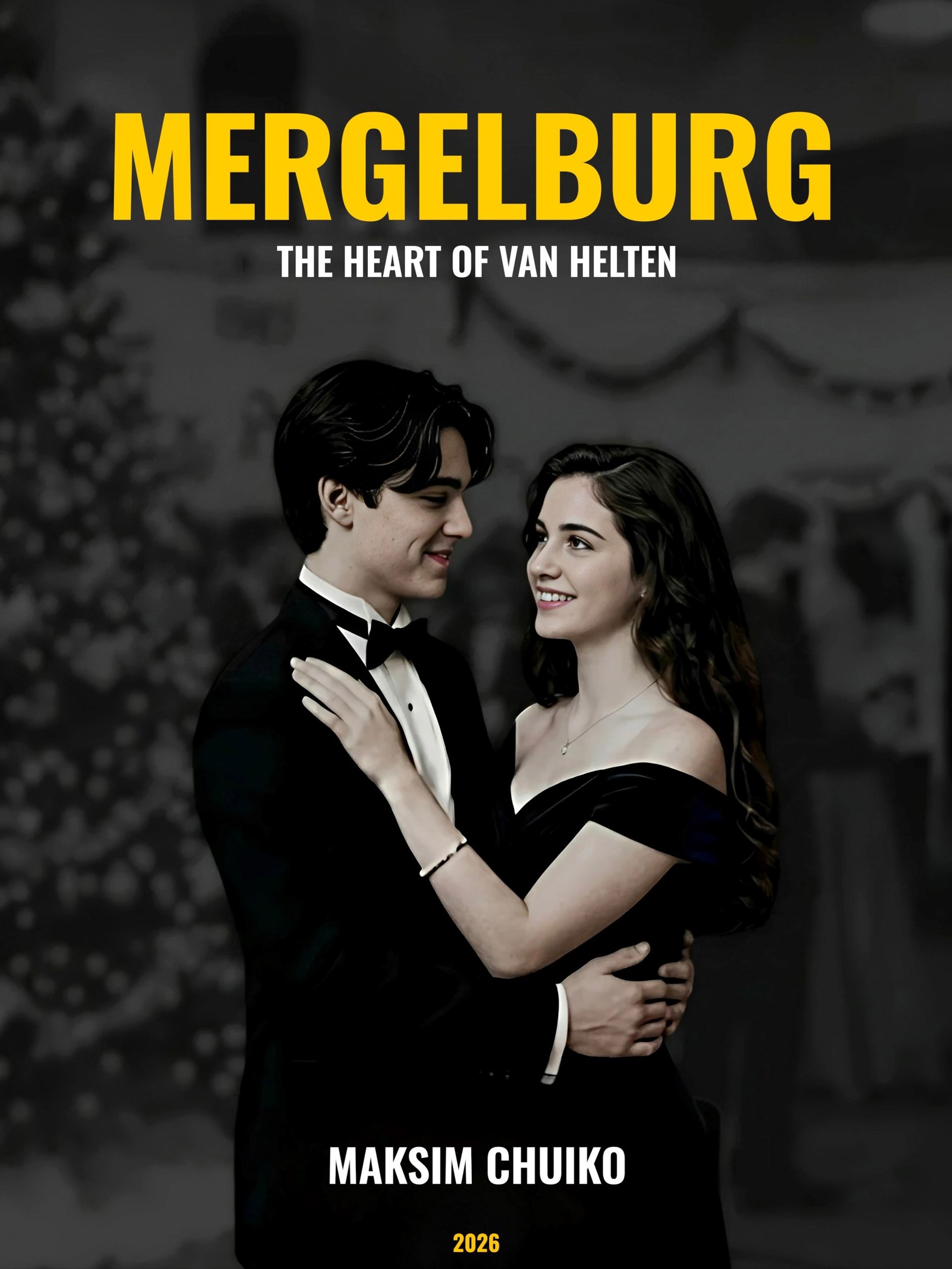
Mergelburg: The Heart of Van Helten [English Verison]
Prologue
“Above all else, guard your heart,
for everything you do flows from it.”
Proverbs, 4:23
“The more we try to control everything,
the more reality slips through our fingers.”
Sigmund Freud.
It is human nature to want to control everything around us—even that which cannot be controlled. We make plans, draw routes, arrange the future on neat shelves, as if life were a mechanism with understandable gears, where one only needs to twist a single part for everything to go as intended. But life is not a mechanism. It is a river—fast, murky, unpredictable—and any attempt to hold it in our palms always ends the same way: the water seeps through our fingers, leaving behind only a cold dampness and the bitter taste of helplessness.
This was precisely what Howard was thinking as he stood by the window on that raw autumn day. Beyond the glass, Mergelburg seemed like a town forgotten by time and weather alike. The gray facades of the houses, as if faded by endless rain, loomed over the narrow streets, while the wet cobblestones reflected the dim glow of the streetlamps like shards of a broken mirror. The rain did not pour—it slid down the windows in slow, unhurried tears, blurring the outlines of the world into vague silhouettes. The air was heavy, saturated with the smell of dampness, cooling smoke, and something elusively sorrowful—as though the town itself was mourning something long gone.
The room breathed with an era its owners had no wish to chase away with modernity; on the contrary, they preserved it carefully. It was not a museum, nor was it an ordinary home: here, the style of the nineteenth century did not seem deliberate—it was a way of life. High ceilings with molding, heavy curtains of dark green velvet that muffled both street noise and light, and wooden furniture with fine carving, darkened in places by time but polished to a soft gleam—all of it created a sense of reliability, almost eternity. Dark oak bookshelves, filled with leather-bound volumes, covered nearly an entire wall; between them hung old engravings and yellowed maps, as if to remind one that the world was far larger than a single room or a single town. On a massive writing desk with bronze fittings lay an open atlas; beside it stood a copper inkwell and a quill, though no one had written with ink for a long time. In the corner, a grandfather clock ticked quietly; its steady rhythm was not intrusive but soothing, like the pulse of an old house.
The air carried not only the dampness from outside but also something homely: the wax used to polish the floors, old paper, and strong coffee. Howard wrapped his fingers around the hot cup, but the warmth did not reach inside—the cold seemed to have settled somewhere deeper than the skin, in the very chest. He watched the drops slide down the glass and felt a familiar, almost habitual tension rising within him: the desire to fix everything, to foresee everything, to hold on to everything.
At seventeen, Howard looked as though he was trying to seem older and more serious than he really was. He wore a dark blue shirt made of thick fabric, its buttons carefully fastened all the way to the top—as if he wanted to hide his vulnerability within it. His sleeves were rolled up to his elbows, and this single touch of carelessness betrayed his inner restlessness. His trousers, made of fine wool and dark gray in color, fit perfectly—recently bought, most likely at his father’s insistence. They felt too “grown-up” for a teenager, but Howard wanted to look like someone to be reckoned with. There was a tension in his posture, as if he were constantly ready for an argument or for defending his rightness.
“You’re making plans again,” came a quiet voice from behind him.
Howard did not turn around. He knew that voice, knew its intonation—there was no reproach in it, only a gentle, almost weary care.
Victor van Helten, Howard’s father, at nearly sixty looked like a man who had lived a long life without squandering either his intellect or his dignity. He held a doctorate in philology and was a professor, and there was an academic composure to him that never hardened into dryness. He wore an old tweed jacket, worn in places but carefully mended—a garment he had kept for so many years that it seemed a part of him. Beneath it, a knitted dark brown vest was visible, and around his neck hung a thin wool scarf, draped carelessly yet tastefully. His gray hair was cropped short, and in the deep wrinkles around his eyes lingered a habit of smiling, even when the conversation turned to serious matters. In his hands he held a worn volume of Kant, as though he had been about to read, but had set it aside to talk.
His father stepped closer and stopped beside him, also staring into the rainy haze.
“Not plans,” Howard replied quietly, without taking his eyes off the window. “More like... insurance. If I think everything through, nothing bad will happen.”
His father gave a soft grunt—not mockingly, but with a touch of sad irony.
“Insurance against life?” He paused, watching the rain draw its incoherent patterns on the glass. “You know, when you were little, we used to float paper boats down the stream. Do you remember?”
Howard gave a barely noticeable nod.
“You folded them so carefully—every corner had to be even, every crease perfect. You thought that if the boat was made right, it wouldn’t sink. But then the current would catch it, spin it around, sometimes flip it over, and you would get angry. You wanted it to sail exactly where you had intended.”
“I wanted it not to break apart,” Howard corrected quietly.
“Yes,” his father agreed gently. “You wanted to protect it. But the river doesn’t listen to our wishes. And do you know what I told you then?”
Howard finally turned. His father’s face was calm, but in his eyes there was that particular wisdom that comes not from books, but from years lived—and from pain a man has learned to accept.
“That the current is not the truth,” Howard said almost in a whisper, as if tasting the words.
“Exactly,” his father nodded. “Going with the flow does not mean giving up. It means accepting that you cannot control the river. But not taking the current for truth—that is what matters. The current simply carries. It does not know where you need to go. It does not decide what is right for you.”
Howard looked out the window again. The rain was still sliding down the glass, and the town was still sinking into gray twilight, but now it seemed that there was not only sadness in it, but also a strange, harsh beauty—the beauty of untamed reality.
“Sometimes I feel that if I don’t control everything, everything will fall apart,” he admitted, and in those words there was no bravado, only a sincere, almost childlike anxiety.
His father placed a hand on his shoulder—light, yet firm, like an anchor in a storm.
“What is meant to fall apart will fall apart,” he said calmly. “But you will remain. And you will build again. Not because you calculated everything, but because you know how to rise. But don’t try to make the current your compass. It will carry you somewhere you don’t need to be.”
Howard took a deep breath, and with that breath, some of the tension that had been building for weeks seemed to leave his chest. He looked again at the rain, at the blurred lights, at the town living its own life without asking anyone’s permission. And for the first time in a long while, he allowed himself not to try to hold on to everything.
Let the river flow. Let the paper boat sail wherever it wants. The main thing is not to confuse its path with your own truth.
Victor settled into a deep armchair that stood in the corner of the room opposite the window. With a quiet, familiar creak, the wood accepted his weight—the armchair was old but reliable, like everything in this house. He clicked the switch of a desk lamp with a yellow frosted shade, and the room immediately became smaller, cozier, as if it had narrowed the world down to a single warm circle of light. Shadows fell upon the carved patterns of the cabinets; the gilding on the spines of books flared softly for a moment and then dimmed.
Taking a pair of thin-framed glasses from their case, Victor put them on unhurriedly, adjusting the temple with a habitual movement. Then he opened the book—that same worn volume of Kant—and found the page where he had previously stopped. He paused for a second, as if listening not to the words, but to something behind them, to the silence between the lines. His fingers, slightly trembling with age but still steady, began to slowly stroke his short gray beard and mustache—an old habit that betrayed deep concentration. He was lost in thought, though certainly not over the concept of the categorical imperative.
His blue eyes, once bright and now slightly faded from the years but still alive, lifted and came to rest on his son. There was so much in that gaze at once: fatherly care, weariness from trying to guess another’s thoughts, and a quiet, stubborn desire to understand after all. One could read parental worry in them—not hysterical, not loud, but deep and patient, as if he were already taking upon himself part of the weight pressing down on Howard.
Victor closed the book carefully, without irritation, as if apologizing to it for the interrupted reading, and set it aside on a low carved table, where several pencil-written pages, a silver pen, and a small bronze owl figurine—a gift from Elizabeth on their anniversary—already lay.
He knew that thoughts of “control” did not arise from nothing. Howard had grown up in the family of philologist Victor and psychologist Elizabeth van Helten, and this had left a particular imprint on him. From childhood, he had not simply noticed emotions—he had read them like text, broken them down into meanings, compared intonations and glances, searched for subtext in every word. He felt the world more keenly than most of his peers, and this sensitivity was both a gift and a curse: it allowed him to see hidden motives, but it also made him vulnerable to any falseness.
That was why the elder van Helten understood: if he began asking directly, it would not be a conversation but a psychological duel. Howard, raised on discussions about the mechanisms of consciousness and the nature of anxiety, parried any questions brilliantly. He knew how to defend himself with words, to build logical barricades, to hide pain behind flawless arguments. And if his father made a mistake in phrasing, the son would simply point it out politely, almost tenderly, and avoid answering.
His father was silent for another moment, as if sorting through not words but entire worlds in which those words had once lived. He knew: if he pushed too hard, Howard would immediately raise his defenses—politely, logically, flawlessly. An endless analysis was always running through his son’s mind: every word from his father was broken down into possible meanings, every question into a dozen possible answers, every tone of voice into hidden intentions. For Howard, a conversation was not an exchange of thoughts but a chess match, in which he calculated his opponent’s moves in advance.
But Victor decided to make a move his son’s mind was most likely not prepared for. Not because he was cleverer, but because he was coming not from logic, but from silence and vulnerability. Such a turn either did not exist in Howard’s calculations at all, or had been dismissed as improbable. And it was precisely this uncalculated scenario, accepted now by the teenager’s consciousness, that could break through his armor.
Victor tilted his head slightly, as if listening not to his son, but to himself, and said quietly, almost to himself:
“You know, when I was about seventeen, I also thought that if you arranged everything correctly—the words, the pauses, the glances—you could make the world follow your script. I was sure: if only I found the right phrases, she would understand that I was the one.”
Howard flinched almost imperceptibly, but did not turn around. Only his fingers tightened around the cup, until his knuckles turned white.
“Her name was Marta,” Victor continued, not looking at his son, as if telling the story not to him, but to the rain outside the window. “I was living in a different town then, in a smaller house, without engravings and old books. And I thought love was a problem that could be solved if you didn’t make mistakes. I rehearsed phrases in front of the mirror, counted how many seconds to hold a pause so as not to seem pushy, and at the same time not let her forget about me. I thought that control was the same as caring.”
He paused briefly, remembering not so much Marta herself, but the desperation with which he had tried to hold on to a feeling that was slipping away.
“And then I understood something that at the time felt almost like a betrayal of my own efforts: you cannot force another person to feel what they don’t feel. And no perfect words will help. It was... hard. As if you were standing on a stage, saying everything exactly as written, and the hall was silent.”
The room grew quiet; only the grandfather clock steadily counted the seconds, and the rain continued whispering something of its own against the glass.
“For a long time I couldn’t accept it,” Victor added quietly. “I thought the problem was with me: I had said something wrong, looked at the wrong moment, smiled the wrong way. And only years later did I realize that the mistakes weren’t the point. The point is that not all stories end the way we want them to. And not all feelings can be earned.”
Howard finally turned his head a little, though he still did not look directly at his father—his gaze slid over the dark wood of the cabinet, over the dim glint of bronze, over any point that was not Victor’s face. But in that half-turn there was already something new—not defense, but expectation.
“And what did you do then?” he asked almost in a whisper, as if afraid of frightening away this unfamiliar, honest tone of conversation.
“Nothing special,” Victor answered calmly. “I simply stopped trying to control everything. I allowed myself to be imperfect. And you know what the strangest thing is? When I stopped trying to be the person I thought I had to be for her, breathing became easier. Not because she suddenly fell in love with me, but because I stopped breaking myself for someone else’s silence.”
He tilted his head slightly, watching his son attentively, but without pressure.
“That doesn’t mean the pain disappears. It just stops being fuel for endless calculations. That’s what you’re doing right now, isn’t it? Running through every possible scenario in your head, searching for where you went wrong, what you could have said differently…”
Howard slowly lowered his gaze to his cup, as if searching the dark surface of the coffee for an answer he didn’t dare speak aloud. His shoulders, tense until now, seemed to drop slightly—not from weakness, but because part of the weight had finally found something to rest on.
“Her name is Emily Moore,” he said, and his voice sounded unusually brittle, as if the words were scraping his throat. “We sit two rows apart in class. Sometimes she laughs at someone’s joke, and I catch myself trying to figure out: is it just laughter, or is she looking at someone, or… well, I don’t know. She doesn’t look at me. At all. As if I’m not there. And every day I try to think of a way to make her notice me.”
He fell silent, as if frightened by what he had allowed himself to say.
“And every time I think that now I’m about to say the right thing, I immediately imagine how it could go wrong. Ten different versions, a hundred… I don’t even manage to start, because I can already see everything falling apart.”
Victor did not nod, did not rush to answer with comfort. He simply sat a little longer in the silence, allowing those words to take their place in the room, without trying to immediately correct or smooth them over.
“You know,” he finally said quietly, “sometimes the bravest thing you can do is not to calculate every possibility, but simply to say: ‘It matters to me that you’re here.’ Without a plan. Without strategy. Just the truth. Even if it changes nothing. Because you have the right to be heard, even if the answer isn’t the one you hoped for.”
Howard looked out the window again, where the rain was still blurring the lights of the town into dim smudges. But now there was something less hostile in that gray light—not a promise of happiness, but an acknowledgment that the world doesn’t have to be comfortable.
“But it’s easier to say nothing,” he said almost in a whisper.
“Yes,” Victor agreed calmly. “Easier. But not freer. And not more honest with yourself.”
And in that silence, filled with rain, old wood, and a heavy but necessary confession, something fragile and real finally settled between them—not a solution to the problem, but the right to have it. The right to feel, and not to hide it behind flawless calculations.
Howard said nothing more. Not out of distrust—he simply suddenly felt that the words that had seemed necessary a minute ago had become too heavy to speak. They seemed to catch on his ribs, unwilling to come out, and he decided to keep them to himself—let them lie where they were more at peace.
Victor understood. Not through any special insight, but by the way his son turned back to the window, by the way his fingers relaxed slightly on the cup, by the way there was no tension in the silence—only the quiet weariness of someone who had finally allowed himself not to defend. The professor did not push, did not search for new detours to the truth. He simply remained seated in his armchair, in the warm circle of light from the yellow lamp, and let that silence become something reliable—not an emptiness, but a space where one could breathe.
The rain outside gradually weakened. It no longer lashed against the windows, but rustled softly, as if the town itself had finally exhaled and decided to quiet down a little. The drops slid more slowly, as if in no hurry, and there was something soothing in that unhurried pace. The lights of Mergelburg, previously blurred and dim, now stood out more clearly, reflected in the wet asphalt like timid sparks of hope.
Victor took off his glasses, placed them on the table beside the book, and closed his eyes for a second, as if giving himself permission to share in that silence.
Howard stood by the window, and his reflection in the glass seemed a little less sharp, less tense. He wasn’t looking at his father, but he felt his presence—not as pressure, but as a support that asked for nothing in return. And in that, too, there was a form of trust: not to pour everything out at once, but simply to let someone know that things were hard, without demanding to be “fixed” on the spot.
“If you ever want to tell me more,” Victor said quietly, almost in a whisper, without opening his eyes, “I’ll be here. And if you don’t want to, I’ll still be here.”
Howard gave a barely perceptible nod, without turning around. That was enough.
Outside, the town was slowly waking from the rain. The sky had lightened a little, and the gray shroud was beginning to break into separate layers—paler, almost pearlescent. Far away, a car passed, and its headlights cut through the damp twilight for a moment, leaving behind only a brief trail of light.
And when that light faded, Howard finally stepped away from the window. He set his cup on the windowsill, ran his palm across the cold glass as if wiping away the last drops, and quietly sat down on the edge of the sofa—not too close to his father, but not at the other end of the room either. Just nearby.
They sat like that for a while—in a silence that didn’t need to be filled with anything. Then Victor picked up the book, opened it to that same page as if returning to something long familiar, and began to read aloud—quietly, steadily, the way one reads when the goal is not so much to tell a story as to build a protective circle around it. And Howard listened, not so much to every word as to the rhythm of his father’s voice—even, calm, as if promising: whatever happens tomorrow, today, here, all is well.
Chapter 1
“Do not seek to have everything happen as you wish,
but wish for everything to happen as it actually does,
and your life will be serene.”
Epictetus
The Mergelburg morning showed no signs of softening. The wind still drove dry leaves along the sidewalks, flung prickly sprays of yesterday’s rain into passersby’s faces, and seemed determined to make every step heavier. Autumn had finally settled in, and the town appeared even grayer than before, yet there was none of the dull hopelessness that had weighed down the previous day. It was simply autumn—harsh, frank, and disinclined toward comfort. Howard pulled his coat tighter, feeling the fabric catch on his shoulders as though trying to hold him in place. In his pocket, he felt a small folded piece of paper—on it, the day before, he had jotted down a few phrases he wanted to say to Emily. Now it felt less like support and more like a burden: the closer Howard came to school, the louder a voice in his head insisted that all those phrases were foolish, ridiculous, clumsy, and destined to end with him face-first in the mud.
Passersby hurried past, wrapping themselves in scarves and hiding their faces from the wind. Some rushed, others wandered slowly, as if unsure of their destination. The town lived its ordinary life—indifferent and yet strangely caring: it promised no miracles, but allowed each person to go their own way.
At the school gates, Howard stopped for a second, drawing in the cold air deeply, as if gathering courage not for some great feat, but for a simple, human step. When he walked into the yard, where students were already crowding, the laughter and shouts sounded not like mockery, but like the ordinary noise of life—chaotic, alive, and impossible to calculate. Amid that bustle, a little apart from a noisy group of seniors, stood Emily. Alone. For a second, the whole world seemed to shrink to that point—to her silhouette, to the way the wind tried to tousle her hair, but it, thick and wavy, just past her shoulders, stubbornly fell in soft waves, as if it knew it was meant to be exactly that.
She was a brunette whose hair, in the dim morning light, seemed not merely dark—dozens of shades hid within it, from deep chocolate to almost black, with thin silver threads where the wind caught it. Her blue eyes, bright as shards of winter sky, looked somewhere forward, as if she were trying to discern something of her own in the gray day, something only she understood. Her athletic, toned figure was not deliberate but natural—as if she were simply used to being in motion, used to the fact that her body was an instrument, not a display. Her hands were lovely, with a neat manicure, not a single extraneous detail—but there was no coldness in that; on the contrary, that composure made her vivid, real.
In Howard’s eyes, she looked not like an unreachable statue, but like a person in whom everything was gathered at once: strength and vulnerability, confidence and a slight confusion that she immediately hid, as if ashamed of it. He looked at her and suddenly understood that he did not want to calculate possibilities. Did not want to think about how she might answer, how she would look, what she would do. He simply wanted to see her like that—real, without the filters of anxiety.
“Now,” he thought, squeezing the edge of his pocket where the paper lay. “Now I’ll go over. I’ll ask how her morning started. I’ll ask about the graduation project. Anything. Just to hear her voice.”
But before he could take a step, Tyler appeared beside him.
“Howard! Hey, where are you rushing off to?” Tyler clapped him on the shoulder, a little too energetically, as he always did when he wanted to share something urgent. “Are you even aware of what happened yesterday?”
Howard flinched, surfacing from his trance. Tyler was about the same height as he was—around one hundred and seventy centimeters—of average build, with neatly styled chestnut hair: his bangs fell to the right side, while on the left there was a perfect part, as if he had spent half an hour in front of the mirror trying to achieve that careless precision. In his eyes burned the same excitement with which he collected school gossip the way others collected stamps.
“Well, picture it,” Tyler went on, not waiting for an answer. “Chris and Jake went yesterday to that old warehouse behind the park—you know the one everyone avoids. Rumor says someone holds underground bicycle races there, but it’s not certain. Anyway, they decided it was their chance to become ‘those guys.’ They climbed in, and there was a security guard—not just any, but supposedly an ex-military man. Chris, of course, immediately started babbling something about ‘we were just looking,’ and Jake tried to act like he’d wandered in by accident and had just been passing by on his way to buy bread. The guard looked at them like he saw right through them and said, ‘If you’re just looking, why do you have flashlights in your hands and gloves like burglars?’ In the end, he made them clean up trash around the warehouse until midnight. And today everyone at school already knows, and Chris is telling everyone it was a ‘voluntary community initiative.’”
Tyler burst out laughing, clearly savoring every detail of the story, and waited for Howard to smile too, to pick up the joke and join in their usual back-and-forth. And Howard did smile—but the smile came out strained, like a badly sewn button. He nodded in the right places, inserted “come on” and “no way,” but his gaze kept slipping back to Emily, who was still standing alone, as if the world around her had paused for a second.
“And in the end, you know what he said?” Tyler leaned forward, lowering his voice to a conspiratorial whisper. “The guard threw at them on their way out: ‘Next time you come back, at least come up with a decent cover story. “We were just going for bread” isn’t even funny anymore.’”
Howard wanted to laugh, wanted to say something witty like before, but the words stuck somewhere between his throat and his tongue. Instead, he suddenly felt how tightly he was squeezing the handle of his bag, as if it were an anchor keeping him from simply turning around and walking over to Emily.
“Listen,” he exhaled, trying to keep his voice calm and unhurried, without resentment toward himself for once again postponing an important step. “Sorry, I really have to go. I’m... a little out of it right now. But I’ll gladly hear the rest later, honestly.”
Tyler paused for a second, as if not quite understanding why his story had not gotten the expected reaction. Then he nodded, frowning slightly, but immediately relaxed again—he had a talent for not staying offended for long.
“Fine. But don’t think you’re getting out of it. After class you’ll tell me where you were rushing off to.” He winked, waved, and melted into the crowd, carrying with him part of the usual noise that always swirled around him.
As soon as Tyler disappeared from view, Howard turned back to the spot where Emily had been standing. But now she was no longer alone. A small group of friends had gathered around her: someone was telling a story, waving their hands, someone was laughing, and she herself had tilted her head slightly, that same smile playing on her lips—light, sincere, as if she really was enjoying the chatter, the little things, the ordinary school moments.
For a moment Howard froze. He took a couple of steps forward, almost without realizing it, and simply looked at her—at the way the light fell on her hair, at the sparks of laughter in her blue eyes, at how she moved as if unaware of her own beauty, as if it were simply part of her, as natural as breathing. And in that moment he suddenly understood: she was beautiful not because she was perfect, but because she was real. There was nothing invented about her, nothing calculated—only life, loud and bright, refusing to obey any scripts.
He held that image inside for another second, letting it warm him from within, then slowly turned left, gripping the handle of his bag more tightly. With his other hand he mechanically adjusted his coat, as if that gesture could give him back even a little composure. And he walked on—not toward her, not now, but not away from her either. Just farther, to where the day was already waiting for him with all its unexpected turns that defied any calculation.
A couple of lessons passed almost unnoticed—as if Howard had been present in the classroom only in body, while his thoughts wandered somewhere far away. In geometry, the teacher drew angles and triangles on the board, wrote out formulas, but to Howard these were not figures but diagrams: he was mentally constructing the ideal trajectory by which he might approach Emily, calculating the points where their routes crossed in the hallways, picking out moments when she was alone. Every line became a step toward a conversation, every angle a possible obstacle to get around. In geography, it was even further from reality. The teacher talked about climates, capitals, and mountain ranges, while the lovesick boy saw not maps and atlases but his and Emily’s travels. There they were, walking along the narrow cobblestone streets of old Brussels—between houses with pointed roofs, where the wind carried the smell of fresh pastries from a little bakery on the corner; there they stood on the shore of the Mediterranean by the cliffs of Amalfi, and the salty wind mixed her wavy hair with the sun’s sparkles on the water; there they were riding a train through the green hills of Tuscany, with rows of cypresses and vineyards bathed in golden light drifting past the window. Every country turned into the place of their future vacation, every river into a road they might walk along together. He caught himself mechanically writing down the names of cities—Brussels, Naples, Florence—as if composing an itinerary, then immediately erased them, feeling the absurdity of those fantasies.
During the long break, Howard sat down at a table in the school cafeteria—at the very one by the window, from which part of the schoolyard was visible. He was served the usual late-80s school lunch: a plate of mashed potatoes with a golden-breaded cutlet on top, a few slices of pickled cucumber and a piece of dark bread beside it. In the mug was warm cocoa—not too sweet, with a light foam on top. Howard ate almost mechanically, not tasting anything, and from time to time stirred the cocoa with his spoon, as if hoping to find some answer in the dark liquid.
The cafeteria hummed with its usual sounds: the clatter of dishes, fragments of conversations, someone’s laughter, the scraping of chairs. But to Howard that noise seemed distant, fading into a background against which his own thoughts rang louder. He looked out the window, where streams from the morning rain ran along the asphalt, and again went over the phrases from that little paper in his head, trying to find an intonation that would not make them sound laughable or pitiful.
At some point he felt someone’s gaze on him—warm, persistent, but not heavy. Raising his eyes, he saw Susan. She had quietly sat down across from him, resting her hands on the edge of the table, and was looking at him with her big green eyes—attentively, patiently, as if she were ready to sit like that through the whole break until he finally noticed her.
Susan was small, delicate, with soft features and a wayward strand of light hair that always escaped from her braid. There was not a drop of that tense composure that lived in Howard—she seemed lighter, as if she knew how not to cling to worries but to let them drift past. But beneath that outward lightness she was incredibly perceptive: she noticed everything—how her brother squeezed his fingers, how he averted his gaze, how he stirred his cocoa not in circles but with sharp, nervous movements. To her, those little things were like words, only more honest.
“You’re thinking about something again that you’re not telling anyone,” she said quietly, tilting her head slightly, as if listening not to words but to what was hidden behind them. “I can tell. You’re sitting like you’re holding the whole world on your shoulders, and it doesn’t fit you.”
Howard smiled weakly—not because things had gotten easier, but because next to Susan even heaviness felt a little less prickly.
“It’s just one of those days,” he tried to wave it off, but his voice betrayed him: there was no confidence in it, only weariness.
“A day like any other,” Susan replied calmly, not arguing, just calling things by their names. “But you’re different in it. Not like when you’re just angry or tired. You seem afraid to take a step, and then afraid you won’t take it.”
She paused, then carefully pushed a saucer with a small shortbread cookie—his favorite—toward him.
“If you don’t want to talk, you don’t have to. I’ll just sit here. Or we can talk about anything: about classes, about Tyler’s dumb gossip, about how weird the cocoa is today. Or about nothing at all. But if you ever want someone to just listen... I’m here. And I won’t say ‘come on’ or ‘it’s not that bad.’ I’ll just listen.”
There was no pressure in her words, only a quiet, reliable kindness—the kind that asks nothing in return and therefore works more powerfully than any persuasion.
Howard looked at his sister, at her attentive green eyes, at that cookie, as if she were trying to support her words with something tangible, and suddenly felt something inside him loosen just a little, shedding some of the tension.
“Thank you,” he said quietly, and that “thank you” was not for the cookie but for the fact that she hadn’t tried to poke at the most painful place, but had simply reached out her hand into the darkness.
He took the cookie, bit off a piece, and this time the taste suddenly became real—sweet, crumbly, simple. And for one short second all that endless calculation of possibilities, all those routes and scenarios, all the attempts to think through everything and miss nothing—all of it receded, leaving room for something small but real: his sister, the cookie, a quiet conversation that didn’t have to lead anywhere.
Susan really had managed to pull Howard out of the whirlpool of his thoughts for a minute—so deftly, as if she had simply turned off the noise. He suddenly noticed how the cafeteria smelled: not only of food, but also of old wood, chalk from the classrooms, a little dusty and homely. He heard someone at the next table giggle, a spoon clink, a chair scrape. And for that one minute he felt lighter—as if the heaviness he had been carrying since morning had become a little lighter, not gone, but at least no longer pressing on his shoulders.
He looked at Susan and thought that in her attentive green eyes there was no judgment, no desire to “fix” him, not even the kind of curiosity that wounds. Only a quiet “I’m here.” And that made him calm. He treasured that sincerity of hers immensely—it was the very support that doesn’t boast of its reliability, but simply stands beside you, even when everything is falling apart.
Howard wanted to tell her everything: about Emily, about the paper in his pocket, about how he rehearsed every phrase ten times and still feared he would say the wrong thing. But he held back. He understood that she couldn’t give him the answer to the questions gnawing at him from inside. He didn’t want to shift that confusion onto her, didn’t want his anxiety to become her anxiety too. Let at least one person have a simple day.
But he did want to talk to her. Just to hear her voice, to feel that the world wasn’t made only of endless calculations.
“I see Tyler managed to fill you in on the Chris and Jake story,” he said with a smile, trying to make the smile not forced but real.
Susan snorted, rolling her eyes, and there was so much sisterly irony in that gesture that Howard couldn’t help smiling wider.
“He told me about it during the break between first and second period. And he made it sound like the news of the century. I even tried to pretend I was listening, but at some point I realized that if I heard the words ‘underground races’ one more time, I’d fall asleep right at my desk.”
“I couldn’t even properly pretend to be interested,” Howard admitted, lowering his voice a little. “I kept trying to look past him, over to where... Ahem.” He glanced aside, as if trying to instantly veer away from what he’d been about to say. “Where Harry was standing.”
Susan noticed that maneuver: her brother clearly didn’t want to say where exactly he had been looking, and it definitely wasn’t about Harry O’Neil. She simply nodded, as if understanding without words: “Yes, sometimes other people’s fun sounds like white noise when something of your own is humming inside.”
They went on discussing that absurd story for a little while—not seriously, just to keep talking, to avoid leaving a silence that could again give way to anxious thoughts. Susan comically imitated Tyler’s intonation when he whispered about “come up with a decent cover story,” and Howard laughed—sincerely, without effort, for the first time that day.
And in that moment he noticed how she suddenly froze, then changed her tone slightly—it became quieter, softer, as if she was trying to sound normal but couldn’t. Susan averted her gaze, and just then, past their table, a boy walked by. Howard saw him only from behind, but that was enough to sense the confidence in his stride: he walked as if he knew exactly where he was going and why, as if the whole world was not a labyrinth to him but a straight road. Shoulders squared, step sure, not a trace of haste.
In that same second, Susan’s fingers began nervously twisting around each other; her nails caught faintly, as if searching for something to hold on to. She seemed to be trying to hide that tremor, to pretend everything was fine, but to Howard, who was used to noticing details, it was like a scream, only very quiet.
A couple of seconds later, she looked back at her brother, as if returning from another world, and hastily broke the awkward pause:
“So... where were we? On how Tyler talks too much? Or on how Chris and Jake are the unluckiest people on earth?”
Howard smirked slightly, but didn’t press with questions. He didn’t want her to feel caught. Instead, he played along gently:
“I think we were on how Tyler is the best storyteller in the world—if you don’t listen to the content, only to the intonation.”
Susan exhaled—Howard noticed it by the way her shoulders relaxed a little—and smiled graciously, as if he had just quietly offered her a hand and kept her from falling.
The next second, Vanessa—Susan’s classmate—slid into the seat at their table. She burst into their quiet corner as if she had brought a piece of sunshine with her: bright, energetic, with that smile that seemed to promise the day couldn’t be all bad. She wore a plaid skirt, a turtleneck sweater, and a bright scarf that seemed to live a life of its own—it kept slipping, and she kept adjusting it, laughing at her own clumsiness.
“Hey there, my dears!” Vanessa exclaimed, flopping onto the bench as if they were not in the school cafeteria but at a picnic in the park. “You look so serious, like you’re discussing the fate of the universe instead of school lunch. What’s going on? Or better yet, tell me what’s been going on without me? I feel like I missed something important!”
Her voice was bright and infectious; there wasn’t an ounce of falseness in it—only a sincere desire to be part of everything happening. She immediately reached for Howard’s mug, pretended she was about to take a sip, then snatched her hand back with a giggle:
“Just kidding! Your cocoa is sacred. But if you have another cookie, I’m ready to sell my soul for it. Or at least tell you the latest gossip—your choice.”
She snapped her fingers as if trying to catch a thought, then blurted out:
“By the way, did you hear? There’s a rehearsal for the Christmas concert in the assembly hall on Friday, and Mr. Harris wants the seniors to help with the decorations. I already signed up. If you come with me, it won’t be so scary hauling those boxes. Or at least you can cheer me on.”
Vanessa talked fast, but not annoyingly—more as if she was afraid that if she stopped, all that charge of energy would simply scatter. And, most surprisingly, she really did change the atmosphere: with her arrival, the silence became fragile and the tension heavy. Now it was just a pause between lines, not an abyss one could fall into.
Susan laughed, shaking her head, but there was relief in her laughter—as if she too was glad they no longer had to hold the conversation just the two of them, that she could hide a little behind that cheerful chatter.
“Vanessa, you’re like a hurricane,” she said, smiling. “In a good way.”
“A hurricane with cookies and good intentions,” Vanessa winked, then turned to Howard as if only now truly noticing him. “And why are you so quiet? Don’t worry, I don’t bite. It’s just that when I’m quiet, I feel like the world stops, and I don’t like that.”
Howard caught himself smiling—and this time it wasn’t an attempt to seem normal. It came on its own, as if in response to that lively, loud sincerity.
The bell rang sharply, as if cutting the conversation off mid-sentence. Vanessa flinched, immediately jumped up, grabbed Susan by the arm, and pulled her along, chattering as she went:
“Okay, okay, let’s run, or else Mrs. Clark will again say I’m ‘disrupting discipline with my lateness,’ when really it’s her disrupting my peace of mind with her looks! Are you coming? Or are you going to pretend you’re an angel who’s never late?”
Susan, already rising, only managed to brush her hand across Howard’s shoulder—a light, almost weightless touch that held all her “I wish I could stay just one more minute.” She smiled at him quickly, guiltily, as if apologizing for the world’s hurry, and then vanished into the stream of students, carried away by Vanessa’s energetic whirlwind.
Everything around started moving: chairs scraped against the floor, someone dropped a notebook, someone called a friend across the hall, someone laughed without hearing their own voice in the noise. The hallways were already beginning to fill with the rumble of footsteps, and the cafeteria, which a minute before had seemed like an island of quiet, turned into a crossroads of hurrying lives—each person rushing to their own class, their own little drama, their own way of not drowning in the day.
Howard unhurriedly folded his napkin, wiped his mouth, stacked his dishes on the tray, and went to the washing station. On the way, he paused for a second, breathing in that particular cafeteria smell—warm bread, boiled potatoes, and a hint of sharp soap—as if he wanted to hold on to that moment of calm before plunging back into the school whirlpool.
By the sink stood Clara—a plump woman with kind, slightly tired eyes and hands roughened by hot water and brushes. She always smiled as if that smile was her personal way of keeping herself from drowning in routine. Beside her bustled her young helper Lina, who had only been working for two months and still fussed about as if afraid of doing something wrong.
“Well, here you are, Howard,” Clara said, nodding almost imperceptibly, and in her voice there was neither reproach nor hurry—only the usual warm recognition of his presence. “As always, you bring everything yourself. Not like some: they leave their trays as if we’re not people but the janitors of their personal messes.” She turned toward Lina and went on. “I remember when he first came. Eleven years ago... such a little boy, big brown eyes, blinking as if the whole world scared him, yet trying to stand straight as if he wasn’t afraid. He’d bring his tray in his little hands, thank me so warmly as if I’d saved his life. I thought then: see, there are children who understand that politeness isn’t about ‘you’re supposed to,’ but about ‘I see you.’”
Lina smiled, tilting her head slightly, and answered quietly:
“It’s nice to see that. In all this hustle... it’s like a little ray of light.”
Howard stood with his gaze lowered a little, and a modest smile played on his lips—not from pride, but rather from the awkward warmth spreading somewhere beneath his ribs. It was pleasant to hear, but he didn’t want to be made into a hero. To him, it was simply the right thing: not to leave a mess behind, not to walk past those who make your life a little easier every day.
He stepped closer and, setting his tray on the counter, said quietly but firmly:
“Thank you. For doing all this every day. For the lunches, for the cleanliness, for the fact that even when everyone is rushing and making noise, it still feels... human here. I appreciate it. Really.”
Clara froze for a second—as if those words had fallen right into her palms and she didn’t know where to put them so they wouldn’t drop. Then she nodded slowly, and something flickered in her eyes—the kind of thing that appears when someone finally notices not only your work, but you yourself.
“Thank you, Howard,” she said quietly, squeezing the cloth in her hand a little, as if that familiar thing had suddenly become an anchor for her. “Sometimes just hearing that... it’s like a cup of hot tea on a cold day. It warms you.”
Lina also smiled, blushed slightly, and murmured:
“Yes... thank you. That’s nice.”
Howard nodded once more, as if wanting to set those words in place, to make them real, then turned toward the cafeteria exit. At the doorway he paused for a second, as if wanting to add something else, but couldn’t find the right words—and just smiled faintly once more toward the sink, where Clara was already getting back to work, but now there was a little more lightness in her movements, and in her voice, as she said something quietly to Lina, there was a quiet gratitude.
“Everyone has their own river,” he thought as he walked down the hall toward the art room. “And each one has its own current, its own rapids, its own quiet backwaters where one can hide for a little while. And no one knows how much strength it takes just to stay afloat.”
He walked on, and those thoughts did not weigh him down but rather supported him, like a railing on a steep staircase. He knew that every person wakes up in the morning carrying some burden—someone is afraid of a test, someone of a conversation, someone simply afraid that the day will again be gray and empty. And almost everyone thinks their own problems are the heaviest, while other people’s are trifles, because those are invisible. But he, like Susan, tried to notice that invisible heaviness. Tried not to pass by, not to pretend he didn’t see.
His mother’s words, spoken one evening when he had complained that people around were “not what they should be,” always came back to him:
“It doesn’t matter whether you know a person personally or it’s just some stranger. Be polite and kind. You can never know what a person went through this morning or last evening, what thoughts are tormenting their mind, what makes them barely hold back from dropping their hands and crying. Sometimes one kind word is a lifeline you throw without even knowing that someone is drowning.”
And he tried to throw those lifelines. Not for praise, not to seem good, but because he believed: if you see that someone is struggling, the least you can do is not add to their burden.
The door to the art room was ajar, and no familiar noise came from inside—no arguments about paints, no laughter, no rustling of paper. Howard paused, as if listening to that strange silence, then stepped inside. There was no one in the room except the elderly teacher—Mr. Finch. He was short, with gray hair heavily silvered at the temples and a large bald spot that made his forehead seem especially high, almost wise. The deep wrinkles on his face formed a complex pattern: they softened when he smiled and sharpened when his gaze turned stern. Mr. Finch’s brown eyes could be both warm and piercing—as if he were simultaneously understanding you and testing whether you deserved that understanding.
“Good afternoon, Mr. Finch,” Howard greeted quietly, feeling that in this unusual silence his voice sounded a little louder than he would have liked.
Mr. Finch looked up from a stack of sketches, raised his eyebrows slightly, as if surprised that someone had actually come, and nodded:
“Hello, Howard. Glad to see at least one boy who hasn’t traded his paints for the stage.”
Howard frowned a little, not understanding:
“Where is everyone?”
“Mr. Harris excused everyone who wanted to help prepare for the Christmas concert. And, imagine, there were so many volunteers that the hall is packed now. So the art room is practically a private temple today. For the chosen ones. Or for those who simply didn’t want to carry boxes.”
He said it without judgment, more with light irony, and Howard suddenly felt something like gratitude stir inside: Mr. Finch neither made a hero of his presence nor considered him strange.
The room was arranged unusually: it was divided into separate “corners,” separated from one another by shelves filled with the best student works from all eighty-nine years of the school’s history. There were plaster heads, vases, old still lifes, darkened with age but still proud of their place in history. That layout had been designed on purpose: so that students wouldn’t distract each other, so that each could remain alone with their canvas and their thoughts.
Howard went to his spot—section number two. Everything here was familiar: an easel with an unfinished landscape still on it from the last lesson, a box of brushes, jars of paint lightly covered with dust, as if even they knew that inspiration didn’t come every day. He carefully arranged everything, set up the canvas, ran his fingers over its rough surface—and paused for a moment, listening to himself.
Mr. Finch watched him from his place by the window. Then he said quietly:
“You know, I don’t like it when students come here just because they have nowhere else to go. It’s much more unpleasant for me to watch them waste paint, drawing something without any desire to create, than to see them absent. In eleventh grade, there really are more important things. But you... you seem to come not out of desperation. You come to talk to the canvas.”
Howard shrugged slightly, not knowing how to respond to such precise words.
“It’s just... it’s calmer for me here.”
Mr. Finch tilted his head a little, as if trying on that phrase the way one tries on a hat—to see whether it suits.
“Calmer. Yes. But look at your work.”
He came closer, not invading Howard’s personal space, but rather standing beside him, as an equal. He looked for a long time at the canvas, where gray tones flowed into one another, forming a city that didn’t exist on any map: foggy streets, empty benches, streetlamps whose light seemed unable to dispel the darkness.
“It’s gray. Not simply restrained—truly gray. And this isn’t your first painting in that vein. Tell me, do you see the world that way? Or are you just afraid to add color, because then you’d have to believe it exists?”
Howard involuntarily squeezed the brush. He wanted to argue, to say it was just style, that he was searching for a mood, but the words stuck halfway between his throat and the truth.
“The world isn’t so bad,” Mr. Finch said softly, as if not arguing but offering Howard a chance to taste that thought.
“Not so bad...” Howard hesitated for a second, then added firmly: “But not as good as one wants to think either. Sometimes it seems the good is just rare breaks in the clouds. They exist, but they’re few and they disappear quickly.”
Mr. Finch didn’t argue; he only tilted his head slightly:
“That means you notice them. Those breaks. That’s already something. Some people don’t even see the sky while walking in the rain.”
“I see them,” Howard admitted. “But it doesn’t make things easier. Because you know they won’t last. And then it’ll be gray again.”
“Maybe that’s the point? Not to wait for the clouds to leave, but to learn to notice the light while it’s there. Even if it’s weak. Even if it’s barely visible.”
“But is that honest?” There was a weariness in Howard’s voice he couldn’t hide. “To pretend everything is fine when it isn’t?”
“No one is asking you to pretend. I’m only asking you not to let the darkness block the whole horizon. Color doesn’t have to be bright to be real. Sometimes a single thin line, a single barely noticeable shade is enough to make the whole canvas suddenly lighter. You don’t have to paint over the darkness. You just have to let it know that there is light nearby. Even if it’s quiet.”
Howard was silent for a moment, looking at his gray painting as if seeing it whole for the first time.
“What if I don’t know how to find it?” he asked quietly.
“You already do. Otherwise you wouldn’t notice that everything around is gray. To see a shadow means to know that somewhere there is light. You’re just not looking in the right place yet.”
Howard looked at his canvas—and suddenly seemed to step inside that gray painting, walking through its streets, where anxiety and fear hung in the air like thick fog. The shutters on the houses were tightly closed, as if the inhabitants were afraid to let into their homes not only the cold but also a stranger’s gaze, a stranger’s word, a stranger’s hope. It seemed the houses hid behind those shutters their own small but heavy truth.
Mr. Finch, standing a little way off, glanced at the thoughtful young man—and his gaze softened; that particular sympathy surfaced in it, the kind that doesn’t shout but whispers: “I see how hard it is for you.” He wanted to pat Howard comfortingly on the shoulder, to say something simple and strong: “You’ll manage. You’ll find your colors yet.” He even half-raised his hand, but then lowered it and hid it behind his back, as if deciding that words or gestures would be too loud for that silence. Turning, he quietly returned to his desk, leaving Howard alone with his canvas and his thoughts.
Howard wanted to add brightness to the painting, but he didn’t know how to do it so that everything would turn out perfectly. It seemed to him that if he made a mistake with a shade, if the line came out too sharp or, on the contrary, too timid, the fragile balance of his world would break. And looking at that city, which had become a mirror of his soul, he suddenly thought: a person’s life is the same kind of easel. Every day a new stroke lands on it: someone’s glance, a chance word, a memory, hope, fear. Some people paint with bright, bold colors, unafraid of smudges and stains. Some carefully lay down barely visible lines, as if afraid of taking up too much space. And some, like him right now, see everything in shades of gray and don’t dare step beyond those boundaries.
At that moment, a woman’s voice came from the half-open door—quiet but insistent:
“Mr. Finch, they’re asking for you in the teachers’ lounge. It’s urgent.”
Finch froze for a second, as if wanting to say something else, but only gave a short nod, cast a warm, understanding look at Howard, and hurried out, pulling the door shut behind him. His absence did not make the room empty—on the contrary, it seemed to give Howard space to breathe a little more freely, to focus not only on drawing but also on his thoughts.
And he began to think—this time about the very philosophy of life. Looking at his gray city, he asked himself: if his world was so muted now, then for someone else it was probably too bright. How did that person feel? With what thought did they wake up in the mornings? Did they notice all the little things Howard was used to noticing in every person and every new day? Or, on the contrary, were they so surrounded by light that they couldn’t see shadows and therefore didn’t understand what it was like to stand in the half-dark and try to make out at least one warm glimmer?
Time passed unnoticed. The hour and a half of class was drawing to a close, and Howard was still standing in front of his easel, as if afraid to move lest he frighten those thoughts away. His easel stood by the window, and from time to time he glanced at the sky, where gray, almost black autumn clouds raced one after another, as if hurrying somewhere, carrying cold and dampness with them. He seemed to draw the mood for his city from them—from their heaviness, from their silent weariness.
But then that unbroken stream began to break apart. Narrow gaps appeared between the clouds, and the sun cautiously peeked out from behind them. Its light was not bright or blinding—rather timid, as if it wasn’t sure whether it should show itself on such a gloomy day. But it was there. And it warmed a little.
Feeling that touch of sun, Howard glanced at the clock—and only then truly realized that the time for his gray city had indeed come to an end. He began putting away the paints, carefully washing the brushes, trying not to damage the bristles, rinsing the palette until the water no longer carried the mixture of colors, and placing all his supplies into the signed shelf in the cabinet—”H. Van Helten.” The letters had been written in his own hand at the beginning of the year, and now that neat label seemed to confirm: this is my place, my corner, my right to be here, even if I’m not like everyone else.
While he was fussing, awkwardly adjusting his shirt after removing his slightly stained apron, a soft, sweet female voice came from behind him:
“Your painting is darker than it seemed.”
The voice seemed to be trying not to startle, but it still rang out sharply, like a sudden chord in the silence. Startled, Howard dropped the cup of solvent and an empty paint jar. They thudded dully on the floor but didn’t break—as if even the world had decided to spare him today.
Emily stood in a patch of sunlight that streamed through the window and lay on the floor in warm rectangles. She was squinting adorably—the sun was shining right into her eyes, and she had tilted her head slightly, as if trying to see him through that golden curtain. The sunbeams seemed to play in her hair, weaving thin golden threads from the dark brown waves. A light strand had come loose and fallen softly onto her cheek—and Howard suddenly wanted to reach out and tuck it behind her ear, but he only gripped his fingers tighter, holding himself in place. There was no harsh, cold beauty in her features—everything was alive: a small, slightly upturned nose, a line of lips that first curved into a guilty smile, then became serious when she looked at the painting. In both hands, lowered in front of her, she held her schoolbag—not like a burden, but like a shield, a familiar support that helped her stay confident even in the most awkward situations. She noticed his fright—and couldn’t hold back a slight smile. Not mocking, but warm, almost guilty: she found it amusing that she had startled him so much, and awkward at the same time.
He froze, blushing, feeling everything inside him clench with embarrassment.
Emily took a couple of steps forward, about to bend down and help gather the supplies, but Howard stopped her, saying:
“No, no, don’t bother, I’ll do it myself!”—almost pushing the air between them, as if he wanted to keep her at a safe distance so he wouldn’t make even more of a fool of himself.
She stopped and apologized again:
“Sorry, I didn’t mean to... Sorry I startled you.”
And he, already hastily picking up the fallen things, suddenly blurted out, not knowing where the words came from:
“Oh, come on, how could such a joy scare anyone? I just wasn’t expecting...”
And immediately groaned inside: “Idiot, be more confident! Why did you say that? What will she think? Say something normal!” He was smiling at her, looking at her as if she were not an ordinary girl but some miracle that had descended right into that dusty classroom, and her smile was literally melting all his tension, driving away his usual doubts.
“You know, I’ve been drawing in section three this whole time,” Emily admitted quietly, lowering her gaze a little, as if she too felt a bit awkward. “And... I accidentally overheard your conversation with Mr. Finch. Not on purpose, it’s just... the acoustics in there, voices carry.”
In that moment, something clicked in Howard’s head: “Damn, she was practically right next to me the whole time!” He suddenly felt hot not from embarrassment, but from the realization that all his thoughts, all his words, even the silence between phrases—she had heard it all. And she hadn’t left. She had stayed. And now she stood here, looking at him without judgment, but rather with interest—as if he were a puzzle she wanted to solve.
“I got curious about which painting you were talking about,” she continued, tilting her head slightly, and in her voice there was no idle curiosity, but a real, quiet desire to understand. “I spent the whole class picturing that colorless landscape in my head and asking myself: is it really so gray that even Mr. Finch paid it that much attention?”
She paused for a second, then, as if making up her mind, lifted her eyes to him:
“Do you mind if I come closer? I want to see.”
Howard nodded so vigorously that he surprised himself with his own eagerness:
“Yes. Yes... Yes! Of course!”—and immediately stepped aside, clearing her path to the canvas, as if giving way to something important.
Emily walked over and stood in front of the painting. She looked not fleetingly, not out of politeness, but as if she were really walking along those gray streets, peering into dark windows, squinting as she tried to make out something in the alley’s gloom. Howard couldn’t take his eyes off her, trying to guess what exactly caught her attention, which stroke seemed important to her, which corner meaningful. He wanted to explain, to tell her why he had laid down that particular shadow, why he had left that corner empty, but the words stuck somewhere in his throat, refusing to form into clear phrases.
At last Emily tilted her head slightly and said quietly:
“There’s so much silence here... Not dead silence, but... tired. As if the city had lived through something for a long time and had just sat down on the edge of a bench, saying nothing. But at the same time... you see these thin lines?” She carefully, without touching the canvas, traced her finger in the air along the silvery strokes. “They seem to say: ‘I’m still here. I haven’t disappeared.’”
Howard nodded, as if those words had lifted a weight he had been carrying without noticing.
“Yes,” he agreed quietly. “I was trying... not to paint over the darkness, but just to show that light exists too. Even if there isn’t much of it.”
Emily stood before the painting a while longer, then turned to him, and in her gaze there was neither admiration nor pity, but something far more valuable—understanding. In that moment, Howard looked into her blue eyes—and seemed to see a whole map of feelings, carefully traced with invisible lines. There was no falseness in them, no desire to seem like someone else: only sincerity, a light anxiety, curiosity, and warmth that didn’t shout but quietly warmed. And in that gaze he suddenly found answers to many questions that had been tormenting him inside: not about the painting, not about the world, but about whether one could be vulnerable and still not seem weak; whether one could show a shadow and still remain light; whether simply standing beside someone could already be a kind of help.
“You know,” she said, smiling slightly, “I think that’s the most honest kind of art. Not pretending the darkness isn’t there. But showing that even in it, you can find a little light.”
Howard exhaled, and the tension that had gripped his shoulders all day finally began to release.
“Thank you,” he said quietly, looking not at the painting but straight at her. “Sometimes it feels like if you see a shadow, it means you’re just fixated on the bad.”
“Or maybe you’re just not afraid to name it,” Emily answered calmly. “And that makes it less frightening.”
For a second the room went quiet again, but now the silence was different—not empty, but filled with something important.
Then Emily lifted her schoolbag slightly, as if to remind him that the world beyond that corner still existed and was expecting something from them.
“The break will be short,” she said, frowning a little, as if she herself regretted having to return to schedules and lessons. “We need to get to the last class as quickly as possible—biology. Otherwise Mrs. Crowley will unleash all her fury on us.”
Howard held his gaze on her face for a second, trying to preserve every detail in his memory: how the light fell on her hair, how a slight worry flickered in her blue eyes before class, how she gripped the handle of her bag a little tighter, as if it were her small anchor in the stormy school day.
“All right,” he said quietly, and in that “all right” there was no indifference, but a readiness to walk beside her, even if ahead lay not a canvas and a quiet classroom, but a noisy classroom and a strict teacher. “Let’s go. Only... thank you. Thank you for looking. For seeing more than just gray.”
Emily smiled—this time a little wider, as if something in her chest had also quietly unfurled, like a folded piece of paper finally being opened.
“Then let’s go,” she said, nodding slightly toward the door.
They left the classroom together. Howard lingered for a fraction of a second on the threshold, casting a last glance at the easel, his canvas, the shelves of works, Mr. Finch’s desk where everything was in its place. And he understood that order wasn’t only about arranged jars and clean brushes. It was also about knowing when to set down the brush and walk beside someone who lit the road not with bright spotlights, but simply with a warm, calm light.
The school corridor crashed over them with its usual bustle: someone ran by, stomping loudly, someone argued at the schedule board, someone laughed so ringingly that the sound seemed to bounce off the walls. Howard, adjusting to that noise after the quiet of the art room, walked beside Emily, trying not to look at her too openly but still catching every gesture. They quickened their pace, skirting a group of kids arguing about whose turn it was at the water cooler, and almost turned the corner where the corridor narrowed and led straight to the science wing. And then, from around the corner, Mr. Finch suddenly appeared. He was walking quickly but not fussily, a folder under his arm and that expression on his face that said, “I have a task and I will do it”—yet he still managed to notice everything around him.
They almost collided. Emily stopped abruptly, clutching her bag to herself, and Howard instinctively stepped forward, as if wanting to shield her from an accidental collision, though there was no need.
“Oh! Sorry, Mr. Finch!” Emily blurted out, and in her voice there was that sincere awkwardness that always sounds more honest than any excuse.
Mr. Finch paused, tilted his head slightly, and a light smile flickered across his face—not wide, but the kind worn by people who know how to appreciate small coincidences.
“It’s all right, it’s all right,” he said calmly, raising his folder a little, as if to show that he wasn’t in such a hurry as to not find a second for them. “Heading to biology? Mrs. Crowley doesn’t like her lessons to start with apologies.”
Emily nodded, blushing a little:
“Yes, we’re... in a hurry.”
Mr. Finch shifted his gaze to Howard. There was a quiet understanding in that look, as if he already knew the whole story that had happened with his gray city. In that moment, he understood everything, and for all the questions he had asked earlier, he found the answer in Howard’s eyes.
“Good,” he said quietly, and in that “good” there was more meaning than in long speeches. “Sometimes the most important thing is not to get everything done, but to take the right step at the right time.”
He gave a slight nod, as if confirming his own words, and continued down the corridor, leaving them standing at that crossroads.
Howard watched him go, feeling something quietly settle into place inside. It suddenly became clear to him: Mr. Finch had seen everything and understood everything. Not only about the painting, but about him as well—about how hard it could be to carry that gray world inside, and how much courage it took to allow even one bright line to appear in it. And the fact that the teacher didn’t say it aloud, but simply nodded at them as he passed, seemed to Howard the greatest approval he could have received.
“Let’s go,” Emily said quietly, touching his elbow—only for a second, barely perceptibly, but it was enough to bring him back to the corridor, to the bustle, to reality. “We’ve got a little over a minute left.”
Biology class truly flew by faster than all the others. Mrs. Crowley, with her usual strictness, talked about cell structure, clicked her pointer against the board, and from time to time scanned the class with her gaze, as if checking whether any chaos lurked that might disturb her perfect order. But to Howard, her voice sounded as if through cotton—he heard the intonations, individual words, but the meaning slipped away.
He kept glancing in Emily’s direction, but each time he seemed to be too late: she sat a little ahead and to the left, her head bent over her notebook, and he couldn’t quite catch the right angle to see her face fully. He was endlessly curious to understand how he appeared in her eyes. Two years of school together—ever since she had transferred to their class in eighth grade—and they had never really talked. All that time he had considered her unreachable, untouchable, as if she lived in some other dimension where everything was brighter, cleaner, and more right than in his.
One question tormented him even more, a question that now seemed almost offensive in its missed opportunity: what did her painting look like? He couldn’t forgive himself, or the schedule, or that cursed lack of time for not asking about her work. Fragments floated up in his mind on their own: section number three, dimmed light, silence in which other voices carried... What had she been drawing all that time while he tried to tame his gray city?
Mentally, he was already jumping ahead to Thursday, to the second art lesson. A whole scenario was rapidly unfolding in his head: he would enter calmly, without fuss, greet her in a way that sounded confident but not pompous. Then, as if in passing, he would ask about her painting—not pushily, but with sincere interest, as if it really mattered to him. He was already choosing intonations, trying out phrases, discarding those that sounded too ornate or, on the contrary, too timid.
“No, better like this: ‘You know, I keep thinking about your work... I wonder what you’re creating there.’ Or no. Too much ‘I.’ Keep it simpler. ‘What’s on your easel right now?’—that’s it. Simple. Human. Although... no.”
Howard began living a whole separate life in his head—with dozens of possible ways things could go. He wanted to foresee everything: not to drop his supplies, not to stumble over his words, not to look frightened, as if the world were once again pressing down on him with all its weight. He wanted to calculate everything two, three, four steps ahead, so that in the moment when she looked at him again with her blue eyes, he could simply be himself—without fuss, without panic, without that endless attempt to control everything.
But class time was almost up. As soon as the bell rang, the classroom instantly exploded with movement: desks creaked, chairs clattered, voices merged into one hum, and everyone rushed for the door, as if afraid it would close at any second. Someone buttoned their jacket on the run, someone hurriedly stuffed notebooks into a worn backpack, someone argued about who would leave first. Howard froze for a moment, trying to catch sight of Emily, but the whirlwind had already carried her away—she flashed somewhere ahead, appeared for an instant between other people’s backs, clutching her bag, then disappeared into the stream of students hurrying about their business. He remained standing by his desk, feeling reality catch up with him again, and understanding that all his perfectly planned dialogues, all those “two, three, four steps ahead” were now worth nothing. Life gave no rehearsals. It simply moved along, not asking whether he was ready.
Out in the corridor, Howard almost despaired for a moment, scanning the crowd for Emily. The hallway was long, with tall windows through which dim autumn light fell. The walls were painted a pale green, peeling in places, and old wooden benches with metal legs stood along them. The school was already living its ordinary life: someone laughed, someone argued, someone hurried, and someone just stood, like him, trying to catch a fleeting moment. Howard quickly glanced over his own appearance, adjusted his dark gray coat, checked that his collar lay straight, that his tie knot hadn’t slipped, that the corner of a crumpled paper wasn’t sticking out of his pocket—it was more important than ever that nothing spoiled his neat, composed look, as if a correct fold on his sleeve could somehow balance the awkwardness squeezing his chest.
“There can’t be that many coincidences,” flashed through his mind. “That she came over, that she spoke, that she saw something in my painting... It can’t be for nothing. And I can’t lose it in this crowd.”
He searched the faces, hoping to spot her dark hair again, the light strand falling onto her cheek, her slightly squinting gaze. And then, amid the noise, he thought he heard her voice:
“Howard!”
He turned. In his imagination, Emily stood a little way off, by the window, waving to him, trying to get his attention. There was something in her eyes that instantly washed away all that inner turmoil: not the expectation of a perfect scenario, not the fear of saying the wrong thing, but a simple, vivid “you’re here, I see you.”
“Wait!” she called, pushing through the stream of kids, and finally came up to him, slightly out of breath, but with that same smile that made everything around a little brighter. “I thought you wouldn’t notice. It’s such chaos here, like everyone suddenly decided the break is a survival race.”
Howard smiled awkwardly, but this time he didn’t scold himself for the awkwardness. Let it be. Let her see him like that—a little lost, a little hurried, a little too eager to anticipate everything.
“I... yeah, I got held up a bit,” he admitted, not trying to seem like someone else. “Kept thinking... wanted to ask...”
Emily tilted her head slightly, as if listening not only to the words but to what lay behind them.
“About what?”
And then all his prepared phrases collapsed like a house of cards under a light breath. And in their place came something real.
“I wanted to ask about your painting,” he said simply, looking straight into her eyes. “The one in section number three. I never got to see it. And I... really want to.”
Emily was smiling—not broadly, but as if his words had landed on something inside her that had long been waiting for exactly that.
“Then come early on Thursday,” she said quietly, lowering her voice as if sharing a secret. “Before class starts. I haven’t put it away yet. I’ll show you.”
For a second, Howard felt that all that school noise, all that bustle had suddenly found meaning. Because ahead wasn’t just a lesson. Ahead was a moment that didn’t need to be calculated. It just needed to be lived.
“All right,” he answered quietly, feeling something inside him settle quietly but firmly into place. “I’ll be there.”
But then Emily’s image began to blur, and he heard someone calling him again, more insistently, louder.
“Howard! Howard, are you deaf?”
He flinched and turned. Bella, his classmate, stood in front of him with her usual mild sternness and a stack of printouts in her hands—the pages were a bit crumpled, with uneven edges: they had been typed on the school typewriter and then copied in the teachers’ lounge on an old photocopier that always smudged the paper with gray spots.
“Don’t forget to bring your part of the biology group project tomorrow. You remember your topic? Ethical aspects of biotechnologies, in case you forgot. We’re already behind, and Mrs. Crowley is starting to glare. If you don’t hand it in on time, we’ll all be in trouble, you understand.”
Howard nodded, flustered, feeling reality crash down on him with all its mundane weight.
“Yes, of course. Sorry... I just... got lost in thought.”
Bella sighed, as if used to Howard’s mind always being elsewhere, and nudged the stack of papers so they wouldn’t scatter.
“Just don’t forget. We’re hanging by a thread as it is.”
She nodded to him and immediately dissolved into the stream of students hurrying about their business.
Howard glanced again at that same window—the spot where, in his imagination, Emily had stood, waving and smiling at him. But she wasn’t there. Other students crowded around. And in the very corner that, in his mind, had been reserved just for her, there was only emptiness.
He felt a light but bitter disappointment—the kind that comes when you’ve seen something important so clearly, and it turned out to be only a trick of light and shadow. Fate, it seemed, had decided otherwise.
He adjusted his coat once more, as if that small, familiar gesture could give him back even a little confidence, and walked slowly down the corridor through the noise and bustle that no longer seemed hostile—just part of the world. A world where sometimes the most important conversations are still waiting for their hour.
Howard walked along the sidewalk, and yellow leaves rustled beneath the soles of his shoes—they covered the path like someone had scattered dry gold coins across the asphalt. Along the sidewalk stretched a low white picket fence—neat, creaking slightly in the wind, as if quietly humming an old suburban melody. Behind it stood their house—a big two-story home with a dark blue front door and a brass handle that gleamed faintly even in that gray October light. A little to the right was the garage—just as solid and familiar as everything else in the neighborhood where the van Heltens lived.
A couple of months ago, a bright green lawn had spread in front of the house, a lawn his father tended so carefully: every Saturday he brought out the lawnmower, as if it were his own small ritual of order in a world where so much did not go according to plan. Now the lawn was covered with leaves, and there was something both sad and right about it—autumn was taking its due, and resisting it seemed pointless. The mailbox by the gate was empty, and that too carried a kind of silence: no bills, no letters, no small signs that the world remembered you.
Howard pushed the door open and stepped into the entryway. Inside, it smelled of something homely—a light aroma of cinnamon, old wood, and just a hint of freshly washed floor. He took off his coat and hung it carefully on the hook. Then he walked slowly through the entryway, casting brief glances into each room. To the left was the living room: a knitted shawl lay on the armchair, a stack of magazines on the table, and photographs in simple wooden frames hung on the wall—in one, Howard was still just a little boy; in another, Susan in first grade, laughing, with two braids. The stairs to the second floor rose upward, creaking slightly, and somewhere above, in the quiet, one could almost hear the house breathing.
From the kitchen came a soft hum: something was sizzling on the stove, dishes clinked, and his mother’s voice could be heard—quick, light, as if she were talking not to herself but to the whole world at once.
“Mom, hi,” Howard said quietly, peeking into the kitchen.
Elizabeth van Helten stood at the stove, leaning over slightly to look into the pan. Her hair was pinned up in a neat bun, but a couple of soft curls had escaped at each temple, curling and falling onto her cheeks—just like Emily’s. At that accidental resemblance, Howard’s heart skipped for a second, and he quickly looked away, as if his mother might read the thought in his eyes.
“Hi there, my little storm cloud! How was school? Tell me, what’s new?” She turned and smiled, and there was so much warmth in that smile that even all his inner turmoil quieted for a moment.
“Oh, you know... everything’s fine. I sat with Susan and Vanessa today, chatted a bit. Vanessa was talking about her ideas for the school play again. And Tyler was spreading some gossip as usual, but nothing serious.”
He spoke calmly, picking the most neutral words, trying not to give away that his head was actually full of something else entirely. He didn’t want to talk about Emily, about that imagined conversation, about the emptiness by the window that now seemed almost tangible. He just wanted to sit there in the kitchen, where everything was familiar and understandable, and feel that he was home.
“I see,” his mother nodded, stirring something in the pan. “You know, Tyler stopped by today. He asked me to tell you he’ll be waiting at Jimmy’s diner at half past four.”
Howard glanced mechanically at the clock—quarter to four. He frowned slightly, trying to figure out why Tyler would suddenly want to meet in the middle of the week. Usually they saw each other on weekends, when they didn’t have to think about homework, projects, or preparing for final exams.
“Strange...” he muttered. “We don’t usually make plans like that in the middle of the week.”
His mother shrugged a little, as if it were nothing special:
“Maybe something came up. Or he just wanted to chat. Eat, don’t just stand there. I made a casserole; it’s still warm.”
He nodded, sat down at the table, and served himself a little food, but he barely tasted it. His thoughts kept drifting back to Tyler, to the meeting, to what might be behind it. But even more often, they returned to Emily—to her dark hair, her smile, her blue eyes.
While he ate, his mother talked about work, about another client who couldn’t sort out his feelings, and about how important it sometimes was to just listen to a person. Howard nodded, inserting short “uh-huh” and “I see,” but he was listening not so much to the words as to her voice—steady, calm, as if it could hold in place all the whirlwinds spinning inside him.
And then, unable to hold back, he asked quietly:
“Mom... did you notice anything strange about him? About Tyler. I mean, when he came by. Was there something in his eyes... or did he gesture differently, as if he wanted to say something but couldn’t quite bring himself to?”
Elizabeth froze for a second with the spatula in her hand, looked at her son—attentively, unhurriedly, the way only she could: as if she saw not just his face but everything hidden behind it. She knew that trait of his—he noticed what others missed: a tremor in a voice, a barely perceptible movement of eyebrows, a glance that darted away for a split second. And as a psychologist, she also understood how much energy it took him to decode those quiet signals of the world.
“You know,” she tilted her head slightly, moving the pan to a lower heat, “he did seem in a hurry. He didn’t want to stay long, as if he was afraid of being asked the wrong question. He stood by the door, shifting from foot to foot, glancing at the clock and then out the window, as if he was afraid someone might show up. And he talked fast, like he wanted to get the main thing out and leave right away.”
Howard nodded, as if those words fit a missing piece into his head.
“Yeah... that’s what I thought. Like he’s hiding something. Or afraid I’ll see it.”
“But it doesn’t have to be something bad,” his mother added gently. “Sometimes people rush simply because things are hard for them. Not because they want to hide something, but because they don’t know how to talk about it.”
Howard nodded again, more slowly this time.
“Where’s Susan?” he asked, only now noticing that the house was unusually quiet for a time when his sister was usually already home.
“She went for a walk with her friend Sarah after school today. She was in such a hurry too, as if afraid that if she waited even a minute, the whole day would fall apart. She was even buttoning her jacket on the way out.”
His mother paused for a second, as if listening to that strange, bustling energy of the day, and added quietly:
“What a day... everyone’s rushing somewhere. As if they’re afraid of missing something important—or, on the contrary, trying to run away from something that’s catching up.”
Howard smiled a little—not because he felt better, but because his mother always knew how to name what hung in the air, and that made it less frightening.
“Probably,” he agreed quietly.
“Don’t worry, she asked me to tell you she remembers about your favorite weekly magazine and will definitely grab it on her way home.”
Howard nodded again. It wasn’t so much about the magazine—it was just good to know that everything was going as usual: Susan on a walk, Mom in the kitchen, Dad at work, him sitting at the table, and somewhere in town Tyler was probably already waiting for him at a booth in the diner.
As he finished eating, the thought of why Tyler had called him wouldn’t let go. When he got up from the table and started getting ready, his mother looked at him a little more closely, as if trying to see something behind that outward composure.
“Are you sure you’re all right?” she asked, tilting her head slightly, just like Emily in his fantasy. “You’re awfully quiet today. If you want, you can just sit here and chat about nothing. Sometimes that helps more than you’d think.”
Howard smiled—this time sincerely, without strain.
“Everything’s fine, Mom. It’s just been... a long day. I’ll go see Tyler. But I won’t be long. I promise.”
She nodded, as if accepting that explanation, though she might have seen there was something more behind it.
“All right. Just don’t be late for dinner.”
Then Howard walked over to her. Elizabeth set down the spatula for a second, wiped her hands on a towel, and opened her arms. He stepped into the embrace, burying his face in her shoulder—that gesture held everything: the weariness of the day, a quiet gratitude that home was still the same, and even the awkwardness he couldn’t shake off after school. His mother hugged him tightly, as if trying to pass on at least a little of her calm, then pulled back slightly, kissed the top of his head, and smiled that smile that always made him feel a little younger and a little more protected.
“Go on, then,” she said softly, picking up the spatula again, but her gaze lingered on him for another second, as if she wanted to make sure he really was all right. “Just don’t be late.”
Howard nodded, smiled a little wider than he felt, and went upstairs to his room. It was a small but decent room for one person—a place where everything followed his inner rhythm. The dark floor swallowed his steps softly, and the dark green wallpaper gave the space depth, as if the room hid a quiet, calm world, closed off from the bustle of the street. Here and there, golden accents glimmered—not intrusive, but like accidentally found treasures: brass handles on the wardrobe doors, elegant fittings on the desk drawers. They shone in the half-light, lending the room a touch of nobility.
By the window stood a soft leather armchair, his favorite place for reading. It was there, in that chair, that he most often opened novels and dramas: he loved when a story seized him by the throat and didn’t let go until the last page, when heroes wavered between what was right and what was desired, when the silence between lines spoke louder than any words. On a neat shelf crowded worn spines: from classics he read “because you’re supposed to” to books he reread two or three times, finding something new each time. Sometimes it seemed to him that in those dramas was hidden some special language—a language of pain and hope, spoken by people who could no longer pretend everything was fine.
On the writing desk, in strict order, lay pens, a notebook, and a ruler—each thing exactly in its place. A little to the side stood a radio: old-fashioned, with large round dials. To Howard, it was more than just a piece of technology—it was a gateway to another world. Through it, he listened to jazz, which his father once called “music for those who know how to listen to silence.” But most often, when settling into the armchair with a book, he turned the radio off: he wanted to hear only the voices of the characters, their inner monologues, their breakdowns and confessions.
The room was kept in perfect order—so much so that if you moved any object a centimeter left or right, it would no longer feel right. Howard always noticed when someone had been there in his absence: a pen set down differently, an armchair shifted slightly, a book taken and not returned to exactly the same spot. To him, those little things were like footprints in wet sand—you could read a whole story from them.
He went to the wardrobe and changed—not into his usual jeans and sweatshirt, but into what felt right for that evening. He put on a dark blue corduroy jacket with neat stitching, and under it a light blue shirt with a small pattern, which he left slightly untucked so it hung loosely but not sloppily. For bottoms, dark chino pants: not dressy, but not entirely casual either—the kind you could wear into a diner or around town without feeling out of place. On his feet, brown sneakers, already a bit worn but beloved: they were perfect for walking along autumn sidewalks, rustling leaves, and not noticing the damp.
As he stepped out the door, Howard felt the approach of a raw, cool autumn evening. The air was thick, as if saturated with rain that hadn’t yet fallen but already hung over the town like an invisible heavy curtain. It was already getting dark, but the sky still clung to daylight, painting the roofs of houses in a muted gray, almost steely tone. Leaves, knocked loose by the wind, swirled at the curbs and stuck to the sidewalk, becoming dark and heavy.
On the way to the diner, Howard ran through possible scenarios of what Tyler might tell him. Maybe he was in trouble. Or he’d done something wrong and was afraid to admit it. Or maybe, on the contrary, something good had happened, and he just couldn’t wait until the weekend to share. Or—and this seemed to Howard almost the worst option—Tyler wouldn’t say anything at all. He’d just sit there, avoiding his gaze, pretending everything was fine while Howard agonized, trying to figure out what was going on.
Cars drove past—old sedans and station wagons, typical of a late-eighties suburb; their headlights cut through the thickening twilight, reflected in puddles, and scattered into glints across the wet asphalt. There weren’t many people on the streets, and they all seemed to be hurrying to escape the encroaching damp. The town felt not so much cold as tired—as if it had been holding itself together all day and was finally allowing itself to exhale.
The diner “At Jimmy’s” stood on the corner, its sign already glowing with warm yellow light, which made its windows seem especially cozy, like islands of light in the gathering dusk. Howard pushed the door open, and the familiar jingle of the bell sounded almost like a greeting from childhood.
The owner, Mr. James—whom everyone called Jimmy—greeted him right away. He stood behind the counter, wiping a glass with a towel, and as soon as he saw Howard, broke into a wide, slightly tired smile.
“Hey, Howard! How’s life?” Jimmy leaned forward a little, as if he genuinely cared about the answer. “How’s your father? Haven’t seen him in here for a while. Be sure to give him my regards—tell him I’m still waiting for that chess rematch we never finished.”
Howard smiled, feeling something settle inside him a little at those simple words.
“I will, Mr. James. He’s doing well, just a lot of work lately.”
“I hear you, I hear you... Work spares no one. Well, if anything, tell him there’s always a piece of pie for him here, and time for a game.”
Howard nodded, again feeling that particular warmth that had always lived in this place. The diner had always been associated in his mind with warm childhood memories, when he used to come here with his father: they’d sit by the window, order the same milkshakes, and laugh at how neither of them could manage the straws that always got stuck in the glass.
Without stopping, Howard headed to the farthest table in the place. Tyler was sitting there with his back to the room. When he heard the bell, he turned, and in that instant his face seemed to relax a little—as if he’d finally allowed himself to exhale after a long strain. He immediately raised his hand, as if to say, “I’m here, come on,” and there was so much relief in that gesture that Howard suddenly understood: Tyler really had been waiting for him, and this meeting mattered to him.
Howard walked over and sat down across from him. A mug of cooled coffee stood on the table, a crumpled napkin lay beside it, and the air carried the smell of fried potatoes and cinnamon—so familiar that for a second everything else seemed unimportant. In the corner, an old radio crackled softly: from the speaker came the raspy voice of Bruce Springsteen—”Dancing in the Dark.” The song seemed to gather up all the evening’s awkwardness, all the unspoken words. Tyler opened his mouth, as if about to blurt something out, but then stopped, looked at Howard, and instead said quietly, almost sheepishly:
“You took your time. I was starting to think you weren’t coming.” He turned the mug in his hands.
Howard shrugged a little, trying to speak calmly to ease the tension:
“I just took a while saying goodbye to my mom. She... well, she always does that. Like she’s afraid that if she doesn’t hold me another minute, the whole day will fall apart.”
Tyler smiled weakly, as if those simple words had given him back a little ground. He spun the mug, watching the condensation drip down its sides, and finally looked up:
“You know, I really didn’t want to drag you out in the middle of the week. But I just couldn’t wait until the weekend. I feel like if I carry this inside for one more day, it’s going to tear me apart.”
At that moment, Jimmy glanced out from behind the counter. He didn’t come over, didn’t pry—just paused for a second, as if making sure the boys were all right, then nodded quietly the way adults do when they understand teenagers need their own space to talk. Then he went back to wiping plates and glasses, and the radio kept whispering about dancing in the dark.
“What’s going on?” Howard asked quietly. Not loudly, not demandingly, but the way he knew how: as if giving Tyler permission to say the hardest thing.
Tyler took a deep breath, as if about to dive, and blurted:
“I’m in love. And it seems like everything’s fine—we talk, she even smiles when I come over... but I don’t understand what I’m doing wrong. She always seems to slip away a little. Or maybe I’m just working myself up. You always see when people are holding something back, when they want to be left alone, or the opposite—when they want someone to say just one right thing. Tell me, am I normal? Or am I doing everything wrong?”
Howard didn’t rush to offer advice. He leaned forward a little, as if to show that his entire focus was on Tyler, and asked calmly:
“Tell me how it looks. Not ‘in general,’ but step by step. Yesterday. Today. What did you say, what did she answer, where were her eyes looking? Sometimes the most important things are hidden in the details.”
And Tyler began to talk. He spoke in fragments, jumping from one thing to another, but Howard didn’t interrupt. He listened the way he was used to listening at home, when his mother quietly explained that people rarely say the main thing directly; more often they hide it behind “unimportant” details.
“She’s... she’s so calm, you know? Not the kind who laughs louder than everyone or raises her hand in every class. I really noticed her for the first time in the library. She was sitting by the far shelf, reading The Catcher in the Rye—I thought it was strange, since it’s a book about a guy, but she held it like she was looking for something of her own in every line. I went over, said something about the cover, how I had the same one at home, only more beat up. She looked at me... not coldly, but like she was testing: do you really want to talk about this, or are you just looking for an excuse? She smiled, but so reserved, like she was afraid that if she smiled any wider, I’d think she was too happy. And then she said: ‘I just got to the part where he keeps asking where the ducks go in winter. As if that’s the most important thing.’ And I... I didn’t know what to say. I wasn’t thinking about ducks at all. I was thinking about her.”
Howard nodded, not jumping to conclusions. Possible explanations were already forming in his mind: maybe she was shy, maybe she was afraid her interest in the book would be taken as an excuse for ridicule, or maybe she was just going through a hard time. He remembered scenes from the dramas he’d read: heroes often suffered because they couldn’t say the simplest thing out loud.
“Did you ask her? Straight out: ‘Did I do something to offend you?’” Howard asked gently.
Tyler winced:
“No. I’m afraid that if I ask, she’ll say ‘no,’ and I’ll know it’s a lie. Or she’ll say ‘yes,’ and then I won’t know what to do at all. Better to just let things go as they are.”
“Sometimes ‘as they are’ means nothing’s moving,” Howard said quietly, without judgment in his voice, only calm certainty. “But I understand why you don’t ask. It’s scary.”
He paused for a second, thinking not about his own feelings—he hadn’t had any yet, he’d never been in love so hard that the ground slipped from under his feet—but about what he’d seen in others: couples arguing over little things, one waiting for the other to make a move, both afraid to take that step because it seemed too big.
“Let’s try a different approach,” he said, taking a notebook and pen from his pocket. “Imagine you’re not trying to guess, but just observing. You see her in the hallway. You walk up. What do you want to say to her? Not ‘I like you,’ not ‘what’s wrong,’ but something simple. About the book, about how they served that same casserole again today in the cafeteria, the one nobody eats. Something that doesn’t demand a big answer from her.”
Tyler frowned, as if trying the words on himself:
“‘They had that casserole again in the cafeteria today.’ Sounds stupid.”
“But it’s true,” Howard smiled. “And the truth is the safest thing to say when you’re afraid of scaring someone off.”
They talked a while longer, and gradually the tension between them began to melt. Tyler still looked uncertain, but no longer so cornered. He even laughed at one of Howard’s jokes, and that laugh came out like a release after holding things in for too long.
When Tyler finally fell quiet, Howard said softly:
“You don’t have to figure everything out at once. Sometimes it’s enough to just be there and not be afraid to say something ordinary.”
And to himself he thought: “I can help him see where he stumbles, because I see other people’s problems. But I’ve never lived through that whirlwind inside—where one word can either ruin everything or save it.”
While they sat, Jimmy quietly came over and set two mugs of hot cocoa in front of them—without a word, just as a sign that he was there, that everything was under control. On the wall hung an old soda advertisement, faded at the edges, and outside the window the town was already sinking fully into dusk, lighting streetlamps one by one.
“Thanks for listening,” Tyler said quietly, staring into his mug as if the right words might be found there. “I know you’ve never been in this kind of situation, but it’s like you see it all from above.”
“Maybe because I’m not looking from the inside,” Howard replied, with a slightly strained smile.
They sat a while longer, no longer talking about feelings but about ordinary things: school projects, a new movie nobody wanted to see, and Mr. Harris’s old car that always started on the fifth try. And there was something right about that ordinariness—as if they’d reclaimed their right to be just friends, not heroes of some complicated drama.
When Howard stepped out of the diner, the autumn wind immediately caught him, but it no longer felt so sharp. The town was still hurrying to hide from the approaching rain, but a strange feeling had settled in Howard’s chest: he had helped. He had done something needed.
The road home led through the same streets where twilight had finally defeated the daylight. The streetlamps burned as yellow blots, reflected in dark puddles, and from the windows of houses poured a warm, slightly dimmed light—as if each home kept its own small, peaceful world inside. Howard walked unhurriedly, breathing in the damp, cool air, and felt the tension that had built up all evening slowly settling somewhere between his shoulder blades, giving way to a quiet weariness.
When he opened the door, the familiar smells of home met him at once: fried chicken, fresh bread, and the faint trace of his mother’s perfume. The television murmured in the living room—his father was watching the evening news, occasionally turning the volume down so he could hear the clink of dishes in the kitchen. His mother stood at the stove, her head tilted slightly, as if listening not only to the bubbling pot but also to everything happening in the house.
“Right on time,” she smiled, not turning fully around, but somehow showing with her whole body that she was glad to see him. “Take off your jacket, hang it on the hook. And wash your hands—dinner’s almost ready.”
Howard nodded, silently did as he was told, and went into the dining room. Susan was already sitting at the table, laying out forks and plates with that deliberate neatness that always meant she had something to say but was holding back. She raised her eyes to him, squinted slightly, as if trying to read something important in his face, then immediately looked away, as if afraid he would notice that intent gaze.
Over dinner they talked about trivial things: his father told a strange story from work—how the phone in his office had suddenly stopped working, and everyone decided it was “the old building’s doing”; his mother remembered how, when she was a child, the same light switch in her house broke every autumn, and it had become almost a family joke. Susan added short remarks, but all the while kept glancing at Howard, as if checking whether he was present, whether he was listening, whether he was all right.
And their parents... they didn’t pry, didn’t demand details. They saw that the day had been hard for their son, that some important conversation was turning inside him, and they didn’t want to push. From time to time, his father and mother exchanged glances—not with worry, but with that particular, almost wordless understanding that comes to people who have lived together for many years.
At some point, when the plates were already half empty, his mother asked, as if casually, in the most everyday tone:
“So, what was so urgent that Tyler wanted to tell you, if it’s not a secret?”
Howard paused for a second, as if searching for the simplest word that would reveal nothing extra but still be true.
“Oh, he’s... in love,” he said calmly, almost matter-of-factly, as if reporting that Tyler had decided to join the basketball team. “So he’s worried. Doesn’t know what to do.”
Susan nearly snorted, but caught herself just in time and covered her mouth with a napkin. Her eyes sparkled with laughter: imagining Tyler in love seemed incredibly funny to her. But she couldn’t help a quiet giggle, quickly pretending to cough.
“Tyler? In love?” she whispered, leaning a little closer to her brother but keeping her voice low so their parents wouldn’t hear. “The guy forgot all his lines when we did that skit at school last year and just stood there like a post. What kind of lover is he?”
Howard smiled a little—really smiled, for the first time that evening, without effort:
“That’s exactly it. He stands there and doesn’t know what to say.”
Elizabeth, as if sensing that the topic wasn’t for jokes or laughter as far as Howard was concerned, gently steered the conversation:
“The important thing is that he came to you. That means a lot. When you don’t know what to do, it’s good to have someone you can just sit with and talk things out.”
“Agreed,” Victor nodded approvingly, supporting his wife’s words.
After dinner, the van Helten house sank into that particular evening quiet that doesn’t come all at once, but softly, as if by itself. Elizabeth and Susan, clinking dishes, started clearing the table; their quiet voices drifted from the kitchen like a distant, soothing echo. Victor, thanking his wife for the delicious dinner and wishing the children goodnight, went to his study—judging by the way he paused in the doorway and cast a long glance at the stairs, he wanted to say something more to Howard, but, as always, decided not to rush things.
Howard went upstairs, feeling weariness seep into his legs with each step, as if he were carrying not only his body but the whole long, exhausting day. In his room, he didn’t turn on the overhead light—only the desk lamp with its green shade cast a soft, muted circle on the walls, making everything seem a little less sharp, a little more bearable. The dark green wallpaper became almost black, and the golden details on the furniture flashed like rare sparks as he moved past.
He draped his corduroy jacket over the back of the armchair and loosened the collar of his shirt—by one button, no more, as if afraid that undoing another might let out something extra. Then he went to the window and stared out for a few seconds. The streetlamps burned unevenly; one of them, right by the house, was flickering as if it couldn’t decide whether to work tonight. The road glistened with damp, and there was something uneasy in that shine, but no longer sharp—just part of the world that doesn’t ask permission to be the way it is.
He sat down in the armchair. For the first time in a long while—without a book. He just sat, leaning back, resting his palms on the armrests, and let the silence close around him. Fragments of the day still spun in his head: Mr. Finch’s voice, the conversation with Tyler, Susan’s words, Vanessa’s laughter, and—like a bright flash—that moment in the art room when Emily looked at his painting. But now those thoughts didn’t burn; they smoldered, like coals that won’t scorch if you don’t touch them with bare hands.
The creak of the door was so faint that Howard thought he’d imagined it. But a couple of seconds later, Susan slipped into the room. She closed the door behind her with the special care of someone who knows how to respect another person’s quiet. She was still wearing her house sweater, a little too big, with stretched-out sleeves from which her thin fingers peeked. Her light hair, tied back in a careless ponytail, had come loose a bit, and one strand had fallen across her face, but she didn’t bother to brush it away.
She stood by the door, shifting awkwardly from foot to foot, and smiled—that smile that held too much all at once: the desire to support, the fear of intruding, and the quiet joy of being there after all. She was holding something behind her back, and Howard, squinting slightly, tried to guess what it was. But he didn’t ask—he just waited.
“So... I brought you something,” she said at last, and, as if gathering courage, stepped closer.
She held out a magazine. The very one she had promised to pick up on her way home. Howard took it, ran his palm over the cover, and smiled a little.
“Thanks. I’d honestly forgotten. Today was just...” He didn’t finish, not knowing which word to choose. Too long? Too strange? Too much like a dream?
“I remembered,” Susan said simply.
He nodded, expecting that now she would leave. But Susan didn’t move. She still stood across from him, looking at him, and in her green eyes was that expression Howard knew too well: she saw more than she said, and she wasn’t leaving because she felt something was wrong.
He raised an eyebrow—barely, but enough for her to understand: “Something else?”
And then Susan, after a moment’s hesitation, pulled her hand from behind her back. In her fingers she held a small crumpled piece of paper—creased, with bent corners, as if it had been carried in a pocket for hours, squeezed, reread, and hidden again. Howard recognized it at once. It was the note he had written the day before, the few phrases he had never dared to say out loud. Everything inside him dropped, then clenched into a tight knot, and then—strangely—let go.
“I found it by the shoe rack when I got back from my walk,” Susan said quietly, not looking him in the eye, as if she wanted to give him time to hide if he thought that would be easier. “It must have fallen out of your coat. I realized right away it was yours. And... I know how important it is to you. So I decided to give it back. I didn’t want it to end up in Mom’s or Dad’s hands.”
Finally, she looked up. There was no curiosity in her gaze, no desire to pry into someone else’s secret, not even a hint that she expected an explanation.
Howard took the note. His fingers trembled slightly, but he hoped it wasn’t too noticeable in the half-light. He unfolded it only partway, just for a second, as if to confirm it really was the same one, then squeezed it in his palm again.
“Thank you,” he said, and his voice came out a little hoarse, as if he’d been silent for a long time. “Really... thank you.”
He got up from the armchair and did something he hadn’t expected of himself: he stepped toward his sister and hugged her. Tightly, genuinely—not the way you hug someone at the door when saying goodbye, but the way you hug when words aren’t enough. Susan froze for a second, not understanding what she’d done to deserve such a gesture, but then she wrapped one arm around her brother and patted his back awkwardly with the other, as if soothing him. There was something very childish and at the same time adult in that embrace—as if they had become those kids again who could share any trouble between them without even naming it.
They stood like that for a few seconds. Then Howard, recovering his usual ironic seriousness, pulled back a little and said, as if embarrassed:
“Okay, this is getting a little too sweet. A bit more and I’ll start reading you poetry.”
Susan snorted, but her eyes were laughing.
“God, no. Please don’t.”
She had already taken a couple of steps toward the door when she stopped, turned, and, looking at him with kind irony, added:
“And that phrase about the quiet light—forget it. Cross it out. It’s terrible. If you ever say something like that to the girl you love, she’ll run before you even finish.”
Howard couldn’t help but laugh—quietly, but sincerely, the way he had only laughed once today, when Susan had been imitating Tyler.
“Go on, get out,” he said, still smiling, waving his hand as if shooing her away.
She left, closing the door gently behind her, and the room fell quiet again. But now the silence was different—not heavy, but almost cozy. Howard sat back down in the armchair, opened his hand, and looked at the crumpled note. He didn’t unfold it, didn’t reread it. He just held it, feeling something inside him slowly, almost reluctantly, begin to change. His secret was no longer only his. And though he didn’t believe in coincidences, this time he was ready to accept that some things happen not in spite of, but because of something larger than mere chance.
He lifted the note toward the desk lamp, as if to examine it in the light, then changed his mind and slid it into the desk drawer—out of reach, but not too deep. Somewhere it would be safe, but not forgotten.
Outside, that same streetlamp was still flickering, and now its unsteady light no longer seemed alarming. It was like breathing—uneven, but alive. A reminder that even in the dark, you can find your own rhythm if you stop being afraid it won’t match someone else’s.
Howard turned off the lamp and lay down on top of the blanket, still dressed. He didn’t want to read, or listen to the radio, or think about tomorrow. He just wanted to lie there and feel the weariness slowly recede, giving way to something else—fragile but real, like a quiet promise that needed no words.
Chapter 2
“What is essential is invisible to the eye;
it is only with the heart that one can see rightly.”
Antoine de Saint-Exupéry
The autumn night in the van Helten house breathed warmth and stillness. The living room, lit only by two wall lamps with amber shades, seemed an island of peace amid the raw chill of Mergelburg. The fireplace flames flared and settled, and with their flicker, long, whimsical shadows slid across the walls—now thickening in the corners, now retreating, as if they too were reluctant to leave that warm light. You could hear the crackle of firewood, the rustle of wind outside tangled in bare branches, and the occasional lonely drop running down the glass, still undecided whether to crawl downward or linger and listen to what these two were silent about.
Victor sat in his favorite armchair by the fire. His head was tilted slightly, propped on one hand, and he slowly, with quiet pleasure, turned the pages of an old volume—Voltaire’s Philosophical Letters, as Elizabeth guessed from the dark green binding. The lamplight fell on his gray hair and on the glasses pushed up onto the bridge of his nose, and in that light his face seemed even more refined, as if drawn with soft watercolor lines. From time to time he looked up from the book, tossed a new log onto the fire, and returned to his reading—calmly, unhurriedly, like a man who had long learned to find balance between the outer and the inner.
Elizabeth sat in the neighboring armchair, but she felt no peace. She held a magazine in her lap—not because she was interested, only because she needed something to occupy her hands. She turned a page, ran her eyes over a few lines, and remembered not a single word. She turned another. Then she set the magazine on the armrest, reached for her cup of chamomile tea, and took a small sip—the tea was already cooling, and that only made her feel more restless. She picked up the magazine again, flipped it from the middle back to the beginning, as if hoping to find an answer to the question tormenting her, found nothing, and with a quiet, almost inaudible sigh placed it on the table.
The silence in the living room was not empty—it was filled with the unspoken. Elizabeth felt that unspoken thing ripening in her chest, rising to her throat, until at last, unable to bear it, she took a final, long sip of the cooled tea and carefully set the cup on its saucer. The porcelain clinked—too loudly in that silence.
“And yet,” she said slowly, looking not at her husband but at the fire, “there is some kind of chaos raging in Howard’s heart. I can feel it. As a mother. And as a psychologist who has seen too many other people’s storms to be wrong about her own family.”
Victor did not look up from his book. His voice came out even, with that particular intonation of a man who had long thought everything through and was now merely sharing a ready conclusion.
“That’s normal, my dear. In every boy’s life, especially at his age, there are changes. Sometimes they look like chaos. Sometimes chaos is simply the first movement toward order—only a different, more mature order.”
Elizabeth shifted her gaze to her husband. Weariness showed in her brown eyes, mingled with a deep, almost unbearable tenderness.
“But you speak as if you know the reason. I don’t see any obstacles. He’s handsome, intelligent, sensitive. Girls should see that. What’s holding him back?”
Victor set the book aside. He took off his glasses, laid them carefully on the open page, and was silent for several seconds. At first his gaze drifted to the window, where wet branches and the dark sky could be glimpsed through the glass; then it returned to the fire, as if he were searching the flames for the right words. Five seconds passed—long, almost tangible ones. At last he spoke—quietly but clearly, the way one speaks only what has been endured:
“My dear, girls his age find it especially hard to accept him as he is. He is a complicated mechanism. You have to take the trouble to understand him. And at seventeen, few are ready for that. At first he may seem different from who he really is. He may not come across as genuine, with all his inner feelings and worries. He’ll try to be suitable, but it won’t last forever—sooner or later his seriousness and reserve will surface.”
Elizabeth grew thoughtful. She looked at her husband, but her thoughts were far away—in school hallways, in her son’s room, in that world where Howard was left alone with his conversations crumpled in his pocket.
“But he won’t blame us for it, will he?” The words escaped her almost in a whisper, and there was so much vulnerability in that question that even the fire seemed to hush for a moment.
Victor turned his head toward her. His eyes, a little faded but still alive, held the same warmth and kindness they had carried on the very first day of their acquaintance, many years ago, when he had first taken her hand and understood that he had not been mistaken. He did not answer at once, but when he spoke, his voice was steady and soft, like a touch.
“No. He doesn’t regret what he has become. Or what he will become. I know that as surely as I know tomorrow will be autumn again. We gave him more than genes, Elizabeth. We gave him the right to be himself. And he values that... just as we value him for who he is.”
Her husband’s words fell on Elizabeth like warm light. She felt the invisible weight that had been pressing on her shoulders all evening finally loosen its grip. She exhaled—quietly, almost gratefully—and allowed herself to relax a little in the chair.
Meanwhile Victor picked up his glasses again, wiped them on the edge of his jacket, and was about to return to his reading, but before that he added, softly, as if continuing a conversation long begun with himself:
“Besides, great discoveries await him ahead. But for that, one must always sacrifice something.”
Elizabeth raised her eyes to him. A question appeared again in her gaze, but now it was not anxious—rather thoughtful.
“To sacrifice what?”
Victor had already put his glasses on and lowered his eyes to the book, but at those words he looked up again—over the thin lenses, so that his eyes seemed larger and especially expressive. He tilted his chin down a little, as if he wanted her to see not only him, but also the thought behind the answer.
“His heart,” he said simply.
Elizabeth did not immediately understand why her husband thought so. She frowned, trying to grasp his meaning, and in that very instant, as if someone had pulled a thread, a chain formed in her mind. She remembered Howard—little, in his school uniform, crying for the first time because someone had treated his sister unfairly. She remembered him as a teenager who always stood a little apart at family gatherings, as if afraid to take up too much space. She remembered his expression at dinner today—deep, attentive, yet at the same time absent. And she understood: yes, he had already crossed the line beyond which adult life begins, where one must pay for everything, even for the brightest things, with a piece of oneself.
Slowly she turned her gaze to the fire. The flames reflected in her eyes, and now there was no fear there. There was acceptance—quiet, slightly bitter, but with a touch of pride in a son who did not yet know how much strength already lived in him.
Victor, as if sensing that the conversation had reached the right point, closed the book. He removed his glasses and set them on the table—no longer on the pages, but separately, as if marking the end of the evening. He rose unhurriedly and went to his wife. His palms rested gently on her shoulders, and for a few seconds he simply stood there, warming her with his presence.
“My dear, let’s go to bed,” he said, and in his voice there was not only weariness but also deep, calm care. “It’s late even for the most grown-up of us.”
He took her hand carefully. Her fingers were as soft and almost velvety as they had been on their wedding day, and at that thought his heart tightened with a familiar, sweet gratitude. He looked into her eyes and added, with the assurance of a vow:
“He’ll manage. I know he will.”
Elizabeth stood. Without a word, she pressed herself against her husband and wrapped her arms around his neck, and he embraced her in return—firmly, reliably, the way one embraces only someone with whom one has lived an entire life and with whom one is ready to live just as long again. They stood like that for almost a minute, and in that minute fit all their unspoken worries, all their quiet joys, and all the hopes they had long learned to share between them.
Then Victor kissed her on the temple, and they went to the bedroom, leaving the living room to the dying fire. The logs were burning out, and their last flashes danced on the walls like reflections of the very chaos they had just spoken of—chaos that, if you looked closely, was not destruction but movement toward something new.
Thursday began for Howard with that particular feeling you get when you have been waiting for an important event for a long time and wake before the alarm, as if your own heart decides to lift you toward the day. Outside the window a fine, almost invisible rain was falling, but even it did not seem an obstacle. On the contrary, there was something hopeful in that rustling—as if nature had decided to wash the extra colors from the town, leaving only what mattered.
Howard dressed with special care. He chose dark gray trousers of soft wool, a white shirt with a neat collar that did not press against his neck, and his favorite dark blue sweater with a thin red thread along the cuffs. His mother always said that color emphasized his seriousness without making him gloomy. Howard secretly hoped that seriousness would be exactly right today. He wanted to look like someone to whom you could entrust not only a painting but something more.
All the way to school he was running through the same conversation in his head. Only now it was not the feverish sorting of possibilities as before, but a calm, almost meditative arranging of intonations. He asked himself how best to approach her: greet her first, as if they had known each other for ages, or wait until Emily noticed him at the easel on her own. In his imagination everything came together easily: they found themselves in the empty classroom, their voices softened, and between them rose again that very feeling he had experienced on Monday—the feeling that he could breathe deeply, without fear of making a mistake.
For the previous two days they had indeed only crossed paths in glances. Howard noticed how Emily caught his eye during lessons—and immediately looked away, a little embarrassed. She didn’t frown, didn’t turn away sharply, but in that fleeting meeting of eyes there was something unspoken. And it was that unspoken thing Howard carried inside him like a treasure he was afraid to shatter with a careless word.
The painting was his only hope. Not just a hope for conversation, but a hope that something more might grow between them than a chance meeting in the hallway. It seemed to him that if Emily showed her work, if he saw what she hid behind her brushstrokes, he would be able to understand her. And to understand meant to draw closer.
But the world decided otherwise again.
Before the second lesson, when Howard was already mentally in the art room, Mrs. Crowley entered the classroom and announced that today, instead of art class, all eleventh graders were to go to the concert hall to help Mr. Harris prepare for the Christmas concert. Her voice was matter-of-fact, almost indifferent, but to Howard those words sounded like a sentence. He froze in place, unable to move, and felt something inside him tear with a crack—the very scenario he had so carefully constructed, the very fragile hope that only that morning had seemed unbreakable.
He would have to wait another week and a half for his next chance. That stretch of time suddenly appeared to him as an endless gray band, and the thought of it made him feel hollow.
He walked down the hall with his shoulders slumped and his eyes empty. Beside him walked his desk neighbor—Derek Mills, a lanky boy slightly taller than Howard, with curly light-brown hair, brown eyes, and small round glasses that kept sliding down to the tip of his nose. Derek was in high spirits and seemed genuinely glad about the upcoming task.
“Finally a good day!” he said with a wide grin. “No biology, no notes. We’ll just help old man Harris with the decorations—might as well be skipping, only under supervision.”
Howard didn’t answer. He walked staring straight ahead, and the same thought spun in his head until at last he spoke it aloud—quietly, as if addressing not Derek but fate itself:
“Why did the preparations have to start now? Why earlier than usual? It’s like it’s on purpose.”
Derek glanced at him, adjusted his glasses, and, missing any irony or question in those words, answered with the naive confidence of someone always glad to share knowledge:
“Because this year the school is celebrating its centennial—one hundred years since the first students crossed its threshold. Mr. Harris wants every concert this school year to be special. You know how he is—he’s given his whole life to this place.”
Howard nodded, but Derek’s words reached him as if through deep water. He heard them but didn’t take them in. All that occupied his thoughts was the image of Emily, still back there in the art room, among canvases and silence, where he had never managed to get.
They entered the concert hall, where nearly all their classmates had already gathered. The room was spacious, with a high ceiling and dark wooden beams blackened by time. Rows of chairs lined the walls, cardboard boxes of decorations were piled on the stage, and the air smelled of dust and old wood. Light from the tall windows fell dimly, scattering in the raindrops on the glass.
The students gradually formed a semicircle in front of the stage. In the center, leaning on a cane with a lacquered handle, stood Mr. Arthur Jefferson Harris. He was sixty-eight years old, and his life was inseparably tied to Aldridge School—named in honor of one of the town’s first patrons. He had studied there for twelve years, then graduated from Clark Wells Teachers College and returned as an instructor. Nearly forty-five years had passed since then, and in that time he had served as a mentor, a vice principal, and even as principal from 1965 to 1970. But with age, his versatility gave way to what he did best: creating celebration.
Mr. Harris’s appearance was striking. Tallish, of average build, he held himself erect but without strain. His short hair, neatly combed to one side, had once been thick and black; now it was white and a little thinner, but the style was the same—the one that had carried through his whole life. Beneath his neat mustache with its touch of gray hid a kind, slightly weary smile. He looked around at those assembled with a gaze that held not only decades of work with teenagers but also a sincere, almost childlike joy at the event ahead.
“And so, young ladies and gentlemen,” he began, his voice clear and steady despite his age, “today we begin preparations for the Christmas concert, which this year will be something special. But before you set to work with boxes and brushes, I want to tell you a story. A story that will explain why this place means so much to me.”
Howard stood in the semicircle, but his thoughts were far away. He looked at Mr. Harris and did not see him. Before his eyes Emily still stood, reaching out to him with an invisible greeting from a world he had never managed to enter. Only at the edge of his consciousness did words echo about a hundred years of history, about celebration, about sacrifices and discoveries, which—he was beginning to understand—always come when you least expect them.
Mr. Harris possessed that rare gift for making even the most seemingly uninteresting subjects fascinating. His voice dropped to a conspiratorial whisper or rose with energy when he touched on the school’s proudest moments, while his hands either sketched invisible images in the air or gripped the head of his cane as if drawing inspiration from it. He spoke of the first students, of how the school had survived hard times, of fires, renovations, and victories in town competitions, and even Derek, who had started out looking frankly bored, eventually stopped adjusting his glasses and sat still, carried away by the chronicle.
When the story came to an end, Mr. Harris looked around again and, clapping his hands, began dividing the class into groups.
“Right then!” His voice rang out with boyish energy. “There’s a great deal of work ahead, and today each of you will become part of a little miracle. Derek, you and your team will be responsible for the hall’s lighting: garlands, portable spotlights, checking the wiring. Make it shine as if the north wind itself had brought the holiday!”
Derek broke into a pleased grin and nudged Howard with his elbow, whispering:
“There, see? And you were worried. It’s a dream job—climb a ladder and pretend we’re electricians.”
“Bella,” Mr. Harris continued, “you and your helpers, Marcus and Amanda, have an equally important task: you will unpack and sort the Christmas ornaments, check the garlands, and wrap the fragile decorations in separate boxes. Without you, the stage will be as bare as a tree in November.”
Bella nodded seriously, immediately issuing invisible instructions to her helpers, and Marcus and Amanda obediently moved to stand beside her, ready to follow her as if she were a commander.
Howard’s group came under the charge of an energetic classmate named Patsy Goodman. For years she had been trying to become class president, and every time her campaign had failed: her energy was simply too forceful, her desire to command too obvious. But at moments like today, her leadership impulses found their use. She immediately lined everyone up as if addressing an army and announced loudly:
“All right, listen up! We’ve got the hardest job—the decorations! Reindeer, sleighs, snow-covered trees, and that damn miniature house that needs to be put together and nailed first. The work is heavy, but we’ll manage. Pair up! The girls shouldn’t carry the heaviest things, but nobody’s standing around either!”
The decorative elements truly were bulky and awkward. Wooden reindeer, worn with age; a sleigh with bent runners; tall plywood trees; and great piles of structures whose purpose could only be guessed at. Everyone got to work: someone puffed and strained, hauling a sleigh; someone struggled to keep their balance while carrying an armful of fake fir branches; someone was already arguing about how to attach the reindeer’s antlers.
Howard, as usual, tried to help the girls more often than the boys. That was how he had been raised: his mother always said strength wasn’t for showing off, but for looking after those who were weaker. He helped one of the girls lift a heavy box of small parts, carried a coil of rope for Amanda, and steadied a wobbling tree when Marcus stepped away to get a hammer. But when everyone had paired off and busied themselves with their own tasks, Howard was left alone.
He stood amid the busy hum, looking around, and felt an emptiness growing inside him. Everyone had something to do, everyone was talking, laughing, arguing—and he stood there alone, like a link fallen out of the chain. At last his gaze landed on a decorative piece shaped like a snow-covered mountain. It was a huge wooden structure about three meters high, flat on one side and curved on the other to create the visual effect of a real mountain. Howard walked over, pressed his palms against the rough surface, and tried to shift it. The mountain didn’t budge. He pushed harder, feeling the wood dig into his hands, but moving it alone was nearly impossible.
“Come on,” he whispered, bracing his feet against the floor. “At least you don’t let me down.”
And then came quick, light footsteps behind him—so hurried, as if the person was afraid of not making it in time.
“Let me help,” said a voice, and Howard recognized it immediately, even before he turned.
Emily stood beside him. She was slightly out of breath, a faint blush on her cheeks, and in her blue eyes there was a sincere desire to help. Howard felt flustered; something tightened inside him, and he answered quickly:
“No, don’t bother. I can manage. Really.”
But Emily didn’t back down. She shook her head stubbornly, tucked a wavy strand of hair behind her face, and stepped toward the decoration.
“I can see it’s too heavy for you. Let’s do it together. It’ll be faster.”
And Howard gave in. They took hold of the mountain from both sides, lifted it, and carried it slowly, exchanging short phrases: “a little to the left,” “careful, don’t hit the chair,” “I’ve got it, take a step.” The work was hard, but there was something strangely right about that strain—as if the shared effort had brought them closer than any conversation could.
And then something happened that no one expected.
Emily stepped backward without noticing a small wooden crate sticking out from a pile of props. Her foot caught, she let out a short gasp, lost her balance, and the heavy structure, as if seized by some invisible force, pitched forward—straight onto Howard.
There was a dull crash; the floor shuddered beneath their feet, and for a moment everything around them froze. Someone flinched, someone cried out, someone whipped around at the sound. Howard had disappeared under the three-meter mountain.
Emily went rigid. Her face turned pale in an instant, and into her eyes—so full of determination only a moment before—flooded pure horror, mixed with hatred for herself. She stood with her hands pressed to her lips, unable to move or cry out. It had all happened so fast that reality itself seemed to shatter into pieces.
“Howard!” she finally gasped, rushing forward.
She tried to lift the decoration by herself, but it was too heavy. Fortunately, two boys nearby dropped what they were doing and ran over. Together they heaved the mountain up and flung it aside, but when they saw Howard moving, they immediately backed away, as if their help was no longer needed. One of them even let out a snort, unable to suppress an awkward laugh, and that sounded especially cruel amid the general tension.
Emily knelt beside Howard. He lay on the floor, shrouded in a cloud of dust that had been collecting on the decoration for years. His hair was disheveled, his face marked by a few scratches and light scrapes, his shirt smudged, but his eyes, barely open, found her face. And in that second the whole world ceased to exist.
He looked at her through half-closed lids, and somewhere deep inside—beyond the pain, beyond the weariness, beyond that foolish day—there glowed the thought that right now, in this very moment, she was near. That her blue eyes were across from him, that her breath touched his face. He wanted to stop time, to stretch that moment out, no matter what.
“It’s all right,” he said hoarsely, with a small cough, and his voice cracked. “Don’t worry. I’m fine. Everything’s fine.”
Emily stared at him, unable to look away. There was something new in that gaze, something barely perceptible—as if a spark had truly passed between them, the kind people write about in books but rarely believe in until they feel it themselves.
“You scared me,” she whispered, and her voice trembled. Tears glistened in the corners of her eyes, but she quickly wiped them away with her palm, as if ashamed of her own weakness.
Hearing those words, Howard immediately began to blame himself. He tried to push himself up onto one elbow and spoke through his own uneven breathing:
“Forgive me. I didn’t want to worry you. I... I shouldn’t have...”
But Emily suddenly laughed—softly, a little bashfully—and the sound turned everything inside him upside down again.
“You didn’t do anything wrong,” she said, shaking her head. “It’s my fault. And that stupid crate that seemed to jump out right under my feet.”
Howard turned his head toward the crate—a small wooden box lying off to the side, as if it had had nothing to do with what happened. Then he looked back at Emily, straight into her blue eyes, and said quietly but firmly:
“Then it didn’t jump out by accident. There are no accidents in life.”
At that moment Mr. Harris was already hurrying toward them, moving as fast as his age would allow, his face a mixture of worry and resolve. He came up, looked Howard over with a keen eye, bent down with a grunt, and asked:
“Howard, my boy, how are you? Not dizzy? Arms and legs all right? No sharp pains anywhere?”
“Everything’s fine, Mr. Harris,” Howard answered weakly, though he didn’t sound very convincing.
The old man straightened, looked at Emily, then back at Howard, and finally spoke with that firm care only people who have worked with children all their lives possess:
“Right. Work is work, but health comes first. Off to the classroom, both of you. I’m pulling you from the job,” he shifted his gaze to Emily, and a kind, slightly mischievous smile flickered in his eyes. “And since that mountain fell on Howard through your fault—unintentional as it was—you’re now responsible for looking after him. I’m trusting him to you. And no more falling.”
Emily nodded, still not taking her worried eyes off Howard. He stood up carefully, holding his side with one hand. Pain flared in his chest with every movement, but he could walk.
“Come on,” Emily said softly, and after a brief hesitation, held out her hand.
Howard paused for a second. Then he took it—warm, slightly damp from the worry she’d just been through—and let her lead him out of the noisy hall, away from the decorations, the snickering, the bustle. They walked side by side down the long corridor, and their footsteps echoed dully off the walls.
Behind them, the corridor slowly swallowed the noise of the concert hall—voices, the crash of moving decorations, someone’s laughter—and with every step that sound grew fainter, as if not just a room was receding, but an entire part of the day full of bustle and absurd accidents. Howard walked with his left side braced, each breath pulling with a dull ache where his rib was bruised. He tried not to limp, so as not to seem even more helpless to Emily than he already was, but his body betrayed him, slowing with every step, and walking beside her felt less steady than he wanted.
Emily stayed close the whole time. She walked a little ahead, glancing back constantly, and in her eyes was that particular worry that comes to people who feel guilty even when the fault is accidental. She didn’t ask how he was feeling—maybe she could see he’d just lie anyway. Instead, she simply held the art room door open for him, letting him pass, and once inside, without asking, went straight to the tall cabinet by the window.
It was the very classroom Howard had been trying to reach all day. The same one where, not long ago, he had stood before his gray city and heard her voice so close for the first time. Now he was here not to draw, but to let another person take care of him. And there was something strange, almost unfamiliar in that—not shame at his weakness, but a quiet, barely perceptible relief.
Emily pulled open the cabinet door, on which hung a small tin box marked with a red cross. She took it down, set it on the table, and opened the clasp. Inside were bandages, cotton wool, a small bottle of hydrogen peroxide, and a few adhesive plasters—all neatly arranged, as if Mr. Finch himself had made sure that his classroom was a place where not only canvases but people could be patched up.
“Sit down,” Emily said, nodding toward the stool by the easel. There was no command in her voice—more a request, with care hidden behind it.
Howard sat obediently. She stood in front of him, took a cotton swab, wet it with peroxide, and, after a moment’s hesitation, reached toward his face. He froze, feeling her fingers barely touch his skin, feeling the cool liquid sting the scrape on his cheekbone. Emily was so close he could see every eyelash, every faint freckle across the bridge of her nose, every movement of her lips as she frowned in concentration, tending to the scratch.
“You’re so serious,” she said quietly, not looking away from what she was doing. “Even when you’re hurt, you act like everything’s fine. I don’t understand—do you really not feel pain, or do you just not want to show it?”
The question caught him off guard. He wanted to joke it off, to say something like “the mountain wasn’t that heavy,” but instead, unexpectedly even to himself, he answered truthfully:
“I feel it. It’s just... I always thought showing pain meant showing you can’t cope. And I don’t like anyone seeing me not cope.”
Emily paused for a second. She lifted her eyes to him, and there was no pity in them, no awkwardness—only calm, attentive understanding.
“I think showing that you’re hurt is exactly what proves you’re alive. Not perfect. Not made of iron. Just alive.”
Howard said nothing. Those words settled somewhere deep, in that part of him he had so carefully hidden behind neat shirts, precise folds, and measured phrases. He suddenly felt lighter—not because the pain had gone, but because someone had seen it and hadn’t looked away.
“You know,” Emily went on, pressing a plaster to the scrape on his chin, “I used to pretend I didn’t care. When my parents divorced and we moved here, I told myself: since everything fell apart, I need to be strong. No crying, no complaining, no getting attached. I thought if no one saw how bad I felt, I’d start believing I was fine. But it doesn’t work. The longer you hide it, the heavier it gets.”
She went to the table, put the first-aid kit away, but didn’t sit down. She stood by the window, gazing out at the gray yard, and there was something very honest in her silence, very open.
“Then I realized that strength isn’t about not showing you’re hurting. It’s about finding someone you can show it to. And not being afraid they’ll use it against you.”
Howard watched her, and for the first time all day his fears, his endless calculations, suddenly seemed so small and unnecessary. He thought that Emily wasn’t just beautiful, wasn’t just the girl he liked. She was a person who, like him, was learning to live with this life. And in that, their paths had crossed.
“I’ve always been afraid of color,” he said quietly, looking at his easel, where the gray city still stood. “Not because I don’t like it. But because if I add brightness, I’ll have to believe it exists. And if everything goes gray again later, it’ll hurt even more.”
Emily turned. Something warm flickered in her blue eyes.
“Maybe it will hurt more. But at least it’ll be real pain. Not an emptiness where even pain doesn’t live.”
She stepped away from the window and stood beside his easel. Her hand reached toward the palette but didn’t touch the paints—she just traced an invisible line in the air above the canvas.
“One day you’ll dare,” she said. “And I want to see it.”
At that moment the classroom door creaked softly. They both turned. In the doorway stood a girl of small stature with dark red hair tied back in a careless ponytail and clear gray eyes that looked at Howard with a strange, barely perceptible excitement. She was holding a packet of ice wrapped in a towel.
“Sorry,” she said quietly, shifting from one foot to the other. “I heard about the decoration falling, and... well, the nurse sent this. It’s ice. For the bruising. To keep the swelling down.”
She took a few steps forward and held the packet out to Howard. Still sitting on the stool, he stared at her in surprise, not immediately sure how to react.
“I’m Alice,” she added, noticing his confusion. “Alice Bennett. From the parallel class.”
Howard automatically took the packet and mumbled “thank you,” but Alice was already backing toward the door, as if she had done what she came for and now wanted to disappear.
“It’s good you didn’t go to the nurse’s office,” she said over her shoulder. “It’s crowded in there, and everyone would just stare. This way... it’s calmer.”
And with that, she left, closing the door gently behind her.
The room fell quiet again, only the clock on the wall ticking steadily. Howard stared at the door the stranger had disappeared behind and felt a faint confusion: he hadn’t even managed to get a proper look at her face, but the name—Alice—was already etched into his memory.
“Who was that?” Emily asked, and in her voice there was not jealousy, but surprise.
“I don’t know,” Howard answered honestly. “From the parallel class, I think.”
Emily watched the closed door, then said thoughtfully:
“She looked at you as if she knows more than she’s saying.”
“What do you mean?”
“I don’t know,” Emily shrugged, but her gaze remained serious. “It’s just that some people can see what others hide. Maybe she’s one of them.”
Howard pressed the ice pack to his aching side and said nothing. In his mind the image of that girl still lingered—calm, quiet, as if she had come from another world where you didn’t need to raise your voice to be heard. But the thought quickly slipped away, yielding to something more important: Emily was beside him, taking care of him, and—as he believed then—there were many more moments like this ahead.
The house greeted Howard with the smell of dinner and the dim light of the entryway. A small lamp with a warm shade burned on the old wooden dresser by the mirror, and from it a soft, amber half-light spread across the walls, making every object seem a little kinder than it really was. Howard hung up his coat, trying not to make noise, but the floorboards creaked under him anyway, and his mother’s voice came from the kitchen at once:
“Howard? Is that you?”
“Yeah,” he answered, and his own voice sounded strange: hollow, weary, as if he had been silent for a long time and the words came out with difficulty.
Elizabeth appeared in the doorway, drying her hands on a towel. She looked her son over with that particular gaze of hers—the one that could read more in a second than another person could in an hour of conversation. Howard saw her eyebrows twitch and her lips press together slightly, but she didn’t gasp; she just came closer and touched his shoulder gently.
“You’re pale. And your shirt is torn at the collar. What happened?”
“Nothing serious,” he tried to smile, but the smile came out crooked. “A decoration fell during rehearsal. It’s all over now.”
“A decoration?” Elizabeth repeated, and in her voice was that motherly worry that doesn’t fade at the words “it’s all right.” “Howard, that could have been dangerous.”
“I know. But I’m fine. Really. Somebody already helped me.”
His mother froze. Her hand was still resting on his shoulder, and he could feel its warmth through the fabric of his shirt. In that moment he suddenly understood with piercing clarity how much she worried about him—not because she didn’t trust him, but because she loved him the way only mothers love: with everything she had, without reserve.
“Who helped you?” she asked quietly.
Howard lowered his eyes, feeling warmth rise to his cheeks.
“Emily. A girl from my class.”
The name sounded in the entryway as if he had truly spoken it aloud for the first time. It hung in the air, and for a second Howard thought even the lamplight had brightened, illuminating his embarrassment.
Elizabeth didn’t press or question him. She just stroked his shoulder and said:
“I’m glad someone was there. Go change. Dinner will be ready soon. And... Howard,” she held his gaze, “if you ever want to talk, I’ll be downstairs.”
He nodded, grateful that she hadn’t tried to pull the details out of him. Right now he needed something else—not conversation, but quiet, where he could catch his breath.
Climbing the stairs, he felt each step echo dully in his chest. The house was full of familiar sounds: dishes clinking softly in the kitchen, the television murmuring in the living room at low volume, the wind rustling outside. But it all reached him as if through cotton. Inside, it was different: there still stood the image of Emily leaning over him with a cotton swab, her focused gaze, her fingers brushing his skin, her voice saying, “Maybe it will hurt more. But at least it’ll be real pain.”
He paused on the top step, waiting for that new, unfamiliar tremor in his chest to settle. Then, instead of going to his own room, he turned toward his sister’s. The door was ajar, and a narrow beam of light spilled through the gap—warm, almost honey-colored, as if not a lamp but a small sun were burning inside. The soft rustle of pages came from within. Susan was sitting at her desk, one leg tucked under her, reading something with concentration. When she saw her brother, she looked up and frowned at once:
“You look like you fought with the furniture. And the furniture won.”
Susan’s room had always seemed unlike the other rooms in the house. There was no dark wood or heavy curtains here, as in the living room or their father’s study. Everything breathed lightness, as if the room itself were made of air and light. The walls were papered in a small floral pattern—pale pink and cream petals that seemed almost alive in the glow of the desk lamp. The window was hung not with thick drapes but with sheer tulle, and beyond it one could make out the dark shapes of the garden and the wet branches of an old apple tree.
In the corner stood a narrow bed, covered with a spread that matched the wallpaper, with several small pillows scattered in artistic disarray. Above the bed hung a shelf of books Susan read in the evenings: paperback romances, a few collections of poetry, a couple of children’s books she hadn’t wanted to part with. Across from the bed, by the writing desk, stood a wooden chair with a carved back, and on the desk, besides notebooks, lay colored pencils strewn in picturesque chaos and a little glass figurine—a delicate ballerina frozen in an eternal dance.
The air smelled of something warm and homey: perhaps the dried flowers Susan kept in a small vase, or maybe that special fragrance found only in rooms where girlish tenderness lives.
Howard smiled weakly and, without asking permission, walked in and dropped onto her bed, arms spread wide. The ceiling was white, with faint cracks running from the light fixture like thin rivers. He stared at them and said nothing.
Susan closed her book, got up, and came closer. She sat on the edge of the bed.
“It’s not just the decoration, is it?”
Howard didn’t answer. He just kept staring at the ceiling, and in his chest there was a strange, heavy feeling—not pain, not joy, but something in between, something very new and therefore incomprehensible.
“I think Emily isn’t who I thought she was,” he said at last, and the words came out quietly, as if he were speaking not to his sister but to himself.
Susan didn’t pry. She only tilted her head a little, and in her green eyes was that particular understanding that always affected Howard more powerfully than any words.
“People often turn out to be different,” she said softly. “The main thing is to notice in time exactly how.”
Howard turned his head and looked at her. Susan smiled—lightly, kindly—and there was so much calm in that smile that for a moment the whole day seemed less heavy.
“You always say things as if you know something I don’t,” he said quietly.
“Maybe I do,” Susan replied with light irony, getting up. “But if I tell you, all the mystery will be gone.”
She headed for the door, but turned at the threshold:
“And don’t lie like that. After a bruise, you should sit up. Or at least put a pillow under your back.”
Howard smirked, but obediently raised himself and stuffed one of her pillows behind his back. Susan nodded, satisfied, and left, leaving the door slightly ajar.
The room went quiet. Outside, a fine rain was falling, and its whisper against the glass was like the continuation of the conversation he and Emily hadn’t finished. Howard closed his eyes and allowed himself to simply lie there, feeling the pain in his side slowly recede, giving way to something else—fragile but alive, like a light in a window he would one day dare to paint.
The evening in the van Helten house stretched slowly, as October evenings do when it is already dark outside and warm within, with the fire crackling and quiet conversations drifting through the rooms. After dinner Howard went upstairs but again couldn’t help turning toward his sister’s room. The door was ajar, and a narrow beam of light fell through the gap. He didn’t knock: in their family there was an unspoken rule between brother and sister—if the door was ajar, you could come in without asking. But tonight he hesitated, as if sensing that the conversation he wanted to begin would be more important than usual.
Susan was sitting on the windowsill, hugging her knees and staring into the dark window. Her light hair was loose, falling in soft waves over her shoulders. In the glass her reflection seemed thoughtful and a little sad, as if she were talking to someone who couldn’t be seen. Hearing his footsteps, she didn’t turn around, only tilted her head slightly.
“You came back,” she said quietly, still not looking. “So it’s not just a bruise.”
Howard sat on the edge of her bed, feeling the mattress sink softly beneath him. He looked at his sister—at the tension in her shoulders, at her fingers laced together—and suddenly remembered that moment in the cafeteria when she had been nervously twisting them, watching someone he hadn’t managed to get a look at.
“That boy in the cafeteria,” he began, his voice level, without pressure. “A few days ago. You watched him like he was the last train leaving the platform. Who is he?”
Susan flinched, and Howard saw her fingers tighten even more. She didn’t turn around, but he could see her breathing change—becoming shorter, more uneven.
“You saw,” she exhaled, and in that breath there was no accusation, only relief, as if the confession had been asking to come out for a long time.
“Of course I saw. You hid your eyes, but you don’t know how to hide your hands. They always give you away.”
He said it gently, but with that brotherly perceptiveness that always surprised Susan. She finally turned to him, and in her green eyes there was a struggle: the desire to open up against the fear of being misunderstood. Howard didn’t hurry her. He just sat, looking at her, and in that gaze was everything she would have wanted to see: not curiosity, not judgment, but a quiet “I’m here.”
“His name is Michael,” she said, and the name fell into the room like the first snow. “Michael Reed. He’s a year older, a senior. Captain of the basketball team. But he’s not like other athletes: he doesn’t shout, doesn’t slap people on the back, doesn’t laugh at other people’s mistakes. He just... is. And when he walks by, everything around seems to fall into place.”
She fell silent, resting her chin on her knees, and her shoulders dropped a little, as if the weight of the confession had finally made itself felt. Howard watched her, trying to picture this Michael: that boy seen from behind in the cafeteria—broad shoulders, confident stride, straight back. He remembered how the whole look of him had spoken of a calm strength that needed no proof. And he remembered how Michael’s gaze, sweeping the room, had lingered on their table for a split second. At the time Howard hadn’t given it any thought, but now, putting the pieces together, he was beginning to understand.
“When he walked past,” Howard said slowly, looking not at his sister but at the dark window, where the occasional drop ran down the glass, “his eyes stopped on you. Not on the table, not on me, not on anyone else. On you. And there was no mockery in that look, no idle curiosity. It was... warm. Like you reminded him of something good.”
Susan lifted her eyes, and a cautious hope flickered in them—fragile as spring ice.
“Do you really think so? Or are you just trying to make me feel better?”
“I never tell you anything I haven’t seen,” Howard answered seriously. “You know that. I notice too much to throw empty words around.”
Susan smiled faintly, and in that smile there was something childlike, almost defenseless. She turned back to the window, and now her reflection no longer seemed so tense.
“I’m scared,” she admitted. “Scared he doesn’t notice me. Or that he does, but only as someone’s little sister. Or not at all. You know, when you’re in love, you start believing all kinds of nonsense: accidental glances, coincidences, the idea that if he sat across from you at a game, it’s a sign. But maybe it’s all just... nothing.”
“Coincidences aren’t as coincidental as they seem,” Howard said quietly, remembering his own words to Emily. “But you’re right: when everything inside is burning, it’s easy to mistake a shadow for light. So I won’t tell you he’s definitely in love. I’ll only tell you what I saw: he noticed you. The rest isn’t up to us.”
Susan nodded, and now there was no despair in her silence, only a quiet, almost grateful calm. She came over to the bed and sat down beside her brother, resting her head on his shoulder. Howard felt the warmth of her hair, which smelled of lavender, and for a moment it seemed they were children again, hiding from a storm under one blanket.
“Thank you for not laughing at me,” she whispered.
“Why would I laugh at something I feel myself?” Howard answered, and the words came out so simply that they both froze for a second, realizing their meaning.
They sat like that until they heard their mother’s footsteps in the hallway as she came upstairs to wish everyone goodnight. Susan quickly straightened up, wiped the corners of her eyes, and, casting one last warm look at her brother, said:
“Now your secret and my secret are tied together. Which means we’re doomed to keep them for each other.”
“Like in a good novel,” Howard smirked.
“Only without the bad endings,” Susan added, and in her voice there was that very hope she had so carefully hidden.
Chapter 3
“A man is not what he thinks he is, but what he does.
But what he does is born of that he feels.”
Friedrich Nietzsche
The days after that conversation began to flow differently. Howard seemed to stop racing against time: he still waited for art lessons, still caught Emily’s glances, but now a new composure had settled in him—not born of fear, but of the understanding that not everything in his life obeyed a plan. And that felt almost pleasant.
Autumn bit deeper and deeper into Mergelburg, and the town grew quieter with each passing day, as if preparing for a long winter sleep. The streets, which only recently had hummed under gusts of wind, now seemed frozen in expectation of the first snow, and only the rare passersby, wrapped in scarves, hurried about their business, leaving dark footprints on the wet asphalt. The air smelled of smoke, dampness, and the faintly sour scent of fallen leaves rotting underfoot, mixing with the mud.
On Wednesday after school, Tyler found him again. He appeared from around the corner just as Howard was heading for the exit, and he looked unusually focused, almost downcast. Tyler’s usual lively smile was gone, replaced by a tense crease between his brows. He walked beside Howard with his hands shoved in his jacket pockets and said nothing, and that silence itself was a sign: today he was in no mood for jokes.
“We need to talk,” he finally managed, without looking at Howard. “Let’s go to the diner. My treat.”
They set off across the schoolyard, past wet benches and bare trees, from whose branches the last drops of the recent rain were still falling. The sky over the town was dense and gray, with ragged breaks through which a pale, faded sun showed itself. Howard walked a little behind Tyler and watched his gait surreptitiously: too fast, with nervous acceleration on the turns—the way people walk when something inside them is raging with no outlet.
The diner “At Jimmy’s” met them with its usual warmth. Yellow lamplight, old wooden tables, vinyl seats worn at the edges, and the unchanging smell of fried potatoes mingled with the cinnamon aroma from the ever-running coffee machine. Jimmy stood behind the counter, wiping a glass, and when he saw the boys, he nodded with that calm, almost fatherly smile that always appeared at the sight of regulars. He didn’t ask what they wanted; a couple of minutes later he simply brought over two mugs of hot cocoa with thick foam and set them on the table by the window.
“Drink up while it’s warm,” he said quietly. “In this weather, it’s the only thing that saves you.”
Tyler thanked him with a barely perceptible nod but didn’t even touch his mug. He sat hunched over the table, twisting a paper napkin in his fingers—tearing it into small pieces, rolling them into balls, smoothing them out again. Howard knew that habit: it came over Tyler in moments when he couldn’t find the words.
The window beside their table had fogged up, and through it the street looked blurred, as if painted in watercolor. The rain had started drizzling again, and the drops running down the glass drew crooked paths like illegible handwriting. Howard looked at those lines and thought there was something of his own thoughts in them—just as tangled, just as elusive.
“I still don’t know how to get through to her,” Tyler finally exhaled. His voice came out flat, as if he had been holding those words back for a long time and they had broken free on their own. “She’s sweet, she smiles when I come up to her. Sometimes I think I’m not indifferent to her. But then she suddenly becomes so distant, as if a wall grows between us. I’m afraid I’ll ruin everything.”
Howard took a sip of cocoa, and the warm gulp warmed him from the inside for a moment. The drink was sweet, with a slight bitterness, and that taste suddenly seemed surprisingly right—like a reminder that even simple things had their own depth.
“Tell me what you said to her last,” he asked.
Tyler looked up. There was no despair in his eyes, only the weariness of someone who has carried the same thing inside for too long.
“I asked if she needed help with the decorations. She said she was already helping with the costumes but could show me where the boxes of garlands were. And I, like an idiot, answered: ‘I don’t care, as long as I’m next to you.’ Can you imagine? I didn’t even understand how it slipped out.”
Howard smirked, but not unkindly—with the warm irony born of understanding. He imagined Tyler standing in front of that girl—flustered, blushing, not knowing what to do with his hands—and suddenly felt a strange, almost brotherly tenderness toward him.
“You know, sometimes those kinds of phrases are the most honest,” he said, looking at his friend. “You didn’t plan it, didn’t construct it, didn’t hide it behind politeness. It came out because you were tired of holding back. And that’s not such a bad thing.”
Tyler dropped his gaze again, and his fingers stilled over the napkin. Howard could see him digesting those words, see doubt wrestling with hope inside him.
“But what if I rushed it? What if she now thinks I’m too pushy?”
“Try not to think about what she thinks,” Howard answered calmly. “Just be there. If she wants to, she’ll take a step herself. Your job is not to disappear when it gets scary.”
He was surprised himself by how confident those words sounded. As if he were speaking not to Tyler but to himself—to that Howard who invented reasons every day not to approach Emily.
They talked for about another hour. Howard, as always, broke the situation down into details, helping Tyler see what he missed in the words and gestures of his beloved. He felt like a stranger translating someone else’s novel, and that was both good and strange at the same time. Good—because he could be useful to his friend. Strange—because deep down he understood: all his advice about courage and honesty he himself didn’t dare apply to his own life.
When they stepped out of the diner, the rain had stopped, but the air was heavy with moisture and the smell of wet leaves. Twilight was deepening, and the streetlamps were only beginning to flicker on, spilling trembling yellow puddles over the asphalt. Tyler turned onto his own street, waved goodbye, and Howard went on alone.
He decided to cut through the old city park—it was shorter, and after that conversation with Tyler he wanted to be among the trees, away from human voices. The park met him with silence, broken only by the rustle of wet leaves underfoot and the distant barking of a dog. The trees stood bare and black, their branches intertwining overhead like lace through which the dark sky showed. The paths were covered with fallen leaves, and they gave softly under his soles, as if carpeting the way.
By an old linden tree standing alone in the depths of the park, on a crooked bench, sat a man. Howard noticed him from a distance: the figure was motionless, as if merged with the tree and the dusk. Drawing closer, Howard recognized him—a young man he had seen a few times in the town library. He always sat in the far corner of the reading room, bent over a notebook, and never raised his eyes when someone passed. Howard didn’t know his name, but something about him drew the eye: there was a calm bordering on detachment, and at the same time a keen attention to everything happening around.
Now he sat on the bench, leaning back, his hands in the pockets of a light coat clearly not meant for the season, staring straight ahead. He looked about nineteen or twenty, and there was a strange, almost too-heavy confidence in his posture, as if he had long stopped fussing and kept only what truly mattered. His dark hair, slightly damp from the recent rain, fell across his forehead in uneven strands, and from time to time he tossed it back with a careless gesture, but it fell into his eyes again. He wore an old tweed coat, worn at the elbows but clean and neatly buttoned, and on his feet were worn leather shoes flecked with water. A small soft-cover notebook bound with a rubber band lay on his knees, but he didn’t open it.
“Hi,” Howard said softly, coming closer. He didn’t want to startle the man, but he sensed that he had already noticed his approach.
The man slowly turned his head. In his dark eyes there was neither surprise nor curiosity nor wariness—only a calm, almost clinical attention, the kind found in someone used to observing people from the outside.
“Hello, Howard,” he said in an even, low voice, without a questioning inflection.
Howard was taken aback for a second: he hadn’t expected the stranger to know his name.
“Do we know each other?” he asked, lowering himself onto the edge of the bench. The wood creaked pitifully.
“I’ve seen you in the library,” the man replied, turning back to the dark trees. “You often sit by the window, reading. Sometimes you stare at a single spot. As if you see something that isn’t there. My name is Leo. Leonard Brooks.”
Howard nodded, though he never got an answer to how Leo knew his name. But he didn’t ask: there was something about this man that made questions feel out of place. He simply told the truth:
“And I’ve seen you. You always sit in the far corner with your notebook. Never look up.”
Leo smiled slightly, just the corners of his mouth, as if that fact didn’t bother him.
“Habit. Loneliness sharpens your vision. And when you sit quietly, you notice more than when you’re running through the streets.”
Howard wanted to argue, but said nothing. He himself knew the value of quiet observation: that was how he read people—through gestures, glances, pauses. But in Leo that ability had been honed to some other, almost frightening precision.
“Are you always alone?” he asked, staring at the wet ground beneath his feet.
“Most of the time. But not because I don’t like people. I just need a lot of quiet to hear myself.”
The wind stirred the linden branches, and a few drops fell onto the bench. Howard shivered, not from cold but from the feeling of being in the presence of someone who saw straight through him.
“You write poetry,” he said, and it was not a question but a statement. “I’ve seen your notebook.”
Leo didn’t deny it. He slowly ran his palm over the cover, as if touching the notebook soothed him.
“I do. But not so that anyone reads them. More like so I don’t suffocate.”
“From what?”
“From feelings that have no place in ordinary words. From the misunderstanding that hangs in the air like fog. From people passing each other by and pretending everything is fine. Poems are my way of stopping a moment and examining it from all sides. Understanding what it’s made of.”
He spoke quietly, but every word sounded distinctly, as if he were sharing something long thought through. Howard listened and felt something echo inside him—faintly but persistently. He himself had always wanted to take the world apart into pieces, but he did it out of fear, while Leo, it seemed, out of a need to understand.
“And where do the themes come from?” Howard asked, not noticing how he leaned forward. “How do you know that this is what you need to write about?”
Leo smiled, took a folded sheet from an inner pocket, and handed it to Howard.
“Here, read it. I wrote it yesterday while watching the rain run down the glass. It’s not about the rain. It’s about the silence that comes after.”
Howard unfolded the page. The paper was warm from his body and slightly worn at the edges, as if it had been read more than once. Uneven but neat handwriting, a few lines:
Silence is not emptiness,
But a room where the light trembles.
In it we hear a shadow
Wearily speaking…
He read it twice. There was something in those simple words that touched him from the inside, as if he himself had just been sitting in that room, listening to a shadow talk with the silence. For a moment it seemed the poem had been written about him—about his gray city, his fear of color, his silence, which he had carried inside for so long.
“It’s... not like anything I’ve read from the classics,” he admitted. “But there’s truth in it.”
“Truth isn’t always beautiful, but it’s always recognizable,” Leo replied. “See? You just felt it. So you can. You can write if you stop thinking about how it should sound and start letting out what’s inside.”
“I’ve tried. It doesn’t work. The words get stuck.”
“Then it’s not time yet. They’ll come when it becomes unbearable. Or when it becomes so good that staying silent is impossible.”
Howard wanted to say that he already had something he was silent about—a name that sounded in his head like a forbidden prayer. But he didn’t. Not out of fear, but out of respect for that conversation: he didn’t want to turn it into another attempt at analysis.
“Leo, have you ever been in love?” he asked instead.
Leo turned to him, and a shadow flickered in his eyes—quick as a wingbeat. He was silent for a long time, and Howard thought he wouldn’t get an answer.
“I have,” Leo finally said. “And still am. But not the kind of love people shout and sing about. My love is a quiet presence. I don’t know how to be loud. I only know how to be near and write poems she will never read.”
The wind stirred the linden branches again, and a few drops fell—whether from the trees or from the dark sky. Howard sat looking at his palms, at the lines he felt he had never managed to understand. Then he stood up, carefully folded the sheet, and handed it back to Leo.
“Thank you for sharing. It matters.”
“And thank you for listening,” Leo said, tucking the page away. “But remember: you put together puzzles for other people. Sometimes it’s worth looking around and assembling your own.”
He stayed on the bench, and Howard walked home, feeling thoughts churning in his head that he couldn’t yet name. He wanted to pull out his notebook and try to write at least one line. But once home, up in his room, he sat for a long time over a blank page, turning a pen between his fingers, and finally set it aside without writing a word. His heart beat too loudly; there was too much still unspoken inside him.
That night he couldn’t fall asleep for a long time. He lay staring at the ceiling, listening to the wind chase dry leaves along the sidewalk, and turned from side to side. Leo’s words about poems coming “when it becomes unbearable” circled in his head, and Howard kept reaching for his notebook and putting it away again, never daring to write. In the end he drifted off only toward morning, when the rain began to patter against the window again.
The next day started gray and ordinary. Howard sat through all his lessons, barely listening to the teachers. He caught himself staring out the window at the wet branches and the drops running down the glass, mentally replaying yesterday’s conversation. He felt both embarrassed by his frankness with an almost-stranger and strangely glad that somewhere in this town there was someone who spoke the same language as he did—the language of silence and observation.
After the last lesson he didn’t rush. He gathered his notebooks, straightened his collar, checked that nothing was left behind. The hallway was as noisy as usual: locker doors banged, keys jingled, someone argued at the schedule board, someone laughed too loudly, as if trying to drown out the autumn gloom. Howard moved through that bustle as if through thick fog: he saw faces, heard fragments of phrases, but none of it touched him. Inside he felt empty and at the same time tense—the way you feel when you’re waiting for something but don’t know what.
He had already stepped out onto the porch when her voice came from behind:
“Howard!”
He froze. His heart thumped in his chest—hard, unexpectedly, as if he had been called not from the school hallway but from somewhere deep within his own thoughts. He turned, and the gray, raw day suddenly became a few shades warmer.
Emily stood in the doorway, fastening her long coat. The warm knitted beret was already on her head, and from under it escaped the same wavy strands he had caught so many times. Her cheeks were pink from the cold air, and there was something so touching in that blush that Howard’s breath caught for a second.
“Where are you headed?” she asked, coming closer. Her voice sounded light, as if she had no doubt he would stop.
He wanted to answer something ordinary—”home,” “don’t know,” “what about you?”—but the words seemed stuck in his throat. He suddenly understood clearly that until this moment his whole day had been a draft, and now something real was beginning.
“Home,” he finally managed, and his own voice seemed too hoarse. “Why?”
Emily smiled—not widely, but as if she had a small secret ready.
“Let’s stop by the bookstore. I promised myself I’d find one art album, but I can’t make up my mind. Maybe it’ll be easier to choose together.”
His heart gave another flutter. “Together.” She said it so simply, as if they had gone for walks a hundred times, as if it were nothing special. Howard felt warmth flood his face and quickly nodded, afraid that if he spoke, his voice would betray his excitement.
“All right,” he said. “Let’s go.”
They walked down the steps and across the schoolyard. The wind was cold but not angry; it pushed at their backs as if hurrying them along, and sent yellow leaves skittering across the asphalt, rustling like old paper. The sky was low and gray, with ragged breaks where a pale, tired sun showed itself—just as tired as the whole month of October.
The road to the bookstore led over the old bridge. They walked side by side, almost in step, and Howard kept catching her glance—quick, elusive, as if she too didn’t know where to put her eyes. He felt an unfamiliar, aching warmth spreading inside him, and it was both joyful and frightening. Joyful—because she was near. Frightening—because he had no idea what to do with it now.
Beneath the bridge flowed the river—dark, almost black, with heavy, lazy water. The lights of the old streetlamps reflected in it, trembling, breaking apart on the light ripples and coming back together. Howard watched them and thought they were like his feelings: alive but unsteady, ready to scatter at one wrong word.
“Do you always walk this way?” Emily asked, stopping in the middle of the bridge and looking down.
“No. I usually go through the park. But today... I don’t know. I wanted to come this way.”
She turned her head slightly, and something warm flickered in her blue eyes.
“I love bridges. They seem to connect not just banks, but people. Right now, walking here, it feels like the whole town is behind us, and ahead—only us.”
Howard said nothing. He suddenly felt awkward that she had put into words exactly what he himself felt. He didn’t know how to say such things aloud—not because he didn’t want to, but because the words he found always seemed too loud or too pale.
They walked on. The conversation started naturally—about books, favorite characters, how strange life was. Emily talked about a novel she’d recently read—Jane Eyre by Charlotte Brontë. She said it wasn’t so much the love story that struck her as how Jane, despite all her outward restraint, remained true to herself.
“There’s a line,” Emily said, her voice quieting. “‘I am no bird; and no net ensnares me; I am a free human being with an independent will.’ You understand? She says it because she doesn’t want to be loved as something fragile. It matters to her to be an equal.”
Howard nodded, feeling those words touch something deep inside.
“I keep coming back to Remarque,” he admitted. “Three Comrades. There’s an idea that love is not salvation or reward, but a test. And that even the greatest love can’t protect a person from life.”
“Do you really think that?” Emily looked at him curiously.
“I don’t know. Maybe I want to believe it. Then it’s not so frightening that everything can end.”
She was silent for a moment, then said quietly:
“I think you’re just afraid. Not of life, but of the fact that if you let something good in, it’ll turn out to be too strong. And you’ll have to truly feel it.”
Howard didn’t know what to say. He walked looking at the sidewalk, feeling something inside him shift quietly but inexorably. He felt awkward, but at the same time light—lighter than he had in a long time.
The bookstore smelled of paper and time. Tall shelves rose to the ceiling, filled with volumes with worn spines, and the particular library silence hung in the air, in which even footsteps sounded muffled. Howard wandered between the shelves, running his hand over the bindings, and felt his breathing settle. He liked that smell, liked how the light fell on the spines, liked that here you could be silent and not feel awkward.
Emily was going through art albums, turning pages with reproductions, frowning, setting them aside, picking them up again. Howard watched her from the side: how she squinted at the paintings, how her fingers touched the pages carefully, as if they might crumble. In those moments she was especially beautiful—not the kind of beauty everyone notices, but the kind that reveals itself only to an attentive gaze.
“Look,” she called quietly, pointing to a spread with an Impressionist reproduction. “I already have this one. But this one—no. The light here is like it’s about to disappear. Like autumn.”
Howard stepped closer and looked over her shoulder. On the page was a landscape: a lone alley leading into fog, with pale sun breaking through.
“Beautiful,” he agreed. “But sad.”
“Beauty is often sad. Maybe that’s why it’s so hard to hold on to.”
She set the album aside and suddenly asked:
“Have you read The Great Gatsby?”
“A long time ago. Last year.”
“Remember the last line? ‘So we beat on, boats against the current, borne back ceaselessly into the past.’ I reread it several times. I think that’s the whole of a person: we keep rowing forward, and the current pulls us back to what won’t let go.”
Howard smirked:
“Sometimes it feels like my current is stronger than my arms.”
Emily looked at him for a long moment without looking away, and there was something in that gaze that made him feel hot.
“Maybe you’re just rowing in the wrong direction.”
He didn’t have time to answer: the shopkeeper, an elderly man in round glasses, came over and politely asked if they needed help. Emily asked him to set aside one of the albums, and they were left alone again.
“You know,” Howard said as they were leaving, “I used to think books were for running away from life. Now I think they help you come back to it.”
Emily smiled:
“That’s because you started reading not with your eyes, but with your heart.”
The street met them with a cold wind and the wet gleam of the asphalt. It was getting dark. The town was lighting up with hundreds of dim lights, and in that light Mergelburg seemed not gray but almost cozy, as if it had covered its weariness with a soft blanket of twilight.
At the very school gates, a small figure was waiting. Alice. She was shifting from foot to foot, holding a paperback book. Seeing Howard, she took a step forward, but noticing Emily beside him, she hesitated for a moment and froze.
“Howard,” she called quietly. “I didn’t mean to interrupt. I just wanted to give back a book you once mentioned. I found it at home and thought you might need it more.”
She held out Three Comrades by Remarque—a worn volume with bent corners. Howard looked at her in surprise.
“I don’t remember lending it to anyone,” he said slowly.
“You didn’t,” Alice blushed a little. “I just heard you talk about it at recess. And decided that maybe you’d like to reread it. I didn’t know where to put it, so... here.”
Howard took the book. The cover was warm from her hands. He suddenly felt something tighten inside—not from awkwardness, but from the unexpectedness of that simple, quiet care.
“Thank you, Alice. That’s... surprising. And nice.”
She nodded quickly, glanced at Emily standing politely to the side, murmured something about having to go, and left, almost running into the deepening darkness.
Emily watched her go, and when Alice disappeared from sight, she said quietly:
“She seems to remember you very well.”
“Strange,” Howard replied, turning the book over in his hands. “I only mentioned Remarque once, and just in passing.”
“Some people listen even to what’s said in passing,” Emily said thoughtfully. “Especially those to whom it matters.”
Howard didn’t answer. A vague, half-formed feeling stirred inside him: as if someone had appeared in his life who saw him from the outside differently than he saw himself. But he pushed the thought away, putting it down to tiredness.
That evening, lying in bed, he opened Three Comrades and on the first page saw a neat inscription in pencil: “To the one who believes in true friendship. E.” He stared at that letter for a long time, trying to figure out what stood behind it. Then he closed the book, set it on the nightstand, and turned to the wall.
Outside, the rain was falling again, and its monotonous patter was like the quiet steps of someone who comes without warning to leave something important behind.
Howard lay looking at the dark ceiling and thought that over the past few days too many new names, new glances, new words had entered his life. Emily. Susan. Tyler. Leo. Alice. They all seemed to have conspired to pull him out of his usual solitude—gently, without asking permission.
And for the first time in a long while, he wasn’t sure that was a bad thing.
Thursday, which Howard had waited for so long, came again, but this time the waiting felt different. There was none of that feverish sorting of scenarios, no trembling fingers, no endless replaying of possible dialogues. Instead, a strange, almost unfamiliar calm had settled inside—not indifference, but a confidence that today everything would go as it should. As if the world, tired of his endless calculations, had finally decided to play along.
Outside, a fine, almost invisible rain was falling. It didn’t knock on the glass but hung in the air, settling on clothes and hair like silver dust. Mergelburg was wrapped in gray again, but now that grayness didn’t press down—it was soft as cotton, muting all sharp sounds and bright colors. The town seemed to be holding its breath, and there was something soothing in that stillness.
Howard left the house earlier than usual. He wanted to get to the art room before the bell, before it filled with voices and bustle. He wanted to be alone with his canvas, with his gray city, which over these days had become almost a living thing to him. He walked through the empty morning streets, breathing in the damp air that smelled of wet stone and decaying leaves, and felt something unfold inside him with each step, like an invisible bud opening.
The art room was quiet. Mr. Finch was already there, standing by the window, adjusting the curtain and humming something softly. When he saw Howard, he turned and nodded with that restrained warmth that always appeared at the sight of a student who had come of his own accord.
“Ah, van Helten,” he said. “I somehow thought you’d be late. Today, luckily, no hauling decorations. You can work in peace. And by the way...” he paused, as if debating whether to say it, “I stayed late yesterday and saw your painting. You still haven’t added color?”
Howard hesitated, feeling the familiar embarrassment rise. He glanced at his easel, where the gray city still stood—unchanging, cold, as if preserved in its own hopelessness.
“I... couldn’t bring myself to,” he admitted honestly. “I was afraid that if I added paint, the picture would get worse. That I’d ruin it.”
Mr. Finch nodded understandingly, and something soft flickered in his brown eyes.
“Sometimes ruining something is the only way to make it real,” he said. “Perfection doesn’t move anyone. It only frightens. But imperfection—that’s what makes things alive.”
He started toward his desk, but halfway there turned back:
“By the way, you can take section two or three today. Hardly anyone will be here. If someone wants to keep you company, don’t send them away. Sometimes shared light helps you see what hides alone.”
Howard didn’t have time to answer. Emily appeared in the doorway. She wore the same knitted beret, but now it was tilted a little to one side, and a stray strand had escaped, falling onto her cheek. She was smiling—that smile that always made Howard’s breath catch.
“Good morning, Mr. Finch,” she greeted.
“Good morning, Miss Moore,” he replied with a slight bow. “And here’s company for van Helten. Well, I’ll leave you to it. Get to work.”
He left, closing the door carefully behind him, and silence settled over the room. Howard and Emily were alone, and there was something new in that silence—not awkwardness, but anticipation.
“You’re early,” Howard said, just to say something.
“I knew you’d be here,” Emily admitted, lowering her gaze a little. “I wanted to work before anyone disturbed me.”
She went to her section—number three, right next to his, separated only by a low shelf with plaster heads and old vases. Howard watched her out of the corner of his eye: how she took off her beret, how she smoothed her hair, how she settled herself in front of the easel. Suddenly he desperately wanted to know what she was painting. Not out of curiosity, but from that same feeling that drew him to her more and more strongly: the desire to understand her world.
He set down his brush and, gathering his courage, walked over to her section.
“Emily,” he called softly.
She turned, and surprise flickered in her blue eyes.
“Can I ask you something?” he went on, trying to keep his voice steady. “What’s on your canvas? I always see you working, but I’ve never seen the painting itself. I... really am interested.”
Emily paused for a second, as if considering. Then a light, slightly bashful smile touched her lips.
“You’re the first person to ask about it,” she said quietly. “Usually nobody cares what I paint. As long as I don’t get in the way.”
She walked to the easel and pulled the white cloth from the canvas. Howard froze.
On the canvas was a portrait of a woman standing by a window. The curtains were half drawn, her face in shadow, but in her eyes there was a soft, distant light. The woman was not old, but she looked tired, as if she had been waiting for someone or something for a long time. There was so much silence in her posture that Howard’s breath caught.
“This is my mother,” Emily said, and her voice came out flat, as if she was afraid the words would break something fragile. “I painted her from memory. She never posed. She doesn’t like being drawn at all. She says she becomes ‘different’ in paintings.”
Howard couldn’t take his eyes off the canvas. He felt he was seeing not just a portrait, but Emily herself—her fear, her unspoken pain, her desire to hold on to what was slipping away.
“She... she seems to be waiting,” he said, stumbling over the words. “Or remembering. And the light in her eyes—it isn’t from outside. It’s from within.”
Emily looked up at him, and gratitude mixed with pain glimmered in her blue eyes.
“She’s always waiting for something. Ever since my father left. Waiting for him to come back. Or for things to get easier. Or for something to happen that will change everything. But nothing happens. And she slowly fades. Like a candle in a draft.”
Howard was silent. He wanted to say something important, something that would ease her pain, but he understood words were powerless here. Instead, he felt a strange, almost physical desire growing inside him—not to embrace her, not to comfort her, but to do something that would be his answer. His own confession, expressed not in words, but in the one language he knew best: the language of paint.
He silently returned to his easel, picked up the palette, and squeezed out some yellow paint. The very paint he had thought about so often but was afraid to use. Emily watched him without a word.
Howard took a brush and carefully, almost reverently, touched the canvas—at the exact spot where the window of one of the houses was. He did it not because he wanted to finish the painting. He did it as an answer to her confession, as a quiet promise, as a thank-you for letting him into her world. The yellow spot fell onto the gray canvas, and suddenly the whole city—his gray, frozen city—came alive. Not on the canvas, but somewhere deep inside him.
Emily let out a soft breath. She was looking not at the painting but at Howard, and there was so much in her eyes that he didn’t dare interpret.
“This... is it for her?” she asked, searching for words.
“For you,” Howard answered. “And for her. Because you managed to see the light where I saw only shadow.”
Emily stepped closer and stood beside him. She looked at the yellow window, and a light, trembling smile appeared on her lips.
“Now there’s life in it,” she whispered.
And Howard realized that for the first time in his life he had done something not according to plan. And for the first time, he didn’t regret it.
After the lesson, they walked down the hall without speaking, but their silence was full of what needed no words. Howard felt warmth spreading inside, and at the same time he knew everything had become more complicated. But today he didn’t care.
At home, Susan met him. She was sitting in the kitchen, wrapped in a blanket, drinking cocoa. Seeing her brother, she smiled, but the smile came out somehow especially warm, as if she already knew about his small victory.
“You’re glowing,” she said, tilting her head a little. “Like you finally managed something you’d been afraid of for a long time.”
Howard smirked, taking off his jacket.
“A little. But don’t ask yet. I still haven’t figured it all out myself.”
“I won’t,” Susan agreed. “But maybe you want to go somewhere? I’ve been sitting at home all day, and it feels like the walls are closing in.”
He thought about it. The evening was cool but not cold, and the air smelled especially fresh—not of rain, not of first frost.
“Let’s go to that ice-cream café on the edge of town,” he suggested. “Remember, we went there with Mom about five years ago?”
“Do I ever!” Susan’s eyes lit up. “They had that hot chocolate with cinnamon. Let’s go?”
“Let’s go,” Howard nodded, and without another word, they quickly got ready.
The café “Old Ben’s” met them with warmth and the smell of fresh baking. It was a small place on the corner, with wooden walls covered in old photographs and tattered posters, cozy booths upholstered in faded velvet, and a low ceiling that made the whole room feel a little like a dollhouse. Above the counter hung a faded Coca-Cola ad—the one with the bright red circle and the white-toothed smile, the kind that was already starting to seem old-fashioned but still reminded you of summer. Next to it was pinned a poster for Dirty Dancing with Patrick Swayze and Jennifer Grey, which had come out the previous summer: Susan’s gaze lingered on it for a second, and she seemed to sigh quietly.
On the counter, next to the cash register, lay a folded copy of the Mergelburg Tribune. On the front page was a large headline: “Reagan and Gorbachev Confirm Meeting in Washington: Disarmament on the Agenda.” Howard’s eyes skimmed over it, remembering that his father had said something last night about perestroika and the world perhaps becoming a little softer. He liked that a big history was boiling outside the windows of his own life, but today it seemed distant, like radio static.
Music drifted from a speaker under the ceiling. It was Whitney Houston—”I Wanna Dance with Somebody,” recorded that spring and still playing from every radio. Howard caught himself humming along mentally: the song was too infectious to remain indifferent. Susan, hearing it, smiled slightly and began tapping her foot, not noticing how the sugar bowl clinked in time.
Behind the counter stood old Ben himself—elderly, round-faced, with a gray mustache and fine wrinkles around his eyes. He recognized them, though several years had passed, and he was genuinely delighted, as if greeting old friends.
“The van Heltens!” he exclaimed, throwing up his hands. “I’ve been wondering where you’d disappeared to. Come in, come in! I’ll get you some hot chocolate, just like in the good old days!”
They took a table by the window overlooking a quiet little street. Outside, twilight was deepening, and the streetlamps, just lit, were drawing long golden paths on the wet asphalt. A dark cherry Chevrolet Caprice drove by—a classic of the era, with shiny hubcaps and a quiet engine rumble. Howard followed it with his eyes: he had always liked those cars, which seemed as solid and reliable as the era itself.
While they waited for their order, Susan looked at the photographs on the wall—black-and-white, creased, showing, according to Ben, “old Mergelburg before the war.” In one of them was the same street, but with horse-drawn carts and ladies in long dresses. Howard thought the town had always been quiet, and that quiet had been passed down from generation to generation like a family trait.
Ben brought two tall mugs of hot chocolate topped with whipped cream and a plate of apple pie, from which steam rose. Susan, as in childhood, had ordered double cinnamon, and her mug gave off a spicy, almost Christmassy aroma. Howard took his without cinnamon but said nothing, watching his sister inhale the scent with pleasure.
The radio changed songs: now Madonna’s “La Isla Bonita” was playing, smooth and dreamy. Susan quietly hummed along, and Howard couldn’t help smiling. He felt good. As good as he hadn’t in a long time.
At the next table, two men in short-sleeved shirts were discussing yesterday’s football game and some stock market news: one mentioned “Black Monday,” but the other waved it off: “That’s New York. Everything’s calm here.” Howard caught the snippet and thought that even in little Mergelburg the echo of big events came through, like the smell of a distant fire.
They chatted about all sorts of nonsense. Susan told him about Vanessa, who had started some new adventure related to the Christmas concert, and about how Mrs. Crowley had punished the whole class for being late. Howard listened, chuckled, and made occasional comments, and he felt so good that he didn’t notice how time flew. They joked, argued, and reminisced about childhood: how Susan had once hidden his shoes before school and he had sat in the hallway until their mother came; how they had built forts out of blankets and chairs; how they had run through puddles after the rain until they were called inside.
“Remember how scared you were of thunderstorms?” Susan laughed, poking at him with her fork. “You used to run to my room, crawl under the blanket, and sit there until you fell asleep.”
“That was you who was scared,” Howard retorted, but laughter danced in his eyes. “You just wouldn’t admit it, so I pretended it was me so you wouldn’t feel so alone.”
“Oh, is that so!” she sniffed, but then suddenly fell silent, looked at him seriously, and added quietly: “You know, I really was scared back then. But with you it wasn’t so frightening. You were always there, even when you didn’t understand what I needed.”
Howard looked away, feeling something warm rise in his throat. He didn’t know how to talk about such things aloud, but what she said settled on his heart softly, like snow on a branch.
They left the café when it was completely dark outside. The town was wrapped in fog, and the streetlamps looked like blurred patches of light hanging in the air. They walked along the quiet streets, their footsteps muffled, as if the whole world were holding its breath. Susan took Howard’s arm, and he didn’t pull away.
For a while they walked in silence. Then Susan, without looking at her brother, asked quietly:
“Howard, do you think I should tell Michael?”
He didn’t answer right away. The question hung in the air, and Howard felt how tense his sister was, waiting for his words. He knew this wasn’t just a question for her. It was a cry for help disguised as casual conversation.
“What exactly do you want to tell him?” he asked.
“I don’t know,” Susan shrugged, but the gesture came out too sharp. “Everything. Nothing. That I like him. That I want to be near him. But I’m afraid he’ll push me away.”
Howard stopped. He turned to his sister and took her by the shoulders, forcing her to look at him.
“Listen,” he said, and his voice came out firmer than he expected. “If you stay silent now, you’ll always wonder: ‘What if?’ That will torment you more than any rejection. If he’s your person, you’ll feel it. If not, at least you’ll know you did everything you could. Better to take the risk and regret it than to regret not taking it.”
Susan looked at him, and tears glistened in her green eyes—not from hurt but from gratitude. She suddenly stepped forward and hugged him tightly, desperately, like when they were children and the world seemed too big and frightening. Howard hugged her back, and they stood there in the middle of the empty street, under the fog and the yellow light of the streetlamps. It seemed to him they were those same children again, hiding from a thunderstorm under one blanket.
“You always knew how to find the right words,” she whispered into his shoulder. “Even when you didn’t believe what you were saying.”
Howard smirked but didn’t answer. He just held her tighter, feeling his own tension recede.
Later, as they walked on, Susan suddenly asked:
“What about you and Emily?”
Howard slowed his step. He hadn’t expected the question, though deep down he knew it would come.
“Complicated,” he answered shortly.
“You always say that when things are actually good,” Susan noted with a slight smile.
“No, really. I don’t know what’s between us. Sometimes it feels like we’re just friends. And sometimes...” he trailed off, searching for words. “Sometimes it feels like she’s the only person I can be myself with. And that scares me.”
“Why scares you?”
“Because if she sees the real me, maybe she won’t like it. And then I’ll lose even what we have now.”
Susan shook her head and, after a pause, said quietly:
“You have the right to be happy too. Don’t forget that.”
Howard didn’t answer. He looked at the dark windows of the houses, at the fog creeping over the pavement, at the distant headlights of cars. He wanted to believe his sister, but somewhere inside the fear still lived—the same fear he so carefully hid behind neat phrases and measured gestures.
When they reached the house, Susan squeezed his elbow once more—not hugging, just letting him know the evening had mattered to her.
“Thank you,” she said quietly. “I needed this.”
“Me too,” Howard admitted, and for the first time in a long while, it was the honest truth.
They went inside, trying not to make noise: it was already late, and only a dim nightlight burned in the entryway. The house smelled of cooled dinner and faintly of their mother’s perfume. Somewhere upstairs a clock ticked quietly. Susan took off her jacket, hung it on a hook, and, turning to her brother, smiled with just the corners of her lips.
“Good night, Howard.”
“Night,” he replied.
She went upstairs almost soundlessly, and a few seconds later her door clicked shut. Howard stayed alone in the entryway. He didn’t go straight to his room—he stood for a moment, listening to the silence of the house. It suddenly seemed that even the walls breathed differently when you knew you were understood.
Up in his room, he didn’t turn on the overhead light. He switched on the desk lamp, sat in the armchair, and stared out the dark window. Fog still crept outside, and the streetlamps looked like blurry yellow spots, like that very light he had let into his gray city today.
Fragments of conversations, images, sounds spun in his head. Susan hugging him in the middle of the street. Emily standing by his easel. The yellow spot on the gray canvas, like a little sun. And his sister’s words: “You have the right to be happy too.”
He turned onto his side, but sleep wouldn’t come. Instead, Emily’s face kept rising before his eyes—her blue eyes, her smile, her voice saying: “Now there’s life in it.”
And at that moment Howard suddenly realized clearly: he could no longer pretend nothing existed between them. But he still couldn’t bring himself to take a step toward her.
He fell asleep thinking of her, and in his dream his gray city came alive again, glowing with a thousand warm lights.
Friday at school always dragged longer than the other days. It was as if the very air in the hallways thickened, and the clock hands moved more slowly, as if stuck in the syrup of collective anticipation. Everyone was waiting for the weekend, and because of that expectation even the dullest lessons seemed especially unbearable. Howard sat in history class by the window, resting his head on his hand, watching the bare branches of an old elm sway outside. Mr. Gallagher, an elderly teacher with a perpetually rumpled tie and a habit of adjusting his glasses on the tip of his nose, droned on about the Industrial Revolution, but his words went in one ear and out the other.
On the desk in front of Howard lay a notebook filled not with dates and terms but with endless drafts of thoughts he had never dared to speak aloud. He drew little squares in the margins, shaded them, crossed them out. He was restless. After yesterday’s art lesson, after adding that yellow light to his gray city, a strange, vibrating feeling had settled in him, as if he had taken a first step into the unknown and now couldn’t tell whether to be proud or afraid.
Emily sat two rows ahead. Howard could see her profile: the slightly upturned nose, the faintly bitten lower lip, the strand of hair falling onto her cheek. She was writing something in her notebook, but Howard noticed her pen moving too slowly, as if she too were somewhere far away. He caught himself staring at her for several minutes and quickly turned to the window, feeling heat rise to his ears.
The bell rang. The class erupted with the usual noise: chairs scraped, notebooks snapped shut, voices rose. Howard didn’t hurry. He had one more lesson to get through—and then the weekend, and he didn’t know whether that was good or bad.
The hallway was crowded and loud. Howard walked, weaving between groups of students, thinking that yesterday had felt more like a dream than reality. Too much had happened: her voice saying “Now there’s life in it”; her gaze when she looked at the yellow window; their silent walk down the hall. And then the evening with Susan, the café, the talk about risk and happiness. It all mixed into a warm, anxious ball that wouldn’t let him rest. He kept replaying those moments over and over until he noticed her.
Emily stood by the schedule board, her gaze drifting thoughtfully over the lines. She wore a tight-fitting dark blue sweater with a small neckline that hugged her figure, emphasizing her narrow waist and high chest. Her jeans fit snugly on her hips and were tucked into short leather boots with a low heel. She wore her hair loose, and it fell freely over her shoulders, one strand carelessly lying across her chest. She looked different from how she did in school uniform: more grown-up, more... feminine. Howard involuntarily let his gaze linger on her figure, on the way the sweater outlined every curve. He wanted to walk past without betraying his excitement, but Emily looked up and smiled—that same smile that turned everything inside him upside down.
“Howard,” she called, taking a step toward him. “I’m glad I ran into you. Are you busy after school?”
His heart jumped into his throat.
“No, not busy,” he answered, trying to keep his voice even.
Emily tilted her head slightly, and the strand fell across her cheek again.
“Mom still has some old art albums. She’s going to give them away anyway, and I can’t decide what to keep. Maybe you could come over and take a look. You know more about it than I do.”
Howard barely managed not to nod too eagerly.
“Yes. Yes, of course. I’m free.”
“Then after school,” Emily smiled, and relief flickered in her eyes, as if she too had feared rejection. “I’ll wait for you by the exit.”
She walked away, dissolving into the stream of students, and Howard stood there feeling his heart pound. He was suddenly scared and happy at the same time. Scared—because her home was her world, and she had invited him into it. Happy—because for the first time in a long while, he felt his life had moved off dead center.
He didn’t remember the last lesson at all. The teacher explained something, classmates took notes, and Howard stared out the window thinking only about what would happen after the bell. He didn’t hear a word, and when the final bell rang, he was the first to bolt from his seat. He had to force himself not to run: he walked quickly but with restraint, adjusting his collar and smoothing his hair as he went. Emily was already waiting at the exit. She stood leaning against the wall, looking up at the sky as if reading something there that only she could see. When she noticed Howard, she straightened and smiled.
“Well, shall we?”
“Let’s go.”
The road to her house led through a part of Mergelburg where Howard rarely went. The streets were narrower and quieter, and the houses lower, with wooden fences and old front gardens where something still bloomed even in autumn. The wind drove dry leaves along the sidewalks, and they rustled underfoot like old paper. Occasionally a car passed—worn sedans and station wagons with bumper stickers—and the drizzle flickered in their headlights.
Howard was nervous. He felt his palms sweating and kept wiping them on his trousers, afraid Emily would notice. She walked beside him, almost touching his shoulder, and said nothing, but the silence wasn’t heavy. It was full of what neither dared to say aloud.
At last they turned onto a quiet little street, and Emily pointed to a house at the end—small, two-story, with peeling white paint on the facade and an old porch whose steps had sagged as if tired of holding up time. A maple grew in front, its last leaves—bright yellow with red veins—lying on the path like scattered gold. A pair of rubber boots stood by the entrance, and an old plaid blanket hung over the railing, as if someone had been sitting there not long ago, wrapped against the evening chill.
“Here we are,” Emily said quietly, and there was something like nervousness in her voice.
She climbed the porch, took a key from her pocket, and, before opening the door, turned:
“Don’t be surprised. It’s probably not like at your house. More modest.”
“I don’t mind,” Howard answered, and it was the truth.
Inside it smelled of wood, dried flowers, and something else, elusive, as if bread had been baked recently. The entryway was small but cozy: two coats on the rack—one a woman’s, well-worn, the other a child’s, long untouched. On a shelf by the mirror were a comb, a perfume bottle with a scratched label, and a small box. Howard thought that their own entryway at home was more spacious, but here it felt warmer somehow, as if the walls knew how to hold not just things but memories.
Emily led him into the kitchen. At the table by the window sat her mother, Margaret. She was a woman in her early forties but looked older: shadows lay under her eyes, and bitter lines at the corners of her mouth didn’t smooth even when she smiled. Yet her eyes were kind, dark brown, with that deep, understanding softness found in people who have lived through much and not grown bitter.
“Howard,” she said, rising. “Emily’s told me a lot about you. Come in, don’t be shy.”
Her voice was quiet, a little tired, but warm. Howard greeted her, feeling heat rise to his cheeks at the thought that Emily had “told her a lot” about him.
“Are you hungry?” Margaret asked, lifting the kettle from the stove. “I have some apple pie. I baked it yesterday, but we didn’t finish it.”
“Thank you, but we... probably go straight to my room,” Emily interjected, and there was a slight haste in her voice, as if she was afraid her mother might start asking questions.
Margaret nodded understandingly, and something like a sad smile flickered in her eyes.
“Go on, go on. I was just about to run to the pharmacy. I’m out of sleeping pills, and without them I hardly sleep at all.”
She threw an old cardigan over her shoulders, picked up her purse, and added as she turned at the door:
“If you need anything, you know where the kitchen is.”
The door closed behind her softly, almost inaudibly, and the particular silence that comes only after someone has left with unspoken things behind settled over the house. Howard felt the atmosphere thicken: he and Emily were alone now, and that solitude suddenly seemed deafening.
“Come on,” she said quietly, and there was an invitation in her voice that made something sweetly ache in Howard’s chest.
Emily’s room turned out to be small but surprisingly light despite the overcast day. The walls were papered in pale blue, and her drawings hung on them—not just schoolwork but things she drew for herself: portraits, landscapes, sketches. On one wall Howard immediately noticed the portrait—a woman at a window, curtains half drawn, soft light in her eyes. Emily had shown it to him in the art room, and he already knew its story. Now, seeing it here in her personal space, he suddenly felt how much she trusted him, letting him into her world not only with words but with these images.
On the windowsill stood glass jars with dried flowers and candle stubs, and on a shelf above the bed crowded books—from tattered novels to the art albums she had mentioned. In the corner by the window stood an easel with a half-finished work covered by a white cloth.
Howard paused at the threshold, afraid to intrude without an invitation, but Emily waved him in:
“Come in. This is... everything I love.”
He entered and immediately felt himself relax. Not because the room was beautiful or cozy, but because Emily herself was present in it—her scent, her habits, her quiet but very real life. Howard walked slowly around the room, looking at the drawings, and each one spoke to him: a lonely girl on a swing, a sea painted from memory, a profile barely discernible, as if slipping away.
“Is all this yours?” he asked, though he already knew the answer.
“Yes,” she confirmed, sitting on the edge of the bed. “Not everything turned out, but I can’t throw things away. Even what didn’t work stays with me.”
Howard didn’t ask about the covered easel—he sensed it was something personal, something Emily wasn’t ready to let him near yet. Instead, he walked to the wall and stopped before the portrait of her mother.
“You hung it here,” he said softly, without turning. “I remember.”
“Yes,” Emily answered, and her voice was soft. “It’s the one thing I can’t hide. Even when it’s here, it’s still with me.”
Howard turned to her and met her gaze. There was none of the pain that had been in the art room—only quiet gratitude that he remembered.
“I’m glad you showed it to me,” he said. “Then. And now, too.”
Emily smiled with just the corners of her lips, then stood, went to the wardrobe, and took out old albums—worn, with faded covers.
“Since you’re here,” she said with a slight shyness, “let’s look at them? Mom’s planning to give them away, and I can’t decide what to keep. Will you help?”
“Of course,” Howard answered, and they sat down on the floor, crossing their legs.
Emily showed him her favorite artists: Monet, Renoir, Van Gogh. She spoke about color as if she herself were paint, as if she saw the world not with her eyes but with her heart.
“This one,” she ran her finger over a reproduction of The Starry Night, “I first saw in a book when I was eight. I couldn’t understand why the sky was so alive. Then I realized: he wasn’t painting the sky—he was painting his loneliness. But not sad... luminous. A loneliness unafraid to be seen.”
Howard listened and felt something warm bloom inside. He wanted to talk with her endlessly, to hear her voice, to watch her eyes light up. For the first time in a long while, he wasn’t thinking about how he looked from the outside or running through possible answers. He was simply there beside her, and that was enough.
“Can you draw something for me?” Emily suddenly asked, and there was a shyness in her voice that surprised him coming from someone who had spoken so much about art.
“Now?” Howard faltered.
“Yes. Right now. Something simple. Not for an exhibition, but... for me.”
He didn’t refuse. They moved to the easel, and Emily placed a blank sheet in front of him. Howard picked up a pencil and made a few uncertain lines, but his hand wouldn’t obey. Then Emily, without a word, moved closer and laid her hand over his.
“Let’s do it together,” she suggested quietly.
Their fingers intertwined on the pencil. They drew the line slowly, clumsily, and both couldn’t help smiling at the silliness of it. The line came out crooked, but there was something alive in it, like in a child’s drawing. Howard felt the warmth of her palm and heard her breathing, so close that chills ran down his spine.
Gradually they got carried away. Emily suggested a simple landscape: a hill, a tree, a cloud. Together, holding the same pencil, they outlined the shapes, and their movements became more coordinated. Laughter gave way to silence, and silence to laughter again.
And then, as they drew the final line, their eyes met. The smiles slowly faded, dissolving into something deeper. Howard suddenly realized how close they were: he felt the warmth of her body, saw her pupils dilate, heard her breath quicken. His free hand, as if of its own accord, settled on her waist, and Emily didn’t pull away.
They froze. The world shrank to that room, to that moment, to that quiet, unspoken question hanging between them. Howard leaned forward slightly, and Emily seemed to do the same. Their lips were almost touching…
And then the front door slammed. The sound shattered the silence like a stone thrown through a window. Howard and Emily sprang apart as if caught doing something forbidden. Footsteps echoed in the hallway—Margaret had returned from the pharmacy.
“I’m home!” her voice called, muffled by the walls.
Emily jumped up, smoothed her hair, and threw Howard a flustered look. He got up too, feeling his heart hammering in his throat and his cheeks burning.
“We... we should probably go downstairs,” she managed, not looking at him.
“Yeah, probably,” he squeezed out.
They left the room, keeping their distance, as if a wall had risen between them again. Margaret stood in the kitchen, sorting through bags. When she saw them, she smiled:
“Well, did you find the albums?”
“Yes, thank you,” Emily answered, and her voice sounded almost normal. “We were just about to have tea.”
Howard stayed another half hour. They sat at the table, drinking tea with apple pie, and Emily’s mother talked about her youth, about how Mergelburg used to have fairs, how the cinema showed Greta Garbo films, how young people gathered by the river in the evenings. Howard listened, nodded, kept up the conversation, but his thoughts were far away—in that room where his hand had rested on Emily’s waist and their lips had been a moment from a kiss.
When he left, Emily came out to see him off on the porch. Evening had already fallen, and it was cold outside. She wrapped her arms around herself, and her breath rose in little clouds into the darkness.
“Thank you for coming,” she said quietly. “I had... a good time.”
“Me too,” Howard replied, and something tightened in his chest.
They stood there a little longer, not knowing how to say goodbye. Then Emily impulsively stepped forward and, rising on tiptoe, kissed him on the cheek—quick, light, like a breath of wind. And immediately stepped back, looking away shyly.
“See you tomorrow,” she whispered, but it sounded not like a usual farewell but like a question.
Howard froze. Tomorrow was Saturday. A day off. They wouldn’t see each other at school. The meaning of her words didn’t reach him at once.
“Tomorrow?” he repeated, trying to keep the confusion from his voice. “But tomorrow’s... a day off.”
Emily raised her eyes to him and smiled—a little bashful, but bold.
“I know. That’s exactly why. If you want... we could go to a coffee shop. In the evening. The one by the old library, where they serve that hot chocolate with cardamom. If you’re not busy, of course.”
“I’m not busy,” he blurted, and it came out too fast, too eagerly.
Emily laughed softly, and that laugh turned everything inside him upside down.
“Then tomorrow, Howard.”
She disappeared behind the door, and he stood on the porch pressing his palm to the cheek where the trace of her lips still burned. His heart was pounding somewhere in his throat, and he couldn’t make himself move. They had made plans. Tomorrow. Saturday. Outside of school. And that meant something real was happening between them, something that could no longer be written off as chance or coincidence.
He walked home in a kind of elated, half-conscious daze. The town surrounded him, but Howard barely noticed anything: not the wet asphalt with the yellow reflections of streetlamps, not the wind throwing handfuls of cold drops into his face, not the smell of smoke from someone’s chimney. It was all at the periphery; at the center was only her voice, her smile, her “tomorrow,” spoken as if the next day could no longer arrive without them.
Before sleep he lay for a long time staring at the ceiling, replaying their parting. He remembered how she had looked at him, how she had asked about tomorrow, how she had smiled when he agreed too quickly. And for the first time in a long while, Howard wasn’t afraid of what the next day would bring. He was waiting for it.
Outside, the rain was falling again, and its patter against the glass sounded not like the steps of someone who arrives without warning, but like a quiet, unhurried countdown to their meeting. Howard closed his eyes and smiled into the darkness. Tomorrow. Saturday. Evening. The coffee shop. Her.
The day off began for Howard with that special feeling you get only in childhood, when you know a whole day lies ahead, unlike any other. He woke before the alarm, before anyone else in the house had begun to stir, and lay for several minutes staring at the ceiling, where the gray morning light traced barely visible patterns. Inside was a strange, trembling excitement—not the kind that tormented him before tests, but something else, almost pleasant, like the anticipation of a holiday.
Outside, the same endless October rain was drizzling. The drops slid lazily down the glass, and there was something soothing in their slow movement. Howard sat up in bed and ran a hand over his face, as if trying to wipe away the last traces of sleep. Tonight they would meet. He and Emily. Outside of school, outside of their usual roles, outside of everything that normally held him back. At that thought, something inside him tightened and loosened like a spring.
He got up and went to the window. The street was empty except for an old man walking slowly with his dog. The streetlamps were still on, their yellow light diffusing in the fog. Howard thought that today would be different. Not because anything grand would happen, but because he himself had decided to be different: not the one who silently watches from the sidelines, but the one who takes a risk.
Time until evening dragged unbearably. Howard tried to read—couldn’t. He picked up a sketchbook, but the pencil hovered over the paper without making a single line. His thoughts kept returning to her: to the way she had smiled when he agreed too quickly; to the way she had said “tomorrow”; to the way her sweater hugged her figure. The last thought he tried to push away, but it kept coming back, sending heat through his chest.
After lunch he stood before the wardrobe for a long time, going through shirts. He wanted to look good but not too dressed up—so she wouldn’t think he attached too much importance to this date. Though, of course, he did. In the end he settled on a dark blue V-neck sweater over a white crew-neck T-shirt and dark jeans. He looked in the mirror, smoothed his hair, and sighed. Normal. But today, it would do.
At the appointed time he approached the coffee shop, trying neither to rush nor be late. The coffee shop was on a corner, near the old library he’d heard so much about. The sign above the door was modest, with faded letters: “Lola’s.” Warm light spilled from inside, and silhouettes of a few patrons could be made out. It smelled of coffee, cinnamon, and something sweet. A small sign on the door said “Open.”
Emily was already waiting for him. She sat at a table by the window, flipping through a magazine, though it was clear she wasn’t really reading. When she saw Howard, she looked up and smiled, and there was so much sincere joy in that smile that his breath caught for a moment. Today she wore a light crew-neck sweater, under which a thin gold chain was visible, and a dark knee-length skirt. Her hair was pulled into a loose ponytail, with a few strands escaping to frame her face. She looked different from usual—not like at school, but not like yesterday either. Softer, somehow.
“You came,” she said, and there was relief in her voice.
“Of course,” Howard answered, settling into the chair across from her. “I promised.”
She tilted her head slightly:
“People often promise, but they don’t come.”
“I’m not like that.”
“I know,” she smiled, and those two words sent warmth spreading through him. A waitress came over—an older woman with a tired but kind face—and took their order: two hot chocolates with cardamom and two slices of carrot cake. When she left, Howard looked around. The coffee shop was quiet: the radio played something by Billy Joel, “Just the Way You Are,” softly, just enough not to disturb conversation. At the next table, an elderly couple was talking: “They say there’s going to be a reduction in nuclear arsenals...” “God willing, otherwise we’re living on a powder keg.”
Howard turned his gaze back to Emily. She was looking out the window, where raindrops ran down the sidewalk, and the light of the streetlamps reflected in her eyes. He didn’t know how to start the conversation. Yesterday at her house everything had felt so natural, but now, sitting across from her in a coffee shop, he suddenly felt self-conscious.
“Nice place,” he finally said, just to say something.
“Yes,” she replied. “I like coming here. No one looks at the clock. And the hot chocolate really is the best in town.”
“Do you come here often?”
“Sometimes. When I want to be alone but not at home. I come, sit by the window, watch people passing. Wonder what their lives are like.”
Howard smiled:
“I like to notice how people hold their hands. If someone fiddles with a button or twists a ring, they’re nervous. If they hide their hands in their pockets, they want to close off. You can read more from hands than from faces.”
Emily looked at him with interest:
“And what do you see in my hands right now?”
Howard dropped his gaze. Her palms lay on the table, one over the other, but her thumb was gently stroking her knuckles. He felt himself blush.
“You... you’re a little nervous too,” he said quietly. “But not because you’re scared. More because this conversation matters to you.”
Emily froze, then slowly took her hands off the table and placed them in her lap.
“You’re right,” she admitted. “I am nervous. It’s been a long time since I sat like this... just talking.”
“Me too,” Howard breathed, and the confession came out on its own.
The order arrived. The hot chocolate steamed, its aroma filling the air. They took a sip, and Emily closed her eyes in pleasure.
“That’s the one,” she whispered, smiling. “Try it.”
Howard took a sip. The drink was thick, sweet, with a slight cardamom bitterness. It warmed him from within, and for a moment he felt the whole world shrink to this table, this cup, her.
“How is it?” she asked.
“Better than at Ben’s,” he admitted, and she laughed.
“Now that’s blasphemy!” she exclaimed in mock indignation. “Ben will never forgive you.”
“Ben will never find out,” Howard replied, and he surprised himself with how easily he could joke with her.
The conversation flowed naturally. They talked about music and films. Emily confessed she adored Dirty Dancing and had seen it three times in the theater. Howard said he preferred old black-and-white films, but he didn’t mention that he liked the solitude of a dark cinema. Then the talk turned to books, and Emily asked if he’d read The Catcher in the Rye. Howard nodded:
“I have. And, honestly, I recognized myself in Holden. Not in everything, but in the desire to run away from it all... and at the same time not want to be let go.”
Emily grew thoughtful.
“I always thought Holden was just afraid of growing up. But maybe he just didn’t want to become like everyone else. To be phony.”
“He called it ‘phoniness,’” Howard smirked. “I think it’s a very accurate word. Sometimes I catch myself hating phoniness too. But then I realize I sometimes play along myself.”
“Everyone plays along,” Emily said softly. “The only question is who you can stop playing with.”
She looked at him with a long gaze, and something tightened inside Howard. He wanted to tell her more about himself—how he feared being misunderstood, how he sometimes felt like a stranger among his peers. And he did. About Susan, about how they hid from thunderstorms under one blanket as children, about how she always knew how to make him laugh even when he didn’t want to.
“We’re very different,” he said, looking into his cup. “She’s light as the wind. And I... I think too much. But with her, I don’t feel so alone. You know?”
Emily nodded:
“I understand. I don’t have brothers or sisters. But I’ve always dreamed of having someone I could just be silent with and not feel lonely.”
“Like a book,” Howard added. “A good book is like a friend who always understands.”
“And you can cry with it without being ashamed,” Emily added quietly.
They fell silent, but the silence wasn’t awkward—it was full. The radio changed songs: now it was Cyndi Lauper, “Time After Time,” her voice fragile and piercing, floating through the coffee shop. Howard listened and thought this moment would stay with him forever: her face lit by warm light, their shared words, this feeling that he could finally breathe deeply.
They stayed in the coffee shop until closing. When they left, the rain had stopped, but the air was damp and cold. The street was empty, with only the occasional car splashing through puddles. They walked slowly, without needing to say it, toward her house. Howard felt a new, almost frightening sensation growing inside: he didn’t want this evening to end.
They talked about small things: tomorrow was Sunday, homework, the Christmas concert. But behind those words was something larger that neither dared to say aloud.
At the porch of her house they stopped. Emily turned to him, and in the light of the streetlamp her face seemed extraordinarily beautiful to Howard. He looked at her, unable to look away.
“Thank you for the evening,” she said quietly. “I haven’t felt this good in a long time.”
“Me neither,” he replied, and his voice trembled.
They stood facing each other, and the same tension he had felt in her room yesterday hung between them. Emily looked into his eyes, and her lips parted slightly. Howard took a step forward—slowly, as if afraid to startle her. His hand rose as if on its own and rested on her cheek. She didn’t pull away; she just closed her eyes and tilted her head a little.
And then he kissed her.
It was a shy, cautious kiss—that very first kiss, when you don’t yet know how it should be, but you feel you can’t retreat. Her lips were soft and warm, and she answered, wrapping her arms around his neck. Howard pulled her close, feeling her heart beat as fast as his own. They couldn’t tear themselves away, and time ceased to exist. The rain began to drizzle again, but they didn’t notice. Only her breath, only her lips, only this endless feeling that the world had become whole.
Several minutes—or an eternity—passed before they finally pulled apart. Emily opened her eyes, and tears glistened in them, but she was smiling.
“Finally,” she whispered.
Howard couldn’t find an answer. He simply looked at her, holding her hand, feeling something vast and bright spread inside him that he had never felt before.
“See you tomorrow,” he said, and now those words sounded like a promise.
“See you tomorrow,” she repeated.
She climbed the porch, turned, blew him a light kiss with her hand, and disappeared behind the door. Howard stood in the rain, feeling neither cold nor damp. For the first time in his life, he felt he was truly living.
He walked home on air. His thoughts were tangled, but all about her. About her lips. About her words. About the way she looked at him. And he smiled—foolishly, childishly, unable to stop.
Outside, the rain was falling again, and its sound was like music. Howard lay in bed staring at the ceiling, still tasting her on his lips. He didn’t know what would happen next, but for the first time in a long while he wasn’t afraid. Now he had something real. And he was ready to fight for it.
Chapter 4
“Nothing is more deceptive than happiness:
it comes when you least expect it,
and leaves when you grow accustomed to it.”
Henri Barbusse
November in Mergelburg began not with cold but with a quiet, almost snowless anticipation. The trees stood bare and dark, the sky hung low, and the air smelled of approaching winter. But Howard did not notice the grayness. He had stopped noticing much of what had once seemed important: he no longer listened to weather forecasts on the radio, no longer looked at shop windows, no longer studied the faces of passersby. His world had narrowed to her—to Emily, her smile, her voice, her hand in his.
After that first kiss on the porch, their relationship ceased to be just friendship. It was as if an invisible spring they had both held back for too long had finally been released, and now they could not—and did not want to—return to their old roles. At school they still sat two rows apart, but now a secret thread stretched between them: they exchanged glances in class, passed short notes, smiled with just the corners of their lips when the teacher said something out of place. Their classmates, of course, noticed. At first they whispered, but soon they got used to it: Howard and Emily were a couple, and it seemed as natural as the first snow.
The first snow fell in mid-November, in the evening, as Howard and Emily walked along the embankment. At first a few solitary snowflakes drifted down—small, timid, like scouts—and then the air suddenly filled with a swirling white veil. Emily stopped, lifted her face to the sky, and spread her arms.
“Look!” she exclaimed, laughing. “First snow! Make a wish!”
Howard froze, gazing at her. Snowflakes landed on her hair, her eyelashes, her cheeks, and she was so beautiful in that white whirlwind that his breath caught. He stepped closer, caught her hand, and pulled her to him.
“I already made one,” he said quietly, and his lips found hers.
They kissed in the middle of the snowfall, oblivious to the cold, the occasional passersby, time itself. The snow crunched underfoot, and that sound seemed to Howard the most perfect music in the world.
Soon the snow lay over the town in a thick blanket, and Mergelburg was transformed. Gray facades turned white, roofs became soft and fluffy, and in the evenings the streetlamps glowed in a snowy haze, turning the streets into illustrations from a Christmas card. Howard and Emily walked in the park, threw snowballs, fell into drifts, and laughed so loudly that birds flew from the branches. Howard caught himself laughing—really laughing, with his whole heart, without his usual restraint. With Emily, it came naturally.
They began going to the movies almost every week. Sometimes it was the melodramas Emily adored and Howard endured for her sake. Sometimes it was comedies they laughed at so hard that people turned around. But one day Emily, with a mischievous smile, suggested an action movie—the one all the boys at school were talking about, with chases, explosions, and a tough hero in dark glasses.
“You hate that kind of thing,” Howard said, surprised.
“That’s exactly why I want to see it. Maybe you’ll turn out to be like that guy from the poster.”
Howard snorted, but something stirred inside him. He wanted to prove—not to her, but to himself—that he could be more than the boy who read books by the window.
After the movie, standing in the lobby, Howard noticed a small souvenir kiosk. Among the keychains and posters lay cheap sunglasses—exactly like the ones the hero wore. Without thinking, he bought them, put them on, and, throwing an arm around Emily’s shoulders, said with mock seriousness:
“So what do you think of this look, baby?” he said, chewing gum.
Emily burst out laughing, but pressed herself against him, wrapping an arm around his waist.
“Very convincing. You’re not Howard anymore—you’re pure danger.”
He walked on, trying to swagger like the action hero, and they both laughed so hard the echo rang down the evening street.
Another time they went bowling. Howard had never played, and at first he threw the ball so clumsily that it kept ending up in the gutter. Emily, laughing, showed him how to swing properly, and her hand lay over his, guiding the motion. She wore a tight sweater, and when she leaned over, her hair spilled over her shoulders, and Howard caught himself losing track of the score. Once he actually got a strike, and Emily squealed with joy and threw her arms around his neck. They stood there in the middle of the lane, embracing, until someone behind them coughed politely.
“Are you going to bowl again?” asked a guy from the next lane.
“Absolutely,” Howard replied, not letting go of Emily. “We just need to celebrate the victory.”
And they laughed again, feeling that the world belonged to them.
There were evenings when their closeness became almost unbearable. In Emily’s room, when her mother went out to the store again, they sat on the bed, kissing, their hands living a life of their own. Howard already knew every curve of her body—the delicate collarbones, the soft lines of her shoulders, the skin glowing in the half-light. She was as beautiful as the paintings they talked about for hours. It would have happened again if not for the sound of a key in the lock.
“Damn!” Howard gasped, jumping up. “Why couldn’t the pharmacist spend five more minutes looking for those pills?”
Emily, stifling laughter, pulled on her sweater, getting tangled in the sleeves.
“Because she doesn’t have a loyalty card,” she whispered, tossing him his shirt.
They dressed in a hurry, bumping into each other, and when Margaret came into the hallway, Howard was already sitting at the table with an open album, and Emily was fixing her hair, trying not to breathe too loudly. Mischief danced in her eyes, and Howard knew they would remember this adventure for a long time.
Then there came an especially snowy day. Howard’s parents and Susan had gone to visit their cousins, and the house stood empty. Howard and Emily walked late, got caught in wet snow, soaked through, and ran laughing to his house. Inside it was warm, but they were both shivering. Howard lit the fireplace—a real one, with wood his father had prepared back in autumn. The flames danced, casting long shadows on the walls.
Emily stood by the fire, trembling, and Howard, without thinking, began unbuttoning her soaked coat. She didn’t resist—only laughed quietly when he got tangled in her scarf. They took off their wet clothes and hung them over the backs of chairs by the fire, then, wearing only what hadn’t gotten soaked, climbed under one wide plaid blanket that smelled of home and firewood.
They sat on the floor in front of the fireplace, pressed close together, watching the fire dance. Howard poured cocoa, and they drank from the same mug, passing it back and forth. The warm drink spread through their bodies, and the heat of the fire wrapped around them like a soft blanket. The room was quiet except for the crackle of the logs and the snow beating against the window.
“Have you ever felt this... real?” Emily asked quietly, resting her head on his shoulder.
“Only with you,” he answered, kissing her temple.
They kissed for a long time, and the warmth of the fire mingled with the warmth of their bodies. Under the blanket their skin touched, and Howard felt her heart beating as fast as his own. It was not passionate impatience but a deep, almost drowsy tenderness, the kind that makes you want simply to be near, to feel each other’s breath, and never let go.
Outside the snow was falling, and inside the house was quiet, only the fire crackling. It seemed to Howard that this was happiness—not bright or deafening, but like this: quiet as breathing and solid as an embrace.
With each day Howard became more convinced that he had changed. He was bolder, more confident, he learned to joke and not be afraid of looking silly. Even Tyler noticed.
“What’s with you?” he asked one day, slapping Howard on the shoulder. “You’ve become... different. Not so boring.”
Howard smiled.
“I’m just happy.”
And that was the truth.
December entered the town slowly, with frosts and short days. The river was covered with a thin layer of ice, and in the evenings the streetlamps along the embankment reflected in the dark water like trembling golden threads. Susan and Elizabeth walked along the parapet, sheltering from the biting wind. They had just bought two paper cups of hot cocoa from a street stall, and the drink warmed their palms, spreading heat through their bodies.
They didn’t often go out together without the male half of the family, and that made the evening feel especially precious. Elizabeth looked at her daughter and thought that Susan had inherited not only her features but also that special, almost painful sensitivity to the world. It simply showed itself differently. Howard read people through their eyes, gestures, and the barely noticeable movements of their eyebrows—like a good translator, he decoded outward signs. Susan, however, did not look into people’s eyes. She seemed to see straight into the soul, into the heart, and because of that she sometimes grew more tired than her brother. Both were empathic, but Howard was slightly behind his sister in that.
“Your brother is in love,” Elizabeth said softly, and her words sounded not like a guess but like a calm statement of fact. “And the girl makes him happy. You can see how he’s changed.”
Susan nodded, sipping her cocoa.
“I see. He’s become softer. And at the same time... stronger. Like a tree that has finally put down roots.”
Elizabeth smiled a little.
“Beautifully said. You’ve always had a gift for exact images.”
She fell silent, looking at the dark river. Victor’s words from that evening by the fire still echoed in her thoughts: “Great discoveries await him, but for that one must always sacrifice something—the heart.” She didn’t want to believe it. She couldn’t. As a mother, as a woman, as a psychologist, she knew that not every first love was destructive. But something inside her, that very professional sobriety she sometimes disliked in herself, had suddenly turned into Howard’s beloved probability calculations. She seemed to feel for the first time what it was like to spin endless scenarios in her head, to evaluate every step in terms of “probability of success” and “probability of failure.” She didn’t like that quality in her son when taken to excess, but she understood it was the result of his brain working too fast, rapidly constructing possible futures, instantly analyzing everything around him. And in that moment, standing by the dark river, she acknowledged something she had not wanted to admit: the probability that first love would be the last and last a lifetime was indeed too small.
“I’d like to believe he can hold on to this for life,” she said quietly, and a barely perceptible sadness crept into her voice. “But, unfortunately, it’s unlikely.”
She stumbled over that last word, as if it burned her tongue. “Unlikely.” God, how it sounded like Howard. He was always breaking things down into probabilities, trying to calculate feelings as if they could be fit into a formula. She caught herself and frowned: she didn’t like it when she began to think the way her son did.
“Why do you say that?” Susan asked, and in her green eyes there was no judgment, only a sincere desire to understand.
Elizabeth sighed.
“Because that’s how the world works. First love is like the first book you read in one breath, without stopping. It’s bright, all-consuming, it feels like the only one. But years pass, and you understand it was just the first book. Not the last.”
“But is that a bad thing?” Susan asked quietly. “Even if a book isn’t the last, it still leaves a mark.”
“Of course it does,” Elizabeth agreed. “And that’s wonderful. But rarely does anyone read the first book to the very end of their life. More often it stays in memory as something bright, almost weightless. Like the first snow. It’s beautiful too. And it melts too.”
Susan grew thoughtful. She looked at her mother and saw not only tenderness in her eyes but also some distant, hidden sadness, as if she were speaking not only about Howard but about herself as well.
“Mom,” she began cautiously, “what was your first love?”
Elizabeth didn’t answer right away. The wind from the river threw a few cold drops in her face, and she shivered, pulling her collar tighter.
“It’s a long story,” she said. “And not a very cheerful one.”
“But you said we have no forbidden topics,” Susan reminded her gently.
Elizabeth turned to her daughter, and something warm, almost grateful, flickered in her gaze.
“Then let’s go inside somewhere. I’m freezing. Stories like that are better told in warmth.”
They found a small diner on Old River Road, a couple of blocks from the embankment. The place was called “The Copper Kettle”—above the door hung a faded sign with the image of a potbellied kettle that gleamed like warm copper in the dusk. Inside it was warm and quiet: old wooden tables, soft yellow light, and on the wall yellowed photographs and a dried wreath of mistletoe left over from last Christmas. They took a table by the window and ordered hot chocolate and a slice of cherry pie each.
From the radio under the ceiling came soft music. It was an old song—”California Dreamin’” by The Mamas & The Papas, the very one that had played in every café in the late sixties. Elizabeth froze, the cup halfway to her lips. Her eyes misted for a moment, and a faint smile touched her lips.
“Imagine that,” she whispered. “This song... I used to listen to it when I was about your age.”
Susan smiled.
“Did you dance to it?”
“I danced. And fell in love. And cried when it was all over.”
She took a sip of chocolate and, looking out the window at the falling snow, began to speak.
“His name was Walter. He was handsome in that particular way you notice from a distance. Tall, with dark hair and gray eyes that, as it seemed to me then, reflected the sky. He was courteous, attentive, with impeccable manners. He could speak so that every word sounded like music. He gave me flowers—for no reason, just because he saw them and thought of me. He wrote notes and left them in my books. He courted me the way they do in novels.”
Susan listened, and an image rose before her eyes—beautiful, like something from a movie screen.
“That sounds wonderful,” she said quietly.
“It was,” Elizabeth agreed. “At first.”
She paused, wrapping her hands around the cup as if searching for warmth in it.
“But over time I began to notice that behind the beauty and the manners there was no depth. He didn’t hear me. He loved not me but the image he had invented. He needed a muse, not a living person. When I laughed too loudly, he frowned. When I was sad, he didn’t ask why; he just gave me another flower, as if that could fix everything. I couldn’t live up to what he imagined. And I didn’t want to.”
“And what happened then?” Susan asked.
“We parted,” Elizabeth answered, and old, dulled pain echoed in her voice. “I blamed myself for a long time. I thought something was wrong with me. That I didn’t know how to be happy. Years passed before I understood: it wasn’t about me. Or him. We simply spoke different languages.”
She took another sip and her gaze drifted back to the window, where the snow was falling.
“Then, in my college years, I met another man. He was the complete opposite of Walter. Attractive, well-mannered, with soft features and surprisingly kind eyes. He treated me with a respect I had never felt from anyone. He noticed every little thing: he remembered what dress I wore the day we met, what song I hummed as we walked through the park. He even remembered that I had dropped a glove that evening, and the next day he brought me the exact same pair, only new.”
Susan smiled but said nothing, afraid to interrupt.
“He courted me persistently,” Elizabeth continued. “Beautifully, insistently, but without pressure. Flowers, letters, walks. He met my parents, and they adored him. My mother said, ‘Elizabeth, why are you tormenting him?’ And my father grumbled, ‘You’ll break his heart, daughter.’ I laughed and waved it off. But inside I understood that it would happen.”
She fell silent, staring at her cup.
“Why?” Susan asked quietly.
“Because my heart didn’t skip a beat,” Elizabeth answered simply. “Understand? He was perfect. Attentive, caring, considerate. Any girl in my place would have been happy. But my heart was silent. I waited for something to stir, but inside it was quiet. And he looked at me as if I were the meaning of his life. I understood I was killing him from the inside, day by day.”
She sighed heavily.
“In the end I felt sorry for him. I saw how he suffered and tried to awaken something in myself. And you know, I even began to think I felt something. But it was too late. He no longer believed it. I had kept him at arm’s length too long, and he had left empty-handed too many times.”
Elizabeth raised her eyes to her daughter.
“Then I saw him with someone else. He looked at her the way he once looked at me—but now there was no pain in his eyes. Only quiet, calm happiness. And I realized I had let him go. No, not him—myself. I realized he was lucky. And she was lucky. She got a man who truly knows how to love.”
“And then what?” Susan asked.
“They married. They had children. I heard he got a good job and built a fine house. We never saw each other again. But I was always glad for him. And for that girl, who managed to love him the way he deserved.”
Elizabeth took another sip, and in her eyes, still holding the reflection of that distant music, something warm appeared.
“And then I met your father. And I understood why my heart had been silent with others. It was waiting for him.”
She smiled, and there was so much light in that smile that Susan felt warmth run down her spine.
“How was Dad different?” she asked quietly.
Elizabeth closed her eyes for a moment, as if listening to something inside.
“Victor wasn’t as dazzling. He didn’t bring me flowers every day or say grand words. But he listened. He heard what I didn’t say aloud. He remembered the little things that mattered to me. And he never tried to make me into someone else. With him I understood for the first time that love is not about perfection. It’s about being near, hearing each other, and not betraying even in small things. It’s about trust. About not having to pretend.”
She fell silent, and something very warm, almost glowing, appeared in her eyes.
“But I was lucky to meet him,” she continued more quietly. “He wasn’t a young man anymore. We were an unusual couple. Many of my friends from college never found their person. The ones we used to laugh with in the evenings, talking about suitors whose hearts we broke just because our hearts ‘didn’t skip a beat.’ Some of them never met anyone again who would look at them as if they were the eighth wonder of the world. They ended up with people they didn’t love, or they stayed alone.”
She turned her gaze to Susan, and in it there was not only motherly care but also deep, hard-won understanding.
“I don’t want you to repeat their fate,” she said. “And I don’t want your brother to repeat the fate of those who never took the risk. So listen not only to your heart but to yourself. Your true self.”
She caught her breath, as if gathering strength for something important.
“And remember, Susan. You, like Howard, have your own life ahead of you. It is in your hands alone. Mistakes await you—your own mistakes, which you won’t be able to foresee but which you’ll have to live through. I want you to live this life so that later you don’t blame a cruel fate that decided something for you, or some higher power that prescribed everything in advance. You are the writers of your own lives. Here and now.”
Susan nodded, feeling something inside her shift quietly but irrevocably. She thought of Michael—his confident stride, his charm, his careless attention. And she thought of David—the classmate who was always there. He wasn’t handsome in that bright, eye-catching way, but he listened. He remembered she was allergic to nuts, that she loved cinnamon in her cocoa, that she was afraid of thunderstorms. He didn’t look at her as an option. He looked at her as if she were the only one.
“Thank you, Mom,” Susan said quietly. “This matters to me.”
Elizabeth squeezed her hand affectionately.
“I know, sweetheart. And I know you’ll understand it all the right way.”
The radio changed songs again—now “Yesterday” by The Beatles was playing, and McCartney’s voice, sad and bright, floated through the diner. Susan looked at her mother and thought that this evening she had received an answer to a question she hadn’t yet asked.
They walked home along snow-covered streets. The snow fell in large flakes, and the town seemed soft, almost toy-like. Susan thought about David. About how he once took her hand at recess just to support her. About how he brought her a blanket when she sat in the bleachers, shivering. About how his eyes lit up when she walked into the classroom.
By mid-December the snow lay everywhere: on roofs, on branches, on sidewalks. The town was wrapped in white silence, and even the sounds had grown softer, as if tucked under a snowy blanket. Howard was walking home from Emily’s house along the familiar road. It was late, the streetlamps burned dimly, their light blurring in the frosty air. He walked without feeling the cold: inside he was still warm from her embrace, her laughter, her whispered goodbye.
His way led across the old bridge. Once he and Emily had stood there, looking at the dark river, and Howard had thought their feelings were like the reflections of streetlamps in the water—alive but unsteady. Now the river was frozen, and the ice, dusted with snow, seemed pale and mute. Howard stepped onto the bridge, and his footsteps creaked on the fresh snow.
In the middle of the bridge, leaning against the railing, stood a man. Howard noticed him from afar—a dark silhouette, motionless as a statue. At first he thought it was some late-night townsman, but as he drew closer, he recognized him. It was Leo.
He stood with his shoulders hunched, staring at the ice, ignoring the snow falling on his hair and collar. He wore the same warm jacket as last time, though now it seemed far too light for such cold. In his hands Leo held his ever-present notebook, bound with a rubber band, but he didn’t open it.
Howard stopped a few steps away. Leo’s appearance here on the bridge in the middle of the night was so unexpected that for a moment Howard felt uneasy.
“Leo?” he said, not hiding his surprise. “What are you doing here?”
Leo didn’t answer right away. He slowly straightened, turned his head, and in his dark eyes there was, as always, neither surprise nor curiosity—only calm, almost otherworldly attention.
“I’m watching the river freeze,” he answered quietly. “It’s different now. In autumn it flowed, hurrying somewhere. Now it has stopped. As if waiting.”
“Waiting for what?” Howard asked, stepping closer.
“For spring,” Leo shrugged slightly. “Or for someone brave enough to walk across the ice.”
Howard stood beside him, leaning on the railing. Snow fell on his shoulders, but he didn’t notice. There was something mesmerizing about this night conversation, something that broke the usual rhythm.
“Do you often wander at night?” he asked.
“When I can’t sleep. What brought you here?” Leo turned to him. “Coming from her again?”
Howard wasn’t surprised he’d guessed. He had almost grown used to Leo’s perceptiveness.
“Yes,” he answered shortly.
Leo nodded as if he’d known in advance.
“A light has lit up in you,” he said, looking into Howard’s eyes. “Bright as a lamp on an empty platform. It can be seen from far away. Many people want to come closer to such a light.”
“You say that as if it’s a bad thing,” Howard noted.
“I don’t divide things into good and bad,” Leo answered calmly. “I only watch how the light falls on the snow. Sometimes it illuminates the path. Sometimes it blinds. And then you can’t see the edge.”
Howard frowned, trying to catch his meaning. But Leo was already looking at the river again, his face distant.
“You always speak in riddles,” Howard said.
“That’s how the river speaks to me,” Leo answered. “And the snow. And the wind. They don’t give direct answers. But if you listen long enough, you can hear what can’t be said in words.”
He paused. Then he added quietly:
“Do you hear it?”
“Hear what?”
“Your river. It’s flowing beneath the ice right now. You can’t see it, but it’s there. And one day the ice will crack.”
Howard looked at the frozen river, and for a moment it seemed something really was moving under the ice—slowly, almost silently. But knowing the direction of Brooks’s thinking, he understood this wasn’t about what lay before their eyes.
“Sometimes it feels like you know more about me than I do myself,” he admitted.
Leo smiled slightly at the corner of his mouth.
“A person is like a house. From the outside you can only see the windows. What’s behind them—only the one who lives inside knows. But sometimes a stranger passes by who can guess by the curtains.”
Howard wanted to ask what Leo had seen behind his curtains, but Leo suddenly took a folded sheet from his pocket, unfolded it, and without looking at Howard, read:
He builds a labyrinth of mirrors,
So as not to see all paths.
But the mirrors lied about
What could be saved.
He folded the sheet and put it back in his pocket.
“Sometimes to see your true self, you have to break all the mirrors,” he said. “And sometimes it’s enough just not to be afraid that what’s reflected in them isn’t who you want to be.”
He straightened, adjusted his collar, and without another word walked away. His figure began to dissolve in the white haze, and Howard was about to turn away when suddenly from the snowy depths came lines—quiet, measured, as if they were being read not to him but to the night itself:
He lit a fire, fearing the shadows of the night,
But the flames, growing, crept toward the house.
And the one who feared the dark so much
Did not see how everything dear was burning away.
Leonard’s voice was muffled, but the words came through with surprising clarity. Howard froze, staring into the void where the man had just been. A chill ran down his spine that had nothing to do with the cold. He wanted to call out to Leo, to ask what those lines meant, but there was no one around—only snow, silence, and a white trail quickly being covered by the drifting snow.
He stood on the bridge, staring into the darkness, and for the first time in a long while he felt truly uneasy. Leo’s words lodged like splinters somewhere inside him. He tried to push them away, but they kept coming back. He walked home slowly, watching the snow cover his tracks. His temples throbbed. But when he entered the warm hallway and saw Emily’s note on the shelf—just four words: “I miss you. See you tomorrow”—the anxiety retreated. He pressed the note to his lips, smiled, and thought that Leo was simply jealous. Or didn’t understand. Or both.
Outside the snow was falling again—large, thick, beautiful. Howard stood at the window, watching it fall on the windowsill, and thought that tomorrow he would see her again. That everything was fine. That happiness was not snow that melts, but something far more solid.
He convinced himself of that until he fell asleep, and in his dream he was with her again—in a white city under a white sky, where there was neither fire nor darkness, only her eyes and her voice.
On another December evening, Howard was returning home after seeing Emily. The frost nipped at his nose, the snow crunched underfoot, and in the glow of the streetlamps each snowflake seemed a particle of frozen time. He walked with his hands in his coat pockets, thinking about how strange memory is: sometimes it takes no effort to recall summer—just one smell, one sound, one shadow on the snow.
That’s what happened now. He was passing the old stadium, its rusty gates black against the winter silence, and suddenly he vividly remembered a July evening when he and Tyler had sat in the top row, legs dangling. He remembered the smell of hot concrete and dry grass, the heat shimmer in the air, and Tyler swatting mosquitoes as he talked about love.
Summer 1987.
The old stadium on the outskirts of Mergelburg had been abandoned for years. The bleachers, once full of spectators, now stood empty, and only the sun, falling through the rusty beams, painted them in stripes of gold and rust. It smelled of dry grass, sun-baked concrete, and dust. The lazy July heat hung in the air, and even the rare, weak wind brought no relief.
Howard and Tyler sat in the top row, legs dangling. Tyler wore a faded “Starsky and Hutch” T-shirt and worn denim shorts, with dusty white Nike sneakers on his feet. He had a baseball cap on backwards. In his hand he held a can of Coca-Cola, which he occasionally raised to his lips, and drops of condensation slid down the aluminum, leaving dark spots on the concrete.
Howard wore a light blue short-sleeved shirt, unbuttoned at the collar, and dark knee-length shorts. He sat with one knee drawn up to his chest, staring into the distance, where heat shimmer rose over the field. In his hands he twisted a blade of grass, absently tearing it into thin strips.
“Still,” Tyler said, swatting at an invisible mosquito, “love is when you’re not bored with a person. You get it? That’s all. All this ‘forever’ and ‘the one’—that’s fairy tales for girls.”
Howard smirked without turning his head.
“Do you really think so?”
“Look,” Tyler took a sip of Coke and stared thoughtfully at the sunset. “I’m not saying it’s bad to believe in something like that. It’s just that life is long. And all kinds of things happen. People fight, make up, sometimes divorce. Sometimes someone stumbles. I’m not saying it’s right, but it happens. You can’t hold on to everything, no matter how much you want to.”
He paused, choosing his words.
“I don’t aim for it, but if I ever do stumble, I’m not going to call myself the worst person alive. Because life isn’t black and white. There are lots of shades.”
Howard shook his head.
“Those shades don’t exist for me. If I fall in love, I’ll give everything. Cheating is betrayal. Not only of her, but of myself. Of my choice. If I choose a person, I choose them forever. Otherwise what’s the point?”
Tyler sighed and turned the can in his hands.
“I get you. You’ve always been like that—serious. But, Howard, eternal love is hard. It means you don’t have the right to weakness. And weakness is in all of us.”
“Then I’ll fight it,” Howard answered quietly but firmly. “I don’t want to jump from one relationship to another. I don’t need a short moment of love. I want it for my whole life.”
Tyler looked at him for a long moment, then smiled without much humor.
“Sure. Let’s see what you say when you really fall in love.”
He finished his Coke, crushed the can, and tossed it down onto the overgrown field. The can thudded dully on the ground and rolled away, disappearing into the dry grass.
“Have you ever been in love?” Howard asked, turning to his friend.
Tyler squinted at the sunset.
“A few times. But not so hard it made me shiver. I just... liked them. There’s one now I especially like. But I’m not rushing. Let her get used to me.”
“And who is she?”
Tyler grinned but didn’t answer. Instead he picked a blade of grass and put it between his teeth.
“You’ll find out. Someday you definitely will.”
The sun was already sinking toward the horizon, and the shadows of the bleachers grew longer. Somewhere in the distance a dog barked. Howard looked at the rusty gates and the faded scoreboard that no one had changed in years, and he thought that his own life so far was like this stadium: empty but ready for something he didn’t yet understand.
He didn’t know then that in just a few months his heart would beat as never before. And that Tyler’s words would prove prophetic.
December was breathing down their necks, and there was little more than a week left before the Christmas ball. Howard caught himself thinking about Emily more and more often, but now those thoughts were mixed with something new—not fear, but a vague, inexplicable unease. She had become a little quieter, a little more thoughtful. Sometimes something unreadable flickered in her eyes, and it irritated him. He was used to understanding her without words, but now an invisible barrier had grown between them.
One day after school, as he walked down the empty hallway, Alice caught up with him. Howard hadn’t spoken to her in weeks—after she returned Three Comrades, their meetings had become rare, almost accidental. Now she stood in front of him, pale, her lips pressed together, and in her gray eyes was that expression that comes over someone ready for a desperate step.
“Howard,” she said, her voice trembling. “I need to tell you something.”
He stopped, surprised by her tone.
“Is something wrong?”
Alice paused, lacing her fingers in front of her. Then, as if gathering her courage, she blurted:
“I love you. I have for a long time. Since the day I brought you the ice. Do you hear me? I can’t stay silent anymore.”
Howard froze. Something inside him snapped. He didn’t know what to say. Alice looked at him, and tears glistened in her eyes—but she held on, not looking away.
“Alice, I—” he began, but she interrupted:
“I know you love Emily. I can see it. But I wanted you to know: you’re not alone. Your quirks, your seriousness, the way you look at people as if reading their thoughts—those aren’t flaws to me. That’s what I fell in love with.”
He swallowed, feeling the heat rise to his face.
“I’m sorry, Alice. I value you, but my heart... it belongs to someone else.”
Alice smiled bitterly, sharply.
“I knew it. But at least you heard me.” She stepped back, and pain twisted her face. “You’re cold, Howard. Selfish. You smile, you listen, and then it turns out it was all just your politeness. You can’t see anything beyond your own feelings.”
She turned and walked away without looking back. Howard stood in the empty hallway, her words ringing in his ears. He felt hurt—not by the accusations, but by the realization that, without meaning to, he had given her hope. That his habit of being attentive to people had turned against him.
After that conversation, Alice began avoiding him. She sat at the other end of the cafeteria, turned away during breaks, and when they crossed paths by chance, she looked straight through him as if he didn’t exist. Howard felt a pang of guilt, but he didn’t know how to fix it. He understood that anything he said would only make her pain worse.
A few days later, Howard went to the old library to return books that were long overdue. The library stood on a quiet street, a stone’s throw from the park, and at that hour, after sunset, it seemed especially gloomy: stone walls, dark windows, and above the entrance a single lamp flickering in the wind.
By the door, leaning against a column, stood Leo Brooks. He wore a long black coat that made him look even paler, and he held several books. Howard wasn’t surprised to see him—he had grown used to Leo appearing where he was least expected.
“Come to return books,” Leo said by way of greeting. “Or to take new ones?”
“Return,” Howard answered, approaching. “And you?”
“I always take. And I always give back, but in my own way.”
He nodded at the books in Howard’s hands.
“You read everything, van Helten. But it seems no book has yet answered your main question.”
“And what’s that?”
Leo smirked with just the corners of his lips.
“Why a man who sees other people’s paths so clearly cannot see his own.”
Howard frowned, but Leo had already straightened, adjusted his collar, and disappeared through the library door without another word. Howard stood there for a moment, watching him go, then sighed and followed.
Inside it smelled of dust, old paper, and wax. The ceiling was lost in shadow, and the light from green-shaded desk lamps picked out only separate areas: long wooden tables, worn leather armchairs, a staircase leading to the upper shelves. There were almost no visitors—just an elderly librarian at the desk and a girl flipping through a magazine in the corner.
Howard returned his books and slowly started toward the exit. His way led through a long row of shelves stretching deep into the room. He walked, running his finger along the spines, and suddenly stopped: it seemed someone had called his name. He looked around but saw no one. Then, from the left, a voice came from behind the shelf:
“Have you ever wondered why the heroes of great books make fatal mistakes?”
Howard froze. The voice was familiar—calm, low, with that particular intonation that sent a chill down his spine. He stepped toward the shelf, trying to see the speaker, but there were no gaps between the books.
“Leo?”
“Don’t rush to find me,” came the reply. “Answer first.”
Howard frowned but spoke anyway:
“Because they don’t know the future. If they did, they’d act differently.”
“And what if they knew and still made the mistake?” There was a faint smirk in Leo’s voice. “Take Madame Bovary. Emma knew where her lies were leading. She felt it. But she kept going. Why?”
“Because she hoped this time it would be different,” Howard answered.
“No,” Leo objected quietly. “She believed in the fiction more than in reality. It was easier for her to live in illusion than to look at her life soberly. Illusion gave her hope; the truth only brought disappointment. She chose illusion.”
The voice moved: now it sounded farther away, as if Leo were walking along the shelf.
“And Anna Karenina?” he went on. “She also knew her affair with Vronsky wouldn’t bring happiness. She knew society would turn away, that her son would be left without a mother. But she threw herself into that love anyway, like into a whirlpool. And she died.”
“Because she couldn’t help it,” Howard said, trying to hide his unease. “Her feelings were stronger than reason.”
“Or her reason was blinded,” Leo corrected. “She saw only what she wanted to see. And she rejected what was right in front of her. The tragedy isn’t that she loved. It’s that she couldn’t see herself from the outside.”
Howard listened, and a chill ran between his shoulder blades. It felt like Leo wasn’t talking about books, but about something larger, something that concerned him.
“You’ve read all that?” he asked, to break the heavy pause.
“I have,” Leo replied. “And more. I’ve read enough to understand one simple thing: almost all tragedies begin with self-deception. A person invents a world that’s comfortable for him, and then wonders why it collapses.”
He paused, and in the silence Howard heard a page turn.
“Take Wuthering Heights,” Leo continued. “Heathcliff and Catherine loved each other so much they destroyed not only their own lives but the lives of everyone around them. But it wasn’t love that doomed them. It was pride. Each waited for the other to make the first move. In the end, both died without ever knowing what the other felt.”
“You think they could have fixed everything?” Howard asked.
“They could at least have tried. But they didn’t. Because they were afraid. And fear is a bad advisor.”
Leo’s voice drew closer. It was now right behind Howard, who couldn’t help turning around. Behind him stood a tall shelf packed with books. A pale hand slipped between the spines, adjusted a volume, and disappeared.
“Are you saying I’m like them?” Howard asked quietly.
Leo didn’t answer at once. A barely audible sigh came from behind the shelf.
“I’m saying you have a gift, van Helten. You see what others don’t. You read gestures, intonations, glances. You can predict a person’s action before they take it. That makes you strong. But it can also destroy you.”
“Why?”
“Because one day you’ll see something that isn’t there. And you’ll believe it. Because your mind has already calculated everything, and your heart will stay silent. You’ll mistake your fantasy for reality. And then you’ll destroy what is dear to you.”
Howard froze. The air in the library seemed to thicken.
“You speak as if you know it will happen,” he said.
“I don’t know,” Leo answered calmly. “I only see the pattern. A person used to analyzing everything sooner or later starts seeing things that don’t exist. Especially if he’s afraid of losing what he has.”
At last he stepped out from behind the shelf and stood in front of Howard. In his hands was a small book with a worn cover.
“Take it,” he said, holding it out. “It’s Northanger Abbey by Jane Austen. The heroine of that novel also imagined secrets that didn’t exist. She nearly destroyed her own happiness because of her fantasies. But she was lucky: she came to her senses in time. Not everyone is so lucky.”
Howard took the book. The cover was cold, and his fingers trembled slightly.
“Why are you giving it to me?” he asked.
“Because I want you to remember: not all mirrors show the truth. Sometimes they reflect only our fears. Learn to tell the difference.”
Leo straightened, adjusted his collar, and without another word walked toward the exit. His footsteps echoed in the silence. At the door he turned.
“And one more thing, van Helten. If you ever see something that causes you pain, don’t be quick to believe it. Ask first. Because the truth you didn’t hear may turn out to be very different from the one you invented.”
The door closed. Howard stood among the shelves, clutching Northanger Abbey to his chest. His temples throbbed. Leo’s words stuck like splinters somewhere inside him. He tried to push them away, but they kept coming back.
That evening he left the library not empty-handed. Along with Jane Austen’s book, he carried in himself a quiet, anxious doubt that had yet to sprout.
On one of the last evenings before the ball, Howard and Emily found themselves at her house again. Margaret had gone to meet a friend, and the house was quiet except for the snow rustling outside the window. They sat in her room, on the bed, talking about everything and nothing. Emily wore a soft knitted sweater that kept slipping off her shoulder, and Howard, listening to her, couldn’t tear his gaze from that delicate line of collarbone, the curve of her neck, the way she smoothed her hair.
He looked at her and thought he had never met anyone more beautiful. And it wasn’t about her features, or her figure, or her clothes. It was in the way she laughed, the way she squinted, the way she fell silent mid-sentence, as if listening to her own thoughts. In how she trusted him. In how she looked at him—as if he were not just a boy but a whole world.
“What are you thinking about?” she asked, catching his gaze.
“About you,” he answered honestly.
She smiled, but a shadow flickered in her eyes.
“I keep being afraid that one day you’ll wake up and realize I’m not the person you thought I was.”
“That won’t happen,” he said firmly. “Because I see the real you. And that’s exactly who I love.”
He leaned in and kissed her—at first carefully, as if asking permission, then deeper. She answered, wrapping her arms around his neck, and they sank onto the pillows. Her sweater bunched up, and his palm slid over her bare back, over warm skin. Emily shivered but didn’t pull away—on the contrary, she pressed closer, as if seeking not only warmth but protection.
Clothes fell to the floor. The room filled with only their breathing, the creak of the old bed, and the rustle of snow outside. Howard was careful, almost reverent, but there was so much accumulated tenderness in his touch that it became impossible to hold back. They moved in one rhythm, as if they had always known each other, as if their bodies remembered what their minds hadn’t yet grasped.
Afterward they lay naked, pressed together. Moonlight filtering through the curtains drew silver patterns on her skin. Howard ran his fingertips over her shoulder, her collarbone, the line of her hips, and it seemed he could do that forever. He never tired of looking at her. At her face—with its slightly upturned nose, the soft line of her lips, the blue eyes that in the half-light looked almost black. At her body—slender, supple, with a narrow waist and tender skin that smelled of soap and something faint, something uniquely hers. She moved as if every motion were part of some unheard music: smooth, but with that particular confidence of someone who knows she is beautiful yet doesn’t attach importance to it. Emily lay with her head on his chest, her breathing quiet and even.
Then she rolled onto her side, propping her head on her hand, and looked at Howard. Her hair spilled across the pillow, a few strands sticking to her damp temple, but she didn’t brush them away. There was something so alive in that natural dishevelment that Howard’s breath caught again.
“Howard,” she whispered, not raising her eyes, “what if someone steals me away?”
He smirked without opening his eyes.
“Who would steal you?”
“I don’t know. Fate. Or people. Or circumstances.” She spoke carelessly, but there was a faint crack in her voice that Howard didn’t notice. “What if I’m taken far away and you can’t find me?”
He turned onto his side and stroked her cheek.
“I don’t believe in fate, Emily. My life is in my hands. If something goes wrong, I’ll be the only one to blame. And if I want to find you, I will.”
“What if I leave on my own?” She tilted her head slightly, and something like worry flickered in her eyes before vanishing. “Just take off and disappear?”
Howard propped himself on his elbow and looked into her face.
“Then I’ll come after you. Or I’ll wait. You know I don’t give up.”
She smiled, but the smile came out pale.
“You talk as if everything is in your hands. What if not everything is?”
“Then I’ll make a mistake, and it will be my mistake.” He kissed her forehead. “But I won’t.”
Emily didn’t answer. Instead she reached for him, wrapped her arms around his neck, and pressed close, as if afraid he might dissolve. They kissed for a long time, until their breathing grew ragged again, until hands began sliding over damp skin. Then suddenly she pulled away, sat up, and, reaching for the back of the chair, pulled his light shirt over her head. It was too big for her, slipping off one shoulder and exposing her collarbone and the edge of her breast, and in that moment she seemed even more desirable to Howard.
“I’m hungry,” she announced, swinging her legs to the floor. “Let’s go to the kitchen.”
Howard watched, spellbound, as she walked to the door—barefoot, wearing only his shirt that barely covered her thighs. Her movements were light, almost weightless, and in each step there was that natural grace he loved so much.
He pulled on his trousers, left his feet bare, and followed her. The kitchen met them with silence and the dim light of the lamp above the table. Emily was already opening the fridge, humming a tune. Howard stood behind her, wrapped his arms around her waist, and buried his nose in her hair.
“What are we making?” he asked.
“An omelet,” she answered, freeing herself from his embrace to get the eggs. “Or toast. Or both.”
She reached for the old radio on the windowsill, turned the dial, and the kitchen filled with soft music. Through the slight crackle of static came a smooth, enveloping saxophone—the very melody that had been playing everywhere that year.
“Oh,” Emily breathed, turning to Howard, warm sparks lighting in her eyes. “‘Careless Whisper.’ I love it.”
She stepped toward him, wrapped her arms around his neck, and they began to sway slowly in the middle of the small kitchen. Her bare feet stepped on the cold floor, but she didn’t notice the cold: her body was pressed to his chest, her head resting on his shoulder. Howard held her by the waist, feeling the thin fabric of his shirt beneath his palms, the shirt that barely covered her hips. The saxophone sang its aching, almost weeping melody, and there was so much sweet, unbearable tenderness in that music that Howard’s chest tightened.
They weren’t really dancing—just shifting from foot to foot, pressed tightly together, as if afraid that if they let go, the music would stop. Emily raised her head, and her lips were very close.
“Dance with me,” she whispered, though they were already dancing.
Howard leaned down and kissed her—slowly, to the sound of the saxophone that seemed to be playing just for them. There was no passion in that kiss, no hurry. Only a quiet, endless “don’t let go.”
The song changed, but they didn’t stop. Emily laid her head on his shoulder again, and they stayed like that until the omelet began to cool on the table. Then they finally sat down to eat—from one plate, with one fork, feeding each other and laughing because pieces fell on the table and it didn’t matter. What mattered was that they were together.
When the plate was empty, they didn’t rush to get up. Emily sat on Howard’s lap, her arms around his neck, her breath tickling his ear. Howard stroked her back through the shirt and thought that no moment in his life had ever been so full and real.
“Do you know what I’m thinking right now?” she asked quietly, not lifting her head.
“What?”
“How good it would be if this night never ended.”
Howard held her tighter.
“It won’t end,” he said. “As long as we’re together.”
Emily lowered her eyes but didn’t take her hand away. A faint, almost imperceptible smile touched her lips—sad and tender at once. Howard didn’t understand then that there was not only longing in her words but also fear. A fear she didn’t yet dare to put into words.
They cleared the dishes, turned off the light, and found themselves in each other’s arms again. Howard held her close, feeling her heart beat, and thought that no force in the world could take this happiness from him. He believed everything was in his hands. And that was exactly why he didn’t hear the farewell motif already sounding in her silence.
The next day after school, Howard ran into Emily in the hallway by the entrance. She stood by the window, watching the falling snow, and when he approached, she turned to him with a light smile.
“I keep thinking about the ball,” Emily said, and a faint, barely perceptible note of excitement crept into her voice. “I have something for you. But I won’t tell you yet. It’s a surprise.”
Howard smirked—not because he didn’t believe her, but because every word she said sounded like music to him.
“I can wait,” he answered. “And I can keep secrets.”
“I know,” she smiled, and that smile warmed his chest. “That’s exactly why I trust you.”
She paused, looking into his eyes, and added quietly:
“You’ll see that evening. I promise.”
Howard didn’t push. He just squeezed her hand, feeling her cold, slightly trembling fingers. He wanted to ask if everything was all right, but instead he simply nodded:
“I’ll be waiting.”
They stood a little longer, holding hands, and in that silence there was more than in any words. Then Emily pulled her hand free, adjusted the strap of her bag, and smiled in farewell.
“See you tomorrow, Howard.”
“See you tomorrow.”
He watched her until she disappeared around the corner, and inside him an unease he couldn’t explain began to rise. Something in her eyes was different today. Something he couldn’t yet decipher.
Howard stepped outside. The frosty air stung his cheeks, and he turned up his coat collar. The snow had stopped, but the sky hung low and heavy, as if ready to spill a new load of white flakes. The town was festively decorated: garlands wrapped the lampposts, Christmas wreaths flashed in shop windows, and fragments of holiday melodies drifted from café doors. But Howard felt no holiday. Inside, it was murky, as before a storm.
The house met him with the smell of pine, baked goods, and a faint trace of wax. The hallway was warm, and from somewhere in the living room came a soft, speaker-blurred melody—Frank Sinatra’s “Let It Snow” was pouring from the receiver, its light tune mingling with the quiet crackle of the fireplace. Howard took off his coat, hung it on the hook, and paused for a moment, listening to the house.
A garland of fir branches intertwined with a red ribbon hung on the stair railing. On the windowsill in the hallway stood three candles in glass holders, not yet lit but already giving off a faint scent of cinnamon. A wreath with golden bells hung on the living room door, and they tinkled softly whenever someone passed.
“You’re early today,” came Susan’s voice.
She emerged from the kitchen, wiping her hands on a towel. She wore a warm cream-colored knitted sweater with a shirt collar peeking out, and soft house pants. Her hair was gathered in a messy bun, but a few strands had come loose and fell onto her neck. She looked homely, yet there was already that pre-holiday liveliness that takes hold of everyone before a big evening.
“Emily had to go home,” Howard answered shortly.
Susan nodded knowingly and cast a quick glance at the stairs.
“Come to my room?” she asked. “I still can’t decide on a dress.”
He followed her upstairs. Susan’s room met him with coziness and a little disorder: on the bed, neatly laid out, were two dresses—one deep emerald green, the other dark blue, almost black. Stockings and a thin scarf hung over the chair, low-heeled shoes stood on the floor, and on the table were scattered hairpins and a pair of shiny bracelets. The air smelled of floral perfume—Vanessa must have stopped by recently.
“Howard,” Susan began, sitting on the edge of the bed and nodding at the dresses. “I can’t choose. Green or blue?”
He shifted his gaze from one dress to the other, then to his sister. In her green eyes there was not only doubt but something else—a light, carefully hidden joy.
“You’ll be the most beautiful in either,” he said. “But if I have to choose, green. It brings out your eyes.”
Susan snorted, but her cheeks pinkened.
“I have green eyes, not a green dress.”
“Exactly,” he smiled. “The dress should bring them out, not compete with them.”
She thought for a moment, then nodded firmly:
“Green, then. Thank you, Howard.”
She already reached for the dress, but suddenly stopped. Howard noticed her shoulders tense, her fingers grip the edge of the bedspread. Something in her posture told him the question about the dress had only been a pretext.
“Howard,” she said quietly, without looking at him, “I need to tell you something.”
He silently lowered himself onto a chair, letting her know he was ready to listen.
“I’ve started seeing someone,” Susan exhaled. “But not Michael. David.”
Howard frowned, trying to process what he’d heard. Michael—the very boy she had been losing sleep over just a couple of months ago, the one who had filled her dreams and about whom she had spoken with such excitement. And David—the quiet classmate who was always around but whom she seemed not to notice.
“David?” he repeated. “The one who sits with you in literature?”
“Yes,” Susan nodded, and a soft, almost shy smile bloomed on her lips. “It didn’t happen suddenly. It’s just that after talking with Mom, I thought a lot. About Michael. About what I really want. And I realized Michael is handsome, but he doesn’t see me. He needs attention, not me. But David...” she hesitated, searching for words. “David has always been there. He remembers I love cinnamon in my cocoa. He noticed I’m afraid of thunderstorms even though I never told him. He looks at me as if I’m the only one.”
She fell silent, and Howard saw her fingers nervously twisting the edge of her sleeve. He stood, came over, and placed a hand on her shoulder.
“Are you happy?” he asked.
“Yes,” she answered, lifting her eyes to him. “I feel calm with him. And at ease. I’m not afraid to be myself.”
Howard smiled—truly, from the heart.
“Then it’s right. I’m happy for you.”
Susan stepped forward and hugged him tightly, the way they’d hugged as children. Howard pulled her close and felt his own anxiety retreat. It warmed him that his sister had found her happiness, and at the same time a thought stirred deep inside: had he found his own?
“You’re happy too, aren’t you?” Susan asked quietly, not loosening her embrace. “With Emily?”
“Yes,” he answered, and it was the truth. “I love her.”
“I know. I can see it.”
She pulled back, smoothed a stray strand of hair, and smiled.
“Then go to your room. You have an important evening ahead.”
Howard nodded, but didn’t leave right away. He wanted to stay a little longer in that warmth, in that quiet sisterly care, which, as it turned out, he needed as much as she did.
“Thank you, Susan,” he said quietly.
“For what?”
“For being you.”
She smiled again, and that sparkle he knew so well flickered in her eyes—the one that always made him believe things would be all right.
Up in his room, Howard didn’t turn on the overhead light. The room was in half-darkness, only the streetlamps outside casting yellow stripes on the floor. He walked to the window and stood looking at the snow-covered street. On the windowsill lay the book Leo had given him—Northanger Abbey. Howard looked at it but didn’t pick it up. His thoughts were too occupied with other things, and he couldn’t bring himself to switch gears.
Instead he turned on the radio on the nightstand. A quiet, lingering melody filled the room. It was Dire Straits—”Brothers in Arms,” slow and piercing, like a lament for something lost. The guitar sounded soft one moment, insistent the next, and in its notes Howard sensed a portent he couldn’t explain.
He stood by the window, hands in his trouser pockets, watching the shadows of passersby slide along the white street below. His thoughts were heavy, viscous, as if someone had poured thick fog into his head. He thought about Emily, about the ball, about what it all might mean. And for the first time in a long while, he felt deeply uneasy.
From the wardrobe, the black classic tuxedo stared back at him—the one his mother had worked so hard to tailor. It hung on its hanger, solemn and alien, a reminder that the evening he had both longed for and feared was almost here. Howard glanced at the tuxedo, then back at the window. He wished time would stop. Just for one evening.
But time did not stop. It moved forward, as always, without asking permission. The radio changed songs, and now Pink Floyd’s “Wish You Were Here” drifted from the speaker—just as quiet, just as aching. Howard closed his eyes, letting the music fill the emptiness inside. It held everything: fear, hope, and the premonition of loss he kept pushing away but which kept returning.
He didn’t know how long he stood there. But when a soft knock came at the door and Susan’s voice said, “Howard, dinner’s ready,” he started as if waking from a dream.
“Coming,” he answered.
With a last glance at Leo’s unopened book, he left the room, leaving the music to fade behind him.
He went downstairs when everyone was already seated. The dining room was warm and smelled of roast chicken, baked apples, and the pine branches his mother had laid on the sideboard. Susan was setting out napkins, humming to herself—the same “Let It Snow” that seemed now to have settled in the house forever. Victor sat at the head of the table with the evening paper, but when he saw his son, he set it aside and nodded:
“Ah, Howard. Sit down. Your mother outdid herself today.”
Elizabeth brought in the chicken and smiled at her son. She looked festive even in a housedress: a thin chain gleamed at her neck and small earrings in her ears. Howard sat down, and for a moment he was washed over by that sense of peace found only in a parent’s home, when everyone is near and everything is in its place.
“You look a little pale,” Elizabeth remarked, serving him potatoes. “Nervous about the ball?”
“A little,” he admitted honestly.
“That’s normal,” she said. “Everyone gets nervous. But you’ll manage.”
Susan nudged his foot under the table, and when Howard looked at her, he saw support in her eyes. He felt a little better.
Dinner passed quietly. They talked about holiday plans, Christmas dinner, the possibility of cousins visiting for New Year’s. Howard listened, offering occasional comments, but his thoughts were far away. He was picturing tomorrow evening: the ballroom, the music, Emily in her dress. And every time that image came to him, his heart beat faster.
After dinner he went upstairs. The room was filled with a soft holiday tune from the radio. Howard turned it off, took off his shirt, sat on the edge of the bed, and looked at the tuxedo hanging in the wardrobe. It seemed both solemn and ominous, like a costume for a play whose part he hadn’t yet learned.
The phone rang. He started, went into the hallway, and picked up the receiver.
“Hello.”
“Howard.” Emily’s voice was soft, but there was a new, barely perceptible note in it. “Are you going to bed?”
“No. Standing by the phone.”
She laughed quietly.
“I just wanted to wish you good night. And to say...” she hesitated. “I’ll tell you tomorrow. All right?”
“All right,” he answered, his heart clenching with tenderness and a vague unease. “Good night, Emily.”
“Good night, Howard.”
He put down the receiver and stood for a few seconds, staring at the dark window. Down on the street, the lamps were burning, and the snow, which had started again, swirled in their light like silver dust.
He didn’t feel like sleeping. Howard went back to his room, sat in the armchair, and picked up Northanger Abbey from the windowsill. The book was cold to the touch. He opened it but didn’t read a single line. The words blurred, and he set it aside, feeling that same restlessness he had so long tried to escape.
That night he dreamed of Emily. They were walking through a snow-covered town, and she was laughing, but there were tears in her eyes. She was saying something, but her voice was drowned by the wind. Howard wanted to hold her, but every time he reached out, a wall of snow rose between them. He woke in a cold sweat, his heart pounding, and lay staring at the ceiling until the dawn began to gray outside.
The morning of the ball was quiet and clear. The snow had stopped, and the town lay under a clean white blanket that sparkled in the low winter sun. The house was already bustling: Elizabeth was busy in the kitchen, Susan was running between rooms trying on different accessories. Victor had gone to pick up the Christmas tree for dinner, and the house felt even more festive.
Howard stood under the shower for a long time, washing away the remnants of the anxious dream. Then, wrapped in a towel, he returned to his room and looked at the tuxedo. It hung on its hanger, black and solemn. Howard dressed slowly, carefully, as if every detail mattered. He buttoned his shirt, fumbled with the cufflinks his father had lent him, finally put on the jacket, and walked to the mirror.
A stranger looked back at him—a lean, serious young man with dark eyes holding an expression he couldn’t understand. He ran a comb through his hair, parting it in the middle so the strands fell on either side. This hairstyle—”curtains,” as Susan had called it when they were kids and as it was called in the fashion magazines Vanessa leafed through—gave his face something boyish and at the same time adult. He adjusted a strand that had fallen over his forehead and froze, studying himself.
“Who are you?” he asked the reflection, but it didn’t answer.
Susan knocked and peeked into the room. She was already dressed: the green dress suited her wonderfully, bringing out the color of her eyes and the soft lines of her face.
“Wow,” she said, looking him over. “You look great. Emily’s going to faint.”
Howard smiled weakly.
“You don’t look bad either.”
“Save it for after the ball,” she snorted. “Come downstairs. Mom wants to take pictures.”
They went down to the living room, where Elizabeth was already waiting with the camera. They took a few shots by the fireplace, by the tree, by the window with the white town outside. Howard smiled, but the smile was strained. He kept thinking about what awaited him that evening.
Finally, as dusk began to fall, he put on his coat over the tuxedo, took the keys from the dresser, and stepped out onto the porch. Susan followed, and together they headed toward the school.
The air was frosty and sharp. The snow crunched underfoot, and that sound felt like a countdown to Howard. In the distance, voices could be heard—other students on their way to the ball. Christmas garlands were already lighting up in the windows of houses, and their colored lights reflected in the snow like scattered confetti.
The school shone ahead. Its facade was wrapped in garlands, a huge wreath hung above the entrance, and music drifted from the open doors. Howard stopped for a moment, looking at that sea of light, and everything inside him tightened. He didn’t know what awaited him behind those doors. He only knew his life was about to change.
“Ready?” Susan asked quietly, taking his arm.
“Ready,” he answered, though he wasn’t.
And they stepped into the glow.
Chapter 5
“The deepest wounds we inflict upon ourselves.”
William Shakespeare
Aldridge School shone like a Christmas card come to life. The facade of the old building was wrapped in hundreds of lights, a huge wreath of fir branches intertwined with gold ribbon hung above the entrance, and on the snow-dusted steps students crowded together. Girls in long dresses wrapped themselves in fur coats and shawls, boys in tuxedos and suits shifted awkwardly from foot to foot, straightening ties, laughing too loudly. The air smelled of pine, tangerines, and frosty freshness.
Howard walked beside Susan, feeling the snow crunch under his soles. Inside he was cold, but not from the frost—from foreboding. Susan, on the contrary, seemed light and carefree: she smiled, caught snowflakes in her open palm, and quietly hummed something under her breath. Howard looked at her and thought his sister looked genuinely happy today. That made him feel both lighter and, for some reason, sadder.
At the entrance they were met by Mr. Harris—in a dark cherry jacket with a bow tie that kept slipping to one side. He was smiling, shaking hands with everyone, and in his eyes burned that special fire found in people who have put their soul into a celebration.
“Van Helten!” he exclaimed, spotting Howard. “I was beginning to think you wouldn’t come. Your friend Tyler is simply incredible tonight! He’s been running around with garlands all evening, helping, making sure everything works. A real hero.”
Howard smiled politely, but something unpleasant pricked inside him.
“That sounds like him,” he replied.
“Go on, go on,” Mr. Harris clapped him on the shoulder. “Enjoy the evening. Nights like this come once in a lifetime.”
They entered the hall, and Howard froze for a moment. The auditorium had been transformed beyond recognition. A tall fir tree stood by the stage, covered in baubles and tinsel, its top almost touching the ceiling. Garlands stretched along the walls, casting soft colored reflections on the dancers’ faces. On the tables were glasses of punch, plates of cookies and tangerines. In the corner, on a small stage, the school band was tuning up, and the sounds of violin and saxophone mixed with the hum of voices.
From the speakers, while the band prepared, came soft music—”Last Christmas” by Wham!, and Howard couldn’t help smirking: that song had been playing everywhere in recent days, like a holiday incantation.
Susan suddenly squeezed his elbow, and Howard, startled, turned to her. She was looking somewhere deep into the hall, and in her eyes appeared that warm, slightly shy sparkle he had learned to recognize.
“Howard,” she said quietly, “David’s already here. I should go to him. Do you mind?”
He followed her gaze. By the wall, near the punch table, stood David—not tall, fair-haired, in a simple black suit that fit him maybe not perfectly but gave him a calm, homely confidence. He wasn’t waving or walking over; he just stood and looked at Susan—the way people look at someone for whom they are willing to wait all night.
Howard shifted his gaze to his sister, then back to David. Their eyes met, and Howard suddenly saw what he was looking for in David’s eyes: not passion, not excitement, but a calm, deep warmth, the kind found in people who know how to care. In that gaze there was no overconfidence or falseness—only a quiet, reliable “I’ll take care of her.”
He exhaled, and something inside him softly let go.
“Go,” he said. “I’m fine.”
Susan smiled, squeezed his hand, and, rising on tiptoe, kissed his cheek.
“You’re the best brother in the world,” she whispered.
Howard watched her go. She walked across the hall—light, radiant—and David, seeing her, leaned forward slightly as if he couldn’t contain the impulse. He didn’t embrace her in front of everyone; he simply took her hand and said something that made Susan laugh quietly. And in that moment Howard understood he had let her go. Not just to David, but into her own life, where there was now room for him too, but no longer as the only support.
He was left alone in the middle of the festive hall, and in his soul it was strange: calm and a little sad. His sister had grown up. And he was still standing still, listening to his own heart.
Acquaintances came up to him. First Derek, a classmate who always lost his glasses and now looked unusually solemn in a dark blue suit with slicked-back hair. He clapped Howard on the shoulder.
“So, van Helten, ready to conquer hearts?”
“Seems I already have,” Howard replied, and he himself was surprised how easily the joke came out.
Then Bella came over, in a puffy pink dress, looking like a peony from a garden. She nodded to him with the seriousness with which she approached everything.
“You’re different today,” she said, looking him over. “Like you’re not from this hall.”
“I am from this one,” he answered. “Just not used to it yet.”
She smiled and walked off to her friends. Howard scanned the hall again, looking for Emily.
And then he saw her.
She stood at the far end of the hall, by a tall window beyond which the snow was swirling. People crowded around her, laughing, raising glasses, but all that noise, all that light, all that festive bustle lost meaning in an instant. The world shrank to her alone. Howard stopped hearing the music, stopped noticing the crowd; his breath caught, and his heart, on the contrary, began pounding so hard it seemed about to burst from his chest.
She stood with her head tilted slightly, adjusting a stray strand of hair—the very one he had tucked behind her ear so many times. Her long blue dress flowed over her figure like water, tracing every curve, and in the light of the garlands the fabric flared and dimmed as if breathing. Bare shoulders, the delicate line of collarbones, a silver chain shimmering at her neck—all of it was painfully familiar and at the same time newly beautiful. She seemed not just beautiful. She was that very music, that very light for which the whole evening had meaning.
Her hair was swept into a soft style, but a few curls had escaped, framing her face. Her blue eyes, even from a distance, shone so brightly that Howard’s chest ached. In her posture, in the way she held herself—calmly but with a faint, barely perceptible unease—there was something fragile and at the same time strong. She was like the snow outside: pure, weightless, ready to melt at one wrong touch.
And in that moment—on its own, without any effort—a poem was born in Howard’s head. Not one he had tried to compose sitting over a notebook. It came all at once, whole, as if someone had whispered it directly into his ear.
You in the hall’s blue light, as in a dream,
And snow outside, and evening breathes more quietly.
All this city, all of it is about you—
In your eyes that rise above the rooftops.
The crowd around is but a phantom mirage,
Blurred shadows, incoherent noise.
And you alone—like my first landscape,
Where light and darkness merged into a clear chord.
So many times I was afraid to approach,
So many times I kept silent, taming my heart.
But you—that very light on my path,
That keeps my soul from sinking into darkness.
And let winter whirl outside the dark window,
And let the winds sing of parting—
I see: in this icy world
You are eternal light, my cherished wish.
The poem echoed in him like a distant melody, and Howard felt heat rush across his cheeks. He didn’t write down a single line, but he knew he would remember them forever.
Emily turned, and their eyes met. The crowd between them seemed to part, though no one moved. She smiled, and that smile—light, tender, meant only for him—broke the last barrier. Howard stepped forward, not seeing the way, and everything else ceased to exist.
He walked through the crowd, not noticing faces or voices. Someone called to him, someone waved, but he didn’t answer. All sounds receded, as if the hall had filled with water, and he was swimming to her, to the only light in that noisy, glittering chaos. Emily took a few steps toward him, and the distance between them melted like snow on a palm.
“You came,” she said when they stood face to face, and in her voice there was so much quiet, restrained happiness that Howard’s breath caught.
“Could I not?” he answered, looking into her blue eyes, where the lights of the garlands reflected.
She smiled, and in that smile was everything he had lived for these months. All the fear, all the anxiety, all the endless replaying of scenarios—it all receded, dissolved like smoke. Only she remained. Her face, her voice, her warmth.
“You’re incredibly handsome,” Emily said quietly, straightening the lapel of his tuxedo. “I kept wondering what you’d be like tonight. But you exceeded everything I could imagine.”
“It’s just a suit,” Howard smirked, feeling heat rise to his ears.
“No. It’s not the suit.” She lowered her gaze, and her lashes trembled. “You’ve always been handsome. Tonight you’re just especially... real.”
The music in the hall changed. The school band began the intro, and a few seconds later the first chords of “Take My Breath Away” floated out—the very song that made something tighten in the chest of everyone who heard it that evening. Howard extended his hand.
“Dance with me.”
She placed her palm in his, and they moved into the circle. Couples already swirled around them, but to Howard they all turned into colored shadows. He wrapped his arm around Emily’s waist, she rested her head on his shoulder, and they began to sway slowly to the melody that seemed written just for them.
“Remember how we danced in my kitchen?” she whispered without raising her head.
“Of course I remember,” he answered, feeling her breath on his neck. “A different song was playing then.”
“Yes. But I felt as calm then as I do now.” She fell silent. “Though tonight everything is different. Tonight I feel like I’m standing on the edge of something big.”
“Are you afraid?”
“A little.” She looked up, and moisture glistened in her eyes. “But with you I’m not scared. You’re my safest place, Howard. Do you understand that?”
He held her tighter, feeling her heart beat fast. He wanted to answer, to tell her she was not just safety to him but life itself. But the words stuck, and he only brushed his lips against her temple.
“I love you,” he whispered.
Emily looked up at him, and a single tear rolled down her cheek. She smiled.
“And I love you.”
They danced, not noticing the couples changing around them, not noticing people watching, not noticing Mr. Harris nodding approvingly from the side of the stage. The world shrank to that slow turning, to her hand on his shoulder, to her breath. Howard felt how in that place inside him where fear used to live, a warm light was now spreading.
When the song ended, they stood for a few more seconds, not loosening their embrace. Then Emily pulled back, smoothed her hair, and smiled guiltily.
“I need a minute,” she said. “To fix my hair. Meet me at the punch table?”
“Yes,” he answered, still drunk on her closeness. “I’ll be waiting.”
She ran her palm over his cheek—quickly but tenderly—and left. Howard watched her until she disappeared into the crowd, then headed to the drinks table. His soul felt as light as it had perhaps never been.
He took a glass of punch and took a sip. Bright, sweet, with a hint of cinnamon and orange. The hall hummed, shimmered with lights, and in that noise, in that festive swirl, Howard felt almost happy for a moment. Almost.
Beside him, at the edge of the table, stood Margaret. He didn’t notice her at once—she seemed so out of place in that noisy hall. She wore a dark green dress of thick, noble fabric, simple but elegant, emphasizing her slender, slightly tired figure. Her hair was gathered into a low bun, with a few silver strands escaping. A string of pearls gleamed faintly around her neck in the light of the garlands. She stood a little apart, like someone who had come not to celebrate but to see someone off. The lights reflected in her dark, deep eyes, and in that reflection there was so much that Howard froze for a second.
“Mrs. Moore,” he greeted quietly.
She turned, and her face lit up for a moment with a warm, almost shy smile.
“Howard.” She looked him over, pausing on the tuxedo, the hair, the bow tie. “You look... like a man. A true gentleman.”
“Thank you,” he replied, feeling heat rise to his ears. “It’s all my mother. She has a talent.”
Margaret laughed quietly, but her laughter quickly faded. She looked back into the hall, and Howard followed her gaze. There, by the stairs, stood Emily. She was laughing, talking to someone, and in that moment she seemed so light, so distant.
“You know,” Margaret said without looking at him, “I look at all this, and it seems to me I once stood in a hall like this too. Everything was different then.” She paused. “Now I look at her and see myself. Only she’s stronger. And happier. I hope.”
Howard didn’t know what to say. He just stood beside her, clutching his glass, feeling something heavy and unspoken hanging between them.
Several seconds passed. Margaret didn’t move. Her eyes glistened, but the tears didn’t spill, as if she held them somewhere inside, not letting them escape.
“Has she told you yet?” she asked at last, and her voice trembled.
“About what?” Howard frowned.
He looked at Margaret. In her gaze was that very pain that seemed stuck in her throat. He looked again where she was looking—at Emily. And in that instant, everything around froze.
She stood by the staircase leading to the stage, talking to Tyler, who had come up to her. He held her hand—softly, almost tenderly—and was saying something, leaning close to her ear because the music and the noise of the crowd drowned out the words. Emily listened, nodding, and a light, thoughtful smile crossed her face. A couple of times she lowered her eyes as if embarrassed, and he squeezed her hand as if to encourage her.
Then Tyler put his arm around her shoulders—not hastily, but the way one embraces an old friend with whom many evenings have been shared. He tilted his head slightly and said something that made Emily laugh quietly. Then, still holding her hand, he looked at her with a long, warm gaze in which, it seemed to Howard, there was too much of everything.
Howard didn’t hear what Tyler was saying. But his mind, trained to assemble details faster than the heart beats, had already filled in the rest. This was the answer to his unease. The very thing that had kept him awake at night. The thing he had pushed away, driven off, afraid even to think about. This was where everything had been leading.
“Tyler’s beloved is Emily. It’s her. All this time I was helping him, not knowing I was digging my own grave.”
He didn’t see that Tyler was saying goodbye at that moment. He didn’t hear him say: “Everything will be fine. You’ll manage. And he’ll manage. He’s a great guy, I’m sure.” He didn’t notice that Emily, answering him with a sad smile, immediately looked around for Howard. His mind had already constructed a scenario—false, but so convincing that his breath caught.
The world began to crumble in Howard’s eyes.
His temples pounded. Tyler’s voice, that summer voice, echoed in his memory so clearly as if he were standing right there: “There’s one now I especially like. But I’m not rushing. Let her get used to me.” And the other thing tossed out at the same time: “You’ll find out. Someday you definitely will.”
The hall suddenly swayed, like a reflection in disturbed water. The garlands blurred into long colored streaks, the music became muffled, cottony, voices merged into a single hum. Everything that a minute before had been bright and alive now receded, losing shape. Only one image remained, burned into his consciousness: Emily and Tyler. His hand squeezing her palm. His lips whispering something to her. His embrace, so confident, so calm.
Howard didn’t hear what they were saying. But inside him, something had already broken.
He set his glass on the table. His hand trembled, and the drink splashed over the edge, spreading a scarlet stain on the white tablecloth. Howard didn’t notice.
“Excuse me,” he squeezed out, looking somewhere past Margaret. “I need... I’ll be back in a minute.”
He turned and walked away.
The path to the exit turned out to be incredibly long. Each step came with difficulty, as if his feet were sinking into invisible snow. The faces of people he passed blurred like watercolor spots. Someone called out to him, someone clapped him on the shoulder, but he didn’t answer. It seemed to him the floor was giving way beneath his feet, that this whole hall was a set about to collapse. He walked staring straight ahead, and in his eyes there was already nothing—neither pain nor anger. Only emptiness, hollow and boundless, like a snow-covered field.
Meanwhile, Emily was already looking for him.
She stepped away from Tyler, smoothed a strand of hair that had escaped her hairstyle, and scanned the hall. At first calmly, then more and more anxiously. Her gaze slid over faces, over dancing couples, over tables. Howard was nowhere. She asked Bella if she had seen him. Bella shrugged. She asked Derek—he didn’t know. A bad feeling grew inside her.
“Howard?” she called, making her way through the crowd. “Howard!”
Her voice was drowned in the music. She walked faster, almost running, until she spotted a familiar silhouette near the exit.
“Howard!”
He didn’t turn. Emily caught up with him on the steps, grabbing his sleeve. Snow swirled around them, falling on her bare shoulders, on his black tuxedo.
“What happened?” she breathed, catching her breath. “Why are you leaving? I’ve been looking for you everywhere!”
He stopped but didn’t turn. He was silent.
“Howard, look at me!” Emily pulled at his arm, forcing him to turn. And when he finally turned, she recoiled: the eyes looking at her were not his. It was the gaze of a stranger—empty, glassy, like someone who had already decided everything.
“I saw everything,” he said, and his voice was quiet, colorless. “You and Tyler.”
“Tyler?” Emily frowned, still not understanding. “He just helped me, I tripped. We were talking. He was saying goodbye because he knows I’m leaving...”
“He knows,” Howard interrupted, and for the first time bitterness sounded in his voice. “He knows. But I don’t. I always find out everything last.”
Emily froze. Tears glistened in her eyes, but she held them back.
“I wanted to tell you. Tonight. But not like this. I didn’t know how...”
“How to say you’re leaving?” he laughed bitterly. “Usually people say it with words. ‘I’m leaving.’ ‘We have to break up.’ ‘I’m sorry.’ It’s not that hard.”
“We don’t have to break up!” she exclaimed, stepping toward him. “I don’t want to break up! I wanted to suggest... letters, phone calls, visits. I thought we could make it work!”
Howard looked at her, and a fire kindled in his chest—not the kind that warms, but the kind that devours from within. Everything he had held back for so long—fears, doubts, jealousy, resentment—all of it burst outward.
“Make it work?” he repeated, and his voice shook. “You’re leaving, Emily. You’re leaving me here and going away. And I don’t even know if you’ll come back.”
“I will come back!” Tears were already streaming down her cheeks, leaving wet trails. “I don’t know when, but I will! And you can come to me. We’ll figure something out!”
He shook his head. Inside him everything was swimming, collapsing like a house of cards. Emotions overwhelmed him, and he could no longer—did not want to—think clearly.
“No,” he breathed. “Don’t. No need to figure anything out. You’re leaving—that’s all. It’s over.”
“But why?” Emily grabbed his lapels, looking into his eyes. “Why do you give up so easily? Why don’t you want to fight?”
“Because I’m tired,” he answered, and in that admission there was more truth than in all his previous words. “Tired of being afraid. Tired of waiting. Tired of thinking that everything is about to collapse. And now—it has.”
Emily let go of him. Her arms fell limply. She looked at him as if seeing him for the first time.
“You’re the one destroying it now,” she said quietly. “Not me. Not Tyler. You. With your fears.”
He stood across from her, and inside him everything was tearing apart.
His eyes reddened and filled with tears he had held back so long that now they burned like molten lead. One tear finally broke free and slowly crawled down his cheek, leaving a hot trail. Howard didn’t wipe it away—he barely felt it. His whole being was focused on one thing: on Emily’s face, on her wet lashes, on her trembling lips, on how she looked at him—with pain, with pleading, with hope that still hadn’t died.
Inside him, love and something dark and unfamiliar were fighting. Love screamed: “Stay! Hold her! Listen! She’s right here, she’s near, she loves you!” And the dark thing whispered, wrapping around him like fog: “It’s over. You lost. She’s leaving. You’re just a temporary stop on her path.” And he couldn’t tell which voice was louder. He couldn’t tell what was truth and what was his own fear pretending to be reason.
He looked at Emily—so close, so dear—and couldn’t believe this was really happening. That this conversation wasn’t a dream. That just that morning he had woken beside her, feeling the warmth of her body, and now he stood on the steps in the snow, and invisible bridges were already burning between them. He saw them burn. He smelled the smoke. He understood that in another moment there would be no way back. But he could do nothing about it.
He was going mad. Mad from helplessness, from anger at himself, from the fact that he couldn’t stop, couldn’t turn around, couldn’t simply believe her. All his scenarios, all his calculations, all his vaunted ability to foresee—all of it had turned against him in an instant. And now he stood, burning from within, watching what was dearest to him collapse.
“I don’t want this,” he whispered, not knowing to whom he was speaking: to her, to himself, to the darkness behind her. “I don’t want...”
But his body no longer obeyed. It stepped backward, step by step, carrying him away from her. Tears clouded his eyes, and Emily’s face blurred like a reflection in water. It seemed to him he saw her through a veil, through the snow, through his own weakness.
“Howard,” she called, and there was so much despair in that voice that he almost broke.
But the darkness in him proved stronger. It wouldn’t let him stop.
Staggering, he walked away—into the snow, into the night, into the silence that, he thought, would now be with him forever. And behind, on the steps under the falling snow, Emily remained—in her blue dress, with a tear-streaked face, with a cry he didn’t hear because his ears were filled with white noise.
As if making one last attempt to stop him, through her tears Emily shouted after him:
“Howard!”
But he didn’t turn around.
He walked on, and the world around him narrowed like a riverbed squeezed by stone banks. The snow fell, but Howard didn’t feel it. He was no longer on the street, no longer in the town, no longer at that festive evening. He was in the current—in the very river his father had once spoken of by the window, when paper boats were carried away by the stream and he, a little boy, was angry that he couldn’t hold them.
Now he had become that boat himself. He was being carried—fast, inexorably, into the unknown—and he could neither stop nor turn back. The water was cold, murky, closing over his head, and because of that, what spread through his chest was not pain but some dull, all-consuming emptiness.
“The current is not the truth,” came his father’s voice in his memory. “It simply carries. Don’t take it for the truth.”
But now he had no strength to argue or to swim against it. The river itself was dragging him away—from Emily, from the ball, from the light of the garlands, from everything that an hour ago had seemed the meaning of life. He stopped fighting. Stopped thinking. He simply surrendered to the current, and it carried him through the snow, through the night, through the white noise in which there was nothing but the whisper of water and a distant, already discernible cry behind him.
Somewhere back there on the shore his life remained. And he floated on—alone, in the icy darkness, not knowing where the current would take him.
The house met him with silence. That special, deafening silence found only in empty houses, when it seems you can hear the dust settling on windowsills and the wind sliding along the white street outside. Howard opened the door, and warmth, pine, and cooled wax met his face. A small nightlight left by one of his family burned in the hallway, and its weak light picked out of the darkness the edge of the coat rack, a pair of shoes, Susan’s forgotten scarf.
His parents hadn’t returned yet: they had gone to the cousins’ for Christmas dinner and would be back late. Susan had stayed at the ball. There was no one in the house but him, and that loneliness pressed down on Howard with all its weight.
He took off his coat and hung it on the hook without looking. The tuxedo was soaked at the shoulders from the snow, and the fabric clung unpleasantly to his body. Howard slowly climbed the stairs, holding the railing as if afraid of falling. Each step creaked, and that sound seemed alien, as if the house no longer recognized him.
In his room he didn’t turn on the light. The streetlamp cast a yellow rectangle on the floor, and in that light everything looked unreal, hazy. Howard pulled off the tuxedo, threw it on the chair, and unbuttoned the top button of his shirt. Then he sat on the edge of the bed and lowered his head.
His gaze fell on the tube of yellow paint still lying on the nightstand. He stared at it for a long time, unblinking, and in his chest rose that same emptiness that had come over him at the ball. But now it was quieter. More muted. As if the whole world had gone silent so he could hear something inside him dying.
He stood, went to the desk, pulled out a drawer, and took out a notebook. The very one in which he had tried so many times to write at least a line and couldn’t. Now the words came on their own. He sat, picked up a pen, and began to write—quickly, his handwriting falling apart, as if afraid that if he stopped he would never finish.
You in the hall’s blue light, as in a dream,
And snow outside, and evening breathes more quietly.
I thought love wouldn’t end from outside,
But I myself broke all that was higher.
I myself believed the lie that you had left,
I myself imagined what never was.
And now I am in my room like darkness,
Where even light is no longer strong.
My gray city that I painted day by day
Suddenly became unbearably dark.
I lit a window, but the thing was
That I myself was afraid to be free.
Now I know: that yellow light
Could not warm, only illuminated loss.
I locked my heart. I don’t need light.
I will never open its doors again.
The pen slipped from his fingers and rolled across the desk. Howard didn’t pick it up. He stared at the written page, and in his chest it was as quiet as it had never been. Not empty—quiet. Like after a storm, when all feelings have been washed away and only cold remains.
He closed the notebook and shoved it into the drawer. He put the tube of yellow paint in there too—he didn’t throw it away but hid it, as if it were the only remaining trace of his heart.
Then he lay down on the bed without undressing and stared at the ceiling. Snow was falling outside. Somewhere far away, music was probably still playing, and someone was laughing, and someone was dancing. But here in this room there was only one thing—the awareness that he himself had burned everything dear to him. And that this fire Leo had warned about had long been blazing inside him, and he hadn’t noticed.
He lay like that until sleep finally took pity on him, carrying him into blackness where there was neither snow nor light nor her face. Only the river, carrying him—the paper boat—farther and farther, and he could neither stop nor turn back.
The night after the ball was long and anxious for Susan.
She returned home after midnight, when the last guests had gone and the wind outside had risen, promising a blizzard. The house was quiet, only that same nightlight burning in the hallway, and Susan, taking off her coat, listened: upstairs, it seemed, a floorboard creaked. She climbed the stairs, trying to step quietly, and passing Howard’s room noticed the door was wide open. She didn’t remember that: her brother always kept it closed, even when just reading.
She looked inside. The room was empty. A crumpled tuxedo lay on the chair. Shoes on the floor. Outside the window, in the gray predawn twilight, the snow was swirling. Susan shivered and went to the window. And then she saw him.
Howard sat in the garden on a snow-covered bench, wrapped in an old blanket thrown right over his tuxedo. He wasn’t moving, wasn’t looking around—just sat hunched, staring at a single point, as if the whole world around him had died and only this white silence remained. Snow had already dusted his shoulders and hair. He looked as if he noticed neither cold nor time.
Susan didn’t hesitate. She ran downstairs, threw on a coat right over her dress, and burst onto the porch. The frost stung her face, the snow crunched underfoot. She ran to him and grabbed his hand.
“Howard! Have you lost your mind?” There was more fear than reproach in her voice.
He slowly raised his head. His eyes, red and swollen, looked through her. His lips were pale, almost blue.
“You’re freezing,” she said more quietly, pulling the blanket off him and brushing away the snow. “Come inside. Now.”
He didn’t resist. He stood, swaying, and leaning on her arm, trudged toward the house. Susan led him, feeling his body tremble, feeling the cold that had settled in him not leave even in the warmth. She sat him on a chair in the hallway, pulled off the wet blanket, helped him take off the tuxedo stiff from frost, and wrapped a dry blanket around his shoulders.
“Go change,” she ordered. “Take everything off. I’ll put the kettle on.”
He nodded but didn’t move. Susan pressed her lips together, turned him around herself, and pushed him toward the stairs.
“Go. I’ll wait in the kitchen.”
A few minutes later Howard came down, changed into warm house pants and a flannel shirt. Susan had already changed and was busy at the stove. Dawn was breaking outside, and the kitchen was dim except for the lamp above the table.
“Cocoa?” she asked without turning.
“No. Tea. No sugar.”
His voice was flat, as if from another world.
Susan froze. She understood: he didn’t want anything that reminded him of Emily. Cocoa had been their ritual, their warmth, their shared taste. Tea—that’s what remains when nothing remains.
She silently poured him tea and set the mug on the table. Howard sat, wrapping his hands around it, but didn’t drink. He just stared at the steam rising above the surface.
Susan sat down across from him, not taking her eyes off him. She wanted to ask what happened, but she was afraid. Still, she couldn’t help it:
“I saw Emily. She was leaving the ball alone. Her face...” Susan faltered. “Did you two fight?”
Howard didn’t answer. He raised the mug to his lips and took a sip. Warm, bitter, tasteless. Like everything now.
“I ruined everything,” he finally said. “Myself.”
“What did you do?”
“I believed in something that wasn’t there.” He raised his eyes to her, and in them was such pain that Susan felt afraid. “I thought Tyler... that she... But she was just talking to him. Saying goodbye. Because she’s leaving.”
Susan flinched.
“Emily’s leaving?”
“Yes. After New Year’s. I was the last to know.”
He fell silent, staring into the mug. His fingers were trembling. Susan looked at her brother, and her heart clenched with helplessness. She could see he wasn’t looking for comfort, that words wouldn’t help here. But she said anyway:
“Howard, look at me.”
He lifted his gaze. Tears glistened in her eyes, but she didn’t look away.
“You have no heart,” she said quietly. “It’s broken.”
He wanted to answer, but couldn’t. A lump sat in his throat. He just nodded, accepting her truth.
“But you’re not dead,” she continued. “You’re still here. And as long as you’re alive, a heart can be put back together. Piece by piece. In time.”
Howard looked away. He didn’t believe her. Not now.
“I don’t want to,” he whispered. “I don’t want to feel anymore.”
Susan said nothing. She stood, walked over, and hugged him, pressing his head to her shoulder. He didn’t resist. He simply closed his eyes, and in that silence, in that morning light, the snow began falling again outside.
They sat like that until the tea cooled and the blizzard outside grew stronger, howling in the chimney. And in that howl Howard heard the same river—cold and swift, carrying him farther and farther from the shore.
Soon Howard rose from the table, not looking at Susan. His movements were slow, like a man who hadn’t slept for many nights. At the doorway he paused for a second, still holding the doorframe, and Susan saw his back tense.
“I lost my love,” he said, and his voice was quiet, but in the morning silence every word came through clearly. “I lost my dream. I lost the best thing that ever happened to me. Myself.”
He turned. His eyes were dry, but tears suddenly ran down his cheeks—two thin trails, unexpected and all the more terrible for it. His expression remained dead: no crease at his lips, no tremor in his brows. Only tears, as if his body were crying separately from his soul.
Susan froze, not knowing what to say. She wanted to rush to him, to hug him, to hold him, but something in his face stopped her. That look was not about pain. It was about emptiness.
Howard turned away and slowly, step by step, climbed the stairs. His footsteps echoed dully in the silence, and each sound struck Susan’s chest. She stayed standing in the kitchen, her hand pressed to her mouth, and only when the bed creaked upstairs did she allow herself to exhale.
She felt sorry. Sorry for her brother, sorry for Emily, sorry for that bright thing that had been between them and now, like a freezing river, was covered with ice. She didn’t know if it could be fixed. But she felt something in Howard had already changed. Something important had gone, and whether it would return—she didn’t know.
She stood at the window for a long time, watching the blizzard cover the garden, watching the white whirlwinds dance between the trees, watching the tracks that had recently led from the bench to the house disappear. Then, exhausted, she went upstairs to lie down.
The phone rang as she neared her room. Susan picked it up in the hallway. It was her mother. Her voice was calm but with a slight weariness:
“Susan, dear, don’t worry. We’re at the cousins’, we’re fine. The blizzard just got bad and the roads are snowed in. We’ll only be able to come tomorrow evening, as soon as the weather lets up.”
“I understand, Mom,” Susan replied, trying to keep her voice steady. “Everything’s fine. Howard and I are home.”
“Is he asleep already?”
Susan glanced at her brother’s door. It was still open.
“Yes,” she said. “He’s in his room.”
“All right. Get some rest. We’ll be there tomorrow.”
She said goodbye and hung up. The house was quiet again.
Passing Howard’s room, she slowed. The door had indeed remained open, and through the gap a strip of gray morning light was visible. Howard lay on the bed, turned to the wall. He wasn’t moving. The blanket was pulled up to his shoulders, but his posture was unnaturally tense, as if even sleep brought him no relief.
Susan stood for a few more seconds, watching him. Then quietly, trying not to make noise, she pulled the door almost shut, leaving only a narrow gap, and went to her room.
The days after the ball blurred for Howard into one endless, faded ribbon. He woke late, when gray noon already stood outside, and lay for a long time staring at the ceiling, feeling neither hunger nor cold nor time. Then he got up, went to the window, and looked at the snow-covered garden, the bare branches, the bird tracks. It was all like someone else’s painting seen through frosted glass.
The house lived its own life: mother cooked, father read, Susan sometimes went to David and sometimes came back, quietly closing the door behind her. Howard heard their voices, but they reached him as if through cotton. He answered when asked, nodded when called, but never started conversations. And he didn’t leave his room unless he had to.
On the table, near the lamp, lay an envelope.
Susan had brought it on the second day after the ball. She came in without knocking, sat on the bed, and silently held it out to him. Howard looked at her—she seemed tired, haggard, but in her eyes there was not pity but something else, warm and sad.
“I ran into Emily,” she said quietly. “Near the pharmacy. She asked me to give you this.”
Howard didn’t move. The envelope lay before him like an unfamiliar object, a thing from another world he didn’t know how to touch.
Since then the envelope had lain on the table. Howard didn’t open it. Sometimes he went over, picked it up, turned it, examined the uneven handwriting—his name written by a familiar hand. Then, as if scalded, he put it in the drawer, farther away. But a few hours later he took it out again, put it on the table, looked at it. And didn’t open it.
He didn’t know what he feared more: reading words that would break him completely, or words that would give him hope. Both were unbearable.
A few days later, Elizabeth came into the house with a photo envelope in her hands. In the living room she spread the pictures on the table, and everyone except Howard gathered to look. Susan laughed, pointing at some shots; Victor adjusted his glasses and smiled; Elizabeth kept gasping, pressing her hand to her chest.
“Howard, come here,” his father called. “There are pictures of you too.”
He reluctantly walked over and stood a little apart. His gaze slid over the photographs: there was the hall, there was the fir tree, there was Mr. Harris with a glass. And then he saw her.
The photograph was black-and-white, but it seemed to glow. He stood beside Emily, his arm around her waist, she pressed against him, her head on his shoulder. They were looking at each other, and in their eyes was something words couldn’t convey: a quiet, enormous happiness that exists only in a single moment when everything is right. Their smiles were barely perceptible, but their gazes said more than any confession. They were together, as if that was how it was always meant to be.
Howard looked at the photograph, and something inside him tightened. Not pain—something colder. He envied the people in that picture. He envied that Howard and that Emily, who didn’t yet know that in a matter of minutes everything would collapse. Who still could have fixed everything—but didn’t know they would have to. Now it was in another universe. Another scenario, one he himself had destroyed.
Elizabeth, looking at that picture, said nothing. She only sighed heavily, as if she suddenly felt all the weight behind that image. Victor also said nothing—he just laid his hand on his wife’s shoulder, and they both froze, staring at the photograph. Susan stood nearby, and tears were already gathering in her eyes, but she held on.
Howard couldn’t look anymore. He averted his gaze, clenched his teeth, and without a word left the living room. His footsteps thumped up the stairs and faded somewhere above.
Then Susan, unable to hold back tears, said quietly, still looking at the picture:
“They were a beautiful couple.”
She paused, pressing her hand to her lips, and then added almost inaudibly:
“But now their hearts are broken.”
No one answered. Only silence hung in the living room, and the snow outside kept falling and falling, covering the town with a white shroud.
In the following days, Howard often left the house alone. At first aimlessly, then more and more often—as if looking for someone. He went to Jimmy’s diner, sat by the window, drank black coffee without sugar, and looked without feeling warmth or taste. He didn’t order cocoa. Cocoa reminded him of her.
He walked past the old bridge where he had once stood with her and later met Leo. He stopped, looked at the ice, the dark water, the tracks in the snow. He waited. He hoped that out of the snowy veil a familiar figure would appear, that a quiet voice would come that might explain how to go on. But Leo didn’t appear.
He went into the old library. He wandered along the shelves, running his finger over the spines, listening. It seemed to him that from behind a shelf would come the familiar “van Helten...” and their strange, almost otherworldly conversation would begin. But the library was silent. Only the smell of dust and old books. Leo didn’t come.
Howard took Northanger Abbey from the shelf, opened it, flipped through, but didn’t read. The words still blurred. He put the book back and left.
One evening, when the house had already sunk into dusk, there was a knock on his door. It was Victor.
“May I?” he asked, and after a barely perceptible nod, he came in.
He saw his son on the windowsill—sitting with his legs drawn up, looking at the snow-covered street. Victor sat in the armchair across from him, folded his hands in his lap, and thought. The room was quiet, only the floorboards creaking somewhere below from time to time. Several long seconds passed before he spoke.
“Hm. You know... how about we go for a walk?” he said, looking not at his son but somewhere into the dark window. “It’s already getting dark, but let’s take a walk. Like friends. And it’s been a very, very long time since I walked with friends in this kind of snow.”
Howard turned his head. That phrase—”like friends”—was so unexpected he almost smirked. But his chest was too empty for a smile. He looked at his father, at his calm face, at his gray temples, and suddenly understood he could no longer sit on the windowsill. He needed to do something. To go somewhere.
“All right,” he answered quietly.
They dressed and went out.
Mergelburg lay under the snow, quiet and white, like a frozen prayer. The streetlamps burned softly, and their light fell on the sidewalks, scattering into millions of sparks. Snow crunched underfoot, and the air smelled of frost and smoke. The town seemed deserted—only a few passersby wrapped in scarves hurried home.
They walked in silence, and that silence was not heavy but rather thoughtful. Father and son, two men separated by years but united by one pain each carried in his own way.
“You know,” Victor began as they reached the embankment, “I’ve thought a lot about you these days. About what you’re feeling. And about what I felt at your age.”
Howard didn’t answer but listened.
“My father once told me,” Victor continued, “that a man remembers three women: the first, the last, and the one. The first is first love. It is always bright, pure, elevated. You’ll never forget it. The last is the one after whom there was no one else. And the one is the one you remember all your life, even if she was neither the first nor the last.”
He paused, looking at the dark river where ice floes drifted.
“Right now you’ve lost the first. But there will be more meetings ahead. There will be other women. And one of them will become the one. But only if you don’t close your heart too soon.”
Howard slowly shifted his gaze to his father. In his eyes there were no tears, no protest—only a tired, burned-out emptiness.
“I don’t want to,” he said quietly. “I don’t want to feel.”
Victor thought for a moment. He stared into the distance over the dark water, and something long past, half-forgotten, flickered in his gaze. Then he smiled—kindly, with a light, barely perceptible irony.
“You know,” he said, “I answered him the same way. My father. Yes, exactly like that. Even more rudely.”
He shook his head, as if amazed by that old defiance.
“I knew examples where men didn’t have three women. They had one—the only one. And I wanted that too! And he, the old man who had already lived his whole life, had messed up so much... And now he was going to teach me, to lecture me.”
Victor smiled again, but there was no bitterness or judgment in that smile. Only the warm understanding that comes with age.
“I won’t tell you that everything will pass,” he added more seriously. “I won’t say you’re too young and just got carried away. I won’t promise you’ll find someone else. Not because it can’t be true. But because right now those words don’t matter. You have the right to your pain. You have the right to emptiness. And to not wanting to feel.”
Howard didn’t answer. He only looked at his father, and somewhere deep in his chest something warm stirred.
Victor suddenly bent down, scooped up a handful of snow, and, stepping back a couple of paces, threw it lightly at his son. The snowball hit Howard in the shoulder and burst into white dust.
“Hey!” Howard blinked in surprise.
“There,” Victor smiled. “Something besides emptiness.”
And for the first time in many days, the shadow of a smile flickered on Howard’s lips—weak, almost imperceptible, but alive. He didn’t throw a snowball back, but he didn’t look away either. He simply looked at his father and saw his own reflection in him.
They walked on along the embankment. The river was dark, calm, and rare ice floes drifted slowly. And then Howard saw a boat in the distance.
A small paper boat was bobbing near the shore, caught on a branch sticking out of the water. How it had gotten there in such frost was unclear. But it was there—lonely, fragile, resisting the current.
Howard stopped and stared at it for a long time. Then he looked at his father.
Victor stood beside him, smiling. Quietly, kindly, like a man who knows more than he says. He stepped closer, put his arm around his son from behind, and pulled him toward himself.
“Going with the flow doesn’t mean giving up,” he began. “It means accepting that you can’t control the river. But not taking the current for truth—that’s what matters. The current just carries. It doesn’t know where you need to go. It doesn’t decide what’s right for you.”
Howard looked at the boat, at the dark water, at the snow falling from the sky. And for the first time in a long while, it seemed to him he heard not only the sound of the river but his own breathing. Quiet, even, still alive.
He didn’t answer his father. He just stood beside him, feeling his hand on his shoulder, and understood: the river was still carrying him. But now, perhaps, he would learn not to fight it but to float.
They stood by the water a little longer, then slowly walked home—two figures leaving tracks in the fresh snow. And somewhere behind them, on the dark river, the little paper boat floated into the unknown, like his first love, like everything that cannot be held on to.
End of Book One
To be continued…
Спасибо за чтение
Вернуться к книге