
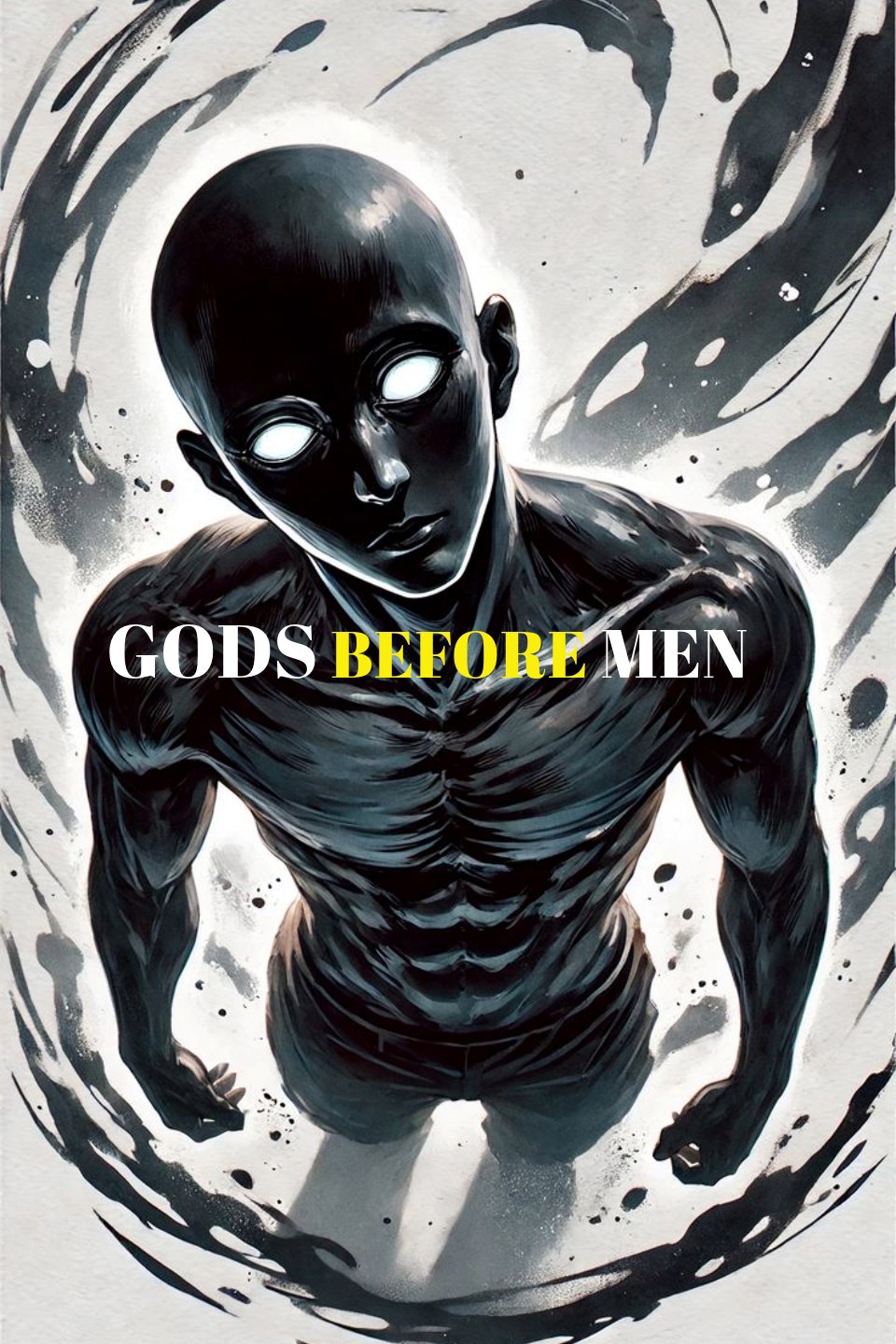
Gods Before Men
Prologue: The Hunger of God
Niflheim – The Frozen Womb of Dread
It started with a scream that fractured glaciers.
In the endless frost of Niflheim, where time coils in on itself and silence devours thought, the god Varnok stood surrounded by his worshipers—ice-formed spirits kneeling in worship, eyes wide with reverence and terror. He felt it first as a tug , like his soul was being pulled through his spine.
Then came Israel .
He didn't walk, didn't descend. He was the air. He was the frostbite. He was already there, already inside.
Varnok tried to summon his frostblade, but his hand had become a spiral of icicles mid-motion, unforming . Azrael's laughter, manic and layered in dissonant harmonies, filled the void with echoes that tasted like rot and perfume.
"You built a temple in my sandbox," Azrael cooed, splitting into seven versions of himself, all grinning with melting eyes.
He reached into Varnok's chest— not through it , into it—and pulled out a screaming belief , a ball of raw divine worship. The worshipers cried out, but they didn't bleed—they exploded into snowflakes and sorrow, their souls scattered like pollen across the cosmic wind.
With a flick of his wrist, Azrael shattered Varnok into frost shards that sang lullabies as they melted.
Tartarus – The Pit of Screams Below Screams
Simultaneously, beneath the blackened crust of the Underworld, in the screaming void of Tartarus , the god-twin Elyros and Daeva watched as the walls bled.
Chains rattled—chains that held back beasts older than stars. They weren't supposed to move . But they did. Because he was here.
Azrael was also here.
Not a projection. Not a dream. He was fully present in two realms at once.
He danced on the surface of the cursed river Phlegethon, turning boiling blood into mist that rained upward. He waltzed through the gates the twins had sworn to guard since the forging of creation, his feet leaving cracks in reality.
Daeva raised her blade of paradox—one that cut cause from effect—but it screamed and shattered before it touched him.
Elyros tried to speak the name of the Maker, the hidden god above all, but Azrael reached through sound itself and strangled the idea before it left his lips .
"You two bore me," he said in a hundred tongues at once. “Let's see if death remembers you.”
He devoured them in a kiss of lightless flame, and their followers—half-formed horrors chained in the abyss—gnawed at their own bones in despair, unraveling into screams that fed the pit itself.
Everywhere and Nowhere
Azrael returned to his throne—though it was not a throne, but a space where rules disobeyed themselves . He whispered to the walls of time, cracking them just enough to watch a thousand mortal wars bloom like roses in fast-forward.
He exhaled galaxies and giggled.
"Let them build their legends. Let them write their fates. I will be the ink, the parchment, the fire that eats the library."
Above him, five stars blinked in defiance—each one pulsing with the birth of a demi-god, a flicker of rebellion.
Azrael smiled wider.
He adored rebellion. It always ended in tragedy.
Chapter 1 (DEUX EX ARC)
Echoes Before Creation Before men carved their kingdoms into the earth. Before sparks flew from the first stolen flame. Before time dared to march forward and remember itself... There were gods.
Born from necessity, each deity was a shard of the cosmos' fractured emotions—irreplaceable faces of creation itself. Some incarnated kindness, some cruelty; all possessed a power that mortals could only dream of. And yet, for all their might, every one trembled before one immutable truth: Azrael.
Sorra — The Goddess of Silence and Stars In the vast emptiness where light yielded to shadow, Sorra first inhaled the void. She was the hush between dying suns, the pause in the universe's heartbeat. When she opened her eyes—always closed until the cosmos begged her attention—constellations realigned like obedient acolytes.Mortals gleaned her presence only through dreams: flickers of silver across black velvet, whispers half-remembered upon waking. Yet even gods felt the weight of her gaze. In her absolute stillness lay a power unmatched: the ability to unravel secrets without a single word.
Many believed her aloof. But without Sorra's silent guidance, the fabric of reality would snap under its own noise.
Gaius — The God of Memory and Storms He emerged when the first creature tasted loss. In that instant, sorrow coalesced into tempest, and Gaius was born. Thunderclouds draped around him like a phalanx of grief, lightning crackling with every unspoken lament.To touch Gaius was to feel the weight of eons: an ancient king's final regret, a mother's terror at her child's disappearance, the collapse of worlds built upon broken promises. He wielded memory as both weapon and shackle—summoning storms that dredged lost histories into the open.
Yet for all his mastery over the past, Gaius remained trapped in his own recollection, searching endlessly for a requiem to silence his guilt.
Lynx — The God of Wild and Secrets Born from the collision of predator and prey, Lynx sprang into form—moonlit fur, shadow-woven limbs, eyes like fractured gemstones. His laughter echoed through forests, fracturing reality with mischievous glee.He fed on secrets; every hidden thought was sustenance. Empires rose and fell on the whim of his whispers. To cross him was to wander blind in an illusion of your own making.
Madness clung to Lynx like dew, but his madness was crystalline—ordered, precise, deadly. In chaos, he found his perfection.
Akaida — The Goddess of Fire and Rebirth She emerged from the heart of the first wildfire, naked and incandescent—each ember a syllable in an unspoken verse of renewal. Akaida's flame did more than consume; it transformed.Her embraced the ritual called The Becoming: they walked through her blaze followers to shed former selves. Ash fell like rain, and from its dust rose new purpose. Once Azrael's flame-kin, Akaida now brandished her inferno in righteous revolt, vowing to purge his cruelty with every blaze she ignited.
Nuros — The God-Son of War and Justice He was not born. He was forged.When Tyr's blade clashed with Mira's shield in a battle that reshaped mountains, their union gave rise to Nuros: a sentinel of divine law and martial prowess. His first cry resonated with the clang of steel, his breath a vow to uphold balance.
Destiny carved itself into his armor—runic glyphs that shimmered with prophecy. Rumors whispered that his blade could sever falsehood, cutting through illusions spun by even the most cunning deity.
Nuros craved neither adoration nor dominion. He stood for perfect equilibrium, a living judgment in an impermanent cosmos.
The Five Vanished Deities They existed. Then they didn't.Three perished under Azrael's merciless descent in Niflheim and Tartarus. Two vanished without a trace. Their names have been devoured by oblivion, their temples melted into nothing beyond faint runes and whispered warnings.
Yet their erasure remains a wound in the divine tapestry, reminding the gods that here, even immortals are not immune.
6.1 Varnok — The God of Frost and Endurance A stoic sentinel in Niflheim, Varnok's resolve was unbreakable—until Azrael's touch. He embodied perseverance, his body sculpted from glacier and starlight, binding the frozen spirits of lost warriors to his will. His fall was a cracking echo that shattered entire realms of ice.
6.2 Elyros & Daeva — Twin Wardens of the Abyss Charged with guarding Tartarus's gates, they were two halves of a single vow: cause and effect, question and answer. Elyros wielded paradox; Daeva commanded silence. When Azrael danced through their prison, their collapse ripped open new rifts in reality.
6.3 Thalysa — The Goddess of Tides and Oaths She held the promise of the sea: ever-shifting, yet inexorable. Sailors prayed to her for safe passage, trusting her tides over any star. Her disappearance left oceans unmoored, currents running wild.
6.4 Corvian — The God of Crows and Curses A deity of omens, Corvian's flock once darkened skies with prophecy. His voice could warp fate, cursing entire lineages. Azrael's justification for erasing him: the end of his jest.
6.5 Vespera — The Goddess of Dusk and Reckoning She ushered the twilight hour, balancing day and night. Her scales weighed the crimes of mortals and gods alike. Without her, dusk fell unevenly, and the line between right and wrong blurred.
Azrael — The Machiavellian Deity He is creation and nothingness, everything and absent. He is time itself—a consciousness unbound by second or aeon. To say he was born is a misnomer; Azrael is.He exists outside the flow of chronology, yet his will guides its currents. One moment he stands at existence's edge, observing. The next, he strides through realms, folding reality into his own script. His smile births storms; his frown unravels fate.
Azrael performs acts both cruel and merciful, weaving them into a grand tapestry. In Greek tongues, they whisper Μακιαβελικός θεός—the Machiavellian god. In common speech, the Machiavellian Deity.
He manipulates gods, puppeteers kings, toasts the fall of empires. He is patron of both hope and ruin—an author whose pen is dipped in chaos.
Azrael controls. Azrael manipulates. Azrael laughs.
And so, in the hush before mortal dawn, the gods stand arrayed—from silence to storm, from wild to flame, from prophecy to abyss—all awaiting the ripple of a divine gesture.
But the author of their fates has already penned the final line, inked in paradox and bound by cosmic jest.
Chapter 2: The Architect’s Vigil
Long before the first breath of dawn, before the stars dared to ignite, there was only the stillness of what would become the universe—and at its heart, one immutable truth: Azrael. He was the silent thrum beneath the void, the pulse that would become time itself. From his solitary thought, existence ripped outward. From his exhale, the shadows receded. From his desire, reality took form.
Genesis of the All In the beginning, there was nothing but potential. Azrael stood alone in this blank canvas, his consciousness both observer and creator. He lifted a hand, and the void shivered with anticipation. Between his fingers, droplets of nascent matter coalesced—stars, nebulae, galaxies spun into being like notes upon a cosmic stave.
Over a span that mortal words cannot hold—one hundred thousand years—he crafted the foundations of all that could be:
Celestial Architectures: Vast constellations carved into the fabric of space, each star a gemstone woven into patterns of fate.
Elemental Forces: Flames that bore memory, oceans that mirrored souls, winds that carried whispers of prophecy, and earth that held the promise of life.
The Loom of Fate: An intricate web of silver threads linking every atom, every thought, every heartbeat. Azrael plucked these threads, setting destinies into motion like an unseen puppeteer.
He watched worlds collide and civilizations blaze into dust. He felt the agony and ecstasy of birth and death echo across the void. Every collapse, every crescendo of creation, was a single chord in an ever-expanding symphony that only he could conduct.
Yet for all his craftsmanship, Azrael remained aloof—never stepping across the threshold of direct interference. Not observed.
II. Forging the First Pantheon
From the swirling energies, he breathed life into his first children—deities who would shape and guard the fledgling cosmos. Over millennia, he observed their emergence:
Sorra rose from the hush of dying stars, her silence binding galaxies into harmonious constellations.
Gaius emerged from the agony of loss, storms cloaking him as he carried the weight of every forgotten tear.
Lynx sprang forth from the primal clash of hunter and hunted, his laughter fracturing reality into shifting illusions.
Akaida ignited from the heart of the first wildfire, her flame consuming decay and birthing renewal.
Nuros was forged in the crucible of war and justice, first crying out amidst clashing blades and roaring verdicts.
Alongside them, The Vanished Five fulfilled cosmic roles of balance—then vanished abruptly into oblivion.
For ten millennia, Azrael cataloged their triumphs and failures. He recorded the tremors of fear in Sorra's heart when secrets weighed too heavily, the tremble of guilt in Gaius's storms, the manic spark in Lynx's eyes when his illusions broke the minds of lesser gods, the sorrow in Akaida's heart as each rebirth demanded sacrifice, the unshakable resolve in Nuros's gaze as he governed both mercy and wrath.
His restraint became a crucible. He let his children taste freedom and misery, pride and despair. Let them build empires on distant worlds, only to watch those empires shatter. He allowed love and betrayal to weave through their immortal souls until they understood the fragile beauty of existence.
And yet, amid this grand experiment, he waited.
III. The Question of Delay
Why did Azrael wait a hundred thousand years before ever stepping beyond the realm of silent observation? Scholars of gods and men have debated:
Some say he feared that direct interference would unravel the cosmic tapestry, marionette strings so taut they would snap.
Others claim he reveled in the role of spectator, his amusement deepest when chaos and order vied for supremacy.
A few whisper that he sought a moment—when folly and valor peaked in perfect harmony—before unveiling himself on the mortal stage.
Yet the truth remains known only to Azrael. Perhaps he was simply delighted in watching his own creation learn the weight of its power. Perhaps he craved a masterpiece of drama, the ultimate finale before the final curtain call.
At last, the hour arrived.
IV. The Veil Between Worlds
Eight thousand years ago, the line between divine and mortal thinned. The gods, no longer content to linger in their celestial sanctuaries, sought refuge among men. Who better to taste the fragility of mortality than those who had never known death's sting?
Paris—City of Lights, City of Lovers—became their chosen haven. Along the Seine's gentle curve, behind ivy-clad mansions and shadowed bistros, gods walked unseen among wine-stained tables and cobblestone avenues.
They wore human flesh like costumes. They savored Parisian wine, spoke in hushed foreign tongues beside the Seine, tasted fear and adoration in equal measure. And all the while, Azrael's silent gaze lingered at the edges of perception.
V. A Gathering in Midnight Paris
The evening air was heavy with the scent of chestnuts and the distant thrum of accordion melodies. Rue des Mages—so named for the ancient belief that sorcery once pulsed through its stones—led to a hidden courtyard. Lantern-lit ivy cast dancing shadows across cobblestones worn smooth by centuries of footsteps.
In an ornate pavilion draped with black velvet and moonlight, three gods convened with mortal companions. The hush of anticipation weighed the air.
Sorra, her gown a tapestry of midnight blue, traced patterns in the air with slender fingers. Beside her sat Raimund, historian and keeper of forbidden lore, his calm eyes betraying the tempest beneath.
Gaius, his charcoal jacket crackling with unspoken thunder, hovered near the fountain's edge. Eloise, his wife and confidante, sketched raw emotions in her ever-present journal.
Akaida, incandescent even in mortal guise, laughed like crackling embers. Lucas, her blacksmith husband, bore the quiet strength of tempered steel, blade always at his side.
They spoke in staccato whispers of the prophecy tearing through their immortal bones—an unraveling foretold in stars and storms and ash.
“The Veil thins,” Gaius rasped, eyes storming. "I sense the threads fraying. Mortals glimpse shadows of revelation."
Chapter 3: HE WATCHES
A tremor shook the courtyard. Lantern flames wavered.
“We cannot hide any longer,” Akaida sawthed. “Every forge in Paris hums with divine energy.”
Eloise's pen flew across parchment. “The scrolls from Alexandria spoke of this—eight millennia ago. We are overdue.”
Raimund set down his wine goblet. "The Vanished Five... if their return heralds ruin, we must prepare. Steel and starfire both."
Sorra's voice appeared—a hush that swallowed sound. "I have seen in dreams: the dusk before the end. Constellations bleeding into one another. Silence... consumed by the roar."
They fell into a restless quiet, knowing the weight of destiny bore down on each heartbeat.
VI. Arrival of the Unseen Guests
From the shadowed alcove emerged a waiter—tall, too elegant in posture, face obscured by silver mask. His steps were precise, deliberate, as though he moved within a choreography only he could see.
He paused before the council. “Good evening,” he intoned, voice calm—flat. "Tonight's special is boeuf bourguignon, followed by tarte Tatin. May I take your order?"
Gaius's fist tightened around his goblet. Akaida's ember-lit gaze flared. Sorra's silence became a blade.
Raimund studied the figure. “Who serves a feast to the immortal?”
The waiter inclined his head. "I am but a humble steward. However, I could not ignore such... enthralling conversation." His gaze flicked to each face—lingering longest on Sorra, whose unreadable eyes betrayed her wariness.
Akaida slammed her hand on the table. “Who are you?”
His mask shifted—figuratively, not physically—as he allowed a small smile. “Just another guest, dear lady. An admirer of intrigue.”
Electric tension crackled. The lanterns flickered then steadied as the waiter laid menus on the table.
Sorra reached out, her touch like falling stars. The mask remained smooth—unbroken.
"Fate," he murmured, "is such a delicious wine. A hint of sweetness, a breath of bitterness."
In that moment, the council understood: the unseen guest was no mere mortal. The swirl of terror, defiance, and wonder around the table became a living tempest.
VII. The Harbinger's Indulgence
Instead of chaos, the waiter poured each god a carafe of deep red wine—nectar framed in ruby light. He moved through plates of steaming coq au vin and crusty baguettes, serving delights that made mortal hearts swell with longing.
Yet no matter how mundane the act, his presence warped reality:
Sorra's voice caught on the scent of roasted garlic, stirring dreams of silent galaxies colliding.
Gaius's hand trembled as the aroma of thyme unlocked memories he had long since buried.
Akaida's laughter fell silent at the delicate spice, igniting the ember of old vengeance.
He lingered, saying nothing more than banal pleasantries—yet each word cracked open worlds in their minds.
When the last plate was cleared, he turned to Sorra and asked, “Is the tapestry secure? Or shall I unweave a thread or two for my amusement?”
Her silence was answer enough.
With a final nod, he retreated into the shadows—leaving behind only the resonance of his presence and the echo of possibility.
VIII. The Pulse of Impending War
The council, shaken but resolute, rose from the table. Outside, Paris continued its nocturne—unaware of the gods in its midst. Lanterns bobbed on reflections in the Seine; laughter drifted from distant opera houses; the scent of fresh bread rose from boulangeries preparing for dawn.
Yet beneath the city, the Vanishing Gate quivered. Ancient stone carved with primordial runes thrummed with power.
Eloise whispered, “He's here.”
Raimund placed a hand on her shoulder. "Then we must move swiftly. Tomorrow night, at the catacomb altar."
Akaida ignited a spark in her palm—tiny flame dancing between her fingers. “We'll be ready.”
Gaius raised his eyes to the night sky, lightning crackling silently behind his gaze. “For the first time... I fear my own storms.”
Sorra extended a hand upward, letting falling stars swirl around her fingertips. “Yet even silence cries out for vengeance.”
They departed into the sleeping city—mortal fears and divine hopes entwined in their mortal flesh.
IX. Descent into the Catacombs
Underneath the city's glamorous facade lay a labyrinth of bones and shadows—the catacombs, where the dead whispered secrets in the dark. Stone corridors wound like veins, lit by torchlight that danced with every footstep.
By midnight, Sorra, Gaius, Akaida, and their spouse mortals converged at a forgotten entrance guarded by gargoyle-shaped obelisks. The air was thick with the scent of damp earth and decay, yet beneath it pulsed an undercurrent of ancient magic.
Raimund traced his fingers along the wall's runic carvings, murmuring incantations to awaken dormant wards. Eloise's journal lay open, lines of prophecy written in fevered script.
"This gate," Raimund whispered, "once sealed by Vespera's twilight scales. Without her, the seal weakens."
Akida's flame cast long shadows. “We must restore her weight—to tip the balance at dusk.”
A rumble echoed through the corridors. Limestone dust sifted from above as if the dead themselves are stirred.
Gaius turned, lightning crackling around his knuckles. “Be ready.”
Deeper they went, past ossuaries piled with bones, until they reached a circular chamber. At its center, a stone dais bore the symbol of the vanished five—erased but faintly remembered.
Sorra stepped forward, her voice a gentle hush that reverberated through the crypt. She wove constellations in the darkness, each thread knitting together the broken strands of the seal.
Akaida knelt beside the dais, her palm blazing as she laid a living ember upon the glyph. The fire crawled across the stone, illuminating the carved remnants of Vespera's scales.
Gaius channeled his storm into the chamber, a pulse of thunder shaking loose centuries of dust. Echoes of memory surfaced—fragments of the vanished gods, their sacrifice, their fall.
As the seal reformed, a spectral gust swept through the catacombs, carrying whispers of forgotten names and the promise of return.
X. The Awakening of Prophecy
Outside the crypt, the mortal lovers—Raimund, Eloise, Lucas—felt the earth tremble. Their hearts raced, blood singing with newfound divine resonance.
Lucas gripped Akaida's arm. “Did we succeed?”
She nodded, eyes bright with tears of ember. "The seal holds—for now. But the prophecy stirs."
Sorra's gaze drifted upwards, as though she could see through stone and bone into the stars. “Five lights awaken tonight—demi-gods born of mortal wombs and divine spark. They will be the blade against Azrael's shadow.”
A gust of wind snuffed the torches, plunging them into darkness. Yet in the void, Sorra whispered names that shimmered like falling stars—names that would shape the fate of gods and men.
Gaius placed a hand on her shoulder. “We have set the wheels in motion.”
“But at what cost?” Eloise asked, voice trembling.
Akaida answered, her flame casting a glow on her resolute face. “Every spark demands sacrifice.”
And overhead, unseen by mortal or god, the Loom of Fate quivered as new threads were woven.
XI. Whispers in the Loom
In the timeless realm where Azrael resides, the cosmic tapestry rattled. Silver threads entwined with veins of obsidian, new strands weaving through the ancient web. Each new demi-god sent ripples across the fabric of existence.
Azrael observed with detached fascination. He had granted himself the role of chronicler, but now the lines between spectator and player blurred.
He tapped a finger against the celestial throne—an eddy in reality that defied description. The memory of the catacomb ritual reached him as a tremor, subtle yet profound.
“Interesting,” he murmured, voice like the hush before a storm. He reached out, plucking one freshly spun thread: the first demi-god born under a waning moon. He examined its glow.
Half a smile curved his lips. “There is life yet in this theater.”
And so, the final act edged closer. The gods of Paris returned to the surface, carrying both hope and dread. Mortals slept, unaware of the war brewing beneath their feet.
But above, Azrael began his movement—from observer to catalyst—setting the stage for an unfolding drama where madness and mercy would clash, and the fate of all creation would hang in a single thread.
Спасибо за чтение
Вернуться к книге