
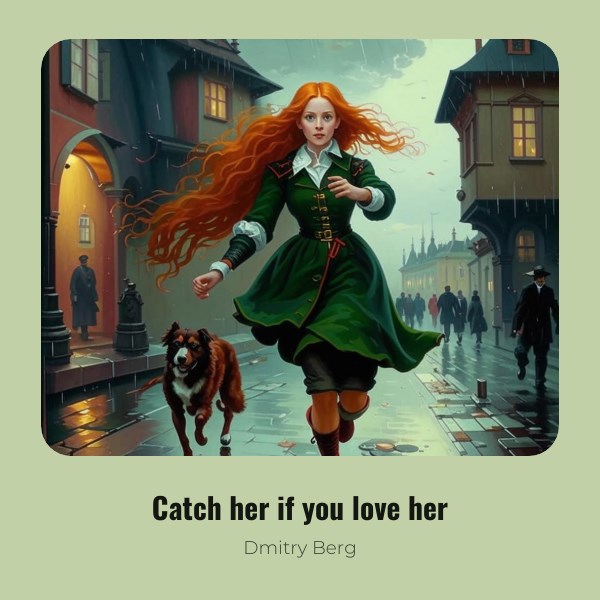
Catch her if you love her
Chapter 1 A Rainy Morning
I was almost running. The sky was clearly hinting that it was about to cry a good rain, refilling the not-quite-dry puddles. And it would have been worth running for. But I wasn't running for no reason; I was running because of my sister. Or more precisely, because of her. And even more precisely, because of her gift.
At the start of the season, Maggie had ordered me a wildly popular magic transformer jacket. A completely impractical and terribly uncomfortable thing, but popular. So popular that during a few minutes of fast walking, I passed three guys and one grandfather wearing the exact same jackets. This popularity played a nasty trick on me.
Yesterday, a potential client had come to our firm, Mike's and mine. He never moved from potential to actual; he argued with Mike and left, cursing us with every word in the book. Well, he left, and good riddance. Getting involved with types like that is nothing but trouble. A hysterical, jealous husband whose wife had left him. But this troublemaker managed to mix up our jackets. He left his in the reception and ran off in mine. They looked very similar, and I barely noticed the switch myself. But when I put it on and stepped outside, I heard nothing.
And my jacket would have definitely reminded me to wear a hat. Maggie still thinks I'm a little kid and had configured the gift accordingly. At first, I thought the fashionable rag was less reliable than advertised, or that its magic charge was dead. But then I took a closer look and understood: the jacket wasn't mine. Good thing Ilona remembered yesterday's visitor wearing a jacket just like mine.
And so now I was running to the address that our indispensable Ilona had also dug up, to make the reverse exchange, fervently hoping that our guest from yesterday would be home. It wasn't far to house number 14 on Menhstridt, so I didn't look for a carriage and went on foot. And of course, after a few minutes, the weather turned nasty. Clouds gathered, the wind picked up. It would be awkward if I showed up in a soaked jacket.
I could, of course, activate the umbrella mode, but on a crowded street, that was risky. The fashion house of Vui Lidona had dedicated a separate section in the jacket's advertisement to describing the umbrella: "Upon voice command, a large, quasi-material, semi-transparent umbrella unfolds above the user's head. Its dimensions will keep you dry even in heavy rain falling at an angle..." The umbrella really does deploy at your first wish. And it's truly big. It's so big you can only walk with it on an empty street. Otherwise, you constantly snag the umbrellas of other pedestrians. And if there's a gust of wind, you'll simply be blown away with such a sail.
So the umbrella remained inactive, and my steps became wider and faster. Rounding a corner, I collided on the wet cobblestones with a disheveled girl who seemed to be in an even greater hurry. She had just slipped and was flying forward, trying to right herself and avoid a fall. A mass of red hair buried itself in my chest, and her hands decisively pushed me aside.
"Let me through!" The voice of the short girl was surprisingly strong and resolute.
And her appearance matched it. Sharply defined cheekbones, piercing green eyes. I even began to doubt that I still needed to run somewhere. A girl like that was worth getting a little wet in the rain for. But she was clearly not in the mood for conversation and was in a terrible rush. Not wanting to hinder her, I moved left. She moved the same way. I shifted right, and she jerked simultaneously with me again.
"Let me through!" She seemed to have decided I was trying to detain her. I tried to step aside again, but didn't have time. She immediately kicked me in the shin with the toe of her shoe, then swung and hit me with her small but weighty bag, aiming for my face. I naturally dodged, and she, losing her balance, began to fall. I caught her at the last moment, preventing her from splatting on the wet stones, but earned no gratitude. The little beast butted me in the chin with her forehead (good thing she couldn't reach higher), pushed off, and, growling something, ran on.
I watched her go. What a firecracker of a girl! She flew, jumping over puddles and scanning the crowd of passers-by for someone. My feelings were mixed. On one hand, the girl was clearly strange, but at the same time, she commanded respect. Despite the slippery road and her haste, she had kicked my shin masterfully: with the toe of her shoe at a right angle to the bone. It really hurt. Respect. And she ran beautifully. I involuntarily stared until the spot of fiery red hair finally disappeared behind the backs of the crowd. The girl was of average height or even a bit shorter. Mentally wishing she wouldn't crash after her next jump, I turned and went on my way. My destination was a few houses away. As I entered the courtyard I needed, the first drops were already beginning to fall from the sky.
Ducking into a through arch in the brick wall, I heard the rain begin to drum on the cobblestones behind my back. House No. 14 on Menhstridt was a typical representative for this district of Landana, where people weren't exactly poor, but those of middle or lower income could rent a furnished apartment with a concierge.
The three-story building of brown-red brick was built in the shape of a rectangle with a well-courtyard in the middle. There were two entrances to the building, both located in the courtyard, which could only be accessed through these arched passageways. The windows of the more expensive apartments faced the two parallel streets. On each floor, there were two cheaper apartments at the end of the building, whose windows looked directly at the wall of a similar house. I'd had to rent a similar one myself once, so I understood the layout of such houses perfectly.
The courtyards of such houses are brighter at night than during the day. Because at night the lamps are lit, while during the day the gloom in the brick well is feebly dispersed by rare rays that the dark brick walls don't have time to swallow before they reach the ground. It only gets lighter here around noon, when the sun is high. It was early morning and raining now, so entering the courtyard, I could see very little. But I knew well where the door should be, so I didn't stand under the arch waiting for my eyes to adjust to the semi-darkness. I stepped into the courtyard and took a few quick steps to the right, hurrying to get under the entrance canopy. But I was out of luck. Half a step from the canopy, I crashed into a transparent barrier and froze like a fly trying to fly into a room through a closed window.
"Sorry, sir. The passage is temporarily closed. If you need to, you can use the other door," a policeman said in a bored tone, standing calmly on a dry patch under the canopy while the rain soaked me.
Well, just my luck. I wanted to say something rude, but picking a fight with a constable on duty is not the best idea. So, kicking the magical membrane blocking the passage in farewell, I silently hurried to the second entrance. But reaching the door, I changed my mind about opening it. If the constables were in the building and the passage was blocked by magic, then something bad had happened here. Either someone had died, or something truly valuable had been stolen, or... In short, the King's constables don't use magical artifacts for trifles. No one would authorize draining the charge of expensive government property over a simple theft or a fight.
Investigations were likely underway in the house. Tenants and visitors were probably being questioned. For me, this only meant I risked getting stuck here for a long time, and that wasn't part of my plans.
Confirming my worst fears, I heard the familiar voice of Sergeant Drix. A dutiful man, but not very bright. He came out of the door blocked to me and began giving orders to the constable standing at the entrance.
"Jones, don't let anyone out. If anyone comes, let them in and block the passage again. Ask everyone who arrives for their names and their purpose for coming..."
Yeah, Drix was in top form. Instructions to a constable should be given immediately. And anyway... A competent sergeant has subordinates who, at a crime scene, know what to do and how without extra instructions. But this sleepy Jones hadn't even asked me who I was or why I'd come, simply sending me to the other door.
Not waiting for Jones to remember me, I quickly took a few steps and disappeared through the arch opposite the one I'd entered by. Better to come back for the jacket after noon. I had absolutely no desire to get stuck here.
It seemed the surprises for today weren't over yet, and one shouldn't hurry too much in dark alleyways. A shadow detached itself from the wall and rushed at my feet. The shadow turned out to be a large dog. It rushed silently, which put me on edge. Dogs usually bark or growl when they attack. Only well-trained or magically altered killer dogs attack silently.
I retreated to the wall and thrust my left elbow forward, shifting my weight to my left leg. If the dog attacked, protecting my neck was the priority. But the approaching canine didn't lunge. Wagging its tail vigorously, it stuck out its tongue and offered its head, clearly expecting to be petted or scratched.
For a stoutly built German Shepherd, it was surprisingly friendly to a stranger. Usually, dogs of this working breed are taught to obey only one person, not allowing anyone else to feed or pet them. As a child, I had wanted exactly this kind of dog. They are strong, loyal, and moderately aggressive. After watching the sincerely happy-to-see-me dog for a couple of seconds, I couldn't resist and patted its broad head. The dog pressed against my leg and switched its tail to propeller mode.
"Sorry, shaggy friend, but I'm in a hurry," I bent down, scratched behind its furry ears, "so I can't play with you. Find yourself another pal."
Turning around, I moved toward the alley's exit.
"Sir, wait!" came from behind. It seemed Constable Jones had finally figured out he shouldn't have let me go.
I pretended not to hear and sped up.
"Stop, sir! Stop!"
The crown servant shouted the last word at the top of his lungs. It seemed the sergeant had chewed him out for his carelessness. I heard the clatter of boots reinforced with copper studs. The constable decided to chase me but was stopped by growling and barking. Unlike me, the constable clearly hadn't made a good impression on the German.
"Get this dog away! Hey! Remove this dog immediately!"
I took advantage of the unexpected help from my new four-legged friend, who was now blocking the passage through the alley, and made my exit. After running a few yards, I turned into a narrow lane between houses, only to collide a couple of steps later with the red-haired stranger who had recently masterfully bruised my shin. She was in a hurry again. But this time, she wasn't chasing anyone. On the contrary. Two guys of rather grim appearance were following, or almost running after her.
"You again! You scoundrel! You still won't stop me!" the red-haired beast blurted in my face and gave me a hearty kick with the toe of her shoe, this time on my right shin.
Taken by surprise, I couldn't even muster indignation. What the hell was this! I decisively blocked the passage, wanting to sort things out with this insolent female. Gorgeous hair and a beautiful figure didn't give her the right to yell at strangers and beat them up without explanation.
The girl, however, seeing me block the passage, finally decided I had been trying to intercept her from the start.
"Oh, so that's how it is! Well, you asked for it!"
She unclasped her purse and tried to pull something out. I suspected some kind of defensive artifact or weapon. But she didn't have time. One of the guys chasing her, the shorter one, snatched her purse and pinned her against the wall. The second one shoved his hand into his jacket pocket and looked at me.
"Sir, you'd best move along to where you were headed. This is a family matter here."
"Family?" the girl shouted, "I don't remember any ugly freaks like you in my family! Let me go, or you'll regret it!"
"Gentlemen, the lady is displeased with your company," I said, watching the tall one's hands.
"She's not happy with you either," the thug decided to drop the politeness, "get lost and you'll stay in one piece."
The bruiser pulled his hand from his pocket and sharply flicked his wrist, extending a telescopic baton with a weighted end. I once again regretted leaving home without my cane. This was all Maggie's fault. She'd declared my cane didn't match the new jacket at all. Oh, little sister... But the cane is very useful when meeting stray dogs and unpleasant types like the one now staring me down while his pal shamelessly groped the girl.
"Get your filthy hands off me, you creep! I don't have anything! Let go!"
"I must repeat, the lady does not wish to associate with you, gentlemen. Be so kind as to return her purse and allow her to leave."
"You're a brave one! Or stupid. Or both..."
Without finishing, the bruiser tried to hit me with the baton. But the trick didn't work. I was on guard. He stood and moved too confidently. Not like your common thug. But not a pro either. A pro wouldn't have fumbled with a baton against fists. I ducked under the swing and answered with a left hook. The bastard was sturdy and stayed on his feet, but he was clearly dazed. I had to add a right uppercut to his jaw. A rather loud click sounded. Lower teeth met upper ones, clearly damaging the enamel, and the thug went down like a sack of potatoes.
And his short friend was already trying to put a hole in me with a switchblade that had appeared in his left hand. I barely avoided the thrust. I broke the distance and got into a more stable stance, preparing for the next attack. The remaining bandit was nervous, glancing from me to the girl and back. Thinking for a second, he kicked the redhead in the stomach, and as she doubled over in pain, he rushed me, slashing with the knife. But he wasn't just slashing wildly; he knew what he was doing. He didn't overextend his arm and kept his weight balanced on both feet. Dangerous, needed to deal with him quickly. I stepped back, and when he followed, I moved forward and to the side simultaneously, letting the knife thrust slide past me. This allowed me to get behind him.
He jumped back and turned around, but I had already managed to do what I intended. I grabbed the big guy's baton. Now the advantage was mine. The first blow I landed was on his knife hand. He didn't drop the weapon, but he clutched his hand and hissed in pain. The second and final blow connected with his head. I hit without holding back. If someone's trying to stab me, I'm not going to worry about preserving their life.
The shorty dropped the knife and sank to the ground, and I quickly felt my side. In knife fights, it's easy to miss getting cut.
"You damn bastard!" I couldn't hold back.
There were no wounds on me, no blood was flowing, but I felt like swearing a blue streak. This creep had slashed my jacket!
I turned to the one for whom this had all started, planning to finally find out what was going on. By this time, the girl had managed to pick up her purse and pull out... a flower?
"Are people like you not even afraid of murder? Do you really measure everything only in money?"
The redhead pointed a half-wilted tea rose in my direction with a look that suggested it was a loaded .38 caliber Colt. Either she was crazy (which wouldn't surprise me), or this wasn't just a flower. My second suspicion was confirmed in the worst way for me. A pink cloud shot out from the flower's head towards me and rapidly expanded. Understanding what I was dealing with, I held my breath and took several quick steps back.
Unfortunately, I didn't manage to squeeze my eyes shut in time, and I paid for it. It felt like ground hot pepper had been poured under my eyelids. I cried like a child who'd had all his sweets taken away for life. What a quality artifact the girl had! Probably expensive. And unusually disguised, too.
By the time I had more or less blinked my vision clear, the girl had long since vanished. Her pursuers remained on the spot. It would have been worth getting a better look at them, but in my condition, they just looked like two dark blurs. Heaving a heavy sigh, I turned around and headed for house number 14.
Chapter 2. Inspector Dricks
Sergeant Jones stood at his post under the awning but had shifted from the door to the concierge's window. "Sir, why did you run away?" The constable's face showed genuine offense. "I was calling for you." "Was that you calling for me?" I feigned sincere surprise. "I had no idea. Did you need me for something? We had just spoken shortly before. Why didn't you ask me right away?" "I... Sir, Sergeant Dricks..." It seemed I had managed to confuse the few thoughts that fit inside that sturdy head under the constable's helmet. Finally, he pulled himself together and delivered: "By order of Sergeant Dricks, all visitors to house number 14 today are to be invited for questioning in connection with the circumstances of an important case." "Ah, circumstances... Well, that makes sense then. Now, Constable Jones, please call Sergeant Dricks here. Robert Good wishes to urgently inform him of another set of important circumstances." "Robert Good?" The constable was clearly intrigued. It seemed he'd heard of me. "And where is that 'pain in the backside'? And, sir... Is that your dog?"
A German shepherd was circling at my feet with a pleased expression, nudging my hand with its head and wagging its tail. "Sir, your dog is without a muzzle and attacks people. It almost bit me! The sergeant called the station to send specialists for it." "This is not my dog. That answers your second question. As for your first question, the 'pain in the backside' is currently standing before you and has been waiting for a minute for you to fetch your superiors. And all the while, the criminals could be getting away."
A rather amusing range of emotions played across the constable's face. For a couple of seconds, he pondered what to do, but then he made the most standard and correct decision for any functionary: "I must report to my superiors and let them sort it out." Jones opened the door and disappeared into the house. Half a minute later, the shrill voice of Dricks could be heard: "Why did you abandon your post? Silence! Are you incapable of following orders? What? Robert Good? Where is that scoundrel?"
The door opened and released the colourful figure of Derek Dricks into the yard. Of short stature with sparse hair on his head that refused to go completely bald, the sergeant compensated with character and posture. His chin was so thrust upward that walking on uneven pavement was dangerous for Dricks. He was simply incapable of looking at his own feet. And he held his back so straight that all royal princesses could envy him, not to mention duchesses. "Mr. Good, good morning. Although I must note that where you are present, good things rarely happen, and today's events are proof of that. What was your purpose here a quarter of an hour ago? Why did you hastily leave the scene of the crime? And why did you return? What did you need in this house?"
As he spoke, the sergeant tried to intimidate me with his "forceful gaze." If this blockhead had his way, he'd subject me to a three-hour interrogation on a hard chair, shining a lamp in my eyes and trying to catch me in contradictions. The sergeant was not brilliant intellectually and held no love for me. And if it weren't for the girl, I would have preferred to avoid tangling with him. But against my will, I had to admit to myself that I had liked the red-headed minx. And I didn't want her hunted by types willing to kill.
"And a good morning to you, Sergeant. Glad to see you in good health and on duty. I have never been in this house before. I simply decided to take a shortcut through the yard and accidentally stumbled upon a deployed magical membrane in the semi-darkness. Constable Jones kindly informed me that passage here was temporarily prohibited, after which I went on my way. But that's not the point. Passing the next alley, I witnessed an outrageous scene. Two hardened thugs attacked a fragile lady. With great difficulty, I managed to disarm them. The poor girl was so frightened she ran away as soon as she was released. Jones, take these."
I handed the constable the club and the knife, then took out a handkerchief and wiped my hands. Dricks looked at me, squinting. "I left the scoundrels lying unconscious, but I fear they will soon come to and escape. I am exceedingly glad to have seen valiant servants of law and order nearby, always rushing to aid good citizens and suppress crime."
Dricks's eyes turned into slits. He clearly wanted to drag me away for a rigorous interrogation. "Dricks, snap out of it. There are two thugs lying out there. And they were ready to kill a girl. Are you going to let them get away?" "Very well," the sergeant opened the door and shouted: "Dickens, to me!"
A few seconds later, another constable appeared on the threshold, unlike Jones, he was short and already grey-haired. "Dickens, you remain here on post. Admit everyone, release no one until my order. Jones, with me. Show me your thugs, Mr. Good. But if this turns out to be a prank, you'll have only yourself to blame!" "I am absolutely serious, Dricks."
The three of us moved out of the yard. Or rather, not three, but four. The dog refused to leave my side. "Good, why is your dog on the street without a leash and muzzle?" Dricks didn't miss a chance to pick a fight. "This is not my dog." "Then why is it following you?" "Dogs just sense good people. Probably, he's just bored waiting for his owner and wants to play." I scratched the dog behind its ears, and it drummed its tail on the ground, radiating contentment with life. "Good dog," said Dricks and reached out to pet the German shepherd. "Sergeant, careful," Jones tried to warn, but he was too late.
The dog bared its impressive fangs and growled at the sergeant, snapping its teeth a centimetre from his palm. He paled and swallowed nervously. The German was quite capable of biting a man's fingers off. "It seems he doesn't like you very much. Well, here it is, everything happened right here…"
We entered the alley where I had encountered the red-headed girl, but it was completely empty. Damn, I shouldn't have wasted time chatting. Or I should have, before running for the police, hit both scoundrels on the head a couple more times for good measure. But in that case, self-defence could have turned into premeditated murder. And that's not my style. "And where are your criminals, Good? Did you decide to play another one of your foolish jokes? You won't get away with this so easily! Did you want to distract us from the investigation? Huh? That's why you were snooping around, then ran away, then came back! What are you plotting, Good? I will expose you!" "Wait, Dricks, save your righteous anger for the real criminals. Five minutes ago, I left two thugs lying unconscious here. They couldn't have gone far. They were lying right here."
I pointed and took a couple of steps towards where I had left that lovely pair. Suddenly, I sensed danger. My combat intuition, which had saved me more than once in the war, kicked in. I peered at the cobblestones and the dusty, cracked brick walls. Where was the threat coming from? The dog following us crouched low and growled. Suddenly, I noticed a disturbance in the air and jumped back. Just in time. A fist-sized stone, as if from nowhere, flew out and whistled past, two fingers' breadth from my head. The dog growled louder and barked, clearly indicating a section of the pavement where I had recently left my opponents.
An illusion! The thugs hadn't had time to leave and had used an artefact to create a diversion. If it was a cheap one, it wouldn't last more than a few minutes and couldn't properly hide moving objects. One could try to attack them blindly, but why risk it when the servants of the law should have standard issue clear-sight artefacts. "Sergeant, an illusion! Check that area by the wall." Saying this, I prudently took another couple of steps back, just before another stone came flying.
To Dricks's credit, he didn't argue but signalled the constable, and they simultaneously activated the artefacts on their belts. After that, Dricks drew his revolver from its holster and aimed it at the spot where the individuals invisible to me were located. "Freeze! In the name of the King, you are under arrest for the use of prohibited artefacts and on charges of attempted robbery and murder. Get on your knees and put your hands behind your head. Jones, cuff them."
Jones approached the wall, and the air shimmered as in intense heat. The familiar types appeared. The bruiser, it seemed, hadn't fully regained consciousness. The short one, however, looked sober and malicious. Another stone, pried from the cobblestones, lay at his feet. It seemed he very much wanted to throw it, but under the barrel of Dricks's revolver, he didn't dare. A sizable bump, adorned with broken skin, had swelled on his head. A scar would remain as a memento of our interaction. Jones deftly fastened the cuffs on both thugs' hands, binding them behind their backs. After that, the sergeant approached and, taking out another set of handcuffs, chained the criminals to each other. That way, they definitely wouldn't get far.
"Jones, with caution, escort these two to the nearest station. The one on Square Street. Then call a wagon and transport them to our headquarters. There, put them in separate cells. I will personally conduct the interrogation. It is possible they are connected to the events at house number 14." "Very good, sir," Jones confirmed the received order. "Escort these two to the station on Square Street, call a wagon, and take them to our headquarters. Place them in separate cells pending your further orders." "Correct, Jones," the sergeant nodded. "Carry on."
Jones proved himself a good executor. He didn't utter another word. The detainees had already heard where they needed to go. The constable took out and activated a magically modified ash-wood baton. From the pained expressions on the detainees' faces, it was clear the effect of this artefact-baton was familiar to them. Jones gestured for the handcuffed pair to start moving. Letting them go ahead, he followed behind and slightly to the side. It was clear that escorting detainees was a familiar task for him.
"Well, you, Good, I must ask to come with me for questioning," Dricks addressed me. "For interrogation, Sergeant?" "For questioning, Good, I said: 'for questioning'. I currently have no grounds for your interrogation," Dricks emphasized the word currently in his reply. "In that case, my dear Sergeant, I would prefer to decline. I am in a hurry. As I already said, I ended up here completely by chance. I know no one in the house where you are conducting your investigation, and I met the just-detained thugs for the first time today. They used prohibited magic in the presence of the police, so my testimony is not necessary for their arrest. The girl they attacked is also unknown to me. I didn't remember any distinguishing features. So..."
"Good, don't push your luck! I can quite easily justify summoning you to headquarters for interrogation. The grounds will be the case file on that pair. After all, we only know they attacked a girl from your words. I could even detain you as a suspect for causing bodily harm to innocent people!" "Those two are innocent? Is that why you began your interaction with these law-abiding citizens by pointing a revolver at them?" "Don't twist my words, Good! You know what I mean."
I understood. The inspector was quite capable of compelling me to testify as a witness. He could even detain me for a couple of days as an accused until Mike got me out. In short, he could fray my nerves and waste my time if he dug his heels in. "Well then, let's have a chat, Sergeant."
We headed back to the now-familiar yard. Dricks walked first, radiating satisfaction. He had just arrested two criminals. And he had also made me agree to questioning. Maybe it was worth playing to his vanity a little more. "I must admit, you detained those two criminals rather deftly. If not for your reaction, the next stone could have damaged someone's hide." "Yes, Good. Professionalism and the ability to act quickly and decisively are required for police work. Negligence is excusable for private detectives. In the King's service, it is impermissible."
I decided to keep quiet about the fact that the valiant servants of order hadn't thought to activate the anti-illusion artefact themselves when the suspects unexpectedly disappeared. Let the sergeant swell with self-satisfaction rather than take offense at my remarks. The dog was following me again. This time, however, it was behaving much more modestly. It didn't nudge my hand or wag its tail. It even seemed to me it was looking at me with a guilty expression. Like, "Sorry, friend, didn't notice the ambush right away, didn't warn you..." Under my gaze, it lowered its muzzle even closer to the ground and approached with small steps. I couldn't resist and ruffled its head. Deciding it was forgiven, the dog wagged its tail again and raised its muzzle, offering its neck for a scratch.
"The dog trusts you too much for a stranger, Good," Dricks couldn't resist remarking. "I just made a good impression, Derek. I've always been easily liked by women and dogs. I've only had difficulties with cats and policemen." "A-ha-ha!" Dricks laughed loudly at my not-so-witty joke but suddenly stopped. The reason was the dog, which ran away from me and decided to shake itself off, stopping a meter away from the sergeant, who had approached the magical membrane. The drizzling rain had thoroughly soaked its thick fur, and Dricks was drenched as if from a bucket.
This time, it was I and Constable Dickens, who was within arm's reach of the sergeant but remained completely dry thanks to the active magical membrane, who laughed. However, Dickens instantly cut himself short under his superior's gaze, and I finished laughing alone. "It seems the dog trusts you too, Dricks. Only a good acquaintance can play such a trick." "I see no reason for laughter. The dog is clearly poorly trained. Especially for a working breed. Dickens, finally turn off this membrane. You can see we need to pass. And why didn't you set it to one-way mode? I ordered everyone to be admitted anyway." "To conserve charge, sir," the constable replied, deactivating the artefact. "In one-way passage mode, the membrane consumes forty-three percent more energy than in full movement block mode. The instruction obliges us to conserve artefact resources. And since I am standing here anyway, I can simply turn off the artefact when I need to let someone into the house." "If the instruction requires it, then fine. But you need to be quicker to turn it off. Because of your slowness, I'm soaked to the bone. Did you find out whose dog this is?" "Not yet, sir." "And why not?" "You didn't give such an order, sir." "You didn't think of it yourself? It most likely belongs to one of the residents. Concierge!"
The sergeant knocked on a small window located next to the door. "Yes, Inspector," the window opened slightly, and a head adorned with a bald patch stuck out. The face of the bald patch's owner was swollen and had the hue characteristic of people who regularly partake of drink. "How can I help?" "Tell me, whose dog is this?" "Don't know, sir." "How can you not know? You're the concierge!" "Correct, Inspector. I've been serving as the concierge in this godforsaken place for seven years now." "You probably serve poorly if you don't know which resident the dog belongs to." "You offend me, Inspector," the face of the clearly tipsy concierge wrinkled with sincere offense. "I serve honestly. Not even a mouse... Hic!... not even a mouse gets past me!" "I'm not asking about mice, but about this dog here." "Well, it's not our dog... Hic! I mean, this dog doesn't belong to any of the residents of our house." "Then who does it belong to?" "Don't know, sir. I'm not aware of that." "So you don't know how a working dog appeared in your yard, and you continue to insist you're a good concierge?" "I never said that," the concierge shook his head decisively. "I only said it's not our dog, and it doesn't belong to any of the residents of this house. There!"
To confirm the weight of his words, the tipsy concierge tried to raise his hand with an extended index finger, but the dimensions of the window didn't allow it. So, he pulled his head back inside the room, then finally raised his hand and wagged his extended index finger in the window. Having satisfied this desire, the concierge removed his hand, stuck his head back out the window, hiccuped, and continued: "A visitor brought this dog with him yesterday evening when he came to see Mr. de Varde in apartment 14. He warned me that someone was coming to see him, so I let the visitor in. But he left the dog in the yard. I didn't let him in with the dog. Because it's not right! If he'd come with a lapdog or a cat, fine, but he brought a working dog, and without a muzzle! What if it frightens one of the residents? Who will answer for it? Me! Because I let this big brute with teeth in. There!" "So why are you, you blockhead," Dricks was indignant, "saying you don't know whose dog it is, if it's the dog of yesterday's guest?" "I'm speaking correctly. Yesterday's guest brought the dog, but whose it is, I don't know. Maybe it's his dog, maybe someone else's. He didn't tell me about that. There!" "Dickens, our dog handler should be here soon. Show him the dog that needs to be caught. Have him put a leash and muzzle on it immediately. And call for me."
Chapter 3. Mike
The conversation with Dricks took about half an hour. It was clear he was eager to go interrogate the arrested thugs. There was a better chance of getting valuable information from them than from me.
I made it to the office just in time for breakfast. Mike hadn't waited for me and was already dissecting an omelet on his plate. He worked his knife and fork with such focus and care, like a surgeon operating on a prince of the blood. Mike took food very seriously.
"You're late." "You won't believe it!" "Don't tell me you met the girl of your dreams!" "How did you guess?" "You find one roughly every two weeks." "You're exaggerating!" "Not in the least. You always follow the same script," Mike said, finishing cutting his omelet and starting to spread butter on a slice of white bread. "You easily get infatuated with the next bright beauty you cross paths with. You spend a week at most trying to seduce her. If you don't succeed, you don't get upset and just move on to the next one. But more often than not, surprisingly, you get your way. And only to toss the boring toy aside after a few days. And then it all starts again."
"You're unfair to me," I said, pulling my plate closer, peppering the omelet, and forking a good piece into my mouth. "I never deceived any of them, always spoke honestly about my feelings and intentions." "Robert, have you ever truly loved even one woman?" "Of course! I have loved and I do love." "And who is she?" "My sister, of course." "If you truly loved your sister, you would have settled down long ago and started a family," Mike dipped a perfectly square piece of omelet into a sauceboat of lingonberry jam and put it in his mouth. "Maggie constantly worries about her wayward little brother." "Drop it, Mike, I'm still young. And anyway, that's just the envy of a married man talking." "Envy of what? I just can't figure out what they see in you!" "You'd better ask the women that; it's a mystery to me too. Yes, yes! And, actually, women themselves are an interesting and eternally intriguing mystery to me." "I asked Meg; she doesn't understand either why they flock to you," Michael swallowed another piece of omelet with jam and took a bite of bread and butter. "You're certainly not ugly. But it's hard to call you handsome either. You're not rich, your manners are rough, and you're often so careless with your clothes... You know, Meg says you might have a hidden magical talent that causes temporary insanity in women, making them fall for you." "She's biased," I finished my omelet and reached for the coffee pot. "She's a loving wife and my sister." "The sister part is clear, but what does her being my wife have to do with it?" "Well, I never make advances on loving wives," I broke off a piece of roll and dipped it into the jam sauce. "It's against my principles. Those I spend time with are usually unhappy in their marriage or, well, free." "So our chief womanizer actually has principles?" Mike pushed away his plate, which still held all the omelet pieces with uneven edges. "Well, I'll be damned!" "Don't be sarcastic," I took a sip of coffee and broke off more bread for myself. "Yes, I love women. But I try to be honest with them." "Ha-ha-ha! You've made me laugh! However!" Mike cut a piece of bread with a well-sharpened knife and handed it to me. "Take it, I can't stand it when you break bread with your hands. And let me remember. That brunette who showed up at our office drunk and screamed, 'Where is that deceiver hiding?' Wasn't she looking for you? And that plump girl in pink who even made Illona take sedative drops? She sat in our reception for half a day, cried her eyes out, and complained about how you deceived and abandoned her. Were you honest with her too?" "Mike, it's not my fault women love to deceive themselves," I folded the received piece of bread into a boat to scoop up more jam. "I never promised any of them anything. And if anyone had false hopes, I tried to explain myself honestly when we parted ways. My conscience is clear." "Clear as a chimney sweep's robe!" Mike was clearly suffering watching me mop up the confiture from the sauceboat with a bread crust. "Listening to you, one would think you're an angel bringing happiness to all." "Well, I certainly shouldn't be called an angel... And you know, today I met a truly unusual girl." "And what surprised you about this red-haired beauty?" Mike poured himself some coffee and added his traditional four drops of cream. "The fact that she sprayed you with pepper spray at your first meeting?" "How did you know?" I was stunned. "She really is pretty, and she has red hair. And she hit me with a pepper spray artefact. Though not at the first meeting, but the second. The artefact is interesting, by the way... Did you talk to Dricks?"
Mike enjoyed my surprised face for a few seconds before deigning to explain. "That she's a redhead is obvious from the two long hairs on your waistcoat. As for pretty—well, you wouldn't be interested if she weren't. And regarding the pepper spray... Swollen eyelids and the characteristic reddish tint in the corners of your eyes. It's simple, my young friend."
For Mike, everything was always simple. I never considered myself a fool, but next to Mike in terms of intellectual development, I often felt like a snail. Plus, my friend and also my boss was incredibly attentive to details. "So what attracted you to this latest dream girl?"
The question made me think. "Firstly, she's a master at kicking a shin with the toe of her shoe," I remembered how my left, and then my right leg had suffered and couldn't help but smile. "So she's already beaten you? Usually that happens to you in the final phase of communication. Did she decide to kick you right away? A very clever girl! Heh-heh!" "She was chasing someone. Then two thugs were chasing her." "And you, of course, jumped into the fight?" "Well, I couldn't just watch a girl being bullied, could I?" "Judging by your description, the girl can bully anyone herself. Maybe she's to blame for her own troubles?" "I don't know. I hardly know anything about her at all. But I'd like to see her again and correct that deficiency." "Alright, with the girl, I think you'll manage. Better tell me, did you get back the jacket Maggie gave you?" "Illona! She already snitched!" "She didn't snitch; she reported to the boss. And she's told you more than once not to leave clothes on the rack in the reception. It's for visitors. If you kept things in order and hung your jacket in the closet, nothing would have happened."
There goes Mike again with his gramophone record about order and rules. I love him, but his pedantry will be the death of me one day. "It wasn't my fault, it was that unhinged Mr. Poder who was cursing in our reception yesterday like a dockworker. And this damned fashion because of which every fifth man in Landen is wearing the same jacket now." "Mr. Poder is indeed an unpleasant individual. He seems to think private detectives are willing to break the law for money. But, I repeat, if you had hung the jacket in its proper place, the trouble wouldn't have happened. I hope you found him and swapped back?" "Unfortunately, no. Poder wasn't home. But Dricks was there with two constables. There was a barrier membrane on the front door, residents weren't allowed to leave, and they were conducting a headcount interrogation." "What happened there?" "I don't know, Dricks didn't want to tell me. But judging by the fact that the Directorate is handling the case, either someone was killed there, or something very valuable was stolen." "Robert, sometimes I think you attract trouble like a magnet attracts iron filings. You do understand the jacket needs to be returned as soon as possible. I ordered Illona not to tell Meg anything, but you can't hide a awl in a sack." "I'll go to Menhstreet again tonight. If I don't find Poder, I'll wait for him. I'll also chat with the concierge. I'm curious to find out what happened there." "Good. We shouldn't upset Meg. She spent a long time choosing that jacket for you. For some reason, she thinks that if you're dressed more decently, you'll find a bride sooner. I've never been able to find the logic in that, but it's not important. The main thing is that Meg believes it and considers her gift very valuable."
My sister really has wanted me to get married for a long time. In her mind, an unmarried man at thirty is something between a loser and an invalid. I disagree with her, but I learned not to argue with my sister back in childhood. I've never met another person so confident and determined.
And I really do love my older sister, who replaced our mother who died early, and I hate to upset her. So, if I have to, I'll set up a round-the-clock watch outside Poder's apartment, but I will get that damned jacket back. "Today we'll work on the files. We have no clients for now."
I sighed. That one sentence contained two pieces of bad news. No clients today meant there had been none for the second week already. And no clients meant no money. Our agency was created on a partnership basis. Michael was the senior partner, and I was the junior partner. So when there are no clients, only Illona—our secretary—gets a salary, and Mike and I have to pay it. Don't get me wrong, we've had good times too; our firm is one of the most famous in Landen. But lately, business hasn't been great, and the bottom was about to become visible in my not-too-thick wallet.
The second piece of bad news was that we'd have to work with the files. Mike felt perfectly comfortable spending hours sorting through papers, sticking labels, and making lists. This tedious work made me want to howl like a wolf. I'd rather spend an evening making the rounds of a dozen seedy places, questioning drunks, or sitting in ambush under some bush than sort through endless folders of documents.
If only a visitor would come and save me from this hellish work. Or let someone call...
Perhaps my prayers were heard. The phone on Mike's desk rang. "Listening," Mike picked up the receiver, then held it slightly away from his ear, as if wanting to distance himself from the person speaking on the other end. After standing like that for a minute, Mike couldn't take it anymore: "Derek, stop it finally! What makes you think Good stole your dog? What? Yes, you can come over and see for yourself that we have no dog here. I can't stand animals in the house. They constantly cause mess. The only animal in this house is my wife's goldfish, but believe me, it certainly doesn't wear a collar or know how to bark. Ah, you insist? Well, I'll expect you here. This won't be the first or last time your foolish head, Dricks, has made your legs do the work."
Mike put down the receiver. The tips of his mustache twitched with irritation. He couldn't stand Inspector Dricks, believing the inspector's stupidity was one of the significant reasons for the rising crime rate in the city. "Robert, don't you have anything to tell me about a dog?" "What dog?" I asked, already mentally understanding which dog he meant. "About a large male of German breed with a bad temper, as Inspector Dricks described him," Mike said, squinting, which meant he suspected me of something bad. He squinted like that when I messed up and tried to hide it. "I saw such a dog today at house number 14 on Manhstreet, but I certainly didn't kidnap it. When I left, the dog was still in the yard of that house." "Robert," Mike squinted harder, "I definitely won't find this dog in our reception or in your room?" "Of course not, Mike. I..." "Mr. Kirk," Illona half-opened the office door, "there's some kind of dog out here!" "What dog, Illona?" Mike's eyes turned into slits. "A German Shepherd, Mr. Kirk. I heard whining outside and opened the door a crack. And this dog just rushed in. And it seems like it's trying to get into your office! It's big, I can't hold it!"
As she spoke, Illona tried to hold the door, but something was pushing it from behind. Finally, a broad-faced muzzle with pricked ears squeezed between the doorframe and Illona's hip. A few seconds later, my old acquaintance, looking very pleased with himself, ran into the room, sat down at my feet, and started drumming his tail on the parquet floor. "Robert, I really hope you can explain what this means. What is this dog and why has it come here?" "Mike, word of honor, it's not my fault. This dog, as I already said, was in the yard of house number 14 on Manhstreet when I was there. The concierge said a visitor left it there yesterday. It took a liking to me for some reason. And it almost bit Dricks. The sergeant called specialists from the station to take the dog away. Apparently, they couldn't catch it. And it decided to find me for some reason." "And where is its owner?" "I don't know," I said, looking at the mutt I was now having to justify myself because of. To be honest, I was pleased that the German Shepherd had followed me. "Considering the dog was abandoned on the street," Mike said, "and the police were called, I can suggest its owner was killed in that house, and Dricks is now looking for the murderer. An unpleasant story." "Looks that way. Or maybe not. Maybe he was kidnapped, or he fell ill, or something else. But the dog has no owner now. And to be honest, I really don't want to hand him over to Dricks."
I looked at the frowning Mike, who couldn't stand animals in the house, and mustered all my resolve. It was almost as scary as being under fire during my army service. "Mike," I said and swallowed, "can I keep this dog? Please."
A pause hung in the air. Illona stood holding the door wide open. A couple of years ago, she tried to sneak a cat into our house. A kitten, to be precise. It was an amazingly cute, fluffy ball that evoked affection in anyone who held it. Mike gave Illona a long lecture about the rules in our office then. The kitten was sent to a shelter. Mike didn't stint on allocating a small sum for the little one's upkeep until they found other owners for it, but his position was unequivocal: "No animals in the house."
Mike was silent. He put his hands behind his back and took a few steps around the office. Then he approached the dog. It seemed to understand its fate was being decided and, surprisingly, quieted down. "Germans are an intelligent breed," Mike said, looking at our unexpected guest. "Dog handlers believe many people are noticeably dumber than these dogs. Giving the animal to Dricks is a bad solution."
Mike started pacing the office again while the three of us waited for his verdict. The dog looked at me and, wagging its tail uncertainly, crept towards Mike. He stopped and let the dog approach. The dog froze right at his feet and whimpered softly. Mike sighed. "Robert, you know I can't stand animals in the house. They bring disorder and fuss. Especially since this house also serves as our office," Mike paused and continued. "But, given the circumstances, I think it's right to leave him with you. Temporarily. To prevent that blockhead Dricks from tormenting an intelligent animal. When the situation is resolved, we will either return the dog to its owner or find a good place for it."
The dog understood something in its own way. It stepped forward and rubbed against Mike's trouser leg. Then it returned to me, wagging its tail again and offering its neck to be scratched. "Naturally, you, Robert, will have to take care of the animal," Mike pointed his index finger at me. "You brought him into the house! That means you will feed him, walk him, and make sure he doesn't ruin anything. And don't count on keeping him permanently. That is not even up for discussion."
Chapter 4. Propeller
Dricks showed up half an hour later. He arrived accompanied by Jones, whom I already knew, and an elderly dog handler. Leaving his companions in the reception area, the sergeant himself entered Mike's office. I took the dog to my room. Ilona found a can of army stew in the pantry, and I treated the dog to a meal fit for a true warrior of the empire.
Ask any soldier who managed to survive a couple of years in the service of His Majesty what's good about army life. He will answer without hesitation: stew. Of a simple private's uniform, only the dress uniform is worth a kind word. And that's only because you can show off in it in front of simple girls in provincial towns. And the food in the army is always disgusting. The only exception is stew. The oily-feeling tin can with the lily insignia always contains moderately salty meat seasoned with pepper and garlic, plus a small addition of cartilage. When a supply wagon arrives at the position, the first question for the quartermaster is: "Did you bring the stew?".
My new dog fully shared the opinion of His Majesty's soldiers and devoured the treat in a couple of minutes. I would need to give him some water a little later. But not now.
I sat down on the bed. The dog contentedly pushed his nose into my knees. I scratched him behind the ears.
"What's up, buddy? Looks like something really bad happened to your owner. I wouldn't leave such a wonderful dog alone on the street unsupervised for long myself. Why did you decide to find me?"
The dog looked at me with big, intelligent eyes. But, naturally, he didn't answer me.
"I hope I can leave you alone in the room? You're not going to chew on my things or something like that like a stupid puppy, are you?"
There was no answer, but the dog seemed to be trying to convey with his whole appearance that he, for one, was definitely trustworthy.
"Stay here until I return," I said, getting up and walking to the door.
I don't know if my new pet understood me, but seeing that I wasn't going to take him with me, after turning around a bit, he lay down on the carpet, put his head on his paws, and allowed himself to be locked in the room. I, however, managed to return to Mike's office a couple of minutes before the guests arrived and had the pleasure of seeing Dricks cross the office threshold again. The sergeant entered, straight as a ramrod. He had hooked the thumb of his left hand behind his uniform belt. His little mustache seemed to bristle with official zeal.
"Will you continue to deny it, Kirk? Will you say again that your associate did not kidnap the murder victim's dog?" Dricks began his accusatory speech almost as soon as he stepped through the door.
His dislike for Mike was mutual. He believed that my boss's fame as Landan's best detective was undeserved. The sergeant was especially angered when Mike Kirk's brilliant work was contrasted with the constables' inability to find criminals.
"Dear Sergeant," Mike spoke slowly on purpose. He didn't even think about getting up from behind his desk, "glad to see you in good health. Perhaps you will sit down and tell me the essence of your claims against Robert."
"Thank you, I'll stand. And don't confuse me," the sergeant was almost jumping on the spot with impatience. "You know perfectly well what this is about. Your associate was today at house number 14 on Manhstreet, where a murder took place. As he left, he took the victim's dog, thereby hindering the investigation of the case!"
"Murder?" Mike threw up his hands. "Sad news. I hope your department is already on the criminal's trail."
"We are working on it, and Mr. Goode, with his outrageous actions, is hindering the investigative process!"
"Sergeant, I am sure there is a misunderstanding," Mike picked up a pencil from the desk and began sharpening its tip with a paper knife. "Robert, like me, is always ready to assist the police in the noble cause of upholding the law. Isn't that right?"
"Without a doubt," I nodded, watching the policeman.
Mike was deliberately speaking slowly, maintaining a relaxed posture, as if trying to anger Dricks even more. The latter seemed close to boiling point. The tips of his mustache seemed electrified.
"A misunderstanding? Yes, there is a clear misunderstanding here!" Dricks was so indignant he even twitched his mustache, inadvertently reminding me of an angry cockroach. "Mr. Goode does not understand that one cannot steal dogs, especially if it disrupts the plan of investigative actions. And you, Kirk, do not understand that you should not cover for your associate. You yourself served in the police and understand that by wasting our time, you are now helping the criminals."
"Derek, I served in the police long enough." Mike placed the perfectly sharpened pencil into a specially designated cup. "I understand that criminals are helped most of all by the unwise actions of inspectors who spend time on completely unnecessary things while missing important details."
"What are you hinting at, Mike?"
"I'm not hinting. I'm voicing my opinion. Here, for example, is you, Derek. You came to our office accompanied by two officers to accuse a law-abiding citizen of unlawful actions. You could have been working on finding the criminals at this time."
"This law-abiding citizen stole a dog. This, by the way, is a purebred dog that could cost a lot of money. And that, besides hindering the investigation, can be considered theft of medium gravity."
Wow! The inspector quickly sketched out charges that could get me about five years of hard labor. Bold! But not very smart. Primitive threats can pressure an ordinary citizen. For people like me and Mike, it's more of a reason to snap back.
"But what makes you think Robert stole the dog?" Mike leaned back in his chair. His expression showed only surprise mixed with curiosity.
"Based on the facts, of course." Dricks twirled his mustache. "Today, in the yard of house number 14 on Manhstreet, a dog was left behind by Richard MacRay. Richard MacRay himself was murdered. Mr. Goode appeared near the said house for an unknown purpose. In my presence, he was playing with the dog. After the conducted interview, he left, and the dog disappeared after him. Naturally, I assumed that Mr. Goode lured and took the dog with him. My suspicions were confirmed by the testimony of the sentry, who saw a large dog running towards your house about an hour ago. I am sure that if we conduct a search, I will find the missing animal in Mr. Goode's room."
"Sergeant, one should not mix facts and conjecture. If Robert petted a dog that approached him, that does not mean he lured it. If your constable lost sight of the dog, that's your problem. Goode did not lure anyone. After talking with you, he returned here, and there was no dog with him at that moment. Which both I and my secretary can confirm."
"So you claim there is no dog in your house right now?"
"Well, Derek, again you're confusing warm with soft. I didn't say the dog is not in this house. I only pointed out that no one lured it. The dog ran here by itself and was scratching at the door. Which is also confirmed by the sentry's testimony you provided. He saw the dog running to our house by itself. Didn't he?"
"Mr. Goode could have fed the dog and then lured it by scent, leaving marks along his path. That's what professional dog kidnappers do."
"Have you already classified Robert Goode among the petty swindlers who kidnap pets? You know that you can't win a dog over like that with just nuts. You need special bait. Why would Robert have it on him? Maybe you'll also accuse Robert of carrying some hunting artifact from the arsenal of those scoundrels? You are clearly twisting the facts. The dog was simply left unattended and followed the first person he liked. That he ended up at our door was as much a surprise to Robert as it was to me."
"Enough, Kirk. I see no further point in proving that Goode took the dog intentionally. Although, knowing your associate, I doubt it all happened by accident... The main thing is that you admit the dog is with you. Accordingly, our handler can take it, and we will finally stop wasting time."
"Sergeant, you are wasting time solely on your own initiative. But why on earth are you going to take the dog from Goode?"
"Why? It's not his dog! It belonged to Richard MacRay!"
"Perhaps, but you are not Richard MacRay, are you? Or are you his heir?" Mike spread his hands, looking at the sergeant questioningly.
"Kirk, are you mocking me?"
"Not at all. The owner of the dog that came to my house is unknown. It is possible that it belonged to Mr. Richard MacRay. Which, by the way, is not proven. But in that case, his heirs may claim the dog. Has any of them filed a report with the police asking to find the missing dog?"
"Of course not! We are still finding out who the victim's heir is. But that's not important! The dog is needed for investigative actions, so we are seizing it!"
"Is that so? Do you think it's normal to take a dog and conduct experiments on it without the owners' consent? You know, Dricks, I am concerned about your attitude towards pets, and I will probably have to inform the Society for the Protection of Working and Hunting Dogs about it, the oldest member of the board of which is the deeply respected Commissioner John Sores."
Dricks twitched nervously. The head of the city police was indeed an avid dog lover. They say he likes dogs noticeably more than people.
"But you also have no rights to this dog," the sergeant said in a different tone but was not yet ready to retreat, "wouldn't it be logical to hand it over to the police? He will be under the supervision of a professional handler. And after the owner's identity is clarified, we will hand the animal over to him safe and sound."
"Dricks, don't make things up. There are established rules to follow when finding pets that have lost their owners." Mike sat up straight and began, in his manner, to verbatim quote a passage from some law or rule: "The finder must report the find to a shelter for homeless animals. If at the time of reporting there is a request from the legal owners at the shelter, the animal must be handed over to them. The finder has the right to receive a reward in the established amount... In case the owners have not submitted such a request, the finder may keep the animal or transfer it to the shelter. If the owners appear within a month, they can take the animal, paying a reward and compensation for maintenance costs. If the owners do not show up, then the one who kept the found dog will be considered its new legal owner..." Correct?
"Yes, you didn't have to read me the rules. I know them no worse than you. But exceptional circumstances have now arisen. A serious crime has been committed. A respected man was killed, and the dog may help find the murderer.
"I don't see how these circumstances can affect Goode's legal right to care for the found dog until its legal owner is determined. But..."
Mike paused, raising his index finger.
"If it can really help the investigation, you can coordinate the investigative actions you have planned with Mr. Goode. Perhaps he will accommodate you if he sees no danger to the dog in the experiment. Do you wish to make a request to Robert?"
Dricks was pitiful to look at. He rushed here to expose, and now he was being forced to ask. But to the sergeant's credit, he controlled his emotions, which earned him a bit of respect.
"Mr. Goode, under the circumstances, I ask you to hand over the dog to us for a forensic experiment. Its presumed owner, Mr. MacRay, was murdered last night in house number 14. As far as is known, there were no other visitors in the house. Probably, the murderer is one of the residents. They have all been interviewed and claim they did not know the deceased and had not met him either last night or ever before. We want to walk the dog through the house and see how it reacts to the residents."
"You want to do this right now?"
"Yes."
"And are all the residents at home now?"
"Almost all. And we asked them not to leave the house in the near future."
"Well, what do you say, Robert?" Mike turned to me. "Can you and your dog accompany the sergeant today to conduct the experiment?"
"Mr. Goode's participation is not necessary," Dricks hurried to interject, "he can hand the dog over to the handler, and we will return it after the event."
"The dog is worried about losing its owner. I think the presence of a person it likes nearby will be beneficial now. We don't have much business today, and I can quite easily release Mr. Goode to your disposal until the evening."
"Propeller and I are at your disposal," I nodded to Dricks.
"With a propeller?"
"Yes, with Propeller. I decided to name the dog that."
"Strange name."
"Nothing strange if you pay attention to his tail."
It was clear the sergeant was not thrilled about having to tolerate me nearby during work. But I wasn't going to give up the dog. The sergeant would find a reason to hold on to it. And my rights to it were too shaky to demand it back later.
"Alright, we'll be waiting for you in the service carriage."
When the sergeant left, Mike sighed and leaned back in his chair. After sitting for a couple of seconds, he called Ilona and asked her to brew him some tea.
"Since we've gotten involved in this case, try to gather as much information on the spot about what happened as possible."
"Alright, boss. And thank you."
"Don't forget, the dog is with you temporarily," Mike accepted the cup from Ilona, "quickly you..."
"I know Dricks gets on your nerves," Ilona smiled, "and when you're nervous, you drink tea."
"Commendable foresight," Mike took a sip from the cup, "but reveal the secret to us, why are you glowing like a new penny?"
"Mr. Kirk, don't embarrass the girl," Ilona smiled even wider.
"One of the qualities I value in you, as my secretary, is that you are very difficult to embarrass. Admit it, Ilona, your mood is related to the fact that that tall constable was in our reception area."
"Nothing escapes you, Mr. Kirk," Ilona sighed, "you know how much I like tall men in uniform."
"Did he ask you about anything?"
"Nothing like that. He's a simple guy. He was so awkwardly trying to get acquainted... Can you imagine, he even blushed... And he also treated me to caramelized nuts."
The latter was a good idea. Ilona has a sweet tooth, and the nuts clearly increased the constable's chances of winning her favor. It seems another admirer has appeared in our secretary's orbit.
I went up to my room, found an old belt from a raincoat in the closet, and made an improvised leash out of it. The handler should have both a leash and a muzzle with him, but they would have to be returned. And returning with the dog without a leash was not a good idea.
I was met by the handler at the carriage.
"A fine dog. May I, sir?"
I nodded. The elderly man took a step, stopping half a meter away from the dog. Then he crouched down, getting to its level, and slowly extended his hand.
The dog sniffed, then looked at me and again at the handler sitting opposite.
"It's alright, Proppy, he won't hurt you," I decided to shorten the invented nickname. Propeller was too long.
The dog allowed the handler to pet him. But he didn't react to the affection in any way.
"The dog is quite calm and, it seems, already considers you the boss. There likely won't be any problems with him, but a muzzle will still have to be put on. It's better if you do it."
The handler handed the muzzle to me, and I put this accessory on my new pet. He treated the procedure without enthusiasm but offered no resistance, showing his displeasure by snorting.
"Get in the carriage quickly," Dricks hurried.
Chapter 5. Meg
Mike Kirk saw his visitor out and leisurely finished his tea. A cup of tea was an opportunity for him to rest and clear his thoughts. He was as attached to tea as a heavy smoker is to tobacco. And depending on his mood, he indulged in his habit in different ways.
Right now, he was drinking slowly, calming down after a rather unpleasant meeting. Giving Dricks a slap on the wrist was good for his ego, but nothing more. Mike disliked the policeman for his narrow-mindedness. He knew this feeling was irrational, but he couldn't help himself.
At the peak of his police career, Kirk had ambitious plans. He wanted to reform the detective service, and it seemed to him that he understood what was needed. Then came years of struggle and failure, when none of his colleagues supported him. For various reasons. Some were sympathetic to the best detective, and later the promising inspector, but they considered his ideas too bold and unrealistic.
Over the years, he came to understand that everyone else had been right, not him. The police weren't ready to change so quickly. And he didn't want to wait. He wanted to immediately do things as he saw fit, but you can't instantly mold reality to an ideal. But by the time this bit of worldly wisdom dawned on him, he had already resigned.
If he had been married by then, perhaps everything would have turned out differently. But he met his one and only beloved Meg when he was thirty-five, a few months after leaving the police. His wife helped him learn to look at life differently. Before that, his mind had been like a scalpel in a narrow spotlight beam. It performed its task perfectly but paid absolutely no attention to what was happening around it. Meg taught him to better understand people who were different from him and to look at life more broadly. This, by the way, came in handy in his future investigations.
He also opened his private detective agency at Meg's suggestion. She saw that he missed his beloved work. He couldn't return to the police, but his reputation as the best detective from the Central Investigation Department gave him the opportunity to start his own business, counting on not being without clients.
Over the years, he had replayed the events of years past in his head many times. If he had been more patient, he could have implemented many useful innovations in the Investigation Department by now. It was a pity that an immature youthful maximalism, unacceptable for a grown man, had ruined everything. In Dricks, he saw the very police force he had failed to change, and it reminded Mike Kirk of his failure.
Now, in a calm setting, he admitted to himself that Dricks was a good policeman. Not the best, but good. Diligent, hardworking, proactive, and impeccably honest. There was much to respect him for. But that didn't change the fact that the sergeant was a limited and arrogant type. Such people needed to have their noses rubbed in their shortcomings from time to time. Maybe a miracle would happen, and he'd get a little smarter.
Mike finished his tea and decided not to think about Dricks anymore. Instead, he switched to working with the filing system. He was implementing one of his ideas that he had once been prevented from introducing in the Investigation Department.
Detectives know that every third crime is solved thanks to police archives. Early in his career, Mike was often tasked by his superiors to find something in the archive. And he was amazed by the number of cases stored in the department's vast basements. Finding the right needle in that haystack was no easy task. The storage room had a file index occupying a row of cabinets in one of the rooms. It allowed for a rough orientation in that sea of accumulated papers.
Mike had figured out how to reduce this file index several times over while simultaneously speeding up the search for the right cases tenfold. It required using a bit of magic and doing a tremendous amount of preparatory work. His idea found no support.
Years later, he decided to create a file index based on his own accumulated archive. Using old connections and the personal respect of the police commissioner, he got the opportunity to copy cases from the Investigation Department and expand his archive. It should be noted that this was the only time the Investigation Department allowed a private detective to use its archive.
Kirk was making notes on another folder of documents when the door opened quietly and Meg approached his desk. She let her husband finish labeling the folder, then placed her hands on his shoulders.
"Ilona said Dricks came by and made a scene in your office."
"Yes," Mike took his wife's hand, "that individual tried to ruin my mood today."
"And you paid him back in kind?"
"To be honest, yes. And it seems I succeeded. And please, don't judge me. He was unbearable."
"Don't apologize. Ilona told me everything. You did the right thing. Some inspector has no right to raise his voice at my husband. People like him sometimes need to be taught manners. But tell me, did you really let Robert keep the dog in the house?"
"Temporarily, Meg. Until the rightful owner is found."
"And if no one is found?"
"Then we'll find him a good owner. You know how I feel about pets."
"Yes," Meg remembered how hard it had been for Mike to accept the appearance of an aquarium with a fish in her room. And now a whole dog... "But still, I want to meet this dog today."
"You'll have that opportunity this evening. The animal is really interesting. A true German and seems quite smart."
"We need to get a leash and a muzzle, and arrange with the butcher to set aside some meat scraps...."
"Let Robert take care of that," Mike interrupted his wife, "let him look after the dog. It'll add a bit of organization and responsibility to him."
"Robert is responsible. Has he ever let you down?"
"It's not that he lets me down. No, you can entrust him with a lot, but... Meg, let's be honest: your brother is a careless scamp who's constantly getting into something. And you keep coddling him like he's a little boy."
"I agree, he's a bit frivolous. And yes, I will coddle him even when he's old and bald. If I live that long, of course. I understand perfectly well that he's almost thirty, that he's a former combat officer and is familiar with the criminal world firsthand, but... He's my Robby..."
"You know," Meg's voice grew sad, "I think I wouldn't coddle poor Robby so much if we had children."
Mike silently drew his wife to him. They didn't like to discuss this. They wanted children, but in twelve years of marriage, God had not blessed them with a son or a daughter. They went to doctors, to healers, even bought artifacts that were supposed to help conceive a child, but all in vain. Neither medicine nor magic helped. Even though the doctors claimed both spouses were healthy and perfectly capable of having children.
"I so look forward to him finally finding a wife. Then we'd at least have nieces and nephews."
"Let's not lose hope. Maybe we'll still succeed," Mike tried to make his voice sound confident. "And Robert is constantly searching for a girl. Though not to marry. By the way, he said he met an amazing woman today who really caught his eye."
"What kind of woman?" Meg perked up.
"Main known traits: determination, red hair, and the ability to accurately kick a shin with the toe of her shoe."
"Kick with the toe of her shoe? Hee-hee-hee! That's my brother. What about her family and upbringing?"
"Nothing is known about that yet, nor whether she's available. But Robert is already burning with desire for another meeting."
"A pity if it ends with another fling."
Meg freed herself from the embrace, walked around the desk, and sat in a chair.
"How is the filing system coming along?"
"The labeling is almost done. If we have no clients for another five days or so, we'll be on the home stretch and can start testing the system."
"Hard to believe," Meg picked up a fountain pen from the desk with a noticeably worn tip, "You don't regret the effort spent?"
"You know regret isn't in my principles, dear. I decide and I do. And regretting is for those who don't value their efforts and time."
"But you've done a huge amount of work. You and Robert, though he tried his best to avoid it."
"Yes, Robert doesn't like routine. But I'm grateful for his help. Especially considering this won't bring any money to our agency."
"But won't the file index help you in your work in the future? And accordingly, earn more?"
"It will help, undoubtedly, but.. You understand, Meg, that the tool we're creating is good for the work of a police department, not a small detective agency. I'm just realizing what I wanted to do. And money..."
"I know how you feel about money. And I understand you just want to create a tool useful for society. But if you're going to gift it to the police commissioner's office, I'm against it. And it's not at all because I also put my labor into it."
"And not just labor, dear, but wonderful ideas. Without your help, this work would have taken twice as long, and the cost of magical materials is too scary to even think about. If I had implemented everything as I originally envisioned, I would indeed have to think about where to get the money... But why do you insist the treasury should pay for our work?"
"Believe me, not out of greed. And I understand that if the system is adopted and launched, the reputation of its creator will be worth much more than what we could squeeze out of the police budget for development. And considering that continuous labeling of new cases will be required for further work, and they will be done using artifacts and materials produced by my workshop... It's a guaranteed income for many years, plus the status of a supplier who is very difficult to replace... But, I repeat, it's not about the money."
"What is it about then?"
"Psychology, dear. What is easily obtained..."
"I see what you're getting at! And yes, you're right. If I just gift them a new tool, they might accept it and even try it out. But what is obtained for free isn't valued. And the inertia of thinking, the unwillingness to learn new things, and simply the habit of doing things the old way will bury the project at the start. It's a different matter if money from the treasury is allocated for it. Here, the system's inertia will work in our favor. There will be strict accountability for everything the royal treasury allocates funds for. Instructions for use will be distributed with signatures, personnel will be familiarized and trained. Artifacts for working with the file index will be issued under personal financial responsibility, and so on... The bureaucratic mechanism will start working and force people to use what has been paid for and accounted for. You're a genius for putting this thought in my head."
"So, we won't give it as a gift?"
"Absolutely not! I'll make them pay us. And that will allow us, by the way, to reward Robert for his help. Especially since he'll need his own separate place to live when he gets married."
"If he ever gets married," Meg sighed, then spoke sternly: "Sometimes I want to strangle that bitch Mary Brown. Because of her, the boy simply isn't ready to trust any woman."
"Don't be angry with her after so many years. It won't change anything. By the way, Mary, as far as I know, believes she was honest with him and certainly feels no remorse. For her, it was entertainment. Robert was never a suitable husband for her. The Goode family may be ancient, but long impoverished. And she had a wide choice. And she didn't make a mistake with her future husband. Her children have a wonderful future, ensured by the combination of a title and lots of money."
"I understand her choice. But I don't understand and won't forgive her for breaking Robert's heart. Why play with the boy's feelings if she didn't need him."
"Maybe she had feelings too and had to sacrifice them."
"What feelings could that doll with a piece of ice for a heart have? Because of her, Robert messed up his life. I will never understand or forgive her. That little bitch decided my Robby wasn't a brilliant enough match for her! He was one of the best students, and after breaking up with that hussy, he dropped out of the academy and joined the army as a junior officer. For two years, I was afraid he'd be killed during riots in some colony, in the back of beyond among swamps or sands. And Mary Brown celebrated her engagement and wedding with pomp, moving to a new house twenty steps from Palace Square."
"Yes, that's how it was. But, dear, why waste nerves remembering Robert's former flame? From what I know of her husband, her life is far from cloudless. And military service also did Robert some good. After all, he wasn't just one of the best students, but also a rare scoundrel. Bar hopping, cards... And he was far from an angel in his dealings with women either."
"That's just it, he was a talented but careless young man. When he truly fell in love, he buckled down. He was ready to break his back to provide a worthy place in society for his future wife and children. I was happy that finally a girl had appeared who didn't just turn his head but directed his brains in the right direction. And it turned out he was just a toy to her. A temporary amusement. And now? The years go by, and my brother, having lost faith in women, is gradually turning into a cynic."
"Well, not exactly. Rather, he's just afraid of serious relationships. He allows himself to be infatuated, but not to love. But he's not a cynic and is unlikely to become one. Robert is still young. Maybe soon the one will appear in his life who will allow him to forget both his unfortunate youthful love and the whole kaleidoscope of short-term affairs. He just needs one real and bright woman, like..." Kirk paused, "just like my wife."
Meg sighed and smiled, looking at her husband.
"Yes, dear, I was incredibly lucky with my wife," Kirk set aside another folder, "I admit, before I met you, women seemed to me, for the most part, either boring and simple-minded, or remarkably cunning creatures. If not for our meeting, I might well have remained a confirmed bachelor to this day."
"I was lucky with my husband too," Meg stood up, smoothing her skirt, "I'll go see about lunch. I hope Robert makes it back in time."
Almost at the door, she turned around, ran back to her husband to give him a quick kiss, and only then left. Mike smiled for some time after that, slowly continuing to apply labels to the case folders. It's amazing to get married at 35 not because you have to, but because you fell in love. And even more amazing to still love your wife after 12 years of marriage.
Meg was special. When they met, she was twenty-six. She was unmarried and not the least bit worried about it, although girls from good families were considered old maids if they weren't engaged by twenty. She was interested in two things—artifacts and the fate of her younger brother. She and Mike crossed paths during an investigation where she was brought in as an expert. Which was unusual in itself. Women rarely became authoritative specialists in artificing, and at such a young age... Mike had noticed then how focused she was working with the material, how quickly and confidently she gave her assessment. He also couldn't help but note that she was beautiful and attracted men's attention, even though her clothing and manners were not at all designed for that.
A few months later, already after resigning from the police, he was tidying up the house and came across a watch left by his father. The item had a slight magical aura and was probably an artifact. Kirk wanted to find out what properties the find had and began going through his memory for someone who could serve as an expert. The first person he remembered was Meg, and he paid her a visit that ultimately greatly changed his life.
The watch, as an artifact, turned out to be of little interest. The craftsman who made them was not the best mechanic and a rather weak mage. He used magic to compensate for inaccuracy. The watch drew power from the magical background and thus never lost time. The peculiarity of the piece was that if you found an anomaly with a zero magical background, the watch would start lying terribly, and the charge would last not for several days but for a couple of hours at most.
It seemed the find was a failure, but talking to the girl, who was passionate about artifacts the way a true artist is about painting or a composer about music, Mike couldn't help but admire her and feel a kindred spirit. Somehow it happened that he told her why he had left the police, and unexpectedly, she said she understood him well... And now, more than twelve years later, he firmly believes that finding that watch was the greatest luck of his life. Because it brought him together with Meg.
Chapter 6. House No. 14 on Menhstridt
In the carriage, Propeller behaved modestly and quietly, but Dricks still looked at him warily, despite the massive muzzle with metal inserts that tightly gripped the dog's jaws.
"Since we have to work together, I'll bring you up to speed," the sergeant began. "The house is divided into two parts. You can only get into them through two different doors located inside the courtyard. There is a door on the first floor that allows access from one half of the house to the other. But that door, according to the concierge, hasn't been opened in a long time. We examined the hinges and the lock. Given the rusted mechanism and the untouched dust on the handles, this statement seems true. There are no balconies in the house. The windows on the first and second floors are barred. Therefore, it's unlikely that anyone could have entered the house other than through the single door guarded by the concierge. The concierge himself is not trustworthy. It seems he's accustomed to drinking alcohol while on duty. But he wasn't heavily drunk this morning. And the door doesn't open from the outside; it can only be opened from the inside..."
"Excuse me, Sergeant," I interrupted, "but in my presence, Constable Jones opened the door from the outside to go fetch you."
"Yes, he was able to do that because, on my orders, he blocked the door ajar with a stone, in case he urgently needed to enter the house to report. Normally, however, the built-in spring slams the door shut, and it can only be opened from the inside. That's why a concierge is on duty in the house around the clock."
I remembered that this wasn't uncommon. The owners of the house, by hiring a concierge, could even remove the handle from the outside of the door. No outsider could enter the house without the concierge's involvement. Given the number of thieves in this part of Landan, this measure wasn't considered excessive.
"And the second door?" I decided to ask. "Is there a concierge there too? I didn't notice a reception window by the second entrance."
"The second entrance has no concierge. On that side, the front door also closes with a spring, but it has a lock that opens from the outside. All the tenants have keys. We questioned them as potential witnesses. With no result whatsoever. But the main thing is that the tenants of the other half are not suspects, so there's no need to talk about them now."
Dricks glanced at me, and I nodded, satisfied with the answer.
"The concierge claims that in the evening, when Richard MacRae entered the house, all the tenants of his wing were home and had no other guests," the sergeant continued his story. "MacRae arrived at half past seven. At five in the morning, his body was discovered by a cleaner on the first floor near the stairs. She reported the find to the concierge, and he called the police. Forty minutes later, the duty constable arrived on the scene and conducted a preliminary examination."
"At six-thirty, I arrived at the crime scene. During this time, one of the tenants had left the house, namely Mr. Poder. I was inclined to assume that he was the killer and had decided to flee. But Mr. Poder returned home at the beginning of the ninth hour. By that time, we had already questioned the other tenants, as well as Mr. Goode, who saw fit to pass through the courtyard of house No. 14. He walked past the on-duty Jones just before literally getting into a fight around the corner with two suspicious individuals who subsequently attempted to resist arrest."
I smirked, listening to the sergeant describe my adventure and the subsequent role of the police. From his words, one might conclude that only the decisive intervention of the police allowed me to survive the encounter with the bandits.
"Besides Mr. Poder," Dricks continued, "there were four other tenants in the house. Mr. Rums, living on the first floor, could not be the killer. He is ninety-two years old and has difficulty walking around his apartment. Next is de Ward, whom MacRae came to see. He occupies the smallest and cheapest apartment, located at the end of the house on the second floor. He insists that the deceased came to him to buy an artifact. After that, having taken the purchase and paid, he left alive and well around eight in the evening."
"De Ward could have been the main suspect, if not for the fact that he is short and of frail build, plus quite old already. Therefore, it would have been difficult for him to strangle the tall and relatively sturdy MacRae. And the deceased was indeed strangled. Although we haven't completely cleared the old artifact dealer of suspicion. Frail-looking people can sometimes possess significant strength. Especially if they are in a state of great anger or fear."
"The entire third floor is rented by Mr. Leroy Manescu, a relatively well-known artist in the city. On the second floor, besides de Ward, the apartments are occupied by Mr. Guido Lars, a theatrical agent, and the aforementioned Mr. Poder, a rentier from Putasu."
Dricks paused and, seeing that neither I nor the handler had any questions yet, continued.
"I plan to take the deceased's dog to each apartment. First of all, we will track the dog's reaction. Perhaps the animal will show that it is familiar with one of the tenants. It might show sympathy or, conversely, aggression. Secondly, we need to assess the suspects' reactions. Perhaps the killer will get nervous, even if the dog is unfamiliar to him. Criminals, if they are not professional killers, often break down and confess their crimes under the most unexpected circumstances. Therefore, the stress of encountering a large dog could also serve as a reason for such a confession."
Listening to Dricks, I drew my own conclusions. Apparently, the sergeant has four suspects (or five, if you add the concierge). But there is no evidence pointing to which of them is the killer. Potentially, any of those in the house could have killed. The police can't arrest all five on suspicion of murder at once. If there were two suspects, Dricks, without hesitation, would detain both and subject them to hours of interrogation. But there are five of them. Moreover, one is already an old man, and another is a fairly famous artist.
Even a blockhead like Dricks isn't ready to send them all to a cell. But the sergeant's desire to interrogate and pressure hasn't gone away. He always strives to pressure suspects when he lacks evidence, trying to extract a confession. And then he remembered the dog. After all, many people are afraid of big dogs. I wouldn't be surprised if the sergeant set the dog on the suspects. Well, not exactly set... He would ask the handler to agitate the dog, and it would growl and lunge at the tenants, breaking off the leash during the investigative experiment.
But my presence ruled out the possibility of using the dog in such a way. No one would sic it on anyone in advance with me here. So now, in reality, the sergeant isn't counting on any significant effect from our planned walk through the apartments in the company of Propeller in a muzzle.
But Dricks also can't back down after so actively trying to take the dog from us. So now he's riding, sitting opposite Propeller, whom he himself seems to fear after the dog's teeth snapped near his hand a couple of times recently.
I could see the dog didn't like the muzzle. He sat still but occasionally shook his head as if trying to throw it off or at least shift the tightly fitting accessory. I decided to loosen the straps a little, which I had tightened on the collar earlier, and unexpectedly felt some object on the inside. Restraining my curiosity, I decided not to retrieve it for now and to wait for a more suitable moment.
When we arrived on Menhstridt, the sergeant was the first to get out, with obvious relief. Next jumped out the imperturbable handler, who seemed bored but was conscientiously watching the behavior of my new pet. I jumped out next, and Propeller followed me. The carriage immediately moved off, and we headed through the arch into the courtyard of the house.
The familiar door no longer had the blocking membrane, but Constable Dickens was still on duty under the porch awning.
"Are all the tenants present?" Dricks asked the subordinate.
"Yes, sir, everyone is in the house," the elderly constable reported with the dignity of a seasoned serviceman. "Mr. Poder recently returned, and the others, as you requested, refrained from wishing to leave the house."
"Good. Did anyone else come?"
"No, sir. Should I continue my duty, sir?"
"Constable Jones will relieve you, and you will join us in the experiment with the dog. Let's proceed."
Meanwhile, I was thinking my own thoughts. That Mr. Poder is here is just excellent. That means my jacket is here now too. But a problem has arisen that might interfere with the exchange of outerwear.
The jacket that this hysterical gentleman left in our reception yesterday now has a considerable slit in the side. Therefore, the reverse exchange might present a certain difficulty. The short bandit who ruined the jacket is now with the police, but Mr. Poder might claim that I am responsible for damaging his fashionable wardrobe item. And in a way, he would be right.
If I hadn't decided to intervene in the fight, or if I had taken off the jacket before getting into the fray, its fabric wouldn't have suffered. Perhaps then my own hide would have suffered, but that's exclusively my problem. In short, problems might arise with the exchange that will need to be sorted out as we go. But Meg's gift needs to be returned.
Constable Dickens opened the door for us, which he also propped open with a stone to avoid depending on the concierge. First entered Dricks, straight as a ramrod, followed by me with the dog and our safeguarding handler. Constable Dickens kept a couple of steps behind us.
The first person we saw was, as you might guess, the concierge. He sat at his little table, and his entire posture and expression showed dissatisfaction. He looked at the constables like a priest into whose temple barbarians had ridden on mountain goats and desecrated ancient shrines. He definitely wasn't afraid, or at least didn't show it. But displeasure at an animal being brought into the house without his permission was emanating from him palpably.
"Maybe we should let the dog take the initiative," the handler asked.
"Why not," Dricks replied, "Goode, release the dog."
I unfastened the leash and gave Propeller a nudge. He took a couple of steps and turned to me. Then he pawed at the muzzle several times, hoping it would be removed. But, receiving no understanding from the people, he sat down on the floor with a displeased look.
"Tell him something," the handler addressed me, "it doesn't matter what, but in a commanding voice. It will spur him to action."
"Go on, go search there," I said to the dog and waved my hand.
He seemed to react to the word "search" and, sniffing, walked down the corridor. Reaching the stairs, he began to worry. The dog crouched close to the ground and sniffed, then changed position and sniffed again. Suddenly, he lay down on the floor and whined. We silently watched for a few seconds. Then the dog suddenly got up, ran to me, pressed against my legs, nudging my palm with his muzzled nose, and whined again.
I suddenly felt sorry for the German Shepherd. He must have somehow understood that his owner had died. After all, judging by Dricks's story, his body was found somewhere around here. I patted the dog on the neck.
"It's alright, buddy, don't grieve. I'll take care of you."
It didn't sound very confident, but the dog quieted down, burying his muzzle in my leg.
"Well, it seems the dog senses something, but it's of little use to us so far. I suggest we return to the original plan and start visiting the tenants," said the sergeant and moved towards the stairs, "let's start with Mr. de Ward."
We went up to the second floor and walked down the corridor to the very last door. Propeller obediently walked beside me. I attached the leash to the collar again, just in case.
On the apartment door was a copper plaque with the inscription: "Master de Ward. Magical and Mechanical Artifacts." On the small door with paint peeling at the edges, the plaque looked alien. It probably once served as a sign and adorned the entrance to a much more presentable premises, but then de Ward, for some reason, had to move it to the entrance of a small apartment with semi-dark windows facing the alley...
The sergeant reached for a small, elegant hammer, which also seemed out of place on this door, and knocked. From the other side, a melody woven from the sounds of several bells rang out. Another artifact, also misplaced in a poor apartment.
After a few chimes, the bells fell silent, and the sound of shuffling steps became audible. Several clicks followed, as if three or four locks were being opened sequentially, and finally, the door slowly opened. On the threshold stood a short old man in glasses with thick lenses.
"How can I help you?" he asked in a servile, quavering voice. Then he peered through his glasses at Dricks, and the servility changed to irritated fatigue. "But I've already told you everything several times! What more do you want from me? Khe-khe."
The indignation was interrupted by a cough. It seemed the old man wasn't entirely well.
"Excuse me, sir," the sergeant began his speech, "we need to ask a couple more questions. Could you take a look at this dog?"
"A dog?" the old man was surprised and asked again, "A live dog? I don't understand anything about dogs, Inspector. Khe-khe. If you had questions about artifacts, then..."
The old man raised his hand, gesturing that he was exceptionally knowledgeable about artifacts. And he started coughing again.
"No, we have no artifacts, but I ask you to step out of the apartment and look at this dog."
"Why?" the old man asked, shrugging his shoulders, but nevertheless opened the door fully and took a couple of steps, holding onto the wall.
Propeller didn't react to the old man at all, who approached the dog almost nose-to-nose and began examining him through his glasses. He reached out his hand and, with trembling fingers, touched Propeller's neck.
"Well, a dog. Big," the old man sighed, "Khe-khe, big and, unlike artifacts, completely uninteresting. What else do you want from me? Khe-khe."
"Have you seen this dog before?"
"No. Khe-khe."
"And did you know that your guest yesterday came with a dog and left it in the courtyard?"
"No, I didn't know..." the old man grunted, leaning his back against the wall, "Although, you know, I could have guessed. He had in his hand... Uh-huh. That. A leash. Khe-khe. Yes, a coiled leather leash that he put in his pocket when he greeted me."
As he spoke, the old man gestured with his hands as if he were coiling something, simultaneously examining it. It seemed things weren't entirely right with the old man's head.
"Is that so... Good that you remembered that," the sergeant's tone made it clear he was no longer interested in questioning the old man further. "Any detail can be important in an investigation. Even such a minor one. Perhaps you remembered something else about yesterday's guest? Or can you tell us something about the dog?"
"No, I won't say anything about the dog," the old man rattled, frowning, "but if you were interested in asking about your artifacts... Then, yes... Hm..."
"No, thank you," the sergeant hurried to end the conversation, "we only wanted to ask about the dog."
"Well, I don't understand dogs. Khe-khe... Now artifacts..."
"Thank you, sir, you've already been very helpful, we won't detain you any longer," Dricks hurried to take his leave and, without waiting for the old man to return to his apartment and close the door, moved back down the corridor.
The next door looked noticeably better.
"It seems Mr. de Ward is already beginning to succumb to senile dementia," the inspector said, standing by the next apartment, "we might as well not have visited him. Whatever else, he couldn't have strangled the late MacRae."
"Are you sure?" I asked, "He is, of course, old and frail, but he's an artifact dealer. The old man could have used some enhancing amulet or magical potion."
"Goode, do you know how much an amulet costs that can make a frail old man strong for at least ten minutes?" Dricks snorted dismissively, "If this old failure had such amulets, he wouldn't be living in a pauper's apartment. Don't look for a hidden meaning where there is none. Let's go talk to the theatrical agent instead."
Chapter 7. The Tenants
Dricks knocked. The agent's door was decorated with a repoussé depicting two theatrical masks: one laughing, one crying. The man who opened it, wearing a house robe, held a cup of coffee in his hand. Tall, with a well-groomed, slightly puffy face, Guido Lars was a rather attractive man. But there was something subtly repellent about his appearance that triggered an instinctive revulsion in me.
"How can I help you?" Lars asked. But his tone implied: "When will you finally leave me alone?"
"Sorry to bother you, but we are investigating a serious crime," Dricks started his spiel. "Could you step out for a minute or let us into your apartment?"
Lars rolled his eyes, placed his unfinished coffee on the hall table with obvious regret, and stepped out into the corridor. He clearly had no desire to let our company inside. The sergeant took a step to the side, and the theatrical agent found himself directly opposite Propeller.
"Oh!" the man exclaimed softly, more from surprise than fear. "Do you think that just because I'm from the theater world, I must have something on me?"
"Something what?" Dricks asked.
"Oh, don't pretend you don't know!" Lars said with indignation, rolling his eyes again. "You brought me a dog trained to sniff out drugs? A waste of effort! I have never indulged in that sin, and none of my clients are dope lovers. Your opinion of the bohemian world is far too biased, gentlemen of the police. However... If you want, you can try to find something with your little dog. Be my guest!"
"Your opinion of the police is also clearly biased, Mr. Lars," Dricks raised his chin another couple of millimeters, "but since the topic of mind-altering substances is so close to your heart, I would recommend my colleague Inspector Scott invite you to give a statement about what you know of drug habits in the theatrical environment of Landen. Perhaps, at my request, he will even find time to pay you a visit. And since you don't mind, he might even bring a police dog. Even better, you could accompany him and show him into the dressing rooms of some of your charges..."
"Stop, stop, Sergeant," Lars waved his hands. "Perhaps I misunderstood you. No need for Scott. I am not guilty of anything, not involved, but that individual is capable of making me fall out with both my clients and the administration of any theater. He is a very difficult man... Better tell me, what did you want from me?"
"Look at this dog, Mr. Lars. Do you know him?"
"No, I'm seeing this dog for the first time. Among my acquaintances, only the compere from the vaudeville on Scaustridt keeps a German Shepherd. But his has a completely different color... A saddleback, you know... Hmm. Anything else, gentlemen?"
Propeller showed practically no reaction to Lars, confirming his words that they were not acquainted.
"Perhaps you remembered something else about last night's events?"
"No, I told you everything I remember. And there's nothing to tell, really. I came home late and went to bed almost immediately. If you don't need me anymore, allow me to take my leave; I have business to attend to."
"We won't detain you," the sergeant said through clenched teeth.
The door closed.
"An unpleasant type," I couldn't help but comment.
"Have to agree," the sergeant replied. "There's no evidence against him, but I feel he's not clean. A slippery pimp!"
Theatrical agents indeed often engaged in procuring, finding patrons for actresses and mistresses for nobles. The sinless were extremely rare among them.
"But that doesn't mean he's involved in Macray's death," I remarked.
"Yes, but he's on our suspect list. He came home drunk yesterday. Perhaps he had a quarrel with the victim. Perhaps you're not aware, Goode, but almost every third murder in Landen happens as a result of drunken brawls. Physically, he's quite strong. About the same height as Macray. Let's say he ran into him near his apartment and..."
"Anything is possible," I didn't argue. "What's next?"
"Now we'll visit Mr. Poder, his apartment is next door," the policeman moved from speculation to implementing the previously outlined plan.
"Quite warm," I said, took off my jacket, and slung it over my arm.
We approached the next door. The sergeant knocked. Getting no answer, he waited a bit and knocked again, noticeably louder.
"Coming," sounded from the apartment.
About a minute later, the door opened. If one were to look for a murderer based on a fondness for drink, Mr. Poder would definitely be a suspect. It was close to noon, and he already reeked strongly of whiskey. He was even unsteady on his feet.
"Yes?" the tipsy rentier looked us over.
"Are you all right, Mr. Poder?" the sergeant inquired.
"I'm perfectly fine!" the apartment owner shook his head. "I just... perfectly fine!"
"Then may we come in for a couple of minutes?" The sergeant was clearly set on interrogating the suspect while he was "warm."
"Ahhh, come in!" Poder waved his hand, swung the door open, and went inside.
The sergeant entered first. The handler let me and Propeller go ahead. I saw a jacket hanging on the rack in the entrance and hung the one I brought next to it. Now all that was left was to grab my own jacket on the way back and not have to explain about the cut fabric.
Poder went into a small living room where a glass and a half-empty bottle stood on the table.
"Rather early for whiskey, Mr. Poder," the sergeant remarked, entering the room.
"What, is drinking in the morning considered a crime now?" the rentier retorted defiantly and poured himself two fingers of whiskey into the glass. "Or would you like some too?"
"No," the sergeant came closer. "But I know that people often drink after committing rash acts. And they also drink when they are scared."
"What do you mean?"
The sergeant seemed to be trying to pressure the suspect. For that, he moved in close. But that was a mistake. They were both standing, and Poder was almost a head taller. And from the drink, the rentier seemed to be in a slight stupor.
"You didn't tell us everything, did you? That's why you're nervous and drinking. You're drinking because you feel bad!"
"I feel bad?"
"Yes, it's obvious!" Unexpectedly, a note of sympathy sounded in the sergeant's voice, quite feigned, but it might work on a drunk. "You feel bad, you're suffering!"
"Yes, we understand you. Everyone goes through hard times," the sergeant continued. "Drink, if it makes you feel a little better."
"What? Drink?" Poder seemed confused by the sergeant's pressure and sympathy.
"Drink!" The sergeant pushed the glass in the rentier's hand and almost forced him to swallow the alcohol.
"You are a respected man, Poder. A respectable rentier, not some... Everyone has difficulties. Drink!"
As he spoke, the sergeant filled the host's glass almost halfway and made him drink again. He obediently swallowed, then sank into an armchair. It was already hard for him to stay on his feet.
"Tell me, Poder, why did you do it? You didn't want it, you didn't plan it. What made you do it?"
The sergeant is clever. He got the suspect drunk and is now feeding him questions, answering which he might try to justify himself. The inspector does have the skill to "crack" people.
But the suspect hadn't said anything yet. Instead, he started sobbing.
"So what made you? Or who? Who is to blame for what you did?"
"Becky!" the sweating rentier suddenly cried out between sobs. "It's all because of her!" Poder hit the table with his fist. Then he took the bottle, poured himself another drink, and downed it immediately.
"Becky, my wife. She! She..." the rentier blew his nose rather inelegantly into the tablecloth and looked pleadingly at the sergeant. "Help me, you can! Find my wife! Please, I beg you! Hic..."
"You killed Macray because of your wife, because of Becky?"
"Because of Becky, everything, yes!" Poder nodded. "But not Macray! Didn't kill... I mean... Macray didn't even meet her... Why would I kill him? Huh?"
"Poder, how did you kill Macray?" the sergeant rephrased the question.
"Macray?" Poder focused his gaze on Dricks. "You're on about this Macray again? Oh! So you won't help me find Becky? Huh?"
"Of course we will help, we have a whole department that deals with missing persons."
"Ahhh! You're all liars! I've already been to the police! You're not looking for anyone," the rentier's gaze turned angry. "You just want to pin this murder on me, right? I didn't kill anyone. Yes, I got drunk! I got drunk because my wife is missing! That's not a crime. Leave me alone!"
Dricks saw that the suspect was clearly out of his influence and tried to change tactics.
"Goode, bring the German forward."
I moved forward and brought Propeller to Poder. The dog showed unease. First, he stretched his nose towards the apartment owner, then began moving his head from side to side. Apparently, the smell of alcohol was irritating him.
"You know this dog, Poder! You know it because you know its owner—Richard Macray. The very Macray whose corpse was found in your building this morning. And don't start again claiming you didn't know the victim. You just said that Macray didn't even meet your wife. How would you know that if you weren't acquainted with the murdered man?"
The sergeant finished his speech, and Poder froze with the empty glass clutched in his hand. At that moment, Propeller shook his head particularly hard and unexpectedly sneezed, spraying the frozen rentier despite the muzzle.
"Yes, yes, yes..!" Poder waved his hand indignantly. "This is all nonsense! Non-sense! You! You pretended you wanted to help, but you... You want to catch me drunk. You want to score points, Inspector. It didn't work! Because I'm not guilty of anything!"
Poder caught his breath and carefully poured himself another finger. The bottle was almost empty.
"Well, yes, I've seen this dog before and I've met Macray," he continued more calmly. "He himself bought me a drink. Good whiskey, better than... than this."
"When and where did he buy you a drink?"
"The night before last, in a bar on Torfstridt, a block from here," the rentier looked at the contents of his glass and, slightly grimacing, drank it. "I bought this bottle there too. And it's not so great! Hmm!"
"And why didn't you tell us you knew the victim when we questioned you this morning? You withheld information from the investigation! That means you had reasons!"
"Because you're only interested in putting someone in jail. But you don't want to help anyone. And anyway! When you questioned me this morning, you didn't say anything about this dog's owner."
"We did, don't try to wriggle out of it. You withheld information about your acquaintance from the investigation."
"I did no such thing!" Poder waved his hand with the empty glass indignantly, and a couple of last drops of alcohol flew towards the sergeant. "You talked about Macray, but he introduced himself to me as Ma-ko-roy! He even spoke with a northern accent. And I only realized it was the same person now, when you showed me his dog! He had the dog with him too when we met. Unlike you, I try to help with the investigation, I tell you everything I can as soon as I remember it. And you try to get a witness drunk so he incriminates himself and becomes a suspect. You're mistaken if you think your trick with whiskey and exploiting my family grief will go unnoticed. I have influential friends and a good lawyer. And tomorrow I will describe this whole situation and send an official complaint to the commissioner's office. People like you shouldn't serve in His Majesty's police!"
"Don't threaten me. I'm doing my job and I have grounds to suspect you."
"Doubtful grounds! And you know it perfectly well. And anyway, I refuse to communicate with you further without a lawyer. Leave the apartment. Please!"
Dricks froze in the middle of the room. His twitching mustache reflected the movement of thoughts in his head. He hesitated. Arrest the rentier? He had just caught Poder withholding information. But he had already provided a plausible enough excuse. The tenants hadn't conducted an identification of the victim. And if Macray spoke with a northern accent, his surname could have sounded like anything to Poder. Northerners were generally hard to understand in Landen. But the fact that he had encouraged the suspect to drink whiskey had been witnessed by three people, including me. Finally, the sergeant made a decision.
"If you are an honest citizen and do not intend to obstruct the investigation, then tell me, what did you talk about with the victim?"
"I will certainly tell! As an honest citizen who knows his duty, but either to another investigator or in the presence of a lawyer. You no longer inspire trust in me. Please!"
"Very well!" Dricks performed a nod, managing not to lower but to raise his head even higher, turned around, and signaled for us to leave.
The handler left first. As I was leading Propeller out, I took my jacket from the rack in the hallway and followed. Maybe Dricks didn't get what he wanted from this visit, but everything went just right for me. I had returned Meg's gift, and Poder's jacket, cut by the knife, remained hanging in the hallway of its drunken owner.
Dricks, after exiting, looked at the closed door for some time.
"Do you think he's the murderer and should be arrested?"
"It's very likely he is the murderer. He's clearly nervous. Hid the fact he knew the victim. Went out for some reason early in the morning. But all this evidence is circumstantial. If I detain him now, his lawyer will get him out in a few hours. We need to continue working. And now we have a tenant from the third floor waiting for us."
"The artist?"
"Yes, and quite famous! I'd say fashionable. That's what allows him to rent an entire floor by himself."
We went up the stairs, and Dricks pulled a cord hanging to the right of the door. A bell rang inside the apartment.
The artist opened almost immediately after the ring.
Leroy Manescu was from the southern provinces. This was indicated not only by his name but also by his hooked nose, swarthy skin, and curly hair. He was built like an antique athlete. His shirt and vest were stretched over impressive muscles, and he was a couple of inches taller than me. The thought flashed through my mind that such an artist could have strangled not only Macray but all the tenants of this house one by one. He simply radiated animal strength. At the same time, he was dressed elegantly, and any coquette would envy his head of hair and his refined, carefree hairstyle.
When he opened the door, the scent of women's perfume wafted over me. Not from the host, but from inside the apartment. It became clear that women were not infrequent guests here.
"How can I help you, gentlemen?" Manescu asked, drawing out his syllables in the manner of the capital's nobility.
"We have some questions in connection with newly discovered facts," Dricks monotonously rattled off and, looking intently at the artist, took a step to the side. Propeller and Manescu saw each other and...
And nothing happened, except that Propeller yawned, and the southerner smiled slightly, looking at the dog. Any woman would have melted from that smile, but the German Shepherd was not a woman.
"Do you know this dog?" asked the sergeant.
"No, I would remember such a handsome fellow. What a color, texture... This dog could easily go to a show. He has every chance for a top prize. You know... I was planning a painting. The concept is this: 'A girl running with a dog.' I even found a suitable model. But the dog... Could you lend me this dog? I'll pay the same rate as for human models."
"Not sure. This is the dog of the murdered Macray."
"The one found in our building today?"
"Yes."
"Poor, poor dog! Losing an owner is like losing parents. Is there someone to look after him?"
"Yes, a kind-hearted soul was found," Dricks said through clenched teeth. "Manescu, I want to ask again, you didn't know the deceased Macray and hadn't heard of him before?"
"No, that name means nothing to me," the artist shook his head.
"Wait," I interjected, "is the surname Ma-ko-roy familiar to you?"
"What did you say?" Manescu asked.
"Ma-ko-roy," I repeated in a northern manner.
"Ah, that name I do know," the handsome athlete frowned. "I remember a rather annoying fellow with that or a similar surname. A northerner, spoke with a terrible accent."
Chapter 8. The Portrait
“When and under what circumstances did you meet this MacRae?” asked Dricks.
“He came to see me a few days ago. A rather unpleasant individual.”
“Did you have a conflict with him?”
“You could say that,” Manesco nodded. “He demanded that I give him the name and address of the model whose portrait he saw at the exhibition.”
“And you didn’t want to provide them?”
“I have rules that I always follow in my work with models. If they don't want it, I don't disclose their names to anyone. And this is exactly such a case. The girl who posed did not want any extra attention.”
“What reason did MacRae give for his interest in this girl?”
“He said he was interested not so much in the girl herself, but in the brooch on her dress.”
“What brooch?”
“A rather beautiful and old piece, reminiscent of the work of masters from a past era. Elegant in its simplicity.”
“What does it depict?”
“A bird. A little bird, resembling a sparrow. I think they are called buntings. (Or:) It's in the shape of a bird...”
“So MacRae was looking for this bird-shaped brooch?”
“Yes. The brooch belongs to the girl whom I had a hard time persuading to pose for me. And she absolutely did not want anyone to find out her name through me.”
“And you refused to reveal her identity to MacRae?”
“Well, of course,” Manesco tossed his beautifully sculpted head, making his dark curls fly. “I gave her my word. This fellow started offering money, then even threatening me. In the end, I threatened to throw him down the stairs myself if he didn't leave immediately.”
Looking at Manesco, one could be sure that he was quite capable of carrying out his threat. With his athletic build, he could easily push out an unwanted visitor without even getting winded.
“And after that, MacRae didn’t come to you again?”
“No, although he sent a note. It contained an apology for his sharp tone and a request to pass a message to the owner of the brooch.”
“Do you still have that note?”
“No, I passed it on to the addressee.”
“Your model?”
“Yes.”
“How can we find this girl?”
“I can’t help you much here. I only know her name. It’s Maria. Not Mary, as is common here, but precisely Maria. I ran into her by chance a few months ago on the staircase in this very building.”
“And you immediately offered her to be a model?” Dricks asked with obvious skepticism. “And she agreed?”
“No, she didn’t agree. But I gave her my card and asked her to contact me if she changed her mind. She has a very interesting face. A couple of weeks later she came herself, and we agreed on the terms of the work.”
“Did you work here?”
“Well, of course, my studio is here,” the artist looked at Dricks as if he were an idiot. “I rent a whole floor in this building not for the living quarters.”
“And how did you and she...” the sergeant couldn’t immediately find the right word. “Work?”
“Oh,” it seemed the policeman was starting to irritate Manesco. “She came in the mornings. The light is best here from 10 o'clock. I worked on the painting for almost a month. She posed for me five or six days during that time, with breaks.”
“Did your collaboration end there?”
“Yes. I offered to pose for me again. I had some ideas... But she didn’t want to.”
“But here’s a discrepancy!” the inspector grinned.
“What dis-cre-pan-cy?” the handsome athlete rolled his eyes.
“You say you haven’t worked with this girl since and that you don’t know how to find her. But you delivered MacRae’s note to her! Huh? A discrepancy, Mr. Manesco!”
“Oh, are you trying to catch me in a lie? Don’t make me laugh, I’m not hiding anything,” the artist’s voice held irritation, but not fear. “I paid the girl an advance on the first day of work, and promised to give her the remainder of the fee after the painting was sold. The day before yesterday, Maria came by, and I settled with her.”
“The painting was sold?”
“Yes, it was sold. My paintings generally don’t linger at exhibitions; they sell quite quickly.”
“Who bought the canvas?”
“I don’t know, but it’s definitely not one of the collectors I know. Otherwise, the exhibition owner, Mr. Mine, would have told me. It’s Mr. Mine. I think he will be able to give you the buyer’s name.”
“Do you have any sketches left?” I intervened in the conversation again.
“A few things remain... Are you interested in the image of the girl?”
“Yes, the girl and her brooch,” Dricks clarified immediately.
“Well, alright,” the artist sighed. “Let’s go to the studio.”
Through a small hallway, we entered a spacious room with several easels. Part of the studio was separated by a screen. A vase with fresh flowers stood on a table next to a palette for paints. Several framed paintings were placed along the wall, turned with their backs facing out.
Manesco retrieved a canvas in a thin wooden frame that was pressed between several others and placed it on an easel.
“I made this pencil sketch on the first day. Later I decided to work on a larger canvas and set the draft aside.”
A girl’s face looked from the canvas, with sharply defined cheekbones, freckles, and very lively eyes. I had entered the room last, and so no one noticed how I froze on the spot. It was the face of the stranger I had run into this morning. The resemblance was so striking that the curls depicted in gray pencil already appeared to me in the color of copper gold.
“Is that the brooch?” asked the sergeant, approaching the easel.
“Yes, that’s it. When I was working in oils, I spent as much effort on that little bird as I did on the girl’s face.”
In the sketch, the brooch was not impressive and resembled a gray sparrow.
“We will make a magograph of the sketch for the investigation, you don’t object?” the sergeant stated rather than asked for permission. “Dickens, take care of it.”
The constable approached the sketch and took an official magograph from the case on his belt. He aimed the device at the painting, looking at the image reflected in the artifact’s crystal, and pressed the locking lever. Now the saved image could be projected onto a white surface.
The artist watched with condemnation, which did not escape Dricks.
“You don’t like magography, Mr. Manesco?” asked the sergeant and added with a slight sneer: “They say that soon new, cheap crystals for magography will appear, and artists will be out of work.”
“Don’t confuse the soulless transfer of an image by a magic crystal with the work of an artist, Inspector,” the previously calm Manesco replied quite impulsively. “A master creates his painting, taking something from reality and something from his imagination. No magograph is capable of that.”
“Not capable yet, but artifactors are an inventive lot.”
“Nonsense! No artifact can replace skill and taste. An artist, painting a portrait of a woman, is able to show how beautiful she can be. What artifact can handle that?”
“Well, yes, heh-heh! To embellish a plain Jane in a portrait so that she likes it and buys the painting... Heh-heh! Artists are good at that.”
“You are too far from understanding real art for me to debate with you, Inspector,” Manesco waved him off. “I might as well explain composition and color harmony to this nice German Shepherd.”
It so happened that the dog shook its head at that moment, making it seem as if he agreed with the artist’s opinion.
“Painting itself interests me little,” Dricks replied imperturbably. “Better tell us about the girl. You said you first met her on the staircase in this building?”
“Yes.”
“What was she doing here?”
“She was going to see an artifacts dealer.”
“To de Ward?”
“Well, yes, to that old foreigner.”
“What was her purpose in seeking him out?”
“I can’t say for sure. Maria didn’t tell me.”
“What did she talk about at all?”
“Not much.”
“But you were drawing her for several days. Didn’t she tell you anything about herself during that time?”
“Actually, a model shouldn’t talk. She should move as little as possible. And Maria isn’t very talkative. As far as I understood, she was ashamed of earning money this way.”
“Maybe she’s from a noble family?”
“I can’t say. She has good manners and carries herself with dignity. But her clothes would suit a commoner more than a noble lady. As for jewelry—only that brooch. For me, she remained a mystery.”
The handsome man uttered the last phrase with a languid sigh, which caused a surge of irritation in me.
“Thank you for your assistance, Mr. Manesco. Given the information received from you, we should pay another visit to Mr. de Ward.”
“Glad if I really helped the investigation.”
The artist gave a polite smile in farewell, but it was clear that he was glad to finally be rid of the police.
Descending to the 2nd floor, Dricks slowed down in the corridor.
“Mr. Good, thank you for your assistance. Your presence is no longer required. You can wait in the courtyard, and we will give you a ride back to your office. But if I were you, I wouldn’t waste time. You can walk from here in about ten minutes. If necessary, you can keep the muzzle for now. Bring it to the station by the end of the week.”
“I don’t think it’s necessary,” I replied, immediately removing the muzzle from the Shepherd. “Propeller obeys me well and is not overly aggressive.”
Dricks glanced at the trainer, who nodded.
“The dog is well-trained and won’t attack without reason in the owner’s presence. And this dog clearly recognizes Mr. Good as his owner.”
“Well, excellent. We won’t detain you any longer.”
Thus, Dricks got rid of me before going to question the artifacts dealer. And yet I had a chance to find my red-haired stranger. Mentally sending the sergeant to the dark side of the Moon, I went outside. But since they decided to get rid of me, I wasn’t going home right away. I decided to check Poder’s words that MacRae had treated him to drinks at the bar on Torfstridt the day before yesterday. I know that bar; it’s just a stone’s throw away.
After about ten minutes of a leisurely walk, I was entering the bar. It was lunchtime, and there were few patrons; they were calm about me entering with a dog. I walked up to the counter, ordered a drink, and, while paying, placed an extra crown on the counter, which immediately disappeared into the bartender’s palm.
“You don’t happen to remember two gentlemen meeting here the day before yesterday. Both about my height. One definitely in a jacket like mine, and the other had this dog.”
“How could I forget,” the bartender replied. “They were here, sir. They took a private booth for about half an hour. Behaved quietly. The one with the dog stayed a bit longer and ordered lunch. He’s been coming in for the last few days, seems like an out-of-towner. Then he left too, but returned about an hour later. He was nervous, asking if the guy he was with had come back. I said no. Then he asked me to tell him, if he showed up, to call him or come by the hotel. And then early this morning the second one came, the one without the dog. Asked if the first one had been looking for him and what he wanted. Then ordered a whiskey, drank it. Wanted to order another but changed his mind. Bought a whole bottle and left.”
So I found out where Poder had gone this morning. Interesting, did he already know by then that his acquaintance was dead? If he did, then why was he asking the bartender about him? If we assume that it was Poder who strangled MacRae, then it’s unclear why he would need to find out at the bar if he was being looked for. After all, in that case, they had already found each other last night.
I wonder what they talked about? Is it somehow connected to Maria? A strange feeling. I don’t even know her, saw her for only a few minutes, and yet I’m worried as if she already means something to me.
Well, I’ve found out everything here, time to return to the office. After writing down the name of the hotel where the murdered MacRae was staying in my notebook, I left the bar.
On the way, I stopped at a “pet supplies” shop to buy Propeller a proper leash and muzzle. I saw that the dog really disliked that device, but sometimes you can’t do without it.
The shop assistant asked what kind of leash I was looking for. I pointed to the dog, but it wasn’t that simple. It turns out the choice of these simple items is huge. And they vary greatly in price. The simplest one costs a few copper shillings, and the best one costs several times more than my belt and shoes combined. I chose a fairly simple one but one that matched the collar’s color. As I was trying it on, the assistant asked:
“Sir, where did you manage to acquire such a collar?”
“It came to me with the dog from the previous owner.”
“Interesting piece, I haven’t seen ones like it in Landen. If you want to sell it or trade it in, come see me.”
“Thank you, I’ll keep that in mind.”
I remembered that something was attached to the inside of the collar. But I decided not to check on the street, and Propeller and I hurried home.
In the lobby, Ilona met us and handed me a rag and a bucket of water.
“Mr. Kirk asked to prepare this so you could wash your pet’s paws.”
Well, there it was, the part of dog ownership they scare children with. You have to feed the dog, walk it, wash its paws, take it to the vet... And you also have to train the animal. Let’s see how my Propeller handles the paw washing.
The dog was completely calm about the washing, so it didn’t take long. Either he’s trained or he just trusts what I’m doing with him. A few minutes later, my dog was already sitting on the rug in my room and devouring another can of army stew. I’ll need to take care of feeding. That can of stew was the last one. And I can’t keep feeding a Shepherd stew.
Just as I was thinking about my pet’s diet, the door opened and Meg came in. She still had the habit of entering my room without knocking from my childhood. It used to infuriate me, then I got used to it, realizing you can’t change your sister.
Propeller went on point as the guest entered.
“Proppy, easy,” I ruffled his scruff. “This is Meg, she doesn’t bite. At least, usually.”
“What a cutie,” Meg approached the dog and squatted down next to him. “Let’s get acquainted.”
Meg extended her hand to the dog. Propeller thought for a few seconds, looked at my reaction, then raised his paw and placed it on her offered palm.
“You’re such a clever boy!” Meg exclaimed with delight and started petting and fussing over my dog.
“Where’s the justice?” I was indignant. “I walked the dog today, I washed his paws too. I even bought a leash and a muzzle today. And it’s my sister who gets to play with my dog.”
“Because he’s a sweetheart!” Meg shouted, hugged the dog around the neck, and scratched behind his ear.
Propeller turned out to be a complete traitor. Not a trace remained of his wary attention from the first seconds. He wagged his tail, threw his head back in pleasure, and offered his neck for more scratching.
“And I gave him my last can of stew...”
“And you shouldn’t feed the dog that garbage. Only soldiers can digest it. Go to the butcher and arrange for him to set aside trimmings for the dog. And also some giblets and chicken necks. And get the little one a proper bowl. Did he eat the stew straight from the can?”
“Well, yes, and he managed just fine. Result: just over a minute per can. And why are you calling him ‘little one’? He’s a grown dog and not small.”
“Well, you just don’t get it, Robby,” my sister ruffled my hair. “He’s a ‘little one’ not because he’s small, but because he’s sweet! Just like you.”
Great, now I’m being compared to a dog.
“Well, since you’ve become friends so quickly, could you keep an eye on Proppy for a bit? I need to go to a couple of places today.”
“Are you going on a date with your new girlfriend already?” my sister raised an eyebrow. “With that red-headed brawler.”
“Not exactly a date, sis,” I replied. “For now, I just want to find her. And how did you... Aha! Mike already blabbed.”
“He didn’t blab, he shared,” Meg answered. “So what’s the deal with this new girl? Does she even have a name.”
“Yes, her name is Maria. Well, that is, if she didn’t make up that name.”
“You think she gave a false name?”
“Not to me, but to the artist who painted her portrait.”
“Okay, start from the beginning and give me details.”
That’s it, now my sister won’t leave me alone.
Chapter 9. The Jacket Again
"Meg, it's a rather tangled story. I know you'll make me tell you everything anyway, so let's go to Mike's office. I don't want to repeat it all twice."
"I've just met your Propeller, and you're suggesting we leave this wonder immediately and go to my husband, whom I've known for over twelve years," Meg, now without any fear, hugged the dog and began to fuss over him.
I didn't know my sister loved dogs so much; before, she seemed more attracted to cats.
"After reporting to Mike, I plan to leave right away. I need to get to at least two different places today. While I'm gone, you can get acquainted with this handsome fellow as much as you like. But first..."
I slipped my hand under Propeller's collar and felt a fastened object. I tried to pull it out for a few seconds but had no luck.
"What are you doing?"
"Something's hidden there, I want to get it out."
I unbuckled the clasp and took the collar off the dog. On the reverse side, not one but two items were fastened. The first resembled a silver bullet with a lightning bolt engraved on its side, and the second... the second looked most like a brooch in the shape of a small bird, similar to a sparrow with a bright yellow breast.
"Wow! A Lightning Caster!" Meg grabbed the "bullet." "This is serious."
"So small," I said, surprised.
Serving on the border, I had dealt with Lightning Casters. Powerful weapons. But I remembered them as rather massive batons almost a foot long. Effective close-combat weapons with adjustable power. A maximum charge from three meters away would kill a horse, and a minimum one could stun a person standing nearby.
"It's a pocket model. Actually, carrying them is prohibited, at least for civilians. At best, something similar can be kept at home for protection. Their power is less than standard army ones, but two or three discharges in a row can easily kill a person. The dog's owner clearly preferred to be armed rather than law-abiding. And he acted riskily. Such an artifact has a large accumulated energy reserve and is easily found by scanners. He really risked being arrested for carrying a forbidden weapon but took this thing with him anyway."
"So, he had something to fear. And, as it turned out, for good reason. What about this little bird? Can you tell me anything?"
"I don't even know," Meg turned the small brooch in her hands. "I'm not sure it's an artifact. The trinket resembles the style of jewelry and amulets from the previous era and is very skillfully made. But I don't sense any magic in it. Maybe it's just a pretty bauble. If you let me borrow it, I can run some tests in the workshop and might be able to figure something out."
"Could it be an artifact from the previous era?"
"Ha-ha-ha! Well, no. Of course, it could. But how to put it... Imagine you accidentally stumbled upon an ingot of yellow metal the size of a brick lying in a backyard. Could it be gold?"
"Unlikely."
"But why? It's yellow and heavy..."
"Who would leave a gold ingot in a yard? It's most likely copper or brass. They're not cheap, but they're used to cast house fence grilles, statues. And they're usually stored in large ingots. And a negligent worker could have left such an ingot in the yard. But no one would just drop a gold ingot the size of a brick."
"It's the same with ancient artifacts," Meg explained, examining the brooch. "The ancient magi possessed incomparable knowledge and power. The artifacts remaining from them are priceless. Most have long been considered treasures of the imperial crown. And it's the same in other countries. Finding a new ancient artifact is equated to discovering a new island. What are the odds that a treasure worth more than some baron's family estate could be found stuffed into the collar of a stray dog?"
"But the item is unusual?"
"Yes. And although I don't sense magic, it doesn't seem like just jewelry to me. Between the old era and our time lie centuries of decline and ruin. And during that time, interesting things also sometimes appeared. They can be just unusual or truly valuable. But definitely not cheap. Perhaps this little thing represents something like that. Or maybe it's just a replica, skillfully made by a master unknown to me in our time. Give me a few days in the workshop. At the very least, I can determine the approximate age of this item."
"Approximately how accurate?"
"If it was made in the last couple of centuries, with an accuracy of three to five years. If earlier, the accuracy will be lower."
"We'll do that a bit later, but for now, I want to keep it with me. It might come in handy today."
I snatched the little bird before Meg could hide it. It was clear the item had piqued her interest.
"And why are ancient artifacts so valued? Magical items are made by the thousands now. Maybe they're not as powerful as those of the titans of antiquity, but can't the power be compensated for with additional accumulators or..."
"Stop, you ignoramus. You're my brother and a former academy student. You should know that ancient masters used magic differently. They weren't just stronger. Their knowledge is incomparable to ours. Yes, today we have thousands of artifacts. Especially many in everyday life. But they were all created thanks to the knowledge of a few magical laws. We know how to use magic to control the movement of gases and liquids, heat and cool objects, create quasi-material objects that are very difficult to destroy. We can summon lightning, accelerate or slow the flow of life energy in plants and animals. We can create spatial pockets to store things. But the ancients could do what is completely inaccessible to us."
"Like what?"
"They could influence the mind. Not just read emotions, but transmit or suggest thoughts and images, view others' memories. Then—spatial control. Creating portals for travel over vast distances or windows with views of the streets of different cities. We with our spatial pockets can only dream of such things. And our pockets are just that—pockets. Because they are easy and cheap to create only if they are no larger than a fist. A spatial pocket that can fit a person would require so much power that the crystals to accumulate it would weigh several poods. And such a shelter would radiate magic so strongly that anyone with the slightest trace of the gift would sense it from ten paces away. And in the treasury of the Han Empire, there is an ancient porcelain vase. Well, two hundred hundred-pound bags of rice once went into it. And it didn't overflow. They just ran out of rice allocated for the experiment."
Meg spoke passionately, as she always did about artifacts. I shouldn't have asked; now she might not stop for a long time.
"The pinnacle of power," my little sister continued her lecture, "was altering the flow of time and restructuring reality. No wonder their era ended in catastrophe. When magi have such power in their hands, the whole world turns into either clay they can mold as they wish, or a porcelain toy that is very easy to shatter! Can you imagine an artifact..."
Seeing that our chief family artifactor was on her favorite hobbyhorse, I silently stood up and headed towards Mike's office. At the door, I grabbed the jacket returned today from the coat rack. But I didn't have time to cross the threshold.
"Stop right there!" Meg shouted. "Why are you wearing someone else's jacket, and where is the one I gave you?"
I froze like a pillar. Oh no. How did this happen? Did I mix up the jackets and take Poder's again? But I checked: there was no knife slash on it. In any case, I was caught red-handed.
"But it is it," I mumbled. "It's my jacket."
"Robert, you can't lie to me! You know it's not it! Or do you think I can't tell the difference from an artifact I tuned myself after buying it? Your jacket's collar should have an additional red stitch. I put it there myself."
"Meg, it's such a story..." I sighed and backed into the hallway. "We'd really better talk with Mike."
I ignored Meg's new questions until we reached Mike's office. In my brother-in-law's presence, I felt safer. Not that I was afraid of my older sister, but her husband always had a good influence on her. Meg is explosive by nature, and Mike possesses a secret I've never been able to uncover in all my life with my sister. He can calm her down with a couple of words and one ironic smile.
For about twenty minutes, I told my sister and boss everything that had happened today. Mike, as always, asked clarifying questions and then gave a brief summary.
"The girl you ran into was in the portrait the victim came to the artist about. Macray was interested in her brooch. You found a brooch matching the description hidden in the dead man's dog's collar. The girl's name is Maria, she dresses tastefully but simply. She has good manners and doesn't like publicity. In the house where the murder occurred, she visited a artifact dealer and then the artist. This morning, she was trying to catch up with someone in the crowd, and then two thugs attacked her... What else? She seems to need money, agreeing to pose for the artist, though she's ashamed of such earnings."
"Basically, yes."
"De Varde trades in artifacts, and on the evening of the murder, he sold something to Macray. A day before the murder, Poder spoke with a northerner in a bar, and an hour later, that man, quite agitated, was looking for Poder and asked the bartender to tell him about it at the first opportunity. The victim also had prior dealings with the artist, Manesco, and even had a conflict. Besides them, there was a theatrical agent and the concierge in the house. The killer could have been any of them."
"Also true."
"Now about the jacket. Yesterday, Poder came to see me. This character wanted me to set up surveillance on the artist and everyone who visits him. When I explained that wasn't our agency's profile, he got indignant, shouted that he'd wasted his time with me, and ran off, leaving his jacket and taking Robert's. Robert, along with the police, was at Poder's apartment today and swapped the jackets. Right? Are you sure you didn't leave with the same jacket?"
"I'm starting to doubt which one I took from the rack. But the one I left had a knife slash. And the fabric on this one is intact."
"Well, that's perfectly normal for a magical jacket, brother. If you had read the instructions for my gift, you'd know that the jacket cleans itself of dirt and repairs minor damage. Depending on the magical background, repairing a slashed side should take from twenty minutes to three hours."
"Oh, for... The dark side of the moon! Then I don't know if I swapped the jackets or not. But if this isn't the one you gave me, then mine is probably still hanging in Poder's hallway."
"Well then, let's summarize. The jacket, which Robin has already gone after twice, still hasn't been returned. Instead, we have a tangled murder no one is paying us to investigate, and a dog whose owner was killed yesterday. Correct?"
I nodded.
"The simplest and most reasonable thing now is to forget about this case. Robert has ended up with practically the same jacket. The size and properties are adjustable. If Poder misses it, he'll come and swap back himself. The dog should be taken to a good shelter, and the collar with its contents can simply be set aside until Macray's heirs show up..."
Mike paused and looked at me and Meg.
"But of course, you won't agree," sighed my boss. "Robert is thinking about the red-haired Maria, and my beloved wife is already interested in the found little bird."
Now Meg and I nodded together.
"And the dog," I added. "We shouldn't send it to a shelter now. If we surrender a found animal properly, the collar must be left at the shelter too. If we surrender the dog but keep the collar or its contents, it'll be like we stole someone else's property. But while the dog is with us, no one can accuse us of anything."
"Yes, darling," Meg supported me. "The dog should stay too. For now..."
Mike looked at us silently for a few seconds. Then he sighed and waved his hand.
"Alright. But since you... Since we're already involved," the senior partner of our agency said after a pause, "we'll act like professionals. We'll investigate this case, find the killer, and clarify all the circumstances. And regarding the dog. Robert, provide it with necessary care and food so future owners have nothing to accuse us of."
"Absolutely, boss! He'll be fed, walked, and brushed."
"I hope so. Now for the investigation. We need to go to the hotel where Macray was staying. Find out everything possible there. Then we should visit house number 14 on Menhstridt again. Question de Varde about Maria. Ask if he knows anything about her bunting bird brooch. Then go to Poder again and try to find out what he talked about with the victim. And swap the jackets. Just check first if there's a red stitch on the collar. And also..."
Mike opened the bar, took out a bottle of brandy, and handed it to me.
"Question the porter. If he's a drunkard, the bottle will loosen his tongue better than money or threats. Proceed according to circumstances, but the main thing is within the law. But one question remains. Those two guys who attacked Maria in the alley. They're in custody now, and Drix is probably interrogating them already. But he won't share the extracted information with us. I have access to the archives, but the interrogation transcripts will only be filed after the investigation is completed. So we'll go another way."
Mike rang, summoning the secretary. Ilona entered a few seconds later.
"Ilona," said the owner of the office, looking at the girl, "You look wonderful."
"Thank you for the compliment, Mr. Kirk," the secretary smiled pleasantly but stopped short, noticing Meg's gaze.
"It's not a compliment, but a simple statement of fact. You touched up your makeup and hair, changed your jacket and shoes. You usually primp like this when you have a date planned. Did one of your old admirers invite you, or has the shy Constable Jones managed to do it already?"
"Mr. Kirk," Ilona blushed, "nothing escapes you! Yes, that sweet constable found out I have a sweet tooth and mustered the courage to invite me to visit a pastry shop on the embankment together. Is there anything wrong with that?"
"Ilona, I'm not judging you at all," Mike waved his hands. "Especially since Jones seemed not very smart but a kind and brave guy to me. Just your type. I'll even allow you to come to work an hour later tomorrow. Who knows how the date will go, it is a pastry shop after all..."
"Thank you," Ilona blushed even more but managed to smile with her characteristic slyness in the corners of her eyes.
"I have a small request. You are curious about who those guys who attacked Mr. Robert yesterday turned out to be, aren't you?"
"Someone attacked Mr. Robert?"
"Yes, this morning two thugs were bothering a girl, and he stood up for her. Then, slightly bruised, he handed them over to our glorious police. And Constable Jones happened to participate in delivering the scoundrels to the station. Quite an interesting story, right?"
"Yes, Mr. Kirk," Ilona nodded. "And who were those thugs?"
"Well, you can ask Jones about that. I think he's in the know. And then share a little with us afterwards."
"Alright," Ilona nodded again.
"Well, that's wonderful, you may go."
This response is AI-generated, for reference only.
The door closed behind the secretary, and Meg burst out laughing.
"He-he-he! Honey, you sent the perfect spy! And so motivated. Ilona is curious; she'll get out of this Jones even what he wouldn't reveal under torture."
"Darling, I'll ask you to participate as well. Just in case, ask around among your colleagues. See if anyone has heard about an artifact in the shape of a little bunting bird."
"Alright, I'll make a few calls."
Chapter 10. Spatial Pockets and the Third Meeting with Maria
Before heading out, I decided to examine the jacket I'd ended up with. Poder was now a suspect in the murder, which meant I needed to gather any information about him. I laid the jacket on the table in the reception area and began my inspection. The item was undamaged and looked brand new. Checking the pockets yielded nothing. I started feeling the lining in case something was hidden beneath it.
"What are you doing, Robert?" asked Meg, coming out of Mike's office.
"Thought I'd see if there's anything interesting in Poder's jacket."
"And?"
"Nothing! Empty and clean, as if this jacket was just bought. Not even lint in the pockets."
"Did you check the spatial pockets?"
"It has spatial pockets?"
"Of course it does! And you, of course, didn't read the instructions for your own jacket," my sister chastised me once again. "There are two spatial pockets here. One is simple, the other is secret. The first one is integrated with the right pocket of the jacket and simply increases its size. It's convenient for storing, say, a large set of keys. In the spatial pocket, they become weightless, don't bulge, and aren't felt at all until you take them out."
Meg slipped her hand into the right pocket, and it went in several inches deeper than seemed normal.
"To open this pocket, simple intent is enough," said my sister, pulling out a small oval object. "What do we have here?"
The item resembled a pendant meant to be worn on a chain. Its surface was adorned with an image of two birds. Not buntings, but ordinary pigeons. Meg found a clasp on the pendant, and it opened like a book. Inside were two portraits.
"Remind you of anyone?" my sister asked me.
"The man is Poder, though he looks noticeably more handsome and happier here than I remember him," I replied. "But the blonde is unfamiliar to me. Given the doves on the cover, this must be his wife or lover. So, this is indeed Poder's jacket, and I didn't swap them after all."
"Seems like it," Meg nodded. "But the most valuable things are usually kept in the second spatial pocket, the one with the secret. It's located on the chest, on the inside."
Meg slipped her hand into the inner pocket and froze for a couple of seconds.
"The pocket is locked with a secret, meaning there's something in it!"
"Can we get it out?"
"By hiding the item, the jacket's owner locked the cache with a gesture or sound saved in the control circuit on the jacket's lining. Now, to open the spatial pocket, you need to know the password... Or be a master artifactor."
"Are these secrets so unreliable that any artifactor can crack them?"
"Well, firstly, not just any, but a sufficiently skilled one... Yes, yes! Your sister didn't earn her reputation in our guild for nothing! But... they really aren't very securely protected. And there are objective reasons for that."
"Such as? What's the point of a magical hiding place that's so easily broken into?"
"It's quite simple. Firstly, the main protection of a spatial pocket is that you need to know it exists. Without special equipment, only a truly powerful mage or an experienced artifactor can detect spatial pockets. Secondly, this protection works perfectly against pickpockets too. And the anti-tampering protection is deliberately made simple. Because owners often... guess what..."
"Forget the cache's password?"
"Exactly! Ha-ha-ha! If you only knew how many orders my workshop gets from such forgetful clients."
"What do you need to open the cache?"
"A couple of tools and a minute or two. But don't tell anyone about this! For clients, it's complex work that takes a couple of hours. Hee-hee-hee! If you blab, it won't be just me who's angry, but the entire Guild of Artificers of Landon. Wait here, I'll be right back."
Meg left with my jacket, and I, thinking I wouldn't have a proper lunch today, suddenly saw a plate of sandwiches appear before me.
"I heard you have to go out again, and lunch isn't ready yet. Have a snack before you leave; I'll make you some tea right now," said an angel in the form of our secretary, Ilona.
"Ilona, you're a gem! As always. How lucky we are to have you. I'm almost a little jealous of your future husband."
"Don't be, Mr. Goode," the girl smiled. "It's for you and Mr. Kirk that I try to make life easier. And if I get a husband, then he will be the one who has to take care of me."
"Well, still," I replied, chewing on a very tasty sandwich, "I'm sure he won't regret his choice."
"Rest assured, I'll see to that. But I'm not ready to give myself to one man forever just yet."
"Haven't found a worthy one?"
"Maybe that's it, Mr. Goode. Or maybe I just want to enjoy life a little more... with a clear conscience."
"With a clear conscience?"
"Well, yes. I haven't decided for sure yet..." Ilona intertwined her fingers, rested her chin on them, and rolled her eyes. "But I think I won't cheat on my husband. And while I'm free, my conscience is clear, and there are so many interesting men around. You know... I sometimes really regret working for you..."
Ilona looked at me from under her lowered eyelashes and slightly parted her lips. She was flirting, but jokingly. It was clear to both her and me that nothing could ever happen between us.
"Practicing for your date with Jones?" I smiled. "That look is a five out of ten! And that languid arch of the neck..."
"Hee-hee-hee! I won't need practice for Jones; he's very easy prey," Ilona stretched. "But desired nonetheless. I can't help myself. I just melt for brave men in uniform."
The girl poured me tea from a porcelain pot that had finished brewing, and I was able to wash down the sandwich. I had just finished the cup when Meg came in.
"Did you manage?"
"Of course, nothing complicated."
"You're just a cracker, little sis."
"I didn't crack anything. I carefully opened it. A cracker would have burned the seal open with magical fire."
"Wow, so there are lockpicks for these locks too."
"There are, but they are expensive themselves. A thief must be sure they'll get something really valuable if they're willing to spend that much. Again: first you need to find the pocket and the location of the locking seal. So you're very lucky to have a sister; you wouldn't have managed without me. And you know what? I'm not giving you what I found!" my sister declared, handing me the jacket.
"How am I supposed to take that?"
"Take it exactly like that! You didn't want to give me the little bird found under the collar, did you?"
"It's not quite like that, sis. I said I wouldn't give it to you now because it might be useful to me. But I was going to give it to you for study when I returned this evening."
"Well, then this evening I'll give you what I found! In exchange for the promised little bird."
"No, that won't work. It's not an equal exchange!"
"It very much is an equal exchange!"
"And it's not fair!"
"Why isn't it fair?"
"I don't even know what you found there!"
"Alright, I'll show you what I found, but if you admit the exchange is equal, then my find stays with me until evening!"
"Fine, show me," I waved my hand.
Arguing with Meg was pointless anyway; might as well let her show what had interested her so much.
Meg took a clenched fist out of her pocket, extended her arm, and slowly uncurled her fingers. Lying on her open palm was a brooch in the shape of a bunting bird!
"The same one?" I exclaimed, but almost immediately realized the brooches were different.
The one I found under Propeller's collar had a bright yellow breast and neck. This one's coloring was hardly different from a sparrow's. And the first bird was looking left to right, while this one was looking right to left. But they were very similar.
"Well, convinced? The exchange is equivalent: bird for bird. Ever since I saw that first one, I haven't been able to calm down. There's no magical aura, but my intuition is screaming that this isn't just jewelry, it's something... something truly significant! And now a second bird, and the feeling is exactly the same. I want to start researching them right now."
"Alright, fine, let it stay with you for now. But don't forget, these birds aren't mine, and besides, they might be evidence in a murder case."
"Robert, stop it! You know I would never keep someone else's property. Even very valuable property. But if I discover something by studying these birds, the discovery will be mine! I just have one request... If the legal owners come looking for these birds, figure out a way to return them not immediately, but at least in a couple of days. Okay?"
"I'll try, sis! Now go study your find. Just try not to saw it into pieces."
Our master artificer just snorted contemptively at the last remark and almost ran back to her workshop. I once again threw someone else's jacket over my shoulders and went out into the drizzling rain. It seemed the sky hadn't finished crying today.
First, I headed to the hotel where Macray had been staying. The hotel wasn't five-star, but it wasn't cheap either. A real doorman greeted me at the entrance, and behind the reception desk sat a smiling woman of pleasant appearance.
This wasn't entirely good. In a cheaper hotel, the porter would tell you everything they know about the guests for a few shillings, but that wouldn't work here. But it was worth a try.
"Good afternoon, miss," I greeted her with a smile. "I'm looking for Mr. Macray."
"Yes, yes, he mentioned it. You are Mr. Poder, correct?"
"Ugh!" I agreed in the most indistinct way possible.
"He was very eager to see you, but he's not here now. He asked that you definitely wait for him or his assistant."
"Assistant?"
"Yes, Mr. McGuz. He allowed you to wait for him in their room."
"How soon is he expected back?"
"I can't say for sure, but he said he would try to return as quickly as possible."
"Alright then, I'll wait for him... in the room. Will you show me the way?"
"That won't be necessary. Here, take the key. Room 26 on the second floor. If you don't manage to wait, just slam the door shut and return the key to me."
"Okay, thank you, miss."
I went up the stairs and approached the room. The hallway floors were covered with soft carpet runners. You don't see those in cheap hotels. They wouldn't spend money on carpets or their constant cleaning. Here, they care about the guests' peace and quiet. I moved silently on the soft pile. The room door was made of dark wood with a massive brass handle. And it was slightly ajar. Maybe the maid had gone in to clean, but I didn't think so.
My sense of delayed danger kicked in. My weak, underdeveloped gift that had saved me so many times during the war. Something was threatening me, and it would happen soon, but not right now. Why did I go out without my cane again? I took a breath and, very slowly pushing the door wider, peeked inside. No one was visible, but judging by the sounds, someone was definitely in the room.
I crept down the hallway and looked into the room. Someone, bent over, was rummaging through the bedside table. I saw a young girl from behind. Her dress clung to her figure, and I noticed my thoughts were straying. Then the girl straightened up, and I saw a mane of red hair.
It seemed I had found my stranger! But what was she doing in the room? The receptionist hadn't mentioned her. And since I was given a key, there shouldn't have been anyone in the room. It seemed she had even less right to be here than I did. But I wasn't sure.
I quietly returned to the hallway and knocked on the door. I waited a moment. "Mr. McGuz, are you back?" I said loudly and opened the door. It was quiet inside. I walked down the hallway without trying to hide and looked into the room where Maria (if that was her real name) had been rummaging through things. No one was visible. I checked the adjacent room. It was also empty. I took a couple of steps into it, then spun around sharply as if I'd heard something. The uninvited red-haired visitor was trying to slip out into the hallway from the first room.
"Oh, I think I have the wrong room..." she rattled off before she got a good look at my face. "You? Oh!"
"Maria, I think we should talk," I said in the calmest voice I could muster.
But the girl clearly wasn't in the mood to talk to me. She thrust her hand into her purse while backing into the hallway.
"Maria, don't pepper spray me again. Especially indoors; it's dangerous for both of us. I'm not going to attack you. Last time, I only wanted to stand up for you."
"Don't try to sweet-talk me," the girl had already reached the exit and was aiming the familiar flower-shaped spray at me.
"Maria, don't believe me if you don't want to, but listen to reason: don't turn this place into a gas chamber," I waited until the hand with the spray lowered slightly and continued. "I'm a private detective; we're investigating the murder of Richard Macray."
"What, that scoundrel was killed?" genuine surprise flashed on her face. "Or are you just trying to confuse me?"
The girl seemed confused, but then, hearing something, she looked out into the hallway.
"You were stalling!" she shouted at me and broke into a run.
I ran after her, but as I flew out of the room, I was knocked off my feet. Tumbling on the carpet runner, I turned around and saw who I had collided with. My two recent acquaintances were looking at me. The very ones I had knocked out in the alley near 14 Menhstridt and then handed over to the tender care of the royal police. How had they been released so quickly? Or had they escaped, which is rather difficult? Maybe our police aren't great at finding criminals, but they excel at escorting them.
"So it's you, Poder?" said the short one, who had a serious bump on his head from my morning club strike. "And Macray said you were just a gullible little husband. Turns out he's not so simple!"
The thugs slowly moved towards me, approaching along the walls from both sides. A sense of danger pricked inside me; I wanted to turn around but didn't have time. A piercing pain shot through the back of my head, and I lost consciousness.
Chapter 11. And Again, the Tenants
I soared in the sky, wings spread wide. A light breeze cooled my skin, and the sky spun with me...
Returning to reality was accompanied by nausea. My vision still swam, but it was no longer the sky—it was the molded ceiling. I closed my eyes, waited a moment, and opened them again. The spinning had almost stopped. Carefully, I turned my head and looked around.
I was in Macray's room, lying on his bed. To top it all off, I was also undressed. Not completely, though. They had taken off my jacket, waistcoat, and shoes. I braced my hand on the bedside table and stood up. The spinning accelerated again. It seemed a concussion was unavoidable. I was alone in the room. My clothes were tossed on the bed nearby. Surprisingly, one shoe stood on the dining table. I stood up and put on my shoes. The other shoe was found on the floor nearby.
My head was gradually clearing. I examined my belongings. The waistcoat pockets were turned inside out, and the lining was slit open. It seemed someone expected to find something on me. And clearly, it wasn't money. The few coins I had on me were thrown onto the table. Next to them lay the opened pendant of Poder's, where his portrait neighbored the portrait of the blonde.
A faint smell of burning hung in the air, which intensified when I picked up the jacket. I turned the inner pocket inside out and saw a scorch mark on the lining. It was as if someone had drawn on the fabric with a smoldering match. I slipped my hand into the pocket and tried to access the secret compartment. But it was simply gone.
After Meg had unlocked the sealing secret, I'd tried putting my hand in. It went in and out quite easily. Then I'd put a copper penny inside and, after withdrawing my hand, drew a cross on the inside of the lining with my finger. After that, my hand could no longer enter the cache, but when I tried, there was a distinct, though not very strong, sensation of where it was located. Drawing the cross again, I was able to insert my hand into the piece of spatial anomaly once more. I repeated the experiment several times and left the penny locked inside. Now, however, there was no sensation when putting my hand in the pocket. But lying on the bed next to the jacket was a lone coin—the copper penny. It seemed someone had used an expensive lockpick to crack the cache and destroyed the spatial pocket. As a result, the contents had fallen out but hadn't interested the intruder.
The situation wasn't great. I'd been attacked and searched. I couldn't go to the police. Then I'd have to explain what I was doing in Macray's room. They hadn't taken anything from me, but they had destroyed the secret compartment in Poder's jacket. This jacket was unlucky: slashed in the morning, now scorched. I looked at the burn mark: it seemed to have gotten slightly lighter in these few minutes. Probably the magical repair and cleaning mechanism was working. In half an hour, the traces of the fire damage would disappear completely, and the jacket would be like new. With the exception that the spatial cache in it would be gone.
One thing was missing, though. The bottle of wine Mike had given me, which I'd put in the inner pocket on the other side from the secret one. I sniffed and noticed the smell of alcohol mixing with the smell of burning. Following the scent, I ended up in the bathroom, where the bottle stood empty. The contents, apparently, hadn't been drunk but simply poured down the sink. Probably they wanted to check if anything was hidden inside the bottle.
The question arose: what to do about the jacket? Poder, it seemed, still hadn't noticed the switch. Otherwise, he should have come to our office. The items in the spatial pockets must be valuable. The pendant with the portraits was quite simple but still made of silver. And the mysterious little bird could turn out to be very rare and valuable. Noticing their disappearance, the owner of the jewelry should have realized he'd mixed up his jacket with someone else's. There weren't that many places where that could have happened. But he hadn't come back to our office.
Maybe he hadn't checked his pockets yet. Or maybe he had but decided he'd simply been robbed. He might not even notice the jacket is different. They really are indistinguishable, it seems to me. Complicating matters is the fact that Poder is one of the suspects in Macray's murder. And Macray was looking for a jewelry piece in the shape of a bunting bird. It's just unclear which of the two pieces he was looking for. Or perhaps there aren't two, but more? For now, there are more questions than answers.
Decision made. I won't tell Poder we noticed the jacket switch yet. I need to get out of the hotel. I looked around. When I came here, I had hoped to examine the victim's belongings and find some leads. I'll spend a couple of minutes on inspection.
The found items told me nothing. Spare clothes and linen, shaving supplies, and an empty valise in the closet. Nothing valuable or interesting. On the table lay a notepad with the hotel's monogram on the cover. I opened it and flipped through the pages. On the first page were ink stains, as if someone had been testing a pen. And in the middle, a strip of embossed paper was tucked in. I pulled it out and examined it more closely. It was the stub from a bank cheque. Someone had been writing a cheque and used the notepad as a backing to tear off the stub neatly.
Most banks in Landon use cheque books with two "stubs." One is closer to the binding; it remains in the book after the cheque is torn out. It must be filled out. When the book is finished, the binding with the stubs is returned to the bank for final reconciliation. The second stub is closer to the edge of the leaf and is torn off when the cheque is written. This stub is usually filled out to keep for one's own expense records.
On this stub, the cheque writer was too lazy to fill in the payment information and just tore it off. On the scrap of expensive embossed paper was printed the name "Icelandbank."
There were no belongings in the adjacent room. It seemed Macray's assistant had packed up and left the hotel. I suspect this Mr. McGuz was the one who provided me with the lump on the back of my head and the lingering, dull headache. I wonder how he's connected to those two thugs? Do they work for him? Nothing but questions.
When I went down to the hall, the receptionist nodded to me with a smile. I approached the desk.
"Excuse me, has Mr. McGuz already left?"
"Yes, about ten minutes ago. He left with his luggage, said he was checking out. Did you want to give him something? Leave a note. I can give it to Mr. Macray when he returns."
The receptionist still didn't know that Macray would never return.
"No, thank you," I replied. "And the gentlemen who were with him, do they also live here at your hotel?"
"They did, but they checked out today too, along with McGuz. They had a room one floor up."
The rooms on the third floor were simpler. They were probably McGuz's henchmen after all. And considering McGuz was called an assistant by Macray, all four were part of the same company, whose boss was strangled yesterday. They mistook me for Poder. So they haven't met the real Poder themselves. What connects Poder and Macray? Why were they so eager to see him? And why didn't they talk to me, just knocked me out and searched me?
Well, let's say they hit me because I had a conflict with McGuz's two henchmen in the morning, and they recognized my face. But why didn't they question me afterward? They could have brought me around and interrogated me. But they preferred to leave me in the room and quickly check out. They were afraid of something? I don't know what they were looking for, but I clearly didn't have it. Logically, they should have tried to find out from me where the needed item was. Strange.
The second, and no less important question: what was Maria looking for in the room, and what connects her to the murdered Macray and his company?
"Could you tell me about the red-haired girl I met recently in the hallway? Average height, in a dark dress with a wide belt."
"We have no such guest. And there were no such visitors today. Where did you say you saw her?"
"In the hallway, on my way to the room. She was walking towards me quite quickly. Did she leave the hotel?"
"No, and that's strange... Wait a moment. Michael!"
The doorman came over at the receptionist's call.
"Michael, did a red-haired girl in a dark dress enter our hotel today?"
"I haven't seen any red-haired girl at the entrance today, ma'am," the doorman stated confidently.
"Tell me," I addressed the receptionist, who was thinking worriedly, "did a girl with red hair ever visit Mr. Macray before?"
"No, although... He himself told me that a Miss Blackstone might come to see him. He described her as a girl of average height with luxuriant red hair. He wanted to meet her himself... But that doesn't explain you seeing a red-haired girl in the hallway at all. I think I'll have to inform the manager. What if she's a thief? Could you identify her if necessary, Mr. Poder?"
This is starting to take an undesirable turn. It seems my stranger sneaked into the hotel secretly, and I just gave her away.
"Unlikely, ma'am. I have a bad memory for faces. I could easily mistake her for any other red-haired girl."
"Why did you ask about her if you didn't really remember her?"
"She was in a hurry, we collided, and I stepped on her foot. She ran off, and I didn't even apologize; it was awkward."
The excuse was so-so, but I couldn't think of a better one. Saying goodbye, I hurried to leave the hotel and found myself back in the drizzling rain. After walking a couple of blocks, I went into a bar. Settling at the counter, I put down a couple of coins, asked for whiskey, and use of the telephone.
I drank the shot of whiskey straight and felt the pain in the back of my head slowly easing. I picked up the receiver and dialed our office number. Ilona connected me to Mike. I briefly told him everything that had happened at the hotel.
"Are you badly hurt?" my partner asked after my report.
"I'm fine. My head has survived worse. And I recover quickly, you know that. Do you think we can find out anything through the bank?"
"We definitely can't. We'll have to feed the information to Drix. Let him earn his keep."
"Alright. I'll proceed as planned then."
With a sigh, I took out a couple more coins and bought a bottle of fortified wine to replace the one Mike had given me.
Another ten minutes under the gray sky, and I, slightly damp, approached house number 14 on Menhstridt.
This time, there was no constable on duty at the door. I went to the concierge's window and knocked quietly.
"Just a moment," came from the other side, and the window soon opened, revealing a slightly rumpled face. "What do you need, sir?"
"I was here today with the police..."
"Many people have been here today," the concierge interrupted, "but thank the light, they've all left now. What do you need again? Are you here to see one of the tenants?"
"Not exactly, or rather, not only."
"Could you be more precise? I've had a hard day, and I'm not in the mood for your riddles."
"No riddles. It's just that I think the job of a concierge can sometimes be a bit boring, and time passes more cheerfully with good wine and a conversationalist who isn't in a hurry."
"What are you hinting at?" the man asked, looking with interest at the bottle of wine I produced from inside my jacket.
"I'm not hinting; I'm directly inviting myself over. You don't mind sharing a bottle of fortified wine with a veteran of the Southern Campaign, do you?"
Concierges are a prickly lot. And they guard their territory. He wouldn't just spill the tenants' secrets for a drink or money. But the hardest part of his job is actually the loneliness and boredom. There are few tenants in his building, and it's unlikely any of them talk heart-to-heart with the concierge. And from his bearing, limp, and the scars on his hand, I guessed I was facing a former soldier of His Majesty. Most likely, he was injured in the war and sent to live out his days on a meager pension. Former military men are readily hired as guards and concierges.
He wouldn't sell information, but he wouldn't refuse a heart-to-heart with a fellow veteran. I served my first year with the rank of corporal and shared stew with the enlisted men. For an officer's rank in the royal army, you need lineage and connections (protektsiya). My pedigree would allow me to command an army, but I had neither the connections nor the money to replace them. So I served as a non-commissioned officer, among whom most were commoners...
The concierge's name was Jack. Over the next hour, he told me much about his service and the tenants of the building entrusted to him.
The richest was the artist Manesco. He tipped generously, ordered expensive wine, and often had women over. Of the other tenants, he only associated with the theatrical agent Lars. But they weren't friends; they maintained some kind of business relationship.
Lars had the most visitors. Mainly actors and actresses who used his services, but not only. Various guests dropped by. Sometimes lackeys from very distinguished gentlemen came with errands, and sometimes clearly shady characters. The old trader de Varde rented the cheapest apartment and had been there for two years. His affairs were once much better, but then he went bankrupt and barely avoided insolvency. Buyers didn't come to him often. Besides trading, the artifact expert also earned money now as a small-time moneylender. De Varde himself was, according to Jack, "a remarkably stingy ass." You couldn't get a tip from him; he bought cheap food and saved on a maid too. Although he had money, Jack was sure of that. There's no moneylender without a sack of coins under his bed.
Poder had rented an apartment just two weeks ago. He came to Landon from Putasu, where he owned several houses and a small hotel. He moved to Landon searching for his missing wife. A nervous type. Maybe he was always like that, or maybe he cracked because of his missing wife. He questioned Jack, like all the tenants, showing a portrait in a locket. The wife, it seems, ran away from her beloved husband to Landon. Jack didn't recognize her from the portrait in the locket. But a couple of days ago, Poder brought another portrait, on a large canvas, and the concierge immediately knew who it was. She had indeed come to pose for Manesco several times, but that wasn't the main thing. The first time she came, it wasn't to the artist but to the agent Lars. And she visited him several more times. A couple of times, Lars even escorted her somewhere afterward.
The last tenant—Mr. Jonathan Rums—never leaves his apartment. He's ninety-three years old. He's of sound mind and generally a nice old man, but he walks with great difficulty.
Concierge Jack didn't like the police. He had personal reasons for that, which he didn't elaborate on. He called Sergeant Drix a pompous goose and his constables blockheads.
Thanking Jack for the story, I set off to question the tenants. I started with Manesco. The artist didn't open immediately. His appearance had changed dramatically since our last meeting. In the morning, he looked almost majestic. The figure and posture of an athlete plus the nonchalance of a man with perfect manners. Now his face was frightening. Meeting someone like that in an alley in the evening, you'd instinctively want to turn the other way. Creases showed on his well-groomed face, and his gaze had become heavy and anxious. The scent of expensive women's perfume was overpowered by the smell of strong alcohol.
"How can I help?" the southerner asked hoarsely and snorted. "Did someone else get killed?"
"Not that I know of," the question made me grimace, "but we need to clarify a few things. May I come in?"
The big man was silent for a few seconds, looking past me, but then he moved aside and allowed me to squeeze into the apartment.
"I won't take much of your time," I said, immediately heading for the spot in the studio where we had talked yesterday, "but first a small request: may I look again at that sketch of the girl with the brooch?"
"You made a magogram," the painter said, emphasizing the last word contemptuously, "why do you need my sketch now?"
"You know that something is always lost on those magical copies," I tried to answer in a way that would please the studio owner. "They're like faceless imprints. But in a portrait, even one drawn in pencil, you can feel the person's soul."
"Don't say 'even in pencil'," the artist sighed and replied in a slightly more lively tone. "If you had seen Rubens's early works, you would treat the pencil with greater respect."
"My father had an unfinished drawing by Rubens, done in lead pencil. I still regret that we had to sell it."
"What was the work?"
"A crying child. It was practically not even a portrait but a sketch, yet..."
"Don't tell me, I know that work, of course," Manesco interrupted me. "To depict so little, to say so much... That's what one should strive for. A scrap of cheap paper and a few minutes of seemingly carelessly sketched strokes, and the result is a masterpiece that will be put in an expensive frame and people will be afraid to dust it for fear of damage. Not like my paintings!"
The artist delivered the last words with a kind of break in his voice and heavily sank onto a chair next to the work table where palette and paints now neighbored a bottle of absinthe.
"Would you like a drink, Mr...?"
"Goode. Robert Goode," I introduced myself. "I would be honored, but I have business to attend to, and I've already had whiskey and port wine today. I'm afraid absinth would be too much for me now."
"I won't insist," the artist replied, picking up and putting the bottle back on the table. "I think I've had enough for today as well. Usually, I don't drink this green poison. I prefer light southern wines... So, how can I help you? Ah yes, the sketch."
The artist took out and placed on the easel the canvas on which I had recognized my stranger this morning. Looking closer, I confirmed that the painting depicted the brooch Meg had found in the spatial cache. Or one very similar to it. The little bird I found in Propeller's collar was facing the other way.
I shifted my gaze from the brooch to the girl's face. Manesco was undoubtedly talented. He had captured something in Maria's image that had subtly captivated me since our first meeting.
"An unusual girl. Seeing her once, you won't forget her," I said.
"Yes, it's a pity she didn't want to pose anymore. The painting I made of her also turned out special... But what else did you want to ask about?" Fatigue was evident in the artist's voice.
"I wanted to inquire about the subject of another painting. The one your neighbor, Mr. Poder, recently brought to this house. It also depicts a young woman you are acquainted with. She is Mr. Poder's wife and an acquaintance of another neighbor of yours—Mr. Lars."
I heard a heavy sigh and turned to the artist.
"Well, I should have expected this..." He sighed again. "But why do you say you're interested in another painting? It's the same one depicting Maria with the brooch. Moreover, it's here right now, in the studio. I'll show it to you."
The artist's words made me doubtful. He had said this morning that the painting was sold at an exhibition and he didn't even know to whom. And the painting depicting Poder's wife should be with the rentier. Why would he give it to the artist? And why did Manesco say it was the same painting?
As the artist spoke the last words, a painful grimace twisted his face. He turned his back to me and went to a corner screened off by a partition. He returned with a bundle, which he carried carefully, as if afraid of hurting himself.
"Here, look at this..." Manesco placed the bundle on the table; his strong, muscle-corded hands trembled as he did so.
I looked warily at what the artist had put down. But he made an inviting gesture, and I carefully unfolded what looked like a crumpled and torn rag. It was indeed a painting, or rather, what was left of it.
I boldly took the canvas and smoothed it out on the surface of the work table, moving aside the bottle of calvados and the empty glass. The canvas seemed to have been either cut or torn from its frame. The edges were uneven. The painting itself had numerous cuts, some quite long. It was amazing it had survived as one piece at all. Smoothing out all the pieces, I could make out the image. It showed two girls having tea. On the right was Maria, and on the left a pretty blonde, the same one I had seen in Poder's locket.
"But what happened? How did the painting end up with you? And why is it all cut up? Why would anyone do this?"
"Why?" The artist's voice trembled. Tears shone on the athlete's cheeks. "That's what I ask: 'Why?'"
Manesco wanted to say something else but couldn't and began to sob. Seeing the athlete, half a head taller than me, crying was strange. I took the glass and wanted to pour him a drink from the bottle, but changed my mind. Taking the glass, I went to the kitchen, filled it with water, and returned.
"Drink, Leroy," I said, handing the glass to the southerner.
The artist took a couple of sips and set the glass on the table.
"Tell me what happened," I said, sitting down opposite him.
"He came and started pounding. He was pounding on the door with the painting. When I opened the door, he had already broken the frame. Seeing me, he pulled out a knife and started cutting it... And screaming. He screamed that it was all my fault... HE WAS CUTTING THE PAINTING, and it felt like he was cutting me! And then he threw what was left at me. Threw it and said he cursed me and my paintings. I... I couldn't. I couldn't say anything! It was like my throat was constricted. And then.. Then I grabbed him and started choking him..."
Chapter 12. Difficult Conversations
Manesco stretched his hands towards me, vividly demonstrating how he had squeezed his hands around the victim's neck. His shirt sleeves slid down, and I saw fresh abrasions above his wrists, resembling nail marks. It seemed the person he was choking had tried to resist.
"Leroy, try to calm down, drink some more water."
The artist, without lowering his hands, looked at me, then at the glass, then at his own hands. For a fraction of a second, I imagined those hands closing around my neck. But the feeling quickly passed. I understood that Manesco was not dangerous now. And I also felt sorry for him, as if he were a big, naive child who had been cruelly wronged.
I handed him the glass and made sure he finished the water.
"Who came to see you?"
"Poder, who else?" Manesco wiped his face with his shirtsleeve. "He screamed that I was a liar and a pimp, that I had disgraced his wife by putting her on public display as if on a podium in a brothel. He said a lot of things. He also demanded I admit that I had also tried to become his wife's lover. He's just insane. I understand why poor Becky ran away from him. A nightmare, what a nightmare. I almost became a murderer because of him."
As Manesco spoke, he seemed to feel better. At least his hands were no longer shaking, and he had stopped crying.
"When did this happen?"
"About two hours ago. He was very drunk. He came with the painting and a kitchen knife... I barely restrained myself from strangling him. I've never lost control like that; it was like a red mist descended. When he was cutting up my work... I don't even know what to do with this now. I'm getting chills! I drank half a bottle of absinthe... I've never drunk that filth in my life... And I..."
"Leroy," I said, putting a hand on his shoulder, "I know what you need."
I really felt like I knew. This happens to me. Though it's been very rare in recent years, I know this feeling when the family gift awakens.
"Take a clean canvas, Leroy. The largest one you have, framed. Take a pencil and draw, draw what you feel, what you remember. Pour it out onto the canvas! Don't keep it inside."
"Draw this?" Manesco frowned, then clenched his fists and stood up abruptly. "Draw! Yes! I need light!"
The room was lit by a gas lamp. In the artist's opinion, it was clearly insufficient. He began to fuss, running around the room. A couple of minutes later, he was lighting candles placed in a large candelabra.
"Yes, by candlelight will be right. Shadows, I need shadows... I see it, yes..."
Unexpectedly, Manesco turned to me, grabbed my hand, and shook it firmly.
"Thank you, Robert. This is truly what I need. Forgive me, but I must immerse myself in my new painting. If I can help you with anything else..."
"Work, Leroy, I'll leave now," I replied. "Just one thing... Can you tell me where to find Poder's wife—Becky?"
"Yes, of course. You're not a scoundrel, and you're not that madman Poder. She played bit parts in the Globe Theatre. Recently, she found herself a patron and is now setting up her own salon for bohemian evenings on Bloom Street."
"And Lars, what connects them?"
"Much and nothing special at the same time. Becky is very practical, though she looks the epitome of frivolity. And Lars is an old cynic and loves blondes. Lars helped her get noticed on stage; she was grateful to him. I wouldn't even call it an affair. Just an episode for him and a stepping stone to a new life for her..."
Manesco was speaking, but he was clearly thinking about something else. His hand moved, alternating broad strokes with fine shading. He was immersed in work on a new painting that would become a masterpiece. And I knew it—dark side of the moon!
I left the apartment, closed the door behind me, and leaned against it. Again! I hate my gift. It never awakens because of something good. It has saved me many times by warning me of danger, but I wish it would never awaken at all.
There was no trace left of the alcohol's effect. Thankfully, the pain in the back of my head hadn't returned. I sighed and went downstairs.
Walking to the end of the corridor, I knocked on the artifact trader's door. I jiggled the knocker, and a melody of little bells sounded. A minute passed, then another, but de Varde didn't open. I rang twice more and finally heard the sound of bolts being drawn. When the old man opened the door, the smell of alcohol fumes hit me once again today. I wonder, is everyone in this house drinking today?
"How can I be... Ahem-ahem!" the old man began, but then waved his hand as if shooing away a fly. "Ahhh! What do you want?"
"I need to ask you a few questions."
"I've already answered the police's questions three times today. Ahem-ahem! And some questions I've answered six times! What more do you want from a tired old man?"
"I'm sorry to bother you in the evening, but I need the help of someone who truly understands artifacts."
"Then you've come to the right place, young man," the old man said, opening the door wider and gesturing for me to enter.
I entered the room, which had been converted from a hallway into a semblance of a shop. A significant area was occupied by a display case in the form of a table covered with a glass top. The back wall was filled with shelves holding the most diverse contents. Meg would probably have enjoyed sorting through the items placed there. The artifacts in the shop were old. Not ancient, but old. Most bore traces of their long lives. In recent years, popular household artifacts are made in manufactories. They are generally not complicated to use, convenient, and not very expensive.
For example, a maga-tinder. It looks like a stone pencil. If you squeeze it firmly in your hand, a small flame appears at the end. The flame will burn for ten heartbeats. You can use the artifact from five to seven times an hour. Then you have to wait for the magic charge to replenish. They are not afraid of dampness and are quite difficult to break. Therefore, they are readily bought. And although they are a hundred times more expensive than a box of matches, they are still quite cheap.
The artifacts presented in the shop are of a completely different type. Each item here is unique. They have gathered here from different countries, from different masters, and from different eras. But what united them was mainly one thing—no one needed them. Either too inconvenient, or too expensive, or simply incomprehensible. Such things are bought by connoisseurs for their unique properties or simply for collections. Meg said that shops like this are like a sandbank where you can accidentally find a pearl, but mostly the tide brings all sorts of rubbish there.
"You said this morning you could tell a lot about artifacts."
"Yes, young man, I can, ahem-ahem," replied the old man, sitting down on a high stool by the display case and offering me the chair opposite. "I told that pompous inspector that he shouldn't question me about dogs. I understand completely different things. Ahem-ahem!"
"Exactly, Mr. de Varde. You were ready to tell something then, but Drix rudely interrupted you."
"Exactly, absolutely no upbringing, these... ahem-ahem. Old people should be respected; they know a lot. Yes. Well, since you asked, I'll tell you what I saw then. Heh-heh-heh! You shouldn't have been looking at the dog; you should have been looking at the collar!"
The old man fell silent, watching the impression he made on me, and I hurried to fuel his enthusiasm.
"The collar, Mr. de Varde? Is it something special?" Surprise and interest sounded in my voice.
"Yes, young man, special! It's made from the leather of a Nogai armadillo. Those creatures died out about a hundred years ago, and you can't get such material anymore. A rarity. It doesn't let magic through. More precisely, it partially absorbs and partially dissipates it. A thousand years ago, they made scabbards for magical blades from such leather. Back when there were still real warrior-mages. Then they sewed pouches for secretly storing magical items from it. They are a great rarity now. But the collar—it's not just rare leather. There's also a clasp with a secret. I think you could hide a magical item under the collar, and not only would no one notice it, but they couldn't retrieve it until the collar was removed from the dog."
"Have you seen such collars before?"
"No, what are you talking about. It might be the only one. But I haven't spent sixty years dealing with artifacts for nothing, young man. And believe me, there are no more than three people in this city who would have seen the same thing I did. For everyone else, it's just a collar on a big dog."
The old man really knew his stuff. If the muzzle strap hadn't gotten caught, I would never have thought to unclip and check Propeller's collar. If the collar doesn't let magic through, then no scanning artifacts would prevent the dog's owner from transporting a magical item. And that is sometimes a very valuable capability.
"Such a collar must be expensive?"
"More expensive than more than half of my shop, ahem-ahem," a greedy interest flashed in the old man's eyes. "If you bring me that collar, perhaps I can tell you something more about it."
"I will definitely bring it to you; I'm interested in the opinion of a master like you. But I have a few more questions. I wanted to clarify something about that red-haired girl who came to see you. Her name is Maria."
"Yes, Maria," the old man darkened. "Maria Haraldson."
De Varde sighed heavily and stared at one point.
"Haraldson... A sonorous surname, but not local," I tried to remember where I might have heard it.
"She is the granddaughter of Professor Haraldson from Norway. About thirteen years ago, his expedition to the Ice Islands caused quite a stir."
"Ah yes, someone told me about him. A restless old man who had a theory that the ruins of an ancient empire's capital were hidden under the ice on one of the islands. He spent his entire fortune on the expedition and returned with nothing."
"Not quite, young man. He truly believed in his theory. So much so that he invested everything he had in magical heaters and accumulators. For several months, he melted the ice in vain. He stumbled upon something valuable when his team's supplies and patience were at their limit. He wrote to the king that the expedition was close to the greatest discovery of the century and asked for help. But at court, instead of help, he was ridiculed. The expedition ended in failure, and the professor returned from it bankrupt and with severely damaged health. Soon he died, and his children couldn't pay off the debts and lost everything: from family lands to the title of lenderman. This was written about a lot in the newspapers, but you were just a child then. Ahem-ahem. Maria Haraldson could have been the equal of our dukes if not for that story."
Speaking about the girl, the old man made an unpleasant grimace.
"Did she offend you in some way?" I asked.
"Offend me? No... She just called me a venal creature and cursed me in the name of her family's patrons. And you know, such curses aren't entirely empty words? Even over the phone. Well, never mind... She's not on her own land here. The magic of her family frightens no one here. And cursing an old artificer in his own house. Heh-heh-heh! Youth, that's all, ahem-ahem," the old man grimaced again.
"But why would she do that?"
"Because she thinks everything is permitted for her. That she can get away with anything. But no, ahem-ahem, I am within my rights. And I did nothing against the law or my word. And there's no reason to curse me! I can curse too. It's a pity you can't destroy cursed banks with a curse! Send all those greedy goblins with their grasping little hands to the dark side of the moon!"
After this unexpected, angry tirade, the old man coughed violently. Pulling a vial of mixture from under the counter, he took a couple of sips and caught his breath. Then, pulling a bottle and a glass from under the same counter, he poured and drank a good portion of brandy. Unlike the artist, he didn't offer me a drink, instead hiding the bottle back under the counter. The old man really was a miser; concierge Jack was right. I would have refused, of course, but to drink in front of a guest and not offer...
"What happened? Did the bank not return your deposit, or did they force a predatory loan on you?"
"A loan? No, worse! They won't give me my money. I have a cheque. A genuine cheque; I'd spot a forgery. And the money was in the account, but they refused to give it to me! Can you imagine?" The old man thought for a moment and looked at me with hope. "You're from the police, maybe you know how to make them give me my lawful money? Maybe through the courts?"
"Tell me what happened; maybe I can advise something."
"This is what happened. I sold an artifact. Sold it to that very Macray who was strangled yesterday in this house. A curse, and all demons from the dark side! Why wasn't he strangled a day later, huh? He paid me with a cheque. The amount was such that you don't carry it with you. But the cheque was genuine, magically certified. If he didn't have the money in his account, he couldn't have written it. The cheque book would just burn up. I know that, ahem-ahem."
The old man took another sip of the mixture to calm his cough. It seemed he knew firsthand how a cheque book burns up for an insolvent payer. Maybe even his own book had once turned to ash in his hands.
"So, I had a genuine Icelandbank cheque. I went to the branch of this damned Icelandbank for my money. And they said they couldn't give me my money because the issuer, Macray, had died. Can you imagine? But it was already my money, right? Can I force the bank to give it to me?"
"I'm sorry, but no. Banks freeze the accounts of deceased clients until the legal heirs come forward."
"And when will the heirs appear?"
"When a legal heir appears, the account will be unfrozen. If the heir doesn't try to dispute the issued cheque, then you can get your money."
"And if this Macray has no heirs? What then?"
"Then the bank will hold his money until heirs appear."
"What should I do then?"
"You can dispute the transaction paid for with a frozen cheque. This is easy to do through any magistrate. You just need to present the cheque and a certificate from the bank about the frozen funds. Then you can demand the sold artifact back."
"But I don't need that artifact; I need the money."
"Then the only option is to wait for Macray's heirs to get the money."
The old man sighed heavily and reached under the counter again, but under my gaze, he restrained himself. Either he decided his health couldn't take more drinking, or he was embarrassed to pour himself another drink in front of a guest.
"So, still, why did Maria curse you, Master?" I asked de Varde.
Chapter 13. The Little Birds
The old man scowled before continuing his story.
"She borrowed money from me. She left an artifact as collateral. She defaulted on the loan, and I sold the pledged item. I didn't break the law, and I kept my word. I lent her money; she didn't return it on time. I had the right to sell the collateral! And she cursed me, and it seems it actually worked. Because I didn't get the money from the sale. It was her artifact I sold to Macray. And the money from that sale was frozen by that damned Icelandbank!" The old man started shouting and shaking with anger again. "And how did they even find out so quickly that their client was strangled? Huh? I just came from the bank, just now. Not even a day has passed since the murder, and they already know!"
It's a good thing the old man doesn't know the bank found out about Macray's death because of me. More precisely, because I called Mike, and he called Drix and said that Macray had recently written a cheque on an Icelandbank form.
Drix reacted quickly, and now the police know the amount and the payee of the cheque, and the bank found out their client was dead and froze his accounts. And the greedy trader, who decided to profitably sell the collateral, was left without his money.
"Was Maria very late with the payment?"
"It doesn't matter how much!" the old man snarled. "The main thing is that she was late! And if it was just one day, that makes no difference. I promised to notify her in case of a sale, and I did. I called her and told her the brooch was being sold. That's it, I kept my word."
"And she left a brooch as collateral?"
"Yes, a small brooch in the shape of a bunting bird. A rare little thing, but not valuable enough to be throwing curses around."
"How did it happen that Maria Haraldson came to you for money?"
"I had dealings with her grandfather. Yes, yes, with Professor Sven Haraldson himself. That's why I know a bit more about that expedition than others." The old man cleared his throat and continued, "Old Sven did find something. And if his money hadn't run out at the most inopportune moment, his expedition could have made him very famous and rich. But let's leave the secrets of the islands alone. Maria's father sold some of the late Sven's finds through me. It helped their family survive when the creditors threw them out on the street. Maria came to Landon two years ago to study at the academy. Her abilities got her in, but foreigners don't study here for free. Although, when it comes to taxes, Norway is a province of the Empire. But when the question is reversed, the treasury immediately remembers that Norwegians are foreigners. Heh-heh-heh! She found herself a side job, but she didn't always manage to gather the money for her studies on time. Then she turned to me. I bought some of her grandfather's leftover things from her. She didn't want to sell this brooch. But she left it as collateral a couple of times when I lent her money."
"With interest?"
"What, am I supposed to run a charity? Yes, with interest, but out of respect for her grandfather, I charged a quite reasonable rate. So you can't accuse me of anything. Tell me this, young man. How can I find out if this Macray has any heirs?"
"To find out about heirs, you need to be one yourself. Such are the laws of the empire. Don't you want the artifact back? It's valuable, isn't it?"
"Yes, it's valuable, but only to connoisseurs. It's ancient, but how ancient exactly is unknown. What properties it possesses is also a mystery. Maybe it's a formidable weapon, or maybe all its magic is aimed at making this brooch indestructible... No one knows the true value of an item whose purpose is unknown. Ahem-ahem," the trader took another sip of his cough mixture. "And Macray offered a sum for this item that would allow me to move out of this dump. I could buy a shop somewhere in the south of the Empire and finally forget about London fogs and drafts. Or just buy a small house on the shore of a warm sea and live out my remaining years in a normal climate. Ahem-ahem."
"You say it's impossible to determine how ancient this item is, but modern instruments can determine the age of things."
"Don't make me laugh, young man. Yes, these newfangled devices can determine the age of a ceramic vase made five hundred years ago and be off by twenty or thirty years. But determine the age of a truly ancient item created using magic we don't understand? I know without any instruments that little bird is much more than a thousand years old. So what? Ten thousand years ago, they also knew how to make beautiful and useless things."
"So this brooch is unique?" I asked as the old man, after coughing, blew his nose into a handkerchief.
"Yes, young man, it is one of a kind, like a single fragment of some ancient history. I haven't come across other similar items."
"Is this item similar to it?" I took out and placed on the counter the brooch I had found in the collar.
The old man turned into a statue for several seconds. He leaned over the table surface, squinted, and froze as if he'd been frozen solid. I had a similar experience during the war when a magical mine discharged nearby, and several people froze right in their tracks. Though unlike de Varde, they were immediately covered in frost.
The trader finally blinked and started breathing.
"Where did you get this?" Now his hands were shaking with a coarse tremor.
"I can't tell you; it's a secret of the investigation," I replied. "Are these items similar?"
"They... They are not just similar," the old man was agitated and spoke quickly and disjointedly, "it's the work of the same master. I'm sure! Perhaps they are parts of a composition... This is when a functioning artifact consists of several parts that don't work separately, but together..."
I recognized the same gleam in de Varde's eyes that burned in Meg's gaze. The excitement of a researcher. Only in Varde, it was much stronger, and besides pure love for science, greed also seemed to be burning in him.
"Tell me, will these items together be worth more?"
"Yes, of course, much more... Because this is... Did Macray find this thing?" The old man looked at me with completely sober eyes. "Well, of course! That's why he paid so much money! And if he knew something about a possible composition..."
The old man jumped off his stool and started pacing the room, occasionally glancing at the item lying on the table.
"Young man, what's your name?"
"Robert Goode."
"Mr. Goode, tell me, was the brooch that Macray bought from me found?"
"That's a secret of the investigation, but let's just say... I have some information about a brooch very similar to this one, but of a slightly different color and with the head turned the other way."
"Yes, yes, that's it! Unless we entertain the insane assumption that there aren't two little birds, but three. Tell me, how can I get this item back? You said I could file a petition with a magistrate if I don't get the money for the cheque."
"Yes, you can. First, go to the bank for a certificate about the freezing of Macray's accounts, and then you can confidently go to any magistrate. He will issue a ruling to terminate the transaction due to the buyer's failure to fulfill payment obligations. After that, you can file a report with the police about a lost item. If the lost item was discovered during the investigation, they are obliged to return it to you."
"Thank you, Mr. Goode, I will be in your debt."
Yeah, misers are always generous with promises. But if he gets his gnarled, wrinkled fingers on the elusive little bird, he'll quickly forget about gratitude. I know that type.
"Help me with this, Mr. de Varde. In the interests of the investigation, I need to question Maria Haraldson. Can you tell me how to find her quickly?"
"Of course I can. She rents an apartment with another student. I'll write down the address and phone number for you, but..." the old man's eyes darted around, "please don't tell that girl about the second brooch that has appeared."
"I'm looking for her to ask her questions, not to tell her anything," I decided to reassure the old man before he started finding arguments to convince or bribe me.
"There, that's right. That's how it should be, Mr. Goode. Interesting, will I manage to get to the bank and the magistrate today?"
"Unlikely. After six o'clock, the banks don't serve anyone. And the magistrates aren't receiving at this time either. You'd better go rest. Tomorrow, go to the bank a little before nine, and you'll sort everything out. Wednesday is a quiet day. There probably won't be a queue at the magistrate's either."
"Yes, yes, you're right, everything tomorrow."
"Well, I must be going; I still have unfinished business," I said, taking the brooch, which the old man still hadn't dared to touch, but the trader and moneylender followed it with a look as if it were the love of his life. "Thank you for your assistance with the investigation, Mr. de Varde."
I was already approaching the next apartment, and clicks and clacks were still heard behind my back. The owner of the antique shop was locking his door with all locks and bolts.
So, Maria's little bird was sold to Macray. The brooch I found in Poder's jacket looks exactly the same, but the pieces don't fit here.
"Not adding up!" as Drix says.
Poder left the jacket at our office yesterday at noon, and Macray bought the little bird from de Varde in the evening. How could he have bought it if it was lying in the pocket of the jacket on our coat rack all this time? Doesn't add up. So, is this another little bird? A third one? Or did I actually swap jackets with Poder in the apartment then? But why did I end up with not my jacket again?
Or let's say it's not three little birds, but three jackets. After all, several thousand of these jackets have already been sewn and sold, while the little bird was until recently considered unique. Suppose Poder didn't hang my jacket on his hook in the hallway but put it somewhere else. Maybe he has two such jackets, or someone else undressed in his hallway. And I took this jacket from the hallway, thinking it was mine. If we assume the little bird is the same one, then the owner of this jacket is the prime suspect in Macray's murder. After all, Macray literally bought this brooch for a huge sum just before the murder. It's unlikely he dropped it so that the owner of jacket number three would find it. And upon finding it, hid it in a secret spatial pocket.
Nope! The owner of the jacket most likely knew the item was valuable. And that is already a motive for murder and robbery. And the prime suspect in this case is Poder. The jacket was hanging in his hallway, after all. But there are two 'buts'. First, I'm not sure I actually swapped jackets last time. If not, then a third little bird must exist to confirm this version. Second, if I did swap jacket №2, and jacket №3 with the little bird in the pocket belongs to the murderer, there's no guarantee its owner is Poder.
Thinking about all this confusion with the jackets, I decided not to knock on the apartment door. Instead, I went downstairs, where Jack was engaged in another round of the battle between concierges and crosswords.
"Jack, my friend," I asked my new good acquaintance, "which of the tenants in the building has the same jacket?"
"The same one?" Jack put down the crossword. "Many people wear those nowadays, Mr. Goode."
After our conversation, he addressed me politely, but not as a concierge to a visitor, but as a private to a corporal.
"Poder has the same one; he arrived in it two weeks ago. Aha! And... That's right, Lars has one too. Though he doesn't always wear it; he has lots of clothes, generally. And the jackets are identical. I remember, Poder and Lars were standing talking in the corridor, and the jackets were the same." Jack picked up the crossword again. "Only Lars also had a scarf like that, fashionable, in a red check in the northern style. Oh, this fashion, I tell you. Last year, anyone wearing such a scarf would be called a bumpkin, but this autumn—it's the latest thing."
"And what were Lars and Poder talking about then?" I asked.
"Well, about Poder's wife, what else? He was showing Lars his locket with the portraits then. But Lars didn't tell him anything about that hussy then. Probably has a guilty conscience himself. Heh-heh-heh! No wonder he used to stay with her in the apartment for an hour at a time, and escorted her somewhere, the dog."
"And yesterday evening, when Macray was killed, was he wearing this jacket?"
"Seems like it," Jack thought. "He came almost at the same time as this Macray. I was then explaining to that northerner that you can't enter the building with a dog. That's when Lars approached. He even looked at the dog and wanted to pet it. And the dog snapped its teeth. Heh-heh-heh! I thought the agent would shit himself right there. The teeth on that German are something else!"
Now this is interesting! When Drix questioned Lars, he claimed he had never seen Propeller, but it turns out he encountered him shortly before the murder! Moreover, he lied to Drix, although the concierge could have told the police about him seeing the dog. One could, of course, excuse oneself by saying he saw the dog briefly, didn't pay attention, didn't remember. But the dog almost bit him. You don't forget that in one day.
Especially since the German is a noticeable breed. They are known in Landon, but very few people keep them. These strong animals need space; they need to be taken out regularly, or even driven for walks. This isn't a lapdog you can walk on the lawn next to the house. Germans are more often kept on estates where there are forests and fields nearby. Some even hunt with them. Although the breed isn't a hunting one, it has a superb sense of smell. And if need be, it can protect its owner from a predator. It wouldn't be afraid of a wolf or a bear.
For some reason, Lars lied. The thought suggests itself that maybe he knew not only the dog but also Macray himself? But then why didn't he greet him when he tried to pet Propeller? Or maybe he had already spoken with the northerner shortly before. Then there was no need to greet him. What if he is the murderer, and it's his jacket I took today from Poder's hallway? But how could it have ended up there? And why would he leave a jacket with such valuable loot inside in someone else's apartment? Although the brooch was in the cache. Without a lockpick or an experienced artificer, no one would have retrieved it, even if they knew it was there.
Alright, I need to go to the next suspect while visiting hours still allow. Although decent people don't usually show up uninvited at this time. But this isn't a social call. The tenants generally think I'm from the police, and the police and propriety are things located in completely different planes.
The day had been heavy, my head was starting to ache again, and I decided that with Lars, I would act as directly as possible. Especially since with such slippery types, you won't achieve much with cunning.
Therefore, approaching the door with the theatrical masks, I knocked like a real policeman: loudly and demandingly. The agent opened fairly quickly. Perhaps he was afraid they would break his door down.
"Mr. Lars, let me in!" Without waiting for an answer, I moved into the apartment, and its owner was forced to step back. "We have questions for you!"
The agent was almost my equal in height and build but didn't even try to stop me. A guilty-innocent expression froze on his face.
"What's happened? I've already been questioned."
"You concealed some facts from the investigation! Don't you want to confess to anything?"
"I concealed?" The eyes in the polished face darted around nervously. "I have nothing to conceal; I am a law-abiding subject of His Majesty. I haven't broken any laws..."
"You, in particular, concealed the fact that you were, and possibly still are, in a sinful relationship with the wife of your neighbor, Mr. Poder! Isn't that right?"
"Well... Uh..." The agent first puffed, then spoke in a thin voice. "So what? Huh? So I was? That doesn't violate His Majesty's laws. We are all not without sin. And besides—it's in the past. And anyway, no one asked me about Poder's wife. She has no relation to yesterday's murder. She hasn't been in this building for over a month."
"What does and does not relate to the murder case is not for you to decide, Mr. Lars," I continued to press. "Maybe the deceased also had a relationship with this Becky Poder of yours? The lady is popular and amorous, as we know. And as for direct questions and lies..."
I paused and moved almost nose-to-nose with the man. His cologne, by the way, was nauseatingly cloying.
"Answer quickly and without evasion!" I pointed my index finger in his face as if it were a pistol or a lightning-charged baton. "Why did you lie that you never saw the victim's dog? Well!"
Chapter 14. Dogs and Actresses
For a couple of seconds, the agent was silent, then he squeaked something unintelligible. I moved even closer. He turned away and covered his face with his hand, as if afraid of being hit. Finally, he couldn't take it anymore and started talking.
"Oooh! I knew it, I knew it would end like this!" The agent was half-speaking, half-sobbing. "You'll always find something to accuse an innocent person of. Yes, yes! Innocent!"
"If you're innocent, then why did you lie?" I stepped back half a step from the cowering Lars.
The man took advantage of the newfound freedom and ran into the living room. For a moment, I imagined he would jump out the window, but it wasn't that bad. He simply relocated from the hallway and ducked behind the desk to barricade himself from me with furniture. There, he felt more confident.
I followed him, noting that an exact copy of my jacket was hanging on the coat rack by the entrance.
"Because I know your methods! The police's main goal is to fabricate evidence and pin it on someone to report back. It's hard to catch real criminals! And a theatrical agent is a ready-made suspect! Of course! A bohemian outsider with dubious connections... Who would listen to me in court? Huh? And I'm not guilty of anything! Yes, I saw that dog, and I talked with this Macray. But I didn't kill anyone!"
"Then where, when, and what did you talk about with the victim?"
"Just yesterday! First in the corridor when he was going to see that cunning old man,"— speaking of de Varde, Lars wrinkled his face in disgust—"and then right here, in this living room."
"Were you acquainted with him before?"
"No, I saw him for the first time yesterday!"
"Then what did you talk about, and why did he come to your apartment?"
"About dogs," said the agent, and immediately seemed to sadden and quiet down. "Sounds unconvincing, doesn't it? A man is strangled and dumped under the stairs, and a certain theatrical agent lures him into his apartment just minutes before to... to do what, huh? To talk about dogs, apparently! Who, who would believe that?"
Finishing his tirade, Lars sat down at the desk with a kind of resignation and placed his hands on the desktop.
"Well, are you going to arrest me?" he asked, looking up from under his brow.
I understood why he was holding his hands like that. Seems he's expecting me to put handcuffs on him.
"Save the theatrics for your theater friends, Guido. They might appreciate it. I'm not taking you to the station right now. I need honest answers to my questions. What conversation did you have with the murdered Macray?"
Surprise flashed across the agent's face, which even seemed genuine to me. He sat a bit more freely; his face showed the gears turning. To prevent him from relaxing too much, I brought a high chair from another corner and sat opposite him, leaning my elbows on the table.
"Don't make anything up. Just tell me how it happened. I'm listening."
"It all happened spontaneously... You know... I returned from a long trip, entered our courtyard, and saw a visitor who wanted to enter the building with a dog. The concierge wasn't letting him in. I would have just walked past. But... You see, one of the very influential people I know is very passionate about breeding German Shepherds. You can't even imagine how... He can spend more money on one dog than on all his mistresses, and he has four of them! And that's just the ones I know about. So, he's a fanatic of this breed, and he promised very good money to anyone who could find him a male of the classic coloration. Real German Shepherds have a white triangle on their chest, and the whole body is dark with a barely noticeable transition. But in recent generations, the coloration has changed, become more saddle-backed: dark on top and noticeably lighter underneath. In the south, many shepherds have a light reddish tone on their legs..."
"Not so many details, Guido. How does this relate to the matter at hand?"
"That's what I'm trying to explain. Lucy, who plays coquettes in the new variety show, is one of this nobleman's kept women. So, he told her he was willing to pay a thousand pounds for a male of the classic coloration! Can you imagine? For that kind of money, you could buy a house. And he also said he was willing to pay a hundred pounds to anyone who could just arrange a mating with such a male for a couple of bitches from his kennel. You should have seen the face Lucy made telling me this! She hasn't been able to beg ten pounds for a new fur coat for two months, and here..."
"Get to the point, Guido!"
"I am trying to be concise. So, when I heard this, I asked all my acquaintances who know anything about dog breeders in Landon and its surroundings. Because if I found the right dog... Even if he doesn't pay the promised money, doing a favor for such a man is worth a lot, believe me," the agent shook his finger significantly. "But naturally, I didn't find one. There are plenty of reddish dogs, saddle-backed ones too, but no one has seen the classic coloration in the capital for many years. They say if any are left, it's by accident, somewhere in the provinces. And then, imagine. I searched for months, searched, and found nothing, and then I come home, and right at the doorstep sits exactly such a male! I was so surprised I couldn't even speak. I stopped, tried to pet this handsome fellow, and he just barked at me and went 'snap' with his teeth. A beast! Well, I got a bit nervous and went to my apartment. I lingered at the door and decided to go back anyway. But by that time, this very visitor had already come up to our floor, only he left the dog in the courtyard."
"And what, you invited him in, and he came to visit you?"
"No, it wasn't that simple. He didn't want to talk to me at all. It seemed he had some very important business with this de Varde. I barely persuaded him to give me a minute. I was practically begging him to hear me out. In the end, he promised he would come to my apartment when he finished his planned business. He probably said that just to get rid of me quickly. Heh-heh! But you don't know Guido Lars. First, I got a promise that he would come to see me. Then I lay in wait for when he would be going back and, as if by chance, opened the door when he was about to walk past. Then I led him to my living room. I was lucky that his mood was excellent. It seemed he had pulled off a successful deal or solved some serious issue... I don't know. But when he was going to de Varde, he was tense and focused, and when he returned, he radiated satisfaction."
Lars paused to clear his throat, pulled a bottle of seltzer water from the desk drawer, poured a glass, and drank.
"I'm good at sensing people's moods. The moment was opportune. I offered him a glass of good Scotch to celebrate a successful day, and he agreed. Then I started talking to him about dogs. It turned out he was also an admirer of the German breed. I asked where he had acquired his dog, and he told me he bought him as a puppy in a small northern town in his homeland. And that there, the classic coloration in shepherds is considered ordinary. The only trouble is that it takes over a month to get to those places. There still aren't proper roads in that direction."
I asked if he would be willing to let his male mate for a good reward. Money didn't interest him at all, but he said he wouldn't mind a couple of good puppies. The coloration didn't matter to him, as long as they were strong and healthy. I asked where I could find him in case of a good offer, and he gave me the address of the hotel. But he warned that he might leave Landon in a few days and not to delay organizing it.
Lars drank another glass of seltzer and sighed heavily.
"Well, can you imagine that, huh!" He waved his hand. "I was going to call Lucy in the morning to make her patron happy that his wish for improving the breed could finally be realized. I had already planned how to coach Lucy, how to play it so she would get her fur coat, and I wouldn't be left without a worthy reward. And instead of all that, a constable barges into my place in the morning, informs me that Macray was strangled in our building yesterday, and starts asking me what I know about it!"
With expressiveness worthy of the best actors, the agent portrayed the full depth of his disappointment and shock on his face.
"I know it's better to have as little to do with the police as possible. The less interesting you are to the police, the farther you are from serious trouble! Believe me, these aren't empty words but a hard-learned truth! So I decided it was better not to say anything about the dog. It's enough that I missed such a wonderful opportunity. I didn't need the police dragging me in for interrogations on top of that. And the line between a witness and a suspect is too thin for me to rely on it."
I remembered how Lars had spoken with Drix and understood that he truly expected nothing good from the police. Propeller's coloration is indeed magnificent; I haven't seen one like it in Landon. So the story could very well be true. In principle, it can be verified by questioning the mentioned Lucy. If her lover is indeed a big shot, and he is interested in dogs, it would confirm that Lars is telling the truth. Or at least that there is a kernel of truth in his words. A good liar always seasons his lies with a good dose of truth to make it harder to verify.
"Your story really isn't all that convincing, but let's say you didn't lie about the dog. Fine. But you didn't tell me about your relationship with Becky Poder. How did you meet? What connects you, and where can she be found?"
"Ah, Becky! Becky is simply delightful. We met by chance a few months ago. I was accompanying a variety show troupe on tour. There were several performances in Putasu, and I ran into Becky there during an intermission. She has that type... You know, those amazingly naive eyes, ready to be surprised by everything, a blush on snow-white cheeks, and a cloud of curly blonde locks. Rare is the man who would pass by. She was so admiring the performance, told me she had always dreamed of the theater, but her parents married her off to a jealous despot. I managed to give her my business card before her crazy little husband showed up. And that's how it all began. Later, I helped her move to the capital and get bit parts at the Globe Theatre. Note, not just anywhere, but straight to the Globe. Success awaited her there. Of course, she didn't get to play anything serious; she lacks the acting skill for that. But how she knew how to make an entrance... And how she would gasp and roll her beautiful eyes. Ah, that, I tell you, is worth its weight in gold!"
Lars, talking about Becky's talents, rolled his eyes himself and even smacked his lips.
"Of course, she was noticed at her very first performance. That's the most difficult time for a debutante. You can't sell yourself short. You can't immediately respond to the advances of the first admirer. What is easily available is valued by no one. But you also can't put on too many airs. And do you know what competition is like among actresses... But Becky is clever; she grasped everything immediately. And then she got lucky with my neighbor."
The agent had completely relaxed, telling the story of his successful protégée from the provinces. Drinking more seltzer, he leaned back in his armchair and continued.
"I arranged for Manesco to see her. If I had asked him to paint a portrait of one of the actresses, that southerner might have just refused or demanded such a price that... But I was smarter! Seeing Becky in a lavish dress with bare shoulders, with a hairstyle by Madame Cotier, the artist simply couldn't pass by! He himself offered her to pose and even paid her for her work as a model. So she appeared in an exhibition of paintings by one of the most fashionable painters, and that immediately added to her popularity. Although it led to other, completely undesirable consequences. Her husband saw this painting at the exhibition. And why couldn't he stay put in his Putasu? A remarkably difficult person to deal with. Poor Becky, I understand her so well! To live with such a monster who controlled her all the time, didn't allow her to leave the house unnecessarily or even invite anyone over. A jealous despot..."
"And you are her noble savior who freed the unfortunate recluse from the tower guarded by the dragon... Heh-heh-heh!"
"Well, you can laugh, but I really did save her. And helped her set up her life in Landon. Now she has an influential patron who treats her wonderfully. She lives on Bloom Street. She has a luxurious apartment in the building opposite the Maritime Museum, and in this apartment, she has organized a salon for bohemian evenings. A wonderful place, it's popular with people of art and connoisseurs of beauty."
"When you speak of beauty, do you mean literature and music or beautiful women, Guido?"
"Both, my dear... sorry. I still don't know your name?"
"My name is Robert Goode. So, what about the beauty?"
"Don't look at me like that, Mr. Goode. A bohemian salon is not a house for dates. It's a very respectable place; you can meet actors of the first rank, playwrights, fashionable poets, and artists there. Largely, it's thanks to Becky's good taste and ability to communicate, but it also played a big role who her patron is. But noble gentlemen with famous names and considerable fortunes strive to get to these bohemian gatherings often not for the latest art news. Heh-heh. At Becky's salon, you can see popular young actresses, whom it's not so easy to get to in their dressing rooms."
"In short, the sweetheart Becky, not without your help, is doing very well for herself in Landon. And does she know that her husband is looking for her and that he is now living in the apartment next to yours?"
"Of course, of course. As soon as that stuffy type appeared and started asking about her, I immediately went to her and warned her. I was afraid Manesco would let it slip or the concierge would blab that Becky and I were in contact. Becky even thought about hiding somewhere for a couple of weeks. But it all worked out. The artist kept his word and didn't tell Poder anything, and the concierge, it seems, didn't understand who was being talked about. Luckily, in Landon, everyone knows her by her stage name. She hasn't appeared at the theater for a couple of months. She's busy with her salon. If her husband does find her—it will be a catastrophe."
"But why doesn't she divorce him? She's not an aristocrat; a marriage can be dissolved through the courts."
"Don't you understand? Her husband is an awfully stubborn and jealous type. He won't want to listen to anything and will try to take her back to Putasu by force. And out there in the provinces, patriarchy reigns supreme. Getting a divorce against the husband's wishes is very difficult. Even through the courts. And it will require a lot of time and no small amount of money. But that's not the worst part," Lars sighed and listened, looking in the direction of the rentier's apartment. "This Poder is an exceptionally neurotic type. He won't want to talk. He'll make a scene, threaten, or use force... And now imagine yourself in the place of Becky's patron. He liked a naive blonde who looks at the world with admiring eyes. He has a sweet and carefree mistress who chirps about theater, music, and literature. He relaxes next to her. And suddenly, a husband arrives from Putasu and starts making scenes. I'm not even talking about the bohemian salon's clientele. A bohemian salon and a jealous provincial husband of its hostess are incompatible things."
"Tell me, did Poder talk to you yesterday or today?"
"No. Yesterday I was away and returned late. Today I've been home almost all day but only talked to the police."
Now that's strange. Jack told Poder the day before yesterday that Becky and Lars were in contact. Why did the cuckolded rentier show up at the artist's today but hasn't come to have it out with the agent yet? After all, Manesco just painted the sweetheart Becky, but Lars definitely got to know her more intimately. I wondered if I should warn Lars that he's already been ratted out? I won't. Let it be a surprise for him.
Whether he's telling the truth or lying is unknown. The reputation of theatrical agents really isn't great. Some in polite society don't see much difference between a theatrical agent and a pimp. And unfortunately, this opinion has very real grounds. Supporting actresses, with rare exceptions, are someone's kept women. Moreover, the exceptions to this rule are usually related not to moral choice but to age or unfortunate looks. In the bohemian world of the theater, the position of a kept woman for a generous nobleman is a common goal for which young bourgeois girls enter the world of backstage and footlights. In rare cases, actresses even manage to marry a noble or simply wealthy admirer. And each such case gives rise to new hopefuls wanting to repeat their path.
And the guides on this difficult path to fame and fortune (sometimes ephemeral) are agents like Lars. They know everything: who visits which theater, what plays are being staged this season, where it's best to order a dress for a performance (standard theater props might not attract but scare off a potential lover). They will also advise their protégée on how to respond to gifts and invitations from admirers, who to refuse, and who must never be refused... In short, a theatrical agent is a helmsman and navigator who can lead a pretty bourgeois girl to a furnished apartment in the center of Landon, avoiding a bunch of dangers associated with this path.
I'm not a prude and don't intend to judge either the girls who want a bit of fame and a beautiful life or those who make a living from it. But one thing I know for sure: you can trust theatrical agents no more than you can trust merchants of magic potions in the port market.
Chapter 15. Visiting the Cuckold
I realized I wouldn't get anything new out of Lars. Leaving the agent's apartment, I took a closer look at the jacket. Meg had said she'd added a thin stitch of red thread to the collar of my jacket. My sister hadn't wanted to explain why she'd done it, but it was a mark by which I could identify my specific jacket. At least, the one hanging in Lars's apartment didn't have the red stitch.
I stopped by the window in the corridor to collect my thoughts. The fact that the victim had visited the theatrical agent's apartment was new information, unknown to the police so far. But this information hadn't brought me any closer to solving the crime. Another compelling reason why Lars hadn't told anyone about his conversation with McCrae occurred to me. Greed. He didn't want to share the information he'd obtained about where in the Empire one could still find German Shepherds with the classic coloration. Maybe he even hoped to get his hands on the victim's dog somehow. The dog was supposed to go to a shelter, after all. And there, anyone who could establish a rapport with it could take it.
But I had no intention of sending Propeller to a shelter. Or selling him to some nobleman for a thousand pounds, for that matter. Between friendship and money, I'd always choose friendship. The dog trusted me not so I could sell him for profit. Lars had had a chance to snatch the dog that morning when everyone found out about the murder, but he either didn't catch on immediately or was simply afraid to approach the dog that had nearly bitten him last time.
But even having missed out on Propeller, Lars had a good chance of making money off an influential dog fancier. He just needed to go himself or send someone to that very town McCrae had told him about. The trip was unlikely to cost more than fifty pounds. You could buy a shepherd in the backwoods province for about twenty pounds. Nobody there knew it was a rare, miraculously preserved original breed. To the provincials, it was just a shepherd. Then, present the dog to the nobleman and receive a well-deserved reward. The main thing was that no one else found a similar dog first.
An unexpected turn. I had thought it more likely that McCrae, after de Ward, might have gone to Poder. He was looking for him through the bartender, after all. Though that indicated he didn't know the address of Poder's apartment. And he told the concierge he was going to see the antiquities dealer, not a word about the rentier.
I approached the apartment of Beckie's husband. If Monesco was to be believed, its owner was thoroughly drunk today and behaving inappropriately. In principle, he hadn't been sober during our last meeting either, and he still had an unfinished bottle left.
I knocked on the door. It was unlocked, but I didn't dare enter without an invitation and knocked again, louder. There was no answer.
After waiting another couple of minutes, I peeked into the apartment. A jacket was hanging on the coat rack. I moved it to the next hook and hung mine (or rather, the one I'd arrived in) in its place, then proceeded further into the apartment.
The rentier was indeed very drunk. The bottle I'd seen last time was still on the table, but it was empty.
Poder was sitting in an armchair in front of a coffee table. A deck of cards lay on the table. He took the top card, pinched it between two fingers, and sent it flying to the opposite corner of the room. He wasn't doing it aimlessly; he was singing some little song. After following its flight with his eyes, he took the next card and sent it flying at the end of another verse. He was singing surprisingly unintelligibly, but the melody seemed to be from some fashionable vaudeville show. Most of the deck was already scattered across the carpet. After throwing another card, he noticed me and fell silent for a few seconds.
Without taking his eyes off me, the rentier set the card aside and tried to stand up, which he failed to do. His legs weren't supporting him well. — And what are you doing here, eh? I already said I would only speak to the police in the presence of a lawyer. All you think about is how to jail... Entrap an innocent man and throw him in prison. But that won't work with me. I am a respected citizen of Putasu... I have...
He couldn't keep up his indignation for long; he seemed tired. I approached and sat down on a chair nearby. — Mr. Poder, it seems you've had a hard day. — I am not going to answer your questions, — the apartment's owner said slowly, not looking at me. — All you can do is waste public funds, and there's no help from you. They've stolen my wife! A respected citizen, a subject of His Majesty, has had his wife stolen! And no one, absolutely no one, wants to look for her! The capital has lost the last vestiges of morality! — You still haven't found your Beckie?
Hearing his wife's name, Poder perked up and looked at me with interest. — Do you know something about my wife? — I know she disappeared several months ago. You came to Lundun looking for her. You sought help and then even tried to hire a private investigator. — Yes, I tried, — the rentier nodded so sharply I feared for the safety of his cervical vertebrae, — but that Kirk is just a charlatan! He, you see, doesn't handle cases of runaway wives! And who told him my wife ran away, eh? Maybe she was kidnapped, or taken away by trickery? You know, she was so naive and sweet. Someone like that is easy to deceive, to fool... She... Oh. — And you also found her portrait, where she's painted with another girl. — Yes, the portrait, that cursed portrait... It was on display at the exhibition, and all sorts of gawkers came up and discussed my wife! What right did they have to talk about her like that! It's all because of that pretty-boy painter, that depraved southern scoundrel, grrr! — Poder shook his fist, then rubbed his neck. — That bastard tried to kill me, can you imagine! I came to express my lawful indignation, and this immoral type attacked me and started choking me. — Were you trying to find out from him where your wife is hiding? — Yes, but he doesn't give up his accomplices. He claimed he had no idea where Beckie is now. He should have been arrested and interrogated, but what did you do, eh? What did the police do? They told me there were no grounds to believe your wife is in danger... Lazy good-for-nothings! No one cares about my Beckie. — You're being too categorical, Mr. Poder. We've managed to find out something about your wife. — What, what do you know about her? — It is known for a fact that your Beckie was in Lundun until recently. And not long ago, she was performing in a theater as an actress. — My Beckie? Acting on stage for the amusement of the crowd? — Unfortunately, it's a fact. As is the fact that she isn't performing now. But we have leads, and perhaps soon I'll be able to tell you her current whereabouts. — Really? You're not trying to deceive me? I had already begun to lose hope. I had almost given up! What do you know? — We know a great deal. Among other things, that your wife visited this house on multiple occasions and was acquainted with the painter Monesco and the theatrical agent Lars, who live here. We also know that the portrait we discussed was exhibited at Mr. Mine's gallery. — Yes, that's all true... But where is my wife? — Patience, Mr. Poder. As you can see, we are working and will definitely find her. But you must also assist the investigation. — Of course, of course... What are you interested in? — To start, tell me how you met Mr. McCrae. — A-a-ah, you're interested in that murdered northerner... Well, alright. We met at the gallery of that very swindler Mine, who put my wife's portrait on public display. Can you imagine, anyone could come and stare at my Beckie, and could even buy her portrait... — Truly unpleasant, but let's return to McCrae. — It's all about that painting. I saw it and recognized Beckie immediately. I demanded the exhibition owner remove her portrait from the hall, but he refused. He stated he had a contract with a respected painter who always pays his models honestly. And that brazen fellow also said it was an honor for my wife! Can you imagine what a scoundrel!
Overcome with emotion, the rentier grabbed one of the cards, crumpled it, and threw it on the floor. — Then I got the artist's address from him and rushed here. But that dauber refused to tell me where my wife is now. He lied brazenly to my face, saying he didn't know where she was! And he refused to take the painting off the exhibition. I then returned to that gallery and offered to buy the portrait, but do you know how much money they asked me for? Two hundred and thirty pounds! For that kind of money, I could repaint all the walls in two of my rental houses. I simply didn't have that much money on me. I sent a telegram to my solicitor, instructing him to gather the necessary funds and send them to me in Lundun. He talked me out of sending such a sum by stagecoach, and he didn't want to come himself. In the end, he suggested depositing the funds into a bank account and sending me a registered bank draft by post coach. Anyway, I could only receive the money from the draft here ten days later. But right after talking to the solicitor, I came here, to this house. The concierge didn't want to let me in. I settled the matter with the landlord. I simply rented the vacant apartment, paying two months' rent in advance. For this very apartment, by the way. Sigh... I thought if I rented a place near this painter, I could keep an eye on him... I questioned all the neighbors, but no one told me anything about Beckie. Not the artist, nor that liar Lars... — And still, how did you meet McCrae. — Ah, yes, McCrae... We met at that Mine's place when I came from the bank after redeeming that cursed painting. And imagine, this McCrae catches up with me and offers to buy it from me. It turns out he also wanted to acquire this portrait and had also stepped out to get money. I, of course, refused him; he started trying to persuade me. I got angry and told him I don't trade my wife, and that he should get lost back to his northern swamps... We almost got into a fight. But then he apologized for his rudeness and asked for permission to make a mago-copy of the painting, paying half the price of the original for it. I didn't agree to that either, of course. But then he said he wasn't interested in Beckie's image. He was fine with a mago-copy of half the painting, the one with the red-haired girl in the dark dress. That proposal suited me. Especially since he not only gave me a hundred and twenty pounds but also fully paid for the mago-copying studio's services. And while the copy was being made from the portrait, he offered to buy me a whiskey at a nice bar. We went to a bar, and he listened to my story. He turned out to be a decent fellow, that northerner. You know, I'm truly sorry he was killed. So suddenly and terribly. A normal man, polite, didn't kidnap anyone's wife, and then bam! strangled at night in the corridor... Horrible, just horrible... — So he was looking for that red-haired girl? — Yes, and he also came to that scoundrel Monesco, and he also didn't want to help him. — And you haven't met this girl? Don't know who she is? — No, but McCrae had a lead. The artist let slip that this redhead was a student. With the portrait in hand, McCrae expected to find her quickly. He even promised to let me know if she told him anything about Beckie when they met. — He invited you to his hotel. — No. — Then why was he looking for you literally an hour after your conversation in the bar? — I don't know. When the bartender told me today that the northerner was looking for me, he was already dead. So... I have no guesses on that matter. — And you didn't tell him where you live? — No, I didn't give him my address. I meant to, but I didn't. For some reason, he seemed like a dangerous man to me. You don't want to tell someone like that where you live...
The rentier didn't seem to notice the contradiction in his words. First, he called the deceased a decent fellow, and now he says he evoked fear and distrust. — How would he have informed you if he had learned something about Beckie? — I gave him the address of the post office where I collect my mail in Lundun. I said I was renting temporary lodging and might move soon. Which, in principle, wasn't far from the truth. I have no more desire to live in this house. — And did you speak with your neighbor Lars again after you redeemed the painting? — With Lars? No, can you imagine, I never did talk to him! With that deceiver, that liar, who.... Whom... grrr! — Poder crumpled several cards at once. — A-a-ah! And there's no point in talking to him now. He's a liar. He lied about not knowing where Beckie is. He'll lie now too. He's a liar and a criminal. You know, I thought. If he's such a liar, then he must... He's the murderer! Exactly! This McCrae's death is on his conscience! It's all that slippery Lars. Why didn't I realize it immediately. There's no one else to blame. You must arrest him! The artist—a pretty-boy scoundrel, of course, is involved too, but the real culprit is that slug, that theatrical pimp, that....
Poder's face darkened, his fists clenched. I even started to worry he might have a heart attack. But after half a minute, the rentier calmed down a bit and started breathing normally. Let's hope there isn't another murder in this house. — You're not planning to attack him, are you, Mr. Poder? — What? Attack Lars? — Poder gave a crooked smile. — Oh, no. I'm not going to jail because of that bastard. But he will answer for everything. I'll hire the best lawyer, he'll get to the bottom of it all, and that slug will be jailed. I won't spare any money or time. He'll answer for both Beckie and McCrae. The main thing is that he doesn't disappear anywhere. You won't let him escape justice, will you? — Rest assured, His Majesty's police will not allow a murder suspect to vanish, — I assured the worked-up Poder.
It seemed the rentier was holding something back. When he declared that Lars was to blame for McCrae's death, it was clear he believed it himself. And not just believed it, but had deduced it. But what gave him that idea, the rentier didn't tell me. His speech was becoming increasingly incoherent. It seemed the alcohol and the difficult day had taken their toll, and he was ready to fall asleep in his armchair. I decided I'd had enough of his company and, after a brief goodbye, left. In the hallway, as planned, I took from the coat rack not the jacket I came in, but the other one. Stepping out into the corridor, I examined the collar and confirmed there was no red stitch on it. Checking the lapel, I also confirmed it wasn't slashed. Though that meant nothing. As I already knew, the mago-jacket could self-repair. In the time that had passed since morning, the cut could have healed over several times.
I put the jacket on and checked for the spatial pockets. They were there. One was empty, and the other was locked with a secret mechanism. I tried tracing several geometric figures on the lining one after another, but couldn't open the hidden compartment. Oh well, I'll give it to Meg; she'll crack it open quickly.
When I stepped outside, it was already dark. A gas lamp was burning in the courtyard-well, but practically no light penetrated the archway. So I didn't see the individuals lurking there. I didn't see them, but I sensed the danger. In such cases, my gift rarely fails me. Danger awaited me a few steps away. I wondered if I was expected at the opposite passage too, or if the ambush was only on this entrance. I didn't want to rush headlong into it, but staying and waiting until morning wasn't an option either. I returned to the door and asked Jack if he had anything like a cane.
He offered me a stick left over from a broken mop, and I didn't refuse. Despite its lack of prestige, it was a good weapon. To those unfamiliar with savate, it might seem that in a narrow passage a cane is a poor weapon against a man with a knife or brass knuckles. But that is a mistaken opinion. And I demonstrated it quite well to the pair who had hidden in the dark passage.
Chapter 16. Familiar Faces
Striking first and without warning is a good tactic. But there was a chance that a constable left by Dricks was on duty in the darkness of the passage. Attacking a law enforcement officer was not part of my plan.
"Gentlemen, if you are not waiting for me, it would be courteous of you to allow me to pass."
There was no reaction.
"I know you're standing in the passage. Take a few steps closer to the light so we can go our separate ways peacefully."
Silence. Then someone stirred in the darkness and even coughed. The sense of danger intensified, and I swung my cane behind my back with all my might. Not elegant, but effective. I heard something hard clatter onto the cobblestones, and the one who had dropped it let out a quiet yelp and began cradling his right hand.
I swung my cane widely and sharply kicked the lover of sneaking up from behind with the toe of my boot under his left kneecap. If you lack experience, it's better to aim for the shin or thigh, but I have enough experience. He lost control from the pain, and I brought my cane down on his hat. Under the hat was the head of this vile gentleman. The headgear slightly softened the blow, but it didn't save him, and losing consciousness, the subject fell onto the cobblestones after that hard object he had intended to use to inflict bodily harm on me.
I spun around sharply and jumped to the side. From under the arch, the familiar shorty was already running towards me. And, of course, with a knife again. Another half-second and he would have sliced my jacket open again. Well, and probably something under the jacket too. But half a second is a long time; he didn't manage to close the distance, and with a vengeful feeling, I struck his wrist again. The knife clattered on the stones underfoot, and my cane delivered two precise jabs in the blink of an eye. One strike to the solar plexus, the second to the liver. Each such hit disables an opponent for a few seconds, but for good measure, I added a whip-like blow to his left kidney.
At that moment, I heard a sound I really didn't like. A crackle. That's the sound of an activated lightning projector. The opponent remaining in the darkness could see me well in the lantern light. If his artifact wasn't a single-use one, I simply wouldn't be able to dodge. The courtyard was small and without cover, and I wouldn't make it to the opposite arch in time—he'd shoot me in the back.
I jumped forward and down, covering my eyes. A crackle sounded, and even through clenched eyelids, a flash of light painfully stabbed my eyes, but the bastard missed me. I tumbled and, getting to my feet, immediately lunged onto my knee. The cane thrust forward. If I had a rapier, I would have skewered the opponent up to the hilt with such a strike; I'd gotten too nervous because of the lightning. During the war, I'd seen enough of those struck by such weapons and had no desire to share their fate. Although this wasn't war and the projector was most likely set to stun, but... No, to hell with this electricity! After being hit by such a "humane" blast to the head, one could easily lose their eyesight. So I struck with all my heart. The end of my weapon slammed into his ribs and slid off, spinning the opponent around. He grunted in pain but didn't drop the projector. However, the second shot went upwards into the arch of the passage. The flash blinded me, but the big guy, it seemed, also hadn't had time to close his eyes. I stepped in, shortened my grip, and blindly delivered several strikes to the right and left.
The opponent, crying out, retreated. He didn't throw any more lightning. Either the charge was spent, or he'd dropped the projector. I stepped forward again and lunged at stomach level. A hit. Now to secure the effect. Another jab, a step, and a kick with my boot. Also blind, but it was hard to miss. He tried to retreat, and we moved closer to the exit, where the light from the street lamps already allowed me to make out his figure. A large opponent. I delivered another jab to the stomach, followed by a blow to the head that finally made him switch off. Good thing the big guy relied on the projector and didn't think to just rush me. In the darkness of the alleyway, he could have lunged and crushed me with his mass.
I returned to the short, knife-wielding enthusiast. He was the only one of the company still conscious. I already understood I was meeting McGuz and his lackeys again. It was pleasant to repay the debt for the lump on the back of my head. Unfortunately, there were no constables nearby now to quickly hand the trio over. Although last time, the two of them had gotten out of custody very quickly somehow.
Just in case, I kicked the knife lying on the ground farther away.
"I offered to part ways peacefully. Why attack me again? Especially after you knocked me out and searched me at the hotel, down to almost my underwear."
"We shouldn't have let you go then; we should have dealt with you on the spot."
"So you were on duty here because of me?"
"Because of you, Poder," came a voice from the side, "just don't make any sudden moves. And put your cane on the ground. Carefully put it down."
McGuz, lying three paces away from us, propped himself up on his elbow and was aiming a revolver at me. I'd underestimated his hat; it had dampened the blow well. The bastard came to his senses in less than a minute.
"What do you want from me?"
"As if you don't know? Don't pretend, we won't believe you. You could feed that story about a missing wife to Macrey," McGuz sat up straight and took aim at me more comfortably now. Then he spoke in the voice of a cheap actor. "I am an unfortunate rentier from Putasu, whose beloved little wife has gone missing..."
McGuz choked and coughed from reciting in a squeaky voice.
"Nonsense!" he exhaled, spitting on the cobblestones. "Rentiers don't fight like that! And naive cuckolds don't just show up so unexpectedly when shady business starts going down. Make it easy for us, Poder, just say it straight: it was you who finished Macrey, wasn't it?"
Despite the pistol pointed at my stomach, I almost laughed. Not only did they still mistake me for Poder, but they also thought I'd killed their boss!
"Why on earth would I kill him? I wasn't even particularly acquainted with him!"
"Don't evade, we figured you out long ago."
"Figured who out?"
"You and your red-headed Norwegian. You decided to use Macrey as live bait. You set up that whole scene on purpose so we'd pick up the bird's trail. And how deftly you swiped the branch from him in the bar then. Huh? I tip my hat. He's an experienced man, but he thought it was an accident, that you'd just mixed them up. What kind of actor do you have to be to fool Macrey's head? So don't bother, we don't believe you. And don't twitch unnecessarily. Killing you without reason isn't worthwhile for us either. Hand over the birds, and you're free."
I was unpleasantly stung when he said it wasn't worthwhile for him to kill us. Not me, but specifically us!
"What have you done with Maria?"
"What, worried about the redhead? Well, she isn't worried about you at all; she said we could finish you off and she wouldn't even be upset. Put the cane down."
"Is she unharmed?"
"Don't worry, alive and well. She'll stay that way if we get what we want."
I didn't want to drop the cane, but it wouldn't protect me against a revolver. The shorty finally recovered from my 'treats' and stood up, turning his head. He was looking for the knife I'd tossed away. Once he picked it up, my chances would be zero. Time to act.
Complying with McGuz's demands, I threw the cane down. I did it so my weapon landed right under the shorty's nose. Without a second thought, he grabbed the trophy piece of a mop handle and stepped towards me, smiling smugly.
"Sam, don't!" McGuz barked, but it didn't stop the little one.
"I'll just pay back once for my bruised guts," the guy said and predictably swung the cane at me.
If he'd picked up the knife, it would have been dangerous, but this way, he helped me out nicely. A short step, a grab and twist—and now his body was securely shielding my stomach from the revolver bullet. Now let's dance. He not only knew nothing about savate but was also noticeably lighter than me. I pulled his wrist, twisted behind his back, forcing him into an unstable stance. After that, I led him towards McGuz like a cavalier leading his partner in a tango. Our passage ended with a lunge that resulted in Sam crashing onto his boss. The latter never decided to shoot. Although for a split second he could still have aimed at my head. But either he didn't have time from his awkward position, or he wasn't prepared to kill me.
As a result, McGuz, with his injured knee, couldn't avoid us and first got his buddy in an embrace, then a cane blow to the head—the cane had already returned to my right hand. I didn't hold back. My own hide is dearer to me. After taking care of McGuz, I clocked Sam on the head too. Just in case he twisted around and grabbed the revolver. I'd had enough surprises for today.
This time, both were definitely unconscious. Maybe I'd even finished off one of them. But I'd check their pulses later. First, I took their weapons, then I ripped the belts off both men and tied their hands behind their backs, first McGuz, then Sam, laying both face down on the cobblestones. Now to check on the big guy.
My eyes had adjusted to the semi-darkness, and I could make out a shiny object on the cobblestones. It was a lightning projector, just like the one hidden in Propeller's collar. Meg had explained how to use them. I set the charge to minimum and, approaching the big guy—whose name remained unknown to me—discharged the artifact from a couple of meters away. He jerked but didn't even cry out. Fine, if he was pretending to be unconscious, that should stun him for at least a couple of minutes. Cruel? Perhaps, but he was shooting at me with this thing a couple of minutes ago, and the charge was set to almost maximum.
I tied up the last bandit too, then proceeded to a more thorough inspection of my new acquaintances. All three were alive, and that was good news. I'd had to kill during the war, more than once, but that didn't mean I'd become casual about it. And it meant fewer questions from the police. One thing is to beat up and tie up your attackers, another is to kill them and then have to prove it was unavoidable.
I examined the contents of the trio's wallets under the gas lamp. All three had mago-copies of the portrait of Maria Horaldsen and passports from the Irish Republic. Even though their appearance and accent were more North Scottish. Northern Scotland has extensive autonomy but still dreams of independence from the Empire, and the Irish Republic supports these sentiments. So I wasn't particularly surprised by this discrepancy between their documents and identities.
McGuz, besides a passport, also had credentials as an employee of the Irish embassy, which granted him protection from local justice. Perhaps he had used his status to secure his lackeys' release. But the Empire's loyalty to diplomats shouldn't be confused with a soft attitude towards conspirators. I think after a repeated attack on His Majesty's subjects, they won't get off so easily. Plus the banned artifact projector. It smacks of this trio being connected to the Free Highlanders movement, which has already staged several bloody rebellions in the name of a free Scotland. But why did they need Maria's brooch?
What a mess! This morning, I just wanted to go get my jacket. And now I have such a tangled web... I urgently need to get to Mike's office. That's his profile; he's good at solving riddles and untangling complex cases. But first, I need to hand these guys over to the caring hands of the law. I knocked on Jack's window; he opened the door, yawning.
"Was there a sudden storm out here, Mr. Good? Need to borrow an umbrella?"
"No umbrella needed. I need a telephone. Need to call the police and report that there are tied-up bandits in the house courtyard. Best tell the duty constable it's important information for Sergeant Dricks. He'll quickly organize a squad when he finds out which house is calling."
"Robert, so it was you calming down some riff-raff out here? And I thought it was thunder. How many are there?"
"Three, Jack. Call Dricks, I don't want to spend half the night here."
"Heh-heh-heh, I'll call right away," Jack grinned with satisfaction. "Let them drag that smug turkey out of bed! You're strong, Mr. Good, the Imperial army's training shows. A real soldier of His Majesty makes short work of three scoundrels! Heh-heh!"
Jack went to make the call, and I returned to the defeated Irish Scots. Surprisingly, McGuz was already conscious. Maybe he had some gift or a protective artifact. After blows like that to the head, people usually rest for a long time and don't come around so quickly.
"What are you planning to do with us?"
"Hand you over to the police. Let them deal with you. I think after repeated lawbreaking, neither Irish passports nor embassy credentials will help you."
"Hrm..." the seemingly composed McGuz seemed to growl. "Let us go!"
"Why on earth would I?" I picked up McGuz's hat and started dusting off my trousers and jacket with it. "You've attacked me three times now. There's no place for the likes of you on the streets of Landan."
"What about your red-headed assistant? Don't you want to see her alive?"
"You said she was alright?"
"For now, yes. But she's tied up and locked in a place nobody knows about."
"Soon the police will know about that place and free her," I replied, but I didn't feel confident.
McGuz responded with a croaking laugh.
"We are the Free, Poder. And the Free never tell the police anything. Last time I got these failures out, but if it weren't for that, they would have just kept quiet. They'd stay silent for years if needed. And they won't make me talk either."
There was truth in his words. The Free Highlanders movement had survived this long because its members never told the authorities anything. That's how it had been for all the two hundred-plus years of its existence. The movement's leaders had some secret magic that allowed them to place protections in their followers' minds. They could switch off their senses at will to not fear torture. But in case of attempted betrayal, they died agonizing deaths. They say it was because of this secret that the King didn't allow Scotland to be burned to the ground and all Scots slaughtered last century. The Imperial authorities hoped to learn such valuable secrets of influencing consciousness and for that reason didn't want to destroy the perpetually rebellious province.
"What do you want?"
"Let us go, and I'll give you your girl back."
"How do you imagine that?" I pointed at the unconscious and tied-up thugs.
"Alright," the Northerner sighed. "At least let me go, and I promise to free her."
"I'm not an idiot either. You're famous for your resilience, not your honesty."
"Fine, let's do this. I'll take you to where your assistant is now, and you'll let me go."
"Alright," I sensed a trick, but I saw no other way to find Maria. "Get up and lead the way."
McGuz got up with difficulty, clearly limping from my blow to his knee.
"Untie my hands, Poder."
"You're asking for too much!"
"Untie me or we're not going anywhere. Let your girl die! What are you afraid of, Imper? You have a revolver and a projector, and I can barely stand. Untie me!"
"Fine," I approached and untied the belt restraining the Northerner's wrists.
McGuz rubbed his numb hands and returned the belt I'd used to tie him to its rightful place.
"That's better; losing my trousers on the way was all I needed," he grumbled and moved through the arch onto the street.
There were no passersby at this hour, and we set off along the empty cobblestone street, illuminated by gas lamps. McGuz walked ahead, limping heavily; I followed him, keeping a distance of a couple of steps. I preferred my trusted cane to the unfamiliar revolver, holding it in my right hand. The slippery character was cause for concern. He was far too good at sneaking up from behind, and he'd come to his senses after a serious blow to the head in literally under a minute. Maybe he was faking the limp too, to seem more harmless.
"Admit it, Poder. I certainly won't tell the police. Was it you who finished Macrey?"
"I'm very interested myself in who killed him. I spent the whole day today trying to find out," I answered honestly. "Why did you decide it could have been me?"
Chapter 17. Conversation on the Way
"Well, it all points to you. The scheme started with the painting. You cast the bait by exhibiting it in the most fashionable gallery in Landan. When we found out a second 'oatmeal' had surfaced, we immediately rushed to search. And how beautifully you played it all out afterwards. First, the bird turns out not to be with the girl, but with a pawnbroker-trader. And the trader is a bankrupt old man selling junk. Couldn't be more harmless. I don't even know if he's in on your whole scheme or if you used him in the dark? And his shop is in the same building where the artist who painted the picture lives. Coincidence? Ha-ha! And the genius idea to depict two girls in the painting? One is your accomplice, and the second is a blonde angel."
"And this angel creates your legend. Turns out you're an unhappy, abandoned husband. And it just so happens that you buy the painting with the bird literally right under Macrey's nose. If the painting didn't have the blonde and that idiotic story, he definitely wouldn't have fallen for your trick. But that story is so stupid and unbelievable that you can actually believe it. And he does believe it, and then you plant the idea in his head to make mago-copies of the painting. And while they're busy with that in the workshop, you drag Macrey to a bar and exchange jackets with him there. What kind of preparation is that, huh? When Macrey went to the artist, you were watching him, memorized his jacket, and bought an identical one to swap them unnoticed in the bar."
At these words from McGuz, I almost fell over. Another jacket exchange! So Poder didn't just exchange jackets with me, but with Macrey too! Maybe he really is an evil genius, like McGuz thinks? I remembered the drunken cuckold sitting in the apartment, scattering playing cards around the corners. Some genius! More like a brilliantly scatterbrained loser!
"And of course, you knew that Macrey would bring his 'oatmeal' to the meeting with the pawnbroker," McGuz continued, "to compare and understand it was the work of the same master. Then you made it so the concierge forced him to leave the Killer in the yard?"
"The Killer?"
"Well, Macrey's dog, his name is Killer. He's trained to guard his master and doesn't let anyone near him without permission. A fearsome beast. I should know. Macrey and I spent plenty of time together, but that dog always looked at us like we were wolves."
Is he talking about Propeller like that now? My friendly German shepherd is a guard dog, trained not to trust any outsider?
"What I can't understand," the Scot continued, in tune with my thoughts, "is how you managed to get along with that beast. He was already following you around like a shadow in the morning. Well, that's your secret. Anyway, Macrey entered the house without his guard, but he must have had some weapon on him. He was no simple guy himself. But he went into the house and never came out. And only five people live in that house, and one of those five, as it turns out, is a rentier from Putasu named Poder. At the meeting in the gallery, you obviously didn't give Macrey your address. I only found out the names of all the tenants from the building owner today. That's when it all clicked in my head. Such coincidences don't happen."
Listening to the Northerner, I even started to doubt myself. Maybe the rentier really isn't who he claims to be. But no, unlike McGuz, I've also spoken with Monesco and Lars and I know for a fact that the rentier's wife, Becky, exists. That's easy to check, considering she performed on stage at the Globe and now lives opposite the theatre café. You can't fake that for a legend. But I understand McGuz. From his point of view, it all looks logical, and Poder is a genius criminal and hunter of rare artifacts. But given the fact that McGuz thinks I'm Poder, his deduction isn't really reliable.
"So, am I right? You're no provincial rentier?" – at the end of his completely erroneous version, McGuz came to an unexpectedly correct conclusion.
"One thing I can say for sure: I had no hand in your Macrey's murder and I'm not hunting for these 'oatmeals' of yours," I replied to the Northerner, "but since I'm stuck in this mess, maybe you could tell me what's so interesting about these birds?"
"Heh-heh-heh! Picked the right person to ask! Macrey knew something about it. I only know they're very valuable. And believe me, if you're interested in money, our organization won't be stingy. You can name your terms and price. I'll arrange everything."
McGuz fell silent, waiting for my answer. I remained silent.
"Or are you not working for money? Who are your employers? Another country? A secret society? Maybe the Norwegians? Tell them our leaders are interested in negotiations. If money isn't interesting, an exchange is possible. We have things to offer, believe me. Just let them say what they're interested in."
"Right now, I'm only interested in one thing: where is Maria Haraldson?" I said to the Northerner, who had stopped in the middle of a not-so-clean alley.
"We're almost there. But going further will be a bit more complicated."
The Northerner bent down and lifted a drain grate. Damn it, we have to go into the sewer? It's not just that I have no desire to take a swim in the muck. In the tunnels underground, it will be difficult for me to control McGuz. For starters, we'll have to climb down now. He'll go first. When I climb down after him, my hands will be busy and I'll be vulnerable. And that's just the beginning. What lies hidden in the tunnels under the cobblestones, unlike the Scot, I don't know. He could have a dozen ways to ambush me.
"Afraid to go underground with me? We can part ways here. I'll tell you where to go, and you let me go."
"No. You'll leave after I see Maria," I pulled the lightning projector from my pocket, "if you try to surprise me, I'll just activate this. You understand what will happen if I release lightning in a tight, damp tunnel, right?"
"We'll both get fried in a sauce of city runoff, heh-heh!" McGuz grinned and started descending into the maw of the manhole on rusty staples. "Don't be afraid, I'm a reasonable man and I want to live a long life."
I descended after my guide. He rustled something in a niche, and I tensed the arm holding the projector. But the Scot just pulled out a flashlight. I remembered that my (or whose, I don't even know anymore) maga-jacket should have a built-in lighting mode in the hood. I pulled the hood over my head and turned on the light. To be honest, the resulting glow blinded my eyes more than it dispelled the gloom in the tunnel, but I didn't turn it off. I didn't want to depend entirely on the flashlight in the Scot's hand.
"Is it far?"
"Not very, it's nearby, but considering the road quality, I think it'll take us about ten minutes."
Thank goodness for the rainy weather last week. Because of it, the tunnel had knee-deep water, but there was no strong stench. I once had to descend into the labyrinth of Landan's sewer canals in mid-July after a two-week heatwave, and those were far from the best memories.
The sewer system under the city is a jumble of relatively new, old, and truly ancient utilities. I think some tunnels are older than the oldest surviving houses on the surface. A significant part of the channels are purely man-made, but karst voids adapted for sewer needs are often encountered. All this turns the drainage system of a big city into a considerable labyrinth, with sections well-known to the city's sewer service and truly abandoned dead ends. In some of these places, homeless children and thieves have found shelter and made their dens. The police don't like to come down here.
"McGuz, so at the hotel, you searched me expecting to find the birds?"
"Not the birds, the branch. Or maybe something else. Macrey could have had anything stashed away."
"Then why, after finding nothing, did you just leave me in the room? If you'd decided to attack, you could have interrogated me."
"That was all Macrey's call. He was sure you were a harmless cuckold who'd mixed up the jackets out of absent-mindedness. He expected you to come yourself and exchange jackets back. He said if you showed up when he wasn't there, we should just detain you until Macrey himself returned."
On the path, we encountered a knee-high pile of rotten rags and pieces of boards. As I was clambering over it, a rat squeaked and shot out from under my foot. A cold sweat broke out on me. No, I'm not afraid of rats, but its squeak almost made me activate the lightning projector.
"But then everything went wrong," the Scot continued with obvious annoyance. "First, Macrey didn't return to the room for the night. He usually didn't tell us his plans, but we got worried. I sent the guys to check out the area around that house on Menhstreet. And a couple of hours later, Sam calls me from the police station and says he and Butch have been arrested for fighting and using banned artifacts. I went to get a lawyer. We managed to get the guys out of the station, by some miracle. The lawyer earns his money, but he said they'd better disappear from the city quickly."
McGuz's flashlight cast a narrow beam, and a circle of yellowish light danced over the dirty walls ahead of him. From the darkness peered slime-covered stones, rotten branches, and someone's bones. Once the beam lingered on a surprisingly well-preserved boot in this place.
McGuz also noticed the strangely clean and intact boot and, walking over to it, kicked it into the middle of a dirty puddle.
"But then Sam and Butch recognize you, and I see it's not going to end well. Where Macrey is with your jacket is unknown, and you've already had a conflict with the guys. So I decided to knock you out and search you quickly. The guys and I would have had to leave anyway, before the fight story blew over."
The Scot walked a few steps in silence, then spat with feeling and continued to vent.
"Sam said back then that you weren't a simple type, that we needed to interrogate you properly!" McGuz clenched his fist and shook it in the air. "But you seemed to have come on your own, just as Macrey hoped. So I decided Sam was exaggerating. And them getting into a fight with you... well, my lads are decisive, but not the sharpest tools in the shed. For them, getting into a fight is like blowing their nose to some. You could have just run into them by accident when they were chasing that redhead."
The Scot spread his arms wide, as if apologizing to me for his lack of foresight.
"Yeah, right! I was wrong about you, Poder," he spat through his teeth again, "When a couple of hours later I found out Macrey was dead, and killed in the same house where you rent an apartment, I re-e-e-ally regretted my softness! I should have brought you to your senses right there in the room and stuck a couple of needles under your nails to make you talkative."
This thug from a secret rebel society was so upset about his own naivety and trustfulness that I almost felt sorry for him. And if you remember that he still mistakes me for Poder, it's hard not to laugh! Although, if I were in his power right now, I probably wouldn't feel like laughing.
"Then it became clear that the girl is working with you too. It's no coincidence you fought the guys off from her and then covered for her when she ran from the hotel," McGuz continued his story, turning from a relatively wide tunnel into a narrow side passage that resembled a natural crack in the rock, "And you didn't come to the room by invitation to meet Macrey. No-o-o! You knew he was already dead, heh-heh! You came with the girl to rummage through his things. You specifically timed it for when I wasn't in the room. Though there was nothing to find there; Macrey carried all valuables on him. The boss didn't trust anyone, us included. All that was left in the hotel was dirty laundry and an empty valise."
The Scot slowed down, illuminating the wall with his flashlight.
"Aha, here it is," the Northerner said, grabbing onto holds invisible to me and starting to climb up, "There's a ladder here, climb up after me."
I felt for the rungs on the wall and climbed up. The ladder was short, only five steps. Squeezing through another crack after my guide, I unexpectedly found myself in a new tunnel. It was dry here, the floor and walls relatively even. I felt the wall and sensed brickwork. It felt like we'd moved from the sewer into a corridor in the basement level of some castle.
"Yeah, I'm an idiot!" the Scot continued to rant, already several steps ahead of me down the corridor. "Even when I opened the hidden pocket in the jacket and found nothing, I should have guessed you weren't who you claimed to be. According to Macrey, the branch was supposed to be there. I didn't put it together then, and I couldn't imagine what to think. I didn't know yet that Macrey had been killed. The boss was independent. We were assigned to assist him, but he didn't trust us with anything. Just gave orders. I have to admit, I even wondered if our boss had done a runner. Left us his dirty socks in the room and skipped town with the bird, bought with the money the organization deposited in the bank for him. That would be stupid, of course; they'd have dug him up from under the earth, and he'd have died a long and joyless death. But who knows what was in his head?"
In the dark end of the corridor, the outlines of a door appeared, and the Northerner stopped.
"Anyway, you got lucky then, Poder," McGuz concluded his confession, feeling for something on the wall next to the door, "I should have taken you in for questioning. Sam was right."
I moved closer and could make out, as much as the meager light from the flashlight and my hood allowed, the door we had stopped at. Yeah, our ancestors knew how to build. The door wasn't very tall, just a bit taller than me, but it was striking in its monumentality. It was made of sections of oak logs, bound together with copper strips a palm's width and a finger's thickness. The copper on the strips had thoroughly greened with time, and against their background, a ring stood out with its reddish hue, which apparently had been gripped by hands many times to open this very door.
McGuz shoved his hand into a niche between the stones and fiddled with something. A soft creak sounded, and the door swayed slightly.
"Move aside, Poder," the Scot said, grabbing the ring with both hands.
I stepped back, and the Northerner began pulling the monstrous door open with considerable effort. The creaking was substantial.
I watched the opening door, and my mood soured. It seemed the rebels had a substantial hideout here. It was well hidden, not some damp nook between sewer tunnels. It was dry and spacious. You don't just reveal such hiding places. Which meant McGuz most certainly did not plan to let me leave here alive. I took another half-step back for good measure, gripping the cane proven in battle in my right hand and the lightning projector taken from the big guy named Butch in my left.
"Surprised, Poder?" the Scot asked, having pulled the door open about half a foot and stopping to catch his breath, "I found this place about five years ago. Needed to hide a few lads very securely then. The Imperial bloodhounds were off the leash! The lads were hiding underground not far from here, and I brought them food and clean water. Decided to explore this labyrinth while I was at it, since I had to wade through this stink anyway. And I came across this place. The cellar of some very old building is preserved here. There's a market above us now; the building itself was demolished before even our grandfathers were a glimmer in anyone's eye. No way out to the top from here, but it's solid and spacious inside. Only problem is the door is heavy and stiff. Been meaning to oil it for ages, but I can't figure out how to get to the hinges."
I remembered that exactly five years ago there had been unrest in the capital. The rebels had killed several important officials they considered enemies of a Free Scotland. Some conspirators were caught and publicly executed, but many managed to hide. It was a huge scandal.
After resting for half a minute, the Scot grabbed the ring and, with a sigh, pulled the door further.
Chapter 18. Interlude. Maria
Her grandfather often told Maria that she should have been born a boy. She had little interest in dresses, dancing, and everything her mother considered obligatory and important for a girl of noble birth. The young Haraldsson often ran away from her governesses to her grandfather's study or workshop.
Professor Sven Haraldsson never betrayed his granddaughter to her tormentors (after all, studying etiquette and dancing was real torture). Instead, he would show her some artifact from his collection and tell its story. And from the age of eight, he also taught his granddaughter fencing, which was permitted for girls in high Norwegian society, though it had become less welcomed in recent years.
Maria grew up dreaming of going on an expedition with her grandfather to search for ancient artifacts. She also wanted to learn how to make them herself. Her mother was not thrilled, but lessons on magical materials and runes were added to the girl's education.
Thanks to her grandfather, by the age of ten, Maria's world seemed filled with mysteries waiting to be solved. But then her grandfather died, leaving behind enormous debts.
During his lifetime, Sven Haraldsson had not been known for his pliable character and, besides a few friends, had amassed a considerable list of ill-wishers. Maria knew that her grandfather's last expedition could have been his triumph. He could have proven his historical theories and found priceless treasures. He had even managed to find some things. He was just a little short. Short on money and time. Maria believed that if her grandfather hadn't died, he would have secured the funds and seen it through. But during work on the Ice Islands, the professor fell seriously ill and never recovered.
Hard times fell upon her parents. The professor's former opponents took their revenge after his death. His theories were ridiculed, and Sven Haraldsson himself was called a dreamer and a senile old man. The estate, along with the library and artifact collection, was sold at auction, but this did not cover all the debts.
Her father was a military man, constantly away on campaigns somewhere on the other end of the Empire. Half his salary was taken by creditors, but what remained was still enough to pay for his daughter's education at a magic school. Later, during the suppression of a rebellion, the officer was seriously wounded and retired on a modest pension.
The family had to live as dependents with their mother's relatives, a situation she bore heavily. When Maria turned seventeen, her mother decided that the only and best way out for their family would be a profitable marriage for her daughter. The Haraldsson line was one of the oldest in Norway. Finding a groom from a less noble but sufficiently wealthy family was a realistic path to end their dire straits.
The only problem was that Maria absolutely did not want to marry for money. She dreamed of something completely different. She wanted to study to become an artifactor at the Academy in Landan. Among the teachers of the Empire's best educational institution were those who remembered and respected her grandfather. The girl corresponded with them; they advised her on how to achieve a reduction in tuition fees by proving her talent and good knowledge.
Maria voiced her future plans to her mother just at the moment when a very advantageous suitor for her daughter had appeared on her radar. A scion of a family of merchants and shipowners who had bought their title a couple of generations ago was ready to pay off all the Haraldsons' debts and provide them with a decent standard of living. He also promised to pay for the best healers to improve the health of Maria's father. The last argument made the girl doubt her choice, but then her father himself intervened. The man declared that he supported his daughter's desire to study and that he would not allow himself to be treated if the healers were paid for with the future of the last of the Haraldsons.
From her grandfather, Maria had a few valuable items that she had managed to save from the creditors. Selling some of them, the girl went to the capital to take her exams. She and her mother parted on difficult terms.
Maria passed her exams as one of the best. It was all the more offensive that local students, even those with worse grades, had their education paid for by the treasury, while the Norwegian girl was simply given a discount. Even though Norway had been considered part of the Empire for over a hundred years.
It was useless to protest. The funds Maria had gathered were barely enough to pay for the first year and rent modest housing. In the second semester, Maria managed to find a part-time job.
In the laboratory where the practical training of future artifactors took place, there was always a shortage of assistants. Preparing magical materials and cleaning equipment after experiments was meticulous and boring work. The pay was low, and the danger of suffering from magical emanations was quite serious. But those who are afraid of suffering from magic don't become artifactors, and those who need to find money for further studies don't complain about boring work. They look for additional opportunities.
The experiments conducted by students rarely yielded valuable items. A significant part of the work in the laboratory involved the safe disposal of all the useless things that came out of the students' hands during practical classes. Maria showed considerable ingenuity and managed to make something useful from the waste. She made acquaintances in a couple of shops selling cheap artifacts and sold her creations there. The money earned, together with her pay, allowed her to scrape together the sum needed to finance another semester.
The constant lack of money forced her to economize on everything. The academy was attended by representatives of different families. There were children from ancient lineages and ordinary commoners. But the majority were still from the aristocracy. Training implied the presence of a magical gift, and it was most often found among the descendants of noble families.
There was no uniform for students, although there were recommendations for choosing clothing. Young girls will always find a way to stand out and emphasize their advantages. But against the background of other female students, Maria in her single dress did not look like a wallflower. Her bright hair, lively eyes, chiseled cheekbones, and the posture of a true aristocrat made young men linger their gaze much more often than a well-chosen outfit and jewelry.
Maria received attention not only from students. She was asked out on dates several times, and a couple of times she even agreed to go, but remained disappointed. Maria's mother, having come to terms with her studies in Landan, now pinned her hopes on her daughter finding a good match at the Academy, but Maria wasn't thinking in that direction at all.
All her attention was focused on artifacts, and she chose friends among students who were the same—fanatics of their future profession. If among them there had been someone attractive enough, perhaps he could have stirred the heart of the young Norwegian, but in her close circle there were only two guys, both nice, but nothing more.
One was already engaged. The second (secretly in love with Maria) was short, plump, and shy, while Maria's ideal man resembled her grandfather—tall, strong, decisive, intelligent, etc... In short, they don't make them like that anymore, as Maria jokingly told her friends about what kind of husband she would like to find.
After studying for two years, Maria learned to somehow make ends meet, but then difficulties arose. Further study required the use of expensive materials, and, as it turned out, foreign students were obliged to compensate for their cost. Proving that Norwegians were not foreigners was useless. Maria managed as best she could, but she didn't have enough money by the deadline for paying for the next semester. From her grandfather's inheritance, she had only one gift left—a brooch in the shape of a bunting bird. Her grandfather believed the trinket was not a simple ornament but an ancient artifact, but he didn't have time to determine its nature.
Maria didn't want to sell the last memory of her dear one, but she decided to pawn it with a familiar artifact trader who dabbled in moneylending. After paying for her studies, Maria lived on bread and water until she could gather the necessary sum to buy the brooch back.
Despite all her efforts, the money ran out again the next semester, and the girl once again turned to the old man De Varde for help. On the way to his apartment, Maria bumped into a tall, dark-skinned man with southern features on the stairs. He introduced himself as an artist and, apologizing for his intrusiveness, offered her to become a model. The girl politely declined the offer, which she found dubious and possibly not entirely proper. The artist, who was, by the way, a rather handsome man, persuaded her to take his business card and think about his proposal.
At the academy, Maria took out the painter's business card in front of a friend, who asked where she got it and then told Maria that Leroy Monesco was one of the most famous and fashionable artists in the capital. Posing for such a painter was the dream of many beauties. And commissioning a portrait from him cost much more than a year's tuition at the academy.
After listening to her friend, Maria thought that perhaps being a model for such an artist was not disgraceful for a noble lady. After recalculating her budget, she decided to visit the southerner after all.
He greeted her with great joy and immediately began talking about the idea for a new painting in which he wanted to depict two exceptionally beautiful but very different women sitting at the same table. When the artist casually called her very beautiful, Maria felt herself blushing, although men's compliments had previously been indifferent to her.
There was something special about the artist that attracted women like a magnet. The second girl who posed for the same painting—Becky—didn't even try to resist this attraction. On the contrary, she tried in every way to show the southerner that she wouldn't mind expanding the boundaries of their communication.
It was good that they posed mostly separately. Maria didn't like watching Becky's attempts to flirt, although she herself showed no interest in Monesco (at least outwardly).
The painter asked Maria what she was doing at De Varde's. She reluctantly admitted that she had pawned a brooch she cherished very much. The artist was interested in her story and asked to see the jewelry.
They went together to the old man, and Monesco was simply enchanted by the little bird he saw. He declared that he absolutely must depict it in the painting, and under his signature, De Varde released the pawned item for a few days.
One morning, when the girls were posing together, Becky unexpectedly suggested they have tea together at a nearby café. Maria was a bit surprised but didn't refuse.
It turned out that Becky just wanted to chat. Being a lively and sociable nature, the actress often felt the need to talk things out. In the theater, she had a wide circle of acquaintances, but there most of the players were engaged in constant warfare against their own friends; the competition on stage was fierce.
So, without any desire to, Maria learned the story of a provincial commoner who had made it to the stage of the empire's most famous theater. In fifteen minutes, Becky told her about the tyrannical husband she had run away from and about her three latest lovers.
Becky slightly stunned Maria with her revelations, which she began by admitting that her new acquaintance seemed like an honest girl to whom she could safely entrust a couple of secrets.
At the end of their conversation, which more resembled a monologue, Becky advised Maria not to waste her chance with Monesco. It was immediately obvious that he was smitten with her, so much so that he paid zero attention to Becky. And men always react to her like wow! The artist wasn't just a handsome guy. He was famous and had good money. If Maria wanted, she could get new clothes, pay for her studies, and she certainly wouldn't be bored with such a man...
Becky was surprisingly unashamed to show how she envied the artist's attention to Maria, but at the same time, she wasn't angry with her at all. A rare case of "white" envy, especially in the theatrical world. Clearly, there was something about Maria that she genuinely liked, something real that often lacked among the inhabitants of the theater world.
Maria, of course, did not take the advice. She admitted to herself that she liked the artist. He wasn't just a handsome and successful man. He was a truly passionate nature. Maria felt a certain kinship of souls in this. Monesco loved paintings and art just as Maria loved artifacts and magic. Maria was also grateful to the southerner for not trying to court her, although she couldn't help but feel that he was interested in her not just as a model.
Monesco was not deprived of female attention; affairs with society beauties were as commonplace for him as morning coffee or reading the newspaper on Friday. But while he was painting this picture, he was alone and thought only of one girl. He even deliberately worked slower when painting the background details to delay the moment of farewell. It was as if he had been waiting for some sign from Maria all this time. He waited, but it never came.
Maria had met a man who truly interested her for the first time. He was very little like her grandfather, although he was tall and strong. He was unusual, even unique. But still, he wasn't her man. Yes, he was infatuated with her, she felt it. But this artist could become infatuated with anything the light happened to fall on favorably. He was infatuated with the beauty of a rare flower, nothing more. She needed someone else. Someone who would understand and love not the beauty in the painting, but the real Maria Haraldsson, with her fingers etched by magical reagents and the dream of becoming a master capable of creating masterpieces herself.
A few days later, the painting was finished. Monesco, as promised, paid Maria the advance immediately, and the remainder was to be paid after the painting was sold. These terms were standard in Landan, but the artist stated them not out of a desire to hold on to the money, but to have a reason to meet Maria again.
On the last day, having already put a sweeping signature in the corner of the canvas, the artist turned the painting towards the window and suggested Maria look at it.
"In my opinion, this painting turned out more interesting than I originally conceived it. What do you think?" "What did you conceive?" "I wanted to show that beauty can be very multifaceted and manifest in completely different ways. But then I realized the idea became deeper," Monesco walked over to the painting. "Let me explain with an example. Look at this and this."
The artist alternately pointed his hand at the little bird brooch and at the massive necklace with shining diamonds on Becky's neck.
"Which of these do you think is more expensive?" "To be honest, I don't know. But I know exactly which one is more valuable to me."
Looking at the painting, Maria remembered another piece of jewelry: her mother's silver bracelet with emeralds. It had been passed down the female line of the family for many generations. The stones were not large, the setting was not of the most expensive metal, but when the creditors inventoried and seized all her mother's jewelry, she regretted that bracelet the most. Even though her jewel boxes had contained treasures compared to which Becky's necklace would seem a mark of unpretentious modesty.
Giving in to the mood, Maria told the painter about the family heirloom.
"I would be happy to paint you wearing that bracelet on your next portrait," the artist said with a bow. "Tell me, were the other jewels bad?" "They were beautiful, expensive, and tastefully made. My mother never had any others. But that bracelet was a real treasure." "That's something like what my painting is about," the artist continued the thought, gazing himself at what had come from his brush.
In the center of the painting was a small tea table set for two. To the right and left of the table sat two young women, and it was hard for a man to look at either without catching his breath.
One was a talented actress brilliantly playing the role of a noble beauty, and the other was a true aristocrat who didn't need to play anything. Becky shone as if she were on stage in a moment of triumph before an enthusiastic audience. The red-haired girl in a simple dress with a single brooch attracted the eye more than the gorgeous blonde in a luxurious outfit literally hung with gold and stones. Maria herself seemed like a precious jewel.
It was not for nothing that Monesco was considered a talent. Maria suddenly realized that she didn't want other people to look at this painting. There was something too personal in it.
New chat
Chapter 19. Bad Luck
The bad feeling about the painting turned out to be prophetic.
The painting hung at the sale exhibition in the city's most prestigious gallery for several weeks. Maria dropped by every few days to stay informed in case it was sold. One day, she lingered a bit longer in front of the painting. Visitors stopped by the canvas, discussing something. One chubby-cheeked gentleman in an expensive and overly bright suit looked at Maria, then at the painting, then back at Maria. The girl became flustered and hurried away. But before leaving, she managed to see the price tag on the painting. Yes, Monesco was not only talented but also an expensive artist.
A few more days passed, and the painting was sold. Maria went to Monesco and collected her money. The artist again offered her to pose, but she remembered the looks she got at the gallery and flatly refused. From the artist, Maria went straight to De Varde, but she was out of luck. It was one of those rare occasions when the old man wasn't home. From that moment on, bad luck simply hounded Maria.
The day after classes, a tall man accompanied by a dog met her at the academy's exit. The stranger apologized and, introducing himself as Richard Macrey with a strong northern accent, asked for a few minutes of her time.
Macrey introduced himself formally: he called himself a collector of artifacts from Scotland, gave her his business card, and named the hotel where he was staying. Then he said he was interested in the brooch depicted in Maria's portrait. The girl replied that the item was not for sale. He expressed regret and didn't insist on a sale, merely asking for the opportunity to see the brooch itself. He wanted to compare it with other items to determine if they were made in the same place and era. He was doing this as part of some historical research.
Remembering her grandfather's historical work, the girl didn't want to refuse the service but was forced to admit that the brooch wasn't with her at the moment; it was at De Varde's shop as collateral. Maria also carelessly mentioned that she planned to redeem her item from the pawnbroker the next day. The loan term was expiring, and she didn't want to give De Varde a reason to do something with her grandfather's last inheritance.
The worst thing happened the next day when she went to De Varde.
In the courtyard of the house, she was attacked and robbed of the money. It happened in the morning in a relatively prosperous area. Maria reported it to the police, but from the responses of the corporal taking her robbery statement, she understood she shouldn't count much on help from the law enforcement. Strangers had attacked her, there were no witnesses. The police didn't know where to look for them.
Maria was never among those who simply resign themselves to life's blows. The first thing that came to her mind was to go search for the robbers herself. She went to the laboratory and gathered what could be used as weapons. Armed with artifacts and determination, she suddenly realized she didn't know how to find those who had robbed her.
So the girl ran to the pawnbroker: to warn him that her money had been stolen and to ask for an extension and to do nothing with the brooch. De Varde said he wouldn't specifically look for a buyer but advised her to hurry up and find the money. Maria turned to her friends at the Academy. None of them were rich, but by the end of the next day, she had almost gathered the required sum.
In the evening, she called De Varde to say she had collected almost the entire debt and would try to get the remaining amount tomorrow and settle with him. The news that the old man had already sold the little bird hit like a bolt from the blue. Early in the morning, Maria went to De Varde's house. In the courtyard, she noticed the dog that Macrey had been with near the Academy, and then she saw one of the two bandits who had robbed her two days prior.
She realized that Macrey had most likely sent those two specifically so she would be left without money and unable to redeem the brooch. Yesterday the debt repayment period ended, and Macrey was able to buy the little bird from De Varde. Maybe he had even conspired with the greedy old man in advance to pull this off. Dark side of the Moon, what scoundrels!
Maria's ancestors were warriors who first charged at enemies and then thought. She pulled out the first contraption that came to hand from her purse—a rat scarer. It was supposed to charge from the magical background and periodically emit sounds barely discernible to the human ear but clearly heard by rats.
Maria had hastily modified the scarer in the lab, directing the sound in a beam in one direction, and added a switch that discharged all the accumulated power at once. She had also altered the sound itself. It became audible at the very limit of human hearing. According to her calculations, such radiation should, at the very least, cause a terrible ringing in anyone's ears.
"Hey, stop!" Maria aimed the emitter at the short bandit. "Give me back my money, or you'll regret it!"
The shorty didn't seem very impressed by her threat. His attention was more drawn to the dog sitting in the yard.
"Are you deaf?" Maria tried to activate the emitter, but the switch jammed. Not surprising, given it was defective and meant to be thrown out.
"What're you shaking there, sweetie? A perfume bottle? Heh-heh-heh," the bandit didn't seem scared at all. As he spoke, the shorty kept looking at the dog and then glancing around, seemingly looking for its owner.
Maria focused on the switch and channeled a bit of magic into it. Finally, the faulty switch worked. The effect exceeded all expectations. The small-time bandit was hit as if with a club. He fell to his knees, clutching his ears, his mouth agape. For a couple of seconds, he completely lost touch with reality, then opened his eyes and stared at Maria, swaying.
What a pity the emitter was essentially single-use. Well, in about twenty minutes it would recharge from the magical background, but even if the switch wasn't completely dead, the bandit certainly wouldn't wait that long. On the other hand, he didn't know how many charges her weapon had...
"Listen to me, you scoundrel!" Maria continued, pointing the discharged emitter at the shorty. "You will slowly get up now, and we will go to the police station. There you will tell them how you robbed me and who put you up to..."
Maria didn't get to finish. The shorty, without getting up from his knees, immediately bolted for the courtyard exit. For the first few meters, he ran practically on all fours, then, clinging to the wall, got up and ran further on two legs. Maria rushed after him, trying not to slip on the wet cobblestones of the pavement. The stunned bandit ran unsteadily, and on the street, Maria almost caught up with him, but suddenly a tall man jumped out from around the corner and blocked her path.
He was wearing a jacket just like Macrey's, and for a second the girl thought it was the vile Scot trying to stop her.
"Let me through!"
Maria looked closer and realized she didn't know this man. Whether he was with the bandits or had just happened to be in the middle of the road was unclear. But the girl wasn't in the mood to figure it out. She kicked him in the shin with the toe of her shoe and then swung her bag at his head.
Maria knew how to fight much better than a proper lady should, but she hadn't learned to do it on slippery cobblestones. When the man dodged the bag flying at his face, the girl, miscalculating her swing, slipped and realized she was falling. But she didn't hit the cobblestones; the stranger quickly and unexpectedly caught her gently mid-fall and set her back on her feet. Just like her grandfather used to do during training in her childhood, not letting his little granddaughter get too badly hurt from a mistake.
She needed to catch the robber quickly, and this tall stranger was still blocking the way.
"Let me through!" Maria shouted, butting him with her head, and when he stepped back, she rushed further in pursuit.
The fleeing man was short, which made him hard to see among the other passersby. Finally, she noticed the shorty's figure pause at an entrance to a courtyard. When she was about three meters away, he ducked into the passage. Maria chased after him, not suspecting that the bandit had already recovered and was now simply luring her in. In a couple of minutes, she ran after him through several courtyards and alleys until she returned to the house where it all started. There he suddenly turned and stepped towards her. Maria raised her hand with the emitter, which she still hadn't had time to replace with something else.
"Now, now, ma'am," a voice sounded a step behind her, "that's no way to behave. Heh-heh."
Maria turned and saw the second bandit who had robbed her—a tall bruiser—approaching from behind. At the same moment, a sharp pain shot through her arm. The shorty quickly stepped forward, grabbed and twisted the wrist holding the emitter.
The girl relaxed her arm so the opponent wouldn't feel resistance, and, continuing the motion, spun in a pirouette as if in a waltz. Her arm broke free from the grip, and Maria started to run. Being brave is good, but being a fool is dangerous. She definitely couldn't handle two opponents unarmed. There were a couple more surprises in her purse, but they couldn't be deployed quickly. She needed to escape the narrow alley onto a main street. They wouldn't dare touch her there. She was almost there when the stranger in the jacket blocked her path again.
Maria ran into him as if into a soft wall. So he was in cahoots with them after all. She needed to turn them all over to the police, but first, she had to break free.
"You again! Scoundrel! You still won't stop me!" Pushing the man away with her hands, the future artifactor kicked him hard in the other shin with her shoe.
Jumping back, Maria tried to finally get something from her arsenal, but then the short bandit intercepted her. Snatching her purse, the bastard pinned the girl against the wall.
Then a fight broke out between the bandits, at the start of which the girl was hit hard in the stomach, causing her to lose track of events for a short while. The unfamiliar type unexpectedly quickly knocked out both robbers. Maria didn't understand: had they argued over something, or were they different gangs of bandits? The main thing was that their scuffle gave her time to get another weapon from her purse. This time it was an aromatizer. Essentially, it was a flower that, using magic, amplified its scent a thousandfold for a few moments. The runes were applied incorrectly, and instead of the scent of roses, the flower emitted a mixture that caused a terrible burning sensation in the eyes and nose. The flower was almost wilted, but its life force should have been enough for one little cloud of poison.
Praying silently to all good spirits, Maria activated the flower, and it worked, spewing a caustic pink cloud towards the tall stranger. It only caught him on the edge, but he lost his vision for a few seconds, and Maria was able to escape.
Fifteen minutes later, she was at the police station. The same one where she had filed the robbery report. It took another five minutes for them to react to her cries that the robbers were lying on the neighboring street. And only half an hour later did a constable, clearly unhappy with his assignment, come with her to the ill-fated alley. Naturally, there was no one there anymore.
Maria returned to the station and declared that Richard Macrey needed to be arrested immediately for organizing her robbery to fraudulently obtain her brooch. For half an hour, the girl explained her version to a lethargic corporal who looked at her as if she were insane. Then she gave up and went back to the house on Menhstreet. She couldn't get in to cause a scene with the pawnbroker. A constable stood at the entrance to the house and said she couldn't enter now. When asked why, he replied that an investigation was underway and he wasn't authorized to disclose its circumstances.
Macrey's dog was no longer in the yard, and Maria thought the Scot had left the house. So she decided to go to the hotel where he was staying.
Maria managed to sneak into the hotel unnoticed and open the door to Macrey's room. As she began her search, the girl noted two alarming thoughts: "It's amazing how easily a person turns to crime when the police refuse to help" and "Artifactors are terrifying people." Indeed, if she—a student with devices cobbled together from scraps on her knee—could break into a guarded residence, what was a real master artifactor capable of as a criminal?
A quick search of the room yielded nothing. There weren't many belongings here, and the lost brooch wasn't among them. Maria stood in the middle of the room and pondered. What to do next was unclear. Maybe wait for Macrey and demand he return the brooch, threatening to turn him over to the police. Most likely, he wouldn't yield to threats, and she'd have to explain how she got into the room. Maybe wait for him in the lobby?
At that moment, a male voice that sounded familiar came from the door: "Mr. McGuz, are you back?" asked the man from the corridor.
Maria hid behind the door in the room, listening to the footsteps. Someone entered the suite, glanced into the room where the girl was hiding but didn't enter, and headed towards the door of the second room. Maria tried to slip quietly behind the visitor's back, but he suddenly turned to face her.
"Oh, I think I have the wrong room..." Maria tried to excuse herself, moving towards the exit, but suddenly recognized the tall stranger she had already encountered twice that morning during the chase with the bandits.
The girl tried to remember if she had anything else to use as a weapon. There was another ball that, when popped, made everyone looking at it ponder something personal for a few seconds and ignore everything else. Essentially, it was a defective concentration ball. A quality concentration ball allows a person to focus on a set task for a couple of minutes. Students and scientists use them when they want to solve a complex problem.
"Maria, please don't pepper spray me again. Especially indoors, it's dangerous for both of us. I'm not going to attack you. Last time, I only wanted to stand up for you."
Aha, this guy didn't know the flower was single-use. And as for standing up for her—a clear lie. He was hanging around the bandits then, and now he's come to Macrey's room. He's clearly connected with these crooks. Maria left the found ball alone, grabbed the dead flower, and pointed it at him. She could scare this guy with it.
"Maria, don't believe me if you don't want to, but listen to the voice of reason: don't create a gas chamber here," the man said. "I'm a private detective. We're investigating the murder of Richard Macrey."
The news of Macrey's death simply stunned Maria. She definitely hadn't expected that. The man had a pleasant voice, the kind you want to trust. Which meant she definitely shouldn't trust him.
"That bastard was killed?" Maria asked, trying to cope with the shock, "Or are you just trying to confuse me?"
Chapter 20. The Troubles Continue
The news of MacRae’s death so stunned Maria that she didn’t even notice the movement at the end of the corridor at first. But then, there was no time left to think: two very familiar thugs were approaching the room.
"Stalling for time?" the girl shouted at this "private detective," leaping from her spot. She wanted to say something else offensive to him, but there was no time for that.
Surprisingly, this guy irritated Maria more than the bandits who had robbed her. He had a courageous face and a pleasant voice, which he used to confuse her. He couldn’t really keep showing up by her side by mere coincidence and trying to help her, could he? He was clearly playing some kind of game.
Running through the hall, Maria finally used the defective attention-grabbing bauble she had saved to distract the porter and the doorman from her person. Outside, she ran past several houses and ducked into a small hardware store. She needed to think about what to do next.
Had MacRae really been killed? Was that why there was a constable on duty near the house where de Ward lived? And who killed him? Maybe it was those two guys who took her money? Or someone else? Could this murder be connected to her brooch? Her grandfather said that thing could be very valuable.
The girl sorted through the spools of thread, buttons, and hairpins lying on the counter and noticed her hands were trembling.
Maria felt her former resolve leaving her. Before she heard about the Scotsman's death, she hadn't thought about the risks she was taking. She was just a young girl in a big, unfamiliar city. She had no relatives or patrons here. Her friends were just as poor, students without connections or money. The brooch was very dear to Maria, but was it worth risking her life for?
The girl no longer counted on the police's help. And even if she imagined that the policemen had found her brooch, they wouldn't give it back to her. MacRae had bought it from the pawnbroker. Maria had defaulted on the loan, and she wouldn't be able to contest the deal. De Ward had the legal right to sell the pledged item to anyone he wanted. Her grandfather's inheritance was lost; she just had to accept it...
"Dearie, did you prick your finger?" an old woman sitting behind the counter asked Maria.
"No, it's just me..." the girl put the unneeded threads and needles on the counter and wiped a welling tear with her sleeve, "...thinking about things..."
"Yes, all our troubles come from them!" the old woman said sympathetically. "Did a fellow offend you?"
"If only! No, ma'am, I don't have a fellow, it's something else..."
"How can such a handsome girl not have a fellow?" the shopkeeper shook her grey head. "How can that be?"
"I don't have time for fellows..." Maria had no desire to talk. But she also didn't have the strength to just leave. It seemed the adrenaline crash from everything she'd been through was starting. Her legs turned to jelly, and she leaned on the counter.
"Sit down, dear," the old woman came out from behind the counter and pushed a stool toward Maria, "you're so pale, white as a sheet, sit for a bit, I'll be right back."
The old woman left and returned a minute later with a cup of tea.
"Drink, my good girl."
The tea was hot and smelled pleasantly of mint and thyme. Her mother used to brew it the same way. She suddenly wanted to see her and talk, or just hug her like she did in childhood.
"Thank you, ma'am."
A little calmer, Maria said goodbye to the kind old woman and went home. On the way, she decided she'd had enough adventures. Yes, she was very sorry about the lost brooch, but if she continued in the same vein, she risked losing much more. She could have been detained for breaking into the room. Yes, she hadn't stolen anything, but she had broken the law, and for that, she could be expelled from the academy. So, she would have to forget about the brooch and focus on her studies. And if she hurried now, she could still make the last two lectures.
Approaching the academy, the girl remembered the old woman from the shop talking about fellows. Other students had fiancés or went on dates. And that actress Beki? She was two years older than Maria but was already married, had run away from her husband, and had gone through several lovers! And Maria had no one. She remembered the artist Monesco, and then, for some reason, the stranger who called himself a private detective. He had strong arms and a pleasant voice. It was amazing how much a person's voice could matter. When a man speaks confidently and calmly, you can't help but want to listen to him.
At the entrance to the auditorium, she was met by Dan. He had been looking out for her from the end of the corridor, for which he had to stand on his tiptoes. Otherwise, he simply wouldn't have been able to see her over the heads of students moving from one auditorium to another.
"What happened, Mary? You missed two lectures," Dan, in two years, had never managed to remember that Maria didn't like her name being changed, and called the girl in the manner familiar to Londoners.
"There were problems, but it's all behind me now. Let's go, or we'll be late."
They entered the auditorium just as the bell rang.
Listening to the properties of magical metals, the girl looked at Dan. The guy was short and plump. He had a pleasant face with lively eyes. And he was impossibly pedantic. In his profession, that was even good, but Dan couldn't feel normal if, for example, his shoelaces weren't tied in perfect symmetry. He was from a noble family, but his family was far from influential or wealthy circles. He didn't need to earn money himself, but he pinched pennies almost as much as Maria. His parents gave him just enough money for his studies. Nevertheless, he had managed to find a large sum to lend to Maria in just one day when she asked.
The girl tried to look at him with different eyes. Dan had good manners, dressed impeccably, was lively in conversation, and knew how to joke in any situation. Thanks to him, the cold halls of the laboratory seemed a little warmer. And Maria had long felt that he liked her, but she preferred not to react to it in any way.
She liked Dan, but she didn't perceive him as a man. Maybe because of his softness, or maybe because of his height. Maria had always thought a real man should be tall and strong.
After lectures, she went to the laboratory as usual to tidy up after the student invasion. Dan kept her company. While the girl, wearing an apron and protective gloves, poured the remains of reagents from the flasks, her friend briefly told her what had been covered in the lectures she missed.
There wasn't much work this time, and in less than an hour, Maria closed the laboratory. Dan offered to walk her home, and the girl realized she didn't mind at all. She even wanted someone she could trust to be with her right now.
The apartment Maria rented was two streets away from the academy. It was a ten-minute walk at most.
On the way, Dan told a couple of jokes and even made Maria smile once. Then he slowed down and spoke in a different tone.
"Mary, I've been wanting to talk to you for a long time..." It was clear he was nervous. The guy held his back straight as if he were at a formal reception and involuntarily adjusted his already impeccably fitting jacket.
The girl had a guess what this might be about, but she herself wasn't sure of her feelings for the guy. Right now, she was glad he was nearby, but... She clearly wasn't ready to answer the impending question. But the student didn't get a chance to ask it. They had almost reached the entrance to the courtyard where Maria rented her room. A carriage stood by the neighboring house. As the young people passed it, a man in a hat and coat jumped off the step and stood in their path.
"Excuse me," he said in a well-trained voice, "Are you Maria Haraldson?"
"Yes," Maria involuntarily stepped back, and Dan moved forward, shielding her.
"My name is Inspector Drix. I am leading the investigation into the murder of Richard MacRae. Are you familiar with this man?"
"Yes, unfortunately."
"I need to ask you a few questions. Would you step into our carriage?"
"Alright," Maria took a few steps and stood on the footstep.
"I'll wait for you," Dan said.
"Don't worry, in a quarter of an hour I will personally see Miss Haraldson to her door," said the man who called himself an inspector.
"I'll wait here," the guy said firmly.
"As you wish," the man in the hat shrugged and offered Maria his hand, opening the carriage door.
The girl was almost glad that the police had found her so quickly. Given what had happened in the morning, she would have been summoned for questioning anyway. So, the sooner, the better. She wanted to get this unpleasant story over with quickly.
Climbing into the carriage, she suddenly felt strong fingers clamp around her wrist. Maria looked up at their owner and screamed, but it was too late. The bruiser sitting inside yanked her by the arm, and the man in the coat pushed from behind, shoving her into the carriage and slamming the door.
The shorty sitting on the box yelled sharply, urging the horses on. Dan rushed toward the carriage.
"Stop! Mary!" The guy jumped onto the footstep and scrambled onto the box, trying to grab the reins from the driver, but the latter sharply elbowed him in the face. Dan almost fell onto the cobblestones but at the last moment managed with difficulty to hold onto the footstep. But that didn't save him.
He broke his grip on the driver, who took advantage of this, striking with his whip. A sharp pain burned his shoulder and back; the guy jerked and couldn't hold on to the accelerating carriage. Falling onto the road, he badly bruised his knee and shoulder but immediately jumped up and, limping, ran after the carriage. But the driver used the whip again, this time making the horses pick up speed faster, and after a few steps, Dan fell behind for good.
Maria sat on the bench in the carriage, squeezed between the wall and the bruiser—one of the two bandits she had recently run from in the hotel. The "inspector" sat opposite.
"I told you the truth, Miss Haraldson," he said, rubbing a scratch on his neck that the girl had managed to leave with her nails, "I really do need to ask you a few questions in connection with MacRae's murder.
"Told the truth?" As often happened with Maria, fear was replaced by anger. "So you really are an inspector? Then I demand a lawyer! I will only give a statement in his presence and in the police headquarters building!"
"Don't get smart, Miss Haraldson. You yourself are far from a law-abiding subject. I think the police are needed neither by us nor by you."
"What do you want from me?" Maria jerked, but the bruiser held her right arm and pressed her firmly against the fabric-upholstered wall.
"Isn't it obvious? I need the birdies. And don't pretend you have nothing to do with this! We can have this conversation in very different ways, eh, Butch?"
The bruiser didn't react to the address, but the man in the coat grinned and continued:
"Only one thing interests me right now: who has the artifacts, you or your friend Poder?"
If the speaker wanted to surprise Maria, he succeeded. What did Beki's husband have to do with this story? Maria had never met him personally.
"Don't make that surprised face, sweetie, you're a lousy actress. You pulled this job together; even an idiot could figure that out! So where are our birdies, sweetheart?"
The man leaned forward and put his hand on Maria's knee. She saw his face up close. He was about forty, with sparse light hair, weathered skin, and a couple of thin scars on his right temple. Despite the man's smile, the corners of his mouth remained downturned, creating the impression of a grinning hyena.
"Well, are you going to talk?" Maria felt the cold fingers slide a little higher and dig through the fabric of her dress into her thigh.
Disgust and fear spurred the girl on. She lunged forward and headbutted the face looming over her with considerable force, then hit him under the jaw with an uppercut from her free left hand. The swing was weak, but her aim was good, and the guy sitting opposite went limp. Maria pushed him away from her and felt a hard object under his coat. There seemed to be a pistol there. She shoved her hand inside the man's coat and... lost consciousness.
"Miss, you shouldn't have done that," said the bruiser, who had knocked out the captive when he saw her going for McGuzz's revolver.
"Ginger bitch!" the Scotsman growled, taking out a handkerchief and dabbing the blood that was streaming from his broken nose. "Well, never mind, we'll have a different kind of chat with her now. Sam, head for the hideout!"
Chapter 21. The Basement
Maria came to in the darkness. She was being carried down a poorly lit corridor. The sound of rushing water was audible, and the smell indicated she was most likely in a sewer.
The bruiser Butch carried the girl over his shoulder like a sack of potatoes. Her hands were tied behind her back, and her wrists and fingers had gone unpleasantly numb from the belt cutting into them.
"Careful, Butch, don't bash her head against the walls before I've had a proper chat with her." "Don't worry, not my first time," the bruiser grumbled in response, adjusting his load, which clearly wasn't heavy for him.
Who were these people, if kidnapping and carrying tied-up people through dark tunnels was routine for them? Maria's thoughts were grim. She didn't even know if they would leave her alive. And as for the anticipated torture, they hadn't just hinted at it—they had stated it plainly.
The guy in the hat and coat seemed to be in charge. For some reason, he had decided that Maria had some artifacts. He had talked about little birds. Perhaps he meant her brooch and some other similar item. But where did he get that idea? It followed, then, that her brooch wasn't currently with these bandits, since they were looking for it. Which meant they probably weren't the ones who killed MacRae. And how was that tall guy in the jacket involved? Maybe he wasn't with them. Maybe he was the one responsible for the murder?
One thing was confirmed: the bandits who had robbed her and the dead Scotsman were part of the same gang. She had guessed correctly that her money had been stolen deliberately yesterday to prevent her from buying back the brooch from de Ward. But something had gone wrong for them, and MacRae had been killed. The killer had probably taken not only the brooch the Scot had bought from the pawnbroker but also another little bird (or several). And the bandits who had kidnapped Maria were now trying to find the killer and get their artifacts back. But why did they think Maria was involved in the murder?
And why had this guy claimed she was acting together with Poder? Poder was the surname of Becky, the actress who had posed with her for Monescu's painting. Maria had never seen her husband. Or was it a different Poder? Although it was a fairly rare surname for Landen.
The bandits had gotten something mixed up, mistaking her for a participant in some cunning plan. But even if Maria could explain that she had nothing to do with any of it, it wasn't a given they would simply let her go afterwards. She was a kidnapping victim and a dangerous witness for these three.
The kidnappers reached a spot and stopped. Then Maria felt the bruiser climbing some stairs. Then they squeezed through a narrow passage, and the girl was genuinely afraid her head would be smashed against the wall, but Butch indeed knew what he was doing. Then the path widened, and the sound of running water faded.
They walked a few more meters down an echoing corridor and stopped. Or rather, Butch, on whose shoulder Maria was hanging, stopped, and the second kidnapper fumbled with something in the dark.
"Butch, help—" Maria recognized the voice of the man in the cloak who had called himself an inspector. "—seems it's gotten even tighter."
The bruiser, without letting go of the girl, stepped forward. Maria felt his muscles tense. A soft creak sounded, and the smell of something dry and dusty wafted from somewhere, like when you climb into an old, long-locked attic.
"Take our guest to the place of honor." "She can walk herself," Butch replied, lowering Maria to the floor. "She's come to already."
The bruiser had clearly carried prisoners more than once if he could even sense that the tied-up girl had regained consciousness, though she had tried not to show she was awake.
"Aha, that's good. Even excellent!" The leader's voice held anticipation. "That means we can have a little chat now. You don't mind a bit of small talk, do you, Miss Haraldson?"
Butch set Maria on her feet and pushed her in the back. "Walk ahead, miss. Don't be afraid."
Maria stepped into the darkness. A beam from a flashlight cut through the gloom, illuminating a fragment of a metal grate, some chains hanging from the ceiling, and massive shelves along the walls.
"Charming ambiance, don't you think, Maria," the leader said, drawing out his words. "I don't know whose basement this was, but the house owners certainly knew a thing or two about heart-to-heart conversations."
The longer the girl was in the room, the more details she could make out. This had undoubtedly been a torture chamber once. The room was quite spacious, about seven meters long and five wide. Against one wall stood two metal cages; in the center was a table made of logs with iron brackets hammered into it, to which chains were attached. The ambiance was slightly ruined by a spirit stove, a kettle, and a couple of bowls. It seemed the last time someone had used this table, it wasn't to chain an interrogation victim but to prepare a simple meal. Maria clung to this thought to suppress the treacherous trembling in her knees and stop herself from screaming in fear.
"Come over here, Miss Haraldson. Butch, help the lady!" The man pointed to a rough bench by the wall.
The bruiser pushed the girl and forced her to sit on the bench. Then he took a chain secured to the wall, threaded it between Maria's hands tied behind her back, and fastened the end to a hook. Now the girl was chained to the wall and could only sit on the bench.
The lead kidnapper took a chair and sat down opposite her, within arm's reach.
"Sorry for the inconvenience, Miss Haraldson, but last time you showed the boys a couple of unpleasant tricks... We took your purse, but better safe than sorry, as they say. So, what did I want to talk to you about? Let's start with this."
Without changing his tone, the man slapped Maria across the face. The blow was so hard a bell seemed to ring in her head, and her face burned with pain. "So, that's what I wanted to say..."
Another slap, this time from the other side. For a couple of seconds, the girl stopped seeing or hearing anything. "Sorry, maybe I wasn't clear, but you could probably guess I didn't like how you behaved in the carriage. Now down to business, miss. Where are the little birds?"
"What little birds?"
"Seems we have another misunderstanding," the man raised his hand. "Don't hit me, I really don't understand. I had a bird-shaped brooch, but your MacRae bought it from my pawnbroker. You should know that yourselves. Didn't you rob me for that? So I couldn't buy it back myself?"
"Lovely try, dear! But that little story of yours has already fallen apart. I started looking into things myself today and found out that Mr. Poder, who bought the painting right from under MacRae's nose, lives in the same building as the artist and your pawnbroker. Too many coincidences."
"I don't understand what you're talking about! Maybe Poder did buy the painting—his wife is in it too—but I don't know him personally."
"Ha-ha-ha! You hear that, Butch? She doesn't know Poder! And he, of course, just happened to rescue you, sweetie, from my boys in the alley. And when you were with him in my and MacRae's room, you still weren't acquainted then either?"
"Are you saying that was Poder?" Maria asked, genuinely surprised.
Becky hadn't described her husband's appearance, but from her words, he had seemed like a different person. The image of a tedious rentier, tyrannizing his wife and locking her up at home, didn't quite match the confident and attractive (no point denying it) man who clearly knew how to handle himself.
"Maria, stop playing dumb. It's been clear to us for a while that you and Poder are working together. The only thing we don't know is where you're hiding the artifacts."
The girl thought about what to do. These bandits clearly had the wrong idea about what was happening. She wasn't acquainted with Poder and hadn't planned any murder or theft of valuables. But if she kept insisting, the bandits would probably just get angrier. Her face still burned from the slaps. And the bastard had clearly hinted this was just the beginning of the conversation. She needed to buy time, at least. But she was a terrible liar. She needed to tell the truth but, if possible, not contradict the guy in the cloak. Maybe try to shift their attention to Poder?
"You may not believe me, but I wasn't working with this Poder. I lost a brooch I inherited from my grandfather. The artist invited me to pose for the painting. I only agreed to earn money to buy back the pawned brooch. But maybe this Poder guy is really involved. When I was chasing your man near the pawnbroker's house, he detained me, and then he showed up again a few minutes later. At that moment, I thought he was working with you and ran away from him. The next time, he entered the room when I was looking for my brooch there. Yes, I admit I broke into the room like a thief, but you robbed me first, taking the money I was bringing to the pawnbroker! When Poder entered the room, he was calling for someone named McGuzz, but he ran into me. He introduced himself as a private detective investigating MacRae's murder. Then I saw the ones who had robbed me and thought he was detaining me on purpose, so I ran. I haven't seen him since. But if he came to the room and was following you or me, then he hasn't gotten everything he wanted yet."
"McGuzz is me," the guy sitting opposite introduced himself. "An entertaining story, little girl, but I can't say I believe you. I'm afraid we'll have to use some of this charming place's arsenal for its intended purpose."
McGuzz demonstratively looked around at the shelves holding various metal tools, then let his gaze rest on the table in the middle of the basement.
"But we'll leave you for now. You're not going anywhere. We can talk in an hour, or in a day. But we might lose your friend Poder. So don't get bored while we're gone. Butch, let's go."
"Could you at least untie my hands? I can't feel my hands anymore." "Don't worry, in the future you'll think twice before picking a fight. And this way I feel safer."
McGuzz stood up and headed for the door, letting the bruiser go first. Leaving the basement, the Scotsman pulled some lever. A mechanism engaged, and the massive door closed surprisingly quickly, especially compared to how hard the bandits had struggled to open it.
The girl was left alone in complete darkness. The scoundrel had taken the flashlight with him.
First, she tried to stand up, but the chain held her to the bench. Maria tugged at her hands, but it was useless. Her hands were asleep and numb. If she stayed like this for several hours, she risked losing them altogether.
The girl tried rubbing the belt restraining her wrists against the wall, but it wasn't rough enough to wear through the sturdy leather. Then she tried hanging her full weight on the chain and moving her hands from side to side. The tension hurt her shoulder joints, but the belt barely yielded to her efforts.
Giving up and doing nothing was worse. Maria tried lying on her side on the bench, and she succeeded. She pulled the chain taut in this new position, trying to twist her bound wrists. After struggling for a bit, Maria returned to a sitting position, then lay on her other side and started pulling the chain again.
For half an hour, she repeated these actions more than ten times until she felt the belt loosen slightly. After that, she allowed herself a few minutes just to lie on her side. Blood began to flow back into her hands, causing an intensely unpleasant sensation. Maria wiggled her fingers slowly, accelerating the blood flow.
After about fifteen minutes, her hands regained normal sensation, and the nasty pins and needles finally stopped crawling under her skin. It was a small but important victory. If they crippled her hands, she would never become an Artificer.
Now for the next task. She needed to free herself somehow. If she could detach the chain, she could somehow saw or cut through the belt. There were plenty of tools in the room for that. But the chain held fast. One end was solidly embedded in the wall, and the other end—Butch had first threaded it through a massive ring protruding from the wall at about the level of the sitting girl's neck, then fastened it to some hook that was clearly out of reach now.
Resting a little, Maria tried to continue stretching the belt using her proven method. But after twenty minutes, she stopped. The effort clearly wasn't producing any additional progress; the belt wouldn't stretch any further.
Then Maria decided to try to wear down the belt with the chain. She leaned forward and began moving the belt restraining her wrists up and down along the taut chain. The range of motion was short, and her arms quickly tired.
After resting a bit, she repeated the attempt, but she clearly lacked freedom of movement. Then she tried a different approach. Sitting with her back pressed tightly against the wall, she pulled her legs up and placed her heels on the bench, then tried to stand up. She managed it, but the moment her thighs became parallel to the floor, her hands slid up the chain to the ring in the wall. The obstacle prevented her from fully straightening her legs, and the girl froze in a half-squat.
A failure, but not entirely. Maria tried squatting and standing up again as far as the ring allowed. The belt rubbed against the taut chain with good force. She even felt it stretch a little more. But she couldn't keep squatting like that for long. Muscles unaccustomed to such gymnastics responded with a burning pain after just a few dozen movements.
Maria allowed herself to sit and rest a little. She didn't know how long the bandits would be gone, but she had to free herself and prepare before they returned. No one was coming to save her, and it wasn't in the criminals' interest to let her go after all that had happened. If you want to live, Maria Haraldson, don't feel sorry for yourself and fight.
Taking small breaks, the girl climbed onto the bench fourteen times to continue her struggle with the bonds. The muscles in her legs and buttocks weren't just sore; it felt like they were being seared with hot metal. The joints in her shoulders felt like they were being cut with a hot knife, and she had long since rubbed the skin on her wrists raw.
The belt was yielding, but very slowly. It seemed that if she could stretch it just a little more, her hand would finally slip out of the loop. But achieving that "little more" was very difficult.
Finally, sitting on the bench after another attempt, she moved her hands and unexpectedly managed to pull her left hand out of the loop.
With a groan, Maria slowly brought her hands in front of her, slid off the bench onto the floor, and froze there, cradling her tortured wrists against her chest.
A few minutes later, she managed to sit on the now-familiar bench. First goal achieved. Now she needed to study the room. Remembering the kettle and spirit stove on the table, Maria moved to the center of the room. After the long struggle with the belt, she was thirsty, but that wasn't the main thing. The spirit stove had been lit somehow. There was hope that a flint or matches were also somewhere on the table. She needed light now.
Reaching the table, the girl leaned on the tabletop; her legs were weak. She found no matches on the table, no flint either, but she managed to get a fire. The spirit stove was an expensive one with a built-in flint striker. Spinning the wheel, Maria saw a few bright sparks. Now the main thing was whether there was any fuel left in the stove. Shaking the device, she heard liquid sloshing in the tank, though it was just a little at the bottom.
Pumping air with the piston, Maria slightly opened the valve and spun the striker wheel again. A spark flew out, and the stove hissed, emitting a thin stream of flame. After a couple of hours in complete darkness, the small blue flame seemed as bright as the sun. Knowing the fuel supply wasn't infinite, Maria turned the flame down to a minimum and began to explore her prison.
The shelf along the wall held many interesting things. There were several pincers of various shapes and sizes, knives and cleavers, saws, hammers. Maria got her hands on a poker, which made her think of a stove or fireplace. Against the far wall, she indeed found a small fireplace, but its chimney had been filled with earth and stones many years ago. The fleeting hope of escaping through the chimney pipe died.
But the poker itself felt comfortable in her hand, its weight reminiscent of the fencing foil the girl had once trained with. The knives looked more dangerous, but Maria wasn't particularly skilled with them. So, she tucked the poker behind her belt as the most suitable weapon.
Trying to find the mechanism that opened the door, Maria suddenly imagined what her mother would say if she saw her from the outside.
A crumpled dress, dirty, scraped hands, and a rusty poker tucked in her belt... Horrible! Involuntarily, the girl straightened her dress and adjusted her posture, despite the muscle pain. A lady must always look dignified.
Unfortunately, she couldn't find the mechanism to open the door. The lever McGuzz had pulled when leaving the basement only seemed to close it. Maria pulled and tugged on it every which way, but nothing happened. It seemed the room could only be opened from the outside.
The door itself was very massive. Maria tried hacking at it with a cleaver but realized that with her strength, it would take several days to chop even a small hole. And considering she had only a little water left in the kettle and no food at all... Even if the bandits forgot about her forever or perished somewhere, she couldn't escape. After a couple of days without drink or food, she would simply weaken and could only wait for inevitable death.
If she couldn't escape on her own, she had to wait for the bandits to return. But she needed to be as prepared as possible for their arrival.
The basement door opened slowly, and she would definitely have a few seconds to react, but she needed to take an advantageous position. Of course, she could sit on the bench and pretend she hadn't managed to free herself. Place the poker and a knife nearby and wait for them to approach. But if there were two or three of them, she would likely only have time to hit one. And the path to the door might be cut off. It was better to arm herself and try to immediately strike the first one entering and run outside This option also had many drawbacks, but Maria so desperately wanted to break free from the cursed basement that she firmly settled on it.
What a pity there were no magical materials or artifacts in this place. She would have figured out how to repurpose them for welcoming the guests. But all the items were non-magical. Only a faint magical aura emanated from the metal of the cages in the corner. Probably, they had once been used to block gifted prisoners. But over the centuries, the magic had dissipated, and now they were just massive iron cages.
Maria was gifted and had an internal reserve of magical energy. But she was an Artificer, not a combat mage. Her strength lay in her sensitivity and her ability to work with magical materials. She possessed no raw power. If she had had not a huge cage but a small bar of metal capable of accumulating magic, she could have inscribed the necessary runes on it, infused them with her own power, and obtained the needed tool or weapon. She could have made the resulting object heat up or explode. Although, perhaps it was for the best that she didn't have the right material. Burning through wood with red-hot metal in a closed, unventilated room... She might not have burned through the door, but she could easily have suffocated from the smoke...
Maria got an idea to drag the table and place it to the side of the door. Standing on the table, she could conveniently hit the entering man on the head with the poker. The bandit wouldn't be ready for an attack from above and wouldn't be able to react quickly to the danger. Unfortunately, the table proved too heavy. Maria could barely move it. She definitely couldn't drag it to the door. The bench, it turned out, was built into the floor.
In the end, Maria took a couple of chairs and placed them next to the door. Standing on a chair, she could already take a position unexpected for anyone entering. Besides, this way she could wait for the enemies sitting by the door.
Chapter 22. So, We've Met
When the door opened wide enough to enter, McGuz let out a sigh of relief.
“You going first, Poder?”
“No way, you go in, just slowly.” I moved after the Scotsman, keeping a couple of steps behind.
I didn't know what was really inside. According to McGuz, the tied-up Maria Haraldson was in there. It was possible the girl wasn't there at all, or that besides her, there were a couple of active fighters for Free Scotland or some kind of trap.
Entering, McGuz directed the beam of his flashlight deep into the room. I could see the Northerner's back thanks to the light from my hood. The doorway itself was dark, so I didn't really understand what happened. A dull thud sounded, the hat vanished from the Scotsman's head, and he himself sank to the floor. What kind of trick was this? I cautiously took a step toward the Scotsman lying on the stone floor. A pang in the back of my head—danger! I halted and began moving backward, still looking at McGuz, but out of the corner of my eye I noticed movement above and to my right.
On reflex, I raised the stick clenched in my right hand, and that probably saved my life. The blow was so strong I barely held onto my weapon, deflecting the projectile flying at my head on a tangent. My wrist ached sharply. The sound of metal hitting metal rang out: the projectile I'd deflected continued its motion and slammed into a copper band binding the door logs.
McGuz's flashlight fell and went out. The only source of light left was my hood, which mostly helped not me, but my invisible opponent. He could see my illuminated silhouette perfectly, while I only gathered that the blow had come from the right and above. Seemed the opponent was noticeably taller than me. If I wanted to survive, I needed to act fast. I tumbled forward and, without getting up, immediately turned and struck backhand with the stick at the level of the assumed opponent's knees.
The result of my maneuver was unexpected. First, I heard a crack. My stick broke. Almost at the same instant, another similar sound rang out. It sounded like a dry board cracking. Then a woman's cry sounded, and Maria Haraldson fell on top of me. I recognized her a split second before I was about to break the arm she had grabbed me with. But thankfully, the hood's light just in time illuminated a mass of red hair and wide green eyes.
Falling, the girl dropped her weapon, which clanged against the stone floor, but tried to punch me in the face. I caught her other hand and pinned the warlike Norwegian to the floor. In response, she tried to headbutt me in the bridge of the nose. I reflexively tilted my head, and our foreheads met with a dull sound. It was quite unpleasant for me, but I think the girl got it much worse.
“Gr-r-r! Let me go!” She tried to break free and literally growled in my face. I leaned back, afraid she might bite me now.
“Maria, calm down,” I tried to speak friendly, but she was struggling with furious energy and managed to scratch my arm.
“Will you calm down already, Miss Haraldson! Are you a lady or a wildcat?” I had to press her down with all my weight and firmly pin her hands to the floor. “I’ll let you go as soon as I understand you’re no longer trying to bash my head in!”
The girl froze. She looked at me with narrowed eyes and pursed lips, but at least she stopped struggling.
“Let me go and I won’t try to bash anything. Just let me go!” Her voice suddenly broke, and tears glistened in her eyes. “I don’t want to stay in this basement anymore!”
“Don’t worry. See, I’m letting you go already,” I unclenched my hands and began to slowly get up. “We’ll get out of here now and have a little talk. If you allow, after that I’ll lead you out of these tunnels to the surface.”
The girl seemed to pull herself together and calmed down a bit. I offered her my hand to help her up and... heard McGuz's laugh and a loud bang.
“No-o-o! No-o-o!” Maria rushed to the closed door and started pounding on it with her fists. “Not this!”
At that moment, I uttered a long phrase that is completely unfit to be uttered in the presence of young ladies. I was mostly cursing myself. How could I have forgotten about the bandit lying nearby? And this was already the second time I’d fallen for his trick. Last time, he also pretended to be unconscious and then drew a bead on me. And by the way, back then he also suspiciously easily took a solid blow to the head. In the basement's gloom, I made out the Scotsman's hat lying by the wall and picked it up. Between the felt and the lining were thin metal plates and some cork-like material. This hat offered better protection than some knight's helmets! If it weren't for it, Miss Haraldson would surely have bashed the scoundrel's head in with her...
Here I couldn't help myself and, despite the seriousness of the situation, laughed out loud. I saw what the girl had attacked us with. It was a poker. And she was hitting from above because she’d been standing on a chair. My stick had cracked one of the legs of that chair, which is why Maria fell on me.
“You’re laughing! You set this up! You scoundrel!” The girl grabbed her weapon again and, swinging widely, tried to hit me.
But this time, though unarmed, I was ready for the attack. I moved into the blow, ducked under the flying poker, and ended up behind the girl's back. Holding her tightly from behind, I prevented her from moving her arms.
“Maria, believe me, I’m terribly unhappy with this situation myself. I laughed when I saw your weapon! You must be a courageous girl to attack a hardened bandit with a poker. Heh-heh-heh!”
As I spoke, I stoically endured the girl, unable to move her arms, actively trying to stomp on my feet. Then she changed tactics and started aiming her heels at my shins.
“Will you stop kicking already if you want me to let you go! Or do I need to tie you up just to talk to you?”
Finally, Maria stopped kicking, and I slowly unclenched my hands. I only kept the poker for myself. Having gained freedom, the girl jumped away from me toward the door and picked something up from the floor.
“Maria, will you stop it finally!” I barked, tired of speaking calmly. “I ended up here trying to save you! And now, because of you, I'm locked in here like a complete idiot!”
“Why should I believe you, Mr. Poder?”
“Well, first of all,” I began but then stopped. I had an unhealthy feeling that we were being listened to, and it was dangerous.
“Shhh!” I put a finger to my lips and listened. The girl unexpectedly obediently froze and also listened. But it was quiet. I tiptoed to the door and pressed my ear against it. Nothing.
Then I knocked on the door and said loudly:
“McGuz, will you let us out of here?”
“That depends on you,” McGuz’s voice came not from the door, but from somewhere in the wall. “You know what I need. Hand over the birdies, and you can go wherever you please.”
“Fine, open the door.” I felt the stones with my hand and found a narrow crack from which the sound was coming.
“Do you have the birdies with you?”
“There's one birdie here with me. But I think it's worth opening the door and letting us out.”
“It’s not that I don’t trust you, Poder,” the Scotsman said, drawing out his words in his nasty manner, “but you’ve got a revolver, a thrower, and a bunch of various ironmongery in there. And I’ve only got a couple of stones at my feet. So I’ll let you out a bit later. And you’d better really have the birdie with you, because otherwise you'll both regret it deeply. And for now, don’t get bored in there, dear guests. I’ve got some business to settle and I’ll be back soon.”
Pressing my ear to the crack in the wall, I indeed heard receding footsteps. In principle, it made sense; he’d gone for weapons or for helpers. Or both at once. Although, maybe he’d first try to get his accomplices, Butch and Sam, out of custody again. In that matter, he’d better hurry. If Drix gets to his buddies, no lawyer will get them out a second time. But with us, he could take his time. We seemed to be locked in tight. The longer we sat here, the more compliant we’d become. He could even keep us locked in this sack for three days to weaken us with thirst.
I was distracted from these gloomy thoughts by a knife pressed to my throat.
“Scoundrel, bastard, thief!” Maria spoke very emotionally, and I was afraid her hand might shake. “Give me back my brooch, you murderer!”
“Maria, you have some kind of mania regarding me. You’ll push it too far and either kill me or I’ll injure you!”
Speaking, I carefully raised my hand and then quickly grabbed Maria’s wrist, twisted it, and relieved her of another tool of violence. I tried to be careful, but the girl suddenly cried out, and when I stepped back, she began to cradle her hand. I looked at my fingers and saw they were smeared with blood.
“Maria, are you hurt? Let me…”
“Don’t come near me!” The girl rushed away from me toward a wooden shelf along the wall and snatched a massive cleaver from it.
“Maria, I’ve already explained I’m trying to help you.”
“And why would you decide to help a stranger, huh? And where did you get the birdie that was swindled from me, and which was with that scoundrel McRae before he died?”
“Maria, let’s sit down, and I’ll calmly explain everything to you,” I set an example myself by sitting on the intact chair by the door.
The girl froze indecisively but then also sat down on a bench. She placed the cleaver on her knees.
“First, let’s get acquainted. I know you; you are Maria Haraldson, granddaughter of a famous Norwegian historian and a student at the Academy.”
As I spoke, I looked at the girl frozen in the semi-darkness by the wall. She sat with a straight back and a raised chin. And she held the rusty cleaver as if it were a ancestral sword. She had an innate sense of dignity of a true aristocrat. Which, however, didn't stop her from swinging a poker and scratching like a cat.
“Well, I am Robert Goode—a private detective who decided to help you,” I continued, “though this desire didn’t arise entirely out of nowhere. Well, it all started with a dog…”
“With a dog?”
“Yes, with a dog. I called him Propeller, although, as it turned out, his previous owner, by some strange misunderstanding, called this fine dog Killer.”
“Killer?” Maria was clearly confused. “And what previous owner?”
“The McRae you know, who was indeed killed yesterday at house number 14 on Menhstride. From what I’ve managed to learn, he wasn’t the best man, but he had a wonderful dog who consequently lost his owner. It so happened that he started following me this morning. He even managed to get into our office and get past our secretary, Illona. And that’s no joke… Heh-heh-heh,” I remembered how Propeller burst into Mike’s office and couldn’t help but smile. “I wanted to keep the dog and thus got tangled up in this affair. I’ve spent the whole day gathering information that should help unravel this complicated murder.”
“Wait, why did that McGuz call you Poder? And you, by the way, took it as a matter of course?”
“It’s related to our meeting at the hotel. I, like you, wanted to examine the belongings of the murdered McRae and had no legal grounds to do so. The porter said that McRae’s assistant and roommate was waiting for a Mr. Poder to arrive. I just nodded to the porter when she double-checked if I was Poder, and she herself gave me the key to the room. When McGuz and his thugs saw me, they also decided I was Poder. Our communication didn’t go well, and I still haven’t explained to him that he’s mistaken.”
“And the birdie? Where did you get my brooch?”
“Well, let’s start with the fact that it’s not yours…”
“It was taken from me by deception!” My words clearly struck a nerve. “I can prove it, I was going to buy it back, it’s a gift from my father…”
“Wait, Maria,” I interrupted her, “that’s not what I meant. It’s just that the brooch I have with me was never yours. Here, it’s easier to show you than to explain.”
I took out and placed on my open palm the brooch I had found under Propeller’s collar. The girl jumped up lively and approached. The fact that she continued to hold the cleaver in her right hand made me tense up a bit. Maria stopped a step away from me and looked at the jewelry in surprise.
“It’s true, this isn’t my brooch, but…” she uncertainly reached out her hand, and I allowed her to take the item. “It’s very similar to it. As if made by the same master, and as if both birdies are part of one composition.”
The girl was so engrossed in the birdie that she didn’t notice she had handed me the cleaver that was now bothering her. She twisted the item right under my nose, examining it in the light of my hood. I noticed the skin on the girl’s wrists was chafed raw and bleeding. And I had been gripping her hands tightly when she tried to attack me. And she endured it and kept fighting. A remarkable girl.
“Maria, your hands…” I stood up and took off my jacket. Hanging it on the back of the chair, I unbuttoned and took off my vest, then pulled off my shirt.
“What are you doing?” Maria distracted herself from the brooch and took a step back. “Why are you undressing? You, you…”
“Your hands, Maria, they need bandaging,” I tore several strips of fabric from the bottom of the shirt.
The shirt became a third shorter. I put on what was left of it and threw the vest over it.
“Give me your wrists, we need to stop the bleeding. Sit down,” I moved the chair with my jacket and its glowing hood on it.
Maria hesitated a little but sat down and held out her hands to me. I examined the chafed skin and abrasions. It seemed I had scraped off barely dried scabs. The blood wasn't flowing, but droplets welled up in a few places.
“The wounds should be washed. Is there any water here?”
“Just a little, in the kettle on the table.”
I walked over to the table and looked into the kettle. There was water for a couple of cups at most. I wet a piece of the homemade bandage and, as carefully as possible, cleaned the wounds with the damp cloth. Then I started bandaging. During my service in the royal army, I often had to bandage wounds: my own and others'. Doing this work, I had to kneel in front of Maria sitting on the chair.
“Your pawnbroker de Ward, by the way, came to the same conclusion. The old trader said these pieces of jewelry are ancient artifacts and clearly made by the same master. He got very excited when he saw this birdie.”
“But where is my birdie? Do you know where it is?”
“I won’t hide it, I know where it is. But unfortunately, that doesn’t mean you’ll be able to get it back once we get out of here. By law, it no longer belongs to you.”
I deliberately said “when we get out,” not “if we get out,” although I had no confidence in our rescue. Our situation was wretched. We were walled up in an ancient basement, the entrance to which was known only to a few members of a secret society of rebels, who were famous for never revealing their secrets.
“Do you think we’ll get out of here?”
“Of course,” I tried to sound confident. “There are no hopeless situations. How long have you been here?”
“I’m not sure exactly. A few hours. They locked me in here around six in the evening. It took me over an hour to untie my hands. I spent about half an hour examining the room, hoping to find a way out. Then I sat in the dark on a chair and waited for someone to open the door.”
“It’s about half past eleven now, so you’ve been here for about five hours. Did you examine the room in the dark, by touch?”
“No, there’s a primus stove here, and it has some kerosene. When I realized the exit was the only one, I turned it off so as not to attract attention when the bandits returned and opened the door.”
I walked over to the table and picked up the mentioned primus stove. There was little kerosene left in it, but I decided to light it anyway. Despite its rather battered appearance, the primus worked properly, though it gave off little more light than my jacket. With the primus in hand, I walked along the walls and confirmed that Maria was right; there was only one way out of the room. I went up and took a closer look at the door McGuz had locked. The logs were thick. The wood looked like oak. Massive copper bands, no hinges visible, nor any locking mechanism. I went to the shelf against the far wall and brought over the tools there. I tested the wood for strength. The pincers just slid over the log. With the cleaver, I could make small notches.
Ugh! If only I had a two-handed axe made of good iron! I tried using the knife as a chisel, hitting the handle with a hammer, but I only managed to chip off small splinters. At that rate, I’d be picking at the door for at least ten hours. That is, if the knife didn’t break. Let’s set that option aside as a last resort.
Alright, I still have the revolver and the lightning projector. If I needed to blow a lock off a normal door, a few revolver shots could solve the problem quickly. But shooting these logs was clearly useless. The bullets would just get stuck inside the wood and make the door a few grams heavier.
The prospects for the lightning projector weren't much better either. It delivers a powerful discharge, but lightning can only set wood on fire. And that’s not at all what I wanted.
“Maria, you’re studying to be an artifactor, right? Do you know how to use a lightning projector to break through a door made of wooden logs?”
New chat
DeepThinkSearch
AI-generated, for reference only
Chapter 23. The Door
"An interesting question," Maria looked at me, raising her eyebrows. "Do you have a lightning thrower?"
"I do, though not the most powerful one," I took out an object resembling a bullet from my pocket. "You're lucky, by the way, that I didn't use it when you started swinging the poker."
"And why didn't you?"
"It's an unfamiliar weapon to me. Using something like that in the dark, in an unknown environment, is dangerous. And besides, I thought it was you in the basement. Though, tied up and helpless, without a poker. I was afraid of hurting you. So, I chose a completely non-magical but proven stick as my weapon."
"You were afraid of hurting me with the thrower, but you hit me with the stick so hard you broke the chair leg. If I had been standing on the floor, you would have broken my legs."
"Well, I didn't know it was you. Judging by the impact, I thought there was someone almost two meters tall behind the door. That was clever, what you did with the chair. I almost missed the poker flying at my head. A poker! Heh-heh-heh! What would my obituary have said: 'Robert Goode fought in two military campaigns, returned to Lundun, and was killed by a poker strike delivered by a student standing on a chair.' Everyone would have died laughing at my funeral!"
Maria unexpectedly smiled at my rather poor joke.
"You don't know what else could have happened to you," she said. "I didn't settle on the poker right away. I could have taken these pliers. Or made a flail from a belt and a hammer. I also thought about dousing the first person to come in with kerosene and setting them on fire. But I chose the poker, just like you. It turned out to be the most familiar; it feels like a rapier in your hand."
"Did you study fencing?"
"Yes, as a child. Although, you mostly thrust with a rapier, but I was hitting with the poker like a golf club... Wait, that's not important right now. Better tell me, do you have any other artifacts on you besides this thrower?"
"Well, weapon-wise, I also have a revolver, but I think it's not an artifact, just a regular, mechanical one..."
"Not weapons? Any other artifacts?"
"Hmm... Well, actually, yes," I pointed to an item of clothing hanging on the back of a chair. "This jacket, according to the advertisement, is a whole artifact system."
Maria picked up the jacket, the one with which, even more so than with the Propeller, this whole story began for me.
"This is a mage-jacket from Wu Yi Lidong's latest collection!" There was a gasp in the girl's tone.
"Well, yes, it's that fashionable thing that looks like a jacket and costs as much as a horse."
"Is it very expensive for you?"
"Well, how to put it. Actually, it's not entirely mine... That is, not mine at all. I have one just like it, but because of a certain absent-minded gentleman, it got lost, and I ended up with this one. Long story short, Maria, why do you need the jacket?"
"It should have spatial pockets integrated, right?"
"Well, yes, it has two such pockets. Although one of them is locked with a secret I don't know."
"What a pity. I can't use the locked pocket. But the open one can be turned inside out."
"Turn a spatial pocket inside out?"
"Yes, turn it inside out. That's a simplified name for the process. A stable spatial pocket can be forced to move from the world's underside into our main space. In this case, it will replace whatever is in the space at the moment of turning with its contents."
"So, you can replace a part of the wall or door with the pocket's contents. And if the pocket is empty, a fragment of the door will simply disappear."
"Well, firstly, the pocket isn't empty. It contains at least air. But you understood the principle correctly."
"Is it safe? As far as I know, spatial magic has the thickest safety rulebook for a reason."
"There is danger, of course, but it's local. If you make a mistake with the settings, the turning might happen in a different direction than planned. During the development of this procedure, its inventor lost his left hand because the pocket turned inside out onto it... But that's all trivial..."
"Losing a hand is trivial?"
"For developing a new type of artifact? If you only knew how many people died while developing the most common and widespread household artifacts... I have enough knowledge and skill to turn a spatial pocket inside out and not get maimed. The problem is different."
"And what is the problem?"
"The pocket is small, and each turning consumes a lot of magical energy. If I use the entire charge of this jacket, I can perform the procedure a maximum of three times. If I use the accumulated energy from your lightning thrower, maybe one more time. We won't be able to make a hole in the door big enough to crawl through. We need to try to destroy the lock or the hinges, but we can't see where they are."
Yes, indeed. The spatial pocket is slightly larger than my fist, and this door is about twenty centimeters thick.
"And your jacket will be ruined. Turning a spatial anomaly inside out is very destructive to the control circuits of most artifacts. Your jacket certainly won't burn or explode... Well, most likely, it won't burn or explode... But its functions won't work properly anymore. For example, instead of light, your hood might start emitting ultrasound, and instead of heating, it might activate cooling. Or some other malfunctions, including unsafe ones."
"It doesn't matter. Our lives are definitely worth more than some jacket. If you can do it, let's try to remove a fragment of the door right here. Logically, the lock should be somewhere around here."
"Let's do it. I'll need a little time to reconfigure the pocket."
Maria took the jacket and went to the table. Placing the primus stove next to her, she laid the jacket out on the tabletop and got to work. Seeing her concentrated face and remembering the cost of a configuration error, I tried not to interfere and just sat on a bench by the wall.
About fifteen minutes later, Maria stood up and stretched her neck, stiff from the intense work.
"Ready," the girl said with a slight hint of uncertainty. "We can turn it."
"Are you sure..."
"Yes, I'm sure," Maria said rather sharply, picked up the jacket, and resolutely headed for the door.
I wanted to stop her, but I didn't have time. The girl brought the jacket to the door and did something. There was a sharp smell of ozone.
"It worked! Yes, yes, yes!" Maria stood there, smiling with satisfaction. A noticeable notch had appeared on the edge of the door.
I breathed a sigh of relief.
"Now we'll repeat it," Maria's voice sounded with obvious enthusiasm.
The girl returned to the table with the jacket. This time she worked for no more than a couple of minutes.
"I redistributed the energy charge accumulated in the jacket," she explained her actions and headed to the door again.
The smell of ozone intensified. The notch in the door became twice as large. I approached and examined the result. Part of the door had indeed disappeared (or turned into air). Unfortunately, we didn't hit the lock. However, there was now a through hole in the door, big enough to put a fist through and stick a couple of fingers to the other side.
"Seems we missed," I stated. "How many more times can we do it?"
"I think we have enough for two more times," the enthusiasm in Maria's voice faded a bit. "After that, we'll have to wait for the artifacts to recharge. But given the weak magical background here, each recharge will take two to three hours, if not more."
"But that's better than if they didn't recharge at all, right?"
"Yes, I agree," the girl nodded and went to prepare the artifact for another attempt.
A couple of minutes later, Maria removed another piece of the door. But this time, the process was accompanied not only by the smell of ozone but also by a suspicious cracking sound.
"Seems the control circuits are starting to fail. I'll need to do additional tuning," the girl stated unhappily.
It took her about ten minutes to configure the artifact and transfer energy from the thrower. This time, there was no crack. The fourth piece of the door disappeared quietly. But, unfortunately, we still didn't see the lock, although we had removed a piece of the door more than half its thickness deep and about thirty centimeters high.
"Well, now we have to wait," Maria sighed. "I'll do the configuration now to save time later."
She sat down at the table again and began, unhurriedly, to perform manipulations that weren't very clear to me.
"Well, I'll try to make some progress in a more primitive way," I said and took up the machete again. Now, with a depression in the door, chopping with the machete had become noticeably easier. By the time Maria, about fifteen minutes later, set aside the configured and double-checked artifact, I had already worked up a good sweat from the effort. As a result, I had chiseled our depression downward by about three centimeters. It's a pity I can't work at that pace for long. I switched hands, but the muscles, unaccustomed to such load, were already aching, and the speed and force of the blows began to drop.
"So, how's the energy reserve recovery going?"
"Slower than I'd like. But about ten percent of what's needed has already accumulated."
"Yeah, slow. So we'll have to wait more than two hours for the next time."
"That's not the worst news."
"What else?"
"Not only is the background low here, it also recovers poorly on its own. Which means each subsequent recharge will take even longer. It's a pity the second pocket is locked. We could turn it inside out right now."
"Can't you open it?"
"No, it's a complex process. To open a spatial pocket locked with a secret, you need special equipment, and it takes several hours of a master's work."
"Who told you that, Maria?"
"Our professor on the fundamentals of protective magical constructs."
"He was either joking or lying. Heh-heh-heh! My sister opened such a pocket in a few minutes. Oops... Although she asked me not to spread that around, so as not to ruin her workshop's business. But you're a bit of an artifactor yourself, so it shouldn't be a secret from you for long."
"Excuse me, who is your sister?" the girl asked with clear skepticism.
"My sister Maggie is an artifactor," I replied, but looking at Maria, I added, "Her full name is Meg Stephanie Goode, she..."
"Meg Stephanie is your sister?" The skepticism in the girl's eyes changed to rapturous interest. "She's a real legend. The most famous female artifactor in Lundun. And her developments in household artifactry! We're going to have a whole semester on them. She..."
Maria even coughed from excitement.
"Robert, I beg you," Maria clasped her hands pleadingly in front of her, "If we get out of here, you must introduce me to her."
I, of course, knew my sister was a good artifactor, but that she was an Academy legend... I also noted that Maria had used my first name for the first time. That's what it means to have the right sister.
"Of course, I'll introduce you. I think you'll have something to talk about. You rest for now, and I'll do some woodworking."
This time, I took the knife and hammer. I sat on a chair and began to chip away, sliver by sliver, gradually widening the depression upward. When my hands started to go numb, I stood up and took the machete again. After about twenty minutes of work, I turned around and saw that Maria had fallen asleep, her head resting on her hands folded on the table. I got up and quietly draped the jacket over her. I think the artifact can charge like that, and the poor girl doesn't need to freeze. She's had enough for one day.
The next two hours passed in monotonous labor. I found a pace where I could work almost without stopping. As a result of my efforts, the depression in the door advanced about ten centimeters up and down, and fresh blisters appeared and then burst on my hands. I'm not a carpenter, after all, and I'm not used to this kind of work.
I felt sorry to wake Maria, but by my estimation, the jacket should have accumulated the necessary energy by now, and losing time in our situation was dangerous.
I sat down next to her and looked at the sleeping girl. From handling the primus stove, there were traces of soot on her hands and face, and a lot of dust had gotten into her hair while we were struggling on the floor in this basement. Her dress had also seen better days... But she was still very beautiful. In her own way, unique. There was something in her appearance that was both strong and touching at the same time. Her lips slightly parted naively in sleep and, at the same time, that stubborn crease near her eyebrows. I caught myself thinking that now was not the time to admire a beautiful girl. That could be done later, provided we got out of here alive.
"Maria, wake up," I gently touched her shoulder.
Without waking up, the girl grabbed my hand and pressed her cheek against it.
"Just a little more..." she mumbled, and I froze for a couple of minutes, not daring to disturb her.
"Maria, wake up," I freed my hand and shook her shoulder slightly, "we need to check the artifact."
"Ah, yes, yes..." she rubbed her eyes and shook her head, "just a second. Where, where is the jacket?"
"Here, take it," I handed it to her.
The girl's gaze became focused. For a few seconds, she listened to something.
"Aha, it might be enough. Now I'll transfer all the energy to the pocket."
A couple of minutes later, Maria stood up and looked at the door.
"I see you managed to make progress even without artifacts. But we still can't see the lock. Where should we make the next turn?"
"Make it upward. But don't continue our current depression; make a new one a few centimeters away. If we're unlucky, that gap will be easier for me to chop out."
"Alright," Maria didn't argue and used the pocket to remove another piece of the door, the size of a large orange.
I brought the burning primus stove closer, but my hopes were dashed. We still hadn't hit the lock.
I felt like swearing dirty, but looking at Maria, I restrained myself.
"I'll do the configuration," she said in a faded voice and returned to the table.
I took up the machete. For about fifteen minutes, I hacked at the wood, forgetting about the torn blisters. Then I stopped and looked at Maria.
"Configured?"
She nodded in response but said nothing. I looked closer and saw her lips were trembling.
"What is it?" I came closer and took her hand. "Are you hurt?"
"No," she shook her head, "it's just..."
Maria sniffled quietly.
"The artifact has charged barely a hundredth of what's needed in that time," she said, swallowing tears. "The magical background here is too poor. It will take at least ten hours to charge! And even longer next time. We... We won't get out of here!"
Finally, the girl stopped holding back and burst into full-fledged sobs. I silently put my arm around her, and she buried her face in my shoulder.
"Don't be afraid. I told you, there are no hopeless situations. You saw it yourself, I can hack at this door even without artifacts. In ten hours, I can quite possibly find the lock. And even if we don't make it before McGuz returns, I still have a revolver, and you have a poker. And that's a fearsome weapon..."
I couldn't tell if Maria laughed through her tears or just sobbed louder. For the next few minutes, I just stood there, quietly stroking her hair.
Finally, she pulled away from my vest, which was now damp on the chest.
"Sorry, Robert, I shouldn't have... It's just..."
"It's alright, Maria. You've already shown wonders of courage. Too much has happened to us at once. First, they took your expensive memento, then kidnapped you, tied you up, and locked you in a dark basement. You freed yourself and gave your kidnappers a worthy fight. I admit, I've never met a girl like you. Knowing you is an honor for me. And I give you my word that I will do everything I can to ensure you are free and safe."
"Thank you, Robert," the girl gratefully squeezed my hand. "Maybe I can try hacking at the door with the machete too? We can take turns."
"It's not worth it, Maria. Better save your strength. You need to stay alert for when it's time to reconfigure the artifact again. So better sit down for now or, even better, lie down on the bench and sleep."
"I can't sleep now."
"Then sit next to me and tell me a bit about yourself while I gnaw at these dry oak logs like a termite."
Chapter 24 Interlude. Maria. Meeting.
Maria didn't know how much time had passed. Having settled on a plan, she sat down on a chair by the door and began to wait. She waited in complete silence, leaning back against the chair and gripping a rusty poker in her hands. Time had lost its normal flow in this darkness and silence. The only thing that allowed her to feel its passage was the beating of her heart. But due to the constant tension, her heart didn't want to beat steadily either: it would either skip a beat or start pounding like crazy.
Then came the fear that she might fall asleep and miss the moment when the bandits returned. She sat up straight and no longer allowed herself to relax. After a while, her back began to ache and her shoulders grew stiff. Maria clamped the poker between her knees and waved her arms, stretching them. She couldn't let her hands be sluggish when the time came to strike.
Then she waited again, and waited, and waited... Suddenly, a clatter rang out, and the girl jumped up. She had indeed begun to doze off and had dropped the poker onto the stone floor.
Maria stood up next to the chair and did some light exercises. As she was doing bends, she thought she heard a sort of rustling sound. Grabbing the poker, the girl climbed onto the chair, but nothing happened in the following minutes. A little later, she allowed herself to sit down.
Then she became very thirsty, but she didn't dare feel her way in the dark to the table to look for the kettle. She was afraid she wouldn't be able to get back quickly enough if the bandits started to open the door. She should have grabbed the kettle and put it next to her right away, but it was too late to regret that now.
When the girl had completely lost track of time, she unexpectedly heard a muffled voice. She recognized the cursed McGuzz.
"...into circulation! Sam was right," the leader of the kidnappers was saying to someone.
There was a rustling sound and a faint creaking.
"Move over, Poder," the voice came from somewhere in the wall. Probably, there was a small vent there that Maria hadn't noticed.
With a loud creak, the door began to open. It moved slowly. The big brute Butch had managed it much faster last time, even though he was carrying Maria over his shoulder. So, someone weaker was opening the door now. Possibly McGuzz himself.
"Surprised, Poder?" the voice was much louder now thanks to the gap forming in the doorway. "I found this place about five years ago..."
Maria didn't pay much attention to the Scot's words. She was standing on the chair, holding the poker with both hands, completely focused on not missing her moment.
"One problem—the door is heavy and stiff. I've been meaning to oil it for a long time, but I can't figure out how to get to the hinges." After these words, another creak sounded, and the door began to move until it was almost half open.
"Will you go first, Poder?" asked the Scot.
So, there were at least two of them. Had McGuzz conspired with Poder? Were they in cahoots now?
"No way, you go in, but slowly," tension was evident in the second man's voice. He clearly didn't trust McGuzz.
A beam of flashlight light cut through the darkness. This was a dangerous moment. McGuzz might notice now that the prisoner was no longer in the spot where he had chained her. Maria felt herself trembling, and the handle of the poker began to slip in her sweaty palms. Finally, McGuzz stepped over the threshold. There was some light source behind him, and Maria could clearly make out his silhouette. She sent the poker flying into the villain's head. He fell like a log.
A thought flashed through her mind and then died: she might have just killed a person for the first time. Maria decided she would think about that later, when she was safe. At that moment, a second figure stepped into the basement. For a second, Maria was confused: it seemed to her that the man had a halo burning above his head, but then she realized he had some kind of light source attached to his hood. She aimed for that hood, striking with the poker a second time.
But with this opponent, she was in for a failure. At the last moment, he dodged and parried the poker with his cane. The poker clanged against the door, the impact reverberating through Maria's arm, and she barely kept her balance. At that instant, Poder somersaulted into the basement and, spinning around, struck the chair Maria was standing on with his cane. The chair legs gave way, and Maria tumbled down onto her enemy. She lost hold of the poker, and the knife remained on the floor by the door. She found herself on top of her enemy, unarmed. The girl tried to punch the man and break free, but he was much stronger and easily pinned her to the floor.
Despair washed over her. Had it all been for nothing? She had spent so much effort untying her hands, then preparing, waiting...
And now she was caught again. Maria growled, kicked, headbutted, screamed something, but it was all useless. Her opponent was too heavy and strong.
"I'll let you go as soon as I'm sure you're not trying to bash my head in!" she heard Poder's unexpectedly calm voice near her ear.
Maria froze, looking at his face, illuminated by a bright, unfamiliar light. The scoundrel had an unexpectedly pleasant, open face. Maybe he really would let her go.
"Let me go, and I won't bash anything. Just let me go!" Maria felt she was ready to cry from despair.
"Don't worry. See, I'm already letting you go," the man indeed loosened his grip and knelt. "We'll leave this basement now and have a little talk. If you allow it, I'll then lead you out of these tunnels to the surface."
He extended his hand, offering to help her up, and Maria believed that it could still end well. But at that moment, laughter sounded behind her back and the door slammed shut loudly. The damned trap had snapped shut again, burying Maria underground.
"No-o-o! No-o-o!" she jumped up and rushed to the door. Forgetting her wounded wrists, she beat with all her might against the hated logs. Tears of despair streamed down her cheeks. And at that moment, she heard Poder laughing behind her back! The bastard, had he set it all up? The poker was lying near the door, and Maria, snatching it, rushed with cries at the scoundrel who had deceived her. But he easily, almost playfully, dodged the blow and grabbed her in a hold.
Maria understood that she was no match for such an opponent, but out of despair, she kept struggling. Then she tried kicking his legs with her heels.
"Maria, believe me, I'm terribly unhappy about this situation myself," his disgustingly calm voice infuriated the girl.
The bastard seemed to feel like he was in control.
"And I laughed when I saw your weapon! You must be a courageous girl to attack a hardened bandit with a poker. Heh-heh-heh!"
And he was mocking her, the cad! Maria twisted around and managed to land a pretty good kick with her heel on his shin.
"Will you stop kicking already if you want me to let you go! Or do I need to tie you up just to talk to you?"
Maria pretended to yield and stopped struggling. The man easily unclenched his hands and released her from the hold. She rushed to the door and picked up the knife she had left near the chair.
"Maria, stop it now!" the man said suddenly, loudly and sharply.
His tone made Maria suddenly feel like a schoolgirl being scolded for a stupid prank.
"I actually ended up here trying to save you. And now, because of you, I'm locked in here like a complete idiot!"
"Why should I believe you, Mr. Poder?"
"Well, firstly," he began, but suddenly fell silent and pressed a finger to his lips.
Maria froze, and Poder walked over to the door and knocked on it.
"McGuzz, will you let us out of here?"
"That depends on you," McGuzz's voice came from the same vent. "You know what I need. Hand over the birdies—and you can go wherever you want."
"Fine, open the door."
"Do you have the birdies with you?"
"I have one birdie here. But I think it's worth opening the door and letting us out."
"It's not that I don't trust you, Poder," came from the other side of the door, "but you have a revolver, a thrower, and a bunch of various ironmongery in there..."
Everything fell into place in Maria's head. Poder had the birdie—so he was the one who killed McCrae, just as McGuzz suspected. And he had come here, probably, to find out where Maria had gotten this artifact. He was a thief and a murderer, pretending to have come to help her. The only question was: was McGuzz playing along with him now, or were they each on their own?
She wasn't just locked in this trap—she was locked in with a murderer. Despair gave the girl courage. She clenched the knife in her hand and was about to stab the scoundrel while he was distracted talking to the Scot, but she couldn't. What if she was wrong?
If she had killed McGuzz, her conscience wouldn't have troubled her. He was definitely a criminal who had kidnapped her. But she wasn't so sure about Poder. All the evidence pointed to him being involved in McCrae's murder, but when he talked to her... That voice... He had a voice you wanted to believe. Maybe he had specifically learned to do that; Maria had once read about a criminal who took acting classes to better deceive his victims.
Precious seconds were ticking away, and Maria was still hesitating, clutching the knife handle in her hand. She couldn't bring herself to strike.
"Fool, indecisive coward!" she mentally scolded herself for her doubts. "He won't spare you!"
Angry beyond measure, Maria put the knife to Poder's throat. Let him try to explain how he got her birdie!
"Scoundrel, bastard, thief!" Along with the words, she was pouring out fear and anger. "Give me back my brooch, you murderer!"
After delivering this tirade, the girl realized she didn't know what to do next if Poder didn't obey. She definitely couldn't slit a man's throat. Her hand began to tremble, and tears welled up in her eyes again.
"Maria, you have some sort of mania regarding me. You'll push it too far and either kill me or I'll maim you!" the man spoke again in his calm and confident voice.
Then he did something, and Maria realized she had already dropped the knife, and the man had firmly grabbed her from behind. Feeling him press her against him was unexpectedly pleasant. He was so strong, calm, and confident. And he held her in a hold so gently, as if he were hugging her. What right did he have to treat her like that! Maria got even angrier and tried to break free.
From the jerk, her wounded wrist, which Poder's fingers were gripping, burned with pain. Maria whimpered and pressed her hand to her chest.
"Maria, are you hurt? Let me..." Poder unexpectedly released her easily, as if he didn't want to cause her pain.
Was he playing? Or did he genuinely care about her? But he was a criminal, he couldn't be trusted. And he had taken her knife! She was unarmed again, although...
The girl turned around and in two quick steps was at the shelf with tools. A hefty cleaver in her hands gave her a bit of confidence.
"Don't come near me!" she commanded, pointing her weapon at the man.
He only sighed tiredly in response.
"Maria, I've already explained that I'm trying to help you."
"And why would you decide to help a stranger, huh? And how do you have the birdie that was swindled from me and was on that scoundrel McCrae before he died?"
"Maria, let's sit down, and I'll explain everything to you calmly."
He moved a chair and sat down. He demonstratively tossed the confiscated knife aside and gestured for Maria to sit down again.
Hesitating a little, the girl sat down on the bench. But she didn't let go of the cleaver, placing it on her knees.
The man nodded approvingly and even smiled slightly. Her buttocks responded with unexpected pain, reminding her of almost two hours of squatting. And in general, a lot of things hurt on Maria, and sitting on the bench, she definitely didn't relax.
"First, let's introduce ourselves. I know you: you are Maria Haraldson, granddaughter of a famous Norwegian historian and a student at the Academy. Well, I am Robert Good, a private detective who decided to help you..."
What Robert Good? The surname was familiar... But wasn't he Poder?
"...it all started with a dog."
"What dog?" asked Maria, completely bewildered.
Maria listened to the man and didn't know whether to believe him or not. Although the story seemed too elaborate to be made up on the spot. Then he showed her the brooch, which turned out to be similar to her lost one, like a sister.
While Maria was examining the artifact, the man unexpectedly began to undress. Maria noted that he was built like a true athlete, and only then did she think: why is he undressing, exactly? What was he planning? Maria suddenly realized that she had been so engrossed in the birdie that she hadn't noticed this Robert Good take and set aside her cleaver.
"Why are you undressing?" the girl tried to retreat towards the shelf. There were still heavy pliers there; they could be used as a weapon.
"Your hands, Maria, they need to be bandaged," saying this, the man began to tear his shirt into strips. He tore the dense fabric so easily, as if it were ordinary paper. No wonder she felt so helpless in his hands.
Having finished preparing the bandages, the man dressed again. His waistcoat巧妙地 hid the fact that he had just lost part of his shirt. Maria noted to herself that he was dressed tastefully, and he managed to look neat and elegant, despite having been tumbling and wrestling on the dirty basement floor just minutes ago. He reminded Maria of Den in some way. He also always managed to keep his suit in perfect order. She wondered what he was doing now. She had heard him shouting and trying to stop the carriage.
Maybe he could bring someone to help them? No, unlikely. This place didn't look like one that was easy to find. The only thing her friend could do was go and report the kidnapping to the police. But how the valiant constables worked, Maria had already experienced firsthand in recent days.
"Give me your wrists, we need to stop the bleeding. Sit down," Good spoke quietly but confidently, like a man who knew what he was doing. "The wounds should be washed. Is there water here?"
"Just a little, in the kettle on the table," Maria suddenly realized she was very thirsty, but there really was very little water, and she didn't dare ask for it for herself.
When the man poured a little water from the kettle onto a piece of cloth, Maria involuntarily swallowed. Good thing he poured out only a tiny bit.
Then the man bandaged Maria's hands, kneeling beside her. He acted surprisingly deftly and carefully. She even thought that with such hands he could have studied to be an Artificer. It was clear that treating wounds and applying bandages was not new to him. Standing so close, he touched her thigh, and Maria caught herself thinking that she liked his proximity. warmth emanated from him, and he smelled of something fresh and pungent at the same time. The girl was rarely this close to a man, but she had certainly never felt anything like this before. And his voice...
"Your pawnbroker de Ward, by the way, came to the same conclusion," the man began to speak, and Maria didn't immediately understand what he was talking about. "The old trader said that these jewels are ancient artifacts and clearly made by the same master. He got very excited when he saw this birdie."
"But where is my birdie? Do you know where it is?" Hearing about the greedy and cunning pawnbroker, Maria again felt acutely the pain of losing the last thing left from her late grandfather.
"I won't hide it, I know where it is," said Good, tying the last bandage. "But, unfortunately, that doesn't mean you'll be able to get it back once we get out of here. By law, it no longer belongs to you."
He released her hands, gently squeezing her palms, as if saying goodbye. Maria suddenly felt sorry to let go of his hands. They were so warm and caring. "It's just fatigue," she decided. In the last few hours, she had been so tormented that it was nice to feel someone's care. And then she added that she was tired not only from the last few hours, but from the two past years in the capital. She had friends, but not very close ones. She hadn't had someone who could take care of her since she left her parents.
New chat
Chapter 25. Interlude: Maria's Door
To believe or not to believe this stranger who introduced himself as Robert Good, and whom McGuz took for Pod? Maria didn't know. She was locked again in the semi-dark, ancient basement where people had been tortured a very long time ago (or perhaps not so long ago). In any case, having company made being in this grim place a little easier.
The man slowly walked around all the walls, illuminating them with a primus stove. There was something solid in his figure and movements. It seemed as if he weren't looking for a way out of a death trap, but simply examining the local attractions. Unfortunately, his search ended with the expected result. Maria certainly knew there was no way out of this bunker. After freeing her hands, she had crawled around it for over an hour, feeling every nook and cranny.
"Maria, you're studying to be an artifactor, right? Do you know how to break down a door made of wooden logs with a lightning projector?"
"An interesting question,"—Maria felt an unexpected warmth of hope in her chest—"do you have a lightning projector?"
"I do, though not the most powerful one,"—the man took it out of his pocket and, without a second thought, handed the weapon to Maria.
Maybe the projector was discharged, or was this some kind of trick? Did he really trust her that much? The girl took the heavy, bullet-like object that felt very cold to the touch. It was undoubtedly a projector.
It took her a few seconds to check the device's primary circuit. The projector was functional and charged almost halfway. It could clearly be fired at least once. Maria just needed to aim the artifact at the man and activate it. The discharge should be enough to stun even a very strong man for several minutes. Then she could tie him up and... No. She couldn't do that. Maybe it was stupid, but after he tore his shirt to bandage her wrists, she wasn't prepared for that. She didn't trust him, but to strike so treacherously... No.
"Why didn't you use it?" asked Maria, placing the projector on the table.
"It's an unfamiliar weapon to me. Using something like that in the dark, in a room with an unknown layout, is dangerous. And besides, you were supposed to be in the basement. Tied up and helpless, though, not with a poker. I was afraid of harming you. So I chose a completely non-magical but already proven stick."
The girl looked at the fragment lying on the floor. It resembled a broom or mop handle. So he was armed not even with a cane, but with an ordinary stick. A worthy counterpart to her poker!
"You were afraid of hurting me with the projector, but you hit with the stick so hard you broke a chair leg. If I had been standing on the floor, you would have broken my legs."
Maria remembered her fall. She was lucky to have fallen on Good. Crashing down onto the stone floor in the dark would have been much more unpleasant.
"Well, I didn't know it was you," the man spread his hands, "Judging by the blow, I thought someone about two meters tall was behind the door."
Good walked over to the spot where Maria had set her "ambush." "That was clever with the chair," he said, standing by the door, clearly recalling how he had parried the unexpected blow from above, "I almost missed the poker flying at my head."
Good waved his hand just as he had when deflecting the attack, then looked at the copper strip on the door. The poker had left a considerable notch in it. "A poker! Heh-heh-heh!" the man suddenly laughed with a surprisingly carefree laugh, "Can you imagine what my obituary could have been?"
He pretended to read a newspaper sheet: "'Robert Good fought in two military campaigns, returned to Landon, and was killed by a poker blow delivered by a student standing on a chair...' Everyone would have died laughing at my funeral!"
Maria unexpectedly found herself smiling. And she remembered Den again, who could joke in any situation. And then she felt sad again. She might genuinely not get out of here alive. And not only had she never had a relationship, she had never even been kissed. Although, to be honest, she had never wanted to kiss Den. And the few other men who had shown interest in her were too much like strangers.
The only one who had genuinely managed to interest her was Manesco. Maybe she was wrong to decide to keep her distance. She wouldn't have to die a virgin. The artist had some incredible magnetism. He knew how to look at women in a way that sent shivers down their spines with just a glance. And he clearly liked her. But... She felt that this interest couldn't last long. On both sides. And she didn't want that. Maybe it was in vain? Becky, for sure, would say she was wrong.
Good stopped laughing and approached the table. Looking at him, Maria remembered how she had prepared to meet the bandits. "You don't know what else could have happened to you," she said, smiling, "I didn't settle on the poker right away. I could have taken these pliers. Or made a flail from a belt and a hammer. I even thought about dousing the first one to enter with kerosene and setting him on fire. But I chose the poker, just like you. It turned out to be the most familiar; it feels like a rapier in the hand."
"Did you study fencing?" he asked with genuine interest. "Yes, as a child. Although you mostly thrust with a rapier, and I hit with the poker like a golf club..."
"My God, what are we talking about?" the girl thought to herself, "We need to find a way out, not share memories." "Wait, that's not important right now," she said in a different tone. "Better tell me, do you have any other artifacts besides this projector?"
"Well, weapon-wise, I also have a revolver," he took out and weighed a heavy six-shooter with a short barrel in his hand, "but I think it's not an artifact, just a regular, mechanical one..." "Not weapons? Any other artifacts?" "Hmm... Actually, yes! This jacket, if you believe the advertisement, is an entire artifact system."
The man handed the jacket to Maria, and she was able to examine it up close. She had held one just like it recently at a lecture. "This is a mage-jacket from the latest collection by Vui Lidon!"
This jacket was probably the brightest example of modern artifactry, where mass production had made it possible to reduce costs and combine many features in a single product. The ancient mages, of course, were mighty lords of the elements and space, but it was not a fact that any of them could make as many magical jackets in a year as Vui Lidon produced in a week. Each such jacket contained dozens of control circuits and hundreds of runic chains.
Good, however, spoke rather dismissively of this masterpiece of modern applied artifactry: "Well, yes, it's that fashionable thing that looks like a jacket and costs as much as a horse."
The man had no idea how he had fallen in Maria's eyes after that stupid phrase! How dare he criticize something he wasn't even capable of appreciating. A boor and a lout! Maria examined the jacket and understood that with her qualifications, she wouldn't be able to adjust most of the circuits. They were too complex. This wasn't a crude handicraft but a mass-produced, yet very complex device with fine-tuning. Although there was one way to use the jacket to break down the barrier, albeit a risky one. But there was no choice.
"Is it very valuable to you?" Maria asked Good about the jacket, understanding that after her experiments, it was unlikely to be usable. "Well, how to put it. It's not entirely mine..." the man was clearly struggling with explanations and had even lost some of his unflappable confidence, "That is, not mine at all. I have one like it, but due to a certain absent-minded gentleman, it got lost, and I ended up with this one..."
The man was completely embarrassed, feeling he looked almost like an idiot. "Anyway, Maria," he asked, waving his hand, "what do you need the jacket for?"
"It should have integrated spatial pockets, right?" As she spoke, Maria already slid her hand into one of the pockets. Then she found a second one, but it was locked. "Well, yes, it has two such pockets," Good confirmed, "Although one of them is sealed with a secret I don't know." "What a pity. I can't use the locked pocket," Maria sighed, "But the open one can be inverted..."
Then Maria reconfigured the spatial pocket. She didn't tell Good that she was doing it for the first time and taking a great risk. She read the runic chains over and over, did calculations in her head, and double-checked herself three times. The process itself wasn't very complicated, but any mistake could cost Maria dearly.
Finally, after a last double-check, she decided to execute her plan. Standing by the door, she could barely keep her knees from trembling. If she made a mistake, she could lose her hands. The girl couldn't help herself and asked for help from all good spirits, although she was usually indifferent to religion. A sigh, and activation...
She did it. Wiping a drop of sweat that had escaped down her forehead, she still looked distrustfully at the indentation in the door. She had inverted the spatial pocket and remained alive and unharmed. "It worked! Yes, yes, yes!"
She even felt like dancing from joy and almost jumped on the spot, but the pain in her strained muscles stopped her. Try jumping when your glutes and thighs are burning from just walking, and your calves are threatening to be pierced by cramps.
A pity none of the students or teachers could see this. But she was intact, and that was the main thing. Now the procedure was tested, and she could repeat it.
An hour later, unfortunately, it became clear that her feat had not brought the desired result. The barrier remained in place. The spatial pocket was too small, and the door was too large. After four applications, she still couldn't destroy the lock. She hadn't even found it. Fortunately, the mage-jacket could actively gather energy from the surrounding space. They just needed to wait a bit and continue.
The next disappointment was even worse. She took several measurements, straining all her sensitivity, but the result was clear. The jacket recharged very slowly. It would take at least a couple of hours before the next use. And what would happen after that was unclear.
The wait was frustrating, and Maria again remembered the second spatial pocket, which was locked. "It's a shame, of course, that the second pocket is closed. We could invert it right now," she lamented to her involuntary companion. "And you can't crack it open?"
The man asked in a tone as if they were talking about opening a can of food. One word – boor. "No, it's a complex process," Maria shook her head and decided to explain to Good, who was clearly far from artifactry. "To open a spatial pocket sealed with a secret, you need special equipment, and it takes several hours of a master's work." "Who told you that, Maria?"
It seemed this lout was doubting her words! "Our professor on the fundamentals of protective magical constructions," Maria said, shaking her head. "He was either joking or lying. Heh-heh-heh! My sister cracked open such a pocket in a few minutes. Oops... Though she asked me not to spread that around, so as not to ruin her workshop's business. But you're a bit of an artifactor yourself, so it shouldn't be a secret from you for long."
What nonsense was he spouting? How could his sister have cracked a locked pocket? Someone had probably just played a prank on the man, showing him some cheap trick, and he believed in his little sister's artifactoring abilities. "Who, excuse me, is your sister?"
Maria asked and thought about how to explain Good's misconception without offending his pride too much. "My sister Maggie is an artifactor."
Maria sighed. Now she had to explain to the man that he was a naive donkey. "Her full name is Meg Stefania Good, she..."
Maria's jaw dropped. So that's why the man's surname had seemed familiar. "Meg Stefania is your sister?"—for a second, the girl even forgot where she was—"She's a real legend! The most famous female artifactor in Landon. And her developments in domestic artifactry! They'll teach a whole semester on them. She is...."
He was the brother of Meg Stefania, and she thought he was an ignorant boor who understood nothing. She was the donkey, or rather, the donkeyess! "Robert, I beg you," Maria understood the inappropriateness of the request but couldn't help herself, "If we get out of here, you must introduce me to her."
She had dreamed of becoming like Meg Stefania since her first year at the Academy. And getting an internship with her, even for a week, in her senior years was her most burning desire. "Of course, I'll introduce you," said Robert Good, and for these words, Maria was ready to kiss him.
Kiss him? She was even ready to give him all the water left in the kettle, although she was terribly thirsty and had even thought earlier of quietly taking a couple of sips while Good was hacking at the door with his cleaver. "I think you'll have something to talk about," added the man, who had instantly changed in her eyes. "You rest for now, and I'll do a bit of work on the wood."
How winding are the paths of human destinies. Maria sat at the table and imagined meeting the legendary master of domestic artifacts. She would need to prepare thoroughly for the meeting. Only... Unnoticed by herself, the girl drifted into sleep.
Maria woke up to Robert's voice. He was shaking her by the shoulder. "Maria, wake up, we need to check the artifact." "Ah, yes, yes..." When she opened her eyes, it seemed to her that something was missing. It was as if she had just been holding something in her hands, but it had slipped away. Something warm and cozy. Something that couldn't possibly be in this grim, semi-dark basement.
The jacket had indeed managed to recharge. Maria transferred all the collected energy to the spatial pocket's circuit and performed the inversion, noticing beforehand that Robert, while she slept, had managed to hack away quite a bit by hand. His efforts had destroyed a slightly smaller volume of logs than two pocket inversions. They still hadn't reached the lock, though.
Maria sat down at the table and set about tuning the artifact. The circuit had drifted slightly again, but it was all fixable. Measured blows could be heard from the door; Robert had taken up the cleaver again. Watching the muscles shift under his vest on his back with each movement, Maria involuntarily remembered him undressing in front of her. The man had the physique of a true athlete. Maria involuntarily compared him to Manesco. The latter was even taller and had outstanding musculature. But something suggested that of the two, Good was far more dangerous. His movements had the grace of a predator ready for a fight. And how he had dealt with McGuz's thugs in a couple of minutes! And Butch was enormous.
Right, she seemed to be thinking about the wrong thing. Maria returned to tuning the circuit. When the wayward chains were back in place, Maria checked the energy level, and her mood plummeted. She double-checked everything again, then forbade herself from panicking prematurely and simply waited for ten minutes, counting time by her heartbeat.
The next measurement left no doubt. A tear rolled down her cheek. The thought surfaced in her mind that crying was stupid now, as they had almost no water left, and here she was shedding tears. After this thought, Maria sobbed.
Robert had just stopped hacking at the door and turned to the girl. "Tuned it?" he asked, wiping sweat with his sleeve.
Maria wanted to answer, but a bitter lump in her throat interfered, and she just nodded.
Robert noticed the girl was trembling and approached her. "Are you hurt?" he took her hands; his palms were dry and hot. "No, it's just," Maria mumbled and finally stopped holding back, "the artifact has charged barely a hundredth part in all this time... We... We won't get out of here!"
Maria sobbed between phrases and then burst into tears altogether, burying her face in the man's shoulder. She was tired of being strong. She had overreached, she had managed spatial magic, but it all turned out to be useless. They wouldn't get out of here.
Robert said something to her, praised her, consoled her, but the words didn't help. She wasn't really listening anyway. Then he fell silent and simply stroked her hair.
It was so unusual to press against someone like she used to press against her grandfather when he saved her from her childhood catastrophes. Robert was so calm, as if nothing bad could harm them.
After a couple of minutes, Maria calmed down a bit and felt ashamed of her weakness. She was a Haroldson, and Haroldsons never give up. What would Sven Haroldson say if he saw his granddaughter had stopped fighting and was only capable of crying into someone's vest? No way, as long as she was alive, she would fight for her freedom!
Maria gratefully shook Robert's hand and moved away. "Sorry, Robert, I shouldn't have..." "It's alright, Maria. You've already shown wonders of courage," he said in his very distinctive voice, "Too much has happened to us at once. First, they took a dear memento from you, then kidnapped you, tied you up, and locked you in a dark basement. You freed yourself and gave your kidnappers a worthy fight. I admit, I've never met a girl like you. Knowing you is an honor for me. And I give you my word that I will do everything I can to get you to safety and freedom."
His words were pleasant, but she was used to fighting for everything in this life herself. "Thank you, Robert. Maybe I should try hacking at the door with the cleaver too? We could take turns." "Not worth it. You need to stay alert for when it's time to reconfigure the artifact again. So better sit down for now, or better yet, lie down on the bench and sleep." "I can't sleep now."
Sleep was the last thing on Maria's mind. "Then sit nearby," Robert smiled and, grabbing a second chair, walked towards the door, "and tell me a bit about yourself while I gnaw away at these dry oak logs like a termite."
Chapter 26. The Deadbolt
“Tell me, if it’s not a secret,” I asked Maria, who had sat down on a chair next to me. “What made a young and beautiful girl dedicate herself to artifactology?”
“And you think it’s not a woman’s occupation? Your sister would definitely disagree with you.”
“Not at all, I’m not some retrograde conservative. It’s just that girls rarely choose this profession. Meg never initially intended to become a master artifactor. She just liked applied magic. But then our parents died, and I was too young. She had to choose an occupation that would allow her to earn a living. It was very difficult at first, but then she became so good at it that when I grew up, there was enough money for me to enter the Academy, instead of looking for a job or enlisting.”
“So you studied at the Academy too?”
“Yes, though I didn’t graduate. But that wasn’t our deal. You’re supposed to tell me about yourself while I’m pounding away at these logs.”
“Alright, but later you’ll tell me your story.”
The girl waited for me to nod in agreement and began her tale:
“For as long as I can remember, I’ve always been interested in artifacts. It all started with my grandfather’s collection. He had amazing things from different countries and different eras. And how he could tell stories about them... Oooh... No wonder the students loved him so much...”
As I listened, I worked with the knife, hammer, and pliers. Maria had very skillfully removed a piece of the log above the main notch, and I was now gradually removing the remaining isthmus.
“When I turned five, I was tested for magical gift. I had one, but it was more than ordinary,” Maria waved her hand and smirked. “Becoming a master of the elements or a prophet was definitely not in my future. But I wasn’t a complete failure either. And my sensitivity to magical emanations is quite high. It’s not a rare combination; it’s exactly what most of those who have chosen artifact creation as their calling have nowadays.”
After another blow of the hammer, for some reason I didn’t see the usual splinter flying out from under the knife. And the knife seemed to have hit something even harder than the centuries-dried oak.
“My parents were not thrilled with the test results,” the girl continued her story, leaning her hands and chin on the back of the chair, “but I, very pleased, ran to my grandfather and declared that I would become an artifactor. He took my desire with complete seriousness, and they hired teachers for me.”
I tried to tear off the cut splinter with the pliers. I couldn’t tear it off, but I managed to bend it back. It seemed to me that metal was visible underneath the splinter.
“For the first couple of years, I had good, expensive teachers. Then there were various ones. In recent years, my family’s relationship with money has been... complicated. In a word, it can be called: debts. I’m still surprised how my father managed to pay for my last two years at the magic school. Not the best, but a quite worthy school. Especially for Norway. I also managed to keep a small part of my grandfather’s library, and it became an indispensable help. I still regret that I couldn’t bring my books with me to London.”
I chipped away with the tip of the hatchet, trying to remove the stubborn splinter, but the spot was awkward, and the hatchet was already quite dull. Finally, I’d had enough.
“Maria, step aside for a minute. I’m going to make some noise.”
The girl stood up and obediently stepped aside. I took the revolver from my pocket, aimed, and pulled the trigger. As punishment for my impatience, I got a cloud of rather acrid smoke. But the damned splinter finally disappeared, and I could see a shiny piece of metal inside the log.
“Take a look,” I called to Maria when the smoke had cleared a little.
“It looks like there’s a deadbolt there!” Her voice clearly held more optimism. “Though it’s hard to tell from such a small piece. Maybe it’s just a nail or a rivet.”
“Yes, to understand what’s there, we need to remove all the wood around it,” I stated the obvious. “So, I’ll keep chipping away.”
I put the revolver away and reached for the knife and hammer again.
“Robert, wait,” Maria caught my wrist. “Your hands!”
“They’re just calluses,” I made a dismissive face, although in truth I would have given ten full-weight pounds right then (if I had them) for a pair of work gloves. The calluses had burst in several places long ago, and the work had turned into constant torture.
“We need to bandage your palms.”
“But with what?”
“With what?” Maria pointed to her wrists. “You managed to get bandages for me. I don’t think it’s a big deal if your shirt becomes a little shorter. But at least you won’t completely tear your palms to shreds.”
The girl turned out to be much more resourceful than me. If I had thought to do that from the start, my hands would be in much better shape now.
I took off my waistcoat and shirt. I wanted to tear strips from the bottom again, but Maria stopped me.
“Wait, let me do it.”
She took the knife and made several cuts on one edge of the shirt. Then she easily tore even strips up to the hem, took the knife again, and cut the edge. She rolled each strip into a roll.
“Give me your hand, Robert.”
I extended my right hand, which had suffered more. Maria began applying the bandages with considerable skill. The wraps were tight but not constricting. Exactly as they should be. I admired her thin, deft fingers and noticed they had many old and relatively fresh scars.
“You apply bandages no worse than a professional medic. Where did you get so much practice?”
“If you knew how many injuries students get during lab work... Bandages and healing ointments are purchased twice a week, and they are always in short supply. So, we often tear napkins, handkerchiefs, or towels for bandages. Fortunately, serious injuries are rare, but burns and cuts happen every day.”
Maria examined my right hand, made me clench and unclench my fist, and, satisfied with the bandage, switched to my left hand.
“I work part-time as a lab assistant, and I’m usually the one who gives first aid to the inept who don’t follow safety rules. Although, even following all the rules, you can’t avoid injuries altogether. Many materials are unstable and behave unpredictably... There, that will be much better.”
I looked at my hands. Doing boxing, I regularly bandaged my fists and thought no one could do it better than me. It turns out I was wrong.
“Excellent work, thank you. It will be much easier to work now. And one more thing...”
Not only did I not think to bandage my hands. I also didn’t think to sharpen the knife. I didn’t have a sharpener, so I started moving the blade against the stone wall. After a couple of minutes, the rusty blade shone, and the edge became noticeably sharper.
Over the next half hour, I managed to remove enough wood to understand that I hadn’t hit a nail or a rivet. A fairly massive metal rod passed through the door. It seemed we had indeed found the deadbolt. But you couldn’t cut it out of the door with a knife or a hatchet.
The only chance was to invert the spatial pocket so that it removes a fragment of the rod at the junction of the door and the wall. For that, two things were needed. First, to remove part of the obstructing wood so Maria could apply the artifact to the right spot. And second, the artifact needed to charge. Maria checked the charging progress. The jacket had been gathering energy for about three hours and had accumulated less than twenty percent of what was required. So we would have to wait another fifteen hours or so. Although, to remove the obstructing wood by hand, I would also need no less than three hours. And that’s if I could maintain the current pace.
I returned to work, and Maria, as promised, told me her story. It seemed she herself had long needed to get it off her chest. She told me how hard it was for the family after Sven Haraldson’s death, how the creditors hounded them. How her father disappeared on campaigns and then returned all wounded. How her mother managed to maintain the appearance of prosperity and observe the decencies accepted in noble society with practically no money. When, for the sake of needing to buy a new dress to replace the one falling apart, they had to give up meat for two weeks and live on oatmeal and turnips alone. Surprisingly, Maria had come to love oatmeal since then, but she still hated turnips to this day.
The girl openly told how her mother had found her a fiancé. A worthy gentleman who was willing to pay well for the chance to become related to the Haraldsons. Maria still felt bad about how she parted with her mother, who considered studying at the Academy an unworthy occupation for a respectable girl of their circle. But Maria herself didn’t doubt for a second that she had made the right choice. Although the reality at the Academy turned out to be much more prosaic and harder than she had imagined when leaving Norway.
I listened and thought about how unlike she was from everyone I had met before. She’s been living in the capital for two years. She earns her own bread and pays for her studies. And it never crossed her mind that with her looks she could easily get a lover who would solve all her problems for her. She chose her path and walks it. But having decided to become an artifactor, she never for a moment ceased to be a true lady. She does heavy and dangerous work, her hands are adorned with scars instead of gold rings, but she has more dignity than a dozen noble ladies occupying the best boxes in the capital’s opera. I guess you had to be locked underground in an ancient torture dungeon to meet a girl like that.
Unexpectedly, I realized I didn’t want to flirt with her. And it wasn’t about the setting. It wasn’t conducive to starting another romance anyway. We need to save our lives first... No. When I first ran into her on the street, I thought, here it is, my next infatuation. A bright beauty whose favor would be so interesting to win. But now—no.
Looking at this tired and wounded girl, I understood two things. First, she is so beautiful that neither her damaged clothes, nor her dirty hair, nor the soot stains on her face could change that. And second, I admire her too much to insult her with an offer of a romance.
Then Maria talked about her studies at the Academy. How she took exams, how she went to her first lecture and almost got lost in the old vaulted corridors. About the teachers she studied with. I remembered a couple of them from my time at the Academy.
She talked, and I kept chipping at the logs. I adapted to hitting with the hammer and hatchet so that the blows didn’t interfere with understanding the story. Suddenly Maria fell silent.
“Robert, you said that Meg Stephanie cracked the secret of the spatial pocket in a few minutes and didn’t need complex tools?”
“Well, she used some tools. She took the jacket to her workshop. But the whole process really took her a couple of minutes. She said the secrets on mass-produced models are specifically made so they can be cracked without much difficulty. Clients constantly forget their passwords, and cracking the secret is a very frequently requested service in workshops. And its complexity is a myth that allows masters to charge good money for their work.”
“That’s all unimportant,” Maria brushed it off. “The main thing is that it’s actually not hard to crack. You just need to understand how!”
“I witnessed one such secret being picked. But the spatial pocket just disappears after that, throwing out its contents.”
“No, Robert,” Maria shook her head. “It needs to be opened, not broken. Breaking it is much easier. Using the projector at minimum charge, I could burn out the sealing runes in a couple of minutes. But doing that without damaging the control circuit is impossible. This requires a subtler touch. You keep working on the door, and I need to think.”
The girl took the jacket and went to the table. Laying the garment, which was also a multi-component artifact, on the tabletop, she began to feel it with her hands, occasionally freezing as if listening to something. I decided not to distract her and focused on my carpentry work. After several hours of agony, I had mastered some techniques, and despite considerable fatigue, I continued to gnaw at the oak interior of the door almost without losing speed. The deadbolt revealed by my work was a match for the door. Just as thick and massive, made of metal darkened with time, resembling bronze. The metal rod was as thick as my wrist.
“Ow!” Maria suddenly cried out behind my back.
I turned around and saw the girl sucking on her finger.
“I made a slight mistake, but nothing terrible happened,” she answered my concerned look.
“Be careful.”
“I’ll try,” the girl muttered, no longer looking in my direction and feeling for something inside the jacket.
I sighed and continued my work. After an hour, I was seriously tired and moving mechanically, by sheer force of will. But in the end, I managed to hollow out the necessary part of the log. Approaching the table, I saw that Maria was asleep. I wanted to throw the jacket over her shoulders, but she was holding it tightly with her hands, and I couldn’t free it. So I decided to wake her up and convince her to move to the bench to sleep.
“Maria,” I shook her shoulder, and the girl opened her eyes. “Why don’t you lie down on the bench, sleep for a couple of hours, and then try to open this secret again.”
“But I already opened it,” Maria straightened out the crumpled jacket. “That is... Wait a minute.”
She slipped her hand into the jacket’s inner pocket and froze for about thirty seconds. Then she pushed her hand deeper and pulled out a clenched fist from the pocket.
“Here,” said Maria, unclenching her fingers. On her palm lay a twig bent into a semicircle. It was made of some kind of stone, but the greenness of the leaves and the roughness of the bark looked so natural that the thing seemed like a piece of a living shoot. And the manner of execution... I realized what this item reminded me of. It was clearly similar to the two little birds that had recently been in my hands.
“Let me see!” I couldn’t help myself and snatched the twig from Maria’s hand, then took out the bird and placed it against the twig. The brooch seemed to graft itself onto the twig and became one with it. I tried to separate them. I managed, but with considerable effort, as if the objects were attracted to each other.
“Look,” I handed both items to Maria, realizing I had just tactlessly snatched the find from her hands.
She placed the twig on the table next to the primus stove, then attached the bird to it and peered closely.
“These are clearly parts of a single composition. And here, on the branch, there’s a spot where my brooch should fit!”
I remembered de Ward’s words that two similar items from the ancient era together are worth an order of magnitude more than one of them. How much would three pieces that assemble into one whole be worth? Then I thought that money wasn’t important right now. What was important was getting out of the basement.
“So now you can invert the decoded pocket.”
“I think I can. Give me five minutes to prepare.”
I moved away and tried not to disturb her or break her concentration. Too much depended on her focus now. After a few minutes, Maria silently stood up and walked to the door. Soon the air filled with the smell of ozone. I approached and looked at the result of the procedure. Most of the deadbolt’s cross-section had disappeared. Most, but not all!
“It seems this pocket has a smaller volume. If I had inverted the first one, it should have been enough to sever the deadbolt.”
“Robert,” the girl asked after a short silence, “you can’t break the remaining part of the rod, can you?”
I shook my head negatively. About a finger’s width of metal remained. With the tools I had, there was no way I could remove it. We had almost reached our goal, but ‘almost’ doesn’t count, and we were back to the start again!
Chapter 27. Maria. The Wait
Waiting was difficult.
When they failed to remove the deadbolt on the first try, it became clear they would be here for a long time. To understand just how long, they needed to measure the recharge rate of the mage-jacket's power store. Maria simply sat and counted her heartbeats. When she reached six hundred, she would check the level. Then again after the next six hundred beats.
No, she hadn't despaired and believed they would get out. But the blow was severe. First, there was victory. She had managed to open the encoded pocket. For a long time, nothing had worked. She felt the solution shouldn't be complicated, but she couldn't see it until she fell asleep. And then, upon waking, she just knew what to do. It turned out to be not much harder than tying and untying shoelaces by touch. A few barely noticeable manipulations with force, and the pocket opened. It happened so matter-of-factly that Maria wasn't even surprised.
But that didn't lessen the disappointment when the deadbolt couldn't be destroyed. The pocket with the secret was about twenty percent smaller than the one in the side pocket, which had no protection. Another clever trick by artifact sellers. They fostered the opinion that a code-protected pocket was much harder to create than a simple one, charged an inflated price for it, and made the pocket smaller. In reality, the protective circuit was a simple addition to the main set of runic chains. Creating a spatial pocket ten percent larger than standard was truly difficult. There, every additional three percent of space required a tenfold increase in energy input.
Robert sat across the table from her. He must be very angry with her. After all, he came here for her. Simply because he couldn't stand aside and decided to help. And she hit him with a poker... And then... If she had done nothing at all, perhaps they would already be free.
Although McGus had agreed too easily to bring Robert to his hideout. He was definitely planning some treachery. Maybe he intended from the start to let the detective into the basement, then jump out and shut the door. Robert didn't know the door opened slowly and with difficulty, but closed in one second with a press of a lever. In that case, the Scot's plan had worked, with the only difference being that he got hit on the head with a poker upon entry. More precisely, on the hat; without his clever hat, he wouldn't have gotten off so easily.
I wonder where McGus is now? Maria suddenly imagined the Scot sitting on the other side of the door, quietly laughing, eavesdropping on them through a vent... Unlikely. If he could free his henchmen, he would return with them and with weapons. If nothing worked out with his accomplices, he should still return. He needed the birds. Even if he found out he had mistaken Robert for someone else, nothing would change. One of the birds was in the basement, and McGus knew that.
But it wasn't in the Scot's interest to hurry. He remembered Robert had a weapon. But there was nothing to eat or drink in the basement. He could just wait for three days or so, until thirst weakened them. The villain's real plans were unknown to them; all they could do was wait.
Ten minutes passed, and Maria checked the energy reserve. Nothing. As if nothing had changed at all. Right, don't panic, wait another ten minutes. Don't panic!
Robert briefly told her everything that had happened the previous day. He was seriously preoccupied with the question of who had killed MacRae? McGus and his thugs had nothing to do with it; they themselves suspected Poder (whom they had confused with Robert). And they had no way to get into the house. The main suspects remained Manesco, Lars, and Poder. Well, and they shouldn't forget about the concierge either. It's just that none of them had a clear motive to kill the Northerner who had come to buy the artifact from de Ward.
Could the old man himself have attacked the buyer? Out of greed, people sometimes commit less-than-rational acts. De Ward was a rare miser; he might have thought he undersold the bird. Or simply been tempted by the chance to keep the rare artifact for himself. He was a connoisseur of such things, after all. But the moneylender physically couldn't have strangled the tall and fairly sturdy MacRae.
On the other hand, the artifact dealer could have used one of the items he had to weaken or immobilize the victim. And it doesn't take much strength to compress the arteries in the neck. But Maria doubted it was de Ward. Yes, he was greedy, but he didn't seem like a murderer. And the old miser was too cowardly for that.
Maria also believed Manesco was definitely not involved. He was barely acquainted with MacRae; he certainly had no reason to kill the Scot. Money didn't particularly interest the artist. Of course, after their last meeting, Manesco was angry with the tactless Northerner, but you don't kill over something like that.
That left Lars and Poder. Neither had obvious reasons to kill MacRae. Both had recently met him. Poder, even in his absent-minded manner, had managed to confuse his jacket with the Scot's. By the way, the rentier from Poitou, because of his runaway wife, was constantly on edge. He could have quarreled with the new acquaintance over something and... In principle, it's possible, though also a rather weak theory.
It was not in Lars's interest to kill MacRae. He was counting on earning a hundred pounds and doing a favor for an important nobleman by using the Northerner's dog, as agreed. However, all this was known only from the theatrical agent's own words...
Maria replayed Robert's story again and decided she definitely couldn't guess who killed the Northerner. Not enough initial data for analysis, as scientists say.
She asked Robert why he hadn't included the concierge in the circle of suspects, and he replied that he simply trusted him. He was a drunkard and a bit of a scoundrel, of course, but Robert never for a minute considered that the old soldier had strangled a guest. For him, this house was like a post where he was on combat duty. The concierge didn't show it, but he was clearly very upset about what had happened on his watch.
The next ten minutes passed, and Maria took a measurement. The mage-jacket's charge had increased, but how... The increase was completely insignificant, noticeably less than one percent. They would have to increase the time interval until the next measurement for clarification, but it was already clear that accumulation would definitely take more than a day.
Robert looked at Maria and noticed the change in her face. "That bad?" "I need to take another measurement in about twenty minutes, but... I'm afraid it might take two days or even more this time." "Can't we speed up the charging somehow? Maybe the jacket will gather energy faster if worn?" "No. People generate magical energy only when they are full, and even then very weakly. Right now we are hungry and, on the contrary, are absorbing free energy from the background." "Then maybe we should stay away from the jacket so as not to interfere with its charging?" "Our influence on the process is minimal, don't bother your head with that. Hand me your lightning projector instead, I'll check it."
Some energy had accumulated in the projector over time; if transferred, it would cover about three to four percent of the total requirement. Not much, but still better than nothing.
"What if..." Robert took the projector and went to the door. There was a through hole in the door, a couple of centimeters in diameter. The man took a couple of wood chips and secured the projector right at the exit to the other side.
"Good thinking, Robert. Maybe this way we can shorten the time a bit. The magical background on the other side of the door should be denser. Let's wait ten minutes, and I'll check the dynamics."
They returned to their places at the table and began to wait again. How long had they been in this basement? Ten hours, probably. Morning had long since come above ground. She was missing lectures again. She'd have to ask Den or Elsa for their notes. Oh, what was she thinking, what lectures could there be now... Robert was silent. He was probably very tired too. Maria remembered how she herself had tried to chop a few splinters off the door with the hatchet. The oak logs had only grown stronger over the centuries. Who and when had equipped this basement? Maybe they weren't even human?
Thoughts jumped around in her head, not lingering. She began to feel sleepy. Maria shook her head and continued counting her heartbeats. Finally, it was time to check. The projector had increased its charge by almost one percent in ten minutes. No miracle had happened, but it would allow them to accumulate the needed energy in less than a day, which was much better. At least without water, they could hold on for that long.
Now they had to wait again, but the waiting felt different now. It was filled with more confidence in a possible escape.
"You know what I thought," said Robert, "what if we break the hole a bit wider and push the jacket to the other side? It would charge there even faster than the projector." "Perhaps, but how long would it take you to widen the hole to at least three centimeters?" "I don't know. Probably a couple of hours. It's an awkward spot." "Don't waste your energy. It's unknown how much time we'd gain, and you'll definitely get very tired. And we need to save our strength in case we get visitors." "If we really want to save strength, we should sleep. The best place for that here is this table; it's wide and flat. Lie down on it and cover yourself with the jacket, and I'll keep watch for now." "Maybe you should, Robert? I already managed to sleep a bit. Now it's your turn." "I'm used to round-the-clock duty, and you're clearly exhausted. You've been in this place several hours longer. Lie down and rest. We'll switch in a few hours."
Without waiting for Maria's answer, Robert cleared everything off the table and offered his hand to help her climb up.
The girl took the offered hand. Her muscles ached so much that climbing onto the table without help was difficult. How pleasant it was to simply lie down on the flat, hard boards and relax her tormented body. Robert threw the jacket over her and adjusted it, covering her up to the shoulders. The girl curled up on her side in a ball to conserve heat better. Robert sat down beside her, and Maria didn't even notice how she took his hand. She took it and didn't want to let go, and fell asleep like that.
When she woke up, she felt noticeably better. Though she was very thirsty. Robert was still sitting beside her, holding her hand. Maria felt ashamed. She had rested, but he had sat in one place all this time because of her and couldn't move his hand. She felt a little ashamed, and also, for some reason, very pleased that he hadn't removed his hand all that time.
"Awake?" the man's voice was slightly hoarse. "Here, take a couple of sips."
He helped her sit up and handed her the kettle. Maria greedily pressed her lips to the spout and forced herself to stop after the third gulp. There was very little water left. And besides, there was the same amount in the kettle as there had been hours ago. Robert hadn't taken a single sip. And at the beginning of their confinement, she had thought about drinking the water herself while his back was turned.
"Take it," Maria gave the kettle with the remaining water to the man, "you have some too."
Robert nodded, but didn't drink and put the kettle on the bench.
"You slept for about three hours. I think we should check our artifacts." "Yes, of course."
The check showed the charge was growing slowly. Less than a fifth of what was needed had accumulated. Robert listened to the measurement results and was about to lie down, but then asked: "What if we walk around the basement with the jacket? Maybe it will charge a bit faster then." "Unlikely, it's the same stone on all sides here. The background should be uniform. The furniture is wooden, and the metal..."
Maria froze. How could she have forgotten! She had felt residual magic emanations in the metal of the cages. They were barely noticeable, but the cages were very heavy. And the denser the material, the more energy it can accumulate.
Maria grabbed the jacket and rushed to the cages. Stretching the fabric over the bars, she barely managed to wait the five minutes she had set for the experiment. Then she took a measurement and realized the jacket's charge had doubled. She rushed to the door, took the projector, returned to the cage, and placed it on the intersection of the bars. After the next measurement, she smiled. If she wasn't mistaken, they could use the pocket in half an hour at most! And why hadn't she thought to check the cages immediately?
She went to the bench, took the kettle, and handed it to Robert. "Drink! Drink boldly! We'll be out of here soon."
This time the man didn't refuse and drank the remaining few gulps.
The charge built up in about twenty minutes. Another five minutes were spent transferring the charge from the projector and adjusting. This time, the inverted pocket removed a piece of the deadbolt with a margin, "eating" a piece of the wall adjacent to the door along with it.
Maria stepped aside, yielding her place to Robert. He braced his feet properly and pushed against the door. It shuddered, began to move, and stopped again. It had shifted by a few millimeters. And it had moved not evenly, but crookedly.
"Dark side of the moon and all its inhabitants!" Robert couldn't restrain a curse. "This damned door has two deadbolts! We broke the top one, but there's a second one left, in the lower part of the door. That's why it's warped!"
The man, who had remained calm all this time, kicked the door several times, then with a growl, took a run and slammed his shoulder into it. The result was predictable: his shoulder suffered noticeably more than the door.
"Who did they plan to lock in this basement? A horde of demons couldn't break this door down!" Robert began hitting the door with his fists, forgetting his injured palms. "We should have realized right away there were two deadbolts. If there was only one, it should have been in the middle, not at the top." He kicked the cursed logs a couple more times and finally calmed down.
"Robert, don't," Maria approached and put her hand on his shoulder, "we couldn't have foreseen this. We're not prophets." "Well, actually..." the man hesitated, then decided to continue. "Foresight is our family's ability. Some distant ancestor of mine might indeed have been a prophet. But not me, I lost my gift."
The news was unexpected. The gift of foresight was a great rarity. Most of the gifted had an affinity for the elements, less often telekinesis. The ability to foresee the future was found in perhaps one in a thousand. Only mental mages were rarer. But if official data was to be believed, not a single mental had been born in the last two hundred years.
But what Robert said was doubly surprising. "Can you even lose a magical gift?" asked Maria.
A gift could be developed or blocked, but not lost. A person was born with their gift and died with it. That's how it had always been.
"Turns out, you can. That's why I left the Academy. Although I didn't lose the gift completely. It just manifests one-sidedly now. I sense when something bad is about to happen to me. Basically, thanks to this ability, I returned alive from two military campaigns." "Does Meg Stephanie have the gift of foresight too?" the girl couldn't contain her curiosity. "Yes, but a very weak one, much weaker than what I had. But she learned to use it while developing new artifacts. It's one of the secrets of her success. Along with hard work, optimism, and an iron will. My sister is great. She uses one hundred percent of the little that she got from our family heritage. And I..."
Robert waved his hand and kicked the door with his boot again.
New chat
Chapter 28. Bolt Upon Bolt
I lost it.
I lost it when I realized that everything we had done was useless. A damned double bolt! I swore, yelled, kicked those goddamn logs. Then I felt ashamed of myself. Maria was probably feeling much worse, and she was still trying to calm me down.
Somehow it happened that I told her about my lost gift. Usually, that topic is taboo for me. I don't even discuss it with Meg. And here I suddenly went and told a virtual stranger. Maybe it happened because she had also shared her experiences with me before?
Long story short, I told her. Both about the family gift, which only a few know about, and about how I lost it. Though I didn't say why, or rather because of whom it happened. That I certainly don't want to share with anyone.
Having cooled down a bit, I sat on a chair and stared at the door. In principle, it wasn't surprising. Those who built this place seemed obsessed with strength and massiveness. If they made a door out of oak logs, then they decided to install a double bolt as well. To make sure no one got out. Well, we'll see about that. The approximate location of the lower bolt was clear. I think by inverting the spatial pocket twice, we'll definitely hit it, and with the third time, we'll break it. But how much time will that take? Is there enough energy left in the metal of the cages, or will we have to wait for hours again? Or even days.
I remembered how McGus opened the door. He was fiddling with something in a wall niche. Probably activating some mechanism. I wonder, are the bolts connected to each other, or do they work independently? That can be checked.
I stood in front of the door, grabbed the ring, and pulled towards me. Maria looked at me with concern. Maybe she thought I'd lost it and was trying to open inward a door that opens outward?
"I'm correcting the warp so the mechanism doesn't get jammed," I explained my actions.
Thanks to my efforts, the oak log panel shifted and returned to its original position, moving the top edge about a centimeter.
I took the hammer and hit the cut end of the top bolt. It shifted inward a couple of millimeters. If it's connected to the second bolt, then it also shifted inside its groove now. Let's try another way.
"Maria, help me, come here. Kneel down and listen if anything moves in the lower part of the door when I move the top bolt."
The girl obediently knelt down, though she didn't seem to understand my idea. Her look was...
I took the poker and pushed hard on the bolt; it shifted a little more. "Got it!" Maria cried out. "Something's moving down there! Ah, I get it, I get it! They move synchronously because they're linked to one mechanism. If we open the top bolt all the way, the bottom one will open too. Robert, you're brilliant!"
For a moment, Maria hugged me out of joy, then jumped back. "And me! I didn't figure it out right away! What a pathetic artifactor I am!" — the girl seemed genuinely upset by her lack of ingenuity. "Not to assume an elementary logical scheme for a locking system! Of course they must be connected!"
Not waiting for her to finish, I started working the poker, pushing the bolt deeper into the door panel. When the movement stalled, I grabbed the hammer. After a few minutes, the metal bar had gone in about ten centimeters and stopped yielding to my efforts. I hope the lower bolt has already come out of its socket in the wall.
For the second time that day, I pushed against the door, but the damned door panel didn't budge. I remembered that McGus opened the door by pulling it towards himself and applying considerable force. And pulling, as we know, is always easier than pushing. I turned my back to the door, squatted down, braced myself properly, and pushed with all my might. Something cracked in my back, and the door slowly moved outward. The first time, I opened it a crack the width of a finger. I felt like resting. A day without water, food, or sleep, and after a recent concussion, doesn't add strength. A snack and coffee right now, then I'd show this door... Yeah.
The second time the door moved much easier because Maria didn't stand aside and also pushed with all her might next to me.
We opened that door for what felt like half a minute. I even saw circles before my eyes, but now we could definitely squeeze through the opened passage.
I slid onto the floor, exhausted. Maria sank down next to me. The feeling was indescribable. The girl hugged me and pressed her whole body against me. I felt her breathing heavily and also hugged her shoulders. Then she pulled away. Our faces were very close, and I knew I could kiss her. I knew she wouldn't push me away.
I... I didn't do it. I remembered my thoughts about Maria and didn't. She is too good for that.
I stood up and offered the girl my hand. "Remember, I offered to escort you to the surface. Do you accept my invitation?" "I accept, Robert," Maria stood up. "I have, of course, a lot of important things planned, but for a walk with you, I'll postpone everything for a couple of hours."
She was smiling, holding my hands, and seemed to be waiting for something. "Then let's not delay."
I took the jacket from the table and put it on, stashed the projector in my pocket, regretting in passing that it was discharged. Nothing else valuable remained here. Although... I bent down and picked up the poker. "I think we should take it as a souvenir of this wonderful place." "Yes, and this too," Maria was holding the primus stove. "Well, we'd have to take it anyway. We don't have another lantern."
I squeezed into the corridor first. Maria followed me. The primus flame was very weak, but I didn't dare increase it—there was only a drop of kerosene left at the bottom.
I walked along the wall, peering, expecting to spot the crevice. Not trusting my eyes too much, I periodically poked the poker into the darkest spots. Maria walked a step behind. Finally, my rusty staff found emptiness, and I ducked into a narrow side passage. I walked a few meters and came out onto a small landing that should have ended a little further with stairs leading into the sewer tunnel. Maria carried the primus behind my back. I moved in almost complete darkness, holding the poker out in front of me. Suddenly it hit something soft, and I heard a surprised cry. From below came the all-too-familiar voice of McGus: "Booch, what's up there?"
I didn't wait for Booch's answer and immediately hit with the poker at head level. A dull blow sounded, and the hulk's body flew down. He was still falling, and I had already thrown the poker, drawn my revolver, cocked the hammer, and fired twice at the spot where I heard the Scot's voice. The shots sounded monstrously loud in the cramped underground. Thanks to the second muzzle flash, I saw that my first bullet had not been wasted.
The bastard who locked me in the underground stone sack was holding his shot stomach, standing at the bottom of the tunnel about two and a half meters below me. His face was contorted with pain, his left hand pressed to the wound, and with his right he was raising something in our direction.
I decided not to wait for him to use his weapon. I was blind and deaf after the shots, but I remembered well where he was standing. I jumped and landed on McGus with my knees on his chest. The impact knocked the Northerner down. I tried to land on my feet but didn't quite succeed. After hitting the stone floor hard with my side, I pushed off with my elbow and reached out, trying to feel for the enemy. He was lying nearby and stirred when my hand found his shoulder.
A second later I was on top of him and immediately hit him on the head with the revolver. The weapon was heavy, and the blow was no worse than with a hammer. I probably cracked his skull. But I didn't stop there, pressed the muzzle to the Scot's chest, and fired. Better safe than sorry with this scum. Even if he was without his clever hat today.
My gift kicked in; a sense of imminent danger burned me, and I fell to the side, rolling across the floor to the wall. A crash sounded, and a bullet meant for me entered McGus's body. Seems I wasn't the only one with a revolver here. I somersaulted and lay flat on the floor. Another crash sounded. The tunnel filled with gunpowder smoke that began to scratch my throat.
I suppressed a cough, but the shooter didn't. I heard him, but didn't shoot immediately. I had two bullets left, and I couldn't see the opponent. And my vis-à-vis had at least four bullets in his cylinder ready to fly. If I pulled the trigger first, he'd see the flash and shoot me full of holes. "Poder, is that you?" the invisible shooter called out.
The temptation to shoot at the voice was great, but I restrained myself. If he decided to talk, it meant he had found cover. Maybe he even coughed on purpose to provoke me. "And I told McGus from the start that you'd be trouble. Pity I didn't cut you down the first time. And at the hotel, I definitely should have finished you off," the thug coughed and spat lustily. "First interrogate you properly, then slit your belly for all your tricks..."
Unexpectedly, a blow sounded next to the speaker, and a flame flared up. I saw that he was also lying on the floor, hiding behind a pile of rubble. The flash scared him, and he rolled aside. In the light of the dying flame, I managed to aim and fire. No return shot followed.
I crawled over to McGus's body and found the revolver the Scot had dropped before dying. I checked the weapon by touch. The model was the same, the cylinder was full. But most likely, I wouldn't have to fight. The sense of danger was silent.
Cautiously, I moved forward a bit. The smoke from the shots had finally dissipated. A flashlight dropped by one of the thugs was lying on the floor, working. I looked closer. Shorty Sam was still lying in the same place, his face buried in the dirty floor. I stood up and approached him. The bandit was dead.
I went back and checked the last of their crew. Booch was no longer breathing either. My first blow with the poker had finished him. The weapon Maria had chosen had indeed managed to take one life. I leaned against the wall. My hands were shaking. My life can hardly be called safe and measured. But killing three men at once... It was like being back at war. "Maria, are you alright?" I shouted, looking up. "Yes, Robert. Are you intact?" "I'm intact, but your kidnappers are not. Wait a minute, I'll shine some light so you can come down."
I picked up the flashlight from the floor. When I straightened up, my head spun; seems the jump and fall didn't pass without consequences. I quickly checked myself. Ignored the dirt, but tried to wipe the drops of blood from my hands before approaching the stairs. "Come down, Maria! That was a clever move, throwing the primus at the bandit. But how did you know it wouldn't explode?" "Well, actually, I wasn't sure. But when that bastard said he wanted to slit your belly, I just couldn't help myself and threw the primus at him, aiming for the voice."
A sweat of belated fear broke out on me. An explosion of a container with kerosene vapors inside a tunnel is no joke. But the gods protect the careful, so I went, found the primus stove dented from the impact, and made sure it was completely extinguished.
I led Maria further down the tunnel so she wouldn't see the criminals' bodies up close. "Don't look at them, leave that activity for the constables." "I was so scared! You... they..." "They are no longer dangerous," I led the girl further down the tunnel by the hand. "And they made their own choice; it's neither my fault nor yours."
After walking a few meters, I suddenly realized I couldn't go any further. Apparently, McGus had hit me hard on the head back at the hotel. With a concussion, you need to lie down for a few days, not fight and shoot. The sound of the shots was still ringing like a bell inside my head. "Robert, what's wrong with you?" Maria held me with both hands, preventing me from falling to the floor. It was dark around, but bright colored circles were spinning before my eyes. "Sorry, I need to rest a bit."
I slid down the wall onto the dirty floor and focused on breathing so as not to faint at such an inopportune moment. The exit I remembered was less than a hundred meters away, but Maria might not find it without me. She might even turn the wrong way and get lost in these endless catacombs. If that happens, I will never forgive myself. And it doesn't matter if I survive now or not. I will be ashamed of it even after death.
After sitting for a couple of minutes, I felt a little better. The world stopped spinning around me, but the weakness didn't go away. "Robert, you're unwell," Maria wasn't asking, she was stating a fact. "Here, lean on me, and I'll guide you. Just explain where we need to go."
She's a strong girl, of course, but she can't drag me for long. I thought about what to do next and couldn't find good options. My body had really let me down.
A new sound appeared in the tunnel. It seemed like someone was moving through it, but it didn't much resemble human footsteps. More like some animal was approaching over the wet stones. A few seconds, and the sound got closer. A human can't run that fast through a dark tunnel. A couple more moments, and a long shadow jumped out from behind a pile of rubbish, and a wet dog's nose nudged my hand.
Propeller, true to himself, didn't make a single unnecessary sound, but his tail expressed emotions much better than barking. The German Shepherd was very pleased with himself and incredibly happy to see us. And I must admit, I shared his emotions. "Maria, allow me to introduce you: this four-legged gentleman is called Propeller. He loves army stew and hates muzzles."
The girl, frightened at first by the sudden appearance of a large dog, calmed down and extended her hand to the dog. "My name is Maria Haraldson, Mr. Propeller. And if you are a friend of Mr. Robert's, then I am ready to consider you my friend as well."
Propeller listened to the girl with a serious expression and offered her his paw, which Maria shook before petting the German Shepherd's head and scratching behind his ears. For half a minute, the dog enjoyed the affections of his new acquaintance, but then remembered his duty, jumped to his feet, and ran back down the tunnel. This time, he wasn't embarrassed to bark loudly a couple of times, as if letting someone know where he was.
A few minutes later, the dog returned in the company of Mike and the police dog handler I already knew.
I remember what happened next vaguely. The brightest memory after exiting the tunnel is a cup of coffee that Meg poured for me from a small thermos. I think I've never had such wonderful coffee in my life.
There was also the incredibly bright light of a gas lamp we emerged next to from the sewer manhole.
Maria was met by some guy with a bandaged arm. She immediately ran up to him and started talking worriedly, taking him by his uninjured arm. He answered something, looking at the girl.
They put me in a carriage... I don't remember anything after that.
The next place I came to was my room. I was lying in bed, covered with a blanket and another afghan (definitely brought by my sister), and Propeller was sleeping next to my bed, his head on my house slippers. The idyll was shattered by Illona's voice. She knocked and opened the door slightly. "Mr. Good, Mr. Kirk asked me to tell you he expects you with a report for breakfast in his office in twenty minutes."
Reluctantly, I crawled out from under the covers and went to wash up. Mike always demands a detailed report on the essence of the matter. I need to collect my thoughts. If anyone can figure out this tangled story, it's my boss.
A quarter of an hour later, I entered the reception area and ran into Meg there, who was talking about something with Maria Haraldson. "Robbie," my sister turned to me, "I invited your new acquaintance to join us for breakfast. I think we all have something to talk about together." "I'm glad you're better today, Robert," Maria stepped towards me with a smile. She seemed to be waiting for me to approach her. "I'm fine," I bowed, also smiling, but stayed where I was. "Don't worry about my brother," Meg interrupted me. "He heals like a dog. The main thing is that he is fed. Although he is capable of catching a three-day cold from a simple draft, he stubbornly refuses to wear a hat on his frivolous head."
Maria couldn't help but giggle. Well, it seems they've already ganged up on me here. "As you can see, Maria, your legendary Meg Stephanie is an ordinary person with a not very successful sense of humor. And she simply has a mania for making me wear a hat. It started with my sister when I was about four years old, and little has changed since then. The only thing is, she stopped making me wear mittens on a string."
Chapter 29. Breakfast
I was a little surprised that Meg had invited Maria to breakfast. Mike usually doesn't like to share the details of our investigations with outsiders. Illona said that Mike was waiting for my report on everything that had happened. Meg couldn't have invited a guest without coordinating it with her husband. So, Mike is consciously involving Maria in the discussion of the case's circumstances.
All this was turning over in my head as I walked into the office, greeted the boss, and sat down at the table.
I was feeling tolerable. Meg had been telling Maria the truth. I always recover from injuries very quickly. The only conditions are a hearty meal and the chance to get a good night's sleep. This is also part of my hereditary legacy.
During the war, I had the chance to compare and realized that my wounds heal almost twice as fast as those of most people I know. And it happens not only faster but better. I've survived several fractures and a serious leg burn in my life. But now I practically feel no consequences from injuries received more than a year ago. And many of my comrades constantly complain about old wounds aching from weather changes or an awkward movement.
My head was still a little dizzy, but my appetite was considerable. I even looked at the oatmeal with genuine interest.
Unfortunately, I wasn't allowed to eat properly. My report took about an hour, and then Mike spent almost another hour asking clarifying questions. Sometimes Meg joined him, and even Maria. Although, in general, the girl was very modest and preferred to listen rather than speak.
When my tongue started to hurt, the boss finally allowed me to be silent and attend to my food. Mike, however, switched to Maria. He questioned her almost as thoroughly as he had me. That's how I heard about the circumstances of the girl's acquaintance with McCrae and her kidnapping.
I also learned that the guy I had recently seen was walking her home when McGuz and his accomplices grabbed her. The young man tried to stop the carriage, fell awkwardly, and broke his arm. When Maria spoke about him, it was clear that she was genuinely worried about the guy. With broken ribs and a broken arm, he went not to the hospital but straight to the police and took the most active part in the search for the missing student.
At the end of our story, Mike drew a brief conclusion.
— Here's what we have. Maria received a rare artifact in the form of a bunting bird from her grandfather. When its image appeared on a painting exhibited in a popular gallery, it was noticed by McCrae or someone from his organization. The Scot took several mago-copies from the portrait and organized a search for the girl depicted in the painting. From the artist, he learned that the girl was a student, which significantly narrowed the search, and the very next day he knew the name and address of Maria Haraldson.
He meets her, introducing himself as a historian scholar, and finds out where the artifact is. Maria, meanwhile, states that she categorically does not want to sell the item, which is precious to her. So, he goes to her pawnbroker and arranges to buy the brooch immediately after Maria defaults on the payment. From De Varde, he learns that the payment deadline is in one day. He sends his henchmen; they intercept Maria and take her money, depriving her of the ability to pay the debt. That same evening, McCrae buys the brooch, paying for it with a bank check he had written out in his room beforehand.
But McCrae doesn't leave the house after the purchase. In the morning, the concierge finds his body under the stairs. Thanks to Robert, we know that on the evening of the murder, after the deal with the pawnbroker, McCrae visited the theatrical agent Lars, who was interested in his dog of a rare color.
Speaking about the dog, Mike pointed his hand at Propeller, who was lying by the fireplace, noticed the attention, and wagged his tail a couple of times. It seems Mike has established a relationship with him. And the fact that the dog was in the office, and not locked in my room, spoke volumes.
— We also know that two days before the murder, McCrae met with the rentier Poder, who had purchased that very painting that day (which depicts both Maria Haraldson and Becky Poder). They spent about an hour in a bar while mago-copies of Maria's portrait were being made in the workshop. From subsequent communication with a certain McGuz (McCrae's assistant, who later organized the kidnapping of Maria Haraldson), Robert learned that in the bar, Poder swapped jackets with the Scot. McGuz believed this was done intentionally, although McCrae was sure it was an accident. Poder himself did not tell the police about this episode. He admitted to Robert that he had met with McCrae but didn't mention the swapped jackets.
Poder is known to us, in principle, as an unbalanced and absent-minded type. On the day I met him, this gentleman managed to confuse his jacket with Robert's in our reception area. So I think he really did swap jackets in the bar by accident. However, this event and McCrae's unexpected death made McGuz suspect that Poder and Maria Haraldson were working together to get to the artifact that was with the Scots. The very artifact Robert found in the secret compartment under the murdered man's dog's collar. Your meeting at the hotel also influenced the Scot's suspicions.
In the room that McGuz shared with McCrae, the Scot finds Maria and Robert. Due to the circumstances of the meeting, McGuz mistakes Robert for Poder, whom he had not seen face to face until then. After knocking Robert out, the northerners crack the secret on the pocket of his mago-jacket but find nothing valuable there.
In the evening, having learned of his boss's death and that Poder rents an apartment in the building where the murder took place, McGuz springs into action. He organizes the girl's kidnapping and heads to the house where Poder lives. There, they encounter Robert, who notices the ambush in time and gives the bandits a worthy rebuff. Disarmed and tied up, McGuz tells Robert that Maria has been kidnapped and is currently tied up in a secret hideout that no one will ever find if the detective turns the Scot over to the police.
Robert agrees to release McGuz if he takes him to the kidnapped girl. McGuz leads my companion to a basement and locks him in it with Maria. The Scot himself goes to his lawyer, who, for the second time in just over a day, pulls the thugs Buch and Sam from the strong (as many think) hands of the law, represented by the royal police.
Armed with revolvers and pepper spray canisters (later found in Buch's bag), the bandits head to their underground hideout to interrogate the prisoners harshly. But by that time, Robert and Maria have managed to escape from the locked basement. Moving through the system of underground tunnels, they meet the bandits coming towards them, for whom this meeting becomes fatal.
Here Mike cleared his throat and made an ironic aside.
— One could say that their lawyer is to blame for the deaths of Buch and Sam. They could have lived long lives, returning from hard labor in a few years, but the lawyer took them from the safe walls of the police station and returned them to a world full of dangers.
I must note that humor is not my boss's strongest suit, but we still politely smiled at his unfortunate joke.
— Now I'll tell you a little about what happened the evening before last and yesterday, things Robert doesn't know. After he left, I checked using our files to see if there were any mentions of the murdered McCrae in the police archives. He had no criminal record, but he participated in several investigations as an expert on ancient artifacts. In one such case, a brooch in the shape of a bunting bird was listed among items missing from a collector's collection of antiquities. The theft occurred three and a half years ago, and the criminals were never found. The file had a note that a copy of it had been requested by the Royal Secret Service.
Unfortunately, I have no acquaintances in that organization, and I had to act through Drix. I called him, said these two cases might be connected, and asked him to send a query to the inquiry agents from the secret service. The inspector was skeptical of my information but promised to fulfill my request.
An hour later, Drix himself rushed over to me, full of vigor, and announced that the investigation into McCrae's murder was now being controlled at the highest level and that finding the missing artifacts was a matter of national importance. I didn't get any real help from him, but I understood that these bunting birds have special value.
I continued working with the files and found not very valuable, but still interesting, information about de Varde. He was once a respected master artifacter. But he was charged with fraud for passing off his works as more ancient artifacts. He lost his master's patent, paid a large fine, and was forced to go into trade and moneylending.
While I was reading about this, Drix called me and reported a new clash between Robert and the bandits and that he had left in an unknown direction with one of the attackers. Knowing Robert as an experienced man, I wasn't worried at that moment. But he didn't give any sign of himself by morning, and that began to cause concern.
— Concern! — Meg interrupted her husband. — You'd have calmly waited for Robert's return until lunch if I hadn't made a scene.
— Darling, — the boss looked at my sister reproachfully, — don't exaggerate. Ahem... Anyway, I had to leave our office...
It should be noted that my boss really dislikes leaving his house. Usually, all work outside the office falls to me, and he sits in his chair like a spider spinning its web. If he himself went out to look for me, then Meg really did make a scene.
After finding out all the details from the concierge (who, by the way, spoke very warmly of Robert), I understood that in the current circumstances, the most logical thing was to try to pick up Robert's trail with the help of his dog. They left on foot, not much time had passed, and there had been no rain at night. True, I don't have the necessary skills. Propeller is a smart dog, and he even obeys me, but that's not enough. I had to ask for help from the police department. When they finally assigned me a staff kennel officer, a student from the Academy, Den Human, who was a witness to Maria Haraldson's kidnapping, latched onto us. Finally, we could start the actual search procedure with the dog. Thank all the gods that another rain hadn't started by then.
Propeller picked up the trail fairly quickly and led us. If you believe the kennel officer, the dog is excellently trained. Almost a day had passed, many people had walked the streets, but he didn't lose direction and led us to a sewer grate. I immediately noticed signs that it had been recently opened. We weren't equipped for a journey through the tunnels, and I had to go back for suitable boots and lanterns. During this time, Meg joined us.
The descent into the tunnel is something we will remember for a long time. Dogs can go up stairs, but no one teaches them to go down. The dog could have been lowered on a rope, but that would have required a special harness or a system of straps. We had nothing like that with us, and I went down the ladder holding Propeller in my arms...
I pictured this scene and couldn't help but snort with laughter.
— So, that's how it is, Robert, — Mike took off and wiped his expensive glasses with thin frames, — next time, if you plan to go looking for something in the sewer, don't count on me coming to pull you out! Not even Meg can persuade me.
So, we have reconstructed the sequence of events related to the murder and the subsequent kidnapping. Now let's return to our little birds. There are two of them. One was stolen over three years ago and was found in Propeller's collar. The second was bought from the pawnbroker de Varde and then was found by Meg in a jacket pocket.
The jacket, or rather jackets, deserve a separate conversation. Robert, the rentier Poder, the theatrical agent Lars, and the murdered McCrae had outwardly indistinguishable jackets. It was in such a jacket that Robert ended up in the basement. In its pocket, by the way, a third artifact was discovered — a stone twig that matched one of the birds so wonderfully.
It's already clear that all the items are part of one composition. But what is the value of these artifacts, and why are they of interest simultaneously to the leadership of the free Scots and the King's secret service? Meg, will you share what you managed to find out?
— I found out a few things. I'll start with the results of my experiments with the birdie found by Sven Haraldson, — saying this, Meg took the brooch out of her pocket and placed it on the table. — It is made of a very durable stone unknown to me and has no external damage. I tried to determine its age and can say it is over two thousand years old. It's impossible to be more precise. At the same time, there isn't a single scratch on it. I don't know of any other items with such properties.
At the same time, the bird has absolutely no magical emission. Any artifact can be tracked by residual magic emanations. Even a completely discharged, weakest artifact continues to radiate magic for centuries. This is a proven fact. After a certain time, a weak Gifted one can no longer sense this trace, but modern instruments compensate for that.
The bird has no such radiation whatsoever. It's as if it's not a magical item. Maybe there were indestructible non-magical materials in ancient times, but I began to doubt that. I decided to double-check all the measurements several times to rule out instrument error. And then, while comparing the test readings, I noticed an unusual feature. The level of the magical background on my worktable was constantly dropping. And it wasn't an instrument error.
Then I started conducting new experiments and understood what was happening. This bird emitted nothing but constantly absorbed all available free magical energy from the environment. Do you understand what this means?
I honestly shook my head, not understanding what Meg meant. So this bird absorbs energy from the background, so what? Half of modern artifacts recharge their energy that way.
— This thing constantly pulls in energy and doesn't spend it anywhere. And it's been doing this for a very long time. Maybe tens, hundreds, or even thousands of years. Can you imagine what power it has accumulated?
— Meg, — Mike looked at the brooch warily, — maybe we should put this thing in a safe? Although what safe is good here... Maybe take it out of Landan, at least thirty miles away?
— Mike, — Meg shook her head, — if it hasn't exploded in two thousand years...
— But then it wasn't in my house and in my city.
— Calm down, darling, nothing will happen to our house. But that was about my experiments. I learned something else about the birds from colleagues. Specifically, about rooks, quails, and goldcrests.
— You have colleagues among ornithologists? — I asked.
— They are not bird specialists, Robert. They are artifacters, specifically some of my old teachers. So, they told me about legendary paired artifacts by an unknown ancient master who had a habit of giving his creations the image of small birds.
The artifacts only worked when joined together. Their purpose varied, but mostly they were weapons. The most is known about goldcrests. If they are joined, the person holding them gains the ability to give orders to other people that they cannot disobey. Everyone who hears it must obey. A terrible weapon. But it doesn't work for long. According to legend, to give one order, you must wait three years.
— So it's just a legend, a fairy tale? — I couldn't help but smile.
— I can't say for sure, — Meg spoke with a very serious face, and my smile faded, — but the person who told me this believed they were quite real things. And one more thing. As far as is known, all such artifacts are kept personally by members of royal families.
— Families? Not the family? — Mike asked for clarification.
— Yes, they are in different countries. As far as one of my teachers knows, our empire keeps the quails, and the rooks are in the Turkish Sultanate. The properties of these birds, like their very existence, are a state secret guarded under penalty of death. Therefore, whether this bunting explodes or not is unimportant. For everyone who knows about it, it is deadly dangerous.
— And the reaction of the Royal Secret Service to my query clearly confirms your words, darling, — Mike nodded.
Chapter 30. And They Won't Explode?
After breakfast, Mike said he needed to think a little and asked us not to disturb him. We left, and Illona took tea to his office, chosen to suit the boss's mood.
Maria walked into the reception area tense. Meg didn't wait for the question she was about to ask.
"No, Maria, I will not give you your bird. My husband has a firm rule. He always follows the law, and I support him in that. The brooch was sold as collateral for a defaulted loan, and it does not belong to you now. We all know the circumstances that led to this. But the guilty are dead, and nothing can be changed."
Maria watched, her lips pressed together. It seemed my sister's arguments didn't seem convincing enough to her.
"On the other hand, the legal owner hasn't been established yet either. De Ward, on Robin's advice, petitioned the magistrate to declare the deal with Macrae void due to the impossibility of cashing the deceased's check at the bank. Drix told us about it. I think the judge has already given his conclusion, and most likely, the moneylender will be able to demand the return of his collateral as soon as he learns of its whereabouts. I'll say right away that we will not hide the found artifact from the police."
The girl listened in silence, though it was clear she was displeased. At one point, she raised her eyes to me, as if seeking support.
"Maria, this thing is very dear to you," I began, "but it is now dangerous for you and for everyone around you. Your friend, Mr. Human, was just nearby and almost died. Think about whether a memorable piece of jewelry is worth such sacrifices."
"And that's also true, Robert," Meg nodded. "I think it will be better for all of us if these birds are handed over to the secret royal service. But..."
Maria and I watched as Meg laid both birds and the twig on the table.
"I am an artifactor, and I asked Robin for three days to study the items that came into my possession. I understand this is on the edge of legality, to hold on to evidence. I understand, but I will never forgive myself for the rest of my life if I don't use this chance. And... And I suggest you join me, Maria."
"This is...," the girl stammered, "an honor for me, Meg Stefania. To work with you has been my dream for the last two semesters."
"And for me, it will be an honor to work with a second-year student who managed to repeatedly invert a spatial pocket and maintain its stability in a dimly lit basement without tools. And then also break the protective circuit of another pocket without tools in a few minutes."
"But... Robert said it was a very simple task for a master," Maria said, sounding slightly surprised.
"Of course, it's simple," Meg nodded, "but only if you are in a laboratory with tuned testing circuits, have tools, and the necessary skills. With bare hands, on intuition alone... To be honest, until recently, I thought such a thing was impossible! You managed to surprise me, Maria, and if you haven't yet decided on a place for your internship after your second year at the Academy, I very much hope you will agree to do it in my workshop."
Maria froze for a couple of moments, like a salt pillar, then burst out.
"Yes! Of course, I agree," the girl shouted in delight. "I won't let you down, I..."
Maria turned in my direction and unexpectedly ran towards me, though only three steps separated us. She hugged me on the run, then jumped back.
"Robert, did you hear? I'm going to do my internship with Meg Stefania herself! And she... She just praised me!"
The girl held my hands just like she did when we opened that cursed door. It was natural for her to share her joy with me, and I... Well, I was also pleased to see her joy. And I didn't want to let go of her hands either. I realized that all my romances over the past year weren't worth a few seconds of this pure joy. And I was also proud of Maria's success, the way you can be proud of someone close to you.
Somewhere inside, a wave rose, and I was pricked by a long-forgotten sensation.
"Maria, now you and my dear sister will go have tea and draw up a plan for researching the artifacts," I said, turning the girl towards Meg. "And I will leave you and return in seven minutes with vanilla ice cream and cinnamon coffee. Be careful not to spill the coffee on your dress when Propeller starts begging you for ice cream."
I turned and hurried outside before the ice cream vendor pushed his cart into the alley.
Maria froze with her mouth half open. Meg also froze but immediately snapped out of it.
"Maria, you do like vanilla ice cream and cinnamon coffee, don't you?"
"Yes, but how does Robert know that? I didn't tell him. And I don't even remember the last time I had ice cream..."
"Robert's gift has returned," Meg took Maria's hand. "Come, my dear, we have much to talk about."
I stepped outside just in time to intercept the ice cream vendor who was passing by our house. I bought vanilla ice cream for Maria and blackberry for my sister. Then I returned to the house and hurried to the kitchen, where a Viennese coffee pot was boiling at that moment. I took a clean cup, poured the coffee, added a little cinnamon, and carried it to the living room.
When there were three steps left to the room door, I finally realized what had happened. My gift had returned! I could again predict events in the near future. Different events, not just those that bring danger and pain...
Meg and Maria were sitting by the tea table.
"Robert received a rather strong gift by modern standards. He could predict what would happen in a few minutes. The future is never unambiguous, and there is often an opportunity to change future events. This was the basis of the greatest power of prophets in ancient times. They could see the possible future days or even months ahead and change it in their favor. If there was an opportunity, of course.
For modern seers, several days is an unattainable level. But even those five to ten minutes available to Robert offer huge opportunities. True, foresight doesn't work constantly and depends not only on the gifted one's desire, but still...
Our great-great-grandfather John White Good was the most successful diplomat of his era. He had the same gift as Robert. Beating him at cards or chess was as difficult as bargaining, trying to sell him something. Thanks to his negotiations, the empire acquired more land than through all the military actions of the same period.
Robert's gift fully awakened after he turned seventeen. He had just entered the Academy at that time. Before that, his general magical abilities were tested. The level wasn't very high for a representative of an ancient family, but sufficient to operate most types of modern artifact weapons. He enrolled in the faculty that trains future officers for the imperial guard, and a couple of months later, his gift awakened.
The experience of our ancestors suggests that it's better for others not to know about our family abilities, so Robert continued his studies as if nothing had happened. Although, studying became noticeably easier for him. It's easy to get good grades when in half the cases you know in advance what the teacher will ask.
Robert used his abilities not only for exams. He became a notorious rake. He changed girls like gloves and had several romances in parallel. The students knew about his reputation, but still succumbed to his advances. It's hard to resist the charm of someone who knows your reaction in advance.
I was ashamed of his frivolity, but I couldn't even scold him properly! He almost always sensed when I was preparing to lecture him and simply avoided meeting me or steered the conversation in such a way that I lost all desire to read him lectures.
But then, in his second year, he fell in love. A girl from a good family, our equal in blood. She had an affinity for the earth element and a good level of gift. Her upbringing was impeccable. And besides, she was considered one of the first beauties at the Academy. She accepted Robert's courtship but did not allow him anything that could damage her reputation. My brother liked her, and the attention of the Academy's premier Don Juan flattered her.
Robert, however, forgot all other women. He guessed her desires, strived to always be nearby. Mary enjoyed his attention and encouraged his feelings. As it turned out later, she even considered Robert as a possible husband, but... Another suitor appeared for her. Significantly older than her, but far from old yet, and with brilliant prospects in the royal service. He met her at some gala evening where the girl was with her parents. It so happened that he proposed to Mary a couple of weeks before Robert planned to do so.
My brother came to Mary with a ring in his pocket and a prepared speech. She met him as always with a smile and thanked him for her favorite flowers, and then... Robert realized that in a few minutes she would refuse him. She would definitely refuse, no matter how he posed the question. He saw perfectly well how his future could unfold in the next ten minutes and understood that there was no scenario where Mary said 'yes'. But he didn't want to accept that future. He began running new and new versions of events through his head. He froze in the middle of Mary's living room with glassy eyes. He stood like that for about a minute, then blood started flowing from his nose, and he fell unconscious.
After that, he lost the ability to use his gift. Only the ability to sense imminent danger remained.
Sometime later, he told me that at the last moment he saw how he could get Mary Brown's consent to marriage. He was supposed to confess to her that he had the gift of foresight. She would have understood that such a husband was more promising in the future than the nobleman she was engaged to and would have reconsidered her choice. This knowledge finished Robert. He hoped to be loved, not promising.
Robert dropped out of the Academy and joined the army as a junior officer. For more than two years, I learned about him only from rare letters. Then he retired and returned to the capital. A military career disappointed him, the pain of his unhappy love burned out, but his gift never recovered. Six years have passed since then..."
While telling her brother's story, Meg kept looking at the birds on the table, and after a pause, she raised her eyes to Maria.
"Do you wonder why I'm telling you all this?" she asked the frozen girl. "The fact is, Maria, I am also from a family of seers, and I also have a gift. Not very strong and not at all like Robin's, but I have one. And it has one interesting manifestation. I feel close people. I feel it immediately.
When I first saw Mike, I already knew he was the most important man in my life. My favorite mentor at the academy, to whom I owe my career as an artifactor, seemed familiar to me from his first lecture. I remember how old John Marius, whom all first-year students without exception feared, was surprised when I approached and hugged him like a favorite uncle and asked about his well-being.
And you, dear Maria, I feel you too. Although I don't know exactly why, I am sure that you and I are very close and we have no special secrets from each other. And since we will definitely trust each other in the future, I see no reason not to trust you now."
Meg took the girl's hand and gave it a friendly squeeze.
Maria didn't know how to react. Communicating with seers can indeed be shocking. At that moment, the door to the living room opened, and Robert entered, bringing with him the smell of coffee and cinnamon. He placed a tray on the table with bowls of ice cream and a cup of steaming drink.
"You figured it all out right away, sis," Robert handed the blackberry ice cream to Meg. "It only dawned on me a minute ago. Maria, careful."
Robert took the bowl of vanilla ice cream and handed it to the girl, but it was unclear what he was warning her about. She accepted the treat warily, just as Propeller appeared from behind her back and nudged her elbow with his nose.
"This four-legged gentleman also loves vanilla ice cream," Robert intercepted the dog by the collar and made him sit. "And so much so that he can forget his manners. Propeller, behave yourself or you can forget about the stew. I'll feed you nothing but oatmeal."
Maria was completely at a loss and couldn't think of anything better than to take a spoon and start eating the ice cream. It tasted as good as it did in childhood. But eating it while looking into the dog's pleading eyes was difficult.
"Can I share with him?"
"It's your ice cream, Maria. But if you let him even lick it, he'll finish the whole portion and leave nothing for you. I guarantee it."
"Well, fine, I can't eat anyway when he looks at me like that."
Maria took another spoonful of ice cream for herself and handed the bowl to the dog. Propeller, as expected, licked the contents clean in a few seconds and began sniffing Maria's hand looking for more. She looked at the dog and offered him the spoon with the last bit, which was also instantly licked off.
"Drink your coffee, Maria," Robert smiled, petting the satisfied dog. "Propeller doesn't like it."
"Next time, buy a separate portion for your German," Meg said. "Now I feel awkward eating my ice cream alone."
"Eat in peace. Neither Maria nor Propeller like blackberry, don't offer to share."
"How do you know?" Maria asked and then caught herself. "So that's how your gift works, right?"
"Yes, I know that if Meg offers you her ice cream, you will refuse. And if Meg lets Propeller try a little, he won't be thrilled either."
"Can you tell what will happen in five minutes?"
"No," Robert's voice became more serious. "I can't. There's a dark spot there for me now. My gift doesn't work constantly. Several factors must align to see the future. Simply put, I don't see it always, only sometimes. And this latest 'sometimes' just ended. Let's leave my gift aside for now. What do you plan to do with the artifacts? It won't turn out that after your research there will be nothing left to return to the legal owners?"
"What do you mean?"
"These little birds won't explode when you start poking them with your lancets and scalpels?"
"Brother, your humor is as wonderful as ever. Let's leave lancets and scalpels to surgeons and anatomists; artifactors have their own tools. But the first thing we need to decide is to assemble these three parts into a whole."
"What's the problem?"
"What do you mean, what's the problem? This is an ancient artifact that has been accumulating energy for who knows how many hundreds of years. And most likely, it can serve as a powerful weapon."
"Maybe yes, maybe no. Although I know one way to check..."
Robert simply took the twig and first attached one sparrow to it, and then the second.
Maria's ins clenched. Having recently heard the legends about ancient paired artifacts, there was indeed something to fear.
But nothing terrible happened. It seemed...
Если нашли ошибки в английском переводе, то напишите мне пожалуйста об этом в комментариях. Мой английский очень далек от совершенства. Помогите сделать книгу лучше.
Chapter 31. I'm Not a God, and Thank God for That.
I walked into the living room where Maria was sitting with Meg at the tea table. Right now, I was at the end of my "clear window." I knew exactly what would happen for the next couple of minutes. Then the window would close, and the future would become uncertain.
The gift works unevenly. Such "windows" usually happen several times a day and last from five to thirty minutes. "Dark spots" are also frequent, when I can't foresee anything except imminent danger. The rest of the time, I catch vague echoes of the future with varying degrees of clarity.
I put the tray on the table and arranged things so that Maria would treat Propeller to her ice cream. I was simply ashamed that I hadn't thought to bring him something tasty. And Maria should have enjoyed treating the dog just as much as eating the ice cream herself.
The "clear window" ended just as I asked about the plans for the artifacts. Now, with my gift awakened, I sensed these birdies differently. They looked very dark. I think that every time I deal with them, I will have "dark spots." I've noticed in the past that my gift works weaker near powerful magical items. Near these buntings, it fell completely silent.
Meg admitted that she was even afraid to assemble this artifact into a whole.
"What's the problem?" I asked my sister, thinking my own thoughts.
"What do you mean, 'what's the problem'? This is an ancient artifact that has been accumulating energy for who knows how many hundreds of years. And most likely, it can serve as a powerful weapon."
"Maybe yes, maybe no. Although I know one way to check..."
I took all the pieces and put them together. One thing I know for sure. My gift can work in different ways, but it has never been silent at the moment when I was threatened by imminent and immediate danger. I don't feel anything now, which means there is no danger. At least, no immediate danger. And if it appears later, I will feel it and take the artifact apart again.
Oops... What if it doesn't come apart? I thought of that only after I was already holding the assembled composition in my palm.
When I was putting the pieces together, they felt as cold as ice cubes. Now my palm felt warm, and also...
"They sing beautifully," I said, listening.
"Who sings?" Meg and Maria asked me in unexpected unison.
"The buntings, who else. Can't you hear it?"
"No, I can't hear anything," Meg reached for the artifact and stopped. "Oh, I can't."
"Can't what?" I asked.
"I can't reach them," Meg tried again. "It seems I can't get near you at all."
She tried to go around and touch me from behind, but nothing worked.
"Apparently, you activated the artifact, and now it's protecting its owner. Maria, try to touch Robert."
Maria stepped towards me but stopped half a step away.
"I can't."
I watched the attempts to touch me, but I was captivated by something else. I was listening to the birds singing. Listening and feeling the world become different. It was changing because I had changed.
For a few minutes, I stopped paying attention to what was happening in the room and immersed myself in the new sensations. Then I disassembled the artifact, put the pieces back on the table, and turned to my sister.
"Meg, please bring me a glass of water and a couple of aspirin tablets."
When the door closed behind her, I took Maria's hand, pulled her to me, and kissed her. When she pulled away a few seconds later, I understood that everything I had seen was true.
"Maria, I love you. Although you already guessed it, didn't you? But I only realized it just now."
"Robert, I..." Maria took my hand.
"And you doubt your feelings, and that's normal. You didn't just have a bout of prophetic gift. But believe me, I will do everything possible to remove all your doubts."
"Robert, I..." Maria squeezed my hand tighter. "I really doubt everything. It's all so fast, but... Could you kiss me again?"
"Yes, Meg won't be back for another four minutes."
When my sister returned with the aspirin, I took it and placed the tablets on the table.
"Sorry for sending you away, I needed to say a few words in private to my future wife. Don't look at me like that, you yourself felt that Maria would become a close person to you."
I took a sip of water from the brought glass.
"This artifact works as an amplifier. It accumulates magical energy for years and then gives it to the gifted. Very quickly. And it makes their gift work at full capacity. I think if a fire mage had assembled this birdie, he could now cause a small volcanic eruption here. Even if his usual limit is melting about fifty grams of iron. And you know about my gift. Ten minutes of the future. Usually. But after listening to the buntings' song, I saw almost a year and a half. It was... To be honest, I don't envy prophets. People shouldn't know so much and feel so much at the same time. It's a burden for gods, not for mere mortals."
I sighed and finished the water.
"By the way, I know the birdies are an amplifier because you, little sister, will analyze it and understand how they affected me. They are completely discharged, and in my opinion, that's good."
"And here's what I want to tell you right away. You will name my niece Susie. She will be born in April, but to make sure this fragment of the future doesn't change, next Wednesday you and Mike need to let Ilona go early and have a dinner for two, well, and... In short, you get it, sis. And don't cry, you know I can't stand it when you cry. Even from joy."
"Robin," Maria interrupted me, "do you know who killed Macray?"
"Yes, I know," Mike figured it out long ago and is now thinking about how to apprehend the killer and combine it with solving several other tasks. He is truly a genius, and I am a rare idiot, even though I can sometimes foresee the future.
"And who killed the Scotsman?"
"Poder. The unfortunate jealous man, as always, got everything mixed up. He found out that the theater agent Lars was simultaneously the lover and the pimp of his wife, Becky. He immediately went to his hated neighbor, but he wasn't home. So he returned home and started drinking. When Lars returned home, Poder didn't hear him, and he also missed the moment when Lars invited Macray over and talked to him about dogs. But he did hear the door closing when Macray left. He rushed into the hallway and saw a tall man in a jacket and a checkered scarf. He decided it was Lars, grabbed him from behind by the scarf, and strangled him."
"After turning the body over, he realized he hadn't killed his wife's lover, but his new acquaintance, with whom he had mixed up jackets in a bar just a day before. A rentier didn't want to go to jail. He swapped jackets with the dead man and put the body under the stairs. Only he didn't consider that he put on Macray not the jacket he had taken from the bar, but the one he had worn in our office. That is, my jacket, with the red stitching on the collar done by Meg."
"And Macray's jacket remained hanging on the coat rack in our reception. I wore it to Menhstreet. Propeller followed me not because I'm a nice guy who loves dogs. He followed his master's jacket. So that's that."
I finished the water and looked at the dog. The most offensive thing was to realize he followed me because of that jacket. But on the other hand, I changed jackets later, but the dog stuck with me. So our friendship is real now.
In about ten minutes, Mike will finish his teapot of tea and start organizing a big meeting. He will gather all the murder suspects here, Drix, Poder's wife, and the investigator from the secret service. He will expose Poder and tell them about the birdies.
Then Mike will pay off Maria's debt to de Vardu. The old moneylender has already contested the deal with Macray and will immediately want to claim one of the birdies, but Mike will note: since the moneylender didn't manage to sell the pledge, the primary right of redemption belongs to the debtor. So Maria will get her brooch back. I could claim rights to the second brooch and the twig, but Mike will suggest the most reasonable thing for me and Maria. We will donate all the artifacts to the royal family. The man from the secret service will take them. As compensation for the transferred valuables, Maria will be able to study at the Academy at the state's expense.
Mike will also tell the investigator about the magical filing system he created and used in the investigation. As a result, the treasury will buy the development from him for a tidy sum, and your workshop, Meg, will supply materials for its operation. By the way, thank you and Mike for the apartment you will buy for me and Maria as a wedding gift with that money. I will, of course, repay you the cost of the gift by the time Susie is born, but you will choose a really successful apartment..."
Meg silently wiped away her tears. And Maria stood with her jaw dropped.
"Sorry, Maria," I turned to my future wife, "a little later, I will definitely propose to you properly. With a ring and flowers, on my knees."
THE END
Спасибо за чтение
Вернуться к книге