
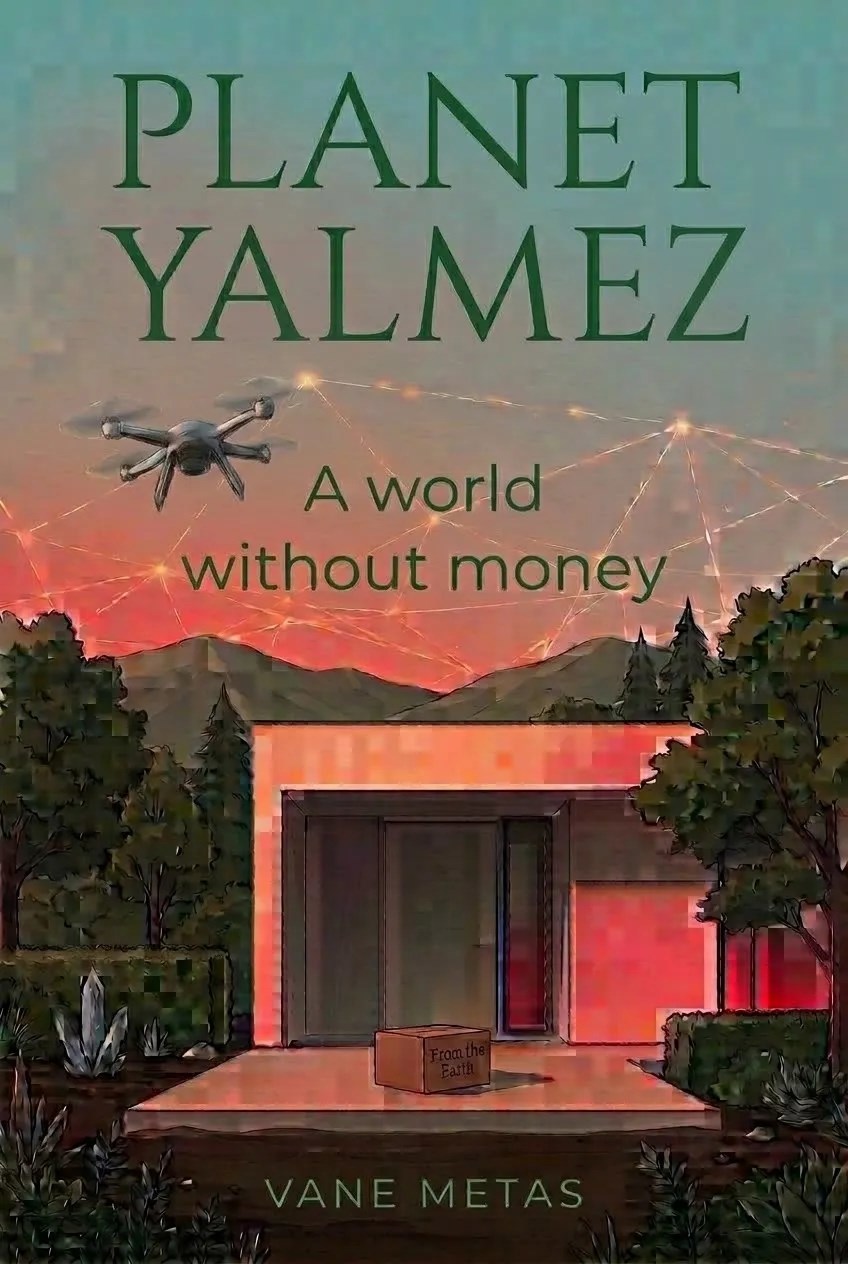
Planet Yalmez
Глава 1
[ In a world untouched by money, every individual devoted themselves entirely to their calling—whether art, programming, or medicine. People had no concept of currency, for the simple reason that they had never needed it, neither in the past nor in the present post-industrial era. On this planet, there was no struggle for power or resources. Yet one could not say that absolute equality reigned here; rather, a person’s calling shaped their daily life, while pervasive peace and the absence of conflict fostered a unique dynamic. ]
Waking in his morning-drenched studio, Kaelis felt a profound sense of clarity. His mind was already alive with fresh visions for a new canvas. After completing a quick study, he headed down to the common dining hall, where he met an art colleague over a cup of warm brew. In the long conversation that followed, they eagerly discussed new forms of self-expression, exchanging ideas without a trace of calculation or self-interest.
For Kaelis, creation had long since become the natural rhythm of life. A society where everyone followed their inner calling offered the ultimate gift: absolute freedom of conception.
[ Commercial transactions and profit margins were entirely unknown; labor existed for the sake of mastery, and communication for the resonance of the soul. ]
As he put the finishing touches on a canvas depicting a crimson sunset over a turquoise sea, Kaelis suddenly caught himself feeling a nearly childlike curiosity about the distant stars. Applying bold strokes to the disc of the setting luminary, he wondered: what was the nature of other worlds? Did they have binary star systems, violet skies, or strange, unprecedented mountain forms?
[ It never crossed his mind how similar those worlds could be. In terms of landscapes and climate, some were virtually indistinguishable from Yalmez. Yet beneath that outer resemblance lay a colossal chasm—a fundamentally different structural architecture of their civilizations. ]
Kaelis wiped his hands, completely unaware that he was standing on the threshold of a discovery that would shatter his entire worldview regarding the life of other realms.
Deciding to take a stroll toward the city's outer district, Kaelis skipped his compact electric car, which was undergoing scheduled maintenance at the service depot. Instead, he stepped onto the platform of a silent urban shuttle gliding smoothly along its designated green lane. Through the panoramic glass, he took in the bright, unhurried streets—free of rush, commotion, or intrusive advertising billboards.
Passing a spacious park, the shuttle slowed near a children’s studio. Through the open stained-glass windows, children and adults alike could be seen absorbed in creative pursuits in the fresh air. Watching them, Kaelis thought with quiet warmth about how upbringing was structured on Yalmez.
[ The special educational system here was never built on formal lessons, rote memorization of rules, or the fear of making mistakes. In this world, no one was threatened with consequences or forced to study for grades—the entire culture of pressure and manipulation through fear was absent. The primary task of the elders was to catch the spark in a child’s eye at the right moment and let it kindle. ]
At the next stop, Kaelis decided to step out and walk a while. Approaching the studio’s open-air grounds, he saw several children trying to draw sound from unusual wooden resonators.
— Kaelis! — called out a boy with fingers stained in dry clay. — Look! If I make the wall thinner, the sound deepens, but the form loses stability. If I make a mistake, will I have to redo the whole thing?
— Of course, — Kaelis smiled warmly, kneeling beside him. — And that is the beauty of it. A mistake is not a failure; it is simply a new answer from the material. Listen to the material itself: does the clay want to ring out or hold its volume?
[ The children around him did not compete over whose work was better, nor did they wait for grades. They were captivated by the essence of things, the pure joy of shared exploration. Adults here imposed no ready-made answers and never taught through coercion—they merely helped frame the right questions. Thus, every child’s natural gift unfolded from an early age, turning learning into a natural and joyful movement of life. ]
One day, while deep in the creative flow of a new painting, Kaelis caught a strange, low hum and a sharp pop echoing outside his studio door. Rushing out onto the porch, he caught a glimpse of a dark, angular craft ascending into the sky at a sharp angle. Its stern geometry exuded a cold alienness, utterly foreign to the fluid, organic forms of Yalmez technology. Executing a sharp turn, it silently dissolved into the upper layers of the atmosphere.
On his doorstep lay a parcel container-capsule made of unfamiliar packaging material. Inside were two glossy catalog magazines. One featured reproductions of paintings, with numbers and symbols printed beneath each piece. Kaelis peered at the figures, trying to decipher their meaning. The other magazine displayed luxurious exteriors and interiors of mansions, likewise accompanied by numbers beneath every image. A third item was an unopened envelope, which Kaelis momentarily set aside, captivated by the glossy pages.
Comparing the images and the digital data in the magazines, Kaelis was stunned by the absurdity of linking specific numerical units to paintings and real estate. By this digital equivalent, a single painting could be traded for a house. “What sheer nonsense,” Kaelis wondered in bewilderment.
To him—accustomed to a world where art was a gift, where mastery was exchanged freely, and housing was guaranteed by society as an inalienable right—the very idea that a canvas or a home could be represented by a tally of abstract points and bartered away seemed bizarre, grotesque, and entirely devoid of logic.
His first impulse was to share the discovery with his wife.
[ Relationships on Yalmez, including family and partnership bonds, were built on absolute sincerity and freedom, free of any property obligations. ]
The artist had a family. His wife and two children shared his principles of honesty and freedom, finding their place in a society where everyone pursued what they loved. Family life did not prevent him from regularly attending public gatherings and clubs, where he met like-minded individuals, relishing conversation and collaborative creation.
Returning home from the studio, Kaelis crossed the threshold and immediately caught the spicy, sweet aroma of freshly baked goods lingering in the dining area. Wiping his hands—still faintly stained with oil paint—he noticed a deep ceramic dish on the table that had not been there that morning.
— Is this from Rael? — Kaelis smiled, breathing in the steam rising from the golden crust.
— Yes, he dropped by an hour ago. — Lira set utensils before her husband and took a seat opposite him. — He said he felt a sudden surge of inspiration, gathered some fresh herbs from the distribution center, and decided to treat all the neighbors.
Kaelis broke off a small piece:
— Incredible. He ought to channel that gift into the main culinary gallery.
— He simply loves cooking, Kaelis, — Lira replied softly. — For him, it’s the same kind of flow state that a new canvas is for you. Why outsource culinary art to automation when it brings a person genuine joy? Robots handle cleaning and tidying perfectly well, but only living hands can bake soul into a dish.
— And it spares me from the stove when my mind is still wet with paint. — Kaelis nodded gratefully. — It’s amazing how harmoniously everything arranges itself when no one owes anything to anyone.
He paused, noticing that Lira had hardly touched her food. Her attention was riveted to the edge of the table, where the glossy catalogs he had brought from the studio lay beside her cup. The screen of her portable terminal was still glowing with a lengthy analytical text.
Kaelis set down his utensils and leaned forward slightly:
— Have you looked through them?
Lira slowly raised her gaze to meet his. Her customary calm had given way to deep concern.
— I have. — Lira shook her head. — Kaelis, your intuition was right. But it goes much deeper and is far more unsettling than just a bizarre way to trade a painting for a house.
She turned the terminal screen toward him, displaying a complex diagram generated by the AI.
— I scanned these pages and queried the system, — Lira continued. — It took our AI some time to construct a logical model of the world these journals came from. Our archives contain no such concepts, so the system had to analyze the underlying mathematics from scratch.
— And what conclusion did it reach? — Kaelis asked, studying the unfamiliar charts.
— The system calls it a “commodity-money model,” — Lira tapped her finger against the figures beneath a painting reproduction. — This number is neither an index of beauty nor an evaluation of energy expended. It is a “price.” In that world, absolutely everything—from creative output to living space—has the status of a “commodity,” bought and sold for these digital units.
— You mean to say that to get a house there, you are forced to first sell your craftsmanship, accumulate these numbers, and only then exchange them for shelter? — Kaelis asked, trying to fit the alien chain of logic into his mind.
— Exactly, — Lira replied, her voice carrying firm, resolute tones. — But the AI also calculated the primary consequence of such a system: the moment the goal of acquiring these units stands between a person and their calling, the act of creation itself becomes distorted. Art turns into an instrument of bargaining. People begin to create not what their soul demands, but what will fetch the highest “price.”
She decisively covered the catalog with her palm, as if shielding their home from alien papers.
— This completely undermines the foundations of our world and violates the very essence of freedom and distribution. Attempting to instill such an approach would turn a society of creators into a space of chaos and endless resource competition.
She fell silent. The AI’s compelling conclusions, delivered in her resolute voice, left a bitter aftertaste in Kaelis’s soul.
— I’m going for a walk; I need to clear my head, — Kaelis murmured, heading toward the coast.
[ The climate on Yalmez mirrored that of Earth, and the surrounding nature was strikingly similar. There was no division into nation-states; instead, the planet was organized into specialized enclaves, allowing people of compatible temperaments and physical needs to live in harmony. ]
Kaelis, whose health was somewhat delicate, lived in a temperate zone where the sound of mountain rivers rushing from wooded gorges merged with the breathing of the sea. It was there, between bouts of creative work, that he found peace and restoration.
The rhythm of the surf rolled onto the sandy shore in measured, soothing cadences. Kaelis half-reclined on a lounge chair, squinting in the morning sun and taking occasional sips of chilled juice from a nearby distribution kiosk. A gentle breeze carried the coolness of the wooded ravines through the seaside heat. Behind him lay the difficult conversation with Lira, yet a vague restlessness still stirred within his soul.
Close by, resting his elbows on his knees, sat Tarian—his longtime friend and fellow painter.
Kaelis silently pulled both journals from his bag and handed them to his friend.
— Take a look, — he said quietly. — These were sent from another world. Beneath every painting and every mansion are numbers. Our AI analyzed them: it is their “price.” Over there, everything is bought and sold for these digital units.
Kaelis expected to see the same bewilderment or rejection on Tarian’s face that Lira had shown. But Tarian merely frowned, staring intently at the glossy pages and the rows of numbers beneath them. With every second, an unhealthy, feverish light kindled in his eyes.
— Incredible… — Tarian whispered, slowly turning the pages. — Kaelis, just think about it! These aren’t just numbers. This is a material valuation of talent!
Kaelis frowned:
— Valuation? Tarian, this system turns art into a commodity. You don’t paint because your soul is on fire; you paint to earn the number stamped beneath your work!
— Doesn’t it happen that when everyone receives equal recognition, the incentive to push one’s craft to perfection simply vanishes? — Tarian turned to him abruptly, his voice ringing with excitement. — Look around us! In our system, both genius and mediocrity enjoy the same comfort. No one truly knows whose labor is more valuable! But this concept… it provides an objective criterion. The higher the number beneath your canvas, the higher your status as a master rises accordingly. That is a monumental incentive to evolve, to be the best among the best!
— That is an incentive for competition, not for art, — Kaelis countered, feeling an invisible wall rising between them. — The moment you start thinking about a price, you cease to be a free creator.
— You’re being far too conservative, — Tarian leaped up from his lounger, clutching the catalogs. — We have to find out if this can be introduced here!
[ Tarian had no inkling of how much personal time Earthlings squandered on the pursuit of money and its constant calculation—bank visits, purchases, bill payments, and endless routine that stole away the active years of their lives. ]
Without wasting a moment, Tarian activated his terminal.
— Calling Elai, — he rattled off quickly. — If anyone can grasp the mechanics of this system, it’s him.
Fortunately, Elai—one of the principal architects of the artificial intelligence governing the Yalmez distribution network—was available. His calm, focused face materialized on the transparent projection screen. The soft lines of the research center were visible behind him.
— Elai, hello! We’ve hit upon a conceptual breakthrough, — Tarian began without preamble, holding the catalogs up to the scanner. — Look at this data. This is a monetary valuation equivalent from an alien civilization. Tell me, how technically difficult would it be to reconfigure our AI for such a model? For price tags, accumulation, and the material appraisal of labor?
Elai silently scrutinized the projected pages. His eyes scanned the lines while the computational module in his terminal processed the data. Finally, he leaned back in his chair and drew a deep breath.
— Technically? — Elai paused, carefully weighing his words. — Technically, any algorithmic model can be created. But we cannot refit our existing AI to this concept, Tarian.
— Why? — Tarian pressed. — It’s just an added module for tracking values!
— No, — Elai shook his head. — Our AI has evolved for over two centuries. Its entire logic rests on a foundational postulate: there are sufficient resources on the planet, and they are distributed to fulfill the genuine needs of every individual without any conditional valuation. If we introduce concepts of “value” and “cost,” the entire distribution architecture will collapse. We would have to build a hybrid system entirely from scratch, which means a global restructuring of our entire civilization and its infrastructure.
Elai paused again, shifting his gaze from Tarian to the silent Kaelis:
— But it’s not even about the code. There is a far more serious factor. The people of Yalmez have been shaped over centuries in conditions of absolute honesty and the gratuitous exchange of craftsmanship. Our internal ethos, our psychology—our genetic code, if you will—contains no drive for the accumulation of wealth or the struggle for resources.
— But new behavioral patterns can be cultivated! — Tarian persisted.
— That would take decades, Tarian, — Elai replied softly yet soberly. — Changing the internal mindset of an entire civilization is infinitely harder than rewriting AI code. Therefore, attempting to introduce a monetary equivalent on Yalmez makes no sense whatsoever. We would simply destroy what we have spent centuries building, receiving nothing in return.
The screen went dark. The sound of the surf reclaimed the beach, but now that peace felt fragile to Kaelis, and a pivotal question confronted him: whose perspective was closer to his heart—Lira’s idealism, Tarian’s pragmatic fervor, or Elai’s cold calculation?
In the wake of these events, rumors of a package from another world began to ripple across the territory. The news stirred local curiosity for a time, but devoid of sensationalism or media hype, it soon lost momentum and faded away.
[ In the information sphere of Yalmez, the concepts of “sensation” or the chase for ratings did not exist: mass media did not inflate the story, churn it through news feeds, or manufacture artificial hype. To society and state structures, news of a distant planet and its monetary systems appeared not as a crisis, but merely as a curious historical-cultural fact—an exotic novelty from another realm, holding zero practical relevance to the reality of Yalmez. ]
Most residents quickly satisfied their initial curiosity and, with a mild sense of wonder, returned to their ordinary lives, creative projects, and daily routines.
Yet for Kaelis, the matter was far from closed. He needed solitude and space to deeply investigate the question. Unaccustomed to searching for such unusual information from home using the Yalmez network, Kaelis made his way to the Central Library. People came here not for quick answers, but for the rare atmosphere of meditative research and access to physical primary sources—ancient manuscripts and folios.
Studying dusty archives, he stumbled upon the treatises of past thinkers. It turned out that even at the dawn of their civilization, isolated Yalmez scholars had hypothesized the possibility of introducing conditional “value tokens” or monetary equivalents—though no one had ever known anything concrete about the actual Earth system; those had been mere speculative models.
[ Yet those ideas remained strictly abstract theories. Yalmez society rested on a specialized educational system that unlocked each person’s calling from childhood, while the other driving force of civilization remained the personal pursuit of mastery and understanding. Alien hypotheses concerning artificial equivalents were unanimously rejected as something foreign to the very nature of their world. ]
As he walked back from the library, Kaelis ran into his neighbor near his doorstep—a man who worked as a refuse collector and frequently shared deep, almost folk-like observations on life. Eager to enrich his inquiry into the concept of value equivalents, Kaelis decided to ask his opinion. “Why would a bear need five dens, or an alpha male two harems?” the neighbor replied instantly. The bear analogy vividly illustrated to Kaelis how a living creature contenting itself with genuine necessities avoided overburdening itself with superfluous possessions.
[ In truth, wild animals are guided by instincts of preservation and shelter, devoid of any urge to control excess resources. This trait persisted among the people of Yalmez, who harbored no such cravings. ]
Several weeks later, wholly immersed in a new project, Kaelis remembered the parcel he had carefully stored in his studio. The catalogs had long since found a place on his shelf, but one forgotten detail remained inside the box—the unopened envelope he had set aside in confusion during his initial unsealing.
Inside the envelope, written in a language now familiar to him, lay an invitation to Earth, promising untold riches and high status, unlocking access to luxuries no one on Yalmez had ever imagined.
The accompanying text guaranteed full logistical support for his relocation to Earth. Holding the proposal, Kaelis sank into deep reflection. He thought about how, in a world ruled by money, art loses its pristine purity, becoming merely an instrument for acquiring status and acclaim.
Our world, by contrast, is filled with absolute awareness and harmony—the artist continued to muse—where every individual perceives life as a continuous stream of creation and joy, free of deception and greed for material goods.
[ As society evolved upon these principles, it added yet another layer of subtle organization, wherein division by behavioral preferences and energy sources ensured the inner peace of every population group. ]
Finally, Kaelis broke off his musings on the world he inhabited, laid aside his unfinished canvas, and, seized with agitation, left the studio to return home where Lira and the children were. Right there, within the warmth of his family, he showed his wife the invitation to Earth, hoping for her understanding.
Lira remained unwavering: true art is created for human harmony and must remain free of commercial valuation. Knowing her husband’s generous, restless nature, she cautioned him, fully aware of the danger this journey posed for someone raised in a world where everything was shared without recompense.
Kaelis stood at a crossroads that fractured his inner peace. On one side were Lira’s arguments regarding the loss of artistic freedom and purity. On the other was Tarian’s pragmatic view, which saw value as the pathway to recognition and the flourishing of talent. For him, this was not merely a choice between worlds, but a decision on what would become of his creative soul.
Kaelis resolved to make no hasty judgments and instead petitioned the Council of the Yalmez administrative center. In his electronic inquiry, he detailed the information he had received, described his reflections, and asked for clarification on whether the concept of material labor valuation could exist in their society without violating its core principles.
Some time later, Kaelis received an official response from the Council. State authorities stated that adopting such practices would lead to the fundamental collapse of their social order. By destroying the foundations of fair and guaranteed resource distribution, society would inevitably forfeit its original ethos, degenerating into an alien world where everyone vied for enrichment.
The Council’s verdict was clear: pushing the idea any further was pointless. Yet as Kaelis pondered the hidden threshold to Earth, he thought of Tarian, whose passion for the news might ignite a different spark. He set out to find him, eager to talk things through.
On his way, he stopped by the clothing center to refresh his outfit. Choosing a new garment, he left his old one in a recycling bay, amused by the thought that somewhere across the stars, a person had to buy clothes, haul them home, and only then put them on.
When they met, Kaelis quietly told him of the Council's rejection. Tarian listened, his eyes thoughtful. “You mentioned an invitation,” he reminded Kaelis. “An arrangement of some kind. Was it meant for you alone, or anyone?”
Kaelis paused, recalling the message, then shook his head. His name was nowhere in the text. The invitation was addressed to an abstract “representative of Yalmez,” promising safe passage and full care on Earth.
At that, Tarian’s face lit up. He leaned in, a sudden fire in his gaze: “What if I go instead of you?”
His words shifted everything.
Back home, Kaelis turned the choice over in his mind. By nightfall, his decision was firm: he would stay on Yalmez with his family. True peace and creative freedom, he knew, belonged only to a world untouched by material measure, where creation was its own reward.
Tarian, however, burned to step into the unknown.
Studying the departure guide together, they unraveled the details: barely five days remained before the transition, and the coordinates pointed to a high meadow deep in a nearby gorge.
The sheer mystery of it still awed them. A system capable of silently bridging light-years—transporting not merely objects, but living souls between worlds—commanded a quiet reverence. In that flawless, subtle power lay a force beyond the grasp of Earth and Yalmez alike. They needed no further proof to trust it.
With no roads leading to the site, a hike was their only way. In absolute secrecy, they prepared for the journey—a quiet leap into the dark.
Kaelis drove the silent silver car along the winding mountain road, while Tarian stared out in silence.
Below them, a rushing river—its waters a striking, lettuce-green—foamed over smooth boulders. Delicate stone bridges spanned the gorges, offering glimpses of sheer cliffs whose layered strata looked like frozen, ancient waves. Emerald valleys flashed past, shaded by tall, bamboo-like trees. On the sunlit alpine slopes, herds of graceful grasses, resembling deer, drifted like soft patches of light.
Cornering a sharp turn over a sheer drop, the car lurched slightly above the chasm. Tarian gripped the door armrest, turning to his friend.
“Twists and turns—just like life. What’s on your mind?”
“I’m wondering what was missing for you here, Tarian,” Kaelis said softly, his eyes fixed on the road. “Why reach for a world where everything is reduced to numbers? Where people fight for status and resources instead of simply living?”
“For recognition, Kaelis…” Tarian looked back out at the soaring peaks. “For scale! Here, we’re sheltered by harmony. But there, I’ll find the true measure of my craft. If a painting of mine fetches millions, it means I’ve touched history.”
The road ended at the base of the ridge. Packing their gear, they began the climb through dense forest toward the high meadow.
As the trees parted, bright sunlight washed over them. In the center of the clearing stood a futuristic vessel. It resembled the module that had delivered the package, but larger, intricate, its light-refracting surface whispering of an impossible technology.
They stopped, transfixed. Kaelis placed a hand on Tarian’s shoulder, meeting his eyes.
“Listen to me, Tarian. As a friend, and as a painter.”
Tarian went still.
“You grew up where giving comes naturally, where no one ever had to fight for bread,” Kaelis spoke slowly, every word heavy with care. “Where you’re going, eyes look at a canvas differently. To them, art is an asset, a token of prestige. They will smile and speak of beauty while pricing every stroke of your brush.”
“I can handle myself, Kaelis...”
“It’s not them I’m worried about,” Kaelis shook his head. “The real danger isn’t being cheated. It’s the day you start painting for their price tags without even realizing it. The moment you ask yourself, ‘What should I paint to sell for more?’—your art dies. You’ll have millions, but you’ll lose the soul of a creator. Is that a world you truly want to live in?”
Tarian fell silent. A shadow of doubt crossed his face, but he gently stepped back, freeing his shoulder.
“Thank you, Kaelis. I’ll hold your words close. But this is a road I have to walk.”
“Safe journey, then. Keep your soul whole,” Kaelis said softly.
[ In a world untouched by money, every individual devoted themselves entirely to their calling — whether art, programming, or medicine. People had no concept of currency, for the simple reason that they had never needed it, neither in the past nor in the present post-industrial era. On this planet, there was no struggle for power or resources. Yet one could not say that absolute equality reigned here; rather, a person’s calling shaped their daily life, while pervasive peace and the absence of conflict fostered a unique dynamic. ]
Waking in his morning-drenched studio, Kaelis felt a profound sense of clarity. His mind was already alive with fresh visions for a new canvas. After completing a quick study, he headed down to the common dining hall, where he met an art colleague over a cup of warm brew. In the long conversation that followed, they eagerly discussed new forms of self-expression, exchanging ideas without a trace of calculation or self-interest.
For Kaelis, creation had long since become the natural rhythm of life. A society where everyone followed their inner calling offered the ultimate gift: absolute freedom of conception.
[ Commercial transactions and profit margins were entirely unknown; labor existed for the sake of mastery, and communication for the resonance of the soul. ]
As he put the finishing touches on a canvas depicting a crimson sunset over a turquoise sea, Kaelis suddenly caught himself feeling a nearly childlike curiosity about the distant stars. Applying bold strokes to the disc of the setting luminary, he wondered: what was the nature of other worlds? Did they have binary star systems, violet skies, or strange, unprecedented mountain forms?
[ It never crossed his mind how similar those worlds could be. In terms of landscapes and climate, some were virtually indistinguishable from Yalmez. Yet beneath that outer resemblance lay a colossal chasm — a fundamentally different structural architecture of their civilizations. ]
Kaelis wiped his hands, completely unaware that he was standing on the threshold of a discovery that would shatter his entire worldview regarding the life of other realms.
Deciding to take a stroll toward the city’s outer district, Kaelis skipped his compact electric car, which was undergoing scheduled maintenance at the service depot. Instead, he stepped onto the platform of a silent urban shuttle gliding smoothly along its designated green lane. Through the panoramic glass, he took in the bright, unhurried streets — free of rush, commotion, or intrusive advertising billboards.
Passing a spacious park, the shuttle slowed near a children’s studio. Through the open stained-glass windows, children and adults alike could be seen absorbed in creative pursuits in the fresh air. Watching them, Kaelis thought with quiet warmth about how upbringing was structured on Yalmez.
[ The special educational system here was never built on formal lessons, rote memorization of rules, or the fear of making mistakes. In this world, no one was threatened with consequences or forced to study for grades — the entire culture of pressure and manipulation through fear was absent. The primary task of the elders was to catch the spark in a child’s eye at the right moment and let it kindle. ]
At the next stop, Kaelis decided to step out and walk a while. Approaching the studio’s open-air grounds, he saw several children trying to draw sound from unusual wooden resonators.
— Kaelis! — called out a boy with fingers stained in dry clay. — Look! If I make the wall thinner, the sound deepens, but the form loses stability. If I make a mistake, will I have to redo the whole thing?
— Of course, — Kaelis smiled warmly, kneeling beside him. — And that is the beauty of it. A mistake is not a failure; it is simply a new answer from the material. Listen to the material itself: does the clay want to ring out or hold its volume?
[ The children around him did not compete over whose work was better, nor did they wait for grades. They were captivated by the essence of things, the pure joy of shared exploration. Adults here imposed no ready-made answers and never taught through coercion — they merely helped frame the right questions. Thus, every child’s natural gift unfolded from an early age, turning learning into a natural and joyful movement of life. ]
One day, while deep in the creative flow of a new painting, Kaelis caught a strange, low hum and a sharp pop echoing outside his studio door. Rushing out onto the porch, he caught a glimpse of a dark, angular craft ascending into the sky at a sharp angle. Its stern geometry exuded a cold alienness, utterly foreign to the fluid, organic forms of Yalmez technology. Executing a sharp turn, it silently dissolved into the upper layers of the atmosphere.
On his doorstep lay a parcel container-capsule made of unfamiliar packaging material. Inside were two glossy catalog magazines. One featured reproductions of paintings, with numbers and symbols printed beneath each piece. Kaelis peered at the figures, trying to decipher their meaning. The other magazine displayed luxurious exteriors and interiors of mansions, likewise accompanied by numbers beneath every image. A third item was an unopened envelope, which Kaelis momentarily set aside, captivated by the glossy pages.
Comparing the images and the digital data in the magazines, Kaelis was stunned by the absurdity of linking specific numerical units to paintings and real estate. By this digital equivalent, a single painting could be traded for a house. “What sheer nonsense,” Kaelis wondered in bewilderment.
To him — accustomed to a world where art was a gift, where mastery was exchanged freely, and housing was guaranteed by society as an inalienable right — the very idea that a canvas or a home could be represented by a tally of abstract points and bartered away seemed bizarre, grotesque, and entirely devoid of logic.
His first impulse was to share the discovery with his wife.
[ Relationships on Yalmez, including family and partnership bonds, were built on absolute sincerity and freedom, free of any property obligations. ]
The artist had a family. His wife and two children shared his principles of honesty and freedom, finding their place in a society where everyone pursued what they loved. Family life did not prevent him from regularly attending public gatherings and clubs, where he met like-minded individuals, relishing conversation and collaborative creation.
Returning home from the studio, Kaelis crossed the threshold and immediately caught the spicy, sweet aroma of freshly baked goods lingering in the dining area. Wiping his hands — still faintly stained with oil paint — he noticed a deep ceramic dish on the table that had not been there that morning.
— Is this from Rael? — Kaelis smiled, breathing in the steam rising from the golden crust.
— Yes, he dropped by an hour ago. — Lira set utensils before her husband and took a seat opposite him. — He said he felt a sudden surge of inspiration, gathered some fresh herbs from the distribution center, and decided to treat all the neighbors.
Kaelis broke off a small piece:
— Incredible. He ought to channel that gift into the main culinary gallery.
— He simply loves cooking, Kaelis, — Lira replied softly. — For him, it’s the same kind of flow state that a new canvas is for you. Why outsource culinary art to automation when it brings a person genuine joy? Robots handle cleaning and tidying perfectly well, but only living hands can bake soul into a dish.
— And it spares me from the stove when my mind is still wet with paint. — Kaelis nodded gratefully. — It’s amazing how harmoniously everything arranges itself when no one owes anything to anyone.
He paused, noticing that Lira had hardly touched her food. Her attention was riveted to the edge of the table, where the glossy catalogs he had brought from the studio lay beside her cup. The screen of her portable terminal was still glowing with a lengthy analytical text.
Kaelis set down his utensils and leaned forward slightly:
— Have you looked through them?
Lira slowly raised her gaze to meet his. Her customary calm had given way to deep concern.
— I have. — Lira shook her head. — Kaelis, your intuition was right. But it goes much deeper and is far more unsettling than just a bizarre way to trade a painting for a house.
She turned the terminal screen toward him, displaying a complex diagram generated by the AI.
— I scanned these pages and queried the system, — Lira continued. — It took our AI some time to construct a logical model of the world these journals came from. Our archives contain no such concepts, so the system had to analyze the underlying mathematics from scratch.
— And what conclusion did it reach? — Kaelis asked, studying the unfamiliar charts.
— The system calls it a “commodity-money model,” — Lira tapped her finger against the figures beneath a painting reproduction. — This number is neither an index of beauty nor an evaluation of energy expended. It is a “price.” In that world, absolutely everything — from creative output to living space — has the status of a “commodity,” bought and sold for these digital units.
— You mean to say that to get a house there, you are forced to first sell your craftsmanship, accumulate these numbers, and only then exchange them for shelter? — Kaelis asked, trying to fit the alien chain of logic into his mind.
— Exactly, — Lira replied, her voice carrying firm, resolute tones. — But the AI also calculated the primary consequence of such a system: the moment the goal of acquiring these units stands between a person and their calling, the act of creation itself becomes distorted. Art turns into an instrument of bargaining. People begin to create not what their soul demands, but what will fetch the highest “price.”
She decisively covered the catalog with her palm, as if shielding their home from alien papers.
— This completely undermines the foundations of our world and violates the very essence of freedom and distribution. Attempting to instill such an approach would turn a society of creators into a space of chaos and endless resource competition.
She fell silent. The AI’s compelling conclusions, delivered in her resolute voice, left a bitter aftertaste in Kaelis’s soul.
— I’m going for a walk; I need to clear my head, — Kaelis murmured, heading toward the coast.
[ The climate on Yalmez mirrored that of Earth, and the surrounding nature was strikingly similar. There was no division into nation-states; instead, the planet was organized into specialized enclaves, allowing people of compatible temperaments and physical needs to live in harmony. ]
Kaelis, whose health was somewhat delicate, lived in a temperate zone where the sound of mountain rivers rushing from wooded gorges merged with the breathing of the sea. It was there, between bouts of creative work, that he found peace and restoration.
The rhythm of the surf rolled onto the sandy shore in measured, soothing cadences. Kaelis half-reclined on a lounge chair, squinting in the morning sun and taking occasional sips of chilled juice from a nearby distribution kiosk. A gentle breeze carried the coolness of the wooded ravines through the seaside heat. Behind him lay the difficult conversation with Lira, yet a vague restlessness still stirred within his soul.
Close by, resting his elbows on his knees, sat Tarian — his longtime friend and fellow painter.
Kaelis silently pulled both journals from his bag and handed them to his friend.
— Take a look, — he said quietly. — These were sent from another world. Beneath every painting and every mansion are numbers. Our AI analyzed them: it is their “price.” Over there, everything is bought and sold for these digital units.
Kaelis expected to see the same bewilderment or rejection on Tarian’s face that Lira had shown. But Tarian merely frowned, staring intently at the glossy pages and the rows of numbers beneath them. With every second, an unhealthy, feverish light kindled in his eyes.
— Incredible… — Tarian whispered, slowly turning the pages. — Kaelis, just think about it! These aren’t just numbers. This is a material valuation of talent!
Kaelis frowned:
— Valuation? Tarian, this system turns art into a commodity. You don’t paint because your soul is on fire; you paint to earn the number stamped beneath your work!
— Doesn’t it happen that when everyone receives equal recognition, the incentive to push one’s craft to perfection simply vanishes? — Tarian turned to him abruptly, his voice ringing with excitement. — Look around us! In our system, both genius and mediocrity enjoy the same comfort. No one truly knows whose labor is more valuable! But this concept… it provides an objective criterion. The higher the number beneath your canvas, the higher your status as a master rises accordingly. That is a monumental incentive to evolve, to be the best among the best!
— That is an incentive for competition, not for art, — Kaelis countered, feeling an invisible wall rising between them. — The moment you start thinking about a price, you cease to be a free creator.
— You’re being far too conservative, — Tarian leaped up from his lounger, clutching the catalogs. — We have to find out if this can be introduced here!
[ Tarian had no inkling of how much personal time Earthlings squandered on the pursuit of money and its constant calculation — bank visits, purchases, bill payments, and endless routine that stole away the active years of their lives. ]
Without wasting a moment, Tarian activated his terminal.
— Calling Elai, — he rattled off quickly. — If anyone can grasp the mechanics of this system, it’s him.
Fortunately, Elai — one of the principal architects of the artificial intelligence governing the Yalmez distribution network — was available. His calm, focused face materialized on the transparent projection screen. The soft lines of the research center were visible behind him.
— Elai, hello! We’ve hit upon a conceptual breakthrough, — Tarian began without preamble, holding the catalogs up to the scanner. — Look at this data. This is a monetary valuation equivalent from an alien civilization. Tell me, how technically difficult would it be to reconfigure our AI for such a model? For price tags, accumulation, and the material appraisal of labor?
Elai silently scrutinized the projected pages. His eyes scanned the lines while the computational module in his terminal processed the data. Finally, he leaned back in his chair and drew a deep breath.
— Technically? — Elai paused, carefully weighing his words. — Technically, any algorithmic model can be created. But we cannot refit our existing AI to this concept, Tarian.
— Why? — Tarian pressed. — It’s just an added module for tracking values!
— No, — Elai shook his head. — Our AI has evolved for over two centuries. Its entire logic rests on a foundational postulate: there are sufficient resources on the planet, and they are distributed to fulfill the genuine needs of every individual without any conditional valuation. If we introduce concepts of “value” and “cost,” the entire distribution architecture will collapse. We would have to build a hybrid system entirely from scratch, which means a global restructuring of our entire civilization and its infrastructure.
Elai paused again, shifting his gaze from Tarian to the silent Kaelis:
— But it’s not even about the code. There is a far more serious factor. The people of Yalmez have been shaped over centuries in conditions of absolute honesty and the gratuitous exchange of craftsmanship. Our internal ethos, our psychology — our genetic code, if you will — contains no drive for the accumulation of wealth or the struggle for resources.
— But new behavioral patterns can be cultivated! — Tarian persisted.
— That would take decades, Tarian, — Elai replied softly yet soberly. — Changing the internal mindset of an entire civilization is infinitely harder than rewriting AI code. Therefore, attempting to introduce a monetary equivalent on Yalmez makes no sense whatsoever. We would destroy what we have spent centuries building, receiving nothing in return.
The screen went dark. The sound of the surf reclaimed the beach. Still, now that peace felt fragile to Kaelis, and a pivotal question confronted him: whose perspective was closer to his heart — Lira’s idealism, Tarian’s pragmatic fervor, or Elai’s cold calculation?
In the wake of these events, rumors of a package from another world began to ripple across the territory. The news stirred local curiosity for a time, but devoid of sensationalism or media hype, it soon lost momentum and faded away.
[ In the information sphere of Yalmez, the concepts of “sensation” or the chase for ratings did not exist: mass media did not inflate the story, churn it through news feeds, or manufacture artificial hype. To society and state structures, news of a distant planet and its monetary systems appeared not as a crisis, but merely as a curious historical-cultural fact — an exotic novelty from another realm, holding zero practical relevance to the reality of Yalmez. ]
Most residents quickly satisfied their initial curiosity and, with a mild sense of wonder, returned to their ordinary lives, creative projects, and daily routines.
Yet for Kaelis, the matter was far from closed. He needed solitude and space to deeply investigate the question. Unaccustomed to searching for such unusual information from home using the Yalmez network, Kaelis made his way to the Central Library. People came here not for quick answers, but for the rare atmosphere of meditative research and access to physical primary sources — ancient manuscripts and folios.
Studying dusty archives, he stumbled upon the treatises of past thinkers. It turned out that even at the dawn of their civilization, isolated Yalmez scholars had hypothesized the possibility of introducing conditional “value tokens” or monetary equivalents — though no one had ever known anything concrete about the actual Earth system; those had been mere speculative models.
[ Yet those ideas remained strictly abstract theories. Yalmez society rested on a specialized educational system that unlocked each person’s calling from childhood, while the other driving force of civilization remained the personal pursuit of mastery and understanding. Alien hypotheses concerning artificial equivalents were unanimously rejected as something foreign to the very nature of their world. ]
As he walked back from the library, Kaelis ran into his neighbor near his doorstep — a man who worked as a refuse collector and frequently shared deep, almost folk-like observations on life. Eager to enrich his inquiry into the concept of value equivalents, Kaelis decided to ask his opinion. “Why would a bear need five dens, or an alpha male two harems?” the neighbor replied instantly. The bear analogy vividly illustrated to Kaelis how a living creature contenting itself with genuine necessities avoided overburdening itself with superfluous possessions.
[ In truth, wild animals are guided by instincts of preservation and shelter, devoid of any urge to control excess resources. This trait persisted among the people of Yalmez, who harbored no such cravings. ]
Several weeks later, wholly immersed in a new project, Kaelis remembered the parcel he had carefully stored in his studio. The catalogs had long since found a place on his shelf. Still, one forgotten detail remained inside the box — the unopened envelope he had set aside in confusion during his initial unsealing.
Inside the envelope, written in a language now familiar to him, lay an invitation to Earth, promising untold riches and high status, unlocking access to luxuries no one on Yalmez had ever imagined.
The accompanying text guaranteed full logistical support for his relocation to Earth. Holding the proposal, Kaelis sank into deep reflection. He thought about how, in a world ruled by money, art loses its pristine purity, becoming merely an instrument for acquiring status and acclaim.
Our world, by contrast, is filled with absolute awareness and harmony — the artist continued to muse — where every individual perceives life as a continuous stream of creation and joy, free of deception and greed for material goods.
[ As society evolved upon these principles, it added yet another layer of subtle organization, wherein division by behavioral preferences and energy sources ensured the inner peace of every population group. ]
Finally, Kaelis broke off his musings on the world he inhabited, laid aside his unfinished canvas, and, seized with agitation, left the studio to return home where Lira and the children were. Right there, within the warmth of his family, he showed his wife the invitation to Earth, hoping for her understanding.
Lira remained unwavering: true art is created for human harmony and must remain free of commercial valuation. Knowing her husband’s generous, restless nature, she cautioned him, fully aware of the danger this journey posed for someone raised in a world where everything was shared without recompense.
Kaelis stood at a crossroads that fractured his inner peace. On one side were Lira’s arguments regarding the loss of artistic freedom and purity. On the other was Tarian’s pragmatic view, which saw value as the pathway to recognition and the flourishing of talent. For him, this was not merely a choice between worlds, but a decision on what would become of his creative soul.
Kaelis resolved to make no hasty judgments and instead petitioned the Council of the Yalmez administrative center. In his electronic inquiry, he detailed the information he had received, described his reflections, and asked for clarification on whether the concept of material labor valuation could exist in their society without violating its core principles.
Some time later, Kaelis received an official response from the Council. State authorities stated that adopting such practices would lead to the fundamental collapse of their social order. By destroying the foundations of fair and guaranteed resource distribution, society would inevitably forfeit its original ethos, degenerating into an alien world where everyone vied for enrichment.
The Council’s verdict was clear: pushing the idea any further was pointless. Yet as Kaelis pondered the hidden threshold to Earth, he thought of Tarian, whose passion for the news might ignite a different spark. He set out to find him, eager to talk things through.
On his way, he stopped by the clothing center to refresh his outfit. Choosing a new garment, he left his old one in a recycling bay, amused by the thought that somewhere across the stars, a person had to buy clothes, haul them home, and only then put them on.
When they met, Kaelis quietly told him of the Council’s rejection. Tarian listened, his eyes thoughtful. “You mentioned an invitation,” he reminded Kaelis. “An arrangement of some kind. Was it meant for you alone, or anyone?”
Kaelis paused, recalling the message, then shook his head. His name was nowhere in the text. The invitation was addressed to an abstract “representative of Yalmez,” promising safe passage and full care on Earth.
At that, Tarian’s face lit up. He leaned in, a sudden fire in his gaze: “What if I go instead of you?”
His words shifted everything.
Back home, Kaelis turned the choice over in his mind. By nightfall, his decision was firm: he would stay on Yalmez with his family. True peace and creative freedom, he knew, belonged only to a world untouched by material measure, where creation was its own reward.
Tarian, however, burned to step into the unknown.
Studying the departure guide together, they unraveled the details: barely five days remained before the transition, and the coordinates pointed to a high meadow deep in a nearby gorge.
The sheer mystery of it still awed them. A system capable of silently bridging light-years — transporting not merely objects, but living souls between worlds — commanded a quiet reverence. In that flawless, subtle power lay a force beyond the grasp of Earth and Yalmez alike. They needed no further proof to trust it.
With no roads leading to the site, a hike was their only way. In absolute secrecy, they prepared for the journey — a quiet leap into the dark.
Kaelis drove the silent silver car along the winding mountain road, while Tarian stared out in silence.
Below them, a rushing river — its waters a striking, lettuce-green — foamed over smooth boulders. Delicate stone bridges spanned the gorges, offering glimpses of sheer cliffs whose layered strata looked like frozen, ancient waves. Emerald valleys flashed past, shaded by tall, bamboo-like trees. On the sunlit alpine slopes, herds of graceful grasses, resembling deer, drifted like soft patches of light.
Cornering a sharp turn over a sheer drop, the car lurched slightly above the chasm. Tarian gripped the door armrest, turning to his friend.
“Twists and turns — just like life. What’s on your mind?”
“I’m wondering what was missing for you here, Tarian,” Kaelis said softly, his eyes fixed on the road. “Why reach for a world where everything is reduced to numbers? Where people fight for status and resources instead of simply living?”
“For recognition, Kaelis…” Tarian looked back out at the soaring peaks. “For scale! Here, we’re sheltered by harmony. But there, I’ll find the true measure of my craft. If a painting of mine fetches millions, it means I’ve touched history.”
The road ended at the base of the ridge. Packing their gear, they began the climb through dense forest toward the high meadow.
As the trees parted, bright sunlight washed over them. In the center of the clearing stood a futuristic vessel. It resembled the module that had delivered the package, but larger, intricate, its light-refracting surface whispering of an impossible technology.
They stopped, transfixed. Kaelis placed a hand on Tarian’s shoulder, meeting his eyes.
“Listen to me, Tarian. As a friend, and as a painter.”
Tarian went still.
“You grew up where giving comes naturally, where no one ever had to fight for bread,” Kaelis spoke slowly, every word heavy with care. “Where you’re going, eyes look at a canvas differently. To them, art is an asset, a token of prestige. They will smile and speak of beauty while pricing every stroke of your brush.”
“I can handle myself, Kaelis…”
“It’s not them I’m worried about,” Kaelis shook his head. “The real danger isn’t being cheated. It’s the day you start painting for their price tags without even realizing it. The moment you ask yourself, ‘What should I paint to sell for more?’ — your art dies. You’ll have millions, but you’ll lose the soul of a creator. Is that a world you truly want to live in?”
Tarian fell silent. A shadow of doubt crossed his face, but he gently stepped back, freeing his shoulder.
“Thank you, Kaelis. I’ll hold your words close. But this is a road I have to walk.”
“Safe journey, then. Keep your soul whole,” Kaelis said softly.
They shared a firm handclasp, and Tarian stepped inside. The hatch sealed without a sound. The craft rose, hovered for a heartbeat, and then — with a silent, blinding leap — vanished through space and time.
Back in his studio that evening, Kaelis stood before a new canvas. It captured the morning sun breaking through the misty green of a gorge. Checking that the oil was dry, he carefully wrapped the piece and sent a signal to the distribution service, knowing that somewhere on Yalmez, his painting would bring quiet joy to a stranger — unpriced, unmeasured, and free.
[ All of these events, every choice, and every movement of souls seemed watched over by a higher, omniscient entity attuned to the symphony of existence across both worlds. This entity serenely shifted its gaze from the owner of a lavish terrestrial palace adorned with multi-million-dollar canvases to the comfortable dwelling of one of the Yalmez AI creators, where a painting by Kaelis hung upon the wall, contemplating the contrast in all its fullness.
The only thing programmer Elai had been mistaken about, the entity reflected, was his belief that the historical evolution of Yalmez alone had shaped humanity’s genetic code. In truth, the code had been fundamentally different from the very start across the two planets. Who had wrought that distinction, not even the entity itself knew. ]
To be continued.
October 2026
Author: Vane Metas
Спасибо за чтение
Вернуться к книге