
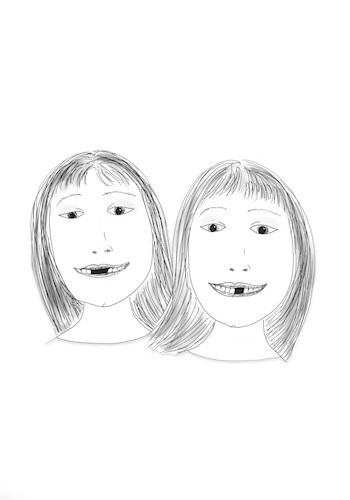
N&K
Ka-kow
‘Our Dad is stronger,’ Nastya said to the neighbourhood boy Pavlik so loudly that he shuddered.
‘No, my Dad is stronger. He can do twenty press-ups.’
‘Huh, and our Dad can do thirty press-ups! He can also eat ten onions, and he won’t even cry.’
‘And my Dad, when he fights with your Dad, will kick him so hard that he will fly to Cheboksary.’
‘No.’
‘Well, yes.’
‘No-no-no, one hundred thousand times “no”. But then, then…’
‘But then we have a cuckoo clock, that's it,’ Ksyusha helped her twin sister win the argument.
Nastya and Ksyusha loved to brag about this unusual clock. Their friends and acquaintances often came to see this miracle and count ‘ka-kows’. Surprisingly, the bird had never made a mistake. The clock was a brown house, under which hung two pine cone-shaped weights and a chain. And most importantly, a tiny grey bird lived in the house. The cuckoo was so smooth and shiny that you would want to lick it.
‘Do you think the cuckoo is real?’ Ksyusha once asked her sister.
‘Of course not!’
‘Then why is she singing?’
‘Because…’
Nastya had no answer. Of course, she immediately wanted to get it, but the parents were at work. It was unbearable to wait, she needed to find out straight away. How was the bird doing there? Did she eat? Did she have chicks? Or was it a he? Most importantly, what did the house look like from the inside? Maybe it looked like a doll’s house with a beautiful sofa and striped wallpaper? Why on earth did these questions come to mind when Dad and Mum were away?!
‘I know, let's open the house,’ Nastya said with a sly smile. Every time she had an interesting idea, she would raise her index finger up. Ksyusha was a little afraid of this gesture, because something always happened after that.
‘They'll scold us.’
‘No one will know, we'll hang the house back.’
‘How about we let her ‘ka-kow’ first, then we’ll open the clock.’
The twins dragged the kitchen table into the hallway. Climbing onto it, Nastya reached for the clock, but could not remove it from the wall. Then Ksyusha helped: ‘Try to lift it up first.’ It worked well, and soon the clock was on the bed.
The girls knocked, but no one opened the door. They examined the clock and found latches on the back wall.
The twins' hearts raced with excitement.
They easily opened the clock to see…
That. There was. No. Bird’s house. Nothing at all. Neither a lamp by the bed or next to the rocking chair, nor a sofa or tiny pictures of Grandma and Grandpa. The bird did not cook dinner for the chicks. Instead, it turned its unremarkable tail to the girls. The cuckoo's house was full of different clockwork details. And its voice was such a thing with air that sounded like a bicycle pump. It was not ‘ka-kow’ but ‘f-f-f-oo f-f-f-oo’.
‘I thought, there should at least be babies in the nest,’ Ksyusha Mumbled.
‘I didn’t think that at all,’ Nastya lied.
Ksyusha hugged Nastya. The girls closed the clock in silence and hung it back up. They unhappily dragged the table into the kitchen. They waited until three to see the cuckoo again, but that time from the front.
‘I wish we didn’t see this,’ Nastya said.
‘Let's not tell anyone about it.’
‘Okay.’
A real man
It was summer. It was hot. Dad was mowing the grass in the field. Nastya and Ksyusha were sent to him with pies and tea. Dad, having seen the girls from afar, waved to them. He wiped the sweat from his forehead, picked two flowers, and started to wait.
‘You're my little helpers! Thanks. Here are some flowers for you.’
‘Thanks, Dad. Are you tired?’
‘Nah, I'm not tired.’
‘Isn’t it too hot to wear trousers today?’
‘What else am I supposed to wear?’
‘Shorts.’
‘Nope. Real men don't wear shorts.’
‘Why?’
‘They simply can’t.’
‘Is Tima not a real man then?’
‘He’s fine, he's not a grown-up yet.’
‘What else don’t real men do?’
‘I should think about it (he adjusted his glasses). They don't cry, for example. They don't carry umbrellas.’
‘Why?’
‘I’m telling you, that’s simply how it is.’
‘What else?’
‘A lot of things. I won't remember straight away.’
‘Dad, are you a real man then?’
‘What do you think?’
‘Let's check,’ Nastya said, pointing her index finger up. She whispered something to her sister, after which they both attacked Dad with a tickle. He giggled and began to run away from them.
‘Well, Dad, are real men ticklish?’
‘Yes, I guess they can be afraid of tickles.’
‘If Pavlik's Dad kicked you, what would you do? Would you beat him if you were fighting?’
‘Real men don't fight for no reason.’
‘Well, let’s say, if he started tickling you, and you kicked him, would he be able to fly away to Moscow?’
Dad laughed and bit into his pie.
Sharik
Sharik
‘I'm your elder sister.’
‘Why you? I'm your elder sister.’
‘No, I am.’
‘I don't want to be the younger one.’
‘I know,’ Nastya had an idea, ‘let’s do this: whoever gets to the tree and back first, she is the elder one.’
No one, except Mum and Dad, knew which of the twins was born first. ‘Both of you are number one for me, no one is younger or older,’ Mum used to say. But then, after the race won by Nastya, everything became clear: she was the elder sister. And Ksyusha did not argue.
Tima, who was already ten, did not think so. For him, both the sisters were babies, equally younger by three years, and they needed to be protected. Well, at least for one day, on the girls' birthday.
It was a hot July morning. ‘Happy birthday! I will protect you today, this is my gift. I'll even go for a walk with you,’ Tima said. The girls, dressed in identical shorts and T-shirts, were glad to get such a generous gift.
As soon as they went outside, Tima began to look for danger from which it would be possible to protect the sisters. And there was Pavlik. Skinny and small, he had just moved to Year Two. Tima approached the boy, looked into his eyes and firmly asked:
‘Do you want to upset them?’
‘What?’
‘My sisters. Do you want to upset them, I say?’
‘No, I don’t want to. I don’t want anything.’
‘Well, watch out, or you’ll regret it. I’ll protect them.’
Satisfied with the fact that he had protected Nastya and Ksyusha just like an adult, the elder brother went on to look for danger.
Just there was the next feat for the hero. There were geese walking in the neighbouring courtyard. They hissed as soon as they saw the children.
‘Don't be afraid. Do it this way,’ Tima straightened his index and middle fingers, bending the rest into a fist. ‘Do just like me. Now say ‘s-s-s-s’ and they'll be scared of you.’
The girls also hissed copying their brother. The geese respected this idea, but one of them decided to chase the children, just in case. It didn’t peck anyone, though.
Along the way, the kids met Sharik, a stray dog that lived in the courtyard. He was lazily gnawing a bone under the summer sun and was not going to quarrel with anyone.
‘There, protect us from Sharik,’ Nastya suggested.
‘That’s Sharik, he's not dangerous,’ Tima was surprised.
‘Kick the bone he’s eating, and we'll see what happens.’
Maybe Sharik didn’t want to upset the boy, but he was ready to fight for his prey. He growled at Tima and accidentally scratched his leg. When Tima saw the blood, he screamed. The girls immediately ran after Mum, who was baking a cake in the kitchen. She stayed with Tima and asked the girls to fetch Dad from the garden. Dad, who was fixing his tractor, dropped everything and took Tima to the hospital on his bicycle.
‘It’s just a scratch, it'll surely heal before your wedding day,’ the doctor tried to calm Tima down. She treated the wound, gave a rabies shot and let the wounded boy go home.
In the evening the guests, who came for the birthday celebration, talked a lot about the brave bandaged Tima, who had protected the girls from an evil dog. ‘I should have kicked the bone myself, now I would be the one with the wound,’ Nastya thought. ‘I will never play with Sharik again,’ Ksyusha thought.
Carrots
In the morning, Mum asked the children to help Grandparents with their vegetable patch and to have breakfast there. Grandma treated them to pancakes with cottage cheese and took her well-fed grandchildren to the garden. They were going to weed the beds.
‘This is a carrot. Its leaves are fluffy, you see. Don't touch it. And this is a weed, it needs pulling out.’
‘And this one?’
‘It’s a weed.’
‘And this one?’
‘It’s also a weed.’
‘Grandma, why do both grow in your garden, but the carrot isn't a weed and the others are? Who decided that?’
‘Well, we want the carrot to grow, don't we? Weeds take away its food.’
‘Can't they be friends?’
‘If they were friends, we'd end up with very small carrots in autumn.’
‘If the carrot hears us talking about eating it, it won't grow at all.’
‘Then don't tell it, and it won't find out.’
‘It's just heard us.’
‘That's alright, the carrot is still very young, it hardly understands us yet.’
Desert
They brought sand to a spot not far from the village for roadworks. Well, for adults, it wasn't a great distance, especially if they had a car. But for the children, reaching that pile was an adventure in itself.
Nastya and Ksyusha grabbed their little buckets and went to see the sand with the other neighbourhood children. Tima was tasked with looking after the younger ones, and he cycled there with his friend Vitalik.
When they arrived at the sand pile, they couldn't help but gasp in astonishment. They stood in front of it silently, taking in its enormity. The sand was pristine, plentiful, and had natural wave-like patterns etched into it.
The children kicked off their shoes and started to climb to the top. The one who reached it first would win. Soon, someone suggested sliding down the hill, and others followed suit. The twins attempted to make mud pies, but the sand was too dry. Even the idea of building a sandcastle failed to materialise. What else could they play?
When they ran out of ideas, Ksyusha proposed playing at being in the desert.
‘What's that supposed to mean?’
‘Well, there are camels in the desert, right? They wander around looking for water. Maybe they even have owners who herd them.’
‘No way! I won’t be a camel.’
‘Me neither.’
‘Nor me. You can be the camel yourself if you want.’
‘Well then, we won't be either,’ the twins decided.
Tima and Vitalik didn't join in the games. They felt they were too old for that sort of thing. But seeing the children struggling for ideas, they came up with a suggestion. Instead of pretending to be camels, they could play as if the camels were lost and the owners were searching for them. Everyone liked the idea. The children pretended to be anxious owners, shouting, ‘Hey, camels, where are you?’ ‘We're here! Let's go home, we'll give you water.’ ‘Camels! Come here!’ The camels were never found, and the game lasted no more than two or three minutes. Then they began playing ‘Pavlik’. It was like a game of tag, but when they caught someone, they had to say, ‘Why me again?’ and catch the next child. Tima and Vitalik were happy to join in. They allowed themselves to be caught so they could be ‘Pavlik’ and pull faces. Pavlik himself was unimpressed with it all and scowled, ‘Why me again?’ The children laughed and patted him on the back.
It was time to head home. Nastya looked at Ksyusha, who was wearing a hat. She touched her head: it wasn't there.
‘My hat's gone, the red one with white stripes. Please help me find it.’ The children searched in the sand, calling out, ‘Hey, hat, where are you?’ ‘Ha-a-at!’ They searched everywhere but couldn't find it. Tima said, ‘Someone will find it.’
They returned home and entered the living room. There on the sofa was the hat, watching TV with Dad.
Pushchair
On their birthday, the girls received Barbie dolls from their Grandparents. The sisters kept calling them by each other's names. The dolls slept in the same bed as the twins and even joined them for meals. Soon, the dolls' dresses were all smeared with porridge and soup. Nastya and Ksyusha didn't like washing them, so they decided it was better to make new dresses for the Barbies.
The girls went to the shed to look for scraps of fabric. Inside was an old wardrobe filled with worn-out clothes. They pulled out the clothes, tossed them on the floor, and sat down to pick out their favourites. While searching, Ksyusha noticed small wheels under the wardrobe. She pulled, and it turned out to be a pushchair. It looked incredibly realistic (well, it was a real puchchair). The girls were eager to take their dolls for a ride.
Forgetting about the fabric scraps, the girls placed the Barbies in the pushchair and went out into the yard.
"Let me push first because I'm younger than you, remember?" Ksyusha asked.
"Let's push together, then neither of us goes first," Nastya suggested.
They covered the dolls with a handkerchief to keep them warm and pushed them along. They encountered Vaska, the garden cat. The girls offered him a ride, but he politely declined it.
"What if..."
"Let's push each other."
"That's exactly what I was thinking. You must have read my mind."
Nastya sat in the pushchair first, with the dolls on her lap. Ksyusha pushed but complained that it was too heavy for her. Was it because of the Barbies? They left them on a bench by the barn. Ksyusha pushed again, finding it easier at first but soon tiring. She rolled the stroller up to the junction and was exhausted. Then it was Ksyusha's turn. As she gripped the pushchair handles to sit down, something suddenly cracked.
"It wasn't me," the scared girls said almost simultaneously.
"Maybe we can glue it back? Dad must have some glue in his toolbox."
They glued the broken piece back on, and it seemed to hold, although not firmly.
"Let's put the pushchair back where it was and not tell anyone. The handle broke on its own," Ksyusha decided.
"Well, there's glue where the crack is. Someone will notice that it's been repaired, don't you think?"
"Not us, okay? Promise: 'I bet my tooth, I won't tell anyone what happened.'"
"I can't do that. Nearly all my front ones have fallen out, and the back teeth aren't even loose yet."
"No, that's just what they say. I heard it from others. Or you could swear not to tell anyone."
"I swear I won't tell anyone. What happens if I do tell someone?"
"I don't know. You might get told off, punished, or something else."
"Okay, I swear. Your turn."
"I swear."
The girls even forgot why they had gone to the barn. They returned home without any fabric scraps or the dolls.
During dinner, the sisters kept glancing at each other, as if trying to anticipate what the other would say. Mum asked how their day had been, and suddenly Ksyusha burst into tears.
"It was me. I broke the pushchair. We tried to fix it, but it didn't work."
"Don't be upset. It's okay. You're not babies anymore. We're keeping the pushchair just in case someone needs it. What did you break?"
"A plastic part on the handle."
"That's nothing. We can still use it. Problem solved. Why didn't you tell me sooner?"
"We were worried you'd be cross. Upset."
"Children, remember: you can always tell me everything. Whether it's something sad or difficult, I'll listen and we'll find a solution together. I won't be cross. Agreed?"
"All right."
"Can I say something? On our birthday, well, um, it was me who told Tima to kick Sharik's bone."
"Well, I'm not scolding you. But I am curious why?"
"Oh, that," Tima continued, "I wanted to protect them, but I didn't know from what."
"My sweethearts, come here for a hug."
"Mum, you're the best," Tima exclaimed joyfully.
"Yes, you are," Nastya agreed.
"And Daddy too," Ksyusha added, pulling Dad over by the sleeve to join the family hug.
Gossip
Nastya and Ksyusha went out for a stroll. In the courtyard, they spotted older girls sitting in a tight circle, chatting quietly. The twins were curious:
‘Hi, what are you doing?’
‘Hi. You wouldn't understand, you’re too young for this.’
‘Please tell us!’
‘We're gossiping, like in films.’
‘Cool. What's that again?’
‘It's when you share interesting things about other people.’
‘Can we join?’
‘Let's see. Well, tell us something,’ Marina suggested. She was in the same year as Tima and hoped to glean something about him from his sisters.
‘Hmm. We had bananas yesterday,’ Ksyusha recalled.
‘Talking about yourselves isn't gossip. You need to talk about someone else. Like Tima, for instance. Something interesting that no one knows.’
‘He has a drawer that nobody's allowed to open,’ Ksyusha remembered.
‘Good. What's inside?’
‘Well, we don't know because nobody's allowed to open it.’
‘So what you're saying isn't interesting. You don't know how to gossip. It means you can't listen to us,’ Natasha interjected. She was a head taller than everyone else.
‘Wait. We do know,’ Nastya suddenly remembered. ‘When Tima was little, he had a teddy bear. He still keeps it on his bed.’
‘How sweet,’ Marina exclaimed.
Nastya and Ksyusha were permitted to stay. They caught up on the latest gossip from the older girls. It was thrilling. Nastya and Ksyusha promised to find out something about someone else for next time.
‘How are you?’ Mum asked the children as they were eating dinner, as usual.
‘We're good,’ Nastya smiled.
‘We now know how to gosspit. Marina and the others taught us,’ Ksyusha added.
‘What does that mean?’
‘Don't you know? It's simple. We'll teach you. We'll share what we've heard, and you'll tell us something about someone else.’
‘Oh, you mean gossip?’
‘Yeah, it's a tricky word.’
‘Well, surprise me.’
‘I heard that Alina is getting married,’ Ksyusha said. ‘Now you tell us something.’
Then Dad realised something and asked:
‘What did you tell Marina then?’
‘Oh, nothing much. We mentioned that Tima has a teddy bear.’
Tima got up and stomped loudly into his bedroom.
‘Where are you going?’ Mum asked.
‘I'm going to yell into my pillow. Why are they there in my life?’
‘You'll understand when you're older,’ Mum replied.
Backpacks
‘That's it, that's it, don't move,’ Dad was photographing his children in front of the house. It was the first day of school for the twins, and Tima was moving up to Year Five straight from Year Three (back then everyone skipped a year). He wore a white shirt which he decided not to tuck in this year, and black trousers. He casually slung a new black backpack over one shoulder because he was no longer a kid. Nastya and Ksyusha were dressed in white blouses, black skirts, and shiny black shoes. They only lacked flowers, so they went to pick some from Grandma’s garden.
Grandma picked asters and gladioli. She dressed up to accompany her grandchildren to school. Grandma gave each a hundred roubles. At first, as expected, the children politely refused the money. Then they accepted it anyway, promising to study hard. Grandpa wished them top marks. ‘If it's a three[1], it's not too bad, it's still a state-approved grade,’ he reassured. At the gate, Grandpa hugged his grandchildren and wished them a good day.
Nastya and Ksyusha entered the classroom. ‘Look, we're all twins here,’ Ksyusha pointed at the girls: they received the same brown bags with a metal clasp upon graduating from kindergarten. Only Nadya and Masha had different backpacks as they didn't attend kindergarten. Nadya lived in Staroe Aktashevo, and Masha moved to Konar just before the school year.
All the boys had identical blue backpacks. They looked uncomfortable in their jackets and white shirts. They weren’t used to the uniform yet, so they were either scratching their necks or pulling up their trousers.
The first school day ceremony was held in the yard. The youngest pupils sang the songs they had learned. The headteacher gave a long speech that nobody really understood. It was sweltering hot. One of the children fainted and was revived. Dad was photographing bored pupils. The flowers they held were wilting. A tall final year pupil lifted Nadya onto his shoulders, and together they rang the bell. Then the final year pupils took the youngest ones by the hand and led them to the classroom while music was playing.
After giving their bouquets to Anna Ivanovna, the children sat down at their desks. The parents stood at the back of the room. Anna Ivanovna introduced herself as the form teacher, expressing how pleased she was to have a new class. ‘I understand how you feel, children. Believe me, I'm just as nervous as you are.’ Those words stuck in Ksyusha's mind.
After introductions, the pupils were allowed to go home. Pleased that there were no real lessons, they scattered in all directions out of the school gates.
‘Now I know why adults don't wear ribbons in their hair,’ Ksyusha shared her thoughts.
‘Yeah, they make my head ache and itch,’ Nastya agreed.
‘Why is Anna Ivanovna so nervous?’
‘Were you nervous yourself?’
‘Nah, not even a tiny bit. And you?’
‘Nope. Not a tiny bit of that tiny bit.’
‘Let's help Anna Ivanovna feel better. I have a plan,’ Ksyusha held up her index finger, mimicking her sister.
The next day, the girls arrived at school early. Anna Ivanovna had already opened the classroom and written the date on the blackboard.
‘The Konstantinovs? Hello. Well, tell me who is who.’
‘I'm Nastya, I'll sit by the window. And she’s Ksyusha.’
‘Nastya, Ksyusha, got it. What's this?’ (Nastya had a bag in her hands which was not only moving but also meowing.)
‘Anna Ivanovna, yesterday you said you were nervous. Our cat has had kittens, and we don’t know what to do with them. So, we’ve brought you one. If you stroke him and play with him, you'll stop worrying about things.’
Nastya opened the bag to reveal a black and white kitten. Anna Ivanovna was initially surprised, then annoyed because it was impossible to teach with a kitten in the classroom. Then she fell silent... Then she smiled: ‘You're so considerate!’
The kitten spent all three lessons either in the bag or in the girls' arms. Naturally, the pupils were distracted and didn't remember anything else from that day except the kitten.
The fourth lesson was PE. Anna Ivanovna agreed to look after Barsik. When the children returned to class, the teacher couldn't imagine her life without the kitten anymore, so she took him home.
After lessons, the pupils returned to the playground. They piled their things together and started playing dodgeball. They only went home when they realized they were hungry.
At home, Nastya opened her brown backpack with a picture of a girl under an umbrella and found Tanya's notebook inside. In Ksyusha's brown backpack with a girl under an umbrella was Olya's record book. The sisters phoned Olya, and she had Irina's backpack with a girl under an umbrella. Irina didn't have a phone at home, so they decided to sort it out the next day.
During the first break, Anna Ivanovna, having heard about the incident, asked everyone to write their names on their backpacks in block letters with a blue pen, next to the girl under the umbrella.
[1] In the Russian grading system 5 signifies excellent performance and 2 is a passing grade indicating unsatisfactory achievement.
Nuts
On the first school weekend, the Konstantinovs went to the Staroaktashevsky forest to gather hazelnuts. Dad took their dog Baron along to sniff around the forest and get ready for the hunting season.
The forest smelled damp and fresh. Baron wagged his tail, darting to sniff every bush in sight. Tima spotted the nuts first. "You're right, we should start with the ones on the ground. Just avoid the ones with holes, they're likely wormy," Mum explained.
Nastya and Ksyusha raced to fill their bags, competing to see who could gather more, then poured everything into a shared bucket. Meanwhile, Mum sang campfire songs. Tima, tired of bending down, joined Dad in collecting nuts from the trees.
Back home, they laid out the nuts to dry before storing them in two large bags. The children were forbidden from cracking them with their teeth; their parents insisted they use a garlic press instead.
The girls really liked the nuts. They ate so much in one go that they didn't want to look at them afterwards. That's when they came up with the idea of selling nuts to their schoolmates. In less than a day, news of the girls' business spread throughout the whole primary school. During breaks, children rushed outside to crack open the nuts they had bought with stones or bits of brick. This continued for a week.
One evening, the family gathered in the living room to watch 'Pole Chudes[1]'. Each time Tima expressed his wish to win a car, and each time his father reminded him he could buy one himself if he studied hard. Sometimes during the game, the girls called their Grandpa for help with answers (their Grandparents were also avid viewers).
Two sacks were brought out for the player: one filled with money and the other with bagels shaped like zeros. During a commercial break, Mum remembered something and asked, "Hey, there were two bags of nuts. If you've eaten them all yourselves, that's not good."
"Why? Nuts are healthy," Ksyusha reasoned.
"Dad and I didn't touch any. Two bags between you three for a week isn't what I'd call healthy," Mum countered.
"I barely ate any," Tima interjected.
"Well, we... um, we ate a lot," Nastya admitted quietly.
"And we sold some at school," Ksyusha added, looking down.
"Really? What did you do with the money?" Mum inquired.
"We bought coconut-flavoured peanuts every day," Ksyusha confessed.
"So, you sold nuts to buy more nuts?" Dad chuckled.
"It always tastes better from the shop," Nastya justified.
"I collected nuts too, so I want my share of the money," Tima demanded, a hint of annoyance in his voice.
"I did as well," Dad chimed in.
"And what about me?" Mum asked.
The sisters blushed and fell silent; they had already spent all the money. They hoped Grandma could help them out. She was practical and knowledgeable about vegetables, fruits, and probably nuts too.
A couple of days later, the girls returned with a bag full of nuts. "Mum, we went after school with Grandma to collect more nuts. We won't sell these ones anymore. Grandma said squirrels store nuts to avoid starving in winter. These are our winter stash—for Tima, you, Dad, and us."
[1] Pole Chudes is a popular Russian television game show based on the format of the international game show "Wheel of Fortune."
Teachers
Autumn holidays had begun. What to do? The girls had just gotten used to waking up at seven in the morning, doing their homework, following Anna Ivanovna's instructions, and suddenly there were no classmates, no chalk and blackboard, no funny stories.
In the morning, the girls styled their hair into a high bun (a hairstyle like Anna Ivanovna's). This was because they had decided to pretend to be teachers. And so the show began.
During breakfast, the sisters hurried the whole family: ‘Eat quickly, break time is short. Finish everything on your plate. Who is clearing the tables today?’
Throughout the day, they read, solved problems, wrote a dictation, and graded their doll-students. ‘Shame on you, we've covered this material before! No cheating! Should I divide the points between you two now?’
For lunch, the girls went to their Grandparents. They rated the soup a five. Grandpa's drawing of a horse received a four with a plus: ‘Don’t worry, Grandpa, this is also a state-approved grade.’
In the evening, the girls welcomed their Mum home from work:
‘What have you brought today?’ They rummaged through her bag. ‘Did you buy any chocolate?’
‘I haven’t, sorry.’
‘But you promised!’
‘I forgot, girls. Completely slipped my mind.’
‘Forgot? Did you leave your head at home too?’
Mum laughed, but gently asked for some respect. The girls apologized.
Later, Dad returned from the barn. He called from the doorway: ‘Hello, everyone! Can someone help me with the bucket, please?’ Nastya said, ‘Come in properly and greet us first.’ Then Ksyusha added, ‘Did you bring your indoor shoes?’
In the evening, the girls sat down to play cards.
‘I beat I’ll win,’ Ksyusha declared.
‘It's "I bet", not "I beat",' Tima corrected her.
‘If you're so clever, why don't you teach a lesson instead, and I'll take your place and laugh!’
Hearing this, Mum chuckled. Ksyusha had something to add:
‘What's so funny? Share it with everyone, let's all have a laugh together!’
‘Alright, that's enough now. Here's a task for tomorrow so you're not bored. Go to the library, pick up some books. And don't forget to vacuum everywhere.’
‘What about Tima? Why doesn't he vacuum? Is he off sick? And who's on duty today? Why is the blackboard dirty?’
A week passed before the girls finally returned to school.
Sprats
‘Girls, I'll probably seat you apart,’ was how school started after the holidays. Nastya was to sit with Nadya, and Ksyusha with Masha.
Throughout the first lesson, Nastya, seated somewhere at the back, thought about her sister, who kept turning to smile at her.
During the break, the twins met in the hall. To overcome the separation, they came up with the idea of writing notes to each other during class.
‘From K. to Nastya:
Theres sprat soup for lunch, if you eat you’ll become a sprat.
From N. to Ksyusha:
You’re a sprat yourself, if I’m a sprat, you’re my twin sprat! Ha ha. Waiting for the break.
From K. to Nastya:
Wanna go home. D.’s sweter looks like a rug.
From N. to Ksyusha:
Ha-ha.
From K. to Nastya:
It’s boring. Let's play noughts and crosses.’
From N. to Ksyusha:
Then the lesson ended. ‘Enough with the notes already,’ said Maxim, who was sitting behind Ksyusha. Irina and Tanya also said they didn't want to be messengers.
During the long break, Nastya's new desk mate offered her an apple.
‘Would you like one? This is for you.’
‘Thanks, Nadya. M-m-m, delicious. We have these apples too, and also the sweet ones.’
‘We only have these.’
‘I see. I'll be right back.’
Nastya walked over to Ksyusha, who was inspecting Masha's pencil case.
‘Try this, Ksyusha. It's Nadya's apple.’
‘A little sour.
Oh, Masha, can I try the green pen?’
Not getting her sister's attention, Nastya returned to her desk. She had two sweets. She looked at Ksyusha again, who was chatting with Masha, and gave one to Nadya.
From N. to Ksyusha
You have a new friend I see......... then then I’ll be friends with Nadya don't write to me anymore.
Ksyusha, after reading the note, glanced back at her sister and expressed her surprise with her eyes. During the break, she approached Nastya.
‘What does that mean?’
‘What do you mean?’
‘Why do you think we're not friends anymore?’
‘You love Masha more now, don't you?’
‘No, what are you talking about? Then do you love Nadya more?’
‘Nadya isn't my sister.’
‘Masha isn't my sister either. What’s wrong with you, my twin sprat?’
‘I don’t want to talk to you right now. I need to think.’
After school, Ksyusha went home with Masha (in August her family moved to a flat in the same courtyard as the girls’). Nastya and Nadya hurried after them, walking a couple of meters behind.
‘Are you ever alone? I mean, without Nastya?’ Masha asked Ksyusha.
‘I never thought about it. Hmm… She's always there. I don't remember being alone.’
‘Are you two the same? Are you really the same in everything?’
‘Well, not exactly. Sometimes we are different. Nastya can be a bit messy.’
‘You're messy, I'm not,’ Nastya interjected from right behind the girls. She ran home without waiting for a reply.
An hour later, Tima came home. Nastya was sitting in the kitchen, and Ksyusha was in the bedroom. Strange.
‘Nastya, did you have an argument?’
‘She's not my sister anymore.’
‘What happened?’
‘Now she's friends with Masha.’
‘So what?’
‘What about me?’
‘Did you think people could only be friends with one person? Do you know how many friends I have? One, two, three, four... I have four best friends and also some of the “just friends” friends.’
‘I don't want to share.’
‘Then don't share her. Think of it like this: you two are sisters, and you share this other friend.’
‘Well, that's easy for you to say. But what about the other two friends? How do we share them?’
‘Split them in half.’
‘Got it.’
Embarrassed, Nastya went to the bedroom.
‘Ksyusha, I've thought about it. Now I want to talk to you. Will you be my twin sprat?’
‘And what do I get out of it?’
‘Nothing.’
‘Hmm. Alright then. Just watch out for tripping over your shoes, messy girl.’
The next day, Nastya and Ksyusha took four sweets and four apples to school.
Tortoise
Vadim, Dad’s city friend, bought a tortoise. His children, unfortunately, soon lost interest in this boring pet. The tortoise, to be honest, didn’t care much about what the family thought: it ate and slept, sometimes slowly walking towards who knows what. Questioning why they were feeding such a creature, Vadim suggested that the Konstantinovs take the tortoise. Sure enough, Dad, out of kindness and curiosity, agreed.
‘Look what I’ve brought!’ Dad called out from the door.
‘Sweets? Ice cream?’
‘No. You’ll never guess.’
‘Have you printed the photos?’
‘Nope.’
Then Dad took the strange animal out of the bag. The Konstantinovs had only seen tortoises in cartoons. This one was rather small: it could fit on a plate with all its legs out. It looked like there were squares painted on its shell. Its legs seemed covered with tiny teeth, and its nails were long. It always hid its head in its shell. No one knew how to tell if it was a girl or a boy, so they randomly gave it a girl’s name, Glasha.
‘When will she leave her shell?’ Ksyusha asked. Nastya, as usual, was curious and brought a leaf of cabbage, placing it in front of Glasha and standing silently behind the tortoise. Glasha crawled to the food, stuck her head out, and bit off a piece with a crunch.
‘Oh,’ Mum, Dad, Tima, and Ksyusha gasped, frightening Glasha.
‘Be quiet, she’s scared of us. That’s why she won’t come out of her shell.’
The family sat in silence for another five minutes, then Mum went to the kitchen. Nastya still wanted to see how the tortoise left her shell. She took the pet in her arms and began to examine it from all sides. There it was! The legs and the head seemed to be glued to the shell.
‘Mum, do they lie to us? Why can tortoises in cartoons come out of their shells, but ours can’t? What else do they lie to us about?’
‘Sweetheart, you’d better ask Grandpa. He knows everything.’
The girls left Glasha alone and hurried to their Grandparents, who had the Great Soviet Encyclopaedia and hundreds of other books.
‘Grandpa, tell me, do ostriches hide their heads in the sand when they get scared?’
‘Probably not, I think they run away from danger very quickly instead.’
‘No way! Grandpa, do bulls hate red?’
‘They’re not annoyed by the colour, but by the fact that someone is waving a rag quickly right in front of their muzzle. If I did the same, like this, like this, you’d be angry too.’
‘Stop, Grandpa! That’s it. Yeah, that was annoying. Do hedgehogs really carry apples on their backs into their dens to store them for winter?’
‘Of course, they can eat an apple, but they mostly like to eat worms and insects. And in winter, hedgehogs sleep, just like bears, so they don’t really need to store apples.’
The girls exchanged surprised looks. They tried to remember what else they knew from cartoons.
‘Grandpa, is it true that mice love cheese?’
‘Of course, they can eat cheese, but they mostly like grains and fruits.’
‘Why do cartoons show everything the wrong way?’
‘I don’t know, but I’ll tell you one thing. Remember this saying: trust but verify.’
‘Trust but verify. That’s clear. Well then, how do we check if what you’re saying is true?’
‘Well done, Ksyusha, you understood right away what I was talking about. Look. This is an encyclopaedia. For example, I say that a camel has one hump, but you don’t believe it. What word should you look for? That’s right, camel. All words are arranged alphabetically. Here you go, “Camel”. You can read and verify now.’
Curiosity
Nastya and Ksyusha liked visiting the neighbours. One day, they were sitting on a bench, counting how many flats in their courtyard they had been to. They had visited everywhere except the Efremovs’ because they assumed it would be boring; their children and grandchildren lived in the city.
‘The Znakomovs! We haven’t been there yet. I only saw their hallway when I went to ask Masha for homework.’
‘Let’s go to theirs!’ Nastya decided.
‘What for? I feel uncomfortable doing it.’
‘Let’s go! Aren’t you curious about how they live? You sit with Masha at school, so you’re allowed to go to hers.’
The twins knocked. Masha’s grandmother opened the door. Nastya immediately noticed the blue wallpaper with large white flowers that looked like monsters that could eat an insect or even a sparrow.
‘Hello, is Masha home?’
‘She is.’
‘Can we play here?’
‘Come on in. Don’t leave your shoes outside; it’s cold.’
The girls went in and took off their shoes in the hallway. They went to the living room. So, the TV is just like ours. They don't have a VCR. The armchairs are so big; they look soft. Masha couldn’t believe her eyes: there they were, standing without their shoes and coats. In her living room!
‘Are you here to ask for homework?’
‘No, we’re here to play.’
‘Um...’ Surprised Masha turned the TV off. ‘What shall we do?’
‘Do you have any playing cards? We could play ‘fool’.’
Nastya sat on the sofa without asking for permission: ‘Do you sleep here?’ It turned out that they did, and every morning they folded the sofa back.
So much hassle! All right, the cupboard is almost the same as ours, only they have more crystal ware. There’s a picture with flowers, apples and pears. There’s a calendar with kittens. The clock on the wall is quite ordinary. They have a desk with drawers and a chair, just like everyone else. There is a rug on the floor. All right.
The girls played cards until everyone had won at least once. Then they were distracted by the smell of pancakes. To their delight, they were called to the table.
Green tiles, a gas stove. A grey-white kitchen set. Curtains. Everything is just like ours. What a beautiful tea set, orange, with white circles. And they eat currant jam instead of raspberry jam. It’s more like jelly.
The girls ate three pancakes with jam and were full. Then Grandmother Tonya turned to the guests: ‘Your mother is probably looking for you. It’s dinner time soon. Have you done your homework?’ The girls understood the hint; they had heard it before at someone else’s house.
As she put on her boots, Ksyusha said to Masha: ‘Come visit us too; we have a tortoise.’ Having said goodbye, the girls went home.
‘Do you think Masha will come to ours?’
‘She will if we ask again. Who would agree the first time?’
‘I wonder what their bedroom looks like.’
‘We’ll find out later. What I know for sure is that the bedroom curtains are blue. There, look, Masha is waving to us. Hello!’
Languages
Children usually arrived at school half an hour before the first lesson, or even earlier. This gave them some time to chat, copy homework, or draw on the board.
‘I’ve learned English,’ Nastya surprised her classmates one day. ‘My brother’s learning it, and he taught me. A-B-C-D-E-F-G... And so on. Ask me any word, and I'll write it down for you.’
‘How about молоко[1]?’
Nastya wrote MOLOKO on the whiteboard. Then, upon request, she wrote down a couple more words and sentences: SOBAKA, BEREZA, LES. YA IZ KONAR.
Then Maxim wanted to share what he knew:
‘So what? My brother told me about the brick language. Only those who know it understand it. Like this, ‘shoo-so-l’ is ‘school’. Tell me something, and I'll translate it into the brick language. ‘I’m-sa Ma-sa-ksi-sim. You-su don’t-su un-sa-der-sa-stand-sa me-si.’ You got it? We just add ‘sa’, ‘su’, ‘si’, and no one will understand us.’
During the day, the brick language became more and more popular. ‘You-su are-sa stu-su-pid-sa!’ ‘No-so, you-su are-sa stu-su-pid-sa.’ The children giggled because their conversations started to sound just like a foreign language. And also because some things could be said right in front of Anna Ivanovna. ‘A-sa-nna-sa I-sa-va-sa-no-sa-vna-sa doesn’t-sa un-sa-der-sa-stand-sa us-sa.’ ‘I’ve-sa co-sa-pied-sa my-sa ho-sa-me-sa-work-sa.’ ‘She’s-sa loo-sa-king-sa at-sa us-sa. It-sa seems-sa she-sa is-sa an-sa-gry-sa.’
All you could hear during the break was ‘si’ and ‘sa’. Maxim lost control and during the class he responded: ‘I-sa don’t-sa know-sa.’ Anna Ivanovna couldn’t stand it anymore: ‘Do-su you-su think-si that-sa I-sa don’t-sa un-sa-der-sa-stand-sa you-su? I-sa was-sa li-sa-ttle-sa too-sa! Stop-sa it-sa. Speak-sa pro-sa-per-sa-ly-sa. All-sa-right-sa?’
The brick language was gradually forgotten. However, ‘all-sa-right-sa’ caught on thanks to Anna Ivanovna.
[1] Milk.
A den
The parents went to Cheboksary to the theatre, so the children stayed with their grandparents for the night. Tima had his Tetris game, Nastya brought her cassette player, and Ksyusha brought her pencils and a sketch pad.
As soon as they arrived, Grandma invited them to eat. They had pumpkin millet porridge. Tima asked for meat, and Grandma offered aspic. He refused the wobbly dish. Then Grandma promised to bake some meat buns the next day, but only if the children helped her. For dessert, there were defrosted home-grown apples. They were brown and looked rotten, so the grandchildren weren’t keen to eat them. ‘What on earth does your mum feed you?’ Grandma grumbled. But then the children ate a slice of bread with butter and honey with great pleasure. They left the kitchen, and Grandma stayed to make some dough for the buns.
Tima wanted to watch TV, but Grandpa was already watching his usual boring programmes. Tima sulked and played Tetris instead.
Nastya’s player ran out of battery, so she was left with nothing to do. She suggested building a den in the bedroom and even got permission from Grandma. Tima and the twins used chairs, bedspreads, pillows, and one side of the bed. The den turned out to be cramped; all three of them could barely fit in. But it was cosy and dark. ‘I know. I’ll be back,’ said Tima and ran out of the den. He returned with Grandpa's flashlight.
‘Wow,’ the twins were delighted.
‘What now? What shall we do now?’
‘We’ll sit here. As if we’ve survived, and this is our shelter,’ Tima improvised.
‘And now?’
‘It’s all still the same.’
‘Now?’
‘You're so annoying. I don’t know, let’s tell spooky stories.’
‘Please don’t!’ Ksyusha was scared.
‘Come on, tell us one!’ Nastya was thrilled.
‘All right. Listen.
In one black-black country there was a black-black city. In that black-black city there was a black-black street. On that black-black street there was a black-black house. By that black-black house there was a black-black oak tree. And on that black-black oak, there were two people sitting. One was telling the other one...
‘A-a-a-a!’ the girls squealed.
‘Grandma, you’ve ruined it all!’ Tima was upset. That’s because she sneezed. To be fair, anyone would be scared of her loud, low-pitched sneeze.
Tima refused to finish his spooky story. The girls, still under the impression of it, wrapped themselves up for the night so that their legs didn’t stick out from under the duvet.
A song
At the end of the school day, the pupils of Year One and Two gathered to prepare a performance for the school's birthday event. Anna Ivanovna decided that it would be a good idea to sing the song ‘Schoolboys, Schoolgirls’. The children, of course, did not want to do anything at all, but no one asked their opinion.
The lyrics were written on the blackboard. First, they listened to the song on the tape recorder, and then they tried to sing along. Then one more time, and again and again. It got dark outside.
‘No, no, no. This won’t work. Open your mouths. Sing no faster and no slower than the music. Let's listen again.
Now let's sing again. Boys, I know you didn't sing. Well, if you can’t at all, at least open your mouths, okay?’
After the rehearsal, the children stayed to copy the lyrics from the blackboard. They had to learn the song by heart by the next day.
There was an audition when they gathered again.
‘Girls, boys. Boys, girls...’
‘Please stop fooling around, Nastya. Come on, sing properly.’
‘I wasn’t fooling around, that’s how I sing, really.’
‘Your mother sings so well, you definitely can too. Let’s try again.’
‘Girls, boys. Boys, girls. We’re learning together, my friends.’
‘It’s all clear. Ksyusha, come here, you try.’
‘Girls, boys. Boys, girls. We’re learning together, my friends.’
The twins ended up in the second row with the boys who were asked just to open their mouths. Nastya and Ksyusha stood next to Pavlik. He bounced off the girls and switched places with his classmate. ‘Stand where I told you to,’ he was told off by Anna Ivanovna.
‘Pavlik, are you afraid of us or what?’
‘N-n-no. I’ll never ever be afraid of girls!’
‘Then why are you running away from us, we won’t eat you.’
‘You're fine, but how about your brother?’
‘What do you mean?’
‘Well, remember, in the summer he said that he would protect you if I offended you? How do I know that I offend you? Better stay away.’
‘Oh, that… Nobody remembers that. Have you been afraid all this time?’
‘Would you not be afraid? I wish I had an elder brother, then I wouldn’t be afraid of anyone too.’
‘Well, don't be scared anymore. We’ll ask Tima, maybe he’ll agree to be your elder brother.’
‘Be quiet there,’ said the teacher.
Pavlik might get an elder brother!
There was some progress during the third rehearsal. Anna Ivanovna gave instructions: ‘Don’t breathe as if for the last time. It should hardly be noticed. Please, do not confuse where to sing ‘boys’ and ‘girls’, otherwise it will be something like ‘goys’ and ‘birls’. And please, smile. Wear a white top and black trousers and skirts to the concert.’
On the day of the performance, the entire choir was on edge, except for the second row. Everyone, of course, was in black and white. However, one of them put on pink tights, and another wore green ones. One had his arm in a cast: he had climbed a tree for cones. Two boys got into a fight during the break, rolling around in the snow. Their trousers were wet.
Anna Ivanovna saw the children go on stage. And they sang, just the way they shouldn't have.
New Year
The Konstantinovs were fond of the New Year season. Already in November, the children decorated the New Year[1] tree, right after the snow stopped melting. They also made a bird feeder every year and hung it in front of the window. For that, they usually reused the box from New Year's gifts that Dad got from Father Frost at work.
On the day when Dad brought gifts, all games, TV, and outdoor activities were cancelled. The children took the sweets out of the box and then sorted them: chocolates, wafers, biscuits, and there was a separate pile of what was not to their taste. Then the exchange began. Three boiled sweets could be exchanged for one chocolate. One pack of wafers was equal to five chocolates or a chocolate bar. The exchange was rather slow, because neither Tima nor the girls liked the boiled sweets. In the end, those were poured into one bowl and offered to guests (in mid-January, when they had finished all their sweets, they began pinching the sweets from that very bowl). In December, any request between children had to be paid with sweets. Switching channels was worth one chocolate.
‘Please, bring me some tea.’
‘First pay with a sweet, please.’
A day or two before the school New Year's party, Mum made costumes[2] in a hurry. This year, Tima no longer wanted to dress up, and the girls were to dress like aliens. They put on warm black clothes (it was always cold in the school gym where they had the party) and antennae made of wire and foil.
One thing was not at all part of the Konstantinovs’ tradition: to be scared of the onset of the new year. And this year everyone was afraid because the planet was expecting a new century, a new millennium, and the end of the world with that. This was in newspapers, on TV, and in conversations between neighbours. Some said that all the equipment would break; others were sure that a meteorite would fall. Some thought it over and ate all the tastiest things that they had: the goods would not be wasted. On the contrary, others bought stews and tinned food.
Nastya and Ksyusha were also worried.
‘What do you think will happen to us?’ Ksyusha asked.
‘Don’t know. But it’ll be sad if we never see Moscow.’
‘At least we have Dad, Mum, Tima, Grandma, Grandpa, Musya, Glasha, Baron, aunts, uncles, cousins, and Konar.’
‘I have you.’
‘And I have you. Nastya, if… If there’s no end of the world, what do you want to be?’
‘Well, as we know, we can’t sing. Then I want to dance or be in films. And you?’
‘I want to paint.’
On 31 December, the Konstantinovs went to the community centre to play the lottery. Mum bought five tickets, one for each. ‘How about, if we win at least something, then there will be no end of the world,’ the girls came up with an idea.
They won a toothbrush and a water tub. That was a sign!
After the lottery, they went home and had dinner. They ate salads. The countdown started on TV. Eight, seven, six, five... The girls closed their eyes. They were scared. Then they finally heard Dad’s ‘hooray’.
Everyone was still in place. Everything was in place. No meteorites, no darkness. But the fear didn't go away.
‘Mum, we are afraid to sleep.’
‘The New Year has already arrived. We’re here, together, nothing has happened. There’s nothing to be afraid of.’
‘What if the morning never came?’
‘Let's wait for it together. Let's lie down. Close your eyes, you don't have to sleep, and I'll sing you a song.’
While Mum was singing, the girls fell asleep and woke up only in the morning.
‘Nastya, it worked! Morning has come! Open your eyes.’
The girls hurried to the living room to see everyone. Tima was eating the leftovers of the festive dinner, and Dad was in the barn cleaning the yard from snow. Mum was reading. Phew! Everyone was in place. Everything was in place. Nastya looked out of the window: ‘Look, look, it’s a miracle! There are bullfinches in our feeder!’
[1] In Russia, instead of a Christmas tree there is a New Year tree. Instead of Father Christmas there is Father Frost.
[2] In Russia, there is a tradition of dressing up in costumes for a New Year celebration.
Sledging
The second day of the new year was sunny. Tima and Vitalik were going sledging in the gullies. Other children in the courtyard found out about it, and a decent crowd gathered. They even allowed the ‘little ones’ to join them: Nastya, Ksyusha, Masha, and Pavlik.
The parents dressed the children in warm clothes and told them to come back before dark.
On the way, Pavlik approached Nastya and Ksyusha. He couldn't really tell them apart, so he simply didn't call them by name.
‘Hey, hey, you two. Did you ask?’
‘Ask who? Ask what?’
‘You know, about Tima? Will he agree to be my brother?’
‘Oh, we forgot. Have you been waiting all this time? I'm sorry. One sec. Tima!’
‘Don’t ask now when I’m here! It’s so embarrassing. Don’t!’
‘It’s all right. Tima!’
‘What’s up?’ Tima approached his sisters. Pavlik wished he were somewhere else.
‘Tima, Pavlik wants you to be his older brother.’
‘Why me? No, no, I didn’t say that,’ Pavlik blushed.
‘Well, I can, but I won’t do anything,’ Tima agreed and ran ahead to Vitalik.
‘Cool, thanks,’ Pavlik’s expression suddenly changed. He also ran ahead, to the ‘fellas’.
They reached the gullies. Some of the kids had pieces of black insulating film that their dads had brought from work. They used these as ‘sleds’: they accelerated quickly and glided really well. Those who didn’t have the black film used plastic bags. Tima and Vitalik were looking for the best place for sledging. There it was: not too steep, not too flat, and without bumps. The children decided that Vitalik should go first: he had the black film, and he wasn't afraid. So he did. ‘Aaaaaaah! So cool!’ The younger ones slid down after the older ones. It was fun to race down at high speed, but climbing back up the snowdrifts wasn’t so nice.
Then they found a place a little further away, already with a bump, from which they took off like from a springboard. Masha and Ksyusha thought it was too much for them, so they stuck to the first slide. Nastya continued with the other kids. ‘I’d like to be as bold as Nastya,’ Masha admitted. ‘You can’t imagine how much I’d like to be too!’ Ksyusha agreed.
The children kept exploring new slopes. They pushed each other to pick up speed. They were delighted. They forgot about food and cold and didn’t even feel tired.
Snow gathered on the girls' woollen leggings, iced up, and hung in small lumps. Their cheeks flushed. At three o’clock, the younger kids suddenly felt tired and begged to go home. ‘We won’t take you next time,’ the older kids were displeased, but to be honest, they also wanted to go to a warm place.
The way back was not easy because the children were so tired. They stretched out in a long line: those who still had some strength went ahead. Nastya, who had been sledging as much as the older kids, was worn out. She was walking at the very back of the line.
Tima came home first.
‘Where are the girls?’
‘Still on their way.’
‘Do you know the unspoken rule in the mountains?’ Dad asked in a calm voice, adjusting his glasses. ‘You always have to look out for the weaker one. If you go on a hike, do not leave the last one behind, protect them.’
‘Sorry.’
‘What will you do next time?’
‘Look out for the weaker ones.’
‘Good. Maybe one day, it will turn out that you are the weaker one. Also, you only go to the mountains with people you trust. Gullies are not mountains, but they can still teach you something. Take off your clothes, drink some hot tea, and I’ll go find them. Where are they?’
‘They’re probably near the school now.’
Dad met the girls. Pavlik was there too (he couldn't keep up with the ‘fellas’ on the way back). Together they reached the house. Tima had already poured tea for his sisters and put a chocolate for each from his stock.
A toy
Tima had his own drawer in the wardrobe in the living room. No one but him could open it. Nastya and Ksyusha were really curious to know what was inside. One day, they plucked up the courage and asked Tima to show them his treasures.
‘Okay, but don’t touch anything until I say so,’ he warned.
Tima pulled out the drawer and placed it in the middle of the sofa. Inside were all sorts of things, from books to napkins, neatly arranged. He began showing his ‘exhibits’:
‘These are my Pokemon coins, this is a penknife. Here's my old money from before they replaced it recently with three extra zeros. These are my sunglasses. And this is a feather I found in the field.’
‘Can I touch this? What is it?’ asked Ksyusha.
‘Wait, let me wipe the screen first. This is a Tamagotchi. Here you go.’
‘Is this a watch?’ asked Nastya.
‘No, it's a toy. It’s a dinosaur; you have to feed it, clean up after it, play with it. It grows every day. But it can also die.’
‘Die?’ asked Ksyusha, alarmed.
‘Yes, but then there’s this button. You press it and it comes back to life.’
‘Can we play with it? Please, please, please!’ begged Nastya.
‘Okay, but give it back later.’
Excitedly, the girls pressed the start button, and the dinosaur hatched from its egg. It needed feeding, and the girls quickly learned how to care for it. For a while, they got distracted, but when they returned, they found a mess on the screen, so they used the toilet button and continued playing with their new pet.
When it was time for the girls to sleep, their virtual pet was still active. They set an alarm to wake up in an hour. At eleven, Ksyusha, barely awake, attended to the toy: the dinosaur had made a mess all over the screen and was sick. Half-asleep, she cleaned up after her electronic pet, nursed it, and went back to sleep. At midnight, the alarm woke both sisters, and this time it was Nastya's turn. She saw the dinosaur in distress, tended to its needs, and then fell asleep.
Later, Ksyusha dreamt about an electronic egg from which a huge, hungry dinosaur hatched and chased her. She ran and fell into a deep, empty hole, waking up shivering in bed. She reached for the Tamagotchi, only to find the dinosaur gone and a grave on the screen. When Nastya woke up, she heard Ksyusha’s story and exclaimed:
‘What? Was this sleepless night all for nothing?’
‘I really wanted to see it grow. But… tell me the truth, do you want to play again?’ asked Ksyusha.
‘No, I’d rather sleep tonight.’
‘Phew, good. Me too.’
The girls returned the toy to Tima. He didn’t even ask why they lost interest so quickly; he had been through the same experience before.
Bell pepper
The Konstantinovs, like any other family in Konar, had a garden. This meant they enjoyed the first cucumbers in June and were tired of them by August. In May, they planted so many potatoes that they could eat them daily until the next spring. And like other families, they were constantly busy with gardening tasks—planting, watering, weeding, harvesting, pickling, or preparing for sowing.
Mum consulted the lunar calendar to find the best time to sow the seeds and chose a weekend day in February. She asked Dad to bring a box of soil from the garden. Mum sterilized the soil in the oven to eliminate fungi and bacteria, then poured it back into the box. Next, she took a packet of seeds from the cupboard.
‘Girls, come and see how I plant bell peppers. These are what the seeds look like.’
‘They look just like the ones in the peppers we eat.’
‘That's right, they come from there. Now watch carefully, you need to plant them like this, one at a time. Fancy giving it a go?’
‘Definitely.’
After planting, they watered the bell peppers and placed the box on a windowsill. Mum instructed the girls to water them every couple of days.
Soon, the first leaves appeared, followed by more and more. Dad mentioned that plants grew better if you talked to them. After school, the girls often chatted with the seedlings about their grades and classmates. They also enjoyed sympathizing with the sprouts, finding reasons like, ‘Poor things, there isn’t enough light here.’ ‘Aren't you cold? Let us breathe on you.’ ‘Tima doesn’t pay you any attention, but we do.’
During one of these conversations, the girls decided to inspect the seed packet again. Among the packets of asters, carrots, and radishes, they found one for cabbage. Why was the cabbage seed packet open? Suddenly some seeds had spilled into the bell pepper box.
‘Oh no, we’re in trouble again.’
‘It’s alright, let’s try to collect them all.’
The girls dug into the soil, but they couldn’t retrieve all the cabbage seeds.
‘Let's tell Mum. Remember, she said she wouldn't scold us?’
‘Alright then, let's do it.’
When Mum returned from work:
‘Good evening, Mum. Take off your shoes, and I'll put away your bag.’
‘Mum, we’ve vacuumed and dusted here.’
‘So… what have you been up to this time?’ Mum asked, removing her second boot.
The twins led their mother to the windowsill and confessed about the cabbage incident. ‘Oh well, let it grow,’ Mum decided.
Tags
As usual, it was terribly cold in February. It was best not to venture outside on such days. Sitting at home, the girls devised a game. They took a book and chose either the left or the right side, then began flipping through it. Each claimed the items on their chosen side. That way, Nastya and Ksyusha browsed through a book about dogs. One got a poodle, the other a pinscher. One had a bulldog, the other a shepherd. Then they turned to a book of fairy tales from around the world with princesses, talking animals, and dragons. After that, they reached for another book. It wasn’t a book at all—it was a diary written in Mum’s handwriting that the girls struggled to read. On the first page, they found entries:
8/VII/92, 10:15. Girl. Height: 48 cm. Weight: 2630.
8/VII/92, 10:20. Girl. Height: 50 cm. Weight: 2960.
Under the first entry, Mum had written ‘Ksyusha’, and under the second, ‘Nastya’.
Studying the entries and the page, the girls realized it documented their height, weight, and most importantly, the time of their birth. They took the diary as evidence and brought it to Mum.
‘Mum, does this mean Ksyusha is older than me?’
‘You are both number one...’
‘We know, we know. Look what we found.’
‘Well then, sit down.’
‘Look, these are tags from the maternity hospital. It was a sunny day, as I recall. Yes, Ksyusha was first, then Nastya. We didn't want you to be influenced by who is younger or older, so we didn't tell you.’
Ksyusha still couldn't quite believe that she was born just a few minutes earlier. After all, she had so readily accepted that Nastya was her elder sister and had the final say. Would everything change now? Would people say, ‘Ksyusha and Nastya are here?’
Nastya thought, ‘At least I was bigger!’
‘Why do you keep it, and what’s written in here?’
‘I keep it because I'll never forget the day we had our wonderful girls. And here I write about you, about something funny or important.’
‘Are there notes about Tima too?’
‘Yes.’
‘Are you writing about us now?’
‘Less and less. I forget. Now you can help me—let's write this diary together.’
‘Sure. Please read us something from it.’
‘Alright.’
‘The girls were born tiny, much smaller than Tima, but the doctor explained that’s normal for twins. They brought them to me, and I realized they weren’t Anya and Yana, as we wanted to call them, but Ksyusha and Nastya.
The girls looked so much alike! There wasn’t even a mole to tell them apart. Fearing I might confuse them, I asked not to remove the tags when we left the hospital. “You’re a brave woman—not every mother of twins admits this,” the nurse said.
Nastya and Ksyusha have Daddy's attentive eyes and my lips. They have their own distinct nose. Well, not exactly distinct, given there are two of them in the world. Precious girls!’
‘Mum, can you tell us apart now?’
‘Certainly. You have slightly different voices, and you each have your own way of speaking. Your head shapes are a bit different.’
‘And if we wear hats and say nothing?’
‘I can still tell.’
‘Please read more. From here.’
‘Alright.’
‘Ksyusha can sit for ages looking at pictures. She’s afraid of the dark and spiders. She likes drawing. She always draws cats and dogs in pairs—with their sisters.
Nastya can't stay still. She won’t do as I ask. Put on tights—no. Pick up your toys—no. I’ve learned a trick. I tell her not to eat an apple, and she says, “Mum, I want an apple.”’
‘You’re clever, Mum.’
‘So are you, a hundred times smarter than me.’
‘Let's write something today.’
‘Let’s do it. Write yourselves, now you know how.’
‘This will take a long time. How about this? We'll dictate to you what to write.’
They wrote the following:
‘February 13, 2000
We're at home, it's cold outside. To go out, you must first put on a T-shirt, a turtleneck, a jacket, another jacket, a fur coat, a warm hat, mittens, and a scarf. Tights, leggings, more leggings, woolen socks, and felt boots. Last Saturday, we went to Grandma’s banya[1]. It took us a very long time to get dressed to go home afterwards. Grandma gave us warm shawls and scolded Mum, saying we were underdressed. Tima sweated while waiting for us and left early. On the way home, Mum said, “Look how bright the stars are tonight.” Ksyusha tried to lift her head to see, but fell back. It didn’t hurt because she had so many layers on.’
‘Well done, girls. When there’s another interesting story, we’ll write it down too. I’m sure we won't have to wait long.’
[1] In Russian villages, each family has an individual sauna called banya. It’s a detached log house.
Stars
‘Guess what I’ve brought!’ Dad asked from the doorway.
‘Another tortoise?’
This time Vadim had borrowed a telescope. It was large and heavy. They couldn't wait to use it to observe the night sky.
In the evening, Tima went out to check for stars, but it was cloudy. They only appeared on the third day. By then, all the kids already knew about the telescope. Dad set up the device, planting its legs in the snow. The children ran around him, imagining what they might see. When Dad finished, he went back inside. Tima was the first to try. ‘I can see, I can see. I can see stars. They're so big. I can see big stars.’ He took his time and savored the starry view, exciting the children even more. Next was Vitalik, who also spotted the big stars. Then it was Ksyusha's turn. She adjusted the telescope and suddenly screamed. ‘A skull! I can see a black skull. Maybe it’s a UFO!’ Unbelievable! Nastya, and then Masha, also saw the UFO. Pavlik too. And others as well. They, it turned out, really existed and were watching us. Ksyusha didn't look through the telescope anymore.
The following day, the children gathered again to spot the aliens. This time, Tima set everything up himself. Ksyusha didn't look through the telescope that day afraid to see the skull. She preferred to watch from the side. Suddenly, she noticed something: the telescope was aimed at the top of a birch tree. ‘Wait, wait, I know! The skull is the branches. You're not looking at the stars.’ After that, Tima aimed the telescope higher, and the UFOs disappeared. Only the stars remained. Big stars. Why bother looking through a telescope when you can see them just as well without one.
They didn’t bring out the telescope again. No one asked for it either.
Pavlik
One day Pavlik paid an unexpected visit. He'd misplaced his keys and needed somewhere to wait until his mother returned from work.
Pavlik took off his felt boots at the entrance and stepped inside.
"Don’t leave the valenki outside," Ksyusha and Nastya chimed in, as was customary for their guests.
"No, I prefer them cold. It keeps their shape," Pavlik insisted.
He wandered into the living room and did a few exercises on the wall bars. Afterwards, the girls treated him to tea and biscuits.
Pavlik lingered longer than expected. They needed to find more things to do together. Nastya raised her index finger.
"Pavlik, we bet you can't squeeze an egg in your fist and break it."
"Of course I can," Pavlik confidently replied.
"No, you can't. Let’s wager for a wish."
"Can I say no?" Pavlik questioned.
"You can't."
"Alright then. What do I get if you lose?"
"You can also make a wish, and we'll have to do what you want."
"Will you buy me a fizzy drink?"
"If we lose, yes. And if we win, we'll trim your fringe."
"Why's that?"
"It's a bit too long."
"Okay, I'll start. I dare you to call the number I dial and say, 'Hello, is this a zoo? Then why are the ears sticking out?'"
"No problem."
A couple of times Pavlik dialed numbers that didn't exist, but eventually he got through. When Nastya asked about the ears, they heard a man swearing through the phone. The kids hung up and laughed.
The girls exchanged looks and handed Pavlik a chicken egg. He tried to crush it in his fist, but it remained intact. It dawned on him that he'd have to bid farewell to his fringe. He covered his forehead with his hand, hoping to negotiate his way out of the bet.
"Why me again? Please don’t cut my hair. I'll buy you gum. I'll give you all the homework from this year, just don't touch my hair!"
"It’s either the fringe or lick soap," Nastya asserted firmly. Faced with these options, Pavlik, regretting his lost keys even more, reluctantly agreed to a haircut.
"Don't worry, we'll trim it so well you'll thank us later!" Ksyusha reassured him.
The girls retrieved scissors from a drawer and found a comb by the mirror. Since Mum cut their hair herself, the girls knew they needed to comb down to the tips and cut in a straight line.
"I'll just trim a bit, don't be afraid," left-handed Ksyusha said. But it wasn’t quite straight. Then Nastya took over: "We'll fix it now."
Pavlik tensed up, squeezing his eyes shut, causing wrinkles to appear on his nose. Nastya started cutting from the side where the fringe slanted down. She was confident she could correct her sister's work, but the result wasn't quite what they expected. The fringe ended up looking almost like the triangular flap of an envelope you lick when you send a letter. Oh right, they should have dampened the fringe first!
They retreated to the bathroom. Finally seeing himself in the mirror, Pavlik realized it was time to make his escape.
"Alright, you've both had a go at cutting, so that's it. No more trimming my hair."
"Alright, alright."
"Thanks," Pavlik mumbled quietly. He pulled his hat down over his eyebrows, put on his cold valenki, and headed outside to wait for his mother, regretting the lost keys more than ever.
A shawl
It was the day when villagers gathered outside the community centre to celebrate the end of winter. Ksyusha and Nastya went to their grandmother's for shawls.
Grandma opened her wardrobe and pulled out white and red shawls. The white one had a fringe, pristine and new. Both granddaughters reached for it at once. Nastya swiftly claimed the white shawl and draped it over her shoulders.
‘What about me? I want the white one too.’
‘But I got there first.’
‘Always first. You get everything first. You're quicker, so what? I want it too.’
Grandma stepped in, ‘Enough. Don’t argue over a shawl. Nastya has it, that's settled. Next time, you can have it, Ksyusha.’
Ksyusha pouted and decided not to speak to Nastya or wear any shawls.
The girls arrived at the community centre in silence. There, they went on a sleigh ride. Nastya, in the white shawl, sat on one side of the sleigh, and Ksyusha sat on the other without a shawl. Neither wanted to make peace. At one point during the ride, they even smiled, but not at each other.
Songs and contests followed. Villagers danced in circles, played tug-of-war, had pillow fights, and raced with sacks. They burned a scarecrow and lit a bonfire to jump over. Nastya wanted to try too. She watched the older ones first, then gathered speed and jumped.
‘Ksyusha, look what I did…’ Then she remembered they weren't talking, and her sister wasn't there.
Nastya returned home. Ksyusha had already come back and was drawing.
‘If you had got the shawl, would I still be upset?’
‘I'm not talking to you.’
‘See? You’re talking now. What can I do? There was only one white shawl.’
‘You're always first. And Grandma loves you more.’
‘What??? No.’
‘Then why didn't she defend me?’
‘Because I got the shawl first. If you want, take it.’
‘I don’t want it anymore.’
‘If you like, let's go ask Grandma who she loves more.’
‘I can't! I'm drawing.’
‘I'll wait.’
Ksyusha drew a girl next to a house with a single cloud and sun in the corner. After finishing, she silently put on her coat and turned to her sister, ‘Are you coming?’
‘Grandma, Grandma, who do you love more, Nastya or me?’
‘What are you talking about? What's happened here?’
‘Nothing. Just answer. Her or me?’
‘Do you want the truth?’
‘Of course.’
‘Alright then. Honestly, I love myself more than anyone else in the world, and I love both of you equally.’ The girls laughed, stopped sulking, and shared an equal number of pancakes.
Poems
Before the spring holiday, the school organized a poetry contest. Both Ksyusha and Nastya decided to participate. Grandma, without giving them a choice (remembering their previous squabble over shawls), lent one granddaughter a collection of Yesenin, and the other one of Tyutchev. The girls went home to memorize the poems.
Ksyusha recited her poem to Mum while she was cooking cabbage soup:
‘Sergey Yesenin’s ‘Bird cherry’ Fragrant bird cherry Bloomed with spring And golden branches… golden branches… What curls, um… curled. Um… Don't tell me. Honey dew all around Slips down the bark… I don't remember. I'll learn more and come back.’
Soon after, Nastya arrived with her poem, ‘The Winter’s angry for a reason’.
‘It's great that you've managed to learn it all. Just remember, when you recite it, don't rush. You can also smile and thank everyone for listening.’
‘Well, of course, for now it's like this. When the time comes, I'll recite it well. Alright then.’
Afterward, Ksyusha returned with her rendition of ‘Fragrant bird cherry’.
By the day of the contest, the girls had memorized the poems so well that they could recite them while juggling, if only they knew how to juggle. All that was left was to impress the judges.
The judges were Russian language teachers, and pupils from Year Two and Three also participated. Seeing so many unfamiliar faces, the girls started to feel nervous. Their enthusiasm for poetry began to wane.
‘So, Ksyusha Konstantinova will be the first to speak today.’ Ksyusha stood before the audience and recited her poem confidently, with the typical intonation of a primary school pupil.
Nastya was the ninth and last on the list. She didn't want to be like her sister; she wanted to do even better. She began, ‘Dear judges, dear participants. Today I will recite a poem by Fyodor Tyutchev, ‘Winter is angry for a reason’. I hope you’ll enjoy it.’ To differentiate herself from Ksyusha, Nastya recited slowly, with deliberate pauses. ‘Thank you, thank you,’ she concluded, and then sat down.
The judges began announcing the results. The girls anxiously crossed their fingers. The first and second places went to pupils from Year Three. Ksyusha took third place, while Nastya received the audience award.
Immediately after the results were announced, Nastya hurried home without saying a word, leaving Ksyusha to catch up with her near the stadium.
‘What are you doing?’
‘It's not fair. It's all unfair.’
‘What's unfair?’
‘That the older pupils were there. And me. I did really well, why didn’t they give me at least second or third place?’
‘Well, you got the audience award.’
‘And you got third place.’
‘Does that upset you?’
‘I'm not worse than you.’
‘Remember who always comes up with ideas? Who got the white shawl? When we went to the gully, who slid down all the slopes? Do you remember what Masha said then? She wanted to be as brave as you. And you know what I said? I wanted to be too.’
‘If, say, instead of this stupid recital there was a sledging competition, would I have won?’
‘Of course.’
Nastya stopped crying and took Ksyusha's hand.
Back home, Nastya found Ksyusha's drawing of a girl and a house, and as best as she could, added herself to it.
A treat
On the last day of the spring term, the primary school kids were let out early. On their way home, Pavlik caught up with Nastya and Ksyusha.
‘Hey there! Hello, Nastya. Hi, Ksyusha.’
‘Hey. How do you know? Maybe I'm Ksyusha?’
‘You've got your names written on your backpacks. What marks did you get?’
‘All top marks. And you?’
‘I'm doing alright. Here, this is for you.’
‘Thanks!’
‘Alright, see you later!’
Pavlik dashed off home after handing Twix bars to the girls.
Money
To celebrate the beginning of the spring holiday, Mum baked a potato meat pie. It was delicious, especially when eaten hot with milk. After the meal, Dad wanted to say something:
‘Girls, I'm proud of you. You do so well at school, keep it up. You're older and smarter now, so Mum and I have decided to start giving you pocket money.’
‘Wow. How much?’
‘Ten roubles a week, what do you think?’
‘With that, we could buy three pens at a time if we wanted to. Wow! Should we tell you what we buy?’
‘It's your money. Do whatever you like with it.’
‘Are you giving money to Tima?’
‘Yes.’
‘We agree then. Thank you, thank you!’
Ksyusha and Nastya were stunned. Money just like that! And there was no need to report what they spent it on. They got their ten-rouble notes. This kind of money felt completely different. It was their own. It wasn’t the same as keeping the change. The girls went to chat in the bedroom.
‘If jeans cost six hundred roubles, then how long does it take to save up for jeans?’
‘Maybe a year. It’s better to have something smaller in mind. I guess we won’t need dolls anymore: we'll be going into Year Two soon. What then would you like to save up for?’
‘Well, I don’t need anything except jeans. Let’s ask Tima what he's doing with his money.’
Tima said that he was saving up for a bicycle. The girls thought about it and decided to save for in-line skates.
The next morning Nastya went to buy some bread. She stood in the shop for a while and ended up spending all her money on a fizzy drink. Six more days until the next payday.
Then Nastya found out about a lottery, which she could play at the post office. She could find out right there whether she’d won or not.
‘Ksu-u-u-sha. What are you doing?’
‘Drawing, can’t you see?’
‘Have you already bought something with your money?’
‘No. We’re saving up, aren’t we?’
‘Well, yes, sure... can you lend me some money? I'll return it as soon as possible.’
‘What do you need it for? To buy some more fizzy drinks?’
‘No. I'm going to win the lottery. It only costs five roubles. In return, I can win a hundred roubles, or more, maybe.’
‘Yes, sure, and you can also lose your money.’
‘You’re boring. Didn’t you hear? They said you can spend your pocket money on anything you want.’
‘Your money, not mine.’
‘Please, please. I can't wait, I need it right now.’
‘Okay, just make sure to return what you owe.’
‘Thank you!’
Nastya went to the post office with the ten roubles she had borrowed. She bought one ticket. She closed her eyes, said ‘please, please, please’ to herself, and opened the ticket. She lost. Without hesitation, she bought another one and opened it too. There was ‘5 roubles’ written inside. Wow! Of course, she exchanged the ticket for another draw. And there was nothing there again.
On the way home, Nastya let out a tear. ‘Why am I unlucky all the time?!’
Twins
The girls came home after a walk, saw themselves in the mirror, and smiled.
‘Would you be able to tell us apart?’ Ksyusha asked her sister.
‘Probably not. Maybe next time we should ask for different jackets?’
‘I agree... Do you remember Mum saying she always knows if it's you or me?’
‘I do.’
‘Let's test it.’
Ksyusha, without taking off her jacket and hat, went to the living room where Mum was doing a crossword puzzle.
‘Hi, Mum, it’s me, Ksyusha.’
‘Hi.’
Ksyusha went out and came back in again.
‘Hi, Mum, this is Nastya.’
‘Hi again, Ksyusha,’ Mum replied without even looking up.
‘How did you know?’
‘Well, first of all, you never introduce yourself by your name. Look, I wouldn’t say to you, ‘Good morning, it’s Mum,’ would I? Okay, maybe I wouldn't have noticed. But you have a hole in your sock. The twins' socks can’t wear out in the same way, can they?
A puppy
"Mum used to say, ‘A spring day feeds a year.’ And sure enough, no one wasted their time. In the spring, all the villagers were in their vegetable gardens, enjoying every new leaf, every flower, every green blade of grass.
Dad ploughed the land, and Mum took care of the greenhouse.
‘Ksyusha, Nastya, this year you will have your own vegetable garden. You can even make yourselves a sign. Here is the cabbage which you have grown instead of the bell pepper. Now I'll show you how to plant. You’ll take care of your garden all summer, and let’s see what happens. I wish we had spilt tomato seeds. Who needs cabbage?’
The girls tried digging in the ground and they liked it. They also asked for two strawberry bushes for their garden. They wanted an apple tree too, but were told that it would be too much.
Tima finished his homework and rushed to the garden too. Mum milked the cow, and he went to graze cows together with other children.
After sunset, the girls returned home. Soon Tima came, but not alone. He was holding a small dark brown puppy. His eyes hadn’t even opened yet. This little one fit comfortably in his arm and was looking for his Mum with his nose. ‘We found him in the forest, someone threw their puppies away,’ Tima said and gave the baby dog to the girls. ‘He needs some food.’ The sisters found a pipette in the first aid kit and filled it with milk. The puppy immediately figured out how to use it.
‘It’s probably a bulldog or a shepherd dog. He will grow big. Let’s give him a name.’
‘How about Jack?’
‘I like it. Cool. Tima, do you like the name Jack?’
‘It'll do.’
Mum was not thrilled about having another pet in the house, but what else was there to expect with such caring and loving children? Dad didn’t mind either – he loved dogs very much.
Jack was put in a cradle, which was made from a large old box and rags. Everyone went to bed. Then Jack decided to whine. Tima either pretended to or really had already fallen asleep, but he didn’t even move. ‘The puppy is just like Tamagotchi, only he doesn’t have a restart button,’ sleepy Ksyusha said and approached the box. She picked up the puppy, gave him milk, put him back in the box, and covered him with a cloth. It didn’t take long for Jack to whine again. She rushed back to the box. ‘Are you looking for your Mum? Don’t be sad, everything’s fine, come here,’ she whispered, took him in her arms and went to bed, putting the puppy next to her. The baby dog hid his muzzle behind her ear and fell asleep. Ksyusha hardly slept that night, afraid of crushing the puppy.
In the morning, before school, they left Jack with Grandpa – he knew how to deal with little ones. When the children came to pick up the puppy, he was already sleeping in a new wooden box with upholstery and oilcloth – Grandfather had made it. The box was small, and the children could put it in the bed next to them without being afraid of crushing the puppy in their sleep. Grandpa had also gone to the vet and found out that the baby needed to be fed with honey water. He also got some goat milk: it was better for the puppy than cow’s milk.
Ksyusha thought that it would be fair if her sister and brother took turns to care for the puppy too. Tima believed that he had already done a huge job when he saved Jack, so he did not want to do any more work. As usual, Mum came to solve the problem. She helped draw up a schedule, and all three of them were on it.
They washed Jack’s sheets and fed him on time. Grandpa took the morning shift, and the children took over after lunch. Jack needed less and less care every day. Unlike Tamagotchi, the puppy survived.
Treasure
Finally, the girls' first summer holiday! The summer was just like the year before, but now they had their own cabbage patch and Jack. By the way, he had just opened his eyes. And then there were Masha and Pavlik, who had become their good friends.
One June afternoon, the four friends were sitting on benches by the entrance, figuring out what to do with their time.
‘I know. Let's bury treasure,’ Pavlik suggested.
‘It’s a good idea. Only I don't want to put my hundred roubles in there, in case someone finds them.’
‘I only have eighty roubles. Nope,’ Nastya objected.
‘It doesn’t have to be money. It should be something cool. For example, I have a Kinder Surprise toy that I like. And this cool ball. Something like that.’
‘I have beautiful wrappers,’ Masha continued.
Nastya had Soviet coins, and Ksyusha had beautiful beads. Everyone approved the idea of the treasure. Masha said they had to write a letter to themselves in the future, because they would open the treasure box in ten or twenty years. And so they did.
‘Hi Ksyusha. This is Ksyusha (ha-ha) maibe you're an artist and you're faimos. Here is a pikcha of Musya and Glasha. I’m ok, I rote this
Summer you are here
I’m happy can you hear?
We play every day
Stay with us longer okay?
‘Hi Nastya. It’s Nastya. I want you to buy a flat in Cheboksary. Do you have flying cars and robots? We bilt a banya.’
‘I want to be a hairdreser or a docter. I like living in Konar. Do you have a TV that you can cary around? Masha.’
‘You have a car. A house with a vegetable garden and a banya. Camputer. Well done.
Here’s a joke
‘Cheburashka-ah! A box fell on my head!!!’
‘What's in there?’
‘Nothing!’
‘And what’s in the box?’
Pavlik, 2000. Yay! I’ve finished year 2!’
The friends brought a box and filled it with their letters, a Kinder Surprise toy, a little ball, wrappers, coins, a photo, beads, a tooth, a stamp, a beautiful piece of glass. Then they drew a map just like pirates did. They buried the box in the alley near the vegetable gardens and gave the map to Pavlik.
A week passed. The children, as usual, gathered in the courtyard.
‘I guess ants are marching through our treasure right now.’
‘What did you write in your letters? I’d like to read those.’
‘How about we just go check on the treasure? Nobody said we couldn't, right?’ Nastya shared her thought.
Without saying a word, they got up and ran to dig up the treasure: there was no need for a map. They brought it out, and there... There was their box, all soaked from a week's rain. But they did not give up and decided to bury their treasure in a new box. They needed Grandpa for that.
‘Grandpa, please don't ask. We really, really need a box just like the one you made for Jack. But it should be waterproof and with a lid.’
‘Give me some time to think.’
‘We can wait here.’
‘You'd better go now. I'll tell you when it's ready.’
A couple of days later, the gang came to pick up a wooden hinged box that could be closed with a nail. Inside, the box was lined with black insulating film. The children were amazed. They moved their treasures (they had to rewrite their letters) into the new box and buried it in the Konstantinovs' garden. The twins begged Dad to never dig deep under the cherry tree, and he couldn’t ask why. The four friends hung out by the cherry tree all the time. The ground under it was dug up, and grass wouldn’t grow there. Dad, as promised, didn’t ask any questions.
Grandmas
There was a tradition to make a bath broom of branches from seventy-seven herbs for the banya before Trinity Sunday. It wasn’t really seventy-seven but five or seven kinds of branches from different trees. The Konstantinovs and Baron went into the forest to gather some twigs for the brooms. They picked maple, rowan, oak, birch, and hazel. On the way home, they collected a bouquet of wildflowers for Grandma. They ate some wild strawberries and gathered a handful for Grandpa too.
Dad, Mum, and Tima stayed in the garden to make the brooms, and the girls hurried to their grandparents to give them the forest gifts. As soon as the girls sat down on the porch to eat ice cream, they heard Grandma talking to her neighbour over the fence.
‘My granddaughters brought me flowers from the field, how lovely.’
‘What good girls they are. You know, my grandchildren have come from the city. They washed the floors yesterday, how nice. Well, I'm gonna go. There’s always something to do, you know.’
Grandma seemed to be a bit frustrated with what she had heard.
The next day, the girls came to Grandma’s to water the cucumbers and tomatoes. Then they sat down on the porch to rest, and Grandma hurried to the fence to chat with the neighbour:
‘Ksyusha and Nastya have watered my tomatoes and cucumbers.’
‘My grandchildren have watered everything in the garden. They’ve also weeded the beds.’
‘I forgot to mention, mine are learning to sew. Poor girls, they pricked all their fingers.’
‘My little angels were learning to bake yesterday and burned their fingers. Look at all the bandages they have. Poor children!’
‘My girls are going to help me with the banya tomorrow,’ Grandma made up.
‘Mine too. Well, I'm gonna go. There’s always something to do, you know.’
‘You can never relax with such neighbours,’ Nastya grumbled.
Nizhny Novgorod
Grandma, Mum, Tima, Ksyusha and Nastya took a bus to Nizhny Novgorod to visit Grandma's sister Nina. Aunt Nina and Uncle Tolya lived in a three-room flat on the ninth floor. Their daughter had moved to Moscow to study and stayed there for good. Aunt Nina and Uncle Tolya had retired and got themselves a poodle. They watched TV and went mushroom-picking. Sometimes they had visitors.
The relatives from Konar brought two bottles of milk, eggs, cottage cheese, butter, and a lot of vegetables and herbs from the garden. They also bought ‘Akkond’ sweets. From the doorway, the guests were welcomed to have lunch. There was a tomato salad and mashed potatoes with meatballs. After lunch, the children went to see the city from the ninth floor. They saw the tops of people's heads, and the cars looked like toys. The children suddenly felt powerful, standing high above everyone else. ‘Hey, he-e-e-y,’ Tima shouted when he saw a man coming out of the entrance. Right after, the children squatted so they couldn't be seen and giggled. ‘My turn!’ Nastya also wanted to try. ‘Hey!’ she shouted to a woman passing by the entrance. ‘It must be cool to fly paper planes from here,’ Ksyusha thought. Indeed, they hovered smoothly for a long time before landing one by one at the entrance.
Grandma stayed to chat with Aunt Nina, and Mum took the kids to the nearest market. ‘Look at this, someone’s been flying paper planes. There are so many of them by the entrance! Outrageous,’ Mum said.
They bought sausage, cheese, mayonnaise, and a cake. Ksyusha spent her pocket money on sparkling mineral water. After the checkout, she opened the bottle, but there was no fizz. It tasted like ordinary still water. What? They read the label, and it said: ‘Drinking water’. Who buys ordinary water? You can drink that from the tap at home.
Mum noticed that the children were eating sunflower seeds and spitting the husks on the pavement. ‘They don't do that in the city,’ she told them. They went to the clothes section. Mum said that Ksyusha and Nastya could choose a birthday present for themselves.
‘Can we?..’
‘What do you want? Tell me.’
‘Can we get jeans? We will wear them to school. We will wear them for a long time, we promise.’
‘Yes, until they’re too small to wear. Can-we-can-we-please-please-please.’
‘Let's see.’
Nastya took a closer look at the flared jeans. Mum asked for two pairs for a fitting, but then Ksyusha interrupted her: ‘I want different ones, the ones over there.’ The shop assistant looked at the girls, at Mum, at Tima and said,
‘But these jeans are expensive.’
‘It’s all right, bring them, please.’
The shop assistant brought the jeans, still thinking they wouldn’t buy them. While the girls were in the fitting room (just a curtain in the corner), Mum turned away and took money out of her inner pocket. It was wrapped in a handkerchief and pinned. She calculated: if she didn’t buy anything for herself, the money would be enough.
‘So, will you take them? Super trendy, with rhinestones, you see.’
‘We'll take them.’
‘Thank you, Mum,’ the girls kissed her.
When they moved away from the shop assistant, Mum said:
‘I hope you’ll wear the jeans for a long time and with pleasure. And I want you to remember one thing. Maybe when you grow up, you will become important people. Maybe you’ll be very rich. But please don’t look down on people.’
‘We won't!’
After dinner, the children fell asleep very quickly, placing their new clothes next to them in bed. The next morning, the tourists went to the memorial house where Maxim Gorky had spent his childhood. Mum told everyone about the writer. The children were impressed by both the museum and Gorky. How did an orphan boy who used to live right there with his grandparents become famous? And he even went abroad. ‘If you want to, you will definitely succeed,’ Mum said. She bought a brochure about the museum. Then they all walked together along Bolshaya Pokrovskaya Street. The girls looked at the buildings and the people. From time to time, they touched their legs and circled the rhinestones with their fingers: they could not believe they were wearing new jeans. They walked around the Kremlin. By the end of the day, everyone was tired and didn't even talk anymore.
The next day, the tourists went home after visiting a planetarium. They played ‘I spy’ on the bus. Then they wrote down their impressions of Nizhny Novgorod in their notebook.
Dad welcomed the travellers home.
‘Dad, guess what we’ve brought!’
‘Sweets?’
‘No. Bread and gingerbread cookies. For you.’
Staroe Aktashevo
In Staroe Aktashevo[1], there was a pond by the road where the locals fished. Sometimes a herd of cows would come to drink water, and sometimes the Konstantinovs would cycle there to swim, and Baron came with them. It was one of those swimming days. The girls hadn’t learned to swim yet. They didn't have a lifebuoy; instead, they brought several empty plastic bottles tied with a rope.
The water was cool, so you had to get used to it. It was better to walk in knee-deep first, then wet your belly, then, without thinking, sit down so that the water reached your shoulders. After that, you could swim.
While Tima was in the pond where his feet could touch the bottom, Dad was teaching Nastya to swim. He lifted her in the water and told her to move her arms and legs just like Baron. She did so. Dad began to remove his hands, and that scared Nastya. She got angry: ‘Why did you do that?’ Dad apologised and, as always, asked in a calm voice:
‘Nastya, do you trust me?’
‘Yes, but...’
‘Do you really think I’d want to hurt you?’
‘No.’
‘Let's try again. Trust me. I'm here. If you want, I’ll continue safeguarding you today. I'll let you swim by yourself only when you tell me so.’
‘Good. I trust you.’
Nastya wallowed in the water for a bit and then went out to warm up. Ksyusha decided that she did not want to learn to swim that day, and instead, Dad towed her through the water, holding her hands.
Having swum enough, they were ready to leave. Then Nastya started wondering about where Nadya lived in Staroe Aktashevo. Dad suggested an investigation.
The Konstantinovs cycled to the village and asked the first person they met where Nadya lived. The detectives went there and really saw Nadya. She was sitting on the porch in front of the house.
‘Hi, Nadya, long time no see. What's up?’
‘Nastya, Ksyusha, how did you end up here? How did you find me?’
‘Well, we have a dog, he sniffed and found you. What are you doing?’
‘Reading a book from the summer list. Have you been reading?’
‘Uh... is this your house?’
The girls stayed to chat. Dad, Tima, and Baron went for a walk around the village, hoping to bump into someone they knew.
‘We went to Nizhny Novgorod,’ Nastya said.
‘We stayed on the ninth floor. From there, we flew paper planes. It’s so cool to see them flying down, they’re just like real planes,’ Ksyusha added.
‘Someday I will go to a big city, too, and will write poems,’ Nadya shared her thoughts and added:
‘What was your best day?’
‘In Nizhny Novgorod or in life?’
‘Well, let it be in life.’
‘I know,’ Ksyusha said. ‘Remember when we didn't have to go to school because of the cold? Nastya and I stayed in bed the whole day. Bullfinches flew to the feeder in front of the window, and the window itself had beautiful frost patterns. It was cold outside, but it was warm at home. After work, to warm up, Mum lay down with us and stayed. When Dad saw us, he also sat on the bed. Then Tima came with Musya. We all fit on the bed.’
‘That was my best day too. Although, no, I'll come up with another one in a minute. And yours, Nadya?’
‘When we became desk mates. Before that, school was boring.’
‘Wow ...’ these words made Nastya think. ‘Mine, well, my best day was when Dad and us went to the forest, and then it was very scary because it started raining very hard with lightning, boom-boom! We hid in a gully. When it stopped, we went home. Mum made a raspberry drink for us and lit a candle. Then we weren’t scared anymore. Musya sat on my lap herself and didn't even run away.’
Soon Dad and Tima came to the girls: it was time to go home. The way back was uphill, not easy. Instead of cycling, they walked and chatted half the way.
‘Dad, when was your best day?’ Ksyusha asked.
‘When your Mum and I moved into our flat. I suddenly realised that I had grown up. I had a real home of my own, a real wife. Even then I knew that we would have you, and definitely a dog. It was a little scary, but being a grown-up is happiness too.’
‘Tima, have you had a best day?’ Nastya asked.
‘When you were smaller, I used to take my friends to look at you for Pokemon coins. One day I had a large stack of them, played them and won every time.’
‘We'll go back to that later. Now, girls, did you come up with such an interesting question yourselves?’ Dad asked.
‘That’s Nadya, not us.’
‘I see. Maybe because she reads books.’
They got home and showered. Right after, the sisters ran to the library.
[1] A village near Konar.
A cake
‘Happy birthday, Nastya!’
‘To you too.’
The girls went to the kitchen. Mum was listening to the radio, dancing, and baking two raspberry cakes. ‘Happy birthday, girls! I love you. I wish you all the best! Tima, come here.’
Tima came to congratulate the girls, giving them balloons and a note:
‘This is a gift from me. Well, you will see in the note where to go next. There will be a treasure at the end.’
‘Thanks, how interesting! Aren't you going to protect us this year?’
Tima looked at his scar and smiled.
The girls washed, ate, and went to look for the treasure. The first note read: ‘I came from the forest, you fed me, brought me up.’ Jack! They ran to the Grandparents’ (the dog now lived with them). They found a note on Jack's kennel that said: ‘It will take you to Cheboksary, but for now it’s having a rest.’ They ran to Grandpa's garage and found a note in the keyhole with the words: ‘Grandpa chops it with an axe.’ Firewood at the bathhouse! The next note said: ‘The tree is big, but the berries are small. When it blooms, it's cold. When you eat the berries, your teeth become black.’ Bird cherry! They found the last note on the tree: ‘There is a lot of meat there.’ They ran to Grandma's freezer, and there was ice cream waiting for the birthday girls.
After finishing the ice cream, the girls went to play with Jack. He had grown a little and was now sandy-orange. Soon Grandma came out to the girls with a fruit drink: ‘Here, have a drink and then go home to help your Mum.’ She didn't like people fiddling around.
At four, the guests began to arrive. Lots of guests. Pavlik came. ‘Here,’ he said and gave Ksyusha flowers. ‘Happy birthday.’ He gave a similar bouquet to Nastya. He also gave the birthday girls the treasure map for keeping. Masha came too and presented a jar of fresly picked raspberries.
‘You're here too. Hello, Nadya. Did you come from Staroe Aktashevo by yourself?’ Mum was surprised. Even Marina and Natasha came, the ones who had taught the girls to gossip. Even Tima's friend Vitalik arrived and some other children from the neighbourhood. There was no seat left in the living room, so all the adults were kicked out into the kitchen, even the Grandparents. The children began to eat salads and homemade pizza. Only Mum was running from the kitchen to the living room, and from the living room to the kitchen worrying if there was enough food for everyone.
Ksyusha came up with games. ‘No, no!’, ‘I’m shy,’ the guests backed off. ‘I’m up for it, what should I do?’ Vitalik asked. Ksyusha smiled. Tima, Marina, and Natasha joined the game. They had to draw the birthday girls with their eyes closed. The portraits turned out to be with eyes on the forehead, a nose on the cheek, no ears. The guests loved it. ‘Are there any other games? I also want to play,’ Pavlik asked. He had to sit on hazel nuts to tell how many of them there were. The children laughed to tears, even the adults came to watch (they were not having as much fun in the kitchen).
Mum cut the two cakes into very thin slices, so that everyone could have a piece. She put some of Masha’s raspberries on each plate. ‘This is how they eat desserts in the most expensive restaurants, they don't overeat,’ she explained to the children. Later on, the parents of the invited children often came to ask Mum for the recipe of the cake ‘like in an expensive restaurant.’
Disco
The girls read the following notice by the shop:
July 22nd
19:00
Disco for children
Konar Community Centre
Free entrance
Nastya really liked the idea of dancing. It was not difficult to persuade Ksyusha. She also loved to dance, she was just a little shy. Pavlik said that discos were for girls and that he would not go. Masha refused for a long time. Of course, she didn't want to miss anything interesting, so she hoped that her friends would eventually persuade her. ‘Please give me a shout before you go. Maybe I’ll join you.’
In the afternoon, the sisters read, cleaned the house, and helped Mum with lunch. At five, they began to choose outfits. Ksyusha decided that it would be good to wear a white blouse and school shoes to match her new jeans. Nastya chose a yellow tank top and trainers.
‘How about some make-up?’ Nastya suggested.
‘A bit of lipstick would do. Just a little bit.’
The girls retired to the bedroom with a make-up bag in their hands. Nastya opened a lipstick, sniffed it and put some on her lips, just like grown-ups did.
‘Wow! What a big mouth I have! Here, try it too!’
While Ksyusha was putting lipstick on, Nastya continued to explore the make-up bag. Why not try some eye shadow? That's it, right up to the eyebrows. What else is there? Nastya opened the mascara. She looked at the brush, then at her eyes in the mirror, then back at the brush. She put the brush to her eye, looking in the mirror, and lost control of her hand, either her own one or the one in the mirror. She slipped, and the brush lightly touched her eyeball. Nastya blinked, screamed in panic and began to rub her eye. Mum came hearing the screaming.
‘What happened! Ah, I can see for myself.’
‘I just wanted to try.’
Mum helped wash off the make-up.
‘Girls, don’t rush to grow up! You’re already trying mascara. Here, look how cute you are without any make-up.’
‘You have a cute face too, Mum. Then why do you wear make-up?’
‘That’s a good question. I'll think about it.’
‘Also, you wear earrings. We want earrings too.’
‘Okay, okay. Let's put it off until August, and then we'll see.’
‘Yay!’
‘Since you're curious, let me make you up.’
At seven, the sisters went to Masha. She was already dressed up waiting for a knock on the door: ‘I thought you weren't coming.’ The girls went to the community centre. Music was playing, party lights were on. Well-dressed children were sitting along the walls. Some pushed each other to dance, others ran from one side to another. But no one danced. With the words: ‘Let’s fix it,’ Nastya led her friends by the hands to the middle of the dance floor. The girls stood in a circle. Masha and Ksyusha were stunned. They were looking at Nastya and nowhere else. ‘Come on, dance!’ she said, shouting over the music. They did what they could: a step to the right, a step to the left. After two songs, the bravest began to catch up on the dance floor. Soon everyone was dancing.
Ksyusha sat down to rest. She saw Pavlik through the window. He was standing with other boys by the building, not daring to go in. Ksyusha went outside and returned with Pavlik. She dragged him by the hand into the circle. The four friends only went home after the last song.
‘I’ve never had so much fun in my life, thank you!’ Pavlik said and went home. Masha agreed.
The two funny-looking girls came home: the lipstick was smudged, the eyes were black with mascara, the hair was wet with sweat.
‘They are growing up,’ Dad said to Mum seeing the girls. He shed a manly tear.
From the diary of Mum, Ksyusha and Nastya
October 1, 2000 (Ksyusha is writing)
We harvested cabbage today. There was more than last year because we accidentally planted it where the peppers were supposed to grow in the spring. The peppers didn’t make it, ha-ha.
Nastya and I joined a dance club.
We got our ears pierced. Grandma gave us earrings (she has lots in her jewellery box).
January 7, 2001 (Nastya is writing)
Happy New Year! We're doing well in school again. Mum made dough nuts filled with boiled condensed milk today. Jack didn't grow into a big dog; he's a mongrel.
May 1, 2001 (Nastya is writing)
We went to a barbecue in the forest, it was delicious. We also roasted potatoes in the fire. Jack had puppies, turns out she's a female. We now call her Zhuchka.
June 1, 2001 (Ksyusha is writing)
First, we saved up our money, then Mum and Dad borrowed it. They paid us back, and we bought inline skates! Mum and Dad pitched in a bit (quite a lot). It's summer again, yay!
Спасибо за чтение
Вернуться к книге