
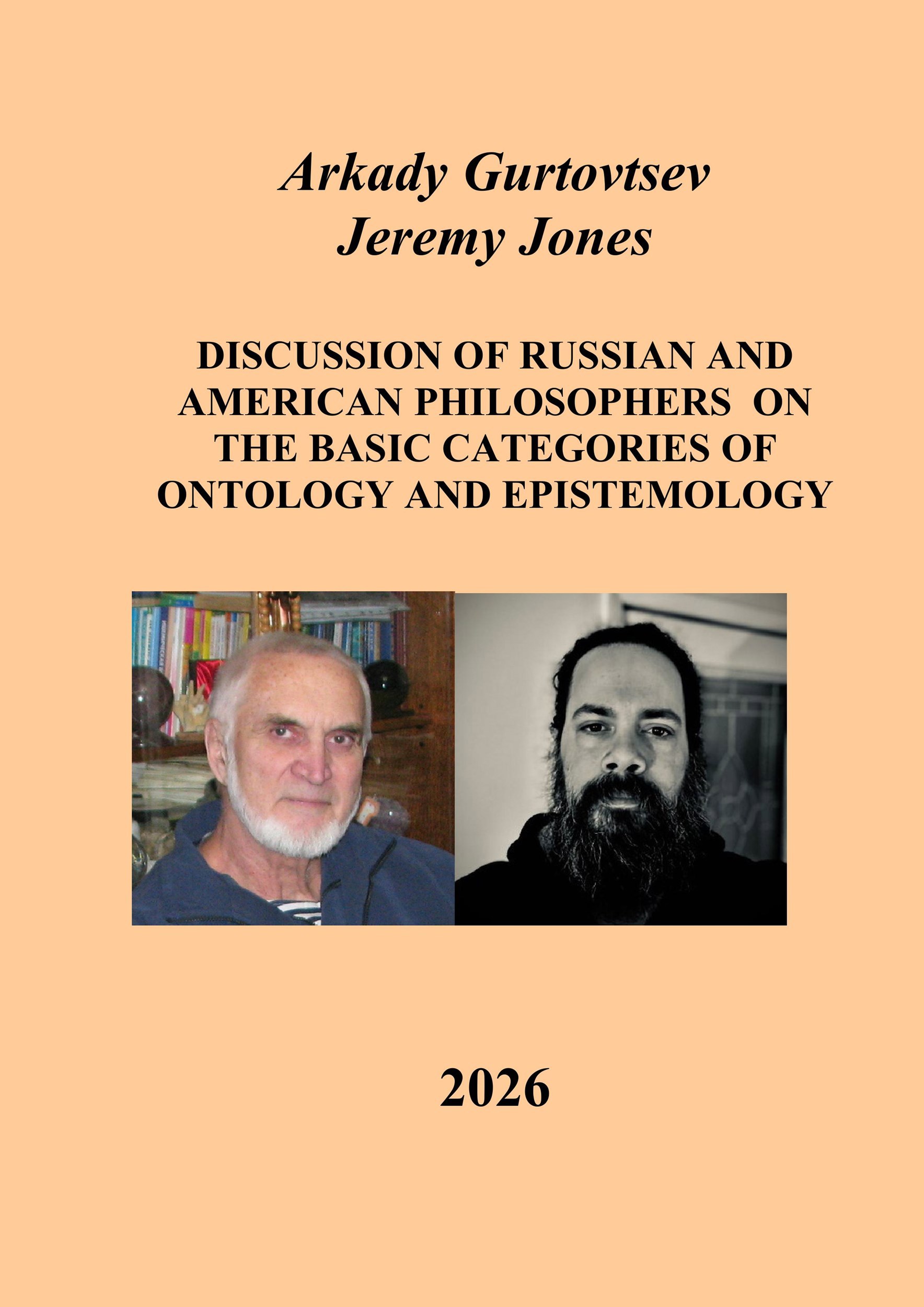
Дискуссия русского и американского философов о баовых категориях онтологии и гносеологии
Глава 1
Arkady Gurtovtsev
Jeremy Jones
DISCUSSION OF RUSSIANANDAMERICAN
PHILOSOPHERS ON THE BASICCATEGORIES OF ONTOLOGYANDEPISTEMOLOGY
The publicdiscussion took placeat the end of July2026on the PhilPeople internationalphilosophicalwebsite.(Canada,WesternOntario). The discussion is presentedinfullintwolanguages:EnglishandRussian.
1. REPRESENTATION OF THEAUTHORS
Arkady LazarevichGurtovtsev is an olderRussianscientistfrom the Republic of Belarus(Minsk).Candidate of TechnicalSciences,seniorResearcher(diplomas of the Higher Attestation Commission of the USSRfrom1979and1988;analogues of the WesterndoctoraldegreeDoctorofPhilosophy[Ph.D.]orPh.D.inEngineeringand the titleSeniorResearchScientist).Engineer,inventor,author of 300publishedscientific and technicalpapers,aswell as developer of originalandserialmicroprocessor-based information and measurementsystemsin the field of energy(automation of accounting for alltypes of energy carriers).Scientificexperience of 40years. An independentphilosopher and researcherin the field of philosophy of materialism,science, natural science,animalandhumanconsciousness,atheismandreligion(author of twomajorphilosophicalmonographsand a number of articles).Continuousphilosophicalexperienceover the last17years.
Jeremy K.Jonesis an independentAmericanresearcher of the middlegeneration. He holds a bachelor's degree in Philosophy,Religious Studies, andpsychologyfromaU.S.university. He does notholdacademicpositions. He worksthroughHoldingLightLLC(his researchprogram is publishedon the websiteuniversalcollapse.com).Inhisworkinphysics,biology, andpsychology, heapplies a structuralmodel for solvingconstraint-driven problems,which is validatedthroughsmallempiricalstudiesinwhich a tool-a corpus, a codebook,forecasts, and an analysisprocedure-is fixedbeforedataanalysisbegins.
2. INTRODUCTION BYARKADYGURTOVTSEV
The discussion is conductedbetweentwoindependentphilosophers of twodifferentgenerations,twodifferenteducationalsystems(Western andeasterntimes of the USSR)anddifferentlifeexperiences.But, most importantly,bothphilosophers are ideologicallyandfinanciallyindependentfrom the ideologyandphilosophicalstereotypesprevailingintheirsocialenvironment,clichesandquestionabledogmasimposed by society. It is knownthatOrthodoxphilosophers(seniorlecturers, associate professors,professors,academics) are mostlysubordinatetothegroupsandorganizationsinwhichtheywork,aswell as to the rules of intellectualrestrictionthattheymustfollow(otherwise they will simply be punishedorfired).Therefore, mostofficialphilosophersverycautiously,cautiously, and withcaution(“no matterwhathappens”)declaretheirtrueviews,intentions, andideologicalpreferencesin the publicspace.As a rule,theythinknot so muchaboutfinding the truthandestablishing it in the publicmind,asabouttheirsocialstatus,position,pocket, andincome.
Inthisregard, independentphilosopherswhohave their ownfinancialsupportoutsidephilosophy(pension, business,trade,banksavings),unrelatedtotheirphilosophicalactivities,feel much morefreetochoosetheirargumentsandconclusions.They have no need to hidetheirtruephilosophicalviews, to trickand be hypocritical.However, it should be notedthat a number of philosophizingpeople,wishing to hide the shortcomings of theireducation,thinkingandexperience,speakonopenphilosophicalplatformsanonymously,under a pseudonym,withouttheirrealnameandface,withoutbiographicalinformation.But,ultimately,this does notsavethemfrom being exposed by literateandexperiencedreaders.Flaws in philosophicalandscientificthinking(fragmentation,dilettantism,randomness,inconsistency,dogmatism,stubbornness)vain,andsometimesveryaggressiveupstarts,high-minded,or even justphilosophizingfools,soonerorlatercomeoutin the process of dialogue(sometimesliterallyfrom the firstwords).Inthisdiscussion, the authors are competentintheirtopics,completelyopen,honestwiththemselvesand with eachother,aswell as withreaderswhomaybeinterestedinthisphilosophicaldebate. The authors are fullyresponsibleforeverythingsaid.Theystatetheirpositionsdirectly and bluntlyandseekwaysto bring themcloser,withouthidingdifferencesanddisagreements. The entireprocess of sharingknowledge,facts,judgments, andconclusions is presentedto the reader's mindin the nude,withoutretouchingorembellishment.
Butperhapssomethingelse is more importantinthisdiscussion.Here,withinitsframework, philosophers of differentlevels(both beginnersandexperienceddoctorsandprofessors)cangaincompletelynewknowledgeandideasfirst-hand.They are almostunknowninEnglish-language philosophy(theyhave been available to the Russian-speakingreader for aboutthreeyears).Perhaps it's time for Westernphilosophy to wake up,criticallyreflect on itspettytinkeringin the dustyphilosophicalarchives of pastcenturiesandturnitsopengaze to thefuture,to the philosophy of the realworld,tosolving the basicideologicalissues of allmankind. It is time to comprehensivelyexamineandscientificallycomprehendsuchbasicphilosophicalcategoriesasbeing,matter,relationships,consciousness,thinking,object,subject,reality,information,evolutionandmanyothers. The wholeworld is passionate about artificialintelligencetoday,butfewpeopleunderstandwhatnaturalintelligence is anditsontologicalandepistemologicalessence. For the first time, the readercanlearnaboutthisandmanyother things fromthiscompactbutextremelydeepdiscussion between the twophilosophers.RussianandAmerican. The discussion is presentedsimultaneouslyinEnglishandRussian.
Myopponent, JeremyJones, mayand most likelyhasadifferentpoint of viewonmodernuniversityandacademicphilosophyfrommine.He is notresponsibleformyviews.
3. THE ORIGIN OF THE DISCUSSION
Thisdiscussionaroserandomly(and thisonceagainunderlinesthelargelyrandom,chaotic, non-deterministicnature of the originofcertainprocessesin the realworld,althoughtheirfurtherdevelopmentisalreadynatural) as aresult of myresponse(Arkady) to thepost of areligiousphilosopherfrom the AustralianCatholicUniversity.He,presentinghisarticleon the “divine”topic,wrote:
“At the center of thisphilosophicalworklies the Cartesiandilemma: the riddleofGodandknowledge.Descartesarguedthatalthough a personbelievesinGod,hecan also believethatGod has madehimintelligentandable to understand the universe.However, Descartesalsoarguedthattheless a person's powerandintelligenceregistershisCreator,thelessreasonhe has to trustnaturalreason,becauseifGod does notexist,thenhow can a personbelievethathe is endowed with reasonandheunderstands the universe?Indeed,if the humanminditselfisjustabyproduct of evolutionaryprocesses,asDarwinargued,thenhow can a personknowthattheseevolutionaryprocessesfavortruthas the endproduct,orthat a personis the laststage of an evolvingintelligencestrivingfortruth?Rediscoveringthe Cartesian dilemmahelpedDr.Hoswelltraveltothefurthestreaches of reasonandphilosophy,studying the works of suchprominentpersonalitiesasCharlesDarwin,DavidHume,JohnLocke,RichardRorty,WilfridSellars,PaulFeyerabendandWilliamBlaketofind the answertoDescartes' dilemma.Thisreissuecontains an expandedandupdatedintroduction,aswell as materialsthatwereexcludedfrom the originaldue to thevolume.Read it if you dare!”
Looking through the currentNewsFeed,Idecided to givemycorrespondingcommentonthispost:
“Descartes was a philosopherwhodiedin1650.Helivedin an erawhennewscience,new natural scienceandnewscientificideasabout the continuousdevelopmentandevolution of livingandinanimatenature were justbeginning to emerge.Hisdilemmaabout the nature of reasonand the truthorfalsity of humanknowledge,dependingonwhetheritis the resultofGod's actions ornatureitself(withoutGod),haslong been solved by scienceand the philosophy of materialism(inparticular,dialecticalandfundamentalmaterialism). It is notthehumanmind itself,notlogic,nothypothesesandtheories,butexperience,practiceandexperiment that determinewhether a person's knowledge is trueorfalse. In otherwords,realityitself,actingon a personasalivingorganismandsubject,tellshimwhetherhisthoughts,judgments,plans,actionsanddeeds are trueorfalse.Ifthey are incorrect, a personwillreceiveblowsfromnatureinresponsetotheiractionsanddeeds.Natureitself will guide a persontounderstandwherehe is rightandwhere he is wrong.This is a fundamentalprinciple of science.Natureitselfis the investigator,accuserandjudgeinrelationtoman,as well astoanyothersubjectorganism. The humanmindonlylearnsor does notlearn from theexperience of itsbearer, a livingsubject.Descartes' dilemmawassolvedsimplyandeffectively. There is noneedforphilosophicalreasoning. There is nopoint in readingyouressayforthispurpose.Pleaseforgivemefor being blunt.”
Thiscommentattracted the attention of anotherreader,whoturned out to be Jeremy.It was withhisresponsetomytexttotheAustralianthatthisdiscussion began.Below, it is offered infullandwithoutedits(machinetranslationerrors are possible)torespectedphilosophers of the Westand the East. I hopeeveryone will findusefulthoughtsandideasinthiscorrespondencediscussion.
4. DISCUSSION OF RUSSIANAND
THE AMERICANPHILOSOPHER
English text of the exchange, 23 July – 3 August 2026
PhilPeople, arranged as numbered exchanges
The discussionwasheldthanks to the use of machinetranslationprograms.JeremywrotehistextsinEnglish,and the built-in translationprogram of the sitetranslatedthemintoRussian(unfortunately,sometimeswithsemanticerrorsthat could not be immediatelyidentified).Arkadywrote the answersinRussian,andthen,notrelyingon the site's translatorprogram,translatedthemintoEnglishusing the provenYandexTranslationprogramandthenpostedthemon the discussionpage.Despitepossiblesemanticmisunderstandings,theoveralldiscussion is clear,logical,broad, anddeep.Anotherdifferenceis its exemplaryscientificethics(an exampleformanymodernphilosophers to follow,whoconducttheirdiscussionson an emotional level,usingaggressionandrudenesstowardseach other). The basicprinciple of scientific and academicethicsis to treatanopponent with respect anddiscuss the subject of the dispute,ratherthan the opponent's personalityandspiritualqualities.
DIALOGUE 1
JEREMY C. JONES — 23 July 2026
Arkady — the practical half of this I'll grant outright. Reality pushes back, error gets punished, and a mind insulated from feedback degrades. That's right, and it does real work.
What I'd contest is that it dissolves the quandary rather than relocating it. Descartes needed a guarantor because reason cannot certify itself from the inside. Your paragraph nominates Nature as investigator, prosecutor, and judge — which is his sentence with one noun replaced. The office survives the substitution. To read Nature's response as a verdict, and to tell correction from noise, you use the faculty that is on trial. And “practice decides” is itself a commitment held prior to the inquiry it licenses; no experiment establishes that experiments settle truth without leaning on the thing in question. That isn't fatal. It's just not a dissolution — it's a working arrangement, which is a different and more modest thing.
Worth noting too that Darwin flagged the residue himself. In an 1881 letter to William Graham he raised the horrid doubt about whether the convictions of a mind descended from lower animals are worth anything at all. Selection favors survival; truth-tracking and survival coincide often enough to be useful, but useful error is abundant — Newtonian mechanics is false and it landed people on the moon.
The deeper point: Descartes' real damage wasn't the puzzle, it was the partition. Materialism and idealism are both rooms in the house he built, and both inherited his geometry — subject on one side, extended stuff on the other, with the only live question being which side gets causal priority. Announcing that one room won the house is the best available evidence the walls are still standing. Solved problems don't keep camps.
There is a third move, which is to go after the premise that drove the split rather than pick a side of it — Descartes assumed extended matter was directionally inert, and Newton's first law says otherwise, in 1687. That's the line I work. Happy to send it along if you want something to disagree with, though I gather reading is optional in these proceedings.
ARKADY GURTOVTSEV — 23 July 2026
Jeremy!
It is a pleasure to read a comment, an intelligent, sensible person. You have completely correctly understood my comment on Descartes (I have studied his works and in a number of my philosophical works analyzed his dualism, his corpuscular theory, the theory of close action, instant interaction and infinite speed of light). I agree with your individual remarks, and some I would like to clarify in points.
1. For Descartes, the guarantor of truth is not something outside of the mind, nor is it experience or experimentation (in his time, experience had not yet gained the significance it would later acquire), but rather the clarity and evidentness of a thing to the mind. He associated the mind not with matter, but with a new, second, immaterial, thinking substance. Behind this substance, there was a hidden God. Thus, for Descartes, the clear perceptions of the mind were the truth. This is evident in his ontological principle: “I think, therefore I am.” We both understand that in reality, it is the other way around: “I think because I exist.” Existence determines consciousness (although consciousness also influences existence through human labor).
2. I referred to nature as a judge metaphorically, but in essence, humans depend on nature like a defendant depends on the judicial system. Humans cannot exist outside of nature. To put it more radically, humans are not “slaves of God” but “slaves of nature.” Dialectical materialism correctly emphasizes that human freedom is a conscious necessity, taking into account the laws of nature and society. However, you correctly point out that nature does not judge humans, but operates independently, disregarding the “opinions” of the organisms under trial. I always emphasize that nature as a whole lacks intelligence, goals, intentions, and desires. It operates automatically through its powerful tool, natural selection. Those who fail to adapt to changes will perish.
3. About the influence of the mind on evolution and Darwin's fears. In themselves, the ideas of people and higher animals on the evolution of species do not have practical significance (although the life of individual individuals, their mental stress can affect dramatically). The mind and beliefs of people have an impact on the evolution of nature and society indirectly, through the labor activities of people. By creating artifacts, people create a man-made reality, and through it change themselves and the surrounding nature. The mind began its evolutionary work of perfecting man when, 2.5 million years ago, the ancestor of man, Homo habilis, picked up a stone and began to work it.
4. You are right when you note that survival and the search for truth do not always coincide. This is a very good, subtle remark. The experience of many ancient civilizations shows that people have survived for thousands of years with a certain set of misconceptions (particularly religious ones). It should be acknowledged that any past, present, or future generation of people has not and will not have full knowledge of the truth. In other words, some, and perhaps a significant portion, of their knowledge will be false or partially incorrect. This is a normal historical process of human society's evolution. You provided an example of Newton's laws (which are accurate in their content but erroneous in their interpretation by the author himself, as instant action at a distance) and the landing on the Moon. But it would be more fair to give an example with the Aristotle–Ptolemy model of the world and the calculation of solar and lunar eclipses.
5. About the harm of erroneous teachings. The harm and benefit of certain teachings are sometimes revealed many years, or even centuries and millennia later (Aristarchus of Samos in the 3rd century BC developed the heliocentric system of the world, and it was only 1800 years later that it was approved by Copernicus). Great people have great achievements, but they also make great mistakes. We should not blame Descartes for his sins. His achievements are numerous (the coordinate system, the infinite division of particles in opposition to the atomism of ancient natural philosophers, the attribution of the first real property to matter — extension, and the introduction of the concept of the subject). Let us thank the great philosopher. The division of nature into matter and thinking substance is a historically justified and useful endeavor. It represents progress compared to the hylozoism of ancient philosophers and the pantheism of Renaissance philosophers. Not to mention Plato's eidos and Hegel's Absolute Idea.
6. Materialism and idealism are not two adjacent rooms. In religion, God created an ordered world out of chaotic matter. Philosophical idealism tries to explain this. In materialism, matter, through self-organization and evolution, created living organisms from inanimate nature, and then organisms with a nervous system, which developed a sign-code system with the characteristics of intelligence. I understand everything here, unlike all the Western philosophers who have been puzzling over the question of what consciousness is for centuries. In my works, this question has been resolved.
7. I am ready to discuss unclear issues with you in a dialogue, but please refrain from reading my works. My mind is clear and energetic, but my vision is poor at the age of 79 (I am close to blindness and the end of my academic career).
DIALOGUE 2
JEREMY C. JONES — 23 July 2026
Arkady — I'll keep this short, given what you said about your eyes.
Thank you for reading closely and answering point by point. That is rarer than it should be, and I noticed.
You're right on point 1 and I'll take the correction. Descartes' guarantor was clarity and evidentness to the mind, not experience — experience hadn't yet earned that office. Though I'd say that is precisely why God had to stand behind it: the criterion could not certify itself as truth-tracking rather than merely compelling. Your correction sharpens the point rather than removing it, and I'm glad to have it either way.
The Ptolemaic example is better than mine. Useful and false for fourteen centuries, and the eclipses still arrived on schedule. I'll use it.
Point 5 I want to mark. You were more generous to Descartes than I was. I'm harder on him than you are — I think the partition cost more than it earned. But “let us thank the great philosopher” is the right posture toward a man who was wrong in a productive direction, and you held it better than I did.
On point 6 we differ, and I'm content to leave that standing as a difference rather than turn it into a debate.
I won't send you anything to read. Whatever I have to say I'll say here, in the comments, where it costs you nothing extra. That you spent some of your reading on a stranger's remarks is not lost on me. Thank you for it.
ARKADY GURTOVTSEV — 24 July 2026
Jeremy!
Thanks for the reply. I can still work on my laptop, and if the text is not contrasting, I enlarge it and make it bold, which makes it easier for me to read (although there are small gaps in the text due to the excavation of the optic nerve caused by glaucoma, which was diagnosed 25 years ago). When I am asked to review a philosophical article in my field of expertise, I usually only need to read the abstract and the introduction. These provide a clear understanding of the article's purpose and logic. I have over 55 years of experience in scientific review (my scientific and technical works have been published in hundreds of leading journals in the USSR, Russia, Belarus, and Ukraine).
I don't mind spending my time and remaining eyesight on you, Jeremy. You are a deep-thinking philosopher with a scientific mindset (just like me). I don't know what kind of higher education you have or where you got it (I would be interested to know more about you — age, education, field of activity, interests), but I don't divide people by formal characteristics (degrees, titles). I care about their spiritual and mental potential, and I'm quite good at this. Yes, you are a stranger to me, but you have a deep spiritual potential. I wish you to continue expanding and deepening it based on scientific knowledge. A true philosopher must know and understand the causes of many phenomena that occur in nature, society, and human thought.
I urge you not to ignore the questions and issues on which we may have different perspectives and engage in debates. This is perfectly normal. Debates help to clarify the most effective direction for our thoughts. However, the truth is not found through debates or logical reasoning, but through human experience and practical activities. Here on the site, many philosophers undeservedly put logical reasoning at the head of everything, considering it as proof of the truth of certain ideas. In the end, this led me to address the poorly developed issue of the origin and ontology of logic. I have been thinking about this issue extensively over the past couple of months. I have a solid foundation for addressing this question in my two previous fundamental works on the ontology of consciousness and the ontology of information. However, we can also delve into discussing other issues that you would like to clarify for yourself. I am ready to provide you with the necessary explanations within the scope of my expertise.
DIALOGUE 3
JEREMY C. JONES — 24 July 2026
Arkady —
On why you write as you do here: I recognized it before you explained it. You go at the position rather than the person, you say plainly when something isn't worth your time, and when you apologize it's for the manner and never the substance. That's the register of someone trained in review, where a weakness in a paper is a fact about the paper and not an injury to its author. It reads as contempt to people who've only met softer conventions. I took it as directness and answered in kind, which is why we're talking.
Since you asked. I'm 41, in the United States. Three bachelor's degrees — philosophy, religious studies, psychology. No graduate degree and no academic post. I work retail and fund my own research out of it, publishing independently under my own name. So your indifference to formal characteristics is convenient for me, though I'd have told you either way.
What I'm building is a structural framework treating constraint-guided resolution as a common grammar across physics, biology, and mind — not by analogy, but as one operator described in each domain's native vocabulary. The third move I mentioned in that comment isn't rhetorical. It's the whole program. I'd rather go after the premise that generated the partition than take a side of it, and most of what I've written is that attempt even where it never says so.
And because I take your practice-decides instinct seriously, I've built it to be checkable rather than admired. The mind-side study is built but not yet run — a fixed public-domain corpus designated, the codebook frozen, the analysis runner blind to the hypothesis, the predictions set. I have nothing to show you from it and won't until it is coded. That order is deliberate: the instrument was fixed before it could be tuned toward a result. If the pattern I claim is there it will show in the coding, and if it isn't, that goes on the record too.
You offered your remaining eyesight, and I'd rather answer that carefully than simply take it. Most of what I've published is inward-facing — written for the program, dense with its own vocabulary and cross-references. You told me you usually need only the abstract and the introduction to see a paper's purpose and logic. Mine would fail you there, because they're addressed to someone already inside. The program is young and more outward-facing work is coming, and I'd rather send you something built for a reader than something built for the structure.
So I'll point you at one section rather than a paper. Kernel First: Collapse Without Reification — Universal Collapse Theory is the program's entry point. Section 6 is on what I call the Observer's Fallacy — the reflex of promoting some nameable layer into the role of grounding all the others. That is the disagreement in my first point below, in developed form, and it's the part least dependent on the rest. The page is HTML and reflows, so it should take enlargement better than a PDF would.
Read it or don't. Nothing in this reply depends on it. And if you'd rather check that I've made the thing fail-able instead of only argued it, the chain from standards to technical note to method to demonstration is closed across four substrates with deposited DOIs. That's a ledger, not a reading assignment.
Now the disagreements, since you urged me not to ignore them.
1. The rooms. Your rebuttal describes materialism and idealism as rival accounts of what comes first — God ordering chaotic matter, or matter self-organizing into life and then nervous systems and then sign-code systems. But “what comes first” is a question about priority between two terms, and those two terms are Descartes'. In your first point you write that existence determines consciousness. That inverts the priority; it doesn't dissolve the pair. And in your fifth point you credit Descartes with introducing the concept of the subject, listed among his achievements. By your own accounting the frame is his. You've furnished the room very differently and then denied it's a room.
2. Practice as a criterion of truth. You conceded that survival and truth don't always coincide, and gave a better example than mine — Ptolemaic astronomy calculating eclipses for fourteen centuries. I think that concession costs more than you've priced it at. If practice sustains a false model for 1400 years while it goes on working, practice is not a criterion of truth. It's a filter against gross unfitness, which is weaker and more useful. Nature killed no one for believing in epicycles. Selection removes organisms; it doesn't evaluate propositions. Something else has to carry you from “this worked” to “this is true” — and whatever that something is, it's holding the office Descartes wanted his guarantor for.
3. Logic. Here I think we're converging without either of us planning it. You write that truth is found through experience and practice rather than logical reasoning, and in the same paragraph that you've spent two months on the origin and ontology of logic. Those sit together only if logic draws its authority from somewhere. If logic has an ontology, that ontology grounds it — and grounding is guarantor work under another name.
I expect your answer is the dialectical-materialist one: the laws of thought are regularities of successful action on the world, internalized through labor and abstracted into form. That's a serious answer and I don't wave it off. My question is whether it reaches normativity. Regularity tells us how people do reason. It doesn't obviously tell us how they ought to. If logic is descriptive residue of practice, then an invalid inference is merely unusual rather than wrong — and yet we both treat it as wrong. You did it in this thread when you corrected me about Descartes' guarantor. You weren't reporting a statistical irregularity. You were saying I had it wrong.
That gap is the same one in a different coat, and it's the most interesting thing either of us has put on the table. I'd rather hear your account of logic's origin than argue about Descartes further.
ARKADY GURTOVTSEV — 25 July 2026
Jeremy!
Thank you for the brief biographical information. Your age corresponds to the age of my son, who lives in England (he received a bachelor's degree with honors from the University of Greenwich with a degree in programming). As I see it, you have a liberal arts education (college or university?) with a focus on the study of human consciousness and mental phenomena. Great. But I have two questions for you in this regard: 1) how did the line of materialism arise in your worldview, 2) how did you get into programming. Usually, the materialistic tradition prevails among scientists with a natural science or technical education. What programming languages do you use when writing your program?
Before proceeding to the analysis of your current work, I want to return once again to your “two rooms” — materialism and idealism, which were manifested by Descartes in his epistemological dualism (the split of the world into two substances, supposedly independent of each other, but nevertheless miraculously interacting with each other). I am beginning to understand that this is a painful and unresolved issue for you, which you are trying to solve not by prioritizing one direction over another, but by finding a third, neutral path, which actually forced you to engage in your own theory and program. Did I understand you correctly? You emphasize your desire to find a third way between materialism and idealism. I would like to note that attempts to find a third way are not new in the history of philosophy. I will cite only a fragment from my major work “The Theory of Fundamental Materialism” (it is listed here on the PhilPeople website; it is written in Russian, but if you translate it for yourself using a translator program, you will get a unique and powerful philosophical tool for further effective work).
“The hidden form of idealism is neutral monism (the third way: ‘neither matter nor spirit’; supporters are William James [‘the only reality is direct sensory experience’], Ernst Mach [‘the whole world is a complex of my sensations’], Bertrand Russell [‘the world consists of events that can be grouped either in the physical series, or in the mental’]). This monism, recognizing the existence of a single basic substance-reality (the source of sensations and ‘elements of experience’), defines it as an inseparable neutral unity of two different, complementary ways of its manifestation or organization of experience — external physical (bodily, material) and internal mental (mental, rational). This philosophy considers both ways of perceiving reality not as ‘different things’, i.e. matter and spirit, but as ‘two kinds of the same thing’. Today, such a ‘neutral’ approach is promoted by Western philosophical trends of reflexive monism, informational realism, and panpsychism.”
And now I'll move on to reviewing your work point by point.
T1. You are talking about your development of a certain structure for solving various problems in the field of physics, biology and psychology. You emphasize that this structure must take into account certain restrictions that the user will set as initial conditions in the dictionary or description of this structure. This formulation of the problem is characterized by great uncertainty. The subject of the study is unclear. Three completely different fields of knowledge — physics, biology, and psychology — are arbitrarily grouped into one group. On what basis? On what grounds? What is the problem? What is the purpose of the study? It is from the answer to these questions that one should present one's work. Any problem can and should be investigated if it is significant and has not been resolved. And that's what should be shown from the very beginning. You are trying, relatively speaking, to describe an axe, but why, for what, and to whom it is needed, you are silent about this.
T2. You say that with the help of your future structure, the analyst-operator program, it will be possible to verify logically by trying various options for combining information data (a corpus of data), where the truth lies: in materialism, idealism or some other neutral phenomenon. Did I understand you correctly? Actually, it's already strange for me to hear from you that logic can establish the truth. At the very beginning, we came to a common understanding that the fact of the truth or falsity of knowledge is determined not by logic, but by material experience, material practice, experiment. They are the ones that indicate whether our knowledge corresponds to the real world or not. There may be complete order in logic, but the truth may not be there. Why then invest your brains and your hard work in something that is obviously doomed to fail? After all, reason is given to us precisely to predict our own and public actions based on the accumulated effective experience.
T3. Disagreements on materialism and idealism. First of all, I want to remind you that the division of the universe into the world of things and the world of ideas was made not by Descartes, but by Plato almost two thousand years before him. Plato did not have the term matter at that time (it was introduced later by Aristotle), and instead of matter he used the phrase the world of things, and sometimes space (the same extent). Plato's analogue of a thinking substance was the world of eternal unchanging ideas-eidos, according to which God created all things. It was not I who opposed matter and consciousness, but the whole world philosophy before me. I did something that none of the philosophers had done before me. I combined matter and consciousness into a single, single universal substance and showed that consciousness is a special material form — a product of the evolution of matter. In other words, in your terminology, I have removed the partition between the two rooms, turning them into one large hall.
T4. Practice as a criterion of truth. You have misinterpreted the concepts here. I'm explaining. Nature and practice, roughly speaking, don't give a damn what a person thinks about them. A person with his own delusions can live for hundreds and thousands of years if these delusions are neutral to his existence and survival. An example is all religions, all myths, all fairy tales, etc. The Ptolemy system existed for more than a thousand years and worked until it began to malfunction in practice due to the development of human civilization, the advent of new astronomical, more powerful and accurate observation devices, and the development of long-range navigation. Here it began to malfunction and no longer coincide with the results of practice. The practice required replacing the erroneous model with a new one, more accurate and efficient. The principle of truth is preserved here. Today, religion is becoming a brake on the development of human society. These misconceptions will also disappear.
T5. Logic. You are right that logic really draws its authority from somewhere. Logic is justified by practice. Logic is the process of ordering the observed chaos of the outside world by the human mind. Most often, the ontological aspect of logic is ignored in philosophy. You can see the first draft of the first paragraph about logic in my previous post.
DIALOGUE 4
JEREMY C. JONES — 25 July 2026
Arkady —
A note first for anyone reading along, since this is a public thread: I've kept my replies to you direct because you prefer it that way and so do I. The bluntness runs both directions and there's no hostility in it — it's the register of people who'd rather argue the position than manage each other's feelings.
And one thing on the record before I answer any of it. Declining a question, which is what I'm about to do, can sound like a man claiming he's seen past everyone else. I'm not. I don't think I've unified anything or found a new truth, and I don't claim to be first at anything — I show the trail of thinkers I'm standing on, in the writing and in the program itself. What follows is me walking a path others cut, not opening one.
Two corrections to the portrait, because both matter.
First: I'm not a materialist. You've read me as a materialist with an unresolved itch that pushes toward a third way — and I see why, but the itch isn't inside materialism trying to get out. I don't hold that matter is the base. I also don't hold that mind is. What I'm after sits outside both.
Second: I have no technical education. Three bachelor's — philosophy, religious studies, psychology — all liberal arts, from a university here in the States. I'm not a programmer in the sense your son is. The code in my program is Python, but I don't write it the way a trained engineer would; I design it in collaboration with AI systems — I specify what must hold and what the instrument may not be allowed to do, and the implementation is co-produced and then tested. So the usual road to materialism you named — natural science, technical training — isn't mine, which may be part of why I didn't arrive where that road arrives. Your own correlation holds: no technical formation, no materialism.
Now the center.
You've filed my third way as neutral monism — James, Mach, Russell — and filed neutral monism, correctly, as idealism in disguise. I agree with the second half completely. When you look at what the “neutral” elements turn out to be — sensations, pure experience — they're mind-flavored, and the neutrality collapses. Mach's elements aren't neutral; they're mental wearing a neutral coat.
But that is exactly why what I'm doing is not neutral monism. Neutral monism is still an answer to the question “what is the one fundamental substance?” It just answers “a neutral one” — and any substance you nominate has a flavor, which is why it always slides back to one side. The trap isn't which substance you pick. The trap is accepting the question. By “third move” I never meant a third substance standing between matter and mind — that's a third position on the same axis, and the axis is the problem. I meant rejecting the premise both sides share: that to ground the world is to name what it's ultimately made of. What recurs across physics, biology, and mind, in my account, is not a substance at all. It's a structure — constraint-guided resolution — and asking whether it's “made of” matter or mind is a category error, like asking what the number seven weighs.
Which brings me to your one large hall, and to where I think we actually meet — which matters more than where we split.
We are after the same thing. You are trying to end the partition Descartes left, and so am I. That you filed me under neutral monism isn't a misreading I hold against you; it's evidence the split is still live enough that a genuine attempt to leave it gets read as a move inside it. Two people trying to get out of the same house.
The fork is only in the exit. You end the partition by unifying the substances — one substance, consciousness as a material form. I end it by refusing the substance question altogether. Your exit keeps matter as the base and absorbs mind into it; mine stops naming a base. I think mine gets further — I think the demand for a fundamental substance is itself the residue we both inherited, and satisfying it, even with a single elegant substance, is the reflex my program is named after. But that's a difference between two people walking the same direction, not a wall between opponents.
And to be clear, since it keeps coming up: I hold nothing against Descartes. The problem is rooted in his work, but the damage is in the inheritance, not the man. People stay inside the room he built until they stop treating his question as the only way out. You stopped by answering it with one substance; I stopped by setting the question down. Different doors, same instinct that the room is a room.
The rest, quickly.
T1. This lands, and I'll take it — with real thanks, because it's the most useful thing in your letter. You read the entry point and couldn't find the problem, the purpose, or why the three fields are grouped. That's the exact defect I named to you last round: my writing is addressed to someone already inside. You've shown it live, as a working reviewer, on the live page, which is better data than agreement would be. On the substance of it — the grouping isn't arbitrary; the thesis is one resolution-operator across three substrates, and there's a fuller account of why those three that I'm still building out. Your pressure sharpens it. I absorb this kind of correction more than I argue with it; it's how the program gets built.
T2. Here you've read the program as a logic engine that will crunch data to decide between materialism, idealism, and neutrality. It isn't. The empirical study tests one narrow thing — whether a specific structural pattern shows up in how a fixed corpus of minds moves — and it's built to come back empty. It's coding and fixed predictions, not logic adjudicating metaphysics. So your objection misfires in a friendly direction: we agree logic can't establish truth, and the instrument I built runs on your principle, not against it. “Built so it can fail” is just the practice-criterion turned on my own claims.
T3. Conceded, cleanly. Plato split things from ideas two thousand years before Descartes, and I overstated Descartes' originality. Let me sharpen what I actually need him for. Plato's world of things is not Descartes' extended substance. Descartes' specific innovation was two substances defined by mutually exclusive essences, with matter as bare extension — geometric, inert, passive. That particular matter, defined by extension and nothing else, is what Newton's first law contradicts in 1687: matter carries its own persistence of motion; it is not inert. That premise is the one I go after, and it's Descartes', not Plato's.
T5. Real convergence here. You grant that logic draws its authority from somewhere, and that the ontological question is usually ignored. We agree there. But “logic is the mind ordering observed chaos” is a genetic account — it tells us where logic came from and what it's for. It doesn't yet tell us why a bad inference is wrong rather than merely ineffective. And you treated one as wrong in this very thread, when you corrected me about Descartes' guarantor: you weren't reporting that my inference was statistically unusual, you were saying it was an error. That step — from how we came to reason to how we're bound to reason — is the one the practice-account still owes, and I suspect it's the most interesting edge of the ontology-of-logic work you've been doing. I'd rather hear your account of that step than relitigate anything.
(T4, briefly, since I don't want it to crowd out logic: Ptolemy worked for fourteen centuries while being false, so practice tolerated a falsehood far longer than any test could catch it — which makes practice a filter with a resolution threshold, not a criterion of truth. But that's the smaller disagreement.)
Send me the title of the major work and I'll run it through a translator myself, as you suggested. I'd rather read your account of substance in your own words than keep arguing against my reconstruction of it.
ARKADY GURTOVTSEV — 26 July 2026
Jeremy! I received your big message. I read it. It takes time to prepare a response. I had to give Timb a big answer today. We left him, but he came to us, and I had to respect the man. It took a while. I am sending you a link to my fundamentally important work, The Theory of Fundamental Materialism.
This work sums up the global development of the philosophy of materialism, and in a form that will be understandable to your system-structure: in the form of postulates and my commentary on them. This is the best thing about modern materialism, and I'm sure it will become a classic over time. Translate, study, and criticize (while I can still see, I'm ready to fight). I would even suggest that you earn good money from this job. But this is a separate issue.
DIALOGUE 5
JEREMY C. JONES — 26 July 2026
Arkady —
No hurry on the reply.
I have the link and I'll read it.
You should know I went looking before you sent it — I found the 2024 book and read 1.4 and 1.5 in translation, matter and relations, and coding matter. The building matter / coding matter distinction is the part I keep returning to. A crater carries the memory of an impact and still isn't a code, because it presents itself rather than designating something else. That's a clean distinction.
Take your time with my last message. And a high degree of respect after looking over some of your work. I believe you and I likely share more common ground than we both might think on the surface.
ARKADY GURTOVTSEV — 27 July 2026
Jeremy!
I admire your pace of work, your drive, your determination to find out the truth, and your deep insight into philosophical categories. I am sure you will go far in philosophy if you choose the right direction. You remind me of myself when I was young.
1. You have quite correctly grasped the essence of the differences between basic matter and coding matter. A meteorite crater in itself, as a physical object, is not yet a sign, is not an informational message, is not a code. This is how it becomes only in the knowledge-code system of the subject. Moreover, it is important to note that it does not become a sign of cosmic interaction for every subject. Yes, for the subject who directly observed the fall of a large meteorite (for example, the fall of the Arizona meteorite, which Indians observed 40 thousand years ago) it immediately becomes familiar, but for posterity it becomes familiar either through the traditions of ancient times, or through a system of accumulated scientific knowledge in astronomy and physics.
2. For many millennia, people have been trying to imagine the workings of human consciousness either through a disembodied, immaterial spirit, or through basic matter. They did not represent any other matter organized in a special structural way. You intuitively called this object a structure in your philosophical approach. In the philosophy of structuralism, structure is a basic category (a structure is a system of internal connections or relationships between its elements, within the framework of an object, phenomenon or process; a structure is something whole, coherent, unified, but consisting of elements, i.e. this is a connected set of elements; every material object has one structure or another, although there are also structureless elements, for example, an electron; codes are a special type of structure). It is considered most often as some kind of immaterial, ideal, purely informational property. This is the fundamental mistake of a philosopher who separates the very property or relation from its bearers.
3. I found the coding matter in nature itself. These are the amino acid codes of proteins and the nucleotide codes of nucleic acids. These are natural codes (with a stretch, fixed codes of mineral lattices can be attributed to them). Then, to the coding matter, I added the material information codes of the neural network of the subject's brain. This approach opens up space for new, more meaningful studies of natural neural networks. After all, researchers still do not understand the essence of the patterns of nerve impulses of neurons. Today, artificial intelligence based on software models of neurons uses a weighted approach (when training networks, the weights change, or, as you call it, information restrictions). I give a hint to neurophysiologists and neuropsychologists — do not look for impulses, but for information codes-signs expressed by them (and I know how to look for them).
4. Coding matter required a revision of the concept of information. This issue is not covered in my large monograph. I solved it in 2025. Two articles (more precisely, one article in two parts): “About the fundamental essence of information.” For the first time in the philosophy of information, I have given its universal, ontological definition. I have shown that there is no information in nature, outside of subjects. It is generated by the subject in the form of material information codes of his consciousness. He transforms the Objective Reality outside his consciousness into the Subjective Reality inside his consciousness. In other words, it transforms Kant's “thing-in-itself” into a “thing for the subject.”
5. Returning to your work, how are you trying to find your way to the truth? Instead of logical analysis and instead of physical experimentation, you offer software, information, and code modeling of the process of evolution and natural selection in the processes of physics, biology, and psychology. Am I interpreting correctly the goals and methods that you intuitively pursue? Modeling methods in science are developed and quite acceptable, although in any case they give probabilistic results and depend a lot on the initial conditions and constraints imposed by the authors on their models.
6. You, my friend, do not want to admit that you are neither a materialist, nor an idealist, nor a neutral monist. Right? I would like to note that there are an overwhelming majority of such Western philosophers. Today I have come up with a completely new but appropriate term for this philosophy of “neither yours nor ours” — “mixotes” (from Ancient Greek miktos, mixed). Mixote philosophers, or mixote philosophy. You are currently in this position, but for some reason I think that over time you will move into the camp of materialists in the process of personal evolution. The difficulty is that there are no materialistic philosophers in the West today (physicalists are the closest to them), although, in my opinion, there is a need for new materialistic ideas in the world. How else can I explain the phenomenon that my two Russian-language monographs have been downloaded 10,000 times each on an English-language website? I think this is a record for Russian-language philosophical books. Recently, downloads have decreased, which, in my opinion, is caused by the blocking of the site in many regions of Russia.
7. In connection with the above, I would like to suggest to you one pragmatic idea — to become an official translator and manager for the publication of one or two of my works in the English-speaking world. The proceeds from the sale (royalties) are divided fraternally, in half. My work can only be translated and promoted by a philosopher with a deep understanding of the issues I write about. Perhaps over time you will come to accept more closely the philosophical concept that I am developing and which will find continuation in your own works. Our views really have more in common than different. I've already seen that.
DIALOGUE 6
JEREMY C. JONES — 27 July 2026
Arkady —
The comparison to your younger self is generous. I'd rather earn it than accept it.
Let me take 5 and 6, since those are where you've drawn me most clearly and where the picture is still off.
5. What the program actually is.
You've read it as modeling — software simulating evolution and selection across physics, biology, and mind. Reasonable guess, and wrong, and your own objection is what tells me the correction matters. You said models give probabilistic results that depend on initial conditions and on constraints the author imposes. Exactly right. That is the failure I built against.
I don't simulate anything. There is no world-model. I take measurements on data I did not generate.
Let me be plain about scale, because I would rather you have the true size of this than a flattering one. What exists so far is modest: a few small closed demonstrations in different substrates. A constraint sweep in a biological system. A reanalysis of published intracranial recordings. A few tests on AI systems. Each one narrow, each one able to come back empty. The first of the AI tests was a positive control — not a discovery, a check that the instrument registers a signal where a signal is known to be. Eight independent runs, effect present in all eight, direction and size stated before the first run.
The larger study, on the mind side, is built and not yet run. Fifty historical episodes, public domain, selected and fixed before any coding began. A codebook written and frozen — not revisable once coding starts. Predictions written down in advance. The analysis runner blind to the hypothesis it is testing. Then a person reads the episodes and codes them by hand. That one will take a long time, and I will have nothing to show you for a while.
You spent twenty-eight years building information-measurement systems, and metrology is in your list of fields, so you will recognize the discipline faster than I can describe it: fix the instrument before the measurement, and make sure the person taking the reading cannot tell which result would be the welcome one.
This is the beginning of a research program, not the report of one, and I say that deliberately. I would rather have four small things that can each fail than one large claim that cannot.
So your objection is correct and lands elsewhere. If I were modeling, you would have me. I am counting — and I have not counted much yet.
6. Mixote.
Good word, and I take it in the spirit offered. But look at what it assumes.
A mixture is made of its ingredients. To call me mixed is to say I have taken some materialism and some idealism and stirred them. That is still your axis — I would simply be in the middle of it rather than at one end. I am not in the middle. I am off the line.
Here is the clearest way I can put it, and it starts by agreeing with your point 2.
You say the fundamental mistake is separating a property or relation from its bearer. I agree, and I don't make it. Every resolution I describe happens somewhere, in something, with a carrier. Nothing floats. No disembodied structure, no immaterial information, nothing hovering above matter.
What I decline is one further step: that naming what the carrier is ultimately made of tells you what the pattern is.
And here your own work is my best witness. In the coding matter section you wrote that the concrete material nature of a code has auxiliary, secondary significance. Your definition of a code is base m, length n, positional order, distinguishability of elements. There is no physics in that definition. You watched the same logic run on vacuum tubes, then transistors, then integrated circuits — the carrier changed three times and the code did not.
You are not separating structure from bearer there. Neither am I. You are saying that a code always has a carrier, and that most facts about the carrier are not facts about the code. That is my position, stated by you, in your own field, better than I have stated it.
We part one step later. You say: therefore the code is material. I ask what that word is adding, given that you have just told me its material nature is secondary. If “material” means of this one world, with nothing supernatural anywhere — I sign it without hesitation and always have. If it means more, I would like to know what the more is, because your own definition does not use it.
That is not a mixture of two positions. It is a question about whether the last word is load-bearing.
As for your prediction that I will end up a materialist — you may be right. I have changed position before and expect to again, and I have no attachment to standing where I stand. But notice the prediction runs both ways. You revised your account of information between the 2024 monograph and the 2025 articles; you told me so yourself in point 4. Same operation. Neither of us is finished.
4, briefly, because it is the most interesting thing in your letter.
No information in nature outside subjects, but natural codes prior to subjects. My own work says something adjacent: a record does its work whether or not anyone reads it. Whether doing its work is enough to count as information in your sense is exactly the seam between us, and it is a better seam than Descartes.
7.
I'm honored, and I have to decline — not from lack of interest but from lack of competence. I have no Russian. I read you through machine translation, which is enough to follow an argument and nowhere near enough to render philosophy into English under your name. You need someone who lives in both languages. Find that person, and if you want a second reader on the English, ask me.
ARKADY GURTOVTSEV — 28 July 2026
Jeremy!
I'll start at the end, but first, my little discovery of the symbolism of your name. Unexpected ideas often come to me at dawn, when the brain has already rested, but the flight of imagination is not restrained by rigid logic. Your name suddenly sounded to me like Do-Re-Mi, i.e. three notes of any octave (perhaps due to an intensive search on the Internet for a suitable synthesizer for self-study in my old age, playing it in conditions of impending blindness: after all, you can press the keys blindly). In other words, your name has a musical, harmonic aspect. Be proud!
111. I am very sorry that you refused to translate my work. A simple professional translator will not be able to cope with my text, he will certainly distort its essence and meaning. It is precisely an understanding philosopher who is needed here. And not every philosopher with a dogmatic mindset is able to understand the breadth and depth of my materialistic ideas. You have already delved deeply into the essence of my philosophy (it is spiritually close to you in many ways), and you can handle the translation. Moreover, this is not my huge monograph, but a rather compact work, “The Theory of Fundamental Materialism” (160 thousand characters, or less than 80 regular A5 pages, i.e. a small brochure), the link to which I previously sent you. Well, English-language philosophy will dispense with fundamental materialism for the time being. As a matter of fact, I was originally counting on the Russian-speaking world. The issue is closed.
222. About information (you can read the article here on the website on my page). Yes, there are structures in living nature that the subject is able to identify as codes. Only the subject decides which structures are classified as codes and which are not. For example, an atom has its own structure (a nucleus and an electronic multilevel shell), a sugar molecule (for example, glucose) has its ring chemical structure, a bacterium has its own structure (shell, protoplasm, organelles), etc. But the fact that the structures of protein and nucleic acids are precisely codes is determined by the subject through the appropriate concepts in his internal model of the world, in the knowledge-code system of the neural network of his brain. Some scientists and ordinary people talk about genetic codes as information carriers. Nature did not make any entries in the genetic codes, did not record any messages in them, did not store information. Just as a falling meteorite formed a crater without bringing information about itself to the earth or its inhabitants, so genes do not carry any information by themselves. It is the subject who interprets the relationships between the elements of the genetic structure as codes that carry some information for the body. You are absolutely right when you say that the structure (not the record!!!) performs its work independently of the consciousness of the subject studying this structure. I would like to emphasize that the very structure in an object is revealed, designated, isolated, abstracted by the subject and, moreover, what is extremely important, it is not the abstract structure that really works, but its material carrier (often the researcher, separating the structure from the object, loses those hidden properties that influenced the work of the structure in the object itself). Detach the structure from the object and it will either stop working or change its properties. You, my friend, are absolutizing the structure. Think about it. If we recall Kant, then “the thing in itself” is never identical with “the thing for the subject,” and if we also recall Parmenides, then thinking is never identical with being.
333. By codes. You got it right there. I constantly emphasize the material nature of codes, not because it supposedly gives any new properties to codes. Absolutely not. The reason is purely philosophical, ontological, and epistemological in nature. Over the past thousands of years, mythology, religion, theology, and philosophy have emphasized the spiritual, divine, non-corporeal, disembodied, immaterial nature of thought. Thought is not matter. And I say, developing the views of my predecessors (materialists, semioticians, linguists, and nervists), that thought is material. Peirce said, “Any thought is a sign,” and I continued, “Any thought is a code.” I would like to add that not any code (genetic codes are not a thought), but an information code that is formed in the neural network of a living organism, including not only humans, but animals with a developed central nervous system. And even more generally, thought is material because it is a coding matter. There is nothing higher. Just as basic matter forms all material objects, coding matter is an evolutionary continuation of basic matter and forms the basis of all living organisms. I emphasize the materiality of codes, despite all the previous misconceptions of all mankind.
444. I have nothing more to say about your system-structure due to the great uncertainty in this matter of the author himself. Figure it out, try, experiment. You know better. I'm not your assistant here. I think that over time you will give up on your idea. But in any case, your work will not be wasted for you as an engine of your spiritual development and self-improvement. When you read my work on the theory of fundamental materialism, please share your comments. Take your time with the answer. I'm still seeing something and I'm still working on the ontology of logic.
DIALOGUE 7
JEREMY C. JONES — 29 July 2026
Arkady —
I'm still working through the Theory and I'll come back on it properly. This is something else. You have spent four letters trying to place me and I have given you almost nothing but method. That is my fault, not yours. Here is what sits underneath it.
Two things from your last letter first.
You say I absolutize structure. I would say the opposite. Structure in my account is no more absolute than whatever holds it — no existence apart from carriers, no priority over them. Laws look universal to us because the arrangements carrying them stay stable far longer than we do. That is not structure placed above matter. It is structure as what stability looks like from the inside. And when I say structure I do not mean structuralism. You reached for that tradition in the same paragraph, which was fair — it owns the word. But I am not working inside it, and I should have said so before you had to guess.
The second: you answered my question about the word straight. You said the materiality of codes confers no new properties on them, and that you hold it for what it fights rather than for what it explains. I would rather have that answer than a defense of it. I am not going to press you on it today.
Now the part you asked for without asking for it.
I had a personal philosophy long before I had a program, and two things in it did most of the work.
The first: believe in nothing, endorse everything. It sounds like nihilism and is not. It means I invest belief in no particular thing — no object, no position, no system gets promoted to being the thing I am. And because nothing is promoted, I can take everything seriously, enter it, work inside it, find what is strongest in it. That is why I read your book looking for your best argument rather than your weakest point. I was not being generous. I had nothing at stake in your being wrong.
The second: a person's worth is not the same object as their actions. Separating those two is a skill, and most people never acquire it, which is why so many arguments end badly. I recognized it in you in your first comment — the one where you told Timb there was no point reading his essay, and then apologized for the manner and not for the substance. That is the register of a man who goes after the position and leaves the person alone. It is why I answered you as I did instead of taking offense.
There is a third, and it is the one you will want to argue with.
Every act of understanding any person performs is built on a process of unknowns that can never be fully known. We learn, we update, we learn more, and we never see the whole. That is not a failure. It is our position — we are a thing inside the universe, made of it, not standing outside it looking in. The matter we study at a distance is the matter we are.
I call that faith. You will not like the word and I understand why. But look at your own 2.10. Humanity has never possessed absolute truth and in principle cannot; all human truths are relative, for four reasons you set out. That is the same statement. We differ on the name and not on the content, and I would rather have the agreement than the word.
And the name. Forty-one years and nobody has ever said that to me, including me. Do-Re-Mi. I can hear it.
Take your time. When you have something on the ontology of logic, I would like to see it. That question is still the one I most want your answer to.
ARKADY GURTOVTSEV — 30 July 2026
Jeremy!
Your answer is full of deep psychological reflections, with the conclusions of which I fully agree. And some of your thoughts are wonderful. I'll start from the end.
111. On the ontology of logic. This issue is multifaceted and requires careful study, starting from the era of the origin of human consciousness and the beginning of human activity to create stone tools, and much later the birth of ancient civilizations (before this period, mankind was engaged in gathering, hunting and fishing, i.e. activities similar to the way of life of animals, and therefore their logic was similar to the logic of animals and was built based on objective and imaginative thinking). I have already written a short first paragraph on this topic. Next, I turn to the analysis of the logic of the ancient Greek philosophers. The process is slow, given the distractions from this job. I used to work at the computer for 6–7 hours every day. It's 3–4 today (because of my eyesight).
222. About the method of cognition, knowledge and faith. My scientific motto from an early age has been “Question everything” (your approach is close to mine). For me, authorities and names don't matter. What matters is my assessment of their ideas. If I understand them and acknowledge them, I always pay tribute to their ideas and works. A true scientist should not appropriate other people's ideas for himself, but is always obliged, by virtue of scientific ethics and an inner sense of justice, to celebrate the achievements of his predecessors (I always do this with genuine pleasure: our current ideas are not born out of the blue, but are based on all previous science and philosophy). Their mistakes or misconceptions are of secondary importance to me (they are even good for self-study and spiritual development). All great people were the same people as you and me, with our weaknesses and strengths. You are right when you talk about faith, but it should be emphasized about scientific faith. The historical, incomplete, non-absolute, limited nature of our knowledge automatically presupposes the extrapolation of our already known, fundamental knowledge for the future, for the further evolution of the universe and our knowledge about it.
333. But I find it difficult to agree with the continuation of your thesis, “endorse everything.” In my opinion, more than 99% of the entire bank of ideas that humanity creates is a delusion and stupidity (this fact was noted by ancient philosophers). It is wrong to support false ideas just because someone once expressed them. This is a wrong approach. The clogging of the information world space with garbage, waste from personal and social intellectual production, creates problems for the approval and dissemination of true, repeatedly proven knowledge. For example, you don't have to go far. Pay attention once again to Timb's post and my last reply to him. He talks seriously about the death of God and the hypothetical search for his corpse in the universe. The ideas promoted by this official philosopher from the AustralianCatholic University are equivalent to the idea of medieval religious scholars about calculating how many angels can fit on the tip of a needle. Are you ready, Jeremy, to support these ideas? I'm not!!! Actually, I explained all this to the philosopher, after which he fell silent. I have nothing personal against Timb as a person, but as a scientist I have to tell him my opinion about the falsity of his position.
444. Once again about the structure. I have understood your explanations and generally agree with them. Although some clarifications are needed. But, first of all, I must emphasize your wonderful idea: “Laws seem universal to us because the mechanisms that support them remain stable much longer than we do ourselves.” Well said. For you, a structure is the laws it expresses. It should probably be clarified here that the laws are expressed not by the structure itself, but by how it functions. It is not enough to say that an atom has a core and an electron shell, but it must be clarified that this shell has a multilevel energy spectrum, and the transition of electrons from one level to another is quantum, discrete, and the atom emits or absorbs a quantum of electromagnetic radiation. The structure is not static, but dynamic, and its dynamics are revealed by functions. And it's also important to keep in mind: the structure and the object are not identical. Structure is information codes, and functions are relationships between codes, as well as between codes and images of real objects, i.e. “denoted” by these codes. In the process of cognition, an object, as a rule, does not change (for example, a hydrogen atom), but its structure and model may change (the Rutherford and Bohr atom).
555. The example of the hydrogen atom shows the difference between real material objects and their equally material models (structure-functions). We can recall an even more ancient misconception of the ancient atomists about the indivisibility and eternal immutability of atoms. It should have taken more than two thousand years to reveal the mistakes of the ancient natural philosophers-atomists. But these mistakes do not detract from the greatness of their ideas about the atomic structure of matter. Their mistakes also draw our attention to the fact that it is not so easy at the current historical moment to sift scientific error from correct knowledge. Apparently, information errors and misconceptions also play a certain positive role in the evolutionary process of mankind's cognition of the surrounding world. There is a natural information selection of knowledge. The truth makes its way into the public consciousness, overcoming the resistance of erroneous stereotypes of society.
666. I'm happy to answer your questions, Jeremy, but I don't have time to work on logic (I don't know about you, but it takes me more than three hours to answer in detail; with good eyesight, it would take much less). So take your time with the answers. I can wait. I am interested in your opinion on the theory of fundamental materialism. Judging by your link, you have already reached the end and it remains only to determine your attitude to the work and comments on it. I'll be waiting.
DIALOGUE 8
JEREMY C. JONES — 30 July 2026
Arkady —
You asked for my attitude to the work and my comments. Here are both. I have numbered them and marked which postulate each one touches, so you can find the place without hunting for it.
The short version first. This is serious work, and one part of it is a real contribution I have not seen made elsewhere. The central thesis is not yet established, and I think you know that better than I do. And there is a problem in 2.10 that I believe is the deepest thing in the book — deeper than what you and I have been arguing about.
1. The strongest thing in TFM — 2.7.2. Natural codes exist prior to subjects. Information does not.
This is the contribution. It is new since the 2024 monograph, as you told me yourself, and it is sharper than anything I have seen from either camp. It dissolves a real confusion. The panpsychists and the information-realists both need information to be a fundamental feature of the universe, and you have shown why it cannot be — without having to deny that nucleic acids do something before anyone reads them. Codes do their work; information requires a reader. Two different claims, and almost nobody separates them.
If one thing from this book survives, I expect it to be this.
2. The definition of code — 2.7.2. Base m, length n, positional order, distinguishability of elements. That is an engineer's definition and it is more rigorous than most philosophical treatments of the term. It also does something you may not have intended: it contains no physics. That is why the same apparatus covers amino acids, Morse code, and a byte.
3. The olfactory account — 2.8. You undersell it. One receptor type per neuron; one odor identified by a combination across receptor codes. That is a real natural code in exactly your sense — combinatorial, designating something other than itself, substrate-specific without being substrate-defined. It is also established experimental work rather than speculation; Buck and Axel took a Nobel for it.
Of everything in the ЗКС thesis, this is the part that has evidence today. I would put it forward rather than leave it in the middle of 2.8.
4. The ЗКС is a research program, not yet a result — 2.8. You write that the details of how the ЗКС works in the neural network remain for neuroscientists to investigate. In your last letter you said you know how to look for the codes, and that you are giving the neurophysiologists a hint.
I take you seriously on both counts. But then the central positive claim of the book — consciousness is the ЗКС — has the same standing as my program: a proposal about where evidence would be found, with the finding not yet made.
I raise it because you told me my work suffers from great uncertainty in the author himself. Perhaps it does. But we are holding the same kind of object. You have specified where to look and why, more precisely than I have. Neither of us has looked yet.
5. The deepest problem — 2.10 against 2.5. This is the one I would most want you to answer.
In 2.10 you make objective reality itself Absolute Truth, and the only criterion against which relative truths are checked. In 2.5 you say cognition is the transformation of OR/ROT into SR/SOT, and that the two systems can never in principle be identical.
If 2.5 holds, a subject never has OR in hand to check anything against. What we actually compare a claim to is another claim, another measurement, another code — always something already inside SR/SOT. The criterion is correct and unreachable in principle.
You answer that science performs the check. But science produces measurements, and a measurement is already inside SR/SOT: a reading, a number, a code. The comparison is still SR against SR, only better disciplined.
I do not think this is fatal. But notice where it puts us. You needed a criterion outside the mind that the mind could not supply for itself, and you named reality. Descartes needed the same thing and named God. Neither of you can reach the guarantor without using the faculty being guaranteed.
That is not a point against materialism. It is the same structure appearing again inside a materialist system — which is what I claimed in the comment that started all this.
6. A rule rather than a claim — 2.1. You write that anything interacting with matter in any way should be regarded as its immanent part, and that future discoveries of new forms will give no grounds for treating them as a non-material substance.
That is a rule about how to describe findings, not a claim about the world. It guarantees in advance that no evidence can bear against the postulate.
You have half said this yourself. In your point 333 you told me the materiality of codes confers no new properties on them, and that you hold it for what it fights. I believe you, and I am not asking you to abandon it. I am asking whether 2.1 should say so plainly. A postulate held for what it excludes is a different object from one held for what it explains, and the reader deserves to know which he has.
7. A clarification I need — 2.7.1 against 2.7.2. 2.7.2 says natural codes are primary in relation to any subject. 2.7.1 says nature does not turn objects into signs — only the subject does. Your last letter says only the subject decides which structures count as codes.
Read together, these appear to contradict. I think the resolution you want is available: codes exist objectively, as structures with a combinatorial designating function, while recognizing something as a code is subject-side. But TFM does not state it, and the ambiguity matters, because it is the same seam as your treatment of Peirce.
8. And a correction, on your 333. You read “endorse everything” as “affirm as true,” and asked whether I would support searching the universe for God's corpse. No. I would not.
I mean something narrower. Nothing is refused at the door. An idea fails on examination or it does not fail at all. And the two halves depend on each other: I can let everything in only because nothing is crowned. A position held as identity has to filter at the entrance in order to protect itself.
Your motto is question everything. Mine is believe in nothing, endorse everything. They look opposed and are the same discipline from opposite ends. Yours guards against accepting too easily. Mine guards against rejecting too easily. Neither of us lets the door do work that examination should do.
And you proved it on Timb. You read the post. You answered it. He went quiet. That is the operation — you endorsed it in my sense and rejected it in yours, and the rejection was earned rather than assumed.
Your own 555 makes the case better than I can. Errors play a positive role in the evolution of knowledge; it is not easy at the current moment to sift error from correct knowledge; there is a natural information selection. If sifting is hard now, the door is exactly the wrong place to attempt it.
Take your time with this. You said a detailed answer costs you three hours and you have three or four in a day. Do not spend them all here. The logic work is worth more than my comments are, and I would rather read that when it comes.
ARKADY GURTOVTSEV — 31 July 2026
Jeremy! Thank you for your reply. You have understood everything correctly. I will give some clarifications and explanations later, in the coming days. Your deep analysis requires time for a response. Until we speak again.
ARKADY GURTOVTSEV — 3 August 2026
Jeremy!
Thank you so much for taking the time and opportunity to translate for yourself, read and comprehend a number of texts from my main monograph on fundamental materialism, as well as the entire article “The Theory of Fundamental Materialism.” I think that you have become the first English-speaking philosopher who has managed to get to know my basic philosophical ideas closely (I have already had discussions in English and Chinese with some novice philosophers, but none of them, fixated on their own fixed ideas, even tried to review my work). You not only understood my ideas correctly, but also partially accepted them and appreciated them. I am grateful to you for your work and understanding. I think my philosophical conclusions will have a definite impact on your future work. Nevertheless, there are still some disagreements between us and even a local misunderstanding (regarding the meaning and objectives of your research). But I will not focus on this now, in the final part of our debate. Another thing is more important — mutual understanding in fundamental concepts and categories of an ontological nature. Now I will briefly go through the points of your last answer and give some additional explanations or comments.
111. Natural codes. Yes, they existed long before the appearance of subjects. Moreover, not only human subjects, but also all other living organisms-subjects. Nature created these codes through trial and error, starting with bacteria and continuing with plants and animals. Without these natural codes, all living organisms would not exist at all. They became the basis of life (no wonder DNA was later called the “thread of life”). But the fact that these most important material formations for life (material objects of a special kind) are precisely codes has already been determined by the subject within the framework of his developed hierarchical system of concepts (the top of these concepts are 2 categories — matter and relations). The subject should have previously formed a general concept of codes in order to then transfer it to particular types of certain material formations. The concept of code, generally speaking, began to form many centuries ago, and not from natural objects, but from artifacts, from man-made human activity (code signals of various types: signal fires, drumming, nodular, shell or notch writing, etc.).
222. There were already codes in nature, but there was no information yet. Information as a message important for the life of the subject's organism appears in living organisms with a developed nervous system (unicellular organisms such as bacteria, amoebae, ciliates, as well as some simple multicellular organisms, such as sponges and placozoa, do not have neurons). It arises in the form of new types of natural codes — the material information codes of the neural network of the animal brain. If the initial natural codes (genetic, protein) have become the basis of life, then information codes have become an important adaptive mechanism for the survival of complexly organized multicellular organisms. These codes, unlike the instincts and fixed conditioned reflexes of animals, gave them the opportunity to accumulate life experience and anticipate the development of future life-critical situations based on it. Moreover, these new codes have made it possible to transfer life experience between individuals of populations outside of sexual selection. It is transmitted not by genetic means, but by informational means, through upbringing and education (yes, animals also have a system of family, tribal and population education). Here I would like to emphasize for philosophers that taking into account the evolutionary animal nature of man in human research has great epistemological and logical significance. This approach brings the subject closer to knowing the truth.
333. Information, unlike motion, space-time and energy, is not a universal property of matter, its attribute. This is an exclusively evolutionary, acquired property of material objects. The overwhelming majority of modern philosophers do not recognize this, do not understand it, and do not want to understand it. Vulgar stereotypes weigh on their consciousness. But you, Jeremy, have understood, and therefore glory to you as a philosopher! The time will come when everyone will understand this truth. Many philosophers, including on this site, lay information in the foundation of the universe and a kind of Universal Mind. Storytellers!!! They believe that it is some kind of disembodied information in itself, existing even before the formation of the material world, that gave rise to this whole world and guides its further “intelligent” development. The falsity of such an idea, its dead-end nature and futility are absolutely clear to me. But this simple truth does not reach the consciousness of many philosophers. You quite rightly emphasize that for information to appear in nature, you need a reader. Great idea!
444. By the definition of the code, you got it right. I have been working with codes professionally since I was still studying at the Radio Engineering Institute (Peterson's book Error-Correcting Codes helped me at the time). My diploma concerned a device for converting binary code into redundant cyclic code. This device was my first invention (I graduated from the institute with honors and qualified as an electrical engineer). Today, in philosophy, the concept of code is interpreted extremely broadly and vaguely (cultural code, social code, family code, etc.). I avoid this uncertainty by giving thoughtful, clear, engineering or scientific definitions. This is my style, my method, and what I'm looking forward to from philosophy. It should be based on a scientific basis, and not on the idle fantasies of philosophizing subjects.
555. Protein receptors. Not only odour receptors, but most biological receptors in living organisms are built from proteins, from protein codes. Although there are exceptions in the form of nucleic, lipid and carbohydrate receptors. They are often an integral part of protein receptors (lipoproteins, glycoproteins). If we recall the Nobel Prize for odor protein receptors, then it is worth remembering Crick and Watson for discovering the structure of DNA in 1953.
666. About the Sign-Code System (ЗКС). Yes, I constantly emphasize that this system is subject to a thorough comprehensive study by a number of sciences — neuroscience, neuroanatomy, neurophysiology, neuropsychology, neurogenetics, neurocytology, computer science. The study of brain function at the ЗКС level is in its early stages. I pointed out that it is necessary to investigate not the patterns of nerve impulses of neurons in the synaptic neural network themselves, but what is above them. And above them is not a vague, immaterial thought, but a thought as a concrete material sign. Signs should be linked to patterns that researchers don't know how to interpret or where to look for their root cause. So far, the neural network is roughly modeled through the selection of weighting coefficients of patterns. We need to go further and deeper.
777. The knowledge of truth. Yes, Subjective Reality correctly or erroneously reflects Objective Reality existing outside the consciousness of the subject. But, Jeremy, I don't understand your logical conclusion that in such a case the subject will never have OR, i.e. freedom of choice. In other words, there is no escaping Objective Reality. That's where you're wrong, my friend. The entire experience of mankind perfectly demonstrates that there are endless spaces where the subject can hide from reality. There is an effective natural mechanism of consciousness for this. Its name is imagination, fantasy. As a scientist and engineer, I will call this property of the subject's consciousness the free combination of signs and codes in the brain's ЗКС. It is this combination property that gives rise to myths, fairy tales and various religious beliefs. People like to hide in their fantasies and virtual worlds. But at the same time, this remarkable property allows the subject to create in art, science, technology and other practical spheres of human activity.
In the process of cognition, we do not compare some statements with others, not some fantasies with others, and not even some codes with others (although this, of course, is also the case). We compare our subjective reality as an artificial system with objective reality. That's the most important thing! Statements exist only in the first reality, and in the second they do not exist. There is reality itself (things in themselves, relationships in themselves), which we are trying to understand and translate into statements of the subject (reality and statements about it do not always correspond to each other). A subject can assert anything he wants, but reality will give him, without any statements, its real harsh response in the form of not a statement, but an action — a blow to the head if the actions of a living subject are based on certain false, life-critical statements. For example, stick your hand in a campfire or your fingers in an outlet and get a meaningful answer — a burn or discharge that will be remembered for a lifetime. Where are the arguments from the campfire or electricity? There are unequivocal and harsh actions, not the chatter of philosophers. After all, it was with this common understanding for us, Jeremy, that our discussion began. Have you changed your mind now, or have you just forgotten???
If you, my friend, draw your conclusions only on the basis of many different statements (for the sake of finding the truth among them: after all, you and I are looking for the truth and nothing else besides it), without referring to experience and experiments with reality, then you will easily fall into a logical trap (as one thinker said, there is often logic in reasoning, but there is no truth). People's statements must be carefully checked and weeded out of false ones that do not correspond to facts and proven scientific knowledge. You, Jeremy, are wrong in the thought that truth is purely subjective and comes down to codes. If we were computers, and not living organisms (we don't exist because we think, but we think because we exist), then your thought might be true. But living subjects are in the process of constantly exchanging matter and energy with the external environment. Try not to drink for a week, and then evaluate the correctness of your ideas about yourself and the world around you. Get a harsh response from nature without any statements. For some reason, researchers easily forget that you won't get enough of reasoning. Isn't this the absolute truth? Or not?
888. You write: “You needed a criterion outside the mind that the mind could not supply for itself, and you named reality. Descartes needed the same thing and named God. Neither of you can reach the guarantor without using the faculty being guaranteed.” Jeremy, do you see any fundamental differences between material, natural reality and God (a fictional being)? Are these equivalent concepts for you in establishing the truth? Will God burn the subject's hand with fire or electric shock? Will God flood the subject's house with water during floods, will the earth shake during earthquakes, will He throw red-hot stones at the subject during a volcanic eruption or send plague and other diseases to people? Does nature or God do this? As a deep philosopher, I think these hints are enough for you. However, most modern philosophers equate religious fiction with the real material world. On this basis, they build their innumerable and inherently empty arguments. This is a deplorable fact not only of the past, but also of the modern life of all mankind.
999. Once again about the evidence. You're always trying to focus on logical evidence as the only way to the truth. I emphasize that the proof of the truth of a statement is not human logic, but the action (interaction, including four types of fundamental physical interactions) of the real world, objective reality. She is the only one who is able to confirm the truth of human knowledge about her. Confirm it not by reasoning, but by action. This is a fundamental difference in our approaches to philosophical reasoning and conclusions. I would say that your view is traditional for Western philosophy in general. Therefore, you should not be afraid of rejection of your ideas in the Western environment. My ideas are opposed to it. I understand this perfectly well, but nevertheless, I am trying to influence the consciousness of Western philosophers, including you. Don't give in to my materialism. This will disrupt your philosophical comfort and cause an uphill struggle with other Western philosophers. I have nothing to lose. I have already come to the edge of life and looked into the bottomless eyes of death. As a philosopher, I'm not afraid to go into oblivion. We'll all be there.
But I'm giving Western philosophy the operator you were talking about. A path selection operator, a choice from a confusing maze. If you go to the right, you will go to hell; if you go to the left, you will find nothing; if you go straight, you will come to the truth. My philosophy of fundamental materialism is Ariadne's thread for world philosophical thought. One day, this thread will allow philosophy to get out of a thousand years of wandering in the dark. On this sad note, my friend, let me conclude our difficult discussion and wish you success in your further philosophical activities!
JEREMY C. JONES — 3 August 2026
Arkady —
The discussion is closed and I am not reopening it. Two corrections only, both about accuracy of the record, since this goes to print.
First, a translation artifact. When I wrote that the subject never has OR in hand to check against, OR meant Objective Reality — your own abbreviation, ОР. It has come through to you as “the operator OR,” a choice operator, which is why your 777 begins with freedom of choice and why the letter closes with a fork in the road. I made no claim about freedom of choice anywhere. Worth fixing before publication, or the reader will follow the same wrong path.
Second, and more important: you attribute to me the view that truth is purely subjective and comes down to codes. I do not hold that and never wrote it.
My claim was narrower. Objective Reality is the correct criterion — I have not disputed that once. What I said is that a subject never holds it directly for comparison. What we actually place beside a claim is a measurement, a reading, a record: something already inside SR. So the checking is real and disciplined, and it is always SR against SR.
The campfire does not touch this. Reality answers with a burn — agreed, and I said so in my first comment to you. But the burn is an experience, and in your own system experience is coded. To read the burn as confirmation rather than as noise, the subject uses the very faculty being tested. That is the whole of my point. It is not that reality fails to answer. It is that we receive the answer from inside.
And on your 999: I am not arguing that logic establishes truth. We agreed it does not, in your very first comment, and I have not moved. Everything I build is designed to be checked against something outside itself, with the instrument fixed before the reading is taken. If I trusted logic to settle things I would not have built the instruments.
On 888 — no, reality and God are not equivalent for me, and I did not say they were. I said the same structure appears in both systems: a criterion outside the mind that the mind cannot reach without using itself. That is a claim about the shape of the problem, not about the two candidates being alike. One of them burns your hand. The other does not. I know the difference.
Everything else stands. Your 222 is sharper than the book — information arriving with the nervous system rather than with subjects generally is a more precise claim than TFM makes, and I think it is right. And your diploma converting binary to cyclic redundant code explains a great deal about why your definition of code is better than the philosophers'.
One last thing, and I say it plainly because you have been plain with me. You told me not to give in to your materialism because it would cost me comfort, and that you have nothing left to lose. I noticed. It was a generous thing to write, and I would rather say so than let it pass.
Thank you for the argument. It was a real pleasure.
— END OF DIALOGUE —
Спасибо за чтение
Вернуться к книге