
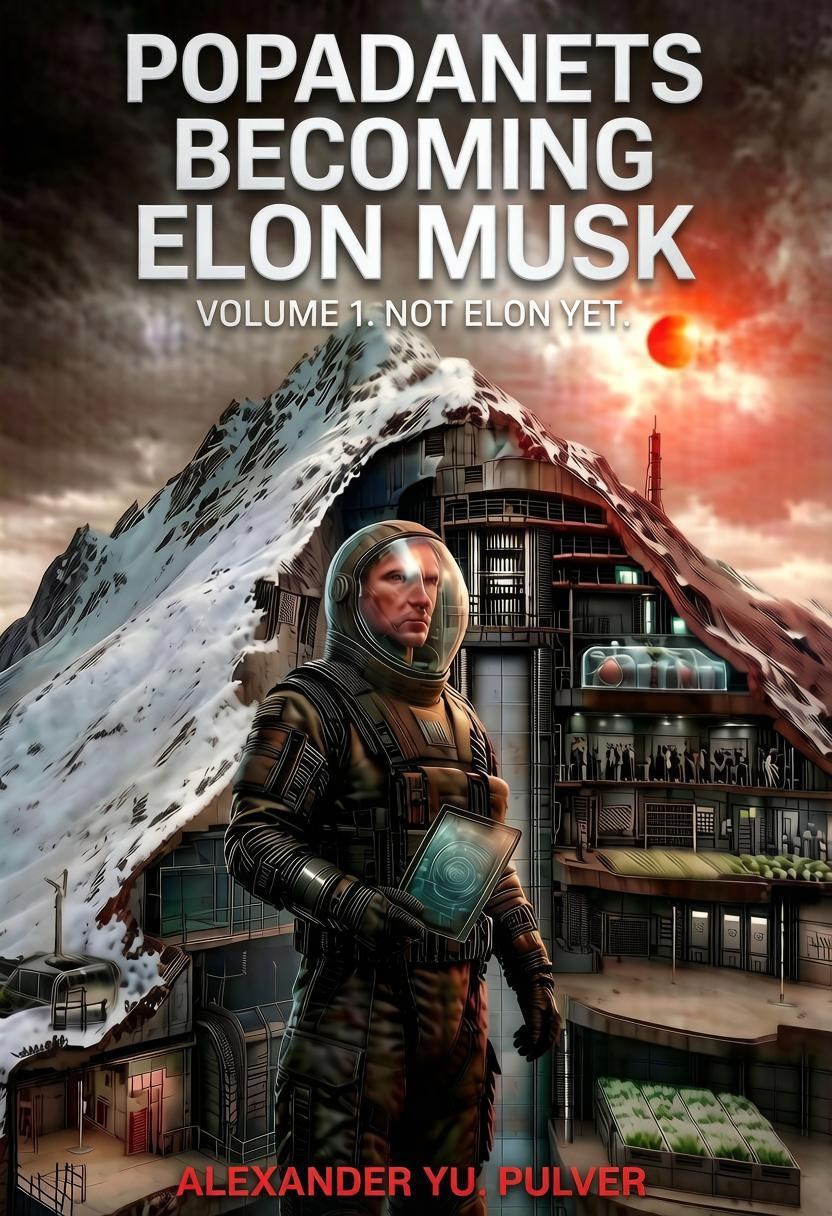
Popadanets Becoming Elon Musk. Volume 1. Not Elon Yet
Chapter 1. The Inauguration of Chaos
January 20, 2025. Washington, D.C.
The cold felt like a deliberate snub from nature. A raw, biting wind whipped the breath out of the spectators huddled behind the double security cordon. Kamala Harris stood at the podium, her back to the Capitol, the hem of her dark blue coat snapping angrily. She smiled — that practiced prosecutor’s smile no weather, no protest, no venomous tweet could rattle.
The crowd was thicker than expected, yet oddly subdued. No roar of triumph. More a wary, held-breath tension — the kind you sense in a bar seconds before the first punch, when everybody knows who’ll swing but nobody wants to be first on the floor.
The ceremony ticked along on protocol, but the air was charged with a dread unseen since the Cuban Missile Crisis. The White House chief of staff’s three phones buzzed before the oath even ended: Moscow had put three strategic missile boats to sea; Pyongyang staged a snap parade; in Tehran they’d lit the torches at the Natanz enrichment complex. Somebody was making damn sure the new administration didn’t relax.
At the edge of the National Mall, a man in dark glasses — odd on a sunless day — watched the ceremony without listening to a word. He was counting snipers. More than usual. Different rooftop pattern. He gave a satisfied nod, turned, and drifted back to an unmarked van.
Behind the scenes, in a private bar at the Willard Hotel, Donald Trump watched the live feed on a giant screen. The sound was off. He sat deep in a leather armchair, gripping a glass of Diet Coke, silent. His entourage — a couple of congressmen, a few media barons, a retired general — murmured but left him alone. Trump wasn’t looking at Harris. He was staring at the Supreme Court justices’ faces. He still believed in numbers and in the people he’d once put in power. A dark, brittle faith, cold as a February draft.
“She won’t last two years,” he said quietly.
The retired general, leathery and dry as an old belt, allowed himself a thin smirk. Two years, he thought, was an eternity when the missiles were already warming up.
Harris was wrapping up her speech, talking of “principled confrontation with autocracy,” of “a sacred duty to defend democracy,” of “red lines that would no longer be dotted.” European leaders in the front row nodded approval. None of them knew those lines would become smoking craters within three years.
Deep underground in Moscow, a hundred meters below Myasnitskaya Street, several men in dark green uniforms with gold flashes exchanged glances. The Chief of the General Staff put down the transcript of the inaugural address delivered by GRU an hour earlier. He had underlined three phrases: principled confrontation, sanctions, escalation.
“So,” he said flatly, “all our de-escalation proposals have been demonstratively binned. We’ll proceed from the worst-case scenario.”
No one objected. The wheel began to turn.
That evening, Harris signed her first executive order: a memorandum titled On Strategic Counteraction to the Authoritarian Alliance. Forty-seven pages. The meat was on page three: immediate release of forty billion dollars in military aid to Ukraine and the transfer of ATACMS tactical missiles with a range of three hundred kilometers.
Moscow replied four hours later. The message was short: any attack on Crimea using American weaponry would be treated as a strike on the territory of the Russian Federation — with all that entailed. Attached were updated scenarios for tactical nuclear weapons use.
The world went to bed not knowing it had just lived through the last day of the old reality.
And deep inside Mount Yamantau, in the warren of tunnels known as Object «Beloretsk-16», life ticked to its own underground clock. This colossal Soviet bunker — carved into the rock since Brezhnev’s time — was built as the final command post, for when Moscow was nothing but radioactive ash. Now, hundreds of meters below daylight, the duty shift of the early-warning radar crews had gone to enhanced alert. The system was still running cold, but sensors were already picking up the first faint spikes of activity. Test sequences, for now — short and harmless. Yet their rhythm was quickening.
Chapter 2. Echoes of Sanctions
February–March 2025. Washington, Moscow, Tehran, Pyongyang.
Harris signed the memorandum on her first day. The ink had not dried. Copies were already in Moscow, Beijing, Tehran, Pyongyang. The intelligence services had worked faster than the White House press office. That was their job. They did it well.
In the Kremlin they read the document without shouting. Nobody shouted there anymore. They spoke in low voices. Not from fear. From the knowledge that loud words changed nothing. The Foreign Minister, a thin man with a thin mouth, said the memorandum was a legal declaration of war. He said it quietly. The journalists wrote it down. It did not make the front pages.
In the General Staff they did not talk to journalists at all. They worked on maps. Big screens covered the walls. They drew circles. Blast radii. Sectors of fire. Lines of advance. They never erased anything. The map grew thick with lines, like a web. The Supreme Commander held a meeting. It lasted four hours. When the generals left, nobody spoke. They knew the room for maneuver was gone.
Tehran took the news well. The hard men there always took bad news well. It proved them right. The Revolutionary Guard had said for years that America could not be trusted. Now they had proof. The Supreme Leader met with his commanders. He spoke one sentence. "The alliance with Moscow and Pyongyang is not a tactic. It is fate." He meant it.
Pyongyang made noise. They always made noise. The state news agency called Harris a rabid she-wolf. They called Trump a clown who had missed his chance. Then Kim ordered a missile test. The Hwasong-19 flew over the Sea of Japan. It hit the water and threw up a column of spray three hundred meters high. Tokyo protested. Seoul went on alert. Washington issued a statement. Nobody read it.
The real work happened in private.
Two delegations came to Moscow in early February. Tehran first. Pyongyang second. They arrived two days apart. The airports closed for a few hours. Rumors spread. Nobody confirmed anything.
The three sides signed a document. Later, if anyone survived to name it, they would call it the Pact of Three. The text was secret. But the contents leaked. The three countries agreed to coordinate their militaries. They agreed to share bases and airspace. They agreed to synchronize their nuclear deterrents. That was the key clause. Three nuclear states — two with working arsenals, one close — now formed a single defense perimeter. It stretched from the Persian Gulf to the Sea of Japan.
European capitals reacted in their own ways. Paris and Berlin kept talking. They believed in phones and notes and mediation. Warsaw and the Baltic states did not. They lived too close. In Tallinn they painted arrows on the streets pointing to bomb shelters. In Riga the line for Israeli passports stretched for months. In Vilnius they taught high school students how to treat radiation burns. Nobody laughed. Nobody called it panic.
In the Middle East the war grew hotter. Hezbollah struck American bases. The Houthis struck American bases. The strikes got closer. American planes hit back. It did little good. The targets moved. The intelligence was bad. In the Persian Gulf, Iranian boats ran close to American destroyers. Men looked at each other through gun sights. One wrong move and the shooting would start.
In Kyiv the snow lay thick on the ground. But the mood was bright. The forty billion from Harris was turning into trucks, missiles, drones. The columns moved through Poland day and night. Under the tarpaulins on the flatcars, shapes were visible. The General Staff had a plan. They kept it secret even from their allies. American advisors saw the outlines. They called it bold. Privately they called it suicidal. But the men on Bankova Street did not care. They believed the window was closing. If they did not strike now, they would never strike at all.
In Washington the National Security Advisor briefed Congress behind closed doors. He said: "We are entering the period of maximum risk. Every step is a tightrope. There is no net. Not for us. Not for them."
The rope was tight. The first stone had been thrown in January. The ripples were waves now. The waves were breaking over the shores.
Deep inside Mount Yamantau, in the tunnels of Object Beloretsk-16, the early-warning crews went to enhanced alert. A young captain, his face thin from lack of sleep, made an entry in the logbook. The number of unidentified signals had risen fourteen percent in twenty-four hours. He underlined the number in red. He closed the logbook. He reached for his tea. It was cold. He did not know that these signals were the first stones of the avalanche.
Chapter 3. The Crimean Gambit
January–February 2025. Zaporizhzhia Front, Kyiv, Moscow, Washington, Brussels.
The cold came first. The steppe froze solid in the third week of January. Snow covered the craters left by artillery. Nothing moved for days. The land waited. When the Russians came, they came in the old way. Armor and infantry across open ground. But this time something new appeared, although it was by no means new. A weapon the Ukrainians had no answer for. The ODAB-9000. A vacuum bomb. Nine tons of metal and fuel. When it detonated, it spread a cloud of flammable aerosol across a diameter of three hundred meters. Then a second charge ignited the cloud. The temperature at the core reached three thousand degrees. The blast created a vacuum that ruptured lungs, collapsed buildings, and left nothing alive in its radius. The mushroom cloud from the detonation looked exactly like a tactical nuclear strike. The Russian command used these bombs to compensate for their weaknesses. They had fewer men than they needed. Their armored units had been bled white over three years of war. But they had bombs. Big ones. The ODAB-9000 was not precise. It did not need to be. One bomb erased an entire fortified position. One bomb turned a Ukrainian company into a crater. The Russian advance was slow but it was relentless. The Ukrainian line bent. It did not break. The 33rd Mechanized Brigade held. They had been on the line for eleven months. They knew the ground. Every fold in the earth, every ruined farm, every ditch. They had mined the approaches. They had pre-sighted every road. They made the Russians pay for every meter. Burning armor littered the snowfields. But holding was not winning. By the fourth day, Russian forces had taken the village of Nezhinskoe. By the sixth, they had reached the administrative border of Dnepropetrovsk Oblast. The advance was slow. Three kilometers here. One kilometer there. Then a pause for resupply. Then another push. Behind the first line of defense, a second was rising. In the forests along the Dnepropetrovsk border, Ukrainian engineers had worked through the winter. Concrete bunkers. Anti-tank ditches. Thousands of dragon's teeth stretching for kilometers. Underground positions deep enough to survive a direct hit. The Second Defense Line was built on lessons learned in three years of war. It was designed for this moment. In Europe, the mood shifted from concern to panic. The German government approved a new military aid package worth five billion euros. But money was not the problem. The problem was time. The Russian advance, however slow, was grinding forward. European leaders held emergency meetings. They issued statements. They called Washington. The calls were urgent, sometimes desperate. The Baltic states demanded immediate NATO reinforcements. Poland put its forces on higher alert. In Brussels, the North Atlantic Council met in permanent session. The suits were rumpled. The coffee was cold. The talk was of red lines. In Paris, the French president convened his war cabinet. In Berlin, the Bundestag debated emergency powers. The headlines across Europe were the same: "Is NATO Ready?" The answer, unspoken but understood, was no. In Washington, Kamala Harris faced a different kind of assault. Her approval ratings were collapsing. By February 2025, her net favorability had fallen to minus 13 points — an eight-point drop since the election. The war in Ukraine was bleeding money. The economy was sputtering. Voters were angry. And the Republicans, led by a vengeful former president, smelled blood. Donald Trump had never conceded. He called the election stolen. He called Harris illegitimate. He called her a puppet, a fraud, a joke. His rallies drew crowds in the tens of thousands. His social media platform lit up with accusations. He called on his supporters to march on state capitals. In Texas, in Florida, in Ohio, in Alabama, protests erupted. Some turned violent. Trump did not condemn them. He encouraged them. Then he went further. In a rally in Phoenix, he called Harris a Putin spy. He said she had been installed by foreign interests. He said the election had been rigged not just by Democrats but by Moscow. The accusation was absurd. The crowd did not care. They cheered. Harris responded with fury. In a televised address from the Oval Office, she accused Trump of sedition. She called him a threat to national security. She announced that the Justice Department was opening a formal investigation into his ties to Moscow. "We will not allow a former president to act as a foreign agent on American soil," she said. The words were heavy. The consequences were immediate. Trump went into hiding. Not silence — hiding. He continued to broadcast. His face appeared on screens in bars and living rooms and underground bunkers. His supporters called him a martyr. His enemies called him a traitor. The country split further apart. Then came the scandal with the Ukrainian president. It erupted during a joint press conference in Kyiv. Harris stood beside Zelensky. A reporter asked about Trump's accusations. Harris, tired and visibly strained, lost her composure. She snapped. She said that Ukraine needed to show more gratitude for American support. She said that Zelensky's government needed to "stop complaining and start fighting." The words hung in the air like a foul smell. Zelensky said nothing. His face was stone. But the damage was done. The clip went viral. Trump's allies seized on it. "Harris insults our ally," they said. "Harris is unfit to lead." European leaders called to express concern. The Ukrainian ambassador in Washington requested an urgent meeting. Harris apologized the next day. It did not matter. The cracks in her administration were showing, and everyone could see them. In Moscow, the Security Council met underground, in the room where the old Politburo once sat. The President listened. The Defense Minister reported on the Zaporizhzhia front. The tone was measured. The conclusions were not. The Chief of the General Staff presented options. A massed counterattack? No. Not enough forces. A retreat to the second line? Possible, but politically unacceptable. A demonstration of strategic resolve? He did not say the word. Nobody needed to. The President asked about the nuclear option. The room fell silent. Not the silence of shock. The silence of men who had discussed this before, many times, and now found themselves at the moment of decision. The doctrine existed on paper. Escalation for de-escalation. A single tactical strike on a military target, to demonstrate that further attacks would bring catastrophe. The President ordered the General Staff to prepare a full options paper within forty-eight hours. All scenarios. All yields. All targets. Then he dismissed the meeting and went to his quarters. His aides said later that he did not speak again for the rest of the night. On the front, a Ukrainian sergeant named Kovalenko sat in a dugout and wrote a letter to his daughter. He had been on the line for three weeks. His company had started with ninety men. It now had forty-one. He wrote about the weather. He wrote that he loved her. He did not write about the war. He sealed the letter and gave it to a medic heading to the rear. The medic took it without a word. Deep in the Ural Mountains, in the tunnels of Object Beloretsk-16, the early-warning crews continued their watch. The young captain with the thin face made another entry in the logbook. The number of unidentified signals in the ether had risen again. He wrote the figure. He underlined it in red. He closed the logbook and sat in the darkness, watching the screens. He did not realize that these signals were only the faint echoes of what was to come.
Chapter 4. Dead Sunrise
February–March 2025. Washington, Moscow, the Zaporizhzhia Front.
The world held its breath. It was the kind of stillness that comes before a thunderstorm. The air thick and heavy. The birds gone quiet one by one. In Washington and Moscow, in London and Beijing, people woke with the same question. Is it today? No. Not yet. But soon. Newspapers ran editorials about a new Cuban Missile Crisis. Cable channels cycled through experts discussing nuclear doctrines the way men discuss football tactics. The hashtag #NuclearDawn trended for two weeks straight. People joked because they were afraid. People were afraid because they understood. The comedians were the most honest. Late night on a cable network, a host took the stage. He was not a young man. His face belonged to someone who had stopped being surprised by human stupidity long ago. He adjusted the microphone and spoke. "So the two candidates for President of the United States are now accusing each other of being Putin's spies. Think about that. The sitting president says the former president is a Kremlin asset. The former president says the sitting president was installed by Moscow. Which means, if we believe both of them, the White House has been running a Russian intelligence operation against itself. That is not an election. That is a Spy vs. Spy cartoon. Except one of them has nuclear codes. And the other one wants them back. Good luck, America. Good luck." The audience laughed. The laugh was nervous. It started loud and died fast. People looked at each other. The joke was too close to the bone. Because it was true. The strange thing was how accurately it described the paralysis. In Moscow, the General Staff received intelligence that Harris was on the verge of impeachment. Protests in Texas, Florida, Ohio, Alabama. The National Guard reluctant to act. The country splitting at the seams. The GRU assessment was blunt: "The internal crisis in the United States precludes a decisive military response to a limited nuclear strike." But the SVR disagreed. Their analysis warned that a cornered president was capable of irrational actions. Including a preemptive strike. The two intelligence agencies argued for days. The Kremlin waited. It was a chess game where every move led to defeat. The only strategy was to freeze and hope the other side broke first. The other side broke first. The Harris administration was convulsing. The decision to declare Trump a fugitive had backfired spectacularly. He did not become a pariah. He became a martyr. His approval among Republicans soared. In Texas, the governor announced he would not permit federal agents to execute a political warrant on his soil. The word secession was whispered, then spoken aloud. Harris needed a win. Any win. Anywhere. An external enemy was the only thing that could unite the nation. Her advisors presented the extreme option. A preemptive demonstration strike. Not on a city. On a military base in Crimea. Or a missile installation in Kaliningrad. A strike that would show Moscow the cost of aggression and distract Americans from the chaos at home. The Chairman of the Joint Chiefs objected. He was overruled. On February 28, the USS Arleigh Burke, stationed in the Black Sea, launched a Tomahawk cruise missile with a nuclear warhead. The target was the Gvardeyskoye airbase near Simferopol. The flash registered on satellites across the hemisphere. A pillar of light punched into the sky. For a few seconds, night became day. It was not just an explosion. It was the end of the old world. Moscow's response was immediate. They did not strike American bases in Europe. They struck the continental United States directly. A Yars missile with multiple warheads hit Minot Air Force Base in North Dakota. The logic was cold and simple. A threat to the homeland would force Washington to reconsider. It was a fatal miscalculation. From that moment, the war ceased to be limited. The machinery of global catastrophe, driven by mutual fear, could not be stopped. On the Zaporizhzhia front, silence fell. American mercenaries and advisors, caught off guard, stared west. There, thousands of miles from this frozen, filthy earth, the real hell was beginning. Soldiers on both sides of the line stopped shooting without orders. They had other things to think about. Sergeant Kovalenko did not live to see that day. He died two weeks before the midnight, killed by a mortar fragment from no-man's-land. He died fast and almost without pain. In this war, that counted as luck. Deep in the Ural Mountains, in the tunnels of Object Beloretsk-16, the young captain with the thin face made his final entry in the duty log. He recorded multiple launches from the territory of the United States and the Russian Federation. He switched the system to full combat alert. Then he sat down and waited. A few minutes later, contact with the Strategic Rocket Forces headquarters was lost forever.
Chapter 5. Dead Noon
March 2025. The Northern Hemisphere.
The missiles fell for three hours. Then the bombs stopped. The world did not end with a bang. It ended with a gray sky and a cold sun that could not break through the smoke. Fires burned on every continent north of the Tropic of Cancer. Cities, forests, oil fields, refineries. Everything that could burn did burn. The smoke rose in columns miles high. The columns spread and joined. By the end of the first day, a black cloud covered the sky from Seattle to Vladivostok. The cloud was not thin. It was thick, oily, and alive with lightning from its own heat. Then the heat bled away and the lightning stopped. The cloud stayed. At noon in Chicago, the sun was a pale disc. People looked up and saw a sky the color of old nickel. The temperature did not rise. It fell. By three in the afternoon, the thermometers read seven degrees below the morning low. A cold wind came from the north, and it did not stop. People who had survived the blasts began to understand that the blasts were not the worst part. In Moscow, the same gray noon. The same cold. The subway stations were full. People sat on the platforms, wrapped in coats and blankets. Nobody spoke much. A child asked her mother why the sun was sick. The mother did not answer. She had no answer. In London, the Thames ran black with soot. In Paris, the boulevards were empty. In Berlin, the fires from the government quarter cast long shadows through the smoke. In Beijing, the sky was invisible behind a wall of dust and ash from burning industrial parks. The cloud did not care about borders. In the North Atlantic, a fishing boat out of Reykjavik tried to raise someone on the radio. The captain was an old man who had fished these waters for forty years. He had never seen a sky like this. The radio gave him static. He tried for two hours. Then he turned the boat south. He did not know where he was going. He only knew he could not go back. In the Pacific, an American submarine surfaced to assess the damage. The captain climbed to the sail and looked east. The California coast was a line of fire. He looked west. Nothing. Just gray sea and gray sky. He ordered the boat to dive. The crew did not ask questions. They did not want to know. In the Urals, inside Mount Yamantau, the crew of Object Beloretsk-16 had lost all outside contact. The last transmissions from Moscow were fragmentary. Then nothing. A young captain with a thin face sat at his console. The screens showed empty airspace. No launches. No signals. Just the steady hum of the ventilation system. He wrote in the logbook: "External contact lost. All systems nominal. Waiting." He underlined the last word. He did not know what he was waiting for. The cloud covered the land for a thousand miles in every direction. It would not lift for years. The scientists had predicted this. They had written papers. They had given lectures. Nobody had listened. Now the papers were ash and the scientists were dead or dying, and the cloud was just beginning its work. The temperature dropped ten degrees in the first forty-eight hours. In some places, twenty. The crops that had not burned froze in the fields. The livestock died in the barns. The birds fell from the sky, their lungs full of soot. The insects died in their millions. The soil turned cold and hard as iron. Dead noon had come. It would not leave for a generation. Inside Mount Yamantau, in the tunnels of Object Beloretsk-16, people were trying to grasp that the world they had known was gone. Volkov walked the levels. Narrow tunnels lit every ten meters. The hum of ventilation. The cold of granite under his hand. The medical block was quiet. Petrova, the chief physician, stood by the supply rack. A surgeon. The Caucasus. Tired eyes. A quiet voice. When ethics came up, her voice turned to metal. She had ended up in the bunker by chance: she had accompanied the evacuated scientists and never made it back. She nodded curtly at Volkov and returned to her work. Volkov entered the laboratory bay adjoining the medical wing. A woman stood bent over a piece of equipment. Kovaleva, the chief embryologist. Thin, like almost everyone in the bunker, but her thinness suggested not weakness but an angular, otherworldly composure. Fair hair, heavily streaked with gray, was pulled back tightly into a knot at the nape of her neck — even now, when grooming had become an unaffordable luxury. A long face with a high forehead and a finely sculpted nose. Cheekbones, once high, now stretched taut by dry skin. Pale gray, wide-set eyes regarded the world with a detached sharpness that made people uneasy. Her appearance was almost elven — but her character, as anyone who tried to get close to her quickly discovered, belonged rather to the Drow. Cold sarcasm, absolute intolerance of stupidity, and a complete lack of any need to be liked made her about as comfortable to deal with as a chunk of granite. They had crossed paths before the war, at joint briefings, and later during the evacuation effort. She gave Volkov a short nod and returned to her instrument. He left her to it. The corridor was quiet. He stood for a moment, forehead against the cold granite, then went back to the command center.
Chapter 6. Beloretsk-16
March 2025. Mount Yamantau, Southern Urals.
The tremors came first. The rock carried them. Not through the air—through bone. The seismographs spiked and stayed spiked for hours. Somewhere above, on the surface of a world that had just ended, warheads were falling on the industrial belt that stretched from Chelyabinsk to Magnitogorsk. The region was dense with strategic targets: missile silos, command bunkers, radar stations, factories that made guidance systems and rocket fuel. Four ground bursts, one subsurface. The sensors registered all five before they died. The mountain held. It had been built for this. Three hundred meters of granite above the main halls. Shock absorbers under the living quarters. Flexible deformation joints that let the rock breathe without cracking the interior. The builders had planned for a direct hit. They had not quite gotten one, but the strikes on the neighboring installations blanketed the area in a radioactive shroud so intense that the external sensors burned out within the first day. The shockwave damaged the ventilation shafts on the eastern slope. The automatic systems sealed the affected sections. The air circulation switched to a closed loop. The mountain stopped breathing and began to live on its own reserves. Object Beloretsk-16 ceased to exist for the outside world. Captain Morozov, twenty-seven years old, sat at his console and monitored the residual radiation. He had not slept in two days. Before the war he had been a physics student in Orsk, drafted into the early-warning forces a year before the catastrophe. His family had been on the surface. He never spoke of them. His face, still boyish, had already acquired the particular pallor that comes only from chronic sleep deprivation and the absence of sunlight. But he moved fast and thought faster, and Volkov had singled him out—for the sharpness of his mind and because Morozov was not afraid to ask questions, even when he did not like the answers. Beside him, at the central console, stood Colonel Dmitry Volkov. Volkov was forty-two. He had been born in 1983, in a closed city near Krasnoyarsk, the son of an officer in the space-oriented units of the Strategic Rocket Forces. His mother worked at the Institute of Biomedical Problems. As a boy, Volkov had watched the last Soviet space launches. At fifteen, he entered a specialized physics and mathematics school. At seventeen, he was admitted to the Mozhaisky Academy. His rise was fast and atypical. By thirty, he was a major. By thirty-five, a lieutenant colonel. He defended a dissertation on artificial intelligence in early-warning systems. He spoke English and Chinese—the latter well enough to read technical documentation without a dictionary. He had participated in joint projects with Chinese neurophysiologists in Chengdu. He was what the closed circles called a "scientific officer of special designation": a man who could assess whether a technology posed a threat, whether it could be replicated, and what resources would be required to protect it. Of Colonel Volkov's character, beyond his universally acknowledged professional efficiency and an elevated degree of decisiveness, precisely nothing was known. Nor could it have been otherwise: he kept his private life behind so dense a curtain that even colleagues who had worked at his side for years could not recall a single detail unconnected with operational reports. This secrecy was neither a pose nor the product of paranoia—merely that Volkov's line of work had never required the sharing of his inner world. He did not share it, and those around him reciprocated, remaining blissfully unaware of how much unpleasantness this saved them. The one trait that occasionally pierced his flawless self-command was a quiet, icy, and thoroughly methodical cruelty toward anyone involved in the theft of state property—an occupation that, in Russia since the twelfth century, had become something between a national sport and an inherited privilege. Furthermore, Volkov had no patience for blockheaded martinets and, when the occasion arose, conveyed this with such murderous politeness that the offender would have preferred to sink through solid granite. Beyond this, the riches of his inner life remained a mystery to humanity—and, as subsequent events proved, this was all to the good. Had his subordinates ever learned what he considered permissible in pursuit of a common goal, many of them would likely have chosen to walk out onto the surface voluntarily, into the radioactive snow, and accept a swift death rather than a long life under this man's command. The commander of the object, Major General Selivanov, had flown to Moscow the day before the war. He never returned. His communications cut off at the same moment as every other channel. Command passed to Volkov. He accepted it without hesitation. Object Beloretsk-16 was not merely a shelter. It was an ark—an underground city designed for three thousand people. Construction had begun in the late Soviet period and continued, in fits and starts, until the final months. At its heart lay two RITM-200 nuclear reactors, the main and the reserve, capable of delivering up to one hundred twelve megawatts of electrical power in paired operation. Alongside them, three binary-cycle geothermal plants drew heat from deep wells, providing an emergency reserve of roughly two and a half megawatts each—enough to sustain life support indefinitely if the reactors failed. The energy section alone required nearly three hundred personnel: reactor operators, geothermal technicians, instrumentation engineers, repair crews. The air and water purification systems were fully autonomous and regenerable. The HEPA filters were metallic, cleanable in place without replacement. The water treatment plant used reverse osmosis and ion-exchange resins designed for hundreds of regeneration cycles. The hydroponic farms occupied several levels, lit by LED arrays with a stockpile sufficient for decades of continuous operation. The seed vault, kept in cryogenic containers, held fifty-three crop species. The medical bay had operating rooms, diagnostic equipment, dental chairs, and prototypes of artificial womb devices for extracorporeal embryo development. The transport fleet included sealed all-terrain vehicles, tunnel-boring machines, and systems for vitrifying radioactive waste into glass blocks for deep-borehole disposal. Every detail had been calculated. Every spare part catalogued. The object was meant to run for forty to fifty years without resupply. The evacuation had begun a month before the war. The first to arrive were the reactor engineers and geothermal operators—men and women without whom the underground city would remain a dead hunk of metal and concrete. They came under the guise of routine rotations, their orders signed by commands that no longer existed. Behind them came the communications specialists, the electricians, the water treatment technicians. By early March 2025, the facility held some five hundred operational personnel. Each knew their sector, their post, their routine. Then the scientists began to arrive. They came from closed institutes and design bureaus scattered across the country. The first group brought quantum computing prototypes from the Lebedev Physical Institute and the Russian Quantum Center. Their leader, a dry physicist named Gromov, requested a low-vibration chamber with stable power. Volkov assigned them Sector K. A few days later, the neurointerface specialists arrived—researchers from Moscow State University and several private laboratories that had worked under military contracts. With them came Chinese neurophysiologists: four men and one woman, old colleagues from Volkov's days in Chengdu. They brought equipment for invasive brain stimulation and prototypes of neural implants. The others followed in a steady stream: propulsion engineers from NPO Energomash, working on reusable rocket engines; drillers from a secret design bureau that had developed a method for ultra-high-speed large-scale boring; biologists and embryologists specializing in extracorporeal development; cryptographers; materials scientists; experts in quantum communication. Each group brought their equipment, their documentation, their families. Volkov met them all personally at the airlocks, checked their credentials, assigned them quarters. He had helped compile the lists. The final group was the largest—about one hundred twenty scientists and engineers from various institutes. They were supposed to arrive two days later. They never made it. The nuclear strikes caught their train on the open track. Two days after the blasts, patrol sensors detected a weak signal outside. A rescue party found the wreckage forty kilometers from the mountain: twisted metal, radioactive snow, a locomotive on its side. There were survivors—about thirty people, all with heavy radiation doses. They were brought through the decontamination airlock in hazmat suits. Five died within hours. The rest were stabilized. With them came the documents they had been carrying. Some of the equipment was destroyed. Some was salvaged. Volkov supervised the recovery personally. After the outer hatches were welded shut, the count began. Two thousand six hundred thirty-two people. Military, scientists, engineers, doctors, support staff, families. Eight hundred of them were children under sixteen. Five hundred were the scientific specialists who had been evacuated in the final weeks—the minds that carried the blueprints for quantum computers, neural interfaces, reusable engines, high-speed drilling, artificial wombs. The plan had called for the arrival of the national leadership—Putin and several key members of the Security Council. They never came. Whether they had perished in a direct hit on a command bunker or remained in more comfortable shelters in Moscow, Volkov did not know. He would not know for a very long time. The meeting began an hour after Volkov assumed command. The main conference room was packed—section heads, security officers, lead researchers. The air, not yet fully filtered, smelled of metal and a faint trace of smoke. Volkov stood at the head of the long table and spoke in a flat, steady voice. Beside him sat those who would henceforth run the bunker. Major Sokolov, chief of security. He was not yet thirty-five, but he looked older—the scar across his left cheek, acquired during the evacuation, and his habit of speaking shortly, without inflection, made him resemble a man who had long ceased to be surprised by anything. Before the war he had served in military counterintelligence, guarding closed installations. In the bunker he had become head of security—not because he wanted to, but because there was no one else. Dr. Petrova, chief physician. A woman with tired eyes and a quiet voice that could, however, turn hard when the subject was medical ethics. Before the war she had been a military surgeon, having served through two Caucasian campaigns. She had ended up in the bunker by chance: she had accompanied the evacuated scientists and had not managed to return. Chief Engineer Kuznetsov. An old man. He was over sixty, remembered Soviet construction projects, and spoke with that particular Ural accent that cannot be mistaken for anything else. He had spent half his life underground — building command posts, missile silos, backup communications hubs. In the bunker, Kuznetsov was responsible for everything that rotated, hummed, and pumped water. His hands were perpetually calloused, and his voice was the deep voice of a man accustomed to shouting over running pumps. And Dr. Kovaleva — the chief embryologist. She sat slightly apart from the others, arms crossed, and did not utter a word throughout the meeting. "The situation is as follows," Volkov said. "At ten hundred hours Moscow time, a full-scale nuclear exchange began between the Russian Federation and the NATO bloc. Contact with the General Staff and the national leadership has been lost. The object sustained indirect exposure: several warheads detonated within a three-hundred-kilometer radius. Sealing was conducted automatically. There is no structural damage. Surface radiation exceeds lethal thresholds. The cloud cover from soot and ash will persist for three to ten years. We are isolated." He looked around the room. "Food, under rationing, will last eighteen months. Water is indefinite, provided the purification systems function. Energy — seven years at full reactor output, up to twenty at reduced load. The geothermal plants provide emergency minimum indefinitely. Medical supplies are sufficient for three to five years. We have a technical database, a seed vault, repair and fabrication capabilities, and a scientific section that can conduct research under isolation." He paused. "There are two thousand six hundred thirty-two of us. Eight hundred are children. Enough to sustain a population and transfer knowledge. Not enough to rebuild civilization as it was. Enough to begin." The meeting lasted two more hours. Rations. Living quarters. Medical protocols. The launch of the hydroponic farms. Every decision was recorded. Every kilowatt of power and every liter of water was accounted for. By the end of the day, the object had a plan. Not a perfect plan. A plan. After the meeting, Volkov walked the levels. In the hydroponic bay, the first seeds were being planted. In the medical wing, Petrova was taking the shift report. In the living quarters, families were arranging bunk beds. In the science sectors, specialists still in shock were unpacking equipment. Volkov returned to the command center. Morozov was still at his post. The young captain turned as Volkov entered. "Sir. External sensors show radiation declining. Slow, but steady." "Good. Continue monitoring." Volkov sat at the table and opened the duty log. Two thousand six hundred thirty-two names. He would have to learn them all. Morozov hesitated. "How long do you think we can hold out?" Volkov did not look up. "As long as it takes." Morozov nodded and turned back to his screens. The ventilation hummed. The lights did not flicker. The mountain stood.
Chapter 7. After the End
March–April 2025. Object Beloretsk-16.
"We will not hold out", Volkov thought. He did not say it aloud. He stood in the main control room, watching the screens. They showed nothing but static and the slow, steady pulse of the reactor cooling systems. The logistics reports lay on the console beside him. He had read them four times. The conclusions did not change. Eighteen months of food at full ration. Maybe twenty-four if they cut to subsistence. The first hydroponic harvest was ninety days away, and that was only if the LED arrays worked at full capacity, if the nutrient solutions stayed balanced, if the seedlings took. If, if, if. There were too many ifs. He had told the staff they could hold out for decades. That was the truth he needed them to believe. But the arithmetic was merciless. One crop failure. One power fluctuation. One outbreak of disease in the crowded living quarters. The margin would vanish. He had lied to them. Not in the numbers. The numbers were accurate. He had lied in the confidence. The mountain was a fortress. But time was time. Nothing stood against it. The door behind him opened. Captain Morozov came in. His thin face was pale with exhaustion. "Sir. The radiation levels outside are falling. But slower than the first models predicted. And there is a complication." Volkov turned. "What complication?" "Seepage. Trace radionuclides in the internal water cycle. The filtration system catches most of it. Not all. The dose is low, barely above pre-war background. But it is chronic. Dr. Petrova is already seeing effects. Thyroid nodules. Immune suppression. Nothing acute. It will accumulate over time." Volkov filed this away. A slow poison, not a sudden death. Even inside the mountain they were not safe. Every year they stayed, the population would sicken a little more. "Keep monitoring," he said. "And tell Major Sokolov to double the guard on the upper access tunnels. If anyone tries to get in, stop them. If anyone tries to get out, stop them. No exceptions." Morozov nodded and left. Volkov turned back to the screens. The mountain hummed around him. Somewhere below, the two reactors churned out their steady pulse of energy. The geothermal plants cycled silently. The air filtration system hissed through its regenerable metal filters. Water trickled through membranes and resin beds, cleaned and recirculated. But not perfectly. Not anymore. Everything worked. Everything had been built to work for decades. Everything except the people. He left the control room and walked the corridors. The facility was a maze of tunnels and chambers carved from living rock. The walls were rough granite sealed with gray polymer. The lights were spaced far apart now. The air was cool and dry. It smelled of rock dust and machine oil. In the hydroponic bay the work had already begun. Long trays of inert growing medium stretched under banks of LEDs. Technicians in blue coveralls planted seeds with tweezers. Volkov stopped beside one of them, a young woman with dirt under her fingernails. "Status?" She did not look up. «Solution's in range. pH stable. Six weeks to greens. Twelve to grain. " "If the pumps fail? " "Spares exist. Not many. Some parts we can make. Some we can't. " "Keep me posted. " He moved on. In the medical wing Dr. Petrova was making her rounds. The beds were full. Not with blast injuries. With the slow erosion of chronic radiation exposure. Swollen thyroids. Bleeding gums. Fatigue that did not improve with rest. And alongside the physical symptoms, the mental ones: anxiety attacks, sleeplessness, a woman who had stopped speaking, a child who woke screaming. Petrova had sedatives, but the supply was finite. She had counseling skills, but they were no match for the weight of a dead world and a slow death underground. Dr. Petrova was the kind of person whose biography fits into a few lines, each one a scar. A military surgeon, two Caucasian campaigns, a residency in a hospital near Mozdok. She knew what a man looked like with shrapnel in his chest and how a soldier's voice sounded when he learned his leg would be taken. In the war she had learned everything she knew—and nothing that could help her here. She had ended up in the bunker by chance: she had accompanied the evacuated scientists, was supposed to return on the same flight, but the flight never came. Her husband and two children had been in Moscow. She never asked about their fate—probably because she knew the answer. She saw Volkov and walked over. "I need to know the truth," she said quietly. "Are we going to run out of food?" "Not if the hydroponics work." "And if they do not?" "Then we have eighteen months to find a solution. After that, we starve." She absorbed this without flinching. "The children?" "They eat first. That is not negotiable." She nodded. "And the elderly? The sick?" Volkov's voice was flat. "We do not triage human beings. Not yet. If the time comes, I will make that decision. Not you. Not anyone else. The responsibility is mine." "That is not fair," she said. "No," he agreed. "It is not." He walked on. Through the living quarters, where families had carved out small spaces of privacy with blankets and cardboard. Children played in the corridors. Their laughter echoed off the granite walls. Some already had bruises that did not heal. Bleeding gums. Morning nausea. But they still played. He returned to the command center. Morozov was still at his post. Sokolov had arrived. "Report," Volkov said. "One incident," Sokolov said. "A civilian engineer. He tried to breach the upper airlock. Said he wanted to see the sky. We stopped him. He is in medical under sedation." "Keep him under observation. If he stabilizes, he returns to duty. No punishment. He is not a criminal." Sokolov hesitated. "Sir, the morale situation is deteriorating. The radiation exposure, the food rationing, the uncertainty. People are talking. Some say we should open the doors and take our chances. Some say worse things." "Let them talk," Volkov said. "But we do not open the doors. Not for anyone." Sokolov nodded and left. The night cycle began. The lights dimmed. The ventilation hushed. Volkov sat alone in the command center. The screens flickered. The reactor pulsed. The mountain pressed down with three hundred million years of weight. "We will not hold out," he thought again. But he would try. That was the only thing left.
Chapter 8. Survival Instructions
May–June 2025. Object Beloretsk-16.
The technician from the hydroponic bay stole half a kilogram of soy paste and a vitamin bar. He hid them under his mattress. Security found them during a sweep. The man did not deny it. He said his daughter was hungry. He said the rations were too small. He said he would do it again. Major Sokolov brought the report to Volkov. Volkov read it and set it down on the console. "Bring him to the main hall. Assemble the section heads. Now." The main conference room was the only space large enough to hold the leadership. Bare walls. A long metal table. Harsh light. Dr. Petrova. Dr. Kovaleva. Chief Engineer Kuznetsov. Gromov from Sector K. The heads of logistics, communications, water treatment, power generation. They sat in silence. They knew why they were here. Sokolov brought in the technician. Young. Thin face. Shaking hands. He stood at the foot of the table. He did not look at anyone. Volkov stood. He always stood. "This man stole food. He has admitted it. He says he did it for his daughter. She is four years old. She is underweight. Medical records confirm it." Silence. "The rules we have now," Volkov continued, "are not written down. They held on shock. The shock is wearing off. People are beginning to think of themselves. That is natural. That is how humans work. But this facility cannot run on natural impulse. It runs on discipline. On rules. On the understanding that the survival of the group is more important than the comfort of any one person. We have no margin. We have no reserves. We have exactly enough, and only if everything works perfectly. One person taking extra means someone else goes without. A child who needs calories does not get them. We all move closer to the line." He looked at the technician. "You understand this?" "I understand," the man's voice was hoarse. "This is the last time this happens without consequences. Next time the consequences will be severe. Not because I am cruel. Because the arithmetic is cruel. You are all intelligent people. You can do the arithmetic yourselves." He turned to Sokolov. "Confine him to quarters for seven days. Reduced rations. He keeps his job. He keeps his daughter. This is a warning. For everyone." Sokolov led the man out. Volkov remained standing. He looked around the room. "These rules," he said, "I have written them down. They are called the Survival Instructions. They have been posted in every corridor since this morning. You have all seen them. Now you will see how they work." He paused. "The Instructions have three sections. The first concerns resources. Food, water, power, medical supplies, vitamin and mineral supplements, radioprotectors. No one takes more than their allotment. No one wastes. No one hoards. Any surplus belongs to the facility. The second concerns conduct. No violence. No sabotage. No attempts to breach the outer seals. Obedience to section heads. Obedience to the command structure. The third concerns justice. Violations are tried by a panel of three, appointed by me. Penalties range from reduced rations to confinement and, if necessary, exile. For such cases, the hatches will be unsealed. At first, some were desperate to get outside with all the force of their idiocy — we had to lock the hatches. Now I can offer something else: a specially developed euthanasia. Painless, humane. If someone is truly incurable and suffering, we will not prolong their agony. But they will receive no extra resources." He let the words settle. "I am subject to the same rules as everyone else. The panel can try me. If I am found guilty, the penalty is the same. Exile or euthanasia." Dr. Kovaleva raised her eyes. "Who appoints the panel?" "I do." "Then it depends on you." "It depends on the Instructions. If I violate the Instructions and the panel fails to act, then this facility is already dead. Because the rules would be just words. Words will not keep us alive. Only rules. Only discipline. Only the understanding that no one is above the arithmetic." Dr. Petrova spoke quietly. "People are afraid of you." "They should be." "That is bad." ""Who has it good now?.. It is necessary. Fear keeps them alive. Fear of the surface. Fear of radiation. Fear of starvation. These fears are real. Fear of me is also rational. I am the enforcer of the arithmetic. If they did not fear me, they would not follow the Instructions. Without them, we die." Petrova shook her head but said nothing. The meeting ended. The section heads filed out. Volkov returned to the command center. He knew this was only the beginning. By then, death had become routine. Three hundred and thirty adults and ninety-six children had died from radiation sickness, infections, and simple exhaustion. The bodies were not taken outside. They were decontaminated and processed. Bones became phosphorus supplements for the hydroponic bays. Soft tissue went to compost. Skin went to filter patches. The medical block salvaged everything usable. Nothing was wasted. The Instructions required it. The infrastructure was decaying. Pipes leaked. Pumps failed. Cables sparked. Repair crews fixed what had already been fixed, piecing one thing together from the scraps of another. Spare parts were running out. The machine shop turned old components into new ones, but precision fell and breakdowns rose. Kuznetsov grimly joked that they were building out of junk and spit. No one laughed. In the science sectors, the work went on. Only a third of the Chinese neurophysiologists remained; many had taken heavy radiation doses during evacuation and died in the first months. The survivors worked on what the old world would have called neural interfaces. Without monkeys, without specialized equipment — only on volunteers who received extra rations, and on those few who had suffered neurological damage during the chaotic evacuation. They implanted electrodes, mapped motor cortex, attempted to create two-way communication between brain and computer. This was not Silicon Valley hype. This was Chinese military research, with modest Russian intellectual input, now buried under a mountain. The propulsion engineers drew schematics for reusable rocket engines, but their daily duty was tending the insect and worm farms that produced protein. "An engineer now works in his free time," the shift boss told them. "While you play with coaxial injectors, the maggots and crickets are starving." They grumbled but obeyed. They also helped maintain the sewage pumps and ventilation turbines, because the original crews were dying off and any skilled pair of hands was valuable. Dr. Kovaleva, prodded relentlessly by Volkov, reluctantly unpacked all her reserves and assembled the holographic photopolymerization units — the "holographators". She mounted them on anti-vibration platforms in the deepest, farthest gallery, where the vibrations from motors, footsteps, and the general noise of the shelter barely reached — even the anti-vibration systems could not provide the silence needed for submicron resolution. Her team built clean chambers around them and began testing the hydrogel scaffolds: three-dimensional matrices of bioengineered placenta, designed to support embryo development outside the body. She called it the functional perfusion culture system. The name did not matter. What mattered was that it worked, and that it consumed resources they barely had. She reported to Volkov in the command center. "The holographators are calibrated. We can begin trials as soon as the perfusion medium is ready. But there is a problem." "What?" "We just moved in. Nothing is unpacked. Nothing is mounted. People are living behind cardboard. We are unlikely ever to produce the media on-site — everything depends on the harvests, and the harvests are uncertain. The plans are vast, and nearly all of them are probably doomed. We can grow only a few children. And under these conditions the thought creeps in: maybe we should abandon this project entirely?" Volkov looked at her. "Everything depends first and foremost on your personal desire and your ability to apply your strength." Kovaleva held his gaze. "Personally, I am entirely for it. Despite the supremely absurd circumstances." Volkov listened. His face did not move. But this time the stillness was different. "I am sincerely delighted by your concern for the success of our hopeless endeavor! As a reward for your selfless work, I propose giving all the children your patronymic! They will be Oksanoviches and Oksanovnas!" The joke did not land. Out of spite, she organized an informal referendum among the personnel. The population voted unanimously to give all the children grown in the apparatuses the surname Volkov. The colonel was categorically against it — he had no intention of becoming anyone's father, let alone a collective one — but public opinion had spoken. Kovaleva informed him with a cold smile that he was now the founding father in the most literal sense. Arguing was useless. The Survival Instructions had no provision for overturning a popular vote. The night cycle began. The lights dimmed. The ventilation softened. Volkov sat alone in the command center. Morozov was at his post. The screens flickered. The reactor pulsed. The mountain held.
Chapter 9. Stillborn Cradles
Spring–Summer 2027. Object Beloretsk-16.
The cleanroom was cold. It smelled of ozone. Kovaleva stood alone, watching the pumps. Their hum was steady, a sound she no longer noticed. She had been here ten months.
Far below, in the deepest gallery where the mountain's vibrations barely reached, the holographator sat on its damped platform. Its work was done. Months ago, a single femtosecond pulse had fired. A holographic phantom flared inside the photopolymer. In seconds the scaffold gelled — a three-dimensional matrix, a placenta shaped by light.
They had brought the scaffold here, to this room. Placed it in the hood. Then the seeding began.
The cells went in all at once, pumped through the service conductive dispersion-framework networks into every branch of the microcirculatory tree. Endothelial cells. Mural cells. Fibroblasts. Macrophages. A slurry of life suspended in gas-transport medium. On the working surface, facing the chamber's open lumen, they laid the endometrial layer — stromal and epithelial cells mixed with solubilized matrix.
It took a week to mature. A week before it was ready. Before it could receive the embryos. The last two thousand kilograms of the Chinese blood substitute went into the culture medium. The stock was gone.
Eight children. That was the limit.
Kovaleva ran the numbers a hundred times. Over ten months, each child consumed nearly twenty cubic meters of culture substrates based on soy and pea hydrolysates from the facility's own greenhouses, additives from pre-war reserves, and the gas-transporting media brought from Chengdu — all of it metered into the perfusion systems day after day, week after week, for ten months.
The Facility Council authorized the project. Volkov had assembled the Council himself — section heads, senior specialists. They existed to approve his decisions. Sometimes they argued. Not often.
At the session, Volkov stood at the head of the table.
"You know what a mule is," he said. "A horse crossed with a donkey. Sterile. But stronger. Better endurance. Smarter. Tougher hooves. Farmers and armies used them for hard labor in bad country. That is heterosis. Hybrid vigor. When two distant lines combine, the offspring often beats both parents."
He paused. "It works in maize. In dogs. In humans. But in our conditions, normal children have it hard. They survive — we fight the radiation, we grow food — but the conditions are still poor. The chimeras are no different from them in principle — except they may be tougher. Like Olympic champions, if they get lucky. But we're not breeding champions. We're breeding those with a better chance."
Then he got to it. "The chimeras are not edited. We just fuse material from unrelated donors. A bad gene in one zygote is masked by a good one from another. The good does the work. It is super-outbreeding. A mule inside the species."
Kovaleva raised a hand. Her voice was dry.
"Thank you, Colonel, for the biology lecture. You could have asked me. I would have told it better."
A few men shifted. Volkov waited.
"I have never fused human zygotes," she went on. "But I did it with hamsters. The only catch: if we used different coat colors, the young came out checkered. Patch by patch. So I would not mix Negroids with Caucasoids or Asians. Unless you want a chessboard."
Volkov's face did not move. "How many zygotes can be fused?"
Kovaleva shrugged. "Two, three — no problem. More? Nobody knows. Nobody has done it. If we had nothing to do and a surplus of ova, we could try five."
"Very witty," Volkov said. "Out of respect for your professionalism, we gladly accept your refined proposal. We will proceed with one pair by fusing five zygotes each."
Kovaleva stared. "I was joking."
"Do not joke during Council sessions. The record will show the head of embryology proposed a five-zygote fusion."
The vote was unanimous. Kovaleva abstained. She had alternatives. None were printable.
Two normal embryos. Two from fused pairs. Two from three. One final pair from five — ten parents per child.
When the time came to name them, Kovaleva brought a list to Volkov.
"I thought we could use Latin," she said. "Primus, Secundus, Tertius, Quintus. The girls would be Prima, Secunda, Tertia, and Quinta."
Volkov looked at the list. "Quintus."
"Yes. For the five-zygote boy."
"The children will call him Squintus. Or Squinter. The English word is squint. It means he looks at things sideways."
Kovaleva opened her mouth. Closed it. "Quintus is a perfectly good Roman name."
"Squintus the cross-eyed. It writes itself. The boy will never escape it."
She took back the list. "English numbers, then."
"English numbers."
So the normal boy became Oner. His sister, Onessa. The two-zygote pair: Twoer and Twoya. The three-zygote: Treyer and Treya. The five-zygote pair came became Fiver and Fivera.
Eight children. All Oksanoviches and Oksanovnas — the patronymics Volkov had sarcastically taken from Kovaleva's own name. All Volkovs — the surname forced by the referendum she had orchestrated out of spite. He did not care.
The embryos were placed onto the working surface of the maternal placenta. They implanted. Nature did the rest. Some failed. Some arrested early. They were replaced from the cryobank. The additives ran low.
On the fourth of May, the first was decanted. Oner. Normal. Four thousand one hundred eighty grams. He howled. Kovaleva cut the cord and laid him on the warming table.
Onessa followed. Four thousand fifty grams.
Then the two-zygote pair: Twoer and Twoya. Five thousand two hundred grams. Five thousand one hundred fifty.
The three-zygote: Treyer and Treya. Five thousand six hundred grams. Five thousand four hundred.
The five-zygote: Fiver and Fivera. Six thousand one hundred grams. Six thousand fifty. They did not cry. They looked. After a short debate — everyone would call him Fiver anyway — the names stuck.
They grew. They got the best care the facility had. Kovaleva watched them. Petrova came when called. The normals caught colds and shook them off. The chimeras barely sickened.
Twoer was the curious one. At three, he got out of the nursery, found the command center, and stood in front of Morozov. Gray eyes. He did not speak. He looked at the screens, the wires, the pulse of the reactor. Then he turned and walked back. Morozov reported it. Volkov listened.
"He found the way. Good. Let him learn the corridors. He will need them."
Time passed. The facility held. The population shrank, but the "Volkov children" lasted.
Chapter 10. Life Beyond the Perimeter
April–May 2029. Object Beloretsk-16.
A sensor tripped on the first day of April.
It was an old seismic probe, set into the rock half a kilometer from the main ventilation shaft. Its function was to listen for tunnel work. No one expected it to hear anything. For two years the surface had been silent. Dead rock. Dead air. Dead snow.
Now the probe was sending a signal. Rhythmic. Mechanical. Not a rockfall. Not a quake.
Captain Morozov put it on the speaker without asking. Volkov came to the console and listened. The sound was faint. A steady metallic tapping, muffled by granite. It went on for three minutes. Then it stopped. Four hours later it started again.
"Someone is digging," Morozov said.
Volkov did not answer at once. He stood with his head tilted, listening to the silence between the taps. Then he said, "Not digging. Driving. Someone is pounding a stake into the rock. They are marking something."
"Marking what?"
"The location of the shaft. They know where we are."
"How?"
Volkov did not know. That was the problem.
The next day Major Sokolov requested permission to run a surface patrol. Volkov denied it. A patrol needed sealed suits, and the suit supply was finite. It needed weapons, and ammunition was finite. It needed a vehicle, and the surface vehicles had been mothballed since the first winter. He did not say he was not ready to lose men. He said the risk outweighed the gain.
Sokolov did not argue. He understood the arithmetic.
Instead, Volkov ordered a drone. The facility had four of them: small quadcopters built for reconnaissance, stored in Faraday cages since the war. The electronics had survived the pulses. The batteries had been kept charged. Two of them still worked.
Morozov launched the first one at dawn.
The drone climbed through a secondary ventilation shaft and emerged into gray light. Its camera showed the eastern slope of Mount Yamantau. The snow lay in patches, pulling back, exposing black rock and frozen mud. The sky was the color of old pewter. The temperature on the surface was minus eight degrees Celsius. Spring was coming, but slowly.
The drone flew a search pattern, widening circles from the shaft. For an hour it saw nothing but rock and ice and the twisted remains of pine trees killed by the blasts. Then, at the edge of its range, it found a camp.
Four shelters made of salvaged sheet metal and black plastic. A fire pit, cold. A pile of tools: picks, pry bars, a sledgehammer. Three figures in heavy coats and crude masks, their faces hidden. They were working around a boulder near the ventilation shaft. The boulder was marked with white paint. A surveyor's mark.
Morozov brought the drone closer. One of the figures looked up and raised a hand to shield his eyes, as if he could see the drone against the gray sky. Then he picked up a rock and threw it. The rock missed. The drone held its position. The man stared at it for a long moment, then went back to work.
"Survivors," Morozov said.
"Three," Volkov said. "Minimum. There will be more. Nobody survives alone."
The next day the drone went up again. The camp was still there. The number of figures had grown to five. They were digging a trench along the base of the ventilation shaft. The trench was deep. They seemed to be trying to reach the concrete foundation.
"They want to breach the seal," Sokolov said.
Volkov nodded. "They want to get inside."
"What do we do?"
"Nothing. For now. The shaft is sealed with half a meter of reinforced concrete. They have hand tools. It will take them weeks. By then we will know more."
The surveillance continued. Over the following days the drone brought back more images. The camp grew to eight people, then to twelve. They built a second shelter. They deepened the trench. They posted a lookout with a pair of binoculars. They were organized, disciplined, and patient.
Gromov in Sector K was working on the quantum co-processor. The machine was primitive by pre-war standards — a prototype based on Chinese designs for superconducting fluxonium qubits — but it was all they had.
"Colonel," Gromov said one evening. "I have preliminary results on the surface radiation model."
Volkov was in the command center, studying the latest drone footage. He looked up.
"Report."
"The cloud is thinning. The soot is settling. The UV is still dangerous, and the hotspots will persist for decades. But the overall dose rate is falling. Within a few years a person could survive on the surface with minimal protection. We were wrong in our initial projections. Safe levels will arrive roughly a decade earlier than we assumed."
Volkov noted it. Something was changing outside, but it meant nothing for them. The surface was still lethal. It just killed a little slower now.
By Friday Morozov had rigged a loudspeaker to the exterior of the ventilation shaft. He ran the cable through a sealed conduit. The speaker was crude. It would work.
Volkov stood in the command center with a microphone in his hand. Morozov was at the console. Sokolov was armed and waiting.
"Open the channel," Volkov said.
Morozov pressed a switch.
Volkov leaned into the microphone. His voice was flat and steady.
"This is the commander of Object Beloretsk-16. You are attempting to breach a sealed military installation. Identify yourselves. State your purpose. Over."
The speaker crackled. On the drone feed the diggers stopped working. They looked at one another. One of them walked toward the speaker, his sledgehammer still in his hand.
Silence.
Then a voice came back. Hoarse and rough, but clear.
"This is the Zlatoust collective. We are survivors. We have women. We have children. We are from a former National Guard supply depot. Our stores are running out. We need shelter. Over."
Volkov held the microphone. He did not speak.
The voice came again. "We have been outside for two years. We have lost a third of our people. We know you have food. We know you have water. We are not leaving. Over."
Volkov pressed the switch.
"How many of you. Exact numbers. Men, women, children. Over."
A pause. Then the answer:
"Forty-two people. Fifteen men. Twelve women. Five elders. Ten children. The children are between two and fourteen years old. Over."
Volkov thought. Forty-two people. More than he had expected. But a National Guard depot meant resources. Possibly substantial ones.
"What is in the depot. List it. Over."
The voice replied slowly, as if reading from memory:
"Field rations. Medical supplies. Tools. Weapons. Fuel briquettes. Construction materials. Power system spares. Filters. Cables. Pumps. Enough for several years of supply. Over."
Volkov exchanged a look with Morozov. This was exactly what the facility lacked. The materials that should have reached Yamantau before the war, but had been stuck in transit. Russian disorder: a way station never unloaded.
He pressed the switch again.
"I offer a deal. You receive entry. All of you. Women, children, elders, men. Full citizenship. Equal rations. Equal duties. In exchange, you transfer the contents of the depot to the facility. The resources become common. No privileges. No special rights. Such are our Instructions. You accept them unconditionally. If yes — we open the airlock. If no — we seal the shaft forever. Decide. Over."
A long pause. Then:
"We agree. Over."
"Wait. We will open in two days."
The airlock bay was readied in haste. Medical staff set up a triage station. Medical staff prepared beds and drugs. Sokolov posted guards.
Two days later the outer hatch slid open. The outside air, cold and stale, smelled of char. People began to file inside, squinting against the harsh electric light.
There were forty-two of them. Filthy, gaunt, in patched clothing. Children clung to the women. Men carried bundles of belongings. One man stood out — an elderly military doctor, a lieutenant colonel. Gray hair. Stooped. He squinted and coughed against the harsh light. Volkov noted him at once. Men like that were hard to find.
The triage lasted all day. Each person was examined, washed, and given clean clothes. The children were fed first. The women were placed in vacant cabins. The men were assigned a common bunkroom. The elders got a cot apiece.
And then the dying began.
Nearly a third of the Zlatoust group had already received lethal radiation doses before they entered the airlock. They had spent too long digging at the shaft. Too long under the open sky, even in masks. The doctors could do nothing. Twelve people died in the first two weeks. Four of them were children. Nearly forty percent of the collective's children. They simply faded, quietly and without pain, despite all of Petrova's efforts.
The remaining thirty newcomers gradually settled into the life of the object. They were given work assignments, ration cards, and the Instructions on the walls. And that was where the trouble began.
The Zlatoust people considered themselves the owners of their depot's resources. They had guarded those stores for two years. They had eaten from them, drunk from their barrels, breathed air filtered through their filters. They believed they had brought wealth into the bunker and deserved special standing.
Volkov thought otherwise. The Instructions were the same for everyone. The depot passed into the common property of the facility. No privileges. No extra rations. Equal work. Equal share.
The Zlatoust group grumbled. Their former commander, a supply captain named Shumilin, filed an official petition: increase rations for the "suppliers of resources," relax work norms, allow free access to the depot. Volkov's resolution was a single word: "Denied." The Instructions were not negotiable.
Shumilin filed a second petition. And a third. Each was denied.
Then he started looking for allies.
There were always malcontents inside the shelter. Those weary of discipline, of the hard hand, of the endless accounting of every gram and every watt. Shumilin found them. The conspiracy formed quickly: several civilian technicians, one of Sokolov's own guards, an old storekeeper who still remembered pre-war laxities. Eight people in all, counting Shumilin himself.
Their plan was simple. Seize the command center at night, when the main shift was sleeping. Disarm Morozov. Kill Volkov. Announce the change of authority over the PA system. Then rewrite the Instructions: higher rations for their own, less work, free access to the depot. The plan was a bad one. The conspirators did not know that Volkov knew everything. He had a man among the Zlatoust group — the old military doctor, the former lieutenant colonel, who had understood from the first day which side was stronger. Volkov had not asked for his consent. He had simply said, "Report." And the doctor reported.
Volkov did not wait. He summoned Sokolov and ordered him to take them all. Quietly. No noise. No shooting. One by one.
They took the conspirators that same night. Shumilin was first. The rest were seized in their bunks. No one had time to cry out. Not a single round was fired. Sokolov interrogated each one personally. By morning the list was complete.
Shumilin and the two who resisted were led to a maintenance corridor and executed. The rest were given a choice: a run to the depot or immediate euthanasia. Most chose the run. Few returned.
The mutiny was crushed before it began. No loyal personnel were harmed.
Volkov assembled the section heads. His face was the same as always.
"The incident is closed. The ringleaders are dead. The Instructions remain in force. No concessions to mutineers."
He paused.
"The external exits will be mined. If anyone else attempts to breach a hatch or go outside without authorization — detonation. No more exile. Only death."
Kovaleva watched him with a stone face. Petrova said nothing.
"For those who transgress," Volkov went on, "a new form of punishment is now established. A run to the Zlatoust depot. The offender must go to the surface, reach the depot, collect a specified load, and return. If he returns with the load — pardoned. If he does not — dead. This is not atonement through blood. This is atonement through bone marrow."
He added: "The full inventory of the depot was held by Shumilin and his deputy. Both are dead. The list has been reconstructed. It is now in my possession. And in Sokolov's."
So the story of the Zlatoust collective ended. The newcomers, having lost some of their number when the mutiny was crushed and a few more on the runs, gradually quieted and accepted the established order. Many of them continued to sicken and die from the effects of radiation, but those who survived melted into the population of the bunker, adding genetic diversity and working hands.
All approaches to Mount Yamantau were mined from that day onward. No one else could come from outside. The perimeter became absolute. The isolation was complete. To leave now meant near-certain death — by mine, by radiation, or by the weight of the run.
The mountain stood. And inside it, people went on living. If it could be called living.
Chapter 11. The Technocrat Heresy
2030–2035. Object Beloretsk-16.
Treya died in 2034, when she was seven years old. Her killers were not religious fanatics in the ordinary sense. They believed that Earth had been seized by reptiloids, who had poisoned the water, soil and air with radiation because such conditions suited them. People in "shelters" were kept as livestock, infected and killed in hospitals, their bodies then consumed under the guise of "processing for agriculture." They considered Volkov the chief subterranean reptiloid, and the chimeric children his spawn, destined to lead new "shelters" for breeding human herds. One night they seized Treya, dragged her to a remote technical dead-end, beat her with a pipe wrench and dismembered her. Someone hauled in a pile of waste paper from the abandoned book depository, lit a fire and began cooking the meat. They believed that eating the flesh of the reptiloid spawn would grant them its power. The fire alarm tripped when smoke reached the ventilation duct. Sokolov's men got there before the cannibals could finish their meal. The ringleaders were executed. The rest were given the choice: a run to the depot or immediate euthanasia. Most chose the run. Few returned. Treya's remains were processed. Her name was inscribed on the wall — like all the others. By the middle thirties, the bunker held around seven hundred people. The reactors still ran. The water still flowed. The hydroponic bays faltered but did not stop. People died — of radiation, of age, of a hollow ache no drug could touch. And each time someone died, someone else asked the same question: why was Colonel Volkov still alive. By 2035 he was past fifty. He did not look healthy — gray skin, sunken eyes — but he walked, stood, talked, thought. Radiation seemed to pass him by. The envious called it luck. Volkov knew better. He tracked every dose. He wore lead-lined clothing in the hot sections. He took the radioprotectors the medical block still managed to produce. He did not hope for a miracle. He simply did what had to be done to last a little longer. Behind his back they muttered. "When will the bastard finally die." He heard it in the pauses, in the lowered eyes. He took no offense. They had a right. Everyone was tired. But he did not allow himself to die. Too much remained undone. The infrastructure crumbled. Pipes leaked. Pumps seized. Cables sparked. The repair crews worked around the clock, but their numbers shrank. The specialists who had installed these systems twenty years ago were long dead or processed. And the new ones — those born and raised under the mountain — could not keep up. Education had collapsed. The chimeric children, eight years old by '35, absorbed knowledge faster than the normals — Oner, Onessa, Twoer, Twoya, Treyer, Treya, Fiver, Fivera. They read technical manuals. They asked questions that made adults redden and stammer. But that was not enough. "Seven nannies, one neglected child" — the old saying surfaced and stuck. Teachers were few. There was no curriculum. Everyone taught what they knew, and everyone knew different things. By fifteen or sixteen, the bunker's youth emerged with scraps of information and no usable skills. Kuznetsov reported this to Volkov twice a month. His voice grew flatter each time. "They can't even rebuild a pump. I show them. They watch. They nod. Then they do the opposite. Not out of malice. They simply do not understand what is asked." "The chimeras understand," Volkov said. "There are five chimeras. They are eight years old. In five-seven years they may be useful. In ten years the reactors will be dead." Volkov listened. He remembered. This problem joined the long list he carried in his head. And he meant to return to it — when the neurophysiologists submitted their report. Kovaleva's illness began in late '34. Fatigue. Night sweats. Weight loss. Swollen lymph nodes she found herself, standing before a mirror. Petrova diagnosed it in a week. Diffuse large B-cell lymphoma. Aggressive. Untreated, she had months. They had nothing to treat it with. Cyclophosphamide, doxorubicin, vincristine — the standard regimen — had run out five years before. Prednisolone they could still synthesize. Rituximab was produced in relative abundance — cancer had long been the second cause of death after radiation — but production was expensive and unstable, and in the very weeks Kovaleva received her diagnosis a temporary local shortage occurred. It simply coincided. She appreciated the irony. By May '35 she could no longer rise. The pain in her abdomen and bones had become unbearable — tumor masses pressed against her internal organs, her enlarged spleen stretched its capsule, metastases grew into her spine. There had been no morphine for years. In its place the medical block distilled a crude tincture from poppy heads grown right there in the hydroponic bays. They crushed the raw material, boiled it, filtered it — a cloudy solution with floating opalescence. Petrova injected it three times a day. It helped less and less. There were always rumors around Volkov, each more vile than the last. It was said that he was impotent and therefore hated both women and men. That he was a homosexual living with young soldiers. That he was a pedophile who, out of perverted motives, had grown the chimeric children and lived with all of them simultaneously. That he was a necrophile who violated corpses before they were processed. That he was a zoophile, secretly keeping the last living pig on planet Earth in the most secluded part of the bunker for shameful acts. Volkov did not fight the rumors — it was useless — but they even somewhat amused him with their absurdity. The truth was simpler. Long before the nuclear war began, he had started meeting secretly with Kovaleva. There were rumors about her too — that she was a man-hater who kept a constantly replenished collection of severed male heads in alcohol, men who had irritated her in some way. Two lonelinesses had come together, each toothier than the other. Volkov came to her in the evening. She lay in a private room he had ordered set aside at the onset of her illness. Her eyes were open. He sat on the edge of the cot. They were silent a long while. "You know what I'm going to ask," she said at last. "I know." "And you'll refuse?" "You know I won't." She turned her head. Her face was gaunt, but her eyes remained sharp. "Dima," she said quietly — the name she had called him all those years when no one could hear. "I'm tired. I don't want to wait until my lungs fail or the tumor crushes my spine. I want to go on my own." He said nothing. "I've never asked you for anything. Not once. I'm asking now." "You're asking me to kill you?" "I'm asking you to let me go." The ventilation hummed. Somewhere far off, water dripped. "We have an inflatable rescue hyperbaric chamber and a cylinder of nitrogen," Volkov said. "You know how it works. The standard way for cancer patients to exit. Painless. You fall asleep and don't wake." "I know how it works. I'm a scientist, remember?" He almost smiled. "Then why the hell are you arguing," she said. "Because I don't want to lose you." She looked at him. Her lips trembled — not with sarcasm, but with something else. "You sentimental fool. You think I don't know you want to end it all along with me? It's written on your face. 'A fine excuse to stop this whole business.' Well, don't you dare. I'm sick to death of you already. I want to go alone, without your company. Understood?" "Understood." "And don't go latching onto a dignified procedure. You're needed here. Those children." She nodded toward the door. "And those idiots who would wreck the bunker in a month without you." "You exaggerate." "I never exaggerate. I'm a scientist." He took her hand. It was dry and hot. "When?" "Tomorrow. I don't want to drag it out." He nodded and left. In the corridor he stood a moment, forehead pressed to the cold granite, then went to give the orders. The next day the chamber was set up in the medical wing. Those Kovaleva had asked to be present gathered — Petrova, Gromov, Morozov, Sokolov, a few senior engineers. The rest were told the chief embryologist was dying and wished to say goodbye. Kovaleva lay on a gurney. They placed her into the inflatable cylindrical bag — as one is placed into a sleeping bag — sealed the seams from the outside, and connected the nitrogen cylinder. She looked at those assembled, her gaze settling on Volkov. "I want everyone to know: I am not complaining. I lived fifteen years longer than I should have. And I made something. What I leave behind — if not here, then elsewhere." She paused. "As for the healthcare system in this facility — it is abysmal. Its prospects are worse." Several people lowered their eyes. Petrova pressed her lips together. "Colonel. You promised no speeches." "I'm not making one," Volkov said. His voice was level. "Then don't start. Farewell." She turned the valve herself. The nitrogen flowed into the chamber. Two minutes passed. Three. She closed her eyes. Consciousness left her abruptly, all at once — together with the final exhalation. Her breathing stopped. Volkov watched the bag. One of the engineers shifted his weight from foot to foot. About a minute and a half passed. Silence. Then a deep, loud, convulsive gasp burst from her chest — a full-lunged breath, as though the lungs refused to acknowledge death. A long pause followed. Then another breath. Another. Kussmaul breathing: rhythmic, mechanical, terrible in its unconscious force. It went on for perhaps two minutes. Gradually the breaths became shallower and more irregular, the pauses longer, until they ceased altogether. Volkov stood motionless. His face was stone. Then he turned to those present. "This tragedy is of a magnitude far greater than the overwhelming majority of you can grasp. Those few who can — I ask you not to spread alarm. As a precaution." No one ever asked him, as a precaution against what. He turned and walked out. Sokolov later said the colonel did not sleep for three days. There was plenty of work. Crime had been rising for years. Theft of food bricks. Prostitution for an extra ration. Drug abuse had appeared as well — poppy straw for medical purposes was grown centrally, but leaks occurred constantly, and homemade opium tincture circulated through the living quarters. Hemp was also grown centrally, more for antidepressant purposes. Smoking was forbidden: open flame was a crime punished by a run. So hemp was centrally processed into "patties" based on food bars. The population demanded ever-increasing dosages, and the main theft attempts targeted precisely these. Sokolov fought it, but he had too few men and the facility was too large. In '33 Volkov ordered cameras installed in all living quarters and corridors. Even his closest aides resisted — they called it a digital prison camp. After two children disappeared in early '34, the resistance died. The operator who should have seen the movement on the screen the night Treya was killed was asleep at his post. Volkov did not punish him. There was no point. Instead he ordered all meals moved to the canteens. Eating and drinking only under supervision. Storing food outside the canteens was forbidden. Ration accounting was tightened to the level of narcotic drugs. That was when he went to Gromov. "I need a system to replace the operators. Artificial intelligence. Without sleep, without error." "We don't have the computing power for that. The quantum co-processor can barely handle the project you already approved." "Use it." "That's like driving nails with a microscope." "Drive." Gromov shrugged. Thus began the second stage — what would later be called the technocrat heresy. The quantum computing specialists had been working on the project for nearly ten years. They had been brought into the shelter at the very start of the war, in '25 — pulled from closed institutes and flown to Yamantau on special transports. The first year or two went to settling in, to calibrating equipment, to getting the quantum co-processor — a Chinese machine built on superconducting fluxonium qubits — operational. It had been running calculations ever since. The specialists themselves were constantly drafted for the same tasks as the propulsion engineers — repairing electrical systems, maintaining computers, any job that required qualification. But working on the "Astronomican" was, for some reason, not forbidden to them. They had insultingly little time for it — "A hobby, in your free time from work!" The phrase had long since gone viral and was applied in every situation, fitting or not. In mid-'35 they finally requested a formal hearing before the Council. The conference room was full. Petrova, Morozov, Sokolov, Kuznetsov, Gromov, a handful of engineers. The chimeric children were not admitted, but they sat in the corridor outside the door, listening. Gromov stood. He was dry as ever, his eyes gleaming with an unhealthy shine — chronic sleep deprivation, and perhaps the early stages of radiation cataracts. "We have found a way. Theoretical, but grounded. The quantum co-processor can exist in a superposition of states. In the many-worlds interpretation, this gives access to the full set of parallel realities branching from every quantum event. We cannot physically travel to another reality. But we can transmit information. And information encoded in neural connections is consciousness." The room was silent. Volkov sat motionless. "We compute a target state in which the nuclear war did not occur and the required temporal point lies at least forty years in the past. A neural interface connected to a volunteer's brain delivers a series of ultra-short quantum pulses that collapse the wave function of the neural network. The volunteer's consciousness ceases to exist here and continues to exist in the recipient's brain in the target reality. A child. An adolescent. This is not time travel. This is quantum tunneling of consciousness across the multiverse. No paradoxes. It either works or it does not." "We have named it the 'Astronomican,'" he added. Volkov grunted. "You won't die of modesty. The Astronomican, Chinese-built," he said. " Charming. 'A Chinaman sold his soul to the Devil, it broke down two weeks later!'." A murmur of indignation rippled through the room. Gromov winced. One of the Chinese researchers sitting against the wall shook his head. The one who spoke Russian better than the others leaned forward. "Colonel, those are musty stereotypes from the third quarter of the twentieth century. Chinese electronics are excellent. The important thing is that there should be no inscriptions on them. Neither in Latin script, nor especially in Cyrillic. Only in characters — then it is fine. Otherwise you really can run into trouble." Volkov grunted again but said nothing. Then one of the neurophysiologists rose — an older man with the face of someone accustomed to being listened to. He was not the head of the group, but he held the highest status. "This is outside my area of expertise," he said slowly, "but at first approximation this somewhat resembles schizophrenia." A murmur ran through the room. Gromov turned to him. "Do you have an alternative proposal?" The neurophysiologist did not sit down. He stood, looking at Gromov. "I have a proposal. A question," he said. "What if, through this quantum tunneling of ours, a nuclear war actually starts in that other reality?" The silence deepened. One of the engineers held his breath. Gromov opened his mouth, but the neurophysiologist was not finished. "We are trying to save our world by sending a consciousness to a place where everything is fine. But what if our intervention is the spark? What if it is precisely our signal that sets off the chain of events leading to war? We are talking about quantum collapse, superposition, about consciousness as information. But information changes reality. Are you certain we will not become the cause of the very fire we are fleeing?" He sat down. Gromov stood, gripping the back of his chair. "Certain," he said, and his voice was louder than he probably intended. "Because the model excludes that probability. The target reality is selected by the criterion of the absence of nuclear conflict in the given period. We are not starting a war. We are choosing a world where it did not begin." "The model excludes it," repeated the neurophysiologist. "The model. And reality?" Gromov did not answer at once. He looked at Volkov. Volkov looked at him. "As for schizophrenia," Gromov said, and his voice grew sharp, "I have the impression that the planet went insanely mad even before Covid, turning into the infectious ward of a psychiatric hospital. And now whoever put on the coat first is the psychiatrist. I, as you can see, am wearing the coat." Volkov said nothing. He sat with his hands on the table, looking at Gromov. Then his gaze shifted to the neurophysiologist. Then to the Chinese researchers by the wall. "Thank you for the report. The session is adjourned. Dismissed." People filed out, murmuring. Volkov remained alone at the table. He did not know what to think. He lacked the knowledge. To evaluate Gromov's idea, a person would need to understand quantum mechanics — the many-worlds interpretation, wave function collapse, the measurement problem. Quantum computing: qubits, co-processors, limitations. Neurophysiology: neural networks, encoding consciousness, synapses. Neural interfaces: connection methods, resolution. Information theory: what a packet of consciousness actually was. Causality: why none of this violated fundamental law. Perhaps even the philosophy of mind. Volkov had none of this. And there was no one he could trust. Kovaleva was gone. Gromov was an interested party. The Chinese — who knew what they thought. Petrova was a physician. Sokolov a soldier. Kuznetsov a mechanic. And one more question gnawed at him. Suppose it worked. Suppose they transmitted information — his consciousness, his memory, his orders — into another universe. One where everything was fine. One where the war had not happened. What would that give them? Why? What did salvation have to do with anything, when everyone here had already successfully failed to be saved? He had no answer. Perhaps there was none. Perhaps Gromov was right, and the only meaning was that at least one version of reality should survive. At least one. Not this one. He remembered the memorandum the neurophysiologists had submitted several days before. A long document explaining what they had been doing all these years, and why they should not be reassigned to sewer maintenance like the propulsion engineers. Volkov had skimmed it and set it aside. Now he understood that it had to be studied first. If anyone could assess Gromov's idea, it was those who worked with the brain directly. He pulled the memorandum from the drawer and began to read. The ventilation hummed. The lights flickered. Somewhere below, the chimeric children were learning their lessons.
Chapter 12. Project Integration
2035–2040. Object Beloretsk-16.
The document Volkov pulled from the drawer had a dry title: "On the Prospects of Closed-Loop Neurocognitive Interfaces for Accelerated Skill Acquisition and Knowledge Outsourcing." The authors were a group of Chinese neurophysiologists and two Russian engineers, still alive. Over fifteen years, the Chinese had learned Russian to fluency, so the text was competent and almost error-free. It began with anatomy. An electrode cannot replace a synapse. Stimulating a neuron with current is like drawing a microprocessor schematic by running voltage through a piece of wire. Skills are encoded not in the activity of single cells but in the synaptic weights among thousands of neurons. We cannot yet change those weights from the outside. But we can do other things. Then came three ideas. The first: a skill prosthesis. Connect to the motor cortex and the somatosensory area, read intention, return sensory feedback. The conscious mind issues a command, the external neural network handles the details, the person feels like the operator of an unimaginable machine. Disconnect, and the skill vanishes. The second: knowledge outsourcing. A mental query to an external quantum system, and an instant feeling of insight, as though you had always known the answer. The information lives outside. The brain is a terminal. Disconnect, and amnesia follows. The third: meditative learning. Through a closed loop of brain–simulator–feedback–brain, neurons can be driven through thousands of cycles per hour, bypassing the slow physics of the real world. The result is real skill, trained without muscles. Volkov read for two hours. He set the paper aside and stared at the wall. The idea was exactly insane enough to work. Or not to work. He summoned Gromov and the chief neurophysiologist, the elderly Chinese man who had spoken of schizophrenia. The talk happened behind closed doors. Volkov ordered two parallel programs. The first: External Loop. Adolescents from the age of twelve would be connected to training neural networks running on the quantum co-processor. They would receive ready-made applied skills: pump control, electrical diagnostics, hydroponic monitoring. On disconnection, the skill would be lost. Operators would have to stay connected constantly, like pilots to an autopilot. Shifts would be short, two or three hours, to avoid overheating the cortex. This helped keep the infrastructure afloat, but it created new problems: people who had grown used to relying on an external mind lost the ability to act independently, and any interface failure turned an accident into a catastrophe. The second: Internal Loop. The chimeric children, now eight years old, would be the first students. No external ready-made knowledge. Only closed feedback loops: reading the motor cortex, simulation, error return, reward. A thousand hours of practice compressed into ten hours of meditation. Within a few years they began to surpass adults in reaction speed and learning ability, but they were still far from replacing the dying specialists. Volkov chose a third path. He decided to connect to the "Astronomican" directly. He needed knowledge — not skills, but knowledge. Quantum mechanics. Neurophysiology. Information theory. Everything he lacked to assess Gromov's project. He understood the risk. His nervous system, at his age, lacked a child's plasticity. There was no other way. For the connection, they used a technology the neurophysiologists had been refining for years. It was called Stitchweave and was a universal transdermal interface — not only for nerves, but for connecting artificial conduits to natural vessels, for anchoring prostheses and exoskeletons directly to bone via bimetallic pins protruding from the bone. In the years before the war it had been developed in deep secrecy by joint Chinese-Russian teams, and after the surface collapsed all the work ended up here, in the bunker. Technically, it worked like this. Micro-perforations were made in the skin, using methods that allowed them to bypass blood vessels and insert millions of metal-polymer needles, each a few micrometers thick. Every needle was coated with a hydrogel that mimicked the composition of the dermal extracellular matrix and was laced with channels through which a cocktail of growth factors and dermal extracellular substance was regularly introduced — to prevent the adjacent tissues from fibrosing and encapsulating into fistulas. At the boundary between living flesh and metal-polymer, over roughly a centimeter, there was a smooth transition: at first, there were fewer needles than biological material, then more, until they merged into a solid artificial surface. No sharp borders. The skin ceased to be an impermeable barrier. Connectors of various kinds could be attached to this surface — from neural interface cables to the power lines of an exoskeleton or vascular adapters. Several tens of thousands of electrodes were required. At such volumes, wireless data transmission was out of the question — unreliable foolery in principle, not merely in bunker conditions. Only a direct wired connection. The preparation took several months. Volkov lay in a chair, tangled in wires, while the external network drove packets of semantic vectors into his brain. He did not learn in the ordinary sense. He simply, suddenly, understood. For an instant, the entire picture opened before him — the many-worlds interpretation, wave function collapse, quantum bits — and he felt it as his own knowledge. Then the session ended, and the knowledge drained away. Only a trace remained. A feeling that he had known it. But ask him, and he could not explain. He continued the sessions for years. The result was strange. While connected, he became a genius. Disconnected, he was a helpless man with the sensation of loss, like early dementia. He remembered that he knew, but not what he knew. It drove him mad. Meanwhile, the bunker was changing. By 2036, the population had fallen to eight hundred and fifty. The deaths continued, the birth rate kept dropping. The fewer people remained, the stronger the fears became. The bunker, always a fortress, was turning into a crypt. People were afraid of the dark — and darkness was everywhere now. Volkov ordered increased lighting in all living quarters, but the old fluorescent fixtures were failing one after another, and they had to be replaced sparingly — with LED matrices salvaged from the hydroponic lines. Paranoia spread. People started at sounds, fell silent when someone passed, whispered behind backs. Someone had started a rhyme, and it spread instantly, like a contagion: Bolt the door and check it twice — In the corridors, the Beast abides. No one knew what the Beast was. But everyone knew it was there. A new custom appeared. Non-viable newborns with deformities — more and more were being born — were called Mawkins, and thrown down the shafts as sacrifices. Despite a strict ban, parents were not deterred. Reaching the open shafts was difficult: the administration punished it ruthlessly, posted extra guards, inspected the barriers. Still, people found ways — crept past the fences, climbed down into the darkness, and threw their infants into the vertical abandoned shafts, often going beyond the radiation-decontaminated perimeter. Sometimes dolls went into the shafts instead of children: women made them from straw and scraps, named them Mawkins too, and threw them into the darkness — believing such a sacrifice would help them bear healthy young. No one confessed. Everyone looked away. By 2038, the bunker held fewer than three hundred fifty people. Chief Engineer Kuznetsov died in early 2040, at the age of seventy-seven. Septic bacterial-viral pneumonia developed swiftly: years of chronic radiation exposure, a worn-down immune system, and the general degradation of the population's health took their toll. Practically no antibiotics remained — of the entire spectrum, they had managed to establish their own production only for certain penicillin-class drugs. Instead, medicine made active use of cannabidiol and cannabigerol — the primary reason hemp was grown in the first place. Petrova fought for Kuznetsov for five days, but the aging organism could not overcome the viral load. Kuznetsov faded while still conscious, up to the last hour trying to dictate instructions to his successor — a young technician who ten years earlier had not known how to rebuild a pump. Epidemics were a constant backdrop of bunker life. Overcrowding, the absence of sunlight, chronic stress, and radiation-weakened immunity created an ideal environment for any contagion. For decades, the medical staff fought fiercely against respiratory infections, tuberculosis, hepatitis, and fungal outbreaks. The quarantine wards built before the war were in constant use. Masks and gloves became everyday clothing. Every outbreak was suppressed at the cost of enormous effort and inevitable casualties. But each new outbreak was slightly harder than the last, and the resources to fight them grew ever scarcer. By 2040, the bunker's population had shrunk to less than two hundred. The reactors still ran, but the fuel assemblies were counting their final years. The water still flowed. The hydroponic bays faltered but did not stop. People died — of radiation, of age, of a hollow ache no drug could touch. Volkov by then had been forced to admit: clarity had not increased. The more he understood while connected, the less he trusted Gromov while not. The physics and mathematics — his formal education was still there — carried him into abstractions the human mind was never meant to hold, and Gromov's enthusiasm became understandable. Quantum mechanics, the many-worlds interpretation, the collapse of the wave function — all of it was almost beautiful in its mad logic. But the neurophysiological and cybernetic aspects pulled in the opposite direction. They pointed toward the meaninglessness and uselessness of the whole enterprise, raising doubts not even about the project — but about the necessity of existence itself, in principle. That was the cocktail he ended up with. One day, while connected to the "Astronomican," he summoned Gromov to the command center. Gromov arrived — dry as ever, with that unhealthy gleam in his eyes. Volkov sat in the chair, wires running from his head to the co-processor rack. He spoke slowly; the words came hard. The interface demanded concentration. "I've read everything you wrote. I've spent years trying to understand. And here is what I think. Your project is schizophrenia. What does salvation have to do with it? We are already not saved. Transmitting information into another universe — why? So that everything collapses there too? So that we become the spark that ignites their world? You don't understand what you're doing." Gromov went pale. He did not answer. Instead, he thrust his hand into his pocket and pressed something — evidently a miniature transmitter, activating the very transmission he had described in his memorandum. Volkov immediately lost consciousness. And immediately regained it. Nothing had changed. The same walls. The same ventilation. The same lights. Gromov was gone from the room. He had fled. The sound of his footsteps faded down the corridor. Volkov disconnected from the interface and sat for a long time, feeling his head. He noticed no change. No cosmic shift, no voice from a parallel world. Everything was as before. They found Gromov an hour and a half later. He was sitting in the remote technical dead-end, the same one where Treya had been killed. He was on mushrooms — it was obvious at a glance: dilated pupils, incoherent muttering, reactions to invisible stimuli. He was undergoing a classic bad trip. He sat with his back pressed against the cold granite, trembling. He stared into the void and whispered. Then he screamed and tried to crawl away when he saw Sokolov's outstretched hand. To him, the walls were melting, faces of the dead were emerging from the darkness, and they had come for him. He sobbed and begged them not to take him. Then he fell silent and stared at a single point, rocking back and forth. They carried him to the medical block. Petrova did what she could. The mushroom psychosis passed in time. Volkov did not punish him. Gromov had punished himself already. Volkov never connected to the "Astronomican" again. He decided he had enough knowledge without it. He knew that he knew nothing. And perhaps that was the most valuable knowledge of all.
Chapter 13. The Dark End
2041. Object Beloretsk-16.
By early 2041, just over a hundred people remained in the bunker. The reactors had failed for good. The geothermal plants ran at their limit. They fed power only to the hydroponic bays and water purification. In the living quarters, the lights burned three hours a day. The air had grown cold and stale. Food was sufficient. There were too few people left. Onessa died in March of acute leukemia, short of fifteen. There was nothing to treat her with. The chemotherapy drugs they had once tried to synthesize were long gone. No new attempts had been made. Perhaps it was for the best. Treatment would only have prolonged her suffering. All Petrova could do was manage the pain with the opium tincture from poppy heads. The narcotic analgesics remained. Onessa faded while conscious, without pain. The body was processed. The name was inscribed on the wall. It was one of the last. There was almost no space left. Volkov stood before the memorial wall, looking at the fresh inscription. Beside it were the names of Oner, Kovaleva, Kuznetsov, Treya. He did not cry. He had forgotten how to cry many years ago. Gromov came running an hour after the funeral. He was waving a tablet. Printouts had stopped three years before. No paper. No resources. His face, gaunt and gray, was shining. "Colonel! Just look at this!" He jabbed a finger at the screen. "A drop in quantum operation speed! One and a half percent! And it began the very moment you lost consciousness! It's an arithmetic progression! Do you understand what this means?" Volkov looked at the graph. The curve was sloping downward. "It means your computer is failing," he said. "No!" Gromov was almost laughing. "It means it's working! You are the savior of humanity! I told you!" No one understood what he was talking about. Gromov had long been written off as a harmless madman. He maintained the servers and the quantum co-processor. That was all. He no longer participated in research. But now he was happy. He had never been happier. Volkov waved him away. He had no time for Gromov. Flickering scotomas crawled across both eyes again. At first they were only colored spots before his eyes. Jagged, zigzag patterns — blue-green, yellow, cutting the eye with unnatural brightness. They appeared without warning and vanished the same way. Petrova suspected migraines. Volkov knew it was not migraines. All Stitchweaves had been removed at the end of 2038. The growth factors needed to maintain the neural shunts had ceased to be produced in 2037. The reserves were depleted. Leaving the interface in the cortex was no longer possible. Rejection would have set in. The procedure itself was straightforward. Pull out the electrodes carefully, like removing a drain. The opium tincture was still available. It was enough. Volkov endured it calmly. And then the seizures began. The first came several weeks after the surgery. He was standing at the console, speaking with Morozov, when he collapsed. His body arched. Foam came from his mouth. Morozov barely managed to shove a folded jacket under his head. The seizure lasted three minutes. Volkov came to with a bitten tongue and a headache that did not ease for a day. The doctors said it was a complication. Improper removal of the neural shunts. Something had been damaged in the cortex. Something had scarred wrong. Epileptic seizures were the natural outcome. They grew more frequent. Twice a week. Then every other day. Then every day. The scotomas grew brighter. The patterns grew more complex. Volkov saw zigzags and spirals that could not exist in nature, geometric figures of impossible colors, pulsing and shimmering, swallowing the real. And then the laws of nature began to change. It was not people who noticed first. It was the instruments. Sensors on the external shafts registered a drop in temperature that no climate model could explain. The spectrometers, the few that still worked, showed changes in the emission spectrum. But by then, no one was looking at the instruments. People simply felt that something was wrong. The air had changed. The silence had grown deeper. Even the familiar hum of the geothermal turbines seemed to have shifted its tone. Volkov knew it was the end. Not of the bunker. Of something larger. He felt his consciousness, already damaged by the seizures, beginning to disintegrate. His thoughts tangled. His memories bled together. He saw Kovaleva, alive, standing in the doorway. He saw Oner playing in the corridor. He saw the sun. The real, pre-war sun. He had not seen it in sixteen years. The final seizure struck in the command center. Volkov was standing by the wall, facing the list of the dead. A scotoma unfurled before his eyes — enormous, filling his entire field of vision, pulsing blue and gold. At the same moment, a convulsion wrenched his body. He collapsed, striking his head on the floor. A rasp tore from his throat. His consciousness dimmed. The scotoma expanded, devouring what remained of reality. The zigzags and spirals swirled together, forming a vortex. The vortex was pulling him in. Somewhere far away, he heard Gromov's voice, still joyful, still mad: "You are the savior of humanity! The savior!" Then the voice was gone.
Only blackness remained. Absolute. All-consuming. There was no sound in it, no thought, no time. It was everything.
* * *
Спасибо за чтение
Вернуться к книге