
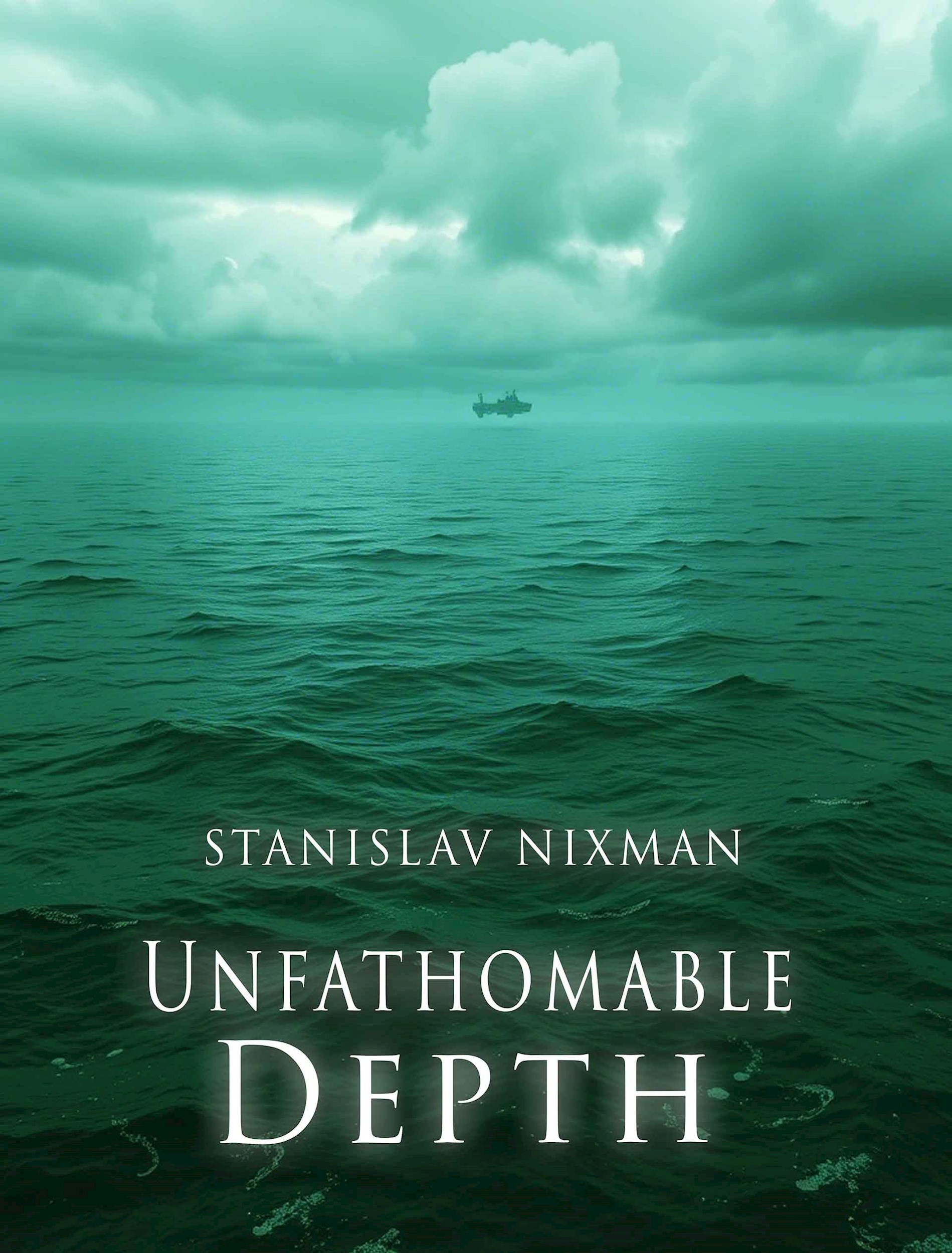
Unfathomable Depth
Chapter 1. Unanswered questions
Thalassa, a research station orbiting the ocean planet Proxima Centauri b, ~4.24 light-years from Earth. Standard time: 14:59, Wednesday, March 26, 2925.
Alex Kronenberg stood at the edge of a large observation window in his office, his right palm pressed against the cold polymer coating the wall. The soft, pearlescent glow of the ocean planet reflected in the neatly trimmed gray hair of the station’s chief scientist—a military precision to his appearance. His jumpsuit hung loosely on his frame, as if tailored for a broader, sturdier man. Beneath the unfastened collar peeked an old black cotton T-shirt—a memento from a colleague on Mars, the last anchor to a reality where complex equations still had a single correct answer, even if not the simplest one.
Kronenberg ran a hand over his face. When his fingers brushed against the small scar above his left eyebrow, the sensors of his personal biomonitor registered a spike in his pulse—the only sign that beneath layers of analytical detachment, honed over years in his position, a flicker of human anxiety still smoldered.
His gaze, gray and nearly colorless, fixed on Thalassa’s key metrics projected onto the window by ceiling-mounted lasers. But Alex wasn’t seeing numbers. Instead, his mind replayed the barren landscapes of the Martian wastelands, where he had once commanded a secret underground lab. He remembered that day—when the last level of Olympus-9 had to be purged with a nuclear blast, along with everyone who couldn’t be evacuated in time.
It seemed the time for difficult decisions had come again.
The very scenario he had feared all these years.
Below the station’s belly, the endless, shimmering ocean pulsed—alive, breathing, alien. Kronenberg knew its parameters by heart: average depth 12 kilometers, salinity 30.8%, polar temperatures hovering around minus ten degrees Celsius, yet the water never froze. This planet defied familiar rules, even as it echoed Earth in so many ways.
It boasted rich flora and fauna, worthy of study. But the researchers had been drawn here by a different mystery. Something that had made the Institute of Space Exploration divert funding from all other projects and build Thalassa in record time.
A second Anomaly had been discovered.
Similar to the one now buried forever in the depths of Mars…
A quiet cough sounded behind him.
Now, two figures were reflected in the transparent metal of the window.
One—tall, lean, with a beard trimmed just short enough to fit inside a standard spacesuit helmet: Kronenberg himself. The other—stocky, clean-shaven Arkady Suvorin, head of Thalassa’s Security Service.
The visitor’s fingers tapped a nervous rhythm against the hard plastic of his belt-mounted armor plate—a habit left over from his service in the Space Forces.
"The forty hours you asked for are up," Kronenberg said. "Report."
"My team found nothing new. No bodies, no logs, no signs of a struggle."
"So, you’re saying the crew just… vanished?"
Suvorin pursed his thin lips.
"You know that’s physically impossible, Chief. Either they were forced to abandon the Poseidon… or—"
"Or what?"
"Or they left on their own."
"Brilliant deductions, Arkady."
"I don’t have data for any other theories," Suvorin replied, a hint of offense in his voice.
Alex turned to face him.
"How is it even possible—to venture into the depths of an alien world without protective suits? Willingly or not?"
Suvorin shrugged.
"I was the first aboard the Poseidon after its return. You followed. This morning, we both read the reports from the experts who combed every square centimeter. Everything’s in place—except the crew. The logs are wiped, even the black box. The auto-return must’ve triggered because all other systems failed at once."
"An electromagnetic pulse?"
"Could be."
As if synchronized, both men glanced at the large monitor to the left. The screen displayed a feed from Hangar Two, where the Poseidon sat—massive, black and white, streamlined like a beached orca. Its airlocks hung open, and its running lights flickered red intermittently. Security and tech personnel still moved around and inside the vessel.
"The emergency subsystem worked as intended," Kronenberg mused, replaying the scenario, searching in vain for a clue. "Brought the ship up from the depths, returned it to orbit, docked with Thalassa. But the crew was gone, and all the magneto-optical storage—"
He spoke slowly, weighing each word as if it had to pass an internal censor—first for content, then logic, before being allowed out.
"—was empty," Suvorin finished impatiently. "Not damaged—just blank. Like there was never any data to begin with. That’s all we have, Chief. There’s only one possible cause—the very thing they went down there to study."
Kronenberg felt a chill crawl down his spine.
"The Anomaly is behind this? Is that what you’re saying? But the station’s sensors haven’t picked up anything unusual… beyond what we’ve already seen in this ocean’s depths."
"What does your Martian experience suggest?"
"Well done, you’ve read my file. First-level access suits you."
"Don’t remind me. I know I got promoted only because of you. Back to the Anomaly—what do you think?"
"Yes. You’re right. But that’s why the Institute equipped us with safeguards—so what happened on Mars wouldn’t repeat. They trained the crew! Warned them what they might face. Yet no one can explain to me now why they ignored all protocols! Not the psychologists, not the investigators, not you—the head of Security!"
Suvorin remained grimly silent. His gaze drifted to the window—down at the murky waters of the alien ocean. To where, roughly ten kilometers below, something lurked.
An entity had announced its presence with a radio signal when the first Earth reconnaissance ship entered this system. The pulse repeated, over and over. The now-familiar activity had prompted the Institute to build Thalassa in orbit.
Like on Mars, this Anomaly did not respond to any queries on the same frequencies. And in some inexplicable way, it disabled every probe sent into the depths. They lost contact, never resurfacing.
Now, it seemed, this entity had claimed the Poseidon’s crew—those who had dared to study it up close.
Too many parallels to the incident a decade ago...
Kronenberg forcibly shook off the clinging tendrils of memory.
Now was not the time for reflection.
"We need to go down there. As soon as possible," he said quietly. "I could order it, but I’d rather you made the choice yourself—"
Suvorin gave a slow nod.
"Understood. I’ll volunteer. But on a different ship. Prep the Triton."
"Why not the Poseidon?"
"Because it’s been there. Near the Anomaly. Something’s… off about it now. It’s changed."
"Be specific, Arkasha," Kronenberg pressed, though he too had felt unease when boarding the empty vessel two days prior.
"I don’t know, Chief. That ghost ship gives me this… unexplainable dread. Like something’s watching us through its dead cameras and sensors. That same creeping feeling of being observed we’ve all had since arriving here—only stronger."
Kronenberg’s wrist communicator buzzed sharply. He glanced at the screen—a new message, ISR channel.
"Fresh transmission from Earth, relayed via the latest subspace probe," he muttered, swiping the display. "The Institute’s sending a ship. ETA two days. Exact arrival time specified. Orders—I’m to greet it personally."
Suvorin ventured a guess:
"Reinforcements? Military or scientists?"
"Neither." Kronenberg frowned. "Only one person aboard. The missing engineer’s twin brother. Michael Andersen."
"A twin?" Suvorin scratched his chin. "You’re telling me they’re sending a relative to a classified site? Why?"
Kronenberg shook his head slowly.
"You’re Security Chief—you’ve read Viktor’s file. Take a guess."
"Right, right," Suvorin muttered, recalling. "The brother. There was a note… something about mental issues. Some serious condition. Now I’m even more lost on the Institute’s motives!"
"You’re mixing things up," Kronenberg sighed. "It mentioned a parapsychological phenomenon. Their minds have been linked since birth. Shared dreams. What one knows, the other knows. Viktor was the transmitter, Michael—the receiver."
Suvorin blinked.
"So what now? Michael sensed his brother’s gone silent? And now he’s coming here so the Institute can confirm it’s not a broken antenna but a dead transmitter?"
"Agreed. It seems pointless."
"Or maybe he has intel on his brother’s fate?" Suvorin suggested.
"Hm." Kronenberg grunted.
"No, I doubt a psychic will clarify anything," Suvorin dismissed his own idea. "Surviving down there, unprotected, is impossible. Even if he did catch some final images or sensations before Viktor died—just agony flashes. If their link is even real. I’ve seen enough psychic shows—all vague guesses and staged theatrics."
Kronenberg didn’t answer. His gaze returned to the window, but his eyes were unfocused, as if seeing not the ocean but something distant, unreachable.
"You missed part of Viktor’s file," he finally said. "Michael Andersen was never supposed to come here, let alone speak with us. But for different reasons."
"What reasons?"
"According to that note, Viktor’s brother has been in a coma for the past eighteen years."
Suvorin froze.
"They studied them, Arkasha. The twins. The Institute wanted to see if the link would hold across vast distances. Measured brainwave patterns. Viktor was frequently pulled into med-bay for tests."
"Where’d you get that? Definitely not from his file. Seems we read different documents."
"The coma part—from the file. The experiments? Viktor told me himself when I asked why one of our engineers kept hogging med-lab time."
"Huh. Funny how none of this was briefed before we left Earth. Well, the higher-ups work in mysterious ways. Let me re-guess why they’d send a comatose psychic: the link’s still active?"
"Let’s assume so."
"Then there’s hope our missing crew might still be alive."
"Possible. Maybe they found an air pocket beneath the ocean floor. Went to explore, thinking it safe—or appearing so. Then something happened, and the autopilot brought the ship back without them. I’d hoped your team would confirm this in forty hours."
"No sediment on the Poseidon’s hull, Chief! Sample bays empty. It never touched the bottom."
"A long ascent could’ve washed it all off."
"No. You saw the reports."
"Assume someone made a mistake."
"Both experts?"
"All of them, for all I care."
"Fine. The next dive’s a rescue op—but which crevice do I search? How long can they last while my team combs the depths?"
"Look near the Anomaly. Maybe Andersen’s brother can give us a hint."
Suvorin laughed nervously.
"How? Hook Michael to an IV and wait for Viktor to speak through him? Might as well air it live—housewives system-wide would tune in."
Kronenberg scowled at the sarcasm.
"I don’t know how it’ll work either," he grumbled. "And there’s more. The message includes another order: ‘Provide Michael Andersen with all necessary equipment and intel—up to clearance level one—regarding the Anomaly on Proxima Centauri b, upon his first request.’"
"What the hell? A coma patient can’t request anything! How’s that possible?"
"I don’t know! I don’t!" Kronenberg snapped, turning back to the window, staring at the ocean. "That’s all. Report acknowledged. I need to think. Dismissed."
Suvorin didn’t argue. He cast one last glance at the strange patterns beyond the glass—like oil swirling in a vast, murky puddle—and left.
His footsteps faded down the corridor.
Silence.
Below, in the hangar, the Poseidon sat quietly, its red lights flickering.
And deep in the ocean, something emitted another short, powerful radio pulse.
Then another.
Chapter 2. Another Enigma
Thalassa, a research station orbiting the ocean planet Proxima Centauri b, ~4.24 light-years from Earth. Standard time: 11:03, Saturday, March 29, 2925.
The main terminal screen in the control tower flickered with a cold blue glow. The duty operator—a sleep-deprived young man with dark circles under his eyes—tapped his fingers against the keyboard, tracking the probable entry vector of the arriving courier ship through external sensors.
The tower’s apex was a narrow pyramidal chamber, shielded by transparent metal with an adaptive polarizing layer. Control consoles and workstations lined the interior perimeter. The control room jutted far beyond the station’s main body, like the tip of a surgical instrument. From here, the entrances to all four of Thalassa’s hangars were visible several levels below.
Kronenberg stood behind the operator. His shadow stretched across the metal floor, as if competing in length with the shadows cast by the instrument panels.
"Sensors detected gravitational field distortions," the operator reported, adjusting the feed on the main monitor. "Sector six."
Suvorin, standing at the opposite console, checked his wrist chronometer:
"Right on schedule."
Meanwhile, the stars on the operator’s screen suddenly contracted, as if space itself had taken a breath—and the next moment, a small Institute starship materialized out of the void.
"Black magic," Suvorin muttered.
Kronenberg watched in silence, deep in thought. Folded space. Theoretically—a localized curvature of spacetime. Practically—a jump through a fold of reality whose laws we still don’t fully grasp. Like blind men trying to describe light. How much more does humanity not understand, yet already exploit for its own purposes?
The ship, shaped like an elongated mercury droplet, hung motionless for several minutes, orienting itself. Then, from its narrow stern, chemical engines flared to life—the good old-fashioned way of maneuvering short distances.
"Shall we go meet them?" Suvorin asked.
Kronenberg nodded.
The elevator was cramped, designed for no more than three people in full suits. Its walls, scratched and worn, betrayed frequent use despite the station’s relative newness.
Suvorin glanced at his communicator.
"Med-bay’s ready to receive the patient," he said, pressing the button for the lower level. "Duty team’s on standby, waiting for my signal. Hope the life-support pod with Michael is standard-sized and fits in this elevator."
Kronenberg didn’t answer. His eyes were fixed on the floor indicator above the door. How does a mind function after eighteen years in a coma, yet still receiving images and experiences from its twin? Has it stayed within what we consider "normal"?
The elevator descended smoothly before stopping and releasing them into the so-called "gut"—a corridor where they could safely wait for the hangar’s atmosphere to stabilize after exposure to the vacuum of space.
The hangar—a vast dome with a high ceiling—was lit by bright diode lamps. Its walls were lined with composite alloy panels and thick insulation, the floor textured to prevent slipping. At the center was a landing platform, surrounded by dormant machinery ready to assist with docking.
The massive doors yawned open to the star-studded void.
The ship glided inside with a low engine hum, settling onto the platform.
The doors sealed, compressors hissed. Minutes later, the atmosphere stabilized, and Kronenberg and Suvorin stepped out of the "gut."
Before they could reach the ship, its hatch opened, and a cylindrical module with a transparent lid rolled out. Inside, suspended in bluish fluid, lay a pale, waxen figure with closed eyes.
"Is that Michael?" Kronenberg frowned.
"Doesn’t look like him."
"But he and Viktor were identical twins."
"It’s a synthetic android," Suvorin realized, spotting the faint, telltale seam around the neck. "Some non-standard model. Never seen one like this among service units. Damn near human."
"Hm," Kronenberg grunted. "Usually, their proportions are deliberately altered to distinguish them from people."
"Some kind of medical model? To care for Michael?"
"Hope it came with instructions."
Just then, a gaunt man appeared in the hatchway. A few silver strands streaked his short dark hair, his pale skin stretched over sharp features, his eyes oddly large for an adult face. He stepped forward unsteadily, gripping the android’s module.
"Michael Andersen?" Kronenberg asked, though the resemblance to Viktor made the question redundant.
The newcomer descended the ramp, struggling to keep the synthetic’s container from tipping.
"Yes," he answered in a quiet but clear voice. "I’m Michael Andersen."
"Alex Kronenberg, head of Thalassa Research Station. This is Arkady Suvorin, Chief of Security."
Michael gave a short nod.
Suvorin raised his communicator:
"Med-bay, stand down. Repeat, stand down. No need for you."
"Interesting," Alex mused, studying the teenager trapped in a thirty-five-year-old’s body. "We expected you in a med-pod. In a... different state."
"I don’t like being addressed formally," Michael said awkwardly. "If you don’t mind..."
"Got it, Mike," Kronenberg nodded. "When did you wake up?"
"I’ve been back for a while."
"Back." What did "normal" even mean here?
"How long?"
"Eight months," Michael clarified.
Alex and Arkady exchanged glances.
"No one told us," Suvorin muttered. "Strange your brother didn’t mention it. Viktor’s been here nearly a year—you’d think he’d throw a party or even request leave to Earth."
"Vik didn’t know," Michael sighed.
"I don’t follow," Suvorin shook his head.
"Our connection... was being studied," Michael spoke haltingly, as if language were an unfamiliar tool. "The experiment couldn’t be interrupted. Especially after Vik was assigned to the dive team."
"Do you know what happened down there?" Kronenberg pressed.
"No. But I keep seeing... unclear and strange images. Very strange. The Institute thought it was important. That’s why they sent me. With this..."
He gestured at the synthetic.
"Did the Institute give you a mission?" Suvorin asked.
"They said I had to find out what happened to my brother. I want to know too."
"And how do you plan to do that? Doubt you’re fit for a dive. Just looking at you, I can tell years in a coma wrecked your physique, kid."
Michael shrugged, accepting the criticism.
"I’m not going down."
"Then how?"
"Through him," he pointed at the android, then at his head. "The Institute developed a new way to communicate. Based on my link with Vik. What the synth sees, I see. No delay. No interference."
"An android on the team?" Suvorin chewed on the idea. "Well, if the Institute insists... We’re prepping to dive soon but couldn’t settle on a fourth. Too many volunteers."
"Thank you."
"Too soon. Save it for the rescue team when we get back."
"Okay."
Kronenberg studied Michael as he spoke with Suvorin. Every word, every gesture, every flicker of emotion was analyzed. Childlike directness, yet no panic. Logic devoid of the social layers expected at his physical age. A mind raised in isolation, fed by another’s experiences. How does he truly perceive reality? Does he see it as we do?
Michael pulled something from his pocket and handed it to Kronenberg—a small electronic key.
"The Institute said you’d know what to do with this."
Kronenberg took the encrypted drive containing the synthetic’s activation codes.
"You handle it," he tossed it to Suvorin, then turned back to Michael.
"You should rest. I’ll show you to your quarters. We’ll stop by the mess hall—bet you missed real food after that flight."
Michael nodded, but his gaze flickered downward, toward where the ocean planet’s surface lay hidden.
"He’s alive," Michael whispered. "I know it."
Suvorin and Kronenberg exchanged glances.
"We’ll know for sure soon, Mike," Suvorin said with forced optimism. "I’m leading the dive myself. Your synth’ll help us bring everyone back safe."
His tone rang hollow—but was he doubting the android’s ability to withstand whatever had crippled the Poseidon’s systems? Or did he fear no one would be left to save?
"Let’s go," Kronenberg urged, steering Michael away before darker questions could surface.
Michael glanced back at the motionless synthetic.
"Arkady will take your partner to Tech and oversee activation. Don’t worry."
"Yeah, see you later," Suvorin slapped his thigh. "Got reports to send anyway."
A case of magneto-optical disks hung at his belt—classified data to be locked in the courier ship’s secure vault for return to Earth. Inside were not just incident reports but updated research from Thalassa’s science teams.
No breakthroughs yet, aside from exobiology’s discovery of genetic markers shared between Earth organisms and Proximian electric rays.
Suvorin, more soldier than scientist, saw nothing shocking in it. To him, carbon-based life in habitable zones was bound to share traits across the universe.
As Kronenberg led Michael to the elevator, his thoughts churned: A consciousness raised in darkness... What does Mike see in those strange visions from the depths? Could he be the key to understanding the Anomaly? Maybe this odd young man is part of something bigger than a rescue op...
Far below, the alien ocean breathed. Its surface, slick with oily swirls, shimmered in time with the escalating radio pulses—pulses no one on Thalassa could hear, yet all unconsciously felt, like the pressure before a storm.
Chapter 3. The Second Team
Thalassa, a research station orbiting the ocean planet Proxima Centauri b, ~4.24 light-years from Earth. Standard time: 09:40, Monday, March 31, 2925.
The quiet hum of compressors mixed with the metallic screech of loaders hauling the last equipment containers into the belly of the Triton. The ship, black and streamlined like its twin, the Poseidon, resembled an Earthly orca—the same smooth hull curves, the same stabilizer "fins." Instead of eyes, it had matte portholes; instead of teeth, rows of sensors lining its bow.
Kronenberg stood by the airlock leading to the "gut," leaning on the railing. Michael, pale and thin as a shadow, stood beside him. They watched as technicians in gray jumpsuits fussed over the synthetic, running final system checks.
The synthetic was asked to raise its hand.
At the same moment, Michael mirrored the motion with mechanical precision.
Kronenberg narrowed his eyes.
"That connection of yours?" he asked.
Michael flinched, as if caught doing something forbidden, but nodded.
"Yes."
"Is it two-way?" Kronenberg was genuinely curious. "Can you control it?"
"I see what it sees. Hear what it hears. But I can’t make it say or do anything."
Kronenberg watched as Michael’s fingers clenched and unclenched in sync with the android’s movements.
Like a reflection in a mirror.
"If that synthetic down there senses something…" Alex hesitated, searching for the right word, "...strange? Will you be able to make sense of it?"
Michael’s gaze flickered, his eyes briefly losing focus.
"Synths don’t feel things like humans. I asked Dr. Darwin about it."
Kronenberg nodded. Carlos Darwin, head of the Institute of Space Research.
"And what did he say?"
Michael frowned, wrestling with concepts too complex for his underdeveloped mind.
"Its hearing, vision, and motor feedback are tied to a... parapsychic biorelay grown from my brother’s DNA. Something like that."
"Simpler, Mike. In your own words."
"I only get the signals the Institute programmed it to send. I don’t think it has sensors for anything... really strange."
Kronenberg knew otherwise. According to the activation logs, the android was packed with every sensor imaginable.
Suvorin, approaching just then, announced:
"Trust me, your artificial friend’s gonna love his new suit—and you’ll feel it. My boys are itching to test those rigs."
"Just don’t blow up the ship," Kronenberg said dryly.
"Relax, Chief. Gotta suit up myself. Launch soon."
The security chief waved and headed for the Triton.
"Good thing your synth’s anthropomorphic," Kronenberg remarked. "The Hecate will fit."
Michael turned to him, eyebrows raised slightly.
"Hecate? What’s that?"
Kronenberg paused. How to explain armor born from misjudged risks? From an error no one ever admitted?
"A universal exploration suit. Version 2.0," he said evenly, avoiding Michael’s gaze. "Heavy armor, enhanced sensors, closed life-support, and heavy firepower—all in one. Designed by the Institute specifically for Proxima Centauri b."
"Was version 1.0 not good enough?"
Kronenberg’s mouth went dry.
"No, Mike. It wasn’t. Years ago, on Mars, the military’s most advanced personal protection failed when it mattered most. So they made the Hecate. A tank shrunk to human size. Titanium plating, myomer actuators multiplying strength tenfold. Flamethrowers, EM shields, toxin sprayers—lethal radius of twenty meters. And if something still gets close—five-megawatt discharge on contact."
"That’s... excessive."
"Agreed. Too expensive for mass production. The military’s jealous."
"No, I mean—why would researchers need weapons like that?"
"Just in case."
Michael didn’t look away.
"In case of what? Is there something down there that dangerous?"
Kronenberg touched the scar above his brow. Martian shadows, back again. They never stopped haunting him.
"We don’t know for sure."
"Overkill, then?"
The hangar smelled of ozone and grease. Somewhere, pressurized air hissed. Pain flared in Kronenberg’s chest—familiar, old. Ten years ago, they’d thought they were prepared too. Then he’d pressed the button, triggering the nuke. Sacrificed subordinates, friends.
"We learned from past mistakes," he snapped, staring at the floor.
Michael heard the weight in his voice.
"On Mars?" he guessed.
Kronenberg’s head jerked up.
"You know about that?"
"No. But when you mention Mars, you talk... differently."
Too perceptive for his developmental age. Or was his receiver-brain picking up more than just his twin’s thoughts?
"There was an accident," Kronenberg chose his words carefully, "at an underground Institute station I commanded. We found a complex life-form where none should exist. Tried to study it. Things went wrong."
"People died?"
"Dozens."
"But some survived. You, for example..."
Silence thickened between them, heavy as spilled oil. The Triton’s engines roared to life, warming up for launch.
"Don’t worry, Mike. This won’t be another Mars. If failure teaches anything, it’s that you can’t predict every risk. But the Hecate—it’s a chance."
"A chance?"
"To come back alive."
"I heard the Poseidon’s suits were still in their racks."
"Which is why Suvorin’s suiting up now."
"You never figured out why Vik’s crew refused theirs?"
Kronenberg shook his head.
"No, Mike. Honestly, we hoped you’d have clues."
"I told you everything I remember. They dove until there was light, strange patterns, flashes. That’s it. Now I’m getting... echoes. His old thoughts, memories. Repeating in my head."
"Right," Kronenberg sighed, though nothing made sense.
At that moment, bright blue lights flared along the hangar perimeter, bathing everyone in a corpse-pale glow.
Ten o'clock exactly.
"Behind schedule! Get that synth over here!" Suvorin’s voice boomed. He stood by the ramp, already clad in the Hecate, helmet tucked under his arm. The teardrop-shaped headpiece with its narrow T-shaped visor made him look like a crude statue of some ancient warrior—all angular plates of matte-gray composite and ugly weapon protrusions.
Technicians ripped diagnostic sensors off the synthetic and ushered it toward Suvorin.
"Come on, Mike. They’re launching," Kronenberg said.
As they left the hangar with the others, Alex cast a last glance at the Triton. The orca-ship seemed alive now—its hull vibrating, heat-exchange "gills" flaring, ready for the void.
What if the same fate awaited them below?
The hangar doors groaned open, revealing the pale glow of the ocean planet against the black.
The Triton slid out, putting distance between itself and the station. Its hull trembled from main engine thrust, portholes glinting like a predator’s eyes in the dark. Minutes passed as its AI made final adjustments—then the ship dove.
Not a plunge, but a controlled descent, like some great sea creature slipping into the depths. Cryogenic vapor billowed from its sides, shrouding it in white mist.
For a second, it seemed to dissolve.
Engines screamed—soundless in space, but shaking the ship’s very bones.
The Triton braked hard at the atmosphere’s edge, its hull glowing red-hot, and then—
Impact.
Steam geysered as it hit dense air. Plasma tongues licked its hull, but the Triton’s polyceramic coating shrugged off far worse.
Soon, the flames died. The ship cut peacefully through cloud layers.
Below, the ocean’s surface stretched endlessly—oily green, flecked with foam where currents clashed.
The Triton descended, stabilizers humming. In the cockpit, Suvorin counted down:
"Three... two... one..."
Second impact.
The ship pierced the waves. Water closed over it, leaving only bubbling whirlpools to mark where two worlds—Earthly and Proximian—had touched.
Green twilight faded to black deeper than the void itself.
The Triton activated its spotlights and pressed onward, down into the abyss.
Chapter 4. Crisis
Thalassa, a research station orbiting the ocean planet Proxima Centauri b, ~4.24 light-years from Earth. Standard time: 10:50, Saturday, April 5, 2925.
Space shuddered and spat out another Institute courier ship from the void. The second in two weeks. But this time, there was no information about the passengers—the warning received two days prior contained only the arrival time and the number of people aboard.
The ship’s engines flared to life immediately, not even pausing for stabilization. Thrusters burned at maximum as the vessel hurtled toward the station. Thalassa’s landing system issued a warning—one to the operator in the control tower, another to the approaching pilot.
This reckless speed violated every safety protocol.
"Is the pilot out of his mind?" Antoine Linay, acting Chief of Security for the past four days, pressed against the observation window of the "gut." "Malfunction, maybe?"
Kronenberg didn’t answer. He watched with growing unease as the ship barreled into the hangar, braking at the last second with forward thrusters. Automation would never have missed the landing pad at the center of the bay, but the human at the controls now had veered wildly off course, nearly clipping a repair crane with the starboard hull.
Compressors roared, equalizing pressure.
Nearly five days of silence from the Triton. Nearly five days of Michael Andersen convulsing in agony.
Kronenberg thought the arriving ship’s hatch opened before the hangar’s atmosphere had fully stabilized—because the "gut’s" airlock door was still sealed.
Alex impatiently jabbed the electronic lock panel again. It finally flashed green and released him and Linay toward the newcomers.
"I’m gonna tear that idiot a new one for his stunt," Linay growled, fists clenched.
He wasn’t wrong—nerves aboard the station had been frayed to breaking by recent events.
Kronenberg took only a few steps forward before stumbling to a halt, frozen. Linay stopped beside him, confusion draining the anger from his face.
The first to approach was a gaunt old man in his seventies, wearing a standard pilot’s jumpsuit. Behind this unremarkable facade stood Carlos Darwin—Director of the Institute of Space Research. His narrow, usually impassive face was tense, etched with grim anticipation. After him stood Natalya Zimina, a red-haired woman with a silver chief specialist badge, and Yen Steinmeyer, head of central biology, his frame augmented with implants.
"Director Darwin…" Kronenberg’s voice was hoarse.
"When did you last sleep?" Darwin interrupted, smoothing his thinning black hair.
He could see the burst capillaries in Kronenberg’s eyes, the bloodshot webs across the whites. Alex reeked of coffee, as if he’d replaced his blood with the stuff.
"On my feet since the Triton dove."
"At your age, Alex, that’s a stroke waiting to happen."
"We have a good med-lab."
"And we have zero time to waste on you," Darwin said sharply. "I need you functional. Status unchanged?"
"The Triton hasn’t returned. No contact. Michael Andersen’s in med-bay—his condition’s unstable. His link with the android flickers in and out. Data’s fragmented, we’re still piecing it together. And…" Alex hesitated, as if reluctant to add another piece of bad news.
"The Poseidon started developing some kind of biological film yesterday," Linay cut in. "Samples are in the lab under maximum isolation. Hangar Two’s quarantined."
Darwin nodded, as if expecting this.
He didn’t seem surprised. Just like back on Mars.
"Natalya will see her patient—Michael. Yen, to the bio-lab. I’ll review the archives myself. And you are?" Darwin pointed at the acting Security Chief.
"Antoine Linay," he introduced himself quickly. "Filling in for Arkady Suvorin."
"New head of security? You’re with me."
Kronenberg stared blankly into Darwin’s dark eyes, waiting for his own orders.
They came swiftly.
"Alex, you’re going to your quarters—to sleep. I need you sharp in eight hours."
Darwin stepped past Kronenberg and Linay, tossing over his shoulder:
"Natalya, five minutes to settle personal matters. Close this now. We have work to do. I won’t tolerate family drama during a crisis."
He crossed the "gut’s" threshold.
Steinmeyer and Linay hurried after him.
An awkward silence fell, broken only by compressor hums and the faint crackle of cooling thrusters.
Father and daughter locked eyes.
"What are you doing here?" Kronenberg asked wearily.
Natalya shifted the small black case she’d brought from one hand to the other.
"If you’d kept in touch these past years, you’d know about my career. Maybe even been proud."
"What career?"
"Neurobiology and neurosurgery, applied to parapsychology. Michael Andersen’s been my patient for three years. I’m the one who pulled him out of coma."
"Wow. That serious? Congratulations."
"Too late for that."
"I won’t even try to justify myself. Working for the Institute, you know now—secrecy, career, personal life don’t mix."
"Now I do," Natalya nodded. "But the little girl who saw her father less and less… until he vanished completely? She didn’t know. Didn’t understand."
"Does that mean you’ve forgiven me?" Hope tinged Kronenberg’s voice.
"She couldn’t," Zimina said coldly. "Good thing she’s not me. We’ll work professionally, Chief Kronenberg. You heard the Director. No family drama."
She stepped around her father and headed for the elevator.
"Wait!" Alex called after her. "All these years, I’ve carried guilt—and relief—that you weren’t with me. Institute work comes with risks."
Natalya slowed.
"On Mars, I saw people separated from loved ones in danger—then lose them forever. You can’t imagine the enemies I made that day. If you or your mother had been trapped in Olympus-9 during evacuation, I could never have pressed that button. Do you know the details? Do you understand what would’ve happened if I hadn’t initiated the safety protocol?"
Natalya turned, met his gaze—but said nothing. A few steps later, she disappeared into the access tunnel. The doors hissed shut behind her, leaving Alex alone with the hangar’s mechanical chorus.
Kronenberg closed his eyes, exhausted.
Relief still laced with pain.
I dreaded that conversation. But at least I told her what she needed to hear. Maybe one day she’ll forgive me.
He took a deep breath.
No. I didn’t say it all. Never told her I love her. That I never wanted her here, on Thalassa, during this mess.
Mess?
Too mild a word for this crisis. Because now, Kronenberg had no clear solution—no single terrible choice like the one he’d made on Mars a decade ago…
Meanwhile, in Hangar Two, the Poseidon was vanishing beneath rapidly spreading biomass. Just yesterday, it had been pale patches on the hull—like mold on forgotten cheese. But now… Sections already encased pulsed as if in death throes. The film shimmered with unnatural oily hues, streaked with whitish veins.
The infection crept along support struts like viscous spiderwebs, thickening by the minute. It contracted and expanded rhythmically, like breathing, its surface shuddering with nerve-like ridges.
A guard at the airlock pressed his helmet’s visor to the observation window. His partner dozed standing up—a useful skill learned in any military unit’s first year.
The alien biomass had already engulfed the ship’s lower half and now climbed toward the portholes.
"Observation post Hangar Two reporting," the guard keyed his comm, unable to look away. "The mold’s accelerating. Right before our eyes. Speed’s increased tenfold, maybe a hundred!"
His partner jolted awake, blinking at the agitated guard.
"Fall back to the elevator—" Linay’s nervous voice crackled, cut off by Darwin’s commanding tone.
"All personnel evacuate the lower deck immediately. Linay, distribute remaining Hecate suits—not the ones from the Poseidon. Flamethrowers and toxic sprayers. Sterilize the hangar. Burn it to bare metal. Then acid wash. Keep the bay open until we’re certain the infection’s gone."
Far below, the Anomaly emitted radio pulses by the hundreds per second. And in time with those waves, the strange mold grew faster. And faster.
Chapter 5. Guest from the Depths
Thalassa, a research station orbiting the ocean planet Proxima Centauri b, ~4.24 light-years from Earth. Standard time: 11:16, Saturday, April 12, 2925.
The door to the medical bay hissed open, releasing Kronenberg into the corridor. The next staff member slipped inside immediately. A dozen more people stood in line, pulled from their duties by strict safety protocols.
Alex absently rubbed the inside of his elbow—where the skin, now covered by a bandage, ached from the blood draw. Tests, tests, and more tests—standard procedure after exposure to potentially contaminated objects.
How effective are these measures, really? What are we dealing with this time? On Mars, we faced more complex organisms. What if these spores are just the beginning of the same scenario?
Kronenberg walked down the corridor toward the first ward, where Michael Andersen was being monitored. His thoughts moved sluggishly, wading through the thick syrup of chronic sleep deprivation.
Exactly one week had passed since the Poseidon suddenly became a contamination hotspot. Security had scorched the hangar black, doused everything in acid, scrubbed every centimeter clean. They’d even vented the compartment to vacuum for three full days.
It should have worked. But two days ago, it started again. First, barely noticeable pale spots on the ship’s hull. Then explosive, rampant biomass growth. This new mold encased not just the Poseidon, but the landing platform around it, threatening to infect the entire station with an alien plague.
They reopened the hangar to space, and the process stopped.
Biologists under Yen Steinmeyer’s direction analyzed the collected samples and confirmed the spore hypothesis. Dormant in vacuum, the Proximian organisms reactivated only under the right conditions—where there was atmosphere, warmth, room to grow.
Director Darwin ordered Hangar Two left open to space—no point wasting limited resources on repeated sterilization while risking contamination of other compartments.
Kronenberg stubbornly pushed away his grim suspicions. It wasn’t working.
His mind kept replaying the image from Hangar Two: pale flakes drifting in zero gravity like slow-motion snowflakes. They seemed lifeless, but it was a lie. The spores waited. Dormant, ready to awaken at the first hint of favorable conditions.
How do we fight something that can’t be destroyed by conventional means? Resort to extreme measures again? Use a nuke and wipe out the station? What about the crew?
Alex’s fists clenched. What if the contamination has already spread beyond the hangar? What if spores are in the ventilation, the life-support systems?
We’ll find out soon enough. Daily health screenings can detect known threats. But the Mars incident proved the Anomaly operates outside our understanding…
Kronenberg reached the ward where Michael Andersen was being held and stepped inside. Here, in this part of Thalassa, artificial silence reigned. No extraneous sounds penetrated—just the occasional electronic beep of medical equipment and the quiet hum of air circulators.
Michael lay on a standard hospital cot, his pale face lit by the soft glow of overhead panels. Two inhibitor devices, developed by station engineers at Natalya Zimina’s request three days prior, were affixed to his temples.
Earlier this week, she had pinpointed the exact characteristics of the parapsychic waves triggering Michael’s seizures and passed the data to the tech team to build neural shielding.
In reality, this harmful signal was nothing more than his fractured link with the android in the ocean depths—but amplified a hundredfold, endlessly repeating like some monstrous echo.
"Chief Kronenberg," Natalya said without looking up from her tablet. "Late again."
Her voice was calm, almost mechanical—not accusatory, just stating a fact.
Or was she?
She stood at the head of the bed. Beside her, Carlos Darwin sat in a chair, working on his own tablet. The Institute Director glanced up, his gaze flicking first to Alex, then to Natalya with a frown.
"Did I miss something important?" Kronenberg asked, stepping closer.
He studied Michael’s face. The young man’s eyes no longer looked as hollow as they had yesterday, but something murky lingered in them—like the abyssal darkness of Proxima b’s depths.
That gaze could no longer be called youthful or naive.
"Our friend is conscious," Carlos said, typing something into his tablet. "No seizures since Natalya tuned the inhibitors. But…" He hesitated, as if reluctant to continue.
"But what?" Kronenberg turned to his superior.
"There’s too little information. Michael speaks in fragments. Worse, we can’t confirm these are real memories and not just the Anomaly’s influence. We still don’t fully understand what that entity does to the human brain down there. Or how to help the teams trapped below."
"We may never know," Kronenberg said grimly.
"Not necessarily. We’ve confirmed the Anomaly emits powerful mixed-spectrum radiation that doesn’t just disrupt electronics—it affects the human brain. The closer you get, the worse it is. Michael will help us develop countermeasures…" He checked his tablet. "If you have questions for him, ask now while I prep the next round. Natalya will monitor his condition."
Kronenberg turned to Michael. The young man blinked slowly, as if waking from a long sleep, and met his gaze.
"Mike," Alex said. "Can you hear me?"
"Yes," Andersen’s voice was hoarse but clear.
"Did you see our people?"
"Yes. Through the android."
"What’s their status?"
"It’s… hard to explain."
"Try," Kronenberg said gently, sitting on the edge of the bed. "No jargon. Remember our talk in the hangar?"
Michael fell silent, gathering his thoughts. His gaze grew distant, as if he were slipping back into the nightmare at the planet’s bottom.
"The people… down there. They’re in a big glowing cave. You can breathe there. Water drips. But they don’t move. Something’s wrapped around them… like plants. But not quite plants. More like… tendrils. They move, coil around bodies like they’re studying them. I saw how easily those things… cracked open the armored suits of the ones who wore them…" He trailed off, as if the words stuck in his throat.
"Go on," Kronenberg urged.
"Inside… they envelop the people. The ones without suits… their bracelet sensors glow orange. I already told Director Darwin this earlier."
"They’re alive but unconscious," Carlos noted.
"Understood," Alex nodded.
For a moment, the ward fell silent. Kronenberg rubbed his chin thoughtfully.
"Can we attenuate the signal from the android to keep Mike stable?" he asked Natalya.
She sighed. "Even if we could, we’d just see the same thing. The cave. Unconscious people. Tendrils."
"So the damn android’s useless?"
"The problem is the synth’s packed with electronics. It’s just as vulnerable to the Anomaly’s local effects. Its memory keeps wiping while in contact. Yes, it reboots using non-volatile storage with base settings, but…"
Just like our ships’ emergency return systems.
"…it doesn’t help. The android sees people in danger, tries to help them per its programming, then shuts down, losing all memory of the situation. Then it reactivates. Cycle after cycle," Natalya finished.
"So all we can do is mine Mike’s memories for useful details," Kronenberg concluded. "And try to develop countermeasures against the Anomaly’s effects—again, based on what’s happening to his brain."
"You just paraphrased my earlier point…" Darwin said distractedly, now reading a message on his tablet. "Critical update from Steinmeyer: The mold in the lab upstairs reacts to the Anomaly’s radio signals. When the pulses intensify, so does its growth. And not just growth. It’s clearly trying to evolve into something more complex, and those pulses are accelerating the process."
What a fool I’ve been. This is what the Institute’s really after. Not first contact with an alien intelligence. No. They want accelerated evolution. A way to apply this power to humans. I should’ve realized back on Mars.
Kronenberg gritted his teeth.
Is Carlos really so confident he can’t see the dangers of this discovery?
At that moment, Alex’s personal communicator chimed.
Antoine Linay’s voice was tense, slightly panicked:
"Chief, get to the control room now. The Triton just appeared on sensors—it’s passed the eight-kilometer depth mark. Seven now. Looks like the auto-return triggered. And… we’ve got another problem."
Darwin set his tablet aside. Natalya’s head snapped up. A strange look flashed in Michael’s eyes.
The pause stretched too long.
"Spit it out, Antoine!" Kronenberg barked.
"Sensors detect complex biological activity aboard. Something alive is coming up with it."
Chapter 6. Interpretation Challenges
Thalassa, a research station orbiting the ocean planet Proxima Centauri b, ~4.24 light-years from Earth. Standard time: 14:42, Wednesday, April 16, 2925.
Hangar Three had been transformed into an isolated environment with the following parameters: pressure 1 atmosphere, temperature 12°C, humidity 98%. Inside, at the center of the sterile zone, stood the Triton, surrounded by monitoring cameras and an array of scanners. Its once-sleek hull was now entangled with writhing tendrils of an alien biological structure, the core of which lay somewhere within the ship’s inner compartments.
One of the external segments of this extraterrestrial visitor was a complex formation exhibiting characteristics of both plant and animal organisms. Protruding from the main airlock, this structure resembled an exotic orchid roughly three meters in diameter, its translucent petals emitting a faint glow.
Strange, stamen-like filaments extended from the flower’s center, pulsing slowly. These tendrils could alter their shape and length, almost as if "inspecting" the hangar—though no visual organs were detectable on their surfaces.
Unlike the mold from Hangar Two, which had aggressively sought to expand its territory, this new guest showed no signs of uncontrolled growth. Yet its activity still correlated with the radio pulses emanating from the Anomaly.
A theory quickly emerged that the object functioned as a kind of amplifier for these signals, creating a zone of heightened psychic influence aboard the station.
Since the Triton's return, over thirty cases of acute psychosomatic reactions had been recorded among the crew. Twenty-four personnel were under medical supervision with diagnoses of "acute anxiety neurosis." Seventy percent of the station’s staff were now taking sedatives.
Nightmares, hallucinations, and panic attacks had become commonplace. And yet, no one could grow accustomed to this pressure.
Alex Kronenberg sat at the table, his head resting on his clasped hands.
Besides him, four others occupied the observation room overseeing Hangar Three. The meeting, which had begun at ten that morning, was nearing its conclusion.
Carlos Darwin was summarizing.
"So, this is an attempt at contact," the Institute Director declared, and no one dared argue. "The Anomaly is an intelligent entity. It’s trying to establish communication with our species. We study it—it studies us… Yes, Antoine? You look concerned."
The acting Security Chief cleared his throat.
"I sincerely hope your conclusions are correct, Director Darwin. And that… thing in Hangar Three isn’t a threat. But the situation aboard Thalassa worsens daily. Perhaps we should reconsider—"
"Steinmeyer, explain it again—specifically for Linay!"
Obediently, the head of the biology department repeated a segment of his earlier report with a bored expression:
"We’ve thoroughly scanned the structure. Collected samples, tested for toxicity and hidden parasites…"
Hidden parasites. We overlooked that factor on Mars. Could we be missing something critical now?
"...No aggressive response from our guest. Histological analysis shows traits of both plant tissue—cellulose fibers, photosynthetic membranes—and animal tissue: neuron-like clusters, contractile fibers. We’ve recorded pulsations at 0.8 Hz, synchronized with the radio pulses from the depths. The structure modulates the Anomaly’s emissions locally, creating complex interference patterns. It’s an extremely sophisticated biological amplifier—nothing more."
Linay snorted skeptically. Steinmeyer hadn’t convinced him, even on the second try.
Kronenberg decided to back his wary colleague:
"Antoine isn’t wrong. Most of the crew is on the verge of a breakdown—"
"We’ve implemented 24/7 monitoring and psychological evaluations," Natalya Zimina interjected. "Severe cases receive GABA-agonist sedatives. The situation is controlled. Research continues."
"Even so, I share Antoine’s concerns," Kronenberg said firmly, avoiding his daughter’s sharp gaze. "You believe we’re on the brink of contact with alien life—I don’t dispute that, and neither does Linay. What we’re saying is that this ‘communication’ will drive the crew insane faster than we’ll learn to speak the Anomaly’s ‘language’ safely."
Carlos Darwin sighed heavily.
"Your proposal, Alex? Burn Hangar Three? Abort another attempt at interaction? Should we send a research team down with dictionaries?"
Kronenberg’s left eyelid twitched, but he kept his voice calm and steady.
"First, we need to understand this radiation. Sedatives aren’t a solution—they just delay the inevitable. Why not order the engineers to replicate the neural inhibitors protecting Michael Andersen?"
"Natalya?" Darwin raised an eyebrow at the specialist.
"Andersen’s brain was studied for years by dozens of Institute experts," Zimina explained, though the Director already knew this. "The neural pathways sensitive to the Anomaly’s emissions—the ones we’ve blocked—either don’t exist in others or formed differently. A universal version can’t be developed in a reasonable timeframe—"
At that moment, the door opened, and Michael entered. His pale face, illuminated by monitor flickers, looked almost translucent—as if his skull glowed beneath the skin. The metallic droplets of inhibitors clung to his temples.
"Something wrong?" Natalya leapt up and rushed to him. "Are you alright?"
He shook his head, gently pushing her away.
"I think… I know what needs to be done, Dr. Zimina."
She stepped back.
"Sit," Darwin gestured to an empty chair. "We’re listening."
Andersen hurriedly took a seat.
"This morning, I disabled the inhibitors for a few minutes," he admitted, his voice oddly altered. "But I didn’t lose consciousness."
Darwin straightened in his chair.
"Go on."
"At first, I didn’t understand. Then I felt… the signals had changed."
Everyone hung on his words. Natalya watched Michael with a mix of professional intrigue and unease.
"The situation below changed?" Darwin guessed.
"No. It’s happening here. Now. On the station."
"Explain."
"I stopped hearing the android. It was like… white noise. And inside it, a call."
"A call?" The Director narrowed his eyes.
Michael hesitated.
"Let me approach the flower," he finally said.
"Michael?!" Natalya exclaimed.
"How does Andersen know what it looks like?" Linay demanded. "He hasn’t left med-bay. Who told him?"
"I see it in my mind," Michael replied. "I need to touch it."
"Touch it?"
"Yes. No suit. No protection."
"Out of the question," Linay refused. "That violates every safety protocol."
"If this structure isn’t just an amplifier but a communicator, we could achieve meaningful first contact," Steinmeyer countered.
Or something else entirely.
"If the contact goes wrong, we could lose our only key to understanding the Anomaly," Darwin said, his expression conflicted, as if wrestling with himself.
Kronenberg stared at him in surprise.
Is Carlos actually advocating for Michael’s safety over the Institute’s interests?
Silence fell over the room, thick and unbroken.
Finally, Darwin made his decision:
"Andersen appears to be the only receiver capable of correctly decoding these signals. While the rest of the station suffers psychoses, he perceives a different message in them. We must allow him direct interaction with the object in Hangar Three."
"You’d trust the judgment of someone who spent eighteen years in a coma?" Kronenberg challenged. "He’s practically still a teenager! He doesn’t grasp the risks—for himself or everyone aboard!"
Darwin pressed his lips together, then answered slowly:
"But we do. Risks have always accompanied the Institute’s work, Alex. You’re one of three people here who could destroy Thalassa with a nuclear blast at any moment. I’d wager that weighs on you more than any fear the Anomaly projects."
Kronenberg clenched his jaw.
Don’t take the bait. If he breaks you, he’ll move on to Linay. Then the only person left to make decisions will be Carlos Darwin.
"Director, your course contradicts standing orders—" Linay stood.
"No direct evidence of threat has been found," Darwin cut him off.
"I demand a full vote," Linay insisted.
Kronenberg caught his desperate look and gave an almost imperceptible shake of his head.
Please, Antoine, sit down. Darwin’s authority far exceeds yours or mine. He’ll remove us for insubordination. He’s waiting for the excuse—can’t you see?
"Unnecessary. I take full responsibility for overriding protocol," Darwin stated, then turned to Michael. "You understand the risks? Still willing?"
The young man nodded.
The Director checked his communicator.
"Natalya, you have two hours to evaluate Michael’s mental and physical condition. Linay—provide security. Steinmeyer, prepare equipment and personnel. Kronenberg—oversee readiness. Contact me if delays arise. We convene at exactly seventeen o'clock at Hangar Three’s checkpoint. Meeting adjourned."
Somewhere below, on the ocean floor, the android from the second team rebooted. It stood, assessed its surroundings, and took a step toward the humans needing its aid—
—only to be struck by a surge of energy, shutting down instantly.
Chapter 7. Lessons from the Past
Thalassa, a research station orbiting the ocean planet Proxima Centauri b, ~4.24 light-years from Earth. Standard time: 19:20, Wednesday, April 16, 2925.
The scene in Hangar Three resembled something from a surreal nightmare: the alien biological entity had wrapped its pulsating tendrils around Michael Andersen, as if attempting to absorb him. Thin, nerve-like filaments latched onto the young man’s temples like leeches.
Michael, clad only in a light jumpsuit, hung limp in the creature’s grotesque embrace, his face paper-white, eyes rolled back.
This bizarre contact had lasted just over half an hour.
Nearby, shielding the scientists, stood eight security officers in Hecate armor. Antoine Linay, acting Chief of Security, tapped his finger nervously against the activation switch of his flamethrower, his gaze flicking between Michael and Director Darwin, awaiting orders.
The researchers kept their distance, observing through the transparent visors of their biohazard suits.
"How much longer is this going to last?" Alex Kronenberg asked, his voice tense, directing the question primarily at his daughter.
"The people down there have been in a similar state for nearly three weeks," she replied without looking up from the tablet displaying Michael’s biometrics.
"We don’t actually know their condition. That’s not the point. When are you planning to extract Andersen from that thing?"
"Not my call."
"Director Darwin," Kronenberg turned to his superior, "what’s the time limit? Do we have a contingency if it refuses to let him go?"
Before Darwin could answer, Yen Steinmeyer intervened. The head of the Institute’s biology department seemed uniquely unperturbed by the situation.
"Relax, everything’s under control," he said, typing on his tablet. "Worst case, we administer a QS-9 metabolic inhibitor. Developed after the Olympus-9 incident to suppress hybrid biological systems. It’s even been tested here—effective against the mold samples from Hangar Two."
Darwin pointed at Michael.
"The moment Andersen’s vitals decline, we administer the inhibitor. If that fails…" He glanced at Linay. "Antoine handles the rest. I’m sure he’ll enjoy it."
The security chief grimaced, though his helmet hid the expression.
"So how long do we wait?" Kronenberg pressed. "Another hour? Two?"
Darwin opened his mouth—but never got to answer.
The monstrous flower suddenly convulsed. Its petals clenched, and the tendrils flung Michael away as if discarding him. His body hit the hangar floor with a dull thud.
Kronenberg could’ve sworn the alien structure’s final movements carried… disappointment?
"Contact terminated!" Natalya lunged forward, but Darwin stopped her.
"Hold," he barked, then ordered, "Linay, retrieve Andersen."
Antoine signaled his team.
The Hecate-clad security moved in, surrounding Michael. Two officers hauled him up and carried him back to the scientists, where they laid him on an open isolation stretcher.
"Vitals stable," Natalya reported, kneeling beside him. "But he’s unconscious."
She sealed the bio-containment lid, ensuring oxygen flow, then stood.
"Get him to the clean room," Darwin commanded. "Natalya, full monitoring. I want updates on everything."
Two officers lifted the stretcher and carried Michael toward decontamination. Natalya followed, trailed by Steinmeyer and Darwin.
The hangar fell into tense silence.
"Let’s get some real coffee," Kronenberg suggested to Linay.
"This late?"
"You planning to sleep tonight?"
"Depends."
"Darwin hasn’t called it yet," Kronenberg noted. "And I’d like to talk. While we still can."
"Fine. Give me five mins."
Linay briefed his remaining team, then followed Kronenberg into the "gut," now converted into a series of decontamination airlocks…
The technical level lay deserted. Only relay clicks and ventilation hums broke the silence. The coffee dispenser—one of maybe ten on the station that hadn’t been neutered to rationing mode—gurgled as it poured two cups of thick, aromatic brew.
"Our techs are sneaky bastards," Kronenberg inhaled the bitter aroma. "Hacked the firmware, disabled the economy setting. Suvorin looked the other way."
Linay sipped silently, eyes flicking to his communicator—the security interface confirmed they were alone on this level.
"What did you want to discuss?" he finally asked.
Kronenberg set his cup down.
"Earlier, Darwin mentioned three people who can activate the nukes aboard this station. That wasn’t casual."
"Trust me, I know the responsibility," Linay frowned.
"You and Arkady served together? On a missile cruiser?"
"Two years aboard the Hephaestus. Patrols during the Ceres miners’ revolt."
"So you understand threat protocols."
"Of course. We carried live warheads, not training sims. Even did live-fire drills in the belt. Well, ‘training exercises,’ officially."
"Then I’ll ask directly—are you prepared?" Kronenberg’s voice dropped.
"For what?"
"I brought you here to admit something: I’m not. I can’t push that button. Even if the entire station’s compromised."
"Because of your daughter?" Linay guessed—he knew about their strained relationship.
"Yes."
Darwin brought Natalya here deliberately. He found my weakness.
Silence. A distant relay clicked.
"You’re doubting yourself," Linay processed this. "Maybe we should inform Darwin. He’s one of the three."
Kronenberg clenched his jaw.
"During the Mars incident, Carlos Darwin did everything to stop the nuke from detonating. Despite the reports piling up on his desk. Consequences be damned—he’s chasing some private agenda. He’ll risk anything to achieve it. And he’s only gotten worse over the years… The only reason I wasn’t fired was because the Institute answers to the Council of Nations. The tribunal ruled I followed protocol. They even put me in charge here, trusting I’d make the hard calls. Darwin raced here the moment things got messy—to stop me. Today, he violated protocol again, just like on Mars."
"Damn… Did Arkady know?"
"I never briefed him on high-level politics. He’d barely accessed my file before diving with the Triton."
Linay stroked his chin thoughtfully.
"Tell me about Mars. Not curiosity—I need to gauge how bad this is."
Kronenberg closed his eyes.
"The Olympus-9 complex was drilling the Tharsis Plateau, like other stations. We found a subterranean pocket—a whole ecosystem. Plants, insects, worms… all functioning as one organism, linked by some invisible neural web. Deeper still, we located the Martian Anomaly. The source of the signals controlling that biome…"
He took a sip, but the coffee tasted like ash now.
"Within a month, personnel on the lower levels started losing their minds. Hallucinations. Panic attacks. Then… infection. Unusual parasites hijacked their minds and bodies within minutes. The infected immediately turned on the uninfected. I sealed the lower levels, evacuated who I could, and blew the station. If Darwin hadn’t been Earthside that day, he’d have stopped me. Who knows how that would’ve ended? I couldn’t take the risk."
"Hell…" Linay set his cup down hard, sloshing coffee. "You think that’s happening here?"
"What’s your take?"
The silence shattered as Natalya’s call came through. Her voice was unnaturally tense:
"Father, we need to talk. Privately. Meet me near midnight."
Kronenberg froze. He hadn’t expected his daughter to reach out first.
Not this soon.
"Of course," he replied, ending the call.
Linay raised an eyebrow.
"Sounds like the ice is breaking. She forgives you. After everything these past weeks—she sees what Institute work really entails."
"I wouldn’t assume that," Kronenberg shook his head. "This isn’t about reconciliation. She’s scared."
Linay checked his comm logs.
"Come on, Alex. What’s worse than what’s already happened? Same mess as before. No new incidents reported…"
But Kronenberg wasn’t listening. A grim thought circled his mind:
We can’t even understand those closest to us—family, friends, colleagues. Yet we’re so sure we’ll communicate with an alien intelligence…
Arrogant fools.
Chapter 8. Revelations
Thalassa, a research station orbiting the ocean planet Proxima Centauri b, ~4.24 light-years from Earth. Standard time: 13:08, Friday, May 2, 2925.
The cameras in the conference room recorded every word, every gesture, every fleeting expression on the faces of those present. The Council of Nations demanded complete transparency—or at least the appearance of it.
Director Darwin sat at the head of the table.
"We've exhausted all options for contact with the object in Hangar Three," his voice was cold, stating facts. "The Anomaly appears to share this assessment. The alien biological communicator shows all signs of degradation: shrinking in size, fading coloration. Psychological tension aboard the station has been decreasing all week..."
Kronenberg sat back in his chair, half-listening. His gaze drifted across the tablet screen before him, displaying activity graphs of the "flower" from Hangar Three. The structure had shriveled like a houseplant deprived of water.
"Michael Andersen's brain surgery was successful. In two days, he'll be ready for another close-contact attempt," Darwin continued. "If we miss this window, we'll have to retrieve another sample from the depths or stimulate mold evolution in Hangar Two. Both options carry risks with no guaranteed outcome, especially after the rat experiment failed..."
Alex's thoughts drifted back to his conversation with Natalya two weeks prior.
He'd come to her quarters late at night after she handed Michael's monitoring over to another shift.
To his surprise, he discovered his daughter kept a pet—a white lab rat with a black spot on its right ear.
"You talked the biologists out of it?"
"Not here. I brought Newton from Earth."
"How did you smuggle him aboard? I met you personally and didn't notice any carrier."
Natalya smiled.
"My case has a compartment with a miniature cryo-pod. They still use these for rat trials—testing new hibernation drugs. Seemed convenient. When I'm too busy to care for him, he sleeps for a week or two."
"Creative," Kronenberg shook his head.
Pity you can't do that with children while pursuing a career.
The rat perched on Zimina's shoulder, cleaning its whiskers.
"An albino with a defect," Alex noted the black spot.
"Recessive gene. My lab considered it unacceptable—wanted to euthanize him. I took Newton instead. Now he travels with me."
"Touching story. But sentiment doesn't override safety protocols. You smuggled unregistered fauna aboard a quarantined station. I assume you plan to take him back to Earth?"
Natalya glared.
"Don't treat me like an irresponsible fool."
"What if he explores beyond your quarters?"
"I've secured all vents. He's not going anywhere."
Kronenberg shook his head skeptically.
"And if he escapes and gets infected?"
"Then I'll report it. As required."
"Might be too late, Natasha."
"I monitor Newton's health daily—same rigor as the lab rats. Speaking of which... do you know what Steinmeyer's really doing?"
"Studying the mold and tissue samples from the 'flower,' testing our defenses... Why?"
Natalya's expression tightened.
"Michael's isolation room is near Steinmeyer's lab. Today there was unusual activity—not related to Andersen. The bio-lab was like a disturbed beehive. I saw things."
"Tell me," Kronenberg demanded.
"They've been experimenting on rats—direct mold exposure. Something went wrong. They had to destroy all samples."
"So the problem's contained?"
"Apparently, or we wouldn't be talking so calmly."
"Then nothing to worry about," Alex said with false confidence.
"I saw two containers with corpses," Natalya said quickly. "Whatever was inside didn't look like rats anymore."
Kronenberg's jaw clenched.
"Understood. I'll question Darwin tomorrow... Is that why you called me?"
"Not only."
She moved Newton to the chairback, then handed her father a tablet. The screen showed two genetic profiles.
"Left: Michael Andersen's expanded genome—neural tissue from the area governing his psionic abilities."
"And right? His brother?"
"Also Michael. After today's contact."
"No," Kronenberg laughed, returning the tablet. "That's impossible. You're saying his DNA was edited?"
"Why surprised? Humanity learned to edit somatic cells in the 21st century—CRISPR gene therapy."
"Yes, but delivering CRISPR to specific tissues requires viral vectors or nanoparticles. Even after centuries, targeting remains complex—especially for large organs like brains. This couldn't happen in thirty minutes!"
"For our scientists—no," Natalya agreed. "For the Anomaly—yes."
"Is Michael even human now?"
She hesitated before answering.
"Before Darwin recalled us here, your biologists sent a fascinating report. Genetic markers in Proximian electric rays match non-coding sequences in Earth organisms."
"Junk DNA."
"Yes. These markers govern neural tissue development—the kind enabling two-way communication with the Anomaly."
"So our 'guest' tried to rebuild Michael into a proper transceiver?" Kronenberg mused. "The contact ended too abruptly. The 'flower' gave up."
"The modification failed?"
"I thought so too," Natalya pulled up another dataset. "Look. You'll see immediately."
Kronenberg needed only seconds.
"This planet lacks primates. Michael's biology is incompatible," he said slowly.
"I showed Darwin this report hours ago. Same conclusion. Michael can't properly interface with the Proximian Anomaly."
"Proximian?" Kronenberg caught her odd emphasis. "What are you implying?"
"Darwin's spent years proving the organism you destroyed on Mars seeded life on Earth."
"How?"
"Olympus Mons—the solar system's largest volcano—erupted for billions of years, ejecting material beyond Mars' atmosphere."
"Panspermia!" Kronenberg exclaimed. "The Martian Anomaly used eruptions to spread its spores to Earth!"
"But development diverged. Maybe mutation or mass extinctions prevented a unified neural network from forming. Yet the markers remain in Earth DNA—vestigial potential for communication organs. This atavism manifested in Michael and Viktor. The local Anomaly senses kinship but can't connect."
Kronenberg processed this.
"Darwin won't accept incompatibility."
"He hasn't," Natalya confirmed. "He's requested Viktor's neural tissue cultures from Earth. They'll arrive within four days."
Alex understood instantly.
"He'll implant Michael with his brother's neurons—like the android had! Turn him into a full transceiver!"
Natalya sighed heavily.
"I've grown attached to my patient. He's under multiple pressures—his brother's plight below, the Anomaly's influence, Darwin's coercion. We might be heading toward catastrophe, not discovery. The Council must be informed."
A lump formed in Kronenberg's throat.
"I'm glad you turned out like me," he said softly—not referring to appearance.
"No thanks to you, father."
"I know... Thank you for trusting me. Darwin wouldn't share such details. He's reduced me to administrative duties—cut me from research. Time to 'sound the alarm.' Let's see how Carlos explains this to the Council."
"Don't mention my involvement."
"Understood. Linay and I will handle it. Cameras everywhere... I should go. Big day tomorrow. Goodnight."
As he stood, Natalya murmured, "Goodnight, father."
A faint smile touched Alex's lips before he left.
Natalya sat in silence awhile, watching Newton sleep curled on the chairback.
The rat dreamed peacefully, oblivious to the storm gathering around them.
Chapter 9. The New Plan
Thalassa, a research station orbiting the ocean planet Proxima Centauri b, ~4.24 light-years from Earth. Standard time: 23:31, Tuesday, May 13, 2925.
The cabin was gray and cramped—like all living quarters on Thalassa. Linay had added only a few personal touches: a printed color photo of skiers against some Earth resort backdrop hung on the wall, and a miniature model of the missile cruiser Hephaestus adorned the desk.
The acting Security Chief regarded his nighttime visitor with pity.
Kronenberg had aged dramatically in recent days. The overhead light carved deep shadows under his eyes and sharpened the wrinkles around his mouth. Alex’s hair, once a dignified silver, had faded to a dull gray. His jumpsuit hung loosely on his gaunt frame.
"We knew Darwin would retaliate after you appealed to the Council," Linay broke the prolonged silence.
"This isn’t revenge. Carlos anticipated my move."
"You’re saying this was his plan all along?"
"Yes," Kronenberg nodded. "He waited until he held enough cards to go all-in."
"Meaning?"
"Steinmeyer perfected the metabolic blocker on mold-infected lab rats. Michael contacted the 'flower,' then agreed to the neural implant with his brother’s tissue. When the alien structure in Hangar Three began withering and crew mental states stabilized, Darwin presented this to the Council as controlled progress in establishing contact..." Alex listed. "Now his proposal to send Michael, you, Steinmeyer, and Natalya down seems perfectly reasonable. I just look like a hysterical alarmist raising objections."
Linay leaned back, lacing his fingers behind his head.
"Maybe you’re overreacting? Natalya says Michael’s stable—constantly exchanging images and sensations with the Anomaly. He hears the 'call' again, even though the communicator’s dead. It’s inviting further contact. Other positives: no more seizures, no inhibitors. The kid’s ready for deeper interaction... And Darwin wouldn’t risk Natalya and Yen lightly."
Kronenberg scoffed.
"You don’t know the Director. Personnel losses are acceptable risks to him."
"Don’t catastrophize," Linay chided. "The interaction’s improved. Now’s the best time to retrieve our people."
"Assuming there’s anyone left to retrieve?"
"Michael still senses his brother’s thoughts."
"'Echoes of memories'—his exact words."
"You think our team’s dead? That the Anomaly absorbed their minds and is mimicking Viktor?"
"You said it, not me," Kronenberg replied tersely.
Linay coughed and shifted posture, planting his elbows on the table.
"That’s just your pessimism talking, Alex. I’ll see for myself down there. Handle any threats. We discussed this."
"I don’t doubt your judgment. But—"
"—But Natalya’s going too," Linay sighed.
"Exactly."
"What do you want from me, Alex?"
Kronenberg rubbed his face as if scrubbing away exhaustion.
"When’s the Triton scheduled to dive?"
"Next Monday, per my intel," Linay said.
"Good. That gives us time."
"For what?"
Alex hesitated. His knuckles whitened as he clasped his hands.
"We’ll execute Darwin’s plan—just earlier. Not waiting for Monday. We descend this week."
"We?"
"Me and Andersen."
"Just you two? Who’ll pilot?"
"All Institute directors train for emergencies."
"I’ve seen Darwin ‘fly.’ You’re all dangerously under-trained."
"Mistakes are inevitable when rushing."
"So are fatal ones! This is insane! Are you thinking straight?"
"Listen," Kronenberg whispered urgently, "if the Anomaly truly wants contact, Michael and I are safe. The only risks are getting caught stealing a ship... or failing to reach the depths."
"And if your pessimism’s justified? What if you face worse down there?"
"Then fewer people die. You and Natalya live."
Linay massaged his temples.
"They won’t let you near the Triton, even if I order it. I’d be arrested immediately."
"I’m not asking you to expose yourself. We’ll do this quietly."
"Quietly? Say you somehow board and start the engines. Then what? Control won’t open the bay doors."
Kronenberg nodded and revealed the rest:
"That’s why we’re taking the Poseidon."
"What?"
"It’s still in Hangar Two—doors open. You delay your guards for a few minutes. Michael and I pose as relief crew—those service suits hide faces and voices."
"Christ," Linay exhaled. "If Arkady didn’t respect you so much, I’d be calling Darwin right now."
It pays to befriend security. A lesson I learned on Mars.
"The Poseidon’s coated in mold," Linay reminded. "You saw what it did to Steinmeyer’s rats. Want to end up like them?"
"The substance is inert in vacuum. And the interior’s clean. We’ll wear suits."
Linay almost asked how Alex planned to transport seven extra suits for the presumed survivors below—but stopped himself.
Kronenberg doesn’t believe anyone’s alive.
"What if the auto-return triggers while you’re down there?" Linay raised another flaw. "Darwin had the Triton’s emergency systems reprogrammed—techs have been at it for days."
"Simple solution. Get me a plasma cutter from storage."
"Ah. Physically remove the control module. There’s also the remote access system—you’ll need to disable it before leaving the hangar. Otherwise, Control can override you."
"I’ll need the Poseidon’s schematics to execute this quickly. Can you retrieve those files by tomorrow night?"
"Easy. I’ve got full archive access—except Darwin’s private databases."
"Then until tomorrow." Kronenberg stood.
Linay rose too. They shook hands firmly.
"Try to sleep," the security chief advised, glancing at the wall med-kit. "I’ll get you a stim cocktail we used in the military for endurance. Take it four hours before diving."
"Thanks, but stimulants aren’t the priority. Just get every tool we need. Every. Single. One. Understood? Don’t worry about my health—I’ll survive the descent."
Linay nodded slowly.
"Some items will be... difficult to acquire, Alex."
There’s one way. If only Suvorin didn’t change his safe code.
"I believe in you, my friend."
The door opened. Kronenberg stepped into the corridor.
The halls lay deserted, as if this sector were abandoned. Pale lighting streaked the walls unevenly, leaving pockets of darkness between diode panels. The air hung motionless, laced with faint scents of ozone, plastic, and metal.
The cabins lining the passage were silent—no voices, no shuffling behind doors, just the hum of life support, too quiet to rouse sleepers.
If anyone’s actually sleeping. Or are they lying awake, listening for those distant pulses from the ocean floor? Waiting for the next panic attack or hallucination that’s plagued Thalassa for weeks...
Alex didn’t know. But he was certain sleep wouldn’t come easily tonight.
A strange sound echoed—like a small creature scurrying through the vents.
Newton.
Kronenberg sighed. So much for Natalya’s strict supervision.
Chapter 10. Aftermath
Thalassa, a research station orbiting the ocean planet Proxima Centauri b, ~4.24 light-years from Earth. Standard time: 05:15, Saturday, May 17, 2925.
Zimina checked Newton's vitals—everything was normal; the creature had entered hibernation. She tucked the capsule with the peacefully sleeping animal deep into her suitcase.
You'll wake up back home on Earth.
Investigators would arrive at Thalassa the day after tomorrow, and Natalya wouldn't have time for a pet. But the inspectors would definitely have questions...
Yesterday, early in the morning around this same time, she had been awakened by a call from Antoine Linay.
The acting Security Chief had informed her in a tense voice that her father and Michael Andersen had stolen the Poseidon at midnight and descended to the zone where the Proximian Anomaly had once been located.
"Had been located?" Zimina hadn't understood at first.
"Ten minutes ago, a nuclear charge was detonated down there..." Linay had paused briefly before finishing. "All life within a three-kilometer radius has been wiped out. No trace of the ship on radar. Director Darwin has called an emergency meeting in half an hour. That's the news. None of it good. Sorry."
Natalya had hung up without a word.
She wasn't surprised. She already knew.
Antoine's call had pulled her from the grip of a nightmare in which she had stolen the Poseidon with her father, descended to the ocean planet's depths, and navigated through a network of glowing underwater tunnels.
It was as if she had participated in the events of the past night—only she had witnessed everything through Michael Andersen's eyes...
The Poseidon floated on the surface of an underground lake inside a massive cave, its walls covered floor-to-ceiling with alien vegetation emitting a soft, pale glow.
Alex Kronenberg, breathing heavily, shoved a large plastic case into the control cabin. Linay had left the case of tools for him on the technical level, hidden behind a false panel.
Fortunately, the guards at Hangar Two's checkpoint had been in a hurry to end their shift and hadn't even questioned why their "colleagues" were hauling something so heavy. Maybe the scientists were installing new equipment?
"What are you going to do?" Michael asked, peering out from the co-pilot's seat.
"Cut out the emergency return module," Kronenberg replied, pulling a plasma torch from the case. "You don't want us getting stuck here, do you?"
"I want to see my brother. You promised."
"That's why we're here. But if the Anomaly disrupts the ship's systems again, the Poseidon will head home without us... Alright, Mike, go wait in the passenger compartment—it's too cramped in here, and it's about to get smoky."
Some time passed before Kronenberg finally emerged from the cockpit, lifting his visor. Despite the helmet's efficient ventilation, his face was dotted with sweat.
"All set."
"Can we go now?" Michael asked eagerly, having grown bored.
"Yes. We need to find Viktor and the others..."
They left the Poseidon, descending the telescopic ramp onto the shore of the underground lake. The vast, shimmering body of water was connected to the ocean by a network of tunnels—the same ones the ship had traversed to get here.
Kronenberg and Michael ventured deeper into the glowing caves, leaving the sparkling lake behind. Choosing the widest tunnel, they soon reached the area where the remains of the first and second teams lay.
The walls of this cave glowed from within—as if thin threads of bioluminescence pulsed through the rock, forming an intricate pattern of bluish-green veins. The light flickered like breathing, intensifying and fading as though the cave itself were a living entity observing the remnants of its uninvited guests.
Four bodies lay near the center, sprawled on the stone floor, which was coated in a thin film of sticky organic slime. They wore no armour—just standard jumpsuits that now looked unnaturally flat, as if nothing remained beneath the fabric but desiccated husks.
The first team's skin had darkened and shriveled, their fingers curled. Their faces retained expressions not of horror, but of strange, almost meditative calm. Clouded eyes stared blankly, pupils dilated, as if they had been gazing at something incomprehensible in their final moments.
A meter away lay three armored corpses. The Hecate suits, once impervious, were now twisted heaps of metal and polymers. Something had torn through the advanced armor as easily as prying open a tin can.
Beside the security officers, like a discarded marionette, lay the android. Its armor was intact, but the helmet had been torn off. The synthetic's face was frozen in an empty expression. One arm stretched forward, fingers clenched as if in a final attempt to grasp something.
A diode on its left temple pulsed red—a sign of system failure.
The tendrils Michael had described in his visions no longer ensnared anyone. No cocoons. Nothing of the sort could be seen in this cave.
Only dead bodies.
As if the guests no longer interested the Anomaly.
"That's it," Kronenberg sighed heavily. "The experiment is over."
He glanced at Michael, expecting a reaction to his brother's death.
Andersen approached Viktor's body and crouched beside it. For a while, he remained there, as if listening for something.
"We need to keep going," Michael said eventually, standing up.
His voice was eerily calm.
"Back to the ship?"
"No. Deeper into the caves."
"Why? It's clear enough—humanity isn't ready for this contact. If it ever will be."
"Viktor is calling me."
"Mike, are you okay?" Kronenberg asked warily. "Your brother is dead."
"He's alive," Michael insisted stubbornly. "And he's waiting for me."
Andersen turned and strode forward, down the glowing stone tunnel.
Kronenberg hurried after him.
Deep in the underground labyrinth, past winding tunnels and passages overgrown with bioluminescent moss, they reached the central chamber.
Here lay the Anomaly.
It resembled a gigantic flower growing straight from the cave's stone bed. A stem as thick as a tower was wrapped in fibrous cords pulsing to an invisible heartbeat.
The apex bloomed into an enormous cup-shaped bud, from which countless tendrils descended—some thin as wires, others massive as ancient tree trunks. They swayed rhythmically in the dim light, as if stirred by unseen currents.
At the monster's base, nestled in bizarre organ-like hollows, clusters of translucent buds ripened.
They varied in size—from as small as a human head to as large as a person. Some had already opened, revealing "biological amplifiers" similar to the one that had boarded the station with the Triton. Their petals twitched, unfurling toward Kronenberg and Andersen.
But the strangest sight lay inside the largest, still-closed buds. Through their transparent membranes, human silhouettes were visible. Naked. Lifelessly suspended in viscous fluid.
Michael stepped forward; Kronenberg followed cautiously.
These beings were perfect copies of the people whose corpses lay in the cave behind them.
Michael approached the bud containing Viktor. He pressed a hand to its quivering surface and stood silently with closed eyes for a long moment.
"They need to mature," he said finally.
"Mike, uh..." Kronenberg cleared his throat. "You're sure that's your brother?"
"Who else would it be?"
"Mike. Viktor is dead. You saw his corpse. These aren't people. They're something else."
"But Viktor is talking to me!"
"Really? What's he saying?"
"He didn't die. No one died. The Anomaly helped them... be reborn."
"Let's say that's true," Kronenberg replied skeptically. "If there was no way to keep our people alive here except like this... So you're saying they need to 'mature'?"
"It won't take long. A few hours."
"Got it. After that, we all return to Thalassa?" Alex clarified.
"Yes, we'll return," Michael nodded. "But we'll need to be reborn too."
Something brushed against Kronenberg's right leg. He glanced down.
Tendril-vines were creeping toward them from all directions.
"Well," he sighed. "I was prepared for this..."
The last thing Natalya remembered was the glowing alien vegetation completely enveloping her father's suit.
She kept silent about her strange dream. The emergency meetings and interrogations Darwin had initiated yesterday passed before her eyes like a haze—even less real than that nightmare.
* * * * *
For the rest of May and half of June, Thalassa resembled a disturbed anthill. The destroyed Anomaly still frayed nerves aboard the station, though its role in recent events was now indirect.
Most of the suspicion fell on Antoine Linay, but he deftly deflected all accusations, supporting his innocence with irrefutable arguments and evidence.
The preliminary version of events given to Earth's investigators was as follows:
Viktor Suvorin and Alex Kronenberg had been close friends. So close that the station director knew the Security Chief's safe combination and, after Suvorin's disappearance, had taken his keycard.
With top-level access, Kronenberg had tapped into the surveillance system, spying on Director Darwin.
Due to sleep deprivation, family issues, and the intense psychological pressure exerted by the object in Hangar Three on all personnel, Kronenberg's mind had become unstable. Paranoid thoughts plagued him. He genuinely feared the hypothetical threat posed by the Proximian Anomaly.
When the Council of Nations ignored his objections to the third dive, Alex decided to act alone. He stole tools from storage and a backup nuclear charge from the vault, intending to hijack the Poseidon and destroy the alien entity. Likely, some rational thoughts still flickered in Kronenberg's mind—hence his decision to involve Michael Andersen, hoping the young man could confirm (or refute) his fears. Recordings showed the station director visiting the medical bay, promising Michael a reunion with his brother...
The investigation lasted over a month before Darwin, Zimina, and Steinmeyer were permitted to leave Thalassa and return to Earth.
New personnel arrived at the research station. The workload only increased. Specialists studied the aftermath of the Anomaly's destruction—how it had affected the planet's other lifeforms. Proxima Centauri b remained a promising candidate for colonization. Perhaps its depths held other mysteries. There was still much work to be done...
One of the new staff members assigned to Natalya's former quarters complained of a foul odor from the vents.
Technicians opened the adjacent ducts and found the corpse of an albino rat inside. An autopsy revealed the rodent—a male—had died of cardiac arrest. No pathogens were detected in its body.
The scientists denied any lab specimens had escaped, insisting no registered biological samples matched the description of a rat with a black spot on its ear...
Спасибо за чтение
Вернуться к книге