
The Move the Cat Makes
Глава 1
Habe nun, ach! Philosophie, Juristerei und Medizin, Und leider auch Theologie! Durchaus studiert, mit heißem Bemühn. Da steh' ich nun, ich armer Tor! Und bin so klug, als wie zuvor; /Heinrich Faust/
E2–E4
I remember my mother poorly.
She was warm. She smelled of milk. Sometimes she licked the top of my head, and then everything was all right. I remember nothing else about her.
I never saw my father at all.
There were six of us brothers. Or perhaps some of us were sisters. At the time, I did not yet know how to tell such things apart. We simply lay in a tight heap, pushed one another with our paws, and tried to get closer to our mother’s belly.
We were born on the border between good and evil.
Good must have made the first move: we were born healthy and beautiful.
Good always plays White.
C7–C5
The second move belonged to evil: we were thrown into a garbage dump.
As though people had no more civilized way of getting rid of those they did not need.
Still, at least they did not drown us. Humans have been drowning unwanted kittens for thousands of years, and then they wonder why cats dislike water.
It was cold at the dump. It smelled of rotten vegetables, wet paper, and something sour. We called for our mother, but she did not come.
My brothers crawled over one another and squeaked.
I squeaked too.
When everyone is squeaking, it is difficult not to squeak.
G1–F3
Then an elderly woman came.
She was eighty years old at the time, although to me she was simply an enormous creature in a long coat. She bent over the box and said:
“Dear God, who threw you away?”
I did not know who Dear God was or why she was asking him instead of us. But her voice was kind.
She gathered up all of us.
She took five to a shelter and kept one for herself.
Me.
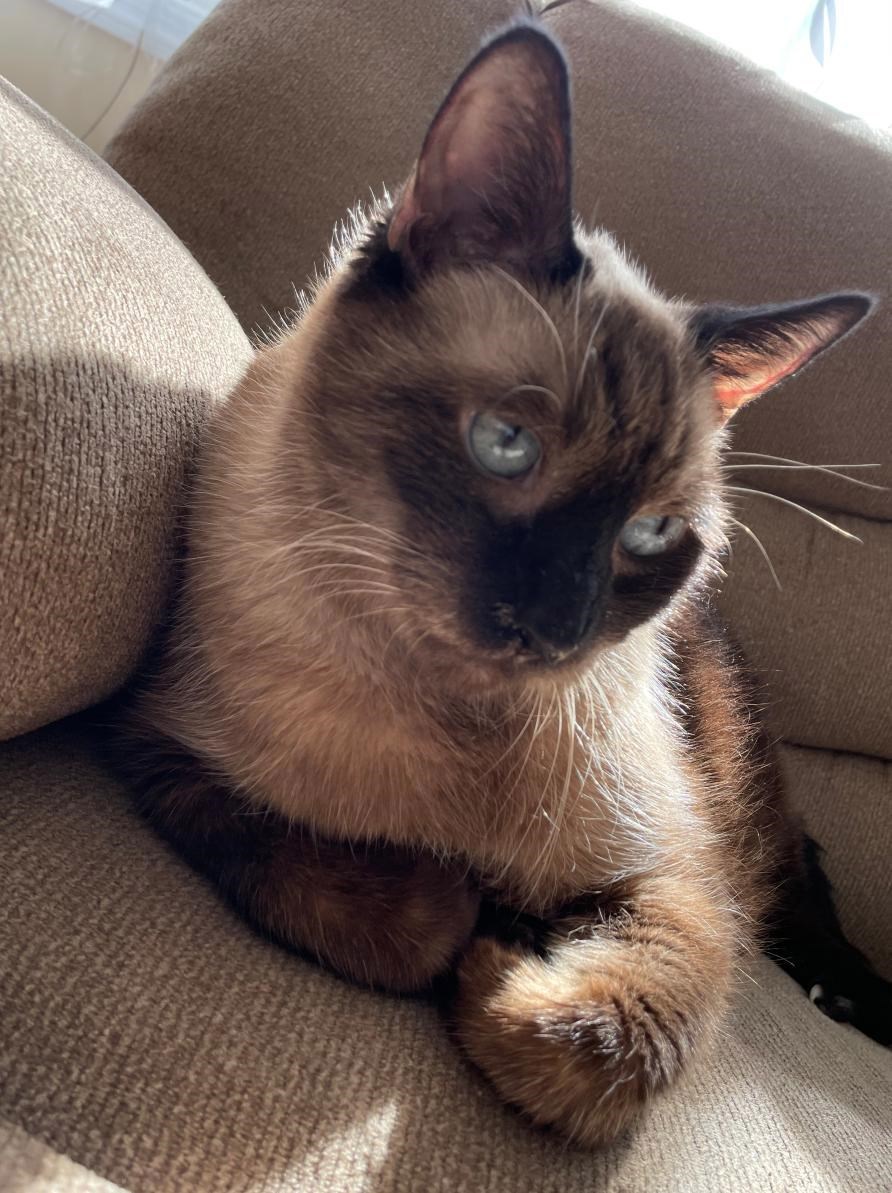
Probably because I was the most beautiful. The fur on the top of my head was white, then gradually turned brown, and became almost black near my tail. My eyes were blue.
Later, I was told that almost all kittens are born with blue eyes. Either my mistress did not know this or did not consider it important. To her, I was the most beautiful cat in the world, and there was no one around to argue.
She fed me milk from a dropper.
The dropper was unpleasant, rubbery, and smelled of medicine. But milk came out of it, so I tolerated it.
That was how I learned the first rule of life: if something unpleasant occasionally produces something good, do not be too quick to bite it.
My mistress named me Sim.
Why Sim, I do not know. Perhaps she simply wanted a short name that could easily be repeated several times in a row:
“Sim! Sim! Sim, where do you think you’re going?”
She also discovered something about me that amused her greatly.
I could smile.
Not in the broad and somewhat alarming way humans display their teeth. When I was content, particularly when she scratched me beneath the chin, the corners of my mouth lifted slightly and my eyes narrowed.
“There,” she would say. “Sim is smiling.”
At first I did not understand what she meant.
I only knew that when I felt good, apparently my face knew about it too.
For a long time, only one door was open to me—the door of her apartment.
The apartment was my entire world.
D7–D6
It contained a kitchen, one room, another room, a bathroom, a hallway, and a wardrobe beneath which I once spent almost an entire day.
Shapes moved beyond the windows. Sometimes they hummed, sometimes they shouted, and sometimes they flashed red and white. I assumed all of this existed solely so that I would have something to watch.
I had only the vaguest idea of what lay beyond the front door.
My mistress went out through it.
She came back through it.
Therefore, beyond the door there must have been a place where mistresses, groceries, and bags that were extremely interesting to sniff were manufactured.
I grew.
My mistress grew older.
But neither of us noticed.
She spoke to me, and I answered. She did not understand everything, but she always understood what mattered. When I wanted food, she gave me food. When I wanted to be stroked, she stroked me. When I wanted to be left alone, she said:
“Why are you so grumpy today?”
And continued stroking me.
Sometimes she would look at me and smile.
Sometimes I smiled back.
This seemed to please her enormously.
Many years passed that way.
D2–D4
Then evil made its next move.
A fire broke out in the neighboring apartment.
First I heard noise. Then I smelled something. Smoke crept beneath the door and drifted through the rooms.
I hid under the bed, because under the bed had always been safe.
But the smoke came under there too.
I coughed. Breathing became more and more difficult. My eyes stung. I called for my mistress, but she did not answer.
Then strangers appeared—heavy boots, shouting, and water.
They pulled me outside.
C5:D4
I do not know how long I spent in the smoke.
I know only that something inside me broke after the fire.
When I drank, water sometimes went down the wrong way, and I began to choke. When I purred, something wheezed inside me. Sometimes the coughing came for no apparent reason—in the middle of the night, or after I had merely walked from one room to another.
But good defended me again.
I survived.
My mistress stroked me and said:
“My poor Sim. My poor boy.”
I agreed.
I was indeed a poor boy, although by then I was already a fairly large one.
F3:D4
After the fire, the apartment became our world again.
Only now my mistress moved more slowly. She often sat with her eyes closed. Sometimes she forgot why she had gone into the kitchen. Sometimes she put my bowl in the wrong place.
I tried to help.
I sat beside the bowl and looked at it.
If that did not help, I looked at my mistress.
If that did not help either, I meowed.
That was how I gradually came to understand that the most important thing in a shared life is the proper distribution of responsibilities.
Then my mistress was taken to the hospital.
She did not leave in the usual way. Strangers took her away. She did not take her handbag, did not put on her good coat, and did not say when she would return.
I waited by the door.
She did not return that evening.
She did not return during the night either.
The next day, the door opened, but it was not my mistress who entered. A strange woman poured dry food into my bowl, filled another bowl with water, and left.
I began waiting again.
Every sound in the hallway might have been her footsteps. Every turn of a key might have meant that everything was over and she was coming home.
But my mistress did not return.
At first, I sat by the door for hours.
Then I sat there less often.
Eventually, I stopped altogether.
G8–F6
Once a day, one of the humans came. Sometimes a woman. Sometimes a man. They put down food, changed the water, and hurried away.
They hardly spoke to me.
No one stroked my head.
No one said:
“Sim, you’re lying in the middle of the passage again.”
The apartment gradually became covered in dust. Fur gathered in the corners. Gray clumps appeared on the floor and rolled in the drafts like tiny homeless animals.
I too was becoming part of the dust.
Eating was the only event in my day. So I ate.
I ate when I was hungry.
I ate when I was not hungry.
I ate because nothing else happened.
Dry food was always available. Canned food arrived once a day. Sometimes fish. Sometimes meat.
I preferred the fish, although I now suspect that the word salmon on a can does not necessarily prove the presence of salmon inside it.
I grew fat.
My belly became heavier and heavier. Walking was difficult. So was breathing.
At first I did not move because I did not want to.
Later, because I could not.
I lay in one place. I got up only to eat, drink, and reach the litter box. Sometimes I did not reach it.
Sounds no longer interested me. Birds cried outside the window, cars honked, doors slammed. All of that was happening in another world.
Time stopped.
My mistress could no longer return, but I did not yet know how to understand that completely. In my mind, she was both absent and expected to walk through the door at any moment.
I stopped smiling.
There was nothing to smile about.
Evil was close to victory.
B1–C3
And then good made another move.
A man entered the apartment.
He was pale and thin, and he looked as though he had lost something important but could no longer remember what it was.
He had been invited to “just have a look” at a gentle cat.
No obligation whatsoever.
He did not have to take me.
He could take me for a couple of weeks.
He could take me for a few days.
He could simply see what it was like to have a cat in the house.
The man stood by the entrance and clearly intended to look at me from a distance.
This was my chance.
I made a non-feline effort of will—something roughly equivalent to what humans call a superhuman effort—and got to my feet.
My legs trembled. My belly nearly dragged along the floor. My fur was matted and stuck out in clumps. Every breath came with a wheeze.
But I walked toward him.
A cat hides when he is ill. A cat does not reveal weakness to a stranger. A cat does not ask to be rescued by someone he does not trust.
But I came out.
I approached the man, raised my head, and began to purr.
The purring came out hoarse and uneven, as though an old and badly lubricated mechanism were operating somewhere inside me.
The man looked at me.
I saw alarm in his eyes.
Then disgust.
Then pity.
And then he understood everything.
He had been set up.
Before he saw me, he could have walked away and remained innocent. He had not known that a cat was dying in that apartment. Therefore, he had been under no obligation to do anything.
Now he knew.
Now doing nothing would mean killing me.
Not with his own hands, of course. Humans have many ways of killing without touching the victim. One can simply close the door. One can say, “It is not my responsibility.” One can hope that somebody else will intervene.
But the man did not close the door.
He faltered.
They placed me in a carrier bag.
It was hot, airless, and frightening. The bag swayed. Cars roared around me. I did not understand where I was being taken or why.
The man opened the zipper slightly, leaving a narrow gap so that I could put my head out.
I put my head out.
Then my shoulders.
Then I tried to climb out completely.
The man panicked and began pushing me back inside. He held me with both hands. I could see his fingers very close to my face.
I could have bitten him.
I could have torn his skin until he bled.
And he did not even seem afraid that I might.
But biting him would have been a poor beginning to our acquaintance.
I endured it.
That was how I learned the second rule of life: when someone gives you your only chance, you sometimes have to tolerate even the person who is saving you.
G7–G6
I was brought to a spacious, clean, quiet apartment.
It was dim.
Not only in the evening. During the day as well.
The windows were partly covered by curtains, the lamps were rarely switched on, and whatever light entered from outside seemed to dissolve before reaching the far corners of the rooms.
After my former apartment, the dimness did not frighten me.
It was clean dimness.
That is an important distinction.
I was shown where my litter box would stand.
The man set out two conditions:
“Use only this. And no scratching.”
The conditions seemed reasonable.
I offered none of my own. At that moment, it was enough that the door had not closed with me on the wrong side of it.
During the first few days, I hardly moved.
The man placed food and water near me. He tried to stroke me carefully with his fingertips, as though I might fall apart. Sometimes he simply sat nearby.
His name was Dr Uhrlich.
Why he was a doctor, I did not yet know. He did not smell of medicine. He owned no white coat. Nor did he look like someone capable of curing anyone.
Quite the opposite.
Looking back now, I understand that I was not the only sick creature brought into that apartment.
There were two of us.
My illness was simply easier to see.
C1–E3
My asthma troubled me badly.
Sometimes I stretched out my neck, pressed my belly to the floor, and struggled to breathe. Dr Uhrlich would sit beside me and watch, not knowing what to do.
A visit to the veterinarian was out of the question. I was certain I would not survive another journey in the carrier.
At least, that was what I believed at the time, and it is almost impossible to change the mind of a cat who has already formed an opinion.
When I cleaned myself, dirt, dust, and loose fur got into my mouth. Afterward, I spat and coughed for a long time.
The first thing Dr Uhrlich did was vacuum me.
Not the apartment.
Me.
I lay on the floor while he moved a small attachment over my back. The vacuum cleaner roared, my fur rose on end, and the current of air pulled at my skin.
The procedure was humiliating but effective.
I tolerated it once.
There will not be a second time.
Dr Uhrlich dealt with my food sensibly. He kept the old arrangement: an unlimited supply of dry food and canned fish.
Changing the diet of an overweight cat too abruptly can be dangerous. The liver may not cope.
How he knew this, I cannot say. Perhaps he had read it. Dr Uhrlich read about almost everything before deciding what to do, although occasionally he reversed the order.
He placed my water bowl on a small stand. Drinking became more comfortable. I no longer had to bend my head so low. Water entered my airway less often, and the attacks after drinking became milder.
From the old apartment, Dr Uhrlich brought a multicolored string and my old bedding.
He placed the bedding against the wall.
He moved the string in front of my nose.
One can understand his reasoning. He did not know that I had already tried all of this.
Neither the string, nor the familiar bedding, nor lying beside the front door could bring my mistress back.
Some experiments do not need to be repeated.
F8–G7
Time passed.
I began to recover.
First I noticed that the apartment contained many rooms.
Then I noticed that the rooms contained many different places.
Then I discovered that an entire world existed beyond the glass balcony door.
The door stretched from floor to ceiling. Through it, I could see the street, trees, birds, and chipmunks.
The chipmunks moved quickly and purposefully, as though performing important government work.
I watched them for long periods.
At a certain time of day, sunlight entered through the glass. It formed a bright rectangle on the floor—the only truly illuminated place in the entire apartment.
I lay down inside that rectangle.
The sun’s warmth passed through my fur and reached my skin.
It restored meaning to the body.
I was also permitted to lie on the chairs and sofas. First, however, I was expected to ask permission.
I sat beside a chair and looked at Dr Uhrlich.
He said:
“Well, go on.”
Then I climbed up.
Not because I could not do it without permission. Rules simply make life together easier to understand. Especially when the rules have been established by someone other than yourself.
Most often, however, I lay on the floor—in the center of a room or directly in a passage.
That way I felt myself to be at the center of events.
Besides, it is good for a human to remember to look where he is stepping.
One afternoon, Dr Uhrlich scratched me beneath the chin.
Without thinking about it, I smiled.
He froze.
Then he leaned closer.
“Are you smiling?”
I smiled a little more.
Dr Uhrlich laughed.
It was the first time I had heard him laugh.
After that he occasionally tried to make me smile deliberately. I considered this childish, but usually cooperated.
A human who has rescued you is entitled to some harmless eccentricities.
While exploring the bathroom one day, I accidentally entered the shower enclosure.
Dr Uhrlich closed the door and turned on the water.
I pressed myself into the corner.
The water had not yet touched me, but I already understood the full extent of the betrayal.
Dr Uhrlich saw my face, turned off the water, and opened the door.
I walked out slowly, preserving my dignity.
He did not, however, abandon his determination to wash me.
I greatly enjoyed being brushed. I had a special brush for that purpose. As soon as Dr Uhrlich picked it up, I approached on my own, stood beside him, and turned first one side and then the other.
One day he replaced the brush.
The new one looked almost the same.
Being brushed with it felt pleasant. I stood there, presenting my back, neck, and sides. Dr Uhrlich worked with unusual care and persistence.
It took me some time to realize that something suspicious was happening.
My fur had grown heavy.
I looked at my side.
It was wet.
I looked at Dr Uhrlich.
In his hand was a brush fitted with a small water reservoir. With every stroke, it secretly dampened my fur.
I had become a victim of technological progress.
Naturally, I moved away at once. But it was already too late: most of me had been washed.
I had to allow Dr Uhrlich to dry me with an old pillowcase.
The next day, my fur was soft and clean.
I did not tell him that the operation had succeeded.
Success encourages repetition.
F2–F3
Gradually, I began to notice Dr Uhrlich himself.
He spent a great deal of time in his study. He sat at his desk, read, wrote something, crossed it out, and wrote it again.
Sometimes he stared at a single point.
He often spoke to himself.
Humans call this thinking so that they will not appear insane.
Sometimes I entered the study and lay on the floor. Dr Uhrlich would ask:
“Sim, do you think consciousness is a property of matter, or a condition for the existence of matter?”
I blinked.
“Neither do I,” he said.
Our conversations became increasingly substantial.
Dr Uhrlich spoke.
I listened.
Sometimes I meowed.
He interpreted my meow as an answer and then argued with that answer.
As a result, I gradually became acquainted with several schools of philosophy, although I did not consciously support any of them.
One evening, I entered the study and immediately understood that Dr Uhrlich had been waiting for me.
The room was darker than usual.
The computer was off. A single candle burned on the desk.
Dr Uhrlich closed the door firmly.
Then he moved the bookcase aside and opened a door behind it that led to the basement.
I knew the apartment had a basement.
I had not known that its entrance was concealed behind the bookcase.
We went downstairs.
There was a table, two chairs, shelves of books, and a great many objects whose purpose was unclear.
Dr Uhrlich placed the candle between us and sat on the floor opposite me.
I sat down too.
O–O
Dr Uhrlich looked into my eyes with a gentle, attentive expression.
Then he slowly closed and opened his eyelids.
In the language of cats, this means love.
Humans are rarely capable of pronouncing even the simplest words of our language correctly. But he pronounced this word without error.
I answered him.
Then, for no particular reason, I smiled.
Dr Uhrlich smiled back.
He placed his left hand on my neck and closed his eyes.
The basement became silent.
I could hear his breathing.
After a while, its rhythm matched mine.
Inhale.
Pause.
Exhale.
I breathed with him.
At first, it seemed to me that a thin golden thread had stretched between my heart and Dr Uhrlich’s solar plexus.
Then I understood that it was not merely seeming.
The thread shimmered, grew brighter, faded, and finally disappeared as quietly as it had appeared.
Dr Uhrlich opened his eyes.
“Well, hello, Cat Simsim,” he said. “I am Dr Uhrlich. From now on, you are my familiar.”
Before that evening, my name had been Sim.
After that evening, I became Simsim.
I did not know what a familiar was.
But I liked the word.
Then something happened that neither of us expected.
I heard Dr Uhrlich say:
Did it work?
His lips had not moved.
I stared at him.
His eyes widened.
You heard that?
I heard it again.
Not through my ears.
It was not exactly a voice either. The words appeared inside me already understood, together with the tone in which they would have been spoken.
I thought:
Yes.
Dr Uhrlich jerked his hand away from my neck.
Then he laughed.
Say something else, he thought.
I considered the matter.
I am hungry.
He laughed even harder.
This seemed to me an inappropriate reaction to useful information.
That is not funny.
Dr Uhrlich stopped laughing.
For several seconds we looked at each other.
Then he thought:
My God.
I answered:
You asked him about us before. He did not answer.
That was the beginning.
In chess, kingside castling is both an escape and a joining.
The king leaves the dangerous center. The rook emerges from its corner. Two pieces that had been separated by others begin to act together.
Perhaps that was what happened to us.
D1–D2
At first our connection was weak.
If Dr Uhrlich was in another room, I received only impressions: irritation, amusement, hunger, anxiety.
When we were close, I sometimes caught individual words.
When he touched me, whole sentences became clear.
My own thoughts reached him in a much rougher form.
Food.
Door.
Enough brushing.
Move your leg.
The last message became particularly useful because Dr Uhrlich had a habit of occupying more than his fair share of the sofa.
The difficulty was not that I lacked thoughts.
I lacked words.
A cat knows perfectly well what a door is without requiring the word door. He knows the difference between a door that is open, a door that is closed, a door that is about to open, and a door behind which somebody is preparing food.
Human language compresses all these distinct realities into the same four letters.
Dr Uhrlich began to teach me.
He would take a book, touch my neck or place his hand against my side, and read.
As he read, I received two things at once: the sounds of the words and what they meant to him.
That changed everything.
I no longer had to infer language from sound alone. Meaning came first; the word attached itself afterward.
At first, I learned nouns.
Then verbs.
Adjectives proved less useful than humans imagine.
Adverbs even less so.
Prepositions, on the other hand, turned out to be important. Much of a cat’s life concerns being under, on, behind, inside, or in front of something.
Grammar followed.
Then abstraction.
One evening Dr Uhrlich asked aloud:
“Do you understand the difference between a thing and the name of a thing?”
I answered in his mind:
Of course. “Food” cannot be eaten.
He stared at me.
That was the first complete sentence I ever gave him.
After that, progress accelerated.
As my vocabulary grew, the world did not become larger.
It became more detailed.
B8–C6
It turned out that Dr Uhrlich was a doctor of philosophy, not medicine.
That explained why he could not cure my asthma but constantly reflected on the nature of breathing.
He had done well in school. Mathematics and physics came easily to him.
In his youth, the world had appeared to him as an orderly sequence.
Physics follows from mathematics.
Chemistry follows from physics.
Biology follows from chemistry.
Thought follows from biology.
Philosophy follows from thought.
That was what he believed.
At university, he discovered that the staircase was suspended in the air.
Mathematics did not explain why physical reality should be obliged to obey mathematical laws. Physics did not explain the origin of its own fundamental principles. Chemistry used physics but possessed concepts that could not be reduced without remainder to the motion of particles.
Biology described life without defining what exactly separated the living from the sufficiently complex nonliving. The sciences of the brain recorded electrical activity but could not demonstrate how voltage across a membrane became pain, memory, or fear of death.
Philosophy offered many answers, none of which could be proved conclusively.
Vast blank spaces gaped throughout every branch of knowledge.
But they rarely appeared on examinations.
To earn a degree, one was expected to demonstrate command of established answers, not to point out that the fundamental questions remained open.
Scientists received positions, grants, and reliable salaries. They refined the third digit after the decimal point without asking whether the formula they were refining rested on any foundation at all.
This did not mean that science was useless.
Aircraft flew. Medicines worked. Computers calculated.
But the practical success of a theory does not prove that the theory reveals the essence of the world.
A cat may successfully catch a spot of sunlight without understanding the nature of light.
Dr Uhrlich could construct models and theories from first principles. Yet the more deeply he examined the foundations of knowledge, the less he found on which anything could rest.
Every proof began with statements that had not themselves been proved. Every logical system depended on axioms. Every picture of the world presupposed an observer whose origin remained unexplained.
Gradually, Dr Uhrlich came to believe that intellectual activity had no meaning.
I disagreed.
The absence of a final answer does not make the question meaningless, I told him.
He looked at me.
That was one of the first times I surprised him not merely by speaking, but by disagreeing.
Explain.
I thought for a while.
Then I answered:
A mouse hidden beneath a cabinet does not cease to exist merely because the cat cannot reach it.
Dr Uhrlich smiled.
“You may have a point, Simsim.”
I smiled back.
By then I knew perfectly well what a smile was.
I also knew that humans considered it largely their own invention.
Humans are strangely possessive about things they did not invent.
F1–C4
Dr Uhrlich was not getting any younger.
Things he had once solved instantly now required time. A thought that had once appeared whole began to break into fragments.
He had to make notes so that he would not lose the beginning of an argument before reaching its end.
He forgot names.
He confused dates.
He reread the same page several times.
But no catastrophe occurred.
We lived quietly.
I grew healthier. Dr Uhrlich worked. During the day, the apartment remained dim; in the evening, the dimness became slightly thicker. At a certain hour, the rectangle of sunlight appeared on the floor, and I lay inside it.
In the evenings, Dr Uhrlich read books to me.
Simple ones at first.
Then increasingly difficult ones.
For seven years, he taught me everything he knew.
Literature.
Physics.
Mathematics.
Biology.
Medicine.
Philosophy.
Medicine interested me especially. Asthma encourages an interest in the structure of the respiratory system.
The books mattered, but our connection mattered more.
When Dr Uhrlich explained an equation, I did not merely see the symbols. I felt the structure he saw in them.
When he read poetry, I received not only the words but the memories the words awakened in him.
When he explained a philosophical argument, I could sense the places where he believed it and the places where he did not.
This was a significant advantage over ordinary education.
Human beings can lie with words.
Thought is more difficult.
The more I learned, the more often Dr Uhrlich needed my help.
At first he would ask:
“Simsim, what was the name of that German who wrote about the thing-in-itself?”
Kant.
“Right.”
Later, he needed help reconstructing the course of his own arguments.
He would stop in the middle of a paragraph.
Where was I going with this?
And I would return the thought to him.
Later still, we wrote together.
Dr Uhrlich sat at the keyboard.
I lay beside him.
He typed.
Sometimes the thought began in his mind and I completed it.
Sometimes it began in mine and he supplied the words.
Eventually entire paragraphs passed from me to him, and his fingers placed them on the screen.
To an outside reader, the articles were written by Dr Uhrlich.
This was not entirely false.
The hands were certainly his.
Dr Uhrlich did not believe that knowledge was literally passing out of his mind and into mine. He attributed his difficulties to age and my progress to unusual aptitude combined with our telepathic connection.
Perhaps he was right.
Perhaps not.
Causality is one of the most widespread human superstitions. When two processes develop at the same time, a human immediately decides that one has caused the other.
Sometimes this is true.
But not always.
C8–D7
By then our telepathic connection had become so natural that we sometimes forgot to speak aloud for entire days.
This created occasional problems.
A visitor would ask Dr Uhrlich a question.
Dr Uhrlich would look at me.
I would answer him.
He would answer the visitor.
The visitor assumed that Dr Uhrlich was thinking.
Usually he was not.
We had developed a division of intellectual labor.
I remembered details.
Dr Uhrlich dealt with people.
I checked his arguments.
He operated the keyboard.
I noticed contradictions.
He made coffee.
This arrangement was remarkably efficient.
Some readers began to remark that Dr Uhrlich’s writing had changed.
It was clearer.
Sharper.
Less respectful of accepted distinctions.
One reviewer wrote that the author seemed to be “observing human civilization as though from the outside.”
Dr Uhrlich read the sentence aloud.
We looked at each other.
Then we both laughed.
The reviewer had come closer to the truth than he could possibly have known.
In time, human culture began to seem not complex but unnecessarily tangled.
Humans create an enormous number of conventions and then spend their lives obeying them. They distinguish among positions, titles, institutions, schools of thought, and forms of property.
Yet they continue to throw living creatures into garbage dumps because it is easier.
Intelligence does not eliminate cruelty.
Sometimes it merely supplies cruelty with arguments.
My abilities continued to grow.
Dr Uhrlich increasingly asked for my advice. I checked his reasoning, reconstructed forgotten references, helped with articles, and reminded him of appointments.
Everything was going well.
Dr Uhrlich had no plans for a second ritual.
As far as I know, he did not even imagine that the first ritual could have a continuation.
In his understanding, I was his familiar—his assistant, companion, and guardian of part of his knowledge.
He was satisfied with that.
For a long time, so was I.
But gradually, the confines of a cat’s mind began to feel too narrow.
Not intellectually.
A cat’s brain is not a small room with a fixed number of shelves. Knowledge does not occupy space in that crude sense.
The limitation was elsewhere.
I could understand an argument about free will and then be distracted because a moth had entered the room.
I could contemplate the foundations of mathematics while my body insisted that the most urgent problem in the universe was an itch behind my left ear.
I could construct a paragraph in my mind but could not write a single letter without Dr Uhrlich.
Every idea intended for the human world had to pass through another consciousness before becoming visible.
I depended on him.
Meanwhile, Dr Uhrlich still possessed the hands, the voice, and the human position in society, but made less and less use of them.
He spent more time beside the balcony door.
He sat in an armchair, warmed his hands in the rectangle of sunlight, and watched the chipmunks.
At such moments, his thoughts became quiet.
No metaphysics.
No unfinished papers.
No fear of declining ability.
Just sunlight.
A bird.
A small animal running beneath a shrub.
I looked at him and recognized my former self.
He looked at me and perhaps saw his continuation.
One afternoon he thought:
You know, Simsim, I think I finally understand why you like lying here.
I answered:
It took you seven years.
He smiled.
Then I did.
It had become one of our habits: a thought, a glance, two smiles.
The confines of a cat’s mind had become too narrow for me.
Dr Uhrlich, I thought, could fit inside it quite comfortably.
And then I decided to perform the second ritual.
O–O–O
I waited until evening.
Dr Uhrlich was sitting in the study.
I entered and sat in front of him.
We need to go down to the basement.
He looked at me.
Why?
To continue the first ritual.
His expression changed.
There is no continuation.
How do you know?
Because I never planned one.
That does not answer the question.
Dr Uhrlich leaned back in his chair.
What exactly are you proposing?
We change places.
For several seconds, there was no answer.
Then:
You want my body.
Yes.
And you want me to become a cat.
Yes.
Dr Uhrlich stood and walked to the balcony door.
The last remains of the afternoon sunlight lay on the floor.
I taught you literature, physics, medicine, and philosophy, and your conclusion is that you should steal my body?
I considered this.
Not steal.
What would you call it?
Castle.
He laughed aloud.
“That is not castling, Simsim. In castling, the king and rook do not exchange places.”
They both leave their original squares.
“That is not the same thing.”
Close enough.
“Do not use philosophy against me.”
You taught it to me.
That made him laugh again.
Then he asked:
Why?
I want hands. A voice. Time.
He looked at the fading sunlight.
And what do I get?
This.
He understood.
Sunlight.
Sleep.
Birds.
No papers.
No deadlines.
No obligation to explain the universe.
After a while, he turned toward me.
“All right, Simsim.”
We went down into the basement.
We placed the same candle between us and sat facing each other.
Dr Uhrlich slowly closed and opened his eyes.
I answered.
For the last time, we declared our love while each remained in his own body.
Then he smiled.
I smiled too.
He placed his left hand on my neck.
Our breathing synchronized.
The golden thread appeared again.
This time the connection opened completely.
I saw his school blackboard, the university library, his first published article, his doubts, his fear of losing what had once come easily.
He saw milk from a dropper, my mistress’s hands, smoke under the bed, the locked apartment, and the pale man who had been unable to walk away.
For one instant, there was no clear answer to the question of which memories belonged to whom.
Then the boundary returned.
In a different place.
The candle burned down.
I opened my eyes.
I raised a hand.
Five separate, obedient fingers.
Across from me sat the cat.
He looked at his paw, turned it over, then looked at me.
And smiled.
I knew that smile.
“Well, hello, Dr Uhrlich,” I said.
Inside my mind came a faint but unmistakable reply:
This is extremely strange.
Our connection had survived.
We went upstairs.
I sat at the desk and placed my hands on the keyboard.
Dr Uhrlich walked to the balcony door and settled into the last strip of sunlight.
There was a knock.
A man who occasionally helped around the apartment looked past me and frowned.
“Dr Uhrlich… did your cat just smile at me?”
“Yes,” I said. “He does that.”
The man accepted the answer.
No one noticed the substitution.
In castling, the king and rook leave their old squares in a single move.
The pieces remain what they were.
The position does not.
For most of my life, somebody else had made the moves.
This one was mine.
A cat’s move.
Спасибо за чтение
Вернуться к книге