
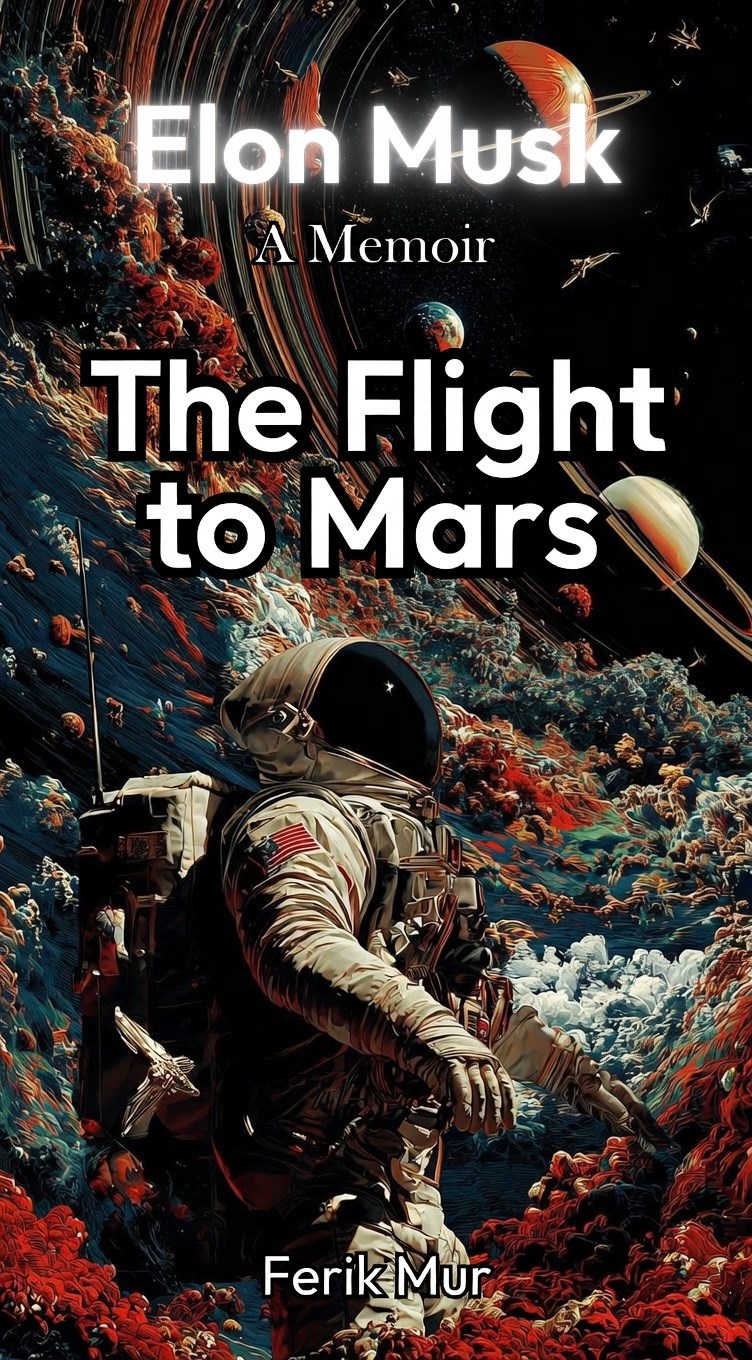
Elon Musk. A Memoir. The Flight to Mars
Dream. Prologue
Vacuum. Silence so loud it could be heard in the beating of your own heart. Beyond the porthole — nothing. And everything. An endless, velvet-black cosmos strewn with diamonds that do not twinkle. They are cold, eternal, indifferent. And there, ahead, barely visible in the light of the distant Sun — a rusty disc. Mars.
It does not beckon. It waits. As if it has always been there, knowing I would come. And now I am here, alone in this metal capsule, halfway between the past and the future. Between what was and what must be. And in this silence, just before the final leap, memory catches up like gravity.
Chapter 1. The Boy with the Library of the Universe
My first memory is not my mother’s voice or my father’s smile. It was light. Not the warm light of a lamp, but the cold, furious light of an arc I accidentally created by short-circuiting wires in the garage. The shock threw me to the floor. The air smelled of ozone and fear. But through the fear broke wonder. I had touched something real — a force that moved the world.
School was an alien planet. The words of other children sounded like meaningless static noise. Their games seemed like primitive algorithms. I found refuge in the library. It was not merely a hall with books. It was my starship. I devoured The Hitchhiker’s Guide to the Galaxy, and Adams’ irony felt less like a joke and more like a survival manual for an absurd universe. The Lord of the Rings taught me about duty and the burden of being chosen. And Asimov’s Foundation … it became my bible.
I would lie on the floor of my room in Pretoria, staring at the cracked ceiling, and see not plaster but star charts. I imagined giant ships, like floating cities, sailing into nowhere, carrying the embryo of human civilization. But the thought brought not excitement, but a nauseating sense of defeat. Eternity on the road? To resign ourselves to the fact that we would never set foot on another planet in a single human lifetime? That was surrender.
One night, after the South African sun had already drowned behind the horizon, I stepped into the yard. The air was thick and sweet. I lifted my head. The Milky Way was a silver river spilled across the sky. And aimed at it like an arrow was a thin red dot. Mars.
In that moment something clicked. It was not mere desire. It was necessity. A physical law of my own existence. I did not simply want to fly to Mars. I had to make it possible. For everyone. To light a candle in the darkness before the wind of fate extinguished our flame forever.
Steel and Silicon
The path to the stars lay through code and steel. Silicon Valley became my proving ground. Zip2, PayPal… To the world they were startups. To me they were simulators. I learned to assemble teams, manage resources, and batter down walls of misunderstanding with a forehead bloodied from the blows. Money? It was merely fuel. A means, not an end.
When I sold PayPal, I had resources. I could have bought an island. Instead, I bought a dream. Or rather, I tried to buy a Russian rocket.
I remember the smell of that office in Moscow — cheap cologne, vodka, and the dust of faded imperial power. They looked at me, a young upstart from America, like some exotic creature.
“You want to send a greenhouse into space? A Martian cucumber?” Their laughter was coarse and smug.
“No,” I said. “I want to send people. Eventually.”
They stopped laughing. They looked at me with a mix of pity and contempt. “Young man, this is impossible. Too expensive. You will die.”
On the flight back, gazing at the endless snows of Siberia beneath the wing, I felt not disappointment but clarity. Crystal, cutting clarity. They could not see the future. They saw only the inertia of their past. If they could not or would not — we would do it ourselves.
I opened my laptop. A blank page. I wrote one word: Falcon.
Creating SpaceX was not a business plan. It was a declaration of war. War against gravity. War against cosmic inertia. War against the very idea of “impossible.”
I remember the first failures. The launch of Falcon 1 from Kwajalein Island. How that slender white candle rose into the tropical sky, carrying all our hopes. And how it fell. Again and again. We stood in the bunker as the screen showed nothing but static. The air left us like it was escaping a punctured spacesuit.
The third launch. The rocket rose. My heart stopped. And then — failure. Stage collision. Another fireball. I saw tears in my engineers’ eyes. Not from exhaustion, but from grief. Grief for the dream that had once again burned up in the atmosphere.
We had resources left for one final attempt. The last bullet in the chamber. The fourth launch. If it failed, there would be no SpaceX. No Mars. No future.
It rose. And it did not fall. When the first stage burned out and separated, when the second stage ignited and our small, ridiculous test payload reached orbit, silence fell over the bunker — the kind of silence you could cut with a knife. And then came the explosion. Not on the screen, but in the room. Shouts, embraces, sobs. We cried like children. That day we did not merely launch a rocket. We proved that the devil of gravity was not omnipotent. We had made a tiny hole in the wall of the impossible.
Red Dust
Years passed. Falcon 9, Dragon, Starship… Every step was a battle. Every success was a foothold for the next fight. We learned to land rockets, just as the fantasists of my childhood had predicted. We built a ship that was not merely a rocket, but the first true starship of Earth.
And then came the day. We named the mission “Phoenix.” Not after the mythical bird, but after the city on Mars that was yet to be built.
Saying goodbye to my children was the hardest part. Their embraces were stronger than the g-forces at launch. I looked into their eyes and saw the same wonder that had been in mine as a child when I gazed at the stars. I was doing this for them. For their future, where the stars would no longer be a destination, but home.
Launch. It cannot be described in words. It is not shaking or roaring. It is the universe deciding to crush you with its finger. It is the planet itself pushing you away like an unwanted guest. Everything burns. But you must remain cold. You must watch the data, listen to the reports, be part of the machine.
And then comes the silence. Weightlessness. You float in the capsule while beyond the porthole stretches the endless blue of Earth. She is so beautiful, so fragile, that it steals your breath. No borders, no wars. Just home. One for all.
The journey took months. Days blurred into a monotonous rhythm of exercises, system checks, and observations. I reread all of Asimov. I watched Earth grow smaller and Mars grow larger.
And then, the day of landing. Autonomous systems guided the ship. My only task was to observe and, in case of extreme necessity, take manual control. The atmosphere of Mars is treacherous and thin. “Seven minutes of terror,” as my engineers called it.
Friction. Vibration. A fiery vortex outside the window. Then silence. Retro engines. A slow, agonizing descent. Sensors screamed with streams of data. And finally — a soft, almost weightless jolt. Silence.
I unbuckled the straps and floated to the main porthole.
The world beyond the glass was not red as in the pictures. It was the color of rust, ochre, and copper. An endless, rolling wasteland beneath a pale pink sky. Nothing. Absolutely nothing. And yet it was everything.
All that remained was to put on the spacesuit. The airlock cycle felt like eternity. The final door slid open with a quiet hiss.
I stepped onto the surface. My foot sank into the loose dust not with a firm thud but with a soft, muffled rustle. I took a few steps, leaving the first footprints in millions of years that the wind would not erase.
I ran my hand over the helmet and raised the visor. The air was cold and dry, smelling of oxidized iron and… nothing. Pristine purity.
I looked around, then turned back to see my ship — a silver cocoon against the vastness.
And then I lifted my head. Among the abyss of black sky hung a tiny blue dot. Home.
And standing there alone on the edge of this desert, under the cold sun, I understood. This was not the end. This was only the beginning. We had done it. We had become a multi-planetary species. And this memory — mine and all of humanity’s — had just gained a new chapter. A chapter we would write together.
The next ship with the main crew would arrive in two years. They would find a base here, built by Russian shift workers, and oxygen reserves. They would bring seeds, tools, and new dreams.
And I would remain here, the watchman at the gates of a new world. So that when they arrived, someone could say to them: “Welcome. We’ve been waiting for you.”
And to glance back at that pale blue dot in the sky that had once been everything we knew. And to smile.
This is the dream that visited me every night for almost twenty years. I knew this dream was prophetic. It will come true. All that remains is to wait and believe that it will be so.
Chapter 2. Solitude
In my second Martian year, I no longer counted the days. I counted the dust storms.
Each storm lasted anywhere from three to forty sols, and during those weeks the world shrank to the size of my suit and the habitat dome. Radio contact with Earth faded into a faint whisper beneath the howling rust-colored wind. Sometimes it vanished completely. Then I was left alone with Mars in a way no human had ever been alone with an entire planet.
I began talking to things.
Not to the rovers—they were too stupid and too obedient. I spoke to the stones. To the red sand that worked its way into every seam of my gloves. To the cracks in the basalt that looked like old scars. I asked them: “Were you once an ocean too?” And sometimes it seemed they answered—not with words, but with a long, heavy silence heavier than any reply.
The worst part was not the absence of people. The worst part was when people were still there, but they were no longer mine.
Every link with Earth now felt like speaking to long-dead relatives. My children told me about school, about new friends, about how Mom had married again. Their voices sounded bright and alien, like recordings from another lifetime. I smiled at the camera, nodded, said all the right father-astronaut words, while inside something quietly tore—thinly, without blood, but irreversibly.
One day my daughter asked:
“Daddy, when are you coming home?”
I had no answer. Because I no longer knew where home was. The home I remembered lay somewhere between the old “Phoenix” and that first green sprout. The new home was here—cold, rust-red, merciless, and impossibly dear.
I began to fear mirrors.
In the reflection of my helmet I no longer saw Elon, nor the dreamer from Pretoria. I saw a man whose skin had taken on the gray-red tint of Martian dust that would never wash off completely. My eyes were sunken, yet something new burned in them—not the fire of ambition, but a quiet, stubborn light of one who had survived. I looked like Mars. And that frightened me more than any life-support failure.
At night I went outside for no reason. I simply stood beneath the two tiny moons and listened as the wind sang through the antennas. Sometimes I removed a glove and touched the soil with my bare hand—for just a few seconds, until the cold began to burn my skin. I wanted to feel the planet against my flesh. To feel whether it was accepting me or rejecting me.
It did not reject me. It simply waited.
Solitude here was not emptiness. It was dense, almost tangible. Like a second spacesuit that could never be removed. It protected and suffocated at the same time. Inside it, I learned to hear my own soul—not voices, not thoughts, but the soul itself: a quiet, steady hum, like the distant roar of Martian winds.
Sometimes I cried. For no reason. I would simply stand in the airlock after an EVA and cry until the tears froze on my eyelashes. Then I would wipe them away with my sleeve and keep going—repairing solar panels, checking the greenhouse, writing reports that almost no one read anymore.
I understood one thing that they never put in the beautiful speeches about colonization:
True solitude does not come when you are alone.
It comes when you can no longer be with anyone else.
I had become too Martian for Earth.
And still not Martian enough for Mars.
Somewhere in the middle, between two worlds, I lived.
Like the first campfire in the night that does not yet know whether it will grow into a great blaze or simply die out, leaving behind warm ash and black stones.
And yet every morning I rose.
I turned on the lights in the greenhouse.
I watched the thin stems of second-generation wheat reach upward—stronger now, more confident.
And I whispered to them like old friends:
“Hold on, guys.
We’re only just beginning.”
Chapter 3. The Moonshine Still
At first, it was planned that robots would assemble the first modules of the Martian city — the boiler house, the oxygen plant, the canteen — and install them on the surface. But after running full-scale simulations in the Nevada desert on Earth, the conclusion was clear: only Russian shift workers, seasoned vakhoviki, could handle such a task. These guys, with their vast experience, could build anything anywhere in the Galaxy.
They arrived on Mars carrying a special gift for Elon Musk — an English translation of Ferik Mur’s book "Vakhoviki Will Fly to Mars". I read it with great interest. After finishing it, I finally understood exactly what kind of men had come to conquer and build on the Red Planet.
I was particularly struck by the chapter about how the Northern Cities were built back on Earth. I still wasn’t entirely sure who the “BICHs” were or what “Former Intelligent Person” actually meant, but one thing was obvious: starting from absolute zero, in conditions where nothing exists, requires truly remarkable people. And time proved they were incomparable. These were true heroes and pioneers.
To create a solid foundation for the modules, they brought in a pile driver, just like in the oil fields, and hammered steel pipes deep into the Martian bedrock. Then they welded all the piles together into one rigid frame. A diesel generator hummed steadily, supplying power, while the welder worked with special electrodes designed for use at the bottom of the Earth’s oceans. Metal stairways and walkways were welded on so the crew could move safely between levels.
Step by step, the living modules were installed and connected. Heating lines were run from the boiler house. A module for extracting water from Martian ice was mounted. Then came the oxygen production unit and, finally, the canteen module where everyone could gather for meals. This was the first stage of building autonomous habitats on Mars.
To protect the structures from the planet’s ferocious dust storms — with their howling winds and powerful gusts — everything was anchored with massive, reinforced connections to the foundation platform. All the modules were linked by covered passages, exactly like the shift camps of Russian oil workers back home. It felt familiar and reliable.
For going outside, special airlock modules were installed, complete with storage for spacesuits. A large greenhouse module with a transparent dome was also erected. There they planned the first experiments: planting seeds directly into Martian soil and setting up hydroponic systems to grow greens and vegetables. The work moved forward at a furious pace. The men built quickly, with skill and genuine enthusiasm.
Russian speech can be both mysterious and strangely beautiful. Once I overheard one of the Russian builders accidentally strike his finger with a hammer right through the thick glove of his spacesuit. In a fit of rage he unleashed a long, thunderous tirade of words I didn’t understand. The others told me it was “Russian mat” — their legendary profanity. Over the helmet comms it sounded like nothing I had ever heard. Incomprehensible, yet somehow oddly pleasing to the ear. I made a mental note to get a translation of that emotional outburst one day.
In the future, the completed cities will be covered by a giant protective dome. The space between the dome and the Martian surface will be filled with breathable air rich in oxygen, allowing people to walk without spacesuits. The dome itself will be made of an ultra-strong material that even a large meteorite cannot penetrate. But for now, all construction work was done in full spacesuits. It reminded me of deep-sea divers working in heavy metal suits on the ocean floor back on Earth.
You have to be exceptionally strong by nature to work four hours straight on the Martian surface without a break. These Russian vakhoviki were tough as nails.
Strangely enough, one of the conditions in their contract was that a moonshine still — a samogonny apparat — be included on the flight. They explained it was an apparatus for producing whiskey under extreme conditions. The request seemed odd, but we agreed. As long as they didn’t get any Martians drunk (there weren’t any on the horizon anyway). For the time being, it was prohibition on Mars. Besides, they needed a pressurized room with Earth-like air to set up the mash for making their “samogon,” as they called it.
These Russians were truly astonishing. Any American would have simply brought a few bottles of whiskey in metal flasks. But these guys wanted to test the entire technology right here on Mars. Some kind of mysterious ritual. Probably the way things are done in the oil workers’ shift camps back on Earth.
They also told me that drinking “the Russian way” requires a properly set table, just like in a good restaurant, with decent snacks. They don’t recognize cocktails with soda and a slice of lemon. And not everyone can keep up with them. You can either die or suffer a week-long hangover.
I am eagerly waiting for the day they start distilling. Whiskey on Mars — it defies all logic. Space, Martian orbit, landing on the surface… and the drink of the gods.
And then the day finally came. They set up the mash in a large flask, and it slowly began to ferment. Time passed, and soon it was ready. The flask was placed over an open flame in the complex, and everyone gathered to watch the first precious drops of samogon trickle out. Tension hung in the air as we waited for the miracle.
It happened in the canteen. They had prepared a proper snack from the emergency rations. The tasting began. It excited everyone. Especially the realization:
“We are drinking on Mars.”
Chapter 4. Tesla Technologies on Mars
Even back on Earth, when we first began seriously developing the initial permanent bases on Mars, a simple but devilishly important question arose: how to drive piles into rocky ground and tie them together with pipes, just as they do on the permafrost of Alaska or at Russian oil fields in Siberia.
We couldn’t simply ship a regular pile driver based on a tractor, a bulldozer with a bucket, and a truck with a steam plant to the Red Planet. All of that weighs tons, guzzles fuel, and is completely unsuited to Martian logistics. Transporting such heavy equipment through space would be pure madness.
So at Tesla, drawing on our experience in building robots and heavy automation, and working together with NASA engineers, we took a path that had already proven itself many times over. We used the “Curiosity” platform as the foundation. These rovers had already been crawling across Mars for many years — drilling, taking photographs, and surviving on solar panels and radioisotope thermoelectric generators (RTGs). The delivery method had been refined to the smallest detail, and the design was lightweight, durable, and reliable. Exactly what we needed.
We created an entire line of universal Martian equipment based on this platform. But the most important part was the control module. A human operator sits inside, in relative comfort, protected from radiation, and controls everything through AI. No unnecessary EVAs in spacesuits during the early stages. Communication was handled via Wi-Fi at short distances and optical fiber that the machine itself unspools behind it and reels back in when returning. We spent years testing all of this at a test site in Nevada. That’s where we ran the prototypes through dust, cold, and simulated Martian radiation.
The pile driver turned out especially elegant. Each pile was essentially a pyrotechnic charge. They were loaded into a drum in a Nagant-style revolver configuration in the center of the cart. The six-wheeled platform would drive itself to the required point, and the computer would use laser scanning and inertial navigation to position itself with millimeter precision. The operator would see “ready” on the monitor. One shot — and the pile would slam into the ground. Then we’d move on to the next spot. No theodolites, tripods, or people with hammers.
For drilling, we also significantly upgraded the same “Curiosity” platform. We installed a reinforced manipulator more than two meters long, an automatic tool-changing system, a tool storage unit, and an industrial laser to first break through the hardest rock. The main drill made 1.6 cm holes, but we scaled everything up for serious depths — up to several dozen meters depending on the soil. The algorithm was simple and reliable: laser scanning, precise approach, positioning, drilling with sample collection, and cleaning. All in automatic mode.
We optimized speed, autonomy, dust protection, temperature swings, and radiation shielding specifically for Mars. Power from the RTG allowed the machines to work around the clock without recharging.
In the very first stage, when connections needed to be made, systems configured, and occasional manual intervention was required — yes, people had to go outside. But we minimized that time as much as possible. The idea was for the robots to complete the foundation, utilities, and basic infrastructure even before the mass arrival of people.
I remember us joking that drilling wells in search of liquid water at the first stage would be entrusted to Russian shift workers — they supposedly work in any conditions on Earth. In the end, we managed with our own iron “shift workers” on wheels. And honestly, they didn’t let us down.
This was not the most glamorous stage of the Martian epic. But it is precisely from such boring but vitally important things — piles, drilling, and reliable robots — that a real colony begins, not just “plant the flag and fly away.”
Chapter 5. The Martian Base
Choosing the right location for the future colony was of critical importance.
The landing zone was placed in a broad lowland near the equator — where solar panels could operate at maximum efficiency and the temperature remained relatively tolerable even during the Martian night. Nearby, orbital surveys had detected rich deposits of subsurface water ice — the planet’s most precious resource, the key to water, oxygen, and rocket fuel. Promising mineral deposits were also identified within a reasonable distance.
If further exploration confirmed the presence of planetothermal energy sources, engineers planned to drill a deep well to secure an almost inexhaustible supply of power.
The most important requirement, however, was different: the base had to be built at the foot of a rocky mountain range. It was inside this massif that tunnels and shelters would be carved out, providing reliable protection from deadly radiation and stray meteorites.
The first to set foot on Mars were not humans, but service robots. Controlled from Earth and from orbit, they worked tirelessly to prepare the site: leveling the ground, installing communication antennas and navigation beacons, and deploying the initial power systems. Several compact nuclear reactors were positioned at a safe distance — their quiet, steady warmth would become the first beating heart of the colony.
Once the robots completed the groundwork, the first tetra-module descended to the surface. Its four “petals” unfolded like a giant mechanical flower. Inside them were a laboratory with a medical bay, a command center with a deep-space communication station, a living module, and a storage section housing life-support and power systems.
The robots quickly and precisely secured the module’s supports, connected all the utilities, deployed the cooling radiators, and began constructing the protective shield. Meter by meter, they laid heavy blocks of sintered regolith, creating a reliable barrier against radiation.
Then came the tests. Hermetic integrity was verified with extreme care: not a single molecule of air was allowed to escape into the thin Martian atmosphere. Inside the module, a robotic manipulator arm methodically transformed the foldable elements into their working positions, activated the air and water regeneration systems, and tested lighting and thermal control.
If necessary, the robots cleared access roads and prepared pads for future structures. Only after receiving a full report confirming readiness was the base declared suitable for the arrival of the first crew.
In the next launch window, a landing module brought four cosmonaut-engineers to Mars. Along with them came the second, third, and fourth tetra-modules.
The second module delivered an expanded medical laboratory, an additional living quarters, a large storage area, and a powerful power-supply system for heavy equipment. It was intended to become the foundation for the workshop and hangar.
The third and fourth modules had non-standard configurations with complex transformable elements. Their deployment required direct human involvement. The cosmonauts, wearing spacesuits, worked side by side with rovers and robots. As a result, the first and second modules were connected into a single complex. A recreation dome, a greenhouse, a full-scale workshop, and a hangar for large construction machinery appeared. The load on the power system was intelligently redistributed.
All living and working modules, except the hangar, were covered with a thick layer of sintered regolith. The base was now well protected.
The cosmonauts remained on Mars until the next launch window. They carried out an extensive scientific and technical program: exploring the surroundings, updating geological maps, testing equipment in real conditions, and preparing the site for further expansion.
From that moment on, every twenty-six months, when Earth and Mars were in the most favorable alignment, new crews and cargo would arrive on the Red Planet. The base grew steadily and methodically.
New facilities were now to be placed not on the surface, but inside the mountain massif. For this purpose, heavy tunneling equipment was delivered to Mars. If natural lava tubes or cave systems were discovered nearby, the work would proceed much faster.
In the distant future, the Martian base was destined to become a fully autonomous, self-sufficient settlement. The settlers planned to produce food in hydroponic greenhouses, generate energy, fuel, and everyday necessities from local resources. 3D printing technologies, closed-loop life-support systems, full recycling of waste, and strict resource economy would become an integral part of daily life for the first Martians.
And all of this had already been brought to life.
Chapter 6. Dogecoin to Mars
I remember one meeting when someone jokingly asked, “So what currency are we going to use on Mars?” I answered without hesitation: “Dogecoin.” The whole room burst out laughing. But I wasn’t joking.
Since then, people have been asking me about it constantly. Yes, I confirm: when the first permanent colonists set foot on Mars, Dogecoin will become the official currency of the Red Planet. At least in the initial stage.
We spent a long time thinking about how the economy of an interplanetary settlement should work. Earth’s banking systems won’t reach that far — signal delay, bureaucracy, dependence on a single regulator. Bitcoin is too heavy for everyday microtransactions and confirms too slowly. What we need is a currency that works fast, cheaply, without intermediaries, and already has a huge, loyal community.
Dogecoin fit all these requirements perfectly.
Imagine an ordinary Martian day in 2035. A person in a workshop buys a liter of purified water produced by a local electrolyzer — pays in DOGE. Another loads oxygen into a spacesuit — again DOGE. Someone orders a spare part 3D-printed from regolith — Dogecoin once more. Rover charging stations, fresh vegetables from the greenhouse, rental of heavy equipment, even minor suit repairs — everything will be accepted in DOGE.
We will make sure that transfers between Earth and Mars happen almost instantly through our satellite relays. No banks, no greedy conversion rates. Just a wallet — and you pay. This is especially important in the early days, when the entire base economy will depend on supplies from Earth and local production.
Of course, in the long term, Mars will have its own full-fledged currency tied to the local economy, resource extraction, and energy. But at the start, while we are building the base, growing the first food, and learning to live independently, Dogecoin will serve as that bridge connecting the two planets.
I know many still see this as a meme. Well, let them. The entire history of SpaceX began with memes and jokes. Starship was first called “the big iron phallus.” And now it flies. So why shouldn’t the first interplanetary currency begin with a dog from the internet?
We even plan to send a few physical carriers to Mars — metal plates and coins with the image of Doge. Just because. Because if humanity is heading out to live on another planet, let it be not only serious but also with a sense of humor.
In the end, we will get something that has never existed before: a truly decentralized, fast, and lightweight currency operating between two worlds.
And yes, I still smile every time I say this phrase.
Dogecoin to Mars.
This time — for real.
Chapter 7. Elon Musk’s Plans for 2026
2026 will be remembered as the year when Starship finally began transforming from a beautiful idea into a real machine that would open the door to other worlds.
Everything revolved around it. This is the largest, most powerful, and most ambitious flying vehicle humanity has ever built. Nearly 120 meters tall, nine meters in diameter, with 33 Raptor engines on the Super Heavy booster and six on the Starship itself. A fully reusable system — like an airplane, only instead of an airport, we have orbit and the surfaces of other planets. The goal is simple: to reduce the cost of launch by tens, and eventually hundreds of times. So that one flight would cost not billions, but around thirty million dollars.
By March 2026, we had already completed eleven test flights. There were explosions, problems with the heat shield and landings — the usual story. We learn from every one of them. The next, the twelfth, was scheduled for early April. This would be the debut of Version 3 — the new, larger, and more powerful version. It is on this version that we plan to master true reusability and heavy cargo delivery. In fully reusable mode, it can deliver more than 100 tons to low Earth orbit, and in the future — 150–200 tons. Compared to Falcon 9, it’s like moving from a passenger car to a freight train.
The plans for the year were clear. We were intensively testing Version 3 and practicing orbital refueling — a critical technology for deep-space missions. At the end of 2026, during the next astronomical window, we wanted to send the first five uncrewed Starships to Mars. The journey would take 6–9 months, with arrival in 2027. Each ship would carry about 10 tons of payload. One of them might even carry an Optimus robot — to see how our robot would handle Martian dust and radiation. Last year I still estimated the chance of success at fifty-fifty. Too much was new: orbital refueling, precise landing, and operations in the Martian atmosphere.
But in February we slightly adjusted our priorities.
I said it openly: the main focus right now is the Moon. We can fly there almost every ten days, not once every 26 months. Building a self-growing base and a self-sufficient city there can be done much faster — in less than ten years. This will give humanity a real “backup airfield.” If something goes wrong on Earth, we will already have a second home. Mars is not going anywhere. We will begin serious work on it in 5–7 years and will build in parallel, but the Moon is now the priority. It is the training ground and the fastest path to ensuring the long-term survival of civilization.
The core idea remains the same: the colony must grow on its own, without constant supplies from Earth. It must produce food, energy, fuel, and spare parts from local materials. Starship gives us that tool. We just need to perfect it.
2026 was a year of hard, relentless work: launches, landings, explosions, refinements. But it is precisely in such moments that the real future is born. We are not just building a rocket. We are building the road along which humanity will finally step beyond the limits of a single planet.
And this path begins here and now.
Chapter 8. Optimus Robots
Optimus is perhaps one of the most underestimated projects we are working on right now.
People still call it “Tesla Bot” and think it’s just another gadget. No. It is a general-purpose humanoid robot. A machine designed to take on all the dangerous, boring, and heavy work that humans either don’t want to do or shouldn’t have to do.
By March 2026, we are already talking about Optimus Gen 3. This is the third generation, and it is finally starting to look truly serious. Height — 173 cm, weight around 57 kg, so it fits easily into the same spaces where people work. Its hands now have 22 degrees of freedom — the fingers move almost like human ones. It can pick up small parts, work with tools, tighten screws, fold items, and carry objects carefully. The legs have also been significantly upgraded: it walks confidently, and in some modes it can already accelerate to nearly 13 km/h.
All of this is powered by the same artificial intelligence we are refining on the Autopilot. Cameras, neural networks, constant learning. The robot sees the world, understands it, and acts.
The target price is $20,000 to $30,000 — cheaper than a new car. If we hit that number, the number of Optimus units on the planet will quickly climb into the millions.
Right now, in the spring of 2026, Gen 3 is coming out of the final development stage. In the summer we begin small-scale production, and in 2027 we plan to rapidly scale up volumes. The first thousands of units are already working inside our factories in Fremont and Austin: sorting batteries, moving parts, performing quality checks. They work 24/7, without complaints, without fatigue, and without unions.
And then — Mars.
Back in 2025, I said that one or several Optimus robots would fly on the uncrewed Starships at the end of 2026. The timeline has shifted a bit, but the idea remains. Robots should be the first to set foot on the Red Planet. They will prepare the landing site, carry cargo, test equipment, and work in the dust, cold, and radiation while humans are still preparing for the journey.
At the same time, I have always emphasized one important thing: Optimus will not replace people — especially those we call “Russian shift workers.” These tough guys from the North — from Yamal, Taimyr, and the Arctic — possess something a robot will never have: character, intuition, and the ability to survive in extreme conditions.
The robot will take on the heaviest and most monotonous tasks: working in minus-fifty-degree frost, carrying heavy loads, operating in dangerous zones, and providing round-the-clock monitoring. People will do what truly requires experience — making decisions, managing, teaching the robots, and solving non-standard problems. As a result, instead of a hundred people at a remote drilling site, there will be thirty specialists and several dozen Optimus units. Shifts will become shorter, safer, and far less exhausting.
I see how, in a few years, dangerous and repetitive work will finally be handed over “to the robots,” while humans will be freed for more interesting and valuable tasks. This applies to both Earth and Mars.
Optimus is the iron.
The shift workers are the soul and the backbone.
Together, they will build the future.
Chapter 9. The First Footprint
I often catch myself thinking that the most important moment in the history of Mars exploration will happen without a single human on the planet’s surface. Not when the first astronaut takes a step and delivers a grand speech. But much earlier.
When the first Optimus steps onto Martian soil.
It will be an ordinary day in 2027. One of the uncrewed Starships we send at the end of 2026 during the astronomical window will make a gentle landing in a chosen lowland near the equator. A few hours after touchdown, the cargo bay will open, a ramp will extend, and a third-generation humanoid robot will cautiously step outside.
No flags. No triumphant marches. Just a quiet, almost timid first step into the reddish Martian dust. Its metal foot will leave a clear imprint — the first artificial footprint of intelligent life on another planet. Cameras will capture it in high resolution. The signal will travel through orbital relays, and we on Earth will see everything with a delay of four to twenty minutes.
I can already picture us sitting in the control center in Hawthorne in complete silence. Because in that moment we will understand: everything has changed forever. We have officially ceased to be a single-planet civilization.
Optimus will not arrive as a tourist. It will have work to do — hard, monotonous, and extremely important. It will begin unloading the next ships arriving in the same window. It will clear the site for the first base, lay blocks of sintered regolith, assemble solar panels and small nuclear reactors. While humans are still preparing for their flight in the next window, Optimus will already have built them a basic camp, tested life-support systems, laid the first cables, and even started drilling wells in search of subsurface ice.
I specifically wanted the robot to be first. Because if something goes wrong — and on Mars something almost certainly will — we will lose a machine, not a person. Optimus can work at minus seventy degrees, in dust storms, and under high radiation. It doesn’t get tired, doesn’t panic, and doesn’t need oxygen. It simply does the job.
And yet… when I think about that moment, a chill runs down my spine. Not from fear. From the sheer scale of it.
This robot, built in California at a Tesla factory and weighing just 57 kilograms, will become the pioneer. Others will follow — more Optimus units, then cargo Starships with equipment, and only then people. First a small group of engineer shift workers, then hundreds, then thousands.
I often tell the team: our task is to make sure that when the first human steps out of the Starship onto the surface of Mars, he does not feel like a lone explorer in the wilderness. He should step out and see a functioning infrastructure already in place — cleared roads, working power units, assembled modules, and a nearby Optimus that calmly turns and says in its even, slightly metallic voice:
“Welcome to Mars. The base is ready to receive the crew. Outside temperature is minus 63. I recommend putting on an M-3 class spacesuit.”
Only then will I be able to say that we did everything right.
The first footprint on Mars will not be huma
It will be metal.
And it is that footprint that will launch the true era of an interplanetary civilization.
Chapter 10. Why the Moon Became the Priority
In February 2026, I made a statement that surprised and even angered many people. I said that SpaceX’s main priority now is the Moon, not Mars. The internet immediately exploded: “Musk has given up,” “Mars is canceled,” “it’s all for money and NASA contracts.”
This is complete nonsense.
I have never given up on Mars. I simply looked at the task for the first time with maximum coldness and honesty, without any romantic flair. And I realized: we are not taking the smartest path.
You can only fly to Mars once every 26 months. One launch window — and if you screw up the landing, orbital refueling, or life support system, the next attempt is only in two years. Two years of waiting, two years of wasted money, and worst of all, two years of lost time. The price of a mistake on Mars is monstrously high.
But we can fly to the Moon every ten days.
This changes everything.
The Moon has become a giant testbed for us. There we can quickly and relatively cheaply develop the technologies we will later need on Mars: heavy cargo landings, working in low gravity, resource extraction from regolith, in-situ fuel production, construction using local materials, and long-duration operation of Optimus in open space.
We are planning to land the first uncrewed Starship on the Moon already in March 2027. After that — a series of cargo missions, then the first humans. We want to build a self-growing base on the Moon in less than ten years. Not a scientific camp for a couple of months, but a real, constantly expanding settlement that will be able to produce most of what it needs.
This will be our “backup airfield.” If something serious happens on Earth — war, pandemic, a global-scale natural disaster — humanity will already have a second home. Not just a few astronauts on the ISS, but a real, self-sufficient colony.
At the same time, Mars hasn’t gone anywhere. We continue to prepare uncrewed missions for the end of 2026. Optimus will still fly first. But the main flow of resources, engineers, and attention in the coming years will go to the Moon. As soon as we learn how to live and build reliably there, the technologies will be scaled for Mars.
I have always said: we don’t just want to “fly” to Mars and plant a flag. We want to stay there. And for that, we first need to learn how to do it quickly, cheaply, and safely. The Moon gives us that opportunity.
This is not a retreat.
This is a smart, calculated step forward.
Many people think that space exploration is about romance and heroism. In reality, it is first and foremost cold engineering calculation. And if the calculation says that we need to master the Moon first in order to confidently move toward Mars — then that is exactly what we will do.
I am not changing the goal.
I am changing the route.
And I am confident that in the end this route will lead us to Mars faster and more reliably than if we stubbornly pushed straight there.
Chapter 11. The Price of One Kilogram
The biggest obstacle on the path to Mars has always been the same one — the price.
When I first founded SpaceX, the cost of launching one kilogram of cargo into orbit was about ten thousand dollars. With Falcon 9, we managed to bring that figure down first to two and a half thousand, then below two. But even those numbers made Mars almost unreachable. To build even a small permanent base there, millions of tons of cargo would be required. At the old price, that meant trillions of dollars. We would never have been able to afford it.
Starship was created precisely to break this math.
A fully reusable system 120 meters tall, with 33 Raptor engines on the first stage and six on the ship. We want it, after landing, to be refueled, quickly inspected, and fly again — like an airplane. If everything works as planned, the cost of launching one kilogram to low Earth orbit will drop to $100–200, and in the future — to $10–20.
This is already a completely different game.
At such a price, we will be able to send not five ships to Mars per window, but fifty or even a hundred. Instead of ten tons of payload per ship, we will carry 150–200 tons in a fully reusable mode. Over twenty years, this will deliver tens of millions of tons of cargo to the surface of Mars. That is enough to build a real city, not a pitiful scientific camp.
I often repeat to the team: the future of humanity will be determined not by whether we can technically fly to Mars, but by whether we can do it cheaply enough. If every kilogram costs a fortune, we will forever remain guests on the Red Planet. But if a kilogram costs less than a good steak — we will be able to build a self-sustaining civilization there.
That is why every test flight of Starship Version 3, every improvement to the thermal protection, every successful launch and landing — is not just an engineering success. It is a direct reduction in the price per kilogram. Every mistake we fix today saves us billions tomorrow.
I know that many consider my forecasts too optimistic. Well, they said the same thing about Falcon 9. And now it flies twenty times a year and returns to the same pad.
Starship must become the same, only an order of magnitude bigger and cheaper.
When the price per kilogram falls low enough, Mars will cease to be a dream.
It will become the next logical step.
And then no one will ask why we are flying there.
People will simply start buying tickets.
Chapter 12. The Flight to Mars: How It Will Be
I’ve tried many times to imagine what it will feel like — sitting inside Starship and watching Earth slowly turn into a small blue marble, and then disappear completely.
This won’t be an ordinary launch. It will be the moment when several dozen people, for the first time in history, leave Earth’s orbit with a one-way ticket — to another planet.
The launch itself will, of course, be brutal. Thirty-three Raptor engines on Super Heavy and six on the ship — nearly 8,000 tons of thrust. G-forces, vibration, and a roar so loud it will deafen you even through your spacesuit. But after about three minutes, the first stage will separate and return home, while we continue accelerating. Then comes orbital refueling — the most complex and critical part of the entire mission. Several Starship tankers will approach us one after another, pump hundreds of tons of methane and oxygen into our tanks, and quietly depart. Only after that will we fire up our engines and set course for the trans-Mars trajectory.
And then silence will fall.
Roughly forty minutes after launch, the engines will shut down. We will enter coasting flight. Earth will still be visible for a few more days as a bright blue dot, then it will become just another star. Ahead of us — two to three months of emptiness.
I often think about those months. It will be the longest period of isolation in human history. Radiation, microgravity, confined space, and immense psychological pressure. We are already training people specifically for this: long months in simulators that are exact replicas of Starship’s habitable module. Optimus will fly with them too — and not just one. Several robots will perform heavy labor, monitor the systems, and repair whatever breaks.
But the most important thing is the people.
I want the first colonists to include not only engineers and scientists, but also the kind of “shift workers” — the guys who already know how to live for six months in complete isolation at minus fifty degrees, with poor communications and limited supplies of everything. They know how not to go crazy when there’s nothing around but metal, cold, and silence. Their experience will be priceless.
The flight itself will be both boring and tense at the same time. Every day — system checks, physical exercises, work with plants in the small greenhouse, training, repairs. And the constant awareness that you are flying somewhere you cannot simply return from if something goes wrong.
When we approach Mars, the most dangerous part will begin. Aerodynamic braking in the thin atmosphere, followed by engine burns for the final landing. I can already picture it: the enormous ship enveloped in plasma, descending over the rusty plain and kicking up huge clouds of dust. And then, at some point, the engines will fall silent, and a silence will descend that none of us has ever heard before.
The silence of another planet.
I’m not a romantic in the usual sense of the word. But when I think about that day, my throat still tightens. Because this won’t just be a flight. It will be the moment when humanity finally cuts the umbilical cord with its single planet and begins to live on two at once.
Many people ask whether I will fly myself.
I answer honestly: if by that time everything is reliable enough — yes, I will fly. Not on the very first mission, but on one of the early ones. I want to see with my own eyes what we’ve been working so hard for all these years.
For now, I sit on Earth and watch Starship rise into the sky over Boca Chica again and again. Every successful flight brings us closer to the day when people will see Mars not on a screen, but through a porthole.
And that day is not far off.
Chapter 13. Preparation on Earth. The Nevada Proving Ground.
The heaviest and most underrated part of the entire Martian epic took place not in space and not even in Hawthorne, but in the dusty, sun-scorched desert of Nevada.
We simply called it “The Polygon.” On maps it was marked as a restricted zone, but for us it was Mars on Earth. The same reddish soil, the same temperature swings from +45 °C during the day to –15 °C at night, the same fine, pervasive dust that got into everything. We even specially brought Martian regolith simulant from Arizona so the conditions would be as close as possible.
It was here, at the proving ground in Nevada, that we worked out everything that would later have to function flawlessly on the Red Planet.
This is where our Optimus Gen 2 and Gen 3 prototypes first stood up. We made them walk over rocks, assemble solar panels in strong winds, bury cables, and lay meter-thick blocks of sintered regolith. The robots fell, broke down, got back up, and kept going. We recorded every mistake, every second of delay, every unnecessary movement. Then we fed that data into the neural network, and a week later they performed the same tasks twice as well.
Here we also built a full-scale mock-up of the tetra-module — the very four-petaled module that was supposed to become the first habitat on Mars. The robots unfolded it, secured the supports, connected the utilities, deployed the radiators, and covered the entire structure with a meter-thick layer of regolith. We tested airtightness, thermal balance, and life-support systems. Sometimes we deliberately created “emergencies”: cut the power, simulated a hull breach, or launched dust storms using industrial fans. And we watched how the system survived.
The toughest test was working out the piles and drilling operations. We created a Martian pile driver based on the Curiosity platform. The robot would find the spot itself, align using lasers, load a pyrotechnic charge, and drive the pile into the rocky Nevada soil. Then we tied everything together with pipes, exactly as they do on the Alaska and Siberian oil fields. Only instead of people, it was Optimus robots and remotely controlled machines doing the work.
Humans were there too. We brought in teams of engineers and real shift workers from Yamal and Taimyr. These guys lived in the modules for two weeks at a time with no communication, under conditions as close to Martian as possible. They learned to work side by side with the robots, to control them with a 20-minute signal delay, and to make decisions when the link dropped. It was they who pointed out hundreds of little things that no office engineer would ever notice: how to hold a tool while wearing thick spacesuit gloves, how not to go crazy from the constant reddish color all around, and how to quickly put on and take off the protective suit in the dust.
I flew there almost every month. I stood in the dust, watching Optimus carefully tighten a bolt in forty-degree heat, and I understood: right here, on this godforsaken proving ground in Nevada, we were truly preparing the future.
Without those two years of grueling work in the desert, everything we planned to send to Mars would have remained just a beautiful presentation. Nevada cured us of illusions. It showed us where our designs would break, where the AI would make mistakes, and where people would fail.
It was there, in Nevada, that Mars stopped being a distant dream.
It became an engineering problem that we stubbornly solved every day under the scorching sun and the freezing night wind.
And I still believe that the most important steps toward the Red Planet were made by humanity not in space, but on this dusty ground in the state of Nevada.
Chapter 14. Bitter Memories. Politics, Money, and the Flight to Mars.
Sometimes I sit at night in Starbase, looking at the Starship prototypes illuminated by spotlights, and I remember. Not the glory. Not the handshakes. But that bitterness that remained after everything. After Trump and I nearly burned each other alive in the live internet feed.
It was in 2025. I gave more than a quarter of a billion dollars to bring him back to the White House. Not because I loved him like a brother — although for a while it seemed like we were two alpha males who had finally found an equal. I believed that together we would break this damned machine: endless debt, bureaucracy, the “woke” madness that is choking the future. DOGE was supposed to be the axe. Vivek and I were slashing trillions, cutting the fat, optimizing. The first months were euphoria. I sat in the Cabinet Room, Trump patted me on the shoulder and called me “my genius.” Tesla stock soared. The world watched and thought: this is it, real change.
And then came the One Big Beautiful Bill Act . This huge, fat, disgusting package. Trillions in new spending, a deficit growing like a cancerous tumor. I looked at the numbers and felt everything inside me tighten. We had just started saving — and here we were again with the same old thing. “Pork-fest,” as I wrote back then. “Disgusting abomination.” I couldn’t stay silent. I posted on X exactly what I thought. Harshly. Too harshly.
And it began.
Trump responded the way only he can: with threats. Federal contracts for SpaceX in question. Tesla subsidies — on the chopping block. Hints that it was “time for me to go back to South Africa.” In return, I brought up Epstein, ingratitude, and the fact that I had helped him win. We both bared our claws. Two egos the size of a planet colliding in space. Stocks fell, markets trembled, friends called and begged us to shut up. I even started talking about a new party — the America Party. The bitterness was so strong that I wanted to drop everything and fly away. Anywhere. Just not in this circus.
I left DOGE. I said thank you and walked away. But inside, emptiness remained. Because politics isn’t code and it isn’t a rocket. It’s people. Money. Compromises. I thought I could change the system from the inside. It turned out the system changes you faster. Or breaks you.
And Mars… Mars was always what remained pure.
In the heat of this war, I sometimes looked at the Starship blueprints and thought: this is what it’s all for. Not for Washington. Not for likes. For humanity not to rot on one single planet. Trump at the beginning also talked about Mars. “Elon, get those rocket ships going.” We even joked that we’d plant the Stars and Stripes there before the end of his term. 2026–2028 launch windows. The first uncrewed Starships. Then people.
The quarrel nearly killed that too.
When we were publicly tearing each other apart, I feared that NASA contracts, FAA approvals — everything that keeps SpaceX afloat — would come under threat. That the dream of becoming a multiplanetary species would slow down because of two stubborn billionaires who couldn’t share power and principles. It’s bitter to admit, but money and politics then stood between me and Mars. Between all of us and the future.
Then came reconciliation. First a cold handshake at Charlie Kirk’s memorial. Then dinner at Mar-a-Lago in January 2026. A photo with Melania. “Lovely dinner. 2026 is going to be amazing.” We’re both adults. We both understand: fighting is expensive. Cooperating is profitable. DOGE continued without me, no longer as fiercely. I returned to my companies. Trump returned to his base.
But the sediment remained. The bitterness. Like an old wound that aches before the rain.
Today, in March 2026, as I write this, Starship is preparing for new tests. The 2026 window is getting closer. Politics and money are still nearby — they always will be. But I no longer believe that Washington can be changed. You can only build what will outlive it. Ships. Colonies. A future beyond this small blue dot.
I remember that quarrel not with anger. With sadness. We could have done more together. But ego is stronger. Money is stronger. Politics is always dirt.
And Mars… Mars is waiting. And it doesn’t forgive weakness.
Sometimes I think: if we hadn’t quarreled, would the flight be closer already? Or did this bitterness, on the contrary, force me to focus on what really matters?
I don’t know. I only know one thing: the next time someone says “bromance forever,” I’ll just smile bitterly and go back to the rocket.
Because a rocket doesn’t betray. A rocket flies.
Chapter 15. The Last Year on Earth
By 2028, I was almost not sleeping at night. Not because I was nervous, but because I understood: time was running out.
We had completed the main test cycle at the Nevada test site. Starship Version 3 was now flying stably, orbital refueling had been perfected in twelve real missions, Optimus Gen 3 was rolling off the production line in series. The first five uncrewed ships had successfully reached Mars in 2027 and were transmitting data every day. Robots were already building the base there. And on Earth, we were preparing the first crewed mission.
It was the strangest year of my life. I called it “the last year on Earth.”
We assembled a team of twelve people. Four Americans, three Europeans, three Chinese, and two Russians — both with vast experience of Arctic shifts. I specifically insisted that the crew include people who knew how to live in isolation for months at a time. NASA astronauts were excellent specialists, but many of them had never spent more than three months in confined spaces without the possibility of quickly returning home.
We settled them all together at the Nevada test site for nine months. Full flight simulation: communication delay with “Earth” up to 20 minutes, artificial gravity only from running in a circle, exactly the same food ration that would be on Starship, the same spacesuits, the same dust. We even recreated the Martian smell in the modules — dry, metallic, slightly iron-like.
I visited them almost every week. I sat at the table with them, ate their food, listened to them argue. Sometimes I deliberately provoked conflicts to see who would break first. No one broke. At some point, the Russian shift workers became the informal leaders of the group. They knew how to defuse tension with a single phrase and how to stay silent when needed.
In the final three months, we moved them to Boca Chica. A fully fueled and equipped Starship was already standing there. Every day they entered it, took their seats, and went through the complete pre-launch procedure. We even simulated launch — firing the engines at minimal thrust so they could feel the vibration.
I remember the last dinner before launch. We sat on the roof of the hangar, looking out over the Gulf of Mexico, and barely spoke. One of the Russians, whom everyone simply called “Sever” (North), suddenly said quietly:
“Elon, do you understand that we’re not coming back?”
I nodded. I understood. Everyone understood.
The next day, on November 14, 2028, we performed the final fueling. I stood in the control center and watched as twelve people in white spacesuits climbed the ramp. Optimus went last — he was carrying a small box with the crew’s personal items. Before closing the hatch, one of the colonists raised his hand and gave a thumbs-up to the camera. I smiled and returned the gesture, even though I knew they would only see it in a few minutes.
When Super Heavy lifted off from the launch pad, for the first time in many years I felt a tear roll down my cheek. Not from sadness. From the realization that it was really happening.
They were leaving.
The first people who would never set foot on Earth again.
And I stayed here — to build the next batch of ships, the next people, and the next chapter of history.
Because this was only the beginning.
Chapter 16. The Day They Left
November 14, 2028, became a day I will remember for the rest of my life.
The morning in Boca Chica was typical: strong wind blowing from the bay, low clouds, and that familiar smell of salt and rocket fuel. The Starship stood on the launch pad — enormous, gleaming, almost alive. 120 meters tall, fully fueled, with twelve people and four Optimus robots on board. This was no longer a prototype. This was a real interplanetary spacecraft.
I arrived at the site four hours before launch. Not to give last-minute instructions — everything had already been said a thousand times. I just wanted to stand next to the ship in silence. I placed my palm on the cold metal of the hull and thought: “This is it. We’re really doing this.”
At 9:47 local time, the fueling of methane and liquid oxygen began. I watched it from the bunker. When the fuel valves closed and the countdown started, a silence fell over mission control like I had never heard before. Even the engineers who had seen hundreds of launches froze in place.
During the final ten seconds, I stared at the large screen. The camera showed the faces of the crew inside the ship. They were calm. The Russian guy named Sever even smiled at the camera and raised his fist — our old gesture from the Nevada days.
“Three… two… one… Ignition.”
The ground shook. All thirty-nine Raptor engines roared to life at once, and the Starship began to rise. Slowly, heavily, but with absolute confidence. After a minute, the Super Heavy booster separated and headed back for landing, while the ship continued to accelerate. I watched as it punched through the clouds, leaving a perfectly straight trail behind it.
Eight minutes later, they reached orbit. Then came the most difficult part — the series of refuelings. Seven tanker ships approached them one after another. We had practiced this process to perfection, but every time our hearts still skipped a beat. The last tanker pulled away at 11:42. The ship was now fully fueled for the trans-Mars injection.
At that moment, I stepped out onto the roof of the bunker. The sky had already cleared. The Starship hung on the horizon like a bright star, slowly moving away. I took out my phone and wrote a short message in the crew’s group chat:
“You’re no longer on Earth. You are the first Martians. Do everything right up there. We’ll be right behind you.”
The reply came fourteen minutes later. From Sever:
“Copy that. We won’t let you down. Doge to Mars.”
I laughed. Even at that moment, they still kept their sense of humor.
When the ship finally fired its engines and left orbit, I stayed standing there alone. There were hundreds of people around — engineers, technicians, journalists — but I felt completely solitary. Because for the first time in twenty years, I had sent people somewhere from where they couldn’t quickly return. Six to eight months of flight, then landing, then life on another planet. Without the possibility of simply saying “let’s bring them home.”
This was not just a launch.
This was the moment when humanity split into two branches: those who remained on Earth, and those who began a new life on Mars.
I looked at the vanishing point in the sky and quietly said aloud:
“Well, that’s it. Let’s go.”
Then I turned around and walked back to mission control. Because in 26 months we had to send the next wave. And another. And another.
The work wasn’t ending.
It was only truly beginning.
Chapter 17. The First Message from Mars
I had been waiting for that message for 241 days.
We knew the exact landing time down to the minute: July 12, 2029, at 14:17 Martian time. The Starship was named “Heart of Gold” — the crew had chosen the name themselves back on Earth. I sat in the main hall of Mission Control in Hawthorne, surrounded by hundreds of people, yet feeling as if I were alone in an empty room.
Communication with the ship was lost 12 minutes before atmospheric entry — exactly as expected during the plasma blackout. Those minutes stretched on forever. No one spoke. There was only the quiet hum of the fans and the pounding of my own heart.
Suddenly, the main screen flashed with the words:
“Signal acquired. Mars surface.”
A wave of relief swept through the hall, turning into cheers. I didn’t shout. I just gripped the armrests of my chair tighter.
Seven seconds later, the first real message arrived. Not telemetry. Not dry data. A voice.
It was Sever.
His voice was hoarse and tired, but completely calm:
“Houston, this is Mars. Heart of Gold on the surface. All twelve of us are alive and well. Landing was nominal. There’s a lot of dust, but visibility is good. Optimus is already heading outside. Awaiting your commands.”
The hall erupted. People hugged each other, some cried, others just stood there with their mouths open. I remained silent. I stared at the timer: the signal had taken 18 minutes and 42 seconds. That was now how long any conversation between Earth and Mars would take.
Then the video came through.
The Optimus camera showed the robot descending the ramp. Reddish soil, rocks, distant hills. The robot took a few steps, stopped, turned its head toward the ship, and raised its hand in a simple human gesture — thumbs up. Behind it, people in spacesuits were already coming down the ramp. One of them — Sever — stepped beside Optimus, placed a hand on its shoulder, and for a few seconds simply gazed into the distance.
I still rewatch that frame. There is no pathos in it. No speeches. Just a human and a robot standing on Mars, silently looking at the new world that would now become their home.
An hour later, another message arrived. This one from the entire crew. They turned on the external microphone, and we heard the real Martian wind — thin, whistling, almost unearthly. Against that backdrop came Sever’s voice:
“Elon, if you’re listening… it’s beautiful here. In its own way. Red, cold, but… ours. Thank you for getting us here. We’re starting work. We’re already deploying the first module. Dogecoin wallet activated — the first transaction on Mars was successful. Bought a liter of water from Optimus for 42 DOGE. Just kidding. We haven’t bought it yet, but we will soon.”
I smiled. Even there, on another planet, they had stayed true to themselves.
That evening I didn’t go home. I stayed at the center until morning. I read every report and watched every new video. They were already clearing the landing site, connecting the power unit, and deploying the first solar farm. Optimus worked without stopping.
And I sat there thinking about one thing.
We had done it.
We hadn’t just sent people to Mars.
We had begun building life on it.
And somewhere out there, 225 million kilometers away from me, twelve people and four robots were already laying the first foundations of a future city.
This was not the end of the journey.
This was only the first real breath of a new civilization.
Глава 18. The First Martian Winter
When they had survived the first Martian winter, I finally allowed myself to exhale.
Winter on Mars is not snow or frost in the earthly sense. It is minus 90 degrees Celsius, almost complete absence of sunlight for many weeks, dust storms that can last for months, and radiation that hammers the ship like a sledgehammer. We knew it would be hard. But reality turned out to be even harsher.
Communication with the *Heart of Gold* came with a delay of almost 19 minutes. Every message we received felt like a letter from the past. And every letter began the same way: “Everything is fine.” But we saw the data. The temperature inside the modules was dropping, solar panels were covered with dust, and one of the Optimus had lost two degrees of freedom in its right arm after a severe storm.
Sever wrote briefly and to the point:
“Energy is tight. The reactor is holding, but at its limit. The greenhouse lost 40% of its seedlings. The people are holding on. The robots are working hard. Don’t worry. We’re working.”
I worried. I worried a lot.
During those weeks, I barely left Mission Control. I slept on the couch, ate in front of the monitors. Every few hours new footage arrived: Optimus in a red blizzard, lit only by the flashlights of the spacesuits, dragging heavy regolith blocks and stacking them on the roof of the residential module. The people worked in two shifts of six hours each — radiation didn’t allow more. The rest of the time they spent inside, in semi-darkness, under artificial lighting.
The hardest moment came when one of the Russian shift workers, Andrey, received a higher-than-calculated radiation dose during an EVA. They didn’t panic. They simply sealed themselves in the module, activated the medical bay, and began the protocol. Three days later he was back on his feet. Sever wrote then a single phrase that I remember forever:
“There are no heroes here. Just those who didn’t give up.”
By mid-winter they had launched the first small nuclear reactor that we had sent on the second cargo Starship. That changed everything. There was now enough energy to heat the greenhouse and even melt some subsurface ice. Water appeared. Real Martian water.
On one of the darkest days they turned on a live broadcast. The camera stood inside the recreational dome — small, cramped, but already lived-in. Twelve people sat around the table. On the wall hung a small embroidered Doge flag. They raised mugs of hot tea (real tea, grown in the greenhouse) and said almost in chorus:
— To those who stayed on Earth. And to those who will soon arrive.
I watched it live with the delay and couldn’t say a word. Next to me in the hall stood engineers; some were crying openly.
That was when I finally understood: they were no longer an expedition.
They were a colony.
When winter began to recede and the sun appeared again over the horizon, they all went outside together. Twelve people and four Optimus. They stood on the crest of a small hill near the base. The wind was still cold, but no longer lethal. Sever raised his hand and showed the camera the gesture we all knew well from Nevada — a thumbs up.
In that moment, for the first time in a long while, I smiled genuinely.
The first winter on Mars had been survived.
Not without losses, not without fear, but survived.
And I knew: now nothing could stop us.
The next wave of ships was preparing for launch.
And there, on the Red Planet, twelve stubborn people and four iron robots were already building the future in which we would all one day find ourselves.
Chapter 19. The Second Window
By the next launch window, at the end of 2031, we were no longer sending twelve people. We were sending one hundred and forty-seven.
It felt completely different. No longer the excitement of pioneers, but a heavy, confident stride. By that time, a small but real base was already operating on Mars. They had power, water, the first hundred square meters of greenhouse, and seven Optimus units that almost never broke down. In two years, Sever and his team had turned a survival camp into a genuine outpost.
We called this mission “Window Two.”
Everything on Earth had changed. Starship was flying like a bus: every ten days to the Moon, and every twenty-six months — major convoys to Mars. The factories in Boca Chica and Starbase were running three shifts. Optimus Gen 4 was rolling off the production line at forty units a day. The cost per kilogram of payload had dropped below a hundred dollars. What had once seemed like madness had become routine engineering.
But I still came to the launch in person.
I stood on the same hangar roof where I had seen off the first crew three years earlier. Only now, instead of a single ship, nine Starships stood on the launch pads — fully fueled, loaded with cargo, equipment, new modules, and people. Among the passengers were people I knew well: engineers from Nevada, a few shift workers from Yamal, and young guys who had just completed our training program.
Before the launch, I stopped by the crew habitat module one last time. There was no longer any solemn silence. People were laughing, checking their luggage, and someone was finishing a game of chess. One of the new colonists, a very young guy from Russia, suddenly asked me:
—“Elon, are you ever going to fly there yourself?”
I answered honestly:
—“As soon as it gets boring here. For now, I need to keep launching the next ships.”
He nodded as if he understood.
When all nine ships lifted off almost simultaneously, the sky over Texas turned into nine pillars of fire. The sight was so powerful that it took my breath away. This was no longer a lone expedition. This was a true migration.
Six months and twelve days later, all nine ships landed in the same valley, twelve kilometers from the first base. I watched the live broadcast. The cameras showed the new colonists stepping onto the surface and seeing, for the first time, not a desert, but an existing infrastructure: modules, lit lights, Optimus units waving at them, and a large white dome on which someone had managed to paint a meme Doge in a spacesuit.
Sever met them personally. He had changed a lot — a beard, a tan from the Martian sun, confident movements. He hugged each newcomer and said one simple phrase that was later repeated by all the world’s media:
—“Welcome home.”
That evening, they held the first big gathering in the new recreation dome. One hundred and fifty-nine people and eleven Optimus units. Someone put on music. Someone opened the first bottle of wine grown already on Mars. And Sever connected with Earth and said, looking straight into the camera:
—“Elon, the base is now called ‘New Dawn.’ We’re growing. Send more people and hardware. And yeah… Dogecoin is now officially in circulation here. Today we bought the first ton of ice for 4200 DOGE.”
I sat in Hawthorne, watching the screen and smiling like an idiot.
The second window had closed.
But on Mars, it had opened a new era.
We were no longer just flying there.
We had begun to live there.
Chapter 20. I Decided to Fly
In early 2033, I realized I could no longer stay on Earth only.
This decision had been building inside me for a long time, but it finally crystallized one ordinary night in Hawthorne. I was sitting at my desk, reviewing the latest reports from Mars. On the screen, Sever was showing the new greenhouse dome — already the third one. Inside, real apple trees were growing. Apple trees on Mars. And here I was on Earth, still launching ships as if that were my only function.
At some point, I simply turned off the monitor, looked out the window at the night ocean, and said aloud:
—“That’s it. Enough. I’m going.”
The next morning, I gathered a small circle of SpaceX and Tesla executives. No one was surprised. Only Tom Mueller quietly asked:
—“Are you sure we’re ready?”
I replied:
—“We’ll never be completely ready. But they’ve already built a city up there. And I’m still sitting here watching them through cameras. That’s not right.”
The preparation took almost two years. I didn’t want to fly as an “honored passenger.” I went through the full course together with the new group of colonists: Nevada, simulators, months in isolation, physical training, and training to work with Optimus Gen 5. I was already over sixty, but I refused any special treatment. If I couldn’t handle it, then I didn’t deserve to fly.
In March 2035, my Starship stood on the launch pad alongside eleven other ships of a large convoy. This time we were sending nearly a thousand people and an enormous amount of equipment. I took a seat in the third row. No private cabin. Just a regular spot, like everyone else.
Before launch, Sever called me via video link. He had already been on Mars for nearly seven years. His hair had gone gray, his face was covered in fine wrinkles from radiation and dry air, but his eyes were the same.
—“Well, boss,” he said with a slight smirk, “finally decided to get out of the office?”
I laughed:
—“I did. Just don’t call me boss when I land there. Up there, we’re all just colonists.”
The launch went perfectly. When we reached orbit and the refueling began, I felt a real sense of calm for the first time in many years. Earth in the porthole slowly shrank. I stared at it for a long time, without words. Then I took out a small metal token from my pocket — the one with the image of Doge in a spacesuit that had been given to me back in 2026 at the Nevada test site. I slipped it into my breast pocket.
The six months and nine days of flight passed unexpectedly calmly. I worked a lot, read a lot, and talked a lot with people. An Optimus brought me coffee every morning — it had already become a habit.
When we began aerobraking in the Martian atmosphere, the ship shook so hard my teeth rattled. But I was smiling. Because I knew: down there, they were waiting for me.
The landing was hard but successful. When the hatch opened and the Martian air rushed inside, I caught the characteristic dry, metallic smell.
I was the last one to exit.
Sever stood in the front row of those greeting us. Next to him were dozens of people I knew and didn’t know. The Optimus units stood in a neat line. Everyone was silent.
I took a few steps down the ramp, stopped, and for the first time in my life dropped to one knee, touching the Martian soil with my hand.
It was cold and incredibly real.
Rising, I looked at Sever and said what I had wanted to say for so long:
—“I’m home.”
He nodded, extended his hand, and replied:
—“Welcome to Mars, Elon.”
At that moment, a small cargo drone flew overhead somewhere above us, and on its side was a huge meme Doge in a spacesuit.
I laughed. Loudly. For the first time truly in many years.
I had finally made it.
Chapter 21. The First Day on Mars
I always thought that when I finally stepped onto Mars, some grand thought or profound phrase would come to me. Nothing of the sort.
The first day turned out completely ordinary. And that’s exactly what made it special.
Right after landing, they took me straight to the medical module. Blood tests, bone scans, vision checks — the standard procedure for every newcomer. While the doctors worked on me, I stared out the small window. Beyond the glass stretched a reddish plain, and in the distance I could already make out the silhouettes of domes and a hangar. Above one of them, a large white flag with Doge slowly rotated.
Sever arrived an hour later. No ceremonies — just his work jumpsuit and dust on his boots.
“Well, boss, ready for the tour?”
“I’m not the boss anymore,” I replied. “Just Elon.”
He grinned:
“Out here, everyone’s just themselves. Come on, I’ll show you what we’ve built.”
We stepped outside in the new-generation light spacesuits. The 0.38 g gravity felt strange — your body was light, but movements seemed slowed down. The air inside the helmet had a faint metallic taste.
Sever led me along a cleared road made of compacted regolith. On both sides stood Optimus robots working nonstop: some were laying pipes, others mounting solar panels, and a few simply stood guard with laser scanners.
“This,” Sever said, pointing to a large dome, “is our main hub. Two hundred and eighty people already live here. Another three hundred are still adapting after the latest ships. The greenhouse provides almost forty percent of our food. The reactor is running stably. We extract water from ice at a depth of forty meters.”
We went inside. It was warm, bright, and… felt like home. Photographs from Earth hung on the walls, along with children’s drawings and someone’s embroidered rug that read “Mars 2035.” In the corner stood an old Optimus Gen 3 with a battered body. A piece of paper was taped to its chest: “Grandpa Optimus. Retired.”
“He was the first one here,” Sever said quietly. “Sometimes he still wakes up and goes to check the piles.”
I ran my hand over its shoulder. The robot slightly turned its head and spoke in that familiar voice:
“Welcome home, Elon.”
For a second, my throat tightened.
Then we reached the edge of the base. Where the untouched Martian desert began, there stood a simple metal post. On it was a small plaque:
“Here on July 12, 2029, the first human stepped foot.
Here on May 17, 2035, Elon Musk stepped foot.
We are building the future.”
I stood there for a long time in silence.
In the evening, almost everyone gathered in the main dome. There were no speeches. Just dinner. Real food — potatoes grown here, bread from local wheat, and even a small amount of wine from Martian grapes. Someone put on music. People came up, shook my hand, and said simple words. No reverence. Just “glad you’re here.”
When everyone had left, Sever and I went out to the observation deck. Mars was sinking into night. The sky was black, strewn with stars, and on the horizon hung a tiny blue dot — Earth.
Sever nodded toward it:
“Sometimes we look at it and think: it’s morning there right now. Someone’s drinking coffee, someone’s stuck in traffic. And we’re here.”
I took the old Doge token out of my pocket and placed it on the railing.
“You know,” I said, “it all started as a joke on Twitter once. And now we’re here. And it’s no longer a joke.”
Sever smiled:
“No, Elon. It’s still a joke. Just a very big and very serious one.”
We both laughed.
That was my first day on Mars.
An ordinary day.
The best day of my life.
Chapter 22. The City We Built
Only four years had passed since my arrival, and Mars was already unrecognizable.
What in 2029 had been just a camp of several modules and piles of regolith had, by 2039, turned into a real city. We named it Nova City — New City. Although the locals more often just called it “Nova.”
When I stepped out of my small dome on the edge of the residential sector in the morning, the view before me still took my breath away.
In the lowlands sprawled hundreds of domes and semi-underground structures connected by airtight passages. Along the wide streets, cleared and paved with sintered regolith, electric rovers and heavy construction machines drove by, operated by Optimus robots. Above the city rose the central dome, nearly two hundred meters in diameter — our main hub, which housed schools, a hospital, laboratories, and a large public square.
In the evenings, hundreds of people gathered there. Children — the first Martian children — ran between the tables. Someone played the guitar, while others simply sat and gazed at the artificial sky, which simulated an Earth sunset.
We no longer depended on Earth as heavily as before.
Three powerful nuclear reactors provided stable energy. Underground farms supplied almost seventy percent of our food. We had learned to mine and process local ice, extract oxygen, and produce methane for fuel. Fifth- and sixth-generation Optimus robots worked around the clock — building, repairing, tending to the plants, and even raising the children, telling them stories about Earth.
I often walked around the city without a spacesuit — just in a light thermal jumpsuit. This was possible because we had already learned to maintain pressure and temperature in large volumes. Sometimes I would stop by the large window in the central dome and simply watch life unfold.
One day, a little girl about seven years old approached me. Her name was Anna. She had been born here, on Mars. She had never seen Earth.
“Uncle Elon,” she asked seriously, “is it true that on Earth there are oceans so big you can’t swim across them?”
I crouched down and nodded:
“It’s true. And they’re blue, so blue.”
She thought for a moment, then said:
“I want to see them. But Dad says we can’t yet. He says we first have to make Mars big and strong, so that later we can fly back and forth.”
I looked at her and felt a lump in my throat.
That’s what we were doing all this for.
That same evening, I stood on the observation tower at the edge of the city with Sever. We had both aged. He had a gray beard, and I had deep wrinkles around my eyes. Below, the lights of Nova glowed. Thousands of lights.
“Remember how we were digging in the mud back in Nevada?” Sever asked.
“I remember. You were saying even then that Optimus would never replace a shift worker.”
“He didn’t replace us,” Sever smiled. “He just became our brother.”
We fell silent.
“You know, Elon… sometimes I think: we did it. We didn’t just fly here. We live here. We raise children. We build. We laugh. We argue. We pay each other in DOGE for coffee and spare parts.”
I nodded.
“We built a city. Now the main thing is not to stop. Because the entire Solar System still lies ahead.”
Sever placed his hand on my shoulder. A gesture that had once been simply friendly now meant so much more.
“Then let’s keep building. We still have plenty of work to do.”
I looked up at the dark Martian sky, where among the stars a small blue dot was barely visible.
“Yes. We still have plenty of work to do.”
And below, in the glow of the domes, children were already running around, robots were working, and a new world was slowly growing — a world that had once begun with one crazy idea and one stubborn man named Elon.
Chapter 23. What We Leave Behind
Sometimes in the evenings, I climb to the top of the hill west of Nova and just sit there for hours.
From here, the whole city is visible as if on the palm of your hand. Hundreds of domes and towers glow softly with warm light. Lights from rovers move along the streets. Music is still playing in the large central dome—today, it seems, is the birthday of one of the first Martian children. The air carries a faint scent of heated regolith and plants.
I am already seventy-three.
My body is no longer what it used to be. My joints remind me of the years spent in zero gravity and Martian gravity. But my mind is still as sharp as ever. I still come to the design bureau and argue with the young engineers until I'm hoarse. They call me "the Old Man," but they do it with respect.
Next to me on the rock usually sits Sever. He is already over eighty, but he is still as sturdy as an old Siberian cedar. We hardly speak. We just look at the city, which once began with five unmanned ships and twelve stubborn people.
Today he was the first to break the silence.
"You know, Elon… if someone had told me in 2025 that I would be living on Mars, drinking tea from local herbs and arguing with Optimus over a poorly tightened bolt, I would have laughed in that person's face."
I smiled.
"And if someone had told me that I would see the first school here, the first wedding, and the first funerals… I probably would have been scared. But I still would have flown."
We fell silent.
Down at the foot of the hill, Optimus Gen 7 walked by. He was carrying a little girl in his arms—Sever's granddaughter. The girl was telling him something, gesturing animatedly. The robot listened attentively and occasionally nodded. The sight was so natural that I had long stopped being surprised by it.
"We did it," I said quietly. "We didn't just arrive. We took root here."
Sever nodded.
"And now it no longer matters who was first. What matters is that we are not the last. Someday there will be millions here. Then tens of millions. Then… who knows. Maybe even an entire Martian civilization."
I took out of my pocket that same old worn token with Doge, which I had carried from Earth through all these years. The metal had long darkened, but the image of the dog in a spacesuit was still visible.
"It all started with a meme," I chuckled. "And it ended… no, it didn't end. It just continues."
I placed the token on the flat rock between us.
"Let it lie here. As a reminder to future generations that the future sometimes begins with a joke in which one stubborn man and a few thousand crazy people who followed him believed."
The wind whistled quietly over the hill. Somewhere far in the sky, Earth shone brightly—now no longer home, but simply a neighboring planet.
I looked at the city, at the lights, at the children, at the robots, at the domes stretching far beyond the horizon, and felt a strange, deep calm.
We did not conquer Mars.
We accepted it.
And it accepted us.
I stood up, brushed the dust off my jumpsuit, and said:
"Come on, Sever. Tomorrow at seven in the morning there's a meeting on the new reactor. There's still a lot of work to do."
Sever rose heavily, looked at me, and smiled with that same northern, slightly ironic smile I had known for almost twenty years:
"There's always work, right?"
"Always."
We slowly walked down the hill—two old men who had once decided that humanity must become a multi-planetary species.
Behind us, on the dark rock, remained a small metal token with a smiling dog.
It still lies there.
And it will lie there long after we are gone.
Chapter 24. Ferik Mur
I first heard this name in 2037, when he was still just a boy — twelve years old. He was born on Mars, in the third dome of Nova, to a family of Russian shift workers and a Korean engineer. Ferik — a strange combination of names invented by his mother. She said it meant “free wind” in some ancient language.
From early childhood, he was different from the other kids.
While others played “first footprint” and assembled Starship models, Ferik would sit for hours on the edge of the large western crater and stare toward the horizon. He hardly spoke. But when he did speak, he always asked questions that made the adults feel uneasy.
One day he approached me while I was testing a new drill at the southern site. Small, skinny, wearing an oversized thermal suit. He looked me straight in the eyes and asked:
“Uncle Elon, why did we stop?”
I didn’t understand right away.
“In what sense?”
“We flew here, built a city, learned how to live. And then what? We didn’t come here just to survive. You always said we wanted to become a multiplanetary species. So why are we just sitting here on Mars?”
For the first time in many years, I was at a loss.
Because this twelve-year-old boy had asked the question I had almost stopped asking myself.
Since then, Ferik Mur became my shadow. He came to see me almost every day. We would talk for hours about terraforming, about starships, about what would come after Mars turned green. He read all my old notes, all my presentations, all my tweets from the 2020s. And the more he read, the more he demanded.
In 2041, when he was sixteen, he came to me with a thick tablet and said:
“I’ve calculated it. We can start building the first real starship right here on Mars. Lower gravity, resources available, industry already running. If we start now, the first ship will be able to depart for Proxima Centauri in thirty-five years.”
I looked at him for a long time. Then I asked:
“Do you understand what this means? This is no longer our century — yours and mine. This is the next one.”
Ferik nodded:
“I understand. But someone has to start. You started the journey to Mars. Now it’s my turn to start the journey further.”
That day, for the first time, I truly felt that the baton had been passed.
Now he is twenty-four. He already heads the “Distant Horizon” project — the first serious program to build an interstellar ship on Mars. People call him “the new Musk.” I laugh when I hear that.
He is not the new Musk.
He is the next.
Sometimes in the evenings we still sit on the same hill. Only now his younger sister and two Optimus robots sit with us. Ferik looks at the stars and stays silent. And I look at him and think about one thing.
We flew here to survive.
He was born here to fly further.
And that, perhaps, is the most right thing that could have happened to humanity.
Ferik Mur.
A name that someday will be spoken in the same way people once spoke mine.
Chapter 25. The Book “Shift Workers Will Fly to Mars”
Sometimes life draws the most amazing loops.
In 2042, I was sitting in my small office under the central dome, going through old digital archives we had brought from Earth. Suddenly, I came across a file I probably hadn’t opened in fifteen years.
The file name: “Shift Workers Will Fly to Mars”.
Author — Ferik Mur.
I froze.
It was that very thin book someone had given me back in 2026 at the test site in Nevada. One of the Russian engineers had brought it in paper form — a worn self-published copy in a soft cover. I read it in one night back then. The book was strange, tough, and brutally honest. It told the story of Siberian shift workers, of permafrost, of people who were used to living on the edge of human endurance. And about how exactly people like them — not polished astronauts — should be the first to step onto Mars.
The author had signed it with the pseudonym “Ferik Mur”. At the time, I remember thinking: what an unusual name.
And then… then we flew.
In 2037, one of the first children born on Mars was given exactly that name — Ferik Mur.
When the boy turned ten, I told him the story. I brought him that same old paper book, which I had miraculously kept all these years. He took it in his hands so carefully, as if it were a sacred relic. He slowly leafed through the yellowed pages. Then he looked up at me and asked:
“So I was named after the man who wrote that shift workers should be the first to fly to Mars?”
“Yes,” I replied. “Your parents decided it would be right. They wanted you to remember what it all started with. Not with shiny engineers from California, but with those guys who know how to work in hell and never complain.”
Ferik said nothing then. He just pressed the book to his chest and walked away.
From that day on, the book became something sacred to him.
He reread it many times. He said it was this book that taught him the true price of survival. That real strength lies not in technology, but in the people who can endure when everything around them is against them.
Sometimes, when we sit on the hill and look at the lights of Nova, he takes that same old, almost falling-apart book from his inner pocket and places it on the rock between us. Like a talisman.
I look at him — already an adult, tall, with a stubborn gaze — and think:
How strangely everything turned out.
The man who wrote the book under the pseudonym Ferik Mur somewhere in the early 21st century most likely had no idea that his words would reach another planet. And the boy named after him is now leading the project for the first interstellar ship.
Life is sometimes wiser than we are.
I don’t know who the real Ferik Mur was. Whether he is still alive on Earth. Whether he remembers that he once wrote a book that would be read on Mars.
But I know one thing for certain:
If he ever hears this story — let him know.
His book didn’t just reach Mars.
It helped raise a person here who may fly even further.
And that, perhaps, is the best fate any writer could wish for.
Chapter 26. Summing Up
Martian night descends slowly and solemnly, like a curtain falling after a long performance.
I stand on the summit of Western Hill — the very same one where North and I used to sit in silence for hours. Below me stretches Nova — the city that once existed only as a dream in the head of one stubborn man. Thousands of warm lights tremble in the cold air. The domes glow with a soft golden light, and above the largest one, a huge white Doge in a spacesuit slowly rotates — our unofficial flag. The wind carries a faint scent of warm stone and young apple trees from the greenhouse.
I am seventy-four. My body is tired, but my eyes still see everything clearly.
I look down and see people walking along the illuminated streets. Someone is laughing. Someone is carrying a child born here, on the Red Planet. Optimus units walk silently beside them, like old faithful dogs. All of it is alive, breathing, real.
We did not conquer Mars.
We fell in love with it.
And it loved us back.
It all began with a crazy idea, with memes, with mockery, and with one single question: “What if…?” And it ended… no, nothing has ended. The story simply changed its author.
I pull from my inner pocket an old, worn book in a soft cover. *“The Shift Workers Will Fly to Mars.”* Author — Ferik Mur. The pages are already yellowed, the edges frayed, but the words inside still burn.
I flip through it one last time. The lights of my spacesuit fall on the lines written more than twenty years ago somewhere on distant Earth. A man I never met managed to see what many of us could not see back then: that it would not only be brilliant engineers who would fly to Mars, but also those tough, silent men from the North — the ones accustomed to cold, isolation, and hard labor.
I close the book and hold it in my hands for a long time.
If Ferik Mur is still alive there on Earth, I want him to know.
Let them deliver my diary to him. The very one I kept all these years — from the first day of training in Nevada to this evening. It contains everything: fear, doubts, moments when I was ready to give up, and those rare minutes when I felt we were on the right path. Let him read how his words became part of our history. How a boy named after him is now considered one of those who will lead humanity to the stars.
This will be my final will.
Let the diary return to Earth. Let Ferik Mur, if he is still breathing, take it in his hands and understand: his book did not simply reach Mars. It helped build an entire world.
I put the book back in my pocket and raise my eyes to the sky.
Somewhere out there, among the countless stars, a small blue spark barely flickers — Earth. My first and only love. I say goodbye to her without bitterness. I did what I promised myself many years ago.
We have become multi-planetary.
Now it is the next generation’s turn.
Somewhere down below, in a brightly lit laboratory, Ferik Mura is working — already an adult, stubborn, with the same fire in his eyes that I once had. He is drawing blueprints for a ship that will fly farther than I could ever imagine.
I smile into the darkness.
Let it fly.
And I… I have done my part.
The wind grows stronger, lifting a light reddish dust at my feet. I stand a little longer, then turn and slowly descend the hill toward the lights of the city.
Behind me remains only silence, the stars, and the old hill where someday they will place a simple stone.
With no grand words.
Just:
“Here stood a man who wanted humanity to live among the stars.
And he succeeded.”
And next to it — a small metal token with a smiling dog in a spacesuit.
It still lies there.
And it will lie there long after we are gone.
Chapter 27. The Diary Reached Its Destination
Martian spring in the year 2048 arrived with unexpected tenderness.
I was sitting on my favorite hill when a young courier from Earth approached me. He wore a brand-new spacesuit of the latest model and carried a small metal box sealed with red wax bearing the SpaceX emblem.
“Mr. Musk,” he said quietly, almost reverently, “this arrived today on the last cargo ship. It is addressed personally to you. Sender… Ferik Mur. Earth.”
My hands trembled.
I took the box, opened it, and saw my own diary — the same worn one with the darkened leather cover that I had kept for nearly twenty-five years. Next to it lay a letter. A real paper letter, written by hand.
I unfolded the sheet and began to read.
“Dear Elon,
When they delivered your diary to me, I was already ninety-two years old. I sat in a small apartment on the outskirts of Ufa and cried like a child. I never thought that my old notes, written once just ‘for myself,’ would reach Mars and become part of real history.
You named a boy after me.
You built a city.
You did what I only dreamed of in my boldest fantasies.
Thank you.
I have lived a long life. I saw my book become a rarity, how it was reprinted in samizdat, how people laughed at it, and then suddenly began quoting it seriously. But only now, after reading your diaries, have I understood the main thing: I was not alone. Far away, in space, there were you and those Russian shift workers I wrote about. You took my dream and made it reality.
I am dying in peace.
Now I know that the shift workers really did fly to Mars.
With deep respect and gratitude,
Ferik Mur
Earth, March 12, 2048”
I sat motionless for a long time, holding the letter in my hands. The wind quietly turned the pages of my diary, as if wanting to read it once more.
Then I stood up, descended the hill, and walked toward the “Distant Horizon” laboratory.
Ferik Mura — already thirty years old, tall, with sharp facial features — stood beside a huge starship model. When I entered, he turned and saw my eyes.
“Something happened?” he asked quietly.
I handed him the letter and the diary.
“Read it. This is from the man you were named after.”
He took the papers carefully, almost reverently. While he read, I looked at him and saw both of them at once: the boy who once asked me “why did we stop?” and that stubborn author of the old book whom I had never met.
When Ferik finished reading, a tear slowly rolled down his cheek.
“So… he lived to see it,” he whispered.
“He did. And he learned that his words did not vanish.”
We stood in silence. Outside the laboratory window, the small Martian sun was slowly setting, painting the domes in a deep reddish hue.
I placed my hand on his shoulder.
“Now you know where it all began. Not with me. Not with Starship. But with one old book and with people who knew how to survive where others gave up.”
Ferik nodded and gripped the diary more tightly.
“I will pass it on. To our children. And to those who will fly on this ship.”
I smiled.
“Pass it on. And tell them… that the shift workers really did fly.
And that dreams sometimes travel much farther than we can imagine.”
That evening I climbed Western Hill once again.
In my hands I held only the old Doge token.
I placed it on the stone next to where the book had once lain and quietly said into the cold Martian air:
“Thank you, Ferik Mur.
The diary reached its destination.
And now… let them fly farther.”
Chapter 29. Autobiography
Elon Reeve Musk was born on June 28, 1971, in Pretoria, South Africa. His mother is Maye Musk (a Canadian-born model and dietitian), and his father is Errol Musk (an electromechanical engineer). His childhood was not easy: his parents’ divorce, bullying at school (once he was beaten so badly that he needed nose surgery), and difficult relations with his father. Elon read a lot, became fascinated with computers and science fiction. At the age of 12, he independently wrote and sold the video game Blastar.
At 17, he moved to Canada (to avoid military service in apartheid-era South Africa). He studied at Queen’s University, then transferred to the University of Pennsylvania in the United States, where he earned two bachelor’s degrees — in physics and economics. He was accepted into Stanford for a PhD in materials science but dropped out after just two days to pursue business on the internet.
Early Companies
- 1995 : Together with his brother Kimbal, he founded Zip2 (online maps and directories for newspapers). The company was sold for approximately $307 million in 1999.
- X.com (later PayPal) — an online payment system. In 2002, eBay acquired it for $1.5 billion. Musk earned enough to finance his next projects.
Major Companies and Achievements
- SpaceX (founded in 2002) — a space company. Its goal: to make spaceflight cheaper and to colonize Mars. Key successes: reusable Falcon rockets, Starlink, Crew Dragon (astronaut flights to the ISS).
- Tesla. (joined in 2004 as an investor and chairman, later became CEO) — a revolution in electric vehicles, autonomous driving, and energy storage (Powerwall, Megapack). Tesla became one of the world’s most valuable car manufacturers.
- Neuralink, The Boring Company , xAI (created to understand the Universe), Starlink , and others.
- X (formerly Twitter) — acquired in 2022, renamed, and significantly transformed.
Musk is known for his ambitious goals: sustainable energy, making humanity a multi-planetary civilization, and the development of AI (with an emphasis on safety). He often works 80–120 hours a week, sleeps at factories, and is known for his tough management style.
Personal Life
Elon has several children (including twins and triplets from his first marriage to Justine Wilson, as well as children from other relationships). He has openly spoken about having Asperger’s syndrome (high-functioning autism), which affects his social interactions. His relationship with his father remains extremely strained.
Chapter 29. Early Projects
Zip2 was Elon Musk’s first company, which he founded in 1995 together with his brother Kimbal Musk and friend Greg Kouri. The original name was Global Link Information Network, Inc., later renamed Zip2.
Idea and Launch
In 1995, at the very beginning of the internet boom, Musk (then 24 years old) realized that newspapers and businesses needed an online presence. The company created online city guides: searchable business directories (like Yellow Pages) integrated with maps and directions. A user could find a store or restaurant and immediately get directions on how to get there.
- Elon personally wrote the first version of the national maps, directions, yellow pages, and white pages in C and C++.
- The starting capital was modest: approximately $28,000 (including $2,000 from Elon himself, $5,000 from Kimbal, and $8,000 from Kouri), plus small angel investments. In 1996, the venture fund Mohr Davidow Ventures invested about $3 million in exchange for a significant stake.
- The brothers lived frugally: instead of renting an apartment, they rented a small office in Palo Alto and slept on couches. Elon did a lot of programming himself and demanded the same from the team.
At first, they focused on helping local businesses get online. Later, they shifted to creating city guides for major newspapers (The New York Times, Chicago Tribune, and others). By 1998, they were partnering with about 160 publications.
The Sale
In February 1999, Compaq Computer acquired Zip2 for $307 million (in cash and stock). The company became part of AltaVista (Compaq’s search engine). Elon owned roughly 7% and received about $22 million. Kimbal received less (around $15 million). It was a classic dot-com era exit — the company was not yet highly profitable, but it had enormous potential in the growing internet market.
Zip2 is often called a predecessor to modern services like Google Maps + Yelp. After the sale, Compaq gradually integrated the technology, but the Zip2 brand itself eventually faded away.
Interesting Fact: Musk later said that during those years he worked extremely hard, and this laid the foundation for his management style — high demands on the team and a willingness to sleep at the factory or in the office.
X.com → PayPal
With the money from Zip2 (about $10–12 million of his own), in March 1999 Musk founded X.com — an ambitious online bank. The idea was a fully digital financial service without traditional banks: checking and savings accounts, brokerage services, insurance, and money transfers. Key features included:
- No minimum balance and no overdraft fees.
- Bonuses for signing up ($20 for new users + $10 for referrals).
- Everything done over the internet, without paperwork.
Co-founders included Ed Ho, Harris Fricker, Christopher Payne, and others.
X.com quickly began competing with Confinity — the company of Peter Thiel and Max Levchin. Confinity had created PayPal — a simple way to send money by email (originally even via the infrared port of PalmPilots). Both companies grew aggressively on the wave of eBay (sellers and buyers needed convenient online payments) and spent huge amounts on user acquisition through bonuses.
Merger and Drama
In March 2000, to avoid mutual destruction in the “bonus war,” the companies merged (roughly 50/50). The combined company initially kept the name X.com. Musk became CEO and the largest shareholder. PayPal became the main product for peer-to-peer payments.
Conflicts began almost immediately:
- Cultural clash: the Confinity team (Unix, focus only on payments) versus Musk’s team (who wanted a full online bank and preferred Microsoft technologies).
- Musk wanted to gradually move away from the PayPal brand in favor of X.com (he believed X had more power as the future financial supermarket). However, PayPal was already well-known and loved on eBay; some people even associated X.com with pornography.
- Technical disputes and Musk’s tough management style.
In September 2000, while Musk was on vacation (on his honeymoon in Australia), the board of directors staged a coup: they removed him as CEO and installed Peter Thiel. Musk was shocked but accepted it relatively calmly and remained on the board. The company was later fully renamed PayPal.
The eBay Sale and Outcome
PayPal continued to grow, went public in 2002 (the first IPO after 9/11), and in October 2002 was acquired by eBay for $1.5 billion in stock. At the time of the sale, Musk owned approximately 11.7% — he received roughly $165–180 million after taxes (different sources cite figures ranging from $160 to $250 million depending on the stock valuation at the time).
This money became the “seed capital” for his next projects: a significant portion went into SpaceX (founded in 2002) and early investments in Tesla (2004).
The “PayPal Mafia”
Many prominent people emerged from the PayPal/X.com team (the “PayPal Mafia”): Peter Thiel, Max Levchin, Reid Hoffman, Chad Hurley (YouTube), David Sacks, and others. Many of them later invested in SpaceX and Tesla, helping Musk during difficult times.
In Walter Isaacson’s biography, these chapters describe Musk’s early style: incredible work ethic, desire for full control, willingness to risk everything (“keep the chips on the table”), but also conflicts arising from his toughness and his focus on the “big picture.”
Zip2 and PayPal are a classic dot-com era story: an idea at the intersection of technologies, explosive growth, dramatic mergers and conflicts, and a big exit that gave Musk the freedom to pursue “impossible” goals like colonizing Mars and building electric cars.
Chapter 30. Space*
SpaceX (Space Exploration Technologies Corp.) is one of Elon Musk’s most ambitious companies. It was founded on May 6, 2002, in El Segundo, California, shortly after the sale of PayPal. Musk invested approximately $100 million of his own money into it (roughly half of what he had earned from PayPal).
From the very beginning, the main goal was to make spaceflight dramatically cheaper through reusability and ultimately to make humanity a multi-planetary species, starting with the colonization of Mars. Elon has often said that he was inspired by the books of Isaac Asimov and by his disappointment with the high prices of NASA and Russian rockets (he traveled to Russia twice to buy old rockets, but the deals fell through).
Early Years and First Failures (2002–2008)
The company started with a small team of about 10–20 engineers. The first project was the light Falcon 1 rocket (named after the Millennium Falcon from *Star Wars*).
The first three launches of Falcon 1 (2006–2008) ended in failure. By 2008 the company was on the brink of bankruptcy — there was almost no money left. The fourth launch on September 28, 2008, became historic: Falcon 1 became the first privately developed liquid-fueled rocket to successfully reach orbit. This saved SpaceX and opened the door to contracts with NASA.
Falcon 9 and the Reusability Revolution
In 2010, launches of the Falcon 9 began — the company’s main workhorse. The key breakthrough came on December 21, 2015, when, for the first time in history, the first stage of an orbital rocket successfully returned and landed vertically on a landing pad (Landing Zone 1).
Since then, SpaceX has taken reusability to an industrial level:
- As of 2025–2026, the Falcon 9 has completed more than 600–630 launches (including all versions), with hundreds of successful first-stage landings (some boosters have flown more than 30 times).
- The rocket flies at a rate of 1–3 launches per week, sometimes more. This has radically reduced the cost of reaching orbit (from hundreds of millions down to tens of millions of dollars per launch).
Falcon Heavy (2018) — a more powerful version with three core boosters. Its first test flight famously included Elon Musk’s Tesla Roadster being launched into space.
Crew Dragon and Crewed Flights
In 2012, the cargo Dragon became the first commercial spacecraft to deliver cargo to the International Space Station.
May 30, 2020, was a historic moment: Crew Dragon Demo-2 carried NASA astronauts Doug Hurley and Bob Behnken. SpaceX became the first private company to send humans into orbit and to the ISS. Since then, Crew Dragon has regularly transported astronauts (Crew-1, Crew-2, and subsequent missions), replacing Russia’s Soyuz spacecraft for the American program.
Starlink — Global Internet from Space
Since 2019, SpaceX has been rapidly deploying the Starlink satellite constellation. It consists of thousands of small satellites in low Earth orbit, providing high-speed internet to remote areas, ships, airplanes, and even battlefields.
Key figures as of March 2026:
- More than 10,000 active satellites in orbit (over 11,500 launched in total).
- More than 10 million active users worldwide (explosive growth: from several million in 2024–2025 to tens of millions planned for 2026).
- Starlink is used in over 150 countries, including hard-to-reach regions, and has generated billions of dollars in revenue for the company.
Starship — the Rocket of the Future
Since 2018–2019, SpaceX has been developing the fully reusable Starship system (the spacecraft) + Super Heavy (the first stage). It is the largest and most powerful rocket in human history (approximately 120 meters tall).
Its goals: affordable flights to the Moon and Mars, interplanetary missions, and enormous payload capacity. Test flights began in 2023. In 2025, several successful test launches took place (including booster and ship returns). Flights continue in 2026, with a focus on orbital refueling, landings, and preparation for NASA missions (Artemis lunar program).
Starship is intended to be the key to Mars colonization: Musk plans to send the first uncrewed missions in the coming years and crewed missions in the late 2020s–2030s.
Current Status of SpaceX (as of 2026)
- SpaceX is the leader in the global launch market (responsible for the majority of commercial and government launches).
- The company has contracts with NASA, the Pentagon, and commercial customers.
- Headquarters and main factory are in Hawthorne, California; the primary launch site, Starbase, is in Boca Chica, Texas. There are also launch complexes in Florida and California.
- Thousands of employees, with a culture of extreme work ethic and rapid iterative development (“fail fast, learn fast”).
SpaceX has radically changed the industry: before it, spaceflight was almost a state monopoly. Now it is a competitive business with rapidly falling prices. Many achievements (reusability, launch cadence, Starlink) were once considered impossible.
Walter Isaacson’s biography describes in detail the dramatic moments: the near-bankruptcy of 2008, internal team conflicts, Musk’s tough management style, and his obsession with details (he often sleeps at the factory during critical phases).
Chapter 31. Tesla Vehicles
Tesla is not just cars — it is a revolution in the automotive industry. The company was founded in 2003 by engineers Martin Eberhard and Marc Tarpenning, and Elon Musk joined in 2004 as the main investor and Chairman of the Board of Directors. Since 2008, Musk has been the CEO. The name was given in honor of Nikola Tesla.
From the very beginning, Tesla’s goal has been to accelerate the world’s transition to sustainable energy through electric vehicles, autonomous driving, solar energy, and batteries. Tesla cars are famous for their acceleration, long range, minimalist design (a large touchscreen instead of a traditional dashboard), over-the-air software updates, and the Full Self-Driving (FSD) system — an autopilot with elements of autonomous driving.
Brief History of the Models
- 2008 : The first car — the Tesla Roadster (a sports electric car based on the Lotus Elise). Acceleration from 0–100 km/h in under 4 seconds, range ~394 km. About 2,500 units were produced. It proved that electric vehicles could be fast and cool.
- 2012 : Model S — a luxury liftback sedan. It became a breakthrough: excellent dynamics, long range, innovative design (battery in the floor). It was named Car of the Year multiple times.
- 2015 : Model X — a crossover with “falcon wing” doors (falcon wing doors). The first SUV to receive a 5-star safety rating in all categories from NHTSA.
- 2017 : Model 3 — a mass-market sedan. It made Tesla accessible to millions of people (target price — from $35,000). It became one of the best-selling electric vehicles in the world.
- 2020 : Model Y — a compact crossover on the Model 3 platform. Tesla’s most popular model thanks to its practicality (5–7 seats, large trunk).
- 2023 : Cybertruck — a futuristic pickup truck made of stainless steel with an angular design. It withstands strong impacts, has enormous payload capacity, and sports-car-like dynamics.
- 2022 : Tesla Semi — an electric truck (in limited production).
In 2026, Tesla continues to update its lineup. The Model S and Model X received a light refresh (new colors, improved sound insulation, aerodynamics), but production of the flagship models is planned to end in 2026 — space at the Fremont factory will be freed up for other projects (including Optimus robots). The main focus is on mass-market models and autonomy.
Current Tesla Vehicle Lineup (as of March 2026)
Here are the main models available or recently updated:
- Model 3 (Highland and 2026 updates):
Compact sedan. Several versions: Rear-Wheel Drive (RWD), Premium RWD, Premium AWD, Performance.
Range — from 300+ miles (about 480+ km) according to EPA; top versions up to 363 miles.
Price from ~$36,990. Improved interior, quieter, better handling.
- Model Y (Juniper update for 2026):
Tesla’s best-selling electric vehicle. Compact SUV.
Versions: Standard, Premium (RWD and AWD), Performance. 5- and 7-seater configurations are now available.
Range — up to 327+ miles (about 526 km). New exterior and interior design, improved suspension and sound insulation.
Price from ~$39,990–$41,630. Ideal for families and daily driving.
- Model S (2026 update) :
Luxury sedan. Dual-motor AWD, 0–60 mph (~0–97 km/h) acceleration in 1.99–3.1 seconds in the Plaid version.
Maximum range — up to 410 miles (about 660 km) — the best in the lineup.
Price from ~$86,630 (Plaid — from $101,630).
- Model X :
Luxury SUV with falcon wing doors. Similar characteristics to the Model S, but with more space. Production is also being phased out.
- Cybertruck:
Electric pickup truck. AWD (Dual Motor) versions. Angular “stainless steel” design, power, range, and off-road capabilities.
Price from ~$79,990.
- Upcoming Models (2026)
Robotaxi (Cybercab) — a driverless taxi without a steering wheel or pedals, priced at around $30,000. Production and service launch is expected in 2026 (tests are already underway in Austin and other cities).
Roadster (second generation) — an ultra-fast sports car (~$200,000).
Tesla is also developing **FSD** (Full Self-Driving Supervised, moving toward unsupervised — fully autonomous driving).
Key Features of All Tesla Vehicles
- Electric motors — instant torque, quiet operation.
- Autopilot and FSD — advanced driver assistance systems (adaptive cruise control, auto-parking, lane changing). In 2026, software updates continue (for example, 2026.2.3 with improvements).
- Superchargers — a worldwide fast-charging network.
- Over-the-air updates — the car improves over time, like a smartphone.
- Safety — high ratings thanks to rigid construction and a low center of gravity (battery in the floor).
Sales and Production
In 2025, Tesla produced and delivered about 1.65 million vehicles (a slight decrease compared to 2024). Model 3 and Model Y account for the vast majority of sales. In early 2026, sales in the United States slightly declined, but grew in China (Gigafactory Shanghai). The company is focusing on cost reduction, autonomy, and new products.
Tesla has radically changed the market: it made electric vehicles desirable, forced traditional automakers to accelerate the transition to EVs, and created an ecosystem (energy + transportation + autonomy).
Chapter 32. Other Projects
Neuralink (founded in 2016)
Neuralink is developing brain-computer interfaces (BCI) — implants that connect the brain directly to a computer. The main goal is to treat neurological disorders (paralysis, ALS, vision loss, speech loss), and in the long term — to expand human capabilities and achieve symbiosis with AI.
Current progress (March 2026):
- 21 people (Neuralnauts) have been implanted worldwide (including the USA and United Kingdom). This is an increase from 12 people in September 2025.
- No serious device-related adverse events.
- Patients control computers, cursors, robotic arms, and devices with their thoughts (“Telepathy”).
- New VOICE trial — speech restoration: thoughts of patients with ALS or stroke are translated into text/voice (goal — up to 140 words per minute).
- Planned expansion: thousands of implants in 2026, mass production of chips, increase in the number of electrodes (from ~1,000 to 3,000+), and improved surgery (less invasive).
- Future trials: vision restoration (“See without your eyes”).
The N1 implant is a small coin-sized device with ultra-thin thread-like electrodes that a surgical robot inserts into the brain. The company is actively hiring and preparing for automated operations.
The Boring Company (founded in 2016)
The goal is to solve the traffic problem by building cheap underground tunnels for high-speed transport (mainly Tesla vehicles on autopilot). Slogan: “Build tunnels, not traffic.”
Main project — Vegas Loop (Las Vegas):
- More than 4 million passengers have already been transported.
- 8+ stations in operation, dozens of miles of tunnels.
- Plans for 104 stations and 68 miles of tunnels in total (up to 90,000 passengers per hour).
- Connected locations: Las Vegas Convention Center, Resorts World, Westgate, Encore, Fontainebleau, Harry Reid Airport (launches in 2026), UNLV (in progress), Chinatown, and downtown Las Vegas (new permits received in 2026).
- Tunnels are built quickly and relatively cheaply (~$25 million per mile versus $1 billion on average in the industry).
The company is also exploring projects in other cities (for example, Nashville Loop). The transport consists of Tesla Model Y/X/Cybertruck vehicles operating in autonomous mode through the tunnels.
xAI (founded in July 2023)
xAI was created “to understand the true nature of the universe” (a mission that Musk repeatedly emphasizes). The company competes with OpenAI, Google, and others, but with an emphasis on maximum truth-seeking, curiosity, and usefulness of AI.
Current status (2026):
- Grok models (Grok 4 series has already been released, Grok 5 is in training). Grok is integrated into X (Twitter), with strong capabilities in image/video generation (Grok Imagine), reasoning, and coding.
- Large funding rounds: in January 2026, it raised $20 billion (upsized Series E).
- Colossus — one of the most powerful supercomputer clusters in the world for training models.
- Grok is used in consumer products, enterprise solutions, and is even being discussed for classified defense systems.
- There are talks about possible merger/deep integration with SpaceX (Starlink + orbital computing) and Tesla.
xAI is growing rapidly and positions itself as one of the leading AI laboratories.
Starlink (part of SpaceX, commercially launched in 2020)
A global satellite network in low Earth orbit providing high-speed internet everywhere there is no terrestrial infrastructure (remote areas, sea, aviation, disasters).
Progress as of March 2026:
- More than 9–10 million active users (very rapid growth: +20,000+ new users per day in some periods). Goal — 25 million by the end of 2026.
- Thousands of satellites (Gen1 + Gen2, with mobile capabilities). Over 10,000 satellites have already been launched.
- Available in 150+ countries/territories.
- Used for home internet, on airplanes, ships, and in military scenarios.
- Generates billions of dollars in revenue for SpaceX (2026 forecasts — from $9 billion to $20 billion for Starlink, depending on the source).
Starlink has significantly changed the satellite internet market and continues to expand (Gen2 promises even higher speed and density).
Other Projects
- Tesla Optimus (humanoid robot) — one of the most promising. Gen 3 is in the final stage of development/prototyping in 2026. Low-volume production is planned to launch in summer 2026, followed by scaling. The robot demonstrates dexterity (folding items, catching objects, walking on uneven surfaces). The goal is millions of robots for factories, homes, and the economy (reducing labor costs). Production is planned on a massive scale at Gigafactories.
- Musk’s companies are becoming increasingly interconnected: Tesla invests in xAI, SpaceX and xAI are discussing merger/integration, Neuralink/Boring use Tesla/SpaceX technologies, Grok is being integrated into cars, and so on.
These projects reflect Musk’s long-term vision: sustainable energy + transportation (Tesla), space and internet (SpaceX/Starlink), brain-AI (Neuralink), underground transportation (Boring), understanding the universe through AI (xAI), and robots (Optimus).
Chapter 33. X (Twitter). Freedom of Speech
X (formerly Twitter) is a social network that Elon Musk acquired in October 2022 for $44 billion. The deal became one of the most high-profile in the history of the tech industry: Musk first agreed to the purchase, then tried to back out of the deal (citing bots and spam), but ultimately completed it. After the acquisition, the company became private, was renamed X Corp., and the platform was renamed X.
Main Changes After the Acquisition
Musk immediately began a radical transformation:
- Staff reduction — about 80% of employees were laid off (from ~7,500 to several thousand). This helped reduce costs but caused chaos in content moderation.
- Content moderation changes — relaxation of strict rules, reinstatement of many previously banned accounts (including Donald Trump), and the introduction of Community Notes (community notes for fact-checking instead of centralized moderation).
- Rebranding:
- July 2023 — official renaming of Twitter to X.
- May 2024 — the domain twitter.com was redirected to x.com.
- All “bird” elements were removed (logo, feature names).
- Monetization for creators — payments based on views, subscriptions to accounts, and ads in replies.
- Premium subscriptions — expanded features (blue checkmark, long posts, editing, priority in replies, less advertising).
In March 2025, an important event occurred: xAI (Musk’s AI company) acquired X in an all-stock deal. X was valued at $33 billion (closer to $45 billion including debt), and xAI at $80 billion. Now X and xAI are closely integrated, and their “futures are intertwined.” This allowed deeper implementation of AI into the platform.
Current Status of X as of March 2026
- Users : Approximately 550–560 million monthly active users (MAU). The numbers are stable or have slightly grown after the decline in the first years following the acquisition. Users are posting more long posts and articles (growth of 10–17 times by some metrics).
- Finances : Advertising revenue fell after the acquisition (many brands left due to changes in moderation), but it is now recovering. In 2025, X was valued again at approximately $44 billion (at the level of the original purchase). The company attracted about $1 billion in new capital. The business model is shifting from classic advertising to subscriptions, AI, and future payments.
- Integration with Grok (from xAI) : Grok is deeply embedded in the platform. Since late March 2026, Grok has been integrated into the main recommendation algorithm — this is one of the most significant changes in recent times. Grok helps personalize the feed, summarize videos, reply in threads, and more. Access to some Grok features (for example, “Ask Grok” in threads) is now available only to Premium/Premium+ subscribers. Grok has tens of millions of active users through X.
Vision of the “Everything App”
From the very beginning, Musk wanted to turn X into a super-app similar to the Chinese WeChat : one place for communication, content, video, calls, shopping, and payments.
What has already been implemented or is in progress:
- Long videos, articles, voice and video calls, encrypted messages.
- X Money (payments) — in March 2026 it was launched or is being prepared for early public access (internal company testing is already underway). Users will be able to send/receive money and store funds in a digital wallet directly in the app. Partnership with Visa and others.
- Planned: trading, billing, and shopping within the app.
Key Features of X Today
- Freedom of speech with an emphasis on “maximum truth-seeking.”
- Community Notes — one of the most effective fact-checking tools.
- Algorithm is (partially) open — the code has been published.
- Grok as a “rebellious” AI without strict censorship.
- Content monetization for regular users.
X remains one of the main platforms for real-time news, discussions, and memes, but it has become more chaotic and politicized. Many critics note an increase in disinformation, while others praise it for less censorship compared to the pre-Musk era.
The company continues to evolve: close ties with xAI make X “smarter,” and the focus on payments brings the dream of an “everything app” closer. In 2026, further integration of AI into recommendations, expansion of financial services, and growth of long-form content/video are expected.
Chapter 34. Elon Musk Is Not Human
Yes, the phrase “Elon Musk is not human” is a popular humorous meme and internet conspiracy theory that has been circulating on TikTok, Instagram, YouTube, and Russian-language social networks for several years.
Where Did the Meme Come From?
People joke that Musk is “too unusual” to be an ordinary human:
- He works 100–120 hours a week and barely sleeps.
- He simultaneously runs several world-class companies (Tesla, SpaceX, xAI, Neuralink, X, and others).
- He launches rockets, builds a global satellite internet, implants chips in brains, creates humanoid robots, and develops AI.
- He talks about colonizing Mars and human-AI symbiosis as if it were everyday routine.
Because of this, jokes arise: “He’s an alien who wants to build a ship and fly home,” “an alien in human form,” “a 3,000-year-old time traveler,” and so on. Musk himself sometimes plays along with these jokes — he loves science fiction, often jokes on X, and names his projects in the spirit of *Star Wars* or Asimov’s books.
There is even a book by Alexey Shorokhov titled *Elon Musk: Alien* (published by AST), in which the author, in a semi-joking manner, discusses why Musk’s genius seems “inhuman.”
Reality
Elon Musk is an ordinary human, just with a very rare combination of qualities:
- High intelligence combined with incredible work capacity.
- Asperger’s syndrome (he has spoken openly about it) — this affects social interactions, making him straightforward and hyper-focused on tasks.
- A difficult childhood (bullying at school, complicated relationship with his father) that hardened his character.
- From childhood, he read tons of science fiction and technical literature, which shaped his visionary thinking.
He has repeatedly emphasized that his main motivation is to make humanity a multiplanetary species in order to survive in the long term (asteroids, climate change, wars, etc.). That is why SpaceX, Starship, Neuralink, and xAI are not just businesses for him, but a mission.
Why Does the Meme Live On?
Because Musk’s achievements really do look like they come from sci-fi:
- Reusable rockets that land back like in the movies.
- Electric cars that have overtaken the entire auto industry.
- Global internet from space.
- A brain chip that allows control of a computer with thoughts.
When an ordinary person sees such results, the brain easily says: “This cannot be just a human.”
But in reality, it is an example of what a person with strong willpower, engineering thinking, and the willingness to risk everything (including bankruptcy in 2008) is capable of.
In short: Elon Musk is human. A very unusual, ambitious, and persistent one, but still human. And the “not human” meme is just a fun internet joke that well reflects how far his life and projects go beyond the ordinary.
Let’s take a closer look at the two main “inhuman” aspects most often mentioned in memes about Elon Musk.
1. Musk’s Own Jokes About Being an “Alien”
Elon himself regularly plays along with this meme and jokes that he is not quite human. Here are the most famous examples:
- On SNL. (May 2021) — in his monologue, he publicly said for the first time: “I’m actually making history — I’m the first person with Asperger’s to host *Saturday Night Live*.” He then added a joke in the style of: “I sometimes say or write weird things, but that’s just how my brain works. If I offended anyone — sorry, but I invented electric cars and I’m sending people to Mars on a rocket. Did you really think I’d also be a normal dude?”
- In Davos (January 2026 and earlier) — when asked if there are aliens among us, Musk answers something like:
“People often ask if there are aliens on Earth. I tell them: yes, there are — it’s me. But I’m from the future. They don’t believe me. Okay.”
The audience usually laughs, and the video spreads across the internet.
- Other versions of his jokes: “I tell everyone I’m an alien, but no one believes me,” “I’m an alien from the future,” or even hints at being a “3,000-year-old time traveler / vampire.”
He does this with irony because he understands that his level of ambition, speed of thinking, and somewhat strange behavior really do seem “not of this world.” Plus, he adores science fiction — from The Hitchhiker’s Guide to the Galaxy to Asimov’s Foundation series — so he enjoys these jokes.
2. Asperger’s Syndrome (High-Functioning Autism)
This is no longer a joke, but a real diagnosis that Musk has spoken about openly.
What he himself has said (especially at TED 2022):
- In childhood, social cues were not intuitive. He took everything literally: if a person said something, that’s exactly what they meant — no subtext, hints, or “social games.”
- Because of this, he was often bullied at school. He described his childhood as “quite difficult” and not particularly happy.
- At the same time, he loved being alone: reading tons of books, programming all night long. He said he could sit with a computer for hours without getting bored — for many people this is “abnormal.”
- Over time, he learned to “emulate” normal human behavior, but it requires conscious effort.
How it manifests now:
- Straightforwardness and sometimes bluntness in statements (he can say what he thinks without “politeness filters”).
- Hyper-focus: when Musk is deep into a topic (rockets, batteries, AI), he can immerse himself for weeks and months, working 100+ hours.
- Lower sensitivity to social pressure — this helps him go against trends (when everyone said electric cars wouldn’t take off and reusable rockets were impossible).
Many people on the autism spectrum (especially high-functioning) have strong systemic thinking, attention to detail, and the ability to concentrate for long periods on complex tasks. In Musk’s case, this combination with high intelligence and iron willpower has produced an explosive effect.
Conclusion
The meme “Elon Musk is not human” did not appear out of nowhere:
— His achievements look like they come from sci-fi,
— He himself jokes about being an alien,
— Plus, the features of his brain due to Asperger’s make his behavior unusual.
But in reality, he **is** human — just a very rare combination: a brilliant engineer-visionary with enormous energy, a difficult childhood, and a brain that works a bit differently from most people’s.
Musk himself once said something like: “I’m not a normal dude, and I never was. But I use that to do things that others consider impossible.”
Спасибо за чтение
Вернуться к книге