
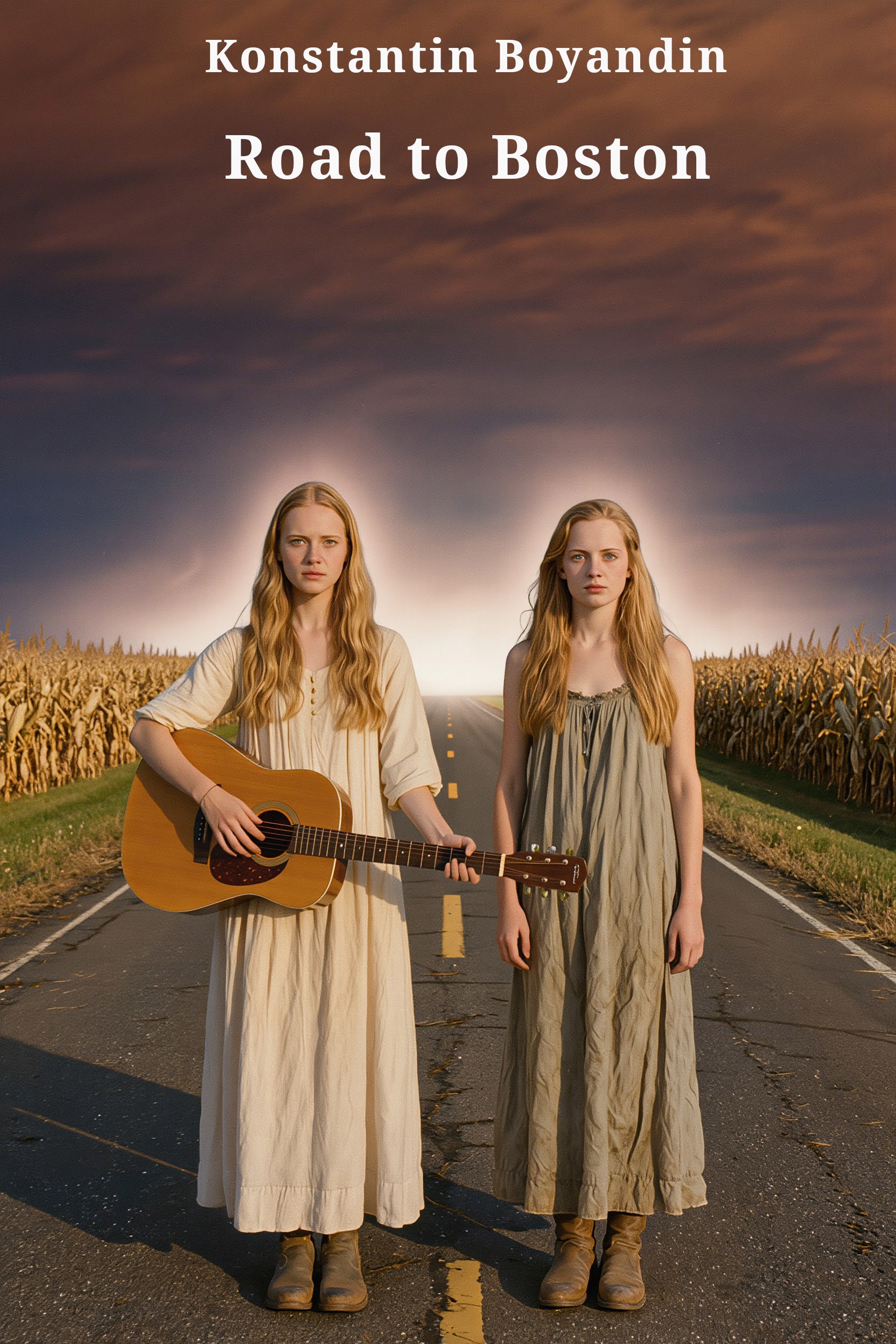
Road to Boston
1. The Leaving
The corn was high in August, and the Wilds farm sat in it like a secret kept too long.
Martha Wilds stood on the porch with her arms crossed, watching her daughters load a single duffel bag into the back of the Abrams' station wagon. The bag was small. Too small for two young women setting off to make their fortune. But then, Martha had learned not to question what her daughters needed anymore.
Ten years. Ten years of waking every morning and walking to the ruins of the Starlight Club, hoping. Ten years of her husband Thomas pretending he'd accepted their deaths while keeping their bedroom exactly as they'd left it. Ten years of grief so familiar it had become furniture in her mind—something she moved around without seeing.
And then, two weeks ago, the tornado.
She still couldn't think about it directly. The way the sky had turned the color of a bruise. The way the Abrams couple—strangers, musicians passing through—had somehow *known* to go to the ruins and play. The way Noah Clark had appeared from nowhere, older now, but recognizable, standing exactly where he'd stood in 1982.
The way the wind had reversed.
The way her daughters had walked out of nothing, holding hands, looking not a day older than nineteen.
"Ma." Mia's voice, calling from the yard. "Ye're starin' again."
Martha uncrossed her arms. "A mother's allowed."
Lora laughed—that bright, careless laugh that had always made Martha nervous. Lora had never understood consequences. Or perhaps, Martha thought now, Lora had simply understood them differently. "We'll be back in a month. Ye'll barely notice we're gone."
"I noticed for ten years, Lora."
The laugh stopped. Lora's face—young, impossibly young, frozen at twenty though she should be thirty now—flickered with something ancient. "Aye," she said quietly. "We ken that, Ma. We ken."
Thomas Wilds emerged from the barn, moving slowly. He'd aged in the years his daughters hadn't. His hair had gone white; his shoulders had curved inward as though protecting something broken in his chest. But when he looked at Mia and Lora, his eyes were clear.
"The guitar," he said. "Ye're takin' it?"
Mia nodded. She held the instrument carefully—an acoustic with a body the color of dark honey, no maker's mark anywhere on it. It had appeared in the cornfield three days after their return, lying in a perfect circle of flattened stalks.
"It's nae ours," Thomas said. "Nae really."
"It came for us," Lora said. "Same as the wind. Same as the way back." She touched the strings, and they hummed a chord that shouldn't have been possible from an unplucked instrument. "We're meant tae have it."
Thomas looked at the guitar for a long moment. Then he nodded, once, and walked to the station wagon.
John Abrams stood beside the open driver's door, notebook in hand. He was writing something—he was always writing something—and didn't look up as Thomas approached. But he closed the notebook and tucked it into his jacket.
"Mr. Wilds."
"Mr. Abrams." Thomas extended his hand. "Ye'll watch over them."
It wasn't a question. John took the hand and shook it. "We will."
"They look young. Ye'll notice people... noticing. Wondering why two grown men and women are traveling with teenage girls."
"Mia's handled stranger situations." John glanced toward his wife, who was checking the oil. "We'll be careful."
Thomas held the handshake a moment longer. "They're nae what they seem, Mr. Abrams. I dinnae mean that as a warning. I mean—" He stopped. His jaw worked. "They're my daughters. They'll always be my daughters. But what they are *now*... I dinnae fully understand it. And I've had two weeks tae try."
John met his eyes. "At the ruins, when we played, something answered. Something in the music itself. Your daughters came out of that answer." He paused. "I don't understand it either. But I know it was real. And I know they're extraordinary."
Thomas released his hand. "Extraordinary," he repeated. "Aye. That's one word for it."
Martha came down from the porch, carrying something small. A cassette tape, its label faded but still legible in her careful handwriting: *Mia & Lora - Barn Sessions - 1981-82*.
"Ma," Mia said. "Ye kept it?"
"I kept everything." Martha pressed the tape into Mia's hands. "Every drawing. Every note ye left on the kitchen table. Every sock ye never matched." Her voice caught. "This was the last one. The last recording before—"
She couldn't say it. *Before the club. Before the tornado. Before you vanished and I thought I'd never hear your voices again.*
Lora moved first, wrapping her arms around her mother. Mia followed. For a moment, the three of them stood in the yard—two women who looked like teenagers and one who had aged decades in their absence—holding each other in the shadow of the corn.
"We'll come back," Mia whispered. "Every month. We promised."
"I know." Martha pulled back, wiping her eyes. "But ye'll also become something. Out there. Something the world will see. And I—" She laughed, shaky. "I just want ye tae remember where ye started. That's all. Remember the barn. Remember the cassette recorder with the broken hinge. Remember—"
"We remember everything, Ma." Lora's voice was soft. "We remember more than ye know."
Mia Abrams finished with the oil and closed the hood. She was a striking woman—dark-skinned, tall, with the posture of someone who'd spent decades commanding stages. She'd been skeptical of this entire venture at first. Two farm girls who'd somehow survived a tornado? Who could allegedly "sing anything"? She'd seen a hundred prodigies come and go.
But she'd also been at the ruins. She'd heard what came out of the reversed wind.
She walked to where the Wilds sisters stood with their parents. "It's a long drive to Boston. We should go before we lose the light."
Mia Wilds—the younger Mia, the structured one—nodded. She tucked the cassette tape into the duffel bag alongside the guitar. "We're ready."
"Ye're nae ready," Thomas said. "Nobody's ever ready." He looked at his daughters—his impossible, ageless, returned daughters—and something in his face softened. "But ye'll learn. That's what the road's for."
Lora grinned. It was the same grin she'd worn at five, at fifteen, at the moment before the first tornado struck. "The road's for singin', Da. Everything else is just scenery."
The station wagon pulled out of the drive at 4:47 PM on a Tuesday in August 1992. Martha and Thomas watched until it disappeared around the bend, swallowed by the corn.
"They'll be famous," Martha said.
"Aye."
"The whole world will hear them."
"Aye."
Martha turned to look at her husband. "Does that frighten ye?"
Thomas was quiet for a long time. The corn rustled. Somewhere far off, a crow called.
"Nae the fame," he finally said. "What frightens me is what they might remember. What they might sing about." He paused. "Ten years, Martha. Ten years somewhere else. And they willnae tell us where."
Martha took his hand. "Maybe they cannae."
"Or maybe they're protecting us."
They stood on the porch until the sun touched the horizon, painting the corn gold and red. Then they went inside, to the kitchen that still smelled faintly of the breakfast their daughters had eaten that morning, and began the long process of learning to wait again.
In the back seat of the station wagon, Mia Wilds held the guitar across her lap. Beside her, Lora had already fallen asleep, her head against the window, her breath fogging the glass.
John Abrams drove. Mia Abrams sat in the passenger seat, reviewing a road atlas.
"Athol's about an hour east," she said. "There's a diner there where we can stop for coffee. Then Fitchburg, Concord, and Boston by nightfall if we push."
John nodded. "And Noah?"
"He's driving separately. Meeting us at the studio tomorrow." Mia Abrams turned in her seat to look at the younger Mia. "You should rest. It's going to be a long few days."
Mia Wilds didn't answer. She was looking out the window at the passing fields, the farms, the familiar landscape of Hollow Path giving way to the wider world.
She hadn't told anyone—not Lora, not their parents, not the Abrams—about the dreams. Every night since their return, she'd dreamed of the Otherworld. Not memories exactly, but *echoes*. Voices calling in languages that didn't exist. Music that seemed to come from the stars themselves. And always, always, the feeling of being watched by something vast and patient.
The Seelie Court had let them go. But Mia wasn't sure they'd been forgotten.
She touched the guitar strings. They hummed beneath her fingers—a sound like welcome, like warning, like the first note of a song that hadn't been written yet.
"I'm nae tired," she said quietly. "I think I've been sleeping for ten years. I dinnae want tae miss anything now."
Mia Abrams studied her for a moment. Then she nodded and turned back to the road atlas.
"Athol, then. There's a jukebox at that diner. Plays old blues."
In her sleep, Lora smiled.
2. Athol
The diner sat at the junction of Route 2 and a county road that led nowhere anyone remembered. Its sign—ROSIE'S, with a coffee cup that had stopped lighting up sometime during the Carter administration—flickered in the early evening haze. Three big rigs idled in the lot, their drivers inside escaping the August heat.
John Abrams pulled the station wagon into a spot near the door. The engine ticked as it cooled.
"Twenty minutes," Mia Abrams said, checking her watch. "Coffee, bathroom, back on the road."
Lora was already out of the car, stretching her arms above her head, rolling her neck. She'd slept for the entire hour but looked as though she'd been awake for days—a restless, hungry energy radiating from her slight frame. "I smell pie."
"You smell grease," her sister said, climbing out more carefully, leaving the guitar on the back seat. "Same as every diner between here and the coast."
"Aye, but this grease has *character*."
Inside, Rosie's was everything the exterior promised: cracked vinyl booths, a counter with stools that wobbled, a jukebox in the corner playing Muddy Waters low enough to be atmosphere. The air conditioning wheezed but functioned. Four truckers occupied various stations—two at the counter, two in a booth—and a waitress with gray hair and a name tag reading DELPHI moved between them with a coffee pot that seemed to never empty.
The Abrams entered first. They were known quantities in places like this—a Black couple, well-dressed but not ostentatious, clearly passing through. Heads turned, assessed, returned to coffee cups. Massachusetts in 1992 was not Mississippi in 1962, but it was not without its calculations.
Then the Wilds sisters entered, and the calculations shifted.
Two teenage girls—or what appeared to be teenage girls—with long hair the color of autumn wheat, skin too pale for summer, eyes that caught the fluorescent light strangely. They moved in unconscious synchronization, Lora slightly ahead, Mia slightly behind, as though they'd been walking together so long their footsteps had merged into a single rhythm.
A trucker at the counter—big man, Peterbilt cap, arms like bridge cables—watched them slide into a booth. His eyes narrowed. Not with hostility. With something closer to confusion.
"Booth in back," Mia Abrams said, guiding them. "Less visible."
"Less fun," Lora countered, but she went.
Delphi arrived with menus and the eternal coffee pot. "Passing through?"
"Boston," John said. "Long day."
"Always is." She poured four cups without asking. "Pie's blueberry today. Made it myself. Don't let the face fool you—I know what I'm doing."
Lora grinned. "We'll take four slices."
"We'll take *one* slice," Mia Abrams corrected. "Split. And whatever's quick for dinner. We need to keep moving."
Delphi nodded and disappeared. The jukebox clicked, cycling to the next track. More Muddy Waters—"Hoochie Coochie Man," the bass line prowling beneath the vocals like something hunting.
Lora's head turned toward the sound. Her fingers began tapping the table, finding the rhythm, playing against it.
"Don't," Mia Wilds said quietly.
"Don't what?"
"Whatever ye're thinking. We're trying tae be invisible."
Lora's grin widened. "When have we ever been invisible?"
The trucker with the Peterbilt cap was named Earl Dawson. He'd been driving rigs for twenty-three years, mostly eastern seaboard routes, and he'd seen every kind of strange that the American road could produce. Hitchhikers who weren't there when you looked twice. Rest stops that didn't appear on any map. A woman in white standing in the median outside Scranton, gone when his headlights passed.
But these two girls in the back booth—they were a different kind of strange. A kind he couldn't name.
He watched them in the mirror behind the counter. The way they moved. The way they *didn't* move—going still sometimes, perfectly still, like deer sensing a predator. The way they looked at the jukebox as though they could see inside it.
His buddy Marcus, two stools down, followed his gaze. "Jailbait," Marcus said, low. "Don't even think about it."
"I'm not thinking about *that*." Earl shook his head. "Something else. Can't put my finger on it."
"You're getting old. Seeing ghosts everywhere."
"Maybe." Earl turned back to his coffee. But he kept watching in the mirror. And when the taller one—the restless one—started tapping the table in time with Muddy Waters, he saw her fingers move in patterns no casual listener would know. Patterns that matched the *original* recording, not this remastered jukebox version.
Patterns from 1954.
The food came. Burgers, fries, a slice of blueberry pie that Delphi placed in the center of the table with four forks.
"Eat fast," Mia Abrams said. "We can make Fitchburg by seven if we don't linger."
John was writing in his notebook again, documenting something—the diner, the route, the way the Wilds sisters had fallen silent when the music changed. He'd been doing this since the ruins. Building a record. Evidence, maybe, for the day when someone asked him to explain what he'd witnessed.
Lora ate three fries, then pushed her plate away. "I need air."
"You just got inside."
"Aye, and now I need oot." She was already sliding from the booth. "Five minutes. I'll be by the car."
Mia Wilds watched her sister go. Something passed across her face—concern, recognition, resignation. "She feels it," she said quietly.
"Feels what?" Mia Abrams asked.
"The music. It's... loud in here. For her." The younger Mia looked at the jukebox. "For us. It's always been loud. But since we came back, it's..."
She didn't finish. She didn't need to.
Lora pushed through the diner door and into the parking lot. The heat wrapped around her immediately—August in Massachusetts, the air thick enough to chew. She walked past the station wagon, past the idling rigs, to the edge of the lot where a scraggly line of trees marked the beginning of someone's property.
She breathed.
In the Otherworld—in the place they'd been, the place they couldn't fully describe—music had been *everything*. Not background. Not entertainment. The Seelie Court communicated in melody. Their architecture was harmony made solid. Their seasons changed when someone sang them into turning.
Ten years of that. Ten years of music so total, so absolute, that returning to a world where it played from *boxes*—tinny, compressed, trapped—felt like suffocation.
But also like hunger.
She could hear the jukebox from here, muffled through the diner's walls. Howlin' Wolf now—"Smokestack Lightning," the guitar figures spiraling upward like actual smoke. She knew this song. She'd known it before the vanishing, from their father's record collection, from late nights in the barn with the battery-powered player.
But she knew it differently now. She could hear the *space* in it. The places where the song wanted to go but couldn't, because 1956 recording technology couldn't follow. The ghost notes. The phantom harmonies.
She started humming. Not the melody—the spaces around it.
Earl Dawson came out for a cigarette and found the girl standing at the edge of the lot, making sounds.
Not singing, exactly. Something stranger. Sounds that wove between the muffled jukebox and the truck engines and the cicadas in the trees—finding gaps, filling them, creating a kind of... architecture. That was the only word he could think of. She was building something out of sound.
He lit his Marlboro and watched. The smart thing would be to go back inside. Mind his own business. Get back on the road to Albany and forget this whole weird stop.
Instead, he walked closer.
"That's Howlin' Wolf," he said.
The girl didn't startle. She turned, slowly, and her eyes caught the parking lot lights in a way that made Earl's cigarette hand tremble. "Aye. Chester Burnett. Born 1910, died 1976. Sang like he had a demon in his throat and an angel in his heart."
"You know your blues."
"I know all music." She said it simply, without boasting. A statement of fact. "What's yer name?"
"Earl."
"Earl." She tasted the word. "Ye're the one who's been watching us. In the mirror."
Earl felt his face heat. "Wasn't—I mean, I didn't mean anything by it."
"I know ye didn't. Ye're curious. That's different." She tilted her head. "What is it ye see, Earl? When ye look at us?"
He should lie. He should deflect. He should get back in his truck and drive until this whole evening felt like a dream.
"Something old," he said instead. "Wearing something young."
The girl smiled. It was not a teenager's smile. "That's closer than most get."
Inside the diner, Mia Abrams was asking for the check when the door opened and her husband's notebook fell from his hands.
The trucker—the big one who'd been watching them—walked in with Lora Wilds beside him. But that wasn't what made John drop the notebook. It was the way they were walking. Side by side, in step, as though they'd rehearsed it. And Lora was still making those sounds—those *architectural* sounds—and the trucker was humming along.
Humming a bass line.
"Oh no," Mia Wilds whispered.
"Oh *yes*," her sister said, loud enough for the whole diner to hear. "Earl here says Scottish girls dinnae know nothin' about the blues. I told him he was wrong. He said prove it."
Earl's face was a mixture of embarrassment and anticipation. "I didn't exactly—"
"Ye said it." Lora's grin was sharp. "And now I'm gonnae show ye."
Mia Abrams stood. "We don't have time for this."
"We have exactly enough time for this." Lora was already moving toward the jukebox. "Mia—sister, not Mrs. Abrams—come on. We havenae sung for strangers since we got back. And these folk need tae hear what we can do."
The younger Mia was already shaking her head. "Lora, this isn't the place—"
"There's nae place that isn't the place. Da said that. Remember?" Lora reached the jukebox and ran her fingers over the glass. "We spent ten years learning tae sing with beings who invented music before humans had throats. And ye want tae hide that? Keep it quiet? Pretend we're just two farm girls with nice voices?"
The diner had gone silent. The other truckers were watching. Marcus, Earl's friend, had half-risen from his stool. Delphi stood behind the counter with the coffee pot frozen mid-pour.
Mia Wilds closed her eyes. Ten years. Ten years of the Seelie Court. Ten years of learning that music wasn't something you *performed*—it was something you *became*.
"One song," she said.
Lora's grin could have lit the parking lot.
The jukebox had a feature most people never used: a "stop" button that would halt the current track and refund your quarter. Lora pressed it, and Howlin' Wolf cut off mid-howl.
She didn't put in another quarter. She didn't select another song.
She just started singing.
The first note was low—lower than should have been possible from a woman her size. A hum that seemed to come from the floor itself, vibrating through the linoleum, up through the stools and booths and bodies of everyone present.
Mia joined on the second note. Higher, but not high. A harmony that wrapped around her sister's voice like smoke around a flame.
And then the words came.
Not English. Not Scots, exactly. Something older. Something that had been old when the blues were born—when field hollers first rose from cotton rows and chain gangs and the bone-deep knowledge that some pain only music could carry.
Earl felt his knees go weak. He grabbed the counter for support.
The Wilds sisters were singing the blues. But not any blues he'd ever heard. This was the *source*. The aquifer beneath the well. The place where all that sorrow and defiance and hope and rage had first learned it could become sound.
Delphi set down the coffee pot. Her eyes were wet.
Marcus, the trucker who'd warned Earl about jailbait, was openly weeping.
And John Abrams was writing furiously in his notebook, trying to capture something that couldn't be captured, trying to pin down a butterfly made of lightning and grief.
They sang for four minutes. Maybe five. Time went strange in the diner—the clock on the wall seemed to stutter, catch, run backward, run forward again. When they finished, the silence was so total that the hum of the refrigerator case sounded like a symphony.
Lora spoke first. "That's what Scottish girls know about the blues."
Nobody laughed. Nobody spoke. Earl Dawson reached into his pocket, pulled out a worn leather wallet, and extracted a twenty-dollar bill.
"For the road," he said, holding it out. His hand was shaking. "I don't—I can't—" He swallowed. "I lost my daughter. Three years ago. Car accident outside Hartford. She loved music. Wanted to be a singer." The tears came now, running down his weathered face without shame. "What you just did—I don't know what it was. But I heard her. In the middle of it. I *heard* her."
Lora's face softened. The trickster energy faded, replaced by something ancient and kind. She took the twenty, folded it, and pressed it back into Earl's hand.
"Keep it," she said. "And when ye hear her again—and ye will, in quiet moments, in the space between songs—tell her we said hello."
She turned and walked out of the diner, her sister following.
The Abrams couple gathered their things in the ringing silence, left money on the table, and went after them.
Earl stood holding the twenty-dollar bill for a long time. Then he sat down on the nearest stool and cried until Delphi brought him pie he hadn't ordered.
"On the house," she said. "I think we all need something sweet after that."
In the parking lot, Mia Abrams caught Lora's arm before she could reach the car.
"What *was* that?"
Lora didn't pull away. She looked at the older woman—the professional, the skeptic who'd come to believe, the jazz singer who thought she understood music—and smiled sadly.
"That was us. What we can do. What we *are* now." She glanced at her sister. "The Otherworld gave us something, Mrs. Abrams. Or maybe it just unlocked something that was always there. Either way—we cannae hide it. The music comes out whether we want it tae or not. So we might as well use it for something good."
"That man was destroyed in there."
"That man was *healed* in there. There's a difference." Lora opened the car door. "His daughter's been trying tae reach him for three years. He just needed someone tae open the channel."
Mia Abrams stared at her. "You're saying you can... communicate with the dead? Through music?"
Lora's smile flickered. "I'm saying music goes places we dinnae understand. And we've been tae some of those places. And now we can... visit. Sometimes. When the song is right."
She climbed into the back seat.
Mia Wilds lingered. "She's telling the truth," she said quietly. "But it's nae the whole truth. The whole truth is—" She stopped. Shook her head. "The whole truth would take longer than the drive tae Boston. And ye might nae believe it anyway."
"Try me."
The younger Mia looked at Mia Abrams for a long moment. Two women named Mia, bound together by a ritual neither fully understood.
"The blues," she said, "are an American invention. But sorrow is older than countries. Older than humans. In the Otherworld, there are beings who have been singing the blues since before there were stars. We learned from them. We carry their songs now. And sometimes, when we sing, the door between here and there opens a crack."
She climbed into the car.
Mia Abrams stood in the parking lot, the August heat pressing against her, the sound of distant trucks and nearby cicadas filling the air.
Then she got behind the wheel and started the engine.
"Fitchburg," she said. "Before full dark."
Nobody answered. In the back seat, the Wilds sisters sat with their eyes closed and their hands intertwined, humming something too quiet to identify.
John Abrams wrote in his notebook: *Athol diner. 6:23 PM. They made a man see his dead daughter. I believe everything now.*
3. The Hollow
They found the campground by accident.
The plan had been to push through to Fitchburg, find a motel, sleep in real beds. But the station wagon had other ideas. Somewhere past the Athol town line, the temperature gauge crept toward red, and John Abrams pulled onto the shoulder with a sigh that spoke of long experience with aging vehicles.
"Radiator again," he said, popping the hood. Steam hissed into the evening air. "Needs to cool. Couple hours at least."
Mia Abrams consulted the road atlas by flashlight. "There's a state campground half a mile up. Quabbin area. We could set up for the night, let the car rest, hit Fitchburg fresh in the morning."
In the back seat, Lora was already reaching for the door handle. "Camping. When's the last time we slept under stars, sister?"
Mia Wilds didn't answer immediately. She was looking out the window at the darkening treeline, her expression unreadable. "We slept under different stars for ten years."
"Aye, but these are *our* stars. Massachusetts stars. They've been waitin' for us."
The campground was called Hollow Pine — a name that would later seem prophetic, though at the time it was just faded paint on a wooden sign. The ranger station was closed for the night, but an honor-system envelope box offered sites for eight dollars. John stuffed a ten inside and didn't ask for change.
Site 14 sat at the edge of a loop, bordered by white pines on three sides and a small brook on the fourth. The Abrams had camping gear in the wagon's back — a habit from years of touring through places where motels weren't an option or weren't welcoming. Within twenty minutes, they had a tent up and a small fire going in the iron ring.
The Wilds sisters didn't help with setup. They stood at the edge of the firelight, heads tilted at identical angles, listening.
"Ye hear it?" Lora murmured.
"Aye."
Mia Abrams looked up from the fire. "Hear what?"
"A bairn," Mia Wilds said. "Crying. Three sites over, maybe four. Has been since we arrived."
Now that she mentioned it, Mia Abrams could hear it too — thin and distant, the unmistakable wail of a very young child. She'd filtered it out as background noise. But the Wilds sisters hadn't. Couldn't, perhaps.
"Probably just needs sleep," John said. "Kids that age, they cry."
"This one's been crying for hours." Lora's voice was certain. "The parents are exhausted. Frightened, even. Nothing they try is working."
"How can you possibly know that?"
Lora turned, and the firelight caught her eyes strangely — reflecting back not orange but something closer to silver. "We can hear the shape of it. The way the crying echoes. It's nae a hungry cry or a wet cry or an angry cry. It's a *lost* cry. The bairn is lost inside itself, and the parents dinnae know how tae find it."
John and Mia Abrams exchanged glances. After the diner — after watching these two young women make a grown trucker weep by singing sounds that shouldn't exist — they'd learned not to dismiss anything.
"What do you want to do?" Mia Abrams asked.
Lora was already walking toward the sound.
Site 18 was chaos contained in a twenty-foot circle.
A man in his thirties paced the perimeter with a toddler against his shoulder, bouncing, patting, murmuring desperately. His wife sat in a camp chair with her head in her hands, shoulders shaking. A porta-crib stood open and useless. Empty bottles littered a folding table. A small radio played soft music that the child's screaming completely overwhelmed.
The man saw the approaching strangers and his face cycled through annoyance, embarrassment, and finally a kind of desperate hope. "Sorry about the noise," he called over his daughter's wails. "We've tried everything. She's been like this for three hours. I don't—we don't know what's wrong."
"May we help?" Mia Wilds asked.
The man blinked. Two teenage girls — that's what he saw. Teenagers, probably from another campsite, probably just curious about the commotion. "I don't think—"
"Please." Lora's voice was gentle. "We're good with bairns. Let us try."
The man's wife looked up. Her eyes were red, her face streaked with tears and exhaustion. "Nothing works. We've tried singing. She hates it. She screams louder."
"Ye've tried yer songs," Lora said. "Let us try ours."
John Abrams arrived with his guitar — a battered Martin that had seen thirty years of studio sessions and roadhouse gigs. Behind him, Mia Abrams carried something strange: a children's toy piano, barely a foot wide, its plastic casing cracked and yellowed.
"Found this in the wagon," she said. "Forgot it was there. My niece's. Half the keys are stuck."
"It'll do." Lora took the toy piano and set it on the picnic table. She pressed a key; it produced a sound like a music box being slowly crushed. She smiled. "It'll do perfectly."
The toddler — a girl, perhaps eighteen months old, red-faced and inconsolable — continued to scream. Her father held her helplessly, swaying in place.
Mia Wilds took the guitar from John. She didn't check the tuning or adjust the strap. She simply held it and waited.
"What are you going to play?" the mother asked.
"We dinnae know yet," Mia said. "It hasnae been written."
Lora pressed three keys on the broken toy piano. The sound was thin, warped, slightly out of tune — but there was something in the dissonance that caught the ear. A pattern that wasn't quite a melody but wanted to become one.
Mia answered with a single guitar chord. Not strummed — plucked, string by string, each note arriving like a footstep in snow.
The toddler's scream hitched. Not stopped, but *changed* — as though something in the sound had snagged her attention.
And then Lora began to sing.
Yon willow greets the nicht sae low, Wi' birken breath an' lantern glint.
The words came from nowhere. Later, Lora would say she didn't remember composing them — they simply arrived, fully formed, as though they'd been waiting in the air for someone to voice them.
She hums a tune nae bairn should know— A sang that curls like cinder flint.
Mia joined on the harmony, her voice weaving beneath her sister's, and the guitar followed both of them, finding notes that shouldn't fit but did.
Lie laigh, lie laigh, the leaves shall sigh, Her branch will rock ye in her cry. But dinnae blink or gaze sae lang— For dreams are whaur the shades belong.
The toddler stopped crying.
It wasn't gradual. One moment, the child was mid-wail, face contorted, lungs at full capacity. The next, silence. Her eyes went wide, fixed on the two young women making sounds she couldn't understand but somehow recognized.
Her father froze, afraid to move, afraid to break whatever spell had settled over site 18.
The Wilds sisters kept singing.
She wears nae face but kens yer fears, A wede o' sighs frae ancient years. She'll croon ye ben the hollow gate— An' hush ye till it's far too late.
The mother rose from her chair, hand pressed to her mouth. Tears streamed down her face, but these were different tears — not exhaustion, not frustration. Something else. Something deeper.
Lie laigh, lie laigh, the leaves shall sigh, Her branch will rock ye in her cry. But dinnae blink or gaze sae lang— For dreams are whaur the shades belong.
The toddler's eyes began to close. She sagged against her father's shoulder, tension draining from her tiny body like water from a cracked vessel.
So sleep, ma jo, wi' dreams sae deep, An' mind the weepin' tree ye keep.
One final guitar note. One final toy-piano chime. Silence.
The child was asleep.
For a long moment, nobody moved. The father stood with his daughter limp against his chest, breathing softly, her face peaceful for the first time in hours. The mother stared at the Wilds sisters as though they'd performed a miracle — which, in a sense, they had.
"How did you do that?" the father whispered.
"We sang her home," Lora said simply. "She was lost somewhere inside herself. Trapped in a feeling she couldnae name. The song gave her a path back."
"That song—I've never heard anything like it."
"Neither have we." Mia Wilds set down the guitar carefully, as though it had become something precious. "It didnae exist until just now. It was made for yer daughter. For this moment."
The mother stepped forward. "Who *are* you?"
The sisters looked at each other. That old question, always the same, never easy to answer.
"We're the Wilds," Lora said. "Mia and Lora Wilds. From a wee place called Hollow Path." She smiled, and there was something ancient in it. "We're musicians."
"Musicians." The father shook his head slowly. "That wasn't music. That was..."
He trailed off. There was no word for what it was.
They stayed at site 18 for another hour. The parents — David and Christine, their daughter Emma — needed to talk, to process, to ask questions that had no real answers. John Abrams took notes. Mia Abrams watched the Wilds sisters with an expression that had become familiar: a mixture of awe and something close to fear.
"The words," Christine said at one point, clutching a cup of coffee that had gone cold. "They were... dark. Weren't they? Something about a tree with no face? Hushing someone 'till it's too late'?"
"Lullabies are always dark," Mia Wilds said. "The old ones, the real ones. They come from a time when the night was dangerous and children needed tae be warned. 'Rock-a-bye baby' ends with the cradle falling. 'Hush, little baby' promises things that cannae be kept. Our songs — the ones we learned *there* — they're honest about what sleep is. What dreams are."
"And what are dreams?"
Mia Wilds looked at the sleeping child. "A place between places. Where the mind goes when the body needs rest. Usually safe. Sometimes nae. Yer daughter was stuck in one of the unsafe parts. We sang her to a better path."
Christine absorbed this. David paced, Emma still cradled against him, unwilling to put her down even though she slept soundly.
"Will she remember?" he asked.
"She'll remember the feeling," Lora said. "The sound. Years from now, when she hears certain kinds of music, she'll feel safe without knowing why. That's what we gave her. A map back home, hidden in a melody."
The Abrams and the Wilds returned to site 14 near midnight. The fire had burned to embers. The pines stood black against a sky crowded with stars.
"That song," John said, breaking the silence. "You need to record it."
"It was just for them," Mia Wilds said. "For Emma."
"No. It was for everyone." John flipped open his notebook, where he'd transcribed the lyrics as best he could. "Songs like that don't come along often. Songs that can actually *do* something. You can't let it disappear."
Lora took the notebook, scanning his handwriting. Her lips moved as she read, relearning words she'd sung minutes ago but hadn't consciously created. "Hush of the Hollow," she murmured.
"What?"
"That's what it's called. 'Hush of the Hollow.' I just — I know that. The way I knew the words."
Mia Wilds moved closer to read over her sister's shoulder. "We should keep it. John's right. It's... it's the first real thing we've made since coming back. The first thing that's *ours*."
"The blues at the diner—"
"That was proof. This is creation." Mia took the notebook gently from her sister's hands. "There's a difference."
They slept under Massachusetts stars that night. The tent was too small for four, so the Wilds sisters took blankets and lay in the bed of pine needles beside the dying fire. They didn't speak. They didn't need to.
Somewhere in the distance, a whippoorwill called. Closer, the brook murmured its patient song. And from site 18, carried faintly on the night air, came the soft sound of a toddler sleeping peacefully for the first time in days.
Lora hummed the melody. Mia joined, harmonizing by instinct. The night seemed to lean in to listen.
Lie laigh, lie laigh, the leaves shall sigh, Her branch will rock ye in her cry.
In the tent, John Abrams wrote by flashlight: *First original composition post-return. "Hush of the Hollow." Improvised for a crying child at Hollow Pine campground. Both sisters report the song "arrived" rather than being composed. This will be important.*
He underlined the last sentence twice.
In the morning, half the campground gathered around site 14.
Word had spread — the way it does in places where strangers become temporary neighbors. The family at site 18 whose baby wouldn't stop crying. The two young women who sang it to sleep in under two minutes. The song no one could quite remember but everyone wanted to hear again.
David and Christine arrived first, Emma awake and cooing happily, clutching a stuffed rabbit. Behind them came an older couple from site 12. A group of college kids from the tent cluster near the bathhouse. A solitary fisherman who'd been packing up to leave until he heard the whispers.
"They want you to sing again," Mia Abrams observed.
Lora looked at the gathering crowd — perhaps fifteen people in the early morning light, more drifting over, all of them with that particular expression of hope and curiosity.
"Then we'll sing," she said.
They performed "Hush of the Hollow" twice more that morning, and by the second time, people were crying openly. Not from sadness. From something else — a release, a recognition, a feeling they couldn't name but knew they needed.
By the time the Abrams' station wagon pulled out of Hollow Pine campground, the Wilds sisters had sung for twenty-three people, refused all payment, and given their names to a woman named Margaret Chen who mentioned she knew someone who knew someone at a Boston radio station.
"What just happened?" Mia Wilds asked as the campground disappeared behind them.
"I think," Mia Abrams said slowly, "you just started a career."
4. Fitchburg
The record shop occupied a narrow storefront on Main Street, wedged between a hardware store and a vacant space that had once been a bakery. The sign above the door read TATE'S VINYL in hand-painted letters, the 'V' faded to near-invisibility. A smaller sign in the window declared: RARE RECORDINGS - JAZZ - BLUES - CLASSICAL - NO TOP 40.
Mia Abrams spotted it first. "Stop the car."
John pulled to the curb without questioning. After three decades of marriage, he knew that tone. His wife had found something that mattered.
"What is it?" Lora asked from the back seat, craning to see past the headrest.
"A place I didn't know still existed." Mia Abrams was already opening her door. "Vernon Tate's shop. I thought he'd closed years ago."
"Who's Vernon Tate?"
"Someone who knew me when I was younger than you look." She paused, hand on the door frame. "Someone who might be useful. Or might be a problem. We'll see."
The shop interior smelled of dust and vinyl and decades of accumulated opinion. Floor-to-ceiling shelves lined every wall, stuffed with albums organized by a system that probably made sense only to its creator. A listening booth stood in the back corner — actual wood-paneled booth with a turntable inside, the kind that hadn't been built since the sixties. Jazz played from hidden speakers: Monk, maybe, or someone who'd studied Monk until the distinction blurred.
Behind the counter sat a man who matched the shop perfectly. Black, late sixties or early seventies, gray hair cropped close to his skull, reading glasses perched on a nose that had been broken at least once. He wore a cardigan despite the August heat, and his fingers — long, elegant, unmistakably a musician's fingers — tapped the counter in time with the music.
He looked up as they entered. His eyes moved across the group with professional assessment: John Abrams first (musician, obvious), then the two young women (uncertain, filed for later consideration), and finally Mia Abrams.
He went still.
"Well," he said. "Mia Foster. Or is it Abrams now? Heard you got married."
"Thirty-one years ago, Vernon. You could have come to the wedding."
"I was in Copenhagen. Session work." He removed his glasses, folded them carefully, set them on the counter. "You look good. Better than you should, considering."
"Considering what?"
"Considering the industry chewed you up and spit you out around '79. Same as it did to everyone who wouldn't play the game." His gaze shifted to the Wilds sisters, lingering. "Who are the children?"
"They're not children. And they're why we're here."
Vernon Tate had been a session pianist in New York from 1962 to 1984. He'd played on albums that went gold and albums that went nowhere. He'd backed singers whose names became legends and singers who died in obscurity. He'd watched the music industry transform from an art form with commercial elements to a commercial enterprise with artistic pretensions, and when he couldn't stomach it anymore, he'd moved to Fitchburg and opened a record shop that catered to people who remembered what music used to mean.
He'd also, in 1971, played piano on an album called *Night Conversations* by a young vocalist named Mia Foster — three years before she became Mia Abrams, a decade before the industry decided she was too uncompromising to promote.
"I remember that session," he said, after Mia Abrams had sketched the basics: the tornado, the vanishing, the return. He didn't seem surprised by the impossible parts. Musicians who'd been around long enough learned not to be surprised by anything. "You had something real. Most singers, they perform. You *inhabited*. I always wondered what happened to you."
"Life happened. Marriage. Teaching. Smaller venues, smaller audiences, smaller dreams." She didn't sound bitter. Just honest. "But these two—"
"These two what?" Vernon's eyes hadn't left the Wilds sisters since they'd entered. "They look like teenagers. They move like something else. And they've been listening to my Monk record like they can hear colors in it."
Lora smiled. "We can. Blue and amber, mostly. Wi' flecks of something that doesnae have a name in English."
Vernon's expression didn't change. "Scots accent. Rural, if I'm placing it right. Not Edinburgh, not Glasgow. Somewhere smaller."
"Hollow Path," Mia Wilds said. "Between Arkham and Dunwich. Ye wouldnae have heard of it."
"I've heard of Arkham. Miskatonic University. Strange things come out of that area." He leaned back in his chair, studying them. "Mrs. Abrams says you disappeared for ten years and came back unchanged. Says you can sing anything. Says you made a trucker cry with Delta blues and put a baby to sleep with a lullaby that didn't exist until you sang it."
"All true," Lora said.
"I've heard a lot of 'all true' in my years. Mostly from people who believed their own hype." Vernon stood, moving around the counter with the careful grace of someone whose joints had started to protest. "The music industry is drowning in prodigies. Every week, someone discovers the next big thing. Every month, that thing turns out to be nothing but marketing and a good producer."
"We're nae a thing," Mia Wilds said quietly. "And we dinnae need marketing."
"Everyone needs marketing. The question is what's behind it." Vernon walked to a shelf near the listening booth, running his fingers along the spines of albums until he found what he wanted. "You say you can sing anything. You say ten years in — wherever you were — gave you something special. Let's test that."
He pulled out an album. The cover was simple: orange and red, a single photograph, four words.
*A Love Supreme. John Coltrane.*
"Ye want us tae sing over Coltrane?" Lora's voice held something between amusement and challenge.
"I want to see what you do with something that matters." Vernon carried the album to the listening booth, handling it with the reverence it deserved. "This isn't pop music. This isn't folk or blues or any of the things you've apparently already conquered. This is jazz at its most sacred. Coltrane recorded this as a prayer. A meditation. A conversation with God."
"We've had conversations with things older than God," Mia Wilds said. She didn't say it boastfully. She said it the way someone might mention they'd visited Paris.
Vernon paused, the album halfway out of its sleeve. "What does that mean?"
"It means we ken what prayer sounds like. What meditation feels like. What it is tae reach for something infinite and feel it reach back." She moved toward the listening booth, her sister following. "Play it. We'll show ye."
The listening booth was designed for one person. The four of them crowded in anyway — Vernon at the turntable, John Abrams pressed against the wall with his notebook, Mia Abrams wedged into the corner, and the Wilds sisters standing in the center as though the small space couldn't contain them.
Vernon placed the needle. The speakers crackled.
And then Coltrane began.
*A Love Supreme* opens with a gong and a declaration. The saxophone enters like someone taking their first breath after drowning — desperate and grateful and impossibly alive. The piano follows, McCoy Tyner laying down chords that suggest rather than define. Jimmy Garrison's bass walks beneath it all, patient as geology. Elvin Jones's drums converse with the saxophone, two voices finding each other across impossible distances.
For three minutes, the Wilds sisters simply listened. Their eyes were closed. Their breathing had synchronized — not just with each other but with the music, as though their lungs had become instruments in the arrangement.
Then Mia began to hum.
It wasn't a melody. It wasn't counterpoint. It was something else — a sound that wove between the existing notes, finding spaces Coltrane had left deliberately empty, filling them with something that felt like response. Like answer. Like the other half of a conversation that had been waiting forty years for a partner.
Lora joined on the third repetition of the main theme. Her voice went higher than her sister's, threading through Coltrane's saxophone lines, and the effect was uncanny: it sounded as though the original recording had always included this. As though Coltrane had intended for two Scottish women to one day complete what he'd started.
Vernon Tate's hands were shaking.
They sang through the entire first movement — "Acknowledgement," seventeen minutes of saxophone prayer and rhythm meditation. They didn't use words. What came from their throats was closer to glossolalia, or perhaps to whatever language they'd learned in the Otherworld. It rose and fell with Coltrane's declarations, answered his questions, harmonized with his grief and joy.
When the movement ended, Vernon lifted the needle.
Silence.
John Abrams had stopped writing. His notebook hung forgotten in his hand.
Mia Abrams was crying — not dramatically, just tears sliding down her face unnoticed.
Vernon Tate stood with his back to them, one hand on the turntable, the other pressed flat against his chest.
"Mr. Tate?" Lora's voice was gentle. "Are ye all right?"
"I played with Coltrane once." Vernon's voice was rough. "1964. A session that never got released. Wrong studio, wrong producer, wrong everything. But for about fifteen minutes, I was in the room when he played. I felt—" He stopped. Breathed. "I felt what you just made me feel. That sense that the music is going somewhere beyond music. Becoming something else."
He turned. His eyes were wet.
"I've spent thirty years in this shop, waiting for someone to walk in who understood. Who could do what you just did. I'd given up." He looked at the Wilds sisters — really looked, seeing past the young faces to whatever ancient thing moved behind their eyes. "You're not prodigies. Prodigies are talented children. You're something else entirely."
"We're musicians," Mia Wilds said simply. "Same as ye. Same as Coltrane. We just... learned in a different school."
Vernon closed the shop early. He made phone calls — three of them, brief and cryptic, while the others waited in the listening booth playing albums Vernon selected: Mingus, Dolphy, late-period Miles. Each time, the Wilds sisters found ways into the music that shouldn't have been possible. Each time, Vernon watched with an expression somewhere between wonder and something that might have been fear.
After the third call, he wrote something on the back of a business card and handed it to Mia Abrams.
"Diane Chen," he said. "She runs a studio in Allston. Small operation, but she has ears. Real ears, not industry ears. I've told her you're coming."
Mia Abrams looked at the card. "Vernon, we're not ready. They need training, polish, understanding of how the business—"
"They don't need any of that." Vernon cut her off, not rudely but firmly. "What they need is someone to capture what they do before the industry figures out they exist. Because once that happens—" He shook his head. "Once that happens, there will be people who want to own them. Change them. Sand off the edges that make them dangerous."
"Dangerous?" John asked.
"To everything the music industry has become." Vernon looked at the Wilds sisters, who were examining his jazz collection with the focused attention of scholars in an archive. "They don't perform. They don't interpret. They *channel*. That's rare enough to be valuable and strange enough to be threatening." He turned back to Mia Abrams. "Get them to Diane before someone else finds them. And for God's sake, don't let anyone put them in a recording booth with a producer who thinks he knows better than they do."
"What do we owe you?" John asked.
Vernon laughed — a short, sharp sound. "You owe me nothing. But they—" He nodded toward the sisters. "They owe me a recording. Someday. When they're ready. I want to hear what they sound like when they're not just responding to other people's prayers."
"When they're singing their own?"
"Exactly." Vernon began reshelveing the albums they'd played. "Now go. Fitchburg's not the place for them. This whole town is too small for what they are."
Back in the car, heading east toward Concord, John Abrams finally opened his notebook and began writing furiously. His wife drove. The Wilds sisters sat in the back, quiet for once, processing.
"What he said," Lora murmured. "About singing our own prayers."
"Aye." Mia stared out the window at the passing Massachusetts landscape. "The blues was answering someone else's pain. The lullaby was for Emma. Even what we did with Coltrane — that was conversation, nae creation."
"We created 'Hush of the Hollow.'"
"Did we? Or did it come through us from somewhere else?" Mia turned to look at her sister. "I've been thinking about that, Lora. About what we actually *do*. In the Otherworld, we learned tae be vessels. Channels, like Vernon said. But whose music are we channeling?"
Lora was quiet for a long moment. The road unspooled. A hawk circled over a field.
"Does it matter?" she finally asked. "If the music helps people? If it makes truckers cry and bairns sleep and old men remember what they loved about being alive?"
"It might matter. Someday." Mia's voice was troubled. "The Seelie Court let us go. They taught us everything we know and then they opened the door and let us walk back intae the world. Why?"
"Because we asked."
"We asked every day for ten years. They only let us go when they were ready. When we were..." She trailed off.
"When we were what?"
Mia didn't answer. But John Abrams, writing in the front seat, caught her expression in the rearview mirror and added a note: *M. Wilds suspects purpose behind their release. Concerned about what they might have been prepared for. Investigate Seelie Court motivations.*
He underlined the last sentence three times.
They stopped for gas outside Littleton. While John filled the tank, Mia Abrams spread the road atlas across the hood and calculated distances.
"Concord's another forty minutes. We could push through to Boston tonight if we wanted."
"I'm tired." Lora leaned against the car, face turned toward the late afternoon sun. "Nae physically. Something else. That session with Vernon — singing with Coltrane — it took something out of me."
"Ye gave something," her sister corrected. "Every time we sing like that, we give something. I can feel it."
"Is it dangerous?"
"I dinnae know." Mia Wilds climbed out of the car, stretching her legs. "In the Otherworld, the fae sang constantly. It was how they... existed. How they shaped reality. But they had something we dinnae have. A source. A wellspring they drew from."
"And we're drawing from ourselves?"
"Maybe. Or maybe—" Mia stopped, her attention caught by something across the road. A small church, white clapboard, steeple reaching toward the clouds. The kind of church that had stood in New England towns for three hundred years, weathering everything.
"Maybe what?"
"Maybe we need tae find our own wellspring." Mia walked toward the church, not entering, just standing at the edge of its shadow. "Vernon said Coltrane recorded *A Love Supreme* as a prayer. He was reaching for something beyond himself. Connecting to something larger."
"We connect. Every time we sing."
"But to *what*?" Mia turned back to face her sister. "The truckers at the diner, the bairn at the campsite, Vernon in his shop — they all felt something when we sang. But I'm nae sure we know what that something is. Where it comes from. What it wants."
The gas pump clicked off. John hung up the nozzle. Mia Abrams folded the atlas.
"We should go," Lora said. "Concord's waiting."
Mia Wilds looked at the church a moment longer. Then she nodded and walked back to the car.
But she didn't stop thinking about wellsprings. About sources. About what the Seelie Court might have planted in them during ten years of impossible education.
About what harvest they might have been cultivated to produce.
5. The Breakdown
The station wagon gave up the ghost three miles outside Littleton.
It happened without drama — a gentle loss of power, the temperature gauge climbing past red into territory the dial hadn't been designed to measure, steam rising from beneath the hood like a white flag of surrender. John Abrams guided the car onto the shoulder with the practiced calm of someone who'd nursed this vehicle through a dozen similar failures.
"That's it," he said, killing the engine. "She's done for today. Maybe done for good."
Mia Abrams was already out, popping the hood, stepping back as steam billowed into the late afternoon air. "Radiator's cracked. See that line? Must have happened somewhere on the back roads."
"Can it be fixed?"
"Not by us. Not here." She looked up and down the empty road. Fields stretched in both directions — corn to the left, something golden and harvested to the right. The nearest building was a farmhouse perhaps half a mile distant, its white clapboard siding glowing in the slanting light. "We need a tow. Or a miracle."
In the back seat, the Wilds sisters sat in uncharacteristic stillness. They'd been quiet since Fitchburg, since Vernon Tate's shop, since Mia had started asking questions about wellsprings and purposes that neither of them could answer. The strange energy that had propelled them through the diner and the campground seemed temporarily banked, replaced by something more contemplative.
"I could walk to that farmhouse," Lora offered. "Ask to use their phone."
"I'll go with you," Mia Abrams said. "John, stay with the car. And with—" She glanced at the younger Mia. "Just stay with the car."
They'd made it perhaps a hundred yards when the truck appeared.
It came from the direction of the farmhouse — an old Ford pickup, blue paint faded to gray in patches, bed loaded with hay bales. The driver saw the disabled station wagon and the two women walking toward him and slowed, pulling onto the shoulder with the easy courtesy of someone who'd helped stranded travelers before.
The man who climbed out was perhaps sixty, weathered in the way farmers get weathered, with hands like old leather and eyes the color of good soil. He wore overalls and a John Deere cap and moved with the careful economy of someone whose body had learned to ration its efforts.
"Trouble?" he asked.
"Radiator," Mia Abrams said. "We're trying to get to Boston."
"Boston's a long way to go with a cracked radiator." He walked past them to the station wagon, nodding at John, peering under the still-steaming hood. "Yeah, she's done. You'll need a tow to Littleton, maybe Concord. Henderson's garage might have a replacement, but not till morning."
"Is there somewhere we could stay? A motel?"
"Closest motel's back in Fitchburg." The farmer straightened, wiping his hands on a rag that appeared from nowhere. "But if you don't mind roughing it, I've got a barn with a clean hayloft. Wife makes a decent supper. You're welcome to stay the night, get this sorted in the morning."
John and Mia Abrams exchanged glances. The sisters had emerged from the car and stood slightly apart, watching the farmer with that particular attention they gave to everyone — as though they could see something beneath the surface.
"That's very kind," Mia Abrams said. "We'd be grateful."
"Name's Harold Mercer." He extended his hand. "Farm's been in the family four generations. Don't get many visitors these days, so you'd be doing us a favor, truth be told."
Harold's truck couldn't tow the station wagon, but he knew a man with a flatbed who owed him a favor. One phone call from the farmhouse and the car situation was handled — it would be waiting at Henderson's garage by morning, diagnosis and estimate to follow.
The farmhouse itself was everything the exterior promised: worn wooden floors, a kitchen that smelled of decades of good cooking, a living room with furniture that had been sat in by four generations of Mercers. Harold's wife, Eleanor, was a small woman with white hair and quick eyes who assessed the travelers with a single glance and immediately began preparing food.
"Four of you? I'll stretch the stew. Harold, get the good bread from the pantry, not the day-old."
The Wilds sisters helped without being asked — Lora setting the table, Mia slicing bread — and Eleanor watched them with the same evaluating look she'd given the whole group.
"You're not from around here," she said. Not a question.
"Scotland, originally," Lora said. "But we've lived in Massachusetts all our lives. A wee place called Hollow Path."
"Don't know it."
"Most folk dinnae. It's between—"
"Arkham and Dunwich," Eleanor finished. "I know that area. Strange country. My grandmother used to tell stories." She turned back to the stove, stirring. "You're musicians, Harold says."
"We are," Mia Wilds confirmed. "Heading to Boston. Recording opportunity."
"Everyone's heading to Boston for one thing or another. City draws people like moths to a lamp." Eleanor's voice was neutral, but something in it suggested she'd seen her share of moths, and lamps, and what happened when they met. "What kind of music?"
"All kinds," Lora said. "Whatever the moment calls for."
Eleanor made a sound that might have been skepticism or might have been acknowledgment. "Supper in twenty minutes. Harold's in the living room if you want to sit."
The living room held the usual artifacts of a long marriage — photographs on every surface, a piano in the corner that clearly hadn't been played in years, a radio on a side table currently playing something low and country. Harold sat in what was obviously his chair, an ancient recliner with a perfect view of both the window and the television.
But he wasn't watching television. He was looking at a photograph.
John Abrams noticed first, his documentarian's eye drawn to the farmer's expression. The photograph showed a young woman — perhaps eighteen, dark hair, Harold's eyes — holding a guitar and smiling at someone outside the frame.
"Your daughter?" John asked.
Harold startled slightly, as though he'd forgotten he wasn't alone. "Katherine. Kate." He set the photograph down, then picked it up again. "She'd be forty-three this year. If she'd—" He stopped. "If things had gone different."
The Wilds sisters had gone still. That particular stillness they got when something important was happening.
"What happened?" Mia Abrams asked gently.
"Nothing happened. That's the tragedy." Harold's voice was steady, the steadiness of someone who'd told this story to himself a thousand times. "She wanted to be a singer. Country music. Had the voice for it, had the heart for it. But this was '68, '69. Nashville wasn't interested in girl singers who wrote their own songs. They wanted pretty faces to stand behind microphones and sing what men wrote for them."
"She could have—"
"She could have done a lot of things. Could have gone anyway, taken her chances, made them listen." Harold shook his head. "But I told her there was no future in it. Not for a girl. Told her she should stay here, help with the farm, find a good man, raise a family." He laughed, short and bitter. "Good advice from a loving father."
"What did she do?"
"She stayed. Did everything I said. Married a man from Concord, had two children, worked as a secretary for thirty years." Harold finally set the photograph down, on the table beside his chair where he could see it without holding it. "She's still alive. Lives in Florida now with her second husband. We talk on the phone at Christmas."
"But she never sang again," Lora said.
"Not once. Sold her guitar the week after the wedding. Said if she couldn't do it right, she wouldn't do it at all." Harold looked at the sisters, and something in his expression was both pleading and resigned. "I killed something in her. With my practical advice and my loving concern. I killed the part of her that believed she could be more than what the world told her she could be."
Silence. The country music on the radio played on — Hank Williams, "I'm So Lonesome I Could Cry," the pedal steel weeping beneath the vocals.
"What was her favorite song?" Lora asked quietly.
Harold blinked. "What?"
"Her favorite song. The one she loved most, back when she still believed."
For a long moment, Harold didn't answer. Then he reached over and turned up the radio.
"This one," he said. "She used to sing it in the barn, when she thought no one was listening. I'd hear her from the fields. Voice like honey and heartbreak."
The Wilds sisters looked at each other. Something passed between them — not words, not even a conscious decision. Just recognition.
"Mr. Mercer," Mia Wilds said, "will ye let us sing something for ye?"
They gathered in the living room after supper. Eleanor sat in the chair that matched Harold's, skeptical but curious. The Abrams took the sofa. Harold remained in his recliner, the photograph of Kate now in his hands.
The sisters stood by the old piano. Lora had lifted the lid, tested the keys — badly out of tune, but playable. Mia held John's guitar, retuned now to something that complemented the piano's imperfections rather than fighting them.
"This isn't Kate's song," Mia said. "This is a song *for* Kate. And for every daughter whose father loved her too much to let her fly."
She began to play.
The first chords were pure country — the kind of progression that Hank Williams would have recognized, that Patsy Cline would have blessed. But there was something beneath it, something older. The Appalachian influence that connected American country to Scottish ballads, the Celtic root system that ran beneath both traditions like an underground river.
Lora's fingers found the piano keys, and what came out wasn't honky-tonk. It was something between a hymn and a lament, something that suggested church pews and mountain hollows and generations of women singing songs they weren't supposed to know.
Then Mia began to sing.
Ye told her to be practical, Tae put her dreams aside, Tae find a man and settle down And let her music hide. Ye told her there's nae future For a girl who writes her songs, That Nashville wants a pretty face And she should play along.
The words weren't Scots — they hovered somewhere between, accessible to American ears but carrying the weight of older traditions. Lora joined on the harmony, her voice wrapping around her sister's like ivy around oak.
But somewhere in the silence Where she put her guitar down, There's still a voice that's singing Every song she never found.
Harold's hands were shaking. The photograph trembled in his grip.
Her daddy's daughter learned to hide The music in her heart, She built a life of quiet days And played the smaller part. But fathers, hear us singing now The truth ye need to know: The songs ye silence in yer children Are the ones that never go.
The chorus lifted — Mia's voice climbing, Lora's supporting, the guitar and piano weaving together in a way that shouldn't have been possible from two instruments so imperfectly matched.
She's still yer Kate, she's still that girl Who sang in the barn alone, And every word ye never let her speak Is carved into her bone. So this song is for the daughters Who were taught to want for less, And for the fathers brave enough Tae finally confess.
The music shifted. The country structure remained, but something else entered — a Celtic turn, a blue note that bent the melody toward something ancient and aching.
Kate, if ye can hear us Across the miles and years, We're singing ye the future Yer father held in fears. Ye'd have made them listen, Ye'd have made them understand, That a girl with a guitar and a dream Could shake the whole damn land. But the song ye never recorded Still echoes in the corn, And every daughter after ye Inherits what ye've borne.
Eleanor was crying now. She'd taken her husband's free hand, holding it tight.
So take this as our promise, Kate — wherever ye might be: We'll sing the songs ye couldn't sing And set that music free.
The final chorus came, both voices unified, the guitar and piano resolving into a chord that hung in the air like a question finally answered.
Ye're still yer daddy's daughter, Ye're still that girl who dreamed, And the silence was never permanent — Just longer than it seemed. The songs ye kept inside ye Have been waiting for this day, And now we're singing them for ye In our own strange way.
The last note faded. The guitar strings hummed into silence. The piano lid remained open, the keys still warm.
Harold Mercer sat in his chair with tears streaming down his face, making no effort to wipe them away. His wife held his hand with both of hers now, her own tears falling freely.
"How did you know?" he finally whispered. "How did you know what to say?"
"We didn't," Mia Wilds said honestly. "It came through us. From somewhere. For her."
"I need to call her." Harold stood abruptly, the photograph clutched to his chest. "Kate. I need to call her tonight. Tell her—" His voice broke. "Tell her I'm sorry. Tell her I was wrong. Tell her it's not too late."
"It's never too late," Lora said. "The song's still there. It's always still there."
Harold nodded, unable to speak, and walked toward the hallway phone. Eleanor watched him go, then turned to the sisters.
"I don't know what you are," she said quietly. "But whatever you are, I'm grateful you broke down on our road."
"Sometimes things break down exactly where they need to," Mia Wilds said. "We've learned that. Since we came back."
"Came back from where?"
Mia looked at her sister. Lora shrugged — that what-harm-can-it-do shrug that had gotten them into and out of a hundred situations.
"From somewhere that taught us what music is for," Mia said. "It's nae entertainment, Mrs. Mercer. It's nae even art. It's a bridge. Between what is and what could be. Between what was said and what was meant. Between fathers and daughters who lost each other somewhere along the way."
Eleanor absorbed this. In the hallway, Harold's voice was audible — broken, apologetic, saying things that had been stored up for twenty-five years.
"Will you stay for breakfast?" Eleanor asked. "I make good pancakes."
"We'd be honored."
That night, the Wilds sisters slept in the hayloft Harold had offered, on blankets that smelled of summer and good work. The Abrams took the guest room in the farmhouse. Through the barn's open doors, the sisters could see the farmhouse windows — the light in the hallway that stayed on for three more hours while Harold talked to his daughter in Florida.
"What we did in there," Mia said quietly. "That was different."
"Different how?"
"The blues was for the trucker. The lullaby was for Emma. The Coltrane response was for Vernon, in a way. But this—" She paused, finding words. "This was for someone who wasn't even there. Someone we've never met. We reached across miles and years and touched someone we'll never know."
Lora was quiet for a moment. Straw rustled as she shifted position.
"Does that frighten ye?"
"Aye. A bit." Mia stared at the barn's ceiling, the ancient beams, the darkness that gathered in the corners. "In the Otherworld, the fae could do things like that. Reach across distances. Touch minds they'd never met. But they were careful about it. They said it was dangerous tae extend yerself too far."
"We're nae fae."
"No. But we learned from them. We carry something of theirs." Mia turned to look at her sister, barely visible in the darkness. "Every time we sing, we reach further. Connect more. What happens when we reach too far? What happens when we connect with something that doesnae want tae let go?"
Lora reached out and took her sister's hand. "Then we'll deal with it. Together. Like we always have."
"Even in the Otherworld?"
"Especially in the Otherworld." Lora's voice was fierce. "They kept us for ten years, Mia. They taught us everything they knew. But they couldnae keep us forever. Because we had each other. Because when ye hold my hand, there's nothing in any world — this one or theirs — that can break us apart."
Mia squeezed her sister's hand. Outside, the farmhouse light finally went off. Harold Mercer had said what needed saying. Somewhere in Florida, Kate Mercer was learning that her father's love had always been there, just buried under fear and practicality and the limitations of men who couldn't imagine their daughters being larger than the world allowed.
"Tomorrow we'll be in Boston," Mia said.
"Aye."
"Everything changes then. Vernon said people will want tae own us. Change us."
"Let them try." Lora's smile was audible. "We survived the Seelie Court. We can survive the music industry."
"Those might nae be as different as ye think."
Lora laughed — that bright, fearless laugh that had sustained them through a decade of impossibility. "Then we'll teach them both what the Wilds sisters are made of."
They fell asleep holding hands, as they had for ten years in a realm that existed between heartbeats, and as they would for thirty more years in a world that was only beginning to understand what had come back from the tornado's eye.
In the morning, Henderson's garage called. The radiator could be fixed — would take most of the day, but the car would be ready by afternoon.
Harold drove them into Littleton to wait. He was a different man than the one who'd found them on the roadside — lighter, somehow, as though a weight he'd carried for twenty-five years had finally been set down.
"Kate's coming to visit," he said as they pulled up to the garage. "Next month. First time in... I don't remember how long. She's bringing her guitar."
"Did she keep it?" Lora asked. "I thought she sold it."
"She did. But last night she told me she bought another one, years ago. Keeps it in her closet. Never plays it." He paused, his hands tight on the steering wheel. "She said she's going to start playing again. Said if two strangers could sing her song, maybe it was time she learned it herself."
"That's all we wanted," Mia Wilds said. "For her tae remember."
"You gave her more than that. You gave us both more than that." Harold turned to face them. "I don't know who you really are. I don't need to know. But I'm going to tell everyone I meet about the two girls who showed up with a broken car and fixed something in my family that had been broken a lot longer."
He shook each of their hands, and Mia Abrams's, and John's. Then he drove away, back to his farm and his wife and the phone calls that still needed to be made, the years that still needed to be mended.
The Wilds sisters watched the truck disappear around a bend.
"One more stop," Mia Abrams said, consulting the atlas. "Concord. Then Boston."
"What's in Concord?" Lora asked.
"I don't know yet." Mia Abrams folded the map. "But at this point, I'm expecting anything."
6. Concord
They reached Concord as the sun was setting, painting the historic town in shades of amber and rose. The station wagon ran smoothly now — Henderson's garage had done good work, replacing not just the radiator but a half-dozen other parts that had been held together by rust and optimism.
"We could push through to Boston tonight," John said, checking his watch. "Another hour, maybe ninety minutes."
"No." Mia Abrams was studying the town through the windshield — the colonial architecture, the literary tourism signs pointing toward Walden Pond and the Old Manse, the unexpected vitality of a Friday evening in a college town. "We've been on the road for two days. We need a real meal, a real rest. Boston can wait until morning."
"There's a college here?" Lora asked, perking up. She'd been drowsy since Littleton, the emotional expenditure of the Mercer farmhouse catching up with her.
"Middlesex Community College. Some others nearby." Mia Abrams pointed toward a cluster of buildings visible past the town center. "Which means bars. Which means—"
"Music," Lora finished, fully awake now.
"Lora." Her sister's voice carried a warning. "We've sung four times in two days. Each time, something... happens. Maybe we should rest. Actually rest."
"Rest is for people who dinnae have songs burning holes in their throats." Lora was already scanning the streets for promising establishments. "There. See it? The place with the neon."
The sign read THE CHARGING BULL in letters that had probably been red once but had faded to something closer to dried blood. Below it, a smaller sign advertised: LIVE MUSIC FRIDAY - LOCAL BANDS - $3 COVER.
"Absolutely not," Mia Wilds said.
"Absolutely yes," her sister replied, already opening the car door.
The Charging Bull was everything the exterior promised: sticky floors, dim lighting, a stage barely large enough for a drum kit, and the particular smell of spilled beer and ambition that characterized college-town music venues everywhere. A crowd of perhaps forty people filled the space — mostly students, mostly young, mostly wearing the flannel and torn denim that had migrated east from Seattle over the past year.
A band was setting up on stage. Four young men — early twenties, aggressive haircuts, instruments that cost more than the cars they probably drove. The drummer tested his kick pedal. The bassist ran through a chromatic warm-up. The rhythm guitarist adjusted his amp with the focused attention of someone who believed volume was a virtue.
And the lead guitarist — tall, angular, with the studied nonchalance of someone who'd practiced looking effortless — watched the door.
He saw them enter. His eyes tracked across John Abrams (old, irrelevant), Mia Abrams (older, more irrelevant), and landed on the Wilds sisters.
Something shifted in his expression. Not attraction — something sharper. Recognition of a challenge he hadn't expected.
"Townies," he said to his bassist, loud enough to carry. "Or tourists. Look at them — probably here for the Thoreau bullshit."
The bassist glanced over, shrugged, returned to his warm-up. But the lead guitarist kept watching.
They found a table near the back, ordered drinks — beer for the Abrams, water for the sisters, who'd learned in the Otherworld that human alcohol did strange things to voices trained by the fae. The opening band finished their set to polite applause. The crowd shifted, refreshed drinks, prepared for the main act.
"We should go after this," Mia Wilds said quietly. "Find a motel. Sleep."
"One set," Lora countered. "We'll listen tae one set and then decide."
The band took the stage. The lead guitarist — someone called him Danny, shouted from the crowd — stepped to the microphone with the casual ownership of someone who'd done this a hundred times.
"We're Concrete Prophets," he said. "And we're about to wake you the f..k up."
They launched into their first song.
It was loud. Deliberately, aggressively, almost punitively loud. The kind of volume that wasn't about music but about domination — about filling every cubic inch of space with sound until nothing else could exist.
The song itself was competent. More than competent. Danny could actually play — his fingers found patterns that suggested he'd studied, practiced, developed genuine skill. The rhythm section locked together with professional tightness. Even the bassist, anonymous in the back, laid down lines that drove the music forward with real momentum.
But there was something missing. Something hollow at the center of all that noise.
Lora leaned toward her sister. "They're angry," she said, pitching her voice below the music. "But they dinnae know what they're angry at."
"Everyone's angry at something."
"Aye, but these boys — they've got the volume and the speed and the technical skill. What they dinnae have is the *why*. They're screaming intae a void because they think that's what rebellion sounds like."
Mia listened more carefully. Her sister was right. Beneath all the distortion and fury, there was a kind of emptiness. A performance of emotion rather than emotion itself.
"Sad," she said.
"Sad," Lora agreed. "But they dinnae know they're sad. They think they're dangerous."
The set continued. Five songs, each louder and faster than the last, each technically impressive and emotionally vacant. The crowd responded with the appropriate enthusiasm — head-banging, fist-pumping, the ritualized appreciation of young people who'd been taught that this was what rock music was supposed to be.
During the break between songs, Danny's eyes found the Wilds sisters again. They hadn't moved. Hadn't nodded along. Hadn't performed any of the expected responses to his musical assault.
They'd just... listened. With expressions that might have been interest, or pity, or something else entirely.
It bothered him. Mia could see it in the set of his shoulders, the way he gripped his guitar neck. He wasn't used to being studied. He was used to being felt.
"Last song," he announced, and something in his voice had sharpened. "This one's called 'No Shelter.' It's about how everything everyone tells you is a lie. About how the only truth is the one you make with your own two hands."
He looked directly at the sisters.
"And it's for the girls in the back who look like they've never heard real music in their lives."
The crowd turned. Forty pairs of eyes found the table near the door. Mia Abrams stiffened. John reached for his notebook, documenting instinctively.
Lora smiled.
"Oh dear," Mia Wilds said quietly.
"He started it," her sister replied, and stood up.
She walked toward the stage. The crowd parted — not consciously, not deliberately, but with the instinctive recognition that something was about to happen that they didn't want to be in the way of.
Danny watched her approach. His bandmates exchanged glances but didn't stop their warm-up. The bassist adjusted his strap. The drummer twirled a stick.
"Can I help you?" Danny asked, leaning into the microphone with a smirk.
"Ye said we've never heard real music." Lora's voice carried without amplification — another trick learned in the Otherworld, where the fae could project a whisper across mountain ranges. "I thought maybe ye'd like tae hear some."
Laughter from the crowd. Danny's smirk widened.
"You want to sing? With us?" He gestured at his bandmates. "This isn't folk music, sweetheart. This isn't whatever Celtic fairy shit they play where you're from. This is rock. Real rock. The kind that breaks things."
"Then break something." Lora's smile didn't waver. "Play yer loudest, angriest, most impossible song. The one ye think nae one could sing over. And I'll show ye what breaking really sounds like."
The crowd had gone quiet. Danny's smirk flickered — just for a moment — before settling back into place.
"You serious?"
"As the grave."
He looked at his bandmates. The drummer shrugged. The bassist grinned — this was going to be entertaining either way. The rhythm guitarist was already adjusting his amp, pushing the gain higher.
"Your funeral," Danny said. He turned to the band. "Wasteland. Full assault. Let's see how long she lasts."
The song started like a declaration of war.
No build-up, no introduction — just an immediate wall of sound. Drums pounding in double-time, bass frequencies low enough to vibrate the fillings in teeth, guitars layered into a churning mass of distortion and feedback. Danny played lead lines that spiraled upward into frequencies that bordered on painful, while the rhythm guitarist held down a chord progression that sounded like buildings collapsing.
It was designed to overwhelm. To obliterate. To make any other sound impossible.
Lora stood in front of the stage, eyes closed, letting the music wash over her.
Then she opened her mouth.
What came out wasn't singing. Not exactly. It was something older — a sound that predated notation, predated instruments, predated the very concept of music as entertainment. A war cry. A battle hymn. A voice that had learned to cut through the chaos of the Seelie Court's wildest revels, where sound and fury were weapons wielded by beings who had invented both.
The first note matched the band's volume. The second exceeded it.
The crowd stumbled backward. Danny's fingers faltered on the fretboard — just for a moment, just a single missed note, but enough. The bassist's eyes went wide. The drummer, deep in his rhythm, didn't notice at first. But the rhythm guitarist did. He turned toward Lora with an expression of pure shock.
She was projecting. Without a microphone, without amplification, her voice was cutting through the wall of sound like a blade through water. And she wasn't just matching them — she was weaving between them, finding the spaces in their noise, filling them with something that made the whole room feel different.
Words began to form. Not planned — drawn from somewhere, somewhen, the same place the lullaby had come from, the same place the blues and the Coltrane response and the country ballad had emerged.
YE CANNAE DROWN US OOT YE CANNAE BREAK WHAT WE ARE YE BUILD YER WALLS OF SOUND AND FURY BUT WE'VE WALKED BETWEEN THE STARS
The feedback from Danny's amp began to bend. Actually, physically bend — curving around Lora's voice like water around a stone. The distortion that had been pure chaos started to organize itself, falling into patterns that supported rather than fought what she was singing.
Danny stopped playing. His bandmates followed, one by one, until only the drummer remained, locked into a rhythm he couldn't escape.
WE'VE STOOD BEFORE THE STORM LORDS WE'VE SUNG THE DARKNESS DOWN YE THINK YER NOISE IS POWER? WE WORE SILENCE AS A CROWN
Mia Wilds had risen from the table. She walked forward, not rushing, and her voice joined her sister's on the next phrase — harmonizing at intervals that shouldn't have been possible, shouldn't have been audible, but somehow cut through everything.
SO PLAY YER LOUDEST THUNDER WE'LL ANSWER WI' OUR OWN FOR EVERY WALL YE BUILD AGAINST US JUST SHOWS HOW MUCH WE'VE GROWN
The drummer finally stopped. The room fell into a silence so complete that the hum of the amplifiers sounded like a symphony.
Lora opened her eyes. She looked at Danny — at his pale face, his trembling hands, his guitar hanging forgotten at his side.
"That," she said, her voice normal now, conversational, "is what breaking sounds like."
Nobody moved. The crowd stood frozen, drinks halfway to lips, conversations abandoned mid-word. The band remained on stage like statues, instruments still strapped on but suddenly irrelevant.
Danny found his voice first. "What... what the f..k was that?"
"Music," Lora said simply.
"That wasn't—" He shook his head, trying to clear it. "Nobody can do that. Nobody can just... the feedback was *moving*. I saw it. The sound was—"
"The sound was what it wanted tae be." Lora looked at the band — really looked, seeing past the posturing and the aggression to the young men underneath. "Ye have skill. All of ye. Real skill. But ye're using it tae hide instead of reveal. Ye build walls of noise because ye're afraid of what might come through if ye left spaces for it."
"I'm not afraid of—"
"Everyone's afraid." Mia Wilds stepped beside her sister. "Fear's nae the problem. The problem is letting fear make yer choices. Ye chose volume because silence scared ye. Ye chose anger because sadness felt weak. But the best music — the music that actually breaks things, actually changes people — it comes from the places ye're most afraid tae go."
The bassist set down his instrument. He was younger than Danny, less defended, and his eyes were wet. "How do you know that?"
"Because we spent ten years learning it," Lora said. "In a place where sound was everything. Where a wrong note could cost ye yer life and a right one could reshape reality. We're nae here tae judge yer band or yer music. We're just saying — ye have more in ye than this. All of ye do."
She turned to leave. The crowd parted again, and this time it felt less like fear and more like respect.
"Wait."
Danny's voice. Lora paused.
"Who are you?"
She looked back. Her sister took her hand — that simple gesture, that anchor that had held them together through a decade of impossibility.
"We're the Wilds," Mia said. "Mia and Lora Wilds."
"And we've been practicing," Lora added, with the ghost of a smile.
They walked out of The Charging Bull and into the Concord night, leaving behind forty people who would spend the rest of their lives trying to describe what they'd heard.
The motel was two blocks away — a Best Western with vacancy signs and continental breakfast promises. John Abrams checked them in while the sisters sat in the car, quiet, processing.
"That was different," Mia said finally.
"Different how?"
"The others — the trucker, the baby, Vernon, the Mercers — they were hurting. They needed something, and we gave it. But Danny..." She trailed off.
"Danny needed something too. He just didnae know it."
"Did we give it?"
Lora considered. Through the motel window, they could see John at the front desk, gesturing, probably charming the night clerk. Mia Abrams had gone to find a vending machine.
"I dinnae know," Lora admitted. "The others, we could feel when the connection happened. When the song did what it was meant tae do. But Danny — he was so defended. So armored. I'm nae sure anything got through."
"Maybe some things take time."
"Aye. Maybe."
They sat in comfortable silence. The August night pressed against the windows, warm and full of the sounds of a town settling toward sleep.
"Tomorrow," Mia said. "Boston."
"Tomorrow."
"Everything changes."
"Everything's been changing since the tornado." Lora squeezed her sister's hand. "The only difference is, tomorrow other people will notice."
John returned with room keys. They gathered their small amount of luggage — the single duffel, the guitar, John's ever-present notebook — and climbed the exterior stairs to their rooms.
On the way, Mia Abrams stopped.
"Listen," she said.
From somewhere in the distance — from the direction of The Charging Bull, perhaps, or perhaps from somewhere else entirely — they could hear music. Not the aggressive wall of sound from before. Something softer. More searching. A guitar playing patterns that felt like questions rather than declarations.
"They're trying," Lora said.
"They're starting tae try," Mia Wilds corrected. "There's a difference. But it's a start."
They listened until the music faded, replaced by the ordinary sounds of a Friday night in a college town. Then they went to their rooms, to sleep, to prepare for whatever Boston would bring.
In his room, John Abrams wrote: *Concord. 11:47 PM. They matched a full band's volume with their voices alone. The feedback bent around them. The lead guitarist asked what they were. I've stopped being surprised. I've started being afraid — not of them, but of what the world will try to do to them once it understands what they can do.*
He closed the notebook and lay awake for a long time, staring at the ceiling, listening to the silence that had settled over Concord like a benediction.
7. Boston
They saw the skyline at sunset.
The highway crested a low rise, and there it was — Boston spread across the horizon like a promise kept too long. The Prudential Tower caught the dying light, glass and steel turned to gold. The Hancock Tower reflected clouds that hadn't existed a moment before. The old city and the new city layered together, history and ambition sharing the same frame.
John Abrams slowed the car without being asked. Some arrivals deserved a moment.
In the back seat, the Wilds sisters had gone completely still. Not the listening stillness they'd shown at the diner, or the processing stillness after the campground. This was something else. Something that looked, from the rearview mirror, almost like grief.
"We were supposed tae be here in 1982," Mia said quietly. "Noah Clark promised he'd make introductions. We were going tae take the city by storm."
"The tornado took us instead," Lora finished.
Mia Abrams turned in her seat to look at them. Two women who appeared to be nineteen, who were actually thirty and twenty-nine, who had spent a decade in a realm that existed outside of time, who had learned to sing in ways that shouldn't be possible — and who were now, finally, arriving at a destination ten years overdue.
"How does it feel?" she asked.
Mia Wilds considered the question. The skyline grew larger as John eased the car back up to speed. Somewhere in that maze of streets and buildings, a studio waited. A producer named Diane Chen. The beginning of whatever came next.
"It feels like finishing a sentence we started speaking when we were children," she said. "Like the last word of a very long story."
"Or the first word of a new one," Lora added.
The car crossed into Boston as the sun touched the horizon, painting everything the color of beginnings.
The studio was in Allston, on a side street that smelled of takeout food and ambition. The building itself was nondescript — a converted warehouse, three stories of brick and determination, a small sign by the door that read CHEN SOUND in letters that didn't try to impress.
Noah Clark's rental car was already parked outside. He'd driven separately from wherever he'd been — New York, probably, where the industry connections lived — and was leaning against the hood when the station wagon pulled up.
He looked older than he had at the ruins. The intervening two weeks had aged him, or perhaps the weight of witnessing the impossible had settled into his features. But his eyes, when he saw the sisters emerge from the car, held the same wonder they'd held when the tornado reversed.
"You made it," he said.
"We made it," Lora agreed. "Eventually. There were... detours."
"I heard." Noah pushed off from his car. "Vernon Tate called. So did someone named Harold Mercer. And I got a very strange message from a bartender in Concord who said two Scottish women made a rock band stop playing by out-singing them." He shook his head slowly. "What have you been doing for the past two days?"
"Learning what we can do," Mia Wilds said simply. "Testing it. Seeing how far it reaches."
"And how far does it reach?"
The sisters looked at each other. That silent communication that had sustained them through a decade of impossibility.
"We dinnae know yet," Lora said. "That's what we're here tae find out."
Diane Chen met them at the studio door.
She was smaller than Mia Abrams had expected — barely five feet, with close-cropped gray hair and eyes that missed nothing. She wore jeans and a faded MIT sweatshirt and moved with the efficient grace of someone who had spent thirty years turning sound into art.
"Vernon says you're special," she said, without preamble. "Noah says you're impossible. Mia—" she nodded at Mia Abrams "—says you're the real thing, and she's the most skeptical person I know." She looked at the Wilds sisters with an expression that combined curiosity and challenge. "I've been in this business since 1965. I've recorded everyone from folk legends to punk pioneers to whatever we're calling the Seattle sound. I don't impress easily."
"We're nae here tae impress ye," Mia Wilds said. "We're here tae show ye what we are."
"Same thing, in my experience." Diane stepped back, holding the door open. "Come in. Let's see what Vernon and Noah are so excited about."
The studio was a single large room, subdivided by moveable baffles and the accumulated equipment of three decades. A grand piano occupied one corner, its lid propped open, its keys worn by countless hands. Microphones of every vintage hung from stands like sleeping birds. A mixing board dominated one wall — analog, massive, covered in handwritten labels that documented sessions going back to the Nixon administration.
"I don't do digital," Diane said, catching their looks. "Digital lies. Tape tells the truth, even when the truth is inconvenient." She gestured toward the center of the room, where a vocal booth waited — a small space with acoustic panels and a single microphone. "One take. Any song. Show me what you've got."
"One take?" Lora raised an eyebrow. "Ye dinnae want tae hear us warm up? Test the levels? Do any of the things studios usually do?"
"I want to hear what you sound like when you're not thinking about sounding good." Diane moved to the mixing board, running her hands over the faders with unconscious familiarity. "I want to hear the thing you do when no one's watching. The thing Vernon couldn't describe and Noah keeps calling 'impossible.' Can you give me that?"
The sisters looked at each other. Another silent conversation, longer this time, with pauses and objections and resolutions that no one else could follow.
"We can try," Mia said finally. "But we should warn ye — we dinnae always know what's going tae come out. The songs we've been singing on the road... they werenae planned. They arrived. From somewhere."
"From where?"
Mia hesitated. This was the question they'd been avoiding — the question about wellsprings and sources and what the Seelie Court might have prepared them for.
"From the place we were for ten years," Lora answered, when her sister didn't. "A place where music isnae entertainment. Where it's... everything. The air, the architecture, the way beings communicate and exist. We learned tae sing there. Really sing. And now, when we open our mouths, sometimes what comes out isnae ours. It's... borrowed. Or channeled. Or—"
"Transmitted," Diane said quietly. "Like a radio picking up signals."
"Aye." Lora looked surprised. "That's... actually a good way tae put it."
Diane nodded slowly. "I recorded a woman in 1978 who said the same thing. Folk singer from the Appalachians. She said the old songs came through her, not from her. That she was just the vessel." She paused. "She made three albums. They're all out of print now, but everyone who heard them said they changed something inside them. Something they couldn't explain."
"What happened tae her?"
"Cancer. 1985." Diane's voice was matter-of-fact, but something flickered in her eyes. "But before she died, she told me to keep the studio. To wait. She said someday someone would walk in who carried the same signal, and when that happened, I needed to be ready to record it."
Silence in the studio. The ambient hum of equipment, the distant sound of Boston traffic, the weight of a promise kept across decades.
"So." Diane straightened, all business again. "One take. Any song. And if what comes out is what I think it is — what Vernon heard, what Noah saw, what that woman in 1978 told me to wait for — then we're going to have a very interesting conversation about what happens next."
The vocal booth was too small for both of them. They stood anyway, shoulder to shoulder, the microphone between them like a confidant waiting for secrets.
John Abrams' guitar had been set up in the main room — Diane wanted the full sound, not isolation. Mia Abrams sat at the piano, ready to accompany if accompaniment was needed. Noah Clark stood in the corner with his arms crossed, trying to look professional and failing to hide his anticipation.
Through the glass, Diane's voice came over the talkback: "Whenever you're ready. No pressure. Just... let it happen."
Mia Wilds closed her eyes. Beside her, she felt her sister's breathing synchronize with her own — that old habit from the Otherworld, where unified breath meant unified being.
What should they sing?
The blues had been for Earl Dawson and his lost daughter. The lullaby had been for Emma and her exhausted parents. The Coltrane response had been for Vernon Tate and his decades of waiting. The country ballad had been for Kate Mercer and the guitar she'd sold. The war cry had been for Danny and his band, their noise hiding their fear.
But this — this was for themselves. For the ten years they couldn't fully explain. For the journey from Hollow Path to this room, this moment, this microphone waiting to capture whatever emerged.
What do you sing when the song is finally your own?
Mia opened her mouth. The first note arrived.
It wasn't anything they'd sung before.
It started in a register that shouldn't have been possible — low, thrumming, more felt than heard. Lora's voice joined a half-beat later, higher but somehow underneath, creating a foundation of sound that seemed to come from the floor itself.
Then the melody emerged. Not Celtic exactly, not American, not any tradition with a name. Something older. Something that predated the categories humans used to organize music into manageable boxes.
Words came with it — not planned, not remembered, but arriving like travelers from a distant country:
Ten years gone in the in-between, Where music is the only tongue, Where every song's a living thing And silence waits to be unsung.
John's guitar found the key — G minor, but with modal shadings that pulled toward something more ancient. He didn't try to lead or follow; he simply existed in the same sonic space, adding texture without direction.
We learned tae sing with those who made The first sound before the first dawn. We learned that every melody Is just a path for walking on.
Mia Abrams' hands hovered over the piano keys, but she didn't play. This wasn't a song that needed piano. This was a song that needed to stand on voices alone, with just enough guitar to give it a place to land.
They asked us why we wanted home — Why would ye leave a place of song? We told them: even paradise Is exile when ye dinnae belong.
Through the control room glass, Diane Chen stood motionless, her hands frozen over the mixing board, her eyes fixed on the two figures in the vocal booth who had stopped being performers and become something else entirely.
So we sang our way back through the storm, Through the door between what is and was. We carried every song they taught us Because that's what a vessel does.
The harmonies spiraled upward — Lora's voice climbing while Mia's descended, creating a helix of sound that seemed to have physical presence. The microphone's VU meter pinned red, then fell back, then pinned again, unable to measure what was passing through it.
And now we're here, at journey's end, At the city we never reached before. But the songs don't end when the road does — They're just looking for another door.
A pause. A breath. The guitar faded to a single sustained note.
Then, together, softly, barely above a whisper:
Ten years gone, but we're nae lost. Ten years gone, but we're still here. We brought the music back with us And now we'll make it clear. This is nae an ending. This is where we start. Every song we learned in exile Is waiting in our heart.
Silence.
Nobody moved for a long time.
John Abrams' hands rested on the guitar strings, stilling their resonance. Mia Abrams sat at the piano with tears streaming down her face, though she couldn't have said why. Noah Clark had slid down the wall to sit on the floor, his professional composure completely abandoned.
In the control room, Diane Chen reached out and pressed STOP on the tape machine with fingers that trembled.
Then she pressed the talkback button.
"That," she said, her voice steady despite everything, "is what I've been waiting thirty years to record."
They emerged from the vocal booth to find the studio transformed. Not physically — the equipment remained the same, the walls hadn't moved, the afternoon light still slanted through the high windows. But something in the air had shifted. A charge, perhaps. A presence.
"The tape," Lora said. "Did it—"
"It recorded." Diane's voice was strange — thick with something between awe and grief. "Every note. Every word. I'll need to listen back to make sure the levels held, but I heard it. The whole thing. And it's—" She stopped, shook her head, pressed her palms against her eyes. "I'm sorry. I thought I was prepared for this. Vernon warned me. The woman in '78 warned me. But actually hearing it..."
"What did ye hear?" Mia Wilds asked quietly.
Diane lowered her hands. Her eyes were wet, her professional armor completely gone.
"I heard where you've been," she said. "Not the words — the space behind the words. The place you brought back with you." She laughed, short and sharp and wondering. "I've recorded music that made me feel things. Made me remember things. Made me understand things I couldn't have understood any other way. But I've never recorded music that made me *see*. And just now, when you were singing — I saw it. The place you described. The beings you learned from. The door you came back through."
She moved to the mixing board, running her hands over the faders, grounding herself in the familiar.
"What you have," she said slowly, "isn't just talent. It isn't even what Vernon called it — channeling, transmission, whatever. It's something else. Something I don't have a name for." She turned to face them. "And the question is: what do you want to do with it?"
They sat in the control room as evening fell, drinking tea that Diane produced from a kettle hidden behind the mixing board. The day's tension had transformed into something else — a kind of anticipation, a sense of standing at a threshold.
"The music industry will try to own you," Diane said, echoing Vernon's warning. "They'll see what you can do, and they'll want to package it, sell it, replicate it. They'll sign you to contracts that give them control. They'll pair you with producers who'll try to 'refine' your sound into something marketable. They'll take the very thing that makes you extraordinary and sand it down until it fits in their little boxes."
"What's the alternative?" John asked.
"Independence. Do it yourselves, or with people you trust absolutely." Diane gestured at the studio. "I built this place so I'd never have to answer to a label again. It's not glamorous, and it doesn't make me rich, but every album that comes out of here is exactly what the artist intended. No compromises. No committee decisions. No A&R executives deciding what the public wants to hear."
"Can we afford that?" Mia Abrams asked. "Independence requires resources."
"It requires less than you'd think. More than nothing, but less than the industry wants you to believe." Diane looked at the Wilds sisters. "The question isn't really about money. It's about what you want your music to do. Do you want it to sell records? Or do you want it to do what it did in that diner, and that campground, and Vernon's shop, and that farmhouse, and that bar in Concord?"
"What did it do?" Lora asked.
"Changed people." Diane's voice was simple, direct. "The man in the diner who heard his dead daughter. The baby who stopped crying. The retired pianist who remembered why he loved music. The farmer who finally apologized to his child. The angry young guitarist who learned the difference between noise and power." She paused. "That's not entertainment. That's transformation. And the music industry doesn't know how to sell transformation. It barely knows how to recognize it."
Mia Wilds was quiet for a long moment. Outside, Boston had fully lit up — a galaxy of windows and streetlights, a city that had waited ten years for them to arrive.
"We didnae come back tae be famous," she said finally. "We came back because... because we belonged here. Because the Otherworld was beautiful and terrible and we learned more there than we could have learned in a hundred human lifetimes, but it wasnae home."
"And now that you're home?"
"Now we want tae share what we learned. Nae for money, nae for fame. But because—" She looked at her sister. "Because music like this isnae meant tae be hoarded. It's meant tae be given away. Every song we learned in the Otherworld, every technique, every way of reaching people through sound — it's nae ours. We're just... custodians. Carriers. Vessels, like the woman ye recorded in '78."
Diane absorbed this. Then she smiled — the first real smile they'd seen from her, warm and slightly sad.
"That's what she said too. Almost word for word." She stood, moving to a cabinet on the far wall, opening it to reveal rows of tape boxes, each one labeled in faded handwriting. "These are the masters from her sessions. I've kept them for thirty-five years. Never released them. She made me promise to wait."
"Wait for what?"
Diane pulled out a box, turning it over in her hands. "For someone who could carry them forward. Someone who could take what she started and... complete it." She looked at the sisters. "I think she was waiting for you."
The tape played.
A woman's voice, recorded in 1978, filled the control room. She sang of mountains and hollows, of old loves and older griefs, of the spaces between heartbeats where the dead wait to be remembered. Her voice was nothing like the Wilds sisters' — Appalachian vowels, different technique, different tradition — but something in it resonated. Harmonized. Answered.
Without discussion, without planning, Mia began to hum along. Then Lora. Their voices wove around the recorded voice, filling spaces that had waited fifteen years for completion.
The dead woman sang of home.
The living sisters answered.
And in the small studio in Allston, surrounded by decades of musical history and the hum of equipment and the distant sounds of Boston at night, something completed itself. A circuit closed. A promise kept across death and time and realms that shouldn't exist.
When the tape ended, nobody spoke.
Then Diane Chen reached for the telephone.
"Who are you calling?" Noah asked.
"Everyone I know who matters." Diane was already dialing. "Not labels. Not executives. Musicians. Producers. The people who've spent their careers trying to make music that changes things instead of just selling things." She paused, receiver in hand. "I'm going to tell them what I heard today. And tomorrow, we're going to start figuring out how to share it with the world without letting the world destroy it."
"Just like that?"
"Just like that." Diane smiled again, that sad and warm expression. "This is what I've been waiting for. What she—" a glance at the tape boxes "—what she made me promise to be ready for. I'm not going to waste a single minute."
She began to speak into the phone, her voice quiet and urgent, words the others couldn't quite hear. Noah moved to the window, looking out at the Boston skyline, processing everything he'd witnessed over the past two weeks.
John Abrams was writing in his notebook — he'd filled half of it on this journey alone, and would fill the rest over the coming years, documenting everything, building the record of what the Wilds sisters were and did and became.
Mia Abrams sat at the piano, playing soft chords, not a song but a meditation. Her hands found patterns that echoed what she'd just heard — the dead woman's voice, her students' response, the sound of music being born and reborn across impossible distances.
And the Wilds sisters stood together by the window, looking at the city they'd finally reached, holding hands as they had in the Otherworld, as they would for the rest of their long, strange, impossible lives.
"We did it," Lora said quietly.
"We arrived," Mia corrected. "That's different."
"Is it?"
Mia considered. Boston sprawled below them, full of people who would never know what had happened in this small studio on this August evening. Full of music waiting to be made, songs waiting to be sung, connections waiting to be forged.
"Aye," she said finally. "Arriving is the end of one journey. But it's also the beginning of another." She squeezed her sister's hand. "We've proved we can adapt — blues, lullabies, jazz, country, rock. We've proved we can reach people, change them, heal them. But we havenae yet proved what we can build."
"Build?"
"Something new. Something that's nae a response tae other people's challenges, nae a service tae other people's needs. Something that's... ours. Truly ours." Mia looked at her sister, and her eyes — those ancient eyes in that impossibly young face — held both fear and determination. "The Seelie Court gave us tools. The road taught us how tae use them. But the music we're meant tae make — the music we came back tae make — we havenae found it yet."
Lora smiled. It was the same smile she'd worn at five years old, planning mischief in the barn. At fifteen, dreaming of stages and spotlights. At nineteen, just before the tornado. And now, at thirty (or twenty, or ageless, depending on how you counted), standing in a Boston studio with everything about to change.
"Then we'd better start looking," she said.
Outside, the city lights reflected off clouds that hadn't existed an hour ago. Inside, Diane Chen made phone calls that would reshape the independent music scene of the early nineties. And two women who had walked between worlds prepared to begin the work they'd been preparing for their entire impossible lives.
The road to Boston was complete.
The road from Boston was just beginning.
Epilogue. The Call
*Three Years Later — Autumn 1995*
The corn had been harvested three weeks ago, and the fields lay in stubbled rest, waiting for winter. The new combine — the one Mia and Lora had purchased after their third album went gold — sat in the equipment barn, gleaming even under the dust it had accumulated during the season's work.
Thomas Wilds stood on the porch of the farmhouse, watching the sun set over land his great-grandfather had cleared. He was seventy-three now, moving slower than he had three years ago, but there was a peace in his face that hadn't been there before the tornado. Before the return.
"They'll be here soon," Martha said, emerging from the kitchen with two cups of tea. She'd aged too, but gracefully — her hair fully white now, her hands steady as she passed him his cup. "Mia called from Fitchburg. Said they're making good time."
"They always make good time." Thomas accepted the tea, warming his hands against the autumn chill. "Remember when we thought we'd lost them forever?"
"Every day." Martha settled into the chair beside him. "And every month when they come home, I remember we didn't."
The station wagon pulled into the drive at 6:47 PM — not the same station wagon from 1992, that one having finally surrendered to entropy in '94, but a newer model that John Abrams insisted was just as reliable. Mia and Lora emerged from the back seat, still looking impossibly young, still moving in that unconscious synchronization that made strangers stare.
But there were differences now. Rings on their fingers — both sisters had married in the spring of '95, a double ceremony at the small church in Hollow Path that had drawn more attention than the town had seen in decades. Entertainment journalists had camped at the edge of the property; Noah Clark's security team had kept them at bay.
The husbands weren't here this visit. This was a sisters trip, a parents trip, a return to the rhythms that had sustained the family through the impossible years.
"Da." Mia embraced her father, careful of his frailer frame. "The combine's running well?"
"Like a dream. Henderson's boy came up from Littleton last week, said he'd never seen farm equipment maintained so professionally." Thomas pulled back, studying his daughter's face. "You look tired, lass."
"Three cities in five days. The tour's been..." She shook her head. "It's been a lot."
Lora was already hugging their mother, the two of them swaying slightly, that wordless communication that mothers and daughters share. "The garden looks good, Ma. Did the new irrigation system help?"
"Better than I expected. Though your father still insists on watering by hand in the mornings. Says it's meditative."
"It *is* meditative," Thomas grumbled, but he was smiling.
Dinner was simple — roast chicken, vegetables from the garden, bread that Martha had baked that morning. They ate in the kitchen, as they always had, surrounded by the accumulated artifacts of four generations of Wilds living and working and loving on this land.
"The Hendersons want to talk to you," Thomas said, between bites. "About the south field."
"The expansion?" Mia set down her fork. "I thought we'd settled that."
"They've got a new offer. Better terms. And James Henderson's eldest — the one who went to agricultural college — he's got ideas about crop rotation that might actually work."
This was how it went now. The sisters had invested their early earnings in the farm — new equipment, upgraded irrigation, proper maintenance on buildings that had been slowly surrendering to time. When the money had grown beyond what the farm could absorb, they'd worked with Noah Clark to find the Hendersons, a family from the far side of Hollow Path who'd been looking to expand their operation.
The arrangement was unusual but functional: the Hendersons managed the day-to-day farming, the Wilds retained ownership and final decisions, and everyone shared in the prosperity that modern equipment and proper investment had brought. Thomas still walked the fields every morning, still knew every acre by heart, but the backbreaking labor was no longer his to bear.
"We'll meet with them tomorrow," Lora said. "Before we head back."
"You could stay longer." Martha's voice was carefully neutral. "The guest room's always ready."
"We know, Ma." Mia reached across the table to take her mother's hand. "But there's a session in New York on Wednesday. Diane's got a new artist she wants us to mentor."
"Always someone new." Thomas shook his head, but there was pride beneath the grumbling. "You two have changed more lives than you know."
"That's the point, Da." Lora smiled. "That's always been the point."
After dinner, the sisters walked the property as they always did on these visits. Past the barn where they'd rehearsed as teenagers. Past the field where the guitar had appeared after their return. Past the boundary marker where Wilds land met the forests that stretched toward Arkham.
The autumn air was crisp, carrying the smell of dead leaves and distant woodsmoke. Stars emerged as the last light faded, the same stars they'd looked at as children, the same stars that had seemed so different during their decade in the Otherworld.
"Something's coming," Mia said quietly.
Lora didn't ask how she knew. After everything they'd shared — the tornado, the decade between worlds, the road to Boston, the three years of building something neither of them had imagined possible — she'd learned to trust her sister's instincts as completely as her own.
"When?"
"I don't know. Soon, maybe. Or not for years." Mia stopped walking, looking up at the sky. "Do you feel it?"
"Aye." Lora stood beside her, shoulder to shoulder. "Like music just beyond hearing. Like a song that's about to start but hasn't yet."
"The Seelie Court used to say that everything important announces itself before it arrives. That the universe sends warnings to those who know how to listen."
"We've been listening our whole lives."
"Then we'll hear it when it comes."
They returned to the farmhouse to find their parents already retired for the night. The old rhythms of farm life — early to bed, early to rise — persisted even now that the heavy labor had been delegated.
Mia made tea while Lora built a fire in the living room hearth. They sat together on the worn sofa, wrapped in quilts their grandmother had made, watching the flames and saying nothing.
The clock on the mantle showed 11:47 PM when Mia noticed the envelope.
It sat on the side table near the door — the table where they'd always left mail to be sorted. A yellowish envelope, the paper thick and old-fashioned, with no address or stamp. Just two words written on the front in ink that looked like it had been drying for decades:
*The Wilds.*
"That wasn't there when we came in," Lora said.
"No." Mia picked up the envelope carefully. The paper felt strange — not old exactly, but *aged*, as though time had touched it differently than it touched normal things. "It wasn't."
She opened it.
Inside was a single sheet of the same yellowish paper, the same ancient-seeming ink. The handwriting was careful, neither masculine nor feminine, the kind of script that could have been written in any century:
*Answer the call and trust your hearts.*
"What call?" Lora asked, reading over her sister's shoulder.
As if in response, the telephone rang.
They both startled — the sound impossibly loud in the quiet house. Mia moved first, crossing to the phone on the wall, lifting the receiver.
"Hello?"
"Mia Wilds." The voice on the other end was calm, androgynous, impossible to place. Neither old nor young, neither local nor foreign. "You will meet four others. When the time comes, remember: you are not alone."
The line went dead.
Mia stood holding the receiver, her hand trembling slightly. Before she could speak, the phone rang again — but not the phone she was holding. This ring came from the kitchen, from the extension their parents had installed years ago.
Lora answered it.
"Hello?"
The same voice. The same words. "Lora Wilds. You will meet four others. When the time comes, remember: you are not alone."
The line went dead.
They stood in the living room, the fire crackling, the mysterious note still clutched in Mia's hand, the echo of that impossible voice hanging in the air between them.
"Both phones," Lora said. "At the same moment."
"Different extensions. Same voice. Same message."
"What does it mean? Four others?"
Mia looked at the note again. *Answer the call and trust your hearts.* The call had come. They had answered. But the message raised more questions than it resolved.
"I don't know," she admitted. "But whoever sent this—" she held up the paper "—knew the call was coming. Warned us to trust ourselves when we heard it."
"The Seelie Court?"
"Maybe. Or something else. Something we haven't encountered yet."
They moved to the window, looking out at the dark fields, the distant treeline, the stars that had watched over Wilds land for generations. Somewhere out there — in cities they hadn't visited, in lives they hadn't touched — four others were waking up to something strange. Four others who would, someday, stand where they were standing now, asking the same questions.
"We should tell the Abrams," Lora said.
"In the morning. And Noah. And Diane." Mia let out a breath. "Everyone we trust. Because whatever this is, whatever's coming — we're going to need all of them."
"You think it's bad?"
Mia considered the question. The voice on the phone had been strange, but not threatening. The note had urged trust, not fear. And beneath the mystery, beneath the impossibility of phones ringing simultaneously and paper appearing from nowhere, there was something else. Something that felt almost like... promise.
"No," she said finally. "I don't think it's bad. I think it's the next thing. The thing after the road to Boston. The thing we've been preparing for without knowing it."
"Another journey."
"Aye. But not alone this time." She took her sister's hand — that old gesture, that anchor. "Never alone."
They stayed awake until dawn, talking through possibilities, reviewing everything they knew about the Otherworld and its connections to the human realm. When their parents rose to start the day, they said nothing about the call — there would be time for explanations later, when they understood more themselves.
The note went into Mia's pocket. She would show it to John Abrams, who would document it in his ever-present notebook alongside everything else he'd recorded about their strange journey. She would show it to Diane Chen, who had waited thirty years for the signal and might recognize something in the handwriting. She would show it to Noah Clark, whose connections stretched into corners of the music industry and beyond that might yield clues.
But first, there were parents to hug goodbye. A farm to walk one more time. A drive back to Boston, to the life they'd built, to the music that connected them to everyone they'd touched along the road.
The Gathering was still thirty years away. They didn't know its name, didn't know the faces of the four others who would one day complete their circle. They didn't know about Kamaskera Kamadan and his premonitions, about Alice Payne and her mirror-worlds, about Kash Myra and her empathic navigation, about Emma Kraft and her computational soul.
All they knew was this: they had been called. They had answered. And something had begun that would not end until six impossible people found each other and became something none of them could become alone.
*Answer the call and trust your hearts.*
The Wilds sisters stood on the porch of their family's farm, watching the sun rise over the stubbled cornfields, and trusted.
Спасибо за чтение
Вернуться к книге