
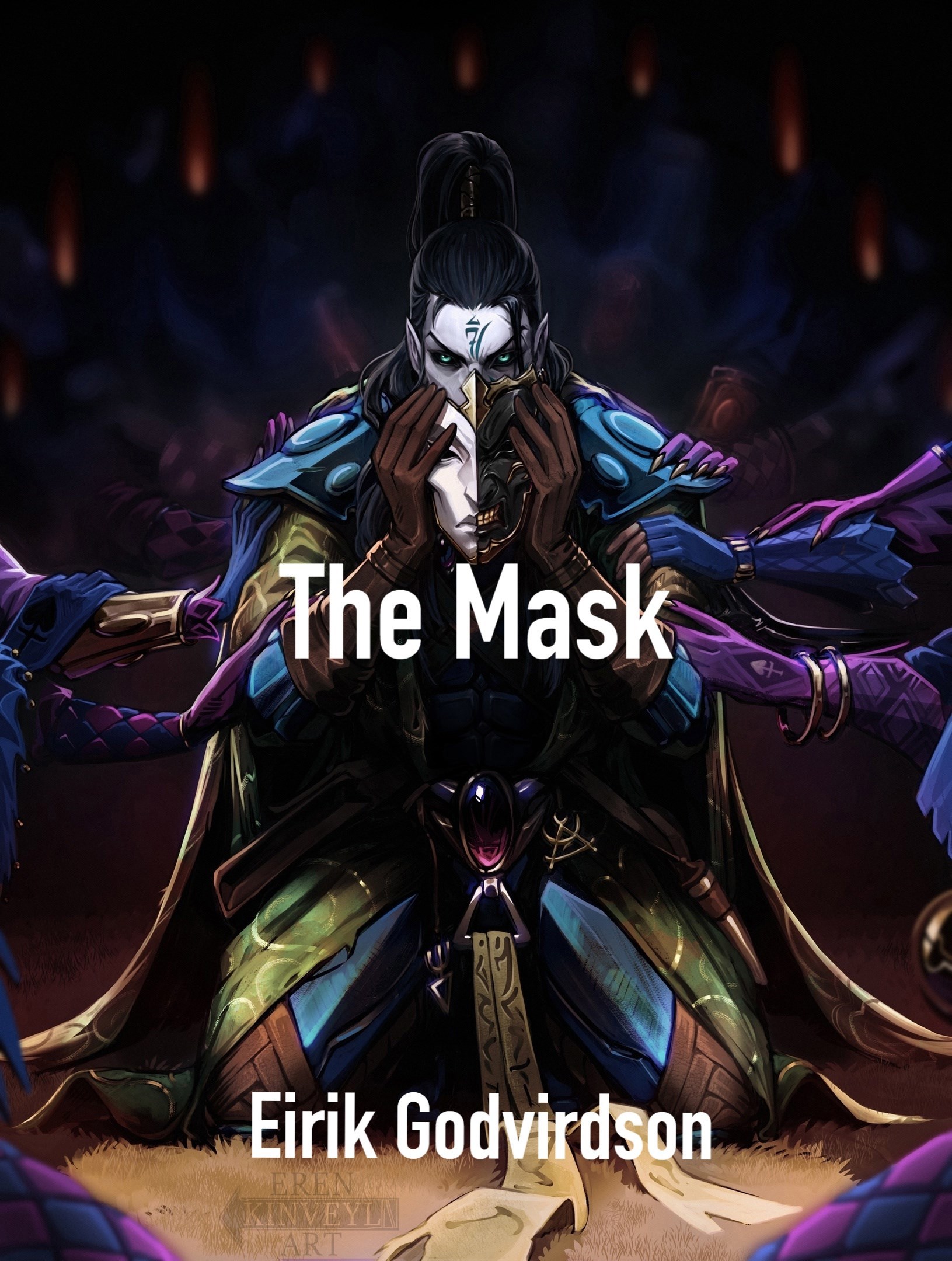
The Mask
Глава 1
Brittle debris crunched beneath each step, spurting geysers of gray and rust-hued dust. The floor was strewn with shards of wraithbone, colored and plain glass, twisted metal fragments—and coarse red sand.
The sand was everywhere. Driven by the ceaseless wind that haunted this world, it hung in the air like a tattered veil of rust, swirling above their heads, mingling with the remnants of shattered machinery and broken statues, shrouding the ruins of what was once a majestic craftworld. Now, the vast artificial world resembled the carcass of some great sea beast cast ashore—a hollow skeleton, stripped of life, flesh, and soul.
The wind, a bodiless mourner, howled through the hollow vaults of the structure. The damage to the hull was so severe that the overhead supports jutted out like broken ribs, and the dim light, strained through the sandy haze, seeped freely through the gaps.
Six Eldar scouts, draped in long cloaks, moved cautiously through the wreckage. Their faces were concealed behind respirator masks, their eyes glinting warily in the gloom. They advanced in silence. Their cameleoline cloaks had shifted to a pale ochre, mimicking the dull hues of their surroundings, and their movements were fluid, deliberate, unhurried—for danger could lurk even in apparent desolation.
"Even through the filters, the air tastes bitter. Death has seeped into everything here," one of them murmured, breaking the prolonged silence. It was the one who led—he paused, bending down to retrieve something from the thick dust, but the object crumbled into weightless ash the moment his gloved fingers tightened around it. "And it happened long, long ago."
"So that’s why they never answered our signals," another muttered in frustration, kicking a shapeless chunk of artificial stone.
The first speaker jerked his head up, fixing his companion with a glare before hissing a pair of unflattering epithets at him.
"Control yourself, Raelin," he added when the chastised ranger lowered his head, staring at whatever had provoked his sudden despair. Was it a piece of a statue? Or just some fragment of a residential structure? Time had gnawed at the once-smooth surface like coarse sandpaper, eroding its form and blurring any discernible features.
"As if centuries had passed. But that’s impossible," he muttered.
"It’s not," the one who had been walking slightly ahead had already moved farther than the rest. He glanced back at his companions and added, "For many reasons, it’s entirely possible."
"Arthalion, wait! By Isha’s name, where are you rushing off to?" called out another scout.
"I want to see if anything at all remains intact."
***
Step by step, the scouts ventured deeper beneath the lifeless arches.
Their kin's craftworld had fallen silent long ago—though certainly not centuries ago—and trusting their own eyes was proving difficult. Almost nothing remained of the once-glorious vessel, a floating continent sheathed in solar sails and shielded by shimmering domes. All that could decay had decayed; all that could collapse lay in ruins. Here and there, they found hollow suits of armor and glittering shards of soulstones—fragile as over-fired glass, veined with cracks. No bones, no bodies—only fine gray ash.
Had centuries done this? Or some malevolent will? Perhaps the planet itself gnawed at organic and psychoplastic matter, grinding them to nothing far faster than nature should allow. Or had the craftworld's distress signals, sent by the long-dead, wandered lost through the Warp, deceiving their kin? Each scout had asked these questions silently, more than once. None had answers.
The rangers communicated in gestures—sharp nods, silent signals—piecing together the craftworld's demise. Bolt-shell casings by a crumbling wall. A shattered rifle—neither human nor Eldar in make, clearly brought from the Dark City. A Drukhari pauldron, its jagged blade still gleaming faintly along the edge. A Farseer’s staff, cleft clean in two by a single, precise strike. A collapsed web of monofilament wire, its lethal strands half-buried in dust.
They stepped carefully around the still-lethal trap, their eyes tracing the scars of violence. They would never know who—or what—had struck the killing blow.
The walls bore dents, bullet scars, ragged tears—wounds on something already dead. The scouts needed no more to reconstruct the craftworld’s final moments. The spilled blood had long since mingled with the rust-colored dust, yet Arthalion was right—its iron tang still lingered in the air.
The craftworld had been mauled, attacked again and again. It had died in agony, and even in death, it knew no peace. Darker tracks marred the dust, as if scavengers had picked at the corpse long after the first layers of sand had settled.
The ship had been assaulted in the void above the planet. Crippled, it had crashed here—and then, like vultures, pirates of every creed and race had descended, carving away what little flesh remained from the fallen giant. That much, at least, was clear.
***
The group moved toward the heart of the ship—or what had once been its heart. The Infinity Circuit. Would it offer any answers? None could say.
"You know what strikes me as odd?" The voice belonged to Eärnil, the rearguard, breaking the silence just as they neared their destination.
"What?" asked Arthalion. He was the eldest among them, even more seasoned than the veteran Eärnil, and the others instinctively listened. His tone was strange—somewhere between sardonic and coldly intrigued.
Eärnil needed no explanation. His old friend had been thinking the same thing, hesitating to voice it.
"There are too few. Far too few." Eärnil chose his words carefully. "Remains, I mean. Empty armor, belongings one would never discard… waystones." He spoke not from fear of misunderstanding, but because the words themselves were heavy. The air was thick with despair, the stale taste of death pressing on them all. No matter how hardened one was, walking the graveyard of one’s own kind was never easy.
Yet Eärnil was right. The precious soulstones—vessels for Eldar spirits faced with death—were rarer than they should have been. Even a small craftworld housed thousands. Could all their stones have turned to dust, like the shattered amber shard Arthalion had tried to lift?
Some stones had survived—cracked, dulled, empty—yet intact. One such stone split in Eärnil’s hands, but did not crumble.
"You’re asking—where are they all? Maybe we’ll find out if we stop dawdling," Arthalion muttered.
The scouts exchanged glances, nodding in unison. None would admit it, but the thought of stepping into the desecrated Infinity Circuit filled them with dread. The brief pause, however unintentional, was a relief.
While a craftworld still lives, its Infinity Circuit is forbidden to all but the Seers. And here, the Seers had been.
Most had likely met their end within this very chamber—their bodies long since turned to dust, leaving only fragments of bone. Yet their robes and light armor remained eerily intact, far better preserved than anything near the ship’s ruined entrance.
The once-gleaming semicircular console at the hall’s heart was now dull, its surface matte and milk-white beneath a shroud of gray dust. The soulstone sockets gaped empty—mostly. A handful of Tears of Isha, cracked and lifeless, still clung to their places. Others lay scattered nearby, equally shattered.
Arthalion let out a long, hissing breath through clenched teeth. He crossed the hall, boots whispering against the dust, and stopped before the desolate console.
There, slumped against the panel, was what remained of the craftworld’s Farseer. Desiccated hands, still sheathed in silver-stitched blue gloves, lay frozen upon the controls. A helmet rested nearby, as if the Seer had let his head drop in exhaustion—or final surrender. A tattered cloak spilled across the floor like a funeral shroud.
By where the dead Seer’s feet should have been, his staff lay broken. Its great stone had melted away, leaving glassy droplets frozen along the haft and floor.
Arthalion reached down and lifted the helmet. A thin stream of ash poured from its hollow visor. He held it up, peering into the amber lenses—now clouded, filmy with dust inside and out, like the eyes of a corpse.
"Yandir," he murmured. "Farseer Yandir."
He returned the helmet to its place and turned.
His companions still lingered at the threshold, stunned, unwilling to step further. The sight had struck them like a physical weight. Even for rangers—hardened souls who’d long since learned to master their grief—the concentrated anguish here was suffocating.
Beyond Yandir’s remains, five more Seers lay near the curving wall—seven in total, judging by their garb. If the rest of the wreck had been painful to behold, this was a blackened wound upon the soul.
"You knew him?" Eärnil asked, voicing the unspoken question.
Arthalion’s reply was flat. "Not truly. But we met once."
The others exchanged glances.
"Did you… know anyone else here?" Ilanithel—Ilani, as her friends called her—was the youngest of them. Her voice wavered.
Arthalion shook his head, his gaze sharp as he studied his team. Eärnil’s hand tightened on Ilani’s shoulder, a silent warning. She hesitated, then shook him off and strode forward.
Ignoring Arthalion, she knelt beside Yandir’s remains, flipping open a chestplate, prying at the stiffened fingers. Arthalion said nothing, only trailed his gloved hand along the console’s dead surface, as if listening for answers in the whisper of dust.
While the others combed the chamber for clues, Ilani wrestled with the Seer’s grip—then gasped.
In the skeletal palm glowed a single, unbroken soulstone, its amber depths alive with crimson sparks.
The others rushed to her.
"Give it here," Arthalion demanded, his voice ragged. When Ilani met his eyes, she flinched—they burned with a feverish intensity that frightened her. She dropped the stone into his palm as if scalded.
A soft, disappointed sigh escaped him.
"You did know someone here!" Ilani accused.
"No one living," he said darkly, turning the stone in the dim light. "This is the only soul left. Not Yandir’s. Someone… important to him, perhaps. We may never know."
His gaze swept the team. "Stop staring at me like I’m a wraith. No stories. No questions until we’re back on the Sunreaver. Understood?"
A ragged chorus of assent.
"No questions. Not here."
"And then you’ll say nothing happened!" Ilani burst out. "You always do this—joke or just stay silent!"
Arthalion exhaled sharply, tugged down his hood, and rubbed his brow—where dark tattoos curled above his eyes. He handed the stone to Eärnil, who secured it in a belt pouch.
"Look at me, child," Arthalion said, startling them all with his patience. "You know I’m twice your age. Born far from any craftworld’s blessed domes. But once, I came here—delivered a dozen Tears of Isha to this very sanctuary. I knew none of the living. But I remembered every name in those stones." His voice cracked. "Do you think I wanted to see this?"
Ilanithel clapped a hand over her mouth. "I didn’t—I’m sorry!"
"To know much is to grieve much," Arthalion said coldly, turning away before her tears could fall. Pity was a blade he’d never learned to bear.
Eärnil caught up to him, gripping his elbow. "You’ve always had a thorny temper."
"I warned you." A ghost of a smirk.
"And I’ve never cared." Eärnil shrugged. "Well?"
"You’re a fool. I’m not your mentor. You’re barely younger than I am. That my team pulled you from those pirates means nothing. You owe me nothing."
"I know. But—are you angry?"
"Angry?" Arthalion barked a laugh. "No, Eär. That’s not the word. Go comfort Ilani. The answer hit her harder than she expected."
"You’re wrong. She’s stronger than you think."
"Time will tell." Arthalion pulled free and walked on.
Eärnil let him go. Some weights could not be lifted with words.
The Sunreaver left the rust-winds behind—but none of the six would forget what they’d seen.
***
Time passes—yet it never fully erases the deepest wounds. This truth is as certain as the sun’s light, as inevitable as the fall of night.
The rangers, returned to their ship, shed their dust-laden cloaks and stowed their gear with ritual precision. They took their meal together, as was their custom, but silence hung heavy over the table. Ilanithel tried again to speak of the dead craftworld, but Arthalion only shook his head.
"I’ve answered," he said. "You wanted immediacy—you got it. It was long ago. There’s nothing more to add."
"But you weren’t always a ranger!"
"No, of course not." A wry smirk twisted his lips as he pushed back a dark strand of hair. "I’ve been many things. But I’m not in the mood for storytelling. Forgive me."
"Arthalion—"
"Leave him be," Eärnil growled, breaking his own silence. "Must every thought be spoken?"
"Precisely," Arthalion said coolly—then rose and retreated to his quarters.
***
"Arthalion! Answer me, damn you!"
"Leave him be, Mor. What do you want?"
"To know if he’s alive or not! Arthalion! Answer!"
He would have, if he could. But breathing alone was agony. Each ragged inhale seared his lungs; his skull throbbed as if split. His body had turned to lead—cold, unyielding. The wounds burned.
Too much blood lost. That’s why I’m freezing.
The thought floated, detached, as the voices—Morvaen and Liranar, dragon-rider and marksman—called his name again.
"He’s alive. Look—his chestplate’s moving."
"I don’t see it," Morvaen snapped. "That’s not armor anymore, Lir. It’s scrap. Arthalion, you son of a drake—say something!"
"Alive. Stop... khh... shouting," he managed, the words grating like broken glass.
Morvaen whooped; Liranar snorted. The uneven sway beneath him told Arthalion they were carrying him—likely on a makeshift stretcher. The last thing he remembered was the enemy’s blow, the darkness that swallowed his vision, the way his lungs had emptied in one brutal rush.
The battle had still raged then. Exodite worlds were never quiet, no matter how serene they seemed from afar. He’d once thought otherwise—but that was long ago. Raids by Commorrites, xenos incursions, skirmishes between rival clans—a dragon-knight’s weapons knew little rest.
This time, pirates had struck. Opportunists, no real strategy—just a village ripe for plunder until its distress call brought Arthalion’s warband crashing down. He tried to move, and pain lanced through his ribs. He meant to ask if they’d repelled the attack, but consciousness slipped again. Voices reached him through fog:
"—fought like a demon possessed—Ow! Mor, what the hell?" A slap cut off Liranar’s admiration.
"Think before you speak, fool! Who says that aloud?" Morvaen’s anger was sharp.
"But it’s true! Even the Drukhari broke. I’ve never seen a whole kabal retreat from one warrior. Sure, reinforcements helped, but—"
The words dissolved into static.
Lir and Mor. The closest things he had to friends—if he ever bothered to define it. Liranar, the chatterbox who could thread an arrow or a bullet with equal ease, whose greatest skill (besides combat) was knowing when to shut up. And Morvaen, temperamental as storm-winds yet steadfast as Worldroot’s bedrock.
She’d been the first in the settlement to speak to him—back when he was still a stranger, a former Commorrite yet to claim his spirit-stone at the World Shrine.
"You’ve so many scars." She’d plopped beside him without invitation, pointing at the pale lattice on his arms, the fresh cut along his cheekbone. "You’ve fought much, yes?"
He’d grunted something dismissive. She seemed a child then—dark-haired, dressed in simple green-embroidered linen, red and green ribbons at her waist. Just another naive Exodite.
Why did I sit here? he’d fumed. Wanted to scout the place, not attract—
"Your skin’s white as snow," she’d mused. "I saw snow once, in the mountains. Cold and bright. Are you ill, or did you live without sun?"
"Where I lived had three suns." The reply surprised even him. "We just... don’t..." He’d snapped his fingers, hunting the word. The dialect here was slightly off.
"Ah. Fashion." Her smirk was knowing. "I’ve heard of such places."
Only then had he realized—she was no girl, but a woman near his own age, her eyes too shrewd for innocence. A scout’s eyes. She’d never asked about his origins again—not until he’d joined the settlement’s warriors as a dragon-rider.
"Of course I knew you were Commorrite," she’d said later, shrugging. "But you’re with us now. Why dwell on it?"
He’d laughed then. These Exodites carried their pasts lightly—what’s gone is gone. Grief, they buried deep, sealed like artifacts in desert sands: You live, so you move forward. It was why the craftworlds saw them as simpletons—kin, but never equals.
Yet hadn’t all Eldar lived thus, once?
The lesson he’d learned here: Wrap memory in mist, in sand. Let it lie undisturbed unless needed. Then the past becomes not chains, but a jagged jewel—painful, yet yours.
(And what Eldar could resist possessing something rare?)
***
But sometimes, that carefully cultivated veil of silence around the past would crack—like after the raid.
It wasn’t the fight itself that had done it. Arthalion hadn’t even bothered to learn the name or kabal of the reaver who’d recognized him.
"Arthalion Bloodhand! By the Laughing God, it is you—your head’s grown quite the bounty since last we met!" The kabalite had laughed, gleeful. "Vect will be pleased when I deliver it."
They were his last words.
The raiders had left Arthalion no choice: surrender wasn’t in his nature, and his head wasn’t for taking. So he’d fought like a thing possessed—ensuring every enemy who got a good look at him died.
Bloodhand. He’d smirked inwardly. You whelps don’t even remember why they called me that.
Once, disarmed and bleeding, he’d torn out a noble rival’s throat with his bare hands. Then, with a sneer, ripped free the heart and hurled it at the dead man’s retinue.
Those memories hadn’t stirred him in decades. But memory is a chain, each link dragging another from the depths.
When he woke in the healers’ halls, the first thing he heard was the dry voice of the attending physician—a lean, dark-haired eldar with a russet braid slung over one shoulder:
"Awake? Good. Very good. I thought you’d wander the shadows in your mind forever. You kept calling out—as if to someone."
"What else did I say?" Arthalion demanded, jerking upright. His hair, longer now, spilled like ink across his shoulders, strands of silver catching the light. The movement sent phantom pain lancing through his wounds, but he gritted his teeth.
"Nothing. Just a name." The healer clicked his tongue at the impatience. "You said it like... hm. Like spotting a friend in a crowd. Or calling to someone you’d been waiting for. Now lie back—you’re not fully mended."
Arthalion assessed himself. Bare but for the bandages cinching his chest and arm, the wounds ached but weren’t crippling.
"I’ve had worse."
"Doubtless," the healer muttered, still watching him.
"Just a name?" Arthalion pressed.
"Yes. Riallain." The healer shrugged. "I know no one by it—or anything close."
Arthalion nodded.
Riallain.
A name bright as lightning, sharp as a blade’s edge. He’d have been surprised if any other had slipped free.
A name that no longer belonged to the living, but to a soul encased in a Tear of Isha—deep blue, threaded with amethyst veins. The stone he’d once pressed into the palm of an Harlequin named Kirvah, who’d accepted it without question, as she had all the others. Stones meant for the Infinity Circuit of a craftworld he’d never called home.
He remembered every name. But he never spoke them.
Except one.
And only when the walls of his will had crumbled in near-death.
***
But sometimes, that carefully cultivated veil of silence around the past would crack—like after the raid.
It wasn’t the fight itself that had done it. Arthalion hadn’t even bothered to learn the name or kabal of the reaver who’d recognized him.
"Arthalion Bloodhand! By the Laughing God, it is you—your head’s grown quite the bounty since last we met!" The kabalite had laughed, gleeful. "Vect will be pleased when I deliver it."
They were his last words.
The raiders had left Arthalion no choice: surrender wasn’t in his nature, and his head wasn’t for taking. So he’d fought like a thing possessed—ensuring every enemy who got a good look at him died.
Bloodhand. He’d smirked inwardly. You whelps don’t even remember why they called me that.
Once, disarmed and bleeding, he’d torn out a noble rival’s throat with his bare hands. Then, with a sneer, ripped free the heart and hurled it at the dead man’s retinue.
Those memories hadn’t stirred him in decades. But memory is a chain, each link dragging another from the depths.
When he woke in the healers’ halls, the first thing he heard was the dry voice of the attending physician—a lean, dark-haired eldar with a russet braid slung over one shoulder:
"Awake? Good. Very good. I thought you’d wander the shadows in your mind forever. You kept calling out—as if to someone."
"What else did I say?" Arthalion demanded, jerking upright. His hair, longer now, spilled like ink across his shoulders, strands of silver catching the light. The movement sent phantom pain lancing through his wounds, but he gritted his teeth.
"Nothing. Just a name." The healer clicked his tongue at the impatience. "You said it like... hm. Like spotting a friend in a crowd. Or calling to someone you’d been waiting for. Now lie back—you’re not fully mended."
Arthalion assessed himself. Bare but for the bandages cinching his chest and arm, the wounds ached but weren’t crippling.
"I’ve had worse."
"Doubtless," the healer muttered, still watching him.
"Just a name?" Arthalion pressed.
"Yes. Riallain." The healer shrugged. "I know no one by it—or anything close."
Arthalion nodded.
Riallain.
A name bright as lightning, sharp as a blade’s edge. He’d have been surprised if any other had slipped free.
A name that no longer belonged to the living, but to a soul encased in a Tear of Isha—deep blue, threaded with amethyst veins. The stone he’d once pressed into the palm of an Harlequin named Kirvah, who’d accepted it without question, as she had all the others. Stones meant for the Infinity Circuit of a craftworld he’d never called home.
He remembered every name. But he never spoke them.
Except one.
And only when the walls of his will had crumbled in near-death.
***
The Sunreaver glided through the mist-shrouded expanse of the Webway—beyond its viewports, the unreal haze twisted into impossible spirals, a labyrinth of light and shadow. Yet the nimble vessel navigated the currents without hesitation. Eärnil was a skilled pilot—though among rangers, the ability to steer a ship was as essential as marksmanship. He simply enjoyed it more than most, and his hands moved over the controls with the ease of long practice.
"You’ve got that look," Eärnil said abruptly, adjusting the course gemstones one final time before turning to Arthalion. "Like you’re plotting something."
"I already told you what I’m ‘plotting.’" Arthalion tore his gaze from the shimmering Webway currents and shrugged. "If we couldn’t uncover the craftworld’s fate, who better to ask than those who wander even farther than we do? The Harlequins specialize in such mysteries."
"I don’t like this," Raelin cut in. Behind him, Ilanithel nodded fervently. The others remained silent, exchanging uneasy glances.
Arthalion laughed—a sharp, genuine sound, like the ring of a blade being drawn. The shadow that had clung to him aboard the derelict craftworld was gone now, burned away by resolve. Most of the warband assumed it had been simple grief for the dead, a sorrow every Eldar knew too well. But Eärnil wasn’t fooled. His old friend was hiding something.
"Ilani," Arthalion teased, wiping imaginary tears from his eyes, "don’t tell me you believe those superstitious tales about the Laughing God’s fools? Rangers aren’t supposed to fear bedtime stories."
"The last troupe I encountered helped my kin," Raelin countered. "Years ago, before I joined you."
"There, you see?" Arthalion spread his hands. "If Ilani’s never met the players offstage, this is the perfect introduction." His tone left no room for debate—when he led, he led decisively. "Or would you rather never learn what happened to Yandir’s people? Could any of you rest without knowing?"
His gaze swept the group, lingering just long enough to make the hesitant look away. A few did.
"Ah. I see." A grim smile. "No one’s forcing you to come. I’ll speak to them alone."
"Someone has to," Eärnil said mildly. "And I’m not refusing."
"We just… don’t want you going either," Ilanithel admitted softly.
Arthalion shook his head. "We’ve discussed this."
"We thought we’d leave a message through an intermediary," Raelin protested. "It’s the proper way. The Harlequins might solve the riddle, but why must we meet them face-to-face?" He turned to Eärnil. "Why the sudden change of heart?"
"Because I’ve known Arthalion longer than you have." The pilot smirked and returned to his console, fine-tuning their trajectory.
A few of the rangers chuckled—more to ease the tension than from genuine amusement.
Harlequins.
Yes, only the Dancers of the Laughing God could unravel the mystery of the vanished craftworld. The group had agreed on that much. But most had no desire to follow the actors into whatever mad scheme might come next.
Yet the debate was over. The course was set—a hidden port, deep in the Webway’s folds, where a troupe of Cegorach’s followers might be found.
***
"Why this particular troupe?" The figure in the dark blue mantle spread his hands in a gesture of helplessness. "Master Kirvah and his players departed for an extended performance. Who knows when they’ll return?"
The hooded proprietor of the Garden of Repose bore no clear allegiance to any Eldar faction—only the easy grace of one who made his living catering to idle audiences. The port-city was small, and this pleasure-dome under its protective canopy was little more than a repurposed craftworld module. Yet within its bounds grew luxuries unheard of in the void: fragrant herbs, flowering vines, secluded arbors. A fleeting illusion of peace.
"Harlequins don’t speak to strangers without reason," Arthalion smirked. "You’ve picked up their habits. Otherwise, why ask my companions to wait elsewhere?"
"Guilty," the gardener chuckled. "Sometimes I think they tolerate me only because my establishment suits their needs—crowds, atmosphere... ‘A stage fit for the dance,’ as one recently remarked. A compliment, I hope!" His laughter rang like a bell.
"So you host players now?"
"A troupe resides here, yes. But not the one you seek." The Eldar rubbed his brow, pensive. "I could speak to them—arrange an audience. Mention you sought Kirvah, if you wish."
"Do." Arthalion’s nod was curt. "Tell them I came for Kirvah."
"Then you must wait. They prepare tonight’s performance. Disturbing them is... unwise."
Arthalion acquiesced. He didn’t know if Eärnil and Raelin—who’d stubbornly followed—would stay or return to the ship. But he would wait.
The certainty settled in his bones: he’d already waited too long for this conversation.
***
"I saw you at tonight’s performance."
The Shadowseer appeared as if woven from the air itself—but Arthalion hadn’t expected less. To anticipate anything ordinary from a Harlequin would be folly.
He’d grown weary waiting in the arbor where the garden’s keeper had directed him, yet never doubted the players would come. Someone had to. His gaze flicked over the newcomer: a mirror-mask, a gem-studded creidann strapped to her back, ribbons of gold and scarlet coiling around her legs. The staff in her grip and the plain white mask at her belt seemed less practical tools than ceremonial marks of her station.
With a dancer’s grace, she glided along the path—but instead of entering the arbor, she beckoned. Her right hand, clad in an embroidered glove identical to the Troupe Master’s, stretched toward him, rubies glinting along the cuff. The left, gripping the staff, wore only plain black leather.
"We’ll speak where I choose," she said. The mirror-mask caught the garden’s artificial twilight, fracturing the light. "You spoke Kirvah’s name. That merits more than a hurried word."
"You already know what I’ll ask." Arthalion tilted his head, resisting the urge to fold his arms.
"Obviously." Her laugh was the chime of distant bells. "Even our meddling host made inquiries. Rangers finding a dead craftworld—how novel. But Kirvah rarely gives his name freely." She leaned closer. "We are of different troupes… but one Mask."
Arthalion studied the domino pattern of her attire—the same colors as Kirvah’s troupe. Cryptic, but Harlequins thrived on riddles.
"Will you come or not?" She jerked her outstretched hand impatiently.
The words—the gesture—were identical to Kirvah’s, all those years ago.
When he took her hand (she stood half a head shorter), the mirror-mask’s opal-glass showed not his reflection, nor the garden’s false sky, but a vision:
A Commorrite noble knelt in a blood-drenched hall, his face twisted in rage. Bruised knuckles, a scream echoing off vaulted arches. Before him, spirit-stones glimmered in the gore—and opposite, radiant in gold and crimson, stood Kirvah.
"So, Arthalion—will you come or not?"
The image lasted but a heartbeat. Yet the Shadowseer’s sympathetic headshake confirmed what he already knew—
She’d meant him to see it.
***
"Life has come full circle, and the past steps from the shadows—just as you, Children of the Laughing God, are wont to do." Artalion sighed as the Shadowseer guided him through a portal, emerging into a dimly lit chamber carpeted in deep, velvety pile.
The room—likely aboard a ship like The Sun-Stealer—was spartan to the point of austerity: no furnishings beyond the dark rug and crude lumens casting jagged shadows. The Shadowseer gestured for him to sit, folding herself onto the carpet with effortless grace. Artalion mirrored her, cross-legged, then laid bare his plea: to find the lost souls of the ruined craftworld, living or dead. He produced a surviving spirit stone—but after a long, contemplative silence, she returned it. "No. This one holds no answers."
Her mirrored mask fixed on him, radiating silent scrutiny. When the quiet grew thick enough to choke on, she spoke:
"When I offered my hand, you remembered something. Something vital. What was it?"
"You saw." His voice was flint.
"I saw an image. My sight is vast, but not infinite. Tell me."
"The remnants of my House." A dry, venomous laugh escaped him. "A noble line of Commorragh, doomed by decree of Vect the Undying. I refused to let my kin die for a tyrant’s whim. Kirvah arrived... just in time."
"That does sound like him." She tilted her head, curiosity humming in her stance. "Now, truth: what do you truly seek from us?"
"To know what befell those Yandir failed to protect."
"Those you failed to protect." Her correction was gentle—and perfectly calibrated to wound.
Artalion’s smile was a blade’s edge. "Centuries walking forward, only to tread a circle. Yes, I need answers. Yes, I failed them. If I must join your Dance to learn why, so be it."
"Do you speak of a single quest... or the Dance itself?"
A pause. Then, sudden clarity: "Kirvah once said the Harlequin’s path must be desired, not chosen in despair. I think... I’ve been walking toward it all along."
"Then we delay no longer."
She unclasped the plain white mask from her belt—a study in restrained tragedy: downturned eyes, sorrow-carved brows, a mouth like a sealed wound. Psychoplast, smooth as alabaster but pocked with the ghosts of old scars. She laid it between them, bared her right hand, and commanded:
"Give me your hands."
Her skin was warm—gloved or bare. Fingers curled around his, not to restrain, but to steady.
"Have you ever composed poetry? Music?"
"Often." His smile, for the first time, was unguarded. "Though my themes are... dark."
Her laughter was silver chimes on crystal. "Good. Poetry, song—we move to the rhythm of the verses within. If you know their birth, you’ll understand what comes next."
With that, she lowered his hands onto the mask resting between them.
The surface was faintly cool, like psychoplast poised for transformation—smooth and silken. For a fleeting moment, Artalion imagined that should he press his fingers deeper, the material would yield like fresh clay or soft wax.
"Close your eyes," the Shadowseer intoned, her voice slow as dripping resin. "Imagine you are about to compose something this very instant. Immerse yourself in that feeling—the breath before thought becomes words, before rhythm gives it voice. Then… release it. Let the words flow freely. Allow them to course through your hands and into the psychoplast beneath."
He obeyed without hesitation, understanding her meaning with unnatural clarity. This was nothing like a sculptor’s labor—oh, how it differed! A sculptor chases form, bending material to their will from first stroke to last. But the Shadowseer demanded no mere shape—she required an imprint of his very soul, with all its anguish, its yearning, its precarious balance on the thread between oblivion and… what? Ascent? Ruin?
The material beneath his palms turned icy. Needle-sharp facets erupted from its depths, piercing his skin. Jagged bolts of pain lanced through his fingers as hot blood welled in crimson beads; moisture bloomed beneath his touch, and even with closed eyes, Artalion saw scarlet rivulets tracing the mask’s bone-white curves. He felt his burning blood wage war against the psychoplast’s enchanted chill.
Then—the spines retracted as if they had never been.
Heat kindled.
"Do not dare stop," came the whisper. "Let the thought flow. Let poetry etch itself upon your mask. Let heart-spilled words become visible. Even if they are words of pain. Even if your hands seem to hold fire itself—and it threatens to consume you. Continue until the current ebbs. I am here… but the path is yours alone. Stray not. Ascent or ruin—the choice is only ever yours."
Her ungloved palm sealed his trembling eyelids shut while the other forced his hands deeper into the blazing—yet somehow unmelted—mass where the mask once lay. She showed no reaction to the heat, though the forms writhing beneath Artalion’s touch shifted faster than even his keen fingers could comprehend.
Poison-hot moisture pricked at his lashes.
Do not falter. Do not falter.
The Shadowseer’s mind-voice was but a wisp of sound—yet it spurred his final mental surge. Gradually, grudgingly, the psychoplast submitted: no more spines, no searing flames, no gelid whispers. All the unnamed things he had carried for centuries—the glinting shards of his most terrible memories—the mask drank them greedily.
In his chest, the familiar tension preceding any great undertaking (be it composing verse or making fateful choices) shattered—replaced by the winged storm of true creative frenzy. The mask still trembled, its contours flickering like petals in a breeze, but its ultimate form was now decided. The Shadowseer withdrew her hands.
Artalion raised his head, blinking away the salt-sting on his lashes, to see the rest of the troupe filing into the half-dark hall. They approached in perfect unison, each crossing their legs in mirrored posture, each removing their masks to place them forward—exactly as he had done.
Mask. Face. Name.
One by one, they spoke—some solemn, some smiling, others with barely perceptible winks:
"I am Danerail." "I am Uvellann." "I am Calidah." "I am Avenia."
Their movements were honed to effortless precision.
Vibrant, living eyes studied Artalion—faces varied in age and bearing, some weathered by time’s toll, others shaped by laughter’s habit, yet all shared the same gaze: solemn, focused… and unexpectedly warm. As warm as the fading glow emanating from the newly-tamed mask in his hands—no longer unclaimed, no longer faceless.
The actors kept arriving until nearly all had gathered. Nearly. The Troupe Master alone remained absent. They arranged themselves in a circle with practiced precision, their motley garments blossoming across the carpet like some exotic floral mosaic. Only the "heart" remained dark—where Artalion himself sat.
"I am Tiviat." The Shadowseer raised a hand to her brow, and the mirrored hemisphere settled into her palm. Beneath lay a face of noble severity: crystalline green eyes, sun-kissed curls faintly kissed by copper. Like most performers, her features bore secret runes—delicate dark lines that enhanced rather than disrupted her natural elegance, rendering her no less enigmatic than when she wore the mirror-mask.
"I am Artalion." He lifted his newly-forged mask—half-gold, half-obsidian, its brow eternally knotted—and let it tilt slightly in his palms. The former wanderer. The former Dracon. The former Commorrite. But never former warrior. Never former poet. Such things cannot be former.
Air stirred behind him. Heavy palms descended upon his shoulders. A ripple of hushed excitement passed through the troupe until Tiviat’s sharp hush reduced it to smiles.
Then—contact. Those nearest extended hands to brush his wrists, elbows, shoulders. Those farther out touched their neighbors instead. The circle tightened, its members now resembling petals drawing inward.
"Are you ready?" The voice belonged to the Troupe Master.
As one, the Harlequins lowered their hands. Without awaiting reply, the Troupe Master emerged from shadow to sit beside Tiviat—facing Artalion. Following tradition, he too revealed his face: sharp-nosed, thin-lipped, eyes the blue of a neutron star’s heart. The same fathomless blue as Kirvah’s… yet in all other ways, unlike.
"And I am Rintil." A faint smile. A nod to the assembly. "The time for masks is come. The time for the Dance." He donned his own once more—Cegorath’s gilded visage starred with void-black eyes.
"Meet the Dance. Meet Life—and Death, dancer."
Unprompted, the others mirrored his gesture. A dozen motions became a single, sighing rustle.
Artalion raised his mask. Cool psychoplast met forehead, cheekbones, chin—molding seamlessly. Through the eye-slits, he regarded his new kin and spoke:
"I am ready. I am life, and death, and the Dance."
The troupe answered as one: "We are all life, and death, and the Dance."
His troupe now.
01.12.2024 ©Eirik Godvirdson
Спасибо за чтение
Вернуться к книге