
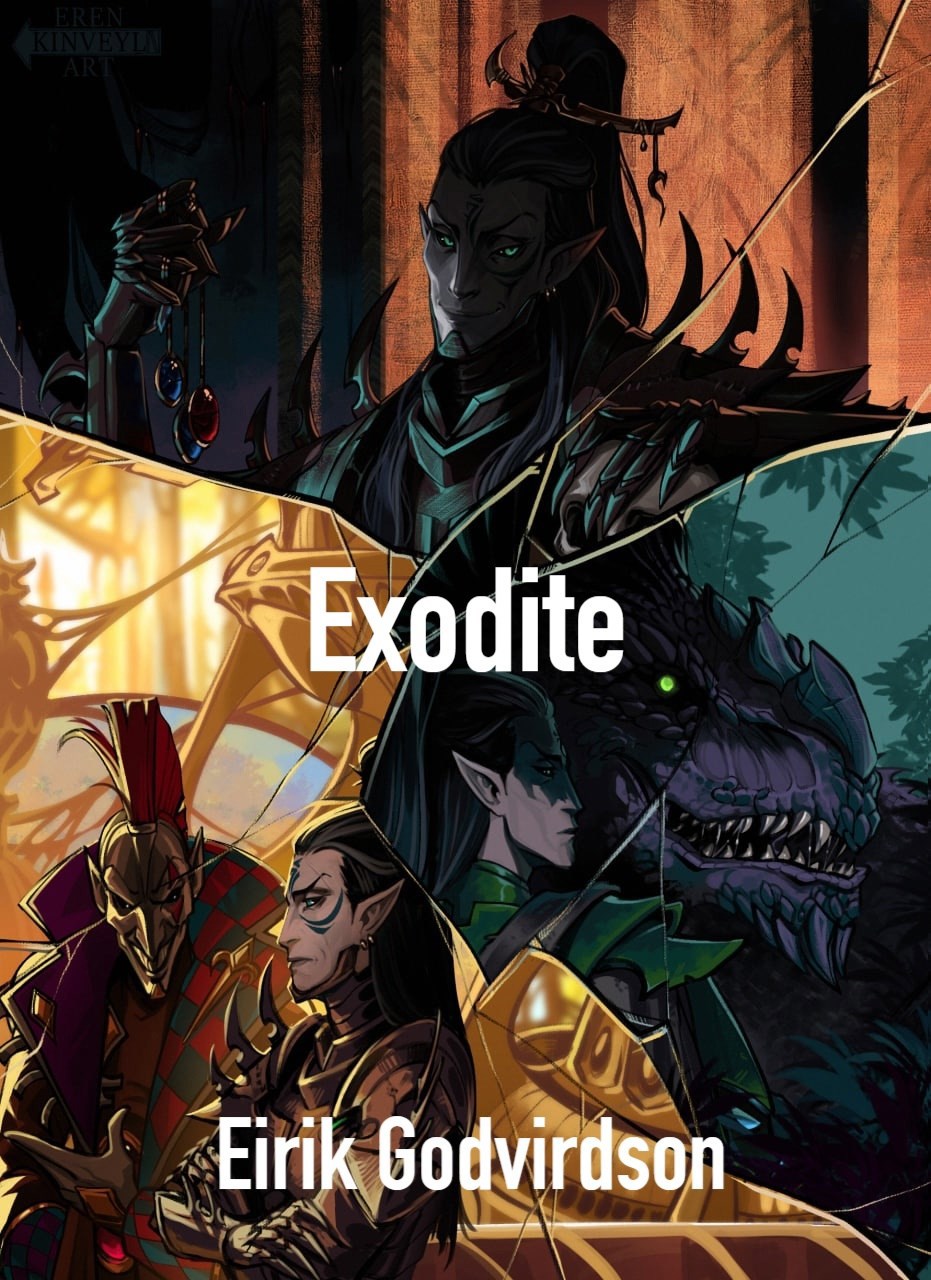
Exodite
Глава 1
At first, there was only the whisper of leaves—and not from any wind.
Branches swayed, the forest litter crunching beneath the weight of something large—then onto the path emerged a mounted beast: saddled, bearing a rider. It raised its broad, scaled head, nostrils flaring like a dragon’s as it tasted the air, then cast a sidelong glance back into the thicket. With a subtle flick of his wrist, the rider tightened the reins, and obediently, the beast resumed its course, its gait smooth and swift. After a time, the rider checked its pace—no sense in letting the steed waste its strength needlessly.
The wind carried the crisp, vivid scents of approaching night, and of course, even in this tamed creature, the animal instinct stirred in response. Without bit or bridle, without the firm mental command of its master, the mount would have long since bolted into the undergrowth—to seek its kin, to hunt, to drink nectar from the deep floral chalices that unfurled only under the cover of darkness... The rider allowed himself a faint, inward smile—such was the way of all living things. Loosen the reins of will for but a moment, and nature would call you back.
The beast’s eyes glimmered violet and green, catching the last embers of sunlight. In the rising twilight, in the full embrace of night, its vision was keen—so there was no need to halt just yet. They could ride freely until midnight, until weariness finally took its toll. Two moons—one large and white, the other small and saffron-yellow—climbed the sky. The night would be clear, and warm besides; when they made camp, the traveler wouldn’t even bother with a fire. He feared no forest predator—at his saddle hung a rifle, and at his side, a short spear and blade. And when it came to the sharpness of night-sight, he was second to none in this world. As were most of his kind.
The World Temple lay less than a day’s ride ahead. If he did not stray, if he rested only as much as needed to regain his strength, he would reach it by the next sunset.
The Temple. A vessel of souls, much like those found aboard the craftworlds of the Aeldari—the World Spirit—here, it spoke to any who were ready to touch it. A place where the vast psychic ocean, binding all ancestral tombs, cromlechs, and menhirs, lay open to the souls of the living. In his city, they spoke of it another way: the Dragon’s Sanctum, for the World Spirit was often depicted as a majestic and beautiful dragon. Yet within the Temple itself, there was little in the way of overt symbolism—just a simple altar adorned with floral motifs, a great Tree, and upon the walls, scenes from legends far older than this world, older even than the culture of the people called Exodites.
This was not his birthworld. The rider, moving through the forest drowned in watercolor blues of dusk, did not dwell on how long he had been here—long enough to feel himself a part of this wood, of the city left behind, long enough to truly believe he might become one with the pulsing force of the Temple ahead. But not so long that he had forgotten: he was not born here.
***
They gave him shelter, yet for a long time, they seemed to deliberately ignore him. No unnecessary words, no unwelcome attentions. For that, he was almost grateful.
He remembered that first evening—when a group of Aeldari, mostly young, clad in simple yet skillfully crafted armor, had come to him. Among them stood a weathered man with a face like storm-carved stone, clearly centuries old. Not quite an elder, but still a warrior of formidable presence. Unlike the others, he wore no breastplate nor pauldrons, but carried a ceremonial spear—its long haft adorned with tassels and ribbons, runes woven into the fabric, and beneath the blade’s edge, a bright blue stone gleamed. Not a weapon, but a symbol of authority, perhaps.
The spearman shook his head, gestured curtly: Here is a house. Food is in the storehouse. If you need more—ask, or hunt for yourself. The forest is rich with game and fruit. The rules were few: Do not kill those who mean you no harm. Do not bring harm without cause.
"Who lived here before?" the stranger had asked, more to break the silence than out of real curiosity.
The spearman frowned slightly. "It does not matter. They have no need of it now. It will serve you."
"What is your name?" the spearman asked then, polite but not probing. No command in his tone, yet the stranger bristled, eyes flashing.
"It doesn’t matter," he replied softly, venomously, feeling the slow boil of irrational anger. That question alone sent a current of tension through him—his name? What business was it of theirs? "Call me whatever you like. A name… is nothing."
"It is everything," the spearman countered, calm but firm. He was not the settlement’s leader, as it turned out, but still held a place in its council. "The past may not always matter. But a name… what else remains of you, if not that? Choose one. But choose it yourself."
The stranger in jagged black armor tilted his head. Perhaps the old man wasn’t entirely wrong. So be it.
"Artalion," he said.
He would never give them his House name, of course. But for some reason, he spoke his given name truthfully, though he could have invented anything. He had no desire to lie.
The answer satisfied them. No further questions came. Then the old man motioned to his companions, and they brought forward two baskets. "Clothing, like ours," they said. "Change if you wish."
Their eyes kept drifting to his armor—blackened, sharp-edged, gleaming with lethal perfection, studded with long spikes. And with sudden, vicious satisfaction, Artalion thought: If they dare tell me to discard it, I will gut the first one who speaks.
But the villagers said nothing—neither the armored youths nor the old spearman. The old man only shrugged.
You may walk clad in war if you wish, their silence seemed to say, but our garments will be kinder to you, at least for now.
No one voiced it aloud, but the meaning was plain. And his anger, denied its full fury, faded as quickly as it had risen. Artalion realized then—he was not angry at them. Not truly. And when he understood that, the storm within him stilled.
The old man, too, seemed to understand something of the stranger—but gave no sign.
After that, they left him be. A few words here, a glance there. Only one piece of advice in all the days that followed:
"If you mean to stay here, even for a time… you must go to the Temple. Let this world know you. It must recognize you."
***
It felt like ages ago, yet the memory burned fresh—the first time Artalion laid eyes upon the Temple.
Not a place of prayer, but a crucible of raw power. Nestled at the roots of a towering mountain, deep within a jagged rift, beneath the vaulted ceiling of a natural cavern, stood the altar—and from it, the sacred World Tree rose. Light spilled through karstic shafts, painting the cavern halls with sun by day, stars and moonlight by night. Yet even without these, the Temple glowed as bright as dawn upon the plains—crystalline geodes studded the walls, luminescent moss clung to stone, and waterfalls, bursting forth from the mountain’s heart, shattered light into prismatic mist.
Parts of the walls had been painstakingly polished, adorned with bas-reliefs—spare, elegant depictions of legends, myths, the old tales. Gods and heroes. A heritage shared by all Aeldari.
And the place thrummed with the gathered might of countless souls. Impossible to miss. Even Artalion, who in those early days had felt half-deaf and half-blind, sensed it long before he stepped beneath its arches.
Back then, the Temple had struck him as barbaric—excessive in its wild, untamed beauty. Pale blues, violets, and whites of cliffside blossoms, the glossy riot of vine leaves, the cascading manes of moss, the glitter of waterfalls and radiant stone. A garish, naive cacophony that clawed at his eyes. The caretakers’ pretense that their hand in its shaping was barely there—that this was all nature’s work—had made him grimace. Primitive. Gaudy.
Yet undeniably compelling.
Too many colors. Too much light. The ceaseless roar of waterfalls, and beneath it—singing. Faint, wordless, hovering at the edge of hearing. A melody beautiful, yet insistent, as if it sought to peel his soul apart. Only after a long while did it cease to torment him. (Or perhaps he had simply grown accustomed.)
In the shadows of the ledges, the Temple’s guardians hid—though Artalion spotted each with a glance. A patch of darkness too dense. A glint of eyes. The barest suggestion of movement where only stone should be. A less observant guest might have noticed nothing. Credit to the Exodite warriors—they knew how to stalk unseen.
But not unseen by one born and raised in Commorragh, the endless dark city where attack, evasion, and sudden murder were as vital as breath.
Two Worldsingers awaited him—a man and a woman. The first time, it had been the woman who approached him: fair-haired, with eyes like clear water, her frame delicate as carved bone. Later, the man joined—just as slender, just as colorless—but spoke scarcely a word.
Strangely, in all his years here, Artalion never thought to ask—Were they kin? Or had time and shared fate simply made them mirrors of one another? Uncharacteristic. And now, he never would.
Today, it was the man who greeted him first. Landanir. Though the Worldsingers seldom used their names—at least, that was how Artalion remembered it.
"You mean to leave?"
"Yes," Artalion nodded, lifting a warning palm. "This is the right choice."
"As you will." Landanir made no move to dissuade him—though Artalion, warrior and scout that he was, saw the truth plain as day: He had intended to. Yet he yielded. Why?
Of course, Landanir would not answer if asked. His sister-in-fate, Eliathé, might have. But not him.
And speak of the wraith—there she was.
"Do you remember when the World Spirit acknowledged you?" she asked, bypassing greeting.
"Of course." Artalion smirked, the curve of his lips sharp enough to send lesser beings scrambling for escape—though now, it held no hidden edge. "And I remember what Landanir said. What you confirmed. That I needed to remember how to be myself."
"Not my words. Not his. The World Spirit wished you to know—so we spoke them. My own counsel came after." Eliathé smiled, barely a flicker.
"Well. I’ve done that. The World Spirit can hear me now—its wish fulfilled. I would give thanks… and move on. This is right."
Many in the settlement knew Artalion’s stubbornness could bend tempered steel. He didn’t expect the Worldsingers to yield—so he had rehearsed this. Planned every word.
"As you will," Landanir said. "You could have left without a word. None of us are chained to this world. To the Spirit. To the Tree. Not while we live."
He hid it well, but Artalion tasted it—displeasure. Grief. Just like their first meeting, when Landanir’s emotions had been a scalding mix of superstition (that near-revulsion at the word "Commorragh"), indignation, and a stubborn, almost paternal insistence.
Now, those same sharp, bitter notes rang clear.
"Our spirit stones are the same Tears of Isha borne by the children of the craftworlds. And it’s to them you go, yes?"
Artalion nodded. Had Landanir asked—Is this truly what you want?—he might have wavered.
Might have.
But the Worldsinger only shrugged—irritated, yet understanding.
"I’ve given what I could. My skills. My knowledge of war, of tracking. Learned much in return. But not all I need."
"You believe there’s nothing left to take. Nothing left to give," Eliathé murmured, melodic. "Perhaps you’re right."
"The World Spirit demands nothing," Landanir said, searching Artalion’s face for doubt. Finding none. "You need no permission to walk your own path."
"I demand it of myself," Artalion said, suddenly lighter. Certain. "To give thanks. To say farewell. Does that seem so strange?"
"No. And yes. Strange that you would wish it at all..."
"For me, yes." Artalion laughed. "You’ve shown me much, Landanir. But don’t pretend you’ve warmed to my... bloodkin. Even now."
Landanir frowned, then waved a hand—why deny the obvious? Artalion knew what he’d say if pressed: "You are our kin now. That is all."
This farewell was no necessity. But Artalion answered honestly—he needed to remember. The first time he’d felt the quiet pulse of a spirit stone beneath his palm, matching his breath, his heartbeat.
That first visit to the World Temple had been about survival.
This last one?
Nothing but the soul’s own calling. Simple. Clean. True.
And the will to do—finally—what he deemed right.
***
Thirty years ago.
A mere blink, really, for any Aeldari. Yet not nothing.
Thirty years since the old spearman, since the house on the settlement’s edge, since the milky-pearl stone—smooth as silk, cool against his palm. A Tear of Isha, unclaimed. It would blaze crimson when he woke beneath the Temple’s vaults—vivid as the last stripe of sunset on a windswept eve, as blood on white marble, as ripe berries bursting between fingers, tart-sweet juice staining skin.
Thirty years since the muffled shroud that had wrapped his senses—dulling the soul’s ravenous hunger, yet severing half his awareness. It split here, in the Temple’s heart, when Landanir spoke the words that mattered most—but too hastily:
"I don’t care who you were before. Only who you’ll be. The past is nothing. A name is everything. Knowing yourself—that is vital. The rest? Not always."
He’d thrust a cup into Artalion’s hands. "Drink. You’re coiled like a spring, ready to fight before thought catches up. But to bond the stone, you must surrender. Let it call you—if you can stop being a bowstring about to snap."
"People like me don’t know any other way," Artalion had snarled.
And there—Landanir’s haste, his sharpness: "I don’t want to know."
But you do, Artalion thought—and wasn’t wrong.
Yet they didn’t cast him out. They gave him the stone. The cup. A feeble draught, a soporific too weak to touch a Commorite’s body, hardened by a thousand elixirs.
But Artalion fell into the vision instantly—not from the drink, but from the melody humming through the World Spirit’s voice, sung through its twin priests, Landanir and Eliathé, indistinguishable in that moment.
In the dream:
"You were taught a way to live—because someone once decreed it so. The one time you chose for yourself, it nearly broke you. Yet you survived. So keep choosing. Keep being what you are."
The World Spirit’s voice echoed, vast and depthless.
"Now go. Live. And never retreat."
***
It felt uncannily like something Kirvah, the Troupe Master, would say—that Harlequin who had led Artalion to the Exodites in the first place. Though Kirvah always spoke in half-truths, so artfully woven that the unsaid rang louder than words. Whether those silences spoke truth or lies was another matter. But the mind could always fill the gaps.
That fog shrouding his senses—that had been the Harlequins’ "parting gift," Kirvah’s doing. A mercy that kept Artalion from unraveling under the gnawing Void, the soul-deep Hunger that plagued every Drukhari as he wrestled with the choice to seek the Temple.
"You did something to me, didn’t you?" Artalion had asked the troupe before they left. "I don’t understand how, but the emptiness—I don’t feel it. I don’t feel much of anything. No emotions, no—"
"Yes, we did. And you don’t want to know what." Kirvah’s voice carried the smirk his mask concealed. "A small gift. A dozen days, perhaps. Enough to help you decide."
"Decide what?"
"Whether you want to keep living, of course." A careless shrug, fluid as a dancer’s step. The grinning visage of Cegorach seemed to widen further, but the eyes behind the mask glimmered with something startling—not pity. Sympathy. "Such choices demand a clear mind, my friend. Absolutely clear."
"You did right. We did, perhaps. But stubbornness is a fickle beast—who can say when it will rear its horns?" Another Harlequin, a hulking figure in a two-faced mask, laughed darkly.
The troupe’s mime, a willowy dancer, pressed splayed fingers to his brow in mock horns and dipped his head, mimicking some stubborn grazer. The Shadowseer simply stepped forward and, with startling gentleness, brushed her fingers along Artalion’s cheek.
"I think you’ll choose well. You always have. You saved many souls—few would dare such a thing."
Then she vanished into the shimmering rift of the Webway, and the rest followed—Kirvah’s troupe, the Harlequins who had dragged Artalion from Commorragh’s jaws, and in doing so, thoroughly soured relations with the seers of a certain craftworld.
Oh, what a spectacle that had been.
The seers, the exarchs, the elders of the craftworld—they had watched their garishly clad guests with icy courtesy, but their gazes toward the black-armored outsider burned with lethal frost. Had they dared, they might have struck him down then and there. But provoking Kirvah and his dancers? Even the Azyrani hesitated.
The Chief Seer—Yandir, was it?—grew increasingly agitated, his voice edging toward a shout. Kirvah, meanwhile, toyed idly with a Harlequin’s token before tucking it away, then peeled off an embroidered glove to fuss over a broken nail with a tiny dagger conjured from his sleeve. The sheer disrespect was calculated. Kirvah was bored—or rather, he wanted them to think he was bored. In truth, he was furious.
Yandir stepped forward, gripping his staff so tightly his knuckles blanched.
"Two cycles ago, raiders in black armor slaughtered dozens of our kin, pillaged half a deck, hauled off treasures we still cannot fathom how they carried—and we barely repelled them before they breached the spirit sanctum! And you—"
"Call it a debt repaid," Kirvah cut in. Yandir choked on his own words. The air around him crackled.
"Seer, enough," an exarch murmured, tugging his sleeve. "This is not how we treat those who come not as foes."
"Those raiders didn’t want your sanctum," Artalion interjected, knowing he shouldn’t but unable to stop. "Just plunder. Slaves, maybe. A petty kabal with a handful of warriors—what were they going to do, storm the heart of your world? They took what they could and fled. And you—what, a defender? You couldn’t even stop them from leaving."
His laughter was a ragged, broken thing. If Yandir struck him down now, so be it—perhaps it would even be a relief.
"Be silent," the Death Jester hissed in his ear. "Truth is cherished here, but not all truths are welcome."
Somehow, Yandir mastered himself. Perhaps his fellow seers’ mental urgings stayed his hand. Or perhaps it was the sight of the Azyrani seeress beside him, her fingers resting lightly on the spirit stones glowing within their opened casket.
"These belonged to warriors, yes?" she murmured. "They are full of anguish… as all who die in battle must be."
Kirvah shifted subtly—relaxing. The worst was avoided. If a single Drukhari riled Yandir so, a handful of Commorrite souls would have undone him entirely. Better he never knew. The dead remembered nothing upon awakening—and all Aeldari were wrought from the same stuff, as Kirvah well knew.
"Bright, strong souls. You see it yourself. Was this not what you asked for, Yandir?" Kirvah tugged his glove back on, the dagger vanishing. "Well?"
"My word stands. We… will take these souls into our sanctum. If, after their rest, they…" A stiff exhale. "Very well. We accept your gift. Now go. And take this outsider with you."
"Gratitude, hm? Nothing forgotten?" Kirvah’s posture shifted, feline, poised. "A gift? This was an exchange. You owe me a boon. I asked for aid for our guest. And this is your answer?"
"I want nothing from them," Artalion drawled, masking desperation with bravado.
"You might not," Kirvah purred. "But I do. Yandir. A final word. Think carefully."
"No! A Drukhari never changes—I will not entertain this. Do not test me further, Harlequin. I… am grateful, but I ask you to leave. Our bargain stipulated the request must be feasible and harmless. This is neither!"
"Leave?" Kirvah, who had already begun to turn, spun back. His cloak flared like a living thing—whether from sheer speed or a flicker of holo-field, none could say. In two heartbeats, he was nose-to-nose with the seer, finger jabbing into his chest.
"You!" A hiss, venomous. "Never ask for our aid again. You break your word. You are no seer. No Aeldari. Not even a man. You are a coward."
"Seer Ethel foresaw your guest would leave a trail of blood—that emptiness would follow his steps—"
"Turn to your exarchs and say that," Kirvah snarled. "Ask if they might welcome a new warrior. They stay silent only because they fear you. A blind fool, not a seer. You wept to me of your dying craftworld—of children no longer born, of souls refusing to wake. I gave you what you begged for: fresh strength, souls eager to live again. I brought you a living soul in need of a Path. And your answer? You quibble over appearances? Coward. My word is given—never seek our help again."
Yandir wilted as if doused. He stepped back, shaking his head.
"I cannot—"
"I see. We are done here." Kirvah flicked his hands as if brushing off filth and strode back to his troupe.
And in that moment, Artalion understood—fully, terribly—what had happened. Not just now, but from the instant Kirvah had stepped from the shadows with his offer. The role he’d been given in this farce.
He laughed—wild, broken, a sound like choking on blood. Then he turned and followed the Harlequins without a backward glance.
***
"At least the souls of your kin—those you gathered with our modest aid—will come to no harm. Yandir is a coward, but no oathbreaker, though I named him such. He has... forgotten what it means to be Aeldari. Now he only remembers how to command a dying ship."
Once the Harlequins and Artalion had passed through the gate into the Webway’s mist-wreathed expanse, Kirvah’s fury evaporated as suddenly as it had ignited. He spoke now with eerie calm.
"Will you come with us?" the Two-Faced one blurted. The Shadowseer jabbed him with her staff—not hard, but enough to make him hop aside with an indignant "Hey!" She waggled a finger: Silence, brother.
Artalion shook his head. His life had split asunder—no gentler way to phrase it—yet some stubborn instinct refused to choose its next shape. He had no strength left for decisions.
"You should’ve slit my throat back when I handed you those stones," he said. A joke? Perhaps.
"Oh, I couldn’t!" Kirvah’s laughter rang like shattering glass. "You’ve a taste for humor, you know. You’d make a fine dancer—bloody jests and blade-pirouettes suit you. But honestly?" The mirth vanished. "Don’t rush. Our path... it must be desired, not chosen from despair. I suspect you’ve forgotten what wanting anything feels like."
A slow nod.
"Then ponder it in your leisure. Clarity may yet come." Kirvah flicked a hand toward the shifting paths ahead. "Ah! Our road lies that way."
And so the Harlequins delivered him to a world veiled in ancient woods, guarded by a Dragon-Spirit.
Long ago.
And just yesterday.
***
Artalion remembered every step taken—and knew countless more awaited. Not the many words spoken by sundry Aeldari in later days—for words were as leaves upon the wind, as mist from waterfalls. Not even the soul-gnawing pain that had hounded him, though even that had yielded before his steel-clad resolve.
No—it was the silken tremor of living souls bound within stones, saved from becoming nothingness or demon-fodder, granted a chance to return—that had first shown him his true face. The understanding, bone-deep and blazing: I acted as I deemed right. Not for approval. For salvage. For that primordial knowing humming in his marrow—perhaps the last divine echo of what all Aeldari once were, wrought from starlight and godly will.
***
And that will drove him onward. Somewhere… else. Away from silence and peace—for neither were made for him, nor he for them.
Artalion would quit this almost-home before next dawn. His true farewell had been to the World-Spirit alone; to those who’d called him friend these thirty years, he offered only a raised palm before the yawning Gate and a request: "What I leave behind, let Morvaen decide." The pragmatic sentinel—a dragon-rider like himself—would surely put his leavings to better use.
Of his old life, he took only the ancient blade. All these years, he’d never set it aside. Aboard the ship, he’d shrug and call it spoils. Won in battle. Proved useful.
10.28.2024 ©Eirik Godvirdson
Спасибо за чтение
Вернуться к книге